 Youth looks ahead to age with eyes full of hope and expectation, but age looks back with pity and disappointment. Adapting her father’s novel, Liu Yulin joins the recent movement of disillusionment epics coming out of China with Someone to Talk to (一句頂一萬句, Yī Jù Dǐng Yīwàn Jù). Arriving at the same time as another adaptation of a Liu Zhenyun novel, I am Not Madame Bovary, Someone to Talk to takes a less comical look at the modern Chinese marriage with all of its attendant sorrows and ironies, a necessity and yet the force which both defines and ruins lives. Communism believes love is a bourgeois distraction and the enemy of the common good (it may have a point), but each of these lonely souls craves romantic fulfilment, a soulmate with whom they might not need to talk. The desire for someone they can connect with an elemental level becomes the one thing they cannot live without.
In the prologue, Aiguo (Mao Hai) is a young and dashing military officer about to marry the glowing Lina (Li Qian). The pair are blissfully happy and just so in love it might not be bearable. They can tell each other everything and they talk for hours. About to hand over their application to register a marriage, shaking with excitement, the new couple are interrupted by two extremely unhappy people there for the opposite reason – divorce. They’re in the wrong place, but someone asks them why they want to separate only for the woman to tersely reply that they don’t talk anymore. Aiguo and Lina look at them askance, they can’t envisage anything like that ever happening to them.
Flash forward a few years and Aiguo has left the military (along with its fancy uniform) far behind him to become a lowly cobbler in a rundown village. The marriage has obviously gone cold. Aiguo and Lina have a little daughter, Baihui (Li Nuonuo), but barely exchange a few words with each other and the ones there are are usually hot and angry. It seems to be an open secret in the village but eventually someone tips Aiguo off that Lina is spending too much time with a handsome local wedding planner, Jiang (Yu Entai). Not wanting to believe it, Aiguo brushes the rumour aside but then again it makes sense. Forcibly exposing his wife and her lover, Aiguo delivers an ultimatum but fails to repair the broken connection. When Lina leaves, he vows revenge, threatening to kill one or both of the illicit lovers but, unable to find her, is forced to address his ambivalent emotions in a more contemplative way.
Despite all of the hopes and expectations of Aiguo and Lina’s early romance, their life together has run its course, frustrated by a series of issues no one wants to talk about. No longer in the military, Aiguo’s economic status is low and unlikely to improve. Lina, perhaps, wants more than Aiguo can give her and the atmosphere in the house is tense and cold. Their daughter, Baihui, wants the latest toy car that her wealthier friends have but Aiguo, even if he could perhaps find the money, does not want to buy it for her, offering the excuse that it will distract her from her studies.
Told from Aiguo’s point of view the film is less kind to Lina who has found herself trapped in a marriage to a man she no longer loves. Her choice is not one of economic escape, though her equally married lover is clearly wealthier and better educated than Aiguo, but motivated by the simple desire to find “someone to talk to”. Jiang is married to a local baker whom Aiguo eventually tries to recruit into his revenge plot, cruelly ruining her happiness in enlightening her to the truth. In a much worse position than Aiguo, Xinting (Qi Xi) considers suicide not only out of the humiliation of being a betrayed spouse (turning violence on herself where Aiguo plans to turn it on others) but of the knowledge of the position that an abandoned wife finds herself in. Aiguo’s 39 year old unmarried sister Aixiang (Liu Bei) knows this pain well enough and has experienced a life of suffering and loneliness after herself attempting suicide following an unhappy love affair. Once married or not, prospects for women past the common age of marriage are not good and whatever anyone might have said about women holding up half the sky, it almost impossible to survive alone.
Everyone tells Aiguo to let Lina go but he stubbornly holds on to his anger and the pain of betrayal. After a while he decides to just forget about it but custom dictates he take some kind of revenge hence he plans to take a kind of vacation pretending to look for her. On his travels he finds more misery and heartbreak by re-encountering an old school friend whose marriage has also collapsed but she has learned to be much more stoical about it than Aiguo and gives him some valuable advice. Yes, everyone should talk more – especially about the things which are hard to discuss within the context of a marriage but equally the fact that Aiguo and Lina no longer talked was merely the manifestation of the unbridgeable gulf that had developed between them. There are no happy marriages in Someone to Talk to, perhaps love really is an unhelpful bourgeois distraction, but Aiguo at least still seems to believe in its potency even if it has betrayed him, finally realising he ought to be thinking about the future rather than living in the past. Perhaps no one is able to escape this particular kind of culturally enforced loneliness, but no one will ever find out by continuing to suffer needlessly trapped inside their own delusions.
Someone to Talk to was screened at the 19th Udine Far East Film Festival
International trailer (English subtitles)
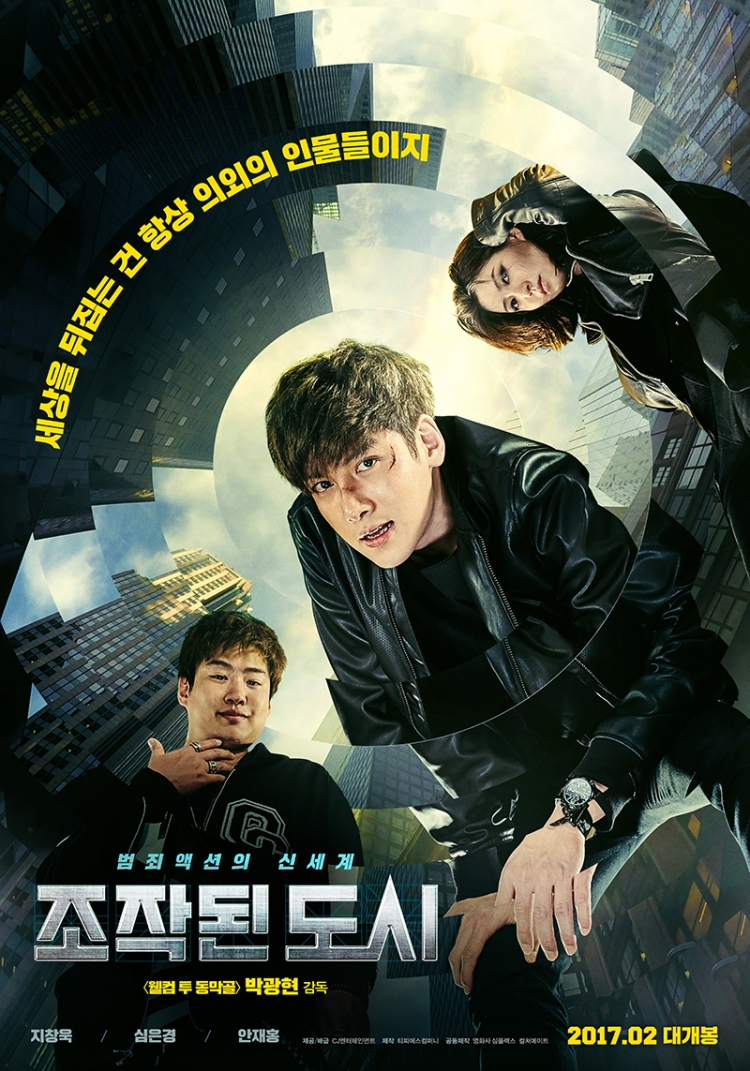 The real and the unreal. In the era of fake news, it’s become ever harder to draw a clear line between the two but when you live online, the borders are even more permeable. Twelve years after the wartime comedy Welcome to Dongmakgol, director Park Kwang-hyun finally makes a return to the director’s chair with an action packed cyberpunk thriller which joins the ranks of recent Korean films bemoaning the country’s hardwired tendency to social inequality where the rich and powerful are free to run roughshod over the merely ordinary. Fabricated City (조작된 도시, Jojakdwen Doshi) refers to more than just the literally manufactured online world, but to the social reality in which unseen forces govern and define the lives of others, operating in secret behind a government backed curtain.
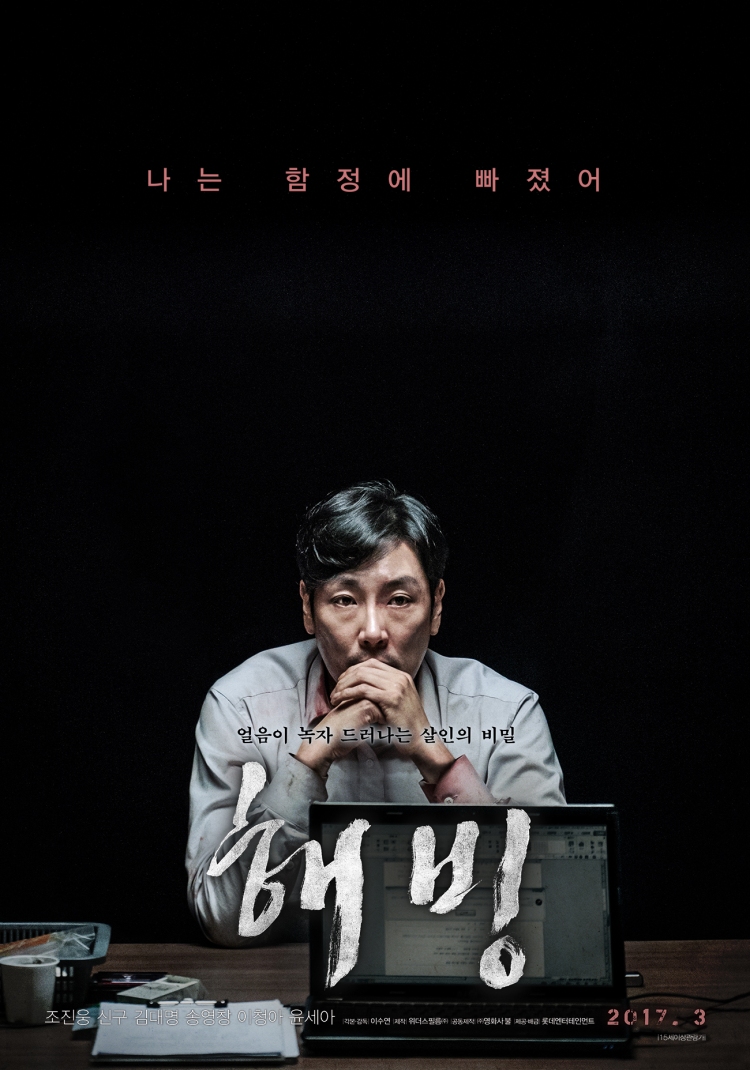 If you think you might have moved in above a modern-day Sweeney Todd, what should you do? Lee Soo-youn’s follow-up to 2003’s The Uninvited, Bluebeard (해빙, Haebing), provides a few easy lessons in the wrong way to cope with such an extreme situation as its increasingly confused and incriminated hero becomes convinced that his butcher landlord’s senile father is responsible for a still unsolved spate of serial killings. Rather than move, go to the police, or pretend not to have noticed, self-absorbed doctor Seung-hoon (Cho Jin-woong) drives himself half mad with fear and worry, certain that the strange father and son duo from downstairs have begun to suspect that he suspects.
 At the end of Zhang Yang’s
  Conventional wisdom states it’s better not to get involved with the yakuza. According to Hamon: Yakuza Boogie (破門 ふたりのヤクビョーガミ Hamon: Futari no Yakubyogami), the same goes for sleazy film execs who can prove surprisingly slippery when the occasion calls. Based on Hiroyuki Kurokawa’s Naoki Prize winning novel and directed by Shotaro Kobayashi who also adapted the same author’s Gold Rush into a successful WOWWOW TV Series, Hamon: Yakuza Boogie is a classic buddy movie in which a down at heels slacker forms an unlikely, grudging yet mutually dependent relationship with a low-level gangster.
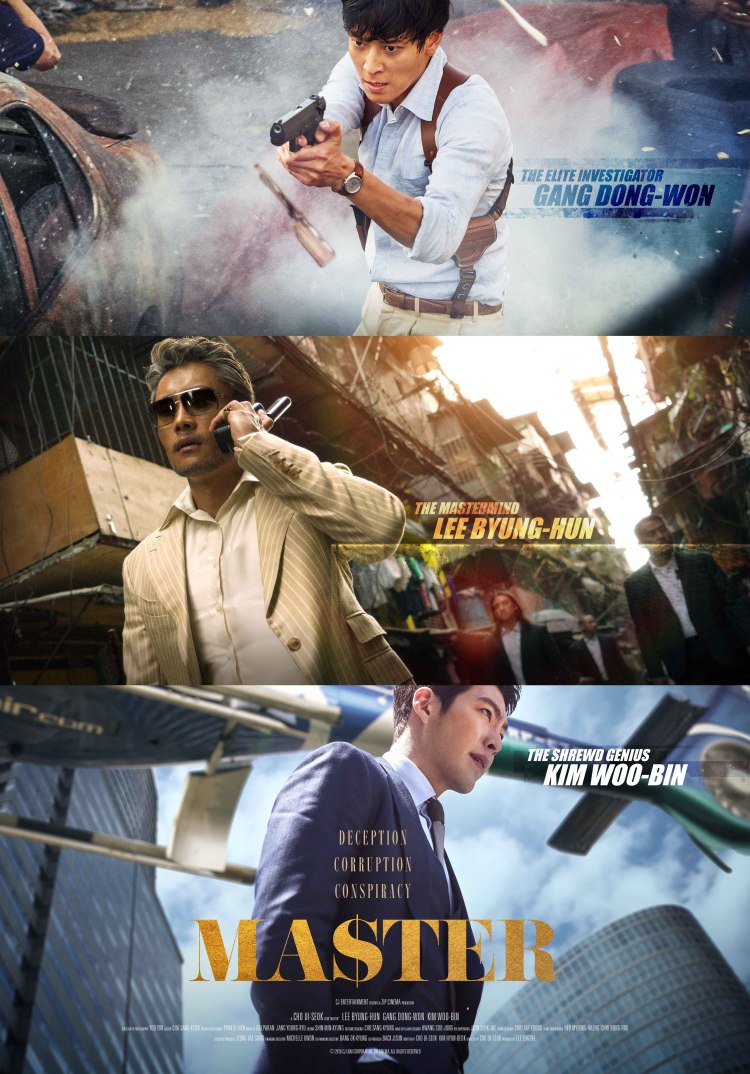 Corruption has become a major theme in Korean cinema. Perhaps understandably given current events, but you’ll have to look hard to find anyone occupying a high level corporate, political, or judicial position who can be counted worthy of public trust in any Korean film from the democratic era. Cho Ui-seok’s Master (마스터) goes further than most in building its case higher and harder as its sleazy, heartless, conman of an antagonist casts himself onto the world stage as some kind of international megastar promising riches to the poor all the while planning to deprive them of what little they have. The forces which oppose him, cerebral cops from the financial fraud devision, may be committed to exposing his criminality but they aren’t above playing his game to do it.
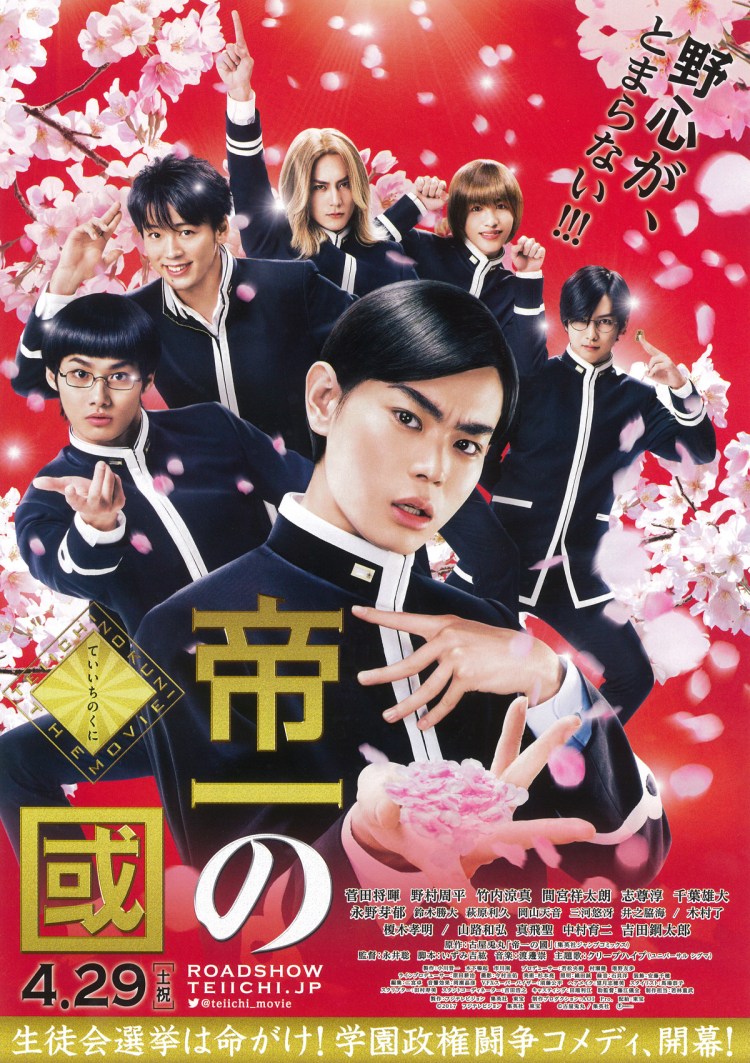 Back in the real world, politics has never felt so unfunny. This latest slice of unlikely political satire from Japan may feel a little close to home, at least to those of us who hail from nations where it seems perfectly normal that the older men who make up the political elite all attended the same school and fully expected to grow up and walk directly into high office, never needing to worry about anything so ordinary as a career. Taking this idea to its extreme, elite teenager Teiichi is not only determined to take over Japan by becoming its Prime Minister, but to start his very own nation. In Teiichi: Battle of Supreme High (帝一の國, Teiichi no Kuni) teenage flirtations with fascism, homoeroticism, factionalism, extremism – in fact just about every “ism” you can think of (aside from altruism) vie for the top spot among the boys at Supreme High but who, or what, will finally win out in Teiichi’s fledging, mental little nation?
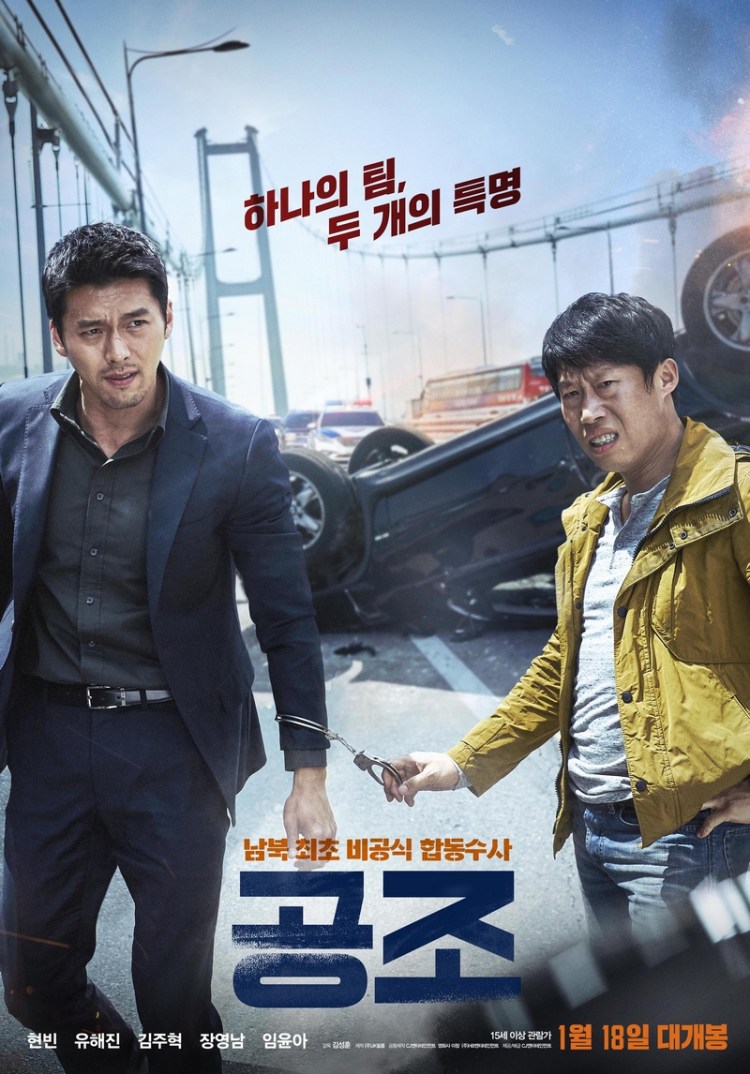 South Korean cinema has a fairly ambivalent attitude to its policemen. Most often, detectives are a bumbling bunch who couldn’t find the killer even if he danced around in front of them shouting “it was me!” whereas street cops are incompetent, lazy, and cowardly. That’s aside from their tendency towards violence and corruption but rarely has there been a policeman who gets himself into trouble solely for being too nice and too focussed on his family. Confidential Assignment (공조, Gongjo), though very much a mainstream action/buddy cop movie, is somewhat unusual in this respect as it pairs a goofy if skilled and well-meaning South Korean police officer, with an outwardly impassive yet inwardly raging North Korean special forces operative.
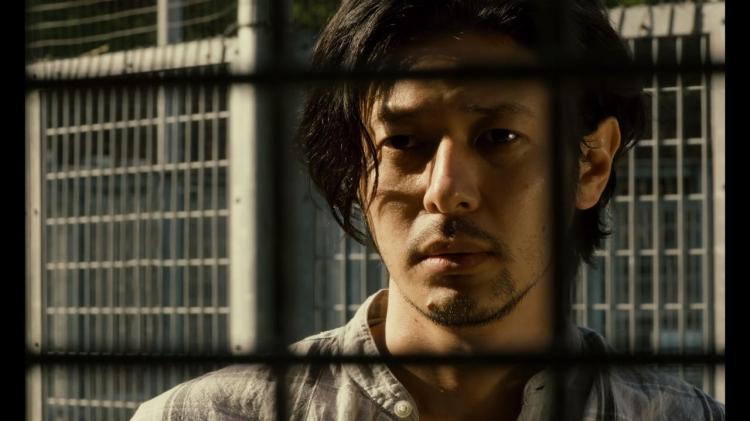 Japan Cuts returns for 2017 with even more of the best in recent Japanese cinema. Ahead of the full programme reveal the festival has announced a few early teasers for what promises to be another year of fantastic films from Japan.
 Fan favourite director Nobuhiro Yamashita will once again feature in the festival with his installment in the trilogy of movies inspired by author Yasushi Sato,
  Another festival favourite Sion Sono returns with his contribution to the Roman Porno Reboot Project, Anti-Porno.
 Kiyoshi Kurosawa’s first international production, Daguerrotype, also makes its way into the festival. Taking the director back to his psychological horror roots, this gothic European ghost story stars one of France’s best young actors, Tahar Rahim, as a photographer’s assistant caught up in both odinary and supernatural conspiracies.
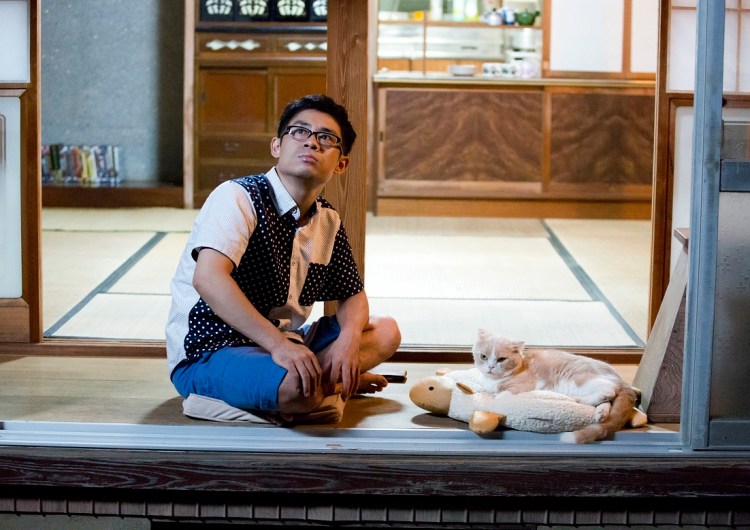 The one you’ve all been waiting for – Neko Atsume House! An adaptation of the popular smartphone game, Masatoshi Kurakata’s film stars Atsushi Ito as a novelist with writer’s block who moves house to stimulate himself only to be overrun with cute cats instead.
 The only documentary announced so far, Konrad Aderer’s Resistance at Tule Lake examines the case of 12,000 Japanese-Americans labeled “disloyal” for attempting to resist the government’s internment order.
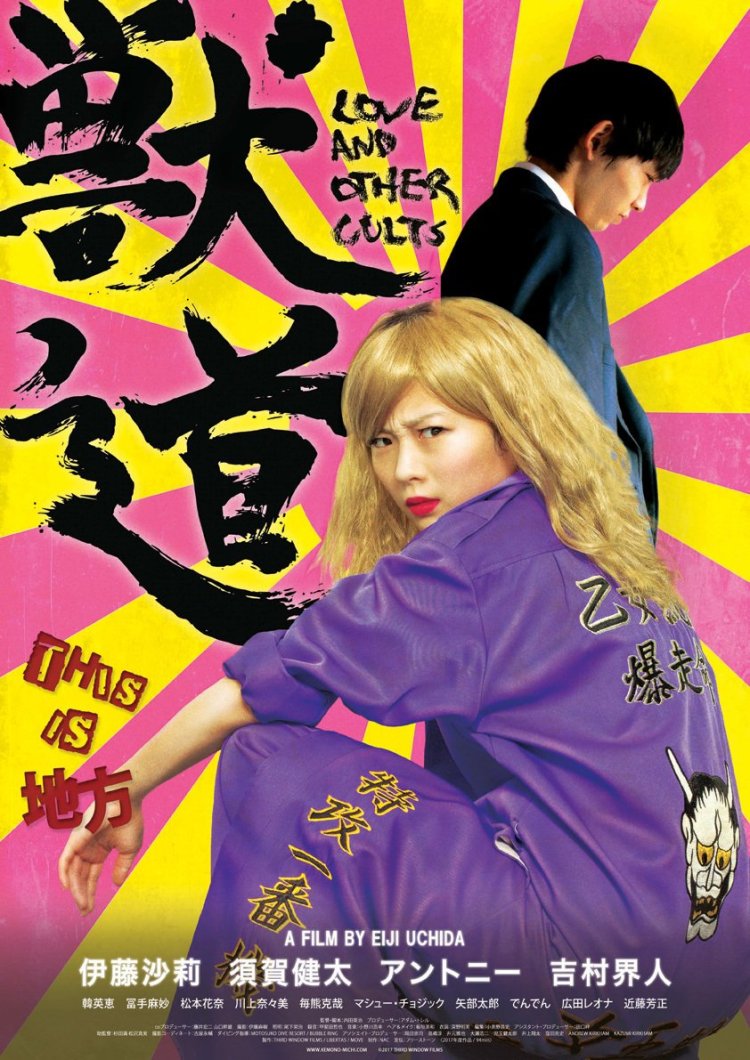 Eiji Uchida’s career has been marked by the stories of self defined outsiders trying to decide if they want to move towards or further away from the centre, but in his latest film Love and Other Cults ( 獣道, Kemonomichi), he seems content to let them linger on the margins. The title, neatly suggesting that perhaps love itself is little more than a ritualised set of devotional acts, sets us up for a strange odyssey through teenage identity shifting but where it sends us is a little more obscure as a still young man revisits his youthful romance only to find it as wandering and ill-defined as many a first love story and like many such tales, one ultimately belonging to someone else.
