Growing Up (たけくらべ, Heinosuke Gosho, 1955)

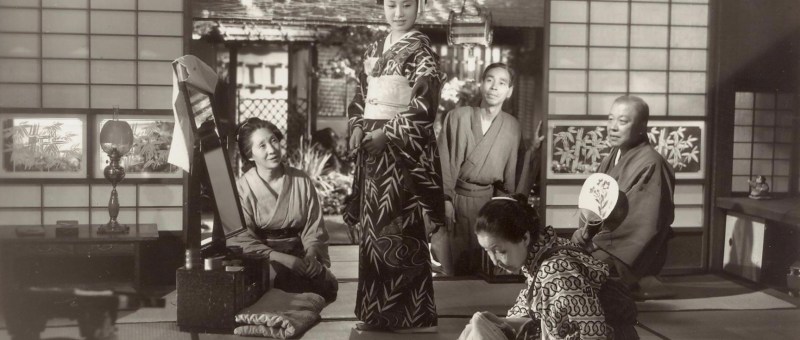
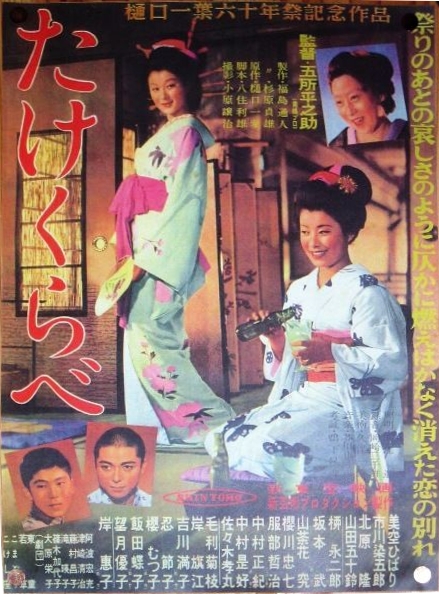
Gosho Growing UpCaught in a moment of transition, it’s no great mystery that post-war Japanese cinema began to look back at the Meiji past. Progress had indeed been rapid but ended in national tragedy and collective madness. The post-war humanists were eager for a different outcome, to avoid the mistakes of the last fifty years and build a society that was kinder and freer than that which had come before. Though on the surface it might seem as if much had changed since the dawn of a new century, the problems were still the same and a failure to address them only likely to add new tragedies in place of the better future many hoped for. Among the foremost proponents of post-war humanism, Heinosuke Gosho made a rare trip back into the Meiji past in 1955’s Growing Up (たけくらべ, Takekurabe), an adaptation of the well known short story by Ichiyo Higuchi, finding that nothing much had really changed when it came to the fates of women and the poor in an often wilfully indifferent society.

The action opens on the outskirts of the Yoshiwara in 1894. Our heroes are a collection of children who find themselves dealing with typically adolescent problems but also, by modern standards, expected to grow up all too fast. Chief among them is 13-year-old Midori (Hibari Misora) whose sister, Omaki (Keiko Kishi), is the most famous courtesan of the red light district. Although she knows on some level that her parents have already sold her to the brothel owner in whose house they live as servants, Midori has not yet quite processed the full implications of her destiny or that her world of childhood innocence is rapidly drawing to a close. She is in love with a local boy, Shinnyo (Takashi Kitahara), who seems to return her feelings but is as awkward and confused by them as any teenage boy and treats her by turns with coldness and contempt mixed with grudging affection.

Shinnyo, meanwhile, is the son of a greedy and heartless monk (Takamaru Sasaki) who has decided to sell his older sister as a concubine to a wealthy man who already has a wife. As he loves his sister dearly and has a naive, childish sense of absolute morality, this is a sin Shinnyo cannot forgive. He argues with his father but has no real power to change the situation and then decides on rebelling against his father’s wishes that he not become a monk by leaving for the main temple in Kyoto to take holy orders. Of course, this also means he must sacrifice any youthful idea he might have had of pursuing his love for Midori.

The title, in a sense, could refer not only to the increasingly melancholy youngsters coming of age in an oppressive society, but also to Japan itself as it emerged into modernity in an effort to prove itself the equal of any other major power in the late 19th century. It is, however, an ironic a title as any could be. To “grow up” here is to abandon one’s humanity and conform to the kind of “real world” thinking that codifies cruelty and makes a virtue of heartlessness. Still an innocent child, Midori bounces her ball and basks in her somewhat elevated position as a wealthy young girl and sister of a “notorious” woman without fully understanding all that entails. When her sister tells her about a dream she had of climbing trees and picking persimmons, she is incapable of understanding her warning about the loss of innocence she’s about to experience, but her world is brought crashing down when a gang of rival boys rudely attack her and point out that all her finery was bought through “whoring” and that she is nothing more than a “whore” in waiting.

Another of the boys, Sangoro (Masanori Nakamura), whose family is poor, says he can’t wait to be “grown up”, reacting with less than sensitivity to Midori’s pained pleas that she wishes everything could stay as it was and they could be children forever. Sangoro sees adulthood as freedom. He’ll be free to earn his own living and maybe he won’t have to be like his father, too afraid to stand up to people with money because when you don’t have any you’re always reliant on their kindness. Sangoro may be poor, but he’s a man (or will be) and can’t process the total lack of agency that comes with being an adult female whose future is decided entirely by her closest male relative. Midori, like Shinnyo’s sister, has been sold by her father and there’s nothing she or anyone else can do about it now.

Nevertheless, confronted by her fate, Midori decides to own it. She encourages her parents to think of her as dead, cooly hitting back at their callousness but acknowledging an obligation as she goes. The final scenes preceding her passage across the small bridge which will forever sever her from her childhood are filled with dread and anger as if crying out for someone to stop the inevitable from happening, but of course, no one can. An old woman and former courtesan, Okichi (Isuzu Yamada), who owns a shop where Midori used to spend time and is indirectly responsible for Midori’s acceptance of her fate in some cruel, drunken words she threw at her, puts it best when she briefly feels as if she could have done something in affirming that it isn’t her fault, and it isn’t Midori’s, it’s simply “the world”.

Midori meets her fate not with resignation but rage and defiance. Shinnyo, who runs away from his inability to help his sister by becoming a monk, is forever incapable of declaring his real feelings in words but leaves a flower in front of her window in echo of another he gave her long ago. At first Midori picks it up and cherishes it for the innocent symbol of love that it is, but by the time she has travelled half way along the bridge which will take her to the Yoshiwara, she has realised this kind of innocence does not belong inside. She throws the flower to the mud and leaves her youthful dreams of love and happiness behind as she prepares to step through the doorway into a future which is not of her making and over which she has no say. To “grow up”, in this world, is a kind of spiritual death in which there exists nothing other than emptiness and indifference.


Bloody Spear at Mount Fuji (血槍富士, Tomu Uchida, 1955)

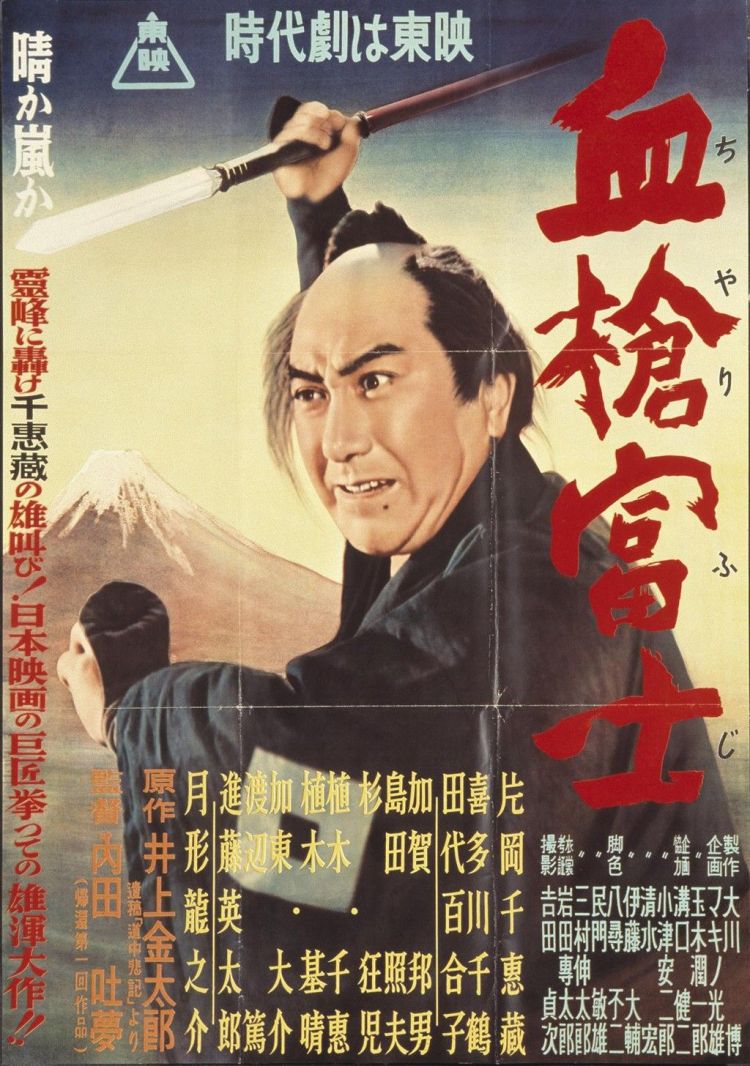
Bloody Spear Mount Fuji posterThere was a reason that the occupation authorities were suspicious of period films, but the jidaigeki of the post-war years are not generally interested in nationalistic pride so much as in interrogating the myths of the samurai legacy in order to pick apart the compromises of the modern era and the follies of the immediate past. Tomu Uchida had been among the most prominent directors of pre-war cinema but left to join the Manchurian Film Cooperative in 1942, remaining in China until 1953. Bloody Spear at Mount Fuji (血槍富士, Chiyari Fuji) was his “comeback” film, brought into existence through the good offices of fellow directors Yasujiro Ozu, Hiroshi Shimizu, and Daisuke Ito who had been the pioneer of samurai movies in the silent era. Like the later films of Masaki Kobayashi, Uchida takes aim at the hypocritical falsehoods of the samurai order and at a series of still prevalent social codes which oblige one human to oppress another in order to avoid acknowledging the fact that one is oneself oppressed.

Ironically enough we begin on the road to Edo as a goodhearted but compromised samurai, Sawaka (Teruo Shimada), makes the journey to the capital to make his name with a precious teacup in tow. He may be a samurai, but he’s making this lengthy journey on foot and accompanied by only two retainers – veteran spearman Genpachi (Chiezo Kataoka), and manservant Genta (Daisuke Kento). While on the road, the trio come across various other travellers including a shamisen player (Chizuru Kitagawa) and her daughter, a cheeky orphan who wants to be a samurai, and a melancholy father and daughter en route to visit a relative in the hope of financial assistance. There is also a notorious bandit on the loose going by the name of Rokuemon, which is one reason that the “recently wealthy” miner Tozaburo (Ryunosuke Tsukigata) is arousing suspicion with local law enforcement.

In contrast to many a jidaigeki epic, the travellers on the road to Edo are mostly good people if wise enough to be wary and on the look out for trouble. Genta and Genpachi have been given strict instructions that Sawaka is not to drink during the journey. Though he’s a nice enough soul when sober, Sawaka is a mean drunk with a tendency to start random fights and his mother doesn’t want him messing up his big chance by causing trouble on the road. This maternal solicitude can’t help but annoy Sawaka who overhears Genta complaining to a servant at the inn as he enjoys a quick glass of solo sake in the kitchen. There may be a sword on Sawaka’s belt, but he’s a middle ranker at best – something rammed home to him when the party is held up by a roadblock which turns out to be solely caused by three elite samurai having a picnic who wish to enjoy the view uninterrupted. Later he grips the handle on his sword in rage and desire to help a young woman in trouble before his hand begins to slip as he realises how little power he really has. The only thing to help her was money, and money is something Sawaka evidently does not have.

Sawaka’s “power” is entirely illusionary and dictated by the complex hierarchies of the samurai era. Breaking all the rules, he considers selling his “priceless ancestral spear” to get money to help the girl, but is told that the spear is a fake and hardly worth anything. With the help of the plucky little boy Jiro, Genpachi helps to apprehend a wanted criminal but it’s Sawaka who gets a commendation – something which causes him not a little consternation but his attempts to transfer the praise onto the rightful parties falls on deaf ears. In any case, the reward is just a piece of paper filled with more empty words and not much practical use to anyone. A fake spear begets a fake reward, he quips, becoming ever more disillusioned with the rights and responsibilities of the samurai order while somewhat romanticising the lives of the “ordinary” who might be more “free” in one sense but then Sawaka is never going to worry about being hungry or have to think about selling his daughter to avoid certain ruin even if he resents the ways in which is social class obliges him to affect coldheartedness.

Sawaka’s rejection of “samurai” values eventually leads to his downfall when an invitation to a servant to join him at his drinking table as an equal provokes outrage in a fellow nobleman who feels his own status threatened by this genial act of meaningless equality. Sawaka’s attempts to insist that he and his servant are both human beings only makes things worse and it doesn’t take long to figure out that he has picked the wrong battle if what he wanted was to strike a blow at samurai hypocrisy. Sawaka himself is no innocent in this game, terrorising a trio of peasants simply because one of them had an interesting nose and the drink was in him. Sawaka’s servant eventually pays the price for his mistake, bearing out his earlier frustrations with the chain of “shadows” that defines the samurai order and seemingly has no end.

Genpachi is the embodiment of the good retainer, but he’s also a kind and sympathetic man who takes an interest in the lonely orphan boy and, to a lesser extent, the shamisen player and her little daughter. The four of them form a kind of makeshift family, but the samurai order destroys even this small slice of happiness as the road prepares to force them apart. Having bloodied his spear but had his act of rage “approved” by the powers that be, Genpachi emerges broken and masterless, his fatherly attentions to Jiro relegated to a literal instruction not to follow in his footsteps and never to become a “spear carrier”, a mere tool at the mercy of a cruel and corrupt regime. Uchida begins in comedy complete with a whimsical contemporary score but makes clear that his ending is inevitable tragedy only made worse by the superficial rubber stamping that neatly sanctions the hero’s moment of madness as one perfectly in keeping with his moral universe.


Bloody Spear at Mount Fuji is available on blu-ray from Arrow Academy with a typically expansive feature commentary by film scholar Jasper Sharp including a minor digression into the career of director Hiroshi Shimizu – another sadly neglected figure of pre-war/golden age Japanese cinema. Other on-disc extras includes a series of interviews ported over from the French release – though it is nice to have them, it’s a shame that they are presented with the hardcoded French subtitles blurred out and English ones placed over the top which is less than ideal but perhaps cannot be helped. First pressing also includes a booklet featuring a lengthy essay by James Oliver which duplicates much of the information from the commentary while also situating the film within the context of Uchida’s career and the wider post-war world, as well as a complete filmography both for Uchida’s directing and acting work compiled by Sharp.

Short clip from an unrestored version of the film (no subtitles)

The Eternal Breasts (乳房よ永遠なれ, Kinuyo Tanaka, 1955)

(c) Nikkatsu 1955

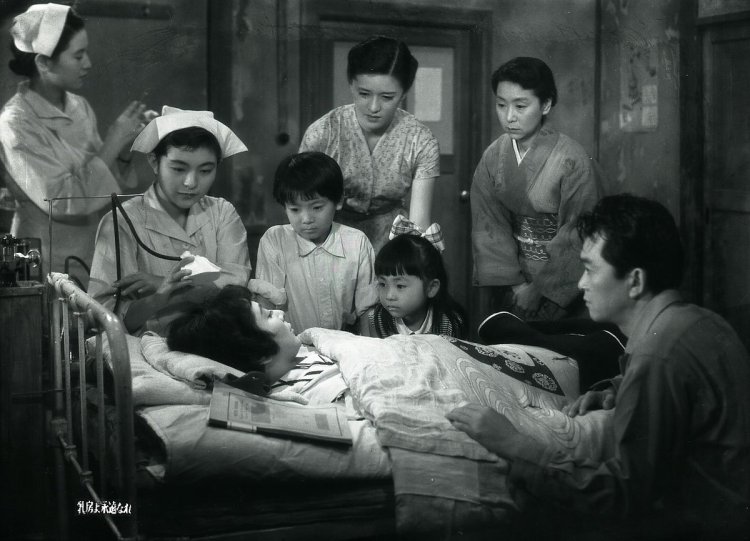
(c) Nikkatsu 1955Having made her directorial debut for Shin Toho with the beautifully drawn post-war romantic melodrama Love Letter scripted by Keisuke Kinoshita, and then moving on to her second film after being accepted as a career director at Nikkatsu – the Ozu scripted humorous romantic family drama The Moon Has Risen, Tanaka chose to work with female script writer Sumie Tanaka (no relation) for a tale of female resilience and resistance in the face of extreme suffering. Fumiko Nakajo was a real life figure who had died of breast cancer at the age of 31 in 1954. The Eternal Breasts (乳房よ永遠なれ, Chibusa yo Eien Nare) , a biopic of sorts, was released in 1955, barely a year later but makes no concession to the recency of Nakajo’s passing in examining both the still taboo subject of breast cancer and the effects of the disease and its treatment on the heroine who, arguably, finally learns to become herself through battling her illness.

Fumiko Shimojo, née Nakajo, (Yumeji Tsukioka) is the wife of a grumpy, resentful stock broker and the mother of their two children, Noboru and Aiko. It’s clear that things in the Shimojo household are far from peaceful with the discord between husband and wife a talking point throughout the local community. Despite her husband’s claims to the contrary, Fumiko is the dutiful “good wife” of the period, trying hard to make her marriage work even in the face of her husband’s ongoing resentment and thinly veiled inferiority complex given Fumiko’s slightly elevated class credentials and education. To get away from her disappointing home life Fumiko has joined a local poetry circle specialising in tanka and is well known for the gritty realism of her poems in which she expresses all of her suffering and unhappiness in regards to life with her husband. When she comes home early one day and finds a woman dressed in kimono entertaining her man, she decides it’s time for a divorce, reverts to her maiden name of Nakajo, and goes back to live with her mother and soon-to-be-married brother, regretting only that her husband insists on custody of their son, Noboru.

The early part of the film deals with the equally taboo subjects of divorce and family breakdown as Fumiko struggles to adjust to her life as a single mother as well as coming to terms with being separated from her son. Though she is often approached by matchmakers and encouraged to remarry, her experience of married life has left her reluctant to commit to a second round of matrimonial subjugation. Her mother, whom she partly blames for pushing her into a marriage she never wanted in the first place, and her brother are fully on her side as are her friends, the Horis – a Christian couple who champion her poetry and act almost as a set of second parents despite being only a little older than she is.

Released from matrimonial shackles, Fumiko is free to embrace her life as a poetess even if she never dreams of any kind of literary success. As the tactless women at the poetry circle put it, pain is good for art and it’s certainly true that each advance in Fumiko’s fortunes is accompanied by emotional suffering. Struggling to cope with the divorce and the children, Fumiko neglects chest pains and a strange feeling in her breast only to keel over when an unpleasant woman arrives to reclaim Noboru with whom she thought she’d finally been reunited.

Diagnosed with late stage breast cancer, Fumiko undergoes a double mastectomy. Refusing to shy away from the medical consequences, Tanaka films the surgery as a kind of fever dream as the bright surgery lights loom over Fumiko whose breasts appear in full view as the surgeons prepare to do their work. The loss of Fumiko’s breasts results in one of her most famous poems, published in a national newspaper, but the physical and emotional consequences are not so easily defined. Before her illness we’re constantly told that young Fumiko was a “tom boy”, and at times it appears as if she has been unsexed after being shorn of her femininity. According to her brother, however, Fumiko has become more like a child – something that rings true as she gaily sings in the bath and almost delights in shocking her friend by flashing her surgery scars unannounced. Mrs. Hori, Kinuko (Yoko Sugi), generally a kind and progressive sort, can hardly bear to look and is unwilling to engage with the physical reality of Fumiko’s condition as much as she would like to help her.

Despite proclaiming that at least she won’t be bothered with marriage proposals anymore, Fumiko’s “unsexing” appears to have the opposite effect in reawakening and intensifying her sense of desire. Earlier on, post-divorce and hiding out from her brother’s wedding at which she feels an awkward guest, Fumiko visits Hori (Masayuki Mori) and confesses her love for him though she knows nothing will come of it. Her love is, however, pure – she also loves and respects Hori’s wife Kinuko safe in the knowledge that Kinuko makes Hori happy. After her operation she returns to the Hori’s home and asks Kinuko to run her a bath so that she can bathe in the same water as her beloved – confessing to her friend that she had been in love with her husband. Kinuko seems to know already and is sympathetic, if a little embarrassed. This same boldness later manifests itself in Fumiko’s last great act of passion in which she embarks on a brief yet intense affair with the journalist (Ryoji Hayama) who is covering her career for a paper in Tokyo.

Fumiko’s relationship with the reporter is originally compromised by his overly gloomy copy which proclaims that her death is only a matter of time (then again, for whom is that not true?). Fearing that her death is being fetishised, that no one would be giving her a second glance if she were not dying, Fumiko refuses to write or have visitors. Just as she was “imprisoned” within her marriage, she is now “imprisoned’ by death. As she puts it in one of her poems, the hospital ward is a gloomy place in which she’s often framed by bars – through the windows, through the footboard of her bed, even the hospital kimono she is wearing is patterned with tiny railings. In an eerie, dream-like sequence she wanders out of her room and follows a parade of wailing relatives as a body is wheeled away but just as she is about to leave the metal gate slides shut in front of her, trapping Fumiko like a ghost in the purgatorial world of the hospital ward as she realises that that same gate will be her only exit route.

The same image is repeated at the end of the film as Fumiko’s own bed is wheeled through the mortuary gates which slam shut across the eyes of her confused children who have been left entirely on their own and without a proper explanation of where their mum is going. Fumiko’s final poem is crushing in its anger and ambivalence as it instructs her children to accept her death as the only thing she has to bequeath them. This terrible legacy seems too cruel, condemning her children to a life of grief and mourning even as she instructs them to “accept” her passing. Yet it also speaks of the final contradictions of her character – loving mother and passionate woman, fierce poet and shy genius. Unlike the sickly heroines of melodrama, Fumiko does not always bear her suffering with saintly stoicism but rages, finally embracing the “true self” she only dared to express through her poetry, learning to live only in the knowledge that she must die.


Screened at BFI as part of the Women in Japanese Melodrama season.

Kokoro (こころ, Kon Ichikawa, 1955)

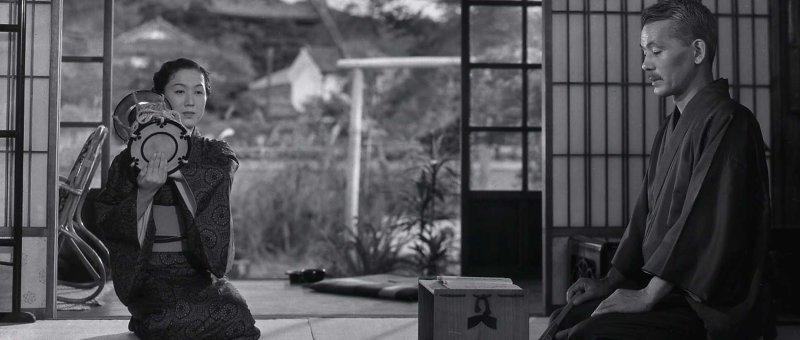
kokoro coverAmong the most well-regarded of his works, Natsume Soseki’s Kokoro (こころ) is a deeply felt mediation on guilt, repression, atonement, and despair as well as an examination of life on a temporal threshold. Kon Ichikawa’s long career would be marked by literary adaptations both of classics and genre fiction but even among these Kokoro is something of an exception, marshalling all of his skills bar his trademark irony in a melancholy tale of loneliness, self loathing, and the destructive effects self-destruction on those caught in the cross fire.

Ichikawa opens in media res as Nobuchi (Masayuki Mori) and his wife, Shizu (Michiyo Aratama), appear to have had an argument. She darns angrily while he paces and eventually seems to relent on his decision not to let her accompany him to the grave of a mutual friend, Kaji (Tatsuya Mihashi), who died when Nobuchi was still a student. Eventually Nobuchi goes alone but is disturbed in the graveyard by the approach of an enthusiastic young university student, Hioki (Shoji Yasui), who has been redirected by Shizu after turning up to ask to borrow some books. Nobuchi is not really in the mood to talk but the two men chat, eventually sharing a drink together in the local bar before Nobuchi abruptly returns home, pausing only to invite Hioki to visit another time for the books he wanted to borrow.

Though the marriage of Nobuchi and Shizu may seem to be a model one, their lives together are mostly performance. Nobuchi is a melancholy, gloomy man who does not work and lives the life of a scholar, living off family money. The household is not wealthy but they are able to afford one maid and live in reasonable comfort. They have no children and, it seems, the marriage may be one of companionship rather than passion.

On their first meeting Nobuchi refuses to tell Hioki the reason why he is the way he is, but decides he must explain and that Hioki is the only person he can unburden himself to. Badly let down by those who should have had his best interests at heart at a young age, Nobuchi has learned not to trust, believes that love is a “sin”, and that he is unworthy of any kind of personal happiness or fulfilment. As a young man, Nobuchi did something completely unforgivable for the most selfish (and fiendishly complicated) of reasons and his best friend, Kaji, later died as a direct result.

Where Nobuchi is cynical, Kaji is ascetic and closed off but sincere in his Buddhist practice. Nobuchi’s actions are not only hurtful in their deliberate betrayal, but amount to a slow implosion of Kaji’s entire spiritual universe. Having been tempted away from his religious beliefs by irrepressible desire, Kaji’s path to spiritual fulfilment has been severed and his path to other kinds of happiness blocked by Nobuchi’s own panicked act of personal betrayal. Unable to reconcile his cowardly, cruel actions which have, in a sense, broken Kaji’s “heart”, Nobuchi resolves to deny himself the life he stole from his friend, committing himself to a living death defined by the absence of physical love, desire, or success.

Hioki first meets Nobuchi when he sees him attempt to walk into the sea and saves him from drowning. Immediately drawn to him, Hioki believes he and the man he calls “sensei” share the same kind of existential loneliness. His eagerness to forge a friendship with the older, aloof scholar may seem strange but Ichikawa is keen to build on a much disputed subtext of the original novel in Nobuchi’s possible repressed homosexuality. Hioki steps into the space vacated by Kaji which has been empty the last 15 years as the sort of man who might understand Nobuchi’s “heart”.

Shizu attempts to ask the question directly, both about Nobuchi’s relationship with Kaji whose name she is forbidden to mention and to new friend Hioki whom she fears maybe taking Kaji’s place in her husband’s affections. Pleading that she just wants to understand his “heart”, Shizu tries to get some clarification on the empty hell that is her married life, but Nobuchi’s heart is firmly closed to her and she’s shut out once again.

On hearing of the death of the Emperor Meiji, Nobuchi’s gloom descends still further as he feels himself to be a man who’s outlived his age. At one point, long before, he pushes Kaji on his spiritual weaknesses prompting him to admit he doesn’t know whether to go forward or back. Nobuchi, cynical and perceptive, points out that there likely is no back even if you wanted to go there. Taking the teacher/student relationship to its natural conclusion, Nobuchi’s final testament in which he confesses the circumstances which have led to his spiritual death is intended only for Hioki in the hope that the younger man can learn from his mistakes and prepare himself to step forward into the bright new age where Nobuchi fears to tread. Once again his actions are selfish in the extreme, but there is something universally understood in Nobuchi’s particular pain and the steps he takes to ease it.


Previously available on DVD from Eureka, now sadly OOP.

Scene from midway through the film

https://www.youtube.com/watch?v=9piqtmNzFZY

The Moon Has Risen (月は上りぬ, Kinuyo Tanaka, 1955)

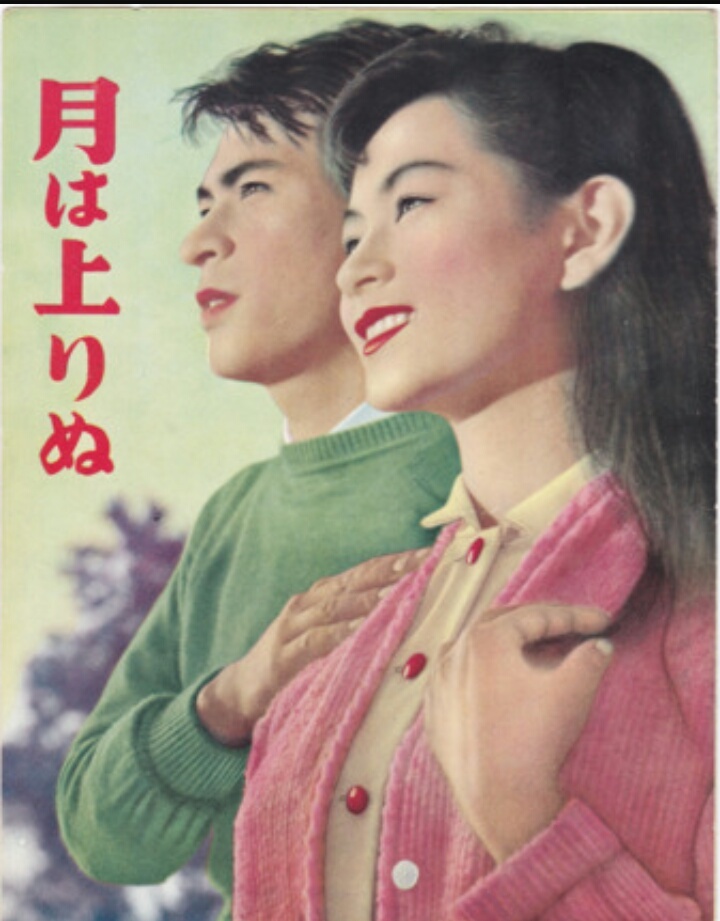
the moon has risen bookletOne of the most celebrated actresses of the 1930s, Kinuyo Tanaka’s post-war career took a couple of unexpected turns. In 1949, she was one of a small number of performers sent to tour America as a cultural ambassador but the reception upon her return was anything but welcoming as her old fans openly criticised her “Americanised” ways. In the same year, she ended her long standing contract with Shochiku to go freelance which meant she could pick and choose her projects from across a wider field of directors and actors she wanted to work with. What she wanted, however, was somewhat unheard of – she wanted to direct. The second woman to ever helm a feature film in Japan, Kinuyo Tanaka made her behind the camera debut in 1953 with the extremely impressive melodrama Love Letter which was penned by the ever supportive Keisuke Kinoshita. Tanaka’s directing career was almost derailed by her good friend and long time collaborator Kenji Mizoguchi who, for reasons which remain unclear, attempted to block her acceptance into the directors guild of Japan (ending their working relationship in the process), but after eventually joining Nikkatsu as a director she was able to begin work on her second film – The Moon Has Risen (月は上りぬ, Tsuki wa Noborinu), ironically enough scripted buy Shochiku stalwart Yasujiro Ozu.

In the classic Ozu mould, The Moon Has Risen is a family drama but Tanaka pulls the focus a little to home in on the central three sisters. Cared for by widowed patriarch Mokichi (Chishu Ryu), the Asai family consists of widowed oldest sister Chizuru (Hisako Yamane), reserved middle sister Ayako (Yoko Sugi), and the exuberant youngest sister Setsuko (Mie Kitahara) who is in a kind of relationship with the currently out of work intellectual, Shoji (Shoji Yasui). When an old school friend of Shoji’s, Amamiya (Ko Mishima), pays a surprise visit whilst he’s in the area to take a look at a broadcast tower, Setsuko sees it as an opportunity to set him up with her shy sister Ayako once Amamiya makes a few wistful remarks about remembering her from their school days.

The first part of the film stays firmly in the realms of comedy as Setsuko sets her plan in motion. She and Shoji do everything they can to find out whether there is any romantic possibility between the pair – baiting Amamiya to come to a non-existent clandestine meeting and then timing him to see how long he’ll wait before giving up, and convincing each of them that the other has something very important to say which can only be said under the romantic light of a full moon. Youthful as she is Setsuko’s plans largely backfire but then the moonlight gets inside them and something shifts.

The courtship of Ayako and Amamiya is quiet and restrained. They keep their romance a secret, communicating with each other through secret codes leading to poignant passages from the Manyoshu – the oldest existing collection of Japanese poetry, which everyone in the family is desperate to figure out but can’t quite get to grips with. Chizuru can’t decide if this painfully innocent path to romantic connection is very old fashioned or very modern but it certainly captures something of the cultural shift of post-war society – the marriage is “arranged” in a sense with Setsuko as a matchmaker but it’s also self determined as Ayako and Amamiya come to recognise their mutual feelings for each other, embrace their love match, and make their own independent decisions to marry.

Modern girl Setsuko has also made a proactive decision in her attachment to Shoji but their shared matchmaking quest eventually drives a wedge between them. As she later puts it, they spent so long worrying about Ayako that they forgot all about worrying about themselves. Shoji’s problem is a common one in being both out of work and soft hearted as he proves when he finds a job but decides to recommend a needier friend for it instead. A blazing row nearly threatens to end things but, again, the pair rely on gentle, well meaning advice from their elders and eventually realise they’re about to make themselves miserable in a fit of pigheadedness.

Though Tanaka mimics the veteran director with iconic Ozu-inspired compositions and frequent use of pillow shots, her emotional canvas is more direct than her mentor’s stoical resignation. Steering clear of Ozu’s trademark tatami mat view and preference for direct to camera speech, Tanaka’s lensing is shier and avoids faces altogether to focus on the physical. She lingers on clasped hands, or on uncertain feet, as they hug the ground unwilling to stay or go. Having ignored her for most of the film, Tanaka turns back to Chizuru whose lonely widowhood seems like a forgone conclusion, as her eyes brim with tears on hearing her perceptive father’s acknowledgement of a possible new suitor.

Mokichi’s inevitable loneliness is background rather than foreground as his daughters take centerstage, leaving him to wonder why young people prefer the “dusty, dirty Tokyo”, to his peaceful Nara but in any case he remains perfectly content for each of them to find their own path to wherever it is they’re supposed to be. In her attempt to film Ozu’s script with Ozu’s camera, The Moon has Risen may seem like a step backwards for Tanaka following the more inventive Love Letter but even while working within such constraints she manages outdo the master in her essential emotional immediacy and well observed depiction of lives and loves post-war women.


Marital Relations (夫婦善哉, AKA Meoto Zenzai, Shiro Toyoda, 1955)

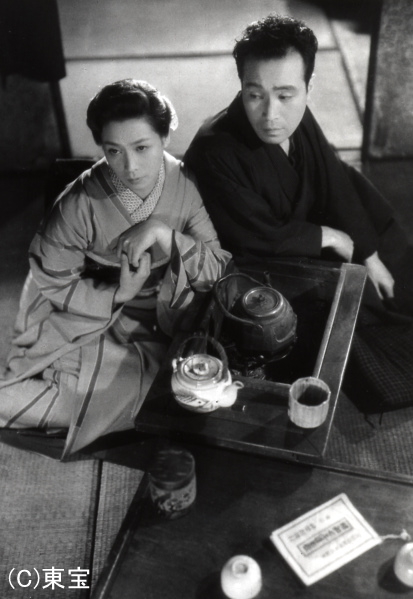
Marriage is not always simple, but when you aren’t actually married (and one of you is technically still married to someone else) the difficulties can be all the more pronounced. Often neglected in comparison with some of his contemporaries, Shiro Toyoda is best remembered for his often humorous literary adaptations. Marital Relations (夫婦善哉 Meoto Zenzai), based on a 1940 novel by Sakunosuke Oda and runner up to Naruse’s Floating Clouds in Kinema Junpo’s top ten for 1955, is a prime example of his style as it examines the unconventional relationship between a spoilt younger son of a wealthy family and a feisty geisha who nevertheless remains devoted to him despite his often insensitive treatment.

In the early 1930s, the oldest son of a wealthy family has scandalised his conservative father by continuing to consort with a local geisha. Irritated, Ryukichi (Hisaya Morishige) elopes with Choko (Chikage Awashima) assuming that he will eventually get his own way only to find his father is just as stubborn as he is. Ryukichi is already married though living apart from his wife who has a serious illness and has returned to her family with their only child, Mitsuko. Nevertheless, Choko and Ryukichi manage to live together as man and wife even without the official paperwork, installing themselves at her parents’ tempura shop. Though the couple are happy enough, Ryukichi is unused to living without his family money and Choko soon has to go back to work.

Even in early Showa things were changing. Ryukichi, spoilt and made useless by access to his family fortune and previously secure path to succession, pouts and whines about his arranged marriage and the wife he’s abandoned, emphatically demanding a free choice of mate even if she happens to have been a geisha. Choko, a working class daughter of shopkeepers, seems to have been sold to the geisha house to fund her parents’ store – in fact, Choko’s abrupt decision to leave the geisha house will also have financial consequences which Ryukichi claims he will take up with his father. Even if Choko were not a geisha, she would likely not have been accepted by the traditional upper middle class family and her constant battle is always for recognition as Ryukichi’s significant other (or perhaps primary carer). Geisha she was though, and will be again thanks to Ryukichi’s recklessness and mistaken assumption that he will regain his former status simply by being his father’s son.

Not having had the luxury of a wealthy upbringing, Choko is (financially, at least) a realist and prepared to work hard for what she wants. Heading back into the geisha world as a hostess and entertainer, Choko is the sole breadwinner of their technically illegitimate union though Ryukichi cannot entirely break with his former habits, casually burning Choko’s carefully balanced housekeeping accounts book, and eventually spending all her savings on a night of debauchery. Nevertheless, it’s Choko who eventually takes the initiative and goes into business with a friend opening a successful night spot which cleverly caters to her internationalist clientele with a “traditionally Japanese” theme. Like many of Toyoda’s women, Choko is a hardworking, practical lady determined to make a success of everything she does even if she’s had the misfortune to find herself shackled to the inconvenient man child that is Ryukichi.

Eventually it all gets too much and Choko takes a drastic decision after receiving a cruel and thoughtless slight from Ryukichi’s brother-in-law who has been adopted as the heir to the family. This shocking incident aside, the tone is largely one of comic knowingness as Ryukichi continues with his various schemes to wheedle his way back into his elite social circle while Choko spends her time working hard to create something new. Ryukichi is the worst of the old world – lazy, entitled, often selfish and thoughtless (if well meaning and resolutely devoted to Choko), whereas Choko is the best of the new – resilient, hardworking, honest and kind. Towards the end, having settled some of their differences, Choko and Ryukichi appear to have cemented their coupledom for good but are suddenly confronted with another ugly aspect of class legacy when a former servant (and sort of friend) of Ryukichi’s passes them in the street now obviously raised in status, and blanks them even as they call out to him.

Ryukichi’s sister comments at one point that her brother’s personality has been warped by his strict upbringing and the pressure to conform to social conventions has meant that he doesn’t quite know himself, though at heart he is good and kind. She may indeed have a point, honest in his love, at least, both for his daughter and for Choko, Ryukichi finds he lacks the moral compass which comes with needing to live in an interconnected society rather than the deference associated with being “the young master”. Subtle political commentary aside, Marital Relations is a wry, humorous look at an unconventional family life as its put upon heroine does her best to rescue her consistently disappointing (if often amusing) unofficial spouse.


The Shiinomi School (しいのみ学園, Hiroshi Shimizu, 1955)

vlcsnap-2016-07-09-01h53m10s460Hiroshi Shimizu is well known as one of the best directors of children in the history of Japanese cinema, equalled only by the contemporary director Hirokazu Koreeda. The Shiinomi School (しいのみ学園, Shiinomi Gakuen) is one of the primary examples of his genius as it takes on the controversial themes of the place of the disabled in society and especially how children and their parents can come to terms with the many difficulties they now face.

The Yamamotos are a happy family with two sons. However, their elation at the birth of their first child soon turned to tragedy as the boy became seriously ill with polio. Times being what they were, the treatment is not completely effective and although their son thankfully survived, he did so with a lamed leg. Now an older child, Yudo walks with a crutch and is constantly left out or bullied by his fellow children. After their second son, Teruhiko, also contracts the disease and is left even more seriously affected than his brother, the Yamamotos decide to open a school for survivors of polio where they can play together, learning how to live with the effects of the disease, free of the stigma which plagues them in their everyday lives.

Yudo just wants to play baseball and the other kids tell him he can if he brings a catcher’s mitt of his own but when he does they take it away from him and use it themselves while he sits and sadly watches them play. When his dad arrives and tries to tell them off, the kids form a mob and all leave together, fake limping as they go. Children are monsters, and often far less forgiving of difference than their adult counterparts (though it has to be said that the parents of other children are hardly blameless here). It’s not surprising that Mr. Yamamoto would want to protect his son by taking him out of this harsh environment where he’s constantly reminded of his disability and a target for the other kids’ cruel games.

The Shiinomi School may be at odds with modern thinking, but its heart is definitely in the right place. The Yamamotos are operating from a humanist perspective – they want to provide a place which helps the children to grow up strong and independent, fully able to cope with their various disabilities, where they can also escape the extreme prejudice which infects society in general. This prejudice is best brought out not by Yudo’s treatment by the other boys, but by the sad case of Tetsuo whose father had so little idea what to do with him that he used to tie him to a pole. Tetsuo’s dad has since remarried and his new wife has no intention of looking after a disabled child so they’ve brought him to Shiinomi with the intention of abandoning him there. Mr. Yamamoto is shocked and originally refuses to take the boy in protest at the idea of a father who wouldn’t want to try and do everything for his son, but eventually reconsiders when he thinks about what the boy is going back to.

Unintentionally segregating the children has some benefits in the short term but there are those who may feel that it sends a message that the problem is with the children and not with the society which rejects them. Perhaps by giving these children a happy childhood and protecting them from the cruelty of others it’s also leaving them unprepared to deal with that same cruelty once they come of age. In any case Shimizu shoots with his trademark humanity, valiantly showing the children singing loudly and learning to enjoy their lives despite their many hardships. From tiny acorns mighty oaks do grow, the Yamamotos want nothing more than to raise these children in love and acceptance and, if the final scene of the children walking down the lane alone with a song on their lips is anything to go by, you could say their efforts have been richly rewarded.


Utae! Seishun Harikiri Musume (歌え!青春 はりきり娘, Toshio Sugie, 1955)

vlcsnap-2016-07-04-00h41m46s630Hibari Misora was one of the leading lights of the post-war entertainment world. Largely active as a chart topping ballad singer, she also made frequent forays into the movies notably starring with fellow musical stars Izumi Yukimura and Chiemi Eri in the Sannin Musume series. This solo effort from 1955 is directed by the Sannin Musume director Toshio Sugie and follows a similar approach with the 18 year old Hibari starring as a teenage girl who looks really like Hibari Misora (but unfortunately cannot sing).

Hibari is playing a teenager here but she’s left school and is working as a bus conductoress. Bright and cheerful in her work, she takes some ribbing from the other employees because of her resemblance to the singing star (she has a large beauty mark drawn on her right cheek to make sure we know she’s not the “real” Hibari) and is a little embarrassed when they ask her to sing something because unlike her doppelganger, she’s tone deaf. Hibari lives at home with her mother and younger brother who’s still in school but their father seems to have left the household and there’s a degree of discord between the couple. Hibari tries to get her parents back together so they can live as a family whilst also maintaining her bus job, beginning a tentative romance with a former passenger, and even getting a few singing lessons from the real Hibari Misora herself!

Unlike the Sannin Musume movies, Harikiri Musume is shot in regular black and white though has pretty good production values for the time with some location shooting and outdoor scenes. Hibari is only 18 here but she’s already working at the bus company which seems like a pretty good gig all things considered (though her money is going to pay for her brother’s school fees, such is life). Her biggest problems are her no good father and her singing star doppleganger which continues to cause her embarrassment.

Harikiri Musume is a pop star vehicle but oddly Hibari doesn’t get to perform that much. Early on she laments not being able to sing as she listens to one of her bus company colleagues singing the song Rendezvous (also featured in one of the Sannin Musume movies) which is then followed by a more operatic track from a male colleague (of course, these two end up becoming a couple, united in their musical talents). She watches “herself”  on TV and later mimes to a recording of the famous Hibari at home but the main subplot of the film takes hold once the two Hibaris meet in a neat cinematic doubling trick. Famous Hibari teaches ordinary Hibari how to sing properly using Misora’s famous song Ringo Oiwake. She then turns up in the finale at the wedding celebration of two employees with a new song just for the bus company as a special gift.

As well as Rendezvous, there are even a few callbacks to Jankenbon which also appears in So Young, So Bright which was released the same year. Hibari is mostly acting with herself here and it’s altogether a more modest affair than the Sannin Musume pictures with no real production numbers or complicated staging but somehow all the more charming for it. In keeping with other similarly themed movies, Hibari has the disrupted family subplot and a very slight romance which never really gets started until near the end but the film cleverly avoids any kind of heaviness in favour of a light and breezy youthful tone. First rate fluff, but nevertheless an interesting look at the “ordinary” people of movie land in the mid fifties and an entertaining musical comedy in its own right.


No trailer but here’s a clip of Hibari Misora singing Ringo no Oiwake almost 25 years later:

So Young, So Bright (AKA Janken Musume, ジャンケン娘, Toshio Sugie, 1955)

Janken MusumePop stars invading the cinematic realm either for reasons of commerce, vanity, or just simple ambition is hardly a new phenomenon and even continues today with the biggest singers of the era getting to play their own track over the closing credits of the latest tentpole feature. This is even more popular in Japan where idol culture dominates the entertainment world and boy bands boys are often top of the list for any going blockbuster (wisely or otherwise). Cycling back to 1955 when the phenomenon was at its heyday all over the world, So Young, So Bright (ジャンケン娘, Janken Musume) is the first of four so called “three girl” (Sannin Musume) musicals which united the three biggest female singers of the post-war era: Hibari Misora, Chiemi Eri, and Izumi Yukimura for a music infused comedy caper.

As far as plot goes, it’s actually very simple and yet quite complicated at the same time as highschoolers Yumi (Chiemi Eri) and Ruri (Hibari Misora) end up on a school trip to Kyoto where they fall in a river because they’re laughing so much at their classmates’ excitement at spotting someone filming a jidaigeki on the riverbank (neat cameo from director Toshio Sugie). Breaking off from their group, they take their uniforms off to dry only to be disturbed by a young man who tries to take photographs of them at which point they pretend to be washing some clothes in the river. Later they head to an inn which is owned by a friend of Ruri’s mother (who is also an inn owner and former geisha) where they befriend an apprentice geisha, Piyo (Izumi Yukimura).

Piyo then turns up in Tokyo in a bit of a state as it turns out she will shortly be sold into prostitution! She’s fallen in love with someone from the city who she thinks could save her if only she can find him so the girls set out to help her, except the guy’s name is Saito which is the Smith of Japan. During all of this, Ruri also has a subplot about her long lost father who will shortly be moving abroad and apparently wants to actually meet her, opening lots of old wounds.

So Young, So Bright is not a musical in the classical sense, it’s not integrated, but allows ample space for its singing stars to do their thing. Yumi just loves to sing so she randomly starts singing songs she’s heard everywhere, Piyo sings as a geisha and Ruri is rehearsing for some kind of kabuki style performance she gives alone on stage at the climax of the film.

That aside, the main musical sequence comes towards the end where the three girls go to the theatre together and strangely end up seeing “themselves” performing on stage. It’s a neat kind of fantasy sequence in which each of the girls indulges in a little bit of daydreaming as they imagine themselves as stage stars with Piyo being given the cutest, most MGM style number which is then followed by a number from Yumi entitled “Africa” which is very much of its time…and then you get the elegant number from Ruri which is mostly the English version of La Vie en Rose. They also get a trio number to close the film which takes place entirely on a rollercoaster but celebrates each of their slightly different singing styles.

So Young, So Bright is not intended to be anything other than irrepressibly cheerful fluff (despite containing a subplot about possible forced prostitution), but succeeds in being exactly that. An early colour film from Japan it certainly makes fantastic use of its technicolour swirl to give Hollywood a run for its money in the sophistication of happiness stakes. Hollywood musicals are quite clearly the biggest influence though perhaps more those from the pre-war era even down to the only large scale dance sequence which has a distinct Busby Berkley vibe (even it only lasts twenty seconds or so). The rest of the film is actually quite light on dance but makes sure to showcase the singing talents of each of its leading ladies equally. Strangely innocent, even if darkness lurks around the edges with the betrayed geisha and possible prostitution subplots, So Young, So Bright lives up to its name as a completely charming musical comedy that is perfectly primed to banish even the bluest of blues far into the distance.


These movies are so much fun! No subtitles but here are some clips of the various musical numbers:

Izumi Yukimura’s Cha Cha number:

https://www.youtube.com/watch?v=4x-ThhiEpok

Chiemi Eri’s Africa number (not very PC by modern standards, just a warning)

https://www.youtube.com/watch?v=ddbJULH30hI

Hibari Misora’s take on the English language version of La Vie en Rose

https://www.youtube.com/watch?v=jm1-KXgPlvI

And the finale:

https://www.youtube.com/watch?v=mrbegS0LHrI

Les Diaboliques

This article will discuss the plot of Les Diaboliques in full and therefore contain major plot spoilers


Now that Les Diaboliques has been been released on Blu Ray, twice, once by Criterion (Region A) and once by Arrow (Region Free, UK) it seems like an appropriate time to revisit one of cinema’s most enduring thrillers. It might be thought that the film would seem dated or that the constant imitations and ought right theft of the central plot twist in every prime time mystery show of the last fifty years would leave a modern audience unimpressed, feeling they’ve seen all of this before. However, on seeing the recently restored print at the BFI a few months ago, it was most reassuring (and completely wonderful) to hear several disbelieving gasps as Nicole and Michel congratulate themselves on the successful completion of their plot, followed by amused discussion of the young boy’s curious reacquisition of his slingshot at the very end. Les Diaboliques remains a perfectly plotted crime thriller, complete with some of the most disturbing imagery ever captured on celluloid.

So then, the plot. As the film opens, we meet Christina (Vera Clouzot) – The Wife, and Nicole (Simone Signoret) – The Mistress, who is wearing dark glasses after, it seems,  receiving a black eye from the film’s apparent villain, Michel (Paul Meurisse) – The Husband. Oddly, Christina seems very concerned about Nicole’s injury and seeks to comfort her, and this strange camaraderie between wife and mistress is remarked upon by two of the other teachers of the boarding school at which the central trio live and work. Later on we see the women discussing a plan to get rid of Michel, who has obviously been causing both of them not a little pain. The plan goes off without too much trouble, but then, the body disappears and Michel’s presence begins to make itself felt in unexpected ways….

of course this is only the beginning of the plot we think we see throughout the film (and you might want to look away now if you ignored the spoiler warning and blatant mention in the first paragraph) as it transpires that Michel really is the villain of this piece and along with Nicole has concocted a diabolical plot involving his wife’s fragile heart, her religious mentality, and his own faked death. The scene where he rises out of the bath tub, with those strange (and painful looking) dead man contact lenses is one of the most iconic in cinema history – truly chilling. However, Michel and Nicole have not counted on the perspicacity of the retired policeman Fichet who is there to rob them of their final triumph. Not content with this masterful plot twist, Clouzot seeks to tease us again, although we see Christina die, we are presented with the mystery of the small boy and his slingshot, which he says was just returned to him by the headmistress, who we know to be dead. This is the same small boy who was accused of lying about seeing the ‘deceased’ Michel earlier in the film, whom we now know to have been telling the truth. So, is Christine really dead? is her ghostly presence inhabiting the school? or did Fichet manage to save her life after all? or is the boy lying this time? We’ll never know, Clouzot just wanted to leave us with that one last note of uncertainty to completely mess with our heads once and for all.

It is Christina, whose apparent death we finally witness, that we’ve sympathised with all the way through. We can see right from the beginning that she’s terrorised by her cruel husband Michel – carrying on with another woman right in front of her, forcing her to eat rotten fish, forcing her off screen where it’s implied he will beat and rape her. We are right behind her desire to kill Michel, we can see that this is the only way out of an unbearable situation for her, and we are eager to release from that torment. She can’t divorce him as she’s a strict Catholic, and he likely wouldn’t consent to a divorce because he’s dependent on her money. She owns the school but he controls it. We also sympathise with Nicole who it seems is under some sort thrall to Michel although he also beats her and she isn’t tied to him in any way, perhaps we buy into her desire to eliminate Michel in revenge for the humiliation she has suffered. Nicole is the driving force behind the initial plan convincing Christina to go through with it, forcing her hand when she wavers. However, it is Nicole who ‘appears’ to crumble as things start to go wrong, for a brief period Christina becomes the dominant woman and Nicole ‘panics’ as the relationship between the two women becomes fraught and they both goad each other to go the police. Though of course Nicole’s actions here are completely calculated to place further stress on Christina, she obviously is fully aware of what’s really going on. In fact the character of Nicole is one of the most intriguing aspects of the film, she must be the most diabolical of all the characters – appearing to comfort and console Christina whilst leading her to her death so that she can have the loathsome Michel and all of Christina’s money. Why she thinks Michel will be any more well disposed to her than he’s been to Christina is anyone’s guess, but then perhaps she really is in that much thrall to him.

Indeed the relationship between the two women both one of the most central aspects of the film and one of the most ambiguous. In the novel which served as the source material for the screenplay (Celle Qui N’Etait Plus by Boileau & Narcejac who also wrote the inspiration for Hitchcock’s Vertigo) the plot twist is reversed. A man and his mistress plot to kill his wife, but haunted by the crime he eventually kills himself and it turns out that the two women are lovers and have plotted together to get rid of the husband, and in the novel they get away with it. Clouzot, probably rightly, assuming such a scandalous affair would never get through the censors, and probably wouldn’t be accepted by the audience even if it did altered the original plot to a slightly more conventional situation. However, throughout the film, the two women appear very close, they’re very tactile and are often posed like a couple, see the way Nicole holds Christina’s arms when persuading her to call Michel in Niort and at several other points in the film. They are seen to share a bed on more than one occasion and at least once they get back to the school there’s no logistical reason for them to do so. The scene where Nicole decides to leave also resembles a typical thwarted lovers parting scene, Nicole’s ‘Do You Hate Me?’ is particularly potent. Is Christina telling her to go because she’s going to confess, or because she doesn’t trust her anymore? Were the two women lovers, is this another motive for the murder of Michel? and of course, this is looking even worse for the already pretty awful looking Nicole, was she sleeping with both of them? Did she like Christina at all, did she have some remorse for what was about to happen? Who can say, but she does seem fairly ecstatic afterwards.

Clouzot’s typically bleak world view is very much in evidence here. Christina aside (and even she’s a murderess, albeit an unwilling one) no one comes out of this film looking particularly good. Does the policeman really let Christina die as punishment for her part in the hypothetical crime? Perhaps he has a plan in place to save her afterwards and whip her out as a sensational witness at the trial but even so it’s quite an ordeal he leaves her to suffer. You also have to wonder why no one is investigating standards at this school, did none of the children complain about the rotten fish, how much are their parents paying for this sort of thing? but I digress. Clouzot succeeds in piling up the tension until it becomes almost unbearable by the end, this has to be one of the most successful suspense films ever made. Even if the twist appears obvious to the modern viewer the final scenes still succeed in being genuinely thrilling!

As for the Blu Rays, as far as picture quality goes Criterion is the winner as the Arrow is slightly cropped and although both releases look occasionally soft the higher bit rate on the Criterion really pays off. As for extras both offer very interesting supplements, I would probably advocate the Arrow as the video introduction from Ginette Vincendeau is indispensable (and much longer than expected!) and the full length commentary by Susan Heywood more informative than the selected scene commentary provided by Criterion. Though the introduction provided by Criterion is also very good and the short piece by Kim Newman is very interesting as well. Fans of the film who have the ability to play A coded discs would benefit from double dipping on both editions, but as always your choice is pretty much decided for you by your region of residence and both have their merits. Les Diaboliques remains a prime example of the thriller genre and a must see for anyone interested in psychological horror.