Crimson Wings (紅の翼, Ko Nakahira, 1958)

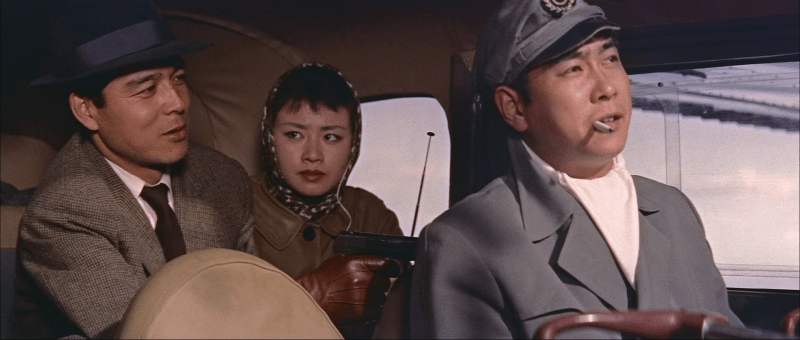
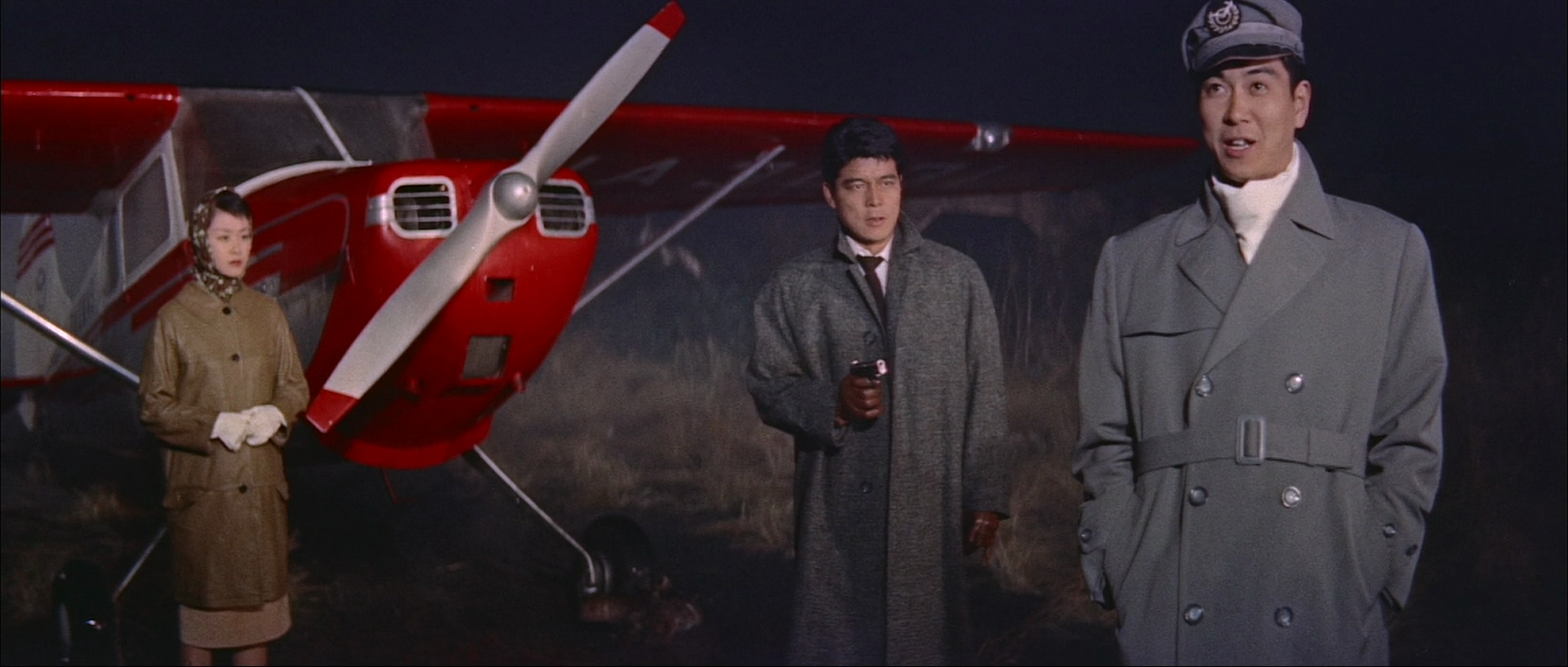
A heroic pilot on a mission to get life-saving medicine to a small boy on a remote island unexpectedly finds himself frustrated by a wanted man in Ko Nakahira’s aviation thriller, Crimson Wings (紅の翼, Kurenai no Tsubasa). This is of course a time in which air travel was still something new and exciting, but not only that, it also offered immense improvements to those living far flung areas making travel to the mainland far easier and much less time-consuming. 

Time is, however, of the essence as a little boy on Hachijojima has contracted tetanus and the only stocks of the antidote on the island are out of date. If they can’t get replacements in the next few hours, it will be too late. Hachijojima is a fairly remote island in the Philippine sea that was used as a base for suicide submarine missions during the war but was developed as a tourist destination in the years afterwards in which it was dubbed “The Hawaii of Japan”. It didn’t quite take off until the 1960s tourism boom, but this is perhaps the reason why there’s an air shuttle service to Tokyo three times a week that is described by the stewardess as their most popular route. It might also explain why part of her job is acting as a tour guide, pointing out important Tokyo landmarks passengers can see from their windows as they come in to land. In any case, it’s the most obvious way to get the serum to the island seeing as there’s a charter flight set to leave in a couple of hours’ time.

But that same day across town, a CEO, Iwami (Toru Abe), is assassinated by a yakuza hitman named Itagaki (Hideaki Nitani). Predictably, he’s the one who’s charted the flight as a speedy getaway and he’s not all that keen on hanging around waiting for the delivery of the tetanus serum. One of the pilots describes Iwami as “take over king” and the “richest tycoon in post-war Japan”, which is to say they don’t have tremendous sympathy for him as someone who’s almost certainly made his money through nefarious means. Itagaki even remarks that he was “one of us,” the only difference between them being that where yakuza use guns he used money though his killing him was a matter of purely business. He didn’t ask or care why Iwami had to die, but obviously thought he was fair game anyway. 

You can tell that Itagaki is not the sympathetic kind of gangster right away when he mows down a little girl while fleeing the scene, her little yellow balloon sadly flying off into the distance. His indifference to the girl’s death is ironic considering the rest of the film revolves around the struggle to save the life of a little boy, directly contrasting his callousness with the righteousness of the pilot, Ishida (Yujiro Ishihara), who is prepared to risk his own life to deliver the serum. Ishida hadn’t previously volunteered for the job because he was supposed to be going on a Christmas Eve date with stewardess Keiko (Shinako Mine), only she tells him she has to cancel because her father is on a surprise trip to town. Unbeknownst to him, however, she’s actually blown him off to go to a Christmas market with another man. In any case, with nothing else to do he accepted the job even though it involves going in a Cessna because of a malfunction on their regular plane that will take too long to repair. 

Aside from having to take Itagaki, who is pretending to be on an emergency trip to visit his mother’s grave, Ishida is also accompanied by pushy journalist Yumie (Sanae Nakahara) who was sent to the airport to interview Keiko as part of a series about “working girls” that she doesn’t seem particularly enthused by. In fact, she’s actually quite rude, elaborating that she’s already interviewed a TV producer and a continuity girl describing them all including stewardess as “glamour jobs” that don’t require very much in the way of brains as journalism obviously does. That might in a way reflect her own resentment in that it’s obvious she feels the paper’s not giving her a fair shake because she’s a woman which might be why she jumps so hard on the tetanus story sensing the potential for a heartwarming human interest article. She does however seem to genuinely care about the little boy on Hachijojima. Not only does she immediately arrange for a large amount of the serum to be delivered by police escort but insists on going to the island herself and after figuring out Itagaki is the fugitive thanks to her transistor radio sticks to the main mission rather than switching to the one about the CEO murder. 

Ishida meanwhile remains a cool-headed wisecracker brazening it out against Itagaki in the knowledge that he can’t actually kill him because he doesn’t know how to fly a plane so all his threats are meaningless. There’s also a rather awkward subplot about Ishida’s brother being a kamikaze pilot during in the war which is intended to further bear out Ishida’s righteousness while his sister (Izumi Ashikawa) also makes a long speech about how he said if he had to he’d like to die like him and is the sort of person who can’t stand by and watch someone suffer. A lengthy sequence switches between various branches of the Japanese government and self-defence forces, as well as the US military, who all swap messages between themsleves and immediately scramble to find this one Cessna when it inevitably gets into trouble and drops off radar. The message seems to be that the system works and the authorities are ready to handle events such as this. Using some impressive aeroplane footage along with a series of split screens and a memorable opening POV shot to disguise the assassin’s identity, Nakahira gives the otherwise lighthearted thriller a little more weight while still allowing its wholesome goodness to shrine through as a collection of determined people come together to save a little boy they don’t even know who lives on a remote island where the children work in soil-pits to make extra money which might as well be a million miles away from the modern capital with greedy fat cat CEO’s and nihilistic yakuza.


Trailer (no subtitles)

Girl with the Fire Banner (唄祭りかんざし纏, Kinnosuke Fukada, 1958)

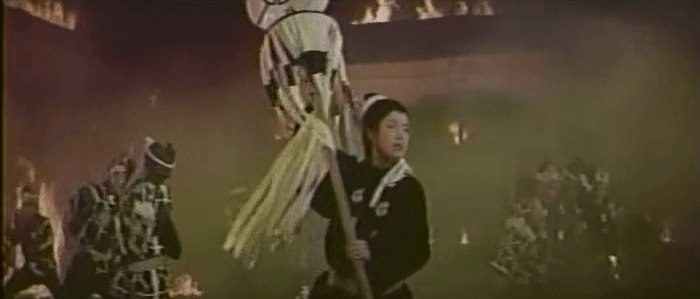
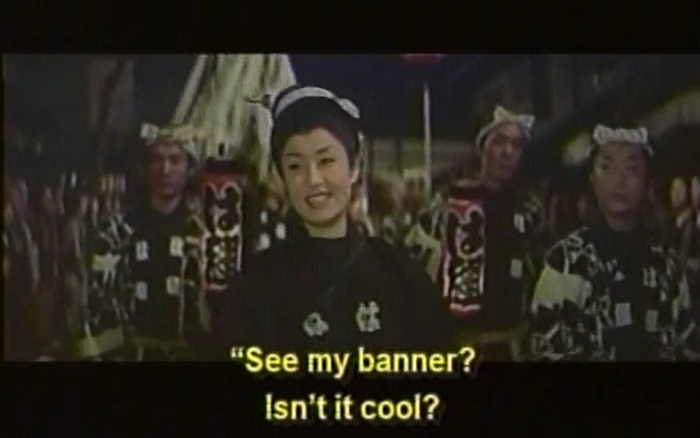
Hibari Misora puts out the fires of the Bakumatsu in another musical jidaigeki adventure, Girl with the Fire Banner (唄祭りかんざし纏, Utamatsuri Kanzashi Matoi). Once again co-starring with Chiyonosuke Azuma, Misora plays another feisty young woman taking over the family business from a sickly father only this time the business is the fire brigade and while she calmly points out to those of a differing opinion that firefighting is an equal opportunities, apolitical occupation, she also finds herself at the centre of a coming revolution caught between corrupt Shogunate loyalists and the imperialist advance. 

Set in Edo in the climactic year of 1868 in which the Shogunate ultimately falls, the action opens with a fire at a townhouse owned by a member of the Satsuma clan, the leaders of the imperialists aiming to topple the Tokugawa and restore power to the emperor. While Haru (Hibari Misora) and her top team of firefighters rush to the scene, others actively refuse to fight the fire even going so far as to try to stop her. While she reminds them that it doesn’t matter who the house belongs to they have a duty to fight fire if only to prevent it engulfing the rest of the town, a dashing young samurai turns up and fights off the loyalists before daringly retrieving their firefighter’s banner from a burning roof asking only five ryo in return. The mysterious man soon disappears only to turn up a few days later having attempted to charge them for a new kimono and a shave in order to ask for a job as a fireman. Haru tries to dissuade him, not least because of his samurai arrogance as he explains he’s not come to join at the bottom and serve out the three year probationary period but to lead, but eventually relents only to find him continuing to behave like an entitled twit flouting all of their rules. 

Nevertheless, as someone later puts it, Japan will shortly be a “classless society” or at least samurai privilege is about to dissolve. This appears to be the central preoccupation of the villainous lords who describe themselves as Shogunate loyalists but in reality care only for their own cause. Not content with running an obvious protection racket with local vendors, threatening to burn down their stores if they don’t agree to contribute to their fund for restoring the Shogunate, they’ve also been buying up rifles to sell at inflated prices to “young hotheads” eager to die for the Shogun, and stockpiling rice hoping to profit when the city burns as they assume it will when imperialist troops arrive. Realising that their gambles may not pay off as the Shogunate may be planning to cut a deal and surrender in order to protect the people of Edo, the lords, who are technically in charge of the fire brigades, consider burning the city to the ground themselves under the cover of avenging the Shogunate’s honour. 

Of course, Haru, a firefighter through and through, could never support such duplicity though it’s clear many of the others would have gone along with it if no one had resisted. In contrast to some of Misora’s other Bakumatsu-era movies, the Shogunate and more particularly the loyalists are definitely the bad guys though in a rather strange turn of events we also see real life sumo wrestlers Asashio Taro III and Wakamaeda Eiichiro arrive to stand up for justice by knocking some of the loyalists heads together, returning later armed with giant poles and dressed only in their mawashi loincloths while throwing hay bales followed by the actual cart (!) at the arsonist loyalists before physically holding them back with the firefighters’ ladders. 

Misora, meanwhile, remains largely on the sidelines uncharacteristically elbowed out of the fight by the guys while lowkey falling for Shintaro despite his samurai arrogance. Musical numbers are fewer than might be expected, the title Edo Firefighter song reprised at the end while Misora gets a second love song wistfully sewing a kimono for Shintaro in the company of a cat wearing a fancy ruff. Shintaro gets his own number before handing back to Misora for another reprise of the title song. Nevertheless, the pair manage to salvage Edo from the flames of the revolution purifying the corruption while furthering progress towards a more equal society even if the closing scenes leave us clearly still on the march. 


Wolves of the Night (夜の狼, Yoichi Ushihara, 1958)

A cold-hearted yakuza starts to get second thoughts when confronted with the misery his actions create in Yoichi Ushihara’s slice of Nikkatsu Noir, Wolves of the Night (夜の狼, Yoru no Okami). Though the hero is ostensibly Tsukida (Ryoji Hayama), the conflicted gangster unable to reconcile himself with the fact that he has fallen in love with a women he himself destroyed, it’s equally about the women who get caught in the crossfire of a burgeoning gang war and are each victims of male greed and indifference.

In any case, gang boss Tachibana (Somesho Matsumoto) brings a lot of this on himself. The secondary narrative revolves around a woman, Takako (Mari Shiraki), who borrowed money from the Manji gang to build her bar, but now that it’s complete Tachibana swindles her by calling in the debt and foreclosing on the property, passing ownership to Tsukida with instructions to kick Takako out. She, however, doesn’t take well to this and is resentful of Tachibana for screwing her over so she vows revenge. Her original attempt to get it by seducing Tsukida doesn’t work out, so she recruits a yakuza from a rival gang to extort them claiming that they have mole and he’ll only reveal their identity when they hand over the cash. This plan has some pretty tragic consequences and not least for Tachibana himself, but none of this would have happened if he hadn’t behaved so badly in cheating Takako out of the bar she worked so hard to build. He’d also told Tsukida that the bar owner was a beauty and it was understandable if wanted to try seducing her. 

But by this point Tsukida has developed a fondness for Katsumi (Izumi Ashikawa), a young woman he first meets when she’s caught by some of his guys offering herself for sex work in their territory. The other ladies describe Katsumi as “odd” and “an outsider”. It’s clear from her behaviour and the way she’s dressed, not to mention a lack of awareness of the rules of the gang, that she’s never done this before and is terrified. Tsukida calls his men off and tells her to go home, but later realises that it’s his own fault she was put in this situation because he was responsible for collecting the debt her parents owed to Tachibana taken out because her father is bedridden. Tsukida seems shaken by the old lady’s intense resentment, but still takes their money if attempting to convince Tachibana not to pursue them any further because they have nothing left to give, correctly assuming that Katsumi resorted to sex work to get the money. 

It maybe the sense of guilt that proved the last straw as the old couple then take their own lives but rather than freeing her lead Katsumi on a lonely path of self-destruction driven only by her hated for Tachibana and Tsukida. The fact that she later becomes ill further emphasises her positioning as a symbol of a despoiled nation poisoned by the ruthless inhumanity of the post-war society, along with literal a embodiment of Tsukida’s guilty conscience. Tsukida rejects Takako as a person more like himself, an example of corrupted femininity using her body to manipulate men in a world in which a woman has little other power, and instead is drawn to Katsumi who was once innocent, demure, and cheerful but who he himself has destroyed through his own greed and heartlessness.

Spending some time in hospital following a failed suicide attempt seems to heal her in body body and soul, though the total about face in Katsumi’s feelings for Tsukida seems somewhat bewildering even if he did visit her every day and presumably win her over despite her resentment towards him for contributing to her parents’ deaths. Nevertheless, it’s his feelings for Katsumi that see Tsukida longing to quit the yakuza and retreat to the country to live a small, honest life with her free of the city’s corruption. But as so often in the movies, it’s not that simple and this time it’s a tragic consequence born of male failure and insecurity that eventually costs him his shot at a normal life even as his frenemy, a local policeman he often sees in the same bar and gives him unsolicited advice about how he should quit the yakuza, remains surprisingly supportive suggesting that his redemption may merely be on hold rather than cancelled. In any case, though shooting almost entirely on stage sets, Ushihara makes good use of stock footage of contemporary Ginza as a place of bright lights and equally dark shadows where gangsters lurk on every corner and mercy is in desperately short supply.

Endless Desire (果しなき欲望, Shohei Imamura, 1958)

In the noir films of the immediate post-war era, the protagonists are often haunted by an inescapable past that prevents them from moving on into the new democratic Japan. But in Shohei Imamura’s Endless Desire (果しなき欲望, Hateshinaki Yokubo) the situation is ironically reversed as a group of former soldiers who on the surface of things at least seem to have made moderately successful lives for themselves reunite to dig up buried treasure from the dying days of the war greedy for a little more glamour than the world has seen fit to show them.

Their venal amorality is directly contrasted with the bumbling earnestness of Satoru (Hiroyuki Nagato), a young man who fears his childhood sweetheart, butcher’s daughter Ryuko (Sanae Nakahara), is going to marry another man because he is unemployed and cannot find a job in the still difficult if steadily improving post-war economy. As such, he’s incredibly excited by the opportunity to get into the real estate business, wandering around town dressed in a suit and carrying a briefcase to scout properties or otherwise doing odd jobs for the gang, which is a shame because unbeknownst to him the business is a sham set up as a front by the crooks who’ve rented a vacant shop from Satoru’s land shark dad so they can tunnel their way to the treasure which they think is buried under Ryuko’s butcher’s shop. 

The changing nature of the times is rammed home by the fact that the shopping district, which stands atop the site of the former military hospital where the gang buried a barrel full of stolen morphine at the end of the war ten years previously, is itself about to be torn down. Effectively a post-war shantytown, the area is now ripe for redevelopment with the economy beginning to bounce back thanks to the stimulus of the Korea War. The post-war era is not quite “over”, but it’s definitely on its way out which makes the gang’s determination to recover the stolen morphine all the more ironic especially as the market for hard drugs may not be as a lucrative as it once was not to mention to the logistical difficulties of turning it into cash. 

Nevertheless, the desire for it immediately sets the gang against each other. The problem is that the lieutenant, Hashimoto, who set the whole thing up has apparently died and extra person has turned up to claim some of the loot despite the gang members having been told there should only be three of them. They were not particularly close in the war and cannot exactly remember each other while Hashimoto had them all work separately without knowing who else was on board so they don’t even know which one of them is the potentially uninvited guest. Meanwhile, the presence of a woman, Shima (Misako Watanabe), who claims to be Hashimoto’s sister sets them all on edge with masculine jealously as she sometimes gleefully plays the femme fatale later even trying to seduce the innocent Satoru, convincing him she’s a victim of domestic violence in need of rescue in an attempt to quiet his concerns over what might be going on at the shop. 

The fact is that none of the gang members can really claim to be desperate, all are simply greedy and selfish silently plotting to keep all the money for themselves rather than share it. One of them is eventually crushed under the barrel, an embodiment of their insatiable desire, but with their dying breath insists it’s theirs and no one else can have any. As old man later says, this kind of greed only leads to a bad end unlike the greed he’s patiently practiced over decades which seems to be taking a little here and there where you find it such as asking Shima for some extra money for “helping” her before asking the police about a reward and turning her in anyway.

Even Satoru’s dad is “greedy”, renting the crooks a shop he new would soon be knocked down and then complaining when his tenants try to take the tatami mats and shoji doors they’d paid for themselves out of his property. Greed maybe the way of the world, at least for those who unlike the diffident Satoru do not lack for self-confidence, but endless desire has only one reward. Darkly comic and often deeply ironic, Imamura plays with a noirish sense of fatalistic retribution but finally returns to a sense of childish innocence in the bumbling courtship of Satoru and Ryuko who may be her own kind of femme fatale playing two suitors against each other while refusing to be dominated by any man but nevertheless riding off into the sunset on her bicycle with a diffident Satoru chasing along behind her.


Wind, Woman and Road (風と女と旅鴉, Tai Kato, 1958)

Tai Kato joined Toei’s Kyoto studio in 1956 having made his directorial debut at the independent production house Takara Productions in 1951 shortly after being letting go from Daiei in 1950 during the Red Purge (he had been chief secretary for studio’s the labour union). Heavily influenced by and a great admirer of Daisuke Ito, Kato had a passion for chanbara and jidaigeki which were Toei’s mainstays at the time, but even while making what were essentially programme pictures his approach was anything but conventional. With 1958’s Wind, Woman, and Road (風と女と旅鴉, Kaze to Onna to Tabigarasu), Kato embarked on what would become a signature style of “realistic” period drama otherwise at odds with the formulaic nature of the genre. 

As he would continue to do, Kato instructed his cast not to wear makeup and while casting kabuki actor/chanbara megastar Kinnosuke Nakamura insisted on a more modern performance style than the sometimes mannered theatricality of the traditional samurai film. Ginji is cocksure young man living on the road after being kicked out of the hometown he is now travelling towards because of a crime supposedly committed by his long absent father. On the way, he runs into Sentaro (Rentaro Mikuni), a middle-aged man recently released from prison who is struck by his appearance and immediately asks how old he is realising that Ginji is about the same age as his own son who died as a result of a fight. 

The two begin walking together and Ginji tells Sentaro that his village sends gold to the governor around this time every year as a bribe to get lower taxes which doesn’t make a lot of economic sense but evidently works for them. Last year, the gold was stolen by notorious bandit Hanzo the Shark (Eitaro Shindo) and two villagers were killed during the robbery. Ginji half jokes about teaming up to steal it, and then playfully attacks Sentaro leading the entourage escorting this year’s payment to flee in terror leaving the gold behind. Sentaro encourages Ginji to take the money back to the village, but he is later shot by the returning villagers who think they must be Hanzo’s henchmen pulling the same stunt as last year. 

Unlike the typical chanbara hero, Ginji is petulant and resentful. He has a very modern way of speaking and is rebellious in character as you might well expect him to be given his life experiences. The other villagers are not happy to see him and continue tar him with his father’s brush, sure that the son of a thief can’t be any better while Ginji pines for his late mother claiming that the villagers’ harassment along with the inability to support herself economically led her to take her own life. Once a member of Hanzo’s gang he vacillates between a desire to be accepted by the village and that to take his revenge on it. Sentaro meanwhile is determined to save him, regretful that he could not save his own son from the life that he had led as a yazkuza and petty criminal. 

There is a persistent sense that everyone here is at heart a wanderer. The doctor’s daughter Ochika (Yumiko Hasegawa) who develops a fondness for both men relates that she was lured away from the village by an itinerant actor and fell into a life of ruin before returning to discover that her mother had passed away. The headman’s adopted daughter Oyuki (Satomi Oka) with whom Ginji falls in love tells him that she too is an orphan, her father was a medicine pedlar who dropped dead in the village which then took her in. Echoing a sense of rootlessness in the post-war world, they are all in someway displaced and looking to restore connections which have previously been broken but largely failing or unable to do so. Ginji is torn between his criminal past and the reformed future offered to him by the more positive paternal relationship he develops with Sentaro who, unlike his own father, is readily accepted by the village which is unaware that he previously spent time in prison. 

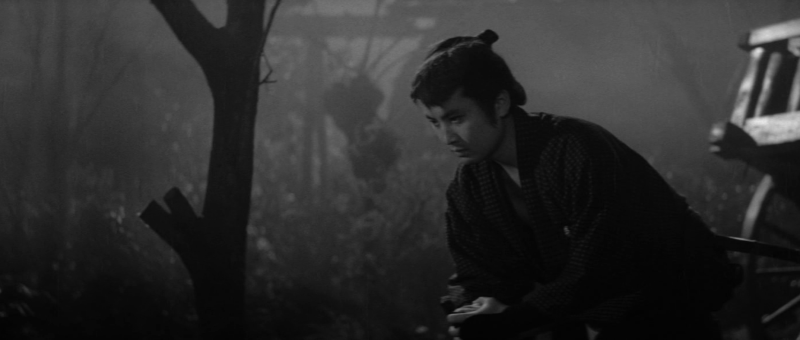
The final showdown takes place in a windswept clearing filled with Kato’s trademark mist as Ginji finally picks a side only to realise that that in the end he will always be a wanderer, a rootless figure whose only home is the road. Kato shoots a little higher than he would subsequently but still rests a little lower than the norm, emphasising a sense of destabilisation in Ginji’s volatility along with a painful longing that keeps him a lonely soul lost in the fog and on perpetual journey towards a long forgotten home. 


Ghost in the Regiment (憲兵と幽霊, Nobuo Nakagawa, 1958)

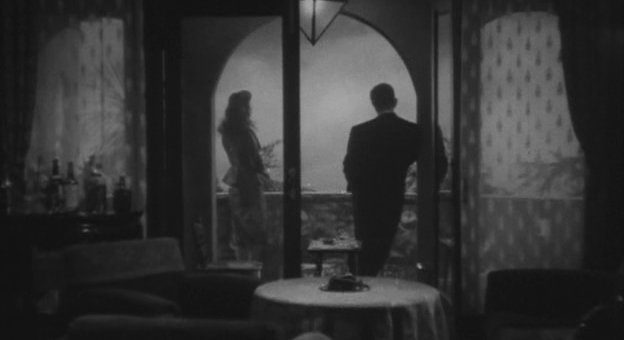
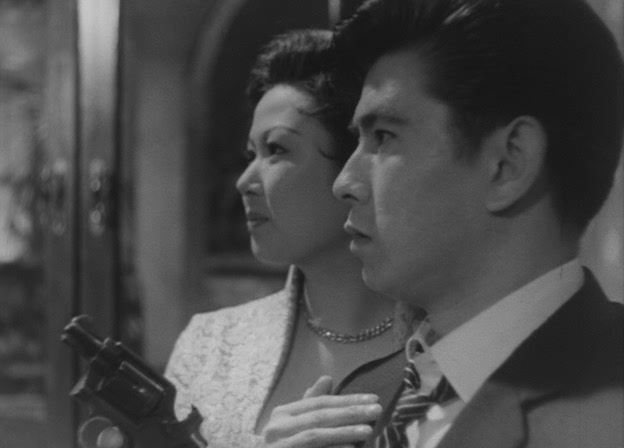
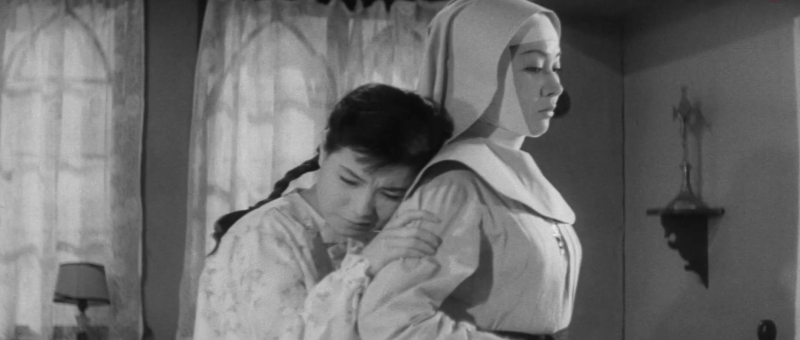
A treacherous military police officer comes to embody the evils of war in Nobuo Nakagawa’s eerie psychological horror, Ghost in the Regiment (憲兵と幽霊, Kenpei to Yurei). Kyotaro Namiki’s The Military Policeman and the Dismembered Beauty (憲兵とバラバラ死美人, Kenpei to Barabara Shibijin) had been a big hit the previous year so studio head Mitsugi Okura tasked Nakagawa with producing something similar at which point he proposed a film centring on “treachery and patriotism”. The Japanese title closely resembles that of Namiki’s film in beginning “the military policeman and…” as if it were a continuation of an ongoing series but is otherwise unrelated and could even be interpreted to suggest that the protagonist is both malevolent supernatural entity and military policeman. 

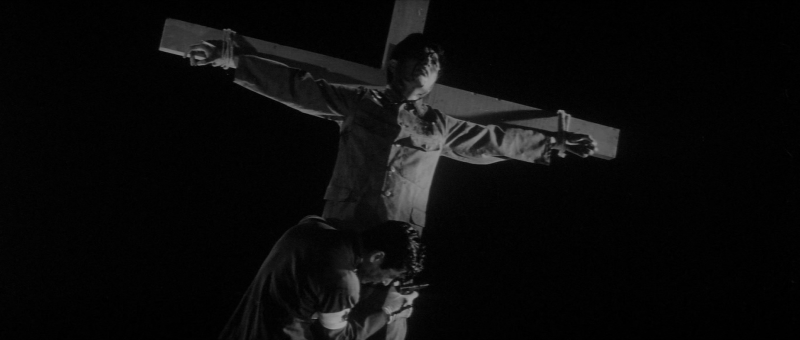
Lieutenant Namishima (Shigeru Amachi) is indeed later described as “the embodiment of evil” and his desire for conquest, in this case of a woman about to marry another man whom he will eventually win and discard, is reflective of the destructive lust for imperialist expansion. When Akiko (Naoko Kubo) marries another member of the military police, Tazawa (Shoji Nakayama), in the autumn of 1941, Sergeant Takashi (Fujio Murakami) jokes with Namishima that he has “failed to win the girl”, but Namishima merely smirks and explains that he’s playing a long game, “The true spirit of a warrior is found in the final victory.” Soon after he frames Tazawa for having stolen secret documents he himself has sold to Chinese spy Zhang (Arata Shibata), subjecting him to heinous torture and having both Akiko and his mother (Fumiko Miyata) tortured in front of him to force Tazawa to confess. Thereafter he has him executed by firing squad but Tazawa, strung up on a cross, continues to protest his innocence until the final moment issuing a curse on all those that have wronged him. 

Unlike some of Nakagawa’s other films, the ghosts here are less supernatural than they are psychological. Namishima has frequent flashbacks and visions that remind him of his crimes and is quite literally haunted by his guilt while refusing to admit that he feels any. It seems that he harbours strong resentment towards the military and implicitly towards the militarist regime and emperor having been rejected by the military academy because his father had committed suicide. His treachery is revenge but also equal parts self-destruction and a wilful bid to assert himself through his transgressions marvelling at his success in becoming the sort of person who could betray his own country and kill his own people. Both Tazawa and his brother (also played by Shoji Nakayama), who later joins the military police hoping to investigate the circumstances of his death, were graduates of the military academy and therefore idealised cogs in the military machine. 

Somewhat uncomfortably, the righteousness of Tazawa’s brother effectively legitimises the militarists in suggesting that a man like Namishima is an aberrance unreflective of the militarist ideal. “Ignoring the innocent goes against all the military police stand for”, Tazawa earnestly tells Namishima when he attempts to cut corners framing another suspect for his own ends, lending the military police an air of legitimacy they may not have had in reality when we might ask ourselves what exactly it was that they “stood for” which is more likely the nihilistic amorality to which the narcissistic Namishima subscribes. As he said, women lose their lustre once he’s got them. Having pretended to be a friend to Akiko in her widowhood, he rapes her during an air raid and it’s at this point that Japan begins rapidly losing the war as Namishima’s moral decline mirrors the fortunes of his nation. Having got what he wanted, he callously discards her and is transferred to Manchuria where he continues to work with Zhang and his wife, Ruri/Honglei (Yoko Mihara), with whom he has something like a more genuine romance.

His crimes will, however, catch up with him and it’s in Manchuria that his schemes begin to unravel not least because of the unsettlement that the presence of Tazawa’s brother, who has been seconded to his unit, causes him. The film’s surreal conclusion takes place in a Christian graveyard with Namishima surrounded by crosses which align with the crucifix on which Tazawa was executed. The crucifix itself would have no particular religious connotation in Japan and is simply a convenient way of constraining someone for execution but here takes on a symbolic dimension in confronting Namishima with his sins of transgression. Soon he is surrounded by hundreds of Tazawas on crosses, echoing the many men who were in effect murdered by the imperialist regime in a war fuelled by the same lust for conquest that motivated Namishima. Nakagawa’s camera takes on the role of an observer, sometimes comically swooping between talking heads as if following an ongoing conversation while later rocking in unsteadiness as Namishima begins to lose his grip on reality, finally confronted with the “ghosts” that surround him. 


Original trailer (no subtitles)
The Hidden Fortress (隠し砦の三悪人, Akira Kurosawa, 1958)

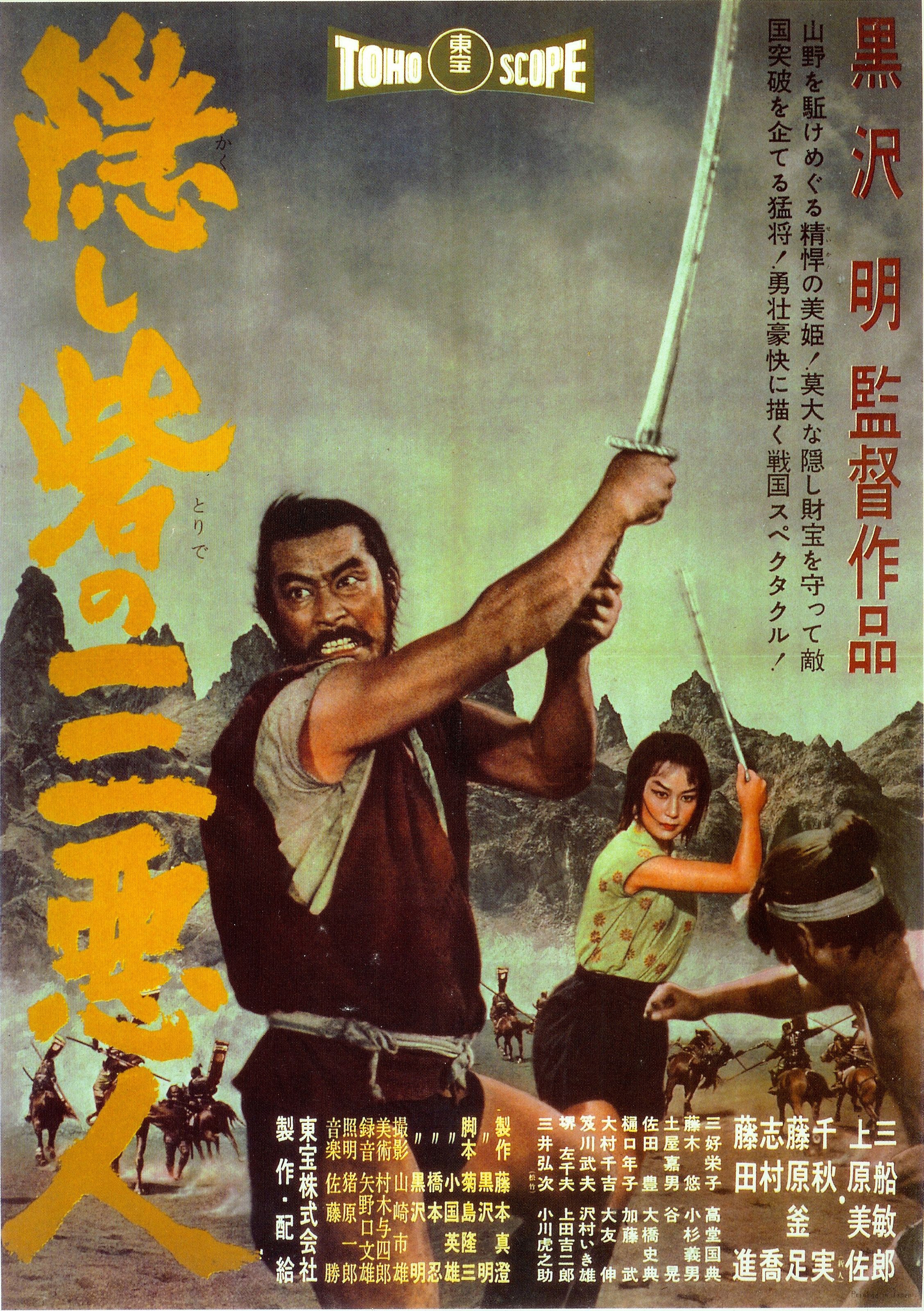
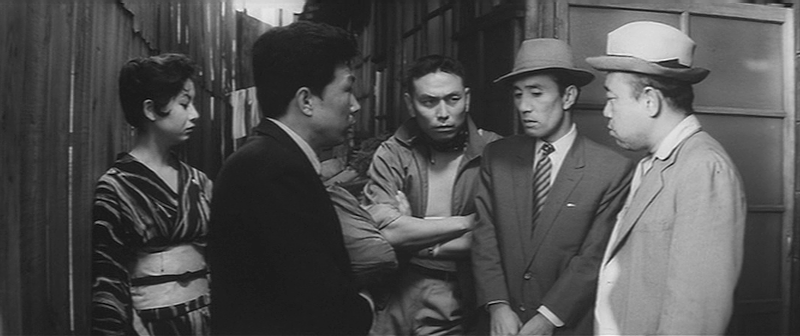
“Your kindness will harm you” a well-meaning retainer advises his charge, but in the end it is her kindness which saves her along with numerous others in Akira Kurosawa’s Sengoku-era epic, The Hidden Fortress (隠し砦の三悪人, Kakushi Toride no San Akunin). Largely told from the point of view of two bumbling peasants trying to get rich quick by exploiting the hierarchal fluidity of a time of war, the film nevertheless cuts against the grain of the democratic era in advocating not so much the destruction of the class-bound feudal order as benevolent authority. 

This can quite clearly be seen in the dynamic figure of displaced princess Yuki (Misa Uehara), the successor of her routed clan protected by a hidden fortress in the mountains which she must eventually leave. Her female servant laments that her father raised her as a boy which has given her a haughty and dominant manner at odds with the polite submissiveness usually expected of upperclass women. While often exerting her authority, she is otherwise uncomfortable with the uncritical servitude of her retainers, chief among them the talented general Makabe (Toshiro Mifune) who sacrificed the life of his own sister, allowing her to be executed in Yuki’s place buying them some time. “Kofuyu was 16. I am 16. What difference is there in our souls?” she asks, yet even if she believes their souls are equal she is not quite so egalitarian as to forget her position or the power and privilege that comes with it. 

Nevertheless, hers is an authority that is tempered by compassion and in the end chosen. Her salvation comes in speaking her mind to an enemy retainer, Tadokoro (Susumu Fujita), who has been savagely beaten by his own lord for losing a duel with Makabe who, to the mind of some, humiliated him with kindness in refusing to take his life leaving him to live in defeat. Yuki says she doesn’t know who is stupider, Tadokoro or his lord, for never would she punish a man in such a way simply for losing to an enemy. She tells him that there is another way, and that he need not serve a lord who does not serve him leading Tadokoro to defect and choose to follow her instead. 

She also inspires confidence in a young woman she insists on redeeming after discovering that she is a former member of the Akizuka clan sold into sexual slavery after being taken prisoner by the Yamane. Kurosawa presents the girl with a dilemma on realising that the mysterious woman who saved her is the fugitive princess, knowing that she could betray her and pocket the gold, but finds her resolving to serve Yuki all the more. In a moment of irony, we learn that the girl was bought for five silver coins, the same amount of money a wealthy traveller offers for Makabe’s horse, but displeases her master in refusing to speak or serve customers. For Yuki he offers gold, though withdraws on being told that she is mute. Knowing that she would be unable to disguise her speech or accent which would instantly give her away as a haughty princess, Makabe convinces her to stay silent though as she tells him he cannot make her heart mute too. 

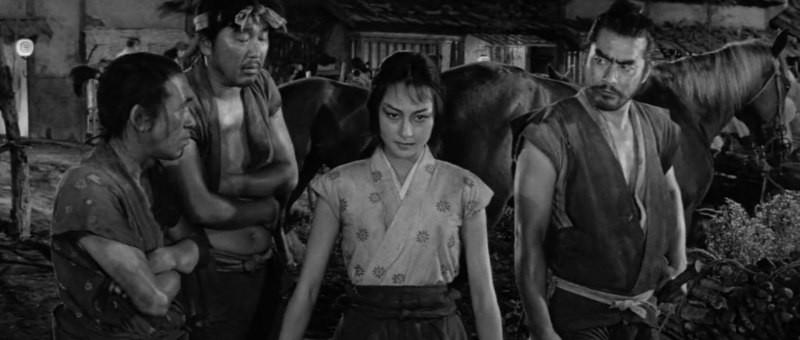
Even the peasants, oblivious to her true identity, view Yuki as part of the spoils insisting that they should be entitled to a third of her too and at one point preparing to rape her only to be fought off by the rescued girl. “We can rely on their greed” Makabe had said, knowing that their material desires make them easy to manipulate and that their loyalties are otherwise fickle. Matashichi (Kamatari Fujiwara) and his friend Tahei (Minoru Chiaki) sold their houses in their village to buy armour in the hope of achieving social mobility through distinguishing themselves in war, but have largely been humiliated, robbed of their armour, mistaken for captured members of the enemy, and forced to dig the graves of others. They pledge eternal friendship but their bond is continually disrupted by the promise of monetary gain. They fall out over a moral quandary, one willing to plunder the body of a fallen soldier and the other not, while even on reuniting squabbling about how to divide the money first deciding it should be equal and immediately disagreeing as soon as they get their hands on it. At the film’s conclusion it rests on Yuki to play mother, telling them that they must be good and share the boon she’s given them equally without complaint each then too only quick to be generous insisting that the other can keep it. 

The implication is still, however, that Matashichi and Tahei should return to their village to live as peasants while Yuki assumes her place in a castle no longer hidden as its ruler. Order has returned and the old system remains in place, all that changes is that this is now a compassionate autocracy ruled by a benevolent lord who views her subjects lives as equal to her own yet not perhaps their status. Where it might prompt Tadokoro to conclude that he need serve no lord at all for there should be no leaders only equals, the film concludes that a leader should be just and if they are not they should not be followed. Then again, the disagreement between firm friends Matashichi and Tahei is ended when they each have enough and no longer find themselves fighting for a bigger slice of the pie content in the validation of their equality. As Makabe puts it, heavy is the head that wears the crown. Yuki’s suffering is in the responsibility of rebuilding her clan though she does so with compassion and empathy ruling with respect rather than fear or austerity. Kurosawa utilises the novel scope format to hint at the wide open vistas that extend ahead of the peasants as they make their way towards the castle in search of gold only to leave with something that while more valuable may also shine so brightly as to blind them to the inherent inequalities of the feudal order. 


The Hidden Fortress screens at the BFI Southbank, London on 20th & 27th January 2023 as part of the Kurosawa season.

Flesh Pier (女体桟橋, Teruo Ishii, 1958)

Teruo Ishii may be most closely associated with his exploitation work for Toei in the late ‘60s and ‘70s but in actuality he began his career at Toho, later joining Shintoho where he served as an AD to among others Mikio Naruse whom he regarded as a lifelong mentor. After making his debut with boxing movie King of the Ring: The World of Glory in 1957, he worked mainly in children’s sci-fi tokusatsu serials before sliding into B-movie noir of which 1958’s Flesh Pier (女体桟橋, Nyotai sanbashi) is an early example. 

Set firmly in the contemporary era, Ishii opens with a documentary-style voiceover exoticising the seedy underbelly of the city’s entertainment district hidden away in otherwise sparkling Ginza. Shooting in a bold reportage style, he captures a sense of natural spontaneity reminiscent of early American independent cinema transitioning directly into nightclub Arizona where a woman is furiously dancing. Arizona is as we’ll see the nexus of the recent proliferation of “call girl” businesses which have arisen since sex work was criminalised and in this case at least dependent on an international sex trafficking network backed by an American gangster, Thompson (Harold Conway). Salaryman Keizo (Ken Utsui) is a new customer, double checking that the business is “safe” before being reassured that they don’t deal with anyone they don’t know and have already vetted his identity, but when he reaches the hotel room he’s been handed the key for, he discovers the body of a woman lying in the bathtub and is forced on the run. The twist is that Keizo isn’t a bored executive after all but an undercover policeman working on breaking the trafficking ring. 

Co-scripted by Akira Sagawa, Flesh Pier seems to draw frequent inspiration from Casablanca only with the roles slightly reversed as replacement hostess Rumi (Yoko Mihara) finds herself wondering why of all the gin joints in Ginza Keizo had to walk into hers while the bar’s musician, Teruo (Teruo Hata), quite clearly in love with her himself, completes the triangular relationship. The couple even enter a Moroccan-style room while echoing Rick and Ilsa’s painful rehash of their Paris break up as Rumi tries and fails to explain why she left him on some previous occasion, Keizo remembering that she wore a white sweater and a blue coat to mimic Rick’s “the Germans wore grey, you wore blue” while the film’s ending is also hugely reminiscent of Casablanca’s “beginning of a wonderful friendship” only with additional romance. 

Nevertheless, the crime here is bigger and darker than most contemporary noir with awkward echoes of Japan’s prewar sex trafficking industry embodied by the karayuki as it becomes clear the gang’s business model relies on finding young women and luring them abroad with promises of good jobs only to force them into them sex work. Meanwhile one of the regular policemen, Hayami (Hiroshi Asami), gets a shock when he sets up a meeting with one of the call girls and is met by his own fiancée who, unbeknownst to him, has resorted to sex work in order to fund her brother’s tuition. “What else could I do?” she tearfully asks him making plain that in the difficult if improving economic environment of late 50s Japan sex work is still the only viable option for many women needing to support their families in the absence of men given persistent societal sexism which often locks them out of other kinds of well-paying jobs. Hayami perhaps understands this, drowning his sorrows with his veteran partner insisting that he’s sick of being a policeman and plans to quit only for the older man to sympathetically tell him not to give up so easily. 

Then again, Keizo’s secondary love interest Haruko (Akemi Tsukushi) is an intrepid undercover reporter posing as a model in order to bait the trafficking ring. Even so the primary drama revolves around Keizo and Rumi’s unfinished business along with her musician’s jealousy, the implication being more that her feelings for Keizo have clouded her judgement rather than reawakened a sense of moral goodness. Like many femme-fatales in post-war B-movie noir she is made to pay the ultimate price for her transgressive femininity in having firstly climbed the in-gang ladder and then damned herself in her conflicted love for the earnest Keizo even while suspecting he may be an undercover cop despite his acting like an underworld thug. These are indeed a new breed gangster much more like those seen in European and American noir rather than traditional yakuza while the environment of the Arizona is also something of a liminal space as the opening voiceover puts it in but not of Japan. 

While nowhere near as lurid as some of Ishii’s later work, Flesh Pier is certainly daring for the time period in the griminess with which it depicts the successor to the red light districts along with its air of forbidden allure even while its club scenes are in keeping with those found in other contemporary gangster tales if lent a little more realism in the immediacy with which Ishii shoots them making full use of documentary-style handheld. Expressing a degree of anxiety as regards Japan’s increasingly global outlook along with that of increasing social change, Flesh Pier is formally daring from the young Ishii artfully playing with classic noir while fully embracing the transgressive thrills of B-movie crime. 


Black Cat Mansion (亡霊怪猫屋敷, Nobuo Nakagawa, 1958)

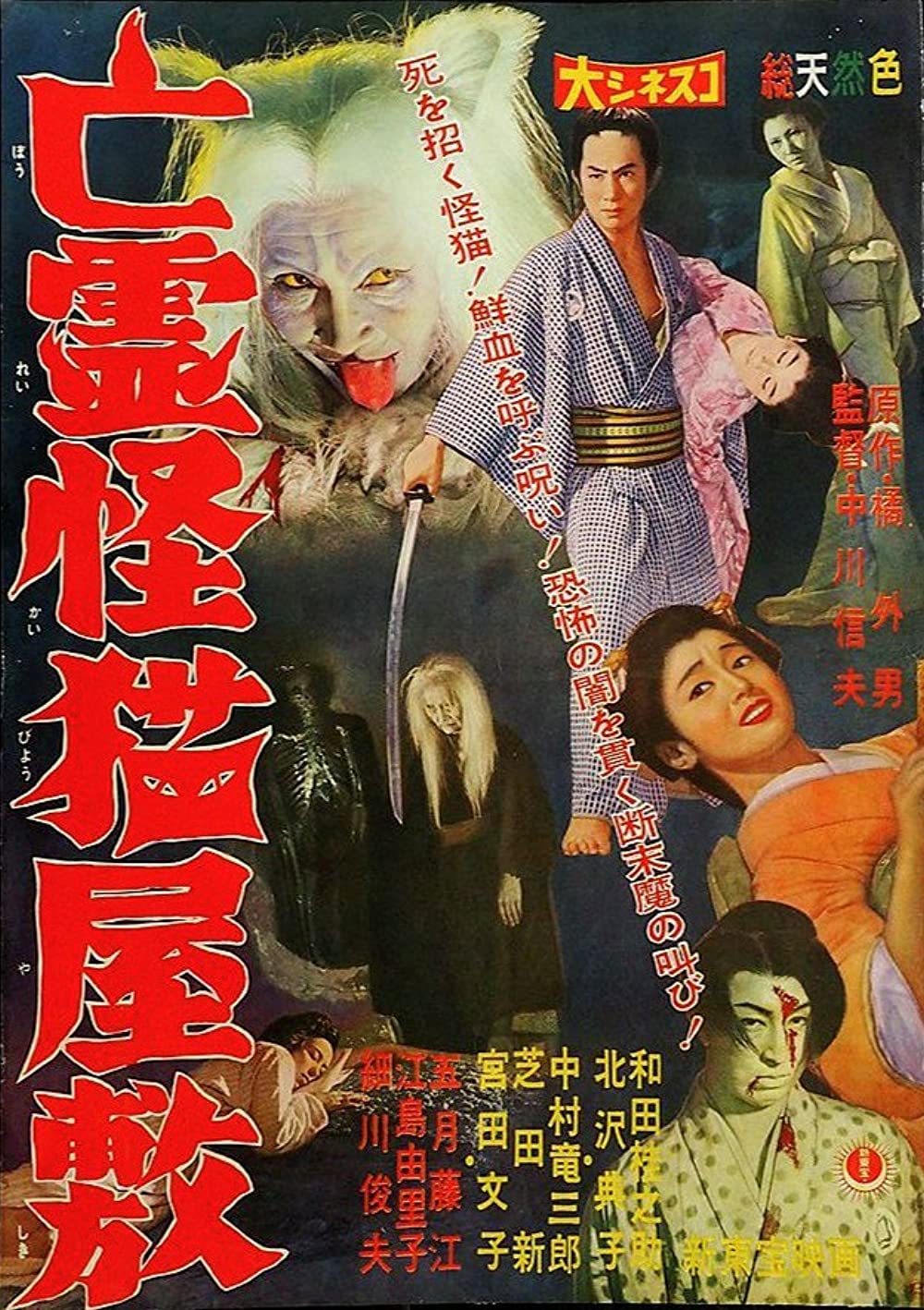
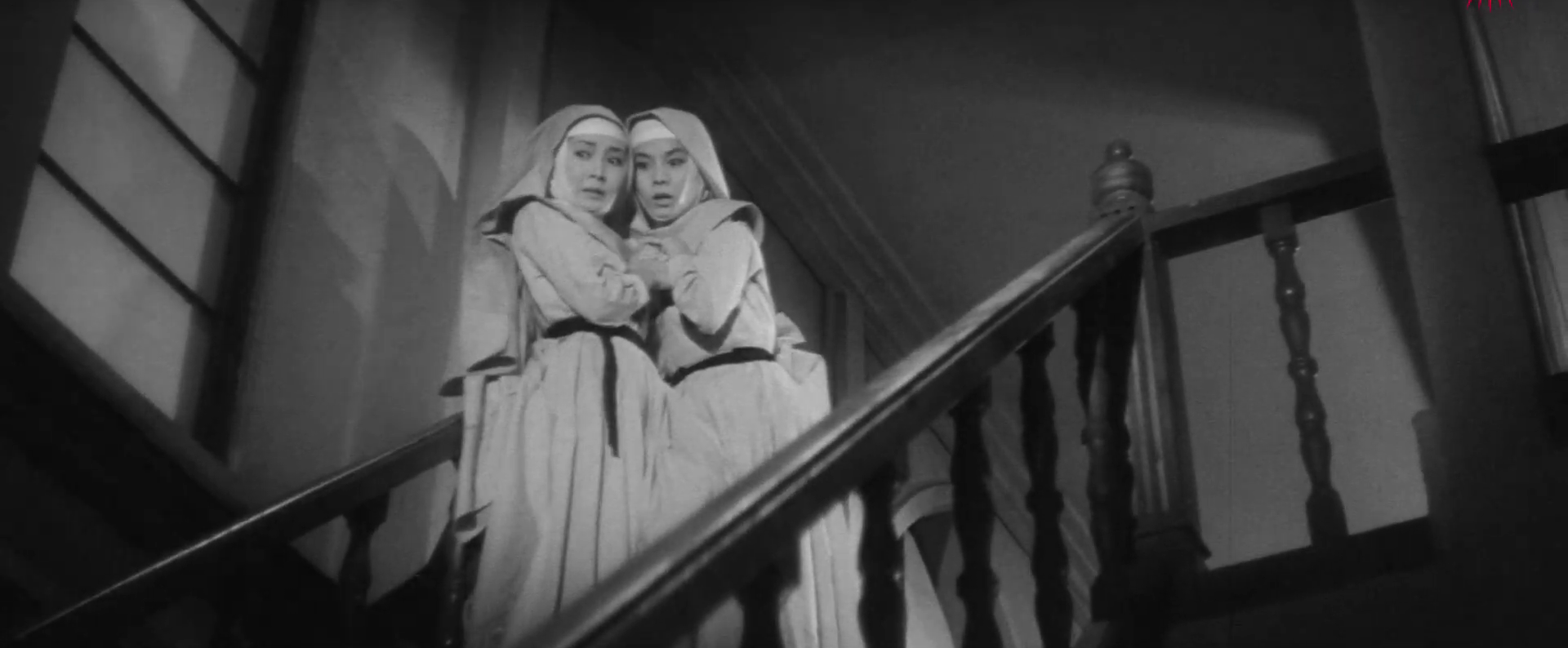
A doctor and his wife find themselves at the mercy of an ancestral curse in Nobuo Nakagawa’s eerie gothic horror, Black Cat Mansion (亡霊怪猫屋敷, Borei Kaibyo Yashiki, AKA Mansion of the Ghost Cat). Most closely associated with the supernatural, Nakagawa’s entry into the ghost cat genre is among his most experimental outside of avant-garde horror Jigoku released two years later. Employing a three level flashback structure spanning the modern day, six years previously, and then all the way back to Edo, Nakagawa positions contemporary Japan as a kind of haunted house with skeletons in its closet which must finally be exposed and laid to rest if society is to recover from the sickness of the feudal legacy. 

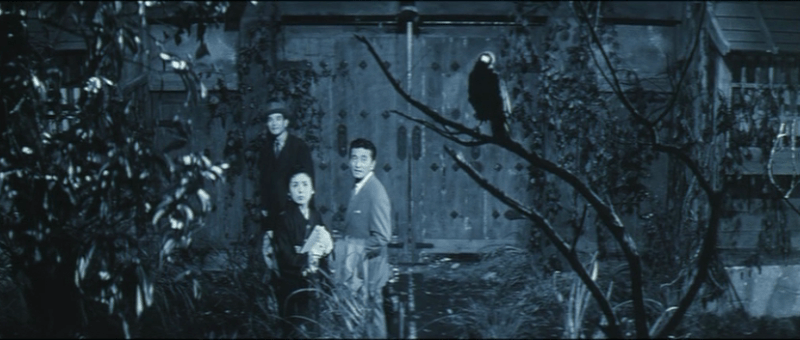
Nakagawa opens, however, with an ethereal POV shot in blue-tinted monochrome of a doctor walking through a darkened hospital armed only with a torch while a pair of orderlies silently remove a corpse on a gurney right in front of him. A man of science, the doctor, Tetsuichiro (Toshio Hosokawa), confesses that he’s tormented by the sound of footsteps on this “evil night” which remind him of a strange series of events that took place six years previously while his wife Yoriko (Yuriko Ejima) was suffering from advanced tuberculosis. In an effort to aid her recovery the couple left Tokyo to return to her hometown in the more temperate Kyushu. Yoriko’s brother Kenichi (Hiroaki Kurahashi) expresses concern over his sister’s health, wondering if she wouldn’t be better to have an operation but Tetsuichiro explains that at this stage an operation might only make things worse so they’re hoping the quiet and fresh air will allow her lungs to recover more quickly. Kenichi has sorted out a place for them to live in an abandoned mansion but the house is extremely dilapidated and in fact barely habitable especially for someone suffering with a debilitating medical condition in which it might be sensible to avoid dusty environments. Nevertheless, the couple fix the place up and Tetsuichiro opens a surgery in the front room. 

For Yoriko, however, the house is full of foreboding. On their journey there, the driver had to swerve to avoid a black cat running out in the road, nearly careering off the side of mountain, while she is also alarmed to see a crow malevolently perching on a tree outside the mansion. Once inside, she glances into a storehouse by the entrance and thinks she sees a creepy old woman silently grinding corn. Tetsuichiro sees nothing when he checks it out, but is strangely unperturbed when Yoriko spots what seems to be a bloodstain on a bedroom wall insisting that they can paint over it while the footprints of someone walking barefoot through the dusty house are probably unrelated and belong to a homeless person who’s since moved on. For a man of science, Tetsuichiro is doing a lot of overlooking but seems to believe that his wife’s distress as she continues to complain of bad dreams featuring rabid cats and the creepy old woman is mere “hysteria” provoked by the mental stress and anxiety of living with a potentially fatal medical condition. 

Unfortunately for him, however, vengeful cat spirits don’t care if you believe in them or not, what sort of person you are, or even if you have any real connection to whatever it was that turned them into a vengeful cat spirit in the first place. A visit to a local Buddhist priest reveals, in a vibrant colour filled with kabuki-esque shadows on the shoji, the reasons everyone thought the house was haunted which stem back to the Edo era and an entitled samurai lord with anger management issues, Shogen (Takashi Wada). Shogen hires a local Go master, Kokingo (Ryuzaburo Nakamura), to teach him the game and is enraged by Kokingo’s lateness for the appointment which is attributed to the fact that his mother is blind but is actually more to do with his cat’s severe separation anxiety. 

Taking this as a personal slight to his position, Shogen attacks his loyal servant Saheiji (Rei Ishikawa) and is only prevented from killing him by his levelheaded son (Shin Shibata) who makes a point of asking his grandmother to keep an eye on his dad because he’s worried his famous temper will cause embarrassment to the family. He is right to worry. Shogen takes exception to Kokingo right away, insisting on playing a “real” game but asking for take backs every five seconds when Kokingo makes a winning move. Fed up with Shogen’s behaviour, Kokingo brands him a cheat and threatens to leave the game. Shogen is once again enraged and fight develops during which Kokingo is killed. Shogen threatens Saheiji into helping him dispose of the body by walling it up inside an adjacent room while telling his mother that Kokingo was so embarrassed over losing to him that he’s gone off  in a huff for additional study in Kyoto and Osaka. Shogen doesn’t even stop there, raping Kokingo’s mother when she starts asking questions after seeing her son’s ghost leading her to commit suicide after cursing his entire family and instructing Kokingo’s beloved cat to lap up her blood and imbibe her wrath to become a vengeful cat spirit. 

Shogen is all the worst excesses of the samurai class rolled into one, narcissistic, angry and entitled as he uses the exploitation of those below him to foster a sense of security in his authority. As in any good ghost tale, the vengeful spirits distort his sense of reality forcing him to destroy himself out the guilt he refuses to feel. His son, Shinnojo, meanwhile is positioned as a good, progressive samurai determined to marry the woman he loves even though she is only a maid and therefore of a lower social class while often transgressively denouncing his father’s bad behaviour. That matters not to the ghost seeing as the curse is to Shogen’s entire bloodline meaning Shinnojo must to die and most likely at the hands of his father caught in a delusion trying to fight the ghosts of his past crimes. 

Tatsuichiro and Yoriko are “innocent” too though as it turns out Yoriko does have a connection to the house and the crimes of the past. They are still, however, trapped within the embodiment of the feudal legacy that is the former samurai mansion. Tatsuichiro’s determination that they can simply “paint over” the bloodstain is in many ways the problem and one reaching a crescendo in post-war Japan as it struggles to deal with the trauma of the immediate past while freeing itself of the latent feudalism which in part caused it. Only by facing the ghost, unearthing the bodies buried in the walls and laying them to rest, can they ever hope to make a recovery both spiritually and medically. Tatsuichiro at least seems to have cured himself even if left with a lingering sense of unease while his apparently now healthy wife seems to have overcome her fear of cats in the relative safety of modern day Tokyo. 


Original trailer (no subtitles)

Equinox Flower (彼岸花, Yasujiro Ozu, 1958)

Japanese golden age cinema is famed for its centring of female stories, but while it’s true that many of Yasujiro Ozu’s family dramas revolve around a young woman’s feelings towards marriage, the perspective is often surprisingly male. Equinox Flower (彼岸花, Higanbana), his first film in colour, marks something of a change in direction in its spirited defence of the young, but at heart is still a story as much about impending old age, the responsibilities of fatherhood, and changing times as it is about contemporary family dynamics or female agency. 

The father in question, Hirayama (Shin Saburi), is a high ranking executive with two daughters. The older, Setsuko (Ineko Arima), is working at another company, and the younger, Hisako (Miyuki Kuwano), is still in school. Marriage is on his mind because he’s just attended the wedding of an old school friend’s daughter at which he gave a speech, with his wife Kiyoko (Kinuyo Tanaka) sitting awkwardly next to him, describing the arranged marriage he had with her as “pragmatic, routine” while he envies the young couple’s “fortunate opportunity” to indulge in romance. He and Kiyoko idly discuss the idea of Setsuko’s marriage, it seems as if there is a promising match on the horizon, with Hirayama conflicted while Kiyoko is very much in favour of doing things the traditional way. She’s already mentioned it to her daughter, but all she does is smile demurely which seems to provoke different interpretations from each of the parents. 

While thinking about all of that, Hirayama receives a visit from an old friend who was a notable absence at the wedding asking him to check up on his daughter Fumiko (Yoshiko Kuga) who ran away from home two months ago to live with a musician after he tried to veto her intention to marry without consulting him. Hirayama is sympathetic, perhaps thinking his friend has acted foolishly and pushed his daughter away. After visiting the bar where she works, he comes to the conclusion that as long as she’s happy with her choice then everyone else should be too. That all goes out the window, however, when a young man, Taniguchi (Keiji Sada), visits him unexpectedly at work and asks for permission to marry Setsuko. Hirayama quite rudely asks him to leave and then irritatedly talks the matter over with Setsuko before petulantly refusing his consent, not because he objects to Taniguchi, but because he is hurt on emotional level that she hadn’t talked to him about this first (not least so that they stop worrying about arranging a marriage) while resentful that she’s gone behind his back and undercut his patriarchal authority. 

In addition to the changing nature of family dynamics, Hirayama is perhaps conscious of his advancing age, feeling himself increasingly obsolescent and therefore additionally wounded by this assault on his authority as a father. The generation gap, however, is all too present. Both Setsuko and Fumiko feel as if they simply cannot talk to their parents because they wouldn’t listen and will never understand. Yukiko (Fujiko Yamamoto), the daughter of another friend, feels something similar in her exasperation with her well-meaning single mother who keeps hatching plans to set her up with various men she isn’t interested in. Intellectually, Hirayama sides with the young, envying them their freedoms and advising Yukiko firstly not to marry at all, and then encouraging her desire to resist arranged marriages despite trying to foist them on his own daughters. 

Even Kiyoko eventually describes her husband’s continuing petulance as “inconsistent”. It seems obvious that Kiyoko is siding with her daughter, immediately taking a liking to Taniguchi who politely brought her home after she stormed out following an argument with her father, but she continues to behave as a “good wife” should, politely minding her husband while gently hoping that he will eventually come round. Only once pushed does she try to explain to him, again politely, that he’s being selfish and unreasonable, but he continues on in resentment while causing his daughter emotional pain simply for trying to find her own happiness rather letting him decide for her. Kiyoko is afraid that if it carries on like this, then Setsuko will, like Fumiko, eventually leave and they’ll lose her completely, something which Hirayama either hasn’t fully considered or is actively encouraging through his petulance. 

In the end the conclusion he comes to is that the parents will eventually have to give way or risk losing their children entirely. He tells both Fumiko and Yukiko that all parents want is for their children to be happy and so nothing else matters, but struggles to put his advice into practice when it comes to his own daughter. Like pretty much everyone in an Ozu film, Hirayama is a good, kind person, even if one struggling against himself as he contemplates a loss of authority, a change in standing, and the difficulty of dealing with complex emotions as a man in a patriarchal society. Predictably, it’s women who essentially bully him into making better decisions, Yukiko “interfering” in the nicest of ways, while his wife makes it clear that though she thinks he’s wrong she will continue to stand by him if only in the hope he will eventually see the light. “Life is absurd, we’re not all perfect” he admits, only later realising how his stubborn foolishness may have caused unnecessary suffering to those he loves the most.


Currently streaming in the UK via BFI Player as part of Japan 2020. Also available to stream in the US via Criterion Channel.

Original trailer (no subtitles)