Birds Without Names (彼女がその名を知らない鳥たち, Kazuya Shiraishi, 2017)

Birds Without Names poster“Human beings are lonely by nature”, a statement offered by someone who could well think he’s lying but accidentally tells the truth in Kazuya Shiraishi’s Birds Without Names (彼女がその名を知らない鳥たち, Kanojo ga Sono Na wo Shiranai Toritachi). Loneliness, of an existential more than physical kind, eats away at the souls of those unable to connect with what it is they truly want until they eventually destroy themselves through explosive acts of irrepressible rage or, perhaps, of love. The bad look good and the good look bad but appearances can be deceptive, as can memory, and when it comes to the truths of emotional connection the sands are always shifting.

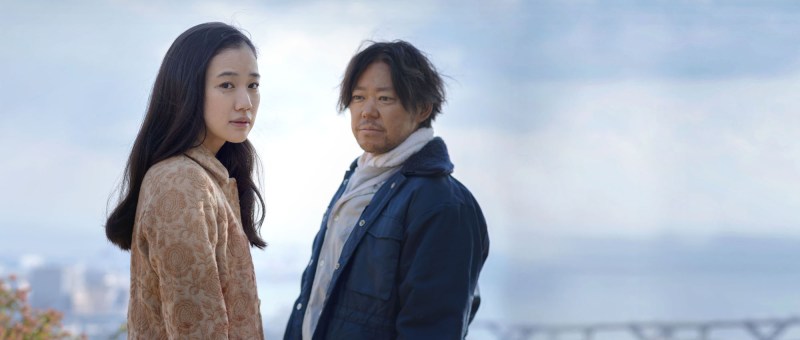
Towako (Yu Aoi), an unmarried woman in her 30s, does not work and spends most of her time angrily ringing up customer service departments to complain about things in the hope of getting some kind of compensation. She lives with an older man, Jinji (Sadao Abe) – a construction worker, who is completely devoted to her and provides both financial and emotional support despite Towako’s obvious contempt for him. Referring to him as a “slug”, Towako consistently rejects Jinji’s amorous advances and resents his, in her view, overly controlling behaviour in which he rings her several times a day and keeps general tabs on her whereabouts.

Depressed and on edge, Towako’s life takes a turn when she gets into a dispute with an upscale jewellery store over a watch repair and ends up beginning an affair with the handsome salesman who visits her apartment with a selection of possible replacements. Around the same time, Towako rings an ex-boyfriend’s number in a moment of weakness only to reconsider and hangup right away. The next day a policeman arrives and informs her that they’ve been monitoring her ex’s phone because his wife reported him missing five years ago and he’s not been seen since.

Towako views Jinji’s behaviour as possessive and his continuing devotion pathetic in his eagerness to debase himself for her benefit. Her sister Misuzu (Mukku Akazawa), however, thinks Jinji is good for her and berates Towako for her ill treatment of him. Despite the fact that Towako’s relationship with her ex, Kurosaki (Yutaka Takenouchi), ended eight years previously, Misuzu is paranoid Towako is still seeing him on the sly and will eventually try to get back together with him. Misuzu does not want this to happen because Kurosaki beat Towako so badly she landed in hospital, but despite this and worse, Towako cannot let the spectre of Kurosaki and the happiness promised in their earliest days go. She continues to pine for him, looking for other Kurosakis in the form of other handsome faces selling false promises and empty words.

Mizushima (Mukku Akazawa), the watch salesman, is just Towako’s type – something which Jinji seems to know when he violently pushes a Mizushima look-alike off a busy commuter train just because he saw the way Towako looked at him. Daring to kiss her when she abruptly starts crying while looking at his replacement watches, Mizushima spins her a line about an unhappy marriage and his craving for solitude which he sates through solo travel – most recently to a remote spot in the desert and cave they call an underground womb. Mizushima describes himself as a lonely soul and claims to have found a kindred spirit in Towako whose loneliness it was that first sparked his interest. Like all the men in the picture, Mizushima is not all he seems and there is reason to disbelieve much of what he says but he may well be correct in his assessment of Towako’s need for impossible connections with emotionally unavailable men who only ever cause her pain.

It just so happens that Kurosaki’s apparent disappearance happened around the time Towako began dating Jinji. Seeing as his behaviour is often controlling, paranoid and, as seen in the train incident, occasionally violent, Towako begins to suspect he may be involved in the mysterious absence of her one true love. Then again, Towako may well need protecting from herself and perhaps, as Misuzu seems to think, Jinji is just looking out for her. The deeper Jinji’s devotion descends, the more Towako’s contempt for him grows but the suspicion that he may be capable of something far darker provokes a series of strange and unexpected reactions in the already unsteady Towako.

A dark romance more than noirish mystery,  Birds Without Names takes place in a gloomy Osaka soaked in disappointment and post-industrial grime where the region’s distinctive accent loses its sometimes soft, comedic edge for a relentless bite in which words reject the connection they ultimately seek. Rejection, humiliation, degradation, and a hopeless sense of incurable loneliness push already strained minds towards an abyss but there’s a strange kind of purity in the intensity of selfless love which, uncomfortably enough, offers salvation in a final act of destruction.


 Screened as part of the Japan Foundation Touring Film Programme 2018.

Also screening at:

  • Firstsite (Colchester) 9 February 2018
  • HOME (Manchester) 12 February 2018
  • Watershed (Bristol) – 13 February 2018
  • Exeter Phoenix – 27 February 2018
  • Depot (Lewes) – 6 March 2018
  • Filmhouse (Edinburgh) – 8 March 2018

International trailer (English subtitles)
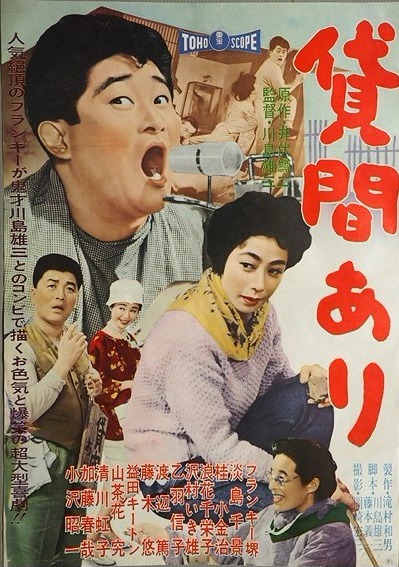
Room for Let (貸間あり, Yuzo Kawashima, 1959)

room for rent poster“Life is just goodbyes” exclaims a tenant of the small, rundown boarding house at the centre of Yuzo Kawashima’s Room for Let (貸間あり, Kashima Ari). Best remembered for his anarchic farces, Kawashima takes a trip down south to the comedy capital of Japan for an exploration of life on the margins of a major metropolis as a host of eccentric characters attempt to negotiate the difficult post-war economy, each in someway having failed badly enough to end up here. Though the setting is perhaps depressing, the lively atmosphere of the boarding house is anything but and the residents, depending on each other as a community of solidarity, know they have the ultimate resource at their disposal in the form of infinitely kind hearted, multi-talented fixer Goro Yoda.

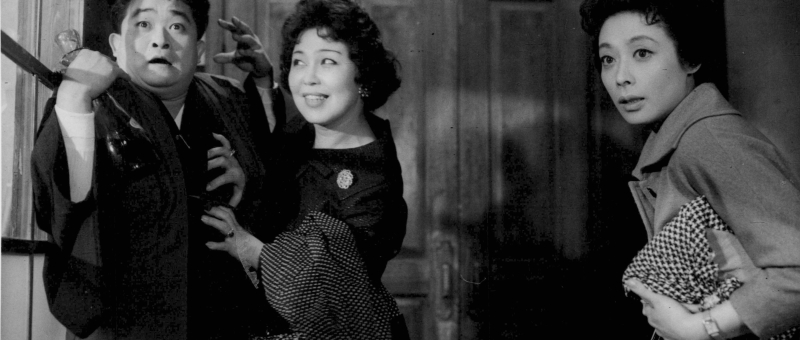
Our introduction to the boarding house follows the passage of an outsider, Yumiko Tsuyama (Chikage Awashima) – a ceramicist who wants to make use of Goro’s printing facilities, but to find him she’ll first have to run the gamut of eccentric residents from the batty bee keeper to the geisha currently trying to fumigate one of her patrons by riding him around the room and the henpecked husband who responds to his wife’s frequent shouts of “Darling!” with a military style “yes, sir!”. On her way to Goro’s jam packed annex, Yumiko notices a room to let sign along with a kiln in the courtyard which catches her eye. Taking a liking both to the room and to Goro, Yumiko moves in and subsequently gets herself involved in the oddly exciting world of an old-fashioned courtyard standing on a ridge above a rapidly evolving city.

Played by well known comedian Frankie Sakai (who played a similar role in Kawashima’s Bakumatsu Taiyoden of two years earlier), Goro is an awkward symbol of post-war malaise and confusion. Goro, a jack of all trades, is the man everyone turns to when they run into a seemingly unsolvable problem, and Goro almost always knows a way to solve them (for a price). His sign in the marketplace proclaims that he speaks several languages and is available for tutoring students, he’s written “how to” books on just about everything you can imagine, he knows how to make the perfect cabbage rolls and konyaku, ghostwrites serial fiction, and runs a small printing enterprise, yet Goro is not a scholar, (licensed) lawyer, doctor, or successful businessman he’s a goodhearted chancer living on his wits. He runs away from success and eventually from love because he doesn’t think he deserves it due his continuing “fakery”.

Despite his minor shadiness, Goro’s kindness and sincerity stand in stark contrast to the evils of his age. Like Goro, many of the boarding house residents are trying to get ahead through somewhat unconventional means including the bawdy lady from upstairs whose main business is blackmarket booze, the peeping-tom street punk who peddles dirty pictures near the station, and the sad young woman working as an independent geisha (Nobuko Otowa) to save enough money to marry her betrothed whom she hopes is still waiting for her at home in her tiny village. That’s not to mention the mad scientist bee keeper who can’t help describing everything he sees in terms of bees and has attempted to turn their apian secretions into a cream which increases sexual potency, or the enterprising landlady who realises she could charge a few more pennies for patrons who want to sit in a fancy seat or watch TV while they eat dinner.

Yumiko isn’t the only outsider sending shockwaves through the community, a young student armed with a camera and the determination to avoid parental disapproval, intends to petition Goro to take his exams for him. The aptly named Eto (Shoichi Ozawa) is a dim boy with seemingly infinite wealth who’d rather scheme his way to the top than invest his energy in getting there the honest way. In this he’s the inverse of Goro whose simple sincerity and easy going nature are, it is subtly suggested, partly the reason he hasn’t made his way in the increasingly duplicitous post-war society. Goro does, however, give in to Eto’s nefarious plan even if it conflicts with his otherwise solid honour code which also sees him turn down the “opportunity” of sleeping with his neighbour’s seemingly insatiable wife in one of the stranger requests coming in to his do anything shop.

Kawashima’s true mastery lies not in the myriad moments of small comedy that pepper the main narrative, but in the glorious way he brings them all together as a perfectly constructed farce. The residents of the boarding house (one of whom is so proud of the “room to let” sign he made that he doesn’t want to rent the room because then he’d have to take the sign down) each face their own difficulties and disappointments but even when darkness creeps in (suicides, arrest, sexual assault, and animal cruelty all raising their ugly heads) the absurd positivity and warmth of these ordinary Osakans seems to be enough to combat it. Life may be a series of goodbyes, but it must still be lived, at least to the best of one’s ability.


 Screened as part of the Japan Foundation Touring Film Programme 2018.

Also screening at:

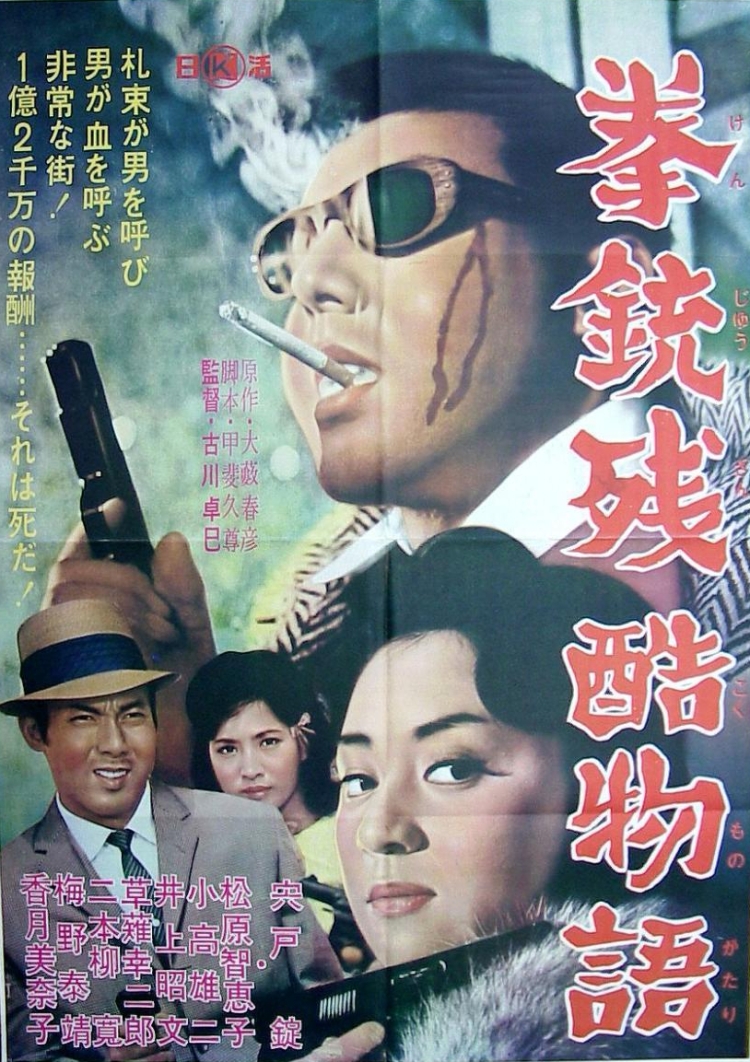
Cruel Gun Story (拳銃残酷物語, Takumi Furukawa, 1964)

cruel-gun-story-poster.jpgIn the history of Japanese noir, the name Haruhiko Oyabu looms large. Oyabu’s gritty, pulp infused tales of tough guy heroes found their clearest expression in the hardline ‘70s with Toru Murakawa’s unique brand of macho action as seen in Resurrection of the Golden Wolf or The Beast Must Die, but a decade earlier they were also finding fertile ground in Nikkatsu’s harder B-movie noir. Based on a novel by Oyabu, Cruel Gun Story (拳銃残酷物語, Kenju Zankoku Monogatari) seems to owe more than a little to Kubrick’s The Killing in its crime never pays tale of honest crooks undercut by their unscrupulous comrades but the central message is that the gun is a cruel master and those living under its control will pay a heavy price.

Togawa (Jo Shishido) has just been (unexpectedly) given early release from a prison sentence incurred when he took revenge on the truck driver who knocked down his little sister (Chieko Matsubara) and confined her to a wheelchair for the rest of her life. Middle rank gangster Ito – formerly a crooked lawyer with a pencil mustache a supercilious air, has a job for him the gang thinks only he can do. The payout is 120 million yen – not to be sniffed at, but Togawa has reasons to be suspicious. He takes some convincing but finally relents when he finds out an old and trusted friend, Shirai (Yuji Kodaka), has already agreed. The gang have another three guys lined up but Togawa rules the third one out when he tests him and confirms he’s an untrustworthy blabbermouth. The other two are a former boxer with mild brain damage whose girlfriend has just left him, and an unscrupulous but clever chancer named Teramoto (Kojiro Kusanagi).

Following the general pattern, Furukawa walks us through the heist as it’s supposed to go if everything goes to plan complete with a 3D diagram and plastic toy cars but, of course, not everything goes to plan. The job is to steal the ticket money from the Japan Derby (much like the race course robbery in The Killing). The gang will set up fake road signs and station a “policeman” to divert the armoured car onto a small country lane where they will kill the police motorcycle escort, get rid of the guards, and load the truck onto a bigger lorry that they will then take to a disused US airbase they’ll use as their lair.

Disused American airbase could easily apply to the entirety of the surrounding area. Jets fly ominously overhead while the world Togawa and his guys inhabit is one of noirish jazz bars filled with foreigners, grimy boxing clubs, signs in English and the relics of destruction everywhere. This is a place for those who’ve already fallen through the cracks, even the gangsters are only really small fry – not yakuza but hoodlums ripped straight from the Edward G. Robinson playbook. This giant heist is the most audacious in living memory, pulling it off would be the finest achievement any of them would ever make, taking them out of their dead end environments and catapulting them into the criminal high life.

Togawa knows there’s something not right about this – he almost turns it down because he wants to be around to take care of his sister, but he also wants the money to pay for an operation he hopes will restore her mobility to assuage his guilt over having sent her out on the fateful day she was injured. Rie now lives in the care of kindly nuns and is a goodhearted, religious woman hoping for her big brother’s reformation. Togawa and his sister are also victims of war having lost their parents during the evacuation from Manchuria and have been essentially on their own ever since. Rie has become a living symbol of Togawa’s failures – his inability to protect her, to keep them both safe and together, and to free them of the ruined post-war landscape within which they both remain trapped. Rie pins her hopes on God, but Togawa says to hell with that – where has He been so far?

Having pinned his hopes on the gun, Togawa intends this to be the heist to end all heists. After this, he’ll be free to give his sister the life she deserves away from crime and the rundown town strewn with mementos of a distant, dethroned occupying power. The gun, however, is a divisive weapon and engenders nothing but mistrust among men. Resentful of Togawa’s solid friendships, the other guys turn on him as do his shady employers sending Togawa even further along the dark path to moral ruination than he already was. All that’s waiting for Togawa is a hollow victory and the intense disappointment of those whose faith in him was ultimately misplaced.


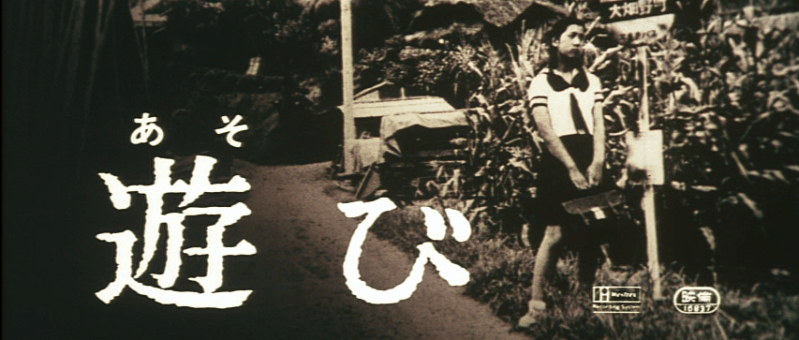
Play (遊び, Yasuzo Masumura, 1971)

5a4a5621a8387Yasuzo Masumura is most often associated with the eroticism and grotesquery which marked the middle part of his career, but his beginnings as a regular studio director at Daiei are a more cheerful affair even if darker in tone and with additional bite. His debut, 1957’s Kisses, was an unusual youth drama for the time – an innocent romance between a naive boy and girl who meet when each of their parents is languishing in jail. Far from the tragic conclusion of Ko Nakahira’s Crazed Fruit, Masumura offers his youngsters a degree of hope and the possibility, at least, of a happy ending. Daiei would go bust in 1971, and so it’s a minor irony that Masumura would revisit a similar theme towards the end of his tenure at the studio. Play (遊び, Asobi, AKA Play With Fire / Games), inspired by Akiyuki Nosaka’s novel, is another tale of youthful romance threatened by a harsh society, but this time around Masumura is not quite so hopeful.

A 16 year old (unnamed) girl has become the main breadwinner for her mother and bedridden older sister following the death of her father, formerly a violent drunk. Having had to leave school, she has a full-time job at an electronics factory where she lives in the company dorm along with a number of other female employees, most of whom are a few years older than she is. The girl is an earnest sort, she resents her mother’s constant pestering of her for money, but she sends her pay checks home keeping only enough to keep herself fed and clothed.

When an older woman, Yoshiko, who works as a “hostess” in one of the local cabaret bars comes to visit, she does so dressed to the nines with a handsome man sporting fancy sunglasses and porting a selection of upscale cakes. Yoshiko sells the virtues of life in the clubs, talking about the money to be made by having fun while the naive gaggle of young women remain in awe of her confidence, poise, and fancy haircut. In desperate need of money, the girl considers Yoshiko’s suggestion which is what brings her into contact with the (unnamed) boy (Masaaki Daimon).

The boy is 18 and pretends to be more worldly wise than he really is. He offers to show the girl around the cabaret scene, though he discourages her from working there. Taking her out and around town, the boy charms the girl though he has a dark and ulterior motive. The boy is a petty yakuza for a gang whose main stock in trade is pulling girls off the street and raping them for reasons of both blackmail and forced prostitution.

Owing to her young age and bad experience with her father who was often drunk and violent, the girl has steered clear of men. The other girls make fun of her for not having a boyfriend, not wearing make up, and for being “good” in sending all her money home. The girl isn’t really interested in the same kind of fun loving life as the more jaded of the factory girls – especially when she sees them roll in drunk boasting about the bruises on their skin from a night of debauchery, or even staggering back crying with a dress torn to shreds after being violently assaulted (perhaps by the same kind of yakuza thugs that will shortly target her). Despite the harshness of her life, she remains naive and innocent, concerned for her mother and invalid sister who have only her to depend on.

The boy is in a similar situation, though far less keen to confess it. Also let down by a drunken, promiscuous mother, he’s found himself in a gang desperate for the approval of his new “big brother”. Though he reacts with horror to the gang’s main stock in trade, he does not try to stop it even if he stops short of rape himself, but continues to assist in trapping the girls whilst fully aware of what will happen to them.

Coming from a harsh world, the boy has never met anyone as earnest or as naive as the girl and her goodness starts to reawaken something in him. Likewise, the girl, unaware of the boy’s true purpose, has never met anyone that was so immediately nice to her – her fear of men and alcohol dissipates as she (mistakenly, or perhaps not) believes she has met someone truly good and kind who only wants to help her. The girl does not belong in the boy’s world of sleazy clubs and youth haunts but bears them well enough for him. The boy recognises the incongruity and takes her somewhere else, still conflicted in his true purpose of delivering her to the dingy love hotel where his boss conducts his illicit trade.

The boy and the girl are innocents corrupted by their environments. Let down by irresponsible parenting (perhaps also a symptom of the difficulties of the society they live in), the pair remain trapped, dreaming of freedom and happiness but seeing no way of finding them. Deciding to make a break for it, leave their respective disappointing families far behind, the boy and the girl sail away. Their boat is full of holes, but they refuse to be beaten, committing to forge ahead together they swim towards the sea and an uncertain but hopeful future.


Title sequence (no subtitles)

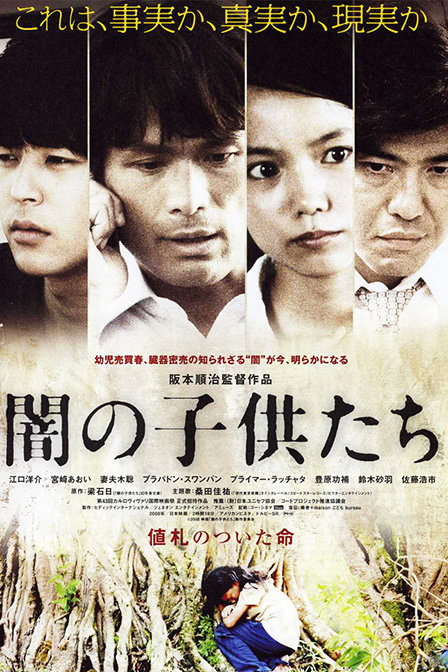
Children of the Dark (闇の子供たち, Junji Sakamoto, 2008)

Children of the Dark posterJunji Sakamoto’s career has been marked by a noticeable split between commercial projects and artier genre pieces but even considering his tendency towards socially conscious filmmaking, Children of the Dark (闇の子供たち, Yami no Kodomotachi) is a surprising entry into his filmography. Starring heartthrob Yosuke Eguchi as an earnest reporter determined to expose the extent of Japanese complicity in the exploitation of Thai children, Sakamoto’s film is hard hitting in the extreme, refusing to back away from the horrors that these children are forced to experience but perhaps taking things too far in putting his young actors through a series of emotionally difficult scenes. Children of the Dark was pulled from its slot in the Bangkok Film Festival for painting a less than idealised picture of the grim underbelly of Thai society but Sakamoto is also keen to point out that the problem is a global one which merely finds an unhappy home in a country many regard as a “paradise”.

Nanbu (Yosuke Eguchi), a Japanese ex-pat reporter living in Thailand, has been handed a hot tip on a difficult piece of investigate reporting relating to the illegal trafficking of human organs. His investigation brings him back into contact with a local NGO who operate a centre promoting educational and human rights whilst helping the impoverished children of the area. The NGO is currently investigating the disappearance of child they’d been trying to save, but the two investigations eventually overlap as it becomes clear that the organ trafficking and sexual exploitation of abandoned children are part of the same deeply entrenched cycle of human cruelty.

Nanbu’s key interest is in the Japanese connection to organ transplant case. A wealthy Japanese couple will apparently be bringing their son to Thailand for an illegal transplant to get around Japan’s strict medical ethics laws which prevent children becoming organ donors. Though it might be thought that the boy’s parents simply believe they will be undergoing a legitimate medical procedure only abroad, they are perfectly aware that the organ they will be receiving will have been acquired specifically for the purpose and will have been ripped from a healthy child rather than transplanted from an unfortunate accident victim.

Using the NGO’s contacts, Nanbu begins to realise how deeply the conspiracy runs. The NGO’s investigations lead them to a brothel in which extremely young boys and girls are kept in cages to be picked out like lobsters in a restaurant by the international clientele each after a different kind of sexual experience. The children are beaten if they refuse and literally “thrown out” in black bin bags should they contract illnesses such as AIDS. When one of the children is killed by a client who overdoses him on hormones, the matter is settled with financial compensation and the body disposed of. Many of these children are orphans from backgrounds of extreme poverty, neglected or abandoned by their parents into a life of sexual servitude in part caused by ongoing economic inequality which is only exacerbated by the thriving underworld enterprises of people and drug trafficking.

Nanbu is, however, only a reporter. Keiko (Aoi Miyazaki), a young and idealistic Japanese woman recently arrived in Thailand to work with the NGO, is committed to saving individual lives whereas Nanbu and the paper are committed to being passive observers exposing the truth in the hope that the whole sordid system will one day collapse. Keiko’s sometimes dangerous naivety is contrasted with Nanbu’s jaded complicity in essentially allowing a young child’s life to be sacrificed to get his story with only the justification that something might be done if the truth were known.

A final revelation, however, proves a step too far even if it encourages all to point the finger back on themselves and accept that personal complicity may run far deeper than most suspect. The tragedy is further undercut by the strange decision to end on an idyllic scene of paradise with a karaoke track playing over the top complete with lyrics pasted on the side – a tonal variation too far given the necessarily somber atmosphere of the the film as a whole. Despite the strangeness of the ending with its unexpected reversals and clumsy attempt at reflexivity, Children of the Dark is an urgent, difficult piece exposing the unspeakable cruelties hidden away in the underbelly of a foreign “paradise”.


Original trailer (no subtitles)

Youth of the Beast (野獣の青春, Seijun Suzuki, 1963)

youth of the beast posterSeijun Suzuki had been directing for seven years and had made almost 20 films by the time he got to 1963’s Youth of the Beast (野獣の青春, Yaju no Seishun). Despite his fairly well established career as a director, Youth of the Beast is often though to be Suzuki’s breakthrough – the first of many films displaying a recognisable style that would continue at least until the end of his days at Nikkatsu when that same style got him fired. Building on the frenetic, cartoonish noir of Detective Bureau 2-3: Go to Hell Bastards!, Suzuki once again casts Jo Shishido in the the lead only this time as an even more ambiguous figure playing double agent to engineer a gang war between two rival hoodlums.

Suzuki opens in black and white as the bodies of a man and a woman are discovered by a small team of policemen. Finding a note from the deceased female which states that she settled on taking her own life because she loved her man and thought death was the only way to keep him, the police assume it’s an ordinary double suicide or perhaps murder/suicide but either way not worthy of much more attention, though discovering a policeman’s warrant card on the nightstand does give them pause for thought.

Meanwhile, across town, cool as ice petty thug Jo Mizuno (Jo Shishido) is making trouble at a hostess bar but when he’s taken to see the boss, it transpires he was really just making an audition. The Nomoto gang take him in, but Mizuno uses his new found gang member status to make another deal with a rival organisation, the Sanko gang, to inform on all the goings on at Nomoto. So, what is Mizuno really up to?

As might be expected, that all goes back to the first scene of crime and some suicides that weren’t really suicides. Mizuno had a connection with the deceased cop, Takeshita (Ichiro Kijima), and feels he owes him something. For that reason he’s poking around in the local gang scene which is, ordinarily, not the sort of world straight laced policeman Takeshita operated in which makes his death next to a supposed office worker also thought to be a high class call girl all the stranger.

Like Detective Bureau 2-3: Go to Hell Bastards!, Youth of the Beast takes place in a thoroughly noirish world as Mizuno sinks ever deeper into the underbelly trying to find out what exactly happened to Takeshita. Also like Detective Bureau 2-3: Go to Hell Bastards!, Youth of the Beast is based on a novel by Haruhiko Oyabu – a pioneer of Japanese hardboiled whose work provided fertile ground for many ‘70s action classics such as The Beast Must Die and Resurrection of the Golden Wolf, but Suzuki’s ideas of noir owe a considerable debt to the gangster movies of the ‘30s rather than the moody crime dramas of twenty years later.

Jo Shishido’s Mizuno is a fairly typical ‘40s conflicted investigator, well aware of his own flaws and those of the world he lives in but determined to find the truth and set things right. The bad guys are a collection of eccentrics who have more in common with tommy gun toting prohibition defiers than real life yakuza and behave like cartoon villains, throwing sticks of dynamite into moving cars and driving off in hilarious laughter. Top guy Nomoto (Akiji Kobayashi) wears nerdy horn-rimmed glasses that make him look like an irritated accountant and carries round a fluffy cat he likes to wipe his knives on while his brother Hideo (Tamio Kawaji), the fixer, is a gay guy with a razor fetish who likes to carve up anyone who says mean stuff about his mum. The Sanko gang, by contrast, operate out of a Nikkatsu cinema with a series of Japanese and American films playing on the large screen behind their office.

The narrative in play may be generic (at least in retrospect) but Suzuki does his best to disrupt it as Mizuno plays the two sides against each other and is often left hiding in corners to see which side he’s going to have to pretend to be on get out of this one alive. Experimenting with colour as well as with form, Suzuki progresses from the madcap world of Detective Bureau 2-3: Go to Hell Bastards! to something weightier but maintains his essentially ironic world view for an absurd journey into the mild gloom of the nicer end of the Tokyo gangland scene.


Original trailer (no subtitles)

https://www.youtube.com/watch?v=RoruaIPA41U

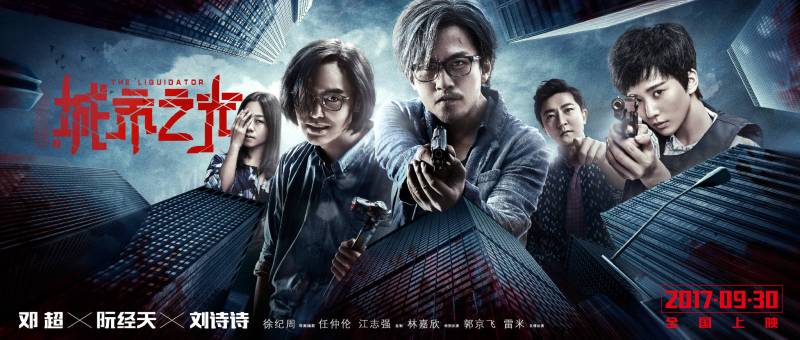
The Liquidator (心理罪:城市之光, Xu Jizhou, 2017)

The Liquidator posterGiven a strangely ‘80s nonsensical two word title, Xu Jizhou’s The Liquidator (心理罪:城市之光, Xīnlǐ Zuì: Chéngshì Zhī Guāng) is a retro throwback to the lurid macho pulp which has largely faded from the crime procedural since its ‘90s heyday. Adapted from a novel by Lei Mi, the film follows last year’s Guilty of Mind as the second in the Fang Mu series only this time the eccentric profiler is played by marquee star Deng Chao rather than Guilty Mind’s Li Yifeng or Chen Ruo Xuan who starred in the Fang Mu TV drama, Evil Minds. A pulpy battle of wits between a crazed vigilante and a world weary cop, The Liquidator is already treading on some overly familiar territory but its main target is the rule of law apparently under threat of mob justice now that China too has entered the social media age.

Fang Mu (Deng Chao) is no longer a police officer after becoming the prime suspect in the disappearance of a man who escaped justice through judicial corruption, but he’s pulled back into the law enforcement fold when young policewoman Mi Nan (Cecilia Liu) is dispatched to get his profiling opinion on a difficult murder case. Calling himself “The Light of the City”, a vigilante killer is already amassing a collection of dedicated online followers thanks to his choice of targets which, to put it bluntly, are not law breakers just terrible people that most would like to get revenge on for one reason or another.

Originally reluctant, Fang Mu is soon hooked on the case only to realise that the crime scenes are being created entirely for his benefit – the killer is attempting to pull him into a battle of wits and taking innocent lives to do it. As it transpires the killer’s name, Light of the City, is inspired by something Fang Mu said in his graduation speech to the effect that the police are the light that shines in the darkness. The killer thinks the law doesn’t go far enough – his targets are bullying teachers, impious sons, and greedy lawyers, the immoral rather than the criminal. He exposes their transgressions online and then allows “netizens” to have their say. Netizens, as they have often been in the “real” world, are not a particularly understanding bunch and are firmly behind the “entertainment” the killer is providing, even down to the decision to live stream a murder.

Fang Mu’s defining trait is his liminal status as a law enforcement officer often pulled towards the dark side – hence why many of his colleagues think it’s perfectly possible that he’s guilty of the crime that got him kicked off the force. The vigilante’s “plan” is to pull him over the line by forcing Fang Mu to execute The City of Light and thereby become the thing he most fears. The Liquidator posits that a robust judicial system free from interference from both government and people is a prerequisite of a well functioning society and the police must be the shining beacons of these laws – if not even law enforcement obeys the law, then all is lost.

What transpires is a battle of minds between the brainy Fang Mu and the psychotic killer, but it’s also a battle for the soul of “society” which ought to place compassion and rationality over the sensationalism of trial by media and arbitrary mob justice. The killer works out his frustrations by proxy through attacking those who committed the same “crimes” which have led to their feelings of frustration and humiliation – chief among them being Fang Mu who has, apparently, offended solely in his continued excellence, but the killer’s personal vengeance is harsh and unforgiving, handing down a death sentence simply for unpleasant or anti-social behaviour.

Beginning in a promising vein, Xu nevertheless introduces his dedicated female cop only to sideline her in favour of Fang Mu before turning her into a mild love interest, potential victim, and sometime comic relief. Filled with macho histrionics (including, at one point, a gun fired in the air followed by a manly wail of grief), The Liquidator is an old fashioned action drama filtered through pulp noir and ‘90s horror with its grimy walls and dingy basements, but it straddles a fine line between ridiculous slasher serial killer thriller and serious cerebral procedural, landing somewhere around heroic bloodshed without the bromance. Ridiculous and melodramatic, Xu’s debut feature boasts excellent production design and innovative photography, but its slick aesthetic cannot overcome the more outlandish elements of the otherwise generic script.


Currently on limited release in UK cinemas courtesy of Cine Asia

Original trailer (Mandarin with English subtitles)

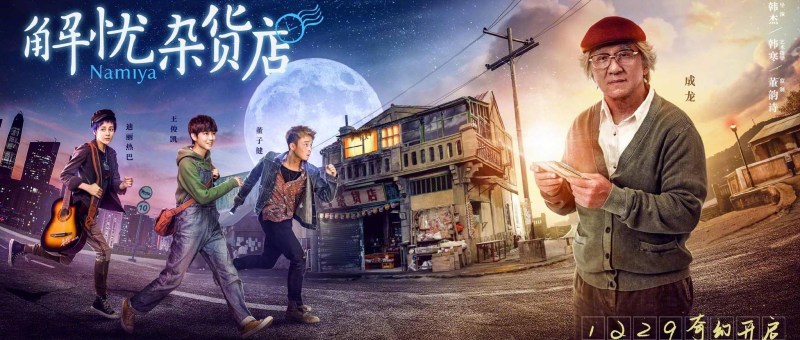
Namiya (解憂雜貨店, Han Jie, 2017)

Namiya posterKeigo Higashino is almost certainly best known for his crime novels and in particular his most famous detective, Galileo, whose exploits have spawned a successful TV drama series and a fair few cinematic adaptations including the international bestseller, The Devotion of Suspect X. One might expect a writer of mystery novels to be a fierce rationalist, but Higashino occasionally dabbles in the fantastic – The Miracles of the Namiya General Store is more or less a nostalgia fest praising the pre-bubble Japan, implying that the modern world is colder and less kind than the aspiring society of 1979. Adapted for the Chinese market by Han Jie, Namiya (解憂雜貨店, Jiě Yōu Zá Huò Diàn) retains the corner shop where time stands still but locates it in 1993, which is not so much a significant date save being 25 years in the past.

On New Year’s Eve 2017, three teens break into a woman’s home with the idea of causing some damage, but the event goes south when she comes home early and one of the three decides to tie her up and steal a bunch of her stuff. Having gone further than they meant to, the trio wind up in an unfamiliar part of town when the car they’ve stolen runs out of petrol. An improbably quaint, apparently disused corner shop attracts their attention but when they break in to shelter for the night they discover that this is no ordinary store. A ghostly miasma gradually creeps its way in and the three youngsters find themselves answering a collection of letters meant for the store’s owner written in 1993 but only dropping through the letter box now. They funny thing is, they get almost immediate replies.

As one of the teens points out, they weren’t even born in 1993 – this store might as well be from 1793 as far as they’re concerned. Though it drips with nostalgia for a simpler time, Namiya treads (understandably) more carefully in painting early ‘90s Beijing and its rural backwater setting, strenuously avoiding any mention of politics and characterising China’s economic development as an entirely good thing despite the troubles the three teens at the centre have been subject to throughout their apparently difficult lives.

The letter writers have various problems but each in someway relates to being a little lost, a little bit confused about how to move forward in life. A frustrated musician (Lee Hong-chi) whose career is not taking off wants to know whether he should give up and come home, a little boy has a bad relationship with his go-getter parents who have lost all their money and got into trouble with loan sharks, and a melancholy bar hostess (Hao Lei) wants to know if she should become the mistress of a gangster who promises to set her up in a shop that would get her out of her dead end life and still enable her to support her family. The kids are not really qualified to offer any kind of real life advice, with sensitive Xiaobo (Karry Wang) and plucky Tong Tong (Dilraba Dilmurat) reacting in broadly sympathetic terms while the sullen Jie takes a hardline moralist stance in which he just wants to write angry letters to everyone telling them they’re doing everything wrong.

Jie has his own reasons for being so angry, especially as one of the letters touches a nerve in his own personal history but his ambivalence was at one point shared by Papa Namiya (Jackie Chan) himself after he feared his treasured advice might have ended up having a negative effect on people’s lives. Papa Namiya tells the troubled little boy to stick with his parents no matter what because family is the most important thing in a person’s life which might be true much of the time, but not when the parents actively endanger their child. What he finally reassures himself with is that his advice was largely meaningless because most people have already made up their minds what they’re going to do, they just want someone to help them feel like they’re doing the right thing. In fact, no one really follows Papa Namiya’s advice anyway, but the kids are able to make a concrete change when they reveal the economic realities of modern China to a young hopeful who then uses the knowledge to build an international business empire (but makes sure to pay it forward whilst paying tribute to their roots by committing to sponsor an orphanage in need of renovation/expansion).

The slightly awkward message Namiya leaves behind is that dreams come true when people work hard to achieve them but that the young are also free to forge their own destinies, that the world is, for them, infinite and filled with boundless possibility. Optimistic and inspiring as it is, it isn’t terribly realistic and does rather imply that those who haven’t made it are either lazy or dishonest as echoed in the mildly moralistic tone taken with the bar hostess’ dilemma or the odiousness of the corrupt businessman and his failure to protect his family from his own mistakes. Moral judgements and naivety aside, Namiya is an otherwise heartwarming, deliberately uncynical New Year tale which does its best to engender hope for the future in an otherwise cold and unforgiving month.


Currently on limited release in UK cinemas.

Original trailer (Mandarin with English subtitles)

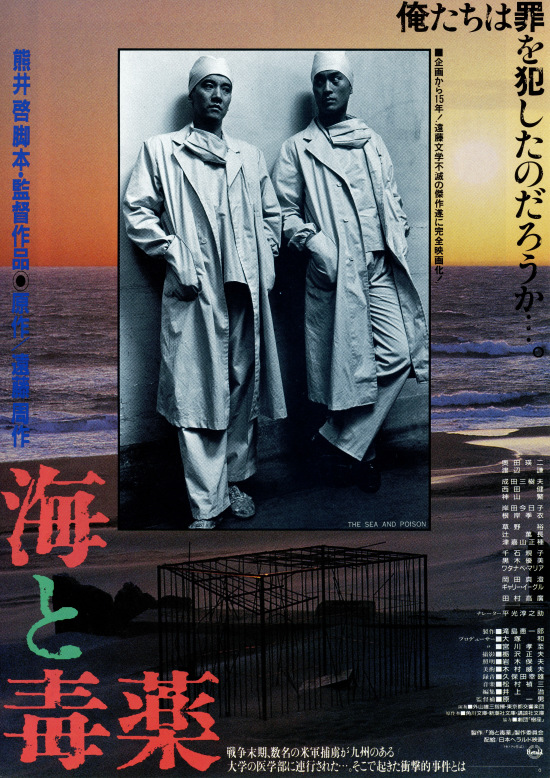
The Sea and Poison (海と毒薬, Kei Kumai, 1986)

the sea and poison posterWhen thinking of wartime atrocity, it’s easy enough to ascribe the actions of the perpetrators to a kind of madness, to think that they have in some way moved away from us to become some kind of “other”. In thinking of those who transgress our notions of humanity as inhuman or “evil” we can absolve ourselves of their crimes, believing that they are not like us and we are not like them. The truth is never so simple and as long as we continue to other these dark parts of ourselves, we will not be able to overcome them. The Sea and Poison (海と毒薬, Umi to Dokuyaku), adapted from the novel by Shusaku Endo, shows this delusion of inhumanity for what it is in taking as its central concern the real life case of the doctors at a Kyushu university who committed heinous acts of experimentation on eight American prisoners of war in late 1945. Rather than focus of on those who took the decision that the experiments should take place, Endo and Kumai examine the motives of those on the fringes who merely went along with them finding that they did so for petty, essentially human motives.

Shot in a crisp black and white, the film opens in a caged cell where an American officer is interrogating a young man still in a student’s uniform. Suguro (Eiji Okuda) is the first of several witnesses to the deaths of eight American servicemen during alleged vivisection at the hospital at which Suguro had worked. Young and naive, Suguro is the most sympathetic of three witnesses we will encounter but his essentially compassionate nature puts him at odds with his colleagues who abhor “sentimentality” and regard his emotionality as a childish weakness. It is through Suguro that we discover that the hardness that has apparently led to these horrific betrayals of the physicians’ code are not born of the war, or of militarism, or of adherence to some ideal like god or country but are a natural extension of the hyper-rational attitude of the medical profession.

Suguro’s colleague, Toda (Ken Watanabe), is his polar opposite, viewing Suguro’s sense of compassion as a ridiculous but somewhat endearing character trait. A textbook nihilist, Toda takes the view that as death comes to us all, the when and why are essentially unimportant. When so many are dying in air raids or on the battlefields, what does it matter that some also die in hospitals. Yet Toda is, in someways, the most ruminative among the hospital staff. In the diary he keeps, Toda attempts to dissect himself and his ongoing lack of feeling. Telling the interrogators that he began the diary because he had begun to find himself “creepy”, Toda asks why it is he feels nothing in relation to his fellow men. Surely it must be right that one should feel some degree of empathy? Toda volunteers for the experiments in part to test his own hypothesis but discovering that he still feels no pity for these men, he wonders if these ideas of morality are a kind of affectation seeing as others too can commit such acts of extreme cruelty and think nothing of it.

In this, Toda earns our sympathy, seeming at least to want to feel something even if he does not. Nurse Ueda (Toshie Negishi), by contrast, is the most human and also the most repugnant of our three witnesses. Her concerns are petty and ordinary, born of jealousy and resentment. Returning again to the scene of a botched surgery, Kumai shows us Ueda calling the operating theatre and being told to give a patient a dose of morphine by a harried doctor still panicked by the ongoing OR drama. Following her instructions, Ueda fills a syringe but the vial is knocked out of her hand by the German wife of the head doctor, Hilda, who was once a nurse herself and likes to help out on the wards. Hilda is a severe woman but not a cold one, she cares for the patients but perhaps with a more rigorous adherence to the nurses’ code than the less experienced team at the hospital. Hilda tries to get Ueda fired for her “mistake”, scolding her by asking (in German) if she is not afraid of God, and expressing concern that she thought so little of giving a fatal dose of morphine to a suffering patient.

Ueda’s decision to attend the experiments is a form of backhanded revenge – Hilda, whom everyone regards as some kind of annoyingly saintly figure, has no idea her husband would be involved in something so against her deeply held ideals, but Ueda also offers another reason when she says that the doctors exist in another, more rarefied world to the rank and file ward staff. This idea is echoed again by the head nurse, Ohba (Kyoko Kishida), who states that nurses must do as the doctors tell them without asking questions. Ohba rounds out the just following orders contingent but the first half of the film has already shown us that the medical profession is corrupt and cannot be trusted.

The old Dean has had a stroke and there is a mini war of succession in play between the heads of surgery divisions one and two. Dr. Hashimoto (Takahiro Tamura) had been the favourite but his star is fading. In an effort to improve his chances, he decides to move up an operation on a friend of the Dean – a young woman with advanced TB. Meanwhile, Suguro’s patient, an old woman who also has TB has been earmarked for “experimental surgery”. The old woman has not been properly briefed on the risks of the operation in which she has only a five percent chance of survival and has only agreed to it because the doctor, whom she trusts implicitly, has told her it’s her only chance. The Dean’s friend is “Mrs. Tabe”, and she is “important”. The old woman is only “the welfare patient” and therefore not important at all.

Suguro, anxious to save the old woman to whom he has developed an attachment, wants the operation to be postponed, at least until she’s potentially strong enough to survive but Dr. Shibata (Mikio Narita) is only interested in using her as a potential candidate for experimentation which he claims will help future treatment of TB but also, of course, improve his career prospects. Mrs. Tabe’s mother asks the doctor if her operation carries any risk but the assistant laughs in her face, claiming the operation is so simple even a monkey could do it and pretending to be insulted that she has so little faith in her physicians. The operation goes wrong and Mrs. Tabe dies which is bad news for Dr. Hashimoto but rather than offer his apologies to the relatives, he tries to cover it up. So that it won’t look like she died on the table, they take the body back to her room and hook it up to a drip, insisting to Mrs. Tabe’s mother and sister that all is well while planning to announce that Mrs. Tabe died of complications from the operation early the following morning.

This level of callousness and self interest is echoed in Dr. Shibata’s justification that the old woman is going to die anyway and therefore the operation is worth a shot even though he believes it will kill her and is not in any way attempting to save her life (though it would be a nice bonus). Unlike Toda’s nihilism, Shibata’s practicality has no human dimension, he thinks in numbers and statistics, deciding who is a “real patient” and who is not. This same justification is used when recruiting doctors for the experiments. The US servicemen are downed aircrew from the bombers which have been making raids overhead for months. A court in Tokyo has ruled the random bombing contravenes international law and has sentenced the airmen to death. Seeing as the airmen will die anyway, might it not be “better” for their deaths to “benefit” medical science? The operations will be conducted under anaesthetic and so the men will not be in pain or know their fates which might, perhaps, be better than a firing squad.

The reality is not so convenient. Asked if his agreement was partly revenge, Suguro replies that, no, he felt no hate, he was just too mentally and physically exhausted to resist. Threatened by soldiers with guns he capitulates but refuses to assist in the room on the day, remaining a passive witness cowering at the edges. Before the operation, Dr. Gondo (Shigeru Koyama) makes small talk with the subject in English, asking about his hometown to which the airman, poignantly, says he’d like to return. The surgery is not like that conducted on Mrs. Tabe. The airman gets only ether and he struggles as the cloth is placed over his mouth, requiring four people – two doctors and two nurses, to hold him down until he stops kicking. This is no gentle death, this is murder.

A possible “justification” lies in the fact that the operating room is also filled with soldiers who laugh and jeer, snapping away on their brand new German-made camera. Tanaka, the officer in charge, asks for the airman’s liver after the operation, joking that he’d like to feed it to his men. The liver is indeed delivered to the horrified faces of the soldiers waiting for the party they’ve organised to begin, though it is not clear whether Tanaka really intends to feast on it or keep it as some sort of grim souvenir. Gondo, looking at the liver, remarks that they’ve all grown used to corpses but that “sentimentality” is never far away. Nevertheless, he appears to feel no real remorse for the heinous act of killing in which he has just been involved.

Adopting Endo’s Christianising viewpoint, the interrogations take place in a ruined church, a statue of the Virgin Mary directly above Ueda as she gives vent to her impure thoughts. The trio are being judged, not only by God but by us – or “society” as Suguro later puts it. The central proposition is that prolonged exposure to death on a mass scale – firstly as members of the medical profession, and later as victims of war, has led to an inhuman, nihilistic viewpoint in which we are all already dead and that, therefore, nothing really matters anymore. It isn’t clear who suggested this be done or why, but it is clear that Hashimoto collaborated in an effort to save his career by allying himself with the military – something he misses out on anyway when Shibata steals his thunder. Suguro is powerless to resist, Toda a melancholy sociopath, Ueda a vengeful woman, and Ohba a willing disciple of a beloved doctor, but none is a zealot to a regime or true believer in militarism. This is the dark heart of humanity – selfishness and cowardice, petty jealousies and ambitions. Kumai paints this scene of desolation with intense beauty, which only makes it all the more painful.


Original trailer (no subtitles)

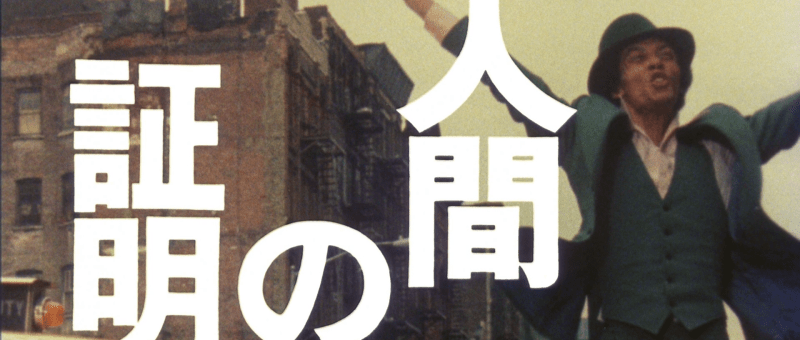
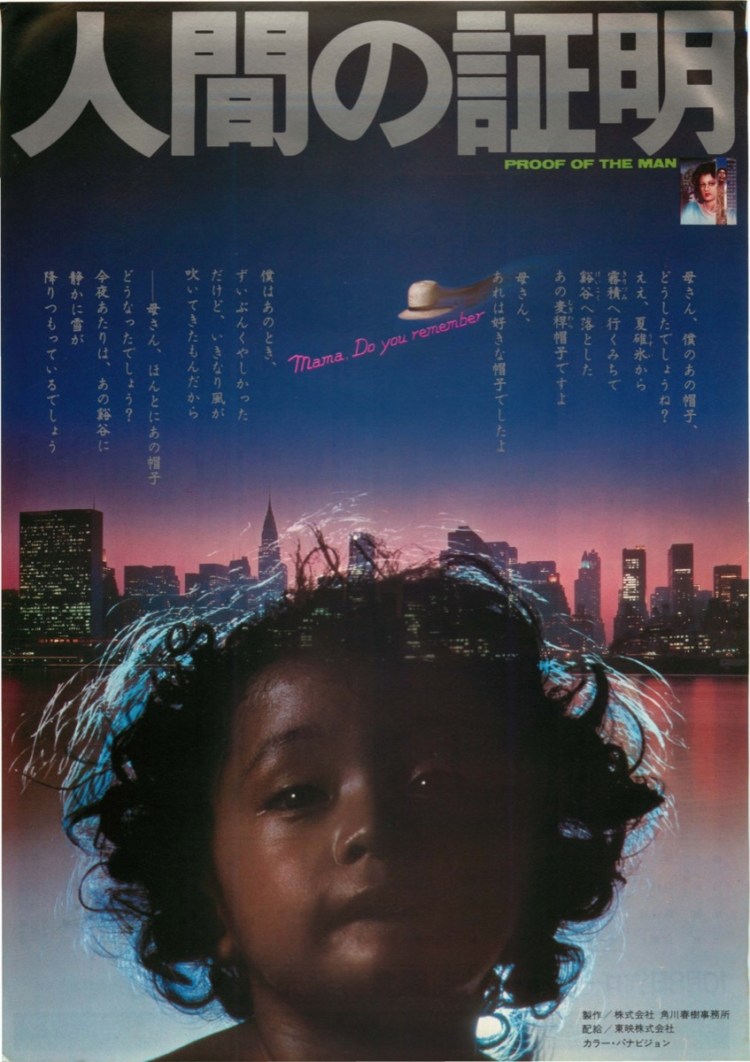
Proof of the Man (人間の証明, Junya Sato, 1977)

proof of the man posterOne could argue that Japanese cinema had been an intensely Japanese affair throughout the golden age even as the old school student system experienced its slow decline. During the ‘70s, something appears to shift – the canvases widen and mainstream blockbusters looking for a little something extra quite frequently ventured abroad to find it. Pioneering producer Haruki Kadokawa was particularly forward looking in this regard and made several attempts to crack the American market in the late ‘70s and early ‘80s before settling on creating his own mini industry to place a stranglehold around Japanese pop culture. Sadly, his efforts mostly failed and faced the same sorry fate of being entirely recut and dubbed into English with new Amero-centric scenes inserted into the narrative. Proof of the Man (人間の証明, Ningen no Shomei) is one of Kadokawa’s earliest attempts at a Japanese/American co-production and, under the steady hands of Junya Sato, is a mostly successful one even if it did not succeed in terms of overseas impact.

Based on the hugely popular novel by Seiichi Morimura, Proof of the Man stars the then up and coming Yusaku Matsuda as an ace detective, Munesue, investigating the death by stabbing of a young American man in Japan. The body was discovered in a hotel lift on the same night as a high profile fashion event took place with top designer Kyoko Yasugi (Mariko Okada) in attendance. After the show, an adulterous couple give evidence to the police about finding the body, but the woman, Naomi (Bunjaku Han), insists on getting out of the taxi that’s taking them home a little early in case they’re seen together. On a night pouring with rain, she’s knocked down and killed by a young boy racer and his girlfriend who decide to dispose of the body to cover up the crime rather than face the consequences. Kyohei (Koichi Iwaki), the driver of the car, is none other than the son of the fashion designer at whose show the central murder has taken place.

Like many Japanese mysteries of the time, Proof of the Man touches on hot-button issues of the immediate post-war period from the mixed race children fathered by American GIs and their precarious position in Japanese society, to the brutality of occupation forces, and the desperation and cruelty which dominated lives in an era of chaos and confusion. The only clues the police have are that the victim, Johnny Hayward (Joe Yamanaka), said something which sounded like “straw hat” just before he died, and that he was carrying a book of poetry by Yaso Saiji published in 1947. Discovering that Hayward was a working-class man of African-American heritage from Harlem whose father took a significant risk in getting the money together for his son to go to Japan (hardly a headline holiday destination in 1977), the police are even more baffled and enlist the assistance of some regular New York cops to help them figure out just why he might have made such an unlikely journey.

The New York cops have their own wartime histories to battle and are not completely sympathetic towards the idea of helping the Japanese police. Munesue, of a younger generation, is also harbouring a degree of prejudice and resentment against Americans which stems back to a traumatic incident in a market square in which he witnessed the attempted gang rape of a young woman by a rabid group of GIs. Munesue’s father tried to intervene (the only person to do so) but was brutally beaten himself, passing away a short time later leaving Munesue an orphaned street kid. In an effort to appeal to US audiences, Proof of the Man was eventually recut with additional action scenes and greater emphasis placed on the stateside story. Doubtless, the ongoing scenes of brutality instigated by the American troops would not be particularly palatable to American audiences but they are central to the essential revelations which ultimately call for a kind of healing between the two nations as they each consider the ugliness of the immediate post-war era the burying of which is the true reason behind the original murder and a secondary cause of the events which led to the death of Naomi.

Naomi’s death speaks more towards a kind of growing ugliness in Japan’s ongoing economic recovery and rising international profile. Kyohei is the son not only of high profile fashion designer Kyoko, but can also count a high profile politician (Toshiro Mifune) as his father. Spoiled and useless, Kyohei is the very worst in entitled, privileged youth driving around in flashy cars and going to parties, living frivolously on inherited wealth whilst condemning the source of his funds as morally corrupt citing his mother’s acquiescence to his father’s frequent affairs. Yet aside from anything else, Kyohei is completely ill-equipped for independent living and is essentially still a child who cannot get by without the physical and moral support of his adoring mother. 

Johnny Hayward, by contrast, retains a kind of innocent purity and is apparently in Japan in the hope of restoring a long severed connection as echoed in Saiji’s poem about a straw hat lost by a small boy on a beautiful summer’s day. The words of the poem are later repeated in the title song by musician Joe Yamanaka who plays Johnny in the film and is of mixed race himself. As in most Japanese mystery stories, the root of all evil is a secret – in this case those of the immediate post-war period and things people did to survive it which they now regret and fear the “shame” of should they ever be revealed. Some of these secrets are not surmountable and cannot be forgiven or overcome, some atonements (poetic or otherwise) are necessary but the tone which Sato seems to strike encourages a kind of peacemaking, a laying to rest of the past which is only born of acceptance and openness. Despite the bleakness of its premiss on both sides of the ocean, Proof of the Man does manage to find a degree of hopefulness for the future in assuming this task of mutual forgiveness and understanding can be accomplished without further bloodshed.


Original trailer (no subtitles) – includes major plot spoilers!