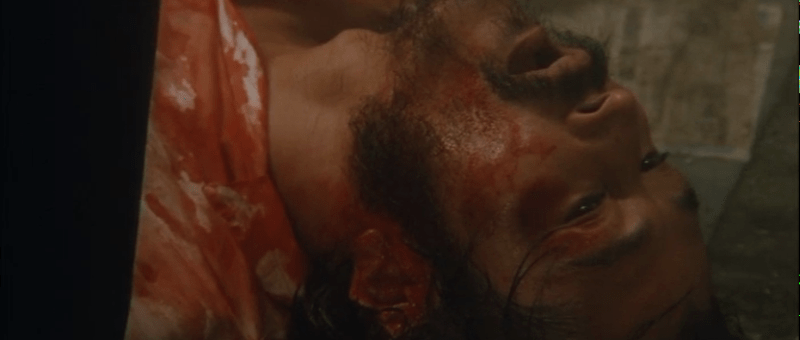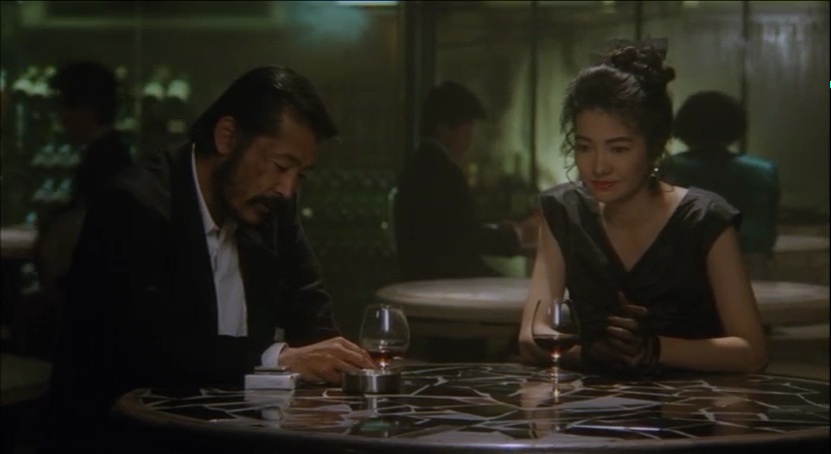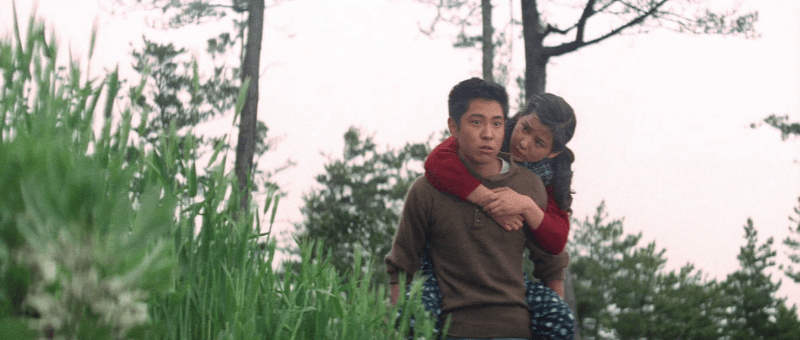
The Sands of Kurobe (黒部の太陽, Kei Kumai, 1968)

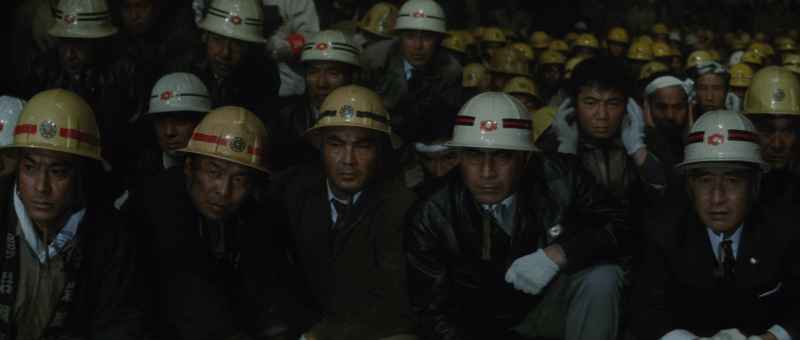
Kei Kumai’s three-hour epic of human engineering The Sands of Kurobe (黒部の太陽, Kurobe no Taiyo) opens with a titlecard to the effect that the film testifies to the courage of the Japanese people who brought the nation back to life after the war. Partly produced by Kansai Electric Power along with the production agencies of stars Toshiro Mifune and Yujiro Ishihara, the film is therefore somewhat conflicted, part bombastic celebration of Japanese engineering skill and ambivalent critique of the wilful decision to place success above all else including the welfare and safety of ordinary workers.

This critique is most evident to the flashbacks to the construction of Kuro 3 in 1938 which as many point out was conducted by the military under brutal and primitive conditions. The construction of the new Kurobe hydroelectric dam, by contrast, is a much more modern, enlightened affair in which workers have proper equipment and are not simply hacking at rocks with pickaxes wearing only a vest. But then as the conflicted Takeshi (Yujiro Ishihara) points out, it’s all effectively the same. Just because no one is pointing a gun at their heads, it doesn’t mean the men actually building the dam aren’t being exploited rather simply pressured by a vague notion of national good that they should be ready to lay down their lives. Could it be that “prosperity” is worse thing to die for than “patriotism”, especially when it appears as if your employer cares little for your physical wealth and economic wellbeing simply pledging that they will support the families of men killed during the dam’s construction. 

That there will be deaths seems inevitable. The man placed in charge of building a tunnel through the mountain, Kitagawa (Toshiro Mifune), is haunted by the vision of a man falling from a cliff that he witnessed when they first hiked to the dam site. He originally described the project as “crazy” and wanted to resign but was convinced to stay on. Kitagawa is himself fond of insisting on safety first where others are minded to cut corners, but also troubled by domestic issues in the film’s sometimes insensitive use of his daughter’s terminal leukaemia as a mirror for the dam project in considering what is and isn’t possible through human endeavour. The suggestion is that Kitagawa wants to believe the miracle of the dam is possible because needs to keep believing in a scientific miracle that can save his daughter, though obviously even if it is ultimately possible to build this dam that’s designed to fuel the post-war rocket to economic prosperity there are limits and unfortunately decades later we have still not found a cure for cancer though treatment may be more effective. 

Takeshi meanwhile has a similar battle with his hard-nosed father whose devotion to the dam project he describes almost like an addiction, suggesting that he values nothing outside of tunnelling and is willing to sacrifice everything in its name including the lives of himself and others. A flashback to to 1938 reveals that he asked his own teenage son to place dynamite and inadvertently caused his death though lax safety procedures which is the understandable reason why his wife eventually left him taking Takeshi with her. But the strange thing is for all his original opposition, Takeshi too is later captivated by the immensity of the challenge if also wary that the workers are falling victim to the same sickness as his father and are still being exploited by those like him who expect them to offer up their lives while paying them a pittance and complaining when the project does not proceed along their schedule. 

The almost nationalistic, bombastic quality of the film seems at odds with some of Kumai’s previous work save the discussion of the building of the 1938 tunnel though this largely serves as a contrast to imply that this time is different because they’re doing it for love of country rather the forced patriotism of the militarist past. Kitagawa justifies himself that if they don’t build the dam, economic prosperity will stall, companies will go bust, and people will lose their jobs but it seems somewhat hollow in the knowledge many men are certain to die while building this dam. Kumai undercuts the bombast with a series of scenes shot like a disaster movie in which supports collapse and the tunnel floods, or men are hit by falling rocks, eventually closing on an ironic Soviet-style statue dedicated to the labour of the workers that seems to question the immense loss of life along with the destruction of the natural beauty of Mount Kurobe but cannot in the end fully reconcile himself, torn between a celebration of human endeavour and its equally human costs. 


Original trailer (no subtitles)

The Eagle and the Hawk (鷲と鷹, Umetsugu Inoue, 1957)

Strapping sailors meditate on revenge and forgiveness while trapped aboard a moribund cargo ship in Umetsugu Inoue’s otherwise charming musical youth drama, The Eagle and the Hawk (鷲と鷹, Washi to Taka). One of several films Inoue released starring muse of the moment Ishihara, the film uses the boat as a kind of metaphor for a reluctance to deal with the unfinished past as several of its crew members are actively engaged in a self-imposed limbo wilfully remaining in a transient space floating between two harbours with no plans to disembark. 

This is most obviously true for the zombified Ken (Kinshiro Matsumoto) who wanders around the boat in a depressive daze unable to get over a girlfriend who left him for another man though as it turns out the bosun too is hiding out at sea waiting for the statue of limitations to run out on the murder of his lover 30 years previously. When two new recruits show up from the sailors union despite only one having been requested, many are under the assumption that they too are running from something on land though the boat itself is a confined environment from which there is no real escape so it’s also an ideal space for confrontation. 

The thing they may be running from is the murder of the boat’s chief engineer in the film’s noirish opening sequence in which a middle-aged man in a sailor’s cap is stalked by a youngster in jeans before being knifed with a ceremonial dagger. If they were running from that particular crime, it might be ironic that they chose this particular boat but then as the murdered man’s son, First Mate Goro (Hiroyuki Nagato), discovers the dagger was part of a set and the other one’s owned by the captain who seems very alarmed by the whole affair. Meanwhile, the captain’s daughter, Akiko (Ruriko Asaoka), has secretly stowed away along with Akemi (Yumeji Tsukioka), the heartbroken former girlfriend of one of the two new guys, Senkichi (Yujiro Ishihara). 

Women are regarded as unlucky on board, and it’s not difficult to guess why with Goro offering strict instructions to the new guys not to try anything with Akiko while one of the other sailors later attempts to rape Akemi with a palpable desperation existing within the crew. There is also a degree of homoerotic tension between the two new guys, the other being Sasaki (Rentaro Mikuni) who typically walks around shirtless in a pair of tight jeans and works hard to give the impression of having a mysterious past all of which leads Senkichi to suspect he’s an undercover cop possibly there after him or one of the other crew members though unbeknownst to (almost) everyone there is another crime in motion on board. 

As usual, it’s the past that’s come calling with Senkichi on the boat ironically running towards rather than away from a confrontation while others desperately try to cover up their crimes or deflect their responsibility for the dodgy dealings of their youth. Both Senkichi and Sasaki immediately remark that the boat’s a “junker” as soon as they get on board, implying that it too is on its way out, its disrepair a sign of its captain’s lack of respect and care for ship and crew alike. Then again, it seems the crew were intent on drinking half the cargo, most of them clearly happy in their work and enjoying a pleasant sense of camaraderie even on this crummy ship and its presumably not quite above board trip to Hong Kong which might hint at why Akemi shows up in cheongsam though for stowaways both women seem to have brought extensive wardrobes which in all honesty are not particularly well suited to life at sea. 

In any case, the boat becomes an unexpected place of healing and forgiveness largely brokered by manly magnanimity as Goro, on learning the truth behind his father’s murder, accepts that the killer’s motivations are “understandable” even while cautioning them against the fallacy of revenge which he insists will only create more hate and violence. He’s also fairly okay with Senkichi romancing his girl, Akiko, who sadly tells him she sees him more like a brother and isn’t interested in marrying him even if that’s what her father also expects neatly reflecting the dynamic which arises between Akemi and the lovelorn Ken who begins to cheer up and consider leaving the boat to open a transistor radio shop only for Akemi to describe him as a little brother while continuing to chase Senkichi despite his interest in Akiko. An expressionistic storm scene provides some divine justice, but also provokes a bittersweet romantic resolution which suggests it’s time to get off the boat and the face the past but with a kind of cheerfulness for the future otherwise at odds with the rage and violence of the original crime. Of course, this being a vehicle for Yujiro Ishihara, Inoue works in a few romantic scenes with his ukulele and a mournful song about the moon and ocean but finally sends him back to dry land a little more “grounded” for having found his sea legs.


Break Out (行き止まりの挽歌 ブレイクアウト, Toru Murakawa, 1988)

Good cop or bad cop? A maverick detective crosses the line in the name of justice in Toru Murakawa’s hardboiled thriller, Break Out (行き止まりの挽歌 ブレイクアウト, Ikidomari no Banka: Break Out). Like many of Murakawa’s films throughout the ‘80s, the main villain turns out to be political corruption along with a complicit police force which the hero must in a sense divorce realising that he can enforce the law only by breaking it but tragically failing to protect those most in need of his care. 

Kaji (Tatsuya Fuji) is indeed the archetype of the lone wolf cop. Stumbling out of bed with an obvious hangover and fuzzy beard that stands in stark contrast to his clean-shaven colleagues, he immediately butts heads with follow officer Sakura (Renji Ishibashi) who is technically in charge of the latest homicide case which Kaji believes may be connected to the death of a young woman at a hotel that the force has so far proved reluctant to investigate. To him, it all seems to point to local gangster Nakai (Kiyoshi Nakajoe) with whom he seems to have an ongoing rivalry which might be why Nakai has implicated Kaji’s ex wife Saeko (Saiko Isshiki) in his drug smuggling operation. 

Kaji quickly identifies the body as a bass player, Shimada, who just happens to have played at a club connected to Nakai, and soon realises that a young woman, Miki (Yoko Ishino), who belongs to a local biker gang, is most likely responsible for his death. But, somehow feeling sorry for her and suspecting she may have access to information that would help him take out Nakai for good, Kaji actively helps Miki evade the police by harbouring her in his own apartment while they are both stalked by a mysterious, Terminator-esque hitman who seems intent on recovering some kind of evidence obviously harmful to his client whoever that may be. 

Murakawa’s greatest successes had occurred in the 1970s partnering with the great Yusaku Matsuda who had at this point moved away from genre films though he would later reunite with the director in his final screen appearance, a television movie in which he played an earnest policeman investigating a terrorist incident, before sadly passing away of bladder cancer at only 39. In any case the image of Matsuda hangs heavy over Murakawa’s subsequent films and it’s quite obvious that the menacing hitman has a distinctly Matsuda-esque silhouette, while Tatsuya Fuji plays a similar role to that he’d inhabited in Yoichi Sai’s Let Him Rest in Peace only this time as a world weary ‘80s cop who has his own particular code of righteousness he feels the world has failed. 

His more cynical boss, played by Murakawa stalwart Mikio Narita, is quick to tell him that he should have resigned after a previous incident and that if he had done so his wife would not have left him, a sentiment which she later confirms which is in part surprising because the incident involved him fatally shooting her father. The implication is that Kaji is a true defender of justice who refused to surrender to institutional corruption even at great personal cost. Yet we do definitively see him cross the line, coldly executing a suspect who goads him by claiming he has already killed someone he cared about and thereafter little caring for conventional morality deciding to take the bad guys down with him no longer having anything left to lose except perhaps the girl, Miki, with whom he has developed a paternal bond. 

Meanwhile his earnest partner, Nishimura (Hiroaki Murakami), who originally disapproved of Kaji’s old school, maverick policing has changed his tune now seeing the value in his belligerence not least when his own wife is taken hostage by Nakai leaving him equally powerless at police HQ. Kaji is constantly told to back off the hotel case because of pressure from above, eventually discovering a connection to a sleazy politician but knowing that he can’t touch him or Nakai while bizarrely ordered to continue investigating Shimada’s death despite the evidence that suggests they are quite clearly connected. Still as the rather more poetic Japanese title which means something more like “elegy for a dead end” implies, this world is already beyond redemption and the only recourse open to Kaji is to make a sacrifice of himself in the name of justice. A good bad cop, all he can do is pass on his outrage to those left behind. Shot with Murakawa’s trademark hardboiled mist, and a noirish sense of fatalism the film paints a bleak picture of infinite corruption in Bubble-era Japan in which the only hero on offer is a morally compromised cop prepared to die for an illusionary justice. 


Red Handkerchief (赤いハンカチ, Toshio Masuda, 1964)

The moral compromises of the post-war era are brought home to a trio of frustrated lovers in Toshio Masuda’s Nikkatsu “mood action”, Red Handkerchief (赤いハンカチ, Akai Handkerchief). Starring an ageing Yujiro Ishihara perhaps cast slightly against type as an ultra noble policeman choosing self-exile after accidentally shooting dead a key witness, who also happens to be the father of the woman he loved, in order to save his partner, Masuda’s noirish melodrama takes aim squarely at the radiating effects of social inequality and the moral bankruptcy of an increasingly prosperous society. 

Masuda opens, however, with an old-fashioned foot chase as cops Mikami (Yujiro Ishihara) and Ishizuka (Hideaki Nitani) attempt to run down a drug mule carrying a briefcase full of illicit substances. The suspect later gets hit by a truck and killed while the briefcase is nowhere to be found. Concluding the mule must have abandoned it at a ramen stand he ran past on the way, the cops haul in the old man running it, Hiraoka (Shin Morikawa), who seems to know more than he’s letting on but is too terrified of the gangsters to consider giving anything up. In an effort to get him to talk, Mikami pays a visit to his relentlessly cheerful factory worker daughter Reiko (Ruriko Asaoka), becoming instantly smitten with her as she quickly packs a bag of warm clothing and miso soup assuming her dad’s in for a bit of drunk and disorderly. Their romance is however not to be. Apparently feeling himself out of options, Hiraoka opts for suicide by proxy, grabbing Ishizuka’s gun and firing at police. An Olympic sharpshooter, Mikami draws his pistol to save his friend and the old man is killed. Guilty, the pair attempt to apologise to Reiko, but unsurprisingly she is not in the mood to accept it. 

Four years later, Mikami has left the force for a life of wandering doing odd jobs all over Japan while entertaining his co-workers with sad songs about lost love. Yokohama detective Tsuchiya (Nobuo Kaneko) eventually tracks him down in frosty Hokkaido, encouraging him to return with tales of Ishizuka’s wildly improbable success as a supermarket entrepreneur now apparently married to Mikami’s lost love Reiko. Tsuchiya thinks Mikami was set up and that Ishizuka is a dirty cop who’s been living the high life while Mikami has been slumming it in an unnecessary act of atonement for something that wasn’t really his fault. 

Though they were apparently good friends and loyal partners, Ishizuka flags up a potential source of tension early on in his solo interrogation of Hiraoka explaining that unlike Mikami he’s not an educated man and understands how difficult it is to be poor. Tsuchiya later posits this same sense of class conflict as one reason that Ishizuka may have betrayed him, that he felt inferior and that he would not be able to compete with his elite partner. Ishizuka later implies something similar in his dog eat dog view of the world, explaining to a newly conflicted Reiko that life is a matter of winning and losing and that Mikami is the very image of defeat. He views himself as a winner thanks to his burgeoning supermarket empire, taking full advantage of the rising consumerism of the post-war era and willing to do whatever it takes in order to achieve success even if that means crossing a line that Mikami would never cross. Yet he is also like Mikami hobbled by his love for the “beautiful”, “pure” Reiko, allowing his insecure acquisitiveness to turn violent in his determination to keep her or at least keep her from any other man. 

“Money rules everything!” Ishizuka insists, attempting to justify himself for his turn towards selfish individualism willing to sacrifice not only a “worthless” old man but even friendship in the conviction that he is “a man of great value, a winner!” and therefore entitled to move beyond conventional morality while using his ill-gotten gains to support needy orphans. Even he, however, is later undone by love, perhaps the one true form of “justice”, in realising that Reiko has chosen nobility in the form of Mikami and could never accept the man he is or the things he’s done. A romantic melodrama masquerading as a crime thriller, Red Handkerchief finds Masuda in expressionist mode, the pounding machinery at the foundry where Reiko works pulverising Mikami’s noble heart as his romantic dreams are crushed, the highway streetlights dancing across Reiko’s windscreen as she returns in confusion, and in the constant use of weather to indicate the mood, the sky suddenly brightening behind Ishizuka as his confidence returns. Echoing in The Third Man in its melancholy ending, however, even if slightly inverted, Masuda sets his battered hero adrift in the confusions of the post-war era striding into the mist guitar in hand a perpetual wanderer. 


Original trailer (no subtitles)

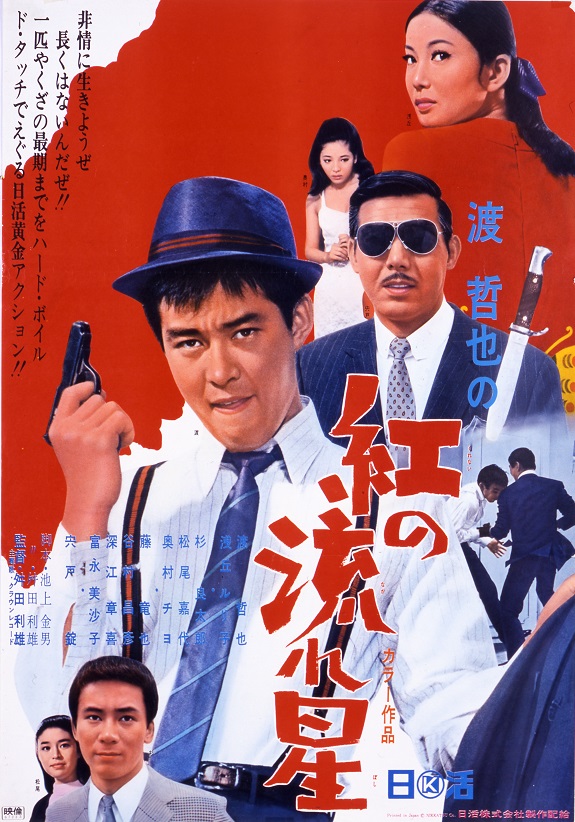
Velvet Hustler (紅の流れ星, Toshio Masuda, 1967)

Perhaps overlooked in comparison with his better known contemporaries, Toshio Masuda was a bankable talent at Nikkatsu directing some of the studio’s biggest box office hits largely thanks to his long association with tentpole star Yujiro Ishihara. Nine years on from their collaborative debut Rusty Knife, however, times had perhaps begun to change. Featuring vibrant colour production design by Tokyo Drifter’s Takeo Kimura, a frequent Seijun Suzuki collaborator, 1967’s Velvet Hustler (紅の流れ星, Kurenai no Nagareboshi, AKA Like a Shooting Star) is a reworking of Masuda’s own Red Pier, itself inspired by Julien Duvivier’s 1937 French thriller Pepé le Moko, with Tetsuya Watari in the role originally filled by Ishihara. Apparently drawing inspiration from Godard’s Breathless, Velvet Hustler is a thoroughly post-modern retake, a parodic tale of gangster ennui and post-war emptiness in which rising economic prosperity has brought with it only despair. 

When we first meet petty gangster Goro (Tetsuya Watari), he’s coolly standing by, leaning on a fencepost like a bored gunslinger as he waits for the perfect getaway vehicle. Jumping into a fancy red convertible which it seems has already been stolen by the young man who parked it in this packed car park, the wires handily hanging striped and exposed, Goro barrels along the highway and and performs an infinitely efficient drive-by shooting on a rival gang boss. According to the man who hired him, Goro was only supposed to cause serious injury, not death, but as he points out if the guy insists on dying that’s hardly his problem. Taking his paycheque, Goro agrees to lie low in Kobe for the next six months after which his boss will come and get him. A year later, however, and he’s still there doing not much of anything, hanging out with the local kids and acting as a procurer dragging sailors on shore leave into gang-run clubs where Americans get into fights with Vietnamese émigrés. So desperate for escape are they that Goro’s underling even suggests they go to war, later thinking better of it when he remembers seeing horrific photos from the front.  

In a convenient but unsatisfying relationship with bar hostess Yukari (Kayo Matsuo), Goro explains that it’s not that he doesn’t like her, but he’s bored, “bored with fooling around with women”, but also of the business of living. The sun comes up, the sun goes down, and then it comes up again, every day all the same. His life has become completely meaningless and he has no idea what to do about it. He longs to go back to Tokyo, but is trapped in this strange Kobe limbo land, an end of the line sea port in which there is ironically no sense of escape. He doesn’t know it yet, but there’s a killer (Jo Shishido) on his trail, a killer who eventually reminds Goro that even if he kills him first another man will come. The bullets you fire are aimed squarely at yourself, Goro’s destiny is already set. There is only one way out of Kobe and it doesn’t lead back to Tokyo. 

Meanwhile, another possibility presents itself in the beautiful Keiko (Ruriko Asaoka), a temporary visitor from the capital looking for her missing fiancé presumed to have done a bunk with her father’s money. Keiko is a distinctly cool yet self-assured figure, generating an instant connection with the affable gangster at once reassured by a sympathetic mama-san that Goro is good but also warned that he’s still a yakuza and as such no good for a smart young woman like her. Keiko thinks that Tokyo is pretentious and boring, confused by Goro’s insistence on getting back there but like him perhaps in waiting. “I love you to death” she later ironically confesses while simultaneously insisting that men and women are different. There is no escape for her. Goro is tired of running but refuses to be handcuffed, choosing perhaps the only path to freedom presented to him. 

A nihilistic tale of gangster ennui in which life itself no longer has value, Velvet Hustler is a curiously cheerful affair despite its essential melancholy, Goro and Keiko sparring in a romantic war of attrition while he almost flirts with the dogged detective (Tatsuya Fuji) determined to bring him down. The kitschy production design gives way to Antonioni-esque shots of a strangely empty city while an ethereal sequence of dissolves eventually leaves the pair alone on the dance floor as if to imply their single moment of romance is but a brief dream of emotional escape. The trappings of post-war success are everywhere from Keiko’s elegant outfits to the cute red sports car and the weird club where Goro dad dances in front of his minions, not so much older than them but clearly out of place in this distinctly unhip seaside bar, but finally all there is is a dead end and an infinite emptiness the embrace of which is, perhaps, the only viable path to freedom. 


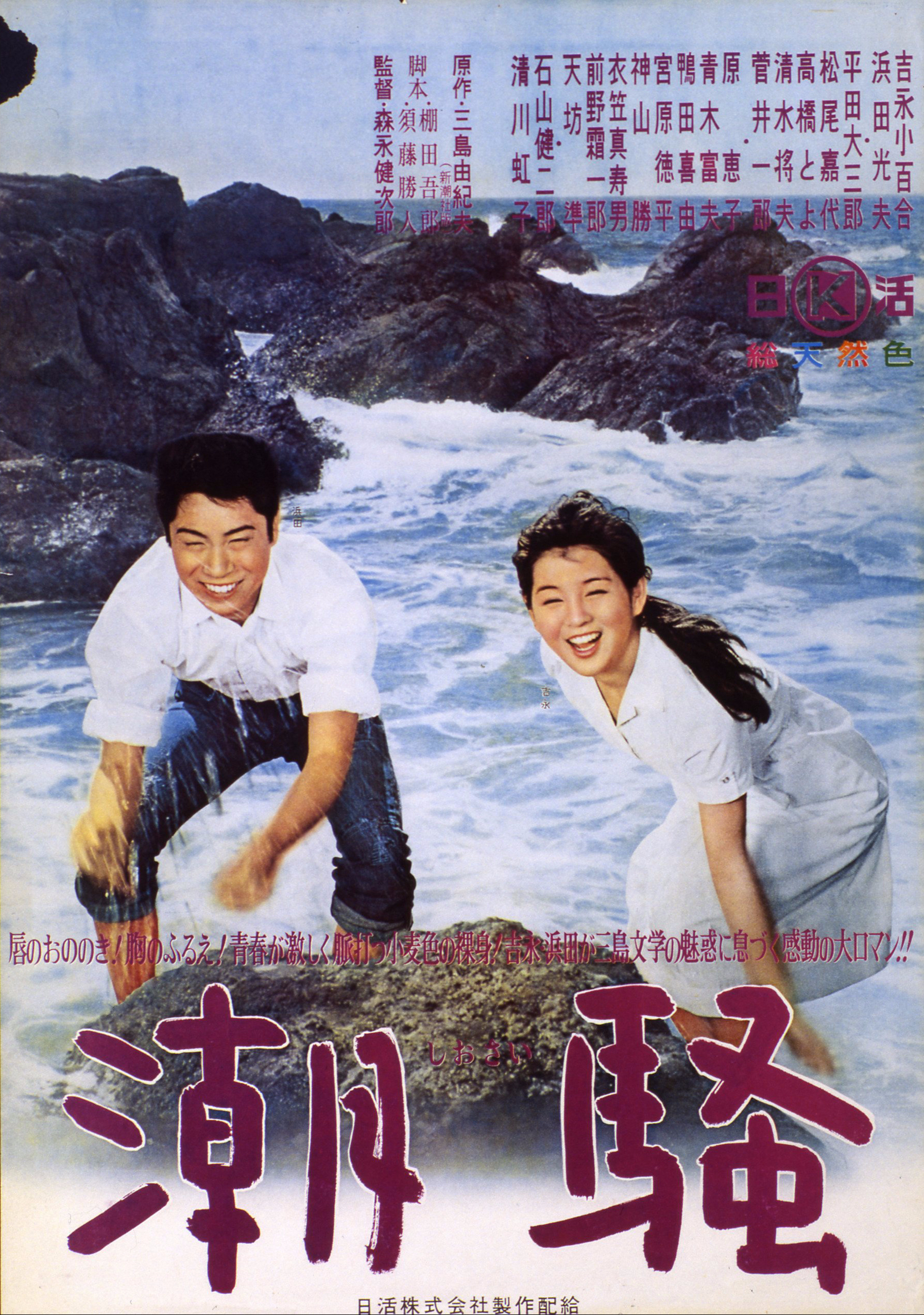
The Sound of Waves (潮騒, Kenjiro Morinaga, 1964)

Still a major marquee name well into her 70s, Sayuri Yoshinaga began her career as one of Nikkatsu’s young starlets in the early 1960s. Based on the well known novel by Yukio Mishima, The Sound of Waves (潮騒, Shiosai) finds her starring alongside regular co-star Mitsuo Hamada in another tale of love across the class divide. Usually, such forbidden love would be fodder for romantic tragedy, but Sound of the Waves is a cheerful exploration of tranquil island life where the people are simple and honest and the good will always triumph. 

Shinji (Mitsuo Hamada) is indeed good. Though still only a teenager, he’s become the man of the house following his father’s death, working hard as a fisherman to support his family and saving most of his salary to pay for his little brother’s education. The trouble starts when the beautiful Hatsue (Sayuri Yoshinaga) who had been living as a pearl diver on another island is called back to live with her father, island big man Terukichi (Kenjiro Ishiyama), after her brother dies. There have long been rumours that, as what Terukichi wants is a son to take over his business, he will soon be marrying Hatsue off and probably to the slick and handsome Yasuo (Daizaburo Hirata) who seems to be his favoured choice of son-in-law. 

When Shinji lays eyes on Hatsue helping out with the boats it’s love at first sight, and even more so when he foolishly drops his pay packet while delivering a fish to an elderly couple and Hatsue takes the trouble of finding out where he lives and delivering it to his mother safely. Though everyone in Shinji’s household is quite taken with the beautiful, kind, and responsible newcomer, they are also aware that she is far out of Shinji’s reach. Terukichi is mean and arrogant, there’s no way he’d let his daughter marry a regular fisherman, and Shinji knows he can’t compete with an eligible young man like Yasuo. Hatsue, however, seems to like him too, especially after she gets bitten by a snake and his quick thinking, immediately sucking out the poison, probably saves her life. 

This being an innocent story of pure love, the couple have the opportunity to consummate their relationship after stripping off during a rainstorm but collectively decide to wait for marriage. That doesn’t stop the rumours starting, however, when they are spotted in the forest by Chiyoko (Kayo Matsuo), a young woman sweet on Shinji who’d gone away to study at university in Tokyo. She tells Yasuo who is immediately threatened, not only feeling unjustly betrayed, but acutely aware that the bright future he’d been so proudly boosting of as Terukichi’s future son-in-law might be in jeopardy. 

Where Shinji is kind and responsible, working hard to look after his family and always supporting the other villagers, Yasuo is, like Terukichi, arrogant and self-centred. He’s perfectly aware that he’s the island’s most eligible bachelor and makes a point of swaggering around like a little prince in waiting. Perhaps for that reason he’s also a snivelling coward and intensely insecure, angrily confronting Hatsue and even attempting to rape her while she collects water at the local spring. She manages to fend him off when he’s stung by hornets coming to her defence, and all he can do is plead with her not to tell her father so he won’t mess up his bright future any further. 

Hatsue seems not to have very much say in her future, romantic or otherwise. Having heard the rumours, Terukichi keeps her prisoner in her own home, insisting that she will marry his choice of son-in-law. The islanders, however, who seem to have grown used to ignoring Terukichi as much as it is possible to do so, are fully behind the youngsters’ romance. After all, what could be more natural than two young people falling in love? Eventually the island women launch a small petition to Terukichi to convince him to end his pettiness, but the contest, it seems, comes down to a test of manliness, Terukichi embarking on a young people today speech in complaining that his boat’s come loose in a storm but no one is man enough to retrieve it. Yasuo is found wanting once again, shrinking back from real risk while Shinji puts himself in harm’s way not only to prove himself a man and win Terukichi’s approval, but simply to serve the community. Manliness is redefined not only as strength and bravery, but kindness and patience too. Shinji’s goodness is indeed rewarded allowing him to dream of a brighter future, building a life for himself alongside a woman who loves him on their idyllic island home. 


Original trailer (no subtitles)
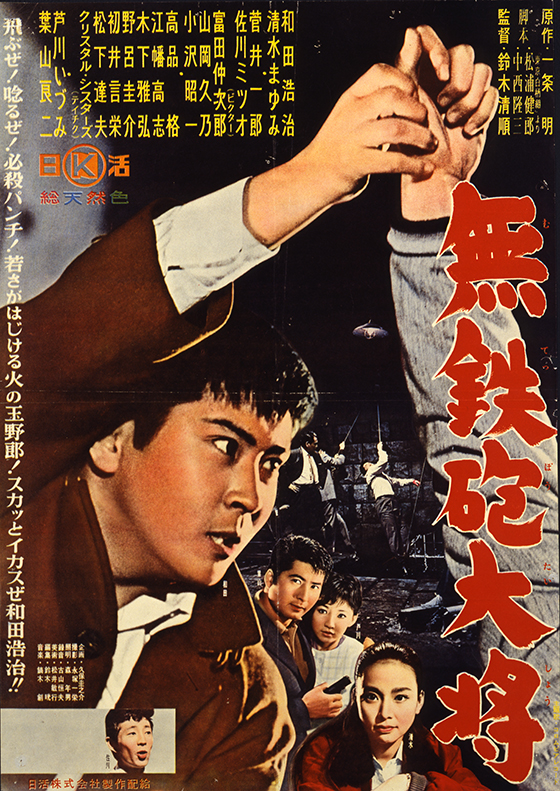
Living by Karate (無鉄砲大将, Seijun Suzuki, 1961)

Nikkatsu’s brand of youth cinema could often have a nasty edge, its damaged heroes caught up in complicated rebellion but necessarily outsiders in a changing world which they feared held no real place for them. For each of those, however, there are others filled with life and possibility, not to mention a cartoonish sense of fun and infinite safety which perhaps largely disappeared from the films of the 1960s only to be found again in Kadokawa’s similarly aspirational teen movies of the bubble era. 

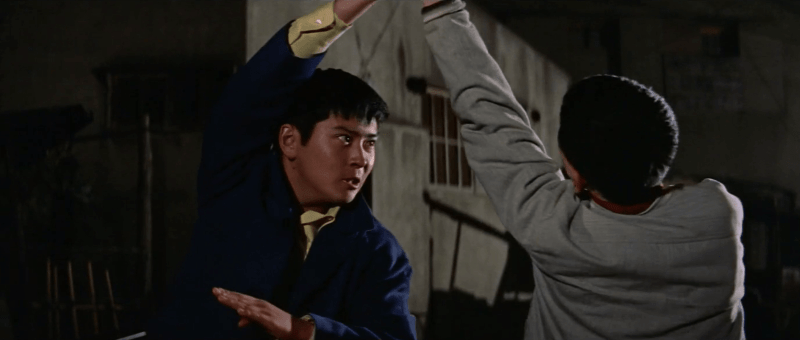
Living by Karate (無鉄砲大将, Muteppo Daisho, AKA Reckless Boss / A Hell of a Guy) once again stars Koji Wada as an earnest young man kicking back against the corrupt wartime generation. Still in high school, Eiji has a part-time job at an ice rink which he doesn’t treat quite as seriously as he ought to but his boss lets him get away with it because his handsome face is a hit with the local ladies. Eiji and two of his friends are keen members of a karate club and have decided to use their skills to fight for justice in their lawless town by going on “patrol”, clearing up the kinds of crimes the police might not make it to in time. Their plan backfires, however, when they come across the body of a recently deceased union leader and are arrested by a local bobby after getting caught with a joke knife one of the boys made for fun at his job on the family scrap yard. 

It comes as no surprise that Eiji’s arch enemy, sleazy mob boss Shinkai (Nakajiro Tomita), is behind the murder, apparently hired by a corrupt corporate CEO trying to stop his workforce exercising their legal rights. Eiji hates Shinkai because he bankrolled his widowed mother’s (Kotoe Hatsui) bar business but did so perhaps in return for being able to control her and by extension him by wielding his economic power against them. His loathing intensifies once he realises that the slightly older young woman he’s carrying a torch for, Yukiyo (Izumi Ashikawa), has fallen for one of Shinkai’s men, Goro (Ryoji Hayama). 

Goro is the classically “good” gangster who feels indebted to Shinkai because he took him in after the war, but wants to leave the underworld behind, going straight in Kobe where he intends to live a settled married life with Yukiyo. The modern yakuza is in many ways a Showa era phenomenon, a mechanism for men without families to protect themselves in the desperate post-war environment. By 1961, however, its existence was perhaps becoming harder to justify. The war orphans had grown up and had families of their own, the economy had significantly improved, and there was no need anymore to live a life of crime and heartlessness – a conclusion Goro has come to on his own after meeting the earnest Yukiyo who has similar problems with her goodhearted yet permanently drunk doctor father. 

Knowing he might have messed things up for his mother in interfering with her relationship with Shinkai, Eiji confesses that doesn’t “know what to do with the grownup world”. For him, everything is still very black and white. He hates yakuza because they prey on the vulnerable and Shinkai in particular because he does it so insidiously, forcing desperate people to accept loans on bad terms so that he can in fact “own” them and use them as he wishes. Eiji and his peer group kick back against what they see as the selfish corruption of the wartime generation, agitating for a fairer, more just world. The wealthy daughter of a corrupt CEO (Mayumi Shimizu) who has a crush on Eiji though he only has eyes for Yukiyo comes up with the idea of selling her fancy car to get money to help Eiji’s mother escape Shinkai’s control, but her father snaps at her that other people aren’t her responsibility and that she doesn’t understand how the real world works. 

Somewhat chastened by the youngsters’ pure hearted love of justice, he eventually comes up with a compromise in buying the car off her himself, but before that Eiji and his friends have to think carefully about the form they want their revolution to take. Taking him to task, Yukiyo points out that if all you do is fight with yakuza then maybe you’re a yakuza yourself, which shifts Eiji’s perspective towards ensuring that his rebellion is fully legal and involves the justice systems already in place. He comes to recognise that Goro is much like himself, and if he’s going to take down a sleazy brute like Shinkai it will take more than some fancy karate. Their resistance starts at home, giving others courage to stand up to yakuza oppression while living right themselves in the hope of creating a better, fairer world free of heartless organised crime.


The Enchantment (誘惑者, Shunichi Nagasaki, 1989)

“A broken romance affects everybody” a sympathetic psychiatrist tries to reassure a patient suffering a dangerous romantic obsession with a possibly imaginary woman. Like so much of his work, they’re soft words offered casually as a path towards something deeper but in this case it’s not the patient we need to worry about but the doctor. The aptly named The Enchantment (誘惑者, Yuwakusha), somewhat less subtly titled “Temptress” in Japanese, takes its “hero” on a dark journey into fascination, the male need for domination, and the self delusions of irresolvable disappointment.   

The film opens with genial psychiatrist talking to a patient, Hirayama (Tsutomu Isobe), who proclaims himself more or less cured from a nervous breakdown born of a broken heart. Hirayama’s love affair may be largely imaginary, and he seems far from “cured”, but Doctor Sotomura’s (Masao Kusakari) failure to challenge him on his new affirmation that he’s over her because he’s realised she was “just a bitch” who treated him “like trash” might be a worrying oversight. Hirayama was supposed to be his last patient of the day, but a last minute walk-in, Miyako (Kumiko Akiyoshi), piques his interest enough to keep him in the office rather than on a planned date with his receptionist fiancée and surgeon best friend.

Miyako, nervous and reticent, tells him the appointment is “about a friend” and takes some coaxing before beginning to explain that she has been physically assaulted by her female roommate apparently jealous over the unwanted attentions of a man who developed an attraction for her at her job as a tour guide. Miyako does not spell it out, but somewhat implies that her relationship with her roommate Kimie is romantic while Sotomura has the good sense not to push the issue, only to urge her that perhaps she should think about staying with a friend a while if she doesn’t feel safe at home. Miyako, however, doesn’t want to do that and is only worried about what might have provoked this sudden and unexpected change, fearing most of all that she herself will fall out of love with Kimie if her moodiness continues to intensify.

Overstepping the mark, Sotomura is fascinated with his mysterious new patient, particularly after he becomes a kind of white night rescuing Miyako from a dangerous encounter with Hirayama who is under the delusion that she is the embodiment of his romantic obsession “Junko”. The fascination only intensifies after he makes a surprising discovery – Kimie is not “real” but a secondary personality inside Miyako. Infuriated by Sotomura’s romantic overtures, Kimie takes control and stabs him in the leg while Miyako continues to visit him in the hospital, unable to remember what exactly happened between them.

Sotomura’s obsession is both sexual and professional, after all how many sufferers of MPD is he going to meet in the course of his career? He is indeed ambitious, casually dating his receptionist Harumi (Kiwako Harada) mostly because she’s the daughter of his former professor. Though the couple live together, Harumi is constantly frustrated by his indifference to their relationship and foot dragging over making it official. Sotomura’s best friend, Shinbori (Takashi Naito), is facing much the same dilemma but has resigned himself to an arranged marriage to further his career and keep his family happy. Sotomura instinctively thinks he ought to do the same and tells Harumi that he’ll sort things out with her father, but remains fixated on the mysterious Miyako and her unconventional love life. 

A more cynical friend warns him that sex is the only thing that matters and it’s essential to avoid emotional entanglements. Nevertheless, Sotomura finds himself desperate to unlock the mystery of Miyako, but it remains open to debate which part of her he wants to “fix” – her MPD, or her sexual orientation. As we find out, Sotomura might assume that Miyako’s love for another woman has driven her “mad”, but in reality it’s more that a sense of impossibility led her to believe that there was no solution to her suffering other than death. Faced with unreconcilable loss, she internalised the figure of her fixation, literally becoming one with her lost lover in order to avoid facing that she was alone once again. Uninterested in Sotomura, Miyako/Kimie becomes fascinated with Harumi who eventually becomes so intensely obsessed with Miyako that she is willing to erase her own identity and become “Kimie” for her in order to support her sense of reality and protect the integrity of the Miyako personality.

Again, Sotomura has a few issues. The first is multi-layered sexual jealousy. Now that Harumi has moved on, found someone who “needs” her, and seems to be happier he is instantly irritated that she left him (for a woman) and desperate to win her back (along with the career boost he romanced her for in the first place). He resents Harumi’s differing vision of medical care, that she is willing to embrace Miyako’s delusion in order to keep her stable while wilfully abnegating her sense of self in a profound act of love. Sotomura the clinician wants to “cure” Miyako of her delusion, but his intervention is brutal, intruding on the mental space of her traumatic memory with physical violence designed to rip her from her safety of her artificial reality. He tries to insert himself between the two women, asserting his masculine “right” to dominate, but is eventually ejected by another knife blow to the thigh as the women assert their right to their own reality in the absence of men.

A strange psychosexual odyssey, The Enchantment spins a dark tale of obsession, delusion, and jealousy but ends on a broadly positive, if perhaps uncomfortable, note, in which the dominant psychiatrist is forced to recognise his irrelevance and the legitimacy of realities outside of his own. Broken romance affects everyone, as Sotomura said, but perhaps he doesn’t have the right to intrude on the broken hearts of others or judge the various ways in which they attempt to patch them back together again. A chronicle of bubble era Tokyo bathed in garish neon and a sense of infinite possibility, Shunichi Nagasaki’s heady feature is a surprisingly subversive affair in which trauma cannot be overcome but can perhaps become integrated in a mutually beneficial whole.


Black Sun (黒い太陽, Koreyoshi Kurahara, 1964)

black sun still 2The Warped Ones showed us a nihilistic world of aimless youth living not so much on their wits as by their pleasures, indulging their every animalistic whim while respectable society looked on in horror. By 1964 things have only got worse. Tokyo might have got the Olympics, Japan might be back on the international map, and economic prosperity might be on the rise but all around the city there’s an arid wasteland – a literal dumping ground in which the unburied past has been left to fester as a grim reminder of historical follies and the present’s reluctance to deal with them.

Akira (Tamio Kawaji), now calling himself “Mei” (perhaps a play on the reading of the character for his name 明), seems to have mellowed since the heady days of his youth. Living alone save for a dog named Thelonious Monk, Mei has co-opted a disused church and turned it into a shrine for jazz. The walls and ceilings are covered in photographs of famous jazz musicians and posters for club nights and solo shows. He has his own turntable and a well stocked selection of LPs, though he still seems to frequent the same kind of jazz clubs that so defined his earlier life.

Change arrives when Mei boosts a fancy car and is almost caught in a police net caused by the body of an American serviceman found floating in the harbour. Apparently the crime is the product of an internal GI squabble, but the offending soldier is on the run with a machine gun. As coincidence would have it, the wounded killer, Gil (Chico Lourant), fetches up at Mei’s church and, as Gil is a black man, Mei assumes that they will definitely be friends. It is, however, not quite that simple.

As in the earlier film, jazz is the force which keeps Mei’s mind from fracturing. His life still moves to improvisational rhythms even if apparently not quite so frenetically as it once did. Rather than the rampant animal of The Warped Ones, this Mei has embraced his outsider status through literally removing himself from the city in favour of self-exile and isolation as a squatter in the house of God – a place about to be torn down.

While Mei has been literally pushed out with only his beloved dog as evidence of his latent human feelings, his formerly delinquent friend, Yuki (Yuko Chishiro), has gone on to bigger and better things. No longer (it seems) a casual prostitute catering to foreigners, Yuki has repurposed the skills her former life gave her to shift into an aspirational middle-class world as a translator for those same American troops she once performed another service for. The American occupation is long over, but the US Army is everywhere.

Mei thinks of himself as one of Japan’s oppressed outsiders – an outcast in a land subjugated by a foreign power. He squats in a ruined church while the Americans “squat” in his ruined country. He likes jazz because it fits the rhythms of his mind but also because he believes it to be the music of the oppressed. In Gil he thinks he sees another like him, a man oppressed in his own homeland and ironically enough by the same forces that are (in part) oppressing him. Mei has a lot of strange, stereotypical ideas about black men – he’s excited to meet Gil because he thinks all black men must love jazz and that Gil must be some kind of jazz god, but Gil is a frightened rabbit on the run, terrified and bleeding. Thinking he’s in the middle of a visitation, Mei tries to make plain his enthusiasm despite the obvious language barrier, pointing wildly at his shrine to jazz, but all Gil wants is quiet and help with the bullet wound currently suppurating on his thigh.

The “relationship” deteriorates, but a strange kind of camaraderie is eventually born between the two men. Things take a turn for the surreal when Mei dons black face and paints Gil’s white, only to get stopped by GIs who want to see an ID from a “foreigner” driving a fancy car, and for Mei to introduce Gil at his favourite jazz bar as his new “slave”. In hindsight it’s all a little awkward as Kurahara throws in stock footage of the civil rights movement and tries to equate it both to the recent protest movements in Japan and to Mei’s self-identified status as one of Japan’s oppressed masses. Still, you can’t argue with the fact that the two men have found a bond in their shared alienation and desire to escape from the impotence of their current situations.

Ironically enough Kurahara does seem to believe in an escape, though it’s perhaps not so positive as it sounds. The tragic friendship of the two men in which one must save the other by releasing him towards the sea and the sun pushes Mei out of his self-exile and back into the “real” world even if he still considers himself to be an outsider within it. The sun is bright but it’s also dull, shining not with hope but with consolation for a hopeless world in which the only victory lies in the final act of surrender.


Short scene from the beginning of the film (English subtitles)

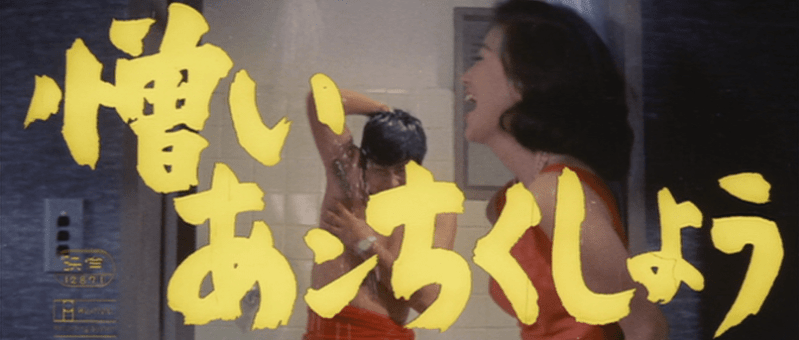
I Hate But Love (憎いあンちくしょう, Koreyoshi Kurahara, 1962)

I hate but love posterDoes “pure love” exist in the Japan of 1962, and if so what does it look like? Yujiro Ishihara, the poster boy for youthful rebellion, might not be the best person to ask but it’s his unfulfilled media superstar that ultimately determines to find out. In I Hate But Love (憎いあンちくしょう, Nikui Anchikusho) Koreyoshi Kurahara puts the jazz clubs and delinquency of The Warped Ones to one side for a Technicolor romp that owes more to Day/Hudson than it perhaps does to James Dean or Marlon Brando. Yet there is something mildly subversive in its low level criticism of Japan’s lurch towards the consumerist future, finding only emptiness in fame and success while the central couple’s deliberately repressed desires push them towards a point of both spiritual and physical exhaustion.

Daisaku (Yujiro Ishihara) and Noriko (Ruriko Asaoka) have been a couple for two years. Noriko is also Daisaku’s manager and has been with him since he was broke and an aspiring poet. Now he’s one of Japan’s top DJs and she looks after his schedule which is packed in the extreme – in fact it leaves him no time for sleeping between his radio show, TV appearances, and meetings in bars, not to mention a late night date starting at 2am! Raiding the local papers for a suitable human interest story they can flag up on the show, Noriko stumbles over the tale of a local woman who is looking for a “driver who understands humanism”. Intrigued, Daisaku and his producer Ichiro (Hiroyuki Nagato) set off to interview her but the woman doesn’t want to be involved with the media – she doesn’t want to sully her love! The fact of the matter is, Yoshiko (Izumi Ashikawa) has kept up a romance with a doctor in a rural town by letter alone and used all her savings to buy a jeep to help transport his patients more effectively. Yoshiko doesn’t need to see Toshio (Asao Koike) – her dashing doctor fiancé, she believes in their love and that’s good enough for her. She just needs someone to actually take the jeep to Kyushu where it is most needed.

Just at this point, Daisaku’s relationship with Noriko reaches a crisis point. Lovers for two years, they each feared the sparks would fade and so to keep them popping they’ve committed to a rule of no physical contact. Spark they do (though not always in a good way), but when trapped in Daisaku’s apartment one rainy afternoon and bored out of their minds they nearly give in – damaging the fragile balance they’ve managed to build through mutual rejection of their equally mutual attraction. Though Noriko remains committed to their plan for long term romance, the non-encounter pushes Daisaku into a profound state of crisis in pondering the nature of his relationship – does “pure love” exist, does he really “love” Noriko, what is the point and the purpose of their central bond of negation? Hoping to find all of that out, Daisaku makes a surprise on air announcement that he himself will drive Yoshiko’s truck to Kyushu and see what her Toshio does with that.   

Yoshiko and Noriko set themselves up as rivals – not for Daisaku’s heart but for the true nature of “love”. “Reclaiming” Daisaku’s Jaguar so she can chase after him, Noriko has a few words for Yoshiko, pointing out that she’s been patiently “building” her love with Daisaku for 737 days. Yoshiko looks at her pityingly – you don’t “build” love, she tells her, you just believe it. For Yoshiko her letters were enough, her love an act of faith, but for Noriko love is a process and an almost scientific endeavour filled with recordable and quantifiable data. Yet everything Noriko says about Daisaku is correct – she knows who he is and truly understands him, every part of him is welcome to her and so she is perfectly placed to find him off on his magic quest even if her desire to bring him back to the city is misplaced.

Daisaku’s journey puts them both through the ringer though their bond is never seriously in question. He runs and she follows, though neither of them can quite escape the net of the society in which they live. Daisaku’s flight is perhaps more from his micromanaged yet extremely comfortable life than it is just of a difficult romance. Taking to the road he wants to feel something, to know that there is something real out there. Unfortunately, even his attempt to embrace something “real” is subverted by his media buddies who secretly film him and air the footage like it’s all been a giant publicity stunt. Fearing that their cash cow is “drunk on humanism”, they ready a contingency plan to bring him back into the fold.

Ichiro tells Noriko that her desire to “tie Daisaku down” is not love but “female egotism”. What drives Noriko isn’t really a desire for control (Daisaku seemingly allows her enough of that), but a need to be needed and fear that Daisaku, now rich and famous, will eventually leave her. Paranoid their love will fail, she rejects its consummation. Yet faith alone is not enough, as Yoshiko painfully finds out on witnessing the disconnect between her imagined love created through her letters and the real flesh and blood man before her to whom she essentially has no real connection. Reaching the end of their journey, Daisaku and Noriko are forced together again, each abandoning some part of their Tokyo lives and personas to break through to something deeper and more essential. Their path takes them straight into a bizarre summer festival complete with giant floats and excited men in traditional Japanese underwear throwing water everywhere. When they finally reach their destination, their love transcends faith to become ritual, their ennui somehow transformed into an ironic celebration of life in fulfilled desire.   

Ichiro categorises Noriko and Daisaku as stingy children – defiantly saving the best for last. There is certainly something immature in their constant bickering and bargaining, the superstition that they can keep their love alive by continually rejecting it and repressing their desire for each other, but there’s also something faintly realistic in the messy grown-up commitment phobia of it all even if it joyfully strays into the absurd. Light and bright and breezy, Kurahara works in the darknesses of early ‘60s Japan from the destructive effects of celebrity and media manipulation to the emptiness of a life of excess but even if he doesn’t quite find “pure love” he does find something close to it in a perfect merger of faith and industry.