Ginza Cosmetics (銀座化粧, Mikio Naruse, 1951)

1951’s Ginza Cosmetics (銀座化粧, Ginza Kesho) is often said to mark a kind of rebirth in the career of director Mikio Naruse whose output in the 1940s was perhaps unfairly denigrated not least by Naruse himself. As in much of his golden age work and in anticipation of When a Woman Ascends the Stairs, Ginza’s heroine is a resilient bar hostess whose brief hopes of escape through romance are doomed to failure, but it’s also, like the slightly later Tokyo Profile (Hiroshi Shimizu, 1953) and Tales of Ginza (Yuzo Kawashima, 1955) an ode to the upscale district and all the defeated hopes of its illusionary glitz and glamour. 

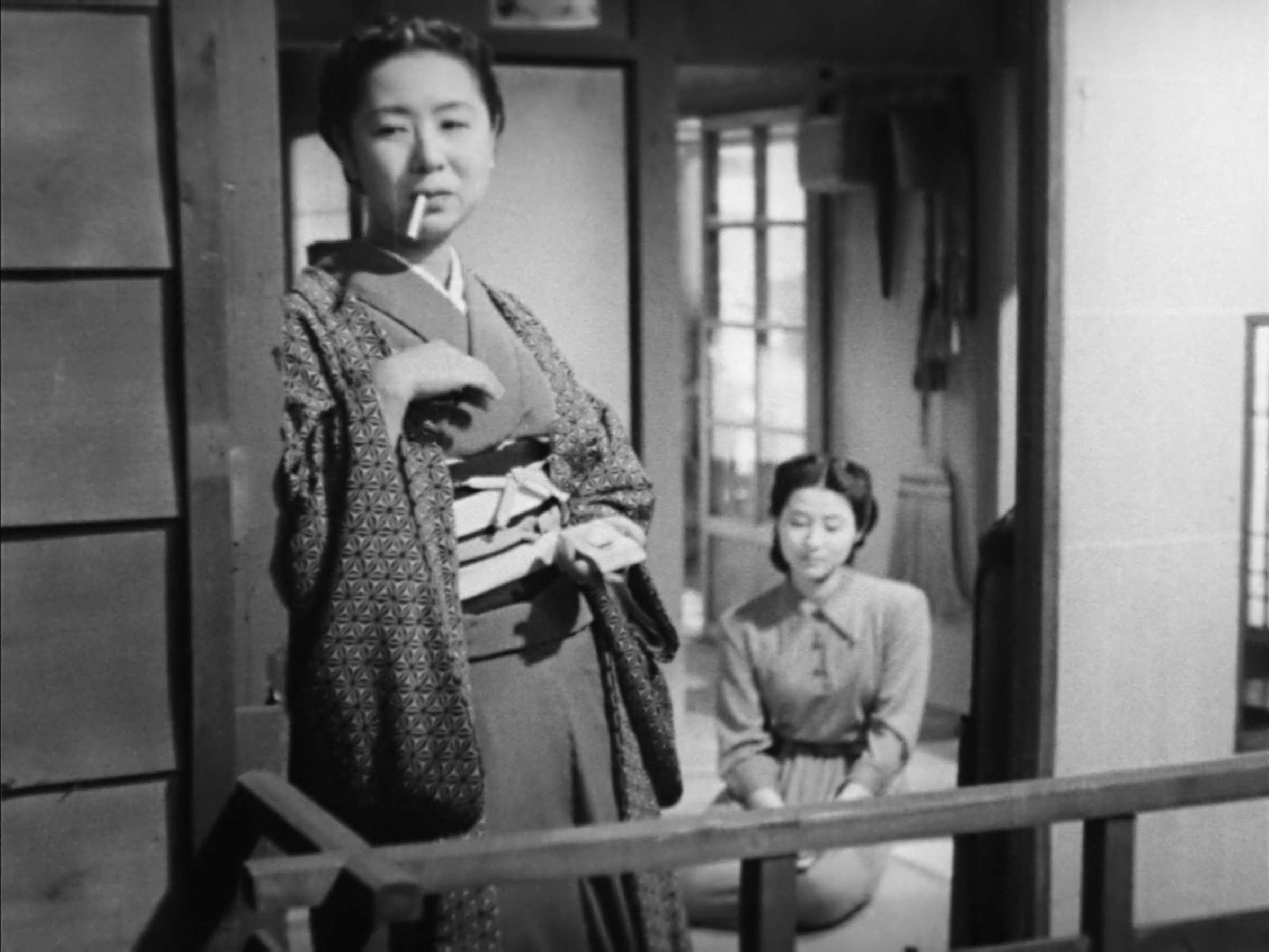
Yukiko (Kinuyo Tanaka), the heroine, is a single-mother approaching middle age and working as a hostess in a Ginza bar. Her landlady who runs a nagauta school on the ground floor and constantly complains about her feckless though goodnatured unemployed husband seems to think she could do better, pointing out that she is an educated woman who seems slightly out of place in the rundown backstreets of this otherwise aspirational area. Even for educated women, however, there may not be many other opportunities in the straitened and socially conservative post-war economy especially for those without connections, and Yukiko also needs to provide for her young son Haruo (Yoshihiro Nishikubo), born out of wedlock after an affair with a customer with whom she had fallen in love but abandoned her when she became pregnant. 

As a slightly older woman who has been working at the Bel Ami bar for many years, seemingly from war to occupation, Yukiko is both looked up to by the younger women and resented as a stern older sister who does not approve of the way some of them ply their trade. She’s taken one, Kyoko (Kyoko Kagawa), who often babysits for her, under her wing, cautioning her against making the same mistakes that she once made in taking the kinds of men that come into the bar at their word. “Men are all animals” she warns her, supporting her desire not to give in to her parents’ attempts to arrange for her not a marriage but a “position” as a mistress. Unlike Yukiko, Kyoko still has hope of leaving the Ginza bar world behind to become a respectable wife even if those hopes are fading with the relative unlikelihood of finding a “good” man with a salary good enough to support a wife who is not already married and can be understanding of her bar girl past. 

The bar world may be on the fringes of the sex trade, but the bar girls are not necessarily sex workers even if some of the younger women are clearly engaging in the kinds of casual sex work of which Yukiko clearly disapproves even while not against consensual romantic liaisons. For her own part, she finds herself in the awkward situation of a continuing non-relationship with a failed businessman, Fujimura (Masao Mishima), who was fairly wealthy during the war but apparently no longer. Yukiko attributes this to him being in someway too good to prosper, though having money in the war which disappeared afterwards perhaps implies the opposite. She does not love him and seems to find his presence a little irritating, but feels indebted because he stood by her when she was pregnant and alone. In any case, he has a wife (whom he apparently resents) and children (whom he claims to adore) and so she feels at best conflicted, especially as the tables have turned and it’s him now constantly asking her for money. Money is not something Yukiko has a lot of, but she isn’t mean and often consents to losing it with a resigned shrug as she does by taking on Kyoko’s bar debt after a customer runs out on the bill and then tricks Yukiko into buying more drinks while waiting for a “friend” to arrive. 

Men, it seems, will always be predatory and unreliable. On hearing from her boss and longtime friend that the bar is in trouble and may have to close, Yukiko ends up acting on an introduction from an acquaintance, Shizue (Ranko Hanai), to meet a “stingy” industrialist who had expressed an interest in her. Shizue has escaped the bar world by becoming a wealthy man’s mistress and with it has claimed a kind of independence. He splits his time between Tokyo and Osaka, leaving her free to do whatever she likes (including meeting other men) for most of her time with none of the strings that go with being a wife. Yukiko is perhaps too “pure” for that kind of arrangement, hinting at the Ginza paradox that only those who learn to accept a certain level of complicity can ever truly be happy there. She agrees to meet Kanno (Eijiro Tono), the businessman, in order to ask him to “invest” in the bar, suggesting they talk things over in a coffeeshop while he tries to pull her into various shady establishments before pushing her into a warehouse and attempting to rape her to get his money’s worth. Yukiko escapes and resolves not to see him again. After all, the point of getting the money to keep the bar open was precisely to avoid having to make arrangements with men like Kanno. 

It’s Shizue, however, who later gives her a last shot at escape when she introduces her to her “true love”, Ishikawa (Yuji Hori), making a brief trip into the city. Shizue can’t entertain him herself because her patron is in town and so entrusts him to Yukiko with the strict instruction not to try it on. Despite herself, however, Yukiko becomes fond of him, reassuming something of a past persona in engaging in intellectual conversation, once again an educated, middle-class woman rather than a bar hostess used to telling men what they want to hear. She has been warned, however, that Ishikawa hates anything “low culture” which is why Shizue has told him they are both war widows and discovers that he has a strong dislike for Ginza which sees him longing for the wholesome charms of home. 

The crisis occurs when Yukiko has to break a promise to Haruo to take him to the zoo in order to look after Ishikawa, causing him to go temporarily missing when he wanders off on his own roaming all over the endless construction site of the contemporary city standing in for the makeshift, in-progress reconstruction of the post-war society. She perhaps feels she’s being punished for choosing to disappoint her son in order to pursue a dream of romantic escape she might also feel is somehow undeserved, but pays in quite a different way after accidentally setting Ishikawa up with Kyoko whom she introduced as her “sister”. Originally angry and resentful, proclaiming herself disappointed with Kyoko in assuming she is the same as the other young women at the bar, Yukiko’s good nature eventually wins out as she realises that Kyoko and Ishikawa seem to have fallen in love in a single night. She has told him everything, and he apparently wants to marry her anyway. Kyoko, at least, is getting out, and Yukiko can be happy about that while privately internalising defeat. Acknowledging that Haruo is the only one on whom she can depend, she resolves to live on as a mother only, trapped in the deceptive diminishing returns of a Ginza bar life even while knowing it has increasingly little place for her.  


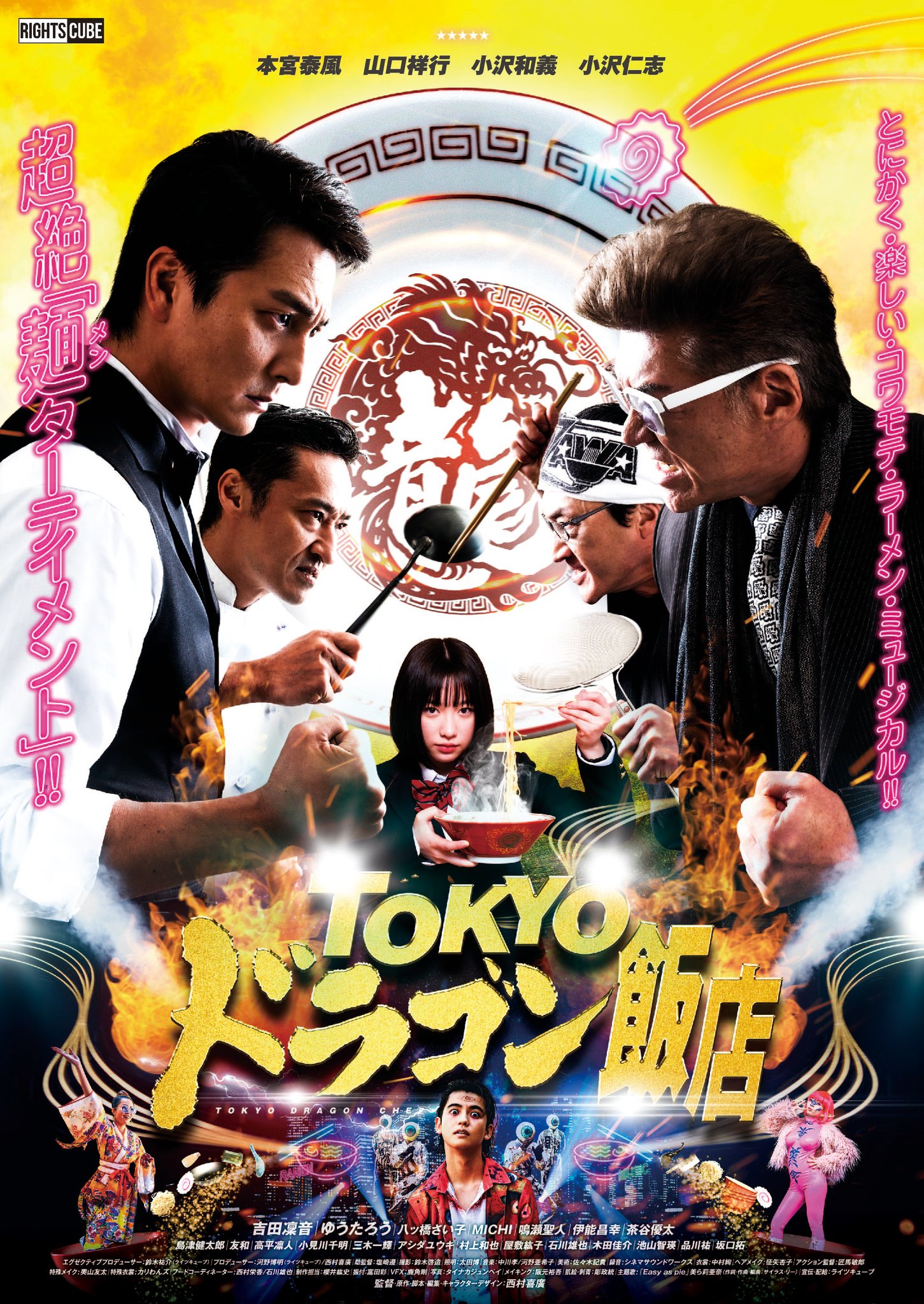
Tokyo Dragon Chef (Tokyoドラゴン飯店, Yoshihiro Nishimura, 2020)

Yoshihiro Nishimura began his career designing makeup and special effects for other directors working in the genre he would later headline, low budget splatter/exploitation primarily produced for the export market. With such legendary titles as Tokyo Gore Police, Vampire Girl vs. Frankenstein Girl, and Helldriver under his belt Nishimura’s reputation for surreal violence is already assured, but Tokyo Dragon Chef (Tokyoドラゴン飯店, Tokyo Dragon Hanten) sees him heading in a different, perhaps unexpected direction with a “family friendly” (depending on your family) musical tale of changing times, intergenerational warfare, and the wholesome soul of ramen. 

Veteran yakuza Tatsu (Yoshiyuki Yamaguchi) has just come out of prison but emerges into a world very different than he left it. His old comrade Ryu (Yasukaze Motomiya) now peddles Nata de Coco out of a tiny van, explaining that a mysterious invader with a third eye, Gizumo (Yutaro), apparently beheaded not only their gang boss but several others in the area effectively killing off the local yakuza scene. Remembering that Tatsu had a reputation as top a cook, a skill he apparently honed inside, Ryu suggests permanently retiring from the life to open a ramen bar. Meanwhile, two rival yakuza, Kazu (Kazuyoshi Ozawa) and Jin (Hitoshi Ozawa), have had exactly the same idea, setting up a van virtually outside and positioning themselves the competition by serving truly ginormous portions literally pushing quantity over quality.  

The truth is that the yakuza as an organisation has entered its twilight period, these older, Showa-style gangsters no longer have much of a place in the modern world hence why they need to find alternative ways of living. This is a fact brought home to them by the main villain who has a bizarre habit of singing Merry Christmas and is something like a youth elitist who resents the privileged status of the middle-aged and older in Japan’s ageing society, insisting that “Japan can’t survive with only old people like you” and that they should step aside to allow the young to rule. His villainy is well and truly signalled by his allegiance to fancy steak dinners which he characterises as high class cuisine suitable for righteous citizens like himself, rejecting the earthy, wholesome charms of the iconic shomin soul food that is ramen. 

The former yakuza, meanwhile, forced to work together, are an unexpected source of egalitarian solidarity. Not only do they eventually add an Okinawan soothsayer (Michi), holding a bright red crystal ball and dressed in traditional Ryukyu fashion while singing in a typical island style, to their ranks but their chief supporter closes all his YouTube videos with “kamsamnida”. Old style gangsters, they intensely resent that Gizumo has taken the battle to the streets in targeting those outside the life such as the Chinese owner of another local ramen bar and the father of their biggest fan, ramen-obsessed high school girl Kokoro (Rinne Yoshida). Yet there is something a little subversive in the irony of these multicultural nods, Kazu and Jin’s rival mascot character Mimi (Saiko Yatsuhashi), a YouTube star famous for eating giant portions who intensely resents being called an “alien”, breaking into cod Korean while the Chinese ramen guy is dressed in the full “Chinaman” outfit complete with fake pigtail. 

Nevertheless, it’s the wholesome charms of authentic ramen which eventually bring people together as the gang prepare to face off against Gizumo who apparently wants to turn the land into some kind of soulless hotel state. The final fight in which the former goons arm themselves only with ramen utensils and noren poles is also not without its share of irony as they turn Gizumo’s weird iconography back against him in despatching his henchmen who are each wearing helmets in the shape of an eyeball which would it seems be something of a handicap in hand-to hand combat even if your opponents were not fearsome gangsters, determined high school girls with vengeance on their minds, “alien” mascots, and spiritualists armed with hazardous balls. A fantastically silly affair, Tokyo Dragon Chef isn’t taking itself too seriously but has wholesome charms of its own in a tale of reformed yakuza, rebirthed communities, and the healing power of ramen as a universal unifier pushing back against snooty, youthful elitism in an ageing society.


Tokyo Dragon Chef is released on DVD & VOD on 25th January courtesy of Terracotta Distribution.

UK Release trailer (English subtitles)

The Ghost of Kasane (怪談かさねが渕, Nobuo Nakagawa, 1957)

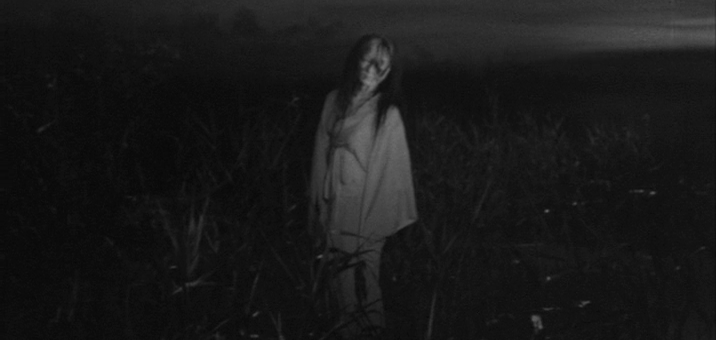
“Fear the hatred of the dead!” a blameless slain wife exclaims after being cruelly cut down by her deluded husband in Nobuo Nakagawa’s tale of karmic vengeance, The Ghost of Kasane (怪談かさねが渕, Kaidan Kasane-ga-fuchi). Then again, though cleaving close to the standard formulas of the ghost movie not to mention the famous tale, these fatalistic, generationally twinned tales of ghostly revenge have an oddly imprecise quality in which it is the innocent who are eventually made to suffer, caught between concentric circles of guilt and retribution. 

The tale opens in 1773 with a blind masseur/money lender, Soetsu (Yoji Misaki), leaving his home on a snowy day hoping to catch venal samurai Shinzaemon (Akira Nakamura) at home. Shinzaemon and his wife are hospitable, but a conflict soon breaks out during which Shinzaemon accuses the old man of disrespecting him as a samurai and generally getting above himself as a mere member of the peasant class. All Soetsu has done is politely ask for the money he’s owed while making it clear that Shinzaemon’s attempts to give him the run around are wearing thin, but he ends up with a nasty gash on his face after the enraged samurai throws a pot at him. Driven into a frenzy by this unwelcome class-based anxiety, Shinzaemon slashes Soetsu with his sword and kills him, instructing a servant to stuff his body in a case and dump it in Kasane swamp. Soetsu, however, does not rest easy, returning to taunt him, eventually causing him to murder his wife by mistake and thereafter drawing him to his death by drowning in the very swamp where he dumped the body. 

20 years later in Edo, Soetsu’s daughter Rui (Katsuko Wakasugi) has become a successful shamisen teacher, while Shinkichi (Takashi Wada), the orphaned son of Shinzaemon, was taken in by a merchant family who continue to treat him as a poor relation. While having internalised a servant mentality that ironically inverts his father’s anxiety in his samurai status, Shinkichi has fallen in love with the daughter of the house, Hisa (Noriko Kitazawa), who is about to be betrothed against her will to the horrible son of local merchants, Seitaro (Shuji Kawabe). Rui, meanwhile, an older unmarried woman, is desperate to fend off the violent attentions of rough ronin Omura (Tetsuro Tanba), eventually convincing herself she is in love with the mild-mannered Shinkichi who might well think a rebound relationship is a good idea if it clears the way for Hisa’s inevitable marriage. 

Oddly enough and somewhat incomprehensibly, it’s Rui who becomes the target of her father’s curse, perhaps for her unwitting affection for the son of the man who killed him though it seems insufferably cruel that a father would involve his own child, not to mention the blameless infant of his murderer, in his bid for vengeance from beyond the grave. For his part, Shinkichi pays a heavy price for his unmanly diffidence, brave enough neither to say no to Rui or to run away with Hisa, simply passive if kind in the face of mounting impossibilities. Yet as much as it’s her father’s resentment that causes her downfall, struck by the pluck from the shamisen which scars her face to mirror his, she adds her own share in the wrath of a woman scorned dragging Shinkichi towards the lake for his inability to let go of his love for Hisa.

Old Soetsu might have a right to be vengeful, but his curse has collateral damage, enacted on women in order to target men as in Shinzaemon’s unwitting murder of his wife and Shinkichi’s accidental violence against Hisa at the instigation of Rui. Only the two old servants are left behind to make peace and tell the story, united by their respective positions rather than divided by their conflicting affiliations. Studio-bound yet filled with a series of supernatural tricks, Nakagawa’s atmospheric adaptation of the classic tale once again features the bug-eyed deformity of the scorned female ghost as Rui’s initial injury eventually balloons as her “sickness” intensifies, later finding time to turn her rage on Omura who was not, it has to be said, on the original list of victims being simply an embodiment of the cruelty of the age. Nakagawa ends, however, not with darkness but with light, freeing the souls of the troubled lovers from the gloom of earthly torment in urging them to leave their hatred behind and return to Buddha in eternal peace. 


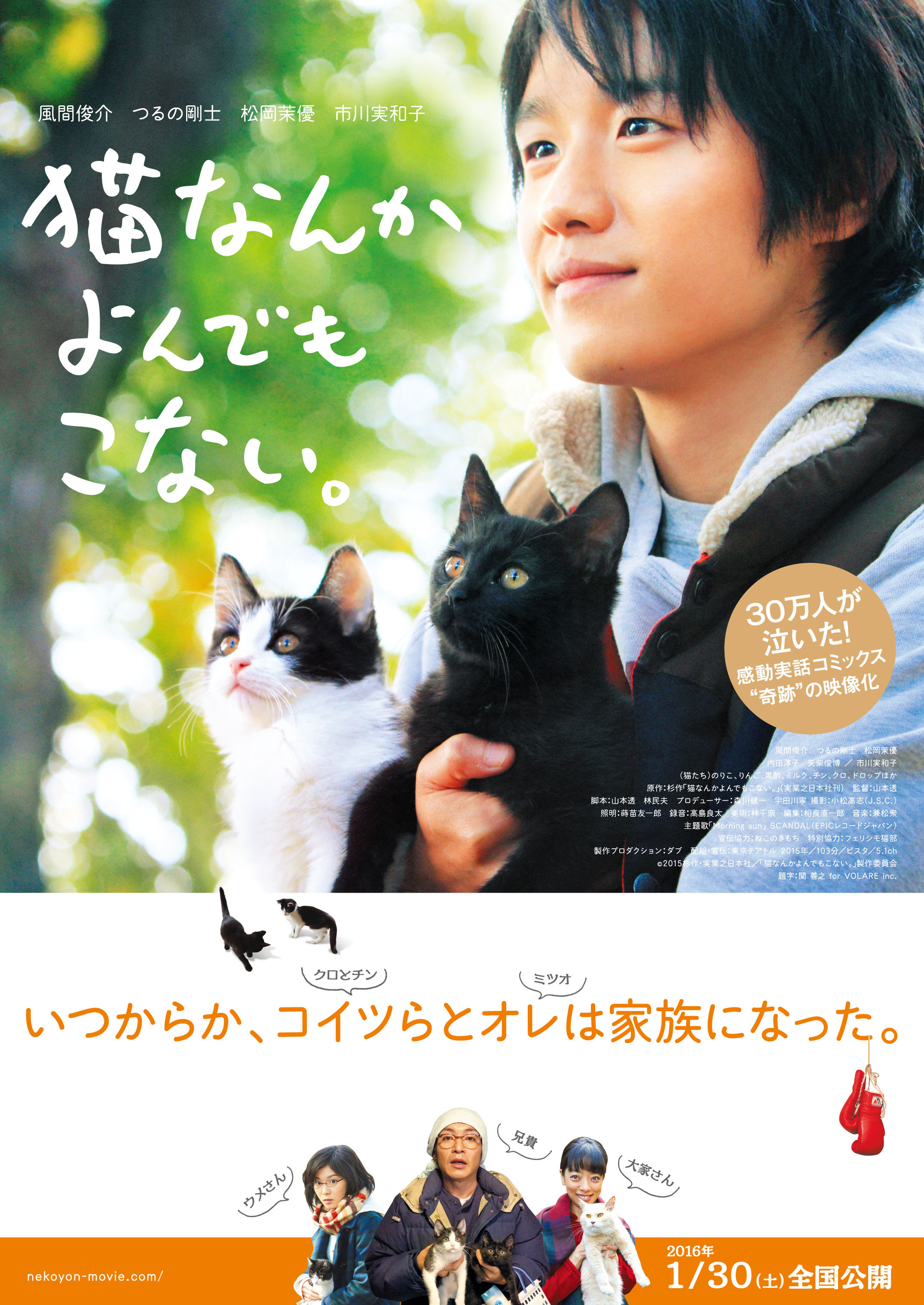
Cats Don’t Come When You Call (猫なんかよんでもこない。, Toru Yamamoto, 2016)

How do you keep going after all your dreams have died? For the hero of manga adaptation Cats Don’t Come When You Call (猫なんかよんでもこない。, Neko Nanka Yondemo Konai.), a pair of adorable kittens eventually point the way towards a more positive future. After all, it’s easier to convince yourself to look after something else than it is to look after yourself. As the title suggests, however, cats like the future can be elusive and confusing, both needy and indifferent. In caring for them you’ll inevitably make mistakes, but those mistakes will perhaps teach you something about the business of being alive. 

The hero, Mitsuo (Shunsuke Kazama), is a dog person, which is why he walks on by when he sees a cardboard box with two abandoned kittens inside by the railway line. An aspiring boxer, he’s moved in with his mangaka brother (Takeshi Tsuruno) and given up all his part-time jobs in the hope of winning enough fights to achieve A-rank status and get a license to turn pro. He’s quite annoyed, therefore, to discover that his brother decided to adopt the cats, naming them Tiny and Blackie, and is expecting him to look after them seeing as he’s not contributing in any other way. 

Despite his original animosity (he claims to hate cats because of their “malicious, warped personalities”), Mitsuo ends up taking to the kittens who quickly take to him, though mostly because he is providing them food and warmth. He even starts to think that these must be “special”, “genius” cats, especially after he wins his big fight and is all set to turn pro believing that the cats are his good luck charm. But all at once his dreams crumble. He receives an eye injury that requires surgery and is advised not to box again in case he goes blind. Feeling sorry for him, his brother keeps giving him money to get out of the house, something which makes Mitsuo feel loved and appreciated. Only later does he realise that he had an ulterior motive when his brother announces he’s decided to get married and will be moving back to the country. “You’re good at taking care of others” he tells him, dropping the bombshell he’s leaving the cats behind too. 

It’s tempting to believe that Mitsuo’s brother picked the cats up with just this purpose in mind, to give Mitsuo another outlet outside of boxing that encouraged him to nurture a more caring side that wasn’t all about solitary, singleminded athletic pursuit. For a man in his early 20s who’s thrown everything at his boxing dream, Mitsuo has few life skills and is perhaps not particularly used to taking care of himself even if he lived alone before surviving on part-time jobs alongside training. He quickly realises that the money his brother left won’t last long, and not only that he can’t really afford to be a cat dad on his meagre savings. An attempt to cut costs by buying cheaper cat food (which he at some points shares) backfires when the offended felines decide to stage a protest by temporarily leaving home. Cats don’t come when you call after all, and Mitsuo wonders if there’s anything more in their decision to stay with him than the fact he feeds them. 

For all that, however, they exemplify the contradictory qualities of his personality. The male cat, Blackie, is timid and shy, while his sister Tiny is outgoing and adventurous, quickly joining a local cat gang and taking up with its boss. Fuelled by a vicarious toxic masculinity, Mitsuo becomes preoccupied with Blackie’s lack of manly energy, obsessed with him becoming the boss of the local cats. A young woman in the park who found the pair after they ran away advises Mitsuo to get the cats spayed and neutered, something he probably should have thought about earlier but doesn’t really have the money for. Worried about Tiny’s “promiscuity”, he eventually decides she should have the surgery but later worries he did the wrong thing when the neighbourhood cats shun her and she becomes a depressed shut-in. Conversely he decides against Blackie getting the snip, glad to discover him going out on the prowl and challenging the local toms even when he is seriously injured in a fight. Projecting his own boxing struggles and the desire to be a champion onto his cat, Mitsuo decides his responsibility as a cat dad is to support from the sidelines as Blackie assumes his masculinity by becoming top cat. 

Because of his underdog boxer past, Mitsuo doesn’t stop to worry that it’s not good his cat keeps getting hurt, believing all these scars are badges of manliness especially after Ume (Mayu Matsuoka), the woman from the park, explains that the male cats fight over the females which is why he should have had him neutered. She also explains that Blackie’s delivering him dead lizards probably isn’t a thank you for not giving him the snip, but a minor insult in implying he thinks he’s a bit helpless and doesn’t know how to hunt. Spurred on by Blackie’s contempt he decides to forge ahead in the new frontier of manga, no longer content with his steady life working part-time in a school kitchen, to prove that he too is a “champion” even if not in the ring. Only too late does he realise he may have let Blackie down in not properly protecting him in projecting his own toxic masculinity onto his cat, and that he may have let himself down too with his all encompassing need to be the champion when maybe it’s better to just enjoy life while doing your best. Nevertheless as Ume points out, cats choose their carers and if they aren’t happy they leave. It’s better to look back on all the happy times you’ve spent together and take note of everything they’ve taught you. Cats don’t come when you call, but they come when you need them, and, as Mitsuo discovers, being needed by them when everything else seems to have rejected you might just be the push you need to finally start taking care of yourself.


Hong Kong release trailer (English / Traditional Chinese subtitles)

Sasuke and His Comedians (真田風雲録, Tai Kato, 1963)

Criminally unknown in the Anglophone world, where Tai Kato is remembered at all it’s for his contribution to Toei’s ninkyo eiga series though his best known piece is likely to be post-war take on High Noon made at Shochiku, By a Man’s Face Shall You Know Him in which a jaded doctor finds himself caught in the middle of rising tensions between local Japanese gangsters and Zainichi Koreans. Kato’s distinctive visual style shooting from extreme low angles with a preference for long takes, closeups and deep focus already make him an unusual presence in the Toei roster, but there can be few more unusual entries in the studio’s back catalogue than the wilfully anarchic Sasuke and his Comedians (真田風雲録, Sanada Fuunroku), a bizarre mix of musical comedy, historical chanbara, and ninja movie, loosely satirising the present day student movement and the limits revolutionary idealism. 

An opening crawl introduces us to the scene at Sekigahara, a legendary battle of 1600 that brought an end to Japan’s warring states period and ushered in centuries of peace under the Tokugawa. Onscreen text explains that this is the story of the boys of who came of age in such a warlike era, giving way to a small gang of war orphans looting the bodies of fallen soldiers and later teaming up with a 19-year-old former samurai realising that the world as he knew it has come to an end. Soon the gang is introduced to the titular Sasuke who, as he explains, has special powers having been irradiated during a meteor strike as a baby. Recognising him as one of them, the war orphans offer to let Sasuke join their gang, but he declines because he’s convinced they’ll eventually reject him in fear of his awesome capabilities. Flashing forward 15 years, the kids are all grown up and the only girl, Okiri (Misako Watanabe), is still carrying a torch for Sasuke (Kinnosuke Nakamura) who dutifully reappears as the gang find themselves drawn into a revolutionary movement led by Sanada Yukimura (Minoru Chiaki) culminating in the Siege of Osaka in 1614. 

Don’t worry, this is not a history lesson though these are obviously extremely well known historical events the target audience will be well familiar with. A parallel is being drawn with the young people of early ‘60s Japan who too came of age in a warlike era and who are now also engaging in minor revolutionary thought most clearly expressed in the mass protests against the ANPO treaty in 1960 which in a sense failed because the treaty was indeed signed in spite of public opinion. Kato’s Sanada Yukimura is a slightly bumbling figure, first introduced banging his head on a low-hanging beam, wandering the land in search of talented ronin to join up with the Toyotomi rebellion against the already repressive Tokugawa regime. His underling sells this to the gang as they overlook a mile long parade of peasants headed to Osaka Castle as a means of bringing about a different future that they can’t quite define but imply will be less feudal and more egalitarian which is how they’ve caught the attention of so many exploited farmers. 

Of course, we all already know how the Siege of Osaka worked out (not particularly well for anyone other than the Tokugawa) so we know that this version of the 16th century better world did not come to pass the implication being that the 1960s one won’t either. The nobles are playing their own game, the Toyotomi trying to cut deals but ultimately being betrayed, while the gang fight bravely for their ideals naively believing in the possibility of victory. Sasuke, for his part, is a well known ahistorical figure popular in children’s literature and this post-modern adventure is in essence a kids’ serial aimed at a student audience, filled with humorous anachronisms and silliness while Kato actively mimics manga-style storytelling mixed with kabuki-esque effects. Boasting slightly higher production values than your average Toei programmer, location shooting gives way to obvious stage sets and fantastical set pieces of colour and light which are a far cry from the studio’s grittier fare with which Kato was most closely associated. That might be one reason that the studio was reportedly so unhappy with the film that it almost got Kato fired, but nevertheless its strange mix of musical satire and general craziness remain an enduring cult classic even in its ironic defeatism. 


Original trailer (no subtitles)

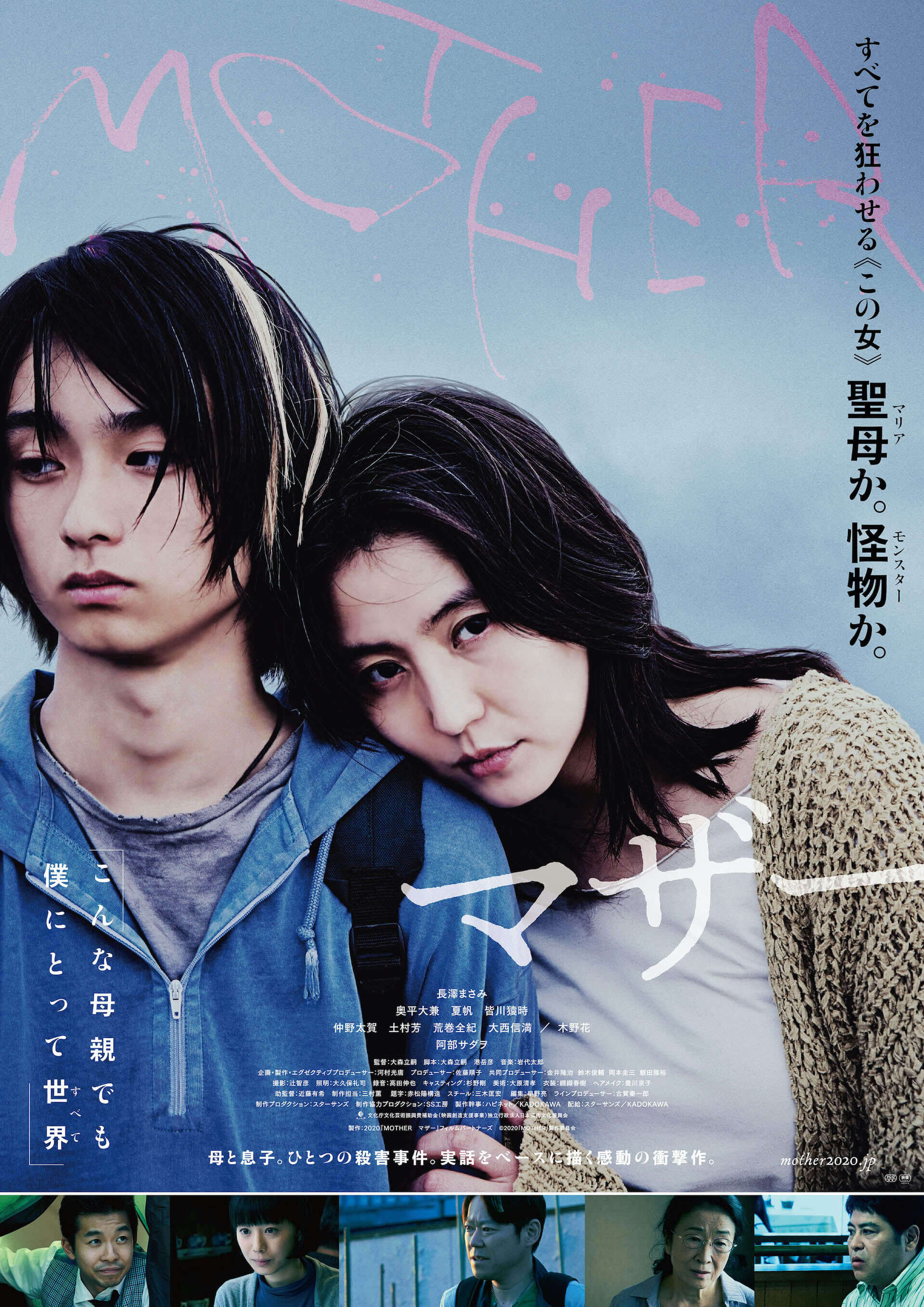
Mother (MOTHER マザー, Tatsushi Omori, 2020)

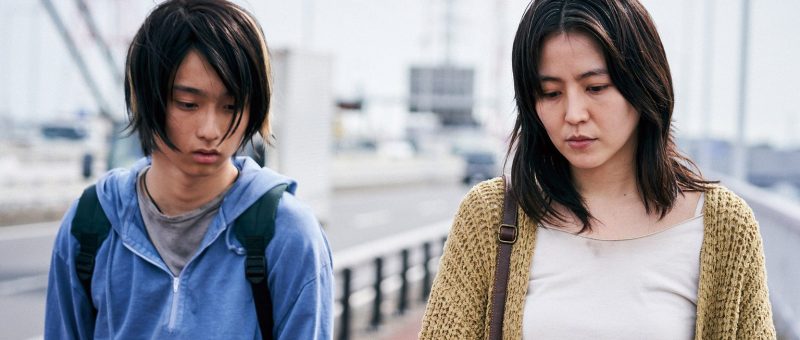
“Everything about my life has been wrong anyway. But is it wrong to love my mother?” the wounded hero of Tatsushi Omori’s gritty drama plaintively asks, and in his case it’s a complicated question. Inspired by a real life case in which a young man murdered his grandparents, Mother (MOTHER マザー) asks how and why such a thing could have happened and points its fingers firmly at corrupted maternity in the form of its extremely toxic matriarch Akiko (Masami Nagasawa) whose twisted, possessive “love” for her children makes them mere victims of her narcissistic emotional abuse and constant need for validation through male attention. 

Our first introduction to Akiko finds her ditching work to meet her young son Shuhei (Sho Gunji) on the way home from school, inappropriately licking the graze on his knee like a grinning mother cat. She then drags him to her parents for an awkward family meeting, her mother refusing to meet her gaze everyone aware she’s there to extort more money from them which, contrary to her promises of having a well paying job lined up, she will almost certainly blow on pachinko. Her father takes pity on them and gives Shuhei a few notes on the sly, but it’s not long before Akiko has decamped to a nearby video arcade which is where she meets Ryo (Sadao Abe), a host from a host club in Nagoya with whom she begins a steamy relationship. Deciding to return with him, Akiko dumps Shuhei with Ujita (Sarutoki Minagawa), a local council worker she’s been flirting with to get her child support benefits sorted out, and takes off. For unclear reasons, however, Ujita declines to let Shuhei stay in his home, leaving him in Akiko’s apartment which has no access to hot water and eventually no electricity seeing as she almost certainly neglected to pay the bill, meaning he can’t even heat up the packets of instant noodles Ujita bought for him either eating them dry or visiting the local combini. 

At this point, Shuhei is a young child who knows no other life and of course loves his mother. Though she emotionally abuses and manipulates him, he has no real choice not do what she says, including agreeing to lie when she and Ryo attempt to blackmail Ujita by threatening to accuse him of molesting Shuhei while they were away. She wilfully uses his cute kid appeal, sending him alone to badger her parents for money (which they refuse), or tap his estranged father for extra cash for a “school trip” even though Akiko hasn’t let him go to school in months and has already blown the child support he sends every month on pachinko. Yet however much he’s beginning to resent the way she uses him, she’s still his mother and there’s a twisted kind of love there along with a toxic co-dependency that locks them into a constant cycle of need and resentment. 

That’s not to say there aren’t ways out. Every time the glimmer of a better life appears, Akiko’s self-destructive impulses kick back in. A teenage Shuhei (Daiken Okudaira) gets a job as a welder with a kind man who can see his family’s struggling and wants to help, but Akiko can’t let go of Ryo who is apparently on the run from debt collectors. The same thing happens again after the family become homeless, a well-meaning social worker, Aya (Kaho), helping to get Shuhei into a catchup education program for others like him who’ve missed out on schooling for one reason or another, but Akiko doesn’t like anything that reduces her influence over her children and fails to understand Shuhei’s desire to at least be as knowledgable as other kids his age. She tells him that no one likes him, that he’ll be bullied wherever it is he goes, that only she will tolerate him and though he can see it isn’t true, no one is mean to him at school and his social worker is actively trying to help him, he can’t help believing her lies. 

They’re my children, I can do with them as I wish Akiko repeatedly snarls at those who attempt to interfere, viewing Shuhei and his younger sister Fuyuka (Halo Asada) more like minions than kids raised to do her bidding as tools or extensions of her own will yet as unable to cope without them as they are without her. Sympathetic social worker Aya, herself a survivor of childhood abuse, reminds Shuhei that he has the option to separate from his mother but he remains unconvinced. Ironically, her mad, cack-handed plan for riches will eventually separate them in her incitement to violence, Shuhei perhaps in a sense relieved knowing the state will take better care of him than his own mother ever had and perhaps he’ll even be allowed time to read, but he loves her all the same and continues to protect her despite himself hopeful only that his younger sister will escape the same fate. Is it wrong to love a mother whose “love” for you is at best toxic? Perhaps not, but it is in its own way a tragedy all the same. 


Mother is currently available to stream via Netflix in the UK (and possibly other territories)

International trailer (English subtitles)

Cash Calls Hell (五匹の紳士, Hideo Gosha, 1966)

“Life is made of gambles” according to the villain of Hideo Gosha’s 1966 Shochiku Noir Cash Calls Hell (五匹の紳士, Gohiki no Shinshi). Sometimes dismissed by contemporary critics for the wilful vulgarity of his late career yakuza films, Gosha was most closely associated with jidaigeki but here makes a rare foray into B-movie crime, a genre which perhaps aligned with the so-called “manly way” philosophy which imbued much of his work. Led by frequent star Tatsuya Nakadai the men of Cash Calls Hell are indeed all suffering manfully, each desperately floundering in the post-war society while quietly resentful in being locked out of its growing prosperity. 

The hero, Oida (Tatsuya Nakadai), is the son of a meek civil servant whom he resented for his passivity. Oida was determined to make something of himself, and so he invested his efforts not in hard work and dedication but in personal relationships, seducing the boss’ daughter in order to win her hand and thereby advancement and security. Meanwhile, he was preparing to unceremoniously ditch the bar hostess who’d been supporting him while he made his way to the top, only after arguing with her on a car drive home he gets into an accident in which a father and his little girl are killed. Oida’s bright future is ruined in an instant. He’s asked to backdate a resignation letter, his engagement is cancelled, and he also owes compensation to the widowed mother Natsuko (Miyuki Kuwano) whose face, filled with rage and resentment, he is unable to forget. With no money to pay her, he winds up in prison which is where he meets soon-to-be released Sengoku (Mikijiro Hira) who has a proposition for him but refuses to give any further details, instructing him to find a woman named Utako (Atsuko Kawaguchi) as soon as he’s released. 

As Utako relates, the job involves knocking off the three men on her hit list for which he will be paid a cool 15 million yen (5 million each). Advised to not to ask any further questions, Oida decides to go along with it after all he has nothing left to lose, but as he begins his investigations he becomes increasingly confused and conflicted. As we discover, the men were all part of a gang that robbed a syndicate of Hong Kong drug dealers, and it doesn’t take a genius to figure out that Sengoku wants them out of the way so he won’t have to divide the loot when he gets out. The money is many ways beside the point, what the men wanted was a way to kick back against the various forces which oppressed them and took their revenge on society through crime. The first, Motoki (Hisashi Igawa), is a former policeman who ran off with a gangster’s wife and subsequently went all the way to the dark side. Umegaya (Kunie Tanaka) is the son of a career criminal who wanted some control over his life and to care for the woman he loved. Embittered former boxer Fuyujima (Ichiro Nakatani) had his dreams shattered when gangsters crushed his hand because he refused to throw a fight. 

Sengoku, who was left lame after being injured in the aerial bombing during the war, recruited them all by exploiting their resentment. Fuyujima describes the men as wandering like ravenous dogs. They are already imprisoned, framed by the chainlink fence which divides them from the well-to-do salarymen killing time at the driving range. “Life is half made of luck and circumstances” Sengoku tells them, echoing his words to Oida, handing them agency in crime in asking them to “bet” on him. “We can’t sink any lower” he rationalises, “now we must get back on our feet”. Oida is much the same. He’d sunk as far as he could and thought nothing of taking these men’s lives to save his own, but resents being used by Sengoku and is probably figuring out that a man who doesn’t want to split his loot in four won’t be keen to split it in half either. He is also burdened by a sense of guilt and responsibility, both to the widow of the man he killed in the accident and to Motoki’s small daughter Tomoe (Yukari Uehara), about the same age as the little girl who died with him. 

Natsuko, it turns out, has since become a bar hostess, herself sinking in the cruelty of the post-war landscape, now wearing a sparkly cheongsam in echo of the “Golden Dragon” syndicate running the club where Umegawa works and the Hong Kong gangsters hot on Oida’s trail. Indulging in a stereotypical B-movie Sinophobia, the implication is that crime is a foreign phenomenon, the threat lurking in the shadows dressed oddly more like a 30s bootlegger from a Hollywood gangster flick than a triad drug trafficker and killing with the point of his umbrella. Oida’s redemption is sparked by his sense of responsibility towards the orphaned little girl who continues to follow him around, latching on to him as a sympathetic figure entirely unaware of his relationship to her father. In the end he declares that he wants the money in order to buy back his soul having sold it to Sengoku in agreeing to take on the job without knowing what it was, but also wants to make restitution to Natsuko which he later does in a poetic if perhaps insensitive fashion that implies he can in a sense restore the child he killed by substituting it with another. 

Oida is one of Gosha’s “manly” heroes, surviving at all costs but finally defending his sense of honour in regaining his humanity. Nevertheless, Gosha is also keen to demonstrate the various ways the women suffer at the hands of irresponsible men, each of the wives endangered by their husbands’ transgressions and Natsuko forced onto the fringes of the sex trade by Oida’s thoughtless crime. Opening in a bold negative with the heist that started it all, Gosha shoots in true noir style all shadows and canted angles through a series of episodic set pieces including a chase pregnant with symbolism through a “purification station” scored by moody jazz before ending on a fatalistic POV shot. Life is a gamble after all, but is this a loss or a victory? With the world the way it is, who could really say.


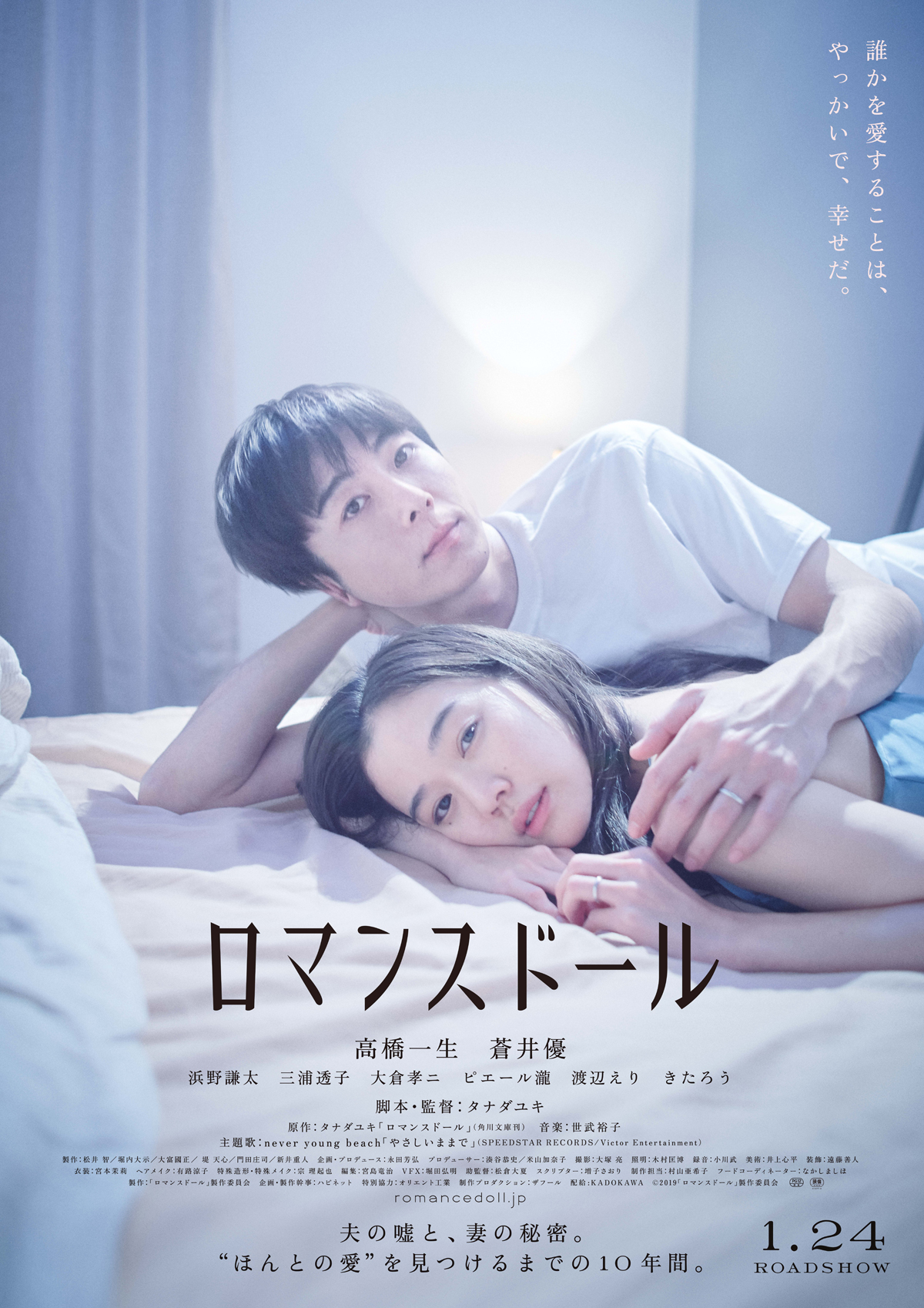
Romance Doll (ロマンスドール, Yuki Tanada, 2020)

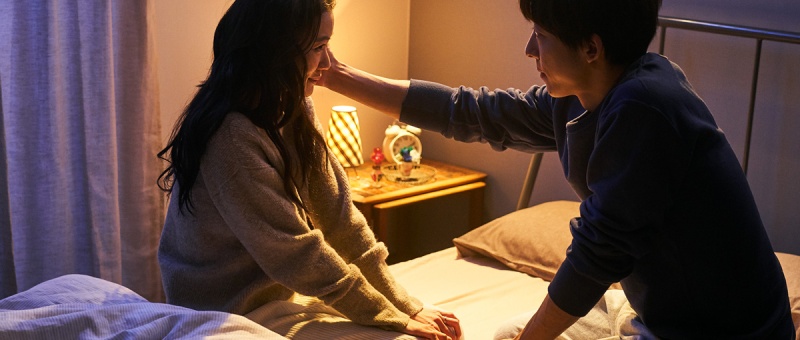
According to an assistant at the factory where the hero of Yuki Tanada’s Romance Doll (ロマンスドール) is eventually employed, what were once called “sex dolls” or the euphemistic “Dutch Wives” (apparently named for a kind of bolster used by sailors) are now marketed as “love dolls”. The difference may be largely semantic, subsuming the physical within the emotional, but speaks to a discomforting dehumanisation of the female form something which barely occurs to the sculptor even as he slowly chips away at his patient wife, gradually erasing her as he dedicates himself to crafting the perfect love doll which is, it has to be said, a woman devoid of agency who can never talk back, challenge male authority, or wound the male ego. 

It’s this insecure fear of intimacy which eventually creates distance and loneliness in the marriage of the sculptor Tetsuo (Issey Takahashi) who hides the fact that he sculpts sex dolls for a living from his wife Sonoko (Yu Aoi) for fear that she will reject him. Tetsuo was himself “tricked” into taking the job as an unemployed graduate in need of work. He does so because he needs the money but also feels guilty, not because he finds the work morally objectionable, but because he has no investment in sex dolls as a craft while the man who’s just employed him, Kinji (Kitaro), has made the creation of the perfect model his life’s dream. 

One the one hand, Tetsuo and Kinji are craftsmen and so the fact of what they’re crafting is largely irrelevant, the important thing being the earnest pursuit of artistry in building beautiful devices whether they be sex aids or sewing machines. But others might not see it that way and in fact the dolls can only be sold as novelties with strict regulations in place to prevent “obscenity”. Concerned that the models lack realism, Kinji comes up with the idea of taking a mould of a real woman’s breasts but given all of the above they can hardly advertise what it’s for. Sonoko answers the ad because she thinks it’s for medical prosthetics, that she’ll be helping other women not providing masturbatory aids for lonely men. The moment Tetsuo touches her breasts he’s hit with a kind of epiphany and is moved to confess his real feelings as he says possibly for the first and last time in his life, while Sonoko too recounts that in his touch she could innately feel that he was an awkward but kind person which is why she fell in love with him. They marry and are happy, but he keeps the nature of his work a secret and becomes so consumed with the idea of capturing the perfection of the female form that he never looks beyond the surface of his wife and, ironically, begins to neglect her physically. 

It’s the secret keeping, the miscommunication and the fear of intimacy that eventually begin to drive them apart. She wants to tell him something important, but he doesn’t listen to her, never notices that she is unhappy or suffering and becomes petulant and resentful on realising that she has lied to him about where she was while she was away from home not realising that she felt unable to tell him because he is not and never has been emotionally available to her. He pours his “love” into the doll, and by doing so he depletes her. Sonoko becomes merely fuel for her husband’s artistic fulfilment until her metamorphosis into a doll is finally complete.

Told entirely from Tetsuo’s perspective, Tanada’s screenplay leans unexpectedly hard into a series of outdated patriarchal social codes which it ultimately reinforces rather than critiques. Tetsuo’s marital dilemma is reframed as a workplace conundrum over whether to pursue the new frontiers of elastomer or stick with the tried and tested silicone which is apparently fragile yet beautiful much like life as Tetsuo is forced to reflect on the transience of all things including love and romance. Something can be beautiful even as it rots, cherry trees still blossom even while they’re dying and there’s nothing that lasts “forever” except perhaps loss. Tetsuo tells himself that others saw Sonoko as the “ideal wife” in that she was “beautiful, a good cook, pristine, modest, and respects her husband” but apparently only he knew that she was also “nice and horny” which even if charitably taken as reclaiming her right to sexual agency is still a crass statement in the circumstances given that he has just reduced her to a literal receptacle for male desire. 

Tetsuo may feel a smattering of conflict when an early model proves successful enough to hit the mainstream media, a happy customer declaring that he’s giving up on real women, but continues to pursue his craft even while reflecting on the poetic symmetry that his wife is disappearing as his creation grows. It’s impossible to avoid the implication that what men want is a sex doll who can cook and clean, a vacant automaton who caters entirely to their desires with no interior life of her own because they are too insecure to want to deal with a real woman who is capable of hurting them emotionally. Straying uncomfortably towards a kind of sublimated necrophilia, Tetsuo only belatedly realises that his wife was more than mere object in the uncomfortable vacancy of the unresponsive silicone. Kinji had wanted to create a doll which looked as if it may come to life, as if it almost had a soul, but the key is in the almost. Rather than a meditation on the destructive effects of miscommunication and emotional insecurity, we’re left with a contemplation of art and the artist in which a man’s artistic fulfilment is valued above a woman’s life, his destruction of her permissible in the perfection of his art. Some things it seems don’t change, women are mere “romance dolls” valued only for their response to male desire be it in art or in “love”.


Romance Doll is currently available to stream via Netflix in the UK (and possibly other territories).

Original trailer (English subtitles)

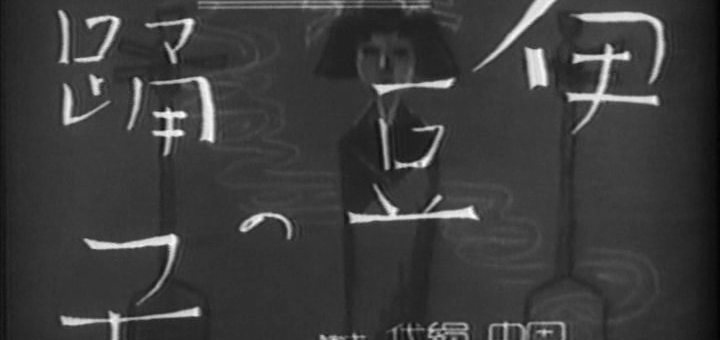
The Dancing Girl of Izu (恋の花咲く 伊豆の踊子, Heinosuke Gosho, 1933)

“Happiness is waiting for you” the melancholy heroine of The Dancing Girl of Izu (恋の花咲く 伊豆の踊子, Koi no Hana Saku Izu no Odoriko) is told by a man who truly loves her, though with his words all her hopes are dashed. Shot on location, Heinosuke Gosho’s 1933 silent is the first of several adaptations of the well-known Yasunari Kawabata story from 1926 and takes a number of liberties with the source material which are partly in keeping with the demands of contemporary cinema and partly an attempt to anchor it more firmly to the increasingly chaotic world of 1933 beset with both economic and political instability thanks to the global depression and Japan’s imperialist ambitions. The price of “happiness” it seems may be love, but perhaps stability as is much as you can ask for in an infinitely unstable world. 

Nominally speaking, the hero of this tale is a young student, Mizuhara (Den Ohinata), through whose eyes we view the transitory nature of young love and the rigidity of a society which will in the end not permit its fulfilment. The “dancing girl” however is our primary focus. Kaoru (Kinuyo Tanaka) is the orphaned younger sister of Eikichi (Tokuji Kobayashi) who inherited a literal goldmine but squandered his inheritance and forced the whole family on the road to earn their keep as travelling players. Such people occupy a kind of underclass, victims of a prejudice against those who have no fixed abode and cannot easily be identified through association with a place or people. Kaoru admits that though she has learned to bear her way of life because at least she’s with her family, signs such as the one they find in a ditch to the effect that beggars and itinerant actors are not welcome in the town fill her with despair. 

Mizuhara meets the actors when they have been unfairly accused of dumping the sign out of frustration (a child later vindicates them after confirming that it was a wandering priest who passed through shortly before). He wades into the fray to urge the angry farmers to exercise a little more patience and ends up agreeing to travel with the family to their next destination as he is himself engaged in a kind of holiday wandering around the picturesque countryside of the Izu peninsula (a popular activity for well to do students of the time). Unbeknownst to him they are already connected by mutual acquaintances in that a friend of Mizuhara’s, Ryuichi (Ryoichi Takeuchi), from the same university also lives in this town and is the son of the man, Zenbei (Arai Atsushi), who bought the goldmine from Eikichi after he went bankrupt. 

The economic subplot concerns an amoral mining engineer, Kubota (Reikichi Kawamura), who apparently has a reputation as a “slave driver” and was responsible for starting the mine which Eikichi’s father owned, the implication being that it failed because of his exploitative business practices and has flourished under Zenbei’s more compassionate ownership in contrast to the picture Kubota is about to paint of him. Having apparently failed at several other endeavours, Kubota has sworn off mines but has convinced himself that he is “owed” something seeing as Zenbei’s mine is now a success and he was the one who found it. He tries to get something out of Ryuichi, but he is unconvinced and eventually offended, accusing of Kubota of blackmail when he insinuates that there was something improper about his buying the mine from Eikichi for much less than it was worth. 

The film’s opening sequence which set up a subplot never resolved about a runaway geisha, however, showed us that Zenbei is as his name suggests a kindhearted man. He reported the geisha’s disappearance to the police not because she took off without clearing her debts but because he was worried for her safety, believing she may have been tricked into running off with an unscrupulous client. Kubota plants the seeds of resentment by convincing Eikichi that he was cheated out of the mine and is owed compensation. Eikichi, feeling humiliated, is determined to “negotiate”, but Zenbei tells him to give them his sister. 

As will be revealed later, Zenbei’s intentions are honourable and he has no thought of replacing the geisha who ran away with Kaoru but wants to take her into his household as an adopted daughter. Eikichi, however, misunderstands but is prepared to sell his sister in order to pursue a pointless revenge against Zenbei by getting money to buy another mine and thereby become even richer. Mizuhara berated him for even considering the idea of trading his sister for money, but in the end even Eikichi only sees her as capital in his rage-fuelled desire to avenge his wounded male pride and sense of impotence. He failed as head of household in losing the family fortune and now has no intention of protecting his sister from the vagaries of the world. 

Mizuhara once again intervenes and learns the truth from Zenbei, that he had been a friend of Eikichi’s father’s and has always been trying to look out for them but has recently lost patience with Eikichi who has already borrowed a lot of money from him. Zenbei is minded towards tough love, convinced his well-meaning attempts to help have only enabled Eikichi’s financial fecklessness. He doesn’t see why Kaoru should pay for his mistakes and has been putting some of the proceeds from the mine into a savings account in her name, hoping also that she may one day marry his son Ryuichi. Mizuhara is at once crushed by the painful goodness he sees in front of him, knowing that his love for Kaoru is now not only impossible but perhaps selfish. All he can do for her now is get out of the way so that she can be saved from the harsh life of an itinerant player, restored to her previous class status, and given the most elusive of all prizes in this chaotic age, stability. 

Zenbei’s plan for Kaoru is in itself a kind of miracle, the best she could ever hope for, but it’s also a minor tragedy in that it both robs her of any kind of agency to make her own choices and destroys the possibility of a romantic future with Mizuhara. To accept everyday comfort and safety, she must resign herself to giving up her love. Mizuhara asks her to do just that in an altruistic act of selflessness which recognises that without money he is powerless to help her. He’s not the one she loves (and we have no idea how he might feel about it), but Ryuichi seems to be a good and kind man, like his father Zenbei who is perhaps the face of compassionate, paternalist capitalism. The world is too chaotic for romance, but there is kindness enough if you’re lucky enough to find it, and if stability is all there is perhaps sorrow is easier to bear than hunger. 


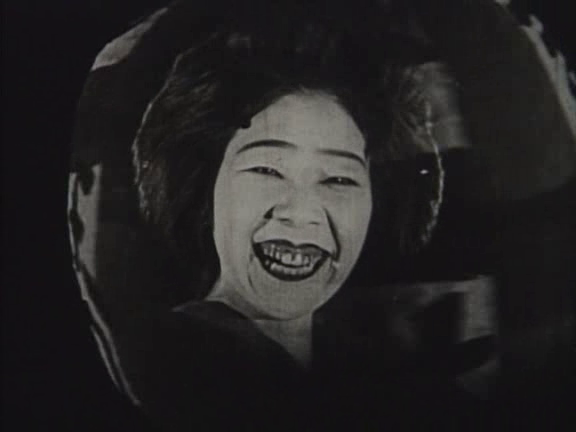
Crossroads (十字路, Teinosuke Kinugasa, 1928)

Does it matter what path you take when none lead out of the darkness because all the world is dark? The heroine of Teinosuke Kinugasa’s Crossroads (十字路, Jujiro) eventually finds herself faced with this dilemma after a series of betrayals born of male failure place her into an impossible, infinitely ironic situation. Following his avant-garde masterpiece A Page Madness, Kinugasa heads in more straightforwardly melodramatic direction if maintaining the same expressionist aesthetic, but the world is still itself “mad” and inescapably so even as it prepares to swallow itself whole. 

Okiku (Akiko Chihaya), an earnest young woman, lives in a small room on the second floor of a squalid tenement building, captured in all of its grotty detail by Kinugasa’s manically wandering yet claustrophobic camera, with her brother Rikiya (Junosuke Bando). She supports the pair of them through seamstressing and doing other odd jobs, while Rikiya has become a devotee of the red light district and developed an infatuation with Oume (Yukiko Ogawa), the proprietress of an archery parlour. So enamoured of her is he that he declares his intention to fight for her love, literally, and is badly beaten by a samurai rival. He steals the ornate kimono his sister had been preparing for a client and hands it to Oume only to reencounter the samurai who tears it in two and hits him on the head, throwing ashes into his eyes causing him to believe that he is blind. Rikiya embarrasses himself by crying out for a sign of love from Oume while clinging to another woman. Humiliated and unable to see, he bumps back into his rival and slashes at him with a sword. Someone shouts “murderer” and Rikiya stumbles out of the tavern and back to his sister believing he has killed someone while the samurai is in fact perfectly fine, merely having another joke at his expense. 

The “joke” will have profound consequences, not only for Rikiya but for his devoted sister. Now entirely unsupported by her feckless brother and in fact burdened by him as he adjusts to his unsighted life, Okiku is determined to keep him safe from punishment for his legal transgression. This becomes another minor problem in their lives as a mysterious bogus policeman (Ippei Soma) with missing front teeth has begun hanging out in their front room for otherwise unexplained reasons, hinting that he knows all about Rikiya’s crime but offering to “protect” him from the authorities for the right price or a suitable alternative. Meanwhile, a doctor has also suggested that Rikiya’s eyes might be healed if he had money to heal them. An old hag having worn out a young woman she was exploiting for sex work is in search of a replacement and thinks Okiku fits the bill. She resists, but is at a loss as to how to find money both for the policeman and for her brother’s eyes. 

Old hag aside, all of Okiku’s problems are born of male failure. Her feckless brother has drawn her into his foolish romantic fancy, allowing himself to be swept away sold on the false promises of the Yoshiwara. Questioned by another patron, Oume reveals that she liked Rikiya but is turned off by “persistent” men. She enjoys the attention she gets, not to mention the gifts, but is not interested in the kind of relationship which limits her freedom. The archery parlour itself is a carnivalesque world of giddy madness, a permanent party town filled with maniacal laughter and the false jollity of those trying to escape despair through mindless hedonism. Rikiya is blind to his delusion and has no idea he has been trapped. Unlike Oume, Okiku is a pure soul and unable to manipulate male interest for her own ends. She finds herself caught between the old hag and the bogus policeman trying to protect the brother who made no attempt to protect her, even hiding in a cupboard when he suspected that his attacker had followed him home. 

Exploited from every possible angle, the siblings have nowhere left to turn but to each other. “If only I could live with you like this all my life” a chastened Rikiya exclaims, adding “I will take you, sister, wherever I escape” when the scene is ironically mirrored yet returning once again to Oume only to realise the degree to which he had been blinded by love even as he could see. Not even fraternal bonds are strong enough to survive the storm of human selfishness. Kinugasa conjures a world of spiralling madness in which cruelty and indifference are the only constants. It doesn’t matter which way you go, the destination is the same.