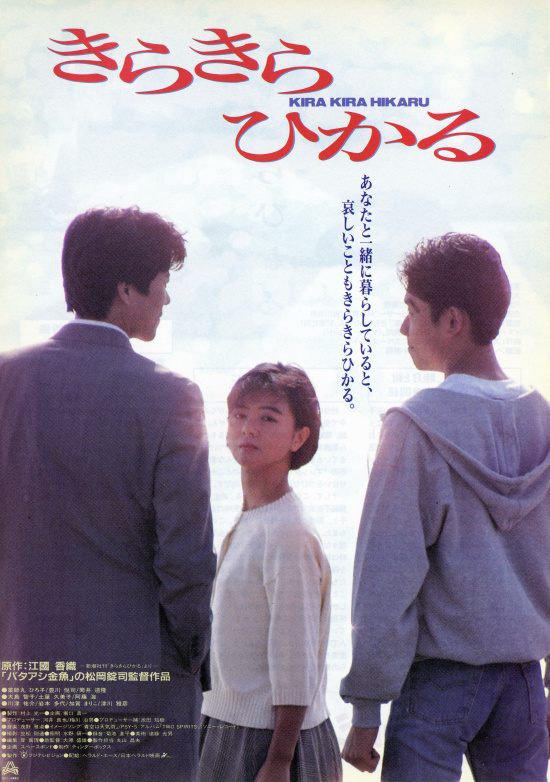
Twinkle (きらきらひかる, Joji Matsuoka, 1992)

TwinkleThe end of the Bubble Economy created a profound sense of national confusion in Japan, leading to what become known as a “lost generation” left behind in the difficult ‘90s. Yet for all of the cultural trauma it also presented an opportunity and a willingness to investigate hitherto taboo subject matters. In the early ‘90s homosexuality finally began to become mainstream as the “gay boom” saw media embracing homosexual storylines with even ultra independent movies such as A Touch of Fever becoming unexpected box office hits. Based on the book by Kaori Ekuni, Joji Matsuoka’s Twinkle (きらきらひかる, Kira Kira Hikaru) tackles this subject head on in examining the changing nature of the modern family as personal freedom and greater social liberalism conflict with familial duty and centuries old tradition.

We first meet Shoko (Hiroko Yakushimaru) in the office of a doctor who assures her that her “problems” are nothing to worry about and the best thing to do is find “a nice man” and get married after which she’s sure to feel much better. On the taxi ride home, her mother suddenly pulls out an omiai photo she’s apparently been carrying in her bag the whole time and proposes Shoko try meeting this particular prospect just as the doctor suggested.

Her “date” is Mitsuki (Etsushi Toyokawa) – an unmarried middled aged doctor who doesn’t seem very interested in the omiai business either. After a brief period of bickering, Shoko and Mitsuki get some time to themselves at which point Mitsuki reveals that the reason he isn’t married is because he has a boyfriend. Despite this, the pair come to an understanding and decide to get married to finally get their relatives off their backs. However, if they thought the pressure would go away after the wedding, they were mistaken. Though both sets of parents know about their children’s reasons for originally avoiding marriage, they don’t know about those of the spouses and when they find out it’s just going to get even more complicated.

We don’t find out exactly what “problems” Shoko may have had in the past. On the morning of the omiai her family dog dies meaning she has an obvious reason to appear visibly upset, yet she also displays symptoms of ongoing depression right the way through the film, flitting between upbeat cheerfulness to impulsive behaviour and crying fits. She also has a long standing drink problem which can result in dangerous accidents such as an incident where Mitsuki returns home to find her passed out on the floor with the iron in one hand and an empty glass of whiskey apparently fallen out of the other.

Mitsuki is in a relationship with a much younger college student and, though they don’t seem to go out of their way to hide their relationship, they can’t exactly be open about it either. Kon did not approve of Mitsuki’s decision to get married and has been avoiding him but Shoko is keen for the two men’s relationship to continue, eventually befriending the young man and bringing him home as fully fledged member of their family. Mitsuki finds this arrangement quite confusing, trapped between two spouses and feeling a responsibility to both of them. In one notable exchange he’s asked to make the relatively simple choice between strawberry and vanilla ice-cream, but the question has taken on a much wider implication than just tonight’s dessert.

The arrangement starts out well enough, except that the growing affection between the married couple eventually begins to place a wedge between them, each knowing that they can never truly satisfy the demands of the other. Not satisfied with a marriage, the parents also expect children which is going to require medical assistance given the circumstances, but Mitsuki is still unsure about taking this next step. Shoko, though experiencing a intensification of her emotional volatility, now suggests a truly radical solution for the early ‘90s – that she undergo artificial insemination using the mixed sperm of both Mitsuki and Kon to essentially have “their” baby.

Shoko and Mitsuki are both trapped, in a sense, by their societal obligations – particularly that of producing children. Mitsuki’s parents know he’s gay, though they tolerate more than accept, yet they still pressure him into fathering a child for appearance’s sake alone. His father had come to terms with his son’s sexuality, even if Mitsuki refers to himself as a son who has “betrayed” his father, but he was against the marriage viewing it as cruel and irresponsible. Once Shoko’s parents discover the real reasoning they try to take over, ignoring Shoko’s views (and even her first clear stating of her problems with alcohol), acting as if they were the injured party.

Though slightly older, Shoko and Mitsuki have found themselves at the centre of a generational conflict as they fight to free themselves from parental control even in adulthood. The future they propose for themselves is an unusual one and unlikely to be accepted by society, yet it is finally their own decision and only by unshackling themselves from the same social pressures which brought them together can they learn to forge a new future. Ten years later, Ryosuke Hashiguchi’s Hush! would suggest a similar scenario which, though still not universally accepted, is greeted with much less resistance than the entirely radical arrangement of Shoko, Mitsuki, and Kon. An interesting look at the changing nature of  social bonds in the immediate post-bubble era, Twinkle is a melancholic though ultimately hopeful tale of three individuals who might be able to provide the stability each needs if only they can learn to withstand the overwhelming external pressures.


Original trailer (no subtitles)
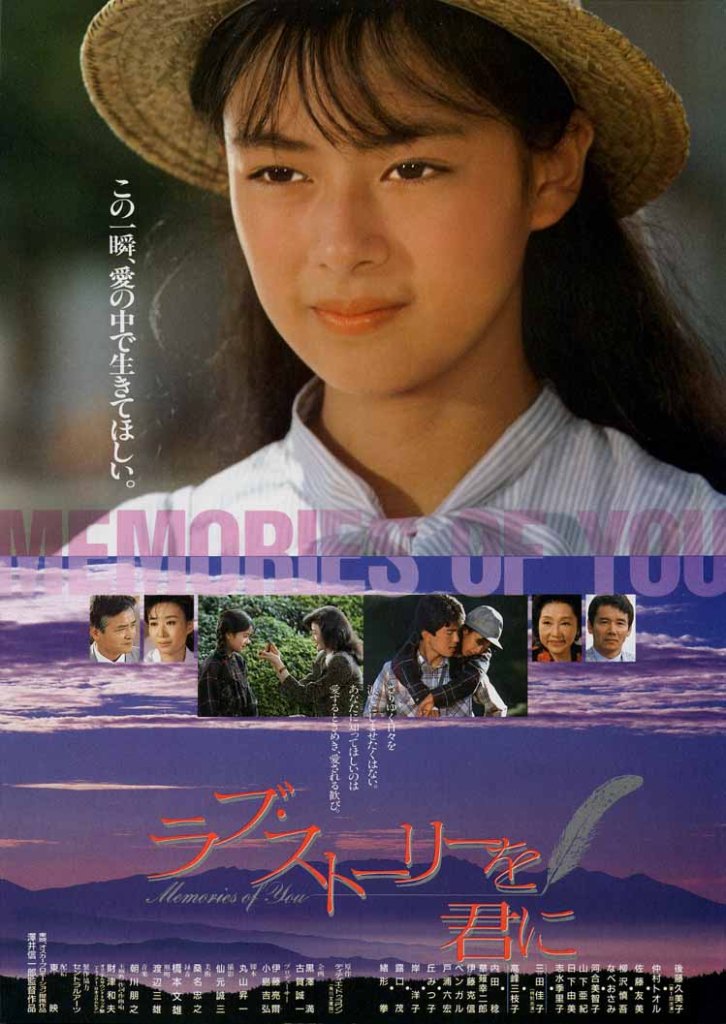
Memories of You (ラブ・ストーリーを君に, Shinichiro Sawai, 1988)

Memories of youIf you thought idol movies were all cute and quirky stories of eccentric high school girls with pretty, poppy voices then think again because Memories of You is coming for you and your faith in idols to make everything better. Directed by W’s Tragedy‘s Shinichiro Sawai, Memories of You (ラブ・ストーリーを君に, Love Story wo Kimi Ni) stars one of the biggest idols of them all – Kumiko Goto, only 14 years old at the time of filming. Seemingly inspired by classic Hollywood melodramas of the ‘50s, Sawai’s film finds its innocent protagonist attempting to live an entire lifetime in only six months as she succumbs to a cruel and relentless disease.
Giving no clue as to its eventual destination, Memories of You begins with two young men returning from a hiking trip. You can tell the pair are committed alpinists because of their distinctly alpine attire and by the way they look at a glockenspiel. In this early comic scene, Araki (Shingo Yanagisawa) is heading straight to an important job interview that he hopes will help him get his girl back if he’s hired so he’s talking a mile a minute whilst awkwardly changing into a business suit inside a photo booth.

The other young man, Akira (Toru Nakamura), runs into the star of film, Yumi (Kumiko Goto), on her way back from the hospital. Akira used to be Yumi’s tutor and it’s obvious she has kind of a crush on him. Unbeknownst to Yumi, the results of her tests are much more serious than might be assumed from her cheerful persona. Yumi has leukaemia and the doctors do not expect her to survive for more than six months at most.

Yumi’s devasted mother shifts her grief away from the pain of losing her only child, to that of her stolen future – no high school, no romance, no love, marriage, or children. Accordingly she asks teacher in training Akira for a considerable sacrifice – essentially, pretend to date Yumi and give her the kind of love story that she will never now be able to experience.

Needless to say, this is a little creepy given that Akira is in in his mid-twenties and Yumi is only fourteen. Of course, it’s all very chaste and innocent like something out of a shoujo manga but still even in 1988 the scenario rings alarm bells. Akira is conflicted about his new role as a fake boyfriend for a dying teenager but it would be heartless to refuse, though one may wonder about what effect all of this may have on his future chosen career.

The world of 1988 is noticeably sexist in that Yumi’s mother works as a cookery teacher, reminding her pupil’s that this is the most important course because they’ll all be competing with their future mother-in-laws in the great culinary battle to win their husband’s hearts. These girls are raised to be housewives and nothing more, although, Yumi’s mother is divorced and now has a career, is taking care of Yumi alone and is not particularly looking to remarry. So, swings and roundabouts in terms of social progress.

The film flits between the viewpoints of Yumi and Akira as they both try to adapt to this unusual situation. As is common in these kinds of films, Yumi is not quite as in the dark as everyone had assumed and is readying herself to say her final goodbyes. This also brings about a reunion with her long absent father who has emigrated to Canada where he has a new wife and younger daughter. Yumi’s family status is an uncommon one for 1988, yet there is relatively little stigma surrounding it. Perhaps her father’s return after three years is one factor in Yumi’s realisation of the seriousness of her condition (as her mother feared it might be) but the final reconciliation does at least bring her a little more calmness and stability.

Yumi’s illness is a mountain which cannot be conquered. The beauty of the natural world and the desire to overcome it, in a sense, through physical exertion are the chief motifs of the film as Yumi dreams of travelling to Switzerland – the spiritual home of alpinism (it would seem). The loving looks at the glockenspiel in the opening scenes develop into an underlying musical theme as they also recur during the lengthy cabaret sequence close to the film’s climax. Of course, Yumi finally attempts to climb her mountain with Akira as her guide but there is only so far she can proceed.

Despite its melodramatic touches and desire to be a grand tearjerker, Memories of You is too restrained to make the full force of its tragedy achieve the kind of emotional effect that it aims for. Filled with syrupy, orchestral music very much like that employed by classic Hollywood examples of the genre, Memories of You really wants the viewer to experience the intense sadness of such a young life taken by a cruel and indiscriminating disease but often overplays its hand. This isn’t helped by the unsettling nature of the “romance” between Akira and Yumi or the (entirely understandable) lack of chemistry between the leads who each give independently high quality performances. An interesting example of an “idol movie” which steps outside the genre norms, Memories of You doesn’t quite have the courage of its convictions but is another nicely photographed effort from Sawai.


End credits and title song (not sung by Kumiko Goto)

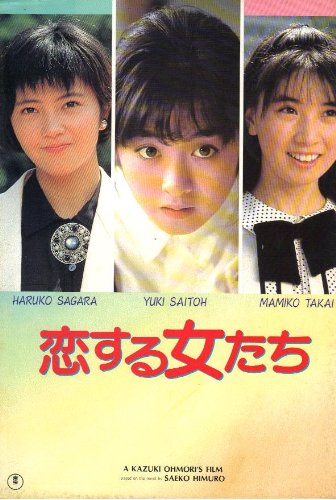
Young Girls in Love (恋する女たち, Kazuki Omori, 1986)

young women in loveThe friends you make in high school are the friends you’ll have the rest of your life, says Takako – the heroine of Kazuki Omori’s Young Girls in Love (恋する女たち, Koisuru Onnatachi). Only she doesn’t quite want hers – they’re weird and cause her nothing but trouble. Also one of them is too pretty so she soaks up all of the attention – where’s the fun in that? Takako is not altogether happy in her adolescence but at least she has her friends there beside her, right?
Takako’s two best friends have both recently fallen in love leaving her feeling a little left out. Midoriko (Mamiko Takai), the most “unusual” girl in her group (but also thought to be the prettiest), had fallen in love with a teacher and even struck up something of a friendship with him as evidenced by her collection of cute photos of them together. However, he’s recently got married leaving her heartbroken so Midoriko is having another one of her trademark “funerals” in which she buries painful memories from her past. Previously she’s had funerals for an unfortunate PE related incident in which she ripped her shorts during gymnastics, and another for when her grades got so bad that the teachers told her she probably wouldn’t graduate from high school.

Teiko has a difficult homelife as her literature professor father has left the family for unspecified reasons and her mother is still mourning the end of the marriage. However, she has found herself and older poet who formerly wrote lyrics for cheesy teen idol pop songs (though he’s a serious poet now so that’s all beneath and behind him). Teiko knows that this relationship is doomed to failure but is pursuing it in any case.

Takako is so wound up by her friend’s series of love stories that she finds herself visiting “raunchy” movies like 9 1/2 weeks. This is where she encounters possible crush and high school baseball star Kutsukake (Toshiro Yanagiba), but does she really like him or is she just lovesick and jealous of her friends? A new complication also arises in the form of fellow student Kanzake (Yusuke Kawazu) who previously had a crush on older sister Hiroko (Kiwako Harada) but seems to have shifted his attentions on to Takako.

Young Girls in Love is a little broader than the average idol drama though it maintains an overall quirky tone with a few swings towards melodrama. Takako continues with her romantic dilemma although in contrast to what she says towards the opening of the film she mostly does so alone. Rather than her similarly romantically troubled friends, Takako confides in a painter friend, Kinuko (Satomi Kobayashi) who has some rather more grown up advice for her than other friends (or sister) are willing or able to offer.

During her troubles Takako also goes to visit another girl who is kind of involved with low level bosozoku motorcycle gangs, and finds out that her morbid friend Midoriko has gone seriously off the rails. Leading some kind of double life, Midoriko is a disco queen in another town, dancing her troubles away and enchanting all the boys in the club (including the other girl’s biker boyfriend). Distressed, yet a little envious of Midoriko’s ability to soak up all the attention for herself, Takako is the only one to try and intervene during a drag race duel though little heed is given to her desperate plea for sanity and she is only one that gets hurt during the proceedings.

It’s all fairly innocent stuff even though biker gangs, older boyfriends, and boyfriend stealing, all fall into the mix. Omori keeps things simple and brings his idols to the fore to do what they do best though he does overly rely on TV style reaction shots for some of his gags. According to the anecdote Takako offers at the end, none of the various love stories have worked out they way the girls hoped (at least for now) but everything carries on more or less as normal. The three girls have another of their traditional extreme tea ceremonies dressed in kimono and sitting on the edge of a cliff, but they’re all still together despite their recent romantic adventures. The real love story is between three childhood friends who may have temporarily drifted apart over teenage drama, but their bonds are strong enough to withstand the storm and, as Takako stated in the beginning of the film, they’ll be together for the rest of their lives.


Original trailer (no subtitles)

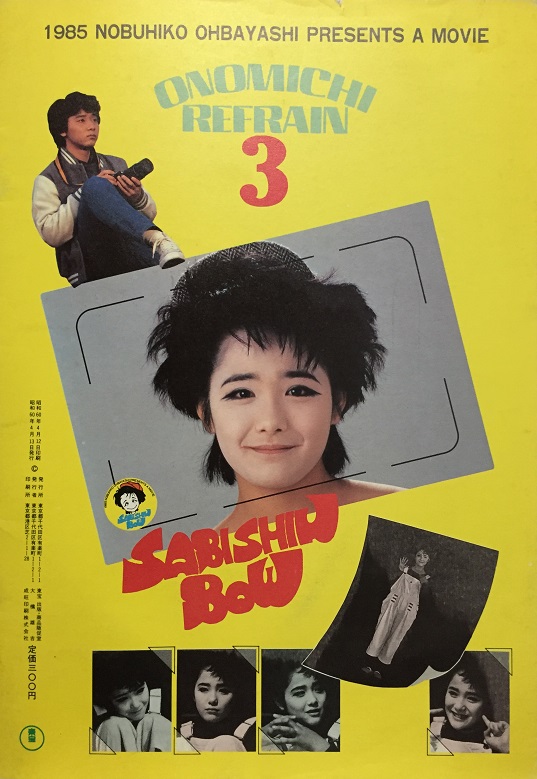
Miss Lonely (さびしんぼう, Nobuhiko Obayashi, 1985)

Miss LonelyMiss Lonely (さびしんぼう, Sabishinbou, AKA Lonelyheart) is the final film in Obayashi’s Onomichi Trilogy all of which are set in his own hometown of Onomichi. This time Obayashi casts up and coming idol of the time, Yasuko Tomita, in a dual role of a reserved high school student and a mysterious spirit known as Miss Lonely. In typical idol film fashion, Tomita also sings the theme tune though this is a much more male lead effort than many an idol themed teen movie.
Obayashi begins with an intertitle-like tribute to a “brusied, brilliant boyhood” before giving way to a wistful voiceover from the film’s protagonist Hiroki Inoue (played by frequent Obayashi collaborator, Toshinori Omi). His life is a fairly ordinary one of high school days spent with his two good friends, getting up to energetic mischief as teenage boys are want to do. The only thing that’s a little different about Hiroki is that his father is a Buddhist priest so he lives in the temple with his feisty mother who is always urging him to study more, and he’ll one day be expected to start training to take over the temple from his father (he has no particular aversion to this idea).

Hiroki’s big hobby is photography and he’s recently splashed out on a zoom lens but rarely has money for film to put in the camera so he’s mostly just playing around, accidentally spying on people. The main object of his interest is a sad looking high school girl who spends her days playing the piano. Hiroki, as an observer of human nature, has decided that she must be just as lonely as he is and has given her the name of “Miss Lonely”. It comes as a shock to him then that a very similar looking sprite appears, also called “Miss Lonely” and proceeds to cause havoc in his very ordinary life.

Although the film is filled with Obayashi’s trademark melancholy nostalgia, there is also ample room for quirky teen comedy as the central trio of boys amuse them selves with practical jokes. The best of these involves a lengthly sequence with the headmaster’s prized parrot which he has painstakingly taught to recite poetry. On being sent to clean up the headmaster’s office after misbehaving in class, the boys quickly set about teaching it a bawdy song instead causing the poor bird to hopelessly mangle both speeches into one very strange recitation. This comes to light when the headmaster attempts to show off his prowess with the parrot to an important visitor but when the mothers of the three boys are called in to account for their sons’ behaviour, they cannot control their laughter. That’s in addition to a repeated motif of the boys’ teacher’s loose skirt always falling off at impromptu moments, and a tendency to head off into surreal set pieces such as the anarchic musical number which erupts at the stall where one of the boys works part time.

Miss Lonely herself appears in a classic mime inspired clown outfit, dressed as if she’d just walked out of an audition for a Fellini film. To begin with, Hiroki can only see Miss Lonely through his camera lens, but she quickly incarnates and eventually even becomes visible to others as well as Hiroki himself. Past and present overlap as Miss Lonely takes on a ghostly quality, perhaps reliving a former romance of memory which may be easily destroyed by water and is sure to be short lived. Love makes you lonely, Hiroki tells us, revelling in the failure to launch of his first love story. Though, if the epilogue he offers us is to be believed, perhaps he is over romanticising his teenage heartbreak and is heading for a happy ending after all.

Chopin also becomes a repeated motif in the film, bringing our trio of lovesick teens together with his music and adding to their romantic malaise with his own history of a difficult yet intense relationship with French novelist George Sand. There’s a necessarily sad quality to Hiroki’s tale, an acceptance of lost love and lost opportunities leaving their scars across otherwise not unhappy lifetimes. Set in Obayashi’s own hometown Miss Lonely takes on a very heartfelt quality, marking a final farewell to youth whilst also acknowledging the traces of sadness left behind when it’s time to say goodbye.


Original trailer (no subtitles)

And here’s idol star Yasuko Tomita singing the title song on a variety show from way back in 1985

Four Sisters (姉妹坂, Nobuhiko Obayashi, 1985)

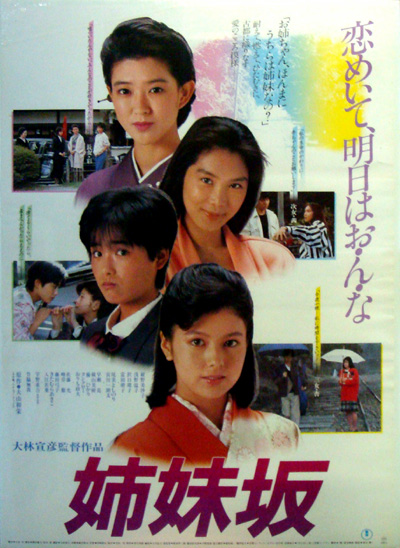
Four SistersNobuhiko Obayashi takes another trip into the idol movie world only this time for Toho with an adaptation of a popular shojo manga. That is to say, he employs a number of idols within the film led by Toho’s own Yasuko Sawaguchi, though the film does not fit the usual idol movie mould in that neither Sawaguchi or the other girls is linked with the title song. Following something of a sisterly trope which is not uncommon in Japanese film or literature, Four Sisters (姉妹坂, Shimaizaka) centres around four orphaned children who discover their pasts, and indeed futures, are not necessarily those they would have assumed them to be.
Yasuko Sawaguchi plays the third oldest sister and more or less protagonist of the story, Anzu, who is facing a very common teenage dilemma in that there are two boys (best friends) both interested in her and she can’t decide if she likes both, one, or either of them. Eventually, Yuzuki (Ichirota Miyakawa) wins out leaving his friend Oba (Toshinori Omi) depressed and on the sidelines. However, Yuzuki is from a wealthy family and it was intended he marry a cousin so his mother does some digging and discovers more about Anzu than Anzu knew about herself.

As it turns out, the four sisters are not actually related by blood as only one was the biological child of the goodhearted couple who raised them. Unfortunately, the children’s adoptive parents died in a car accident leaving their birth daughter, Aya (Misako Konno), as a kind of maternal figure to Akane (Atsuko Asano), Anzu, and Ai (Yasuko Tomita) though Akane was the only one old enough to remember their lives before coming to live with Aya and her family. The rediscovery of the truth knocks both younger girls for six, especially as Anzu’s birth mother has reappeared and presents an existential threat to their insular family of four.

Set once again set in a peaceful, countryside town, Four Sisters revisits many of Obayashi’s constant concerns in its evocation of memory, mislaid truth, and the need to come to terms with the past in order to go on living in the present. The four young women are each very different, but bound tightly together by their shared experience, including the recent loss of their parents. Anzu’s discovery threatens to destroy the family firstly through the exposure of a lie (or, what is really an omission of truth), and secondly to speed up the inevitable fracturing as she begins to seek a new life and eventually family of her own. Though Akane has been able to forge a career for herself (less pleasant part-time work aside), she rightly points out that in becoming their maternal figure, Aya has in a sense lost or rejected the opportunity to pursue her own happiness. The sisters’ bond is tight and near unbreakable, but it’s also, in a sense, constraining.

Obayashi begins the picture with in a polaroid-like frame in which the two boys declare their intentions to duel for Anzu’s affections. As the film moves on, Obayshi returns to these intertitle-like captions particularly in bookending the various seasons throughout which the film turns. Though not as radically as in some of his other work, Obayashi once again uses colour filtering as a highlighting tool which is most obvious towards the end as the edges of the screen start to blur, greying out everything other than our central heroines. However, other sequences take place in a noticeably expressionist environment with extreme colour contrasted backgrounds and unreal, star filled skies and Obayashi also allows the real world weather with its storms and raging rivers to dictate the mood.

Four Sisters is, at heart, a family drama though one seen through a slightly distorted mirror. The four girls are indeed a unit which would inevitably have to split or stagnate in the normal order of things but the bonds are strong enough to withstand the unusual amount of pressure placed on them, enabling the sisters to move on with their individual lives whilst remaining close. Obayashi keeps things relatively low key (by his own standards) but gently builds a melancholy, nostalgic tone filled with loss and regret yet also with hope for the future. Beautifully shot, with Obayashi’s characteristically unusual use of imagery and wistful, ethereal atmosphere Four Sisters may not be among the director’s most experimental efforts but does provide a warm tale of love lost and gained in the lives of four ordinary women.


Warning from Space (宇宙人東京に現わる, Koji Shima, 1956)

Warning_from_Space_1956
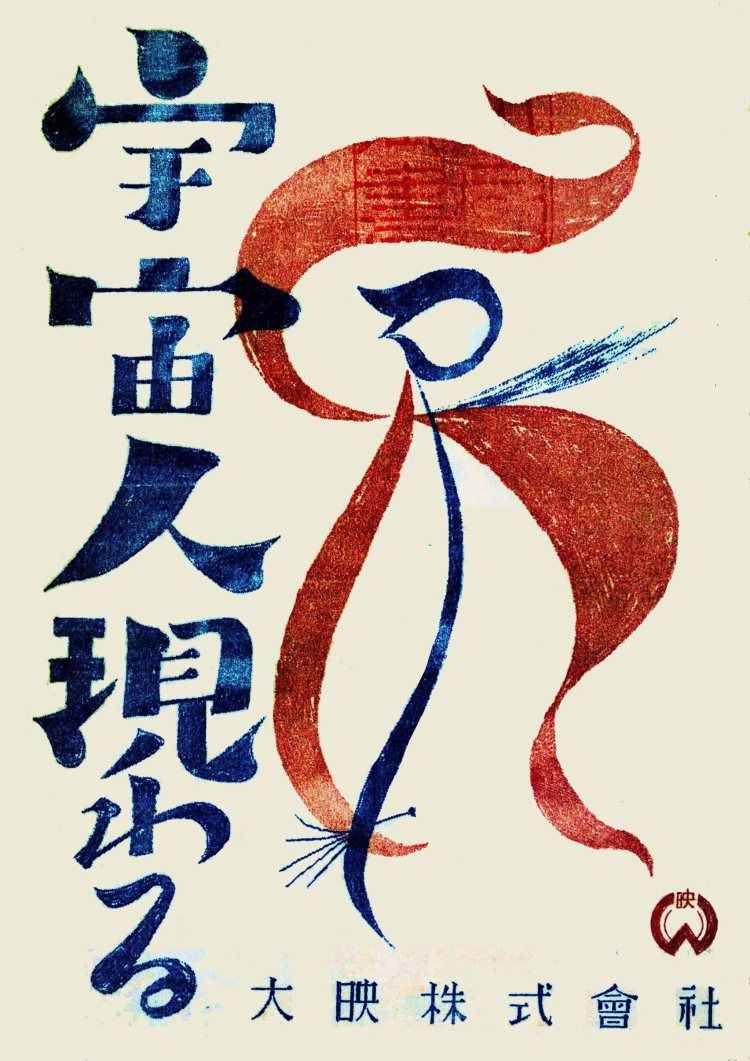
Taro Okamoto illustration from Japanese DVD liner notes

Apparently the citizens of Japan are a little more cautious than some of their contemporaries when it comes to extraterrestrial contact. After all, the kindly aliens who visit with helpful advice in The Day the Earth Stood Still end up leaving in a huff because humanity is just not ready to accept their offers of interplanetary research and is constantly trying eliminate the alien “threat”. Hence, though the people of Japan recoil in horror from the Pairans in their scary starman shape, they start paying attention when they come in the form of a pretty showgirl. Somethings never change, eh?

Mysterious flying objects have been spotted above the skies of Tokyo. Nobody knows what they are with some leaning towards aliens and others becoming paranoid that Japan is under attack from another nation who are positioning spy satellites above its capital city. There have also been sightings of mysterious creatures near sources of water, usually accompanied by blue flickering lights.

These strange creatures turn out to be a scientific delegation from the planet Paira (inconveniently located directly opposite Earth but behind the sun which is why it’s never been discovered). They are a race of star shaped bipedal creatures with a single eye in the middle of their chests. Actually, they are quite cute and completely non-threatening in appearance and seem quite hurt that the Earthlings think they are ugly and are too frightened to talk to them. Consequently, they send their best scientist through a special process to change his appearance to one humans find more appealing which just happens to involve copying that of a local superstar showgirl.

The Pairans have come in peace! With their advanced technology they can see a rogue planet is about to crash into Earth and destroy it forever. This is bad news for everyone so they’ve come to warn humanity and try to help, if only they could get someone to listen to them. They also know that Doctor Matsuda has been developing a nuclear weapon which is far more powerful than the atomic bomb. The Pairans think this is a very bad idea and he should stop, but only after they’ve used it to destroy the rogue planet before it’s too late.

Warning from Space (宇宙人東京に現わる, Uchujin Tokyo ni Arawaru) is Daiei’s first colour sci-fi film though it’s actually not all that colourful aside from that weird blue light. In contrast to many other films from the era and even those previously made by Daiei, Warning From Space seems to have an oddly ambivalent view on weapons of mass destruction. The Pairans have chosen Japan because they think the Japanese are the best placed to appreciate the destructive power of an atomic bomb and will therefore share their stance on the necessity of abandonment. Yet, they also know Dr. Matsuda has been working on an even more destructive weapon – the Pairans also discovered this power at some point in their history but abandoned it over fears of its power being misused. They supposedly developed a much safer way to harness nuclear energy but now need Matsuda’s research to destroy the rogue planet. Like much of the Pairan’s behaviour, this doesn’t make complete sense (at least, to those of us used to Earth logic).

The Pairans are very friendly, but a bit shy. Their idea of “making contact” seems to be running away when the humans spot them and start screaming. Seeing something so unusual is probably quite traumatising, but the Pairans are so cute with their starfish outfits and comical waddle that it’s strange to think anyone could find them threatening. The Pairans are even a little upset that Earthlings find them “ugly”. They think the best thing to do is appear in a more pleasing form so they freak everyone out by visiting a popular musical show and stealing a picture of the star to clone. Because every scientist on Earth is going to want to listen to the advice of a cabaret showgirl, right? That’s always how it happens. She doesn’t even care very much about maintaining her disguise and keeps doing alien stuff like jumping really high in the air or dematerialising in one place and rematerialising somewhere else, but then no one seems to find this that weird anyway.

Basically, the Pairans have come to tell the Earthlings not to go ahead with their weapons research because they don’t know what they’re getting into. However, they also need to use this research to destroy the rogue planet which is a bit contradictory. The Pairans are apparently too shy to actually talk to the UN and think the other nations are kind of mean anyway so Japan will have to sort this out on their own while the Pairans nod appreciatively in the background (other than when they randomly disappear for a whole month until coming back to sort everything out because humans are rubbish). Of course, evil corporations are also after Matsuda’s super weapon but he’s a proper scientist and doesn’t want to sell, so they kidnap him and tie him to a chair out of spite while the world simultaneously floods and burns thanks to the rogue planet’s effect on the atmosphere.

Finally, science saves the day in a quiet and methodical way! All the creatures of the Earth emerge from underground. The birds are singing, turtles are swimming, racoons are doing racoon stuff again all while the sun is shining brightly and children are singing, so it’s definitely all going to be OK and Earth has probably made a whole new set of star shaped friends! All in all it was probably worth near destruction. Warning from Space is the kind of science fiction film which is always 100% serious, with the consequence that it’s not serious at all. Not as much fun as some of other B-movies of the era it nevertheless adds its own charms particularly in the form of the completely batty Pairans and their cute star shaped suits but fails to offer anything memorable beyond them.


Original trailer (poor quality, no subtitles)

The adorable starfish-like Pairans were designed by iconic Japanese artist Taro Okamoto who is probably best known for the Tower of the Sun constructed for Expo ’70.

The Little Girl Who Conquered Time (時をかける少女, Nobuhiko Obayashi, 1983)

Little Girl Who Conquered TImeThe Girl Who Leapt Through Time is a perennial favourite in its native Japan. Yasutaka Tsutsui’s original novel was first published back in 1967 giving rise to a host of multimedia incarnations right up to the present day with Mamoru Hosoda’s 2006 animated film of the same name which is actually a kind of sequel to Tsutsui’s story. Arguably among the best known, or at least the best loved to a generation of fans, is Hausu director Nobuhiko Obayashi’s 1983 movie The Little Girl Who Conquered Time (時をかける少女, Toki wo Kakeru Shoujo) which is, once again, a Kadokawa teen idol flick complete with a music video end credits sequence.
As in the novel, the story centres around regular high school girl Kazuko Yoshiyama (Tomoyo Harada). She has two extremely close male friends (generally a recipe for disaster, or at least for melodrama but this is not that kind of story) – Horikawa and Fukamachi, and one Saturday while all three are charged with cleaning up the schoolroom, Kazuko ventures into the science lab where she sees a beaker on the floor emitting thick white smoke which smells strongly of lavender causing her to pass out. Everyone seems to think it’s either hunger, anaemia, or that old favourite “woman’s troubles” but from this day on Kazuko’s life begins to change. The same day repeats itself over and over again with minor differences and Kazuko also begins to experience multilayered dreams in which her friends are in some kind of peril.

Tsutsui’s original novel was a Kadokawa Shoten property (though first published 15 years previously) which made it a natural fit for the Kadokawa effect so when legendary idol master Haruki Kadokawa found an idol he was particularly taken with in Tomoyo Harada the stars aligned. Obayashi set the story in his own hometown, the pleasantly old fashioned port village of Onomichi, which adds a nicely personal feel to his take on the original story. Although The Little Girl Who Conquered Time is an adaptation of a classic novel, many of Obayashi’s regular concerns are present from the wistful tone to the transience of emotion and the importance of memory.

Kazuko is another of Obayashi’s young women at a crossroads as she finds herself wondering what to do with the rest of her life. The original timeline seems to point to a romance and possibly a life of pleasant, if dull, domesticity with one of her best friends but with this time travelling intrusion everything diverges. Though assured that she will not remember most of the strange events that have been happening to her, something of her adventures seems to have stuck in Kazuko’s mind even if she couldn’t quite say why. Much to the consternation of her mother, Kazuko’s purpose in life begins to lean to towards the scientific rather than the romantic, almost as if she’s waiting for the return of someone whom she has no recollection of having met.

Obayashi once again uses conflicting colour schemes to anchor his story. Beginning with black and white as Kazuko has her first encounter with someone she’s known all her life under the brightly shining stars, he gradually re-introduces us to the “real” world through sporadically adding colour during her bus ride home to her small town which does have a noticeably more old fashioned aesthetic when compared to Tokyo set features of the era. The effects are highly stylised and very much of their time including the celebrated time travel sequence which has Kazuko framed by a neon blue halo. The most touching sequence occurs near the end of the film in which Kazuko crosses paths with a familiar face that she doesn’t quite recognise, the camera perspective actively changes physically pulling us away from the encounter until Kazuko turns around and walks away in the opposite direction and into yet another empty corridor.

Tomoyo Harada developed into a fine actress with a long standing and successful career in both television and feature films as well as releasing a number of full length albums. As is usual with this kind of film she also sings the theme tune which has the same title as the movie though in an unusual movie Obayashi includes a music video retelling of the events of the film over the end credits featuring all of the cast helping Harada to perform the song with silly grins on their faces all the way through. Harada proves herself much more adept at convincingly carrying a feature length movie than some of her fellow idols but the same cannot be said for many of her co-stars though she is well backed up by established adult cast members including Ittoku Kishibe as Kazuko’s romantically distressed teacher.

The Little Girl Who Conquered Time is first and foremost a Kadokawa idol movie and has all the hallmarks of this short lived though extremely successful genre. Necessarily very much of its time, the film has taken on an additional layer of nostalgic charm on top of that which has been deliberated injected into it. Nevertheless, in keeping with Obayashi’s other work The Little Girl Who Conquered Time has a melancholic, wistful tone which is sentimental at times but, crucially, always sincere.


Original trailer (no subtitles)

And here’s the famous music video for the title song (which is of course sung by Tomoyo Harada herself). English Subtitles!

Bad Film (Sion Sono, 1995/2012)

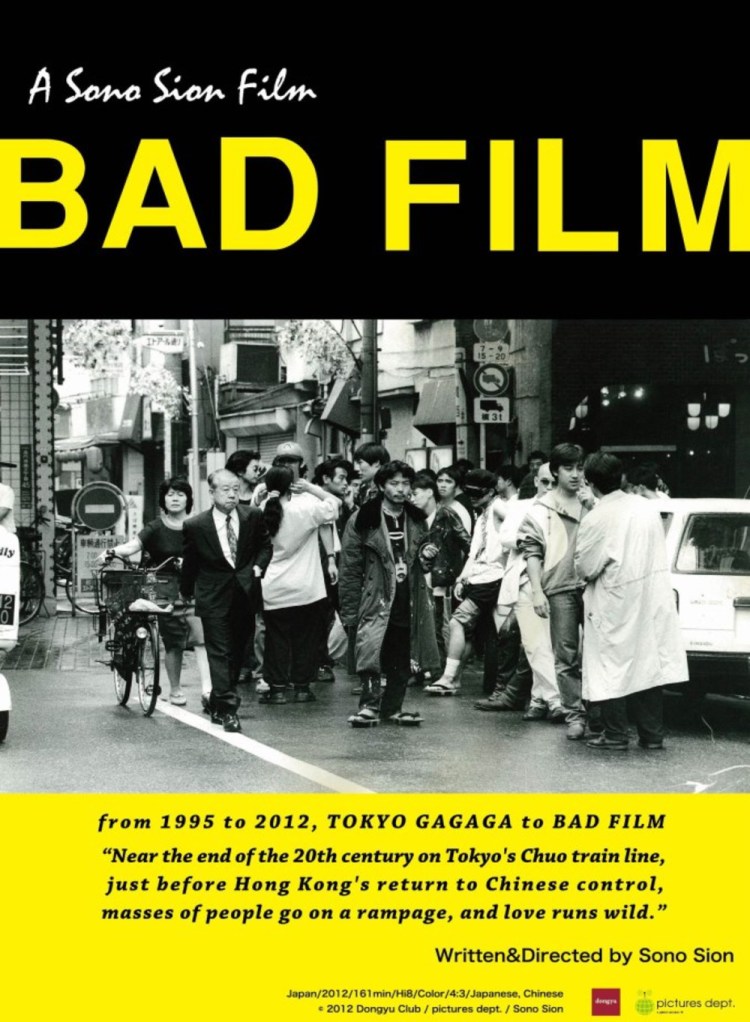
Bad_FilmThe recently prolific Sion Sono actually has a more sporadic film career dating back to the early 1980s though most would judge his real breakthrough to 2001’s Suicide Club. Back in the ‘90s Sono was most active as the leader of anarchic performance art troupe Tokyo Gagaga. Taking inspiration from the avant-garde theatre scene of the 1960s, Tokyo Gagaga took to the streets for flag waving protests and impressive, guerrilla stunts. Bad Film is the result of one of their projects – shot intermittently over a year using the then newly accessible Hi8 video rather the traditionally underground 8 or 16mm, Bad Film is near future set street story centring on gang warfare between the Chinese community and xenophobic Japanese petty gangsters with a side line in shifiting sexual politics.
Momentous things were at play in 1997, not least amongst them the looming handover of Hong Kong when it would cease to operate under British rule and embark upon the “one country, two systems” era with ultimate authority passing to Beijing. Fascism has bloomed in Tokyo with intense anti-foreigner activity targeting all non-Japanese including those from other areas of Asia. By 1997, the yakuza have infiltrated the fascist infrastructure and amped up gang violence between the Chinese community and the ultra-nationalist Japanese.

Fast forward a little and the Chinese and Japanese groups have managed to iron out some of their differences largely thanks to a different kind of divide which ultimately proves a unifying factor – many of the men and women on either side are gay and are sick of the prevailing “hetero hegemony”. Eventually the gay contingent manages to assume control of their respective factions and enact the gay alliance. This is very successful and brings peace and love to the city but unfortunately two members of opposing factions just can’t get over their cultural differences and are prepared to go to great lengths to restart the Japan/China gang war.

Sono shot the entirety of the movie back in 1995 ending up with around 150 hours before abandoning the project for financial reasons. In 2012 Sono re-edited his existing footage into something resembling a feature length film. The project was designed to make use of the entire Tokyo Gagaga company (over 2000 people took part) and was shot guerrilla style with no permits or warnings (you can see at least one face blurred out during their city centre protests). This goes someway to explaining why the narrative diverges unexpectedly at random junctures and the voiceover is there largely to corral the footage into some kind of coherent structure aided by the occasional on screen text. It’s a “Bad Film” in that it’s not quite a film at all but an activist’s poetic documentation of his artistic street warfare even including going so far as to include a justification for the visibility of the cameraman.

Hi8 was what it was – a convenient low-res format for the domestic market. Bad Film is not a pretty film, it looks rough and low rent though that often works in its favour and the film takes on a considered aesthetic that is never concerned with trying to be more than it is. Consequently, it makes the most of its roughness to bring out the grungy, time capsule-esque atmosphere that it’s looking looking for. Sono also experiments with fish eye lenses, odd angles and hand held multi-camera chaos to bring the streets to life. His world is weird, and it’s filmed weird, but it always makes sense in terms of its own particular look.

The action turns on the unexpected love story between two women – one Japanese, and one Chinese, and despite all of the resulting chaos and carnage, the final image we’re left with is one of love. The forces of destruction are those who cannot abandon their hate to live in harmony, subverting this very force for peace and using it to wreak vengeance. Sono launches into absurd mode at full throttle and, as per usual, it’s hard to tell when he’s in earnest and when just being facetious. Bad Film is, loosely speaking, an anti-prejudice themed performance art piece documenting the passion and commitment of the Tokyo Gagaga collective. An interesting case of a belated “director’s cut” Bad Film is necessarily an imperfect beast, but perhaps all the more interesting for it.


Opening sequence (no subtitles)

All Around Us (ぐるりのこと。, Ryosuke Hashiguchi, 2008)

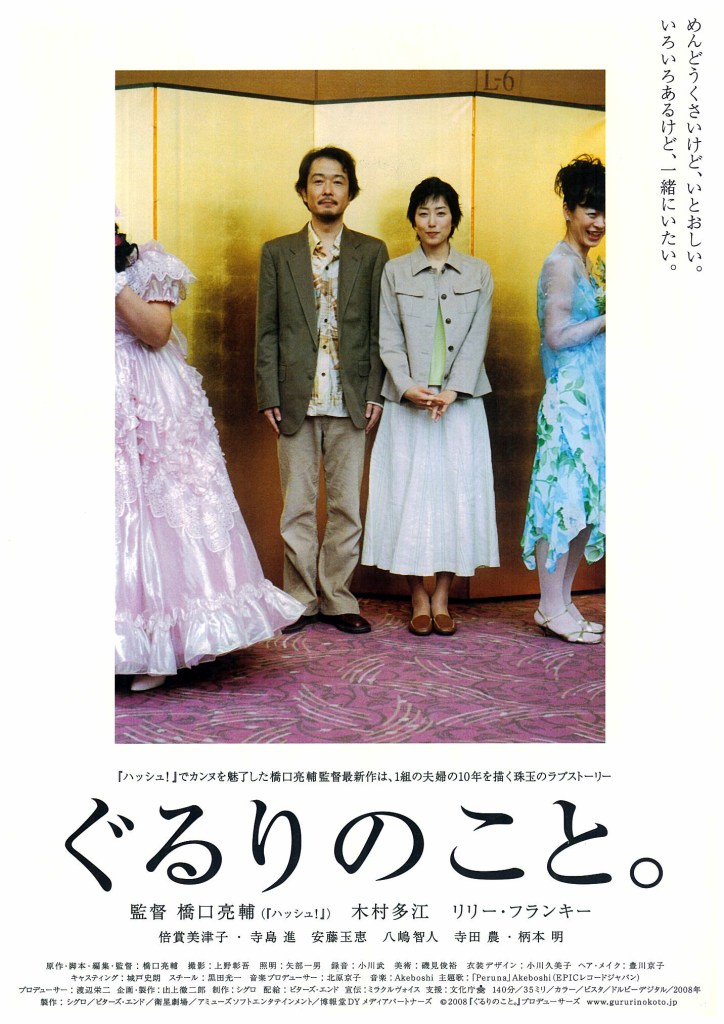
all around usRyosuke Hashiguchi returns after an eight year absence with All Around Us (ぐるりのこと。Gururi no Koto) and eschews most of his pressing themes up this by point by opting to depict a few “scenes from a marriage” in post-bubble era Japan. Set against the backdrop of an extremely turbulent decade which was plagued by natural disasters, terrorism, and shocking criminal activity Hashiguchi shows us the enduring love of one ordinary couple who, finding themselves pulled apart by tragedy, gradually grow closer through their shared grief and disappointment.

Tokyo, 1993. Kanao (Lily Franky) and Shoko (Tae Kimura) have had an “on and off” (but seemingly solid) relationship since their art school days. She works at a publishing house and he’s kind of a slacker with a job in a shoe repair booth. Shoko worries that Kanao plays around too much (but actually doesn’t seem that bothered about it) whilst continuing to attempt to micromanage their entire existence with her clearly marked calendar planning out the most intimate of actions. When Shoko discovers she’s expecting a child, the pair decide to finally get married and begin their lives as a family. Kanao also gets an opportunity on the work side when an old college friend helps him get a job as a courtroom artist for a news agency.

However, their joy is short-lived as an abrupt jump forward in time shows us a tiny shrine underneath the calendar (shorn of its red crosses) dedicated to the memory of their infant daughter. Kanao is the keep calm and carry on sort so he just tries to bluster through but Shoko is distraught and slowly descending into a mental breakdown. If that weren’t enough to contend with, Shoko’s estranged father has been tracked down and is apparently very ill dredging up even more pain an uncertainty from the long buried past.

We follow Shoko and Kanao over a period of nine years. As well as the ever present motif of the calendar, we feel the passage of time through Kanao’s work at the court house which sees him become the artistic recorder of some of the most traumatic moments of the age. Having entered into an era of economic turmoil following the end of the bubble economy, the 1990s saw not only the devastating Kobe Earthquake but also the sarin gas attack on the Tokyo underground perpetrated by a dangerous religious cult, members of which wind up in court in front of Kanao, tasked with the thankless task of bearing witness to their testimony.

Kanao evidently decided not to discuss his personal tragedy with his work colleagues or, one would assume, his boss would not have reacted so harshly when he made the reasonable request to turn down the opportunity to sit in on yet another child murder trial – either by accident or design, the trials which present themselves to Kanao (and are all real, sensationalised media events of the time) involve the horrific murders of small children with only one of the defendants voicing any kind of regret or remorse.

Meanwhile, Shoko has been trying to get on with life as best she can but finds herself sinking ever deeper into depression. Her uptight, controlling personality cannot cope with this perceived “failure” on her part or of the destruction of all her plans by a truly unforeseen tragedy. Having had her doubts before regarding Kanao’s commitment to her, she finds his lack of reaction puzzling. Mistaking Kanao’s lack of outward emotion for indifference, Shoko finds it hard to continue believing in their shared destiny and wonders if her husband ever really cared for her at all. Kanao is a laid-back soul, someone who’s learned to become used to disappointment by accepting it quickly and then trying to move on. His more grounded approach might be just the one Shoko needs in order to come to terms with what’s happened – never pushing or complaining Kanao is contented simply by her presence and is prepared to give her the space she needs whilst always being around to offer support.

Hashiguchi relies on visual cues to help navigate the shifting dynamics including the repeated use of the calendar as a symbol of Shoko and Kanao’s marital status, the now unneeded pregnancy books bundled to be thrown out, or rice discarded in the sink as a marker of a house proud woman’s slide into crippling depression. Small moments make all the difference from a mother’s bandaged wrists and a cutback to the only person who’s noticed them, to the repeated joke of all the veteran journalists suddenly falling over themselves in an attempt to escape the courtroom and be the first to file their copy. A necessarily sad story, but an oddly warm one as two people worried they may be mismatched grow into each other in the face of their shared tragedy. Anchored by the strong performances of its two leads (particularly Tae Kimura who manages some convincing on screen crying in a difficult role) All Around Us is another beautifully pitched human drama from Hashiguchi who proves himself an adept chronicler of the human condition even whilst stepping away from his trademark themes.


Original trailer (English subtitles)

Hush! (ハッシュ!, Ryosuke Hashiguchi, 2001)

hushThe family drama is a mainstay of Japanese cinema, true, but, it’s a far wider genre than might be assumed. The rays fracture out from Ozu through to The Family Game and Crazy Family which sought to ask a few questions about where the idea of “family” was headed in a society of rapidly increasing materialism. Ryosuke Hashiguchi comes at the idea from a different angle in 2001’s Hush! (ハッシュ!) as he once again takes the perspective of the gay community and asks if the “traditional family” is about to change – what could, or should, survive if the old, rigid ideas can be remade into something lasting created out of love and acceptance rather than obligation?

As the film begins, Naoya (Kazuya Takahashi) wakes up to find his one night stand already fully dressed and heading out the door, awkwardly, without even stopping to say goodbye. Eventually he hooks up with the kindly Katsuhiro (Seiichi Tanabe) and the two quickly become fairly serious but then a damaged woman, Asako (Reiko Kataoka), enters their lives hoping to use Katsuhiro as a sperm donor, forcing the men to reassess a number of important desires and beliefs, putting strain on their still fledgling relationship. If that weren’t enough drama, a girl at Katsuhiro’s place of work has also developed a crush on him and is prepared to take her unreturned love to some extremely dark places.

The first level of mini stresses Naoya and Katsuhiro have to contend with is their conflicting (if complementary) personalities and attitudes to their sexuality. Naoya is an easy going type with a job at a pet grooming salon. He’s a fully out gay man and a frequenter of city’s gay scene. Katsuhiro, by contrast, is much more mild mannered and innately kind. He works at a scientific research station and is more or less closeted – that is, he doesn’t particularly go out of his way to hide his sexuality from his work mates and family but he doesn’t volunteer the information either. This attitude seems to bother Naoya at various points but being the easy going type he’s apt to let it go most of the time.

However, when Katsuhiro reveals Asako’s offer, Naoya is actively against it. His idea of gay life suggests that relationships are generally short, he prefers the relative freedom of his life as an essentially “single” man rather a husband shackled to a family. Katsuhiro on the other hand perhaps would have liked children, or to be a father figure to someone else’s. Though Naoya has previously expressed boredom and disillusionment with his life spent in clubs and gay bars, he’s still resistant to the idea of settling down, or at least to the belief that a single relationship really can stay the course.

All three of the central characters have, in a sense, been let down by the “traditional” family. Naoya’s father left when he was small, leaving him with a single mother which is something that wasn’t so common when he was a child resulting in a fair amount of social stigma from other people in the community. These days his brassy mother knows about his sexuality and seems OK with it (aside from getting the random idea that Naoya will be wanting a pair of breasts at some point). Katsuhiro’s father was an alcoholic who died when he was just a small boy, his relationship with his brother and his family seems good but he’s afraid to reveal his sexuality to them for fear of disapproval. His brother had an arranged marriage, which doesn’t seem to have worked out so well at least from the sister-in-law’s perspective. Asako has also had a troubled life looking for affection in all the wrong places, feeling that if she had not been neglected as a child perhaps she’d have been a steadier adult. Naoya was running away from the idea of family ties, but Katsuhiro and Asako are actively seeking to repair the ones which never grew into the kind of roots one needs to anchor onself in a society entirely built around familial bonds.

After receiving some surprising medical news, Asako perversely decides that her own salvation lies in becoming a mother. She’s had enough of casual relationships and decided to go a different route so when she spots the kind look Katshiro gives a small child at a restaurant, she decides he must be the one to father her baby. Asako knew that Naoya and Katsuhiro were a couple, but that works out pretty well for her plan so she approaches him and makes her left field offer right off the bat. It will take some figuring out but this literal third way is a neat solution to a series of problems and, being completely new, is safe from the pettiness and misery often found within the traditional family unit. Contrasted with the bitterness displayed by Katsuhiro’s sister-in-law, the unusual arrangement of these three would be parents and their unborn child(ren) is one filled with love, forgiveness and mutual support rather than cold obligation or a simple fulfilment of societal expectations.

Once again Hashiguchi proves himself adept at creating a series of complex, flawed human beings who are nevertheless relatable and often endearing. Hashiguchi’s films tend to run long but he also ensures that even his supporting characters are well enough drawn to maintain interest in the many subplots from Naoya’s abrasive gay bar buddy to Katsuhiro’s unhinged stalker. An interesting sideways look at the state of the modern family, Hush! seems to advocate that just shutting up and going with the flow is not the answer but there are quieter solutions to be found if everyone is willing to listen to the silence.


Original trailer (no subtitles)