Black Rain (黒い雨, Shohei Imamura, 1989)

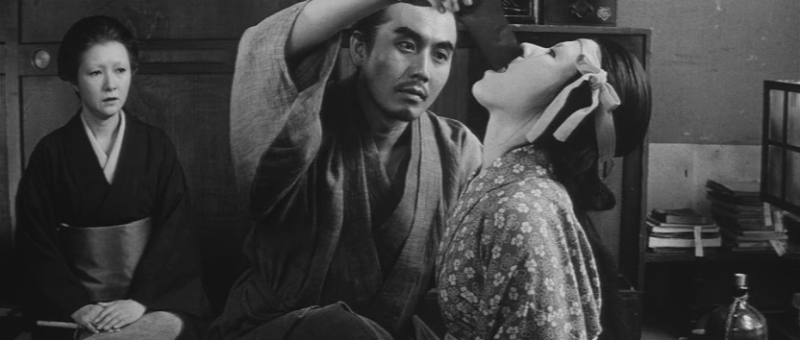
Caught in a moment of transition, post-war Japan struggles to free itself from the lingering feudal legacy and the trauma of the immediate past in Shohei Imamura’s contemplative adaptation of the novel by Masuji Ibuse, Black Rain (黒い雨, Kuroi Ame). As many things change others stay the same, the Shizuma family burdened not only by the anxiety of a ghostly illness symptomless until it isn’t and the unfair prejudice of a wounded society, but the pressure of outdated patriarchal social codes along with a sense of filial failure in the inability to protect their ancestral estate. 

Imamura opens on the fateful morning the atomic bomb struck Hiroshima, voiceovers from 20-year-old niece Yasuko (Yoshiko Tanaka) and her uncle Shigematsu (Kazuo Kitamura), a soldier severing at a factory in the city, detailing what they were doing on that very ordinary day. What unfolds is a scene of hell, the train Shigematsu is riding on blown apart while he crawls free and tries to look for his wife, Shigeko (Kazuo Kitamura), packing up their house preparing for evacuation, eventually reuniting with Yasuko who had come into town to find them. Hoping to get to the factory, they make their way past charred and hideously warped bodies, a woman cradling her carbonised infant, a little boy overjoyed to have found his big brother only to go unrecognised because his face is melted away while skin hangs painfully from his forearms and fingertips. The brother only accepts him after checking his belt which has somehow miraculously survived. The trio eventually make it to comparative safety at the factory with relatively few injuries, only later learning of the implications of having been in such close proximity to the blast. 

Jumping ahead five years, the Shizumas are living quite comfortably in their ancestral home on a mountain estate largely spared the post-war agricultural land reforms because of its location, though Shigematsu attributes his mother’s dementia to an inability to accept the changing times not only their loss of a semi-aristocratic status but the essential failure of having proved unable to protect their ancestral lands. His immediate problem is however the marriage of the now 25-year-old Yasuko. We see him triumphantly leave a doctor’s office with a certificate stating that Yasuko is in good health he hopes will reassure her current suitor’s family in the face of persistent rumours that she too was a direct victim of the “flash”, rather than an indirect victim simply of the rain which Shigematsu mistakenly believes to have been less dangerous. 

At 25 this is Yasuko’s last chance, she’s aged out of the arranged marriage market. She has also had a promising job offer from the local post office but is minded to turn it down in the hopes of being married. Taking the post office job may be the most sensible option, but it also seems like defeat, an acceptance that she is unfit for marriage and a clear sign that Shigematsu and Shigeko have failed in their patriarchal duties to ensure that Yasuko finds a good husband and will be well looked after for the rest of her life. In this age, it is difficult for a woman to support herself alone even leaving aside the social stigma of being an unmarried woman. A marriage is therefore also a job, and the families fear one Yasuko may not be able to perform if as the rumours suggest her exposure to radiation may have left her unable to bear children. The situation is further complicated seeing as Shigematsu and Shigeko were not able to have children of their own, and with Yasuko’s mother Kiyoko having died young Yasuko is the last of the Shizuma line even if she technically may not bear their name. 

Lost in old memories and mistaking Yasuko for her mother, grandma (Hisako Hara) may have it right when she tells her not to marry for marriage only leads to death. Yet in an odd way, Yasuko’s liminal status perhaps grants her the right to turn away from these old-fashioned patriarchal expectations in making her own decision not marry even if she orients herself back towards the filial in requesting to stay with the aunt and uncle who raised her in order to care for them should they suddenly begin to experience symptoms of their exposure to “the flash”. Shigematsu continues to treat the notion of radiation sickness with an almost supernatural mentality, convinced that having seen the light or not is all that matters constantly trying to provide evidence that Yasuko was not there when the bomb went off while ignoring her exposure to the black rain which fell afterwards even while himself filled with the anxiety of not knowing if he may someday become ill even if he and Shigeko are in otherwise good health. 

He watches friends with secondary exposure become ill and die before him, recalling being asked to read sutras for the dead in the aftermath of the bomb though feeling himself unqualified, while some in the village perhaps jokingly accuse them of playing on their status as bomb victims as if they are merely lazy rather than actively sick. Meanwhile, across the way a young man with intense PTSD suffers flashbacks every time he hears an engine running and is compelled to throw himself in front of it as if it were an enemy tank. Yuichi (Keisuke Ishida) is ironically enough “a veteran of the suicide squad”, otherwise alright if fragile spending his days carving Buddhist Jizo statues may of which have grotesque, anguished expressions in contrast to the comforting, almost cute faces such statues usually bear. Just as the wider society distances itself from the survivors of the bomb, so they reject men like Yuichi. When Yuichi’s mother comes to propose an unlikely marriage between the two lonely youngsters who have become close after bonding through their shared anxieties, Shigematsu is offended, resenting the implication that they must believe Yasuko is a poor catch if daring to suggest she marry a man of a lower social class who is also in need of assistance in living with his mental illness. 

Yet her marriage continues to weigh heavily on Shigeko’s mind, feeling as if she has failed the Shizuma family in being unable to provide an heir and subsequently failing to secure a match for Yasuko. It is perhaps this anxiety that finally makes her ill, taking strange medicines provided by a dubious Shinto priestess who tells her it’s all her own fault for not being able to visit Kiyoko’s grave because someone has to stay at home to look after grandma. Only Shigematsu sees the writing on the wall, advising Yasuko that after grandma dies she should sell the estate and take the money as her dowry freeing her from the feudal and familial legacy and giving her permission to move into the modern post-war future even as she begins to doubt that the future has a place for her. 

Shooting in black and white and in a much more classical style than that which is found in his other work, Imamura adopts the aesthetics of Golden Age cinema to comment on the contemporary era now perhaps feeling itself sufficiently distanced from the toxicity of wartime trauma, suggesting that the entire society is in a sense soaked in black rain its inability to confront the recent past a poison slowly eating away at its foundations. “An unjust peace is better than a just war” Shigematsu is fond of saying, quoting Cicero dismayed by the heated geopolitical debates he hears on the radio he uses to set the clock, his friend dying without ever really understanding why the bomb was dropped, why on Hiroshima, why at that particular moment. Imamura denies us closure too, leaving on a note of anxiety if tempered with an all but forlorn hope for signs of a miracle on the horizon that the sickness can be healed and a better world will someday arrive.


Black Rain screens at the BFI on 28th December as part of BFI Japan and is also available on blu-ray as part of Arrow’s Imamura boxset or to stream in the UK via Arrow Player

Silent Tokyo (サイレント・トーキョー, Takafumi Hatano, 2020)

Traditionally speaking, Christmas is a time of joy and hope, peace to all men. It is then a particular cruelty to plan a terrorist event at the very time people have been conditioned to feel safe, even if in Japan Christmas is less about familial love than the romantic. Christmas Eve will be far from a silent night in Takafumi Hatano’s holiday thriller Silent Tokyo (サイレント・トーキョー) adapted from the novel by Takehiko Hata, the sound of explosions disrupting the peaceful atmosphere as a mysterious bomber threatens to blow up Tokyo Tower if they are not granted a personal audience with the prime minister on live TV. 

Thankfully Japan does not have an extensive history of terrorist action at least of this nature, that’s one reason why a when a pair of TV journalists report a tip off they’ve received about a bomb in a shopping centre the police take little notice. The shopping centre bomb is real but of low power leaving only a single person with light injuries after most shoppers are evacuated following a smaller warning explosion in a bin near the Christmas display. It’s enough for the police to take notice, especially as grizzled veteran Seta (Hidetoshi Nishijima) becomes convinced it’s likely a dry run for something more serious, but still no one really believes a bomb could go off in the middle of Tokyo even when a message from the bomber threatening to blow up the Christmas tree in Shibuya if they are not granted an audience with the prime minister is played on large screens around the city. For whatever reason, the police choose not to evacuate the area which is quickly filled by the morbidly curious along with holiday revellers in Santa suits live-streaming the event via social media as if it were the countdown on New Year’s Eve. When the bomb doesn’t go off, they content themselves with a rousing chorus of “congratulations” as if it were all some kind of Christmas prank only to be hit by the delayed explosion a few minutes later in an elaborately staged scene of urban carnage. 

Hatano shifts suspicion between a number of suspects before finally bringing it all together while continually hinting at the bomber’s, and the film’s, true message. Early on we see a mass protest against the prime minister who appears on a large screen insisting that Japan abandon its pacifist constitution and become militarised nation capable of going to war should the necessity arise. The irony is, of course, that the PM evidently chooses not to mount much of a defence against this immediate internal threat, never mind the external, while the bomber’s message turns out to be that war is morally wrong and not something a civilised nation should be pursuing. The bombs are intended as a wakeup call to the prime minister and the “apathetic” citizens of Japan who elected him, urging them that if they truly understood the nature of war they would want no part of it. That the message is delivered through violence which includes loss of life and serious injury is another irony and one likely to prove counterproductive especially considering the bullishness of the PM who repeatedly appears on TV screens insisting that the government does not negotiate with terrorists while simultaneously playing the strongman and not appearing to do very much else. 

In any case, the film briefly touches on other kinds of secondary violence such as the affects of post-traumatic stress in soldiers returning from peacekeeping missions overseas, police dealing with major incidents, victims of crime, and that of a young man having witnessed his father violently abusing his mother. But in keeping with the Christmas theme, the motive turns out to be romantic in addition to political delivered with a kind of misplaced love and desire for vengeance which goes someway to explaining the various target locations which are all obvious stop offs on a stereotypical Tokyo day trip culminating with the iconic Tokyo Tower. The irony of this anti-violence bombing campaign is fully brought home by the assertions of the police that they are technically at war with the bomber, who perhaps hopes that being directly subjected to the reality of military violence will help bolster support for the pacifist constitution while their hope of being able to change the prime minister’s nationalistic mindset through chatting with him on TV seems rather naive. In any case, the messages of peace to all men are perfectly suited to the festive season even if they come in slightly counterintuitive packaging. 


Original trailer (English subtitles available from CC button)

Mother (おかあさん, Mikio Naruse, 1952)

The hahamono or mother movie is a mainstay of post-war cinema, obsessed as it is with self-sacrificing maternity. Mikio Naruse, however, is not a name you’d expect to see associating itself with the genre and his 1952 film Mother (おかあさん, Okaasan), adapted from a child’s essay, is indeed subtly subversive, transgressively questioning the institution of motherhood itself while ostensibly remaining faithful to genre norms even as it makes an accidental villain of its teenage heroine who closes the film plaintively praying for her mother’s happiness having not so long ago shut down perhaps her only real hope of achieving it. 

The Fukuhara family ran a successful laundry before the war, but these days father Ryosuke (Masao Mishima) works at a factory and is nicknamed Papa Popeye by his kids because of his finely tuned muscles born of a lifetime training the iron. Matriarch Masako (Kinuyo Tanaka) and 18-year-old daughter Toshiko (Kyoko Kagawa), our narrator, help the family finances by running street food stalls, while oldest son Susumu (Akihiko Katayama) has become ill with a lung complaint caused by poor conditions at the wool factory where he was working. In addition to youngest daughter Chako who is still in school, the family has also taken in little Tetsu (Takashi Ito) the son of Masako’s sister Noriko (Chieko Nakakita) who is now a widow recently repatriated from Manchuria. 

Like many films of the occupation period, the family at the centre of Mother is determined to rebuild, pinning all their hopes on being able to renovate their home in order to be able to reopen the laundry. The war is very much a background presence but its influence is still deeply felt not least in the ruins and devastation glimpsed around the house and the constant references to loss and widowhood which seem to plague Masako, so many women having lost sons and husbands in the conflict. The tragedy is that Masako will eventually in one sense or another lose all her children by the end of the picture, Susumu succumbing to his illness after having discharged himself from hospital out of guilt and loneliness missing his mother, Chako eventually taken in by wealthier relatives who lost their son in the war, Tetsu soon to be retrieved by his mother, and Toshiko herself clearly heading towards marriage with the cheerful and surprisingly progressive baker Shinjiro (Eiji Okada) with whom she has become close. 

Perhaps surprisingly Toshiko seems remarkably immature for her age, her voiceover taken as it is from a child’s essay has a slightly stilted quality that nevertheless makes plain her poor grasp of the adult world and most particularly the reality of her mother’s life. Masako later tells us that she started working at 14 and continued until she married at not so much older than Toshiko is now despite later stating that Toshiko is too young to marry only to find her self shocked when confronted by the sight of her in a wedding dress stifling a brief wave of despair that her daughter may soon be a wife. Originally complaining about not being able to take dressmaking classes like some of the other girls, Toshiko belatedly swears to help support the family firstly to prevent Chako going to stay with relatives and secondly because her boyfriend inadvertently gives her the impression there’s truth in a local rumour that her mother plans to remarry following her husband’s death from overwork and poverty with a friend of their father’s who’s been helping them out in the shop, “Uncle POW” Mr. Kimura (Daisuke Kato). 

Shinjiro is quick to tell her that she’s being unreasonable. In the modern world parents shouldn’t be expected to sacrifice their personal desires for their children, her mother is also a woman and has the right to pursue happiness in marrying again if she chooses. On the other hand, there is nothing particularly concrete between Masako and Mr. Kimura besides a genial domesticity, the rumour is partly local wishful thinking in knowing that remarriage is sensible economic choice and the pair seem well suited. Toshiko objects strongly to the idea out of fear, jealousy, and outdated moralising resenting her mother for betraying her father’s memory but also fearing further changes in her familial relationships in an already uncertain world. 

In this her otherwise saccharine closing monologue in which she looks on as her mother plays with Tetsu and wonders if she’s really “happy” achieves its final irony, transgressively undercutting the primacy of the self-sacrificing mother to question the ideology of motherhood itself when it requires women to sacrifice their lives and desires in service of an ideal of “family”. Nevertheless, Mother is among the most ostensibly cheerful of Narusean dramas in the gentle comedy and naturalistic depiction of a warm and loving family committed to compassion, kindness, and mutual support as pathways towards a better post-war future.  


Mother is currently available to stream in the US via Criterion Channel

Kekkon Annai Mystery (結婚案内ミステリー, Yoshikuni Matsunaga, 1985)

Selected via a talent competition held in conjunction with the search for a new actress to play the leading role in Kosei Saito’s Ninja Wars, Noriko Watanabe became the second of the new “Sannin Musume” alongside the future star of The Little Girl Who Conquered Time, Tomoyo Harada, and Kadokawa’s top idol Hiroko Yakushimaru. Her career with the studio was however comparatively short-lived affording her only three leading roles before she eventually left the agency and went independent after turning down a lead in Koibitotachi no Jikoku because of its explicit nude scenes. Again adapted from a novel by Jiro Akagawa, Kekkon Annai Mystery (結婚案内ミステリー) was her final leading performance as a Kadokawa idol (though she would also play a supporting role in Obayashi’s His Motorbike, Her Island) and saw her playing a slightly more mature role as a young woman working for a matchmaking agency who finds herself mixed up in a country house mystery after accepting an unusual proposal from a client. 

At 19, Hiroko (Noriko Watanabe) is the sole employee at the Fukada Marriage Consultation Agency owned and operated by her boss Mr. Fukada (Bengal). As we first meet her she’s deep undercover at a rival firm which has already shifted into a new era of computer-assisted matchmaking whereas Mr Fukada prefers to do things the old-fashioned way which is presumably why he has no business. It comes as something of a shock therefore when he receives a call from Mrs. Sekine (Aiko Nagayama), the temporary CEO of a major company who apparently wants to find a match for her son Masakazu (Ken Watanabe) who is shortly to return after graduating from Harvard in order to take over the family business following the death of his father six months previously. At the initial consultation, however, Mrs Sekine scandalises Mr Fukada by immediately selecting Hiroko as a potential bride. Seeing as it’s only an initial meeting, which would earn them a bonus payment, Hiroko agrees but when they drive out to the Sekines’ creepy gothic mansion in the middle of nowhere they discover all is not quite as it seems. Masakazu has a fiancée already, but unfortunately she was involved in a traffic accident and is currently in hospital which is a problem because for undisclosed reasons they need to hold the wedding right away. Hiroko is to act as a proxy seeing as no-one who’ll be coming to the ceremony has met Masakazu’s girlfriend and so will be none the wiser. 

Perhaps somewhat naively, Hiroko agrees and ends up staying in the house posing as Masakazu’s intended which includes sharing a room. Briefly shifting genres, a training montage sees Hiroko undertaking a crash course in how to be posh, adopting the correct deportment, using cutlery elegantly, and learning to walk downstairs in massive heals or up while wearing an inconveniently long dress. Which is all to say, the fabulously wealthy inhabit a different world of which Hiroko was hitherto ignorant. This is further brought home by the apparent cracks in the foundations of the Sekine family which is also a corporate entity with the other board members largely favouring other candidates more closely connected to the themselves to take over as chairman while apparent liability uncle Masao (Tamio Kawaji), whose creepy crossbow-carrying young son Mamoru is for some reason being raised by Mrs Sekine, is in some kind of trouble with yakuza loansharks. The other main issue is that Mrs Sekine is a second wife and longtime mistress of the late CEO. Masakazu was born out of wedlock and Mrs Sekine will do anything and everything she can to ensure he assumes his birthright. 

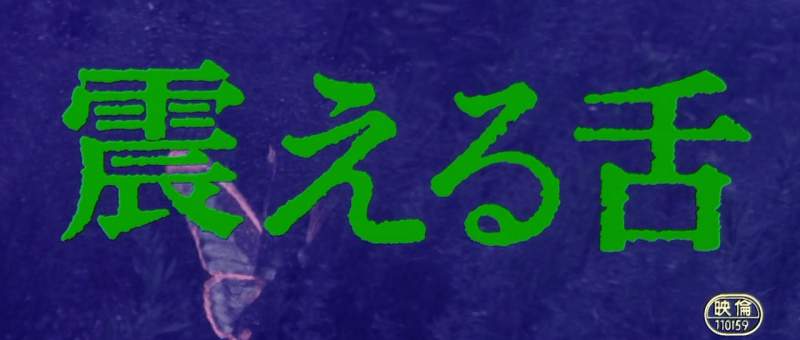
Counter-intuitively succession intrigue has little to do with the central mystery which begins to unravel when Hiroko is attacked on the eve of her wedding by a strange woman who had previously tried to warn her off Masakazu and kills her in self-defence. The body, which we can identify as that seen buried in the snow in the solarised green-tinted opening sequence, is taken care of by Mrs Sekine’s right hand man Kinoshita (Hayato Tani), but Hiroko begins to have her doubts after catching sight of a woman who looks exactly like the one she killed at the local ski resort. 

“Rich people are like that. They’d lie about anything in order to keep their wealth” Hiroko is told, realising she may be at the centre of an infinitely complex plot and becoming aware of Mrs Sekine’s tendency to throw money at people to get them to play along with her plans. Like any good gothic mystery, however, the house holds a dark secret in a hidden room which perhaps hints at the corruptions of the Bubble era along with those of the super rich elite and the undue pressure it puts on its young while uncomfortably suggesting that Mrs Sekine herself is the source of the corruption in her attempt to integrate into a higher social class into which she was not born. Atmospheric in its chilling vistas of the freezing snow, Kekkon Annai Mystery’s twisting tale of greed and manipulation may end in tragedy but ironically lives up to its name as its heroine finds a potential match in her accidental co-conspirator. 


Sensei, Would You Sit Beside Me? (先生、私の隣に座っていただけませんか?, Takahiro Horie, 2021)

An under-confident mangaka tries to save her moribund marriage through a passive aggressive attempt at “realism”, but then is that really what she wants? What is she really up to? Takahiro Horie’s anti-rom-com Sensei, Would You Sit Beside me? (先生、私の隣に座っていただけませんか?, Sensei, Watashi no Tonari ni Suwatte Itadakemasenka?) is more complicated than it first seems, a tale of romantic revenge, of a woman’s determination to reclaim her independence, or perhaps even a slightly cynical not to mention sexist story of a betrayed wife’s attempts to rekindle her moody husband’s creative mojo in the hope of reigniting the spark in their marriage. What transpires is however a literary game of cat and mouse as a suddenly alarmed husband attempts to get ahead of the game through the transgressive act of reading his wife’s diary. 

A successful manga artist, Sawako (Haru Kuroki) has just completed a long-running series assisted by her husband of five years, Toshio (Tasuku Emoto) who was once a bestselling mangaka himself but hasn’t worked on anything of his own since they got married. Toshio appears to be prickly on this subject, and is in something of a bad mood while Sawako’s editor Chika (Nao Honda) waits patiently for the completed pages. Seemingly suspecting something, Sawako asks Toshio to escort Chika back to the station with the intention of following them only she’s interrupted by a phone call from the police to the effect that her mother (Jun Fubuki), who lives out in the country, has been in an accident and broken her ankle. Sawako and Toshio decide to go and stay with her while she recovers, though a change of scene seems to do little to relieve the pressures on their marriage. 

Indeed, on their first night there Toshio remarks that it’s been a while since they’ve slept in the same room which might go some way to explaining the distance in their relationship. Aside from that, Toshio superficially seems much more cheerful perhaps putting on a best behaviour act for his mother-in-law who makes a point of telling her daughter how “great” her husband is and how she’s almost glad she broke her leg because it’s brought him to stay. Her gentle hints to Sawako to let her know if there’s something wrong elicit only a characteristic “hmm” while she otherwise makes only passive-aggressive comments which suggest she fears her marriage may be on the way out. Having long been resistant to the idea of learning to drive even though she grew up in the country, Sawako starts taking lessons at a nearby school cryptically explaining to Toshio that perhaps she’d better learn after all because she’ll be stuck when he leaves her. 

Sawako’s “driving phobia” as she first describes it appears to be a facet of her underlying lack of self-confidence. She simply doesn’t trust herself to take the wheel and cannot operate without the safety net of someone sitting next to her. Having not got on with the grumpy old man she was originally assigned, Sawako gains the courage to take her foot off the brake thanks to a handsome young instructor, Shintani (Daichi Kaneko), who makes her feel safe while slowly giving her the confidence to trust in herself. The implication is that Toshio has been unable to do something similar in part because he’s so wrapped up in his own inferiority complex over his creative decline complaining that nothing really moves him anymore. When Chika advises Sawako choose a more “realistic” subject for her next series, she passively aggressively decides to go all in with a clearly autobiographical tale of adultery that suggests she is well aware her husband and editor are having an affair behind her back while the heroine experiences a passionate reawakening thanks to her handsome, sensitive driving instructor. 

Of course, Toshio can’t resist reading her “diary” and obsessing over how much of it is “true”. Perhaps Sawako intended just this effect, driving her husband out of his mind with guilt and jealousy indulging in a little revenge whether in fantasy or reality. The irony is that there are at least three “senseis” floating around including Sawako herself with the eventual decision of who, if anyone, she wants to sit beside her the unanswered question of her “revenge” manga. Her real revenge, however, may lie in her determination to grab the wheel, reclaiming agency over her life along with a new independence born of her ability to drive and therefore decide its further direction while toying with Toshio’s inner insecurity in order to effect a plan which is far more insidious than it might first seem. Filled with twists and turns, Horie’s cynical love farce eventually cedes total control to its seemingly mousy heroine as she gains the confidence to go solo or hand-in-hand as it suits her towards a destination entirely of her own choosing. 


Sensei, Would You Sit Beside Me? screened as part of this year’s New York Asian Film Festival.

International trailer (English subtitles)

Love Letter (ラブレター, Shunji Iwai, 1995)

“People are forgotten so easily” a widow laments after an insensitive comment from a family friend, yet there is perhaps a difference between forgetting and letting go as exemplified in the distance between two accidental pen pals in Shunji Iwai’s profoundly moving romantic melodrama, Love Letter (ラブレター). A huge hit and pop culture phenomenon throughout Asia on its 1995 release, Iwai’s first theatrical feature bears many of the hallmarks of his enduring style in its soft focus, ethereal lighting and emphasis on nostalgia as the two women at the film’s centre each restore something to the other through their serendipitous correspondence. 

Iwai opens with a memorial service for Itsuki, the late fiancé of the heroine, Hiroko (Miho Nakayama), who passed away two years previously in a mountain climbing accident. Hiroko has since started a relationship with his friend Akiba (Etsushi Toyokawa) who avoided attending the memorial out of misplaced guilt and gave up mountaineering soon after Itsuki’s death. Akiba is keen to move their relationship forward, but fears that Hiroko is still stuck in the past unable to let go of her love for Itsuki. On a visit to Itsuki’s mother (Mariko Kaga), she finds an old address in his middle school year book for a home that apparently no longer exists and decides to mail him a letter saying nothing more than “How are you? I’m fine” of course expecting no reply. What she didn’t know, however, is that there were two Itsuki Fujiis in her Itsuki’s class, the other being a woman still living at the same address to whom Hiroko has accidentally mailed her correspondence. Confused, the other Itsuki (also played by Miho Nakayama) mails back and eventually finds herself recalling memories of the male Itsuki as an awkward, diffident teen she may have entirely misunderstood. 

Played by the same actress the two women are each in a sense trapped in an eternal present, unable to move forward with their lives. While Hiroko is consumed by grief and fearful of committing to her new relationship with Akiba lest she betray the memory of Itsuki, Itsuki is still struggling to come to terms with the traumatic death of her father 10 years previously who passed away from pneumonia after contracting the common cold leaving her with persistent health anxiety. Meanwhile, she is also struggling to move on from her family home which is in an increasingly perilous state of disrepair. She and her mother (Bunjaku Han) want to move into a modern apartment, while her grandfather (Katsuyuki Shinohara) prefers to stay even though it seems that the house will soon have to be demolished. 

Through their accidental correspondence, both women are forced to deal with recent and not so recent loss, Itsuki in some senses having forgotten the boy who shared her name while Hiroko remains unable to forget. Through his trademark ethereal lighting and frequent use of dissolves, Iwai hints at a sense of perpetual longing for the nostalgic past. The letters may not have been from the late Itsuki in a literal sense but were perhaps a message from him, connecting the two women and eventually freeing each of them as the love letter of the title is finally delivered ironically enough hidden inside a copy of Remembrance of Things Past. 

This sense of grief-stricken inertia is perfectly reflected in the snowy vistas of the lonely northern town of Otaru, thrown into stark contrast with the intense heat of the furnace in Akiba’s glassblowing workshop, or the gentle warmth of the old-fashioned stove in Itsuki’s room as she types replies to Hiroko’s handwritten letters. As Hiroko eventually reflects, they each knew a different Itsuki and have each in a sense both lost him if restoring something one to the other through the exchange of memories that grants Hiroko the understanding she needs to let go and Itsuki the poignant realisation of a youthful missed connection. A bittersweet meditation on love, loss, grief, and memory, Iwai’s epistolary drama has its own sense of magic and mystery in the strange power of this serendipitous connection leading to a tremendous sense of catharsis as a long delayed message finally makes its way home bringing with it a shade of melancholy regret but also possibility in the new hope of forward motion.


Love Letter screens at the BFI on 22/28 December as part of BFI Japan.

Original trailer (no subtitles)

Last of the Wolves (孤狼の血 LEVEL2, Kazuya Shiraishi, 2021)

“The Showa era’s over. We don’t use guns now, business is our battlefield.” a recently released foot soldier is told, finding himself in a whole new world emerging from a not so distant past of turf wars and street scuffles into a late bubble wonderland of besuited corporatised gangsters. Set in 1988, Kazuya Shiraishi’s Blood of Wolves had been about the twilight of post-war gangsterdom forever associated with an era that was literally about to pass. Set three years later in the twilight of the bubble economy and an already established Heisei, Last of the Wolves (孤狼の血 LEVEL2, Koro no chi: Level 2) finds no longer rookie cop Hioka (Tori Matsuzaka) taking on the mantle of his late mentor Ogami, attempting to broker peace by getting uncomfortably close to yakuza. 

At the end of the previous film, Hioka had managed to engineer a truce between rival gangs Odani (with whom he is affiliated), and Irako through pushing top Odani guy Ichinose to take out boss Irako. Three years later, the peace has held and in any case Heisei yakuza no longer take violence to the streets. The release of crazed Irako foot soldier Uebayashi (Ryohei Suzuki), however, threatens to destabilise the local balance of power. Despite mournfully declaring that he doesn’t intend to wind up back in prison, Uebayashi’s first call on release is to the sister of one of his guards whom he rapes and kills in quite gruesome fashion. Hioka is put on the case and partnered with a genial veteran, Seshima (Yoshiko Miyazaki), weirdly excited about investigating a murder at this late stage of his career, but quickly realises that Uebayashi’s recklessness is primed to destroy everything he’s built. 

Having started out a straightlaced rookie, Hioka has fully incorporated the Ogami persona dressing in sharp suits and sunshades, driving a sports car, and hanging out with the Odani guys, while also using his girlfriend’s little brother Chinta (Nijiro Murakami) as a mole in rival gangs. As a cynical reporter points out, however, Ogami was essentially “undercover” in that he understood hobnobbing with yakuza was part of his job and something he did solely to keep civilians safe by preventing another street war. Hioka has started to lose his way, enjoying himself a little too much and already way out of his depth as the fragile peace he’d brokered by less than ethical means begins to crumble beneath his feet. 

Having been in prison, Uebayashi is unaware of the various ways in which the world has changed seeking to return to old school rules of gangsterdom, ironically lecturing his superiors on the absence of jingi (honour and humanity) in their new corporate existence. He’s a monster and a sadist, but his violence is also a result of the horrific abuse he suffered as a child which led to an equally heinous act of revenge while as a member of the ethnic Korean Zainichi community, like Chinta and his siblings, he continually faces discrimination and social oppression. His first act on release is of revenge against the guards who relentlessly tortured him in prison, the murdered woman’s brother confessing that they wrote him up as a model prisoner in the hope he’d be released early so they wouldn’t have to deal with him anymore.  

Yet what Hioka and Uebayashi have in common is that they’re both pawns in a game they were unaware was being played. As it turns out the police corruption Hioka discovered during the previous film did not go away, and in certain senses they liked things the way they were before. Hioka’s truce is very bad for business for a certain subset at least. They might be minded to let a dangerous killer go loose if it disrupts Hioka’s attempt to suppress the criminal underworld to manageable levels. Mimicking the classic jitsuroku, Shiraishi throws in occasional voiceover from an anonymous narrator along with freeze frame and montage while skewing still darker in the levels of depravity among these desperate men fighting over the scraps of a world already in terminal decline even as the bubble seems fit to burst. Shiraishi ends on a note of change with the institution of the organised crime laws which have contributed to the ongoing decline of the yakuza, a relic of the Showa era unfit and unwelcome in the modern society, but also discovers that for good or ill there may yet be wolves in Japan.


Last of the Wolves screened as part of this year’s New York Asian Film Festival.

Teaser trailer (English subtitles)

Fire Festival (火まつり, Mitsuo Yanagimachi, 1985)

By 1985 the Japanese economy was approaching its zenith yet along with increasing economic prosperity had come social change of which small-town Japan was either casualty or sacrificial victim. “Nigishima will stay as it is” declares the last holdout of an increasingly obsolete way of life in Mitsuo Yanagimachi’s intense modernity drama, Fire Festival (火まつり, Himatsuri), a manly mountain man and animalistic force of nature by several metrics unsuited to life in the contemporary society into which he is ultimately unable to progress. 

There are many things which it seems have not changed in Nigishima for generations, one being the animosity between the cohorts of its bifurcated community, those who live by land and those who live by sea. Rural depopulation may have forced them to come closer but it has also increased their sense of mistrust while both industries continue to suffer in an economy which no longer prizes their humble rural output. Despite being catapulted into a promised modernity by the advent of the railway to great fanfare in 1959, it now seems that Nigishima cannot survive without a new road which could be paid for by the development of a marine park only mountain man Tatsuo (Kinya Kitaoji) owns the property right in the middle of the earmarked area and has hitherto refused to sell further increasing the tension between the two communities. 

Tatsuo is thought of, and thinks of himself, as a big man in the area quite literally it seems as part of the reason he enjoys this status is down to his being unusually well-endowed. He believes himself to have a special relationship with the mountain goddess, often joking to the other men about having a sexual relationship with her while sometimes describing her as his girlfriend. Several times he is mistaken for an animal, firstly by the boatman bringing his childhood sweetheart and sometime mistress Kimiko (Kiwako Taichi) back to the island who assumed he was a monkey crawling along the cliff edge thoughtlessly throwing rocks at them, while he often gambols through the forest whooping like some kind of Tarzan. Entirely unreconstructed, his worldview is patriarchal and misogynistic. All of his banter with the other men is sexual, constantly referring to his penis while greeting his friends with lewd hand gestures thrusting his fist into his pocket as if waving with an erection. The cure for offending the goddess he tells his young protege Ryota (Ryota Nakamoto) is to drop his trousers and display his manhood, Tatsuo strangely believing this would appease her for taking wood from a sacred tree or killing without permission. 

Smearing the blood of a sacrificial animal over his chest and forearms he dedicates the death to the goddess, a gesture he will repeat in the film’s violent and tragic conclusion yet there is also arrogance in his conduct as if he believes himself above natural law, protected as the goddess’ favourite even as he describes himself as “suffocated” by the women in his life from his mother and five older sisters all of whom indulge him to his wife, kids, and mistresses. He has trained his dogs to hunt wild boar without the use of guns in a method he admits even other hunters describe as “cruel” while breaking a local taboo shooting monkeys in the forest well aware of nature red in tooth and claw. As such, there is little nobility to be seen in his determination to preserve this already obsolete way of life. His virility maybe contrasted with that of the ageing land broker Yamakawa (Norihei Miki) and his failed attempts to bed sex worker Kimiko who tricks him into paying off her debts, but he at least knows the way the wind is blowing explaining to her that towns such as Nigishima survive only through things like marine parks or hotels or even nuclear power plants. Without the road, the town will die. 

Yet in 1959 they were told the railway would save them and it seems it did not. Tatsuo’s love making with Kimiko in a boat borrowed from a treacherous fisherman who later agrees to sail it transgressively into sacred waters is intercut with memories of the rail line’s opening ceremony, two teenagers who might have been them or at least of around the same age ride an elephant on the jetty while the townspeople arrange themselves into the formation of the character for “celebration” captured by the aerial photographer above. For Tatsuo as a boy, was this a rebirth of Nigishima or the beginning of its demise as the coming modernity began to eat away at its foundations? 

The fire festival is “for men”, according to Tatsuo, “to drive out evil spirits”, his manliness getting the better of him as he disrupts the proceedings to attack a man he accuses of having brought “false fire”. These are the lessons he teaches to surrogate son Ryota whose devotion to him borders on the homoerotic, Tatsuo cradling him during the climactic rain storm and he seeming to develop a fascination for Kimiko as a kind of indirect fixation. Ryota has learned Tatsuo’s chauvinism mimicking his lewd hand gestures and swaggering walk, his cruelty in sacrificing 1000 yen to trick Yamakawa into injuring his hand in a bear trap, and his arrogance ensuring that his problematic masculinity will survive into another generation presumably no more capable of halting the march of modernity than he has been. Tatsuo poisons the waters with fuel oil which as one of the greek chorus of fish wives points out does not catch fire, Tatsuo himself smouldering until an inevitable explosion. Receiving some kind of epiphany during a mystical congress with the goddess in the middle of a storm, he knows what he must do and accepts that he cannot progress into the modern society. Smoulderingly intense in its small-town animosity and primeval sensibilities, Yanagimachi’s poetic tragedy of futility and the broken promises of a badly distributed modernity may accept the the sacrifice but mourns it all the same. 


Fire Festival screens at the BFI on 20/27 December as part of BFI Japan.

Clip (English subtitles)

Sun Above, Death Below (狙撃, Hiromichi Horikawa, 1968)

“Fighting is the only way I have to live my life” according to a hitman battling existential ennui in Hiromichi Horikawa’s Toho action B-movie, Sun Above, Death Below (狙撃, Sogeki). A starrier affair than the studio’s other forays into moody crime, Horikawa’s psychedelic exploration of a killer drawn to death nevertheless situates itself very much in the world of 1968 in which the hero’s attempt to escape his sense of emptiness through killing is directly linked to an increasing economic prosperity and its concurrent costs in the nation’s current geopolitical positioning. 

As if to signal this sense of societal anxiety, the first target Matsushita (Yuzo Kayama) knocks off is sitting in the back row of the last carriage on the Shinkansen out of Tokyo. His next job, however, will apparently be more complicated. A criminal gang want him to take out “five or six” targets at a specific location in order to intercept a fortune in gold smuggled by, as later becomes clear, an international Chinese gangster, though the men at the waterside greet each other in Arabic. The hit does not go entirely to plan but Matsushita is later able to bring the situation under control allowing the gang to get their hands on the gold. The smugglers, meanwhile, are obviously unhappy with this turn of events and send in their best hitman (Masayuki Mori), who permanently travels with a blonde companion, to take back what’s theirs. 

Matsushita is a killer for hire so he doesn’t really care very much about the gold and is even annoyed when the gang try to pay him with it, correctly surmising they didn’t really expect him to succeed so haven’t bothered bringing any cash. As he explains to love interest Shoko (Ruriko Asaoka), he doesn’t really care about anything. He simply shoots at the best target, man, with his favourite gun. He kills to feel alive, explaining that the intense concentration in which he becomes one with the gun as if it were an extension of his own body allows him to overcome his sense of existential dread which is why he’s so ice cool all the time. 

A fashion model obsessed with rare butterflies and the paradise to be found New Guinea Shoko dreams of a time in which they can become one under the sun, envisioning a future in which Matsushita has become friends with all the creatures of the forest. Yet as Matsushita tells an old friend, Fukazawa (Shin Kishida), running a secondhand gun shop near a US army base as a front for his revolutionary activities, he has no dream or ideal and knows nothing other than killing. Whereas as his friend is apparently working for some kind of never quite explained but seemingly left-wing/anarchist cause, Matsushita simply lives out his days of emptiness on some level knowing he’ll probably never make it to Shoko’s New Guinean utopia. 

Fukazawa nevertheless hints at the political instability all around them, firstly agreeing to pawn a gun for a pair of Americans after beer money, and then by handing Matsushita an AK47 apparently smuggled back from Vietnam via the American base. Matsushita’s sense of ennui is born of this growing unease with empty capitalistic consumerism and a concurrent sense of powerless in Japan’s ongoing complicity with American foreign policy in Asia. Displaying a sense of Sinophobia familiar from many similar films of this era, the big boss turns out to be Chinese while many that surround him are also from outside of Japan even if Matsushita’s rival is just a slightly older, crueller version of himself. 

One of Toho’s more serious crime dramas, Horikawa often veers into experimental territory with his psychedelic butterfly imagery Matsushita apparently having some kind of vision while experiencing carnal ecstasy that equates climax with literal gunshot, while his usage of stock footage featuring the New Guinean indigenous community along with an out of place blackface tribal dance performed in a hotel room clearly display some outdated attitudes otherwise unacceptable and potentially offensive in the present day. Nevertheless, Sun Above, Death Below largely lives up to its hardboiled title, the Japanese “Sniping” perhaps also hinting at the various ways Matsushita eventually strays into the crosshairs of his own inevitable destiny. 


Original trailer (no subtitles)

Choji Snack Bar (居酒屋兆治, Yasuo Furuhata, 1983)

Beginning his career at Toei, Yasuo Furuhata is most closely associated with tough guy action films forging a strong and enduring relationship with the genre’s key star Ken Takakura through their work on the New Abashiri Prison series. From the late ‘70s however he began to transition further towards the realms of manly melodrama with a series of films which often starred Takakura as a man struggling to adapt to life in modern Japan such as the guilt-ridden policeman of Station or the conflicted former yakuza of Yasha. Arriving between the two and adapted from a novel by Hitomi Yamaguchi, Choji Snack Bar (居酒屋兆治, Izakaya Choji) is in someways much the same casting a typically stoic Takakura as an intensely noble man whose values are increasingly at odds with the world in which he lives while shifting away from the realms of manly action towards a more somber contemplation of the broken dreams of post-war youth. 

Eiji (Ken Takakura), known to all as “Choji”, is a happily married father of two who gave up his job in shipping to open a bar selling small eats in a Hakodate. He and his wife Shigeko (Tokiko Kato) have been planning to expand the business by opening a larger location near the docks but Eiji is dragging his feet largely it seems because the place found for him by childhood friend Kawahara (Juzo Itami) is too close to another bar run by an old man who helped him when he first started out so he’s loathe to risk infringing on his livelihood. Meanwhile, the central drama in town in the mysterious disappearance of Choji’s childhood sweetheart, Sayo (Reiko Ohara), who married a wealthy ranch owner but has long been trapped in an unhappy marriage she has several times failed to escape. Sayo’s disappearance coincided with a fire at the ranch which is suspected to have been started deliberately the assumption being that Sayo is responsible. 

The ironic disappearance of Sayo forces Choji into a reconsideration of his life choices, something his middle-aged friends also find themselves experiencing if for various different reasons. Choji was once a high school baseball star dreaming of turning pro but his hopes were dashed after an injury forced him to leave the sport thereafter working in an office at the docks but later resigning rather than accept a promotion that would mean he’d suddenly be the boss to his former friends. The bar is his way of being his own man, no one’s boss but his own, though his decision was not universally respected among his friends and in fact came as something of a shock to Shigeko who consented to an arranged marriage partly in search of the typical salaryman life. Most of the other men in town, however, struggle to keep their youthful dreams alive or to find accommodation with the way their lives are now. Inoue (Eiji Misato), for example, is obsessed with cabaret singing, spending all his time in karaoke bars often wearing elaborate costumes and makeup. Childhood friend Iwashita (Kunie Tanaka) even wonders if he’s gone “mad” after taking him to task for neglecting his family on discovering that he’s converted a docked boat into a tiny private cabaret space complete with a sound system and lighting as well as a small seating area for spectators who presumably have not yet materialised. 

This is perhaps in a way a symbol in itself of Japan’s new economic prosperity, later thrown into stark contrast by Choji’s explanation that he and Sayo broke up because of their mutual poverty he nobly pushing her to marry a wealthy man so at least one of them could be happy. Happy is however something Sayo has never been, later paying a short visit to Choji during which she blames him for his “cowardice” suggesting that he is largely responsible for the misery of her life in failing to fight for their love, giving up too easily on a distant happiness which is something he later cautions a young baseball player not to do. The police meanwhile accuse him of complicity, implying the pair knew Sayo’s husband had TB and thought he’d die soon enough after which they’d inherit his money and stay together, consequently assuming the “arson” was an attempted murder. 

The irony is that Choji is far too noble to have ever considered such a thing, something demonstrated by his continuing righteousness in refusing to take up Kawahara’s offer of cheap and lucrative new premises because it would mean betraying his former mentor, refusing to condemn his former teacher’s shock marriage to a woman 30 years his junior, and eventually taking Kawahara to task for his callous comments over the death of friend’s wife. Rival cabbie Akimoto (Masao Komatsu) was forever joking that his wife would die before him and sleazily flirting with young women, but went into debt in order to buy her an elaborate funeral altar and is completely devastated by her loss while living with his three children in a noticeably rundown apartment. As Choji puts it, Kawahara’s broken dream is in no longer being the big boss among the boys as he was in their high school days, fuelling his sense of middle-aged male frustration into embittered drunken violence. Yet everyone is always telling Choji he is being unnecessarily “good”, that he should stop thinking about doing the right thing and put himself first by accepting the offer to relocate the bar because business is business. 

Sayo too is trapped in the past unable to accommodate herself with the way her life turned out, an ironic casualty of Choji’s goodness clinging to her broken dream of youth. These now middle-aged teens of the post-war era are in a sense victims of their age, denied the sense of possibility the youth of today might enjoy but equally unable to step fully into the contemporary era of economic prosperity which some feel has become increasingly amoral and unkind. Nevertheless, as Shigeko puts it “no one can take away what a person carries in their heart”, Choji manfully retaining his nobility while literally burning the image of the past but perhaps carrying it with him as the other men carry the shards of their broken dreams some with more nobility than others.  


Original trailer (no subtitles)