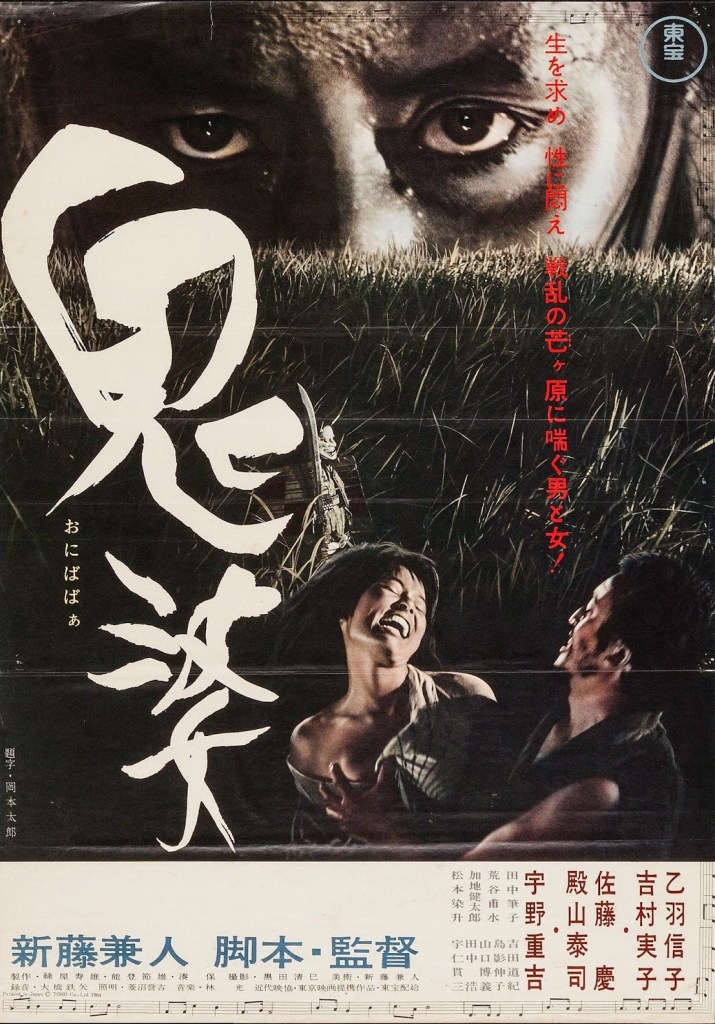
How do you go on living in a world turned upside-down? It may be the central theme of post-war cinema, but few have tackled it in such a direct if allegorical way as Kaneto Shindo, repurposing a Buddhist parable about the perils of duplicity as a lesson in the dangers of the age, defined by a cruel hunger which could not be satisfied by bread alone even if there were bread to satisfy it. Onibaba (鬼婆), as the title implies, makes a villainess of an old woman driven to extremes by her chaotic times, but perhaps suggests that the times make villains of us all.
Deep in the war-torn country of 14th century Japan the imperial capital of Kyoto has been razed, a horse is said to have given birth to a cow, and the sun rose black in the sky leaving day as dark as night. With farmers dragged away from their fields to fight in a war they barely understand on behalf of distant lords, the grain basket of the nation is close to empty. An old woman (Nobuko Otowa) and her daughter-in-law (Jitsuko Yoshimura) have learned to make ends meet by hunting battle-weary samurai, stripping them of their armour, and throwing their bodies into a gigantic pit sitting right in the middle of the tall grass like a gravitational black hole of human compassion. The old woman has been patiently waiting for the return of her son, Kichi, who was taken away by the samurai, certain that everything is going back to normal when the war is over. Kichi, however, will not be returning. Hachi (Kei Sato), another young man from the village taken along with him, brings the sad news that the old woman’s son was beaten to death by a mob of farmers much like herself resentful of the war’s intrusion onto their land.
Everything becomes food, Hachi explains, a sentiment extremely familiar to those who lived through the chaos of the immediate post-war era. Pointing at a baseline problem in the feudal economy, the war starves the poor and makes the wealthy hungry. The fields run wild with no men to tend them, as if symbolising the madness of the times. Lost in the tall grass, samurai and peasant alike search for an exit but are drawn only towards that black pit of human cruelty, more beasts than men driven by the need to survive alone.
Without her son, the old woman is unable to farm, and without her daughter-in-law she is unable to survive through killing. She knows that these are times without feeling and that if Kichi will not return there is no reason for her daughter-in-law to stay. Ushi (Taiji Tonoyama), the broker for the looted samurai armour, makes an indecent proposal of extra millet for sexual favours but the old woman defiantly turns him down, perhaps not quite realising the offer was likely not intended for her. Which is to say that Hachi is not the only man in town, but is perhaps the only “desirable” one. Such desires that there are apparently cannot be satisfied by a crusty old man like Ushi, but are there all the same. Hachi presents a triple threat. The old woman knows her survival depends on the younger one, but also that she has no means to keep her now that her son is dead. She offers Hachi her body instead but he, as she did Ushi, baulks at the idea of slaking his lust on such an old woman.
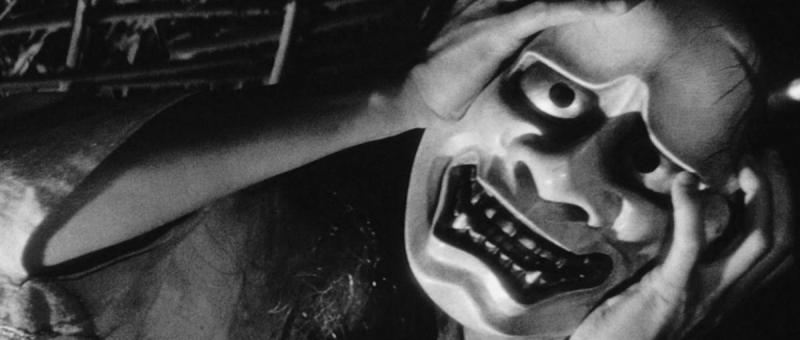
When a strange samurai wanders into her hut and orders her at the point of his sword to lead him out of the tall grass a solution presents itself. The old woman lures him to the black pit and prises away the ornate oni mask which he claimed he wore to protect his beautiful face from the ravages of war. Despite the fact that the samurai appears to have suffered from some kind of aggressive skin disease, the old woman unwisely decides to put the mask on her own face, convincing her daughter-in-law that her relationship with Hachi is sinful and appearing out of nowhere dressed as a demon to remind her that she’s going to hell. The mask’s crazed expression becomes fused with her own face, cementing her transformation into a “demoness” which it seems had already begun with stretch of white disrupting the uniformity of her hair and the kabuki-esque exaggeration of her eyebrows. Running desperately through the tall grass she cries out that she’s human, but this world has made demons of them all. The black pit of hunger knows no fill, and there can be no satisfaction in a world so devoid of human feeling.
Onibaba is currently streaming on BFI Player as part of the BFI’s Japan season.
Original trailer (dialogue free)
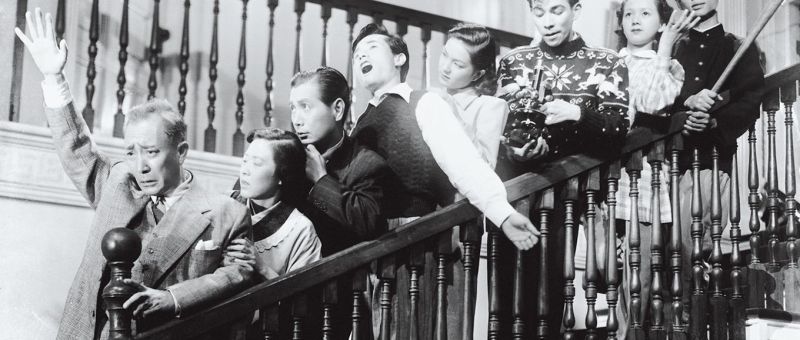
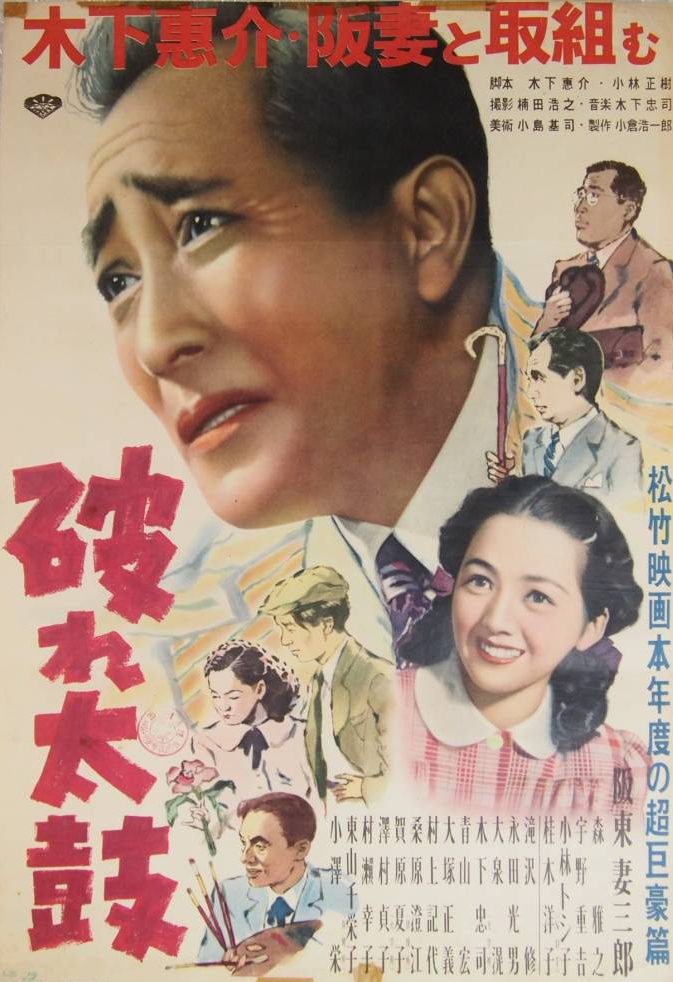


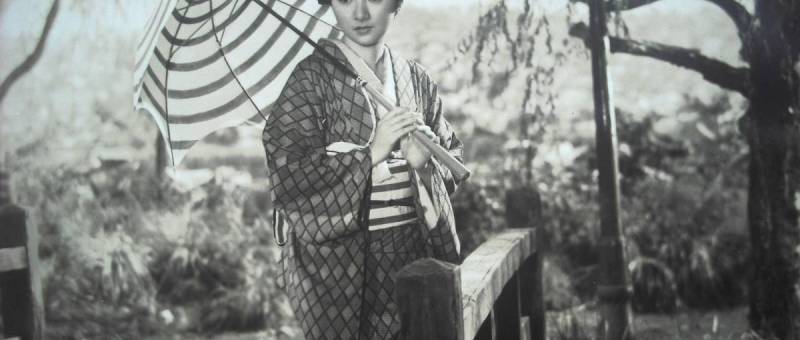
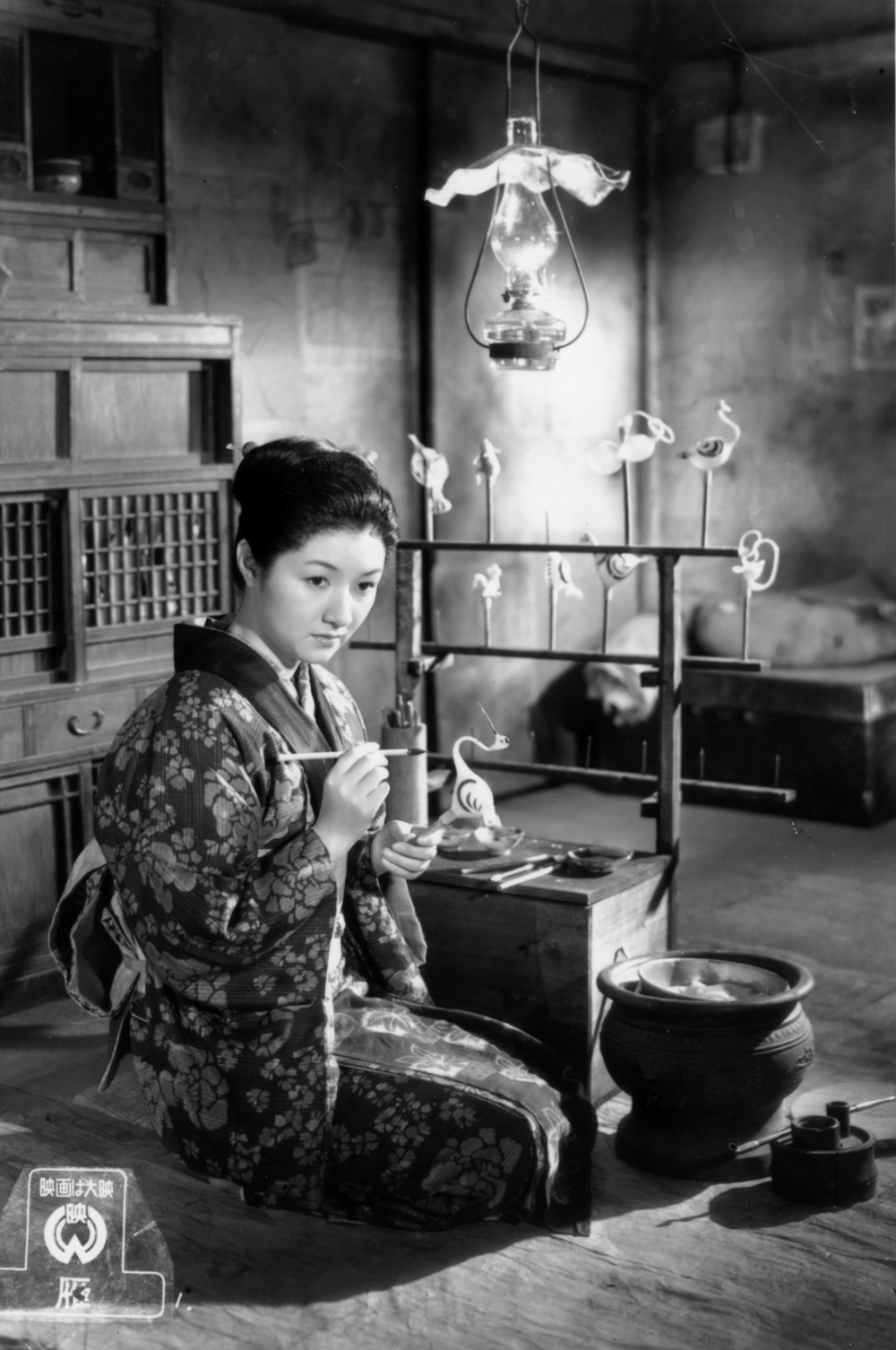 In the extreme turbulence of the immediate post-war period, it’s not surprising that Japan looked back to the last time it was confronted with such confusion and upheaval for clues as to how to move forward from its current state of shocked inertia. The heroine of Shiro Toyoda’s adaptation of the
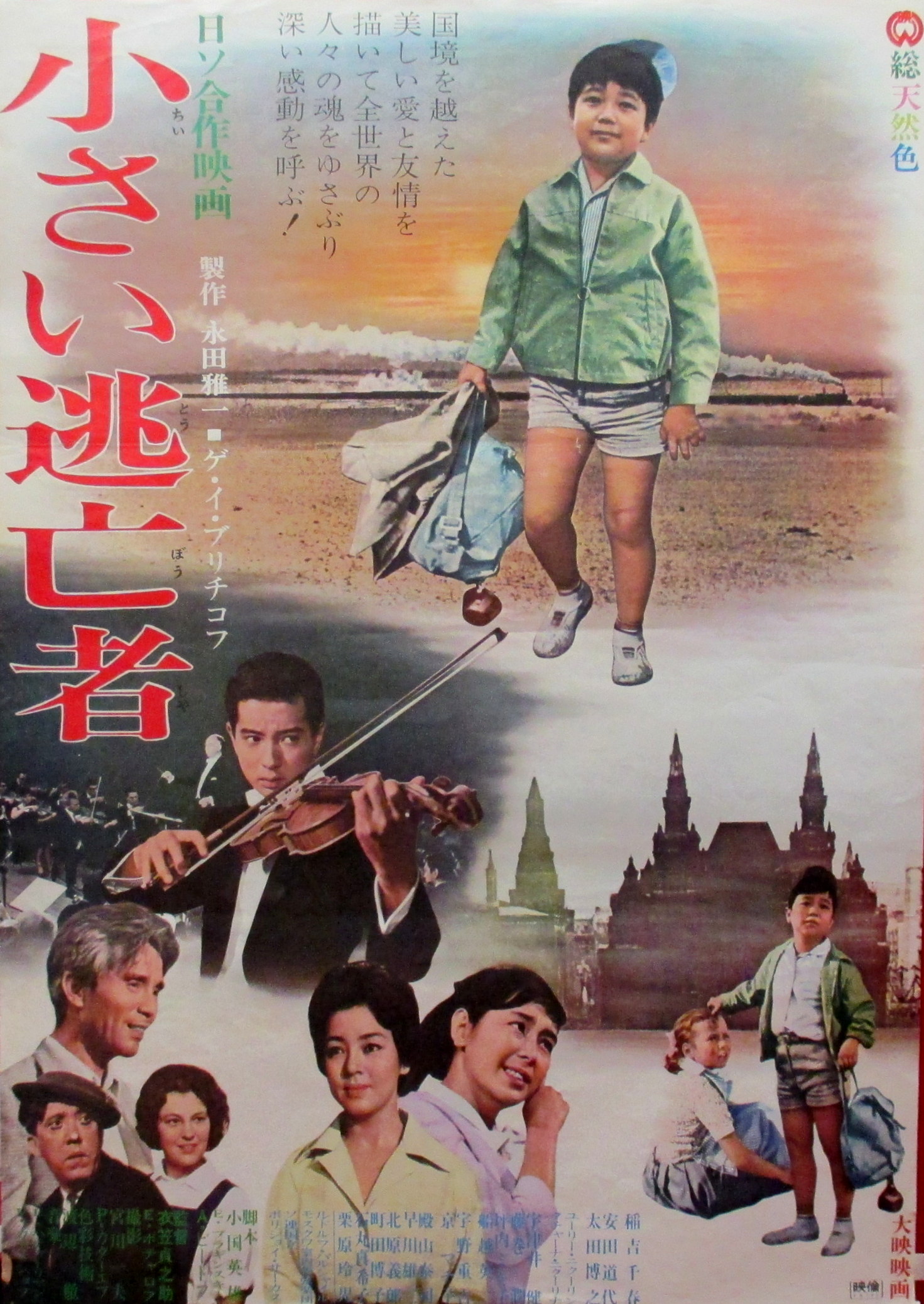 Teinosuke Kinugasa maybe best known for his avant-garde masterpiece The page of Madness even if his subsequent work leant towards a more commercial direction. His final film is just as unusual, though perhaps for different reason. In 1966, Kinugasa co-directed The Little Runaway (小さい逃亡者, Chiisai Tobosha) with Russian director Eduard Bocharov in the first of such collaborations ever created. Truth be told, aside from the geographical proximity, the Japan of 1966 could not be more different from its Soviet counterpart as the Eastern block remained mired in the “cold war” while Japan raced ahead towards its very own, capitalist, economic miracle. Perhaps looking at both sides with kind eyes, The Little Runaway has its heart in the right place with its messages of the universality of human goodness and endurance but broadly makes a success of them if failing to disguise the obvious propaganda gloss.
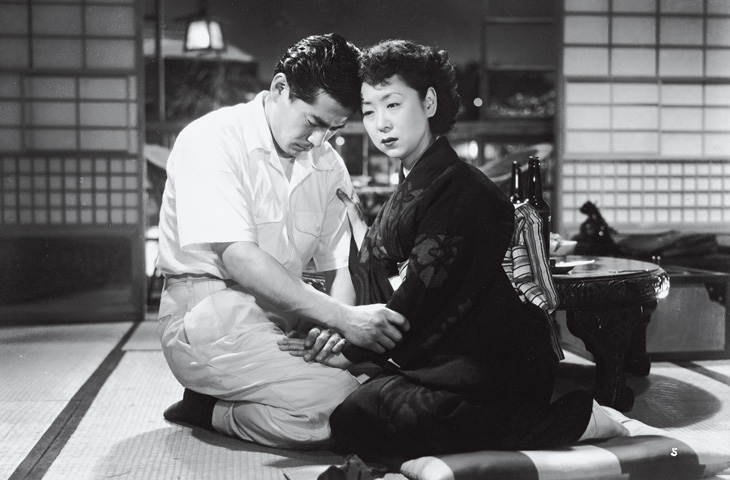
 Kiju (Yoshishige) Yoshida is best remembered for his extraordinary run of avant-garde masterpieces in the late 1960s and early 1970s, but even he had to cut his teeth on Shochiku’s speciality genre – the romantic melodrama. Adapted from a best selling novel, Akitsu Springs (秋津温泉, Akitsu Onsen) is hardly an original tale in its doom laden reflection of the hopelessness and inertia of the post-war world as depicted in the frustrated love story of a self sacrificing woman and self destructive man, but Yoshida elevates the material through his characteristically beautiful compositions and full use of the particularly lush colour palate.
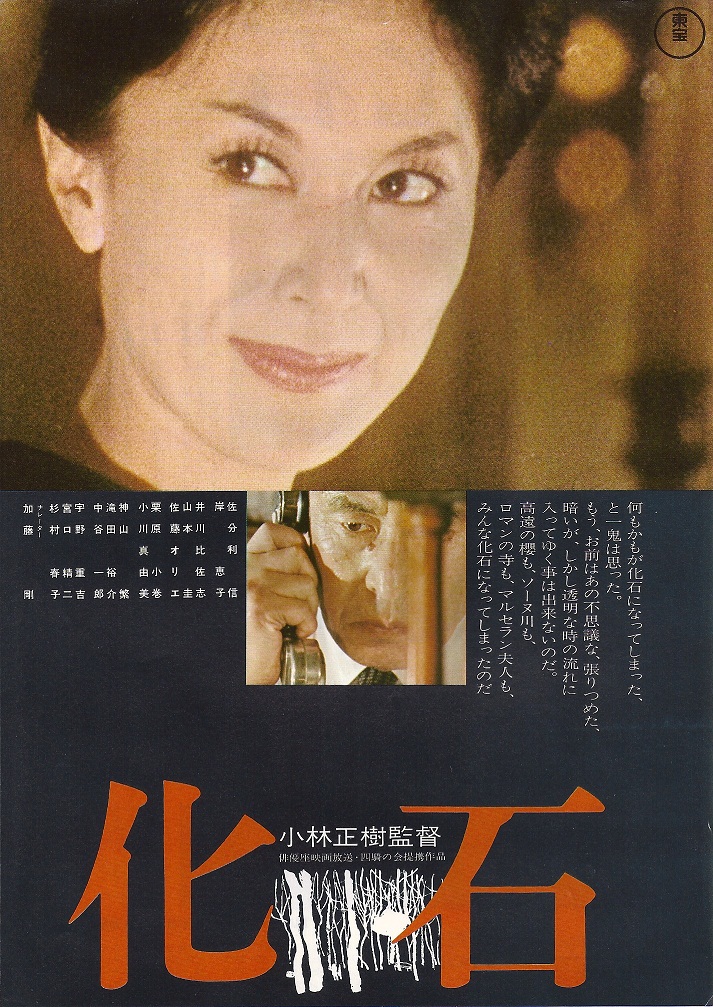 Throughout Masaki Kobayashi’s relatively short career, his overriding concern was the place of the conscientious individual within a corrupt society. Perhaps most clearly seen in his magnum opus,
  Windows on Worlds