Home Sweet Home (我が家は樂し, Noboru Nakamura, 1951)

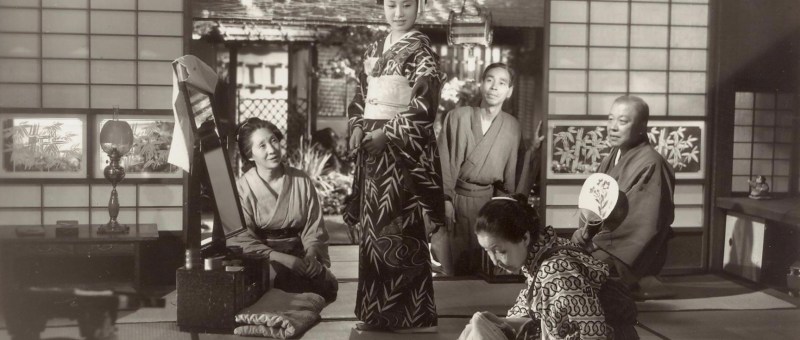
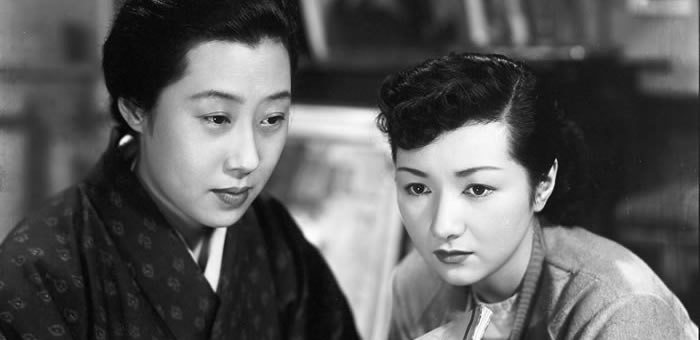
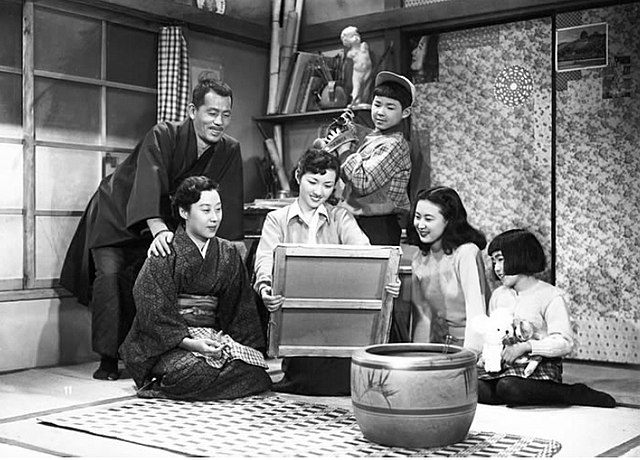
There must have been a lot of families like the Uemuras in the Japan of 1951. As film’s title implies, their home is a happy one and though they may not have much they make the most what they have and are cheerful and loving towards each other. Still, the world stores up trouble for them perhaps because they are so very defiant of their circumstances. In many ways a classic shomingeki, Home Sweet Home (我が家は樂し, Waga Ya wa Tanoshi) was the film that put Noboru Nakamura on the map and finds Japan at a kind of crossroads edging past post-war privation towards a broadly consumerist society.

We can get a sense of that in the constant needs of four children in the Uemura family, patriarch Kosaku (Chishu Ryu) picking up his young son Kazuo (Katsumasa Okamoto) after baseball on his way home and noticing that his mitt is almost worn through only to get there and spot his daughter’s boots are getting pretty thin too. It’s clear they struggle for money despite Kosaku’s steady job for which he is about to receive a 25-year good service commendation as wife Namiko (Isuzu Yamada) supplements the family income by taking in sewing at home while we later find out that she’s already sold most of her kimono to help make ends meet and is considering selling her wedding ring to pay for middle daughter Nobuko’s (Keiko Kishi) school trip to Kyoto.

But her hard-nosed sister Kayo (Mutsuko Sakura) tells her that secondhand kimono have lost their value with so many new ones now available. In the immediate post-war era, rice and kimono were the only things that had held their value and so selling one could bring in a lot of money quickly. Conversely, after receiving a sizeable bonus along with his commendation, Kosaku and Namiko visit a department store which has a large range of affordable clothing for sale though the kimono fabric Kosaku picks out for Namiko is still fairly expensive so she instinctively puts it back insisting that they buy the presents they promised the children first. 

That was probably a good move, seeing as the rest of the money is stolen from them on their way home to a congratulations party the children are busy setting up. Kosaku asks why someone would rob people like them, honest, hardworking types who don’t have much to begin with but as Namiko sensibly points out pickpockets don’t really think like that and how would they know anyway. The subtext is that times are still hard for a lot of people even if there are now more exciting, definitely non-essential things appearing on shelves for people with disposable income to buy and a new kimono, though out of fashion, is no longer so out of reach for the ordinary housewife. 

The loss of the money might seem as if it should place a wedge between husband and wife, but bar a moment of disappointment cured by the realisation that oldest daughter Tomoko (Hideko Takamine) has been considerate enough to place hot water bottles in their futons, they resolve to muddle through together and in any case they’re no worse off than they were before. Tomoko herself is conflicted, feeling as if as a young woman in her early 20s she should give up her dreams of becoming a painter and get a job to support the family but Namiko always tells her not to. She encourages each of her children to follow their dreams, perhaps a sign of a new post-war liberation, telling her sister that she’d happily sell all her kimono so that Tomoko could go on painting. Later we discover that she also dreamed of becoming an artist and that though Kosaku had encouraged her to keep it up, a housewife’s day is never done and there was simply no time left for herself. Painting is just another thing she sacrificed for her family and Namiko seems to be determined that Tomoko won’t have to do the same not that she particularly regrets her decision.

Tomoko only really comes to understand her mother’s sacrifices on noticing that the cupboards really are bare, she’s sold everything that could be sold and pawned her ring though the colleague that owned the house they were renting has encountered some financial difficulties of his own and going to to sell to the grumpy old man who bought the house across the way. The Uemuras are such obviously good people that it feels so unfair that so much bad luck has come their way all at once though it is their goodness that eventually saves them when the old man is touched by seeing youngest daughter Mitsuko (Kazuko Fukui) playing with his dog. He later comes to admire Tomoko’s painting of his garden though he’d put a fence up to stop her peering in. The scars of the post-war era are visible in the damage to Uemura’s front wall which would have blocked the way but now perhaps enables them to become good neighbours after all. Though the film may lack some of the visual flair present in Nakamura’s later work, it more than makes up for it with genuine sentiment and the implication that in the end the world is basically good and rewards those who are the same even if it sometimes tests their resilience.


The Angry Street (怒りの街, Mikio Naruse, 1950)

As its opening text explains, Mikio Naruse’s The Angry Street (怒りの街, Ikari no Machi) takes place in a world in which a love of justice and faith in others has been crushed under foot. That might equally apply to any other of Naruse’s films and well enough reflects his generalised philosophy that the world in which we live betrays us, but in this case it’s more than usually true as he adopts the trappings of film noir to consider the series of reversals that have taken place amid post-war chaos chief among them class and gender. 

Sociopathic student Shigetaka’s (Yasumi Hara) primary motivation is to earn money for his family, once upper middle-class but now fallen on hard times, but he’s also engaged in an act of class warfare taking revenge on the “nouveau riche” who he feels have usurped his class privilege. His chief weapon is his good looks along with his seductive charm which he puts to full use on the dance floor flirting with naive young women to whom he sells sob stories of his poverty to extort money out of them. He and his friend Mori (Jukichi Uno) have an “agreement” that what they’re doing’s alright as long as they only take advantage of the women financially rather than sexually though at this point Shigetaka seems to have little interest in that anyway insisting that women are just business to him so he little cares for their feelings. 

Their sense of class resentment is rammed home by their mocking of their classmates who have to do “humiliating” jobs to support themselves such as selling lottery tickets in the streets. Trying to get them to attend a meeting about student employment, their classmates describe them as “privileged” suggesting they may feel it’s not their problem because they don’t need to work little knowing that each of them is impoverished and dependent on exploiting women for their income.

There is however also a gender reversal in play as Shigetaka misogynistically takes on a feminised role, playing the gold digger in attempting to manipulate women, who are now in a position of power, into supporting him financially. He even tells some of them that he’s being forced into a financial marriage by his “old-fashioned” family, playing the damsel in distress and hoping that his target will swoop in to rescue him. When one of the women writes to his home after he abandons her, his grandmother is scandalised by the idea that he might have formed an attachment to a woman to whom he had not been formally introduced but equally that he might have been frequenting “effeminate” places such as dance halls. Unmanliness is something he’s accused of several times but also the tool which he uses to seduce women who are taken in by his feminine features and graceful dancing. Closely echoing Alfred Hitchcock’s Rope, it’s near impossible not to read both Shigetaka and Mori as queer coded and the relationship between them filled with homoerotic tension as Mori looks on in jealously while Shigetaka goes about his business seducing naive young women they’ll swindle together. 

A point of crisis arrives when the pair bite off more than they can chew in getting involved with a woman who is slightly older and sophisticated in her dealings with men. An independent woman, Tagami (Yuriko Hamada) claims to be a dentist but actually makes her money through smuggling and the black market if drawing her line at drugs. Shigetaka thinks he’s using her, but Mori warns him she’s really the one in charge and playing him at his own game planning to drop him once she’s got what she wanted which in this case is his youthful flesh (realistically the only thing he could possibly offer her). Tagami draws him into a wider and more dangerous world of crime than he’s equipped to deal with just as Mori receives twin blows that break the spell and encourage him to want out of Shigetaka’s schemes firstly in discovering that one of their targets, Kimiko (Mayuri Mokusho), is the sweetheart of an old war buddy, and then into running into Shigetaka’s earnest sister Masako (Setsuko Wakayama) who is the film’s de facto moral authority pulling him away from Shigetaka’s dark machinations back towards a more conventional morality. 

In a series of flashbacks, he remembers more innocent times before the war when he too sold tickets on the street and worked in a shop washing windows while going on innocent dates with Masako. The implication is that it’s his wartime service along with the world he came back to that have filled him with nihilistic cynicism while he later says that he indulges in Shigetaka’s schemes as a means of staying close to him and earning his favour. But Shigetaka is already far too corrupt, filled with class resentment over his lost privilege along with a deep-seated misogyny as a reflection of his sense of emasculation in this new world in which young women wield significant economic power. Kimiko in particular is brash and insensitive even aside from her naivety remarking on the piles of money that turn up at her home every day before virtually throwing cash at Shigetaka with seemingly no thought as to how that might make him feel even if he weren’t conning her in offending his pride and masculinity. 

Mori wonders how he can save himself if Shigetaka remains so irredeemable and is instructed by Masako that they must work together and live honestly though even she hangs on to her ideas of social class scandalised by the revelation that her mother too has begun selling things in the street, in her case knitted socks which is a fairly labour intensive activity for an incredibly small profit margin. Echoing film noir, Naruse opens and closes with scenes of the present day city teeming with life yet in a way that seems more ominous than exuberant even in the myriad dance halls where youngsters come to look for love but soon find themselves lost amid the contradictions and confusions of a rapidly changing city.


Early Spring (早春, Yasujiro Ozu, 1956)

By the mid-1950s, Japan’s economy was beginning to improve but now that the desperation that went with hunger had dissipated it freed those who’d managed to climb out of post-war privation to wonder just what the point of their ceaseless toil was. Yasujiro Ozu’s primary subject matter remained the modern family, but 1956’s Early Spring (早春, Soshun) sees him heading in a darker direction as he weighs up the delusions of the salaryman dream and discovers that whichever way you swing it, life is disappointing. 

So it seems to be for salaryman Shoji (Ryo Ikebe). He and Masako (Chikage Awashima) married for love a long time ago, but it’s clear that there is distance in their relationship. They sleep in the same room but their futons are slightly too far apart, and the few words they exchange with each other in the morning are terse in the extreme. The truth is that for many a salaryman for whom long hours and interoffice bonding sessions are compulsory, work is the new family. Wives are welcome to join the Sunday hiking outings but it seems few do. Masako too declines, telling her mother she felt it to be too expensive, already irritated with her husband’s irresponsible spending on mahjong games and drinking with friends. 

Money is certainly a constant worry for her and as we learn from her mother they’re behind on the rent despite it being “very cheap”. Masako had made a visit home in part to ask for another loan, which her mother seems reluctant to give, offering her daughter a takeout of the oden her restaurant sells which is first declined but then accepted. Her mother also flags up the other problem in their marriage which is that they sadly lost a child in infancy and have had no more. Sorrow may have killed their love, but the fact her husband stays out all hours and wastes the little money he earns while failing to win promotions only makes the situation worse. 

As for Shoji, he is becoming very aware of the delusions of the “salaryman dream”. He is one of thousands of men identically dressed in white shirts and grey trousers that board the packed rush hour trains every day heading into the city. His life is one of pointless drudgery and its only victory is that keeps hunger from the door, not even quite stretching to a roof over his head. “All that’s waiting for us is disillusion and loneliness” according to a veteran salaryman growing close to his retirement and realising that he has little left to live on, his dream of buying a small stationary shop all but unobtainable. He was dead set against his own son joining the ranks of the salaryman, but in the end failed to prevent it.

It is perhaps this sense of frustration and impotence that draws Shoji into an affair with a younger woman, Chiyo (Keiko Kishi), who is admittedly very pretty but seems to hold little interest for him aside from her youth and beauty. Chiyo openly pursues her older colleague, declaring that she doesn’t care he has a wife but has come to hate her after the first time they slept together. Shoji meanwhile remains guilty and conflicted. He evidently continues seeing Chiyo, lying to Masako that he’s visiting a sick friend, but otherwise regards her as an irritation. When his co-workers figure out what’s going on they try to stage an intervention, but Shoji doesn’t show up and Chiyo angrily denies everything before arriving at Masako’s looking for Shoji only this time he really is out visiting a sick friend. 

Miura (Junji Masuda), the sick friend, is a true believer in the salaryman dream. Now that he’s ill, he misses the packed trains and elevators, not to mention his old workplace friends. All he wants is to be well enough to return to the office and his predicament perhaps has Shoji thinking that at least he has his health and things aren’t so bad for him after all. Masako, meanwhile, turns to other women for advice. The woman across the way recounts how she caught her husband out with his mistress and made a scene that’s rendered him docile and obedient ever since (a rare man in an Ozu film putting his socks neatly in the laundry basket and hanging up his own coat rather than throwing it on the floor for his wife to deal with). Her widowed friend is more sanguine, admitting that caution is necessary but it’s a little dark to envy the life of a widow for its “freedom”, while her mother thinks she’s overreacting because that’s just how men are in this generation or any other. 

Shoji’s old mentor agrees that “everyone’s disappointed” and all that remains is to try and make the most of it, but still he sees that Shoji has been reckless and inconsiderate in his treatment of both women. He avoids his wife because of the emotional distance between them born of grief, and only really has an affair with Chiyo because it was easier than refusing her. He didn’t even enjoy it, and doubtless it did not quite quell the sense of despair he feels with the utter pointlessness of the “salaryman dream”. Masako, in turn, is disappointed with married life, with her husband’s emotional cowardice, and with her own lack of options. Ultimately, Ozu sides with the mother, not quite condoning Shoji’s behaviour while perhaps excusing it as a direct consequence of dullness of his life while forcing Masako to accept complicity in her husband’s weakness. They may reunite, the stressors of their Tokyo life from the high cost of living to the lure of mahjong now absent, but there is a sense of futility in their eventual insistence that they will “make it work” through starting over in a new place while gazing at the train that, they assume, will eventually carry them back to the city and all of its false promises of a brighter future. 


Early Spring screens 19th/20th/21st October & 20th/23rd November at London’s BFI Southbank as part of BFI Japan. It is also available to stream in the UK via BFI Player and in the US via Criterion Channel.

Snow Country (雪国, Shiro Toyoda, 1957)

Closely associated with literary adaptation, Shiro Toyoda had been wanting to adapt Yasunari Kawabata’s Snow Country (雪国) since its serialisation and apparently spent four years preparing his treatment ahead of the 1957 film starring Ryo Ikebe as the solipsistic aesthete at the novel’s centre. Characteristically, however, he takes several liberties with the source material, notably introducing an entirely different conclusion which perhaps helps in re-centring the tale away from the hero Shimamura to the melancholy geisha who apparently falls for him because of his intense loneliness. 

A brief reference to a failed military insurrection in Manchuria sets us firmly in the mid-1930s as do repeated mentions of the ongoing depression which causes additional anxiety to local business owners in a small holiday resort town. Mimicking the novel’s famous opening, Toyoda opens with a POV shot of a train exiting a tunnel into the snow-covered landscape, the hero Shimamura (Ryo Ikebe) sitting sadly gazing out of a window and eventually captivated by the reflection of a young woman devotedly caring for a young man who appears to be in poor health. Meanwhile, another young woman, Komako (Keiko Kishi), gazes at her own reflection in a train station window, waiting once again as if unable to depart. As we discover, Shimamura has returned with the intention of seeing Komako with whom he’d struck up a relationship during a summer trip but is somewhat disappointed to learn that she has since become a geisha.

In a flashback to their first meeting, Komako asks Shimamura if he has come for “escape”, a question he doesn’t exactly answer while petulantly complaining about his lack of artistic success as someone who paints pictures apparently out of step with his times. When the head of the local commerce association tries to involve him in conversation about the failed insurrection, he bluntly tells him that he’s an artist and as such has no interest in such things, but it does indeed seem that he is looking for some kind of escape from the turbulent times, expressing that here the war seems very far away as does “the depression”. Komako, a more modern and perhaps prophetic figure than it might at first seem, is the only one to bring up the war directly speculating that it may be about to intensify while the frustrated affair between the two seems to be informed by the mounting tensions against which they are attempting to live their lives. 

Rather self-absorbed, Shimamura in a sense may even identify with Komako explaining that he too has a “patron” and implying that his flight is perhaps a response to his sense of powerlessness, that he feels constrained by his financial dependency presumably on his father-in-law though his relative economic superiority which leads Komako to frequently remark on his “extravagance” obviously affords him the freedom to make these random solo trips to ski resorts and indulge his career as a painter regardless of its capacity to support himself and his family. Komako must know on some level that the relationship is a fantasy, yet she believes in it enough to end her connection with an elderly patron on suspecting that she is carrying Shimamura’s child only to have her hopes dashed when he does not turn up for a local festival as promised with the consequence that all of her dependents are turfed out of the home he had provided for her. 

Komako is not “free” in the same way that Shimamura evidently is, her entire life dictated by the fact that she is poor and female. Fostered by a shamisen teacher, she may have been technically engaged to the young man, Yukio (Akira Nakamura), Shimamura saw on the train being cared for by Yoko (Kaoru Yachigusa), Komako’s foster sister in love with him herself, but intensely resents the burdens she is expected to bear quite literally with her body. She later tells Shimamura that she didn’t become a geisha for Yukio in order to pay his medical bills but out of a sense of obligation, while she is also responsible for her birth family, the now bedridden shamisen teacher, and Yoko who intensely resents her for her callous treatment of Yukio and generally “dissolute”, selfish way of living. During the famous fire in a cinema that closes the novel (but not the film), Komako even exclaims that her life would be easier if Yoko burned to death, but on witnessing her either fall or jump from the burning building she can do nothing other than run to her side. 

Indeed, the novel’s climax finds Shimaura standing alone indifferent to the fate of Yoko, a young woman he had come to admire if only for her contrary qualities, admiring instead the beauty of the night sky. In Toyoda’s characterisation, Yoko is in one sense the conventionally good woman whose selfless devotion to the sickly Yukio so captivates Shimamura, but her goodness is nevertheless undercut by the degree of her animosity towards Komako even as the two women remain trapped in a complex web of frustrated affection and intense resentment, each perhaps knowing they neither can have the man they want and are condemned to an eternal unhappiness as the snow mounts all around them in this perpetually cold and depressing moribund resort town. Switching between studio matte paintings ironically mimicking Shimamura’s art and on-location footage of the deepening snows, Toyoda’s sense of near nihilistic melancholy evoking the atmosphere of Japan in the mid-1930s hints at grand tragedy but finds resolution only in stoicism as the heroine picks up her shamisen and trudges onward amid the quickening blizzard.  


Love Under the Crucifix (お吟さま, Kinuyo Tanaka, 1962)

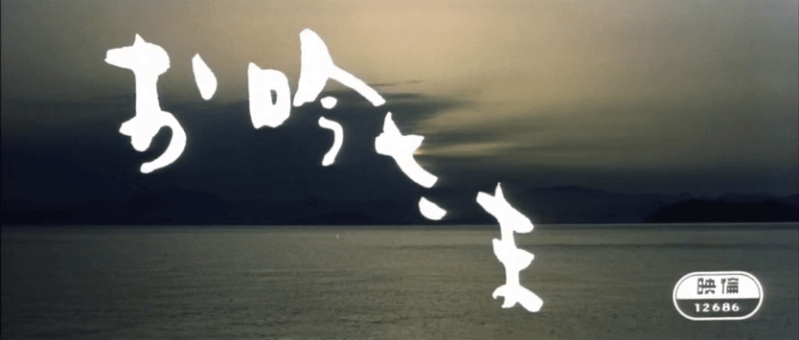
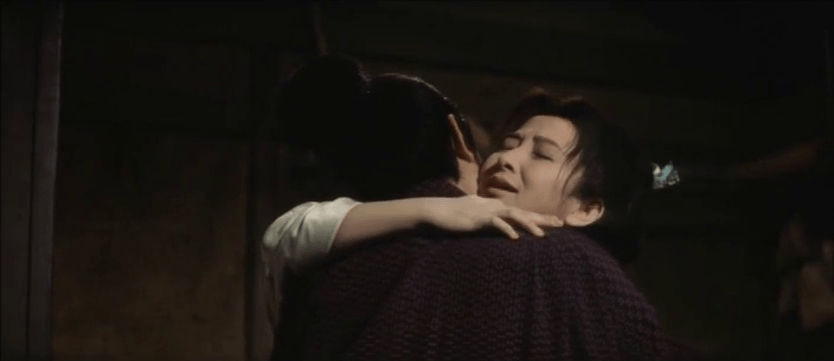
Love Under the Crucifix cap 1A legendary screen actress, Kinuyo Tanaka completed only six films in her career as a director. The last film that she would ever make, Love Under the Crucifix (お吟さま, Ogin-sama), is the only one to be set in the historical past taking place against the backdrop of turbulent late 16th century politics just forty years or so before the nation would embark on 200 years of self imposed isolation undertaken in the name of preserving the national character while solidifying a political regime. As in her other films, however, Tanaka employs a standard melodrama narrative in order to subvert it. Her heroine defies all “for love”, but not so much in itself as for the right to it and to the legitimisation of her feelings as a human woman with all the rights and freedoms that ought to entail.

The film begins in the 15th year of Tensho (or 1587). Toyotomi Hideyoshi (Osamu Takizawa) is attempting to solidify his command over a Japan which is in a state of constant warfare. Meanwhile, foreign trade and influences, including Christianity, are flooding into the nation. There is growing suspicion among Hideyoshi’s advisors that Christian converts are nothing more than foreign spies working to undermine the social order and cannot be trusted. Therefore, Christianity is a spanner thrown in the works of Hideyoshi’s plans for peace and unification, only no one is quite sure as yet what to do about it except disapprove.

Meanwhile, our heroine, Ogin (Ineko Arima), is the step-daughter of prominent tea master Rikyu (Ganjiro Nakamura). She has long been in love with Ukon (Tatsuya Nakadai) – a young lord who has converted to Christianity and is in fact already married. Despite the impossibility of her love, Ogin holds fast to its purity and has refused all entreaties to marry. However, she is placed in a difficult position when it is made clear that a prominent suitor affiliated with the local lord desires her. Rikyu affirms that he will follow Ogin’s will, but Mozuya (Hisaya Ito) is too important a man to be refused out of hand and the consequences of turning him down may be severe. Ogin searches for a sign from Ukon, but he coldly tells her to marry, refusing any confirmation of the feelings which she believes to exist between them.

The film’s English title, Love Under the Crucifix, reminds us that this is not so much a story of religious freedom as social oppression. Divorced form its Christianising context, the crucifix was in this era the primary punishment for sexual transgression, most often for both men and women committing adultery or daring to love in places where society would not approve. Thus Ogin lives her life under it in being reminded of the potential costs of her inappropriate emotions. Even so, observing a young woman tied to the cross (Keiko Kishi) and apparently electing to go to her death rather than become the concubine of the local lord against her will, Ogin sees in it not censure but defiance and path towards personal empowerment if only in ultimate negation.

The literal crucifix becomes a noose around Ogin’s neck in the form of the necklace given to her by Ukon. Ogin remains unconvinced by Ukon’s religiosity even if she respects it but later resents the austerity it provokes in him while wondering if his friendship with her was only ever a pathway to conversion. Ukon’s troubles are multiple, not only is he oppressed by the social strictures of his time but also by an additional burden of Christianising morality which instructs him that his feelings are sinful and must be rejected.

Later, Ogin berates Ukon insisting that all of this suffering and the predicament they now find themselves in might have been avoided if only he had not kept his feelings hidden. Ukon’s religiosity obliges him to behave in ways which are cruel and selfish, and which ultimately bring him little other than additional suffering and unhappiness. This emotional tension has also played into the hands of the ruling regime who are content to use their feelings, and the prevailing tendency towards properness, against them as a plot against Rikyu and to prevent Ukon’s return as a military rival.

Despite Rikyu’s best efforts, Ogin has indeed become a pawn in the hands of men. Rikyu, as we’re reminded at the film’s conclusion, fell from favour and committed ritual suicide at the age of 70. Like Ogin, he remained true to himself even when politically unwise, advancing his philosophies of simplicity and respect for the natural world in the face of what he saw as Hideyoshi’s increasingly gaudy superficiality. Thus he councils Ogin that there is nothing wrong in her feelings and her only duty to him or to anyone else is to try to live happily even if that means she must live in hiding with the less courageous Ukon who refuses to abandon his faith but struggles to find the courage to fight for love, or more specifically for the right to love, as Ogin has done all her life.

Ogin is, in a sense, already on the cross as she continues to suffer not for faith but for faith in love and in her own right to her individual feelings and agency. Faced with being forced to surrender her body to a man she does not love because of a cruel game played by men for men, Ogin prefers death and finds in it the ultimate expression of her personal freedom and emotional authenticity.


The Garden of Women (女の園, Keisuke Kinoshita, 1954)

garden of women still 1Things changed after the war, but not as much as some might have hoped. Sadly still topical, Keisuke Kinoshita’s Garden of Women (女の園, Onna no Sono) takes aim both at persistent and oppressive patriarchal social structures and at a compromised educational system which, intentionally or otherwise, systematically stifles attempts at progressive social change. A short few years before student protests would plunge education into crisis, Kinoshita’s film asks why it is that the establishment finds itself in conflict with the prevailing moods of the time and discovers that youth intends to have its brighter future even if it has to fight for it all the way.

The setting is an exclusive private woman’s university in the elegant historical city of Kyoto. The ladies who attend this establishment are mostly from very wealthy families who have decided to educate their daughters at the college precisely because of its image of properness. As one student will later put it, there are two kinds of girls at the school – those who genuinely want to study in order to make an independent life for themselves and intend to look for work after graduation, and those who are merely adding to their accomplishments in order to hook a better class of husband. Everyone, however, is subject to a stringent set of rules which revolves around the formation of the ideal Japanese woman through strictly enforced “moral education” which runs to opening the girls’ private letters and informing their families of any “untoward” content, and requiring that permission be sought should the girls wish to attend “dances” or anything of that nature.

As might be expected, not all of the girls are fully compliant even if they superficially conform to the school’s rigid social code. Scolded for her “gaudy” hair ribbon on the first day of school, Tomiko (Keiko Kishi) rolls her eyes at the over the top regulations and enlists the aid of the other girls to cover for her when she stays out late with friends but her resistance is only passive and she has no real ideological objection towards the ethos of the school other than annoyance in being inconvenienced. Tomiko is therefore mildly irritated by the presence of the melancholy Yoshie (Hideko Takamine). Three years older, she’s come to college late and is struggling to keep up with classes but is, ironically enough, prevented from studying by the same school rules which insist she go to bed early.

Meanwhile, dorm mate Akiko (Yoshiko Kuga), from an extraordinarily wealthy and well connected family, is becoming increasingly opposed to the oppressive atmosphere at the school. However, as another already politically active student points out, Akiko’s background means there are absolutely no stakes for her in this fight. She has never suffered, and likely never will, because she always has been and always will be protected by her privilege. Fumie (Kazuko Yamamoto), a hardline socialist, doubts Akiko’s commitment to the cause, worrying that in the end she is only staging a minor protest against her family and will eventually drift away back to her world of ski lodges and summer houses. Despite her ardour, Akiko finds it hard to entirely dispute Fumie’s reasoning and is at constant battle with herself over her true feelings about the state of the modern world as it relates to herself individually and for women in general.

This is certainly a fiercely patriarchal society. Even though these women are in higher education, they are mostly there to perfect the feminine arts which are, in the main, domestic. They are not being prepared for the world of work or to become influential people in their own right, but merely to support husbands and sons as pillars of the rapidly declining social order that those who sent them there are desperate to preserve. For many of the girls, however, times are changing though more for some than others. Tomiko rolls her eyes and does as she pleases, within reason, and even if she eventually wants to see things change at the school it is mostly for her own benefit. She sees no sense in Akiko’s desire for reform as a stepping stone to wider social change, and perhaps even fears the kinds of changes that Akiko and Fumie are seeking.

Akiko and Fumie, and to an extent, Tomiko, seem to have a degree of agency that others do not as seen in the tragic story of Yoshie whose life has been largely ruined thanks to the selfish and heartless actions of her father. From a comparatively less wealthy family, Yoshie worked in a bank for three years during which time she met and fell in love with an earnest young man named Shimoda (Takahiro Tamura). However, her father, having become moderately successful, developed an appetite for social climbing and is determined she marry “well” to increase his own sense of superiority as a fully fledged member of the middle classes. He sees his daughter as nothing more than a tool or extension of himself and cares nothing for her thoughts or feelings. In order to resist his demands for an arranged marriage, Yoshie enrolled in school and is desperate to stay long enough for Shimoda to finish his education so they can marry.

Yoshie is trapped at every turn – she cannot rely on her family, she cannot simply leave them, she cannot yet marry, if she leaves the school she will be reliant on a man who effectively intends to sell her, but her life here is miserable and there is no one who can help her. All she receives from the educational establishment is censure and the instruction to buck up or get kicked out. She feels herself a burden to the other girls who regard her as dim and out of place thanks to their relatively minor age gap and cannot fully comprehend her sense of anxiety and frustration.

Finally standing up to the uncomfortably fascistic school board the girls band together to demand freedoms both academic and social, insisting that there can be no education without liberty, but the old ways die hard as they discover most care only for appearances, neatly shifting the blame onto others in order to support their cause. “Why must we suffer so?” Yoshie decries at a particularly low point as she laments her impossible circumstances. Why indeed. The oppressive stricture of the old regime may eventually cause its demise but it intends to fight back by doubling down and the fight for freedom will be a long one even if youth intends to stand firm.


Titles and opening scene (no subtitles)

Growing Up (たけくらべ, Heinosuke Gosho, 1955)

Gosho Growing UpCaught in a moment of transition, it’s no great mystery that post-war Japanese cinema began to look back at the Meiji past. Progress had indeed been rapid but ended in national tragedy and collective madness. The post-war humanists were eager for a different outcome, to avoid the mistakes of the last fifty years and build a society that was kinder and freer than that which had come before. Though on the surface it might seem as if much had changed since the dawn of a new century, the problems were still the same and a failure to address them only likely to add new tragedies in place of the better future many hoped for. Among the foremost proponents of post-war humanism, Heinosuke Gosho made a rare trip back into the Meiji past in 1955’s Growing Up (たけくらべ, Takekurabe), an adaptation of the well known short story by Ichiyo Higuchi, finding that nothing much had really changed when it came to the fates of women and the poor in an often wilfully indifferent society.

The action opens on the outskirts of the Yoshiwara in 1894. Our heroes are a collection of children who find themselves dealing with typically adolescent problems but also, by modern standards, expected to grow up all too fast. Chief among them is 13-year-old Midori (Hibari Misora) whose sister, Omaki (Keiko Kishi), is the most famous courtesan of the red light district. Although she knows on some level that her parents have already sold her to the brothel owner in whose house they live as servants, Midori has not yet quite processed the full implications of her destiny or that her world of childhood innocence is rapidly drawing to a close. She is in love with a local boy, Shinnyo (Takashi Kitahara), who seems to return her feelings but is as awkward and confused by them as any teenage boy and treats her by turns with coldness and contempt mixed with grudging affection.

Shinnyo, meanwhile, is the son of a greedy and heartless monk (Takamaru Sasaki) who has decided to sell his older sister as a concubine to a wealthy man who already has a wife. As he loves his sister dearly and has a naive, childish sense of absolute morality, this is a sin Shinnyo cannot forgive. He argues with his father but has no real power to change the situation and then decides on rebelling against his father’s wishes that he not become a monk by leaving for the main temple in Kyoto to take holy orders. Of course, this also means he must sacrifice any youthful idea he might have had of pursuing his love for Midori.

The title, in a sense, could refer not only to the increasingly melancholy youngsters coming of age in an oppressive society, but also to Japan itself as it emerged into modernity in an effort to prove itself the equal of any other major power in the late 19th century. It is, however, an ironic a title as any could be. To “grow up” here is to abandon one’s humanity and conform to the kind of “real world” thinking that codifies cruelty and makes a virtue of heartlessness. Still an innocent child, Midori bounces her ball and basks in her somewhat elevated position as a wealthy young girl and sister of a “notorious” woman without fully understanding all that entails. When her sister tells her about a dream she had of climbing trees and picking persimmons, she is incapable of understanding her warning about the loss of innocence she’s about to experience, but her world is brought crashing down when a gang of rival boys rudely attack her and point out that all her finery was bought through “whoring” and that she is nothing more than a “whore” in waiting.

Another of the boys, Sangoro (Masanori Nakamura), whose family is poor, says he can’t wait to be “grown up”, reacting with less than sensitivity to Midori’s pained pleas that she wishes everything could stay as it was and they could be children forever. Sangoro sees adulthood as freedom. He’ll be free to earn his own living and maybe he won’t have to be like his father, too afraid to stand up to people with money because when you don’t have any you’re always reliant on their kindness. Sangoro may be poor, but he’s a man (or will be) and can’t process the total lack of agency that comes with being an adult female whose future is decided entirely by her closest male relative. Midori, like Shinnyo’s sister, has been sold by her father and there’s nothing she or anyone else can do about it now.

Nevertheless, confronted by her fate, Midori decides to own it. She encourages her parents to think of her as dead, cooly hitting back at their callousness but acknowledging an obligation as she goes. The final scenes preceding her passage across the small bridge which will forever sever her from her childhood are filled with dread and anger as if crying out for someone to stop the inevitable from happening, but of course, no one can. An old woman and former courtesan, Okichi (Isuzu Yamada), who owns a shop where Midori used to spend time and is indirectly responsible for Midori’s acceptance of her fate in some cruel, drunken words she threw at her, puts it best when she briefly feels as if she could have done something in affirming that it isn’t her fault, and it isn’t Midori’s, it’s simply “the world”.

Midori meets her fate not with resignation but rage and defiance. Shinnyo, who runs away from his inability to help his sister by becoming a monk, is forever incapable of declaring his real feelings in words but leaves a flower in front of her window in echo of another he gave her long ago. At first Midori picks it up and cherishes it for the innocent symbol of love that it is, but by the time she has travelled half way along the bridge which will take her to the Yoshiwara, she has realised this kind of innocence does not belong inside. She throws the flower to the mud and leaves her youthful dreams of love and happiness behind as she prepares to step through the doorway into a future which is not of her making and over which she has no say. To “grow up”, in this world, is a kind of spiritual death in which there exists nothing other than emptiness and indifference.


The Rendezvous (約束, Koichi Saito, 1972)

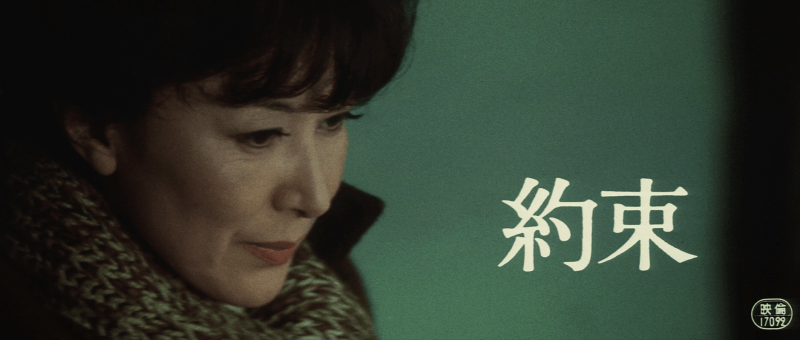
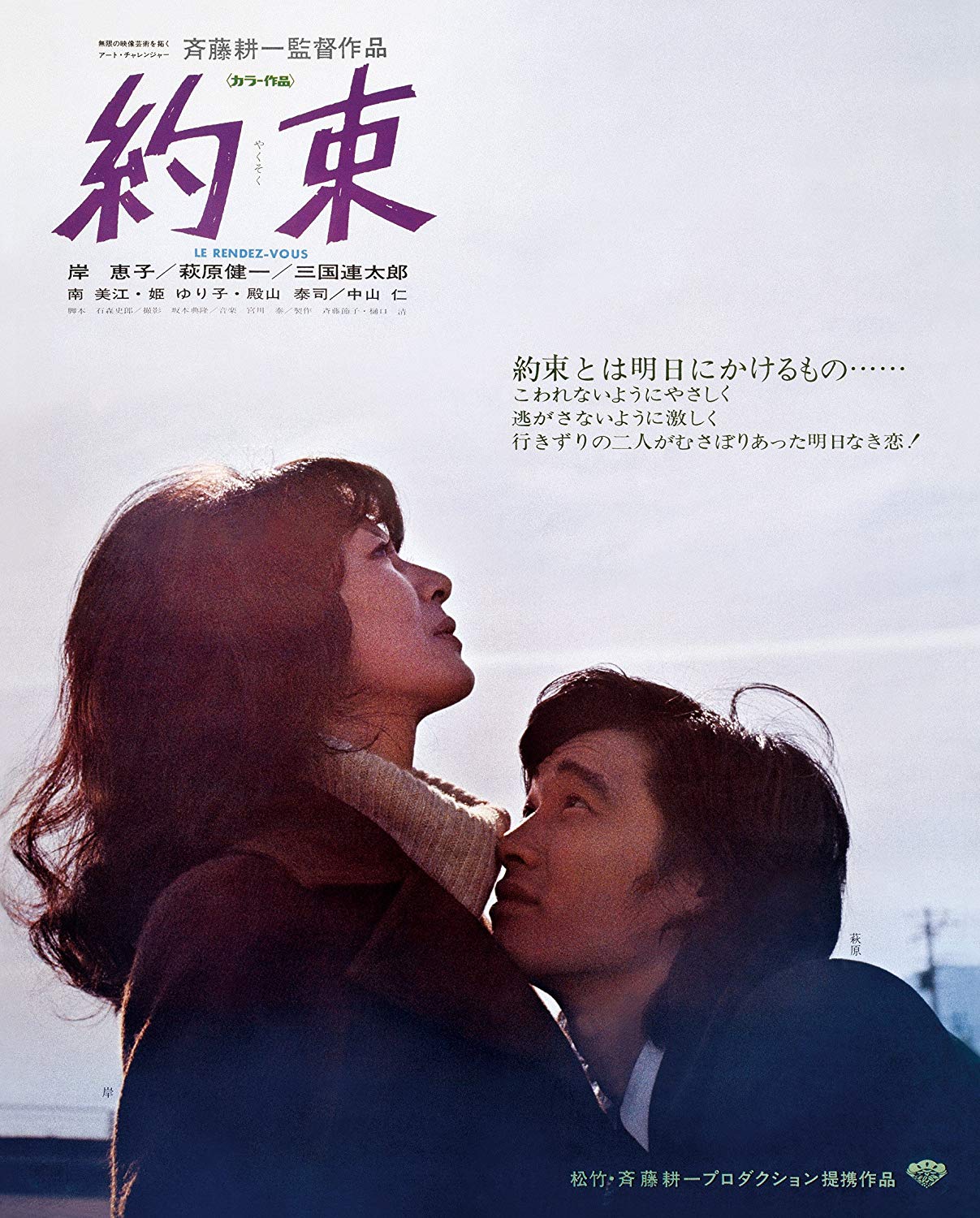
The Rendezvous poster“If human’s don’t trust each other, it’ll be the end of the world” – so says the cheerful hero at the heart of Koichi Saito’s The Rendezvous (約束, Yakusoku). Saito’s film is, somewhat unusually, a rare example of a Korean film remade in Japan. Inspired by Lee Man-hee’s Late Autumn (now sadly thought lost), The Rendezvous has been remade three times in Korea by such esteemed directors as Kim Ki-young (1975), Kim Soo-yong (1982) and most recently Kim Tae-young in 2010. There is indeed something particularly timeless in its tale of fate frustrating a fated love as each of our protagonists struggles to find the energy to rebel against their own sense of impossibility.

A brief framing sequence begins with a nervous, melancholy woman, Keiko (Keiko Kishi), sitting alone on a park bench, surrounded by the cheerful activity of athletes training, women pushing prams, and families enjoying the crisp sunshine. As she thinks back to what brought her here we travel back with her to a fateful train journey some years previously.

Keiko sits sadly by the window, impassively watching the sea stretch out as the train whizzes by. An older woman (Yoshie Minami) is sitting next to her, though they appear at least not to be on particularly friendly terms. At the first stop a younger man, Akira (Kenichi Hagiwara), gets on and sits down opposite Keiko, throwing a newspaper over his face, presumably to help him get some sleep (or, as we later wonder, perhaps just to better disappear). Intrigued, Keiko nevertheless shivers on catching sight of the paper’s headline – “Drunken Husband Stabbed to Death”. Knocking the paper off his head as she gets up to go to the bathroom, Keiko clips it back on for him with her hairpin – something that later gives him an excuse to talk to her when he eventually wakes up.

Akira, it turns out, is the chatty sort of person who enjoys making conversation with strangers. He makes a nuisance of himself trying to chat to Keiko and the old woman who ignore him, whilst accidentally frightening the bored little girl opposite by trying to entertain her. The ice finally thaws when Akira decides to buy everyone lunch – Keiko accepts and speaks to him if only to insist on paying him back (which the old lady then also feels compelled to do). Though very little actual conversation takes place on this first train journey, Akira is also travelling to the same small town as Keiko and continues to make a nuisance of himself by following her around. Nevertheless a connection begins to form between the pair, such perfect opposites in every way but one, though the time is always ticking and the encounter is one coloured by its impending end.

Keiko’s mysterious behaviour is later revealed to be more than just shyness or existential angst. Akira repeatedly asks for her trust, but she claims herself incapable of trusting anyone because in a sense she is already dead. Indeed, her entire aura is one of deliberate stillness, rarely speaking, and often leaning sadly against a more solid structure as if lacking the energy to fully support herself. Ironically enough, Keiko’s name is written with the character for “firefly” – a creature that burns out bright and then fades away. Keiko not only believes that her light has gone out, but that there are no more fireflies left. Akira, whose name is written not with the character for “bright” but with one for “cheerful”, begins to show her that there could be fireflies still, jokingly pointing to the lights from a nearby boat bobbing on the water.

We’re later told that the root of all Keiko’s suffering is “an absence of love”, that as passion cooled there was only emptiness in its place. “Emptiness” seems to be the force which defines Keiko’s existence, the reason her fire is out and her life apparently over. Though she feels a passionate attraction to Akira, she cannot bring herself to submit to it, both distrusting herself and afraid to face the possibility that it too will end. Both Keiko and Akira are fugitives from themselves, literally railroaded towards an inevitable conclusion they lack the courage to oppose. Akira wants to run, but Keiko knows she belongs on the train, incapable of escaping her self-imposed imprisonment and unwilling to step away from her unchanging destiny.

Fate follows them everywhere – violent headlines, prisoners being escorted, flashes of handcuffs, all reminding them that they are trapped, powerless in the face of an oncoming reckoning. Akira repeatedly asks Keiko to trust him, insisting that as long as she believes in him everything will be alright. Yet Akira is a flustered young man always in a hurry, running as if already late for the future. He makes Keiko a promise of a meeting and even gives her his watch to help her keep it, yet fails to appear. Akira’s heart may be trustworthy, but his body less so and even if he really wanted to come fate may have other plans. Love, it seems, is not enough. Saito returns to Keiko, sitting alone on the bench, waiting as the park empties and all the kids go home for tea. There’s no way to know if Akira can keep his promise even if he meant to, but perhaps there is something even so in the continued faith that he might simply bound in, hours late but as earnest as ever.

The central narrative seems to retain the Korean of sensibility of Lee’s original in its sense of dread and inevitability, and of passion repressed. Saito’s approach leans more towards misty European arthouse than your average Shochiku romance, making the most of its mystery as the time continues to run down for Keiko and Akira before they must prepare to meet their respective fates. Fate, at least, will wait for you and will always be there in the end. Impossibility defines the world of the defeated Keiko and the childlike Akira, but perhaps the most painful thing is hope itself, and the lingering faith that a promise will be kept despite the overwhelming odds.


Original trailer (no subtitles)

The Snow Flurry (風花, Keisuke Kinoshita, 1959)

Snow Flurry poster 2

Studies of the post-war world have often made the cities their home. Filled with the starving, the ruined, and the hopeless, the cities of post-war Japan were places of defeat but also of perseverance as a betrayed generation struggled to survive in whatever way they could. Generally speaking, the rural countryside seems to fare better, coping only with the absence of lost sons and lonely daughters as life goes on much as it always has. Nevertheless things are changing even here. Recalling the subversion of his earlier Army, Keisuke Kinoshita’s The Snow Flurry (風花, Kazahana) employs a complex non-linear structure to examine the various ways in which the past continues to inform the future, trapping post-war youth in the same way their parents were trapped not only with a legacy of wartime rigour but with the weight of the feudal world pressing down upon them as they struggle to escape the authority of the generation by whom they have been betrayed.

We begin with the conventional “happy ending”. A middle-aged woman looks on with genuine happiness as a younger one leaves in a bridal outfit before running off to look for her son, Suteo (Yusuke Kawazu), who has run off towards the river with dark thoughts clouding his mind. Stepping back a little, we are told that 19 years previously Suteo’s mother, Haruko (Keiko Kishi), attempted double suicide with his father, Hideo (Masanao Kawakane) – the son of the local lords. Hideo, fearing that he would soon be sent away to war and knowing that his noble family would never approve of the woman he loved, felt death was his only solution but while his attempt succeeded, Haruko’s did not. Surviving she gave birth to a child and was eventually taken in by Hideo’s family, the Naguras, but only to avoid the gossip in town that their heartlessness was the cause of their son’s death. Haruko and Suteo, rather than living in the main house with the other family members, occupy a small shed to the side of the property and are treated as a maid and farm hand respectively. The only member of the family to treat them kindly is the grand-daughter, Sakura (Yoshiko Kuga), who is a little older than Suteo and remains unmarried at 25 while her grandmother insists on finding a wealthy man willing to marry into the family and save it from dying out altogether.

Though the main action takes place in 1959, not much has changed in the village and the eventual arrival of modern cars belonging to Sakura’s prospective suitors proves jarring in more ways than one. The Naguras, once the feudal landlords, have been greatly reduced in status thanks to the post-war agricultural reforms which limited the amount of land which could be held by one family to that which they could reasonably farm themselves. This obviously means that their income has sharply decreased which, coupled with the patriarch’s profligacy, makes their present way of life untenable unless they can find a wealthy man to marry into the family and re-inject it with cash while they figure out how to make money by farming their own land. Sadly, this will be hard because the Naguras are terrible people with a bad reputation thanks not only to their unpleasant personalities but the lingering stigma of Hideo’s death and the continuing existence of Suteo.

Nagura (Yasushi Nagata), a hard man, rejected his son’s remains out of shame for his “cowardice” in refusing to die bravely for the emperor. When Suteo is born in 1941, he takes it upon himself to register the child’s birth name without consulting the mother, insisting that the child is neither hers nor his but belongs to the nation and will be expected to sacrifice himself in his father’s place to make up for Hideo’s failure of duty. “Suteo” itself means “abandoned boy” and is hardly a warm legacy to leave to anyone let alone your own grandchild and the only offspring of your own late son.

Despite their reduced circumstances, the Naguras continue to behave like lords and are trapped within the feudal pre-war world, obsessed with status and position while those around them have entered the brave new era of promised equalities and modern possibility. Sakura, the only “legitimate” child of the last generation, is literally kept a prisoner by her hardline grandmother (Chieko Higashiyama) who has insisted on conferring various “accomplishments” such as traditional dance and learning to play the piano intended to hook an upperclass husband. Such things hardly matter now in the post-war world and any man who valued them is unlikely to make her very happy, but the Naguras care little for happiness and only for their own “good” name. Sakura wanted, like her friends, to go Tokyo for university but of course she couldn’t – her family wouldn’t even let her spend time with the other girls because there were boys around and they viewed even that as “improper” given her “position”. It’s no wonder that Sakura already feels as if her life will be “crushed by the weight of this house” and longs to leave it, as well as her cold and oppressive family, far behind her.

Suteo’s tragedy is the same has his mother’s, he has fallen in love with someone who can never be his because of outdated notions of social class and the unbreakable authority of the older generation. Sakura loves him too, though she hardly knew it until faced with her own dilemma and realises a marriage is the only way to escape her miserable existence even if she must sacrifice her feelings to do so. Despite all this lifelong suffering, grandma declares herself satisfied in having reasserted her noble status in marrying Sakura off to another prominent family, even if it is to a second son and no one could be persuaded to take on their family name. The Nagura family ends here and she gives her permission for the estates to be sold after she’s gone. All of this sacrifice in name of honour was, apparently, entirely pointless.

Employing a bold non-linear structure in which past and present inhabit the same space, Kinoshita mythologises his ordinary villagers through the repeated use of theatrical narration in the songs which accompany Sakura’s traditional dance, commenting on the action with a melancholy passivity. Trapped by circumstance and burdened by legacy, his protagonists are backed into corners with no way out other than to accept the paths before them. The future for Suteo lies in “abandonment” as he prepares to reject his cruel history and attempts to start again by walking bravely into the post-war world free of feudal oppression.


Original trailer (no subtitles)

Noh Mask Murders (天河伝説殺人事件, Kon Ichikawa, 1991)

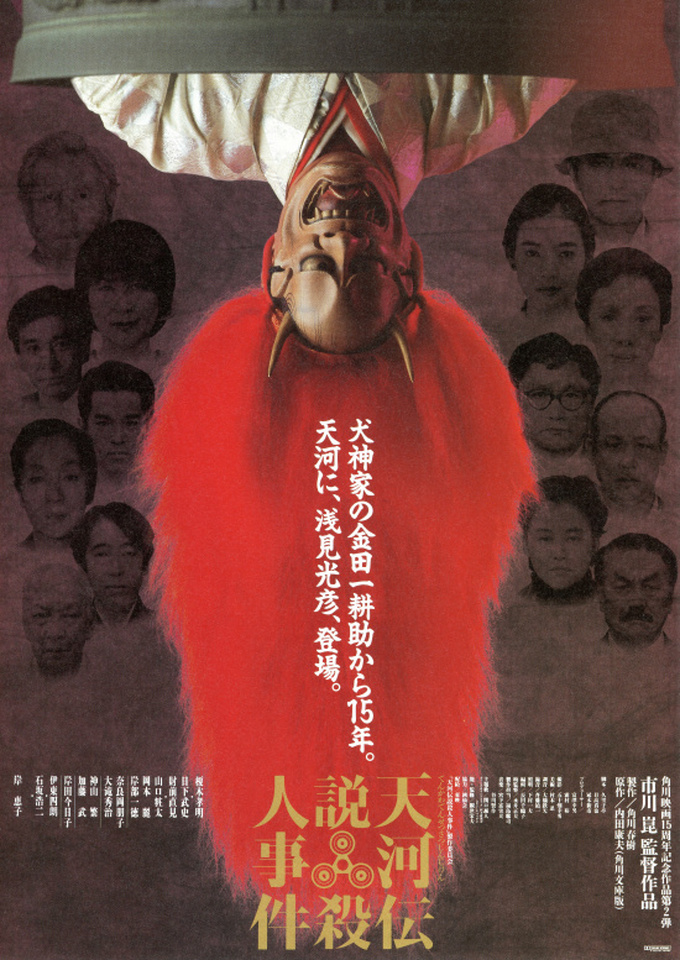
noh mask murders posterFor one reason or another, Japanese mystery novels have yet to achieve the impact recently afforded to their Scandinavian brethren. Japan does however have a long and distinguished history of detective fiction and a number of distinctive, eccentric sleuths echoing the European classics. Mitsuhiko Asami is just one among many of Japan’s not quite normal investigators, and though Noh Mask Murders (天河伝説殺人事件, Tenkawa Densetsu Satsujin Jiken) is technically the 23rd in the Asami series, Kon Ichikawa’s adaptation sets itself up as the very first Asami case file and as something close to an origin story.

Ichikawa, though he may be best remembered for his ‘60s arthouse masterpieces, was able to go on filmmaking where others perhaps were not precisely because of his forays into the populist with a series of mystery thrillers including several featuring top Japanese detective Kindaichi (who receives brief name check in Noh Mask Murders). Published by Kadokawa, Noh Mask Murders is produced by Haruki Kadokawa towards the end of his populist heyday and features many of the hallmarks of a “Kadokawa” film but Ichikawa also takes the opportunity for a little formal experimentation to supplement what is perhaps a weaker locked room mystery.

Asami (Takaaki Enoki) begins with a voice over as four plot strands occur at the same temporal moment at different spaces across the city. In Shinjuku, a salaryman drops dead on the street, while a young couple enjoy a secret tryst in a secluded forest, a troupe of actors rehearse a noh play, and Asami himself is arrested by an officious policeman who notices him walking around with a dead bird in his hand and accuses him of poaching. As he will later prove, all of these moments are connected either by fate or coincidence but setting in motion a series of events which will eventually claim a few more lives before its sorry conclusion.

To begin with Asami, he is a slightly strange and ethereal man from an elite background who has been content to drift aimlessly through life to the consternation of his conservative family which includes a police chief brother. He harbours no particular desire to become a detective and is originally irritated by a family friend’s attempts to foist a job on him but gives in when he learns he will have the opportunity to visit Tenkawa which is where, he’s been told, the mysterious woman who helped him out with the policeman in the opening sequence keeps an inn. Hoping to learn more about her, he agrees to write a book about the history of Noh and then becomes embroiled in a second murder which links back to the Mizugami Noh Family which is currently facing a succession crisis as the grandfather finds himself torn over choosing his heir – he wants to choose his granddaughter Hidemi (Naomi Zaizen) who is the better performer but the troupe has never had a female leader and there are other reasons which push him towards picking his grandson, Kazutaka (Shota Yamaguchi).

As with almost all Japanese mysteries, the solution depends on a secret and the possibilities of blackmail and/or potential scandal. The mechanics of murders themselves (save perhaps the first one) are not particularly difficult to figure out and the identity of the killer almost certainly obvious to those who count themselves mystery fans though there are a few red herrings thrown in including a very “obvious” suspect presented early on who turns out to be entirely incidental.

Ichikawa attempts to reinforce the everything is connected moral of the story through an innovative and deliberately disorientating cross cutting technique which begins in the prologue as Ichikawa allows the conversations between the grandchildren to bleed into those of Asami and his friend as if they were in direct dialogue with each other. He foregrounds a sad story of persistent female subjugation and undue reliance on superstition and tradition which is indirectly to blame for the events which come to pass. Everyone regrets the past, and after a little murder begins to see things more clearly in acknowledging the wickedness of their own actions as well as their own sense of guilt and complicity. Noh is, apparently, like a marriage, a matter of mutual responsibility, fostering understanding between people and so, apparently is murder, and one way or another Asami seems to have found his calling.