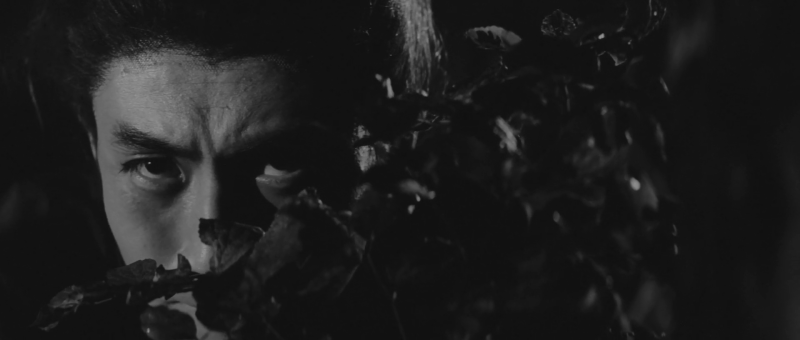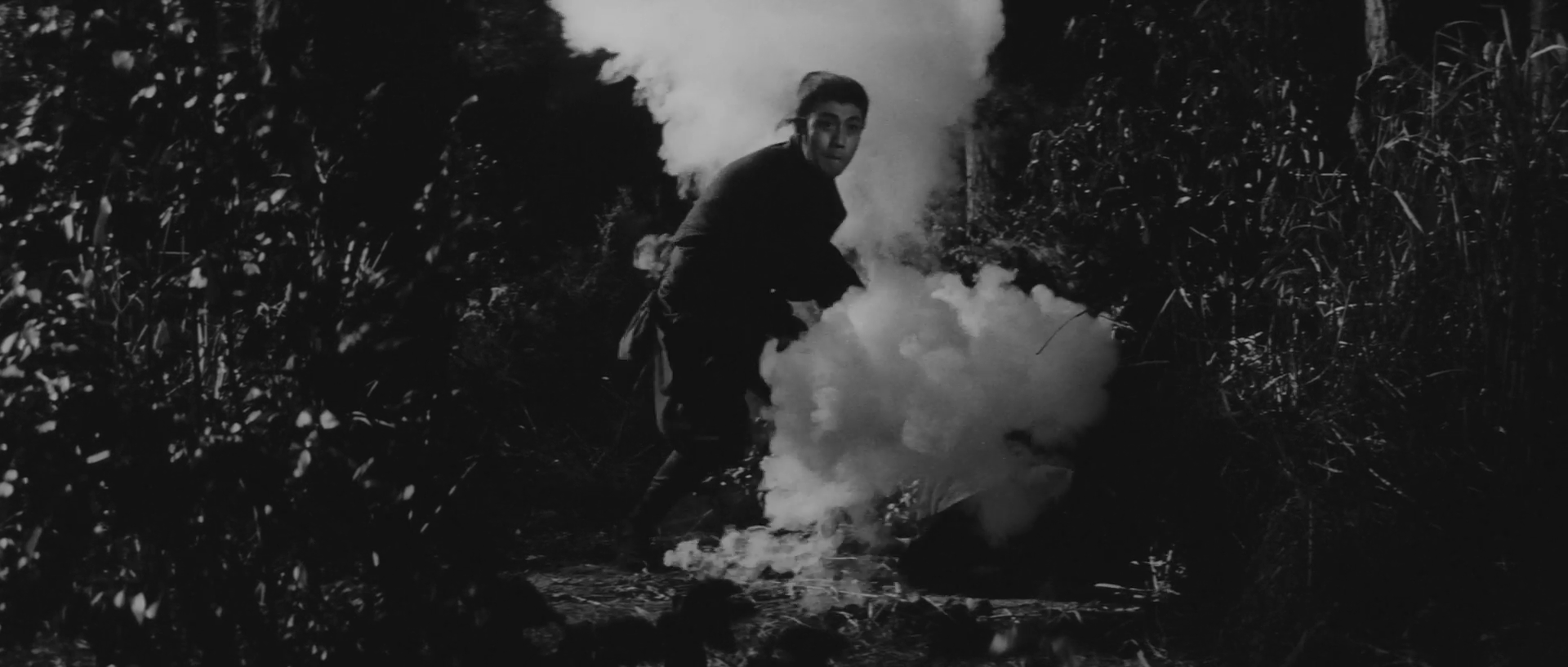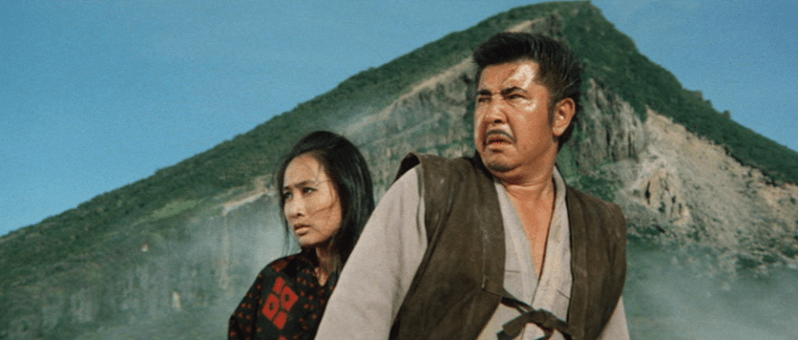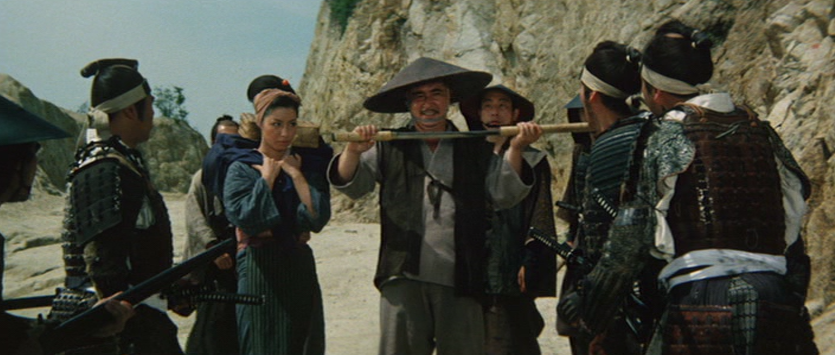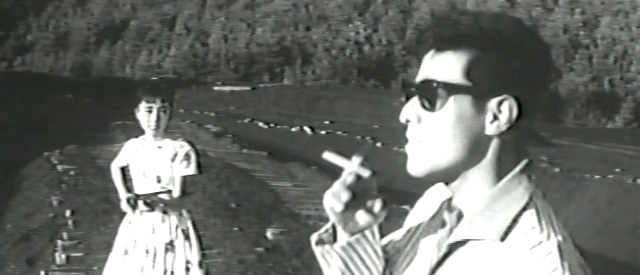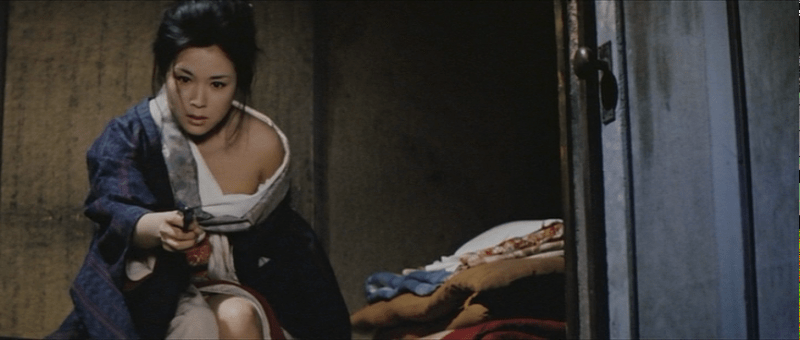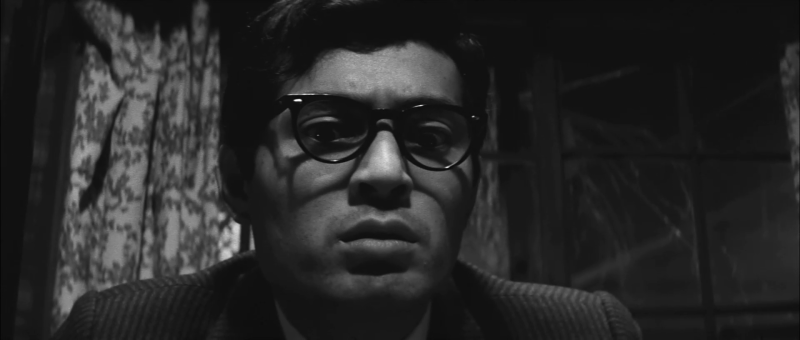
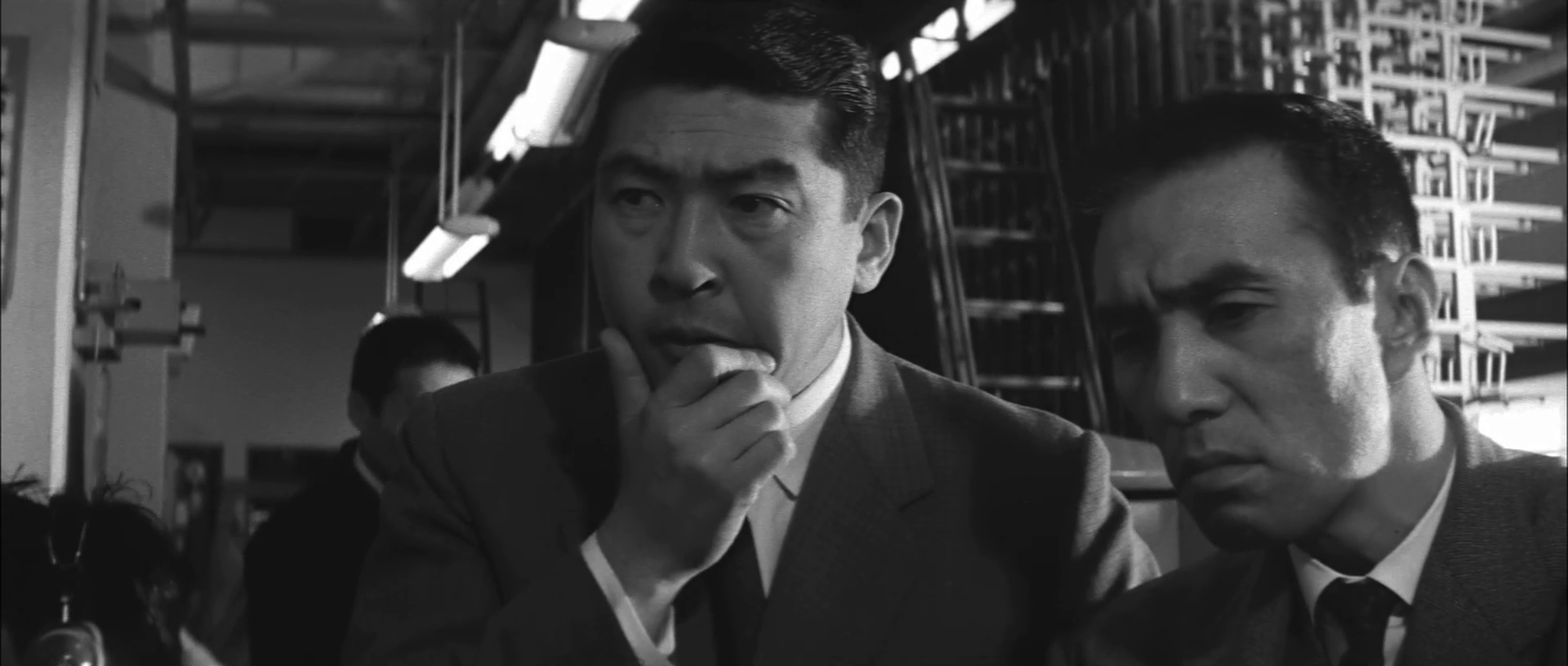
Killer’s Mission (賞金稼ぎ, Shigehiro Ozawa, 1969)

According to the title card at the beginning of Shigehiro Ozawa’s Killer’s Mission (賞金稼ぎ, Shokin Kasegi), none of the events it depicts have been recorded in history because the shogunate decided to erase them all in fear of the effect they may have on the nation’s geopolitical stability. Nevertheless, it gives some very concrete dates for its historical action, even if they may not make complete sense while foreshadowing the political turbulence of the following century. 

What it essentially attempts to do is tell a James Bond-style tale of political intrigue in a feudal Japan in which perpetual peace has begun to create its own problems. Here played in a cameo appearance from Koji Tsuruta, the Shogun Ieshige was weak in part because he was in poor health and had a speech impediment which led him to be rejected by his retainers. The problem here, however, is with Satsuma which has been on bad terms with the Tokugawa shogunate since the Battle of Sekigahara after which they took power. Satsuma will in fact be at the centre of the conspiracy to overthrow the government in the following century, but for the purposes of the film have fallen foul of a rumour that the plan to do an arms deal with some Dutch sailors who sailed South to Kyushu after being rebuffed in Edo. 

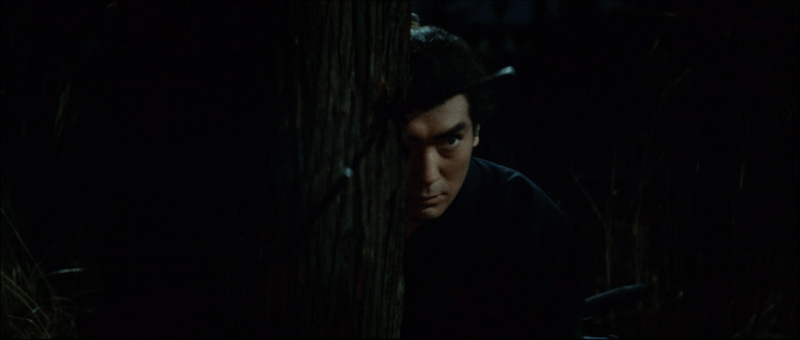
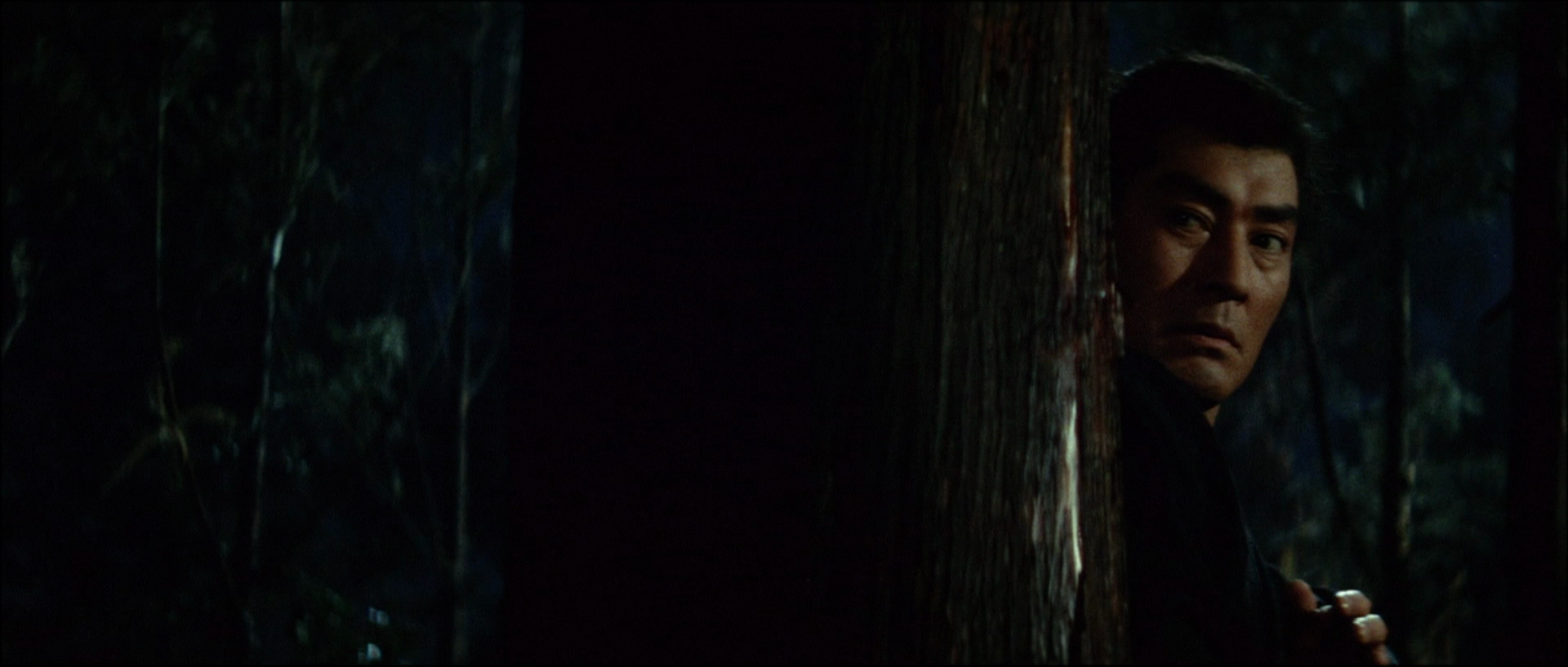
A civil war is feared and in the interests of maintaining peace, Ieshige sends his trusted spy Ichibei (Tomisaburo Wakayama) to protect Satsuma official Ijuin Ukiyo (Chiezo Kataoka) in the hope that he will be able to talk his young and naive lord out of doing the deal. Ostensibly a doctor by trade, Ichibei has a series of spy gadgets such as hidden blades and collapsible guns stored in a secret room at his surgery which he then carries in a black leather utility belt. He keeps the nature of his mission close to his chest, but often double bluffs by simply telling people he is a shogunate spy or otherwise adopting a disguise as he does in a moment of meta comedy impersonating the signature role of his brother Shintaro Katsu by posing as a Zatoichi-style blind masseur. 

As if to signal the cruelty of the feudal world, Ichibei comes across the corpses of suspected spies abandoned outside Satsuma territory while his enemies meditate on their ancient slight and consider taking the deal in the hope of avenging their defeat and overthrowing the Tokugawa. They are warned that creating unrest and sowing division may be exactly what foreign powers like the Dutch crave, but aren’t particularly bothered, preferring to take their chances with them rather than curry favour with the Shogun and possibly destabilising the entire society along with it. 

Of course, much of this is anachronistic with the Dutch sailors appearing in a distinctly 19th century fashion carrying weapons which are also too advanced for the era as are Ichibei’s folding pistols. Through his travels, he runs into a female Iga spy who too can do some nifty ninja tricks and has a gadget of her own in a comb which can shoot poison darts, though luckily it’s one of the poisons Ichibei has already developed an immunity to. Ichibei is fond of crying that you kill him he’ll simply come back to life, barrelling through the air with feats of improbable human agility and generally behaving like some kind of supernatural entity with a secondary talent for violent seduction. 

Though ironic and often darkly comic, there is an unavoidable poignancy in the inner conflict of Ijuin who knows his clan is about to do something very foolish but is torn between his duty to obey them and that to act in their best interests, eventually backed into a corner and left with no real way out of his predicament. As Ichibei points out, it’s difficult to keep the peace, especially when restless young samurai spot opportunities to cause chaos and the outside world knocks on the door of a closed community. Even so, Ozawa ends on a romantic image of a beach at sunset somehow undercutting the violence and tragedy with the restoration of an order that might itself be imperfect in its peacefulness.


Morning’s Tree-Lined Street (朝の並木路, Mikio Naruse, 1936)

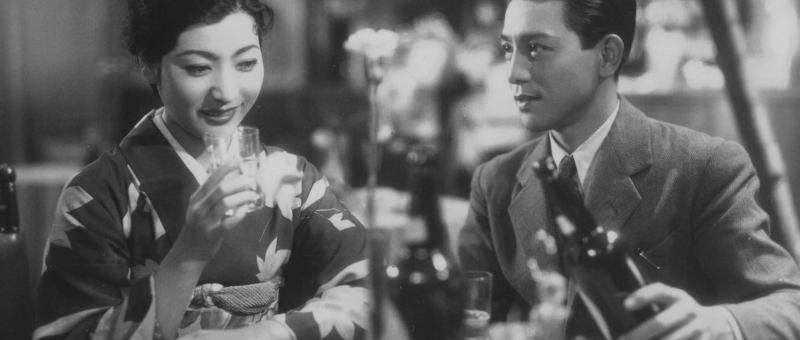
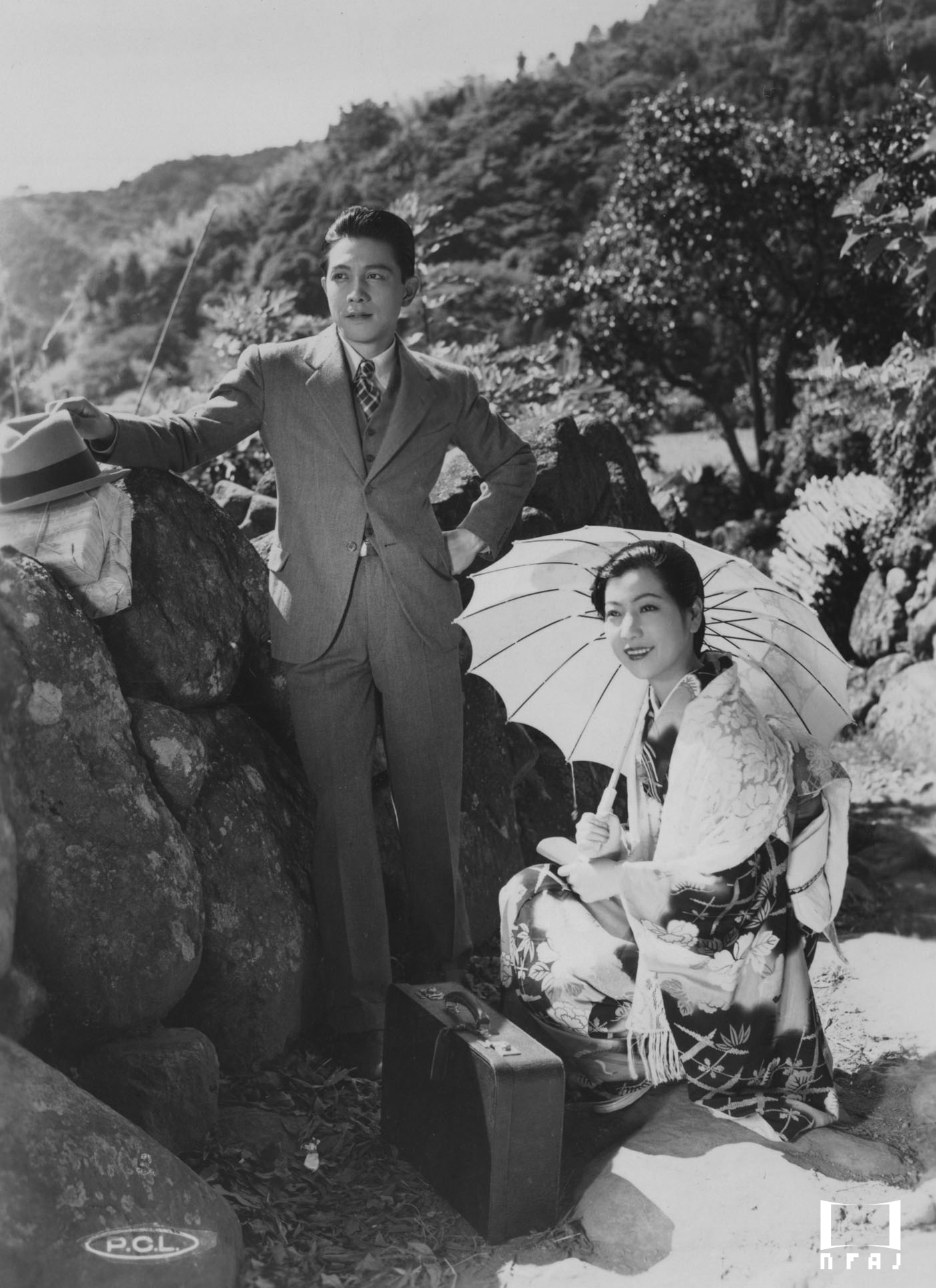
A country girl comes to the city in search of a more glamorous life but largely finds only disillusionment and disappointment in Naruse’s 1936 drama Morning’s Tree-lined Street (朝の並木路, Ashita no Namikimichi). Naruse depicts Chiyo’s (Sachiko Chiba) spiritual journey literally as she takes the bus from her rural hometown all wide-eyed wonder and then arrives in the city to be bothered by a homeless man and then walk into a less salubrious area of the city with only her friend’s address to go on. 

In her hometown, everyone thinks Hisako (Ranko Akagi) works in a big office in Marunouchi, but in reality she’s now working in a hostess bar under the name “Shigeko.” Nevertheless, despite a degree of shame in her circumstances, Hisako doesn’t reject Chiyo and isn’t angry that she’s come and found out her secret. She talks her landlady, Okada, into letting her stay but discourages her from working in the bar. The current economic depression is evident in the fact that the bar isn’t doing so well and never has many customers, yet the “help wanted’ sign keeps going up and down outside. There’s even a running gag that the cook makes a permanent version so they won’t waste so much paper, only he spells “hostess” wrong, so they have to take it down anyway. 

The help wanted sign is a harbinger of doom for Chiyo who, it seems, is being drawn towards this kind of life. As Hisako had told her, it’s impossible for a country girl to find a job when there are already so many “desperate” people in Tokyo, and at the grand old age of 22 Chiyo is worried that she’s simply too old to find employment. By the standards of the time, she may be considered on the older side not to be married, and indeed Hisako tells her she’d be better off to go home and find a husband, but Chiyo wants both more and to find a grand romance. She romanticises an idea of poverty believing that she could be happy with a man she truly loved even if they had no money. Hisako doesn’t disillusion her, but may be inwardly rolling her eyes at her naivety. She has a boyfriend already, but he’s no good. He keeps turning up and pestering her for money which might be one reason Hisako can’t escape the life of a bar girl.

It is indeed money that gets in the way everyone’s relationships. Hisako reads in the paper about a salaryman who embezzled money to spend at a hostess bar and then died in a double suicide with one of the women who worked there. The dark fantasy the bar represents echoes the wider despair in the society coloured by economic depression and broken dreams in which the fantasy version of Ogawa admits that his life was without hope or joy. Chiyo gets close to a nice young man who comes into the bar who tries but fails to find her a legit job in an office in attempt to save her from becoming a bar girl. In the end, she gives in and becomes one. Ogawa says he thinks no less of her, but begins coming to the bar more often and appears to be spending beyond his means even while Chiyo warns him not to waste his money. 

What happens next turns out to be a cinematic fantasy informed by Chiyo’s naive desires in which Ogawa agrees to marry her but has already ruined himself by embezzling public funds and later asks her to die with him while she pleads that as long as they have love poverty is nothing to fear. In many ways, the dream shatters her illusions and confronts her with the stark reality of her life in playing out a best/worst scenario in which Ogawa is so deeply in love with her that willingly walks to his destruction, which is at least preferable to the truth, which is as Hisako says that a man may seem honest and sincere but will turn out to be a coward or else he’ll cheat on you.

Unable to find employment nor rely on men, the women have only each other and the solidarity of those like Mrs Okada her running a small bar in this rundown corner of the city where dreams go to die. Chiyo takes to her new life a little more than to her liking. She turns to Hisako and asks if she looks like a bad girl, fearful that it’s already changed her and it’s no longer possible to go back to being the innocent country girl who wanted a bigger life in the city. Her conviction might be brought home to her by the fact that Ogawa is promoted and sent out of Tokyo but doesn’t ask her to come with him, only leave his address in case she ever feels like writing. But at the same time it spurs her into a flurry of false positivity, committing herself to the job search despite knowing that it’s almost certainly futile. Throwing his note into the river and letting it flow away, she both sees through the naivety of her dream of escape through romance and also resigns herself to the life of a bar girl, like Hisako with nowhere else to go and no possibility of return only the vague and far off hope of salvation through employment.


Morning’s Tree-Lined Street screens 21st June at New York’s Metrograph as part of Mikio Naruse: The World Betrays Us – Part II.

Images: Collection of National Film Archive of Japan.

Castle of Owls (忍者秘帖 梟の城, Eiichi Kudo, 1963)

A surviving member of the Iga clan swears vengeance on Toyotomi Hideyoshi only to slowly come to the realisation that the best revenge is living well in Eiichi Kudo’s ninja drama, Castle of Owls (忍者秘帖 梟の城, Ninja Hicho: Fukuro no Shiro). Adapted from the novel by Ryotaro Shiba, the film is somewhat unusual in its positivity in allowing its hero to first reject the codes by which he was raised and then those of the prevailing times in eventually choosing love and happiness over the internecine obligation to gain vengeance against a corrupt social order.

Hoping to solidify his grip on power, Oda Nobunaga has his right-hand man Toyotomi Hideyoshi massacre the Iga clan of ninjas who are then almost entirely wiped out. Juzo (Ryutaro Otomo) and his friend Gohei (Minoru Oki) both survive, but Juzo’s entire family is brutally murdered while his sister takes her own life after being gang raped by Hideyoshi’s soldiers, using her final breath to tell her brother to avenge her. Overwhelmed by grief, Juzo is chastised by veteran ninja Jiroza (Kensaku Hara) for his show of emotion. He reminds him that a ninja should be as unbreakable as stone and that he should abandon all human sentiment. Juzo, however, insists that he may be a ninja but is also human and refuses to apologise for his feelings. 

This is it seems the major conflict. Jiroza has already signalled his own heartlessness and practicality when he advised the surviving ninja to flee, for escape is less dishonourable than death. Those who refuse are welcome to surrender, and those who cannot run must be left behind to their fate. For Jiroza, all that matters is survival for both himself and his small daughter Kizaru (Chiyoko Honma) who is currently tied to his back (no mention is made of her mother, perhaps she had already passed away). Now that his family are dead, Juzo has a new mission and reason for survival insisting that what the living can do for the dead is vengeance, though in his case it is personal rather than principled for he mostly wanted revenge for his sister rather than the Iga clan as a whole or anything it represents which he otherwise seems to be at odds with. 

10 years later, Oda Nobunaga has already been bumped off in an act of betrayal by one of his own men leaving Toyotomi Hideyoshi in charge and now the target for Juzo’s revenge. Around this time, Hideyoshi is planning an invasion of Korea against the advice of most of his courtiers in order to legitimise his rule through imperial ambition and military dominance. Juzo has been trying to assassinate him, and has apparently failed five times already. A surprise visit from Jiroza and his now teenage daughter involves a job opportunity promising a monetary reward should he succeed, but Juzo is wary. The merchant who hires him says he wants Hideyoshi out of the way because a war in Korea will damage his business prospects, but as Juzo points out Hideyoshi’s death will leave a power vacuum resulting in another civil war. The merchant, however, giggles childishly and remarks that domestic wars are good for business, leading Juzo to suspect he’s here on behalf of Tokugawa Ieyasu, the most likely to assume power in the event of Hideyoshi’s death.

The irony is though Juzo very definitely wants Hideyoshi dead, when someone else suggests it he becomes conflicted because he knows it will lead to another period of chaos in which even more people will die. Meanwhile, a ninja’s allegiance should belong to his client, who is always the highest bidder, so this is both a win-win situation and a mild conflict of interest. Conversely, Gohei (Minoru Oki), who was betrothed to Kizaru, has apparently betrayed the clan and taken a position as a retainer for one of Hideyoshi’s lords. He agrees to betray the Iga, inform on the plan to assassinate Hideyoshi, and even bring in Juzo in return for a 300-koku stipend and a shot of advancement under the new regime.

Now, on one level this might be understandable. Japan has emerged from a couple of hundred years of constant warfare, there’s no place for ninja in a world of peace as former Iga man Mimi (Tokue Hanasawa) remarks revealing that he’s survived the last 10 years through begging. It’s also understandable given that a ninja is expected to be duplicitous and act in self-interest. Even Juzo applaud’s Jiroza’s ninjutsu on realising that he’s teamed up with Gohei to betray him in order to take out the leader of the Koga ninjas. In essence, he’s only really done what Juzo later does but also the opposite in choosing his individual happiness through betraying those around him to throw his lot in with the person who murdered his entire clan. 

Juzo meanwhile is shaken by his unexpected attraction to female ninja Kohagi (Hizuru Takachiho), a daughter of the Koga,  who like him finds herself conflicted in her mission because of her growing affection for Juzo. Kohagi asks him if they really have to live on hate when they could live happily together instead, but even while conflicted Juzo can’t bring himself to let go of the idea of vengeance and is haunted by images of his friends and family dying. Even so, having decided to give up on a happy future and risk his life to kill Hideyoshi he finds that it ceases to matter. Confronting him, his hatred melts away. He begins to recognise the futility of revenge and that it would be silly to cause a war and make a merchant rich to prove a point. Gohei, meanwhile, pays a heavy price for his choices when his lord disowns him. Even when Juzo comes to rescue him from jail, he laughs that he’s caught him at last. Having escaped from the Iga life to live in the sun, he finds himself in darkness once again. Juzo, however, rides off into the sunshine with Kohagi to live in peace that’s divorced from the wider world. They choose to exile themselves from this world of darkness and duplicity, to live freely in the sunlight rather than be consumed by the internecine codes by which they were raised. Kudo films his ninja battles in near total silence with an almost balletic intensity and paints this world as one of infinite mistrust and uncertainty but equally affirms that it is possible to simply walk away and choose happiness over duty or hate.


Hiroshima (ひろしま, Hideo Sekigawa, 1953)

During the post-war occupation of Japan which lasted until 1952, the censorship regulations which replaced those of the militarist era perhaps ironically made it more or less impossible to criticise the US presence or depict the extent of wartime devastation lest it raise hostility towards American forces or reinforce a feeling of victimisation. For this reason, images of the atomic bombings were tightly controlled and the events rarely referenced in mainstream media, Hiroshi Shimizu’s Children of the Beehive being a notable if brief exception. Once the occupation was over, however, many assumed it would become easier to broach such taboo subjects. 

Hiroshima native Kaneto Shindo’s comparatively better known Children of Hiroshima, inspired by the book Children of the A Bomb: Testament of the Boys and Girls of Hiroshima, was released in 1952 shortly after the censorship regulations were lifted and stars his later wife Nobuko Otowa as a teacher who returns to Hiroshima to visit the graves of her parents killed in the atomic bombing and thereafter several of the children from a nursery school she once taught at who have survived but continue to suffer in various ways due to their experiences. Despite Shindo’s well known leftist credentials, many including the Japan Teachers’ Union who apparently owned the rights to the book though there is some dispute as to their involvement in the production, were disappointed with the film which they felt to be an overly sentimental studio melodrama that was ultimately unhelpful in supporting the anti-war political movement or accurately representing the hibakusha community. 

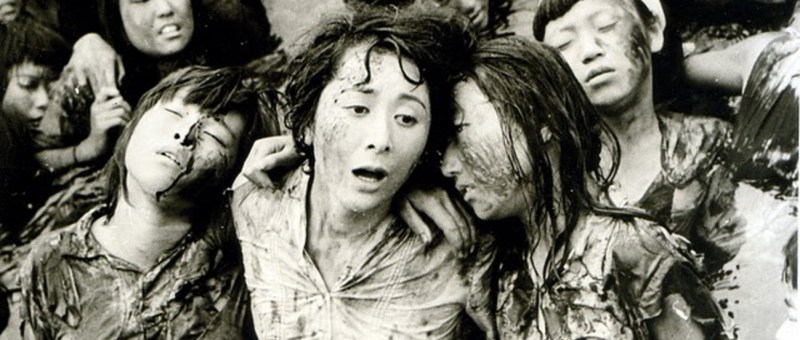
In response, the JTU commissioned a second version in order to better reflect their aims and ideals. Long unseen in either Japan or internationally prior to its recent restoration, Hideo Sekigawa’s Hiroshima (ひろしま) adopts a much more strident docudrama approach while, like Children of Hiroshima, maintaining a focus on the plight of children during the bombing and beyond though it seems somehow unlikely that teachers and parents would be wholeheartedly enthusiastic about showing such a deliberately harrowing piece to a sensitive younger audience. One criticism of Shindo’s film had been that he’d dodged dealing with the bombing itself by concerning himself only with the present-day aftermath. Sekigawa meanwhile focuses directly on the traumatic instant of the attack, utilising expressionistic techniques to recreate the living hell to which the city was reduced literally in flash. 

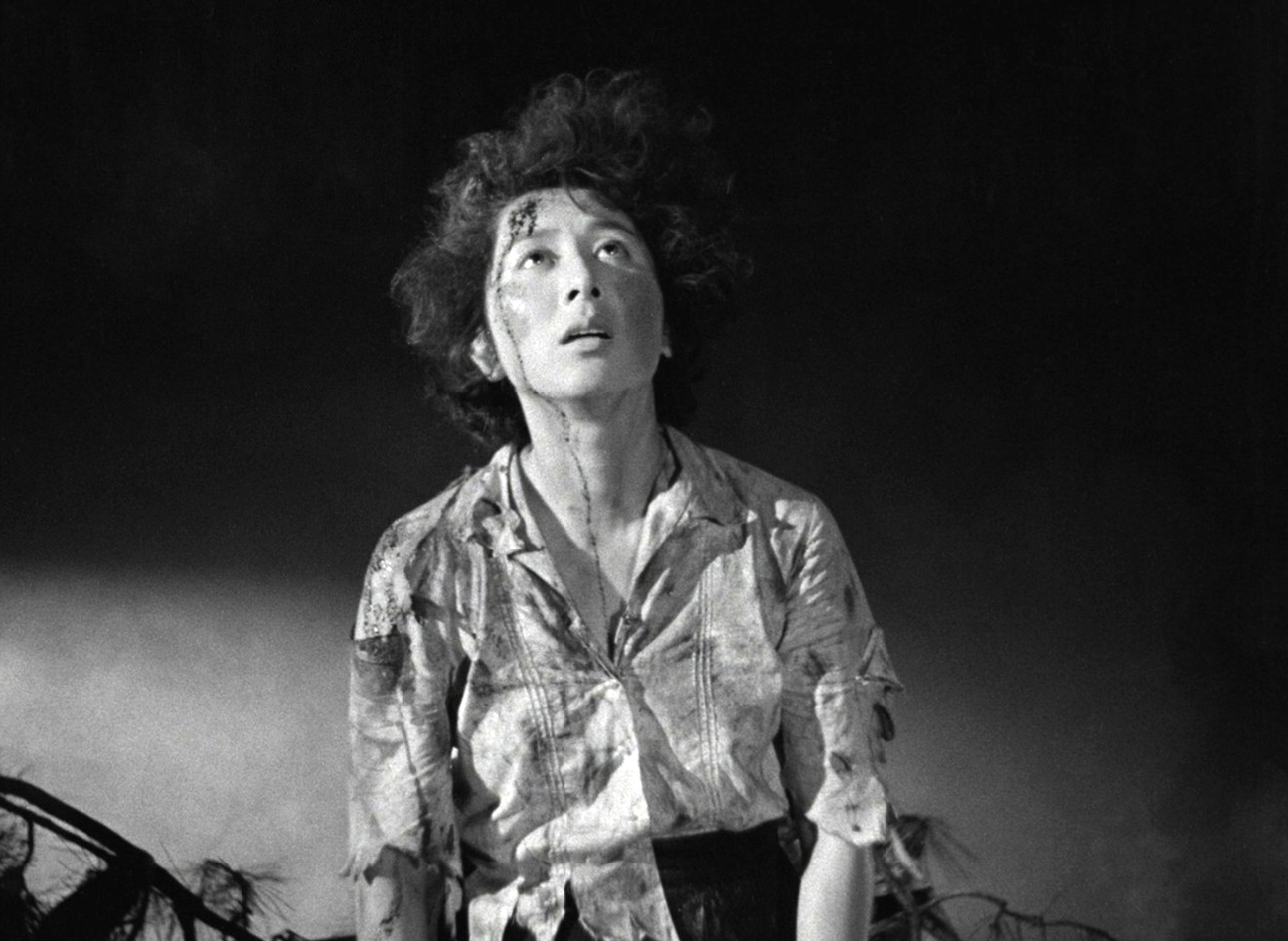
It’s clear however that the normal of that day was already far from normal. Rather than go about their studies, school children are working hard for the war effort helping to clear extensive bomb damage. A teacher and a class of school girls salvaging roof tiles from a ruined building pause to look at the sky. They can hear bombers but no sirens and it’s in that moment of stillness that everything changes. The world as it was implodes and is left in total collapse. Survivors search desperately for loved ones while stumbling through an unfamiliar landscape filled with crying children, charred bodies, rubble and fire. “This is hell” an injured man groans after managing to make his way to the field hospital, “hell”. 

Sekigawa bookends his tale with a contemporary framing sequence in which an idealistic teacher tries to instil compassionate values in his students some of whom are survivors of the bomb and still living with its effects including one suffering with radiation-related leukaemia who becomes very upset on listening to a radio lesson recounting the morning of the bombing from the point of view of the pilot flying the plane. Another of the students later comes to her defence, taking some of the others to task and lamenting that the suffering of those affected by the A Bomb is not taken seriously while victims still undergo a degree of social stigma even if they have no visible wounds. He is also very worried about his friend, Endo (Yoshi Kato), who later appears in the flashback to the aftermath of the bombing and has apparently gone off the rails, working in a cabaret bar and addicted to pachinko after losing his entire family. 

It’s through Endo that Sekigawa dramatises many of the secondary effects of the bombing in that he was not physically injured but is consumed by a sense of hopeless anxiety, intensely concerned about the prospect of another war and unable to envisage a successful future for himself in a world in which such horror can occur seemingly at random. It’s he who first introduces us to the parasitical disaster tourism that generates a grim trade in A-Bomb “souvenirs” as he passes a stall selling fake skulls as a child and then later attempts to sell actual human remains with inspirational stickers plastered on the top. The “better” future they have imagined for him is however in itself problematic, harking back to the traditional post-war solution of a factory job which directs aligns him with the nation’s push towards a capitalistic society, but is then undercut when he quits not because he is bored or lazy but because he discovered the factory was being used to produce artillery shells and he felt he could have nothing to do with it. 

Endo is also among a group of post-war street kids who learn to say the word “hungry” without knowing what it means to get bread and chocolate from passing Americans. A later more direct speech has them make a formal accusation that the Americans are responsible for the deaths of their parents and therefore bear a responsibility towards them which they should immediately repay with food. Some, including Shochiku who were originally set to distribute but later declined, described the film as overly anti-American, but Hiroshima largely refrains from mentioning the Americans other than a suggestion that the dropping of the bomb was itself a racist act in which they used the Japanese people as guinea pigs to test their new weapon, and focuses on the failure of the militarist authorities to respond in an appropriate fashion. We see a soldier read out a proclamation telling a ragged queue of survivors queuing up for food that the situation is “not unusual” in time of war and they should all return to their jobs despite the fact that there are no longer any buildings in which to work. Meanwhile, militarists talk of using the disaster to foment the war effort by marshalling hate and resentment towards the enemy while commanders refuse to take scientific advice that tells them Hiroshima may be uninhabitable for the next 70 years, obsessed only with continuing the war at all costs ironically insisting that their “fervent will” which “burns as brightly as a million stars” will bring them an assured victory.  

In the face of a second bombing, however, they are forced to accept that the war cannot continue, many of the victims left perplexed and defeated that despite their suffering the government has unconditionally surrendered and seemingly abandoned them. An abnegation of responsibility is also suggested by the presence of the street kids abandoned by their society and left to fend for themselves though Endo is eventually taken into a progressive care home from which he and other boys make numerous attempts to escape, in his case in the hope that he can find the sister from whom he became separated. Sekigawa does not make suggestions for the future, merely depict the difficult post-war reality while arguing for greater compassion in the contemporary era, one bomb survivor describing her despair in the knowledge that her disability is a barrier to marriage while finding work that can be done with her physical limitations is also difficult as is accessing government support. Sekigawa too may give in to a particular kind of sentimentality in the closing moments but it is indeed undoubtedly effective as a reminder of the human cost of war and our collective responsibility to ensure that it never happens again.


Tengu Priest (お坊主天狗, Yasushi Sasaki, 1962)

Disparate denizens of Edo are united in one thing in Yasushi Sasaki’s light hearted jidaigeki, Tengu Priest (お坊主天狗, Obozu tengu), revenge. Like many jidaigeki, what they really want is revenge against the evils of feudalism to which they have each fallen victim, but also acknowledge that they have found something better in being outside it in the solidarity that exists between them as outsiders free from the obligations of samurai society if also with loose ends waiting to be tied.

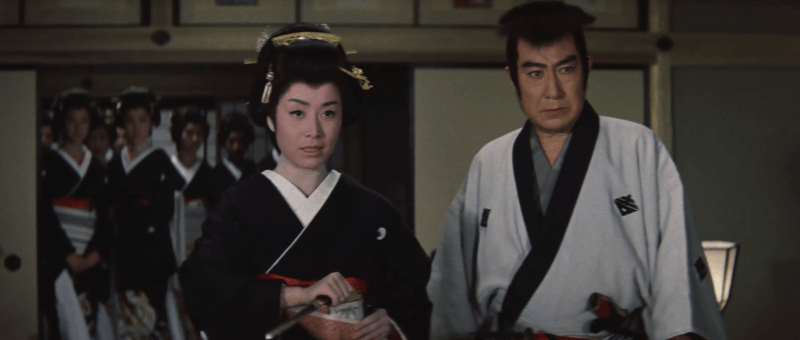
Once a hatamoto with a 1000 Koku stipend, Obo Kichiza (Chiezo Kataoka) is now a much feared figure keeping order in Edo. When some yakuza toughs are hassling the geisha Kozome (Hibari Misora) at the theatre, insisting that she serve them sake even as she reminds them she’s off the clock, one look from him stops them dead though Kichizo is also impressed with Kozome’s nerve. Like him, Kozome is also in Edo for revenge. Formerly a samurai’s daughter, she became a geisha to look for the man who killed her father in a stupid quarrel over a fencing duel. Kichiza, meanwhile, seeks revenge against the local lord, Honda Etsu (Masao Mishima), who killed his father in a fit of temper when he ordered him to commit seppuku for causing his son-in-law to fall off his horse but he refused. 

Loyal retainer Kinpei (Ryutaro Otomo) had begged for his forgiveness and insisted that he could get Etsu to reform but three years have passed and not only has he bribed his way to head office but his behaviour has declined still further. We see him cruelly cut down a maid seemingly for no reason, simply ordering his men to get rid of the body. Etsu has a reputation for random violence while drunk, but as he is the lord, there are no real consequences for him. His retainers cover up his crimes, and Kinpei’s sole attempt to talk some sense into him goes nowhere, meanwhile his chief adviser Shichinosuke (Sentaro Fushimi) is basically running the show telling others the lord is not in his right mind and cannot make decisions so he must make them for him.

They are all, including Etsu himself, victims of the feudal order in which the systems of power are necessarily corrupt. In his yakuza persona, Kichiza has struck up a friendship with another geisha, Kozuru (Naoko Kubo), who was actually a lady in waiting working as a maid at his estate. She has long been in love with him, but the class difference would have made any union impossible. Ironically, she remarks to Kozome that even in their present state they are still a Hatamoto and a lady in waiting so she dare not express her love for him. Only once his revenge is concluded and he’s fully abandoned his samurai status can Kichiza truly be free to embrace a relationship with Kozuru while conversely Kozome regains her life as a samurai’s daughter by avenging the death of her father.

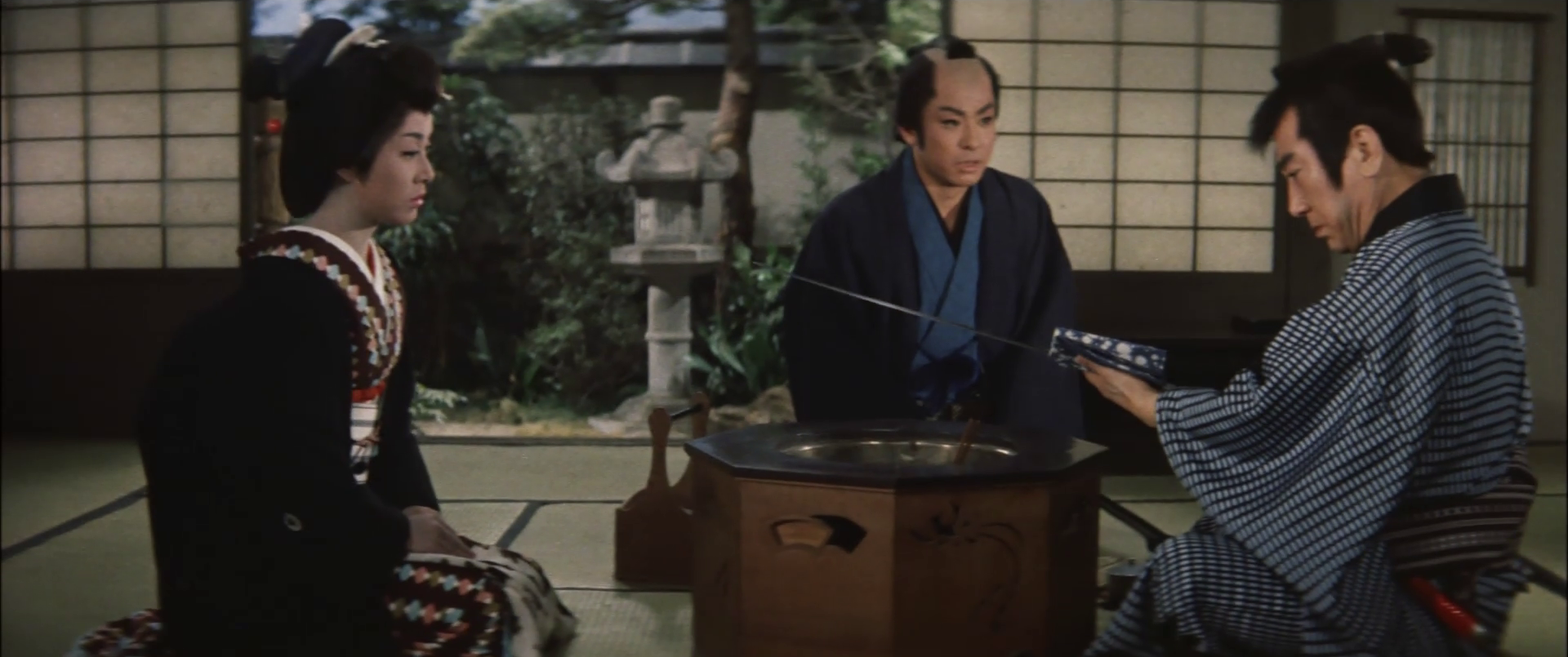
Kozome asks for Kichiza’s help to track down the target of her revenge, but he also respects her wishes and understands that it’s something she must do herself as does eccentric sword sharpener Shinzaburo (Hashizo Okawa ) who actively stands back so she, another wronged woman, can stick the knife in. Hibari Misora’s role in the film is smaller than one might expect as her revenge subplot is secondary to Kichiza’s and she has relatively little screen time with only a brief musical sequence during a naginata dance though she does participate in the high octane final showdown in which all grievances are exorcised and a kind of order returned to the samurai realm even if it must be destroyed to so as Kinpei resolves to protect both the lives and livelihoods of their many retainers and the integrity of Kichiza, going so far as to congratulate Kozome on the successful completion of her revenge. 

Yet what made the whole thing possible was Kichiza’s own band of outlaw drifters whom he allowed to live in his home he later says just so that they would have a place to come and be together so that they might more easily reintegrate into mainstream society. He might have lost his domain and samurai status but has discovered something better in this accidental community. They may be in a sense almost like retainers to him, but if so they stay by choice rather than obligation and help out of a genuine sense of loyalty and affection. In essence, in taking his revenge, he frees himself from the oppressive nature of the samurai code and is able to live like an ordinary man lamenting that if only he and Kinpei had both been ronin they could have enjoyed their time together for longer. Lighthearted and cheerful despite its dark themes, the film is nevertheless a condemnation of the hypocrisies and abuses of a feudal society in which freedom is to be found only among those who live outside it.


Volunteering for Villainy (悪人志願, Tsutomu Tamura, 1960)

Tamotsu Tamura is best known as a screenwriter who worked closely with Nagisa Oshima, though he did actually direct a film himself at the beginning of his career. Having originally planned to become a reporter, Tamura was offered a job at Sankei Shimbun but his employment was postponed for medical reasons and he decided to retake the entrance exam for Shochiku joining the studio in 1955. Unfortunately Volunteering for Villainy (悪人志願, Akunin Shigan, AKA The Samurai Vagabonds) was not successful at the box office and Tamura soon left Shochiku along with Oshima and became a screenwriter at his independent production company. 

In any case, the film is very reminiscent of New Wave filmmaking both in terms of theme and aesthetic. It repurposes a moribund quarry town as an almost literal purgatorial space casting the protagonists into a deep hole from which they are eternally unable to escape. As the film opens, a collection of children are taunting a young woman, Hide (Kayoko Hono), calling her a murderer and castigating her for failing to die, though it later transpires that they’ve been hired by a henchmen of Tatsuo (Masahiko Tsugawa), the brother of the man she was involved in double suicide with who is determined to become some kind of local dictator.

But even he is in some ways rebelling against his powerlessness as the son of a local politician he brands as phoney and corrupt. Tatsuo claims he hates people who claim to be good but aren’t, in much the same way as Hide claims she can no longer trust anyone. Tatsuo seems to want revenge for the death of his brother for which he holds Hide responsible but insists he doesn’t want to settle it with money nor is he in favour when a shady local man makes vague allusions to having her bumped off.

When a new recruit, Yasuo (Fumio Watanabe), joins the quarry he becomes its latest kicking bag not least because it was Hide who escorted him into town. Yasuo has a stammer and incredibly meek manner that leans towards obsequiousness. “You’re as obedient as a dog,” people often remark with Tatsuo later astutely observing that he’s the sort of person who can’t do anything without someone telling him to do it. Yet it later seems as if his desire to obey, to be liked and accepted by those around him, has led him to commit a terrible crime claiming that he only did what everybody wanted done even if they were too afraid to say so.

Ashamed of himself and his corrupted masculinity Yasuo alternately rebels and overcompensates. He refuses to hit Hide when ordered to by Tatsuo, and to sleep with her when forced by the other men, but later hits and sleeps with her possibly not quite consensually when his masculinity is challenged. The irony is that Tatsuo who claimed he wouldn’t tolerate anyone defying him cannot control Hide’s free spirit and is therefore unable to overcome his powerlessness. He bullies and harasses her insisting that she leave town, but Hide refuses to go and is continually unbothered by the way she’s treated. Hide also eventually rejects Yasuo for his cowardice, severing her ties to him on realising that he informed on one of the other men who was fugitive from justice to curry favour with Tatsuo and take the heat off himself. She tells Tatsuo that though he’s always wanted things his own way, she’s always decided for herself, infuriating him with her free decision to leave having realised how petty and meaningless it was to stay in this petty and meaningless purgatory of broken and hopeless men. 

Tamura shoots with a roving and curious camera that takes on a life of its own swooping through the dorms but lends a degree of mythic eeriness to the final confrontation in the quarry as the workers begin to dot the skyline looking down at Hide below in a scene somehow reminiscent of L’Avventura. The town’s only bright spot is presented by Tatsuo’s younger sister Kiyoko (Chiaki Tsukioka) as the voice of reason even as she  brands everything boring and meaningless but thereby suggesting that it might not have to be this way. Her words, however, fall on largely deaf ears save those of Hide perhaps finally awake to her own agency only to have it immediately crushed by fragile masculinity.

The Wolves (狼, Kaneto Shindo, 1955)

Post-war desperation drives a collection of otherwise honest men and women towards a criminal act that for all its politeness they are ill-equipped to live with in Kaneto Shindo’s biting social drama The Wolves (狼, Okami). “Wolves” is what the criminals are branded, but the title hints more at the wolfish society which threatens to swallow them whole. After all, it’s eat or be eaten in this dog eat dog world, at least according to a cynical insurance salesman hellbent on exploiting those without means. 

Each of the five “criminals” is an employee at Toyo Insurance where they’re immediately pitted against each other, reminded that in order to qualify for a full-time position they need to meet their quotas for six months. The orientation meeting is cultilke in its intensity, the boss insisting that only in insurance can you become a self-made man while recounting his own epiphany as to the worthiness of his profession. They are told that the only two things they need are “faith and honesty”, and then “faith and pursuasion”, while encouraged to think of their work as an act of “worship”, “for the salvation of everyone”. 

Yet they’re also told to exploit their friends and family by pressuring them into taking out life insurance policies in order to help them meet their quotas. As one man points out, friends and relatives of the poor are likely to be poor themselves, but these are exactly the kind of people they’re expected to target. They’re told there’s no point going after the weathly because they’re already insured, but there’s something doubly insidious in trying to coax desperate people who can’t quite afford to feed themselves into paying out money they don’t have on the promise of protecting their families from ruin. One man even asks if the policy covers suicide and is told it does if you pay in for a year, sighing that he doesn’t want to wait that long.

“Suicide or robbery, choose one,” one of the salespeople reflects after failing to make their quota once again. They each have reasons to be desperate, all of them already excluded from the mainstream society and uncertain how they will find work if the job falls through. Akiko (Nobuko Otowa) is a war widow with a young son who is being bullied at school because of his cleft palate for which he needs an expensive operation. She’s already tried working as a bar hostess but is quiet by nature and found little success with it. Fujibayashi (Sanae Takasugi) is widowed too with two children and five months behind rent for a dingy flat in a bomb damaged slum where the landlord is about to turn off her electric. Harajima (Jun Hamamura) used to work in a bank but was fired for joining a union and is trapped in a toxic marriage to woman looking for material comfort he can’t offer. Mikawa (Taiji Tonoyama) too is resented by his wife, a former dancer, having lost his factory job to a workplace injury while the ageing Yoshikawa (Ichiro Sugai) was once a famous screenwriter but as he explains people in the film industry turn cold when you’re not hot stuff any more. 

Their unlikely descent into crime has its own kind of inevitability in the crushing impossibility of their lives. They may rationalise that what they’re doing is no different from the insurance company that exploits the vulnerable for its own gain, thinking that if they can just get a little ahead they’d be alright while feeling as if robbery and suicide are the only choices left to them and at the end of the day they want to survive. Perhaps you could call them “wolves” for that, but they’re the kind of wolves that give the guards from the cash van they robbed their train fare home after bowing profusely in apology. The real wolves are those like Toyo who think nothing of devouring the weakness of others, promising the poor the future they can’t afford while draining what little they have left out of them. As the film opens, Akiko looks down at a bug writhing in the dirt attacked by ants from all sides and perhaps recognises herself in that image as the sun beats down oppressively on both of them. Breaking into expressionistic storms and unsubtly driving past a US airbase to make clear the source of the decline, Shindo paints a bleak picture of the post-war world as a land of venal wolves which makes criminals of us all. 


Two Wives (妻二人, Yasuzo Masumura, 1967)

Everything is facade in Yasuzo Masumura’s ironic exploration of the corruptions of the post-war society, Two Wives (妻二人, Tsuma Futari). Based on the novel by Patrick Quentin and scripted by Kaneto Shindo, Masumura’s dark mystery drama is a characteristically circular affair revolving around the hero’s moral confusion but positioning its two women as mirrors of each other, one a conservative upperclass daughter of a magazine editor whose intense properness has alienated all around her, and the other a perpetual mistress hung up on no-good starving artists.

Kenzo (Koji Takahashi), the hero, is married to the upperclass Michiko (Ayako Wakao) but is accidentally reunited with former uni girlfriend Junko (Mariko Okada) through an act of extreme coincidence. Junko is sporting a bandage around her neck to hide bruises caused by her violent drunk of a boyfriend Kobayashi (Takao Ito), a failed writer. This is in a sense ironic, as Kenzo had himself been an aspiring author during their uni days and it was Junko’s introduction to an old family friend, Nagai (Masao Mishima), which resulted in him getting a regular salaryman job before dumping her to marry the boss’ daughter. Despite himself, Kenzo ends up doing the same thing for Kobayashi but the young man’s motives are less than pure and he’s not so much tempted by consumerist comforts as coldly avaricious quickly setting his sights on Michiko’s wayward younger sister Rie (Kyoko Enami) who is just young and reckless enough to rebel against her sister’s puritanism through an affair with an unsuitable man. 

The magazine, Housewife’s World, seems to have been Michiko’s brainchild and runs under the slogan “clean, bright, beautiful”. Its target demographic is conservative wives and mothers with a particular interest in wholesome family values. These are all things Michiko practices in her personal life though as it becomes clear her excessive properness often annoys those around her who claim her moral authoritarianism pushes them towards transgressive rebellion. As the film opens, Nagai holds a meeting in which he announces that he’s fired two employees for being cautioned by the police when caught in an after-hours nightclub fearing that if such an event were to make to the papers it would tarnish their brand. However, pretty much no one other than Michiko is very dedicated to wholesomeness, her father having married off his mistress to a penniless aristocrat for the prestige of his name while employing the couple to manage a fund Michiko had set up for disabled children only for them to siphon all the money off for themselves. 

Having chosen consumerist fulfilment over the romantic, Kenzo has dedicated himself to his new role but is perhaps still conflicted in his decision especially after reuniting with Junko. His mirror Kobayashi, however, has no conflict at all and is willing to do anything and everything to achieve consumerist success. “You’ve no idea what a man without standing or money will do” he snarls, laying bare the effects of post-war inequality, pledging to use the Nagais like a springboard to jump as high as he can while threatening blackmail over having discovered all the sordid goings on at Housewife’s World. 

The soul of properness, Michiko is presented as the ultimate image of respectability while Junko is perceived as its inverse, a sexually active unmarried woman living in squalid backrooms and hanging out in bars. Yet Michiko’s austere exterior hides an inner ruthlessness in addition to an internal conflict over her own role in society. She publishes a magazine aimed at housewives though she is not a housewife herself but technically her husband’s boss. Eventually Nagai attempts to promote Kenzo above his wife claiming that the present situation does not fit with the traditional patriarchal outlook of magazine but he refuses, uncomfortable with this little piece of political manoeuvring in thinking that Michiko is better suited to the job and mildly insulted by the attempt at manipulation knowing that the reason for his promotion has nothing to do with his own ability. “I’m not interested in being a dog” he eventually barks back having come to the conclusion that this life of consumerist comfort is not worth the sacrifice of his autonomy or dignity. 

As for Junko, her love is indeed selfless continuing to support each of her starving artists even after they abandon her in favour of conventional success. Faced with Kobayashi’s rage, she cannot fire he effortlessly taking the gun from her which will eventually be retrieved by Michiko who does indeed use it to defend herself after Kobayashi attempts to rape her. “I want to be a woman who is loved like you” she exclaims on meeting Junko who has been accused of the murder she herself committed, jealous of her warmth and openness while Junko envies her for her refinement. Michiko claims that she hates lies, but discovers that everyone in her life has been lying to her while eventually forced to lie herself in covering up her crime. Yet it’s the weight of all the lies which eventually jolts Kenzo out of his complicity, resenting being made to lie to the police to cover up Rie’s potentially scandalous behaviour while unwilling to allow Junko to be convicted of a crime she did not commit. Nagai even convinces the family maid to lie for them in order to guarantee medical treatment for her sickly daughter. 

At his cruelest moment, Nagai goes so far as to undercut Michiko’s conflicted sense of self in telling her coldly that he only considered her a “token figure” he used for business who should have known her place and sat quietly in a corner ironically relegating her to the patriarchal space to which she on some level feels she ought to have confined herself while simultaneously wanting to take control as she had when she informed her father she would be marrying Kenzo rather than allowing him to find her a match. She too had worried about the direction of the current society and their magazine, wanting to move away from pure consumerism towards socially conscious content while her father clearly just wanted to make as much money as possible with no particular concern for morality only for optics. When she asks Kenzo if he loves her, he does not lie but replies only that he respects her which might in a way be an expression of love, later claiming that the properness which has alienated everyone else has in fact made him a better person who is determined to stand by her after she eventually commits to doing the right thing. 

In a final touch of irony, we see the “clean, bright” slogan echoed on a billboard outside the police station which is probably not an entirely transparent agency either though it appears as if in this case justice legal, moral, and emotional will be served striking back against amoral post-war consumerism and societal hypocrisy as the circle is brought to a close, both women landing on an equal footing and making their respective choices while Kenzo recommits himself to decency by pledging to start over together with Michiko. All in all, a more optimistic ending that might be assumed in a Masumura picture but then again no one can ever really escape the insidious hypocrisies of the contemporary society. 


Original trailer (no subtitles)

The Ceiling at Utsunomiya (怪異宇都宮釣天井, Nobuo Nakagawa, 1956)

Crime does not pay for a series of conspirators at the centre of Nobuo Nakagawa’s supernaturally-inflected historical tale, The Ceiling at Utsunomiya (怪異宇都宮釣天井, Kaii Utsunomiya Tsuritenjo). As the title implies, Nakagawa’s ominous jidaigeki is inspired by a historical legend in which a retainer supposedly attempted to assassinate the shogun through the rather elaborate device of a mechanical ceiling designed to crush him as he slept. In actuality no such thing took place, the shogun changed his route and subsequent investigations of Utsunomiya Castle found no sign of a false ceiling, yet the story took on a life of its own as local folklore. 

In this version of the tale, conspirators Councillor Kawamura (Ureo Egawa) and local yakuza Kagiya (Masao Mishima) are conspiring to depose Tokugawa Iemitsu (Yoichi Numata) in favour of his brother, manipulating Lord Honda (Shuntaro Emi) of Utsunomiya Castle by convincing him that his clan will prosper when the other retainers fall in behind the new shogun. The pair have arranged for nine talented craftsmen to be shut up in the castle to install “the mechanism” in time for the arrival of the shogun who is due to stay at the castle on his way to Nikko. Meanwhile, Kawamura is also intent on sleeping with the daughter of head carpenter Toemon (Yoji Misaki), Ofuji (Konomi Fuji), whom chief minion Tenzen (Tetsuro Tamba) is supposed to kidnap once the workmen have gone into isolation in the castle. Righteous samurai Ryutaro (Hiroshi Ogasawara) however, an undercover shogunate bodyguard, begins to disrupt their plan saving Ofuji while bonding with a friendly bar hostess, Onobu (Sachiko Toyama), and secret princess forest woman Oshino (Akemi Tsukushi). 

The plot represents in itself a malfunctioning of the feudal order in the essential weakness of Lord Honda, the ambition of his underling Kawamura, and the cruel greed of Kagiya. As the two men conspire, Kagiya jokingly laments that he isn’t a samurai while Kawamura reminds him that if the plan comes off he’ll be fantastically rich. Kagiya, a yakuza who sends his thugs to extort protection money from the local market, is representation of the threat of the rising merchant class whose financial power presents a challenge to the authority of the samurai. Toemon, meanwhile, a master craftsman, is manipulated into participating in the plan because he is in debt to Kagiya, later promised that he too will be “promoted” in being given permission to carry a sword little knowing that Kawamura and Kagiya not only plan to kidnap and rape his daughter but never intend to allow any of the craftsmen to live because they simply know too much. 

The Ceiling at Utsunomiya is not a ghost story in the manner for which Nakagawa is best known but it certainly plays like one, Kagiya eventually haunted by the figure of a betrayed Toemon which in turn leads him to a self-destructive attack on Tenzen and his eventual demise collapsed over his ill-gotten gains, a koban falling from his hand. Greed and violence will only repay in the same, the weak-willed Lord getting his comeuppance from the ever confident shogun even if he himself coolly stands back while others risk their lives to protect him. Even so, the eventual operation of “the mechanism” is intensely startling, the ceiling abruptly collapsing with alarming ferocity though one wonders what the advantage is in such an expensive, elaborate contraption aside from its ironic symbolism when the point of a sword will do. 

Then again, the heroic Ryutaro is almost assassinated while crossing a river via zip wire later fished out of the river by sullen forest woman Oshino, first encountered hunting birds with darts but later revealed to be the illegitimate child of samurai parents who fell foul of political intrigue. In a sense this revelation emphasises the restoration of the political order, Ryutaro permitted to fall in love with Oshino because they are of the same social class, while the romance between Ofuji and craftsman Yoshichi (Kotaro Sugiyama) also comes to fruition eliding the minor class difference between them in allowing the boss’ protege to marry the now orphaned daughter. Onobu meanwhile pays heavy price for her misplaced love for Ryutaro, denied romantic fulfilment in her liminal existence as a bar hostess. In any case, the corruption is exorcised and the normal order resumes reinforcing the hierarchical shogunate society with each of the players back in their rightful positions and possessing new hope for the future as Ryutaro and the shogun continue their tour while their former comrades kneel at the roadside. 


Mother (おかあさん, Mikio Naruse, 1952)

The hahamono or mother movie is a mainstay of post-war cinema, obsessed as it is with self-sacrificing maternity. Mikio Naruse, however, is not a name you’d expect to see associating itself with the genre and his 1952 film Mother (おかあさん, Okaasan), adapted from a child’s essay, is indeed subtly subversive, transgressively questioning the institution of motherhood itself while ostensibly remaining faithful to genre norms even as it makes an accidental villain of its teenage heroine who closes the film plaintively praying for her mother’s happiness having not so long ago shut down perhaps her only real hope of achieving it. 

The Fukuhara family ran a successful laundry before the war, but these days father Ryosuke (Masao Mishima) works at a factory and is nicknamed Papa Popeye by his kids because of his finely tuned muscles born of a lifetime training the iron. Matriarch Masako (Kinuyo Tanaka) and 18-year-old daughter Toshiko (Kyoko Kagawa), our narrator, help the family finances by running street food stalls, while oldest son Susumu (Akihiko Katayama) has become ill with a lung complaint caused by poor conditions at the wool factory where he was working. In addition to youngest daughter Chako who is still in school, the family has also taken in little Tetsu (Takashi Ito) the son of Masako’s sister Noriko (Chieko Nakakita) who is now a widow recently repatriated from Manchuria. 

Like many films of the occupation period, the family at the centre of Mother is determined to rebuild, pinning all their hopes on being able to renovate their home in order to be able to reopen the laundry. The war is very much a background presence but its influence is still deeply felt not least in the ruins and devastation glimpsed around the house and the constant references to loss and widowhood which seem to plague Masako, so many women having lost sons and husbands in the conflict. The tragedy is that Masako will eventually in one sense or another lose all her children by the end of the picture, Susumu succumbing to his illness after having discharged himself from hospital out of guilt and loneliness missing his mother, Chako eventually taken in by wealthier relatives who lost their son in the war, Tetsu soon to be retrieved by his mother, and Toshiko herself clearly heading towards marriage with the cheerful and surprisingly progressive baker Shinjiro (Eiji Okada) with whom she has become close. 

Perhaps surprisingly Toshiko seems remarkably immature for her age, her voiceover taken as it is from a child’s essay has a slightly stilted quality that nevertheless makes plain her poor grasp of the adult world and most particularly the reality of her mother’s life. Masako later tells us that she started working at 14 and continued until she married at not so much older than Toshiko is now despite later stating that Toshiko is too young to marry only to find her self shocked when confronted by the sight of her in a wedding dress stifling a brief wave of despair that her daughter may soon be a wife. Originally complaining about not being able to take dressmaking classes like some of the other girls, Toshiko belatedly swears to help support the family firstly to prevent Chako going to stay with relatives and secondly because her boyfriend inadvertently gives her the impression there’s truth in a local rumour that her mother plans to remarry following her husband’s death from overwork and poverty with a friend of their father’s who’s been helping them out in the shop, “Uncle POW” Mr. Kimura (Daisuke Kato). 

Shinjiro is quick to tell her that she’s being unreasonable. In the modern world parents shouldn’t be expected to sacrifice their personal desires for their children, her mother is also a woman and has the right to pursue happiness in marrying again if she chooses. On the other hand, there is nothing particularly concrete between Masako and Mr. Kimura besides a genial domesticity, the rumour is partly local wishful thinking in knowing that remarriage is sensible economic choice and the pair seem well suited. Toshiko objects strongly to the idea out of fear, jealousy, and outdated moralising resenting her mother for betraying her father’s memory but also fearing further changes in her familial relationships in an already uncertain world. 

In this her otherwise saccharine closing monologue in which she looks on as her mother plays with Tetsu and wonders if she’s really “happy” achieves its final irony, transgressively undercutting the primacy of the self-sacrificing mother to question the ideology of motherhood itself when it requires women to sacrifice their lives and desires in service of an ideal of “family”. Nevertheless, Mother is among the most ostensibly cheerful of Narusean dramas in the gentle comedy and naturalistic depiction of a warm and loving family committed to compassion, kindness, and mutual support as pathways towards a better post-war future.  


Mother is currently available to stream in the US via Criterion Channel