That Guy and I (あいつと私, Ko Nakahira, 1961)

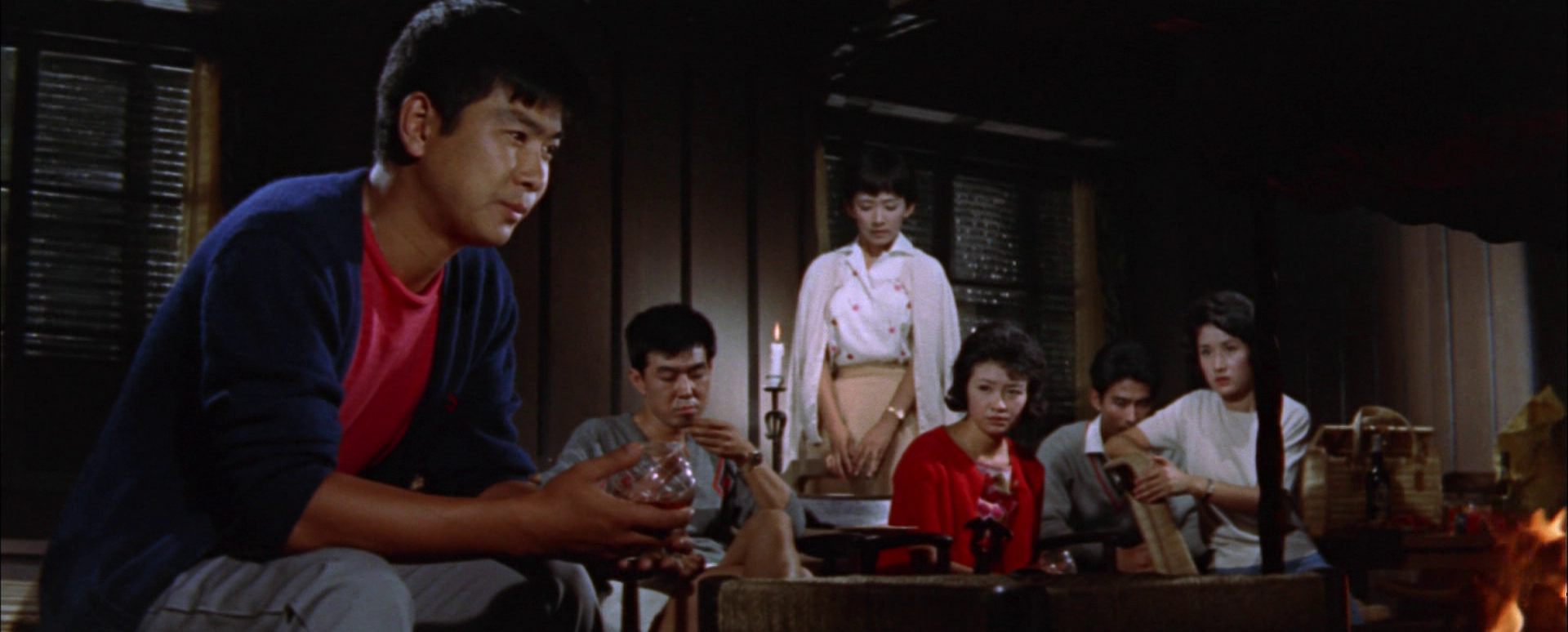
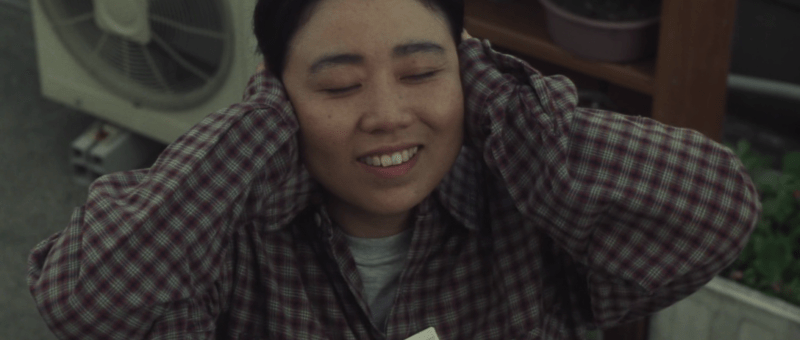
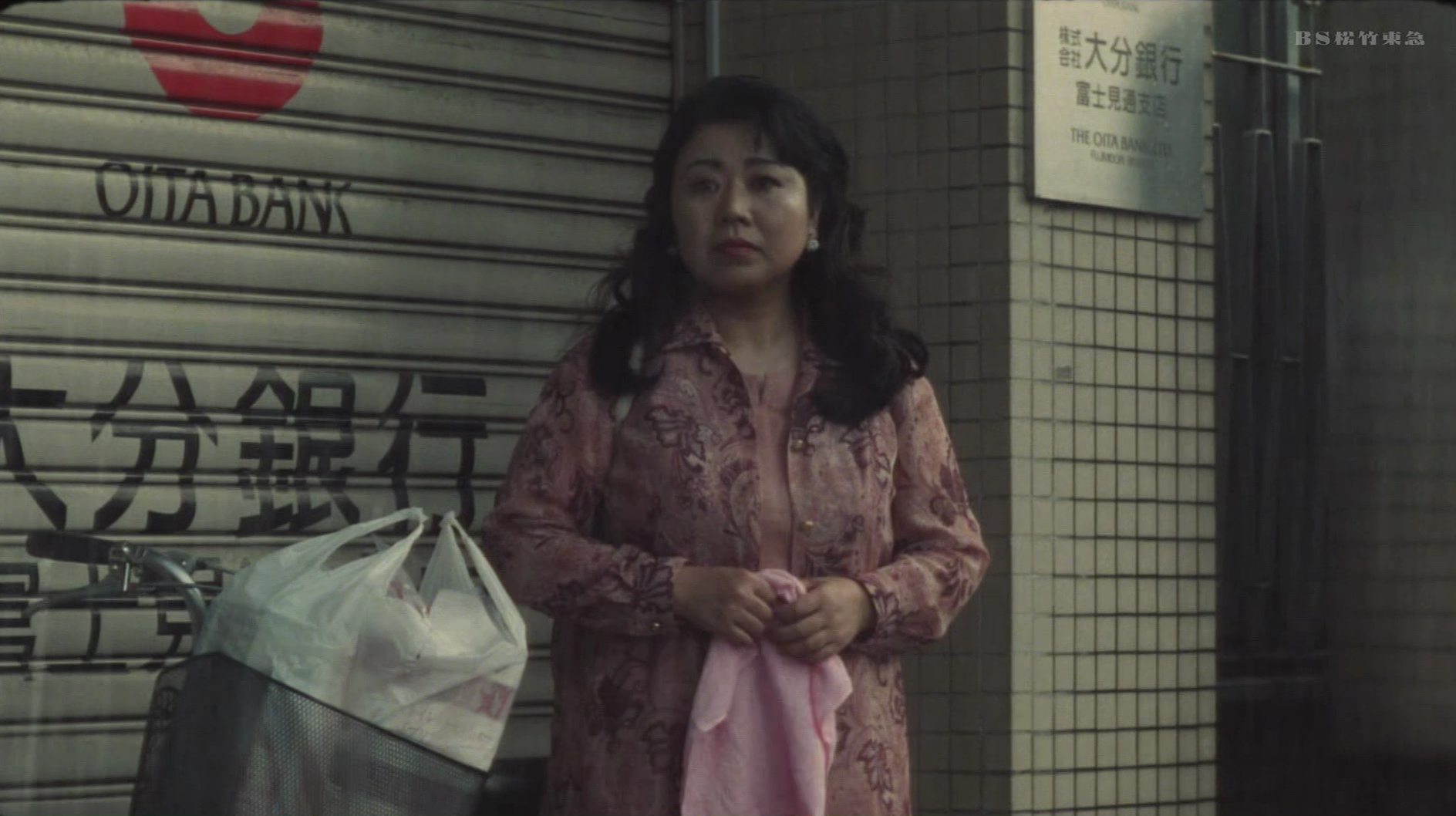
Likely intended as a slightly silly student rom-com, Ko Nakahira’s That Guy and I (あいつと私, Aitsu to Watashi) captures a sense of the changing gender roles and sexual mores of the early 1960s, if through a very male and at times even middle-aged lens. Adapted from a serialised novel by Yojiro Ishizaka and set amid the ANPO protests of 1960, the film is narrated by its heroine, a very ordinary young woman from a typical, moderately wealthy middle-class family, as she struggles with her attraction to a fabulously wealthy young man who pretends to be a boor but is actually a nice guy and unexpected feminist.

One of a new generation of women attending university with a prospect of independence, Keiko’s (Izumi Ashikawa) horizons seem to be broadening. She’s not exactly conservative and openly jokes about sex and dating with her friends, but is quite settled with her life, not particularly wanting anything more than she already has. Her psychology tutor highlights the problem of social inequality in their school that she had already raised in her opening voiceover in remarking that the rich kids all have cars and can drive themselves to school, while others are having to work to support themselves while they study. When he asks how much pocket money they all get, some are outraged and keen to stress they don’t get any help at all, but Keiko reveals that her parents actually give her a healthy allowance. It’s just that she has no real urge to spend it, so it’s been mounting up quietly in a desk drawer in her childhood bedroom while she still lives at home close to the university.

Saburo (Yujiro Ishihara), by contrast, boasts that he gets more than some people’s monthly wage as an allowance from his mother and blows it on drink, gambling, strip clubs and sex workers. It’s this last point that scandalises the female students who are all shocked and disapproving, even going so far as to ask the teacher to throw Saburo out because they don’t feel comfortable sharing a space with a man like that. The teacher also says he’s disappointed and wishes Saburo hadn’t added the last bit, only for Saburo to call him a hypocrite because sex work was legal in his day and he simply doesn’t believe that he’s never paid for sex. Most of the other boys join in on Saburo’s side, insisting that no man sees any problem with visiting sex workers which they regard as a natural right because the male sex drive is driven by “uncontrollable forces”.

But then there’s something unexpected that occurs among the female students in that some of them are obviously attracted by this very rough form of masculinity. “I’d rather have a wild beast than a meek sheep,” one intones, but nevertheless goes to join the group of girls confronting Saburo at the pool in the hope of gaining an apology for the offence he caused them. They’ve since found out that he probably made it up anyway, which is ironic because he claimed he’d only spoken the truth when they asked him to leave, but that’s somehow even worse because it means he said it deliberately to upset them. The upshot of it all is that Saburo ends up in the pool and is then forced to borrow some of the girls’ clothes while his dry off, signalling his awkward positioning between traditional masculinity and femininity in that he’s otherwise surprisingly sympathetic of women and makes sure to look out for them but in a way that encourages their independence and is never patronising. 

That might, in one way, be because of his unusual upbringing which is far more modern and bohemian than Keiko’s and in the beginning, at least, quite confusing for her. Saburo’s mother Motoko (Yukiko Todoroki) is a famous entrepreneur with a beauty shop empire. She writes her name in Western order and uses katakana for her first name which makes look foreign and therefore exciting and sophisticated even though it obviously isn’t. It was Saburo’s mild-mannered father who gave up his career in insurance to raise him, while his mother apparently blows off steam through numerous affairs. His father occasionally gets upset about this and the pair go through a charade of him leaving her while she professes her love for him, which seems to have a sexual dimension in itself. Perhaps this has given Saburo an alternative view of romantic relationships, though we also later discover that he was subject to what we’d now see as a form of sexual abuse as a teenager when his mother got a young but still adult woman, Michiko (Misako Watanabe), to essentially give him practical lessons in sex and satisfy his teenage urges, only he thought it was an organic romantic relationship and feels more than anything else emotionally betrayed. 

But then again, the film has a very of its time and defiantly male view of rape which is dealt with in a fairly flippant manner. Keiko rings her mother to tell her she’s realised that the reason she didn’t like the idea of her being at the ANPO protests was because she feared she’d be raped, which is at any rate an odd conversation to be having. Her mother asks her what her virginity has to do with ANPO, which is a fair question, but also implies that it’s not so much the physical and psychological harm of sexual assault that bothers her mother but the shame of premarital sex. One of the girls who goes to the protest, Ayako (Shigako Shimegi), is actually raped by the two boys she went with who deliberately plied her with alcohol and took her to a hotel knowing that she trusted them, but her roommate, who had a crush on one of the boys, immediately turns against her. Sadako (Kazuko Yoshiyuki), the most political of the students, calls her a slut who parades herself in front of men and says Ayako must have led them on. Only Keiko takes her side, walking her to the bath and waiting outside for her while admitting that she has conflicted thoughts about Saburo. She throws things at him to shoo him away, feeling that his presence as a man is inappropriate and not wanting him to see Ayako in this moment of vulnerability, but also she admits to herself because she’d be jealous and doesn’t want him to see a naked woman that isn’t her.

Something similar happens when she finds out about Saburo’s past and is jealous and resentful of Michiko, irrationally angry with Saburo, and on another level protective of him knowing that happened when he was a teenager was wrong. After she runs out into the rain and the pair argue about it, Saburo forces a kiss on her which, again, Keiko seems like in a show of robust manliness. Saburo is though also protective and sympathetic towards Ayako, insisting that that the way for her to move past her rape is to ensure she becomes financially independent and successful so that she can see it as just something unpleasant that happened to her rather than something that ruined her life or makes her unworthy of another man’s love. He even helps her to do that by getting her a job at his mother’s company. 

Saburo’s mother Motoko, meanwhile, gives Keiko some frank advice in disclosing the secrets of her life and Saburo’s birth. Even when Saburo suddenly announces their engagement without actually asking her, Keiko does not merely swoon but reflects that she’s got to have a proper think before actually agreeing which she is still free to do or not. Nevertheless, the film seems to have hit on a contradiction in redefining masculinity as both tough and soft. Keiko is despite herself attracted to Saburo’s forcefulness, but also his chivalrous nature and awkward kindness, his fair-mindedness and care, and recognition of women as actual human beings with interior lives and a right to independence. Nakahira may be a little less surreal than usual, but leans heavily into absurdity, on the one hand acknowledging the somewhat superficial quality of these privileged students’ lives in having them confront a band of angry rural workers and half-heartedly take part in the ANPO demonstrations without much thought to what they’re for or what they mean, but, in the end, characterises them as merely ordinary, slightly lost amid the rapid changes of the post-war society but otherwise cheerful and looking ahead to a bright future stretching out in front of them.


Trailer (no subtitles)

Dissolution Rites (解散式, Kinji Fukasaku, 1967)

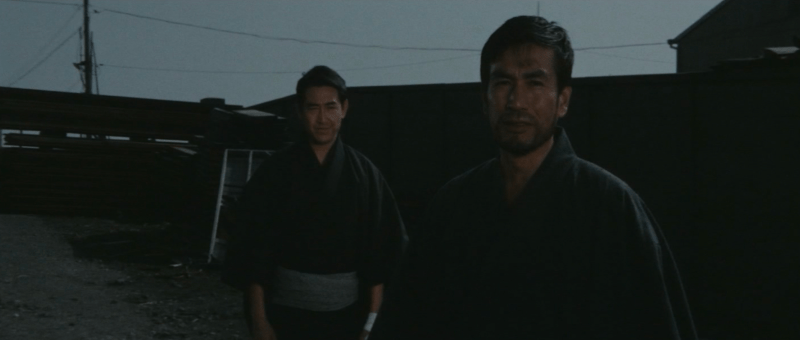
“We’re all legitimate businessmen now” as a former yakuza explains to a recently released foot soldier stepping out into a very different Japan in Kinji Fukasaku’s Dissolution Rites (解散式, Kaisan Shiki, AKA Ceremony of Disbanding). The funereal opening scenes feature the first in a series of dissolution rites as a man dressed in black reads from a scroll and explains that all the local yakuza clans will be disbanding because despite “working day and night for the benefit of the world and humanity in the spirit of democracy” times have changed and they find themselves unnecessary.

There at the beginning of that change, Sawaki (Koji Tsuruta) served eight years in prison for the murder of a rival gang boss to ensure his gang got hold of a local landfill site where they later built an oil complex. While he was inside, his boss died and his clan disbanded leaving him with nowhere to go but thankfully looked out for by an old friend, Shimamura, who has since become a construction magnate. On his arrival at Shimamura’s office, however, he’s ambushed in a suspected case of mistaken identity while the man driving him is killed. 

Shimamura (Fumio Watanabe) tells him he’s gone straight, but it soon becomes clear that even as yakuza forsake the streets for more organised crime they still behave like thugs using the same old tactics to get what they want. Shimamura is in cahoots with a corrupt local politician, Kawashima (Asao Uchida), and is determined to get access to another stretch of bombed out wasteland owned by an egalitarian doctor, Omachi, who refuses to sell because he’s set up a community there of marginalised people, including Sawaki’s former girlfriend Mie (Misako Watanabe), who work on his chicken farm. Meanwhile, Shimamura is targeted by rival “legitimate businessman”, Sakurada (Hosei Komatsu), who pulls a few dirty tricks of his own in an effort to cut Shimamura out of the picture.

Once again Tsuruta plays a man who is out of step with his times, partly because he’s been in prison but also in his fierce commitment to a now outdated code of gangsterdom. “The chivalry that we were taught was just a way for bosses to use their soldiers” Shimumura insists, “you’ll look foolish if you don’t get rid of it”, disingenuously casting his transformation into a legitimate businessman as a way of freeing himself from yakuza oppression. Sawaki turns down his offer to join the business because it seems a bit dodgy while intensely disappointed to discover another former colleague, Kubo (Kyosuke Machida), running a trafficking ring masquerading as a management studio for cabaret singers and strippers by tricking women with the offer of good jobs then getting the hooked on drugs and shipping to them to Okinawa to do sex work near the US bases.  

On his return, Sawaki is also stalked by the man whose arm he severed in killing the rival boss who turn out to be, like him, an old school gangster which is why he insists on his revenge only to find an unexpected kindred spirit as the two men find themselves each adrift in a world in which no one really cares about humanity and honour. Sakai (Tetsuro Tanba) chooses to walk a different path, conducting his disbandment ceremony in protest of yakuza corruption. Like many Tsuruta heroes, Sawaki also has the possibility of walking away and living a conventional family life as a husband and father having been forgiven by Mei but inevitably is pulled in a darker direction by the necessities of his code. The oil complex he helped to create is only a symbol of the duplicities of the post-war society allowing men like Shimamura to get rich while literally choking the life out of those like Mei whom they now want to kick out of her home to add insult to injury. 

There’s no one more tragic than a yakuza Sawaki admits, knowing there is no longer any place for him in an amoral gangster society while unable to simply leave it and enjoy a quiet life with the woman he loves. An indictment both of corporatised yakuza and the equally duplicitous practices of “legitimate” businesses and corrupt authorities, the film ends in another righteous assault filmed handheld with Fukasaku’s characteristically canted angles amid the chaos and confusion of a rapidly changing society. 

Endless Desire (果しなき欲望, Shohei Imamura, 1958)

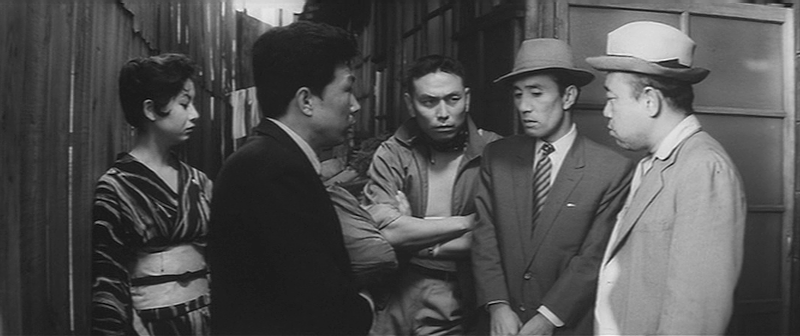
In the noir films of the immediate post-war era, the protagonists are often haunted by an inescapable past that prevents them from moving on into the new democratic Japan. But in Shohei Imamura’s Endless Desire (果しなき欲望, Hateshinaki Yokubo) the situation is ironically reversed as a group of former soldiers who on the surface of things at least seem to have made moderately successful lives for themselves reunite to dig up buried treasure from the dying days of the war greedy for a little more glamour than the world has seen fit to show them.

Their venal amorality is directly contrasted with the bumbling earnestness of Satoru (Hiroyuki Nagato), a young man who fears his childhood sweetheart, butcher’s daughter Ryuko (Sanae Nakahara), is going to marry another man because he is unemployed and cannot find a job in the still difficult if steadily improving post-war economy. As such, he’s incredibly excited by the opportunity to get into the real estate business, wandering around town dressed in a suit and carrying a briefcase to scout properties or otherwise doing odd jobs for the gang, which is a shame because unbeknownst to him the business is a sham set up as a front by the crooks who’ve rented a vacant shop from Satoru’s land shark dad so they can tunnel their way to the treasure which they think is buried under Ryuko’s butcher’s shop. 

The changing nature of the times is rammed home by the fact that the shopping district, which stands atop the site of the former military hospital where the gang buried a barrel full of stolen morphine at the end of the war ten years previously, is itself about to be torn down. Effectively a post-war shantytown, the area is now ripe for redevelopment with the economy beginning to bounce back thanks to the stimulus of the Korea War. The post-war era is not quite “over”, but it’s definitely on its way out which makes the gang’s determination to recover the stolen morphine all the more ironic especially as the market for hard drugs may not be as a lucrative as it once was not to mention to the logistical difficulties of turning it into cash. 

Nevertheless, the desire for it immediately sets the gang against each other. The problem is that the lieutenant, Hashimoto, who set the whole thing up has apparently died and extra person has turned up to claim some of the loot despite the gang members having been told there should only be three of them. They were not particularly close in the war and cannot exactly remember each other while Hashimoto had them all work separately without knowing who else was on board so they don’t even know which one of them is the potentially uninvited guest. Meanwhile, the presence of a woman, Shima (Misako Watanabe), who claims to be Hashimoto’s sister sets them all on edge with masculine jealously as she sometimes gleefully plays the femme fatale later even trying to seduce the innocent Satoru, convincing him she’s a victim of domestic violence in need of rescue in an attempt to quiet his concerns over what might be going on at the shop. 

The fact is that none of the gang members can really claim to be desperate, all are simply greedy and selfish silently plotting to keep all the money for themselves rather than share it. One of them is eventually crushed under the barrel, an embodiment of their insatiable desire, but with their dying breath insists it’s theirs and no one else can have any. As old man later says, this kind of greed only leads to a bad end unlike the greed he’s patiently practiced over decades which seems to be taking a little here and there where you find it such as asking Shima for some extra money for “helping” her before asking the police about a reward and turning her in anyway.

Even Satoru’s dad is “greedy”, renting the crooks a shop he new would soon be knocked down and then complaining when his tenants try to take the tatami mats and shoji doors they’d paid for themselves out of his property. Greed maybe the way of the world, at least for those who unlike the diffident Satoru do not lack for self-confidence, but endless desire has only one reward. Darkly comic and often deeply ironic, Imamura plays with a noirish sense of fatalistic retribution but finally returns to a sense of childish innocence in the bumbling courtship of Satoru and Ryuko who may be her own kind of femme fatale playing two suitors against each other while refusing to be dominated by any man but nevertheless riding off into the sunset on her bicycle with a diffident Satoru chasing along behind her.


Being Two Isn’t Easy (私は二歳, Kon Ichikawa, 1962)

With the Olympics still two years away, the Japanese economy had begun to improve by 1962 and the salaryman dream was on the horizon for all. But for young couples trying to make it in the post-war society things were perhaps far from easy and having more to want coupled with the anxieties of a newly consumerist society only left them with additional burdens. A surprisingly moving evocation of the cycle of life, Kon Ichikawa’s Being Two Isn’t Easy (私は二歳, Watashi wa Nisai) is as much about the trials and tribulations of its toddler hero’s parents as they try to navigate their new roles in a world which now seems fraught with potential dangers. 

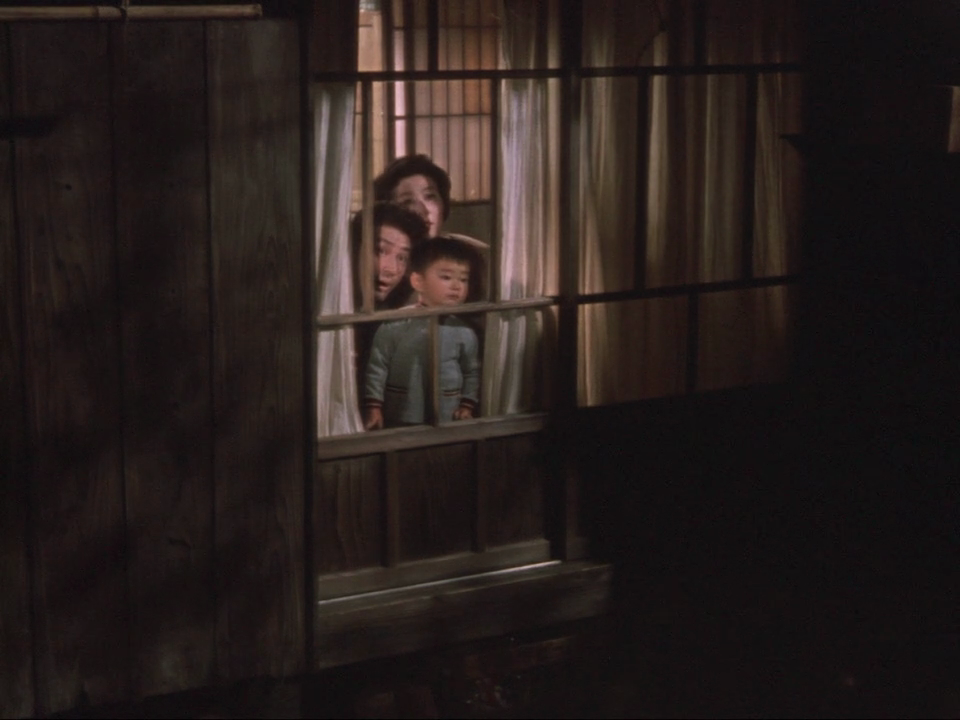
This difference in perspective is brought home in the opening sequence in which soon-to-be two Taro (Hiro Suzuki) recalls his own birth in a slightly creepy voiceover, lamenting his mother cooing over him excited that he is smiling for her though he is not yet able to focus and has no idea the vague shadow above him is his mother or even what a mother is. His smiling is simply involuntary muscle contraction as he learns how to manipulate his body. Nevertheless, little Taro is a definite handful taxing his poor mother Chiyo (Fujiko Yamamoto) with frequent attempts to escape, managing to get out of the apartment and start climbing the stairs the instant she’s turned her back. “Always finding fault, that’s why grown-ups are unhappy” Taro complains, irritated that even though he’s quite proud of himself for figuring out not only how to undo the screws on his playpen but the string his parents had tied around it for extra protection, he’s not received any praise or congratulation and it feels like they’re annoyed with him. 

The landlord alerted by the commotion somewhat ironically remarks that “Japanese houses are best for Japanese babies” (being at least usually all on one level even if they also sometimes have their share of dangerously precipitous staircases), implicitly criticising the new high rise society. There do indeed seem to be dangers everywhere. Another baby playing on the balcony eventually falls because the screws are rusty on the railings only to be caught by a passing milkman in what seems to be an ironic nod to the film’s strange fascination with the new craze in cow’s milk to which Taro’s father Goro (Eiji Funakoshi) attributes Westerners’ ability to grow up big and strong. Taro does seem to get sick a lot, the doctor more or less implying that his sickliness is in part transferred anxiety from an overabundance of parental love. Visited by her older sister who lives on a farm in the country and has eight children, Chiyo becomes broody for a second baby (though not another six!) but Goro isn’t so sure, not just because of the additional expense or the fact that their danchi apartment is already cramped with the two of them and a toddler, but reflecting that he already lives in a world of constant fear why would you want to double it worrying about two kids instead of one?

Nevertheless, Goro is certainly a very “modern” man. He helps out with the housework and is an active father, taking on his share of the childcare responsibilities and very invested in his son. He accepts that his wife also “works” even if he also insists it’s not the same because she doesn’t have to bow to Taro and is not subject to the petty humiliations of the salaryman life. Tellingly, this changes slightly when the couple end up leaving the danchi for a traditional Japanese home to move in with Goro’s mother after his brother gets a job transfer. Grandma (Kumeko Urabe) is actively opposed to him helping out around the house, viewing it as distasteful and unmanly not to say a black mark against Chiyo for supposedly not proving up to her wifely duties. Living with Grandma also introduces a maternal power struggle under the older woman’s my house my rules policy which extends to criticising Chiyo’s parenting philosophy not to mention refusing to trust “modern technology” by insisting on rewashing everything that’s been through the washing machine by hand.

Yet when Taro becomes sick again it’s perhaps Grandma who has a surprisingly consumerist view of medical care. Exasperated by the couple’s failure to get Taro to take his medicine she offends the doctor by insisting on him having an injection as if you haven’t really been treated without one. Eventually she takes him to another clinic where they get on a conveyor belt of doctoring, rushed through from a disinterested receptionist to a physician who yells “bronchitis” to a nurse who violently sticks the baby in the arm. After that Taro vows never to trust grown-ups, though Grandma only gives in when she realises injections are not an instacure and didn’t do any good. 

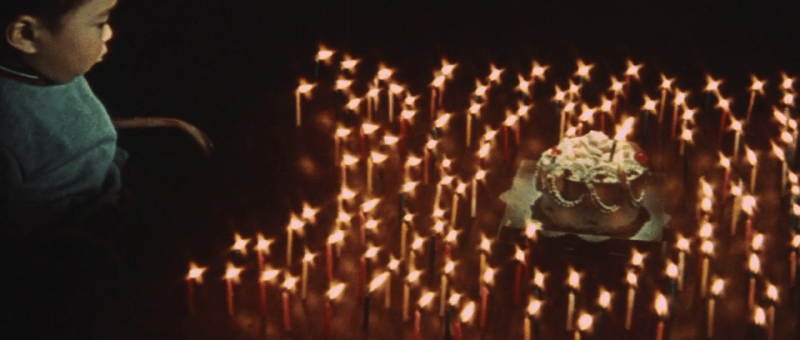
For all that however there’s a poignancy in Taro’s reflecting on his birthday cake with its two candles that Grandma’s must have many more and in fact be brighter than the moon with which he has a strange fascination. He’s just turning two. He used to be a baby but now he’s a big boy and soon he’ll be a man. Goro reflects on time passing, for the moment he’s a father but might be a grandad soon enough. The wheel keeps turning which perhaps puts the hire purchase fees on the TV he bought to keep Grandma occupied and out of the way into perspective. From the experimental opening to the occasional flashes of animation and that banana moon, Ichikawa paints a whimsical picture of the post-war world as seen through the eyes of a wise child but ironically finds a wealth of warmth and comfort even in an age of anxiety.


Bread of Happiness (しあわせのパン, Yukiko Mishima, 2012)

“Plain bread is nice too” a short-term visitor concedes having reached an epiphany after a few days’ stay at Cafe Mani in Yukiko Mishima’s slice of comfort cinema, Bread of Happiness (しあわせのパン, Shiawase no Pan). Perhaps in its own way a reaction to the devastating earthquake and tsunami of the previous year which is referenced in the closing arc, Mishima’s drama is one of a series of films from the 2010s advocating for a simpler life built on empathy and mutual compassion as a bulwark against the increasing disappointments of a relentlessly consumerist society. 

The heroine, Rie (Tomoyo Harada), was a lonely child who buried herself in a fantastical children’s book about a little boy, Mani, who was best friends with the Moon. Touched by Mani’s words when the Moon asked him to take down the sun because its brightness made his life unbearable that “what matters most is that it shines on you and that you shine on others”, Rie resolved to find her own Mani but has long since given up. She and her her husband Mizushima (Yo Oizumi) have recently relocated to a Hokkaido ranch where they run a cafe bakery that has quickly become a community hub tending to the wounded souls of the local area and sometimes even beyond. 

The urban/rural contrast is rammed home by the couple’s first guest, Kaori (Kanna Mori ), a young shop girl from Tokyo who was supposed to be going to Okinawa with her boyfriend but he stood her up and she’s come to Hokkaido instead. Although originally grumpy and sullen, Kaori begins to warm to the charms of rural life complaining that in Tokyo people have to force themselves to smile. Her words accidentally hurt the feelings of local boy Tokio (Yuta Hiraoka), conversely jealous of big city opportunity but lacking the courage to strike out from his small-town life in which ironically enough he works as a points switcher at the local railway. What Kaori learns through her various experiences and the kindness of the Mizushimas isn’t that country life is better just that small happinesses are often all you need, there is pleasure in simplicity, and there’s no need to submit herself to the pretentiousness of city life explaining that she’s going to tell her coworkers the truth about her Okinawan holiday and bring some of the wholesome homemade bread back for them too. 

But then, it isn’t always so easy as the couple discover trying to help a sad little girl in the wake of marital breakdown. In a slightly surprising twist, Maki (Yuki Yagi) has been abandoned by her mother who has left the family and is struggling to accept both her loss and the change in circumstances which goes with it. The dilemma revolves around a bowl of pumpkin soup which Maki refuses to eat despite having previously longed to taste her mother’s signature dish. The realisation she comes to is that something can be different but that doesn’t make it bad, bonding with her equally dejected father (Ken Mitsuishi) thanks to the gentle support of the Mizushimas who seem to have a knack for knowing just what everyone who comes through their door needs. 

That goes double for the elderly couple who turn up late one night in the dead of winter, husband Fumio (Katsuo Nakamura) worryingly explaining that they’ve lived long enough, that while you’re young you still have the possibility of change, of becoming “a different you”, but old age has no further possibility nor the ability to change. Having lost their daughter in the tsunami the old couple are trapped in an inertia of grief from which they are gradually awakened by the gentle care of the Mizushimas and the sight of the beautiful moon that shines down on Cafe Mani. 

Rie meanwhile remains privately dejected, longing for her own Mani but convinced she’ll never find him only to realise he’s been there all along. Just like the words in the picture book, Rie and Mizushima have resolved to be the light, Fumio later sending them a letter claiming that they have discovered the ideal form of happiness in their simple life doing as they please surrounded by friends who have already become family and offering love and support to all who come through their doors through the medium of delicious seasonal food. With a host of quirky side characters including an omniscient glass blower (Kimiko Yo), genial postie (Chikara Honda), farmers with an ever expanding family, and a regular customer who carries a mysterious trunk around, while narrated (seemingly) by a sheep with the voice of a child Mishima’s gentle drama is foodie pure comfort cinema in which good bread and a warm fire may yet save the world.


Bread of Happiness until 27th February in several territories as part of Japanese Film Festival Online 2022.

Original trailer (English subtitles)

The Wife of Seishu Hanaoka (華岡青洲の妻, Yasuzo Masumura, 1967)

The close relationship between two women is disrupted by the reintroduction of a man in Yasuzo Masumura’s fictionalised account of the rivalry between the wife and mother of pioneering Japanese doctor Seishu Hanaoka. Scripted by Kaneto Shindo and adapted from the novel by Sawako Ariyoshi, the refocusing of the narrative is apparent in its title, not the life of but The Wife of Seishu Hanaoka (華岡青洲の妻, Hanaoka Seishu no Tsuma) less a tale of scientific endeavour than of domestic rivalry born of the inherently patriarchal social codes of the feudal society which cannot but help pit one woman against another while forcing each of them to play a role they may not wish to fulfil in order to secure their status and therefore their survival. 

Samurai’s daughter Kae (Ayako Wakao) first catches sight of the beautiful Otsugi (Hideko Takamine) at only eight years old and is instantly captivated by her, a fascination which persists well into adulthood when she is approached to marry into the Hanaoka household as wife to oldest son Seishu (Raizo Ichikawa) away studying to become a doctor like his father. Kae’s father originally objects to the match because of the class difference between the two families, Seishu’s father Naomichi (Yunosuke Ito) being only a humble country doctor of peasant stock whereas they had envisaged a grander station for their only daughter. Yet Kae is already old not to be married and continues to decline prospective suitors and so her mother and nanny (Chieko Naniwa) are minded to put it directly to her discovering that she is in fact more than willing to become a Hanaoka though mostly it seems in order to get close to Otsugi whom she has continued to idolise. 

The strange thing is that the wedding is conducted in Seishu’s absence, a medical text standing in for him while Kae in effect marries her mother-in-law Otsugi. These early days are spent in blissful tranquility as Kae does her best to be the ideal daughter-in-law, Otsugi even remarking that she’s come to love her more than a daughter. The two women share a room, Kae often staring longingly at the back of Otsugi’s head, their relationship one of mutual respect and affection that allows them to forget their respective stations but when three years later Seishu finally returns, it forces them apart in reverting to the roles of wife and mother their statuses conferred only by proximity to a man. 

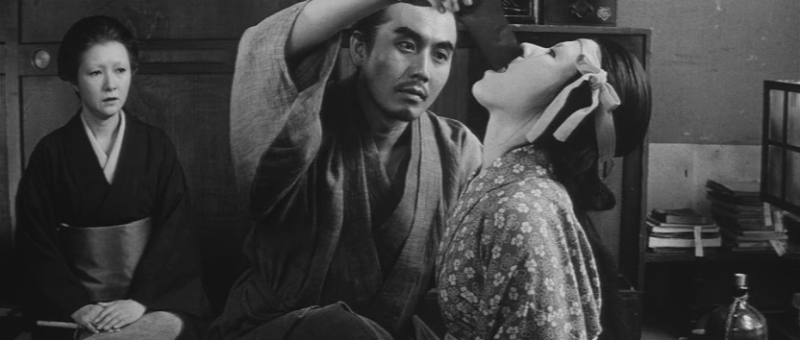
Pregnant with her first child and about to become a mother herself, Kae’s resentment towards Otsugi begins to boil over. In an ironic premonition of the way the relationship between Masumura and his muse would eventually break down, she claims to have seen through Otsugi’s beauty and concluded that she is cold and calculating believing that she only brought her into the household as an unpaid servant forcing her to work a loom to raise money for Seishu’s medical training. Alternately jealous and condescending, Otsugi’s resentment is mediated through attempts to undermine her daughter-in-law’s authority finally leading to an ironic and absurdist battle between the two as they attempt to outdo each other volunteering to become test subjects for Seishu’s ongoing experiments to discover a safe anaesthetic in order save patients who require surgery but cannot endure the trauma. 

The marriage itself perhaps represents a moment of change in the feudal society, it becoming clear that the samurai are on their way down while skill and knowledge will define success in this new age of enlightenment. While Seishu works on his anaesthetic, the superstitious local community begins to view the Hanaokas with suspicion, believing that the misfortune that befalls them is the result of a curse owing to the large number of cats and dogs which have become casualties of Seishu’s failed experiments while a pedlar brings news of a mysterious disease attributed to the rain which is in fact due to mass malnutrition following a famine caused by the bad weather. When news of Seishu’s prowess as a doctor spreads they are soon overwhelmed with patients, many of whom cannot pay but are seemingly treated anyway. 

Seishu’s eventual victory is one of science over superstition, but it also requires faith which is the battleground contested between wife and mother. Having found a successful solution in cats, Seishu needs human test subjects with both instantly volunteering only to become locked into an absurd, internecine contest to prove who is the most self-sacrificing. The competition goes so far that it effectively becomes a game of dare with each determined to be the one to die for Seishu’s discovery but later realising that the stakes are even higher than first assumed because the winner will be dead but the loser saddled with guilt and possible ostracisation as someone who allowed their mother/daughter-in-law to die to in their place. 

Even so, the pair of them are described as “wonderful examples of womanhood” in their willingness to risk their lives for their “master’s success”. Kae is reminded that a woman’s job is to give birth to a healthy baby, later weaponising her ability to do so as currency in realising that Otsugi has all the control but the one thing she can’t do is bear Seishu’s child. Ironically enough, the cases Seishu is trying to treat are of aggressive breast cancer, the oft repeated maxim being that a woman’s breasts are her life and to remove them is as good as killing her contributing to the sense that maternity is the only thing that gives a woman’s life meaning. It’s not without irony that the first successful surgery under anaesthesia directly juxtaposes a massive tumour removed from a woman’s breast with a baby being removed from a pregnant Kae who, at this point having lost her sight as a consequence of Seishu’s experiments, must bear the pain with no relief. 

Brought together by tragedy, Kae comes to a better understanding of her relationship with her mother-in-law only after she dies learning to see her once again as the kind and beautiful woman she met at eight years old while her unmarried sister-in-law having witnessed their painful war of attrition prays that she won’t be reborn as a woman glad that she was never forced to become a bride nor a mother-in-law. “The struggles of the women in this house were in the end just to bring up one man” she laments, suggesting that Seishu most likely noticed the conflict between the two and used it to his advantage in getting them to participate in his experiments as they desperately tried to prove themselves the better through dying for his love. 

Going one step further, it seems that being a woman is an exercise in futility the only source of success lying paradoxically in birth or death alone, the natural affection between Otsugi and Kae neutered by the presence of Seishu who inserts himself as the pole around which they must dance for their survival. Kae becomes a local legend, a woman who sacrificed her sight in service of her husband but now rejects this mischaracterisation of her life along with the implication that it’s somehow a wife’s duty to deplete herself for her husband’s gain retreating entirely from the society of others while Seishu’s practice continues to prosper. Even so Masumura ends on a note of irony in the literal transformation of Kae into the figure of Otsugi recreating the opening scene as she walks among the bright flowers she can no longer see.


Original trailer (no subtitles)

Temptation (誘惑, Ko Nakahira, 1957)

Ko Nakahira made his name with the seminal Sun Tribe movie Crazed Fruit, a nihilistic tale of bored, affluent post-war youth. Released a year later, Temptation (Yuwaku), adapted from a novel by Sei Ito, is in some ways its inverse pitting a melancholy widower harping on dreams of lost love against his relentlessly practical daughter for whom “Sex is life. Art is money” but finding in the end perhaps more commonality than difference save for the fact the youth of today may have no real dreams to betray. 

Now 55 years old, Sugimoto (Koreya Senda) is the proprietor of the Sugimoto Dried Goods store in upscale Ginza. Father to an only daughter, Hideko, now that his wife has passed away he finds himself carried back towards the past and is planning to turn the upstairs space in the store into a small gallery. For her part Hideko (Sachiko Hidari) and her coterie of artist friends are hoping to convince him to allow them to exhibit in the gallery for cheap, but he, slightly more conservative in his old age, views them all as low class Bohemians and fails to understand why Hideko hangs out with them in the first place. He has, it seems, an internal conflict symbolised by the beret he’s taken to wearing in which he is unable to let go of the broken dreams of his youth when he was a struggling artist forced to give up his first love, Eiko (Izumi Ashikawa), because he had no money or prospects while she eventually consented to an arranged marriage.  

The world of 1931 being very different, Sugimoto and Eiko never did anything beyond holding hands (later a key plot point), though in her parting letter she laments that she regrets not having let him kiss her and mildly berates him for not having been more forceful. A slightly uncomfortable sentiment, but diffidence seems to be the force defining Sugimoto’s life. At the store he finds himself dissatisfied with his senior salesgirl Junko (Misako Watanabe) whose brusque manner with customers and refusal to wear makeup he fears are harming sales, but is unable to say anything until his rather half-hearted attempt to talk to her provokes a mutual misunderstanding, he thinking she may be anxious about being fired and she wondering if he’s about to make a proposal. 

For unclear reasons, Junko seems to have a crush on Sugimoto, something which becomes a minor problem when he also becomes a target for Kotoko (Yukiko Todoroki), a middle-aged woman/insurance agent from Hideko’s floral arrangement class. Privy to their interior monologues, we can hear the two women squaring off against each other, Junko complaining that Kotoko is “meddling, talkative, and fat”, while Kotoko fires back that Junko wears “no makeup at all and is so stuck up” as they glare at each other through the shop window. Yet it’s not Sugimoto who eventually provokes a change in Junko, but another eccentric, struggling artist, Sohei (Shoji Yasui), who bluntly tells her that she is pretty and so should put some makeup on to bring it out. 

Junko later characterises this intervention as an act of salvation that sees her re-embrace her femininity, not only wearing makeup and having her hair styled but beginning to talk warmly with customers, improving the business but ironically giving Sugimoto the mistaken idea her friendly new demeanour may be partly for his benefit. For his part, Sohei, an unkempt artist suffering a seemingly permanent lice infestation, claims not to have cared very much about money or possessions which led him to accidentally abuse the generosity of his artist friends but has now been awakened, it seems, to a kind of consumerist mentality thanks to the interest of Junko and recognition of his art when some of Sugimoto’s old friends (well known artists Taro Okamoto, Seiji Togo, and critic Kimihide Tokudaiji) praise his paintings on seeing them in the gallery leading to them fetching a high price from prominent collectors. 

“The value of a work of art hinges on whether or not it sells” one of Hideko’s friends points out while she adds “We should be proud that art is profitable”, a sentiment that hugely offends Shohei (Ryoji Hayama), the beret-wearing leader of another artist circle the gang enlist to help them pay for the rental of the gallery. Though he concedes to Hideko’s argument that her father’s gallery is a business enterprise, not a charity, Shohei is somewhat horrified by the casual equation of art and commerce, shocked that the girls view their flower arranging as a practical more than an aesthetic skill. Still, in another irony it turns out that his talent is for business rather than art, shrewdly steering Sohei’s success rather than his own when it’s clear his work is the standout in the gallery. Just like Sugimoto had, he eventually resolves to give up his artistic dreams after falling in love with Hideko, planning to marry into her family and take over the Sugimoto store. She meanwhile, had described him as not good marriage material, “no poor painters for me, only rich men” but is apparently in favour of his selling out if only in that it ironically makes him more himself. 

As we discover there are more than a few reasons besides the beret that Sugimoto keeps feeling Shohei reminds him of someone else even as he finds himself wary of him, pointlessly trying to set Hideko up with someone more “suitable” just as she makes a point of inviting a series of alternative widowed, middle-aged ladies to the gallery opening not so much because she particularly objects to Kotoko but she’s worried her dad might get bamboozled into something without properly surveying his options. While Sugimoto remains maudlin and filled with regret though perhaps putting the past aside through a symbolic act of closure, the youngsters are cheerfully cynical, practical in the way the older generation are always telling them to be but are perhaps disappointed in them for not having dreams or aspirations beyond those of claiming or maintaining or their chosen status in life. “Art is money” Hideko is fond of saying, and it’s true enough in so much as money is an art and the one which seems at least to have captivated the post-war generation eagerly awaiting the advent of the consumerist revolution. 


Sasuke and His Comedians (真田風雲録, Tai Kato, 1963)

Criminally unknown in the Anglophone world, where Tai Kato is remembered at all it’s for his contribution to Toei’s ninkyo eiga series though his best known piece is likely to be post-war take on High Noon made at Shochiku, By a Man’s Face Shall You Know Him in which a jaded doctor finds himself caught in the middle of rising tensions between local Japanese gangsters and Zainichi Koreans. Kato’s distinctive visual style shooting from extreme low angles with a preference for long takes, closeups and deep focus already make him an unusual presence in the Toei roster, but there can be few more unusual entries in the studio’s back catalogue than the wilfully anarchic Sasuke and his Comedians (真田風雲録, Sanada Fuunroku), a bizarre mix of musical comedy, historical chanbara, and ninja movie, loosely satirising the present day student movement and the limits revolutionary idealism. 

An opening crawl introduces us to the scene at Sekigahara, a legendary battle of 1600 that brought an end to Japan’s warring states period and ushered in centuries of peace under the Tokugawa. Onscreen text explains that this is the story of the boys of who came of age in such a warlike era, giving way to a small gang of war orphans looting the bodies of fallen soldiers and later teaming up with a 19-year-old former samurai realising that the world as he knew it has come to an end. Soon the gang is introduced to the titular Sasuke who, as he explains, has special powers having been irradiated during a meteor strike as a baby. Recognising him as one of them, the war orphans offer to let Sasuke join their gang, but he declines because he’s convinced they’ll eventually reject him in fear of his awesome capabilities. Flashing forward 15 years, the kids are all grown up and the only girl, Okiri (Misako Watanabe), is still carrying a torch for Sasuke (Kinnosuke Nakamura) who dutifully reappears as the gang find themselves drawn into a revolutionary movement led by Sanada Yukimura (Minoru Chiaki) culminating in the Siege of Osaka in 1614. 

Don’t worry, this is not a history lesson though these are obviously extremely well known historical events the target audience will be well familiar with. A parallel is being drawn with the young people of early ‘60s Japan who too came of age in a warlike era and who are now also engaging in minor revolutionary thought most clearly expressed in the mass protests against the ANPO treaty in 1960 which in a sense failed because the treaty was indeed signed in spite of public opinion. Kato’s Sanada Yukimura is a slightly bumbling figure, first introduced banging his head on a low-hanging beam, wandering the land in search of talented ronin to join up with the Toyotomi rebellion against the already repressive Tokugawa regime. His underling sells this to the gang as they overlook a mile long parade of peasants headed to Osaka Castle as a means of bringing about a different future that they can’t quite define but imply will be less feudal and more egalitarian which is how they’ve caught the attention of so many exploited farmers. 

Of course, we all already know how the Siege of Osaka worked out (not particularly well for anyone other than the Tokugawa) so we know that this version of the 16th century better world did not come to pass the implication being that the 1960s one won’t either. The nobles are playing their own game, the Toyotomi trying to cut deals but ultimately being betrayed, while the gang fight bravely for their ideals naively believing in the possibility of victory. Sasuke, for his part, is a well known ahistorical figure popular in children’s literature and this post-modern adventure is in essence a kids’ serial aimed at a student audience, filled with humorous anachronisms and silliness while Kato actively mimics manga-style storytelling mixed with kabuki-esque effects. Boasting slightly higher production values than your average Toei programmer, location shooting gives way to obvious stage sets and fantastical set pieces of colour and light which are a far cry from the studio’s grittier fare with which Kato was most closely associated. That might be one reason that the studio was reportedly so unhappy with the film that it almost got Kato fired, but nevertheless its strange mix of musical satire and general craziness remain an enduring cult classic even in its ironic defeatism. 


Original trailer (no subtitles)

Hungry Soul / Hungry Soul, Part II (飢える魂 / 続・飢える魂, Yuzo Kawashima, 1956)

When you think of the family drama, you think of a young woman getting married and that her marriage is an unambiguously good and righteous thing despite the pain it may bring to her parents who will obviously miss her yet must comfort themselves that they’ve done everything right. In melodrama, however, we get quite a different picture of the “modern” marriage in which it is not quite so unambiguously good or righteous but a patriarchal trap enabled by a kind of gaslighting which tells women that suffering is the natural condition of life and that they should wear their unhappiness as a badge of honour.  

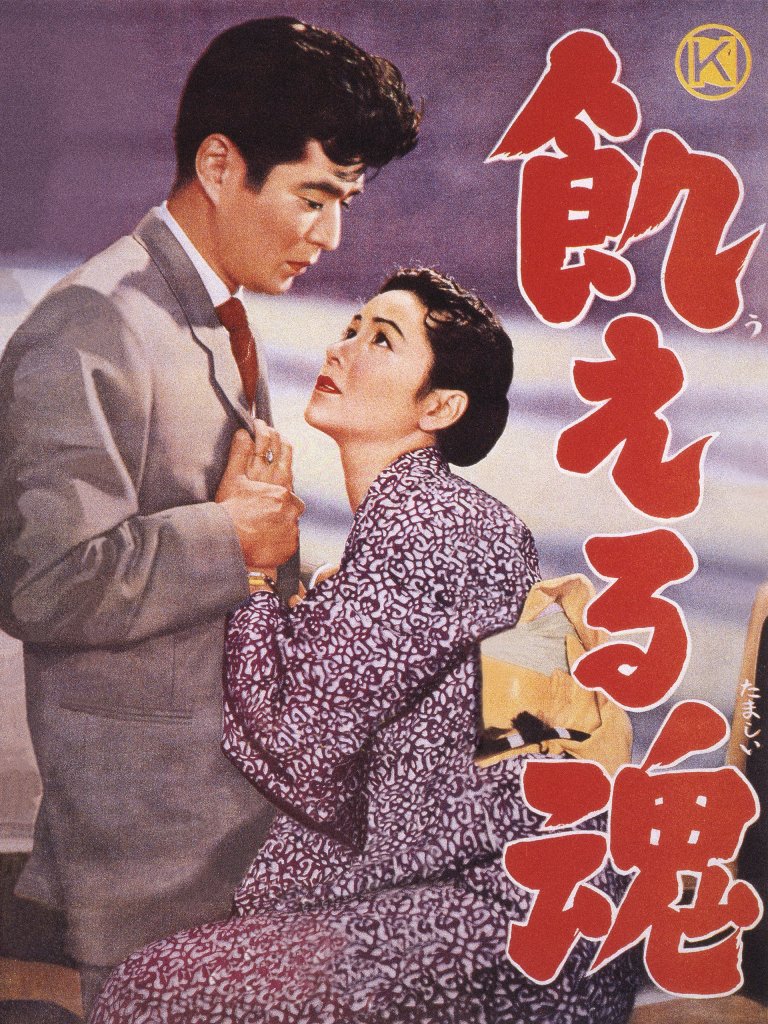
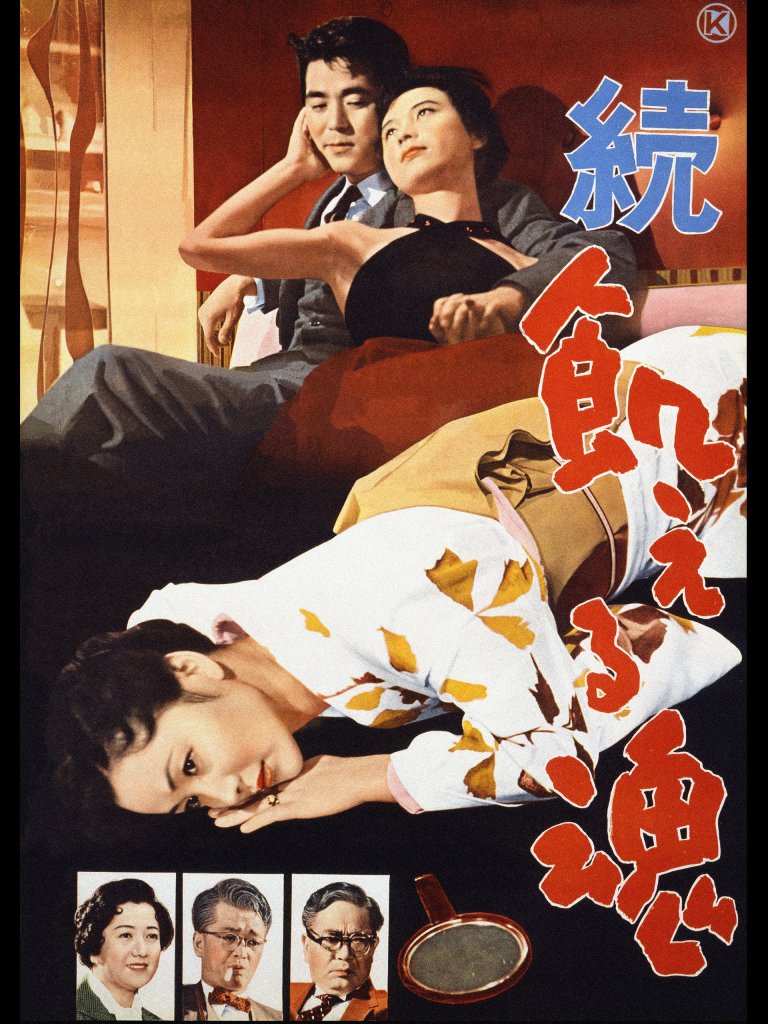
Nowhere does this seem truer than in the films of Yuzo Kawashima who in general takes quite a dim view of romance as a path to freedom and finds his heroines struggling to escape outdated social codes to seize their own freedom. Hungry Soul (飢える魂, Ueru Tamashii) finds one still comparatively young woman and another middle-aged discovering that they want more out of life than their society thinks a woman is supposed to have but continuing to wrestle with themselves over whether or not they have the right to pursue their personal happiness in a rigidly conservative society. 

Reiko (Yoko Minamida), a woman in her early 30s, married Shiba (Isamu Kosugi), 23 years her senior, 10 years previously apparently out of a mix of youthful naivety and post-war desperation. Shiba has supported her financially and apparently enabled her brother’s career, but it’s clear that he thinks of her as little more than a glorified housemaid, treating her with utter contempt even in public. He makes her carry her own bags at the station rather than wait for a porter and forces her to accompany him on business trips where he shows her off to colleagues and then retires her to the hotel with nothing to do all day. Tyrannised, Reiko has been been raised to be obedient and does her best to be a good wife, but Shiba repeatedly reminds her that he bought her while openly talking about his relationships with other women even at one point bringing a geisha home with him while Reiko cringes in the front seat next to the driver. 

Perhaps what she’s learning is that obedience is not an unambiguously good quality, but still she struggles to let go of the necessity of measuring up to the standards of social propriety. When Shiba unwittingly introduces her to handsome politician Tachibana (Tatsuya Mihashi), her accidental attraction to him awakens her to all the ways her married life is a hell of disappointment. Shiba reminds her that he keeps her in comfort, little understanding that she may hunger for something more than the material, while Reiko realises that she may starve to death for lack of love but has been conditioned to think that a woman’s emotional needs are not only unimportant but entirely taboo. 

Mayumi (Yukiko Todoroki), meanwhile, has known love but feels obliged to live on the memory of her late husband and fulfil herself only though caring for her two teenage children. To do that, paradoxically, she has seized her independence as a working woman with a job in real estate, later hoping to manage a ryokan traditional style hotel, only for her children to resent her perceived rejection of motherhood in favour of individual fulfilment. “School is for people who have two parents” her son tells her, threatening to move out into a dorm, while her daughter at one point considers suicide simply because she suspects her mother may be sleeping with her late father’s best friend. 

In Reiko’s case, her desire for liberation is kickstarted by a hunger for love, though as we later realise Tachibana is also perhaps looking to break with the past and with conventional male behaviour in that he has been a womanising playboy involved in relationships with women from the red light district which to him were always casual while they, like Reiko and Mayumi, longed for more. Mayumi’s relationship with Shimozuma (Shiro Osaka), by contrast, is complicated by the fact he is married to a woman with a long-term illness, though what he craves (besides Mayumi herself for whom he seems to have been carrying a torch for many years) is a conventional family home, jokingly chiding Mayumi that her interest in business may be making her less “womanly”.  

Both women try, and fail, to break free of patriarchal control to claim their own agency, discovering that romance is not the best way to find freedom. Despite her love for and possibly misplaced faith in Tachibana, Reiko is both too brutalised by her abusive husband and constrained by the taboo of being a woman ending a marriage for another man to definitively escape Shiba’s control. Mayumi, meanwhile, is shamed by the reflection of herself in her children’s eyes and motivated to reassume her maternity but does so also as a way of rejecting easy romantic fulfilment in the hope of discovering more of herself as a middle-aged woman embracing all the freedom that might offer while her children, though grateful to have her return to them, are also chastened and guilty in having realised that their mother is a woman too and ultimately they just want her to be happy. As often in Kawashima, no one quite gets what they wanted, but they do at least find a kind of resolution. Their souls may still be hungry, but their appetites have returned and there is the promise of future fulfilment if still tempered by the restrictions of a cruelly repressive society.


Hungry Soul opening (no subtitles)

Hungry Soul, Part II opening (no subtitles)

The Devil’s Ballad (悪魔の手毬唄, Kon Ichikawa, 1977)

Devil's Ballad posterA year after his box office smash The Inugami Family, Kon Ichikawa returns to the world of eccentric detective Kosuke Kindaichi with The Devil’s Ballad (悪魔の手毬唄, Akuma no Temari Uta). Like many a Kindaichi mystery, Devil’s Ballad finds him called upon to delve back into the past to satisfy an ageing detective’s anxiety about an old case, only to be faced with a series of new ones as a consequence. This time, however, the mystery leans less on buried secrets than deeply held grudges, betrayals, and lingering feudal feuds as the post-war society tries and fails to free itself from ancient oppressions.

The film opens with a tryst between two adolescent lovers in the ominously named “Devil’s Skull Village” in 1950. Yasu (Yoko Takahashi), the girl, is at pains to let her boyfriend, Kanao (Koji Kita), know that she is keen to take the relationship to the next level but he is old fashioned and wants to wait until their union is formalised. The pair are interrupted by some of their friends who are in the middle of planning a celebration for a visit from a girl who moved to the city, Chie (Akiko Nishina). Meanwhile, Kindaichi (Koji Ishizaka) has arrived at the inn owned by Kanao’s mother Rika (Keiko Kishi) on invitation from a retired policeman, Isokawa (Tomisaburo Wakayama), who wants Kindaichi to look into the murder of Rika’s husband twenty years ago. Isokawa, then a young rookie, is convinced that Rika’s husband was not the victim but the murderer and the corpse actually belonged to another man entirely – Onda, a drifter who defrauded half the village with a wreath making scam.

Rika and her children – 20-year-old Kanao and his younger sister Satoko (Eiko Nagashima) who has prominent facial birthmarks and rarely leaves the house, came to the village with her husband and are therefore slightly divorced from the longstanding social rivalries. The village has two noble families – the Yuras and the Nires. Feeling the need to modernise, the Nires bet everything on vineyards and it paid off. The Yuras, by contrast, were defrauded by Onda’s wreath scam and lost their fortune and social standing. Yasu, Kanao’s girlfriend, is a daughter of the Yuras, but the Nire’s have been petitioning Rika for quite some time to have her son marry their daughter, Fumiko (Yukiko Nagano), who also has a crush on him (though this is largely irrelevant to her father’s dynastic ambitions). When the younger generation start getting bumped off in ways eerily similar to a local folk song, Kindaichi and Isokawa are on the case, wondering if these new murders have anything to do with their old one.

Despite its 1950 setting, Devil’s Ballad is unusual in resolutely making an irrelevance of the war which only receives a brief mention as an explanation for why some of the case files have been destroyed and for why marriage is such a hot button issue given the lack of men and abundance of women. Nevertheless, the crimes span a turbulent 20 years of Japanese history with the original murder taking place in the early ‘30s during a period of economic instability following the Manchurian Incident. In the socially conservative pre-war era, it seems Onda also got around and may have fathered several illegitimate children with women in the village, some of them noble, some not. These buried secrets seem primed to bubble to the surface now that the children are coming of age and marriage again becomes an issue as worried parents try to think of acceptable ways to block potentially “inappropriate” matches without sending their children off into ruinous elopements or tipping off the wrong people that their kids may not be their kids.

The crimes themselves, old fashioned as they are, are partly reactions to a changing society. We discover that the reason Rika and her husband were forced to come back to the village was that their showbiz careers were stalling – she was a vaudeville performer specialising in shamisen, and he a “benshi” (narrator of silent films) who became convinced his job was obsolete after witnessing a subtitled print of Morocco. Likewise, the two rival families cannot let go of their petty provincial privileges, and as Kanao angrily snaps back at his mother, Japan is now a democratic country and he is free to choose his own wife at a time of his own choosing with or without parental blessing. This remote village is perhaps isolated from the privations of the post-war world but it’s also stuck in the past, hung up on past transgressions and unable to move forward into the new era. However, the primary motivations for murder are as old as time – guilt, humiliation, and self preservation.

Ichikawa keeps things simple but splices in a few strange, avant-garde sequences of kokeshi dolls menacingly bouncing balls coupled with shifts to black and white, fast-paced reaction shots, and stuttering still frame sequences all while Kindaichi showers innocent passersby with his famous dandruff, the idiot police officer continues to offer ridiculous theories while his sergeant dutifully follows him around, and the local bobby perfects a line in hilarious pratfalls. Overlong at two and a half hours and falling prey to the curse of the prestige crime drama in spoiling its mystery through casting, the Devil’s Ballad may not be the best of the Kindaichi mysteries but offers enough of a satisfying twist to prove worthy of the Kindaichi name.


Original trailer (no subtitles)