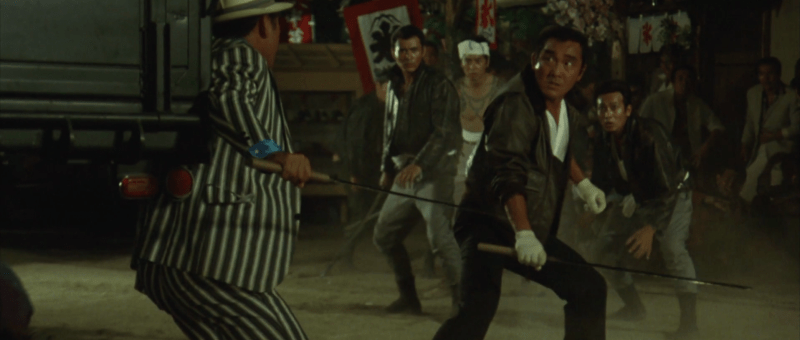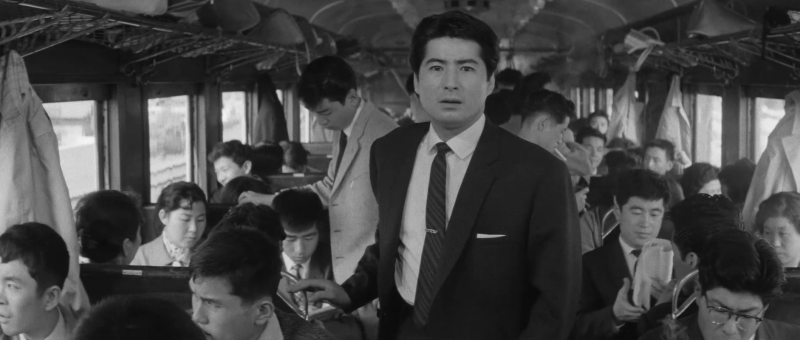
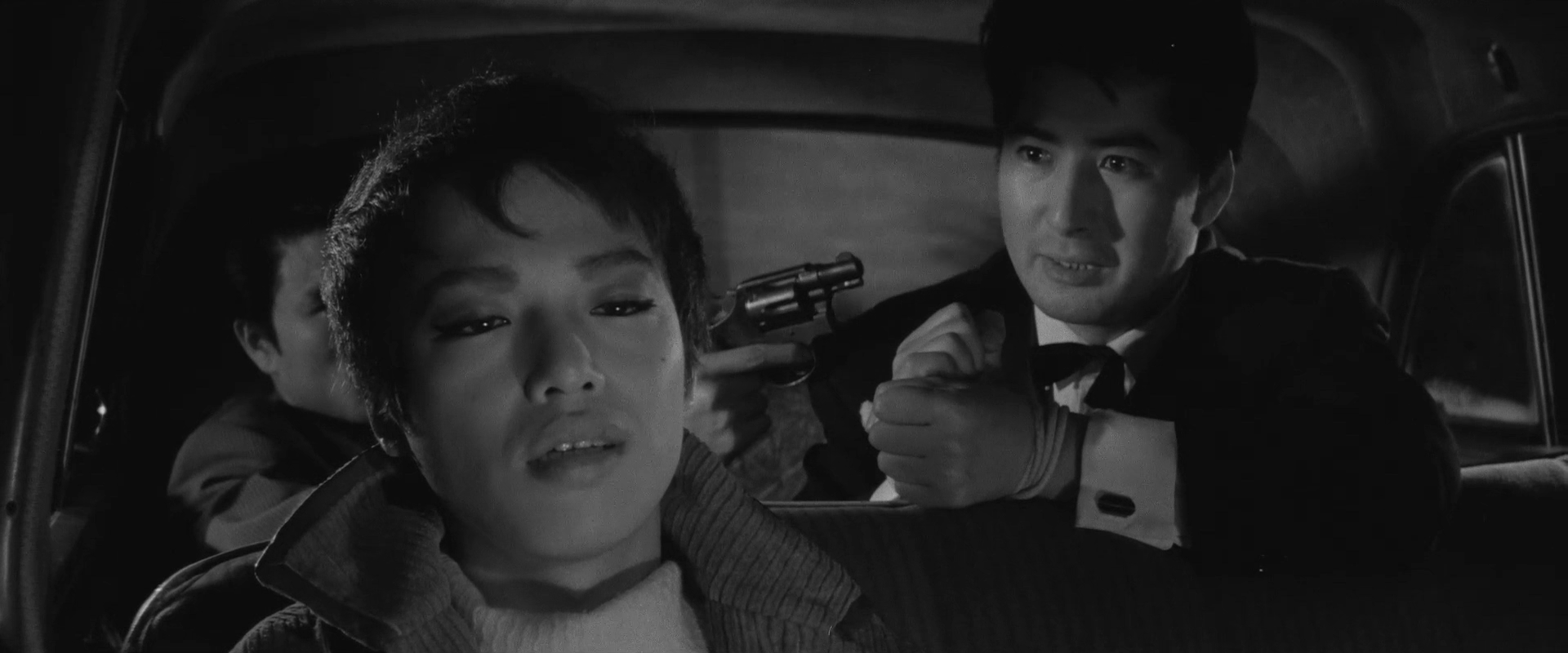
Jungle Block (地図のない町, Ko Nakahira, 1960)

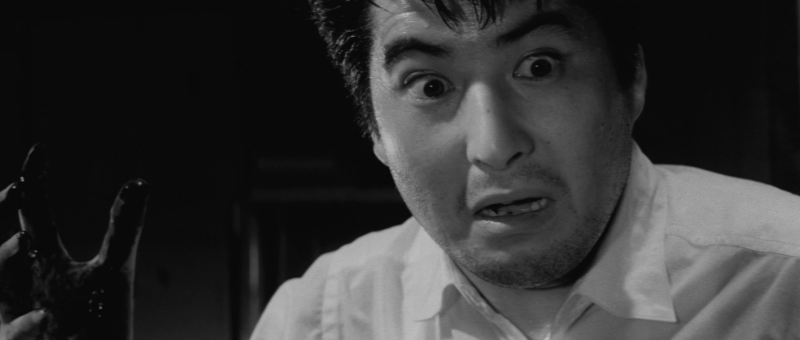
The contradictions of the post-war era are thrown into stark relief in the forced redevelopment of slum area on the edge of an increasingly prosperous city in Ko Nakahira’s intense noir, Jungle Block (地図のない町, Chizu no nai Machi). The slightly unfortunate English title may hark back to that chosen for a US screening of Nakahira’s landmark film Crazed Fruit, Juvenile Jungle, or just echo the titles of classic Hollywood noir movies such as Asphalt Jungle and Blackboard Jungle, but otherwise has little to do with the content of the film. The Japanese title, meanwhile, means something like “a town not marked on the map” and hints at the invisibility of those who live in this slum, a self-built post-war shantytown inhabited by those largely left behind by the nation’s rising prosperity. 

Then again, Shinsuke (Ryoji Hayama) seems to have fallen behind on his own account. We’re later told that he resigned from his position at the hospital because of some kind of medical mistake for which he blames himself and has since taken to drink and gambling while working at the poor clinic run by his former mentor Kasama. The most immediate effect of his, perhaps unnecessary, decision to resign was that it prevented the marriage of his younger sister, Sakiko (Kazuko Yoshiyuki), as he was then financially dependent on her. Having delayed the wedding for two years waiting for Shinsuke to pull himself together, Sakiko and her fiancé are set upon by local gangsters working for yakuza turned politician and legitimate businessman Azusa (Osamu Takizawa). Sakiko attempts to take her own life and the relationship does not survive this crisis thanks to her fiancé’s wounded masculinity in having been unable to save her or stand up to the goons afterwards. 

As repeated flashbacks reveal, Azusa is the root of the disease spreading across the city. It’s he that’s intent on clearing the slum, as he says just doing what the government has asked him to do, planning to build luxury apartments on its site along with supermarkets and entertainment facilities. Perhaps it’s not an entirely bad thing to clear a slum, the living conditions are in themselves a health hazard, but Azusa has drastically cut the amount of compensation on offer preventing the residents from securing new places to live and essentially rendering them homeless which defeats the humanitarian justification for forcing them out when most of them don’t want to go. 

Kayoko (Yoko Minamida), an old flame of Shinsuke’s who’s since become a sex worker to pay off her father’s debts to loan sharks and ends up as Azusa’s mistress, has a cat that she confesses to mistreating which makes her feel better only to feel terrible afterwards. The film seems to align the cat with the people of the slums who are bullied by men like Azusa who have untold influence buying off police and politicians while he himself later holds public office. The cat eventually fights back by scratching Kayoko who acknowledges it’s her own fault for her treatment of it, while it’s clear that the anger of the slum dwellers will eventually boil over and they too will strike back against the corruptions of this post-war era which otherwise sees fit to leave them behind. 

Meanwhile, Shinsuke plots a revenge he may not have the courage to take explaining to Kasama (Jukichi Uno), otherwise the voice of moral reason, that it’s the city that sick and the only way to save it is an operation to remove the Azusa-shaped tumour that’s currently killing it. It’s not for mere convenience that his weapon of choice is a scalpel. Kasama, however, tells him that he’s got the wrong idea and it’s their responsibility as doctors to take the long-term view and patiently run their clinic to produce results in the far off future. But Kasama’s eventual decision would seem to walk that back, suggesting that perhaps a radical solution really is necessary to save the patient from the ravages of amoral capitalism. 

Then again, like Kayoko’s father Yoshichi (Jun Hamamura) who is branded a “cripple” and “only half a man” by Azusa, Shinsuke begins to realise that perhaps you can’t create lasting change on your own and taking out Azusa won’t solve the problem as someone else will simply rise to take his place. There is a pervasive sense of hopelessness, Shinsuke caught and frantic amid the dim backstreets of this rundown town desperate for revenge when the police are in league with Azusa and no one really cares about the residents of the slum who are beginning to lose the will to resist. Nevertheless, eventually rediscovering himself Shinsuke opts to follow Kasama’s path insisting that will join the ranks of “good, honest, people” who, like the cat, will eventually scratch back until then resisting by “doing the right thing” even in the face of violence and intimidation while staunching the flow of corruption and cruelty from the seeping wounds of the post-war society.


DVD release trailer (no subtitles)

Wolves of the Night (夜の狼, Yoichi Ushihara, 1958)

A cold-hearted yakuza starts to get second thoughts when confronted with the misery his actions create in Yoichi Ushihara’s slice of Nikkatsu Noir, Wolves of the Night (夜の狼, Yoru no Okami). Though the hero is ostensibly Tsukida (Ryoji Hayama), the conflicted gangster unable to reconcile himself with the fact that he has fallen in love with a women he himself destroyed, it’s equally about the women who get caught in the crossfire of a burgeoning gang war and are each victims of male greed and indifference.

In any case, gang boss Tachibana (Somesho Matsumoto) brings a lot of this on himself. The secondary narrative revolves around a woman, Takako (Mari Shiraki), who borrowed money from the Manji gang to build her bar, but now that it’s complete Tachibana swindles her by calling in the debt and foreclosing on the property, passing ownership to Tsukida with instructions to kick Takako out. She, however, doesn’t take well to this and is resentful of Tachibana for screwing her over so she vows revenge. Her original attempt to get it by seducing Tsukida doesn’t work out, so she recruits a yakuza from a rival gang to extort them claiming that they have mole and he’ll only reveal their identity when they hand over the cash. This plan has some pretty tragic consequences and not least for Tachibana himself, but none of this would have happened if he hadn’t behaved so badly in cheating Takako out of the bar she worked so hard to build. He’d also told Tsukida that the bar owner was a beauty and it was understandable if wanted to try seducing her. 

But by this point Tsukida has developed a fondness for Katsumi (Izumi Ashikawa), a young woman he first meets when she’s caught by some of his guys offering herself for sex work in their territory. The other ladies describe Katsumi as “odd” and “an outsider”. It’s clear from her behaviour and the way she’s dressed, not to mention a lack of awareness of the rules of the gang, that she’s never done this before and is terrified. Tsukida calls his men off and tells her to go home, but later realises that it’s his own fault she was put in this situation because he was responsible for collecting the debt her parents owed to Tachibana taken out because her father is bedridden. Tsukida seems shaken by the old lady’s intense resentment, but still takes their money if attempting to convince Tachibana not to pursue them any further because they have nothing left to give, correctly assuming that Katsumi resorted to sex work to get the money. 

It maybe the sense of guilt that proved the last straw as the old couple then take their own lives but rather than freeing her lead Katsumi on a lonely path of self-destruction driven only by her hated for Tachibana and Tsukida. The fact that she later becomes ill further emphasises her positioning as a symbol of a despoiled nation poisoned by the ruthless inhumanity of the post-war society, along with literal a embodiment of Tsukida’s guilty conscience. Tsukida rejects Takako as a person more like himself, an example of corrupted femininity using her body to manipulate men in a world in which a woman has little other power, and instead is drawn to Katsumi who was once innocent, demure, and cheerful but who he himself has destroyed through his own greed and heartlessness.

Spending some time in hospital following a failed suicide attempt seems to heal her in body body and soul, though the total about face in Katsumi’s feelings for Tsukida seems somewhat bewildering even if he did visit her every day and presumably win her over despite her resentment towards him for contributing to her parents’ deaths. Nevertheless, it’s his feelings for Katsumi that see Tsukida longing to quit the yakuza and retreat to the country to live a small, honest life with her free of the city’s corruption. But as so often in the movies, it’s not that simple and this time it’s a tragic consequence born of male failure and insecurity that eventually costs him his shot at a normal life even as his frenemy, a local policeman he often sees in the same bar and gives him unsolicited advice about how he should quit the yakuza, remains surprisingly supportive suggesting that his redemption may merely be on hold rather than cancelled. In any case, though shooting almost entirely on stage sets, Ushihara makes good use of stock footage of contemporary Ginza as a place of bright lights and equally dark shadows where gangsters lurk on every corner and mercy is in desperately short supply.

The Tattooed Hitman (山口組外伝 九州進攻作戦, Kosaku Yamashita, 1974)

The close brotherhood between two men is disrupted by changing times in a more contemporary gangster drama from Kosaku Yamashita, Tattooed Hitman (山口組外伝 九州進攻作戦, Yamaguchi-gumi gaiden: Kyushu shinko-sakusen). As many are fond of saying, times have changed and the yakuza must try to change with them or else meet a melancholy end. But as the hero admits, change is something he has no intention of doing even as his old school gangsterism leaves him increasingly at odds with the corporatising ways of the contemporary yakuza. 

The change in the times is obvious from the film’s opening sequence set in 1957 in which an attempt is made on the life of petty boss Ishino (Tatsuo Umemiya) by a gunman who shouts “die, for the good of the world” before firing a pistol and running away. Ishino has been targeted in a dispute over construction rights connected with the regeneration of hot springs resort, Beppu. The hit seems to have been ordered by rival gang, Sakaguchi (Eizo Kitamura), the leader of which is also a prominent local politician who is content to abuse his power for his own financial gain. So confident is he in his safety, that Sakaguchi even gets the police involved rather than deal with it himself. 

Ginji (Bunta Sugawara) has been Ishino’s sworn brother since their teenage delinquent days and determines to get revenge by raiding the Sakaguchi offices and killing one of their high ranking officers. Seeing as he’s already wanted by the police for a previous murder, Ishino sends Ginji to Osaka to lay low while working for an associate, Daito, mainly as a debt collector. It’s this act of separation which introduces a rift between the two men. While Ginji waits patiently to be recalled, Ishino climbs the ranks of corporatised gangsterism by learning to play by the new rules. 

To fill the void, Ginji takes on a new “brother” or perhaps surrogate son in the wayward Ken (Tsunehiko Watase) whom he first meets cheating at pachinko at a parlour where his pregnant wife Fusako (Mayumi Nagisa) is working. It’s Ken who first drags him into a brewing turf war as Korean gang Soryu threaten to disrupt the local equilibrium not least by selling drugs of which Ginji does not approve. Ginji “saves” Ken from joining Soryu by essentially making him his one of his guys though he doesn’t really have much of a position in Daito’s gang, offering him a sense of grown-up responsibility by handing him a pistol with the only the instruction to make sure he shoots with two hands. Unfortunately, Ken will follow his advice but otherwise ends up almost causing an incident with another gang by shooting a man who disrespected him in the street. Ginji marches straight down there to sort things out, but on arrival discovers an arrangement has already been made with his boss which further strains his sense of pride and confidence in his position as a yakuza.

Ginji feels something similar on being invited to a party to celebrate Ishino’s promotion only to be seated with the lowly footsoldiers and ignored by Ishino all night. Ishino rejects him still further in agreeing to plan to send him back to Kyushu out of the way hoping that his old school hotheadedness can finally be tempered. Others meanwhile voice concern that Ginji may have forged a relationship with rival Kobe gangs during the 18 months he abruptly disappeared from Osaka and has only come back to cause trouble. Ginji perhaps knows that he has no more future in the contemporary society, others remarking that seems like someone who is in a sense already dead for having accepted that he will die and most likely in Hakata, the town he had wanted to conquer with Ishino who had crushed his dreams in his newfound pragmatism by calmly explaining that they would never have the power to take it. 

Koji Takada’s screenplay positions Ginji’s gradual decline as an allegory for the yakuza himself while citing the new legislation that this particular series of incidents made necessary creating the new offence of assembly with dangerous weapons as a decisive moment in weakening the yakuza as an institution. Ginji remains a man displaced by his times unable to move forward into a new society in the way that Ishino has but stuck in a permanently post-war mentality despite the constant reminders that “times have changed”. Yamashita adopts the trappings of the jisturoku drama with frequent references to real life events and narrative voiceover but otherwise maintains his classicist formalism while ending on a note of ambivalence that tells us a certain kind of justice may have been served but the cycle of violence may not yet be completed.


Original trailer (no subtitles)

Criminal Woman: Killing Melody (前科おんな殺し節, Atsushi Mihori, 1973)

“Five women like us could take on the whole world!” a woman exclaims after a very successful mission of revenge in which they didn’t have to do very much at all except play on male pride and yakuza honour. Criminal Woman: Killing Melody (前科おんな殺し節, Zenka onna: Koroshi-bushi) stars the two main players of Toei’s pinky violence line, Reiko Ike and Miki Sugimoto, and plays with their star rivalry by casting them as a pair of women eventually divided by the conflicting loyalties presented by the heroine’s desire for revenge. 

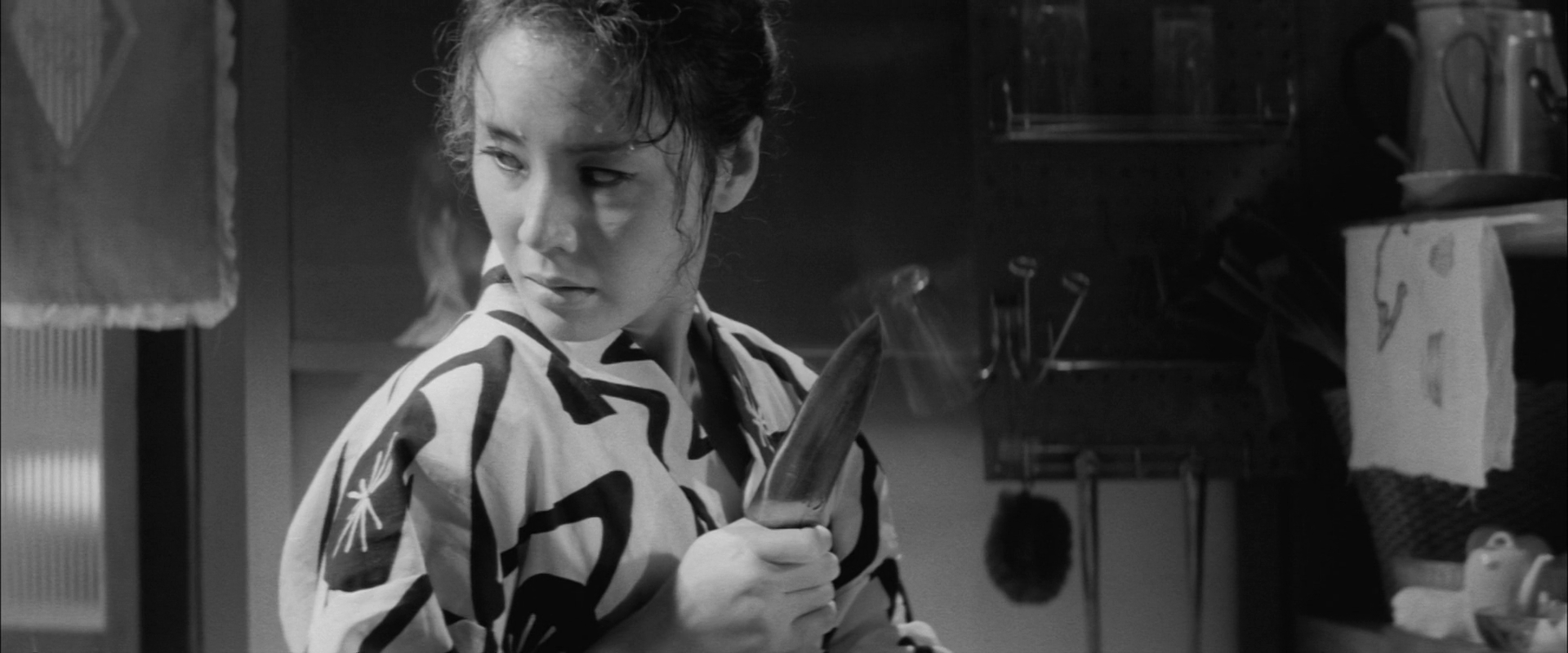
Ike stars as Maki, an intense young woman first seen hiding behind a door in the classic club scene that opens the film. Eventually she darts inside and slashes some yakuza with a knife, but her assassination attempt is very unsuccessful landing her in prison for a number of years where she largely spends her time glaring at the bars and plotting her revenge. Nevertheless, it’s the solidarity she finds with her cellmates that eventually allows her to carry out her plan. On her arrival, she first clashes with cell boss Masayo (Miki Sugimoto), a former yakuza moll inside for slashing some guys with a razor after they caught her cheating at hanafuda, but eventually wins her respect after a prison test of strength in which each woman is armed with a glass shard and grips a rope between their teeth until the loser gives in and lets go. Maki is not a skilled fighter and easily wounded by Masayo but refuses to surrender, getting right back up again every time Masayo knocks her down until Masayo finally concedes defeat.

The early prison fight is repeated at the end of the film only without the rope and with real knives, drugs replacing the white chalk that clouded around them as they fought in the prison yard. This time they are more evenly matched. Maki is no good with a knife, but more than able to hold her own and the fight is more about settling a score than it is about revenge so neither really wants to harm the other anyway. Though they found themselves temporarily on opposing sides, inevitably it turns out that Masayo is the woman of the yakuza Maki is trying to bring down, the sense of solidarity between them as women eventually wins out and though Masayo is unable to betray Oba (Ryoji Hayama) she cannot betray Maki either and ends up helping in her in quest for revenge if in a round about way.

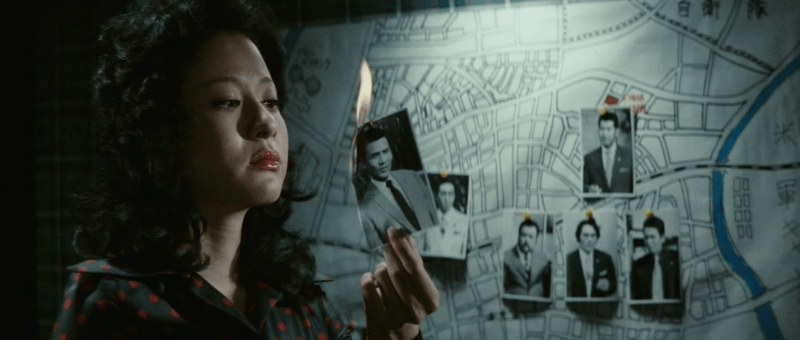
It’s this sense of solidarity that brings the other cell mates back to the prison when Maki is released already having decided to help her get her revenge on the yakuza who forced her father to traffic drugs and then had him killed. Maki first refuses their help, as she had the opportunity of getting legal justice by telling the police everything that had happened including her own gang rape at the hands of the same yakuza, because it’s important that she’s the one who takes down Oba but later accepts their gesture and forms a tightly knit gang of her own fronted out of former sex worker Kaoru’s (Yumiko Katayama) bar. To fund the mission, Maki goes on a two week sex work spree mostly bedding American servicemen with whom she later makes a deal to buy a large number of guns and grenades she eventually sells to hotheaded yakuza son Tetsu (Takeo Chii) who is already resentful towards Oba for having stolen his father’s turf.

All Maki has to do to is light the touch paper on a simmering gang war between old school yakuza and the amoral corporatising Oba. She antagonises him by expertly offing one of his guys in a rain drenched assassination scene and getting one of the other girls to strongly hint it was Tetsu’s doing, then pretending to come to Tetsu’s rescue with the guns only to further provoke Oba. The girls even joke they’re doing a public service by cleaning up the town in taking out the corrupt politician who was propping up Oba for his own financial gain. It’s all expertly planned by Maki who appears in a series of quite stunning power suits and sporting giant hair, battling yakuza with killer style and an expert understanding of the way their brains work. But the reason the plan succeeds is the shared sense of solidarity between the women, Masayo included, as they strike back together against an oppressive and patriarchal society.


Father of the Kamikaze (ゝ決戦航空隊, Kosaku Yamashita, 1974)

By the mid-1970s, Japanese cinema at least had become much more comfortable with critiquing the wartime past, considering it from a greater distance than the often raw depictions of war in the films from the previous two decades. 1974’s Father of the Kamikaze (ゝ決戦航空隊, A Kessen Kokutai), however, is among the few to skew towards the nationalist rather than the ambivalence or simple anti-war messages of other similarly themed films of its era. 

Starring ninkyo icon Koji Tsuruta who served in the air force himself, the film is a kind of biopic dedicated to Admiral Onishi who oversaw the kamikaze operations at the end of the war. As is pointed out, Onishi had been against the war in general terms even before its inception and is originally against the philosophy behind the kamikaze squadrons but as Japan’s fortunes continue to decline he becomes its biggest advocate citing a kind of sunk cost fallacy that it would be in someway unfair to the men that have already died to surrender while insisting that suicide missions are the only feasible way to turn the tide because one kamikaze could take out a hundred men by destroying battleships singlehandedly. 

The film in part attributes this extreme solution to the prevailing with your shield or on it philosophy of the contemporary society which placed extreme shame on the act of being taken prisoner. In the prologue that opens the film, a squadron of downed pilots whose heroic deaths have already been recorded is discovered alive in an American prisoner of war camp but as being a prisoner of war is so shameful and would reflect badly on the military, the decision is taken to fix the books by sending the men on a mission from which they are not intended to return. Onishi is opposed to the plan, he asks why they can’t find a way for the men to live, but the decision is already made. In any case, he describes the action of a suicide mission as a “beautiful ideal” even when insisting that a war cannot be fought in that way not least for purely practical reasons in that they do not have the resources to be wilfully sacrificing skilled pilots and their planes. 

Having come round to the idea, however, Onishi is a crazed zealot who cannot accept the idea of surrender and even goes so far as to barge into a cabinet meeting to urge ministers against a truce even though the war is clearly lost. To his mind, the only way to honour the sacrifices of those who’ve died is to fight to the last man. Kozono (Bunta Sugawara), another officer opposed to the kamikaze, eventually meets a similar fate in refusing to obey the order to lay down his arms and ending up in a psychiatric hospital. His objection had partly been that it’s wrong to turn men into ammunition, but also that the kamikaze project is itself defeatist and self-defeating when there are men such as himself who are committed to fighting on.  

In this the film leans into the image of militarism as a death cult in which dying for the emperor is the only noble goal of the whole imperial expansion. In its eventual lionising of Onishi’s image, his bloody suicide atop a white cloth resembling the flag of Japan while his parting words scroll across the screen in text, it does not shy away from his more problematic aspects in which he fails to object to a request from a junior officer that soldiers should be allowed to test their swords on American prisoners of war, roundly telling a subordinate who breaks protocol to insist that such a thing is not only morally wrong but will ruin their international reputation that he has no need to think of consequences because Japan will win this war. He claims to want to find a way of defeat that will satisfy the living and the dead, but in reality cannot accept it not least in that it would entail admitting that he sent 2600 young men to their deaths for nothing. 

Tsuruta brings the same level of pathos to his performance as he did in playing conflicted yakuza stoically committed to a destructive code, but there’s no getting away from the fact that the film focuses mainly on Onishi’s personal suffering as a man who sent other men to die for a mistaken ideal and then could not admit his mistake offering an apology only in his death in which he urged the young people of Japan to work to rebuild the nation in the name of peace. In switching to the present day and showing us Onishi’s dilapidated former residence and in fact the room in which he died with its tattered shoji and peeling paintwork, he veers towards the nationalistic in uncomfortably reinforcing the nobility of his death rather than the folly of war or absurdist tragedy of the kamikaze programme. Adopting a quasi-jitsuroku approach with frequent use of onscreen text, a narratorial voiceover, and stock footage of kamikaze in action Yamashita may portray war as madness in Onishi’s crazed devotion but cannot help depicting it as a “beautiful ideal” even in the undignified violence of Onishi’s ritual suicide. 


Violent Streets (暴力街, Hideo Gosha, 1974)

“Nothing’s like it used to be anymore” sighs a woman who’s had to betray herself but has tried to make break for it only to discover there is no way back. Hideo Gosha’s Violent Streets (暴力街, Boryoku Gai) is like many films of its era about the changing nature of the yakuza in an age of corporatised gangsterdom. Now “legitimate businessmen” who claim to no longer deal in thuggery, their crimes are of a more organised kind though a turf war’s still a turf war even if you’re fighting from the boardroom rather than simply getting petty street punks to fight it for you in the streets. 

In a touch of irony, former yakuza Noboru Ando stars as a man who’s tried to leave the life behind but is pulled back into underworld intrigue when his former foot soldiers mount an ill-advised bid for revenge against the clan they feel betrayed them. After serving eight years in prison for participating in the last turf war, Egawa was given flamenco bar Madrid on the condition that he dissolve his family and attempt to go straight as a legitimate businessman. The Togiku gang has since gone legit and distanced itself from most of its old school yakuza like Egawa. But now a yakuza conglomerate from Osaka is moving in on their old turf and the Togiku want the Madrid back as a bulwark against incursion from the west which is why they’ve been sending the boys round to cause trouble in the bar. 

Egawa is the classic ex-gangster who wants to turn himself around but is largely unable to adapt to life in a changing society. He is technically in a relationship with a bar hostess who has a severe drinking problem in part exacerbated by his inability to get over his former girlfriend who left him and married the boss, Gohara, while he was in prison. His former foot soldiers attempt to convince him to get the gang back together and take revenge, resentful of having been used and discarded, but he tells them to let it go, that they’ve all got “honest jobs” and that they should try to live as best they can. Like him, the guys are ill-equipped to make new lives in the consumerist society and cannot move on from the post-war past. Hoping to engineer a turf war between the Osaka guys and Togiku, they kidnap a popular TV personality/pop singer (Minami Nakatsugawa) attached to a station which Togiku controls and frame a rival affiliated with the Osakans for taking her. 

This just goes to show the various ways in which newly corporatised yakuza have expanded their business portfolio, heavily participating in the entertainment industry moving beyond bars, clubs, and the sex trade into mainstream television and idol stars. Egawa’s old friend Yazaki (Akira Kobayashi) is his opposing number, just as caged but trapped within the confines of the new gangsterdom, reprimanded by his boss for raiding the rival studio’s offices and undoing the gang’s attempt to rebrand themselves as legitimate businessmen rather than violent street thugs. “I can’t stand being humiliated” he explains as Gohara points out he’s stepped right into their trap now giving the Osakans an excuse for retaliation. “The Togiku group is a defanged, domesticated dog” Yazaki barks, “I can’t pretend to be an obedient company employee forever and do nothing”. 

Neither man is able to progress into the new era of rising prosperity, both little more than caged animals thrashing around trying to break free but continually crashing into the bars. Just as Egawa’s old guys had tried to engineer a turf war hoping that the two gangs would take each other out and leave a vacuum they could fill, arch boss Shimamura (Tetsuro Tanba) flies above the city in a helicopter as the “worms fight among themselves” and observes the chaos below as he completes his silent conquest of the contemporary economy like some modern day Nobunaga of corporatised gangsterdom. 

Taking over the Togiku through a process of corporate infiltration and gradually ridding themselves of all the old school yakuza ill-suited to the shady salaryman life, the contrast between the world of cabaret bars and back street dives and Shimamura’s smart suits and helicopters couldn’t be more stark. A slightly sour note is struck by the use of a transgender assassin (Madame Joy) who performs a lesbian floorshow by day and kills by night while working with a bald sidekick who carries a parrot on his shoulder, her coldness bearing out the tendency of yakuza movies to associate queerness with sadistic savagery. Gosha rams his point home with the otherwise surreal scene of a pile of abandoned mannequins by a swamp that becomes a popular yakuza kill site homing in on the emptiness of their eyes and the uncanniness of dismembered bodies, mere empty shells just like the men who die in this literal wasteland. Egawa perhaps feels himself to be a man already dead long before being pushed towards his act of futile rebellion, somewhere between sitting duck and caged dog fighting for his life between the chicken coops of a moribund small-town Japan. Marching to a frenetic flamenco beat of rising passions and barely contained rage, Violent Streets leaves its former foot soldiers with nowhere to go but down while their duplicitous masters continue to prosper riding the consumerist wave into a new and prosperous future.


Violent Streets opens at New York’s Metrograph on Dec. 16 as part of Hideo Gosha x 3

Trailer (English subtitles)

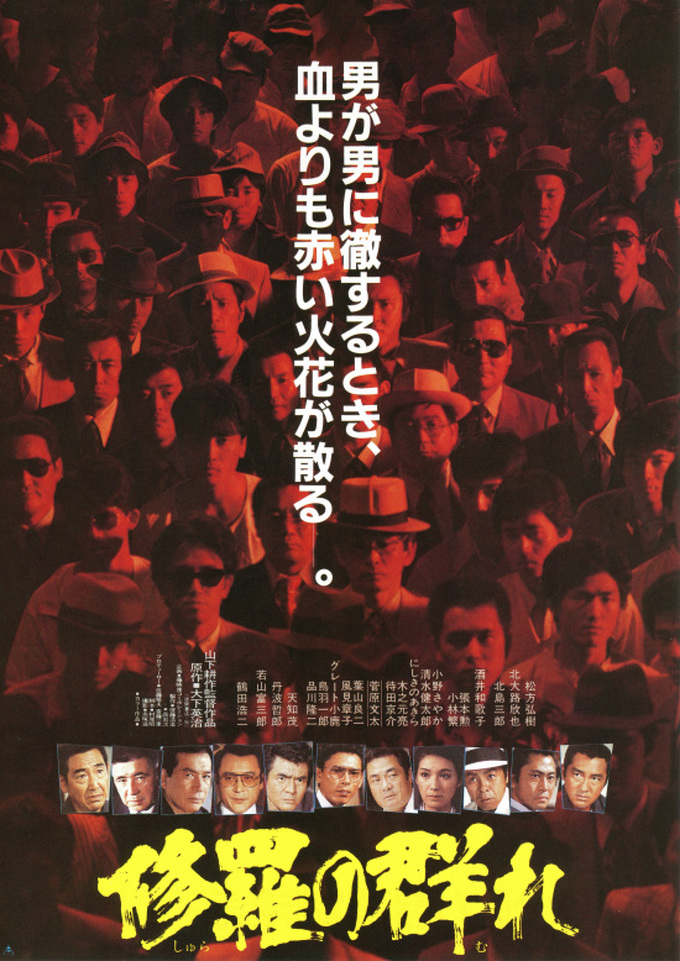
The Story of a Man Among Men (修羅の群れ, Kosaku Yamashita, 1984)

The ninkyo eiga, chivalrous tales of noble gangsters standing up for the little guy with decency and honour, had been Toei’s mainstay throughout the 1960s but a decade later the image of righteous yakuza had been well and truly imploded by the advent of the jitsuroku or “true account” movie which drew inspiration from real life tales of post-war gangsterdom using voiceover narration and onscreen text for added authenticity as it proved once and for all that there was no “honour and humanity” to be found in the gangster life only nihilism and futility. Still, the ninkyo, like many of its heroes, proved hard to kill as 1984’s Story of a Man Among Men (修羅の群れ, Shura no Mure) perhaps proves. A throwback to an earlier era with its infinitely noble hero and unexpectedly if not quite happy then defiantly positive ending, Kosaku Yamashita’s manly drama nevertheless adopts some of the trappings of the jitsuroku in its infrequent use of voiceover and emphasis on concrete historical events. 

The hero, Ryuji Inahara (Hiroki Matsukata), is like many heroes of post-war gangsterdom an orphan though his story begins in the mid-1930s as he’s recruited by a friendly yakuza at a karate dojo. As his teacher explains, Ryuji has already been offered a job with the police but given the chance to join the other side instead immediately agrees, explaining that his life’s ambition has been to gain revenge against the force that ruined his father and destroyed his family, gambling. He chooses to do this, however, not by destroying gambling dens everywhere but by becoming a gambler himself determined to be a winner which is, it seems, a textbook example of having learned the wrong lesson. Still, his noble gangster cool stands him in good stead in the yakuza world where he quickly earns the loyalty of other men, rapidly advancing up the ranks to head his own gang by the crime heyday of the mid-1950s. 

As the title implies, this is a story of a man, a very manly man, among other men. The gangster world is intensely homosocial and founded on ideas of brotherhood and loyalty. Thus, Ryuji finds a surrogate father figure in fellow gangster Yokoyama (Koji Tsuruta) who constantly gives him advice on what it is to be a proper man. “Don’t be a fool, don’t be too smart, and most of all don’t be half-hearted” he advises, later adding “you can’t be a man if you’re dirty about money”, and “taking action isn’t the only way to be a man. It takes a man to have patience.” (this last one as Ryuji hotheadedly discharges himself from hospital to get revenge on a punk who got the jump on him outside a shrine). To be a man, Ryuji intervenes when he sees some less than honourable young toughs hassling an old couple running a dango stand at the beach and the young woman from the caramel stall next-door, throwing his entire wallet on their counter to make up for the damage in what will become something of a repeated motif. His manliness earns him the eternal devotion of the young woman, Yukiko (Wakako Sakai), who eventually becomes his devoted wife against the will of her concerned mother who is nevertheless brought round on realising the love she has for him because of his intense nobility. 

Indeed, Ryuji lives in a noble world. He’s a gambler by trade but only because he hates gambling and is trying to best it. He doesn’t participate in the seedier sides of the yakuza life such as drugs or prostitution and is also in contrast to jitsuroku norms a humanist who defiantly stands up against racism and xenophobia, taking another gambler to task for using a racial slur against a Korean opponent while opting to befriend the “foreign” gangs of Atami when eventually put in charge of the lucrative area rather than divide and conquer. This is apparently a lesson he learned from his flawed but goodhearted father who hid a Korean man and his daughter from the pogroms after the 1923 earthquake because “we’re all the same human beings”. Spared the war because of an injury to his trigger finger, Ryuji kicks off against an entitled son of a gang boss for acting like a slavedriver while working at a quarry but earns only the respect of his superiors further enhancing his underworld ties because of his reputation as a standup guy willing to stand up to oppression. 

Such an intense sense of uncomplicated righteousness had perhaps been unseen since the ninkyo eiga days, and Ryuji’s rise and rise does in that sense seem improbable as his goodness only aids his success earning him the respect of over 1000 foot soldiers even as he finds himself in the awkward position of having to exile one of his most trusted associates for getting too big for his boots and disrespecting the yakuza code. His children also suffer for their connection to the gangster underworld, but are reassured that their father is a good man if with the subtle implication that he has damned them as his father did him. Shot with occasional expressionist flourishes such as crashing waves or a midnight sky, A Story of a Man among Men is not free from manly sadness and indeed ends on the sense of a baton passing from one era to another but does so with an unexpected sense of moral victory for its righteous hero who vows to bring his manly ideas with him into a new age of gangsterdom. 


Original trailer (no subtitles)

A True Story of the Private Ginza Police (実録・私設銀座警察, Junya Sato, 1973)

By the early 1970s the ninkyo eiga (pre-war tales of noble yakuza) had begun to fall from favour. Modern audiences were perhaps unconvinced by the romanticism of the honourable gangster caught between personal loyalty and his inner humanity, real life thugs are rarely so high minded after all. The cinema industry may have been in decline, but the consumerist revolution was well underway, the economic miracle was nearing completion, and there was perhaps a readiness to reckon with the recent past from a position of relative safety. The jitsuroku eiga did just that, providing a more “realistic” depiction of the yakuza life based on the recollections of real life gangsters and incorporating the aesthetics of reportage with the use of stock footage, newspaper montage, narratorial voiceover, and high impact text recording the names of characters along with the times of their deaths. 

Released in the same year as Kinji Fukasaku’s Battles Without Honour and Humanity which has perhaps become the jitsuroku archetype, Junya Sato’s A True Story of The Private Ginza Police (実録・私設銀座警察, Jitsuroku: Shisetsu Ginza Keisatsu) paints an even bleaker picture of the immediate post-war era as one in which chaos and inhumanity rule. The pre-credits sequence follows demobbed soldier Watarai (Tsunehiko Watase) who finds himself in a bombed out warehouse where a woman is drinking around an open fire with a US serviceman. Standing motionless he stares at an upper balcony where another woman is having sex with a black GI. It seems this woman is known to him, perhaps his wife or in any case a woman he thought he was coming back to. She is not overjoyed to see him, breaking down in tears while he spots a baby girl crying in the corner who also happens to be black. Unthinkably he takes the child and throws her into a flooded area of the floor below, chasing the mother when she goes after the baby, strangling and then bludgeoning her to death with a rock. 

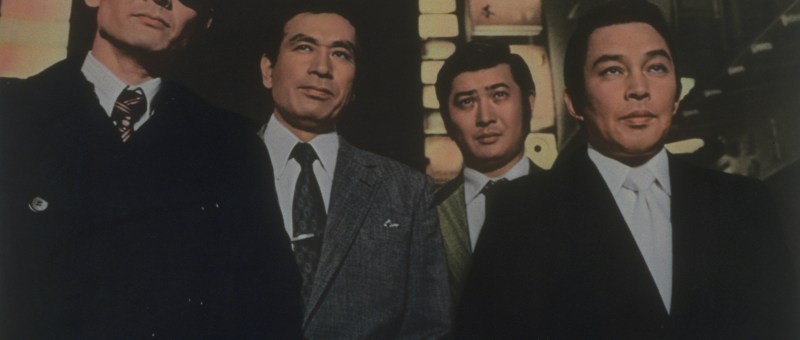
All of this has happened in the first five minutes. There will be no heroism here, no noble act of resistance only shame and desperation. These are men brutalised by war who’ve come home to a land in ruins where the enemy is now in charge, ruling their streets and sleeping with their women. They are humiliated and resentful, many of them still in uniform likely because they simply have no other clothes. Sato introduces us to the later gang members in turn beginning with a scene which echoes those of the Battles Without Honour series as Iketani (Noboru Ando) is chased and beaten by an angry mob in the chaos of the marketplace after being accused of stealing. Masaru (Tatsuo Umemiya) meanwhile is beaten by GIs who come to the rescue of a sex worker he tries to rape, offended when she tells him she doesn’t go with Japanese customers dismissing him as “just another defeated soldier”. Iwashita (Hideo Murota) uses his service revolver to commit an armed robbery to get money to gamble. Only the gang’s later leader, Usami (Ryoji Hayama), is introduced without a wartime record, named only as a pre-war gangster. The gang is forged when they meet by chance in a gambling den and bond over a grenade, mounting a military operation against the Korean street gang who hassled Iketani by bombing their HQ. 

A few months later they’ve become the “Private Ginza Police Force” of the title, now all in smart suits, loud shirts, and sunshades. They have their eyes set on ruling the area, taking down rival gangsters the Nakane brothers through cunning and trickery, turning an underling by threatening his family. But there is no honour among thieves and the gang is only a temporary arrangement intended to last only as long it’s useful. Iketani goes his own way, starting a small business running black market goods from China, bribing the police to turn a blind eye while Usami runs a conventional protection scam targeting the Chinese owner of a cabaret bar, Fukuyama (Asao Uchida), run as a front for black market smuggling. The problems start when Iketani learns that Fukuyama has been colluding with a government accountant to misappropriate money intended to be used for subsidies. 

This world is infinitely corrupt, from the easily bribed policemen to the civil servants out for all they can get and those who merely make use of them like Fukuyama and Iketani. While the guys get rich opening gambling clubs in Ginza, a wide scale famine creates a shantytown of starving poor at Ueno station where six die per day from hunger. Iketani is in someways the “noble” thug, he looks after his guys and pays attention to their lives, perhaps even claiming that his black market activities are a public service but it’s still every man for himself and if he’s assuming post-war chaos is on its way out he is sadly mistaken. Having got him hopped up on heroine and used him as a ghostly assassin, the gang jokingly refer to Watarai as a zombie, somehow surviving every bizarre death experience that comes his way including being buried alive, but they are walking dead too, soulless men who left their humanity on the battlefield. Fearing the game may be up, Masaru suggests one last hurrah blowing their ill-gotten gains on sake and women. “I’ll show you how rape is done,” Usami deliriously exclaims”, “how we used to do it on the continental front.” Meanwhile, Masaru throws notes all around the room screaming “Rejoice! There will be no tomorrow” sending all into a Bacchanalian frenzy as they cram as much cash as they can grab inside what little clothing they still have on.

All moody, anarchic jazz score and canted angles, Sato’s post-war Tokyo is a world of constant anxiety, a maddening no man’s land of fire and rubble inhabited by ghosts of men who died long ago for whom the war never ended. In true jitsuroku fashion, the picture ends on a note of fatalistic nihilism, the screen filled with red as the narrator cooly informs us what became of our heroes as they find themselves consumed by the futility of their lives of violence.


Original trailer (no subtitles)

Temptation (誘惑, Ko Nakahira, 1957)

Ko Nakahira made his name with the seminal Sun Tribe movie Crazed Fruit, a nihilistic tale of bored, affluent post-war youth. Released a year later, Temptation (Yuwaku), adapted from a novel by Sei Ito, is in some ways its inverse pitting a melancholy widower harping on dreams of lost love against his relentlessly practical daughter for whom “Sex is life. Art is money” but finding in the end perhaps more commonality than difference save for the fact the youth of today may have no real dreams to betray. 

Now 55 years old, Sugimoto (Koreya Senda) is the proprietor of the Sugimoto Dried Goods store in upscale Ginza. Father to an only daughter, Hideko, now that his wife has passed away he finds himself carried back towards the past and is planning to turn the upstairs space in the store into a small gallery. For her part Hideko (Sachiko Hidari) and her coterie of artist friends are hoping to convince him to allow them to exhibit in the gallery for cheap, but he, slightly more conservative in his old age, views them all as low class Bohemians and fails to understand why Hideko hangs out with them in the first place. He has, it seems, an internal conflict symbolised by the beret he’s taken to wearing in which he is unable to let go of the broken dreams of his youth when he was a struggling artist forced to give up his first love, Eiko (Izumi Ashikawa), because he had no money or prospects while she eventually consented to an arranged marriage.  

The world of 1931 being very different, Sugimoto and Eiko never did anything beyond holding hands (later a key plot point), though in her parting letter she laments that she regrets not having let him kiss her and mildly berates him for not having been more forceful. A slightly uncomfortable sentiment, but diffidence seems to be the force defining Sugimoto’s life. At the store he finds himself dissatisfied with his senior salesgirl Junko (Misako Watanabe) whose brusque manner with customers and refusal to wear makeup he fears are harming sales, but is unable to say anything until his rather half-hearted attempt to talk to her provokes a mutual misunderstanding, he thinking she may be anxious about being fired and she wondering if he’s about to make a proposal. 

For unclear reasons, Junko seems to have a crush on Sugimoto, something which becomes a minor problem when he also becomes a target for Kotoko (Yukiko Todoroki), a middle-aged woman/insurance agent from Hideko’s floral arrangement class. Privy to their interior monologues, we can hear the two women squaring off against each other, Junko complaining that Kotoko is “meddling, talkative, and fat”, while Kotoko fires back that Junko wears “no makeup at all and is so stuck up” as they glare at each other through the shop window. Yet it’s not Sugimoto who eventually provokes a change in Junko, but another eccentric, struggling artist, Sohei (Shoji Yasui), who bluntly tells her that she is pretty and so should put some makeup on to bring it out. 

Junko later characterises this intervention as an act of salvation that sees her re-embrace her femininity, not only wearing makeup and having her hair styled but beginning to talk warmly with customers, improving the business but ironically giving Sugimoto the mistaken idea her friendly new demeanour may be partly for his benefit. For his part, Sohei, an unkempt artist suffering a seemingly permanent lice infestation, claims not to have cared very much about money or possessions which led him to accidentally abuse the generosity of his artist friends but has now been awakened, it seems, to a kind of consumerist mentality thanks to the interest of Junko and recognition of his art when some of Sugimoto’s old friends (well known artists Taro Okamoto, Seiji Togo, and critic Kimihide Tokudaiji) praise his paintings on seeing them in the gallery leading to them fetching a high price from prominent collectors. 

“The value of a work of art hinges on whether or not it sells” one of Hideko’s friends points out while she adds “We should be proud that art is profitable”, a sentiment that hugely offends Shohei (Ryoji Hayama), the beret-wearing leader of another artist circle the gang enlist to help them pay for the rental of the gallery. Though he concedes to Hideko’s argument that her father’s gallery is a business enterprise, not a charity, Shohei is somewhat horrified by the casual equation of art and commerce, shocked that the girls view their flower arranging as a practical more than an aesthetic skill. Still, in another irony it turns out that his talent is for business rather than art, shrewdly steering Sohei’s success rather than his own when it’s clear his work is the standout in the gallery. Just like Sugimoto had, he eventually resolves to give up his artistic dreams after falling in love with Hideko, planning to marry into her family and take over the Sugimoto store. She meanwhile, had described him as not good marriage material, “no poor painters for me, only rich men” but is apparently in favour of his selling out if only in that it ironically makes him more himself. 

As we discover there are more than a few reasons besides the beret that Sugimoto keeps feeling Shohei reminds him of someone else even as he finds himself wary of him, pointlessly trying to set Hideko up with someone more “suitable” just as she makes a point of inviting a series of alternative widowed, middle-aged ladies to the gallery opening not so much because she particularly objects to Kotoko but she’s worried her dad might get bamboozled into something without properly surveying his options. While Sugimoto remains maudlin and filled with regret though perhaps putting the past aside through a symbolic act of closure, the youngsters are cheerfully cynical, practical in the way the older generation are always telling them to be but are perhaps disappointed in them for not having dreams or aspirations beyond those of claiming or maintaining or their chosen status in life. “Art is money” Hideko is fond of saying, and it’s true enough in so much as money is an art and the one which seems at least to have captivated the post-war generation eagerly awaiting the advent of the consumerist revolution. 


Living by Karate (無鉄砲大将, Seijun Suzuki, 1961)

Nikkatsu’s brand of youth cinema could often have a nasty edge, its damaged heroes caught up in complicated rebellion but necessarily outsiders in a changing world which they feared held no real place for them. For each of those, however, there are others filled with life and possibility, not to mention a cartoonish sense of fun and infinite safety which perhaps largely disappeared from the films of the 1960s only to be found again in Kadokawa’s similarly aspirational teen movies of the bubble era. 

Living by Karate (無鉄砲大将, Muteppo Daisho, AKA Reckless Boss / A Hell of a Guy) once again stars Koji Wada as an earnest young man kicking back against the corrupt wartime generation. Still in high school, Eiji has a part-time job at an ice rink which he doesn’t treat quite as seriously as he ought to but his boss lets him get away with it because his handsome face is a hit with the local ladies. Eiji and two of his friends are keen members of a karate club and have decided to use their skills to fight for justice in their lawless town by going on “patrol”, clearing up the kinds of crimes the police might not make it to in time. Their plan backfires, however, when they come across the body of a recently deceased union leader and are arrested by a local bobby after getting caught with a joke knife one of the boys made for fun at his job on the family scrap yard. 

It comes as no surprise that Eiji’s arch enemy, sleazy mob boss Shinkai (Nakajiro Tomita), is behind the murder, apparently hired by a corrupt corporate CEO trying to stop his workforce exercising their legal rights. Eiji hates Shinkai because he bankrolled his widowed mother’s (Kotoe Hatsui) bar business but did so perhaps in return for being able to control her and by extension him by wielding his economic power against them. His loathing intensifies once he realises that the slightly older young woman he’s carrying a torch for, Yukiyo (Izumi Ashikawa), has fallen for one of Shinkai’s men, Goro (Ryoji Hayama). 

Goro is the classically “good” gangster who feels indebted to Shinkai because he took him in after the war, but wants to leave the underworld behind, going straight in Kobe where he intends to live a settled married life with Yukiyo. The modern yakuza is in many ways a Showa era phenomenon, a mechanism for men without families to protect themselves in the desperate post-war environment. By 1961, however, its existence was perhaps becoming harder to justify. The war orphans had grown up and had families of their own, the economy had significantly improved, and there was no need anymore to live a life of crime and heartlessness – a conclusion Goro has come to on his own after meeting the earnest Yukiyo who has similar problems with her goodhearted yet permanently drunk doctor father. 

Knowing he might have messed things up for his mother in interfering with her relationship with Shinkai, Eiji confesses that doesn’t “know what to do with the grownup world”. For him, everything is still very black and white. He hates yakuza because they prey on the vulnerable and Shinkai in particular because he does it so insidiously, forcing desperate people to accept loans on bad terms so that he can in fact “own” them and use them as he wishes. Eiji and his peer group kick back against what they see as the selfish corruption of the wartime generation, agitating for a fairer, more just world. The wealthy daughter of a corrupt CEO (Mayumi Shimizu) who has a crush on Eiji though he only has eyes for Yukiyo comes up with the idea of selling her fancy car to get money to help Eiji’s mother escape Shinkai’s control, but her father snaps at her that other people aren’t her responsibility and that she doesn’t understand how the real world works. 

Somewhat chastened by the youngsters’ pure hearted love of justice, he eventually comes up with a compromise in buying the car off her himself, but before that Eiji and his friends have to think carefully about the form they want their revolution to take. Taking him to task, Yukiyo points out that if all you do is fight with yakuza then maybe you’re a yakuza yourself, which shifts Eiji’s perspective towards ensuring that his rebellion is fully legal and involves the justice systems already in place. He comes to recognise that Goro is much like himself, and if he’s going to take down a sleazy brute like Shinkai it will take more than some fancy karate. Their resistance starts at home, giving others courage to stand up to yakuza oppression while living right themselves in the hope of creating a better, fairer world free of heartless organised crime.