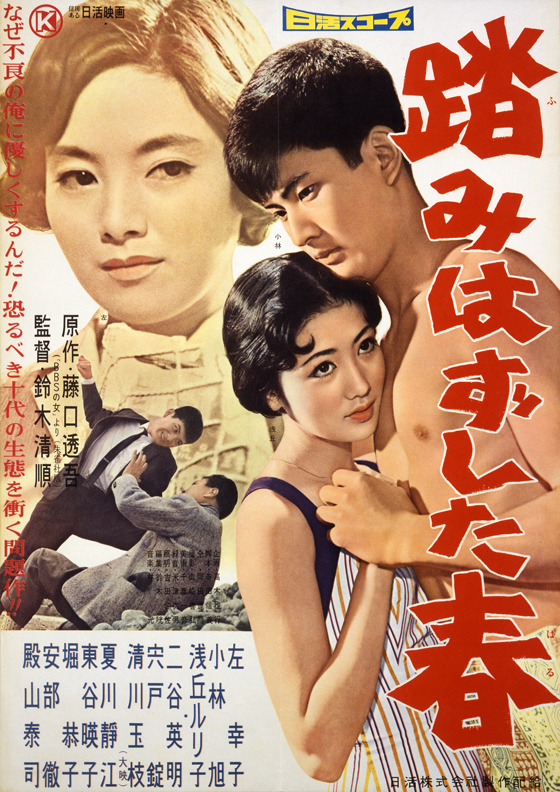
Take Aim at the Police Van (13号待避線より その護送車を狙え, Seijun Suzuki, 1960)

o0500070913581105946Nikkatsu’s main stock in trade during its 50s/60s heyday was the youth movie – films which captured the frustrations of being young (and usually male) in the scrappy post-war years. It’s a surprise then that the hero of Seijun Suzuki’s “action” movie Take Aim at the Police Van (13号待避線より その護送車を狙え, Jusango Taihisen Yori: Sono Gososha wo Nerae) is a genial middle-aged man who’s more Cary Grant in North by Northwest than Japanese James Dean. A programme picture, there’s nothing particularly interesting about the movie on paper but it’s among the first in which Suzuki indulges his talent for the surreal including a number of fantastically choreographed action sequences.

The film opens with a warning as a sniper trains his sights on a set of road signs which state that many accidents have occurred in this area. The one which is about to befall unlucky prison warden Tamon (Michitaro Mizushima) is however entirely man made. Momentarily confused by the figure of a woman watching the bus from the roadside, Tamon is blindsided when the sniper opens fire and kills several of the passengers while another, Goro (Shoichi Ozawa), cowers in the back. Tamon is suspended for six months but isn’t particularly upset about it. He’s not a detective and he knows he should leave it to the professionals, but he’s desperate to know why someone would bother attack such a lowly crew of petty criminals. Wondering who the woman was and how she fits into the case, who the snipers were aiming for and if they got them, and perhaps wanting to assuage his own feelings of powerlessness during the attack Tamon gets on the case.

Tamon is not your typical Nikkatsu action hero. He’s a little on the old side for starters – hardly the marquee face the studio was beginning to favour with its collection of “Diamond Guys”. He’s also not a policeman or a detective, he has no idea what he’s doing or what he’s getting himself into. What Tamon is is a righteous man. Almost immediately he’s sucked into the seedy underbelly of late ‘50s Tokyo with its strip clubs, trafficked women, and petty gangsters. This world is alien to him and he’s disgusted by it. Meeting the female manager of the “talent agency” which supplies in-room strippers to sleazy hotels where businessmen go when they’ve told their wives they’re at a conference, Tamon is horrified to hear her admit she thinks of the girls as “merchandise”. He pauses to explain to her that he always thought of the felons he looked after as “humans” rather than “criminals”, no matter what it was they’d done. Such naive humanitarianism is too much for Yuko (Misako Watanabe) – she’s instantly smitten, which is a problem because it means she needs to play both sides of her own game.

The pair end up in an uneasy alliance as Tamon’s goodness begins to work its magic. An unlikely white knight, Tamon finds himself wanting to save all the ladies threatened by “Akiba’s” dastardly plan from the icy charms of Yuko to Goro’s cabaret girl Tsunako (Mari Shiraki), and another young one, Shoko (Kyoko Natsu), about to get sucked into the Akiba web. What he discovers is a nasty trail of exploitation running from the bars and clubs of the city centre to the genial holiday spa towns where the moderately wealthy travel to pursue their discrete pleasures.

Tamon may be a little older than your average Nikkatsu action star, but he’s also a perfect fit for a film noir hero in wrong man mould. Tamon is not on the run, but he is out of place in this world, perhaps harking back to a presumably more innocent age where honesty and compassion still counted for something. He views his job as a prison warden as a public service, believing that there is goodness in everyone and it’s the job of people like him to find it and bring it to the surface. This he does at least seem to accomplish with Yuko who (despite her role in events so far) seems to have “reformed” and intends to follow Tamon’s lead in taking her “talent agency” in a more legitimate direction. 

Suzuki often claimed that Youth of the Beast was the first of his films where he was able to fully embrace his madcap desires, but Take Aim at the Police Van contains a fair few Suzuki touches of its own from the bold opening sequence shot through the sights of a sniper rifle, to the show girl killed by an arrow to her bare breast, bizarre murder by petrol tanker set piece, and exciting train station finale. Keeping the camera fluid, Suzuki captures a world in motion, seemingly running away from our noble hero until justice, in the form of an unstoppable steam train, finally arrives.


Attack on the police van clip (English subtitles)

https://www.youtube.com/watch?v=D2FcJY003HA

Youth of the Beast (野獣の青春, Seijun Suzuki, 1963)

youth of the beast posterSeijun Suzuki had been directing for seven years and had made almost 20 films by the time he got to 1963’s Youth of the Beast (野獣の青春, Yaju no Seishun). Despite his fairly well established career as a director, Youth of the Beast is often though to be Suzuki’s breakthrough – the first of many films displaying a recognisable style that would continue at least until the end of his days at Nikkatsu when that same style got him fired. Building on the frenetic, cartoonish noir of Detective Bureau 2-3: Go to Hell Bastards!, Suzuki once again casts Jo Shishido in the the lead only this time as an even more ambiguous figure playing double agent to engineer a gang war between two rival hoodlums.

Suzuki opens in black and white as the bodies of a man and a woman are discovered by a small team of policemen. Finding a note from the deceased female which states that she settled on taking her own life because she loved her man and thought death was the only way to keep him, the police assume it’s an ordinary double suicide or perhaps murder/suicide but either way not worthy of much more attention, though discovering a policeman’s warrant card on the nightstand does give them pause for thought.

Meanwhile, across town, cool as ice petty thug Jo Mizuno (Jo Shishido) is making trouble at a hostess bar but when he’s taken to see the boss, it transpires he was really just making an audition. The Nomoto gang take him in, but Mizuno uses his new found gang member status to make another deal with a rival organisation, the Sanko gang, to inform on all the goings on at Nomoto. So, what is Mizuno really up to?

As might be expected, that all goes back to the first scene of crime and some suicides that weren’t really suicides. Mizuno had a connection with the deceased cop, Takeshita (Ichiro Kijima), and feels he owes him something. For that reason he’s poking around in the local gang scene which is, ordinarily, not the sort of world straight laced policeman Takeshita operated in which makes his death next to a supposed office worker also thought to be a high class call girl all the stranger.

Like Detective Bureau 2-3: Go to Hell Bastards!, Youth of the Beast takes place in a thoroughly noirish world as Mizuno sinks ever deeper into the underbelly trying to find out what exactly happened to Takeshita. Also like Detective Bureau 2-3: Go to Hell Bastards!, Youth of the Beast is based on a novel by Haruhiko Oyabu – a pioneer of Japanese hardboiled whose work provided fertile ground for many ‘70s action classics such as The Beast Must Die and Resurrection of the Golden Wolf, but Suzuki’s ideas of noir owe a considerable debt to the gangster movies of the ‘30s rather than the moody crime dramas of twenty years later.

Jo Shishido’s Mizuno is a fairly typical ‘40s conflicted investigator, well aware of his own flaws and those of the world he lives in but determined to find the truth and set things right. The bad guys are a collection of eccentrics who have more in common with tommy gun toting prohibition defiers than real life yakuza and behave like cartoon villains, throwing sticks of dynamite into moving cars and driving off in hilarious laughter. Top guy Nomoto (Akiji Kobayashi) wears nerdy horn-rimmed glasses that make him look like an irritated accountant and carries round a fluffy cat he likes to wipe his knives on while his brother Hideo (Tamio Kawaji), the fixer, is a gay guy with a razor fetish who likes to carve up anyone who says mean stuff about his mum. The Sanko gang, by contrast, operate out of a Nikkatsu cinema with a series of Japanese and American films playing on the large screen behind their office.

The narrative in play may be generic (at least in retrospect) but Suzuki does his best to disrupt it as Mizuno plays the two sides against each other and is often left hiding in corners to see which side he’s going to have to pretend to be on get out of this one alive. Experimenting with colour as well as with form, Suzuki progresses from the madcap world of Detective Bureau 2-3: Go to Hell Bastards! to something weightier but maintains his essentially ironic world view for an absurd journey into the mild gloom of the nicer end of the Tokyo gangland scene.


Original trailer (no subtitles)

https://www.youtube.com/watch?v=RoruaIPA41U

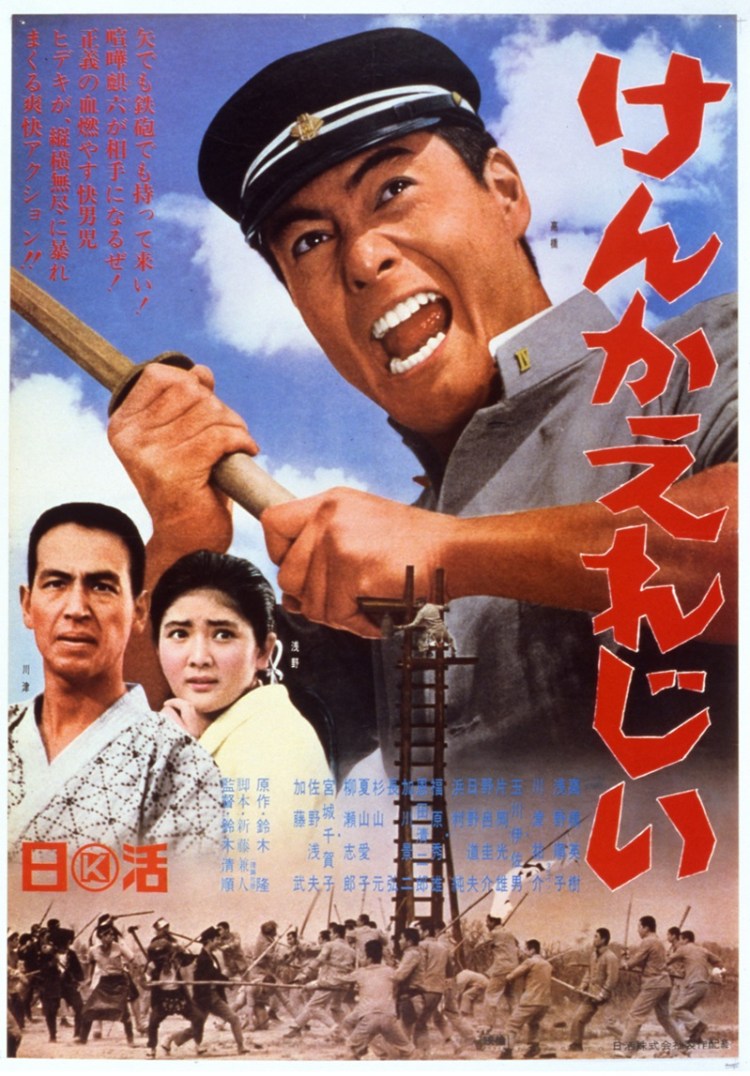
Fighting Elegy (けんかえれじい, Seijun Suzuki, 1966)

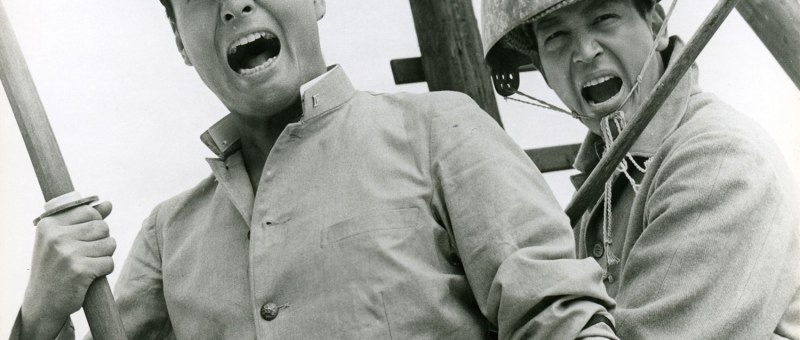
Fighting Elegy PosterAh, youth. It explains so many things though, sadly, only long after it’s passed. For the young men who had the misfortune to come of age in the 1930s, their glory days are filled with bittersweet memories as their personal development occurred against a backdrop of increasing political division. Seijun Suzuki was not exactly apolitical in his filmmaking despite his reputation for “nonsense”, but in Fighting Elegy (けんかえれじい, Kenka Elegy) he turns a wry eye back to his contemporaries for a rueful exploration of militarism’s appeal to the angry young man. When emotion must be sublimated and desire repressed, all that youthful energy has to go somewhere and so the unresolved tensions of the young men of Japan brought about an unwelcome revolution in a misguided attempt at mastery over the self.

Kiroku (Hideki Takahashi) is an impulsive young man with a magnetic personality who, like many of his age, has found himself at a military training school designed to toughen up the boys of Japan for the glorious services they will later be expected to provide for the emperor. Very much into his training, Kiroku submits himself to the rigid codes of the school which prize virility and encourage competitive brawling between the boys. Despite the strict prohibition on soft stuff like getting it on with girls, Kiroku has developed a heavy crush on the daughter at his Catholic boarding house, Michiko (Junko Asano). Delighting in her piano playing, Kiroku cannot find a permissible way to express his desires and so records them in a very frank diary. Michiko, it seems, may return his feelings but times being what they are cannot say or do anything until he declares them and so things are left to simmer between the two with no useful place to go.

Despite belonging to a military school, Kiroku’s main outlet is in a kind of extracurricular club which is obsessed with being manly but also with rebelliousness and showing how individualist they can be through a series of challenges which often involve flagrantly breaking the rules of the school. Kiroku’s violent escapades eventually get him expelled and sent to a different institution a few towns over which explicitly prizes the “Aizu Spirit”. By now truly invidualist in his isolation, Kiroku is disappointed in the tenets of the “Aizu Spirit”. Calling all of his fellow students “wild monkeys”, Kiroku makes some odd comments on the nature of oppression and dominance by pointing out that the students all willingly submit to the teacher who demonstrates authentic authority, but refuse to respect the ones who simply don’t have it. This is, in a sense, the opposite of the philosophy which Kiroku has come to follow in which pleasure comes from rebelliousness and the natural tendency of the young to resist all forms of constraining power.

However, the most primal constraining force acting on Kiroku is sexual desire as a running joke finds him consistently bothered by unwanted erections which he then has to hide from his comrades to avoid embarrassment. Kiroku is quite passionately obsessed with Michiko to the point that he thinks of little else despite the total prohibition on female contact advanced by his military training. His diaries are full of notes about how he dreams of her delicate hands though he lies about refusing to masturbate in favour of pouring all of his virility into his violent pursuits. The situation is complicated by the presence of Christian religion which places a further taboo on the young people’s desires as they glance guiltily at the crosses on the walls each time impure thoughts arrive. Michiko is not much better off, though her own frustrations result in internalised rather externalised violence which looks set to rob her of her own happiness but lacks the all encompassing destructive element of Kiroku’s unresolved energy.

Suzuki’s message is clear, if somewhat blunt. If only these young men and women had been allowed to work out their frustrations in a more normalised way, the entire folly of warfare and imperialist expansion could have been avoided. The Christian context does add to the levels of guilt and repression, but it is one layer further than the average farm boy from rural Japan who suddenly found himself caught up in the fascist movement would have experienced. Events reach their natural conclusion at the end of the film as Kiroku reads a newspaper report of the declaration of martial law in Tokyo following the February 26th Incident in which a cabal of hotheaded young military officers launched a broadly leftwing yet authoritarian coup designed to delegitimise the government and restore power to the emperor in a return to paternalistic feudalism. His romantic dream shattered, Kiroku recognises a kindred spirit and finds a calling in the call to arms but his vocation is a false one in its negation of everything it is to be alive. The path of militarism leads only to death and destruction in its pointless and nihilistic quest to overcome rather than satisfy ordinary desires and the forces which divide Kiroku and Michiko are those same forces which bring such overriding misery to a society caught in its own difficult adolescence.


Original trailer (English subtitles)
https://www.youtube.com/watch?v=j4Hy7WJtnI8

Detective Bureau 2-3: Go to Hell Bastards! (探偵事務所23 くたばれ悪党ども, Seijun Suzuki, 1963)

detective-bureau-2-3Before Seijun Suzuki pushed his luck too far with the genre classic Branded to Kill, he bided his time adding his own particular brand of zany absurdism to Nikkatsu’s standard cool guy fights crooks and gets girl formula. Detective Bureau 2-3: Go to Hell Bastards! (探偵事務所23 くたばれ悪党ども, Tantei Jimusho 23: Kutabare Akutodomo) is just one of these efforts. Made around the time of Suzuki’s major turning points such as the similarly named The Bastard, and relatively better known Youth of the Beast, the film follows Nikkatsu’s standard pattern but allows frequent Suzuki leading man and Nikkatsu A-lister Joe Shishido to swan about the place in grand style, effortlessly manipulating everything and everyone to come out on top once again. Filled with snappy dialogue and painted with an irony filled noirish aesthetic, Detective Bureau 2-3 does not care about its plot, and wants you to know you shouldn’t either.
The action kicks off when a low level yakuza, Manabe (Tamio Kawachi), is captured by the police following a bloody turf battle. Manabe isn’t talking, the police can’t hold him much longer, and a bunch of gangsters from all factions are already waiting outside to eliminate him as soon as he’s released. Enter Tajima (Jo Shishido) – private detective and head of Detective Bureau 2-3. Managing to convince his “buddies” in the regular police that he’s exactly the right guy to sort all of this out, Tajima constructs an undercover ID, stages a daring rescue of Manabe, and worms his way into his gang to find out what’s going down in yakuza land. Whilst there he begins romancing the boss’ cold hearted girl and attempting to find out the whereabouts of a cache of stolen weaponry before getting all of the bad guys together in one place so the police can arrest them with maximum efficiency.

Even more so than Suzuki’s other films from the period, Detective Bureau 2-3 moves like a rocket with barely anytime to follow the plot even if there was one. Tajima is like some cartoon hero, half Lupin III and half Top Cat, always landing on his feet or speeding away from danger in a swanky sports car. Even when trapped (along with his love interest) inside a burning basement with no means of escape, he comes up with an ingenious solution to get the all important evidence out there in the hope that his police buddies will come and rescue him. Tajima is the guy you can always rely on to get you out of a fix, even if it gets you into an even bigger fix.

Unexpectedly, Detective Bureau 2-3 also has a mild Christmas theme as the seedy dive bar Tajima and the crooks hang out in attempts to get into the festive spirit. This is a world of gamblers and showgirls where the glamour of the smokescreen underworld undercuts the less savoury aspects the men who people it. Suzuki gives us a fair number of cabaret numbers set against the Christmassy decorations and creates an awkward situation for Tajima as his on and off cabaret star girlfriend threatens to blow his cover, even dragging him up on stage for a pointed duet about useless boyfriends who never keep their promises. Actually that all kind of works for him too because it annoys the boss’ girl, who is definitely starting to at least develop complicated feelings towards him. Trapped with her cruel yet supposedly impotent gang boss boyfriend-cum-jailer, she’s about eight different kinds of frustrated and has been waiting for someone like Tajima to come and set her free (in about eight different ways), so all of this is really going very well for him.

Detective Bureau 2-3: Go to Hell Bastards! is just as zany and frenetic as the title suggests, moving from one bizarre action set piece to another filled with exploding coke bottles and weaponised cement trucks all while Shishido grins wildly and poses in his sharp suit and trench coat. Inconsequential, yes, but Detective Bureau 2-3 never claims to be anything other than cartoonish fun as Shishido and co offer up a series of wacky one liners and breeze through the action with an effortless kind of glee. Filled with Suzuki’s visual flair, Detective Bureau 2-3 is among his lesser efforts but is undeniably good fun and another colourful outing for the increasingly cool Shishido.


Original trailer (no subtitles)

https://www.youtube.com/watch?v=rztsD3cWTes

Nikkatsu Diamond Guys Vol. 1

nikkatsudg_av037Review of Arrow’s Nikkatsu Diamond Guys Volume 1 first published on UK Anime Network.


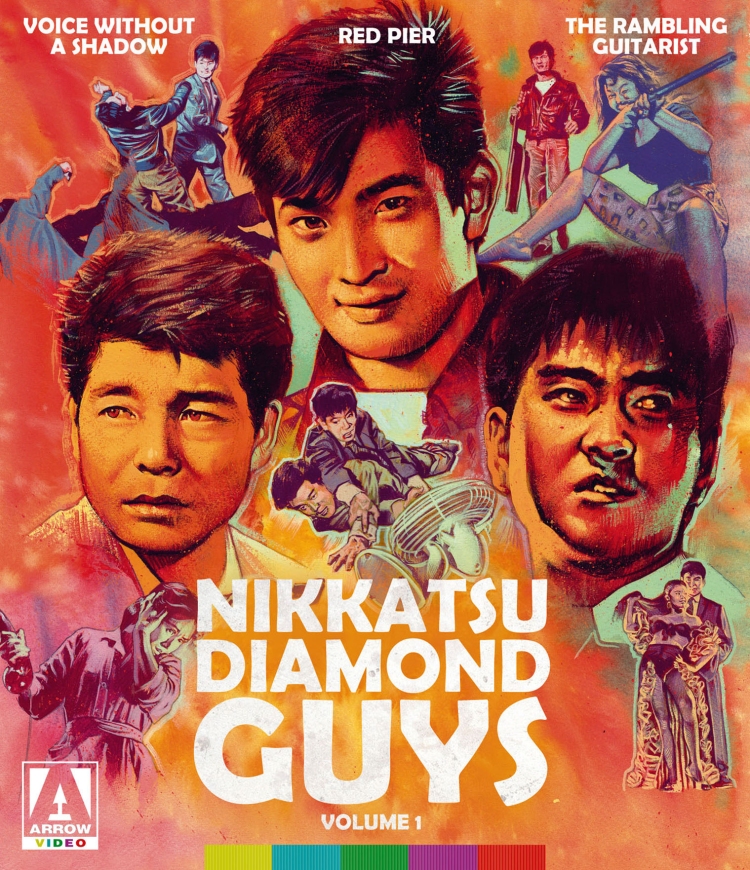
“Diamond Guys” is the name given to the top line of A-list stars at Japan’s oldest film studio Nikkatsu during their period of relaunching themselves as a major production house during the 1950s. At this time, Japanese studios, like their Hollywood counterparts, worked largely on a star system where they held a number of actors and actresses under contract and slotted them into their productions as and where they saw fit. Of the three stars in these pictures, Yujiro Ishihara perhaps burned brightest as a James Dean style apathetic hero and icon of the “sun tribe” era. Hideaki Nitani ultimately carved a niche for himself as a second lead rather than in starring roles and is a little more on the soulful side than the other guys. Akira Kobayashi who’s still fairly young here is probably the most familiar to overseas audiences later starring in a number of gangster pictures including Arrow’s previous releases Retaliation and the Battles Against Honour and Humanity series.

The first film included in the set, Voice Without a Shadow, is a notable inclusion as it’s a little seen, early effort from the notorious master of the surreal, Seijun Suzuki. In a significantly restrained mood here, Suzuki adapts a Seicho Matsumoto short story with noirish overtones as a telephone switchboard operator accidentally connects a wrong number and unwittingly hears the voice of a murderer at a crime scene. Hideaki Nitani plays a conflicted reporter who’s fallen in love with the switchboard operator who is, alas, already engaged. Three years later she hears the voice again in a gangster her husband unwisely becomes involved with only to have him killed and her husband become the prime suspect.

Film number two, Red Pier, comes from Toshio Masuda and stars pinup of the day Yujiro Ishihara in a characteristically cheeky, nihilistic gangster role. Dressed in a bright white suit and sunglasses, “Jiro the Lefty” is a petty yakuza street kid who found a home in a gang but dreams of a better life somewhere else. After witnessing the strange death of a potential target who gets crushed by a crane at the docks, Jiro ends up meeting the man’s sister and, of course, falls for her. Unfortunately, just about everyone now has it in for Jiro and his happily ever after seems very far off indeed.

The Rambling Guitarist, by contrast, is the only film in the collection to be filmed in colour but makes fantastic use of its super bright, psychedelic look. Starring Akira Kobayashi as a drifter with a guitar, the film starts out like a western but ends as a yakuza pic with a little youth drama thrown in for good measure. It’s fighting, music, and gunplay with Jo Shishido lending grinning support as a late addition hitman.

In some senses each of these films was built around its star – men want to be them, women want to be with them, you get the picture. The Rambling Guitarist is sort of the odd one out here as it’s of a slightly different strand than the other two with a lighter emphasis on crime and a shift from noir to western in terms of its overseas influences. Both Voice Without a Shadow and Red Pier lean much more towards film noir with Red Pier leaning a little more towards Europe than America. That said, The Rambling Guitarist is perhaps the weakest film on offer simply because of its up to the moment youth orientation which leaves it feeling a little more dated than the other two which can rely on their more classical style to find a modern appeal.

Each of these little seen gems would have been worthy of a solo buy in any case but finding them all offered in this fantastic new package from Arrow is a real treat. Each offered in stunning HD re-masters on blu-ray, even if they show their age in a couple of places the transfers are particularly fine and are likely to be the best these films will ever look. The Nikkatsu films from this era offered crowd pleasing thrills and good looking actors, but they were often also made by interesting directors who injected a little of their own individual, often youthful, flair to lift them well above the generic genre movies also on offer. That isn’t to say that each of their pictures was a smash hit, but the three on offer as part of this set are certainly each worthy of consideration even if for quite different reasons and if the included trailers for Vol. 2 are anything to go by we have even more undiscovered gems to look forward to in the future!


Nikkatsu Diamond Guys Volume 1 is out now on dual format DVD/blu-ray in the UK and USA courtesy of Arrow.

http://www.youtube.com/watch?v=-4AUqrF38gQ


Voice Without a Shadow (影なき声, Seijun Suzuki, 1958)

Snapshot-2016-01-24 at 10_45_06 PM-571365520
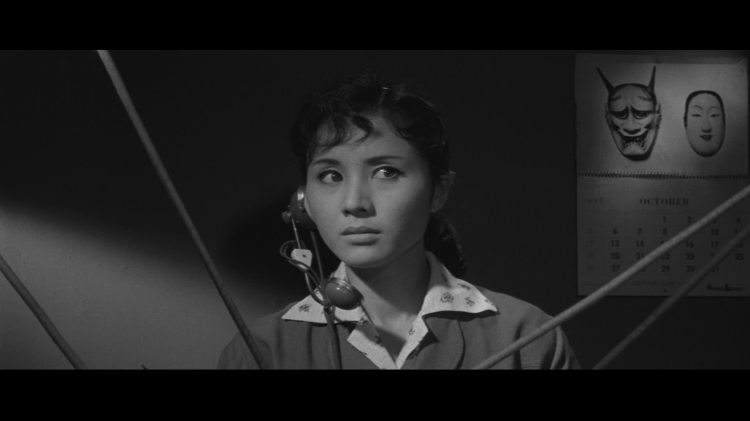
Make friends with this Oni mask – you will be seeing a lot of him throughout the film.

Seijun Suzuki might be best remembered for his surrealist pop art masterpieces from the late sixties or his even less comprehensible art films which followed his return to directing after settling his dispute with Nikkatsu, but everyone’s got to start somewhere and it comes as something of a relief to know that Suzuki was perfectly capable of making a straightforward movie if he wanted to. Voice Without a Shadow (影なき声, Kagenaki Koe) is exactly what it sounds like – a fifties style, US inspired noir however, Suzuki adds his usual flourishes and manages to wrong foot us pretty much the whole way through so that we never end up where we thought it was that we were going.

To begin with, our story is fairly straightforward. Reporter Ishikawa (Hideaki Nitani) provides our film noir style voice over as switchboard operator Asako (Yoko Minamida) accidentally dials a wrong number only have it picked up by a strange man who tells her she’s rung a crematorium then laughs hysterically. It turns out that the number was actually for a pawn shop which was in the process of being knocked over and the owner killed – Asako heard the perpetrator’s voice and thanks to her switchboard experience isn’t going to forget it. Ishikawa grows closer to Asako as the case becomes a media sensation but backs off after learning she’s already engaged.

Three years later Asako hears the voice again – a friend of her husband’s who keeps co-opting their living room for mahjong games that go on for days and cost everyone but him a lot of money. Before long Hamazaki (Jo Shishido) is found dead and Asako’s husband is the prime suspect but did he really do it? And if he didn’t, does Ishikawa really want to find out who did?

As you can see it’s a story that wouldn’t be out of place in any B movie noir from the fifties and the telephone set up is even a little reminiscent of Sorry, Wrong Number (though that film has a very different conclusion indeed). Based on a short story by Seicho Matsumoto, Voice, Voice Without a Shadow is full of the classic play of light and shadow that characterises the best film noir and the mood is ably supported by a suitably jazzy score from Hikaru Hayashi. If there’s a criticism to be made in this area, it’s that Nitani’s Ishikawa is a little too nice and pure hearted in comparison to the broken hearted heroes from the detective serials. He seems content to try and help Asako whilst uncovering the truth even if it ends up costing him in the end.

Although Asako herself is technically the leading character she quickly gets relegated to a more conventional woman in peril role. She is the one who recognises Hamazaki’s voice and the only clue linking him to the pawn shop murder three years ago but, while he’s alive anyway, Hamazaki is more interested in having fun terrorising everyone rather than trying to rub her out. In fact, the sudden demise of Hamazaki, played by an extremely young Jo Shishido, is one of the most surprising things about the film in which you’d expect him to remain the central antagonist right up until the grand finale.

Voice Without a Shadow is then a fairly conventional, noir inflected B movie which wears its Hollywood influences on its sleeve. However, there are glimpses of Suzuki’s individual style leaking through such as in his occasional and surprising use of double exposure, innovative composition and other modernist techniques which all help to lift the rather workmanlike script onto another level. In someways, it’s all a little too nice – even Hamazaki’s nasty lowlife activities are neatly skirted around almost like a film noir that’s been through a car wash though its strange pleasantness also has a nicely refreshing quality.

A minor film from the master of the surreal then, but an interesting one none the less. The mystery element proves satisfying even if it could do with a little more dirt under its fingernails and the committed performances also do their bit to enhance the mood. A prime example of its genre, Voice Without a Shadow is a notably restrained entry in Suzuki’s back catalogue but its classical style mixed with an offbeat, absurdist undercurrent make it one worth seeking out.


Voice Without a Shadow is the first film included in Arrow’s Nikkatsu Diamond Guys Vol. 1 collection.


Gate of Flesh (肉体の門, Seijun Suzuki, 1964)

nikutai_no_mon_2_film-1600x900-c-defaultWhat are you supposed to do when you’ve lost a war? Your former enemies all around you, refusing to help no matter what they say and there are only black-marketers and gangsters where there used to be merchants and craftsmen. Everyone is looking out for themselves, everyone is in the gutter. How are you supposed to build anything out of this chaos? Perhaps you aren’t, but you have to go one living, somehow. The picture of the immediate post-war world which Suzuki paints in Gate of Flesh (肉体の門, Nikutai no Mon) is fairly hellish – crowded, smelly marketplaces thronging with desperate people. Based on a novel by Taijiro Tamura (who also provided the source material for Suzuki’s Story of a Prostitute), Gate of Flesh has its lens firmly pointed at the bottom of the heap and resolutely refuses to avert its gaze.

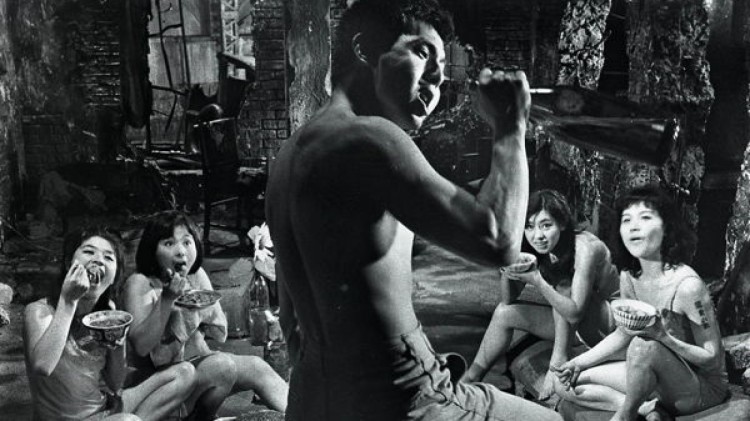
A nervous young woman, clearly tired, starving and alone wanders through a marketplace in desperation before a yakuza offers to buy her something to eat. She is wary but has little choice. Soon after she meets toughened prostitute Sen who is the de-facto head of a small group of streetwalkers committed to supporting and protecting each other. They have few rules but the biggest one is no giving it away for free. Maya joins their “merry” band and things are going OK for them until they make the fateful decision to take in a wounded ex-soldier on the run from the American military police. Shin puts a great big wedge between the members of the group, deepening the cracks which were present all along. Sure enough, Maya starts to fall for this damaged man threatening to fall foul of the gang’s single taboo. When you’ve lived like this, without hope, without a future, can you ever go back to being a “real human being” ever again?

Make no mistake, this is a ruined world. Almost post-apocalyptic, it’s populated by the starving and the desperate. The sweet potato seller is king here – the working girls are depicted like packs of rabid animals, descending on any passing male ready to extract any amount of loose change which they immediately run out to thrust into the hands of anyone who has food. The great horror is hunger.

The other great horror is, of course, violence and particularly male violence against women. Maya is assaulted early on and a truck carrying two army officers and a priest tries to make a quick escape after noticing her lying wounded by the roadside. The Americans aren’t going to help her, she’s just another raped Japanese woman after all, but the priest stops and offers another kind of salvation shining from his dangling crucifix. He repeatedly turns up later and tries to convince Maya to come back to church but you can’t live on a communion wafer alone and eventually Maya puts a definite end to the idea of any kind of religious solution to her predicament.

Sex is business for the woman under Sen’s command. They sell their bodies, hence the prohibition on giving them away. Breaking the rules will get you cruelly beaten and humiliated before being thrown out of the group and it’s near impossible to survive alone. The other women have all been injured by the war, they’re all among those left behind. One of them, Machiko, stands a little to the side as a middle class war widow rigidly sticking to her kimono and dreaming of becoming someone’s wife again. Needless to say, she and Sen do not always see eye to eye as Machiko’s desire to return to a more innocent age conflicts with Sen’s hard nosed pragmatism.

This is Japan in defeat. The girls live in a warren of ruined buildings haunted by visions of the past. Shin has returned from the war to a land devoid of hope. He’s a broken man and, as the woman have been “reduced” to prostitution, he has been “forced” into crime. There aren’t any real people here anymore, just animals willing to do whatever it takes just to stay alive.

When Suzuki was given this assignment, they wanted him to make a soft-core exploitation pic full of the sleazy lives of the red light district. Suzuki doesn’t give them that, he gives them another round of beautifully composed, surrealist social commentary in which the downtrodden citizens of Japan are defeated for a second time by the corrupting influences of the American occupation. The final shot of the ascendant Stars and Stripes flapping in the wind while the Japanese flag lies drowned in the muddy river speaks for itself and though Suzuki shows us those defiantly trying to live his prognosis for them is not particularly hopeful. He uses multiple exposure here more than in any other film as the past continues to haunt the traumatised populace in quite a literal way where one scene of degradation leads on to another. Extended metaphor, surrealist examination of the post-war world and also the low level exploitation feature Suzuki was hired to direct (albeit in more ways than one) Gate of Flesh proves one of his most complicated and accomplished features even given his long and varied career.


Gate of Flesh is available with English subtitles on R1 DVD from The Criterion Collection.

http://www.youtube.com/watch?v=_NHgbKL57hc

Capone Cries a Lot (カポネおおいになく, Seijun Suzuki, 1985)

1040003_lNever one to be accused of clarity, Seijun Suzuki’s Capone Cries a Lot (カポネおおいになく, Capone Ooni Naku) is one of his most cheerfully bizarre movies coming fairly late in his career yet and neatly slotting itself in right after Suzuki’s first two Taisho era movies, Zigeunerweisen and Kageroza. Though not part of the so called “Taisho trilogy” (this would be completed with Yumeji in 1991), Capone Cries a Lot begins its tale in the short lived period between the ages of Meiji and Showa when the world seemed open and foreign influence flooded into this once isolated nation. Could that influence also travel upstream? Naniwa-bushi, for example, could could a Naniwa-bushi singer on the run make something of himself in the New World?

Like most of Suzuki’s movies, plot is a secondary concern. However, loosely speaking, our protagonist is Jun – a man who wanted to learn the art of Naniwa-bushi from its accepted master but ultimately ran off with another man’s wife and ended up in 1920s America. Once there he hooks up the Japanese gangster Gun-tetsu who makes use of Jun’s sake making experience to assist in his bootlegging business during prohibition. This brings them in contact with the Capones, firstly with Frank and eventually with Al (who Jun amusingly mistakes for the president of the United States). Meanwhile, Jun’s girl, Kozome, has left him (to an extent) and become a prostitute. However well things seem to be going for Jun, he’s still a foreigner in a strange, and sometimes unkind, land. Is this the sort of place where dreams can survive?

Suzuki films the whole thing in Japan at an abandoned theme park which is 100% Americana – the Old West tricked out with cowboys, saloons and guns. Now it’s strange kind of new city populated by runaway Japanese criminals gambling and whoring their way through life. Jun wants to sing Naniwa-bushi in this odd place even if no one understands him. Originally he’s annoyed by the foreigners laying a hand on his shamisen or making attempts to join in with their jazz inflected modern music, but eventually he’s singing new Naniwa-bushi songs about the plight of the Native Americans and finally joining the jazz band for a full on musical fusion number. Suzuki does not shy away from the racial politics and problems inherent in his critique of American imperialism even up to an including the KKK and the Japanese internment camps.

In contrast to the previous two Taisho set films, Capone is much lighter in tone and obviously more playful even if it includes a similar level of oblique surrealism. Chaplin references and slapstick humour mix with absurdist dialogue and cosmic silliness to create a popcorn candy world that’s still somehow sad and strange. It’s a vision of America filtered through ‘20s gangster pics and B-movie westerns, equal parts bubblegum and tommy guns. It doesn’t make a great deal of literal sense but offers plenty of Suzuki’s psychedelic eye for colour, surprising editing choices and all round idiosyncratic approach to storytelling.

There may be ample reasons why Capone Cries a Lot has never found an overseas audience, it’s a little overlong for one and its comments on race are perhaps a little uncomfortable from several different angles. Nevertheless, it’s another characteristically zany effort from Suzuki and full of colourful pop aesthetics that are much more playful than the rather heavier Zigeunerweisen and Kageroza. Well worth the long strange ride, Capone Cries a Lot is a trip to 1920s candy land that few of the directors devotees will be able to resist.


(Unsubtitled) Scene from midway through the film

http://www.youtube.com/watch?v=r_ILc3zQ7nE


Kagero-za 陽炎座 (Heat Haze Theatre – Seijun Suzuki 1981)

SuzukiKageroza1Zigeunerweisen was an unexpected commercial and critical hit in Japan netting both an improbably good box office return and more than a few awards. The next instalment in what would become Suzuki’s Taisho Roman Trilogy (though it would be another ten years before the final part, Yumeji, would arrive) therefore benefitted from a slighter bigger budget, bigger stars and even greater ambition. Like the others in the trilogy and as implied by its title, Kagero-za is once again based on a book set in the Taisho era though this time by Kyoka Izumi. Izumi was a novelist and kabuki playwright most closely associated with supernatural tales influenced by Edo era traditions and Kagero-za even features a playwright as its protagonist. With even less clarity than Zigeunerweisen, Kagero-za is not altogether as successful but nevertheless boasts Suzuki’s bizarre imagery and surreal world view.

Like Zigeunerweisen Kagero-za also throws dreams and reality into a giant melting pot with a non-linear narrative that floats and wefts like a strange nightmare. It begins with the central character, Matsuzaki (played by Yusaku Matsuda), meeting a lone woman near a shrine who asks him to accompany her to visit a friend in the hospital. She doesn’t want to go alone because she’s afraid of the old woman who sells charms and medicines there including bladder cherries which are said to contain the souls of women. Originally reluctant Matsuzaki agrees only to have her change her mind shortly after. Matsuzaki is pre-occupied over having dropped a love letter and worrying it’s been found by an ‘evil’ person – something which upsets his new friend as she’s convinced the letter was from a married woman.

This mysterious woman, it turns out, may be (or have been?) the wife of Matsuzaki’s wealthy patron Tamawaki. To make matters even more confusing, Tamawaki may have had two wives – the first a German woman he married while abroad and brought back with him to Japan who died her hair black and wore contact lenses to look more Japanese but regained her original blonde & blue eyed foreignness in the bright moonlight. The second is, apparently, dying in hospital – not that Tamawaki is terribly upset about it. Matsuzaki becomes increasingly obsessed with the mysterious woman, following her across the country only to discover Tamawaki waiting for him – apparently intent on witnessing a double suicide.

The film takes an even more surrealist dive towards the end as Matsuzaki finds himself the only adult audience member at a kabuki show entirely performed and witnessed by children. Not only that, this bizarre kabuki play appears to re-enact the exact same events from the first half of the film. A fitting trap for a playwright, this last, nightmarish section echoes the film’s ghost story origins complete with the creepy bladder cherry seller from the beginning as some kind of villainous demoness and Tamawaki as a tempting devil. Who talks of realism here? Says Tamawaki making an exit through an alleyway with a rifle on his shoulder. Who indeed? Not us, that’s for sure.

Even less coherent than Zigeunerweisen, Kagero-za is a veritable fever dream of a film. There’s barely any linear plot, Matsuzaki’s perceptions are recounted in fractured dream narrative where the true nature of events is always unclear. We can’t trust Matsuzaki to guide us here, nor can we trust Suzuki who employs fewer absurdist tricks than with the previous film but injects a heavy dose of kabuki inspired theatrics. Everything feels inevitable, like the action in a play it’s all been scripted and performed many times before. Yet for all that we don’t ever come to feel very much for Matsuzaki and his presumably tragic fate even though we realise fairly early on what sort of story this is. It’s hellish, and gruelling and honestly tries the patience at times but never achieves that sense of over arching dread that characterised Zigeunerweisen.

That said, if Kagero-za’s largest weakness is playing second fiddle to Zigeunerweisen that’s not so much of a problem. Once again filled with bizarre and trippy imagery, Kagero-za has many startling moments but fails to marry its visual virtuosity with the more individualistic focus of its script. Undeniably without the power of Zigeunerweisen, Kagero-za ultimately feels a little too clever (and perhaps too cold) for its own good but nevertheless does offer Suzuki’s visual flair and an entertaining (if baffling) narrative.

Branded to Kill (uk-anime.net review) / Masters of Cinema to release Suzuki’s Youth of the Beast

vlcsnap-2014-08-18-11h50m48s63

One of my favourite films – Seijun Suzuki’s Branded to Kill reviewed at uk-anime.net!


In the words of the bosses at Nikkatsu who chose to fire Seijun Suzuki immediately after the film was released in cinemas, Branded to Kill is ‘incomprehensible’. The same bosses then went on to add that they were stopping Suzuki’s monthly salary with immediate effect because his films never made any sense or any money and that he should probably give up being a film director because no one else was going to hire him. To be frank, it was their loss. ‘Incomprehensible’ is one way to describe the film, it’s almost fair though the plot and shooting style feel more straightforward than his previous film, the psychedelic yakuza movie Tokyo Drifter. Like Tokyo Drifter, Branded to Kill is the story of a tough guy killer but this time around our ‘hero’ turns out to be much less self aware.

Hanada (Joe Shishido) is one of the top hit men operating in the Tokyo underworld (though perhaps not *the* best). His latest assignment is to escort a someone across town assisted by his alcoholic hit man friend. However, they’re ambushed and his friend is killed though the client reaches his destination safely. On the way home, Hanada’s car breaks down but a pretty girl, Misako, stops to give him a lift. Completely besotted, Hanada returns home to play odd sex games with his wife all over the house whilst sucking in the smell of boiling rice from the rice cooker to put himself in the mood. Becoming more and more obsessed with Misako, he agrees to take on an impossible hit which goes wrong after a butterfly lands on his sights. Accordingly, Hanada then loses his status as one of the top guys and begins to become increasingly insistent on claiming the number one slot for himself.

As you can see, the suits at Nikkatsu may have had a point. Essentially, Branded to Kill takes a fairly standard B-movie gangland plot where multiple guys duke it out for the top spot but it adds in multiple layers of quirky humour and surreality that were definitely not part of Suzuki’s brief. The first section of the film shows you Hanada’s tough and resourceful nature as he takes down the ambushers and completes his original mission in a cool headed fashion. His subsequent assignments have him showing a little more flair whether perfectly timing his shot to fire through the opening of a giant cigarette lighter on billboard, escaping via hot air balloon, or in the famous sequence in which he assassinates an optician by firing through the drainage pipes which lead to his sink. Unfortunately though, Hanada made a serious miscalculation when he accepted Misako’s job offer – as his friend told in him in the beginning, booze and women will get you killed. Stripped of his status and now a wanted man, Hanada’s fragile grip on his identity begins to crumble leaving him at the mercy of his own desires.

Misako herself is obsessed with death. She tells Hanada on their first meeting that her dream is to die and shows him the dead black canary she has hanging from her rear view mirror. Her house is filled with taxidermy birds and black butterflies and it’s hard not to see her as a kind of death goddess, luring Hanada from his certain path of simple but precise killing to one of neurotic questioning. Hanada’s relationship with his wife, Mami, also appears quite strange as in he seems not to care very much about her. He uses her for sex (whilst ordering her to cook him up a fresh batch of rice which, it seems, is what he really wants) but then seems faintly annoyed that she exists and barely seems to care when he telephones his boss but it’s Mami that answers the phone. She appears fairly devoted to him, though intolerant of his fetish for the smell of cooking rice, and is hurt by his lack of attentiveness. During the course of the film, both women will try to kill him and both will suffer directly or indirectly at his hands. Even the strangely homoerotic relationship he develops with the mythical No.1 is fuelled by death – what is it, really, that Hanada has been looking for?

Speaking of strange relationships, as part of this set Arrow have also provided the 1973 ‘Pink film’ remake of Branded to Kill, Trapped in Lust. Following Suzuki’s departure, Nikkatsu was taken over by new management who moved more into the realms of explicit sex and violence in the hope of recapturing an audience that was deserting the cinema for TV. Known as the ‘Roman Porno’ line Nikkatsu continued to pour out a series of explicit sex films, some of which were more ‘arty’ than others. Trapped in Lust is only loosely based on Branded to Kill but its protagonist is a more of a would be hit man who blows his chances by breaking the rules but still desperately wants to be taken seriously. Though it lacks Suzuki’s directorial flare, it makes up for it with sheer weirdness. How often can you say the villain turns out to be a ventriloquist and his doll in which you’re never quite sure which one is actually in control? These sorts of films have lots of rules about what can and can’t be shown including the prohibition on visible pubic hair which might explain the marker pen like scribble at one point where, presumably, the actress’ towel fell down unexpectedly. Pure wish fulfilment, Trapped in Lust has a slightly more upbeat ending (for the protagonist at least) and is worth seeing for its total bizarreness alone but is perhaps more interesting than actually enjoyable.

After being fired by Nikkatsu Suzuki entered a lengthy tribunal process (which he eventually won) and didn’t make another film for ten years. Strange, surreal and other worldly from its more straightforward beginnings to its boxing ring show down, Branded to Kill is one of the most perfectly constructed, but totally insane, B movie extravaganzas ever created. ‘Incomprehensible’? No. Well, a little bit – but only in the best possible way. Like all of Seijun Suzuki’s movies, Branded to Kill defies description or explanation and must be seen to be believed. A genre bending classic, Branded to Kill is a true must see and perfect example of late sixties weird cinema.


Also, hot on the heals of Arrow’s dual format DVD/BD combo of Branded to Kill, Eureka/Masters of Cinema announced today that they’ll be releasing a dual format release of Suzuki’s earlier colour film, Youth of the Beast!

http://www.youtube.com/watch?v=pk6H4r7FfVI

Everybody’s going Seijun Suzuki crazy which can only be a very good thing! Now someone hurry up and release the Taisho trilogy.