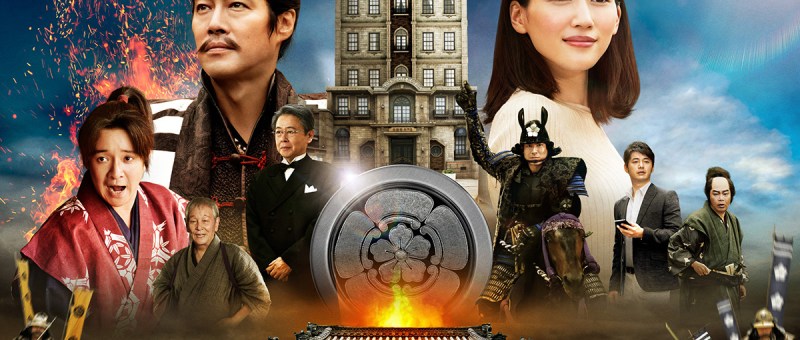
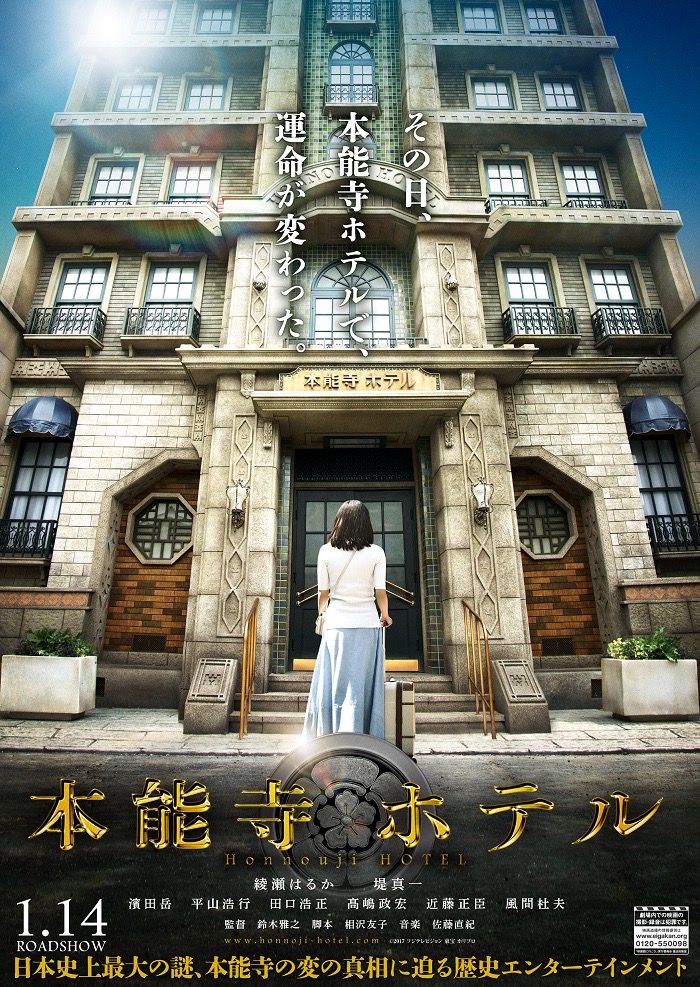
According to the opening quote from Otto von Bismark, fools learn from experience and the wise man from history, but in truth you’ll need a little of the former to correctly interpret the latter. The heroine of Honnoji Hotel (本能寺ホテル) is not exactly lacking in life experience, but hers has been of the passive variety. She’s blithely gone along with the path her society laid out for her, but now she’s hit an unexpected bump in the road it’s prompted her into a reconsideration of where it was she was going. Most people wouldn’t meet such a crisis by asking “what would Nobunaga do?”, but that’s where our heroine finds herself after accidentally exiting a hotel lift right into the middle of the Sengoku era.
20-something Mayuko (Haruka Ayase) is in Kyoto for a short holiday and to meet up with her fiancé to be formally introduced to his family. The problem begins when it transpires that owing to an administrative error, her hotel reservation has been made for the following month and everything is currently fully booked seeing as the city is such a tourist hotspot. After wandering around a while, she stumbles across a dated, slightly musty establishment named the “Honnouji Hotel” which, she realises even given her shaky grasp of history, is a fairly inauspicious name. Everyone knows that 16th century general and noted tyrant Oda Nobunaga committed seppuku at the Honno temple after he was betrayed by one of his retainers who rose against him. Nobunaga had been primed to bring peace to Japan after more than a century of destructive warfare, paving the way for unification under the Tokugawa Shogunate, but is a somewhat ambiguous figure known for his extreme volatility and tendency towards cruel authoritarianism.
That vision of Nobunaga is indeed the one Mayuko first encounters when she finds herself accidentally thrown back into the Sengoku era after exiting the lift in her hotel. The first person that she meets turns out to be Mori Ranmaru (Gaku Hamada) with whom she bonds over a shared sense of anxiety, she over meeting her boyfriend’s family, and he over an important tea ceremony with life or death consequences. She gives him some modern-day stomach medicine while he warns her that his lord is “cruel and demonic”. Still not quite grasping that things work differently (to a point at least) in the feudal world, she advises him to quit rather than allow himself to be exploited to the point that it’s ruining his health but he exasperatedly reminds her that you can’t simply drop out of samurai society. Mayuko gets another cruel awakening when observing the tea ceremony and witnessing a man, whom she later realises to be Nobunaga (Shinichi Tsutsumi), extorting a tea caddy from a distressed master who tries to protest that he’d only been informed that the caddy would be displayed and is unwilling to give it away. Nobunaga reminds him that the nation will soon be unified under his banner, at which point he will be in control of business affairs, threatening him with economic consequences backed up with the possibility of immediate violence.
Despite her essential passivity, Mayuko cannot bear injustice and immediately springs into action, handing the caddy back to its original owner and instructing him that he shouldn’t allow himself to be intimidated into giving up his prized possessions. In her own life, however, she’s nowhere near as certain. We find out that she’s only known her fiancé for six months, and is still ambivalent about the idea of marriage. When the company she’d been working for suddenly went bust, she found herself at a loss, told that the teacher’s certificate she’d taken as a backup is largely useless because even teaching is oversaturated in today’s difficult job market. Now, it’s not feudal times anymore, but many people in Japan still expect a woman to give up her career to get married, which is what most of her friends advise her to do especially seeing as she had no particular ambitions or goals in life. Kyoichi’s (Hiroyuki Hirayama) proposal comes at an opportune moment, but she finds herself asking opportune for whom and if this is really what she wants or if she’s just allowing herself to be railroaded into conventional “success” without really thinking it through.
It might be going too far to read too much in to a similarity between Nobunaga’s dictatorial dynamism and Kyoichi’s domineering manliness, but that’s largely where Mayuko seems to be. Beginning to realise his mistakes, Kyoichi confesses that he cynically took advantage of the situation to manipulate Mayuko into marrying him, believing that she was “insecure and unreliable”, “unable to do anything alone” and in need of his protection. Talking with Kyoichi’s father and beginning to assert herself in opposition to Nobunaga’s injustices, she begins to realise that she can take charge of her own destiny and has a duty to find what it is she wants to do, and do that as best she can.
The lesson is, however, somewhat problematically learned in her realisation both that she can’t change “history” and that she can because history is a consequence of our collective choices. This Nobunaga, apparently wanted a peaceful society for all, one in which class divisions had been eradicated and equality ruled. He sees our world and deems it good enough to sacrifice his life for, but Mayuko by turns becomes enamoured of the past, finding her vocation as a teacher of history in a move which is both progressive in seeing her reject a marriage of “convenience” to strike out under her own steam, but also backward looking in its reevaluation of Nobunaga and his unfinished revolution as if there is no real need for change “now”. Granted, Honnouji Hotel is partly concerned with selling the charms of Kyoto as an unchanging historical centre, but it’s difficult to escape the slightly sour note of conservatism as Mayuko finds her forward path only by embracing the samurai past.
Original trailer (no subtitles)




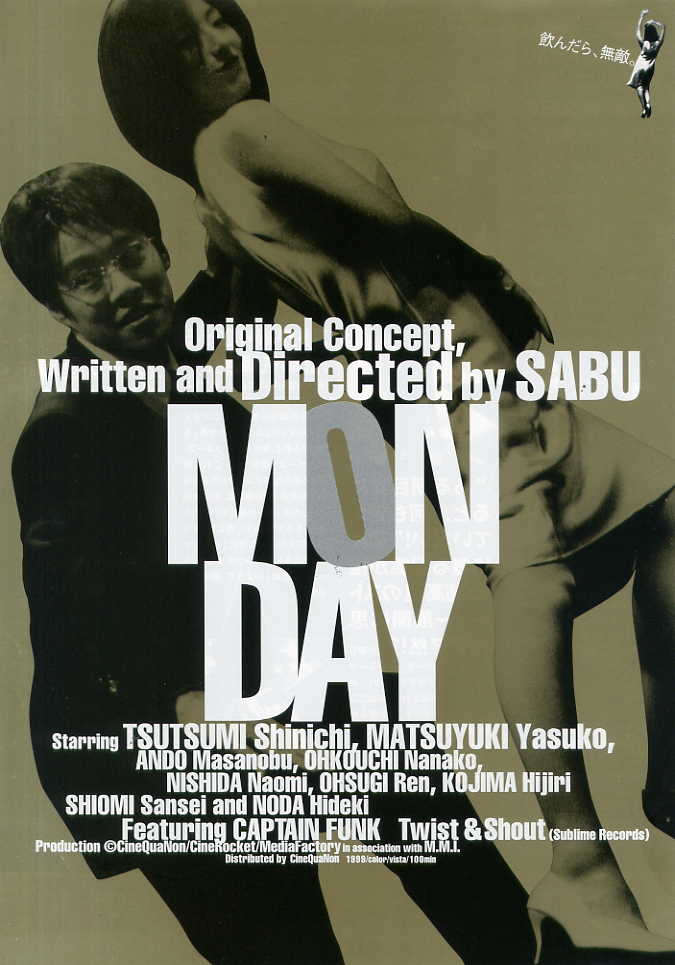 Waking up in an unfamiliar hotel room can be a traumatic and confusing experience. The hero of SABU’s madcap amnesia sit in odyssey finds himself in just this position though he is, at least, fully clothed even if trying to think through the fog of a particularly opaque booze cloud. Monday (マンデイ) is film about Saturday night, not just literally but mentally – about a man meeting his internal Saturday night in which he suddenly lets loose with all that built up tension in an unexpected, and very unwelcome, way.
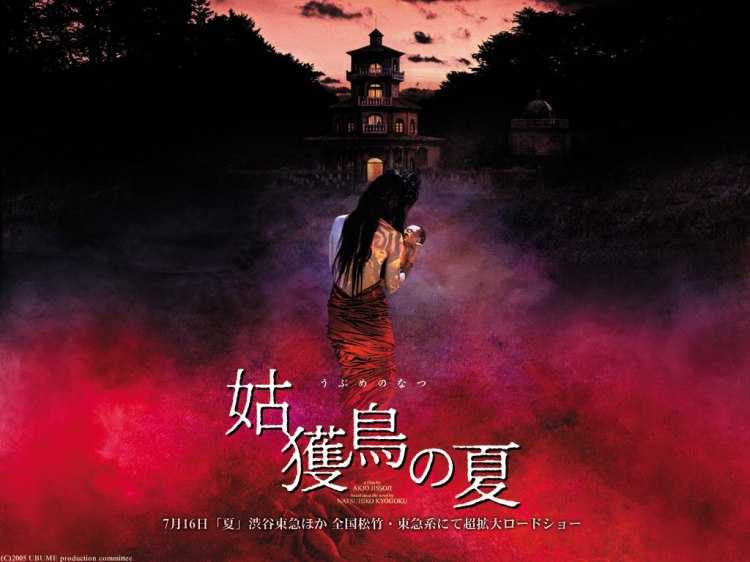 Akio Jissoji has one of the most diverse filmographies of any director to date. In a career that also encompasses the landmark tokusatsu franchise Ultraman and a large selection of children’s TV, Jissoji made his mark as an avant-garde director through his three Buddhist themed art films for ATG. Summer of Ubume (姑獲鳥の夏, Ubume no Natsu) is a relatively late effort and finds Jissoji adapting a supernatural mystery novel penned by Natsuhiko Kyogoku neatly marrying most of his central concerns into one complex detective story.
 2009 marked the centenary year of Osamu Dazai, a hugely important figure in the history of Japanese literature who is known for his melancholic stories of depressed, suicidal and drunken young men in contemporary post-war Japan. Villon’s Wife (ヴィヨンの妻 〜桜桃とタンポポ, Villon no Tsuma: Oto to Tampopo) is a semi-autobiographical look at a wife’s devotion to her husband who causes her nothing but suffering thanks to his intense insecurity and seeming desire for death coupled with an inability to successfully commit suicide.
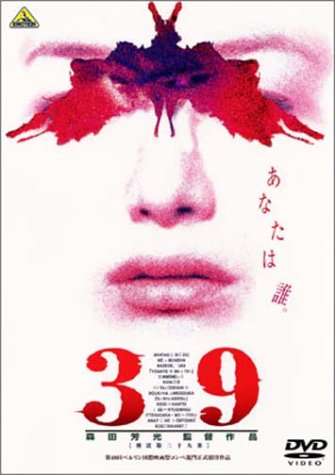 Article 39 of Japan’s Penal Code states that a person cannot be held responsible for a crime if they are found to be “insane” though a person who commits a crime during a period of “diminished responsibility” can be held accountable and will receive a reduced sentence. Yoshimitsu Morita’s 1999 courtroom drama/psychological thriller Keiho (39 刑法第三十九条, 39 Keiho Dai Sanjukyu Jo) puts this very aspect of the law on trial. During this period (and still in 2016) Japan does nominally have the death penalty (though rarely practiced) and it is only right in a fair and humane society that those people whom the state deems as incapable of understanding the law should receive its protection and, if necessary, assistance. However, the law itself is also open to abuse and as it’s largely left to the discretion of the psychologists and lawyers, the judgement of sane or insane might be a matter of interpretation.
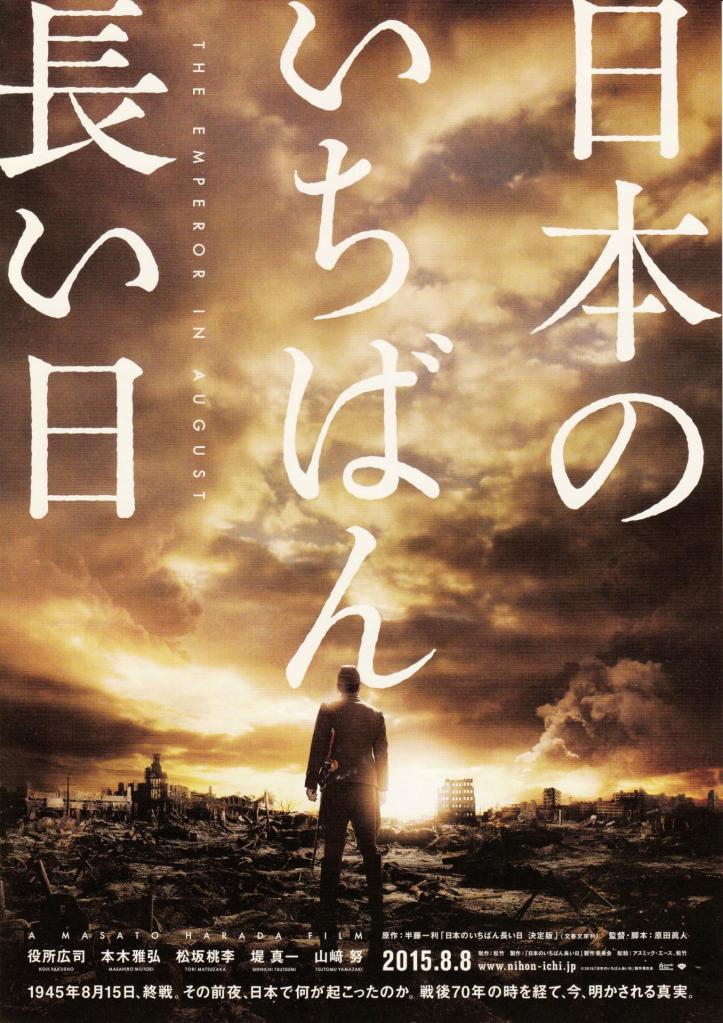 How exactly do you lose a war? It’s not as if you can simply telephone your opponents and say “so sorry, I’m a little busy today so perhaps we could agree not to kill each other for bit? Talk later, tata.” The Emperor in August examines the last few days in the summer of 1945 as Japan attempts to convince itself to end the conflict. Previously recounted by Kihachi Okamoto in 1967 under the title Japan’s Longest Day, The Emperor in August (日本のいちばん長い日, Nihon no Ichiban Nagai Hi) proves that stately events are not always as gracefully carried off as they may appear on the surface.
 The world of the classical “jidaigeki” or period film often paints an idealised portrait of Japan’s historical Edo era with its brave samurai who live for nothing outside of their lord and their code. Even when examining something as traumatic as forbidden love and double suicide, the jidaigeki generally presents them in terms of theatrical tragedy rather than naturalistic drama. Whatever the cinematic case may be, life in Edo era Japan could be harsh – especially if you’re a woman. Enjoying relatively few individual rights, a woman was legally the property of her husband or his clan and could not petition for divorce on her own behalf (though a man could simply divorce his wife with little more than words). The Tokeiji Temple exists for just this reason, as a refuge for women who need to escape a dangerous situation and have nowhere else to go.
