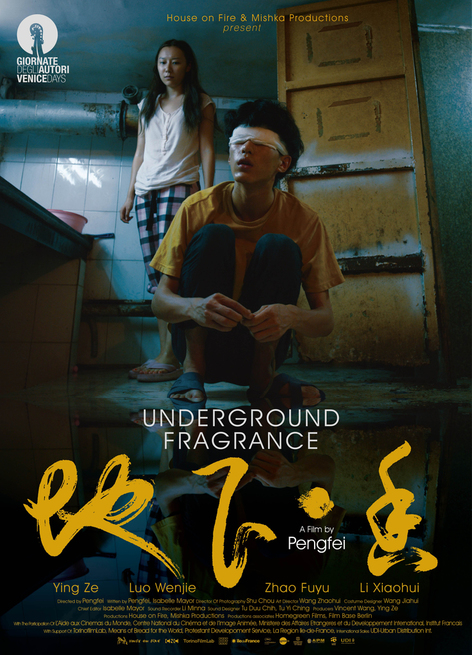
 The original Chinese title of recent Tsai Ming-liang collaborator (Song) Pengfei’s debut feature 地下・香 (dìxìa・xiāng) has an intriguing full stop in the middle which the English version loses, but nevertheless these two concepts “underground” and “fragance” become inextricably linked as the four similarly trapped protagonists desperately try to fight their way to better kind of life. Recalling Tsai’s dreamy symbolism, Hou Hsiao-Hsien’s romantic melancholy, and Jia Zhangke’s lament for the working man lost in China’s rapidly changing landscape, Pengfei’s film is nevertheless resolutely his own as it chases the ever elusive Chinese dream all the way from dank basements and ruined villages to the shiny high rise cities which promise a tomorrow they may never be able to deliver.
Yong Le (Luo Wenjie) is just one such young man, trying to buy a future by raiding the past. He has a small van he uses to “reclaim” furniture and sell it second hand. One day he has an accident whilst working which costs him his sight. Finding it difficult to manage in the cramped, noisy corridors of the subterranean cavern he is currently living in, Yong Le strikes up a friendship with his kindly new next door neighbour, Xiao Yun (Ying Ze), who helps him with some of his everyday problems like telling the time and finding food. Xiao Yun is currently working as a pole dancer in a seedy club which she longs to quit and is hoping to bag a salesgirl position at a new development office.
Yong Le is also friends with an older man, Lao Jin (Zhao Fuyu), who lives above ground with his wife (Li Xiaohui) in a large, old fashioned courtyard style house. Lao Jin and his wife are the only remaining residents of the village, the rest of which has been knocked down already after the other homeowners settled with the development company for what they considered the best deal they could get. Lao Jin, however, thinks it’s worth holding out and has been “in negotiations” for eight years. Dreaming of a mega payout he can use to by a fancy city flat and be a big shot at last, Lao Jin has already run through his savings and is dangerously close to losing everything.
In a rather pointed piece of symbolism, Xiao Yun walks past a large mural with the slogan “Run Towards Your Dreams” prominently displayed in the middle. Later, this same wall will be reduced to rubble, a handful of brightly coloured stones marking the spot where once a village stood. Xiao Yun and Yong Le have very different dreams to those of Lao Jin, reflecting the way that even aspiration has shifted with the generations. He wants the fancy penthouse life for himself and his wife, even if it means selling their furniture and sacrificing his wife’s beloved white rooster, but all Yong Le and Xiao Yun want is out of the dingy basement and into a cleaner sort of life.
Yong Le and Xiao Yun may begin to fall in love during his period of blindness, but it’s a luxury neither of them can afford. There’s a slight irony in the fact that Xiao Yun who’s come to hate the men who visit her bar, some of them trying to buy more than a show, becomes attached to a man who cannot see her, but her desperation to escape her dead end life before it’s too late means she can’t afford to hang around for romance to bloom. A heart stopping moment sees the sight restored Yong Le unexpectedly end up at the bar where Xiao Yun dances, but having been blind the entire time he knew her, he doesn’t recognise the woman on stage (though to his credit he does not particularly look). Pulled apart by the increasing harshness of the economic environment, romance is an unattainable dream for those like Yong Le and Xiao Yun, drifting around from one thing to the next barely able to touch the ground let alone live on it.
Pengfei’s camera operates with a formalist grace, putting architecture at the forefront of his storytelling. From the ruins of a village to lie of the as yet unfinished high-rise future and the dank, dangerous underground world of the casual drifters always aiming for something better, the landscape gives voice to the often despairing nature of life on edges of a society where the rate of change threatens to leave vast swathes of its citizens behind. Adding a touch of the surreal such as a supremely timed return of the electricity in which Lao Jin’s attempt to oust a noisy owl with fireworks lines up with his peking opera record, or the couple’s later attempt to woo the developers with a musical performance of their own (another demonstration of the way their old world customs have become obsolete), Pengfei undercuts the ever present melancholy with a dose of whimsical irony. Wistfully romantic, and dreaming of a better, fairer society Underground Fragrance is a snapshot of a world in flux in which even the most essential of human connections can become lost in the crowd of faces all running towards tomorrow.
Currently screening for free on Festival Scope as part of their Torino Film Lab selection.
Trailer from Venice (English subtitles)

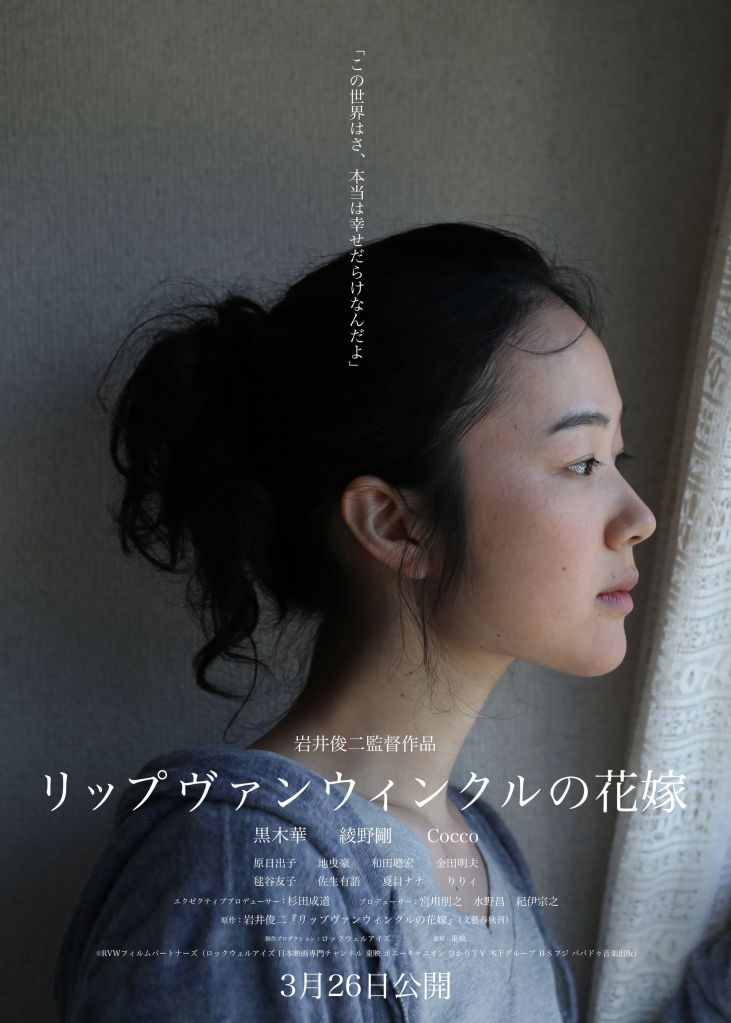 “Being naked in front of people is embarrassing” says the drunken mother of a recently deceased major character in a bizarre yet pivotal scene towards the end of Shunji Iwai’s aptly titled A Bride for Rip Van Winkle (リップヴァンウィンクルの花嫁, Rip Van Winkle no Hanayome) in which the director himself wakes up from an extended cinematic slumber to discover that much is changed. This sequence, in a sense, makes plain one of the film’s essential themes – truth, and the appearance of truth, as mediated by human connection. The film’s timid heroine, Nanami (Haru Kuroki), bares all of herself online, recording each ugly thought and despairing notion before an audience of anonymous strangers, yet can barely look even those she knows well in the eye. Though Namami’s fear and insecurity are painfully obvious to all, not least to herself, she’s not alone in her fear of emotional nakedness as she discovers throughout her strange odyssey in which nothing is quite as it seems.
 The ‘70s. It was a bleak time when everyone was frightened of everything and desperately needed to be reminded why everything was so terrifying by sitting in a dark room and watching a disaster unfold on-screen. Thank goodness everything is so different now! Being the extraordinarily savvy guy he was, Hiroki Kadokawa decided he could harness this wave of cold war paranoia to make his move into international cinema with the still fledgling film arm he’d added to the publishing company inherited from his father.

 Review of Byun Young-joo’s Helpless (화차, Hwacha) first published by
 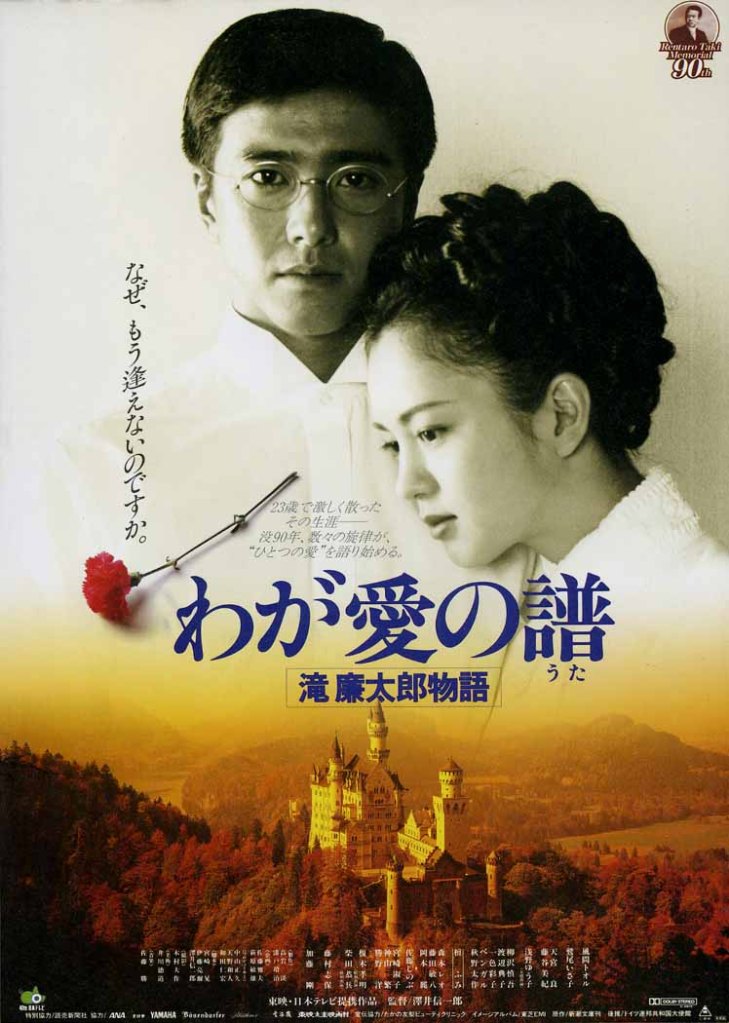 All those songs and rhymes you learnt as a child, somehow it’s strange to think that someone must have written them once, they seem to just exist independently. In Japan, the name behind many of these familiar tunes is Rentaro Taki – the first composer to set Japanese lyrics to European style “classical” music. It’s important to remember that even classical music was once contemporary, and along with the opening up of the nation during the Meiji era came a desire to engage with the “high culture” of other developed nations. The Tokyo Music School was founded in 1887 and Taki graduated from it just four years later in 1901. However, his career was to be a short one as his health gradually declined until he passed away of tuberculosis at just 23 years old. Bloom in the Moonlight (わが愛の譜 滝廉太郎物語, Waga Ai no Uta: Taki Rentaro Monogatari), also the title of one of his most well known and poignant songs, is the story of his musical career but also of the history of early classic music in Japan as the country found itself in a moment of extreme cultural shift.
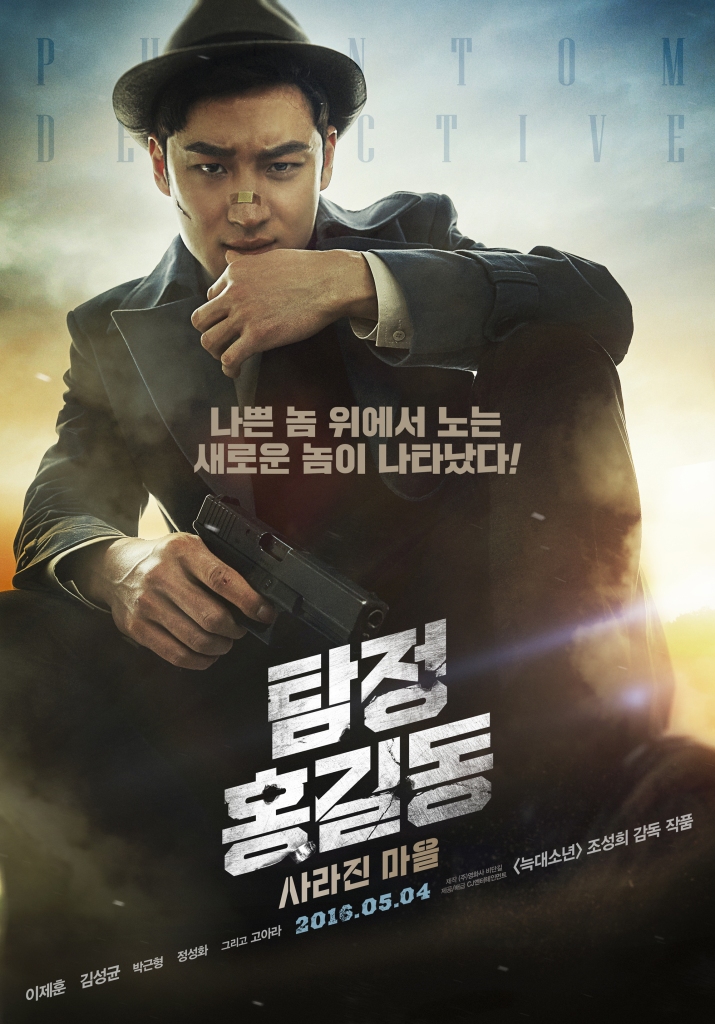 Review of Jo Sung-hee’s The Phantom Detective (탐정 홍길동: 사라진 마을, Tamjung Honggildong: Sarajin Maeul) first published by
 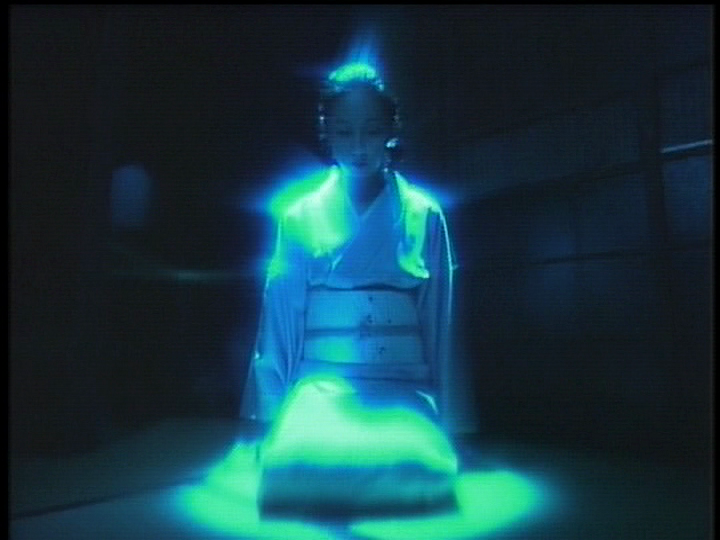 Akio Jissoji had a wide ranging career which encompassed everything from the Buddhist trilogy of avant-garde films he made for ATG to the Ultraman TV show. Post-ATG, he found himself increasingly working in television but aside from the children’s special effects heavy TV series, Jissoji also made time for a number of small screen movies including Blue Lake Woman (青い沼の女, Aoi Numa no Onna), an adaptation of a classic story from Japan’s master of the ghost story, Kyoka Izumi. Unsettling and filled with surrealist imagery, Blue Lake Woman makes few concessions to the small screen other than in its slightly lower production values.
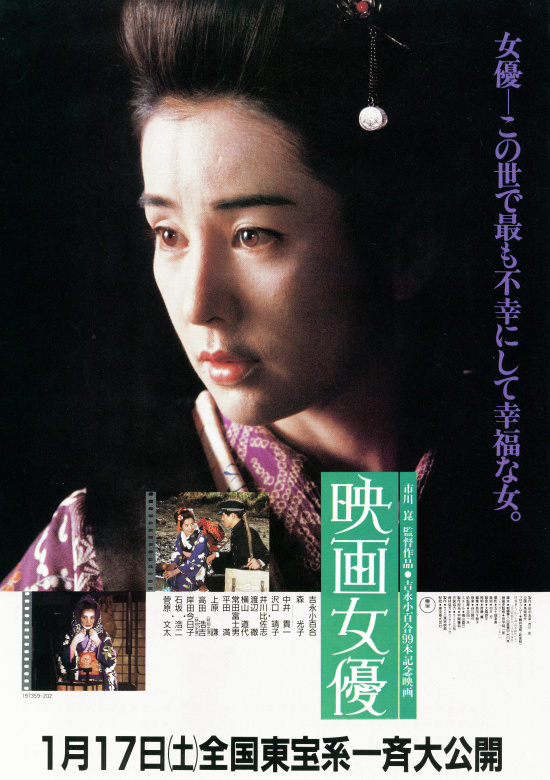 Kon Ichikawa was born in 1915, just four years later than the subject of his 1989 film Actress (映画女優, Eiga Joyu) which uses the pre-directorial career of one of Japanese cinema’s most respected actresses, Kinuyo Tanaka, to explore the development of Japanese cinema itself. Tanaka was born in poverty in 1909 and worked as a jobbing film actress before being “discovered” by Hiroshi Shimizu and becoming one of Shochiku’s most bankable stars. The script is co-written by Kaneto Shindo who was fairly close to the action as an assistant under Kenji Mizoguchi at Shochiku in the ‘40s before being drafted into the war. A commemorative exercise marking the tenth anniversary of Tanaka’s death from a brain tumour in 1977, Ichikawa’s film never quite escapes from the biopic straightjacket and only gives a superficial picture of its star but seems content to revel in the nostalgia of a, by then, forgotten golden age.
 Windows on Worlds