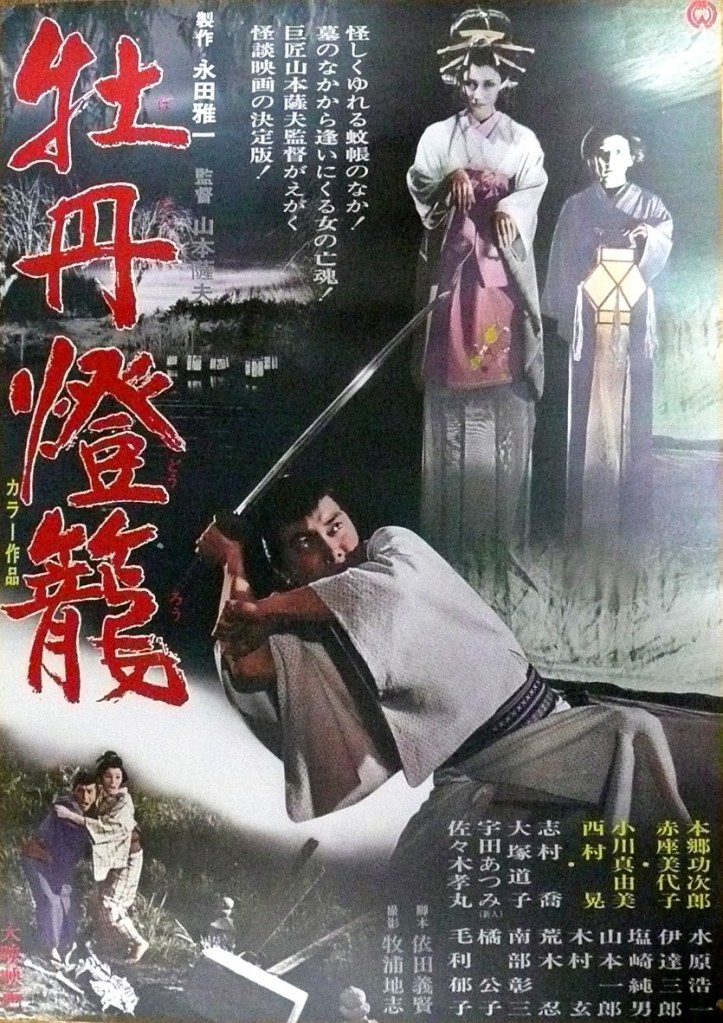
 The Peony Lantern (牡丹燈籠, Kaidan Botan Doro) has gone by many different names in its English version – The Bride from Hades, The Haunted Lantern, Ghost Beauty, and My Bride is a Ghost among various others, but whatever the title of the tale it remains one of the best known ghost stories of Japan. Originally inspired by a Chinese legend, the story was adapted and included in a popular Edo era collection of supernatural tales, Otogi Boko (Hand Puppets), removing much of the original Buddhist morality tale in the process. In the late 19th century, the Peony Lantern also became one of the earliest standard rakugo texts and was then collected and translated by Lafcadio Hearn though he drew his inspiration from a popular kabuki version. As is often the case, it is Hearn’s version which has become the most common.
The central figure in Satsuo Yamamoto’s 1968 prestige picture for Daiei is the third son of a samurai household, Shinzaburo (Kojiro Hongo). This is the first Obon festival since his older brother died leaving a young widow behind him. Kiku, his sister-in-law, is becoming a problem for the clan as her birth family have not called her back and it’s embarrassing for them to have an unattached woman of age wasting away at home. Accordingly, they think the best option is for Shinzaburo to marry his brother’s wife. Shinzaburo is having none of it. A progressive kind of samurai, he spends his time teaching poor children to read and even dreams of opening a school one day but his family most definitely do not approve and see this marriage as an opportunity to put an end to his improper ideas about social justice.
Heading back to the village under a cloud, Shinzaburo helps one of the children push two of the lanterns which had got stuck by the shore out onto the lake. Suddenly two lantern carrying women appear from nowhere and thank him. Later, the same two women arrive at Shinzaburo’s home to thank him again and relate a sad tale – the older woman, Oyone (Michiko Otsuka), is a servant of the younger one, Otsuyu (Miyoko Akaza), and they’ve come from the red light district. Otsuyu apparently hailed from a samurai background but was tricked and forced into the yoshiwara after her father was abandoned by his clan and subsequently fell ill. She is still a virgin but has attracted the attentions of an older wealthy client and is expected to acquiesce to his desires after the Bon festival is over. Shinzaburo seems like such a nice guy that she’d much prefer to stay with him, at least until Bon is over. There is one quite important detail which Oyone and Otsuyu have omitted from their history.
Despite it being Bon – the Japanese summer festival in which the dead return to the land of the living, Shinzaburo never stops to think about where these two women might have come from. Truth be told, he’s in something of a dark place what with the current familial discord which might see him either exiled from his clan (which would entail the loss of his living as well as his status), or an arranged marriage to a woman he doesn’t love who also was previously married to his brother. The villagers are very fond of Shinzaburo and grateful for his efforts with the children. Should they lose him, they would never find a replacement and the children would remain uneducated.
Despite having contributed to the war effort by making a series of propaganda films, director Satsuo Yamamoto was an openly committed communist and though Peony Lantern is in no way overtly political or at least not in the same sense as some of his other work, it nevertheless manages to work in the cruelty and indifference of feudal elites towards the ordinary people below them. This is a theme which is common in kaidan/horror films from this era and particularly from Daiei, but Shinzaburo is something of an exception to the rule as he stems from the samurai order himself. His family find his commitment to educating the peasantry at best eccentric and at worst embarrassing though Shinzaburo is determined to live in a more altruistic way than his rigid, tradition bound relatives.
This does leave him feeling slightly adrift as he’s at odds with both the samurai class of his birth but also with the villagers who see him as a teacher and someone to look up to, but definitely not as one of them. When the pretty Otsuyu and her maid arrive with a tragic story also involving the harshness of the samurai class, it’s primed to catch Shinzaburo’s attention and lonely as he is perhaps he doesn’t quite stop to ask questions when offered the opportunity to play kindly saviour to a sad young woman about to be robbed of her right to choose her own destiny (much as he will be, only worse). His relations with Otsuyu leave him feeling progressively weaker but still he can’t seem to bring himself to the decision to send her away entirely.
Perhaps it’s death Shinzaburo craved all along, an end to his tormented existence and the loneliness that comes of being caught between two social strata in a strictly controlled class hierarchy. The two ghosts are not malicious, they’ve come craving love and kind words from an honest man and hit the jackpot with the softhearted Shinzaburo. Tragic as it all is, perhaps everyone ultimately got what they wanted – an end to the eternal loneliness of having been cast out from one world and unable to fully embrace another.
Despite the emphasis on the indifference of the samurai class, the poor aren’t all saints either as seen in the feckless servant character, Banzo (Ko Nishimura), who begins as comic relief but ends up very much not. He is the first to witness the ghostly nature of the two visitors and to try and save Shinzaburo from their clutches, but when his wife comes home for her Obon holiday everything changes. Banzo’s wife orders him to blackmail the ghosts for money which they eventually get by digging up a neighbouring grave. Little to they know that it’s not supernatural forces which they will need to be worrying about in the future and they will pay a heavy price for their greed.
Yamamoto captures the eeriness of his undead visitors perfectly as they float and glide across the screen. The first scene in which Banzo peeks in on them with Shinzaburo and sees them as they really are is truly shocking as is the raw power with which Oyone later confronts him. Switching effortlessly between nervous, melancholy women seemingly caught in a more Earthly kind of purgatory, and etherial escapees from the underworld, Otsuyu and Oyone continually carry a kind of death-tinged strangeness around with them. A beautifully filmed, supremely creepy adaptation of the classic story, Yamamoto’s Peony Lantern is a suitably macabre, gothic affair which is entirley unafraid to explore the essential darkness of the tale at hand.
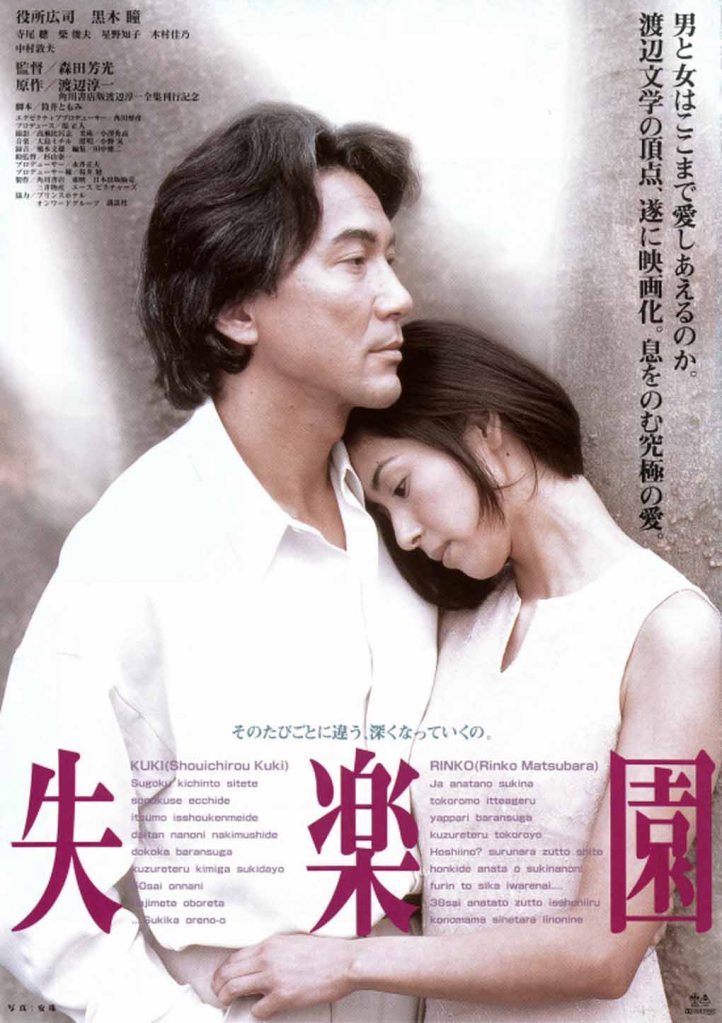 Yoshitmitsu Morita tackled many different genres during his extremely varied career taking in everything from absurd social satire to teen idol vehicles and high art films. 1997’s Lost Paradise (失楽園, Shitsurakuen) again finds him in the art house realm as he prepares a tastefully erotic exploration of middle aged amour fou. Based on the bestselling novel by Junichi Watanabe, Lost Paradise also became a breakout box office hit as audiences were drawn by the tragic tale of doomed late love frustrated by societal expectations.
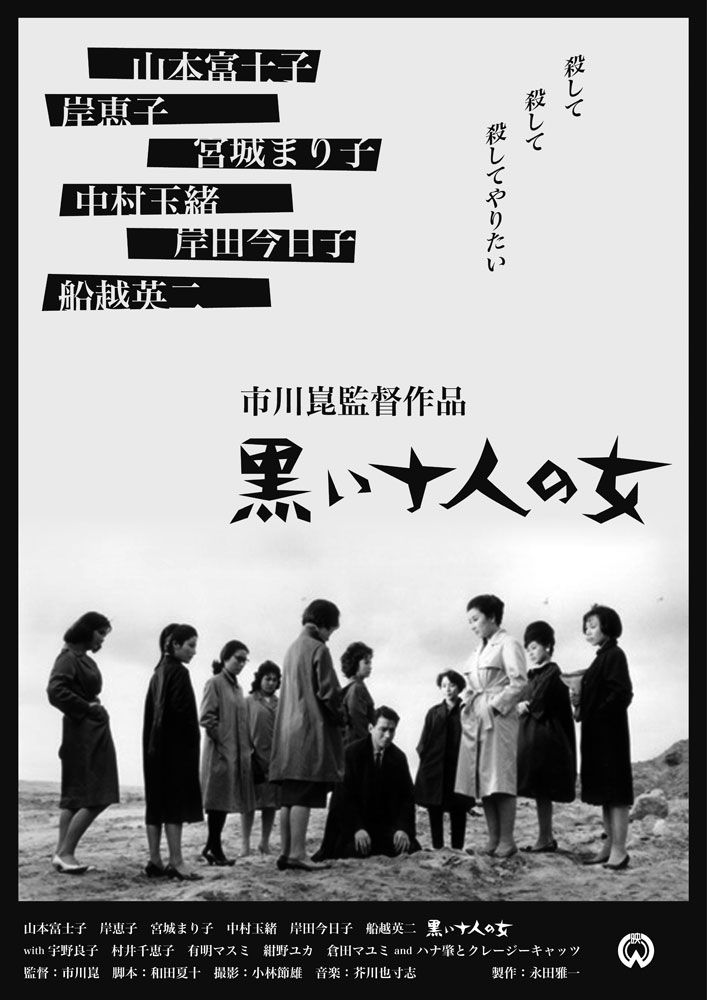 Kon Ichikawa, wry commenter of his times, turns his ironic eyes to the inherent sexism of the 1960s with a farcical tale of a philandering husband suddenly confronted with the betrayed disappointment of his many mistresses who’ve come together with one aim in mind – his death! Scripted by Natto Wada (Ichikawa’s wife and frequent screenwriter until her retirement in 1965), Ten Dark Women (黒い十人の女, Kuroi Junin no Onna) is an absurd noir-tinged comedy about 10 women who love one man so much that they all want him dead, or at any rate just not alive with one of the others.
 Because it’s there. As good a reason as any for doing anything but these were the only three words of explanation offered by George Mallory in answer to the question “Why climb Everest?”. In Powell & Pressburger’s The Red Shoes, the heroine reacts in a similarly philosophical fashion when asked “Why do you want to dance?” replying with the question “Why do you want to live?”. What makes some people prepared to dance until their feet bleed and their toes break, and sends others to the peaks of snowcapped mountains staring death in the face as they go, is something which cannot be fully explained in words but cannot be denied by those who hear its calling.
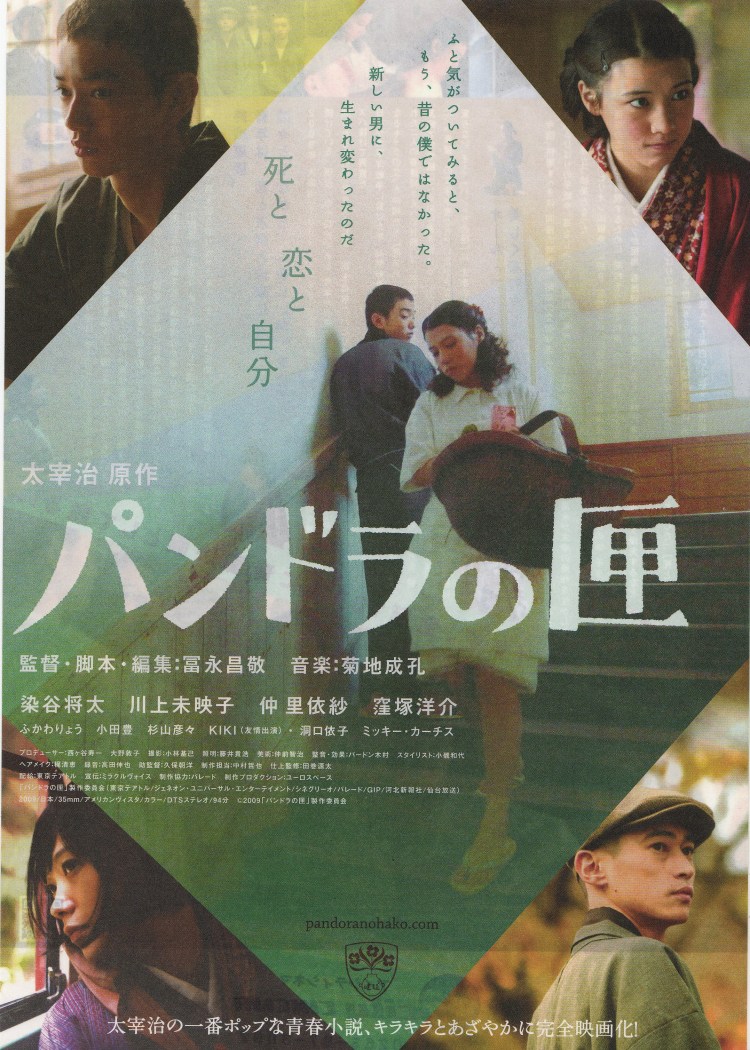 Osamu Dazai is one of the twentieth century’s literary giants. Beginning his career as a student before the war, Dazai found himself at a loss after the suicide of his idol Ryunosuke Akutagawa and descended into a spiral of hedonistic depression that was to mark the rest of his life culminating in his eventual drowning alongside his mistress Tomie in a shallow river in 1948. 2009 marked the centenary of his birth and so there were the usual tributes including a series of films inspired by his works. In this respect, Pandora’s Box (パンドラの匣, Pandora no Hako) is a slightly odd choice as it ranks among his minor, lesser known pieces but it is certainly much more upbeat than the nihilistic Fallen Angel or the fatalistic
 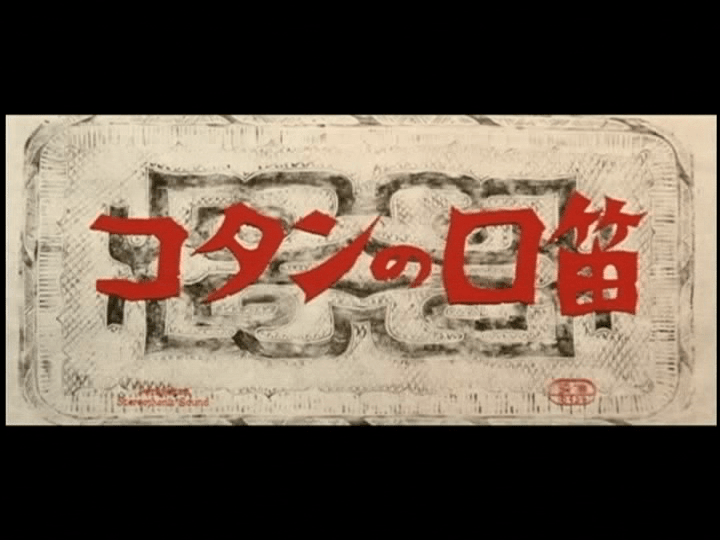 The Ainu have not been a frequent feature of Japanese filmmaking though they have made sporadic appearances. Adapted from a novel by Nobuo Ishimori, Whistling in Kotan (コタンの口笛, Kotan no Kuchibue, AKA Whistle in My Heart) provides ample material for the generally bleak Naruse who manages to mine its melodramatic set up for all of its heartrending tragedy. Rather than his usual female focus, Naruse tells the story of two resilient Ainu siblings facing not only social discrimination and mistreatment but also a series of personal misfortunes.
 Akio Jissoji has one of the most diverse filmographies of any director to date. In a career that also encompasses the landmark tokusatsu franchise Ultraman and a large selection of children’s TV, Jissoji made his mark as an avant-garde director through his three Buddhist themed art films for ATG. Summer of Ubume (姑獲鳥の夏, Ubume no Natsu) is a relatively late effort and finds Jissoji adapting a supernatural mystery novel penned by Natsuhiko Kyogoku neatly marrying most of his central concerns into one complex detective story.
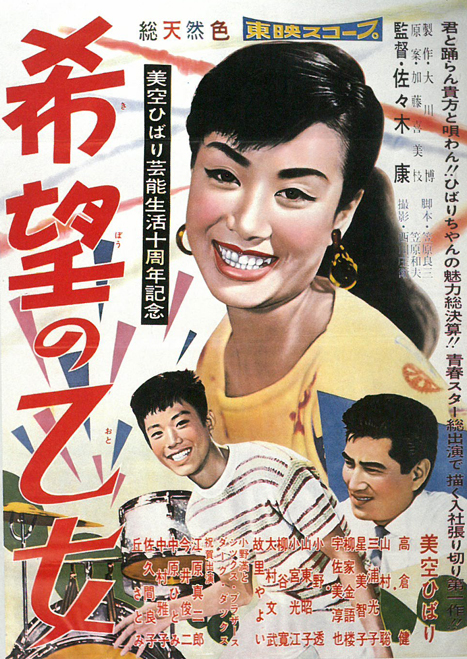 Another vehicle for post-war singing star Hibari Misora, With a Song in her Heart (希望の乙女, Kibo no Otome) was created in celebration of the tenth anniversary of her showbiz debut. As such, it has a much higher song to drama ratio than some of her other efforts and mixes fantasy production numbers with band scenes as Hibari takes centre stage playing a young woman from the country who comes to the city in the hopes of becoming a singing star.
 If you’re going on the run you might as well do it in style. Wait, that’s terrible advice isn’t it? Perhaps there’s something to be said for planning a cunning double bluff by becoming so flamboyant that everyone starts ignoring you out of a mild sense of embarrassment but that’s quite a risk for someone whose original gamble has so obviously gone massively wrong. An adaptation of a manga, Katsuhito Ishii’s debut feature Sharkskin Man and Peach Hip Girl (鮫肌男と桃尻女, Samehada Otoko to Momojiri Onna) follows a mysterious criminal trying to head off the gang he just stole a bunch of money from whilst also accompanying a strange young girl, also on the run but from her perverted, hotel owning “uncle” who has also sent an equally eccentric hitman after the absconding pair with instructions to bring her back.
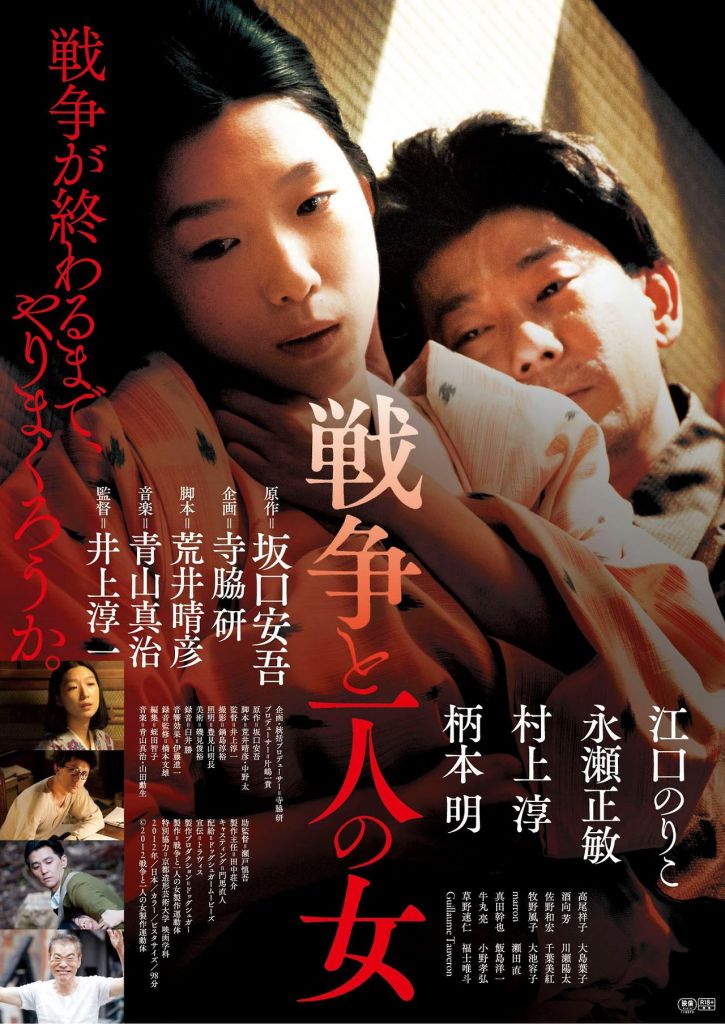 Junichi Inoue is better known as a screenwriter and frequent collaborator of avant-garde/pink film provocateur Koji Wakamatsu. A Woman and a War (戦争と一人の女, Senso to Hitori no Onna) marks his first time in the director’s chair and finds him working with someone else’s script but staying firmly within the pink genre. Adapted from a contemporary novel by Ango Sakaguchi published in 1946, A Woman and a War is an intense look at domestic female suffering during a time generalised chaos.
