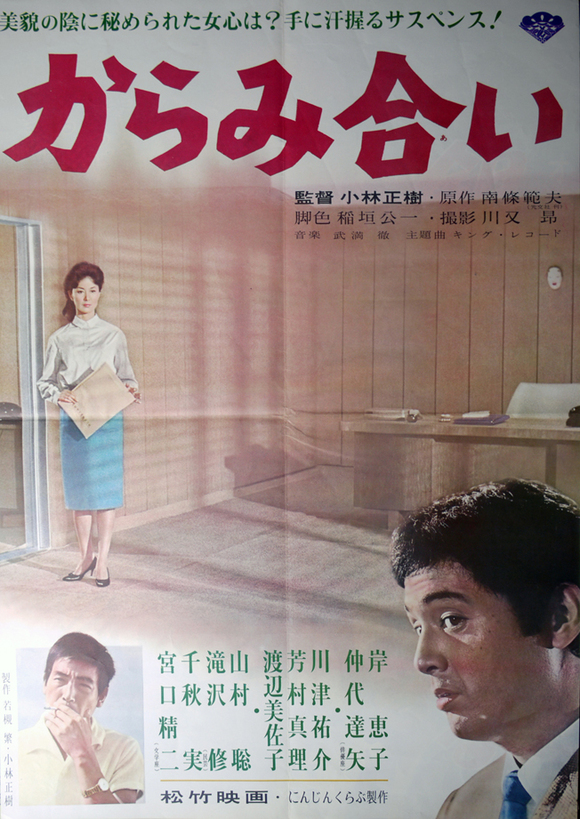
 Kobayashi’s first film after completing his magnum opus, The Human Condition trilogy, The Inheritance (からみ合い, Karami-ai) returns him to contemporary Japan where, once again, he finds only greed and betrayal. With all the trappings of a noir thriller mixed with a middle class melodrama of unhappy marriages and wasted lives, The Inheritance is yet another exposé of the futility of lusting after material wealth.
The film begins in a framing sequence in which Yasuko, an elegant woman dressed in a fashionable outfit, sunglasses and large black hat, is aimlessly window shopping when she encounters a familiar face she’d no desire to see ever again. The pair head for coffee with Yasuko lamenting that her pleasant afternoon has been ruined by the necessity of spending time with this “unpleasant” man. We then flashback to some time previously when Yasuko was just a poor secretary working for a top executive and lamenting over her sad life in her “concrete coffin” of a tiny apartment. When her boss discovers he has a terminal illness he makes a surprising declaration – he isn’t going to leave all of his money to his wife. The law says she has to get a third so she will, but the couple had no legitimate children and Kawara wants an heir. Apparently, he has three illegitimate children with whom he did not keep in contact so he intends to find these young people of differing ages and divide the money between them. As you can imagine, this news pleases no one and it’s not long before everyone is scheming how they can manipulate the situation to grab some of the money for themselves.
Shot this time in 2.40:1, The Inheritance has a slightly more whimsical air than some of Kobayashi’s other efforts. Aided by Toru Takemitsu’s jazz infused score, there’s a feeling of a chaotic, black farce lurking below the surface as the complicated schemes and counter schemes play off against each other all while an old man lies dying and largely, it seems, alone. In fact, the dying man himself is relegated to little more than a plot element, a physical countdown to the zero hour of his death and the release of his funds. Though charged with the task of tracking down these, until now forgotten, offspring, Kawara’s underlings immediately start thinking about the best way to spin their assignments. Maybe it’s better if they just can’t find the kids, or maybe if they find them and manipulate them into a more beneficial course of events. The only thing that matters is sticking to the course of action which is most likely to bring them into contact with the money.
The children themselves? Well, they’ve not turned out quite the way Kawara might have hoped. He stated that they’d only get the money if he finds out that they’re honest, decent, right living people. However, the oldest, a son, is a delinquent college student who likely wouldn’t be able to cope with receiving a sudden large lump sum of money so he’s out. The middle daughter is a nude model living a lifestyle Kawara would most likely regard as “immoral” so she will require some “fixing” if her side is to prevail. The youngest child, a seven year old daughter, has sadly passed away after being adopted in another town. However, the enterprising wife and her paramour have an ace up their sleeve in the form of another child they can substitute in her place. This child is quiet, well behaved and in all an ideal candidate for Kawara’s money (if only she actually were his daughter).
Our story is being recounted by Yasuko, so how does she fit into all of this? Commentator, heroine, perpetrator? We can guess a little of what must have happened from her appearance in the later framing sequence with which the film began. Though apparently wealthy, this Yasuko doesn’t seem particularly happy (even bar her unwanted reunion with Kawara’s lawyer). After being entrusted with the task of tracking down the oldest son who then develops a crush on her, Yasuko finds herself ensconced in Kawara’s household and eventually becoming his mistress. The affair begins with a quasi-rape after which Yasuko receives a large amount of money in a white envelope – an offering which repeats itself after each encounter with Kawara. At first she tries to pretend there was something more to it but eventually admits she got used to taking the money. Though she later tries to refuse Kawara’s offering, the corruption has already set in.
Recounted in a world weary tone by Yasuko, The Inheritance is another, though less abrasive, look at greed and lack of moral authority. Kawara is dying and perhaps regrets his devotion to his career rather than something with a greater legacy. However, he evidently showed no interest in his children before and has no real desire to meet and have a relationship with them before it’s too late – he simply wants an heir. His marriage turns out to be mostly physical convenience and even his wife is not so broken up about his illness so much as irritated to have sacrificed the last seven years and only receive a third of what she assumed would all be hers. The underlings scheme amongst themselves and unwittingly open a door for a challenger nobody expected. In some ways, from our point of view, the “right” person won but this was a game that had no right to be played. A sordid farce of squabbling over a dying man’s estate and for what, in the end? A fancy hat? Kobayashi doesn’t push as hard here as he has before, this time he casts veniality as black comedy rather than a social evil but still the lesson is clear, in most cases avarice will get you nowhere and even if you play the slow game and win you may not like where it takes you.
The Inheritance is the fourth and final of the early films from Masaki Kobayashi available in Criterion’s Eclipse Series 38: Masaki Kobayashi Against the System DVD boxset.
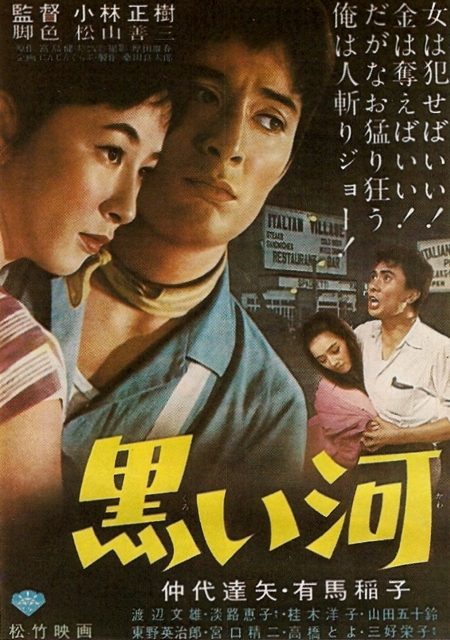 Masaki Kobayashi is still not enamoured with the new Japan by the time he comes to make Black River (黒い河, Kuroi Kawa) in 1957 which proves his most raw and cynical take on contemporary society to date. Set in a small, rundown backwater filled with the desperate and hopeless, Black River is a tale of ruined innocence, opportunistic fury and a nation losing its way.
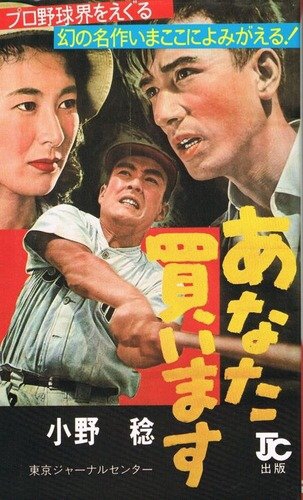 In I will Buy You (あなた買います, Anata Kaimasu, a provocative title if there ever was one), Kobayashi may have moved away from directly referencing the war but he’s still far from happy with the state of his nation. Taking what should be a light hearted topic of a much loved sport which is assumed to bring joy and happiness to a hard working nation, I Will Buy You exposes the veniality not only of the baseball industry but by implication the society as a whole.
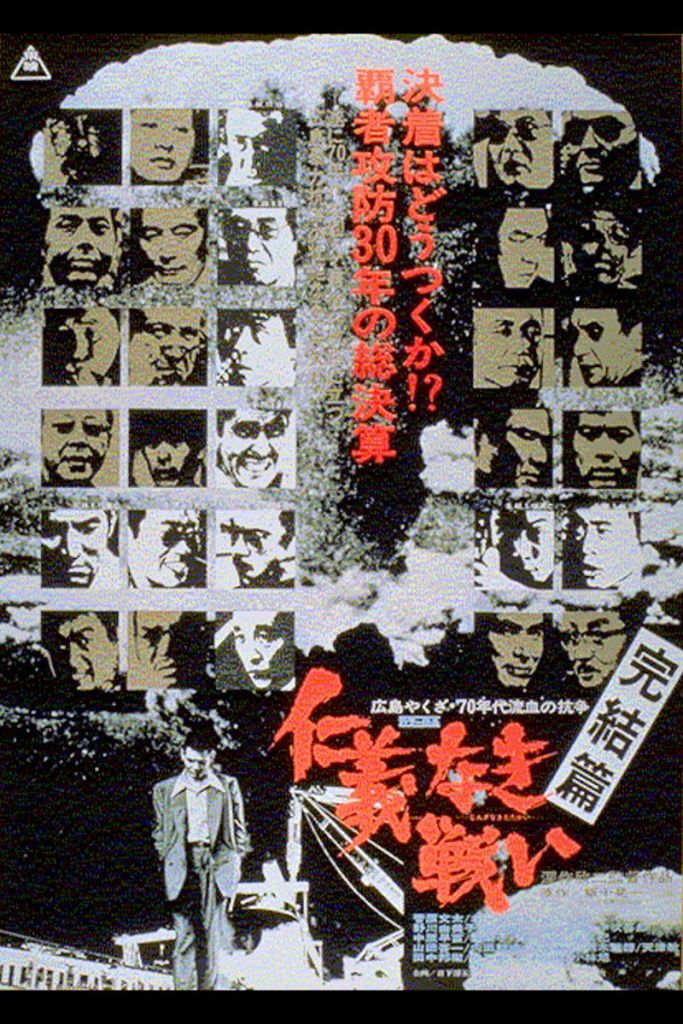 And so, the saga finally reaches its conclusion. Final Episode (仁義なき戦い: 完結篇, Jingi Naki Tatakai: Kanketsu-hen) brings us ever closer to the contemporary era and picks up in the mid ‘60s where Hirono is still in prison and Takeda, released on a technicality, has decided to move the yakuza into the legit arena. The surviving gangs have united and rebranded themselves as a political group known as the Tensei Coalition. However, not everyone has joined the new gangsters’ union and the enterprise is fragile at best.
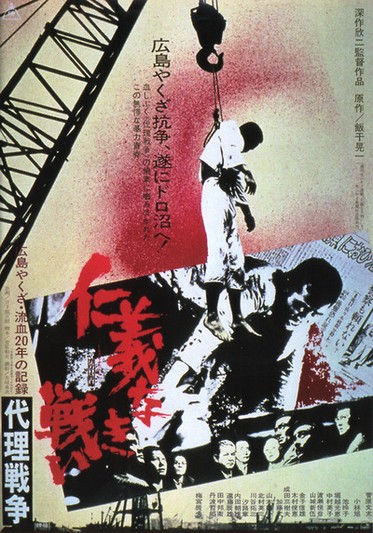 Three films into The Yakuza Papers or Battles Without Honour and Humanity series, Fukasaku slackens the place slightly and brings us a little more intrigue and behind the scenes machinations rather than the wholesale carnage of the first two films. In Proxy War we move on in terms of time period and region following Shozo Hirono into the ’60s where he’s still a petty yakuza, but his fortunes have improved slightly.
 If you thought the story was over when Hirono walked out on the funeral at the end of
  When it comes to the history of the yakuza movie, there are few titles as important or as influential both in Japan and the wider world than Kinji Fukasaku’s Battles Without Honour and Humanity (仁義なき戦い, Jingi Naki Tatakai). The first in what would become a series of similarly themed movies later known as The Yakuza Papers, Battles without Honour is a radical rebooting of the Japanese gangster movie. The English title is, infact, a literal translation of the Japanese which accounts for the slightly unnatural “and” rather than “or” where the “honour and humanity” are collected in a single Japanese word, “jingi”. Jingi is the ancient moral code by which old-style yakuza had abided and up to now the big studio gangster pictures had all depicted their yakuza as being honourable criminals. However, in Fukasaku’s reimagining of the gangster world this adherence to any kind of conventional morality was yet another casualty of Japan’s wartime defeat.
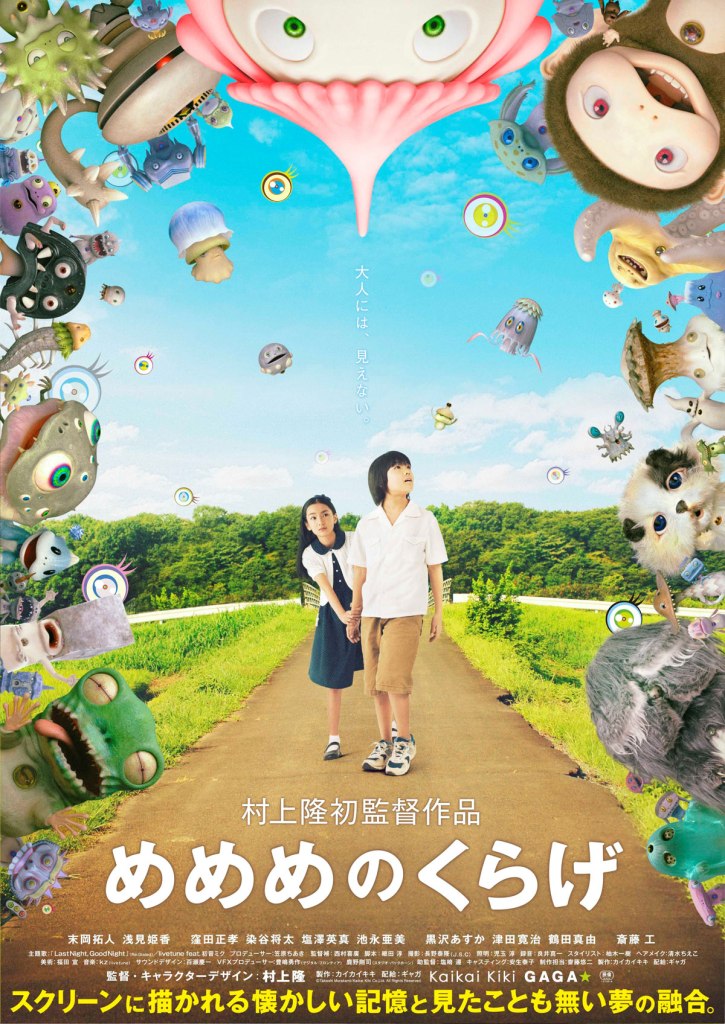 Jellyfish Eyes (めめめのくらげ, Mememe no Kurage) is the feature film debut of the internationally popular Japanese artist, Takashi Murakami. Well known for his cutesy character designs which are as likely to turn up in the world’s best regarded art galleries as they are on a kid’s backpack, Murakami is one of Japan’s most highly regarded art exports. Having unsuccessfully tried to raise interest in the more obvious totally CG animation, Murakami has enlisted the help of gore master Yoshihiro Nishimura for some director’s chair tips in creating a live action/CGI hybrid. Jellyfish Eyes is very definitely a kids’ movie, calling it a “family film” seems unfair when the age cut off is most likely around seven or eight years old but those who meet the (lack of) height requirement are sure to lap it up.
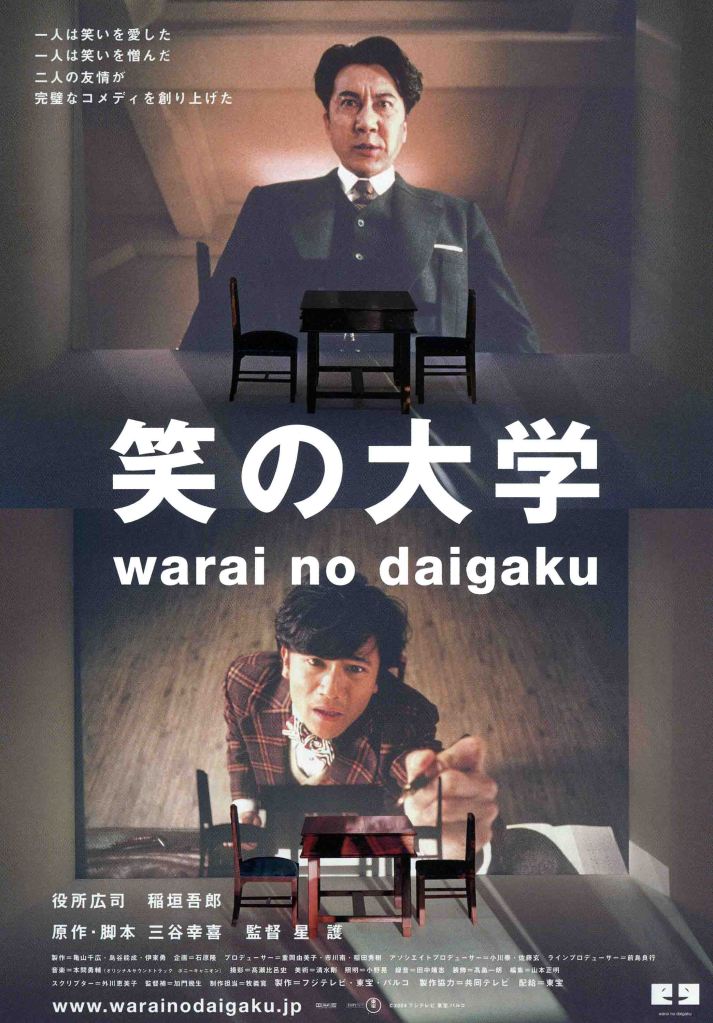 University of Laughs (笑の大学, Warai no Daigaku) is certainly an apt name for a film which aims to teach the universal power of comedy. Based on a 1997 stage play by Japanese comedy master Koki Mitani and directed by Mamoru Hoshi, the film is set in 1940 at the height of Japan’s militaristic fervour. With the annexation of Manchuria only three years previously and the war in full swing, there is no room for such petty bourgeois pleasures as slapstick comedy shows. The censor’s stamp rules all and if the piece doesn’t exult the glorious nature of the empire, then what good is it?
