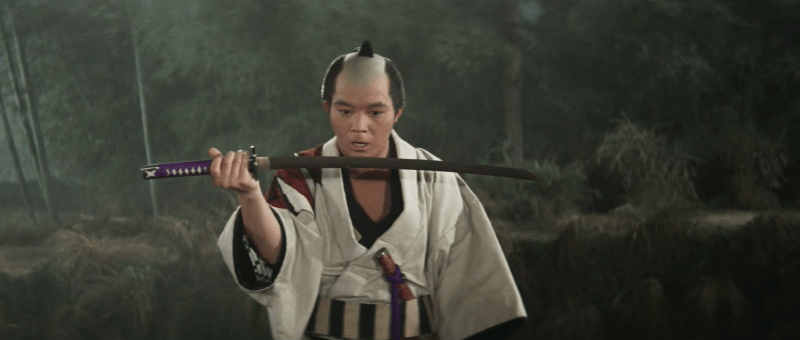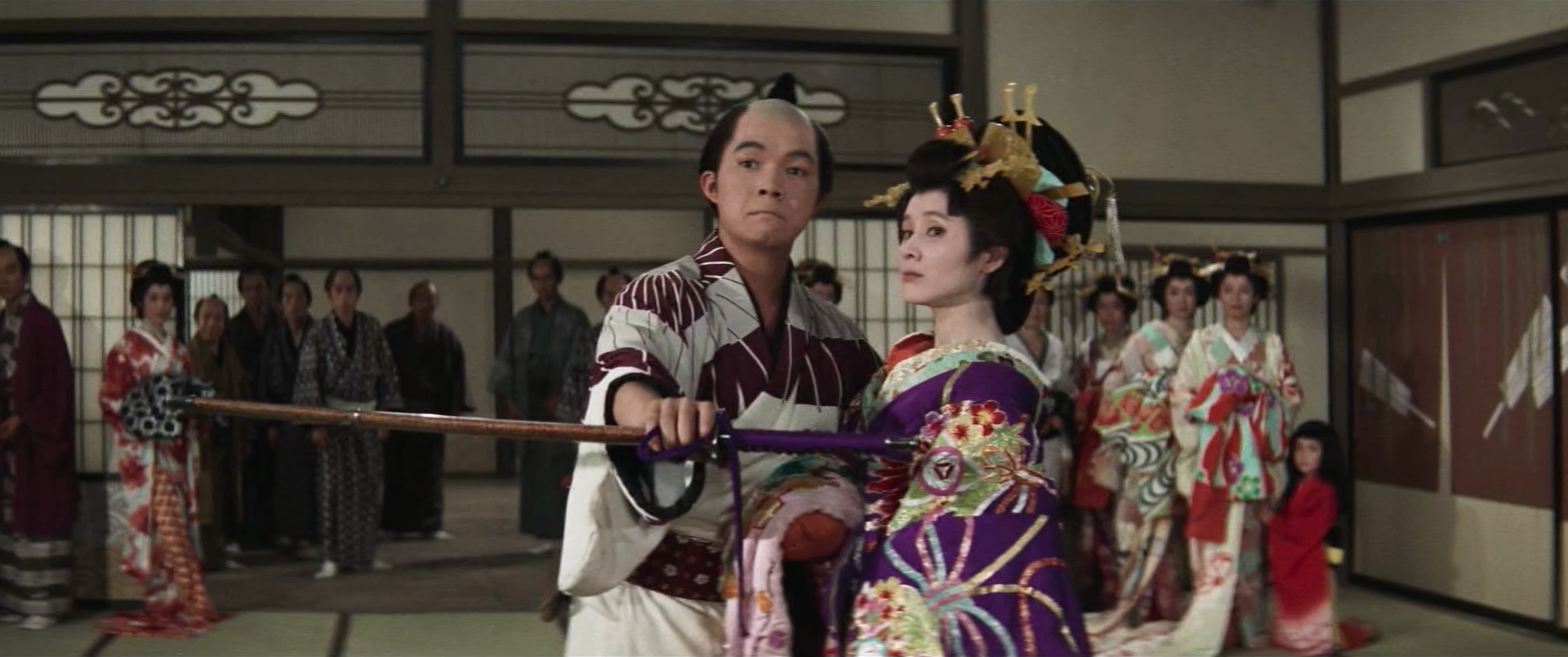
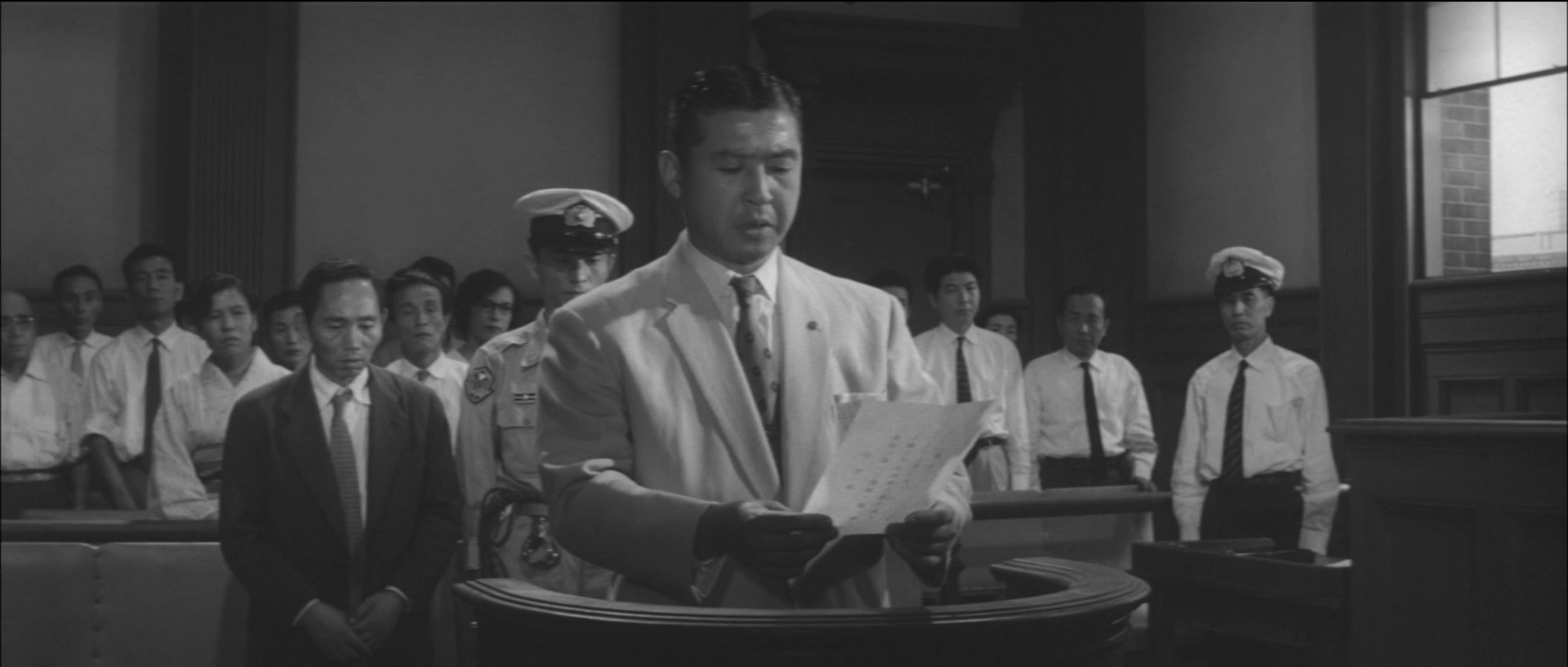
Hiroshima (ひろしま, Hideo Sekigawa, 1953)

During the post-war occupation of Japan which lasted until 1952, the censorship regulations which replaced those of the militarist era perhaps ironically made it more or less impossible to criticise the US presence or depict the extent of wartime devastation lest it raise hostility towards American forces or reinforce a feeling of victimisation. For this reason, images of the atomic bombings were tightly controlled and the events rarely referenced in mainstream media, Hiroshi Shimizu’s Children of the Beehive being a notable if brief exception. Once the occupation was over, however, many assumed it would become easier to broach such taboo subjects. 

Hiroshima native Kaneto Shindo’s comparatively better known Children of Hiroshima, inspired by the book Children of the A Bomb: Testament of the Boys and Girls of Hiroshima, was released in 1952 shortly after the censorship regulations were lifted and stars his later wife Nobuko Otowa as a teacher who returns to Hiroshima to visit the graves of her parents killed in the atomic bombing and thereafter several of the children from a nursery school she once taught at who have survived but continue to suffer in various ways due to their experiences. Despite Shindo’s well known leftist credentials, many including the Japan Teachers’ Union who apparently owned the rights to the book though there is some dispute as to their involvement in the production, were disappointed with the film which they felt to be an overly sentimental studio melodrama that was ultimately unhelpful in supporting the anti-war political movement or accurately representing the hibakusha community. 

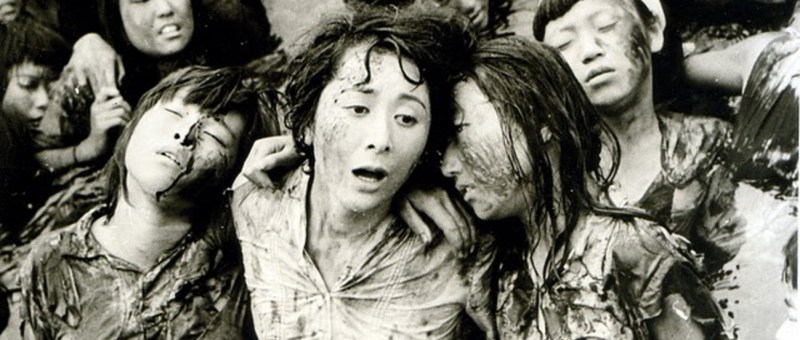
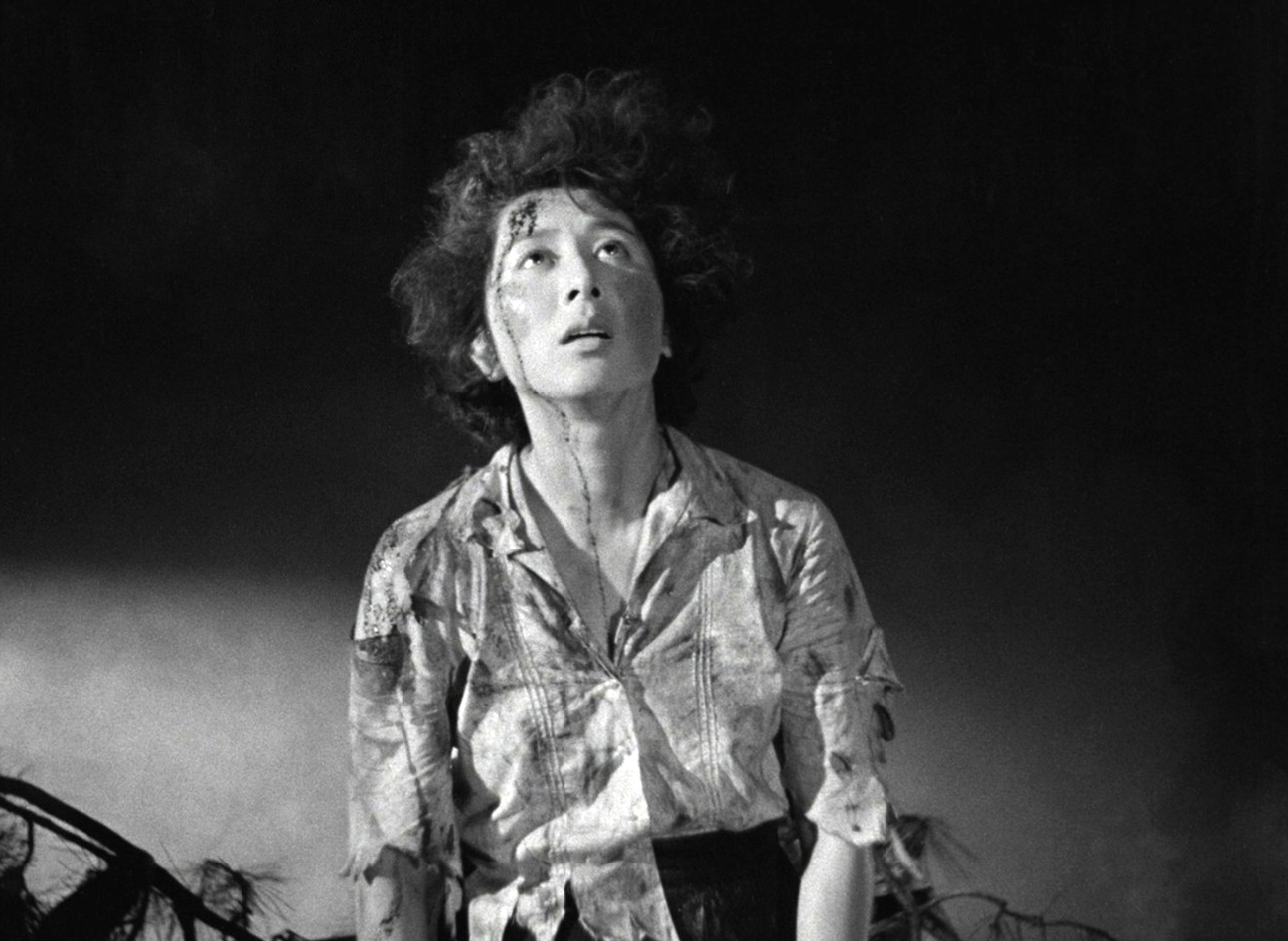
In response, the JTU commissioned a second version in order to better reflect their aims and ideals. Long unseen in either Japan or internationally prior to its recent restoration, Hideo Sekigawa’s Hiroshima (ひろしま) adopts a much more strident docudrama approach while, like Children of Hiroshima, maintaining a focus on the plight of children during the bombing and beyond though it seems somehow unlikely that teachers and parents would be wholeheartedly enthusiastic about showing such a deliberately harrowing piece to a sensitive younger audience. One criticism of Shindo’s film had been that he’d dodged dealing with the bombing itself by concerning himself only with the present-day aftermath. Sekigawa meanwhile focuses directly on the traumatic instant of the attack, utilising expressionistic techniques to recreate the living hell to which the city was reduced literally in flash. 

It’s clear however that the normal of that day was already far from normal. Rather than go about their studies, school children are working hard for the war effort helping to clear extensive bomb damage. A teacher and a class of school girls salvaging roof tiles from a ruined building pause to look at the sky. They can hear bombers but no sirens and it’s in that moment of stillness that everything changes. The world as it was implodes and is left in total collapse. Survivors search desperately for loved ones while stumbling through an unfamiliar landscape filled with crying children, charred bodies, rubble and fire. “This is hell” an injured man groans after managing to make his way to the field hospital, “hell”. 

Sekigawa bookends his tale with a contemporary framing sequence in which an idealistic teacher tries to instil compassionate values in his students some of whom are survivors of the bomb and still living with its effects including one suffering with radiation-related leukaemia who becomes very upset on listening to a radio lesson recounting the morning of the bombing from the point of view of the pilot flying the plane. Another of the students later comes to her defence, taking some of the others to task and lamenting that the suffering of those affected by the A Bomb is not taken seriously while victims still undergo a degree of social stigma even if they have no visible wounds. He is also very worried about his friend, Endo (Yoshi Kato), who later appears in the flashback to the aftermath of the bombing and has apparently gone off the rails, working in a cabaret bar and addicted to pachinko after losing his entire family. 

It’s through Endo that Sekigawa dramatises many of the secondary effects of the bombing in that he was not physically injured but is consumed by a sense of hopeless anxiety, intensely concerned about the prospect of another war and unable to envisage a successful future for himself in a world in which such horror can occur seemingly at random. It’s he who first introduces us to the parasitical disaster tourism that generates a grim trade in A-Bomb “souvenirs” as he passes a stall selling fake skulls as a child and then later attempts to sell actual human remains with inspirational stickers plastered on the top. The “better” future they have imagined for him is however in itself problematic, harking back to the traditional post-war solution of a factory job which directs aligns him with the nation’s push towards a capitalistic society, but is then undercut when he quits not because he is bored or lazy but because he discovered the factory was being used to produce artillery shells and he felt he could have nothing to do with it. 

Endo is also among a group of post-war street kids who learn to say the word “hungry” without knowing what it means to get bread and chocolate from passing Americans. A later more direct speech has them make a formal accusation that the Americans are responsible for the deaths of their parents and therefore bear a responsibility towards them which they should immediately repay with food. Some, including Shochiku who were originally set to distribute but later declined, described the film as overly anti-American, but Hiroshima largely refrains from mentioning the Americans other than a suggestion that the dropping of the bomb was itself a racist act in which they used the Japanese people as guinea pigs to test their new weapon, and focuses on the failure of the militarist authorities to respond in an appropriate fashion. We see a soldier read out a proclamation telling a ragged queue of survivors queuing up for food that the situation is “not unusual” in time of war and they should all return to their jobs despite the fact that there are no longer any buildings in which to work. Meanwhile, militarists talk of using the disaster to foment the war effort by marshalling hate and resentment towards the enemy while commanders refuse to take scientific advice that tells them Hiroshima may be uninhabitable for the next 70 years, obsessed only with continuing the war at all costs ironically insisting that their “fervent will” which “burns as brightly as a million stars” will bring them an assured victory.  

In the face of a second bombing, however, they are forced to accept that the war cannot continue, many of the victims left perplexed and defeated that despite their suffering the government has unconditionally surrendered and seemingly abandoned them. An abnegation of responsibility is also suggested by the presence of the street kids abandoned by their society and left to fend for themselves though Endo is eventually taken into a progressive care home from which he and other boys make numerous attempts to escape, in his case in the hope that he can find the sister from whom he became separated. Sekigawa does not make suggestions for the future, merely depict the difficult post-war reality while arguing for greater compassion in the contemporary era, one bomb survivor describing her despair in the knowledge that her disability is a barrier to marriage while finding work that can be done with her physical limitations is also difficult as is accessing government support. Sekigawa too may give in to a particular kind of sentimentality in the closing moments but it is indeed undoubtedly effective as a reminder of the human cost of war and our collective responsibility to ensure that it never happens again.


A Wanderer’s Notebook (放浪記, Mikio Naruse, 1962)

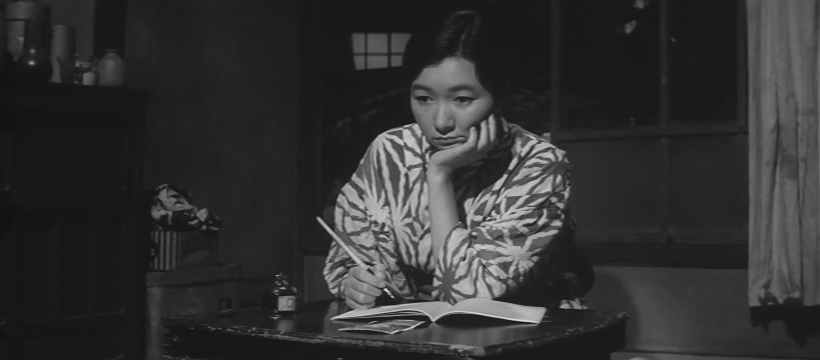
Many of Mikio Naruse’s most famous films are adapted from the work of Fumiko Hayashi, a pioneering female author who chronicled the life of a working class woman with startling frankness. Yet his dramatisation of her life, A Wanderer’s Notebook (放浪記, Horo-ki), is both a little more reactionary than one might have expected and surprisingly unflattering even in the heroine’s eventual triumph in escaping her poverty through artistry. Even so if perhaps sentimentalising the economically difficult society of the 1920s in emphasising the suffering which gave rise to Hayashi’s art, the film does lay bare the divisions of class and gender that she did to some extent transgress in pursuit of her literary destiny. 

Naruse and his screenwriters Toshiro Ide and Sumie Tanaka bookend the the film with a literal “lonely lane” which the young Fumiko walks with her itinerant salespeople parents. As a small child, she sees her father arrested for a snake oil scam peddling some kind of wondrous lotion, setting up both her disdain for men in general and her determination not to be deceived by them at least unwittingly. She has no formal education but is a voracious reader well versed in the literary culture of the time and intensely resentful of if resigned to her poverty. In the frequent sections of text which litter the screen taken directly from her novels, she details her purchases, wages, and longing for the small luxuries she can in no way afford. 

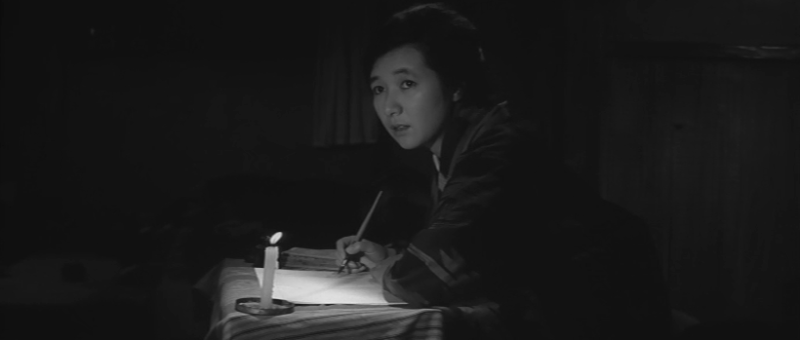
As an uneducated woman in the 1920s her working opportunities are few. She exasperatedly relates standing in a queue with hundreds of other women waiting for an interview for a company job only to be told they’ll let her know, while her other opportunity involves meeting a theatre director at a station who later takes her to his hotel/office and makes it plain he’s not really interested in her CV. She gets a job at the office of a stockbroker, but lies about being able to do accounts and is flummoxed by double entry bookkeeping getting herself fired on day one. After a brief stint in factory painting toys, she leaves with a friend to become a hostess but is also fired on her first day for getting drunk and being unwilling to ingratiate herself with the boorish men who frequent such establishments. 

Despite her animosity, she is drawn towards men who are callous and self-involved, firstly taking up with a poet and actor who praises her work but turns out to have several “wives” on the go, and then begins living with a broody writer, Fukuchi, who is insecure and violent, resentful at her success in wake of his failure. Perhaps because of her experiences, she seems to resent any hint of kindness though sometimes kind herself, lending money to her friend whose mother is in need and often ready to stand up for others whom she feels are being mistreated. A kindly widower in the boarding house where she lives with her mother, Yasuoka, falls in love with her but she repeatedly rejects him partly as someone suggests because he is not handsome, but mainly because of his goodness and kindness towards her. Nevertheless, he continues to support always ready in her time of need though having accepted that she will never return his feelings or accept his proposal. 

Perhaps her might have liked to have been kinder, but was too wounded by her experiences to permit herself. In any case at the film’s conclusion in which she has achieved success and in fact become wealthy it appears to have made her cold and judgemental. She instructs her maid to send a man away believing he is from a charity set up to help the poor, insisting that the poor must work for industry is the only path out of poverty implying that as she managed it herself those who cannot are simply not applying themselves when she of all people should know how fallacious the sentiment is. As if to bear out the chip on her shoulder, she forces her mother to wear a ridiculous kimono from a bygone era that is heavy for an old woman and makes her feel foolish because of her own mental image of the finery she dreamed of providing her on escaping the persistent hardship of their lives. 

As she says, she’s no interest in the socialist politics espoused by the literary circles in which she later comes to move, pointing out that the poor have no time for waving flags. One of her greatest supporters is himself from a noble family despite his progressive politics and in truth can never really understand the lives of women like Fumiko. He describes her work as like upending a rubbish bin and poking through it with a stick, at once fascinated and repulsed by a frankness he may see as vulgar. At one point he accuses her of writing poverty porn, playing on her humble origins for copy and becoming something of a one note writer. 

In truth, the film is not really based on the novel from which it takes its title but on the play that was adapted from it, while the novel itself was apparently reworked and republished several times in response to reader taste giving rise to a series of questions both about its essential authenticity and what it was that it was attempting to convey. In the film at least, moments after her literary success, Fumiko is challenged by a fellow female writer, Kyoko, who was once her love rival, that she cheated in a contest by failing to submit Kyoko’s entry until after the deadline had passed, though as it seems she would have won anyway. She is occasionally underhanded, perhaps because she feels she has no other choice, but then as we can see there is no particular solidarity between women save the kindly landladies who often let her delay her rent payments. Fumiko feels herself to be alone and her quest is not really for literary success but simply for her next meal, though she feels the slights of the bitchy women and arrogant men who mock her commonness while simultaneously exploiting it as entertainment. 

On the one hand, her success seems to signal a triumph of independence having freed herself from the need to depend on terrible men though she also she seems to have met and married a warmhearted painter who cares for her and supports her work while she has also been able to give her mother the level of comfort they both once dreamed of. Even so, the unavoidable fact that she dies at such a young age implies she’s worked herself into an early grave in a sense punishing her for her rejection of contemporary social norms undercutting her achievements with some regressive moralising while the one thing she still desires, rest, is given to her only in death. In Takamine’s highly stylised performance, as some have implied perhaps intended to mimic the silent screen, Fumiko is at once a carefree young woman who dances and sings and a melancholy fatalist with a self-destructive talent for choosing insecure and self-involved men, but above all else a woman walking a lonely road towards her own fulfilment while searching for a way out of poverty that need not transgress her particular sense of righteousness. 


Original trailer (no subtitles)

The Desperate (どろ犬, Takaharu Saeki, 1964)

A bruiser cop railing against the system is pulled towards the dark side in Takaharu Saeki’s icy noir, The Desperate (どろ犬, Doro Inu). Adapted from a novel by Shoji Yuki, the film is one of only two Saeki directed in an otherwise lengthy career mainly spent in television and captures an eerie sense of existential dread as its detective hero sinks to even greater depths in a quest for self preservation while kicking back against the hypocrisies of the post-war society. 

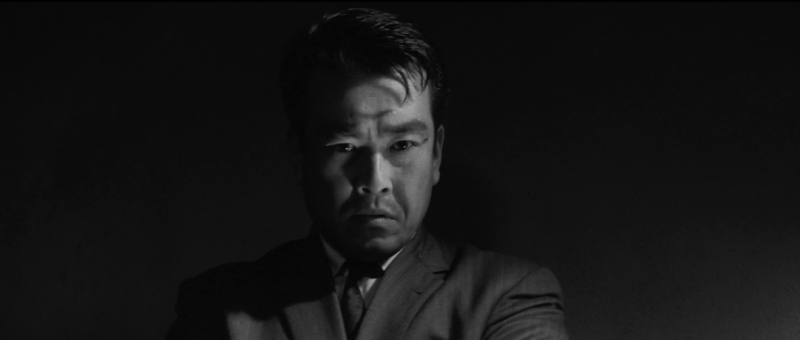
As one officer puts it, Sugai (Minoru Oki) is one of many veteran officers who can’t adjust to new codes of justice in the democratic era. In the film’s opening sequence, he’s pulled aside and warned about using excessive force on a suspect only to counter that he knows the guy’s guilty so he doesn’t see what the problem is. Sugai had been particularly motivated about this case as the victim was an 18-year-old girl raped after accepting a lift from a stranger. She was so traumatised that she could hardly speak but did remember the registration plate of the car. She’d only been working because her father lost his factory job though he appears to have begun drinking and is abusive towards his daughter for her silence, later coming to the station to drop the charges after being paid off by the suspect’s lawyer. The legal definition of rape in this era is founded not on an idea of consent but whether violence was involved and the victim can be proved to have resisted physically. The guilty party, Tomita (Hideo Murota) claims that nothing illegal transpired in his car and then walks away with a smirk when his lawyer gets him off the hook. It’s all too much for Sugai to bear, resentful that the rich and powerful are now effectively above the law thanks to legislation he feels ties his hands as a police officer. 

It’s at this point he runs into petty yakuza Yamaguchi (Ko Nishimura) whom he’s been trying to turn as an informant, unwisely mouthing off about his dissatisfaction with contemporary law enforcement only for Yamaguchi to turn the tables and effectively blackmail him having discovered that Sugai has begun a relationship with the estranged wife of an imprisoned gangster. In an act of petty revenge and desperation, Sugai leaks info on “guilty” suspects who weren’t charged to Yamaguchi who exacts financial justice by extorting them for money while threatening to expose their immorality. 

Disappointed in him, the gangster’s wife, Chiyo (Chisako Hara), exclaims that Sugai’s no different from her husband and in truth he isn’t. Part of Sugai’s resentment lies in the fact his wife left him for another man while he was on a stakeout, frightened by his violence and insisting that she hated detectives. His old-fashioned police tactics include taking suspects to the dojo where beats the living daylights out of them. Later he tells another, more earnest officer, he reminds him of himself when he was younger implying that he has become corrupted by the times and the impossibility of justice, particularly for young women whom he feels an urge to protect, in a world ruled by money and status. He may feel some pangs of guilt for a rookie who is unfairly fingered as the mole on the grounds that he and Yamaguchi were originally from the same area and had a past acquaintance, but in the end is happy enough to scapegoat him for his wrongdoing while he continues trying to dig himself out a hole but falling still further into the abyss. 

Sugai is merely trying to save his own skin, but those around him are desperate too. His opposite number, Toku (Hisashi Igawa) is desperate to clear his name, while Chiyo is desperate for what she describes as a proper marriage to a proper man while seemingly kept captive in the apartment Sugai rents for her on his meagre police salary but does not live in himself. She wants to work and has an innocent desire to buy him some better shoes that he otherwise resents in its implied challenge to his masculinity that he evidently cannot afford all this additional expense coupled with the strain of keeping his problematic relationship with a gangster’s wife secret from his employers. In the end he claims that the problem was he couldn’t escape from being a detective, pushed into desperate acts of destruction as a man now exiled from his times unable to move on from post-war chaos into a newly democratic, consumerist Japan. Saeki ends his fatalistic vision with an image of a train reeling backwards, echoing the degree to which Sugai has lost control of his life and himself no longer a detective but only a man without a moral compass whose path can only lead in one direction. 


High and Low (天国と地獄, Akira Kurosawa, 1963)

A self-made man is landed with an unthinkable dilemma when his chauffeur’s son is kidnapped in place of his own just at the moment he’s staked his entire fortune on a manoeuvre to outsmart cynical executives set on taking over his company in Kurosawa’s post-war crime film, High and Low (天国と地獄, Tengoku to Jigoku). The movie’s Japanese title, Heaven and Hell, might hint more strongly at the growing economic disparities in the era of the economic miracle but also at the dualities embodied in the hero’s choices. “Success isn’t worth losing your humanity” his wife tells him, but he still struggles with the validity of choosing his heart over his head knowing that to pay anyway even though it’s another man’s son means financial ruin, the final question being if he is really prepared to allow a child to die simply to maintain his own wealth and status. 

The problem is that Gondo (Toshiro Mifune) has attempted to mount a rebellion against the evils of consumerism, incurring the ire of the cynical executives who attempt to get him on their side in their attempt to oust the boss whose outdated ideas are running the business into the ground. Though Gondo appears sympathetic, hinting that he might be interested if there’s a good enough promotion in it, he later tells them where to go on seeing that their business plan is to start producing poor quality disposable footwear. Gondo started on the factory floor and he doesn’t want to put the company’s name on such shoddy produce nor does he think that their admittedly fair point that if the shoes are well made and last a long time no one will need to buy any is a good way to do business. He doesn’t think the boss is right either and wants to make shoes his own way which is why he’s remortgaged the sizeable mansion he owns on top of a hill overlooking the city and has pretty much run through his wife’s dowry to buy a majority stake in the company.

On top of a hill is a good place to live if you want a good vantage point to oversee the land below, but while you’re looking down others look up and not all of them kindly. Gondo is as he says a self-made man, but also out of touch with contemporary society and not so far from an ambitious courtier always after a little more. He says it isn’t about getting the top job but getting shoes made right, but it seems he too had been bitten by the consumerist bug and is otherwise unable to affirm his status without material proof. When he thinks it’s his own son that’s been kidnapped, he’d have given it all away but when it’s the driver’s boy it’s a different question. Shinichi (Masahiko Shimazu) isn’t his responsibility and as he points out there are plenty of other wealthy men, why is he the only one to pay? While his wife (Kyoko Kagawa) tearfully urges him to do the right thing, his assistant (Tatsuya Mihashi) tries stop him, insisting he should take the sizeable cheque they’ve had drawn up to Osaka and the stakeholder he’s buying the shares from. 

While he vacillates, the driver, Aoki (Yutaka Sada), is humiliated and forced into servitude. Gondo seems to have the old-fashioned idea that the kidnappers would simply let Shinichi go on realising they’ve got the wrong boy and his father can’t pay, but Aoki knows there’s nothing he can do to save his son but throw himself on Gondo’s mercy. He falls to the ground and prostrates himself, but later retracts all telling Gondo it doesn’t matter, that he hadn’t realised what he was asking of him, and insisting that Shinichi is a bright boy who will look for a chance to escape on his own. Once the boy is returned he treats him harshly, interrogating him about anything he might have forgotten and later driving him around looking for the hideout where he was kept in an attempt to do something and repay the debt he now feels he owes to Gondo by helping the police retrieve the money Gondo eventually agreed to pay for him. 

In agreeing to give up the money, Gondo is in a sense unburdened knowing he has made the right choice and realising that he would never live a comfortable life in that house if cost a child’s life to keep it. Part of his rationale for not wanting to pay had been that though he had been poor before and might be again, his wife had not been and does not truly understand what it is to live in poverty much as she says her life of luxury means nothing to her. She has never wanted for anything, after all. As for the kidnapper, Ginjiro (Tsutomu Yamazaki), we know little of his motives save for his intense resentment living quite literally in the shadow of Gondo’s mansion and feeling as if it were mocking him. Then again, though his life is hard Ginjiro already had a path to success in that he would soon have completed his medical studies implying at least that he or someone else was able to cover his tuition and costs of living, that he was able to continue in education, and really had no need to take such drastic action in rebellion against the antagonistic capitalism of the post-war society. “Do you think we have to hate each other?” Gondo asks him, but Ginjiro has no answer only his intense resentment for everything he represents.

The “hell” that Gondo inhabits is a backstreet wasteland peopled by the hopeless. Tokura (Tatsuya Nakadai), the earnest policeman, follows him through thronging clubs and on into “dope alley” where Ginjiro picked up his accomplices so desperate to escape their suffering that they’d agree to help him kidnap a child. Though it costs him his job, Gondo decision to do the right thing makes him a national hero, the working class millionaire who mows his own lawn and can still knock up a pair of shoes should the occasion call while women across the country decide to boycott the company in protest at his treatment. Ginjiro can only howl like a caged animal while facing a death sentence for the coldblooded murder of his accomplices. The light bouncing off his mirrored sunshades gives him an eerie supernatural quality, a demon arising from depths of hell to wreak havoc in heaven but finding only infinite tragedy in the contradictions of the consumerist post-war society.


High and Low screens at the BFI Southbank, London on 19th January 2023 as part of the Kurosawa season.

Original trailer (English subtitles)

Woman of Design (その場所に女ありて, Hideo Suzuki, 1962)

“This job poisons you and deprives you of your youth” according to conflicted ad-exec Ritsuko (Yoko Tsukasa) trying her best to make it in the still very male world of adverting. A snapshot of the city in the early ‘60s, Hideo Suzuki’s workplace melodrama Woman of Design (その場所に女ありて, Sono Basho ni Onna Arite) considers the changing position of women through the eyes of four friends working at the same company, each facing challenges mainly at the hands of useless men while trying to claim a space for themselves as individuals but discovering that they are still subject to a binary choice when it comes to deciding their romantic futures. 

A woman of around 30, Ritsuko has worked her way up to a fairly senior position at Nishigin Advertising which at least appears to be a fairly progressive company run by a compassionate boss who treats his employees equally with respect for all. Nevertheless, Nishigin is very interested in its bottom line especially as the company is apparently not doing so well to the extent that they’ve unfortunately had to cut back on their “entertainment” budget which is apparently how they win and keep clients. A new opportunity has presented itself in the chance to win a contract with a pharmaceuticals company to market their brand new drug aimed at “revitalising” the lives of the over 40s. Unfortunately, they have a rival in the form of Daitsu and suave adman Sakai (Akira Takarada) who appears to have pipped Ritsuko to the post in “seducing” their sleazy PR guy.

Though focussed on her career and somewhat resistant to romance, Ritsuko finds herself attracted to Sakai if eventually wondering if he’s only using her for inside info on Nishigin which she doesn’t directly give him but their relationship does perhaps soften her attitude. Sakai’s minor betrayal in poaching the head of their art department will eventually destroy any genuine feelings they may have had for each other while leaving Ritusko painfully aware of her vulnerabilities as a female employee and of the costs of her momentary decision to break with her long-held determination to keep her professional and private lives entirely separate, admitting that her relationship with Sakai may have been a mistake but refusing to resign because of it. Meanwhile, the boss of the pharmaceuticals company with whom she seems to be on good terms tries to blackmail her into attending an omiai meeting implying he’ll be much more likely to give them the contract if she goes. Not that they necessarily mean she should give up her career, but even Ritsuko’s colleagues seem to be keen that she get married, shocked that she might determine to remain single for the rest of her life. 

That’s exactly the decision her friend Yuko (Akemi Kita) has made, dedicating herself to her career but also moody and embittered. In fact though it is no way explicit, Yuko is strongly coded as a lesbian with a possible crush on friend and colleague Mitsuko (Kumi Mizuno), herself in a difficult position apparently pushed into debt because of an attachment to a no good man whose hospitals bill she has been paying. Ritsuko’s deskmate Hisae (Chisako Hara), meanwhile, is a divorcee wondering what she’s going to do when her ex, whom she’s still hung up on, stops paying alimony, and her sister is forever badgering her for money because her brother-in-law is an irresponsible layabout who can’t hold down a steady job and has no real intention of doing so. “Men who live off women are the worst” Yuko exasperatedly exclaims thoroughly fed up with the bunch of two bit louses who seem to have ruined the lives of all her friends. 

It’s not difficult to understand why Ritsuko may be ambivalent about marriage, but even at work she’s not free of selfish, entitled men who routinely take credit for her work. Sleazy college Kura (Tsutomu Yamazaki) from the art department is forever sucking up to her only to attempt rape while discussing work at her apartment, later brushing the affair off while talking to a female colleague by affirming that older women aren’t his thing anyway. He also undercuts her by visiting the client himself to discuss ideas and changes. Kura later wins a big design prize in part thanks to the slogan Ritsuko came up with only to annoy his colleagues by implying he handled the whole campaign single-handedly. Meanwhile, though in some ways progressive her bosses are conservative when it comes to the business, shutting down the art director’s suggestion of running with an out of the box campaign (the sexier ad featuring a muscular man in his briefs which he later sells to Sakai is the one which ends up winning). Tsuboichi (Jun Hamamura) and Kura perhaps too feel constrained by a top down hierarchal structure which frustrates innovation and in their own ways rebel, but as Ritsuko later makes plain in her speech to the boss if she wants to keep her position she has to play by the rules. “Life’s short. Especially for a woman. We have no room for mistakes” as Yuko cheerfully agrees.

Yet even within that, Ritsuko manages to redefine her boundaries, making it clear that she won’t be doing the omiai. She does not, however, reject marriage entirely only state that “I will get married only when I feel the time is right”, for the moment at least entirely focused on her career. Though the future may have looked gloomy, the crisis passes and the mood brightens significantly with the news that another company is about to officially announce the launch of a long-rumoured anti-ageing cream which provides another potentially lucrative campaign opportunity for Nishigin and of course for Ritsuko should she win it. Having opened with a series of still frames followed by hazy footage of a sea of workers wandering towards their offices on an overcast morning, Suzuki closes in the twilight with the three ladies leaving the office, their friendship solidified as they head off to celebrate renewed hope for the future bolstered by a sense of female solidarity.


Tokyo Bay (東京湾, Yoshitaro Nomura, 1962)

Yoshitaro Nomura is most closely associated with the thriller and particularly with its lower end as a purveyor of B-movie noir, yet look a little closer and his films are perhaps not really about crime at all but about the complicated relationships between people in the ever changing post-war society. Just as Stakeout is really about a policeman’s marriage, Tokyo Bay (東京湾, Tokyowan) is less concerned with the radiating corruption of the smuggling ring at its centre than with frustrated male friendship and the wartime legacy.

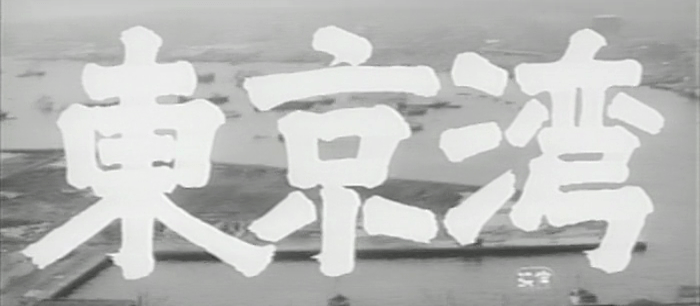
Opening with an aerial pan over post-war Tokyo, a title card informs us that this is just one frame in the “intense struggle for existence” in a city of 10 million before we arrive at the titular bay and a boat which is presumably carrying drugs later passed from one hand to another. The fixer, Takeyama (Kei Sato), talks to a man in a car and instructs him to be in front of the Taiyo building before 10am to pick up a golf bag from his contact. Gazing up at a post-war construction site, however, the man, Saeki (Jun Hamamura), is shot in the head and killed by a bullet piercing the roof of his car, Nomura suddenly switching to a disorientating POV shot as he twists in a sudden death spiral. 

As it turns out, Saeki was a plant, an undercover cop with the drugs squad sent to expose the smuggling ring the shadowy owners of which will predictably turn out to have Chinese connections in another echo of post-war cinema’s continuing Sinophobia. Two officers are assigned to the case, the young and earnest Akine (Jiro Ishizaki), and the veteran Sumikawa (Ko Nishimura) who acts largely on a series of inexplicable policeman’s hunches. Their major lead, however, comes as a stroke either of dumb luck or dark fate as Sumikawa, dodging into a dodgy mahjong parlour while tailing Takeyama, runs into an old army buddy, Inoue (Isao Tamagawa), who just happens to be a left-handed sniper perfectly matching the profile of the man they’ve been looking for. 

While Sumikawa keeps tabs on his old friend, somehow feeling he has something to do with all this but ambivalent in his torn responsibilities, Akine travels to Inoue’s hometown of Onomichi and sympathetically concludes that he was merely “rather unfortunate”. His life derailed by the war, Inoue returned to discover the girl he hoped to marry had married someone else. Giving evidence at Inoue’s trial for pulling a knife on her husband, the young woman remarks that she never promised him anything and did not consider their relationship to be serious, merely treating him with the politeness due to someone about to leave for war. In any case, she asks, even if she had been in love and intended to wait for him, as an orphaned woman there were only two choices open to her to survive, marriage or sex work, what else could she have done?

Back in Tokyo, Sumikawa begins to catch up with his old friend, realising that his romantic disappointment set him on a dark course of bad relationships and a drift towards crime but that he seems to have turned himself around. He is now happily married to a woman he describes as “simple” who seems devoted to him and if he did this, he did it to start again. His one last job intended to take him back to Onomichi, a pleasant coastal town the bay of which he describes as far more beautiful than that of the grimy, industrial Tokyo and largely untouched by urban corruption. Sumikawa feels himself torn, not least on account of the debt that exists between the two men because Inoue once saved his life, but also knowing that he may have to arrest this man and destroy his attempt to return to a more innocent world leaving his wife alone. Disapproving of the nascent relationship between his younger sister Yukiko (Hiromi Sakaki) and his partner, Sumikawa worries Akine may be becoming the kind of man who cares more for making an arrest than friendship, a conflict presumably weighing on his mind, even as he agrees he’s a good man and a good police officer. Yukiko meanwhile fires back that Sumikawa’s wife left him not because he is a policeman but because he is selfish and arrogant, and more to the point incapable of understanding a woman’s feelings. 

Nevertheless, he’s acutely aware of the effect his actions or inactions may have on Inoue’s wife Yoshiko (Kyoko Aoi), especially as it’s suggested she may need a degree of looking after. Inoue, careful to admit nothing, reveals that the man who carried out the hit may not have known he was killing a police officer but may have assumed the target was fair game being, like themselves, a denizen of the underworld. Largely a MacGuffin, the smuggling ring is not as important as one might assume, the two men locked into a cycle of guilt and retribution each marked by wartime trauma and in a sense unable to claim their place in the post-war society. Twin betrayals lead to a fateful, train-bound showdown shot with fraught claustrophobia as each man engages in an intense struggle for his survival but also perhaps already defeated in a shared sense of fatalistic nihilism. Trekking through the half-constructed streets of the post-war city with shaky handheld Nomura hints at the radiating corruption exemplified by the growth of the trade in drugs, but perhaps one corruption is merely the result of another which may in turn be far less easy to cure. 


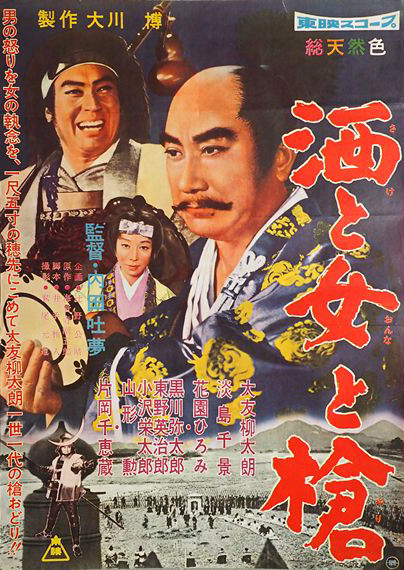
The Master Spearman (酒と女と槍, Tomu Uchida, 1960)

After the war during the American occupation, the samurai film encountered a de facto ban with the authorities worried that historical epics may encourage outdated fuedal and fascistic ideology. The period films of the post-war era, however, are often fiercely critical of the samurai order even as it stands in for the hypocrisies of the contemporary society. Two years before Masaki Kobayashi launched a similar assault on the notion of samurai honour in Harakiri, Tomu Uchida’s The Master Spearman (酒と女と槍, Sake to Onna to Yari) finds a loyal retainer similarly troubled when he is ordered to die only to be ordered not to and then finally told that yes he must commit suicide to serve a kind of honour in which he no longer believes. 

Takasada (Ryutaro Otomo) is a battlefield veteran with the Tomita clan much revered for his skill with the spear. As a retainer to the current regent, Hidetsugu (Yataro Kurokawa), he finds himself in trouble when the ageing Hideyoshi (Eijiro Tono) stages a coup to solidify his power, accusing his nephew of treason on abruptly “discovering” a stash of illegally obtained rifles. Takasada is outraged not to have been ordered to die with his master, but later resents being “strongly encouraged” to do so by his brother, the head of their clan. Storming out, he temporarily retreats into a drunken haze during which he convinces his favourite actress, Umeme (Hiromi Hanazono), to stay with him (just serving drinks, no funny business), before committing himself to public seppuku on a date of his own choosing. When the day arrives, Takasada is greeted by parades of “well wishers” keen to congratulate him for being such a fine samurai. Encouraging those in line to step out of it and stand horizontally without account of rank or status, he agrees to drink with them all, with the consequence that he becomes extremely drunk and passes out. 

Just as he’s about to cut his belly, a messenger arrives from Hideyoshi himself ruling Takasada’s suicide illegal. He if goes ahead and does it anyway, his clan will be disgraced. Takasada’s brother changes his tune and begs him not to proceed for the sake of the Tomita honour. Thoroughly fed up, Takasada has a sudden epiphany about the hypocrisies of the samurai code and decides to renounce his status, dropping out of court life to live simply in the country where he is eventually joined by Umeme who has fallen in love with him. 

Meanwhile, court intrigue intensifies. These are the quiet years leading up to the decisive battle of Sekigahara which in itself decided the course of Japanese history. While the elderly Hideyoshi attempts to hold on to power by ruling as a regent on behalf of his sickly son Hideyori, Tokugawa Ieyasu (Eitaro Ozawa) plots on the sidelines. Hideyoshi is advised by his steward Mitsunari (Isao Yamagata) to take a hard line with treachery, executing all 36 “spies” planted in his household by Ieyasu, including a number of women and children. Mitsunari is himself working with the other side, and the executions are nothing short of a PR disaster for Hideyoshi, provoking fear and resentment in the general populace who can’t accept the inherent cruelty of putting women and children to the sword. Sakon (Chikage Awashima), a kabuki actress and fiercely protective friend of Umeme, comes to a similar conclusion to Takasada, hating the samurai order for its merciless savagery. 

That’s perhaps why she’s originally wary of Takasada’s interest in Umeme, uncertain he will keep his promise to keep his hands off her and so staying over one night herself to make sure Umeme is safe. Umeme, meanwhile, may not have wanted him to be quite so honourable, leaving in the morning visibly irritated and exclaiming that Takasada is drunk on himself and understands nothing of women. That may be quite true, but it’s his sense of honour which eventually tells him that he must reject the samurai ideal. First they tell him honour dictates he must die, then that he must not, then when Hideyoshi dies and the prohibition is lifted, that he must die after all because his entire clan is embarrassed by his continuing existence. By this point, Takasada has decided to accept his “cowardice”. Sickened by the spectacle of his ritual suicide and the humiliation of its cancelation, he came to the conclusion that “loyalty and honour for world fame, glorious exploits etc” is all a big joke. He loves food, and wine, and his wife, and if that means others call him coward so be it because he’s finally happy and perhaps free. 

His spear, however still hangs over his hearth. He hasn’t truly let go of it or of the code with which he was raised. Sakon, perhaps on one level jealous and guarding her own feelings as she accepts that Umeme has chosen to leave the stage to retreat into an individual world with Takasada, warns her that her happiness will end if Takasada is convinced to accept a commission from the Tokugawa. He surprises her by once again renouncing his status as a samurai, choosing to stay a “coward” living a simple life of love and happiness. But as soon as he puts his hand on the spear intending to break it for good something in him is reawakened. He can’t do it. He finds himself at Sekigahara, confronted not only by samurai hypocrisy but by his own as Sakon does what he could not do to show him what he has betrayed. His rage explodes and he raises his spear once again but not for the Tokugawa, against the samurai order itself piercing the very banners which define it in an ironic assault on an empty ideology.  


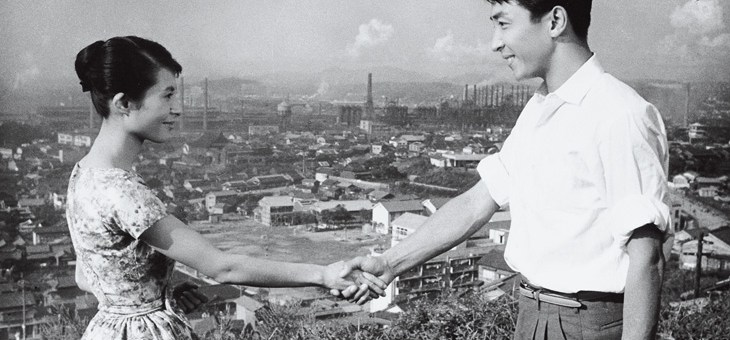
The Eternal Rainbow (この天の虹, Keisuke Kinoshita, 1958)

Eternal rainbow poster 1Famously, towards the end of the war, Keisuke Kinoshita got himself into trouble with a dialogue free scene of a mother’s distress as she sent away the son she’d so carefully raised “for the emperor” towards an uncertain future in the midst of hundred of other, identically dressed faceless boys. Army might have showcased the director’s propensity for resistance, but one could also argue that there was just as much propagandistic intent in the post-war films as their had been in the militarist era even if the messages they were selling were often more palatable. 1958’s The Eternal Rainbow (この天の虹, Kono Ten no Niji) is a case in point. A portrait so positive one wonders if it was sponsored by Yahata Steel, The Eternal Rainbow is nevertheless conflicted in its presentation of defeated post-war hope, exploitation, and growing social inequality even as it praises its factory city as a utopian vision of happy industry and fierce potential.

A lengthy opening sequence featuring voice over narration recounts the history of the Yahata Steel Works which began operations in 1901 in Northern Kyushu and now employs thousands of people, many of whom live nearby in the ever expanding company dorms the newer models of which feature bright and colourful modern designs in contrast to the depressing grey prefab of the traditional workers’ homes. Gradually we are introduced to our heroes – chief among them Mr. Suda (Yusuke Kawazu), a young man from the country who saw a factory job as his over the rainbow but is rapidly becoming disillusioned with its dubious gains. Rather than the company dorms, Suda rooms with the foreman, Kageyama (Chishu Ryu), and his wife Fumi (Kinuyo Tanaka) whose young son Minoru (Kazuya Kosaka) didn’t qualify for a factory job on account of his small frame and his been unable to stick at anything in the precarious post-war economy. Meanwhile, Suda has made friends with an older worker, Sagara (Teiji Takahashi), who has fallen for a secretary, Chie (Yoshiko Kuga), but her family are dead against her marrying a factory worker while she is also in a relationship with a college educated engineer, Machimura (Takahiro Tamura), but is beginning to doubt the seriousness of his intentions.

The drama begins when Sagara employs Kageyama to act as a go-between in a formal proposal of marriage to Chie’s parents, the Obitas. Kageyama didn’t really want to be a go-between because it’s gone badly for him before and he thinks this one is a non-starter too – women around here have their sights set on office workers, no one in the arranged marriage market is looking to marry someone on the shop floor. The Obitas feel much the same. Mrs. Obita is keen for Chie to marry up and is somewhat offended by the proposal, granting it only the customary consideration time to not seem rude in turning it down flat. Sagara is stoic about the matter, but the abruptness of the rejection greatly offends Suda who cannot stand for the Obitas snobbish put down of working people.

Herein lies the central conflict. Suda was a country boy who’d been sold an impossible dream. He believed that a job in the factory, for which he had to sit an exam and has been chosen out of thousands of other hopefuls, was his ticket out of rural poverty. Now that he’s working there he realises he is little more than a wage slave, working long hours for almost nothing with the only goal of his life being to earn enough to feed a family with a little (very little) left over for his old age. Minoru, the Kageyamas’ son, feels much the same and has already turned cynical and desperate. He can’t abide his father’s work ethic and wants more out of life than there perhaps is for it to give him. Suda repeatedly asks how people can learn to be happy in this sort of life, wondering if those that claim to be have simply given up their hopes and aspirations in resignation. When Minoru decides not to go to Tokyo it ought to be a victory, but then perhaps it is more that he has simply accepted that there is no hope there either.

Nevertheless, the depiction of Yahata as a place to work is ridiculously positive even as Kinoshita undercuts it with the disillusionment of both Suda and Sagara. A factory city, Yahata is characterised as a cornerstone of the burgeoning post-war economy, literally making the rails on which the new Japan will run. The works provides affordable accommodation for families, guaranteed employment, insurance, a “self service” supermarket right on site, social clubs, cultural activities, and festivals. They even get a large scale show from Tokyo every year.

Even so, an immense and seemingly unbridgeable gap exists between the steelworkers and the company men. Mrs. Obita might seem self serving and mercenary, but she’s had a hard life and perhaps it’s only natural that wants better for her daughter. Suda is angry to think a good man like Sagara who might be a bit old fashioned and unsophisticated but has taken the trouble to do things the “proper” way would be dismissed out of hand simply out of snobbery. His attitude is, however, somewhat problematic in that he begins bothering Chie to find out her reasons for declining the proposal, refusing to recognise that she doesn’t need to offer any reason besides her own will. Chie, meanwhile, is conflicted. A proposal of marriage from a man she doesn’t even really know is not something she was minded to consider in any case, but her feelings for Machimura are tested once she becomes aware that he is not quite in earnest and may have been messing around with his landlady while enjoying the attention he receives as an eligible bachelor around town.

Machimura, like Suda, Sagara, and Minoru, is somewhat listless and apathetic even if for the opposite reason in that his life is far too easy and he hasn’t had to make a lot of concrete decisions about his future. Chie doesn’t deny that his college education and urban sophistication are part of the reason she was attracted to him, but as she later tries to explain to Suda, she wasn’t simply angling to marry up – she just fell in love with someone who happened to be of a higher social class which isn’t the same as looking down on working people. She has a right to her feelings whatever political label an increasingly resentful Suda might like to put on them. Even so, if she had been trying to marry up who could really blame her for that? In a society in which women are still entirely dependent on a man, being largely prevented from pursuing a career in their own right, a marriage is effectively a job for life. Shouldn’t she pick the offer with the best benefits, just as Suda did when he chose to leave the country for a factory job?

Progressive factories are often presented as an ideal solution the problem of post-war poverty, but here Kinoshita does not seem so sure. Despite the emphatic tone of the infrequent voice over and the central messages that factory jobs are good jobs and looking down on manual work nothing more than snobbery, Suda and Sagara remain conflicted. This work is dangerous, pays little, and offers nothing more than false promise. If the vast cities like Yahata are the engines repowering the economic growth of a still straitened Japan, what will be the end result? Metropolis made flesh, the “eternal rainbow” is exposed as a self serving lie but what, Suda might ask, else is there for men like him in a society like this?


Original trailer (no subtitles)

Twilight Story (濹東綺譚, Shiro Toyoda, 1960)

Director Shiro Toyoda, closely associated with high minded literary adaptations, nevertheless had a talent for melancholy comedy and for capturing the everyday reality of ordinary people. A fierce condemnation of the patriarchal society at a moment of intense masculinity, Twilight Story (濹東綺譚, Bokuto Kitan), an adaptation of the novel by Kafu Nagai, follows an ambivalent author as he covertly observes the life and love of a former geisha daring to dream of romantic salvation while fully aware of the world’s cruelty.

Set in 1936, the film opens with an author on a research trip who guides us into the world of the Tamanoi pleasure quarter which he seems to disdain but is drawn to all the same. Whilst there he runs into a nervous middle-aged man, Junpei (Hiroshi Akutagawa), who is later accosted by sex worker Oyuki (Fujiko Yamamoto) for use of his umbrella during a violent storm. A mild-mannered sort, Junpei is unused to the ways of the red light district and quickly makes his escape after being invited into Oyuki’s home. After a swift drink, however, he returns and the pair begin an awkward semi-romantic relationship.

Despite his affirmation that he is single, Junpei is in fact already married if (for the moment) unhappily. Though he knew his future wife Mitsuko (Michiyo Aratama) had given birth to an illegitimate child fathered by her employer, Junpei chose to marry her anyway because he was in love. The pair married, they say, for “genuine” reasons but the father of Mitsuko’s son continues to send maintenance money for the boy’s education and his constant presence has begun to play on Junpei’s mind especially as his teacher’s salary is dwindling in this age of militarism in which educational hours are decreasing in favour of compulsory military drills. Meanwhile, Mitsuko also seems to have got religion and spends most of her time reciting sutras with the implication that she has begun to neglect her husband, emotionally, spiritually, and most particularly physically. In order to escape his depressing home life, Junpei hangs out in the Tamanoi where men’s hearts are lighter and people talk frankly about love.

This is, of course, not quite the case, but the fantasy the pleasure quarters sell of themselves. Our jaded author is perfectly aware of that and broadly sympathetic towards the women caught in its web. Oyuki, a former geisha, has “debased” herself in order to earn extra money to send home to her family and pay the medical fees for her sickly mother. Her uncles constantly pressure her for more and she wonders if they are not merely exploiting her, using her money for their own benefit and refusing to chip in for her mother’s care. Nevertheless, she is trapped. On meeting Junpei with whom she seems to develop a genuine emotional connection, she dares to dream that one day they might marry, that she could leave this life behind and build a stable family home of her own.

Of course, it’s not to be. Like all men in the Tamanoi, Junpei is misrepresenting himself for his own ends. He is only using Oyuki as an idealised point of refuge from the unhappy marriage he shows no other signs of leaving. As the author points out, the men think they’re using women but the women are also using them though they do so without calculation. Denied power or agency of their own, the women of the Tamanoi have no other option than to manipulate that of men, though the author sympathises with them so strongly that to expose the hidden “vulgarity” seems to him an act of intense cruelty.

Junpei falls in love with the world of the Tamanoi because he thinks it’s more emotionally honest, but the truth is quite the reverse. Wandering through the narrow streets at night, the author pities the women in the windows, knowing that men come here to escape their isolation but there is no escape for these women who are forced to delude themselves that a better future is waiting in order to go on living. Meanwhile Junpei’s colleague, looking back over his shoulder towards the young men in uniform, declares that he too has lost all hope for a promising future. With militarism on the rise, hyper-masculinity has led to a further decline in the already woeful status of women with even the girls’ sympathetic pimp lamenting that the army, who have been rounding up sex workers for forced service in Manchuria, regard them as little more than products to be poked and prodded and giggled over as they are cruelly bought and sold.

Reuniting with his wife, Junpei is forced to face his emotional cowardice, that he was just playing with Oyuki’s feelings in indulging the fantasy of an idealised romantic union. Oyuki, meanwhile, faces the destruction of all her dreams when she realises her uncle has betrayed her, her mother is dead, and all her sacrifices have been for nothing. On some level she may have known Junpei had another woman, but needed to believe in the fantasy of his love for her in order to make her life bearable. Even so, she now sees no other future for herself than a return to work shorn of all her hope. Toyoda’s condemnation of the red light district is bleak and total, even as the jaded author himself becomes an ambivalent part of it, but the Tamanoi is only a symptom of longstanding social oppression exacerbated by militarist fervour as the lights go out all over town.


Blood is Dry (血は渇いてる, Kiju Yoshida, 1960)

Blood is dry DVD coverIn the new post-war economy, everything is for sale including you! Kiju (Yoshishige) Yoshida’s second feature Blood is Dry (血は渇いてる, Chi wa Kawaiteru) takes its cues from Yasuzo Masumura’s earlier Technicolor corporate satire Giants and Toys, and Frank Capra’s 1941 comedy Meet John Doe in taking a faceless corporate drone and giving him a sense of self only through its own negation. The little guy is at the mercy not only of irresponsible capitalist fat cats, but of his own imagination and the machinations of mass media who are only too keen to sell him impossible dreams of individual happiness.

The action opens with a grandstanding rooftop speech from a former CEO to his distressed workforce informing them that because of “indifferent capitalism” this small business is going bust and everyone’s out of a job. Then, dramatically, our hero Kiguchi (Keiji Sada), steps out with a pistol and threatens to shoot himself, proclaiming that he no longer cares for his own life but doesn’t want anyone else to lose their job. Another worker, Kanai (Masao Oda), tackles Kiguchi and the gun goes off. Thankfully, he is only mildly wounded but Kiguchi’s case reaches the papers who make it into a human interest issue exemplifying the precarious economic conditions of the modern society. While he’s still somewhat current, an enterprising advertising executive hits on the idea of getting Kiguchi to act as the face of their campaign, bizarrely attempting to sell life insurance with the image of a man putting a gun to his head while proclaiming that “it’s high time everyone is happy”.

When we first meet him, Kiguchi is indeed a faceless, broken man at the end of his tether. His noble sacrifice is interpreted as an act of war on an unfair capitalist society, but as he later affirms in exasperation, Kiguchi had no political intent and never considered himself as acting with a greater purpose, he was simply terrified at the prospect of losing his job which is, in a sense, also his entire identity. Shy and mild-mannered, he stammers through speeches and curls himself into a hostile ball of awkwardness in front of the camera but ad exec Nonaka (Mari Yoshimura) is sure that only makes him a better sell for being “real” and relatable. Like the hero of Meet John Doe, however, Kiguchi starts to buy into his own hype. He fully embraces his role as the embodiment of the everyman, at once gaining and losing an identity as he basks in the unexpected faith of his adoring populace.

Kiguchi’s conversion wasn’t something Nonaka had in mind and it frightens her to realise she has lost control of her creation. Meanwhile, Nonaka’s ex, a paparazzo with a penchant for setting up celebrities in compromising situations in order to blackmail them, has it in for Kiguchi as the personification of his own dark profession. He resents the idea of using “suicide” as a marketing tool and the cynical attempt to sell the idea of happiness through the security of life insurance which, it has to be said, is a peculiarly ironic development.

Kiguchi’s liberal message of happiness and solidarity does not go down well with all – he’s eventually attacked in a taxicab by a right-wing nationalist posing as a reporter who accuses him of being a traitor to Japan, and it’s certainly not one which appeals to the forces which created him. Nevertheless, he does begin to capture something of the spirit of the man in the street who just wants to be “happy” only to have his message crushed when his image is tarnished by tabloid shenanigans and left wondering if the only way to reclaim his “artificial” identity is to once again destroy himself in sacrifice to his new ideal.

Yet Kiguchi’s motivation is both collectivist and individual as he claims and abandons his identity in insisting that he belongs to the people. His confidence is born only of their belief in him and without it he ceases to exist. Kiguchi’s entire identity has been an artificial creation with an uncertain expiry date and his attempts to buy it authenticity only damn him further while his actions are once again co-opted by outside forces for their own aims. The little guy has achieved his apotheosis into a corporate commodity leaving the everyman firmly at the mercy of his capitalist overlords, dreaming their dreams of consumerist paradise while shedding their own sense of self in service of an illusionary conception of “happiness”.


Original trailer (no subtitles)