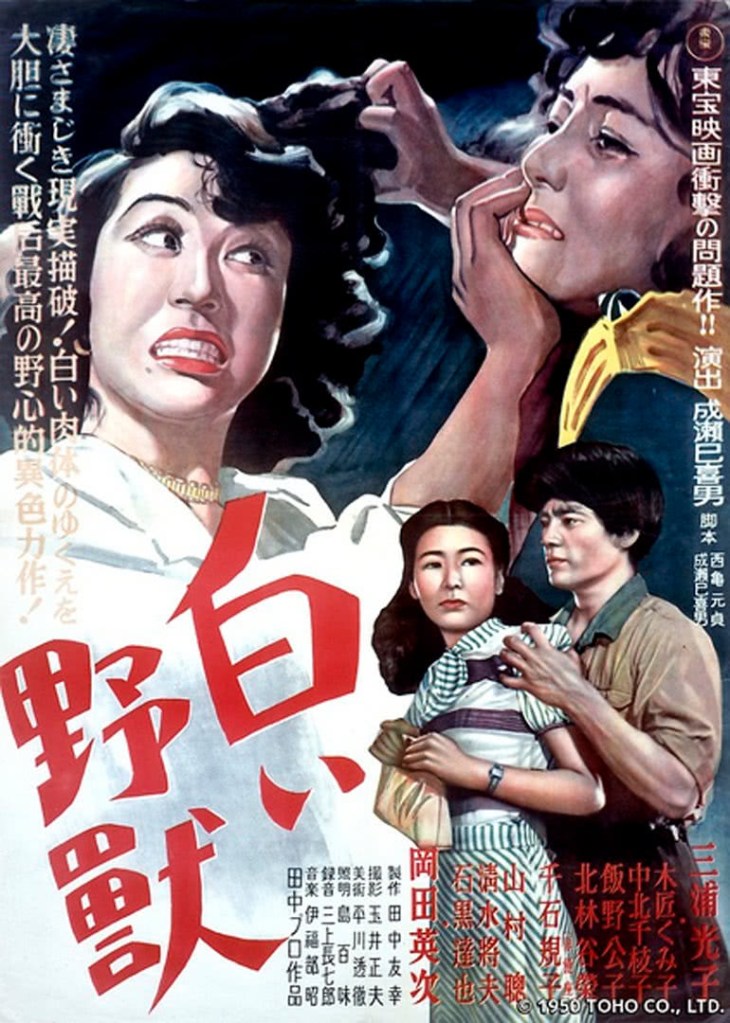
White Beast (白い野獣, Mikio Naruse, 1950)

Though motions were made towards criminalising sex work under the American occupation from as early as 1946, not that much changed until the passing of the Prostitution Prevention Law 10 years later. In the desperation of the later war years and their immediate aftermath, many women who’d lost husbands, families, and their homes, found themselves with no other way to survive than to engage in sex work, but the existence of these women who were only doing something that though not exactly well respected was fairly normalised five years previously became an acute source of embarrassment most especially given the views of the morally conservative Occupation forces. 

Slotting in right next to the pro-democracy films of the era, Mikio Naruse’s White Beast (白い野獣, Shiroi Yaju) is a surprisingly progressive effort which locates itself in a “home for wayward women”. The White Lily Residence is run with love and compassion and even if the older female warden is stern in a practical sort of way she is never unkind or uncaring, while the male governor Izumi (So Yamamura) is patient and supportive, always keen to tell the women in his care that they are not spoiled or dirty and are fully deserving of the bright new futures he is certain are waiting for them. Rather than lecturing the women, the home makes a point of teaching them new skills such seamstressing so that they will be able to find honest jobs on the outside, though the conviction that those jobs exist may be a little optimistic in itself. 

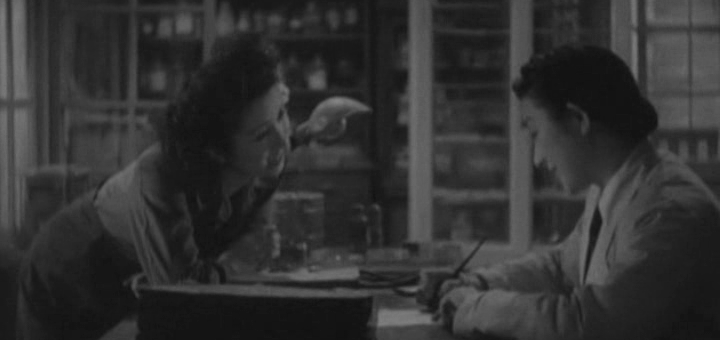
Our first introduction to the White Lily is through the eyes of Yukawa (Mitsuko Miura), an educated woman who claims she engaged in sex work simply because she enjoyed it and doesn’t see why she’s been arrested. She tries to leave and is told that she is technically free to do so, but they will have to call the police if she does. Yukawa decides to stay, especially once she locks eyes with cheerful female doctor Nakahara (Kimiko Iino). Perhaps surprisingly, the central drama revolves around an awkward love triangle between Yukawa who becomes fixated on the doctor who to be fair is unambiguously flirting back, and the bashful Izumi who has designs on Nakahara himself. 

Refreshingly direct and professional, Nakahara nevertheless has an engaging warmth that has made her a real asset to Izumi’s team as she deals with the sometimes quite difficult medical circumstances of the women at the centre, many of whom are understandably suffering with various STIs including syphilis. Never judging them she remains sympathetic and egalitarian, even joining in when Yukawa cheekily invites her to dance while some of the other women are listening to records. Appearing to understand what Yukawa is asking her, she tells her that she has remained single by choice and has no intention to marry because she’s prioritising her career. Yukawa’s confidence is, however, shaken when she hears a rumour that Nakahara and Izumi may be romantically involved. 

Yukawa looks to Nakahara to try and understand why she’s ended up at White Lily. She asks her what it means to have a “dirty” body and gets a diplomatic medical answer which nevertheless coyly places the blame on sexual repression. Nakahara admits that marital relationships can also be “dirty”, not because of infidelity but because of patriarchal inequalities – marriages in which the wife is treated as a “doll” or a “maid” for example. The answer seems to satisfy Yukawa, but Nakahara has also cut to the quick of her psychological trauma in asking her if she is not also internalising a sense of shame in secretly battling with the idea that she is somehow “dirty” because of the way she’s lived her life. 

Given her fixation with Nakahara, we might wonder what it is that Yukawa so struggles to accept about herself despite her outwardly liberated persona. Beginning to reflect on her past life, she sees the faces of the men she slept with looming over her but seems confused. Was she deflecting desire rather than embracing it, trying to prove or perhaps overwrite something? In any case, her time at the centre begins to soften her but, crucially, not towards accepting a social definition of herself as dirty but emerging with new degrees of self knowledge and acceptance. 

The one sour note in Izumi’s otherwise progressive philosophy sees him encourage one of his star pupils, Ono (Chieko Nakakita), to reunite with a man she was engaged to before the war who has just been repatriated and claims his feelings haven’t changed despite finding her at White Lily. Ono is reluctant, partly because she feels a sense of unworthiness, but also because she suspects that whatever Iwasaki (Eiji Okada) says now, he will someday hold her past against her. She’s proved right when she gets a day pass to visit him in his flat where he eventually rapes and then tries to strangle her. Ono vows not to see him again, but Izumi convinces her otherwise, as if this is all her fault, telling her that two people who love each other can work through anything, implying that it’s her job to fix his wartime trauma (if perhaps mildly implying the reverse is also true for him). For an otherwise compassionate man, telling a vulnerable woman to return to a violent partner because “love is enough” seems an oddly patriarchal gesture. 

Nevertheless, despite the late in the game swerve towards conservatism, White Beast presents a surprisingly progressive critique of an inherently misogynistic, hypocritically puritanical society. At one point, a wealthy big wig arrives to lecture the women, berating them for “bringing down Japanese womanhood” while insisting that women who justify sex work as a means of avoiding starvation are being disingenuous because most women are just “decadent” and wanting handbags etc. Yukawa, unable to control herself, fires back, asking him who it is he thinks buys their services in the first place. It’s very valid point, and one it seems few are willing to consider. 


Short clip (English subtitles)
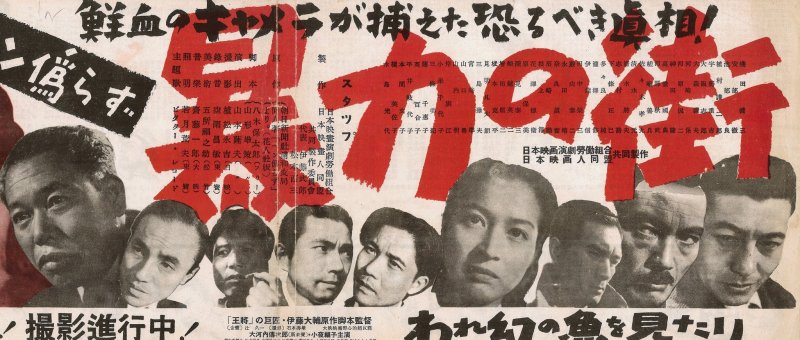
Street of Violence: The Pen Never Lies (ペン偽らず 暴力の街, Satsuo Yamamoto, 1950)

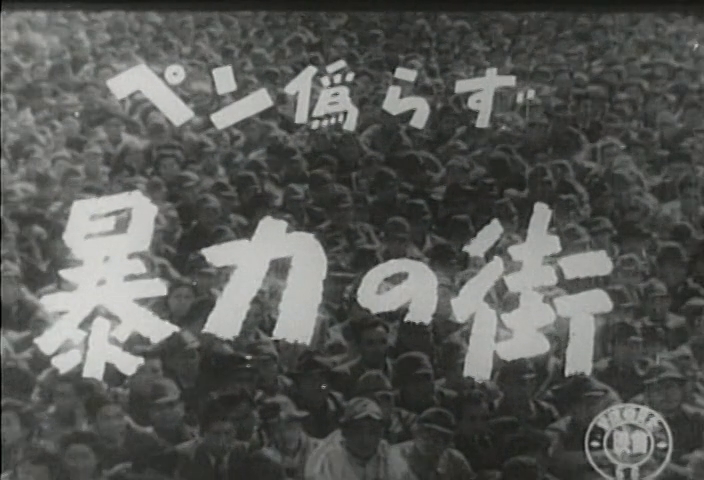
vlcsnap-2020-01-16-00h05m26s354The immediate post-war era was one marked by fear and anxiety. The world had turned upside down, food was scarce, and desperation had provoked a widespread moral decline which rendered compassion a luxury many thought they could ill afford. Yet, in hitting rock bottom there was also the opportunity to rebuild the world better than it had been before. Street of Violence: The Pen Never Lies (ペン偽らず 暴力の街, Pen Itsuwarazu Boryoku no Machi), is one of many pro-democracy films arriving in the wake of Japan’s new constitution and makes an unlikely hero of the local newspaperman as the sole means of speaking truth to power in the fierce belief that the people have a right to know.

Tojo, a small town Northwest of Tokyo, was once the centre of the silk trade but as the industry declined, it gradually became home to gangs and a hub for wartime black market shenanigans. The sad truth is that the growing nouveau riche middle-classes profiting from post-war shadiness have more or less got the town sewn up. The corrupt police force is in cahoots with the gangsters who call themselves a “police support organisation” and make a point of wining and dining the local police chief, while also making sure the local paper is firmly in their pocket. The trouble starts when rookie reporter Kita (Yasumi Hara) is invited to a policeman’s ball and figures out the whole thing is sponsored by the silk traders’ union, which he thinks is not quite right. He takes what he’s learned back to his editor and is warned off the story but publishes something anyway, quickly becoming a target for prominent “politician” Onishi (Masao Mishima).

Street of Violence opens with onscreen text taken from the press code which emphasises that mass media has a duty to preserve the truth. Kita’s paper had been in league with the police and the gangsters enabling the atmosphere of casual violence which is gradually consuming the town. Kita, a new recruit, is not yet inured to the way things are and immediately thinks his duty is to blow a whistle, most obviously on the corrupt police force and judiciary. He is only allowed to do so because the previous editor stepped down and a similarly idealistic older gentleman (Takashi Shimura) from out of town has taken over. He decides to fight back, standing up to the crypto-fascist goons by continuing to publish the truth about the links between the police, black market silk traders, gangsters, and the rest of the local press who eventually gain the courage to join him.

Onishi continues to masquerade as a “legitimate businessman” and “respectable politician” claiming that he’s “striving for democracy” to help the “downtrodden”, but is also responsible for directly targeting Kita’s mother and sister in an attempt to intimidate him. The editor assigns another reporter, Kawasaki (Ryo Ikebe), to keep Kita safe and starts trying to find locals who will consent to be interviewed about gang intimidation while Kita’s friends from the Youth Association generate a kind of resistance movement holding protests and handing out flyers condemning the atmosphere of violence which has ordinary citizens turning off their lights and avoiding going out after dark to protect themselves from thuggery.

The silent cause of all this strife is of course post-war privation which has made the blackmarket the only means of survival for those otherwise starving but has also given free rein to selfish immorality. The Onishis of the world, the spineless police chief, and the cynical local press, have all abnegated their human responsibilities in wilfully taking advantage of a bad situation to further their own cause. When the press chooses not to turn a blind eye to entrenched corruption, it raises a flag that ordinary people can follow. Too intimidated to speak out, the townspeople had been living in fear but post-war youth has the courage to say no and demand a better future. A mass rally crying out “democracy” and insisting on an end to the cronyism and the corrupt systems of pre-war feudalism produces a people power revolution that can’t be ignored, forcing Onishi into submission, and a clean out of corrupt law enforcement. But, the earnest voice over reminds us, the victory is only partial – violence still exists and will rise again when it thinks no one’s looking. The press, most of all, cannot afford to look away if “democracy” is to be maintained.


The Straits of Love and Hate (愛怨峡, Kenji Mizoguchi, 1937)

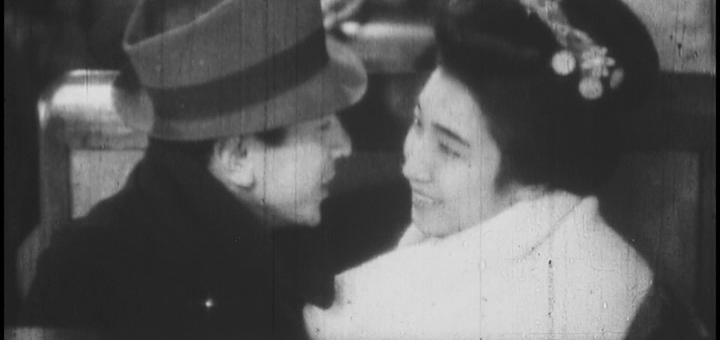
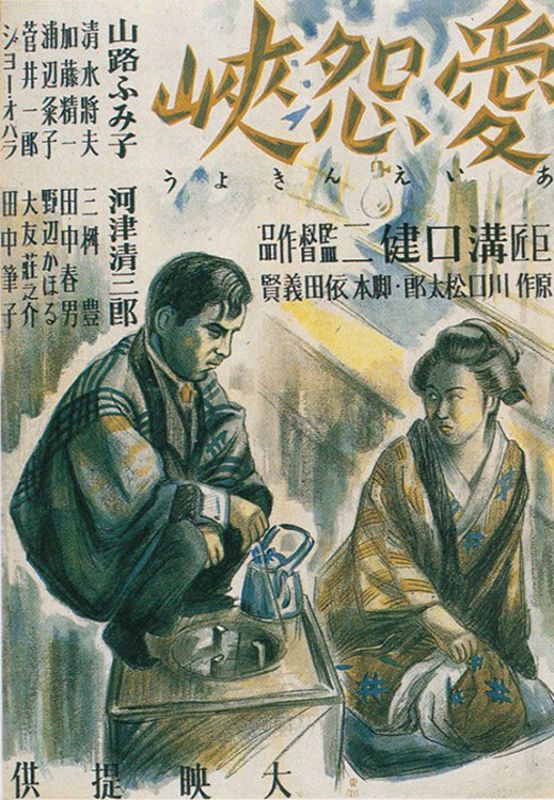
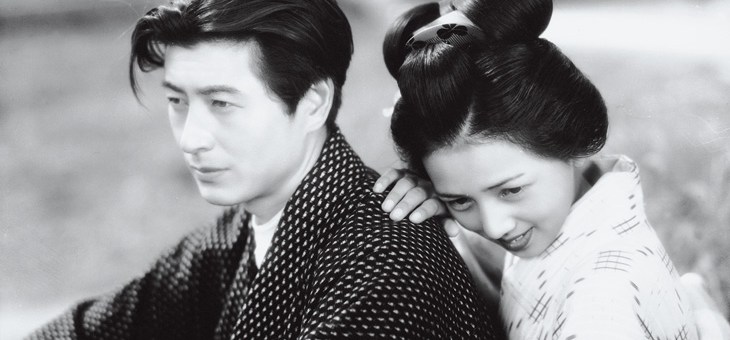
straits of love and hate poster“Tokyo is a dangerous city that traps innocent people like you” the heroine of Kenji Mizoguchi’s 1937 melodrama The Straits of Love and Hate (愛怨峡, Aien kyo) is told, but it’s not so much the darkness of the city streets as the world’s cruelty which threatens to consume her soul. Loosely inspired by Tolstoy’s Resurrection, then particularly popular in Japan and a frequent source for adaptation in the silent era, Straits of Love and Hate is a familiar tale of an innocent maid seduced and betrayed by the weak willed son of her social superiors, but rather than see her beaten by a broken heart Mizoguchi allows to her to find new strength in the determination to move forward in a direction of her choosing.

Kitchen maid Ofumi (Fumiko Yamaji) is in love with Kenkichi (Masao Shimizu ), the son of local hotel owners. Now that he’s finished his studies, his parents were expecting him to take over the inn so they’re not exactly pleased when he tells them he plans to go to Tokyo to become a teacher, nor would they be very happy about the idea of him marrying a lowly maid. After arguing with his father, Kenkichi more or less gives up on the idea of leaving, deciding to postpone until his parents come round or perhaps going on his own and sending for Ofumi when he’s financially stable. Twin pressures, however, force him to accept that it’s now or never. Ofumi is a few months pregnant and will soon be showing so his hand is in a sense forced. Meanwhile, Ofumi is keen to leave as soon as possible because her uncle, Murakami (Seiichi Kato), has turned up extremely drunk and is talking to her employers about taking her away to join his troupe of travelling players which she is desperate to avoid because she remembers her mother telling her he was no good and would sell her to a brothel as soon as look at her.

Kenkichi relents and the pair elope to Tokyo, but once there his general fecklessness resurfaces. The couple have begun to outstay their welcome at the apartment of a friend whose wife is becoming thoroughly fed up with Kenkichi who lounges about all day not looking for work, while an increasingly pregnant Ofumi is out job-hunting alone in the unforgiving city. A naive bumpkin, she’s nearly scammed by a street pimp who claims to be saving her from someone in fact just like him, but is rescued by Yoshi (Seizaburo Kawazu) – a wandering accordion player regarded by all as a petty thug. Kindhearted by nature, Yoshi takes pity on her and sets Ofumi up with a job in a cafe but is soon arrested for stabbing the pimp who was bothering her. Meanwhile, the irritated wife of Kenkichi’s friend has wired his dad who promptly arrives to retrieve his son. Spineless, Kenkichi walks out on his pregnant girlfriend leaving her only with a note that says “sorry, good luck with the rest of your life”, and an insultingly small amount of compensation money.

It’s easy enough to think that Kenkichi wasn’t really invested in his romance, got cold feet, or simply rejected adult responsibility, but the truth is more that he’s just as trapped by patriarchal social codes as Ofumi is and no more free even with his comparatively comfortable class background. He lacks the will to defy his father, and is simply too lazy to consider living an ordinary life in the city with a regular job where no one calls him “young master”. Ofumi, by contrast, fights for love. She breaks the class barrier, naively believes that Kenkichi’s parents will accept her because they cannot reject their grandchild, and forgives Kenkichi’s fecklessness because she truly believes in him. One word from his father, and he crumbles. Left alone Ofumi is forced to send her son out to foster parents and has no other choice than to become a bar hostess.

Unlike Kenkichi, Yoshi is patient and kind. He truly means to protect Ofumi and her son, but also has a self-destructive violent streak as manifested in his over the top attack on the pimp and later altercation with a remorseful Kenkichi. Ironically enough, Uncle Murakami whom she so feared becomes an unlikely source of salvation, inviting Ofumi and Yoshi to join the company as a standup double act. Witnessing Ofumi reenact her romantic tragedy on stage as part of a routine forces Kenkichi to confront his moral cowardice. While the intervening years have seen Ofumi become cynical and bitter, still angry and resentful, Kenkichi has become weary and resigned. His parents have moved to the country, and he now runs the hotel, but he’s still not free. Hoping to convince Ofumi to come back, he invites his dad to meet their son but it becomes clear to her that Kenkichi will never change. He lacks the strength to reject his father’s authority, and as he’s abandoned her before he will likely do so again.

Kenkichi, perhaps meaning well, offers to take the child, pointing out that growing up among travelling players is an inauspicious start in life whereas he can bring the boy up with all the advantages of middle-class comfort. Ofumi is guilty in her immediate refusal, acknowledging that she may be denying her son a “better life” than she can give him, perhaps selfish in her reluctance to be parted from her child, but equally certain that she doesn’t want her son to grow up like Kenkichi, a spineless product of a patriarchal social order unable to stand up to his father or seize his own agency. She tells Kenkichi that she’s fallen in love with Yoshi because theirs is a partnership of equals, they understand and support each other, moving forward as one. He won’t abandon her by choice, but he isn’t perfect either and his foolish self-destructive impulses and selfless nobility threaten his new hope for the future as he embarks on a high risk strategy to prompt Ofumi to accept the “better life” that Kenkichi can offer her. Nevertheless, the point is that the choice is finally hers – no man is going to make it for her, not even her son. What she chooses is a kind of independence, stepping boldly forward into a future that’s entirely of her own making.


Apostasy (破戒, Keisuke Kinoshita, 1948)

Hakai still 1For all his good hearted humanism and intense belief in the simple power of human goodness, the films of Keisuke Kinoshita can also be surprisingly conservative, most particularly in their attachment to the old, pre-war Japan which they often see as unsullied by the corruption and ugliness of the militarist era. A new constitution film, Kinoshita’s adaptation of the Toson Shimazaki novel The Broken Commandment, The Apostasy (破戒, Hakai), opens with a series of bold titles proclaiming “Freedom and equality”, and “respect for human rights” before breaking into an attack on the persistent feudalism which has managed to survive into the new era along with prejudice and contempt. Zooming back to the missed opportunity of Meiji-era liberation, Kinoshita too remains somewhat ambivalent about the the decline of a social order in a Chekhovian lament for the rise of the petty middleman and the fall of noble aristocracy.

In Meiji 35 (1902), despite the advent of the Meiji Restoration and abolishment of the class system, prejudice against the “burakumin” – untouchable “outcasts” who lived in isolated settlements and (historically) made their living in occupations connected with death, was still very much in existence. This is all too apparent to Segawa (Ryo Ikebe). A bright young man, Segawa’s father sent him out of their village to make something of himself with the solemn promise that he must never reveal his burakumin origins to anyone. The world being as it is, however, Segawa is conflicted especially as he has fallen in love with his mentor’s daughter Oshiho (Yoko Katsuragi) and wonders if it would be fair to marry a non-burakumin woman without telling her truth and live with the threat of discovery forever over their heads.

The Broken Commandment would later be adapted again by Kon Ichikawa whose focus is, perhaps quite surprisingly, very different to that of Kinoshita who, uncharacteristically, chooses to prioritise class concerns over the right to live freely and honestly in a compassionate society. Ichikawa’s adaptation deliberately widens the implications of Segawa’s dilemma, making it plain that he is talking not just about burakumin rights but directly to all oppressed peoples and most particularly to those who feel obliged to keep their true natures a secret in an oppressive and conformist society. Strangely, Kinoshita chooses not to engage with this theme which might otherwise seem tailor made for his persistent concerns if perhaps a little close to home, preferring to focus not on Segawa’s gradual shift into accepting his own identity and hearing the call to activism but on the reactions of the changing world around him which seems to be imploding while besuited upstarts enact their petty revenge on the chastened nobility.

This is most clearly seen in the unfair treatment of Segawa’s mentor and landlord, Kazama (Ichiro Sugai) – a former samurai and until recently the local school teacher. Mere months away from his retirement, Kazama has been instructed to resign so that the school will not need to pay his pension while his position has been taken by a pushy local man with limited education whose sole claim to the job is being of the people. Kazama is understandably resentful but stoic. Segawa’s liberal colleague, Tsuchiya (Jukichi Uno), takes the school board to task for its unreasonableness and underhanded attempt to save money by forcing an old man out of his position with no thought for his 30 years of service. Though Tsuchiya might be broadly in agreement with the changes taking place in Meiji-era society, he too worries about the greedy upstarts usurping privilege rather than seeking to eradicate it.

Stepping back for second, Apostasy is a post-war film designed to echo the egalitarian philosophies of the new constitution drawn up under the American occupation. It is then somewhat subversive that our villains are the Westernised lower middle classes of Meiji-era society who seem to have embraced “modernity” by dressing in suits but refuse to abandon ridiculous ancient prejudices such as that towards burakumin, doubtless because those prejudices largely work out in their favour. It would be tempting to read these prejudices as foreign imports, but that against the burakumin is wholly Japanese and truth be told somewhat backward in contrast to (the kimono’d) Tsuchiya’s forward looking socialist beliefs which superficially at least seem more in keeping with the age.

Yet it is in some senses Segawa himself who struggles to emerge from the feudal yoke. His promise to his father is a sacred vow underlined by loss and sacrifice. He feels it is his duty to live as his father wished, as a “normal” Japanese citizen in success and comfort, but also begins to become acutely aware that to do so may be cowardly and selfish. If he chooses to keep his promise to his father and never reveal himself as a burakumin, he will be complicit with the systems which oppress him and thereby ensure those like him will always be oppressed. His awakening comes, in a sense, from a second father – Inoko (Osamu Takizawa), a burakumin who has come out of the closet and loudly fought for burakumin rights along with the general liberty of all oppressed people. Caught between two fathers and his growing love for Oshiho, Segawa remains lost while one of the suited proto-militarists threatens to out him leaving him floundering in the face of intense social stigma and the possibility that those he loves may turn against him.

Segawa has to free himself or risk becoming like Kazama – a man haunted by the feudal past, as Tsuchiya puts it. Kazama himself is painted in broadly sympathetic terms, forced to endure the melancholy fate of being eclipsed by a Lopakhin-esque member of the insurgent middle-classes, but his prejudice is later exposed despite his original support of Segawa when he notices one of the suits smirking at him and instantly feels humiliated, turning his impotent rage back on the outcast as if his presence further dishonours him as a samurai. Segawa’s aim as a teacher had been to teach his children the power of individual thought, which would seem to be the best weapon against prejudice but his message has been cut off at source thanks to the self-interested school board who have been all to quick to claim the benefits of modernity with none of the responsibility. Resolved to fight for a freer future, Segawa finally accepts his responsibility as a burakumin spokesman in the knowledge that his calling is to educate and that only through education can anything ever change. The lessons of Meiji may have gone unheeded, but the opportunity presents itself again to abandon the feudal past in favour of an egalitarian modernity built on fairness and compassion rather than obligation and oppression.


Titles/opening (no subtitles)

Once More (今ひとたびの, Heinosuke Gosho, 1947)

(c) 東宝

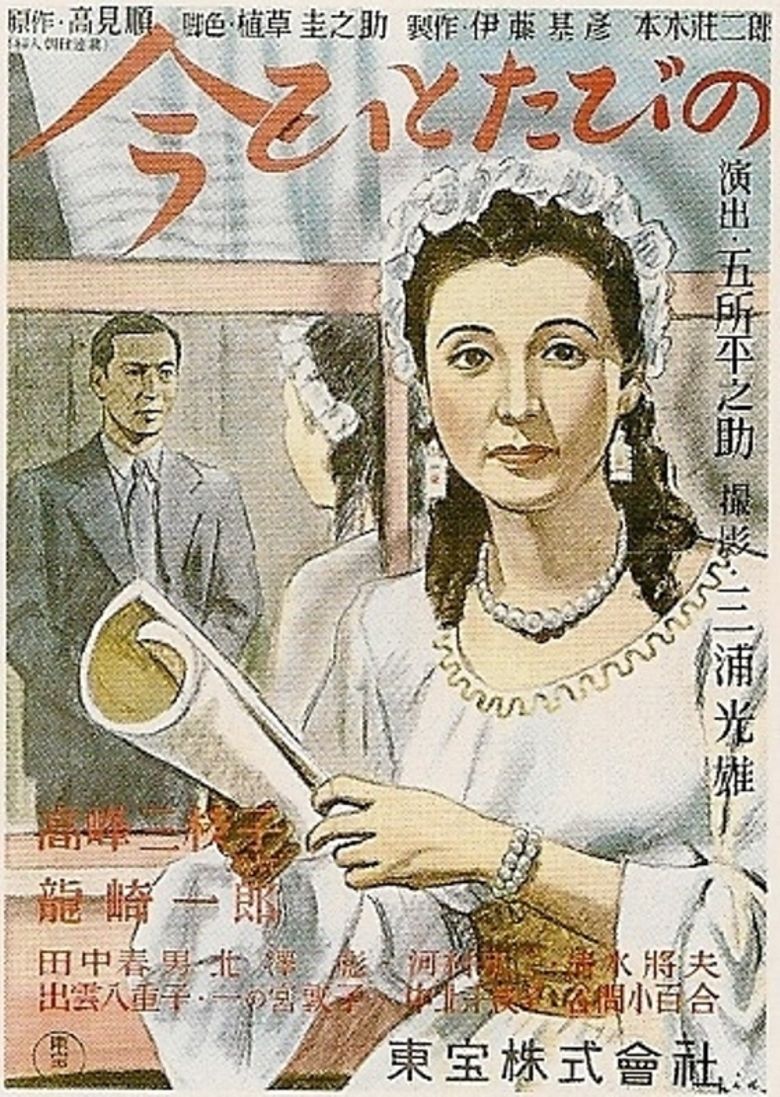
Gosho once more posterOf the Japanese golden age directors, there were few who’d “happily” gone along with the requirements of making films under a militarist regime. Heinosuke Gosho, however, must rank among the most recalcitrant in his unwavering refusal to compromise his convictions in order to preserve his career. Most of the scripts he submitted to the censor’s board were rejected in the preliminary stages though he was able to ruffle a few feathers with the few films he did manage to make if only for his skilful ability to skirt around the promised propagandistic overtones. It also “helped” that Gosho had become seriously ill with tuberculosis in 1937 which perhaps protected him from official interference and, in any case, removed him from the film industry for three years while he recovered. Nevertheless, he felt keenly that he and others had a duty and an opportunity to turn the tables in the post-war era, advancing the ideology of humanism to create a better, fairer world than the one which had descended into so much ugliness and chaos.

In fact one of the reasons Gosho decided to film Once More (今ひとたびの, Ima Hitotabi no) in 1947 under the American occupation was to counter the view held among some young people that there had been no active opposition to militarism. Gosho and his screenwriter Keinosuke Uekusa chose to adapt a heavily political novel by Jun Takami which painted itself as a romantic tragedy of resistance in which its leftist heroes find themselves carrying the legacy of defeat onward into the post-war world. Gosho depoliticises Takami’s tale and reconstructs it as a romantic melodrama with a more positive resolution, but is careful to preserve the fierce idealism of the conscientious students relentlessly protesting Japanese Imperialism whilst trying to advance the course of social justice in an increasingly oppressive environment.

The tale begins in 1936 as a group of students prepares to graduate. Nogami (Ichiro Ryuzaki), a doctor, has turned down a lucrative university post to minister to the poor. Unlike his friends Tanaka (Koji Kawamura) and Kambara (Hyo Kitazawa), Nogami is not an activist or left wing agitator but has a strong belief in humanistic socialism and a conviction that he has a duty to ensure his skills are available to those who need them most. Invited to a play directed by Kambara which is being performed to raise money for socialist causes, Nogami accidentally wanders into the dressing room of the leading lady – Akiko (Mieko Takamine), a wealthy socialite, and falls in love at first sight. Akiko too takes a liking to Nogami and invites him to her birthday party despite his rather odd behaviour after the play, but he finds it impossible to get on with her upperclass friends and eventually leaves. The pair advance and retreat, but their romance is frustrated by the times in which they live, politics, and their own senses of personal integrity which encourage them to willingly sacrifice their happiness in acknowledgement of living in an unhappy world.

Despite their original, electric attraction the obstacles surrounding the love of Akiko and Nogami may seem insurmountable, chief among them being the obvious class difference between the pair. Nogami, somewhat contrary to his humanistic ideals, has a mild prejudice against the bourgeoise, believing them to be selfish, unfeeling, and existing in their own bubble hermetically sealed away from the kind of suffering he sees everyday at the clinic. Yet he cannot forget Akiko who harbours no prejudice towards him because of his humble origins (though her friends and family make no secret of theirs) and feels similarly about her own social class, overcome with guilt that she lives in such comfort while others suffer. Eventually Akiko joins the cause, becoming a left-wing agitator and even getting herself arrested and branded a “Red Lady” in the papers (further annoying her very confused social circle). Unlike Nogami she is also subject to a kind of social and gender based oppression in which she is under constant pressure to marry her longstanding fiancé, Sakon (Haruo Tanaka), and conform to the requirements of her position. Nogami is “free” to choose to live a life of selfless altruism in a way that Akiko is not and will struggle to be throughout the rest of the picture.

Yet time and again it is the times which frustrate their romance. Akiko and Nogami repeatedly make plans to meet, but one of them is arrested and prevented from arriving leaving the other assuming the worst – that they have been abandoned, romantically and ideologically. Matters aren’t helped by Nogami’s natural diffidence and awkwardness coupled with his rigid code of honour which makes it impossible for him to pursue Akiko in any normal way, leaving her confused and later at the mercy of her controlling family. In the end it is their own senses of personal integrity which prevent their union, as a friend bound for the front points out when he, essentially, tells them to get over themselves and embrace happiness rather than overthinking an emotional response and ruining it in the process.

As much as Gosho’s central tenet could be boiled down to “don’t think, feel”, he does argue for compassionate rationality and considered fairness and understanding between people. Thus he removes the Marxist overtones from the original novel because his conflicts aren’t “political” but between justice and injustice; he simply sees unfairness and opposes it, placing his faith in the absolute truth of positive emotion and human connection to eradicate the false barriers of rational civility and irrational oppression. For Gosho, love wins, every time. 


Rusty Knife (錆びたナイフ, Toshio Masuda, 1958)

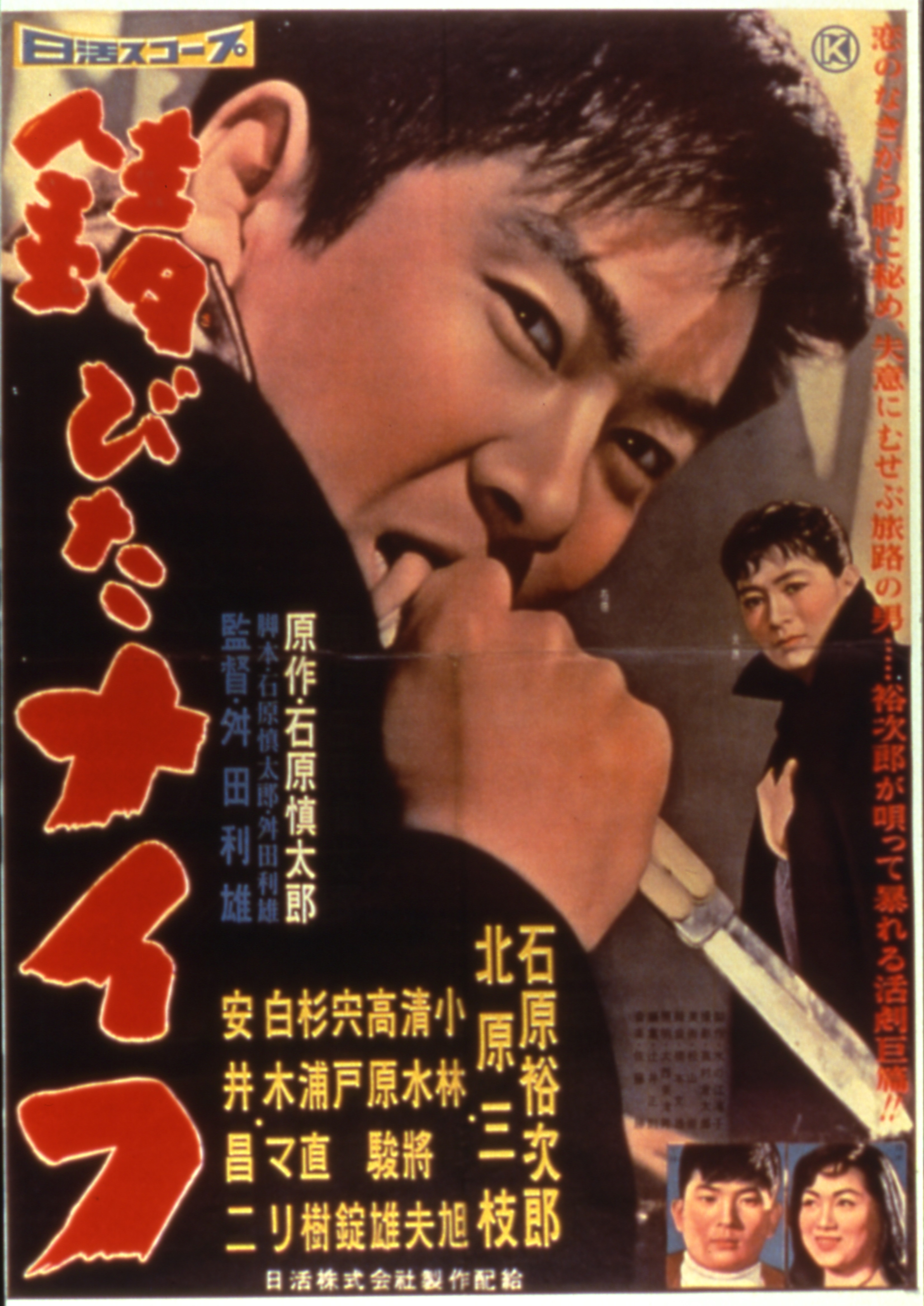
rusty knife posterPost-war Japan was in a precarious place but by the mid-1950s, things were beginning to pick up. Unfortunately, this involved picking up a few bad habits too – namely, crime. The yakuza, as far as the movies went, were largely a pre-war affair – noble gangsters who had inherited the codes of samurai honour and were (nominally) committed to protecting the little guy. The first of many collaborations between up and coming director Toshio Masuda and the poster boy for alienated youth, Yujiro Ishihara, Rusty Knife (錆びたナイフ, Sabita Knife) shows us the other kind of movie mobster – the one that would stick for years to come. These petty thugs have no honour and are symptomatic parasites of Japan’s rapidly recovering economy, subverting the desperation of the immediate post-war era and turning it into a nihilistic struggle for total freedom from both laws and morals.

Public support is, largely, behind this new force of order as seen in the local uproar when top gangster Katsumata (Naoki Sugiura) is arrested in connection with an assault. Things being what they are, Katsumata is soon released to laugh at law enforcement from a safe distance but the past is coming for him. Some years ago Katsumata killed a local councillor, Nishida (Ikunosuke Koizumi), and made it look like suicide but three guys from a local gang saw him do it. He paid them to keep quiet, but now one of them feels like talking and thinks Katsumata might like to pay a little more to reseal the deal.

Chatty Tokyo thug Shima (Jo Shishido) gets pushed off a train for his pains but Katsumata is worried enough about the other two to send his guys out to make some enquires. He’s particularly worried about Tachibana (Yujiro Ishihara) – a “sleeping lion”, Tachibana is a hot head who’s now gone straight after coming out of jail for murdering a guy he thought was a direct cause of his girlfriend’s death. Luckily enough, Tachibana now runs a bar where he employs the other witness, Terada (Akira Kobayashi), to whom he acts as a stern big brother hoping to keep them both on the straight and narrow. Tachibana is unlikely to talk, he wants out of the gangster world for good, but Terada is young and ambitious with a girlfriend to impress. He takes more hush money from Katsumata, not realising what he’s getting himself into, and then lets it go to his head.

Tachibana is the rusty knife of the title. After letting his rage consume him in murdering a petty mobster in revenge for the rape of his girlfriend who later committed suicide, Tachibana has vowed to quell his anger and live a decent, peaceful life. Angry outbursts are, however, never far from the surface and following recent revelations, a rusty knife may find its cutting edge once again.

Keiko (Mie Kitahara), a customer at Tachibana’s bar, is making a documentary about violence in the city which coincidentally turns up a few clues as to Tachibana’s past, not to mention her own. The daughter of the murdered councilman, Nishida, and the niece of another powerful politician, Keiko is a figure of righteousness, charting her own course through the difficult post-war world and attempting to do so with dignity and elegance while refusing to abandon her sense of decency and compassion. Later a real life married couple, Kitahara and Ishihara were a frequent on screen romantic pairing though this time around the connection is more subtle as Keiko begins to sympathise with Tachibana’s plight and commits herself to saving him from destroying himself in becoming consumed by his barely suppressed rage.

Tachibana is indeed raging, though his rage is understandable. As someone later puts it “nothing in this city makes sense”. The systems are corrupt, the wartime generation continue to run the show and run it badly, or at least for their own ends, robbing youth of its rightful place at the forefront of economic recovery. Yet even if Ishihara is a symbol of youthful alienation, his rage is one which must be quelled. Even in this city where nothing makes sense, self control is one’s greatest weapon. If youth is to walk forward into the exciting post-war future, it will have to drop its rusty knives.


Original trailer (English subtitles)

Youth of the Beast (野獣の青春, Seijun Suzuki, 1963)

youth of the beast posterSeijun Suzuki had been directing for seven years and had made almost 20 films by the time he got to 1963’s Youth of the Beast (野獣の青春, Yaju no Seishun). Despite his fairly well established career as a director, Youth of the Beast is often though to be Suzuki’s breakthrough – the first of many films displaying a recognisable style that would continue at least until the end of his days at Nikkatsu when that same style got him fired. Building on the frenetic, cartoonish noir of Detective Bureau 2-3: Go to Hell Bastards!, Suzuki once again casts Jo Shishido in the the lead only this time as an even more ambiguous figure playing double agent to engineer a gang war between two rival hoodlums.

Suzuki opens in black and white as the bodies of a man and a woman are discovered by a small team of policemen. Finding a note from the deceased female which states that she settled on taking her own life because she loved her man and thought death was the only way to keep him, the police assume it’s an ordinary double suicide or perhaps murder/suicide but either way not worthy of much more attention, though discovering a policeman’s warrant card on the nightstand does give them pause for thought.

Meanwhile, across town, cool as ice petty thug Jo Mizuno (Jo Shishido) is making trouble at a hostess bar but when he’s taken to see the boss, it transpires he was really just making an audition. The Nomoto gang take him in, but Mizuno uses his new found gang member status to make another deal with a rival organisation, the Sanko gang, to inform on all the goings on at Nomoto. So, what is Mizuno really up to?

As might be expected, that all goes back to the first scene of crime and some suicides that weren’t really suicides. Mizuno had a connection with the deceased cop, Takeshita (Ichiro Kijima), and feels he owes him something. For that reason he’s poking around in the local gang scene which is, ordinarily, not the sort of world straight laced policeman Takeshita operated in which makes his death next to a supposed office worker also thought to be a high class call girl all the stranger.

Like Detective Bureau 2-3: Go to Hell Bastards!, Youth of the Beast takes place in a thoroughly noirish world as Mizuno sinks ever deeper into the underbelly trying to find out what exactly happened to Takeshita. Also like Detective Bureau 2-3: Go to Hell Bastards!, Youth of the Beast is based on a novel by Haruhiko Oyabu – a pioneer of Japanese hardboiled whose work provided fertile ground for many ‘70s action classics such as The Beast Must Die and Resurrection of the Golden Wolf, but Suzuki’s ideas of noir owe a considerable debt to the gangster movies of the ‘30s rather than the moody crime dramas of twenty years later.

Jo Shishido’s Mizuno is a fairly typical ‘40s conflicted investigator, well aware of his own flaws and those of the world he lives in but determined to find the truth and set things right. The bad guys are a collection of eccentrics who have more in common with tommy gun toting prohibition defiers than real life yakuza and behave like cartoon villains, throwing sticks of dynamite into moving cars and driving off in hilarious laughter. Top guy Nomoto (Akiji Kobayashi) wears nerdy horn-rimmed glasses that make him look like an irritated accountant and carries round a fluffy cat he likes to wipe his knives on while his brother Hideo (Tamio Kawaji), the fixer, is a gay guy with a razor fetish who likes to carve up anyone who says mean stuff about his mum. The Sanko gang, by contrast, operate out of a Nikkatsu cinema with a series of Japanese and American films playing on the large screen behind their office.

The narrative in play may be generic (at least in retrospect) but Suzuki does his best to disrupt it as Mizuno plays the two sides against each other and is often left hiding in corners to see which side he’s going to have to pretend to be on get out of this one alive. Experimenting with colour as well as with form, Suzuki progresses from the madcap world of Detective Bureau 2-3: Go to Hell Bastards! to something weightier but maintains his essentially ironic world view for an absurd journey into the mild gloom of the nicer end of the Tokyo gangland scene.


Original trailer (no subtitles)

https://www.youtube.com/watch?v=RoruaIPA41U

Female Prisoner Scorpion: Beast Stable (女囚さそり けもの部屋, Shunya Ito, 1973)

beast-stableAt the end of Female Prisoner Scorpion: Jailhouse 41, Matsu – the “Scorpion” of the title, had enacted parts of her revenge but lost even more friends and allies along the way. Still filled with an intense rage, she wandered away from her imprisonment towards the dawn and a free, if uncertain, future. It’s here we find her at the beginning of Beast Stable (女囚さそり けもの部屋, Joshu Sasori – Kemono Beya) – a fugitive from justice, but a seemingly calm one. Until, that is, she is cornered.

Beginning in an extremely memorable opening sequence, the film zooms in on Matsu riding a subway train like any other young woman when she gets spotted by a couple of policemen who decide to try and take her in. Whipping out her knife from under her coat, Matsu slashes away but is almost caught when one of the policeman handcuffs her. She reacts to this situation in a typically direct way by simply hacking the policeman’s arm off and running away with it.

Hiding out in a graveyard and gnawing at her macabre bracelet in an attempt to get it off, Matsu strikes up an improbable friendship with prostitute Yuki (Yayoi Watanabe). Yuki is harbouring a dark secret in that she keeps her brain damaged brother locked up in a back room where she is forced to satisfy his sexual urges lest he attack other women.

While working as a seamstress, Matsu becomes more and more involved with the underworld and its collection of pimps and madams, each eager to profit from the weakness and misfortune of others. Eventually, after becoming too much of a problem, Matsu is locked up again – but this time inside the birdcage of a dangerous and eccentric yakuza mama-san, Katsu (Reisen Lee), with the corpse of a less fortunate victim on the other side of the bars. New names are about to appear on Matsu’s ever growing grudge list as the wrongs done to others begin to outweigh the pain of those enacted on herself.

Beast Stable differs from the first two films in the series as it mostly takes place in the “free” world until it reenters the prison environment for the final stretch. Matsu may be out of jail but she’ll never be truly free and her intense inner rage might give her away if it weren’t for her the fact her face is plastered all over the city adorning wanted posters in every conceivable location. With no particular target for her vengeful spirit, Matsu is in survival mode but her growing alliance with Yuki and the cruelty of the underground sex industry quickly awaken her old fire.

This time the big bad is another woman – a cruel madam, willing to protect her investment to the max. When she finds out one of her girls has been hiding a pregnancy, she insists on an abortion even though the baby is six months or so along. Kicking and screaming, the pregnant woman is subjected to a horrific procedure conducted by a drunken doctor which is neatly contrasted with another abortion which is carried out with a much higher level of medical care. Needless to say, Matsu cannot let this one go and makes another of her daring and mysterious escapes to enact her revenge. As she leaves, she’s become a fury of vengeance once again – her face pixelated by the surgery window, shaving her of her identity.

Though more grounded in reality than Jailhouse 41, Beast Stable is still selling the ballad of Matsu as she continues her trajectory into legendary heroine status. Always playing a long game, Matsu has the uncanny ability to escape from any holding pen save the one that burns inside her mind. Having satisfied her personal desire for revenge, Matsu moves on to the cruelties of the wider world and those that bully and misuse already vulnerable people. Her sense of greater responsibility grows as her humanity begins to return through her friendship with Yuki which eventually becomes a deep alliance between two equally trapped women.

At the end of the film we’re told that Matsu served her prison sentence and was released, but no one knows what happened to her after that. Her apotheosis is complete as she becomes the legend – a wandering heroine, meeting out justice in a cruel and indifferent world. Kaji continues to excel in her performance of the near silent Matsu, burning with rage and resentment in every scene. Beast Stable would be Ito’s final contribution to the series and acts as a suitable conclusion to the trilogy as Matsu finally becomes Scorpion in our imaginations and, strangely, our hearts.


Original trailer (English subtitles)

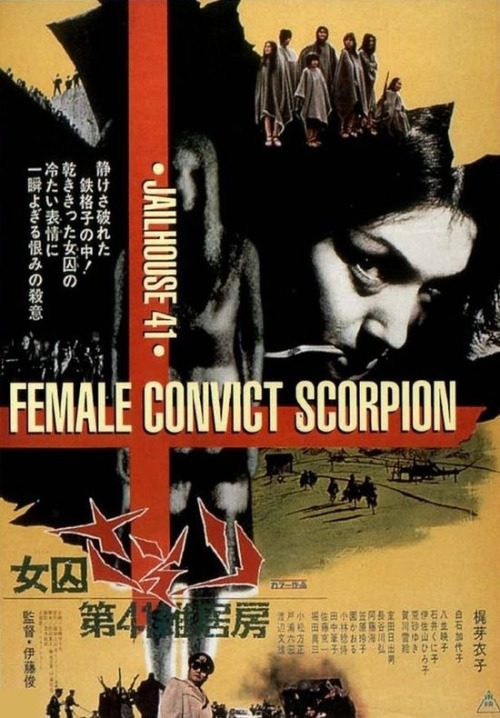
Female Prisoner Scorpion: Jailhouse 41 (女囚さそり第41雑居房, Shunya Ito, 1972)

scorpion-2Female Prisoner Scorpion: Jailhouse 41 (女囚さそり第41雑居房, Joshu Sasori – Dai 41 Zakkyobo) picks up around a year after the end of Female Prisoner #701: Scorpion and finds Matsu (Meiko Kaji) tied up in a dingy prison basement, apparently left bound and in solitary confinement for the entire interval. Once again directed by Shunya Ito, the second instalment in the Female Prisoner Scorpion series is another foray into the women in prison field but Ito resolutely refuses to give in to the exploitative genre norms, overlaying his tale of individualistic rebellion with an arthouse sensibility that has a much wider scope than its ordinary vengeance driven narrative may suggest.
Matsu may have been lying bound and gagged in a dingy underground hole for the best part of a year but today is a special day and sadistic prison warden Goda (Fumio Watanabe) is going to let her out to be shown off in front of a visiting inspector who’s paying a final visit before Goda is promoted to a top job in Tokyo. When Matsu makes a lunge for Goda, the inspector is so afraid that he wets himself, sending the other woman into a frenzy and resulting in a riot. Once again the entirety of the prison is punished, but this time Matsu is singled out for a public punishment gang rape by Goda’s goons. This kind of humiliation is too much for her fellow prisoners who instantly turn on her, but their violence provides an opportunity for escape and before long Matsu is on the run, again.

At the end of the first film, Matsu had accomplished her first round of vengeance – against the man who orchestrated her downfall and the men who secured it, but ultimately she wound up a female prisoner once again. Though Goda may have had her hidden away because of her habitual escapism, Matsu had not given up as we see from her attempts to scrape the floor away with her spoon held tight in her mouth. Barely speaking, Matsu is an unstoppable column of pure rage but an elegant one, supported by her self contained restraint.

Her anger this time is directed towards Goda himself, especially after his despicable organised punishment rape that was designed both to break her own spirit once and for all and also to damage her in the eyes of her fellow inmates who are intended to see her defeated and destroyed. The guards are a stand in for society at large, using sexual dominance and social position to keep their women in line. The visiting prison inspector makes a point of telling Matsu that “they” don’t hate her personally – they’re there for her, to help her “recover” and become a functioning member of society. Which is ironic because Goda does hate her personally as he holds her responsible for the damage to his eye sustained in the previous film. His last act before moving on is one against Mastu – an attempt by the forces of authority to crush her individual rebellion and use their victory as a coercive tool to force others to conform.

In this way, Matsu’s position as a member of a subjugated class is less important than her status as an agitator but these are women who have each suffered at the hands of men. As an extremely theatrical sequence sung in the traditional form informs us, the women who escaped with Matsu committed their crimes out of love or jealousy. Poisoned rivals, dead lovers, even children murdered to get back at their philandering father in some Medea level psychotic rage which ruins the perpetrator even more than the intended victim.

Later while the women are enjoying their brief taste of freedom, one of them is brutally raped and murdered by a troupe of feral men who boast about the wartime atrocities they committed before descending on a lone woman like a pack of rabid dogs. The others take their revenge for their friend, but also for all the women who have met a similar fate inflicted by a male dominated society which sees them as something to be controlled and then made use of, little more that cattle hemmed in and milked until dry.

As in the first film Ito makes use of expressionist techniques and strange angles to give his film a more elevated feeling that might be expected but this time he adds in a surrealist, spiritual dimension as with the old woman who sings the stories of our heroines and then dies only to bury herself in leaves and disappear into the ether, like some forgotten deity of misused women. Likewise, when one of the prisoners is raped and murdered, the men throw her body into a nearby river like an empty beer can but the waterfall behind her suddenly runs with blood as an expression of the violence which pollutes the natural world. A bus suddenly splits in two, separating our subjugated women from the violent men who mentally sentence them, given free reign simply because of their sex. Ironically enough, our last glimpse of of Matsu takes place in the reflection of Goda’s glasses and then in his false eye when she is suddenly rejoined by her compatriots for a triumphant dance of freedom on a city rooftop.

Even stronger than in the original Female Prisoner #701 Scorpion, Jailhouse 41 further advances its ideology of free individuals battling the conformist authority of the state all filtered through the prism of the patriarchy. Matsu’s vengeance is personal, she keeps her distance from the other women who do not seem inclined to band together to oppose the forces which oppress them so much as seek a wary, temporary alliance of necessity, but seeing them all reassembled in spirit at the end brings a larger dimension to Matsu’s victory which now seems much less like solving a practical problem than a deliberate strike at a wall which was solely designed to keep a certain group of people in their place. The jail is broken, all that remains is to choose to escape its restraints.


Original trailer (English subtitles, NSFW/gore)

The Snow Woman (怪談雪女郎, Tokuzo Tanaka, 1968)

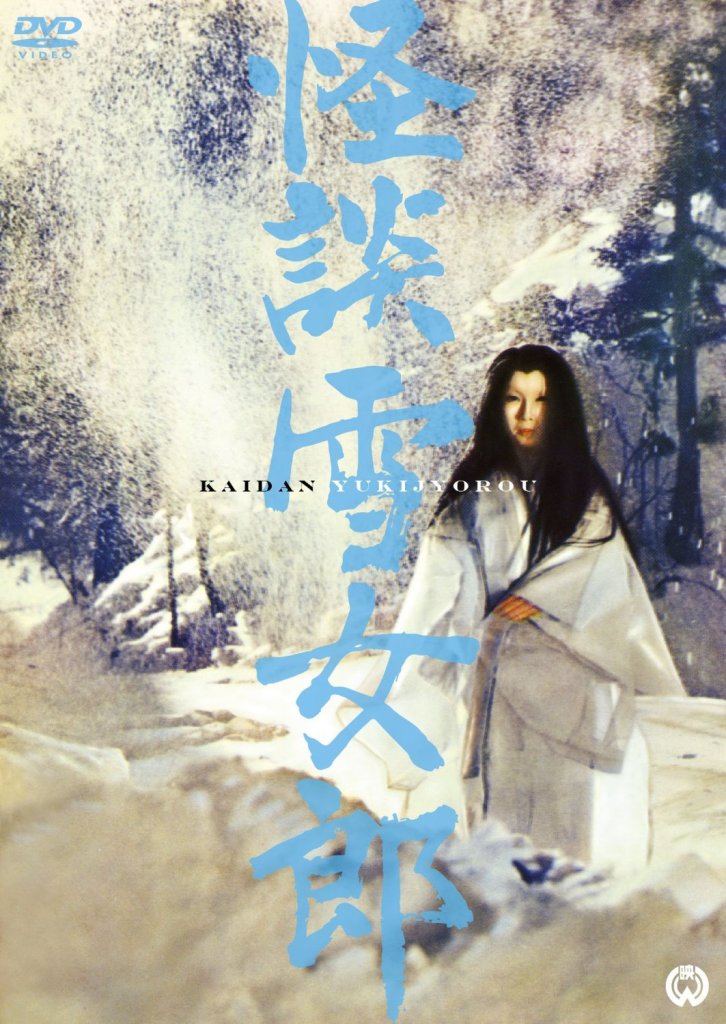
snow womanThe Snow Woman is one of the most popular figures of Japanese folklore. Though the legend begins as a terrifying tale of an evil spirit casting dominion over the snow lands and freezing to death any men she happens to find intruding on her territory, the tale suddenly changes track and far from celebrating human victory over supernatural malevolence, ultimately forces us to reconsider everything we know and see the Snow Woman as the final victim in her own story. Previously brought the screen by Masaki Kobayashi as part of his Kwaidan omnibus movie, Tokuzo Tanaka’s expanded look at the classic tale (怪談雪女郎, Kaidan Yukijoro) is one of extreme beauty contrasting human cruelty with supernatural inevitability and the endless quest for compassion.

As in the original folktale, the film begins with two sculptors venturing into snow filled forests looking for the perfect tree to carve a statue of the Buddhist goddess of mercy, Kanon, for the local temple. Having finally located the longed for tree, the pair spend the night in a cabin only to receive a visit from the Snow Woman herself who freezes the older man but is taken by the younger one’s beauty and spares his life, instructing him never to speak of these events.

Yosaku is taken back to the village followed not long after by the tree trunk. In tribute to his master, the head of the temple asks him to complete the statue himself despite his relative lack of experience. Later, a beautiful yet mysterious woman takes shelter from the intense rain under Yosaku’s roof and is taken in by his adoptive mother and wife of his former master. Eventually, Yosaku and “Yuki” fall in love and marry but the two quickly come to the notice of the higher samurai orders who seem determined to ruin their happy union.

Inspired by Lafcadio Hearn’s version of the story, this retelling adds a layer of social commentary with the constant interference of the higher echelons who exist solely to plague those below them with their petty games of subjugation. We first meet the local bailiff Jito when he rides into town trailing a massive entourage and immediately stars beating some of the local children who were playing with piles of wood. When Yosaku’s adoptive mother pleads with them to stop, he beats her too for having the temerity to speak to a samurai. Unfortunately, he has it in for Yosaku because he has another master sculptor he wants to use for the statue, and now he’s also taken a liking to the beautiful Yuki and will stop at nothing to have his wicked way with her. He is in for quite a nasty shock but even so, the higher orders remain the higher orders and those below them are left with no recourse but simply to follow suit.

The real villain of the film is this enforced class system which allows or even encourages those at its summit to run rampant over those below. The samurai will have their way and the people have nothing to oppose them with save their sense of personal integrity. The Snow Woman then becomes the film’s unlikely heroine. By the time we reach the film’s emotionally devastating finale, Yuki claims that she learned human compassion in her life with Yosaku and their child and ultimately sacrifices her own happiness to preserve that of her husband and son. Yosaku finds himself in competition with the other sculptor who manages to complete a beautiful statue but the temple priest finds it wanting, its expression is soulless and devoid of the sense of compassion he was looking for in the face of a goddess of mercy. Yosaku finds the very look he needs in his wife’s face, exhausted from lending her supernatural strength to save the life of a small child and her husband’s freedom, and in her eyes as she prepares to bid goodbye to him.

The Snow Woman is only obeying her own nature and cannot be blamed for merely being what she is, but the human cruelty and selfishness inherent in the feudal world is a matter of choice. Jito is an evil man, doubtless his world has also made him cruel and selfish but the choice always remains for him not to be – a choice which he is incapable of making. Men like Yosaku toil away endlessly and honestly but their rewards are fragile, personal things rarely recognised by the world at large. Only the Snow Woman, a cold creature, possesses the necessary warmth to breath life into a monument to mercy built solely by a pair of sincere hands.

Tanaka creates a stunning visual world using mostly simple effects and optical trickery to bring the Snow Woman’s icy domain into the ordinary feudal environment. The Snow Woman glides eerily through impressively layered snow scenes, dissolving from one world only to reappear in another. Beautifully filmed and filled with warmth and compassion despite its frozen aesthetic, The Snow Woman is deeply moving plea for empathy in a cruel world which successfully makes a tragic heroine out of its supernatural protagonist.


Original trailer (no subtitles)

https://www.youtube.com/watch?v=sleTyt5PF4Y