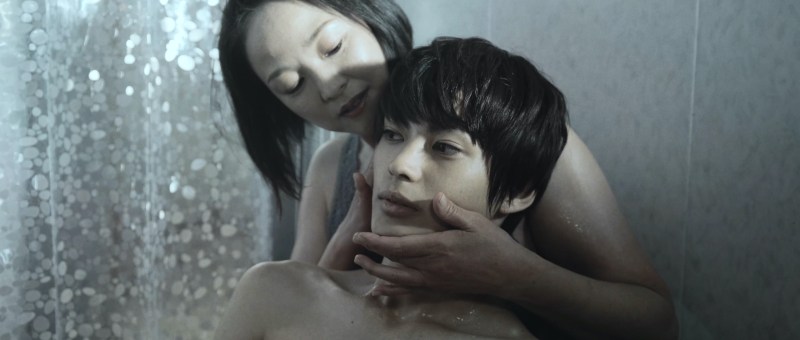

“This society pampers men too much, no matter their age” according to a middle-aged woman searching for her missing son, yet in many ways it’s the primacy of the mother and maternal neglect that drive Mayu Nakamura’s eerie psychological chiller, Intimate Stranger (親密な他人, Shinmitsuna Tanin). Perhaps in some ways, that’s what a mother and a son should become, of course close and loving yet each with their own lives unknown to one another but for Mrs Ishikawa those boundaries have perhaps become corrupt in her overwhelming need to embody the maternal ideal.
Mrs Ishikawa (Asuka Kurosawa) lives alone and is searching for her grown-up son, Shinpei, who went missing a year ago. She has a job in shop selling baby clothes and accessories but is described by other staff members as a bit strange though they continue to invite her to afterwork gatherings knowing she won’t come. One day she gets a call from a young man, Yuji (Fuju Kamio), who says he has information about Shinpei but in reality is part of a gang running “ore ore” scams who are also looking for him because he previously worked with them. Yuji’s purpose in approaching Mrs Ishikawa is to get info out of her, but she’s a little bit ahead of him and manages to plant the seeds of a dark seduction.
Seduced is what Yuji eventually is in a discomforting mix of the erotic and the maternal. Casting shades of Vertigo, Mrs Ishikawa persuades him to move into her apartment, sleep in Shinpei’s room, and wear his clothes keeping him a virtual prisoner while forcing him into the role of her surrogate son. As we later discover, Yuji was a teenage runaway seemingly abandoned by his mother and craves maternal affection but is ashamed of admitting and fearful of accepting it all of which would make him ideal prey for a woman like Mrs Ishikawa who at all rates seems to need a son to feel herself complete.
At the shop where she works, Mrs Ishikawa transgressively sniffs and fondles clothes for newborn infants while at one point driven to distraction by a crying child temporarily separated from its mother to the point that she inappropriately picks it up. She appears to be totally consumed by the maternal image and to that extent or else because of some previous trauma becomes extremely hostile when confronted with her sexuality. Her horror on being picked up by a gigalo when expecting to meet a man with info about Shinpei might be understandable, but the glee on her face after slashing a man with a straight razor when he attempted to attack her is less so while Yuji’s eventual confusion about the nature of their connection highlights the discomforting intersection of the maternal and the erotic.
We have to wonder if Shinpei simply decided to escape the grasp of an overbearing mother who could not bear to accept that her son was now a man, or if Yuji’s suspicions that he may have met a darker fate are more than mere reflections of his own fear of maternal connection. Yet like story of the bluebird of happiness that Shinpei was apparently fond of telling, perhaps each of them for a time found what they needed in the other only to lose it again on identifying the darkness that underlines their relationship.
Listening to a report on the news, Mrs Ishikawa explains that “ore ore” scams only happen in Japan because nowhere else would a parent drop everything and run cash in hand when told a grownup son is in financial trouble which might in a sense be unfair save for the urgency, similar scams circulate via text and messaging apps in many countries. Yet the scam hints at this same level of disconnection, that the often elderly targets cannot tell that it is not their son or grandson’s voice on the phone nor realise that the information they’re being given does not make sense so estranged have families become. The coronavirus pandemic meanwhile only makes the scammers’ job easier given the loneliness of enforced isolation coupled with generalised masking which decreases the level of intimacy on both sides dehumanising the target while allowing the scammer to further conceal their identity.
Mrs Ishikawa is in a sense wearing a permanent mask, consumed by the maternal ideal and unable to conceive of herself as anything outside of a mother. There is something unsettling and vampiric in her need as she at one point sucks blood from her finger and wields her razor with dangerous affection when offering Yuji the closest shave he’ll ever have but also a deep sadness that like the bluebird of happiness that which she most wants is always going to fly away from her one way or another. The uncanniness of the desaturated colour palate adds a further note of dread to the noirish tale of a young man seduced by Oedipal desire and drawn as much towards death as love.
Intimate Stranger screened as part of this year’s New York Asian Film Festival.
Original trailer (no subtitles)
Images: © Siglo/Omphalos Pictures







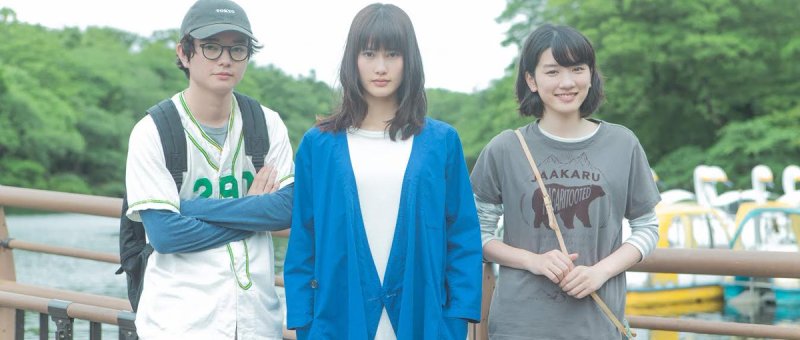
 Parks are a common feature of modern city life – a stretch of green among the grey, but it’s important to remember that there has not always been such beautiful shared space set aside for public use. Natsuki Seta’s light and breezy youth comedy, Parks (PARKS パークス), was commissioned in celebration of the centenary of the Tokyo park where the majority of the action takes place, Inokashira. Mixing early Godardian whimsy with new wave voice over and the kind of innocent adventure not seen since the Kadokawa idol days, Parks is a sometimes melancholy, wistful tribute to a place where chance meetings can define lifetimes as well as to brief yet memorable summers spent with gone but not forgotten friends doing something which seems important but which in retrospect may be trivial.
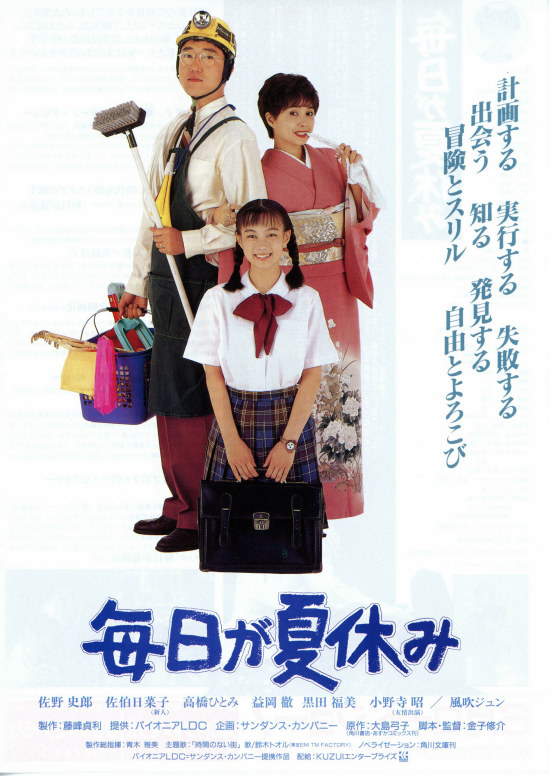 Summer Holiday Everyday – It’s certainly an upbeat way to describe unemployment but then everything is improbably upbeat and cheerful in the always sunny world of Shusuke Kaneko’s adaptation of Yumiko Oshima’s shoujo manga. Published in the mid-bubble era of 1988, Oshima’s world is one in which anything is possible but by the time of the live action movie release in 1994 perhaps this was not so much the case. Nevertheless, Kaneko’s film retains the happy-go-lucky tone and offers note of celebration for the unconventional as a path to success and individual happiness.
