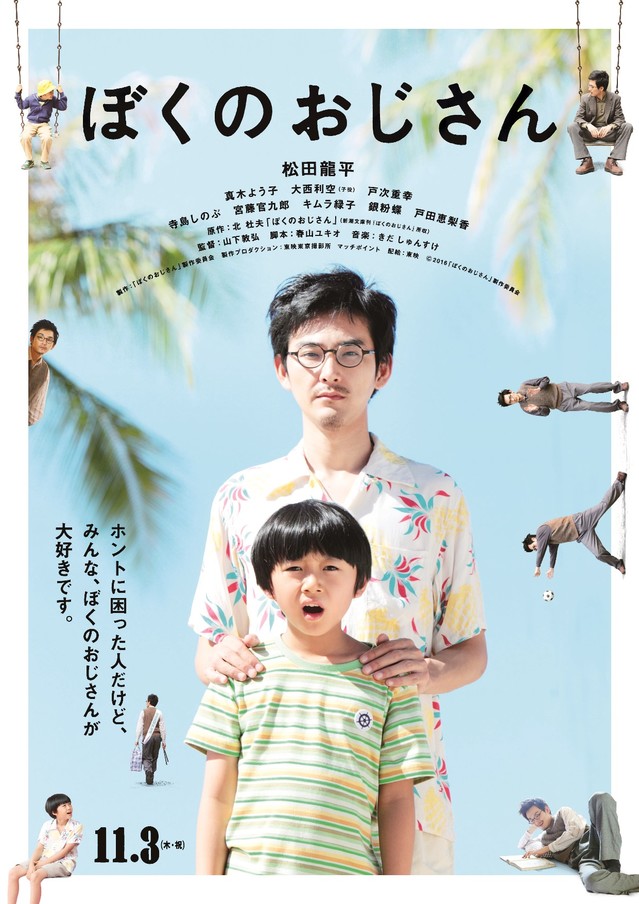
 Crazy uncles – the gift that keeps on giving. Following the darker edged Over the Fence as the second of two films released in 2016, Nobuhiro Yamashita’s My Uncle (ぼくのおじさん, Boku no Ojisan) pushes his subtle humour in a much more overt direction with a comic tale of a self obsessed (not quite) professor as seen seen through the eyes of his exasperated nephew. “Travels with my uncle” of a kind, Yamashita’s latest is a pleasantly old fashioned comedy spiced with oddly poignant moments as a wiser than his years nephew attempts to help his continually befuddled uncle navigate the difficulties of unexpected romance.
Yukio (Riku Ohnishi) has been given one of the most dreaded homework assignments ever – he’s supposed to write an essay about an “interesting” family member. This is a problem because Yukio thinks his family is very boring – dad is a civil servant, mum is a housewife, and his little sister is very frank but fails to generate sufficient interest for a whole essay. At this point, Yukio’s eccentric Uncle (Ryuhei Matsuda) enters the scene to enquire if the next edition of a children’s manga magazine has been released yet. Yukio says it has but he doesn’t buy it anymore because he’s grown out of it. Uncle hasn’t and wants him to buy one as soon as possible, convincing Yukio to pay 30% of the sticker price in the process. Annoyed, Yukio starts chronicling his Uncle’s strange adventures in school essay which proves a hit with his teacher (Erika Toda) who has accidentally become Uncle’s biggest fan.
Uncle lives with the family because he’s “a philosopher” which involves a lot of rejecting capitalist ideals and lying on his futon “thinking” or reading manga to give his brain a rest. Though Uncle’s brother and the father of the family (Kankuro Kudo) is content not to rock the boat, his wife (Shinobu Terajima) is often fed up with Uncle’s behaviour and is trying to set him up with proposals for an arranged marriage to get rid of him. Uncle is having none of it but is instantly smitten after being introduced to Japanese-Hawaiian photographer Eri (Yoko Maki). Eventually chasing her all the way to Hawaii with Yukio in tow, Uncle tries his luck with romance but only seems to get himself mixed up in even more unpredictable mischief.
There’s something so pleasantly innocent about My Uncle with its almost nostalgic tone and embrace of the surreality of everyday life. As seen through the eyes of Yukio, Uncle is not an entirely sympathetic figure at the beginning of the film. A part-time professor, Uncle talks big but spends his life rooting through ashtrays looking for smokable cigarette butts and collecting coupons to use for cheap dinners. Attempts to entertain the children backfire when he gifts them a very realistic plastic toy of a giant millipede though he does sometimes take Yukio out on “thinking expeditions” – usually on weekends and holidays to not be in the house to be shouted at by Yukio’s parents who are rapidly loosing patience with Uncle’s inability to progress in life.
If this were a series (and one could only hope) you could easily call the first instalment “Uncle Falls in Love” as Uncle finds himself finally thinking about settling down with the beautiful and outgoing Eri. Eri does seem to be among the few people who finds Uncle’s unusual qualities charming though he might need to rethink his plan of action if he’s finally to win her heart. Unfortunately, Eri is about to move back to Hawaii but invites Yukio and Uncle to visit. Uncle is desperate to go but as he can’t even afford to buy cigarettes, international travel is out. Undeterred, Uncle comes up with a number of labour intensive schemes to get there rather than actually working for the money but eventually makes it with Yukio’s help. There is, however, a rival on hand in Eri’s former boyfriend Shinsuke (Shigeyuki Totsugi) who is equally determined to win her back.
Life with Uncle may be one of constant exasperation but as Eri points out it’s never boring. Whether he’s getting himself arrested for accidentally buying weed or making up wild stories about himself in a misguided attempt to impress people, Uncle lives on a different plane of existence. Yukio reflects on all of this with a world weariness worthy of a 70 year old man but eventually comes to a kind of grudging affection for his silly old Uncle who is quite clearly setting himself up for a fall even if he has his heart in the right place. Yamashita mixes in poignant moments such as a reflective look over Pearl Harbour which gives rise to a discussion of life as a Hawaiian citizen of Japanese descent during the war, but broadly the tone is a bright one of zany humour and ironic one liners. Hilariously funny in a gentle, old fashioned way, My Uncle is Yamashita in full on comedy mode but all the better for it even as he leaves us desperate to find out what other strange adventures befall Uncle in the continuing saga of his existence.
My Uncle was screened as part of the Udine Far East Film Festival 2017.
Original trailer (no subtitles)


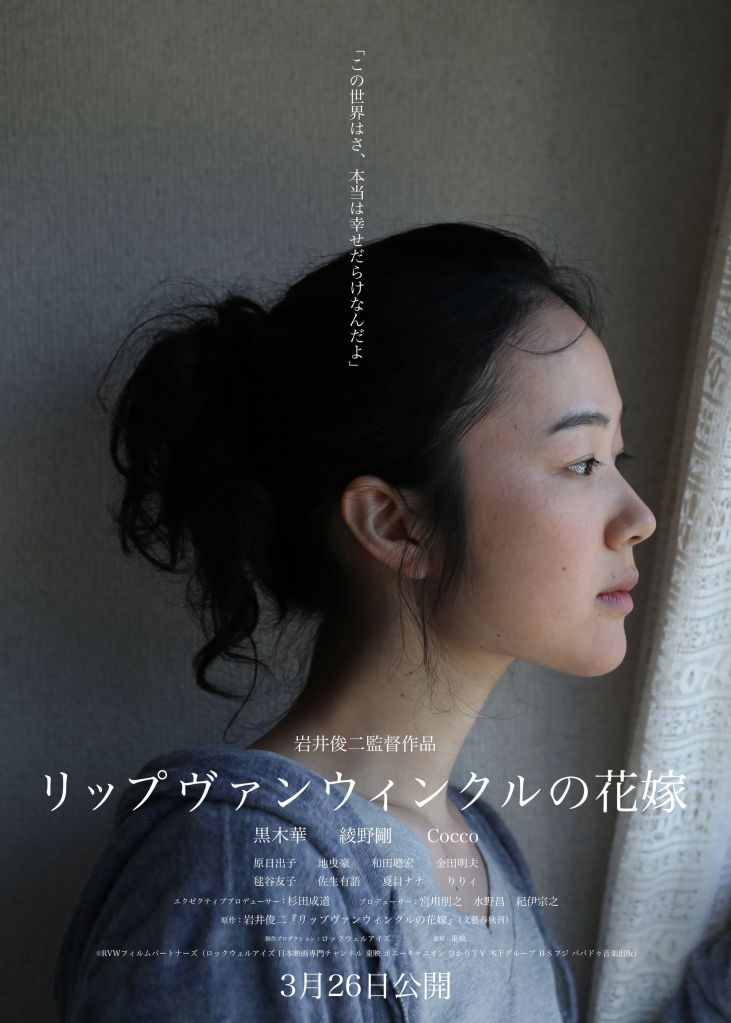 “Being naked in front of people is embarrassing” says the drunken mother of a recently deceased major character in a bizarre yet pivotal scene towards the end of Shunji Iwai’s aptly titled A Bride for Rip Van Winkle (リップヴァンウィンクルの花嫁, Rip Van Winkle no Hanayome) in which the director himself wakes up from an extended cinematic slumber to discover that much is changed. This sequence, in a sense, makes plain one of the film’s essential themes – truth, and the appearance of truth, as mediated by human connection. The film’s timid heroine, Nanami (Haru Kuroki), bares all of herself online, recording each ugly thought and despairing notion before an audience of anonymous strangers, yet can barely look even those she knows well in the eye. Though Namami’s fear and insecurity are painfully obvious to all, not least to herself, she’s not alone in her fear of emotional nakedness as she discovers throughout her strange odyssey in which nothing is quite as it seems.
 At the end of
 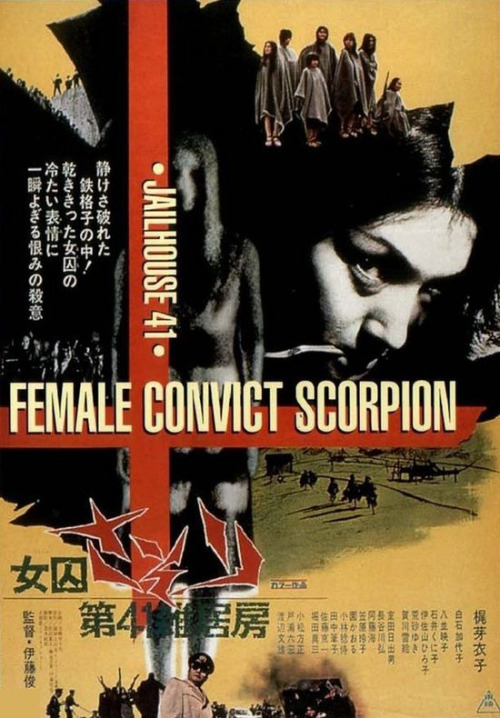 Female Prisoner Scorpion: Jailhouse 41 (女囚さそり第41雑居房, Joshu Sasori – Dai 41 Zakkyobo) picks up around a year after the end of
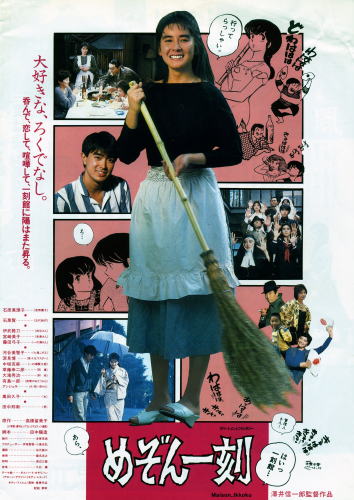 If you’ve always fancied a stay at that inn the
  The Girl Who Leapt Through Time is a perennial favourite in its native Japan. Yasutaka Tsutsui’s original novel was first published back in 1967 giving rise to a host of multimedia incarnations right up to the present day with Mamoru Hosoda’s 2006 animated film of the same name which is actually a kind of sequel to Tsutsui’s story. Arguably among the best known, or at least the best loved to a generation of fans, is Hausu director Nobuhiko Obayashi’s 1983 movie The Little Girl Who Conquered Time (時をかける少女, Toki wo Kakeru Shoujo) which is, once again, a Kadokawa teen idol flick complete with a music video end credits sequence.
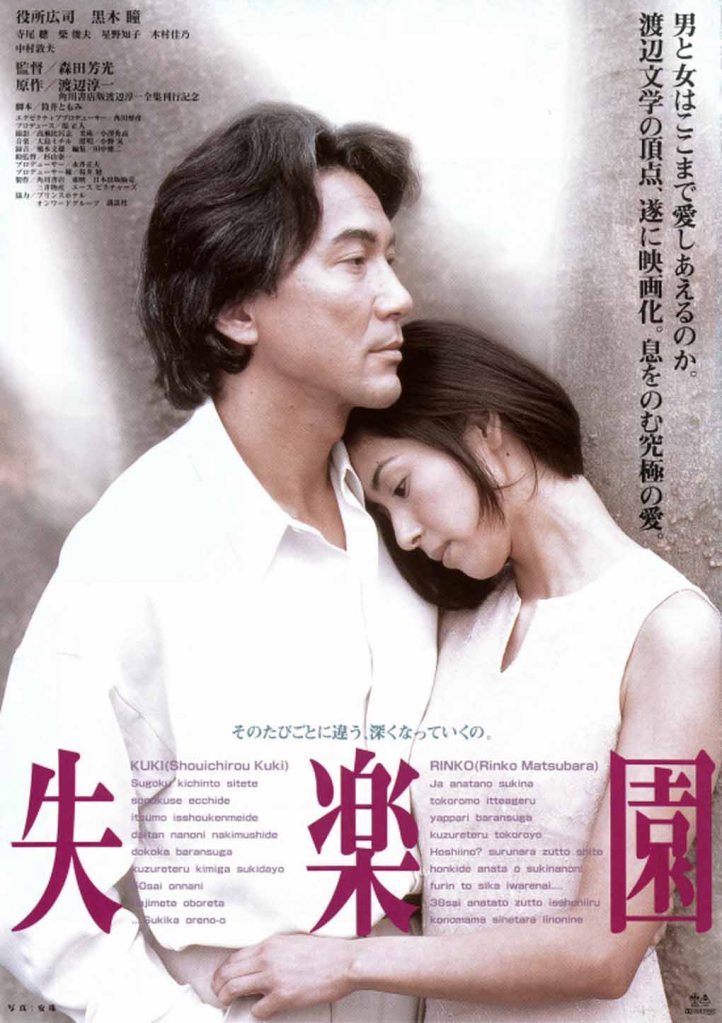 Yoshitmitsu Morita tackled many different genres during his extremely varied career taking in everything from absurd social satire to teen idol vehicles and high art films. 1997’s Lost Paradise (失楽園, Shitsurakuen) again finds him in the art house realm as he prepares a tastefully erotic exploration of middle aged amour fou. Based on the bestselling novel by Junichi Watanabe, Lost Paradise also became a breakout box office hit as audiences were drawn by the tragic tale of doomed late love frustrated by societal expectations.
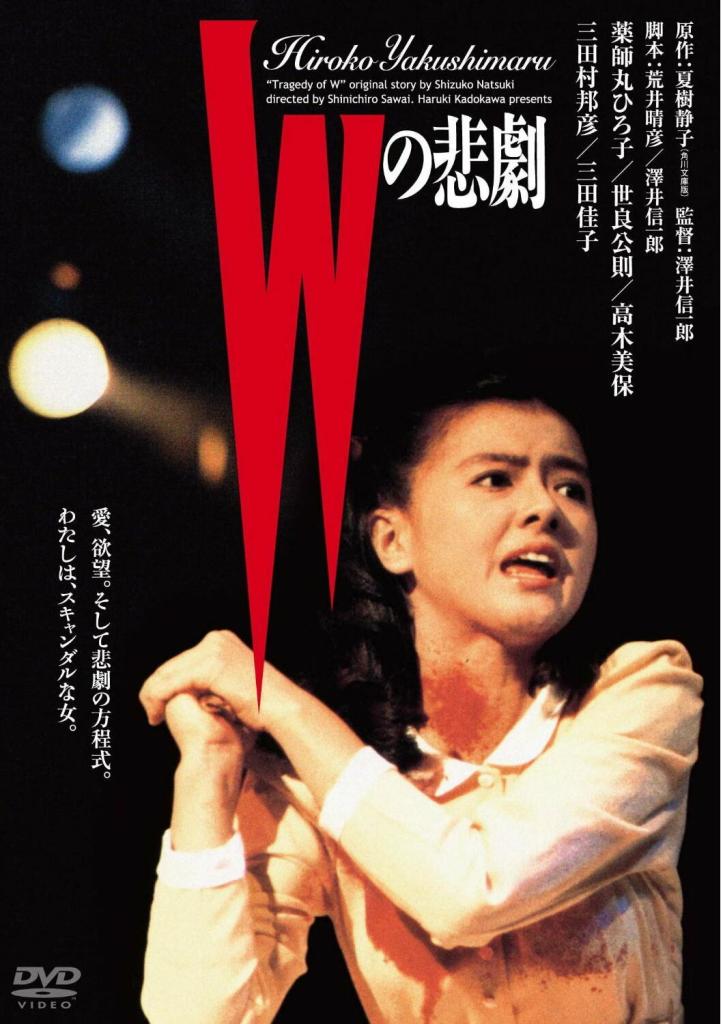 Hiroko Yakushimaru was one of the biggest idols of the 1980s. After starring in Shinji Somai’s
