Female Ninja Magic (くノ一忍法, Sadao Nakajima, 1964)

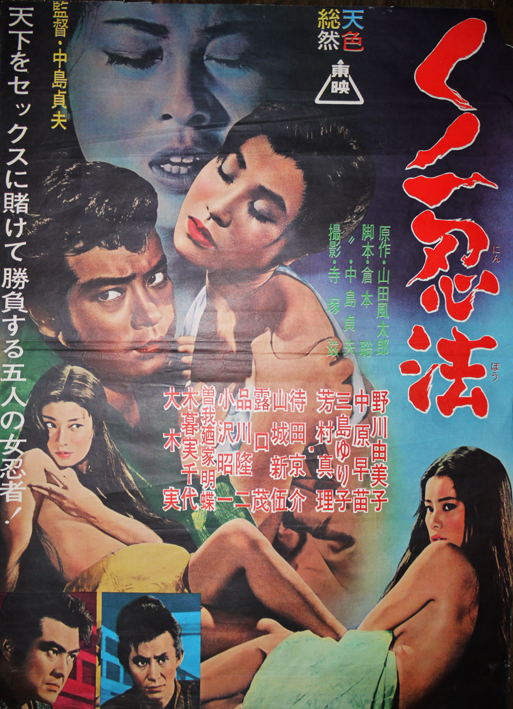
female ninja magic posterSadao Nakajima, a veteran director and respected film scholar, is most often associated with his gritty gangster epics but he made his debut with a noticeably theatrical fantasy tale of female ninjas and their idiosyncratic witchcraft. Adapted from a novel by Futaro Yamada, Female Ninja Magic (くノ一忍法, Kunoichi Ninpo) is an atypically romantic take on the ninja genre, infused with ironic humour and making the most of its embedded eroticism as a collection of wronged women attempt to change the course of history and mostly pay with their lives.

The night before the fall of Osaka castle in 1615, Sanada Yukimura (Eizo Kitamura) comes up with a cunning plan to ensure the survival of the Toyotomi clan. Following the death of Hideyoshi, his son Hideyori had inherited the title but he was sickly and had no children of his own. His wife, Princess Sen (Yumiko Nogawa), was not able to bear an heir and so Sanada has hit on an idea. He wants to send five women of Iga to Hideyori’s bed chamber in the hope that one of them will become pregnant and ensure the survival of the Toyotomi line. Princess Sen is very much in on the plan and hopes to raise the child herself. However, she is by birth a member of the Tokugawa which is where she is eventually sent following fall of Osaka. Refusing to return to her birth clan, Sen rejects her father and insists on remaining true to the memory of her (now departed) husband and his unborn child. Tokugawa Ieyasu (Meicho Soganoya), however, has learned of the Toyotomi heir and is determined to see it killed…

Nakajima opens in grand fashion with a ghostly sequence in which Sanada outlines his plan. The ninjas sit silently before magically fading from the frame and being replaced by Sasuke, Sanada’s messenger. Soon enough, both Sanada and Sasuke are cut down by a rogue assassin but rather than going straight to heaven they decide to hang around and see how well the plan works out, becoming our narrators of sorts, hovering around in the background and occasionally offering the odd ironic comment from beyond the frame.

The ghostly effects don’t stop with the two undead commentators but comprise a key part of Nakajima’s deliberately theatrical aesthetic. Like many ninja films, Female Ninja Magic is filmed almost entirely on studio sets but never pretends otherwise. Its world is unrealistic and deliberately over the top, filled with with visual motifs both from traditional Japanese and classical European art. The female ninjas dance, topless, beckoning and seducing but they do it against a stark black background moving firmly into the film’s magical space in which all things are possible.

Meanwhile, Tokugawa Ieyasu has sent five male ninjas to take care of our five female witches, making use of their own, devious, ninja magic to combat that of our heroines. The first nefarious male ninja technique involves the murder and identity theft of a trusted maid, while another tries a similar trick by “projecting” himself into the consciousness of a handmaiden he has figured out is pregnant by listening for additional heartbeats, and convincing her to commit harakiri. His villainy is eventually turned back on him as the female ninjas make use of the most important of their spells – the “Changing Rooms” technique which effectively shifts the foetus from one womb to another.

Deliciously named – Rainbow Monsoon, Dancing Snow, Robe of Wings etc, the spells run from the sublime to the ridiculous with the self explanatory Eternal Gas which sends noxious purple smoke billowing from under the skirts of an elegant princess. Each has its own erotic component, even if it doesn’t necessitate a shift into the film’s elegantly designed dreamscape, but by and large the female ninja fight with supernatural rather than earthly powers. Facing such extreme threat, the women form a tight group of mutual support in order to ensure the survival of the child which Princess Sen will raise but not birth. Though her quest originated as a fierce declaration of her loyalty to the Toyotomi, she later recants on her tribal zealotry. Shocked by her father’s cruelty and sick of a persistent suitor, she admits that she has come to loathe the world of men and prefers to think of the baby as belonging to her band of women alone. Nevertheless, male violence eventually saves her as her aggressor, ironically enough, is moved by her devotion to the new life in her arms – he is “defeated by her strength as a woman”, and turns on his own kind. Female Ninja Magic eventually achieves the revenge it sought, allowing a princess to survive in triumph while the male order quakes in its boots.
The Blood of Wolves (孤狼の血, Kazuya Shiraishi, 2018)

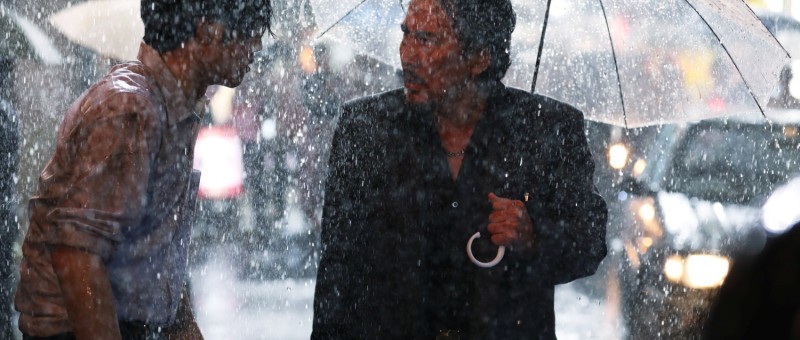
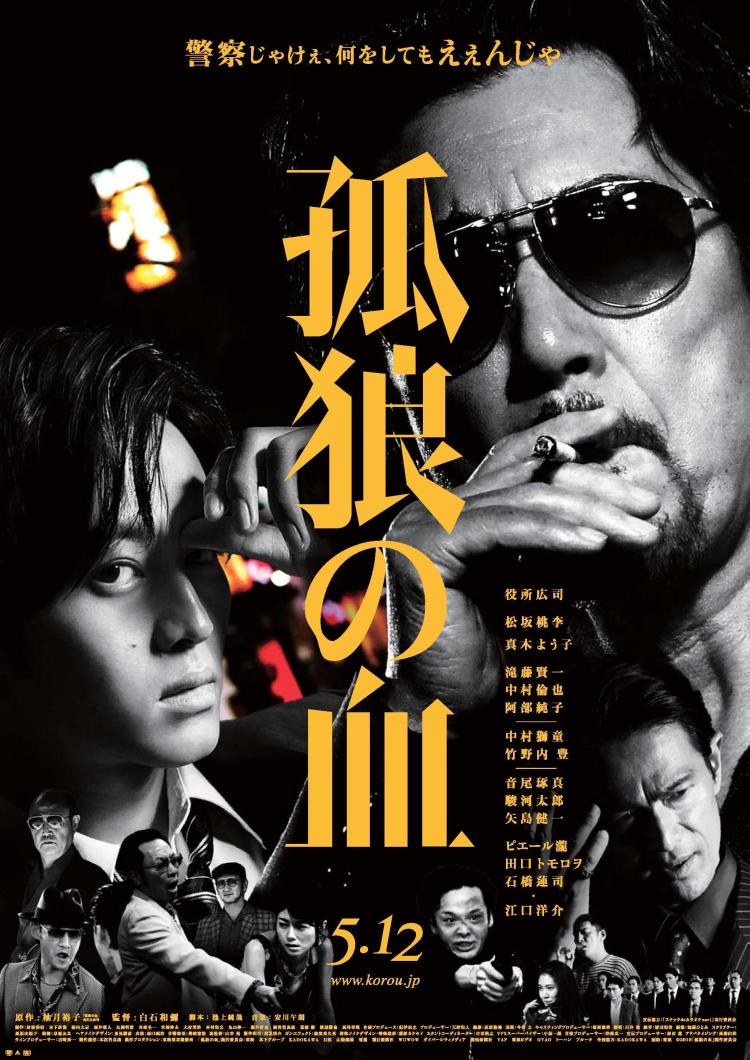
korou_honpos_0220_fin.aiJapanese cinema, like American cinema, is one of the few in which the hero cop is a recognisable trope. Though they may be bumbling, inefficient, obsessed with bureaucracy, or perhaps just lazy, police in Japanese cinema are rarely corrupt or actively engaged in criminality. Even within the realms of the “jitsuroku” gangster movie, the police maintain a fringe presence, permitting the existence of the underground crime world in order to contain it. “Jitsuroku” is, in a fashion, where we find ourselves with Kazuya Shiraishi’s throwback underworld police story, The Blood of Wolves (孤狼の血, Koro no Chi). Set in 1988, the end of the Showa Era which had seen the rebirth of post-war Japan and the ascendency of yakuza thuggery, The Blood of Wolves is based on a novel by Yuko Yuzuki rather than a “true account” of life on the frontlines of gangsterdom, but otherwise draws inspiration from the Battles Without Honour series in updating the story of nihilistic yakuza violence to the bubble era.

In 1988, a young accountant “goes missing” sending his sister to ask the police for help in locating him. The case gets passed to sleazy detective Ogami (Koji Yakusho) and his new rookie partner, Hioka (Tori Matsuzaka). Ogami leers disturbingly at the dame who just walked into his office before dismissing the newbie and extracting a sexual favour from the distressed relative of the missing man. Unfortunately, the accountant turns up dead and the bank he worked for turns out to be a yakuza front caught up in a burgeoning gang war between the Odani with whom Ogami has long standing connections and the gang from the next town over who are looking to increase their territory.

Ogami, a chain smoking, hard drinking, womanising detective of the old school, has one foot in the yakuza world and the other on the side of law enforcement. Hioka, a recent graduate from the local but also elite Hiroshima University (something of a rarity in his current occupation), is not quite sure what to make of his new boss and his decidedly “unorthodox” methods, becoming increasingly concerned about the way the police force operates in a town defined by organised crime. Deciding that Ogami has gone too far, he eventually makes the decision to go to IA with a list of complaints but there’s still so much he doesn’t know about Hiroshima and it is possible he may have picked the wrong side.

What he discovers is that the police force is so intrinsically rotten as to have become little more than a yakuza gang itself, only one with the legal right to carry guns and a more impressive uniform. Ogami, for all his faults, apparently has his heart in the right place. His “friendships” with gangsters are more means to an end than they are spiritual corruption, gaining leverage that will help him keep a lid on gang war – after all, no one wants a return to the turbulent days of the 1970s when the streets ran red with the blood of unlucky foot soldiers and that of the civilians who got in their way. Meanwhile Hioka, starting out as the straight-laced rookie, is himself “corrupted” by the corruption he uncovers, developing a complex mix of disgust and admiration for Ogami’s practiced methods of manipulation which, apparently, place public safety above all else.

Ogami, as he tells the conflicted Hioka, knows he walks a tightrope every day, neatly straddling the line between cop and yakuza, and the only way to stay alive is to keep on walking knowing one slip may lead to his doom. He may say cops can do whatever they like in pursuit of “justice” (and he does), but Ogami has his lines that cannot be crossed, unlike others in his organisation who care only for themselves and have long since given up any pretence of working for the public good.

Shiraishi channels classic Fukasaku from the noticeably retro Toei logo at the film’s opening to the voice over narration, garish red on screen text, and frequent use of freeze frames familiar from the Battles Without Honour series and associated “jitsuroku” gangster fare that followed in its wake. Moving the action up to 1988, the gangster world is once again in flux as it tries to corporatise itself to get in on the profits of bubble era prosperity which largely has no need for the thuggish gangster antics of the chaotic post-war years in which the yakuza could paint itself as a defender of the poor and oppressed no matter how ridiculous it might have been in reality. Ogami is a dying breed, a relic of the Showa era meeting its natural end, but perhaps you need to be a wolf to catch a wolf and guardian spirits can come in unexpected forms.


Screened at the 20th Udine Far East Film Festival.

Original trailer (English subtitles)

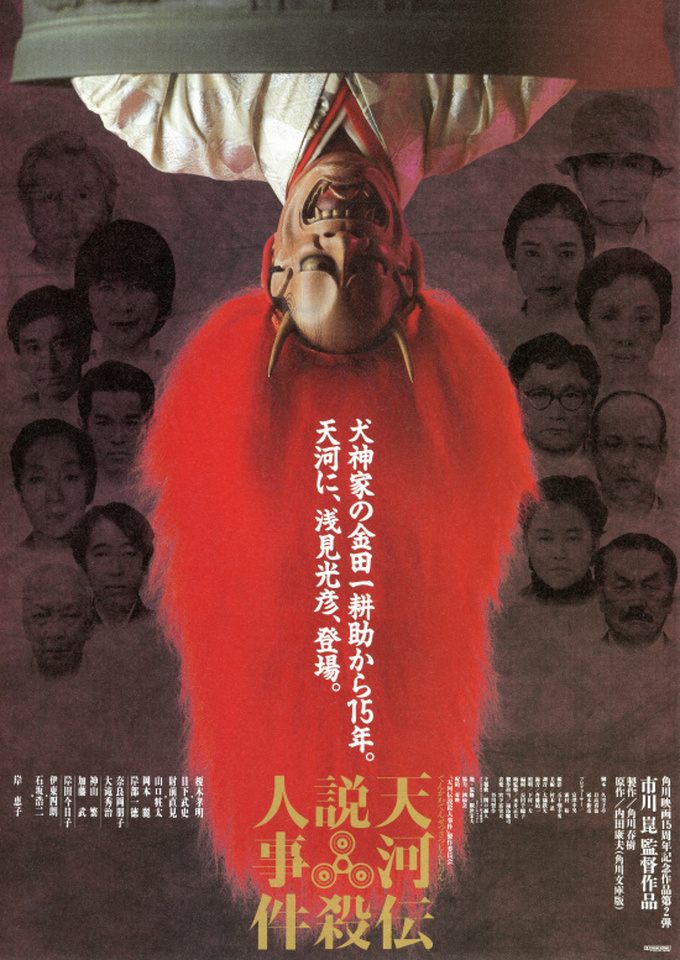
Noh Mask Murders (天河伝説殺人事件, Kon Ichikawa, 1991)

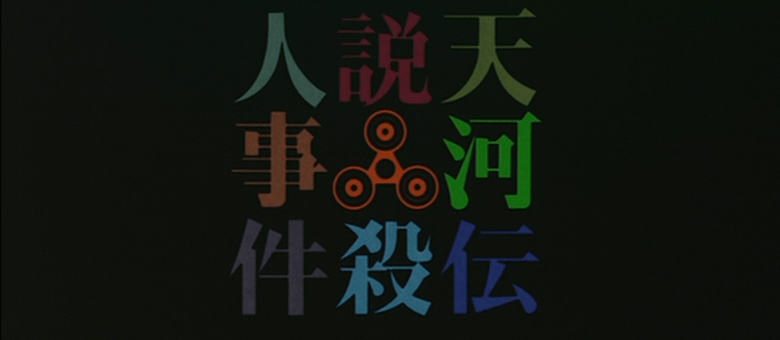
noh mask murders posterFor one reason or another, Japanese mystery novels have yet to achieve the impact recently afforded to their Scandinavian brethren. Japan does however have a long and distinguished history of detective fiction and a number of distinctive, eccentric sleuths echoing the European classics. Mitsuhiko Asami is just one among many of Japan’s not quite normal investigators, and though Noh Mask Murders (天河伝説殺人事件, Tenkawa Densetsu Satsujin Jiken) is technically the 23rd in the Asami series, Kon Ichikawa’s adaptation sets itself up as the very first Asami case file and as something close to an origin story.

Ichikawa, though he may be best remembered for his ‘60s arthouse masterpieces, was able to go on filmmaking where others perhaps were not precisely because of his forays into the populist with a series of mystery thrillers including several featuring top Japanese detective Kindaichi (who receives brief name check in Noh Mask Murders). Published by Kadokawa, Noh Mask Murders is produced by Haruki Kadokawa towards the end of his populist heyday and features many of the hallmarks of a “Kadokawa” film but Ichikawa also takes the opportunity for a little formal experimentation to supplement what is perhaps a weaker locked room mystery.

Asami (Takaaki Enoki) begins with a voice over as four plot strands occur at the same temporal moment at different spaces across the city. In Shinjuku, a salaryman drops dead on the street, while a young couple enjoy a secret tryst in a secluded forest, a troupe of actors rehearse a noh play, and Asami himself is arrested by an officious policeman who notices him walking around with a dead bird in his hand and accuses him of poaching. As he will later prove, all of these moments are connected either by fate or coincidence but setting in motion a series of events which will eventually claim a few more lives before its sorry conclusion.

To begin with Asami, he is a slightly strange and ethereal man from an elite background who has been content to drift aimlessly through life to the consternation of his conservative family which includes a police chief brother. He harbours no particular desire to become a detective and is originally irritated by a family friend’s attempts to foist a job on him but gives in when he learns he will have the opportunity to visit Tenkawa which is where, he’s been told, the mysterious woman who helped him out with the policeman in the opening sequence keeps an inn. Hoping to learn more about her, he agrees to write a book about the history of Noh and then becomes embroiled in a second murder which links back to the Mizugami Noh Family which is currently facing a succession crisis as the grandfather finds himself torn over choosing his heir – he wants to choose his granddaughter Hidemi (Naomi Zaizen) who is the better performer but the troupe has never had a female leader and there are other reasons which push him towards picking his grandson, Kazutaka (Shota Yamaguchi).

As with almost all Japanese mysteries, the solution depends on a secret and the possibilities of blackmail and/or potential scandal. The mechanics of murders themselves (save perhaps the first one) are not particularly difficult to figure out and the identity of the killer almost certainly obvious to those who count themselves mystery fans though there are a few red herrings thrown in including a very “obvious” suspect presented early on who turns out to be entirely incidental.

Ichikawa attempts to reinforce the everything is connected moral of the story through an innovative and deliberately disorientating cross cutting technique which begins in the prologue as Ichikawa allows the conversations between the grandchildren to bleed into those of Asami and his friend as if they were in direct dialogue with each other. He foregrounds a sad story of persistent female subjugation and undue reliance on superstition and tradition which is indirectly to blame for the events which come to pass. Everyone regrets the past, and after a little murder begins to see things more clearly in acknowledging the wickedness of their own actions as well as their own sense of guilt and complicity. Noh is, apparently, like a marriage, a matter of mutual responsibility, fostering understanding between people and so, apparently is murder, and one way or another Asami seems to have found his calling.


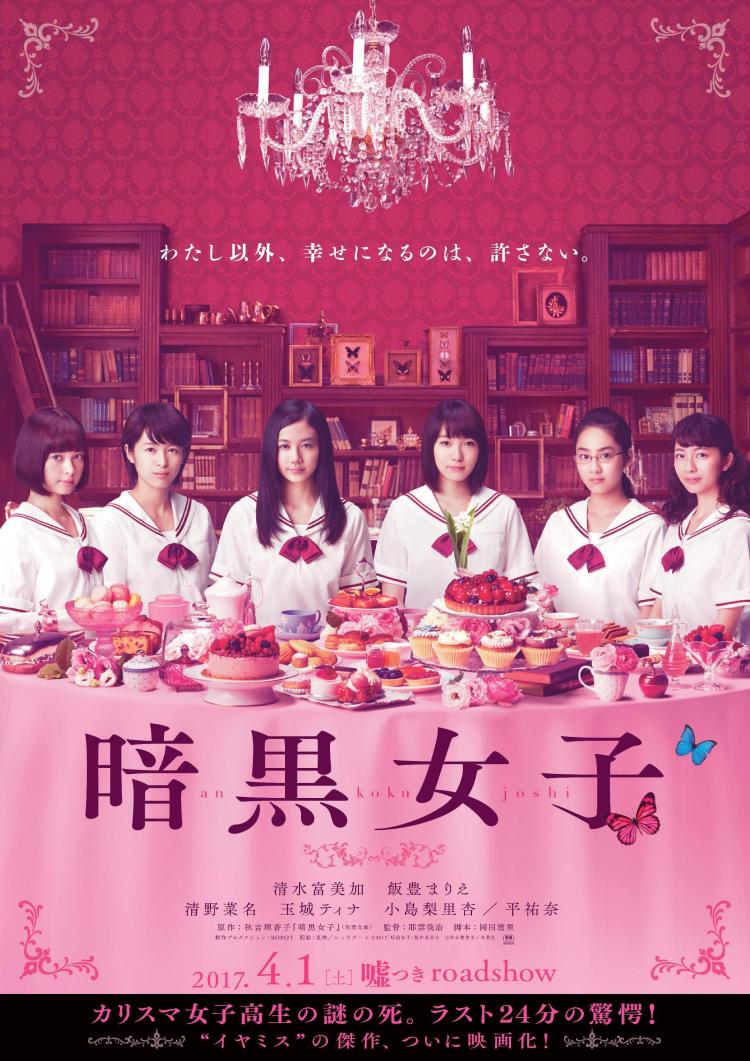
The Dark Maidens (暗黒女子, Saiji Yakumo, 2017)

dark maidens posterThe world of teenage girls is often arcane and impenetrable to those outside of its extremely exclusive bubble, but The Dark Maidens (暗黒女子, Ankoku Joshi), Saiji Yakumo’s adaptation of the Rikako Akiyoshi novel, takes duplicity to new heights. When the school darling dies by falling (oh so beautifully) off a roof, speculation is rife and a rumour quickly spreads through the otherwise repressive educational environment that her very best friends are somehow to blame. Each implicates the others in turn, indulging their petty grudges and jealousies seemingly falling over themselves to express their closeness to the departed “sun”, but all is not quite as it seems and these collective acts of fantasy perhaps expose a little more than they were first intended to.

Itsumi Shiraishi (Marie Iitoyo) is dead. The daughter of the chairman at the elite all girls Catholic high school, Virgin Mary Academy, Itsumi was loved by all as the radiant sun whose innate goodness was the very embodiment of the school’s Christian aims. Immediately before the school holidays, the literature club – the most prestigious and exclusive of school associations of which Itsumi had been founder and president, are to meet one last time presided over by Itsumi’s best friend Sayuri (Fumika Shimizu). The girls will each read a story they have written “inspired” by Itsumi’s death, each of which attempts to tell her story from their perspective but ultimately paints themselves in a favourable light whilst casting doubt on the others. 

The sole clue to the mystery is the lily of the valley Itsumi clutched to her breast, Snow White-like, as she lay pale and wan amid the flowers, elegantly arranged as always despite an apparently violent death. Quickly the girls run through a series of possible motives each with a degree of internal consistency but veering off in their own particular directions. Three of the girls awkwardly hint at their (unrequited?) love for their dead friend, insisting on a kind of ownership of her memory and of their rightful place at her side while the fourth descends into a xenophobic horror story casting the half-Bulgarian girl as a “vampire” come to suck the life out of the previously warm and vivacious Itsumi.

Yakumo delights in sending up the ever present girls school trope of repressed lesbianism and passionate friendships, but it remains true enough that the love card was apparently not one which Itsumi was afraid to play. The stories are all, in part at least, fabrications intended to cover up the various skeletons each of the girls has in their closets, but what they reveal is the series of manipulative machinations which underpins this seemingly sweet and elegant collection of conservative young ladies indulging a love for literature and the Christian virtues. Affairs, blackmail, inappropriate sexual relationships, forced abortions (at a Catholic school!), arson, all of these precede the presumed murder of Itsumi in a vast web of deception and illicit activity.

Teenage girls are often desperate to fit in, to be accepted by the “elite”, at the best of times but especially in an environment as otherwise repressive and exacting as an all girls Catholic high school. Adolescence is a time for trying on different personalities, but there can be something inherently plastic about the identity of a high school girl wanting in to the popular club. Hiding their true feelings, their fears and jealousies, the girls play the parts of they’ve been assigned – supporting cast in the tragic history of Itsumi, a girl betrayed who remained beautiful even in death. Then again, there might be some push back from those growing to resent their peripheral status and beginning to wonder if the spotlight was not theirs for the taking all along. A sun, however, will always need its lesser stars to demonstrate how much brighter it can shine.

Adapted from the novel by Rikako Akiyoshi, The Dark Maidens is a perfect mix of European drawing room mystery and gothic melodrama. Yakumo ups the camp fantastically with the girls sitting round a mysterious pot of stew in a room lit only by candlelight while a storm rages outside and each revelation is accompanied by crashing thunder and flashes of light. The setting is oppressive and sinister, but the only horror in the room is entirely human as each of these young women eagerly submits themselves to someone else’s control in fear of being, in some way, exposed, while those who seek to play the lead have to stoop to underhanded methods just to make “friends” who are really just minions rather than true believers. A sad and sorry state of affairs – who knew teenage cliques could be so, well, dark?


Screened as part of the Japan Foundation Touring Film Programme 2018.

Screening again:

  • Brewery Arts Centre – 16 February 2018
  • Macrobert Arts Centre – 19 February 2018
  • Showroom Cinema – 1 March 2018

Original trailer (English subtitles)

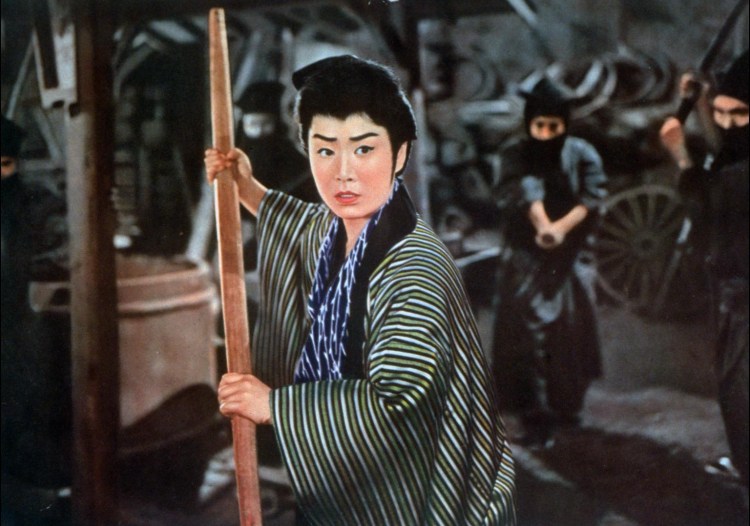
Hibari Ohako: Ojo Kichisa (ひばり十八番お嬢吉三, Yasushi Sasaki, 1960)

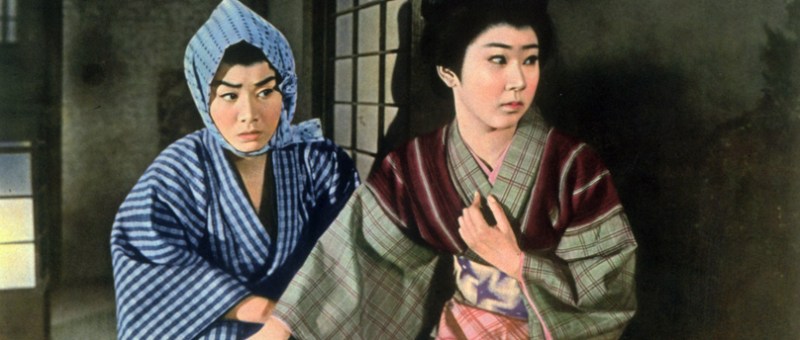
Ojo Kichisa still 1Following Benten Kozo, Ojo Kichisa (ひばり十八番お嬢吉三, Hibari Obako Ojo Kichisa) is the second in a small series of movies starring Hibari Misora in a tale adapted from a well known kabuki play and featuring a cross dressing hero/heroine. This time around Misora plays a young woman dressing as a man for the purposes of revenge who eventually meets up with two men sharing the same “Kichisa” name – a lord (Obo), and a priest (Osho), to form a brotherhood of three including her “Ojo” as in “young lady”. Together they fight the injustices of the feudal world (which are myriad) whilst helping Ojo Kichisa get revenge on the men who murdered her parents forcing her into a precarious life of self preservation.

Beginning with Misora singing the title song of the three Kichisa, the action then switches to a small drinking house where a young woman gets herself into trouble with a bossy samurai who accuses her of spilling sake on him. Though the woman, Otose (Eiko Maruyama), apologises profusely, the samurai threatens to make her pay with her body. Fortunately Ojo Kichisa strides in and fights the samurai into submission, temporarily saving the day. Unfortunately, the samurai come back later brandishing a loan agreement Otose’s father had signed and demand immediate repayment or they will take Otose in its stead.

Once again the feudal world is one of intense unfairness and corruption in which the samurai class abuse their privilege to oppress the ordinary men and women of the Edo era. The samurai who takes such extreme offence at Otose’s possible slip-up has no real reason to do so other than expressing his superiority and once humiliated by Ojo Kichisa feels himself duty bound to double down. The samurai order looks after its own and so his underlings spring into motion to manipulate Otose’s family into giving her up. The two loan sharks gleefully celebrate their good luck, confessing that a major reason for lending money to the needy is for occasions such as this – not only for the interest but for the leverage in getting the desired outcome in ongoing schemes.

Meanwhile, there is a bigger game at play concerning the new finance minister and local governor. The governor accepts “gifts” from a shopkeeper hoping to be promoted onto the council whilst subtly hinting that more “gifts” might be an idea while he needs to be turning a blind eye to the smuggling that’s currently going on in town. Of course, the governor turns out to be involved in Ojo Kichisa’s mission too and is currently being blackmailed by an old acquaintance who once helped him steal a famous sword from its rightful owner.

Another of Misora’s frequent cross-dressing roles, Ojo Kichisa starts out as male but is later revealed to be female having adopted male dress to survive in male dominated Edo and pursue revenge on those who rendered her an orphan. After losing her parents, Ojo Kichisa and her young brother Sannosuke (Takehiko Kayama) were travelling in search of relatives when they were abducted by slave traders and separated. Presumably, both managed to escape at some point and have been living by their wits vowing revenge and reunification but apparently largely untouched by the darkness of feudal society.

The darkness is something which gets pushed into the background in this otherwise comedic tale of the little guy standing up to corrupt elites. The three Kichisas each represent various areas of society – the priest, the noble lord who hates the cruelty of his class, and the elegant lady, Ojo. Obo Kichisa (Tomisaburo Wakayama), the lord with a conscience, is committed to protecting the weak and fighting injustice everywhere he sees it, but it’s not long before pretty much everyone has decided the governor has to go thanks to his inherently corrupt approach to governing in which he’s all about take and never about give, neglecting the townspeople under his care and prioritising his personal gain.

Hibari Misora sings the title song twice – at the opening and closing, as well as another insert song but her brother Sannosuke also gets an opportunity to showcase his singing his voice in a mild departure from the star vehicle norm (actor Takehiko Kayama was also Misora’s real life brother). As in Benten Kozo, Wakayama takes on the bulk of the heroic fighting but Misora gives it her all in the many fight scenes in which she too gets to defeat injustice and rescue maidens to her heart’s content. A straightforward jidaigeki idol movie, Ojo Kichisa is unremarkable in many ways but nevertheless another entertaining example of Misora’s talent for playing ambiguous gender roles.


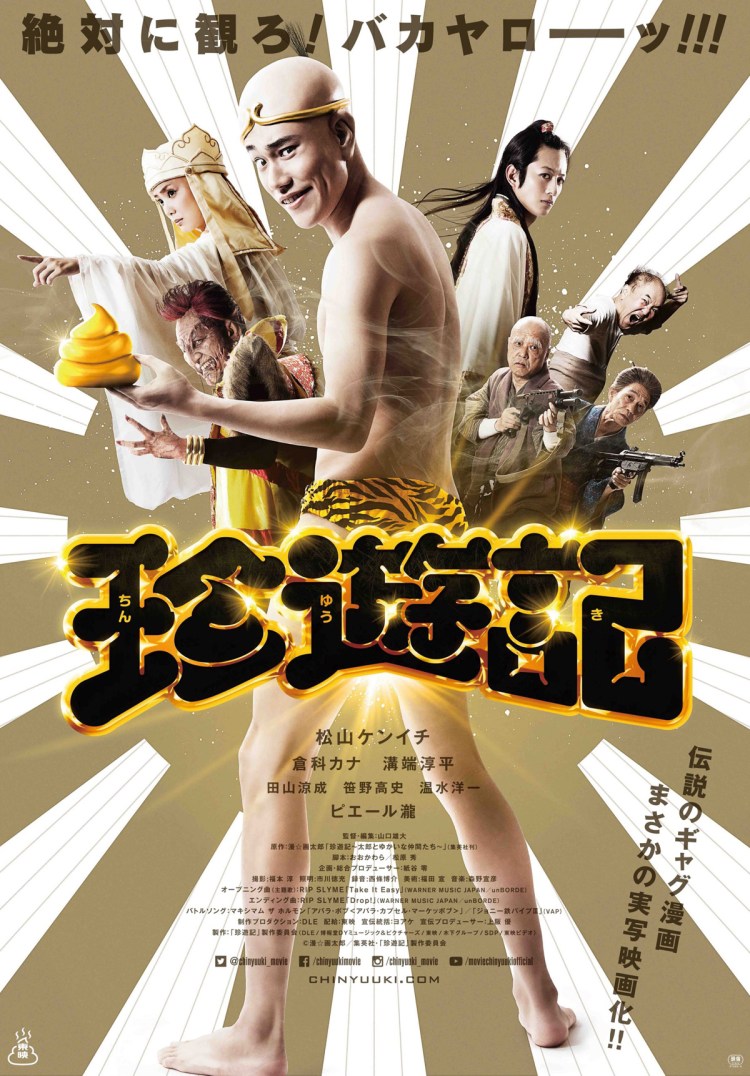
Chin-yu-ki: The Journey to the West with Farts (珍遊記, Yudai Yamaguchi, 2016)

Chin-yu-ki posterWhen a film tells you what it is, you should believe it the first time. Many fine films are undone by unwise titles, but if you were expecting anything more than what is promised by the title of Chin-yu-ki: Journey to the West with Farts (珍遊記), you have only yourself to blame. Director Yudai Yamaguchi is known for his distinctly lowbrow, zany humour and it seems he’s met his match in adapting the much loved Journey to the West parody manga, Chin-yu-ki – Taro to Yukaina Nakamatachi. Set in Japan in an indistinct period possibly somewhere around the Meiji restoration, Chin-yu-ki is a bawdy story of penis power, fantastic farts, romantic disappointments, and the ongoing path to enlightenment of its slightly more than cheeky hero.

Beginning as it means to go on, the film opens with a Buddhist nun, Genzo (Kana Kurashina – renamed “Shenzang” in the subtitles on this HK blu-ray to match the original Journey to the West), talking to an older couple referred to as “Old Fart” (Ryosei Tayama) and “Old Bag” (Takashi Sasano). The couple were never blessed with children of their own and so when they notice a great flash and something falling to Earth, they are delighted to find a lovely baby boy lying in the crater. Unfortunately, Taro Yamada (Kenichi Matsuyama), as the baby is called, is a wrong ‘un. Now 16 years old, Taro is a fiery demon who has robbed the entire area to build himself a giant mansion where he lives on his own and has provided his adoptive parents with a small hovel on the outskirts of town. Old Fart and Old Bag try to warn Genzo that Taro is not your average sinner – he controls people with his giant penis and stinky farts.

Genzo is undeterred and demonstrates her various skills which, strangely, centre around the ability to unping a bra at 20 paces (yes, apparently in this version of the Meiji era, people wear bras). Her other trick is magically hurling buns into people’s mouths which does at least shut them up for a bit. Against the odds she manages to tame Taro, reducing him to his basic, naked state in which she manages to shove a magic crown on his head which allows her to control him and stop him doing naughty things. Genzo determines to take Taro to Tianzhu to purify his soul and so the pair walk off together towards their joint destiny.

The road trip format provides plenty of scope for set piece gags as Genzo and Taro encounter various strange characters along the way who often make surprising returns. This is no character drama, but Taro does indeed learn a few things even as he remains as wilfully naughty as in his unreformed state. As it turns out, the major narrative event revolves around a grudge held by a man who previously encountered Taro at his most cruel. Ryusho (Junpei Mizobata), now a famous pretty boy actor, is still nursing a broken heart after Taro ruined his true love dream which had proved so difficult for him to win as a shy young schoolboy. Now backed by a series of strange companions including a dominatrix-type assistant who dresses in shiny leather and carries a whip, a woman in Cheongsam, and a man in anachronistic Chinese PLA uniform, Ryusho is still a hopeless romantic and develops an unlikely crush on Genzo, which she returns but is unable to act on because of her vows and her mission to reform Taro.

Misunderstandings abound and it has to be said, the crosstalk between Ryusho who has been abandoned by his buddies and has hired a series of Vietnam-era American mercenaries, Genzo, and Taro as they argue about an unclear subject is genuinely quite funny as is the reaction when Taro unmasks himself in a local bar full of bounty hunters who don’t believe he is who he says he is because he’s wearing a shirt with the name of a guy he just robbed on it. The rest of the humour is, however, of a lower order even if the penis and fart jokes fade out in the middle section of the film which does have a few amusing jokes of its own. Matsuyama delivers a surprisingly energetic performance which is in strong contrast with the distant, inscrutable characters he often plays but as cheerful as his Monkey King stand in is, he can’t compensate for the film’s otherwise disposable quality which seems primed to appeal to those seeking zany, lowbrow humour but offers very little else.


Original trailer (no subtitles)

Hibari Ohako: Benten Kozo (ひばり十八番 弁天小僧, Yasushi Sasaki, 1960)

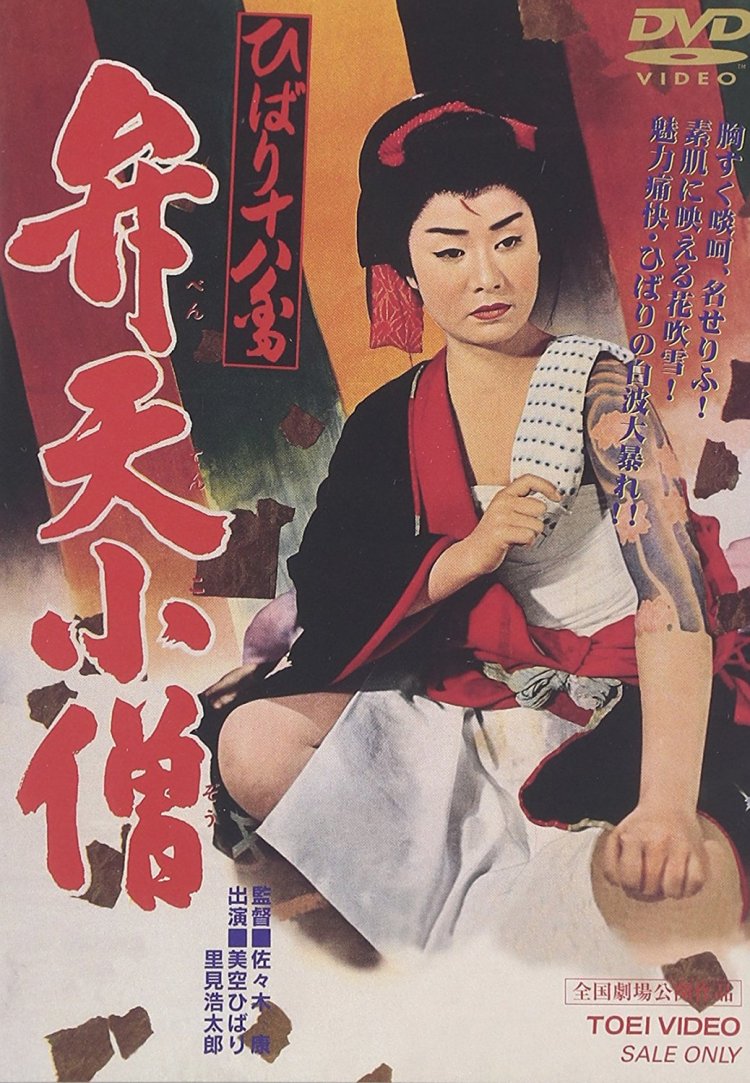
Benten Kozo dvd coverStarting out as a child actress, Hibari Misora was one of the biggest singing and acting stars of the post-war period whose songs are often pointed to as embodiments of the era’s melancholy yet determined spirit. Though it’s her singing career which has perhaps had the most historical impact, Misora made an immense number of films most of them in ’50s and ‘60s, many typical star vehicles of the time – silly comedies and softer musicals, usually finding an opportunity or two for a song even in straight drama. Hibari Ohako: Benten Kozo (ひばり十八番 弁天小僧), released in 1960 for Toei, is very much of this mould and showcases another somewhat interesting facet of Misora’s career in her readiness to play ambiguous gender roles.

Based on the well known kabuki play, Benten Kozo, which had also been adapted two years previously in a version starring male actor Raizo Ichikawa, Sasaki’s film stars Hibari Misora in the title role – a 13 year old boy who was given up at birth to be raised in a temple which specialises in performing Noh theatre. Kikunosuke (Hibari Misora) is their star, but there’s a dark side to temple performing companies in that they’re dependent on donations and it’s accepted practice to allow wealthy patrons to do whatever they like with the talent, no matter their age or gender. Kikunosuke knows this and isn’t having any of it. Pushed into a room with a lecherous, overly made-up older woman, Kikunosuke balks at the old monk’s attempts to pimp him out and tries to leave, much to the monk’s disappointment.

Unfortunately, just as Kikunosuke is leaving, a thief arrives to steal the money meant for the monk and kills the old woman in the process. Kikunosuke kills the thief but is accused of killing the old woman too and is forced on the run. Tracking down his birth mother, Ofuji (Mitsuko Miura), Kiku thinks he’s found a home but is betrayed, at which point he adopts the name “Benten Kozo” (lit. “Benten Kid” where Benten is the name of the goddess at the temple where he was raised) and joins a gang of Robin Hood-style outlaw thieves.

Like many period films of the time, Benten Kozo revolves around exposing the corruption of the samurai order. In this case, it’s a salt scam – the samurai elders have been stockpiling salt to push the price up, endangering the lives of ordinary people for their own financial gain and thinking nothing of it. The thieves, led by later Lone Wolf and Cub star Tomisaburo Wakayama, are dedicated to robbing the rich to feed the poor but they also aim to expose those in power for the reckless bullies they really are. Benten Kozo joins the “Shiranami Five Alliance” both out of self preservation and out of genuine sympathy with their cause, eventually encountering the same corrupt monk who turned a blind eye to his attempted molestation when he intervenes to save a woman forced into prostitution to pay her father’s debt whom the monk was attempting to rape.

Benten Kozo listens to the woman’s story and decides to give her his savings (which he no longer wants after being betrayed by his mother for whom he’d been saving the money) to pay off her family debt. In fact the pair met earlier when Benten Kozo was on the run and she helped him hide from the authorities. The woman, like several in the film, falls for Benten Kozo’s androgynous charms though he remains resolutely noble and indifferent. Benten Kozo would originally have been played by a male actor on the kabuki stage which did not allow female performers. The “onnagata” or actors who specialised in playing women were often effeminate younger men or boys much like Benten Kozo himself who plays these skills to the max throughout the film.

Hibari Misora, with her low, husky voice, effortlessly switches between the elegant upperclass women Benten Kozo impersonates on stage and in service of the gang’s scams, and the rough and ready dialect of a street ruffian. In a shocking display of bravado, Benten Kozo drops the top of his kimono to show his off his tattoos proving once and for all that he’s no lady but still his appeal lingers perhaps precisely because of his gender ambiguity.

Benten Kozo is not a musical but finds two occasions for Misora to sing – once as Benten Kozo takes off on the road, and the other at the end as he paddles a boat away back to his new found friends. The film ends with a giant mass brawl and also provides ample scope for Misora to escape across roof tops and fight off the unjust but it’s otherwise fairly straightforward fare and not exactly among the singer’s most memorable outings. It is however generally entertaining and interesting enough in its central theme of woman playing man playing woman to warrant attention from more than just diehard Misora fans.


Hibari Misora singing Benten Kozo in concert some years later.

North Sea Dragon (北海の暴れ竜, Kinji Fukasaku, 1966)

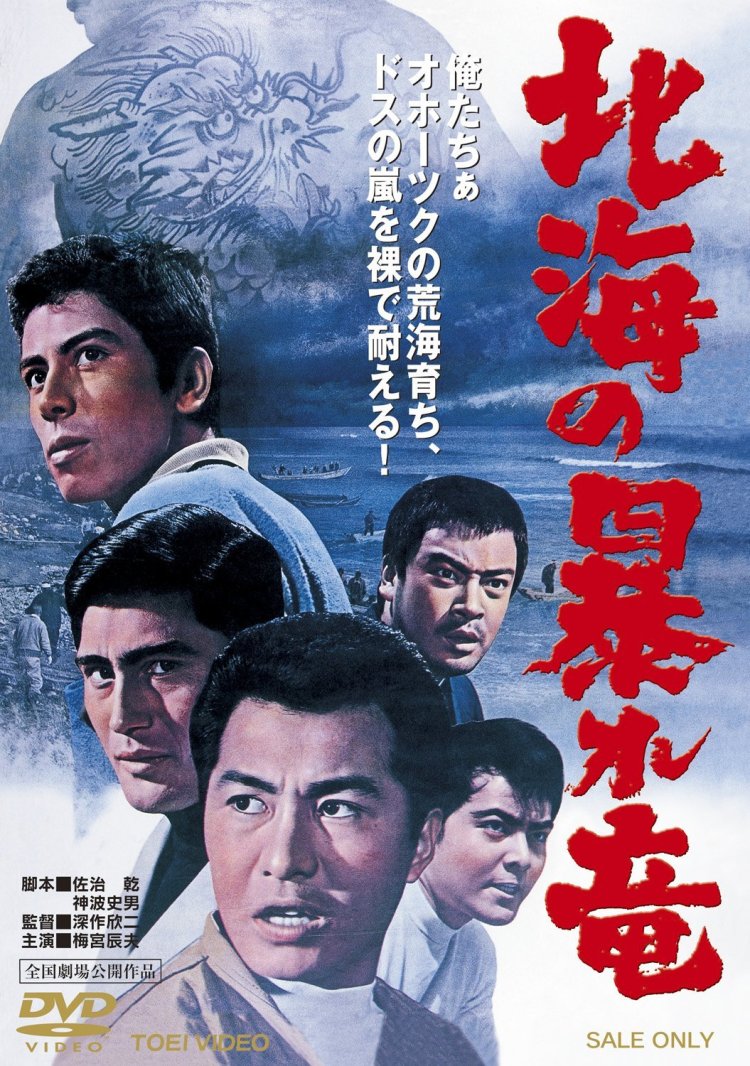
north sea dragon dvd cover.jpgAt the beginning of the 1970s, Kinji Fukasaku’s Battles Without Honour and Humanity would put the ninkyo eiga firmly to bed, but in the mid-1960s, they were still his bread and butter. Fukasaku’s earlier career at Toei leant towards the studio’s preference for youthful rebellion but with a stronger trend towards standardised gangster tropes than the countercultural thrills to be found in similar offerings from Nikkatsu. For Fukasaku the rebellion is less cool affectation than it is a necessary revolt against increasing post-war inequality and a constraining society though, as the heroes of If You Were Young, Rage or Blackmail is My Life find out, escape can rarely be found by illicit means. Jiro, the prodigal son of North Sea Dragon (北海の暴れ竜, Hokkai no Abare-Ryu), finds something similar even whilst conforming almost entirely to Toei’s standard “young upstart saves the village” narrative.

Jiro (Tatsuo Umemiya), dressed in white with jet black sunshades, nonchalantly walks into his childhood fishing village filled with a sense of nostalgia and the expectation of a warm welcome. The village, however, is much changed. There are fewer boats around now, and the fishermen are all ashore. Arriving at his family home he discovers they now live in the boat shed and his mother doesn’t even want to let him in. Jiro, as his outfit implies, has spent his time away as a yakuza, and his family want little to do with him, especially as his father has been murdered by the soulless gangsters who are currently strangling the local fishing industry.

The local fishermen are all proudly tattooed but they aren’t yakuza, unlike the tyrannical son of the local boss, Gen Ashida (Hideo Murota), who carries around a double barrelled shotgun and fearsome sense of authority. The Ashidas have placed a stranglehold around the local harbour, dictating who may fish when and extracting a good deal of the profits. An attempt to bypass them does not go well for Jiro’s mother who is the only one brave enough to speak out against their cruel treatment even if it does her no good.

When Jiro arrives home for unexplained reasons he does so happily, fully expecting to be reunited with his estranged family. Not knowing that his father had died during his absence, Jiro also carries the guilt of never having had the opportunity to explain himself and apologise for the argument that led to him running away. An early, hot headed attempt to take his complaint directly to the Ashidas ends in disaster when he is defeated, bound, and whipped with thick fisherman’s rope but it does perhaps teach him a lesson.

The other boys from the village – Jiro’s younger brother Shinkichi (Hayato Tani) and the brother of his childhood friend Reiko (Eiko Azusa), Toshi (Jiro Okazaki), are just as eager as he is both to avenge the death of Jiro’s father and rid the village of the evil Ashida tyranny. Jiro tries to put them off by the means of a good old fashioned fist fight which shows them how ill equipped they are in comparison with the older, stronger, and more experienced Jiro but their youth makes them bold and impatient. The plot of Toshi and Shinkichi will have disastrous consequences, but also acts as a galvanising force convincing the villagers that the Ashidas have to go.

Jiro takes his natural place as the hero of a Toei gangster film by formulating a plan to undermine the Ashidas’ authority. His major strategic decision is to bide his time but he also disrupts the local economy by attempting to evade the Ashida net through sending the fisherman to other local ports and undercutting the Ashida profit margin. As predicted the Ashidas don’t like it, but cost themselves a crucial ally by ignoring the intense bond between their best fighter and his adorable pet dog. Things do not quite go to plan but just as it looks as if Jiro is about to seal his victory, he stays his sword. The Ashidas’ power is broken and they have lost enough already.

Fukasaku’s approach tallies with the classic narrative as the oppressive forces are ousted by a patient people pushed too far finally deciding to fight back and doing so with strategic intelligence. It is, in one sense, a happy ending but not one without costs as Jiro looks at the restored village with the colourful flags of fishing boats enlivening the harbour and everyone going busily about their work. He knows a sacrifice must be made to solidify his mini revolution and he knows who must make it. Like many a Toei hero before him, he prepares to walk away, no longer welcome in the world his violence has saved but can no longer support.


Original trailer (no subtitles)

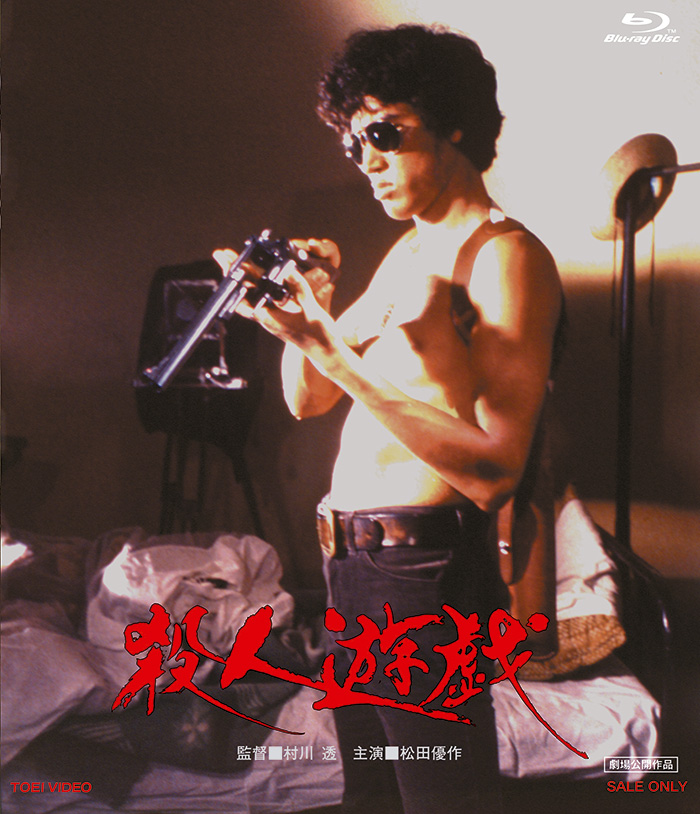
The Killing Game (殺人遊戯, Toru Murakawa, 1978)

the killing gameFollowing the success of The Most Dangerous Game, the second in what was to become a trilogy arrived within the year and once again stars Matsuda as the ice cold hitman Narumi. Sunnier in outlook, The Killing Game (殺人遊戯, Satsujin Jiken) unfolds along the same pattern as the first instalment as Narumi is dragged out of the shadows to intercede in a gang war only to find himself surplus to requirements.

Narumi (Yusaku Matsuda) has been retired from the killing game for the last five years and now lives a life of poverty and dissipation. Gone are his swanky apartment and stylish suits, now he lives in a bare hovel which is covered in dust and cobwebs, and he dresses like a farm boy in a white vest and jeans with a straw hat hanging on his back. He’s trying to lie low, but gets pulled into the kind of hostess bar he can’t really afford where he meets the first of two familiar faces which threaten to send him back into the middle of chaos. Akiko (Kaori Takeda), now a hostess at Bar Tako, is the daughter of the chairman Narumi bumped off in his last job before retiring but far from bearing a grudge against him, Akiko is grateful to have been set free. The second familiar face belongs to the same chairman’s former secretary/mistress, Misako (Yutaka Nakajima), who is now a mama-san at a bar popular with the local goons. All those years ago Narumi let Misako go in a moment of weakness and now regrets it but attempting to “reconnect” is going to land him right back in the thick of things.

Murakawa begins with a prologue which takes place in the noirish urban darkness of The Most Dangerous Game, but shoots in dreamy soft focus to emphasise that this is all memory before jumping forward five years. Exactly why Narumi has decided to give up a career in assassination is not revealed, nor is what he’s been doing the last five years, but he has apparently got himself an annoying sidekick who, in contrast to Narumi’s intense reserve, does not shut up. The first half of the movie is Narumi and his buddy trying to get by as outlaws including one humorous skit where they get themselves a van with a nudie pinup on the front plus a loudspeaker to humiliate debtors into paying up.

Things take a darker turn when Narumi runs into Misako – a chance meeting that seems almost like fate. Gradually the old Narumi begins to reappear. Deciding to pay Misako a visit he runs into her new man, gang boss Katsuda (Kei Sato), who figures out who he is and wants him to bump off another old gang boss. Narumi needs to get back in shape which he does via the tried and tested method of a training montage, lifting weights and running through the town with his trademark perm returning to its stylish buoyancy. This time around Narumi has buddy to help out, even if he only ends up being a liability, but the same strange dichotomy occurs – he may be an ace hitman, but Narumi is a mess without a gun in his hand.

Perhaps weathered by his experiences, Narumi is also much less cocky and much more unwilling to take a chance on trust. Once again he is betrayed by clients who’d rather not pay up and forced to play a “dangerous game” to bring the whole saga to a close in such a way as to keep both his life and the money. Rather than the surprising and largely inexplicable devotion of Dangerous’ Kyoko, Narumi finds himself torn between two women – the youthful Akiko who is grateful to Narumi for releasing her from an overbearing father, and the jaded Misako whose feelings for Narumi are complex, mingling fear, gratitude, attraction, and resentment into an irresistible storm of ambivalence. Again Narumi’s cool, animalistic aggression seems to be the key to his mysterious sex appeal but this time around there are no flickers of response as there were for the devoted Kyoko, these “relationships” are opportunistic and transactional.

Ironically titled, The Killing Game makes plain that Narumi will never be able to escape his chosen profession even if he wanted to. Without a gun in his hand Narumi is a pathetic wastrel, playing around at tuppenny schemes with his rather dim but talkative friend, and trying to play the big shot by buying out a hostess bar he is entirely unable to afford despite his recent windfall. The setting may be brighter, but Narumi’s word is still a nihilistic one in which he’s conditioned to expect betrayal and the only remaining vestiges of his humanity are his strange friendship with his bumbling sidekick and his ongoing fecklessness at coping with everyday life. Matsuda is as cool as ever in his effortless ability to cope with any given situation and kill with ruthless efficiency, but as Narumi edges ever closer to machine it is clear there is only one way to beat The Killing Game.


Original trailer (no subtitles)

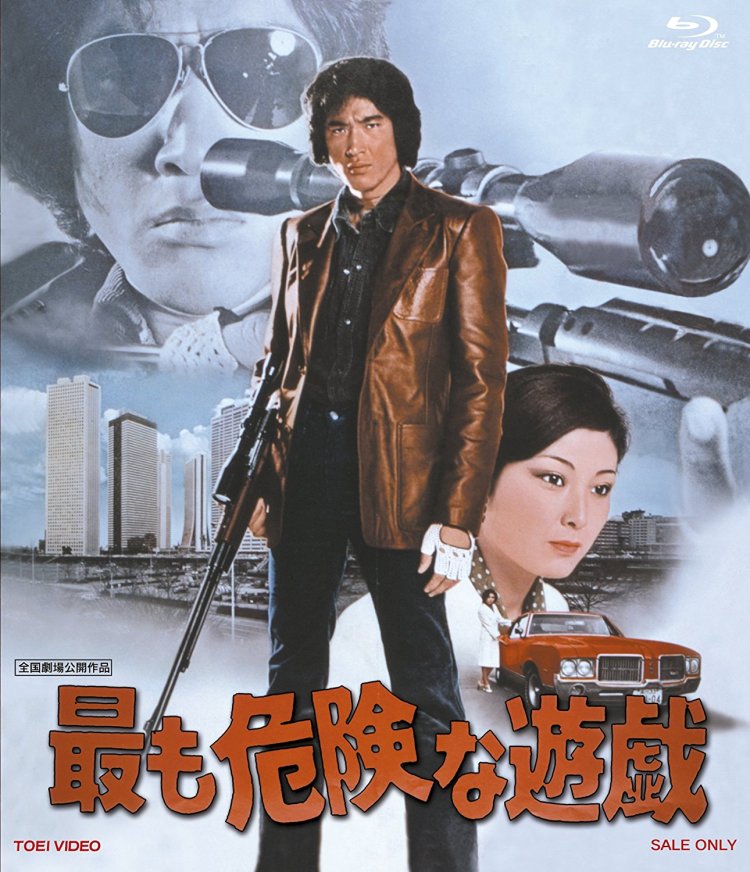
The Most Dangerous Game (最も危険な遊戯, Toru Murakawa, 1978)

the most dangerousThe late Yusaku Matsuda remains an ultra cool pop culture icon thirty years after his death and forty after his reign as the action king of Japanese cinema. Though there were several other contenders for the crown – Sonny Chiba, or the tough guy yakuza stars Ken Takakura and Bunta Sugawara, to name but a few, it’s Matsuda’s intense screen presence which continues to endure as an example of mid-1970s extreme masculinity. This image was in large part created through his work with director Toru Murakawa in roles inspired by hardboiled novelist Haruhiko Oyabu in Resurrection of the Golden Wolf and The Beast Must Die, but before that it was the “Game” trilogy which helped to make his name.

The first of these, The Most Dangerous Game (最も危険な遊戯, Mottomo Kikenna Yuugi), introduces us to Narumi (Yusaku Matsuda) – a sleazy hitman with a gambling problem who is capable of pulling off the most daring and precise of hits but remains a disaster outside of his working life. After losing a mahjong game and getting roughed up by gangsters, Narumi gets a job offer from an arms company currently vying for a large government contract to develop a Star Wars-style air defence system. As reported in the news, a number of top CEOs are being kidnapped for ransom thanks to a plot by the Godai Conglomerate. The Tonichi Corporation want Narumi to rescue their kidnapped employee, Nanjo (Masanori Irie), who also happens to be the son-in-law of CEO Kohinata (Asao Uchida).

Unlike the later Resurrection of the Golden Wolf or The Beast Must Die, the corporate conspiracy and shady government military project are merely background and never really dealt with in any further detail. Nevertheless, it appears Narumi has got himself involved in a much darker world than even he is used to. Kohinata claimed to want to save Nanjo because of their familial connection, but as it turns out he doesn’t really care so much about his daughter’s husband as he does about wiping out the Godai and getting the lucrative government contract all to himself. He’s even willing to pay Narumi twice for doing the same job, but then perhaps he’s not really looking to pay at all. Conspiracy may extend further than just the corporate realm.

Narumi makes for a strange “hero”. His very 1970s bachelor pad is a monument to sleaze with its prominent topless pinups displayed like precious artwork in his living room and his well stocked personal bar – a strange thing to have when it’s clear he does not entertain many visitors. Dancing around with his gun and posing topless in front of the mirror Taxi Driver-style implies perhaps he’s not so confident with his chosen profession yet he’s clearly well known enough to get a phone call out of the blue from the Tonichi Corp. Despite his rather pathetic attitude at the mahjong game and equally pathetic exit after falling asleep during a lap dance at a sex parlour, Narumi’s professional exterior is one of infinite capability and powerful masculinity.

Yet, like many films of the era Narumi’s masculinity is also intensely misogynistic. Gangster’s moll Kyoko (Keiko Tasaka) becomes an unlikely (and inconvenient) love interest after Narumi tries to use her to bait her boyfriend. Lying in wait in Kyoko’s apartment, he surprises her coming out of the shower while she is half naked and vulnerable. She tries to escape, he stops her, phone’s the boyfriend, and begins raping her so that the gangsters can hear her distress over the phone. Kyoko stops struggling and apparently gets into the groove, falling instantly in love with Narumi’s awesome love making skills and following him back to his apartment where she stays for the rest of the film.

Nevertheless Matsuda is presented as the epitome of cool, unshaken by danger and always coming out on top with enough time to strike a pose as he takes down a target with automatic precision. Murakawa’s approach is of its time but leaning towards arthouse rather than Toei’s unusual brand of action cinema. Its vistas are noirish but filled with 70s paranoid claustrophobia while the hopeless, melancholy jazz score by Yuji Ohno adds to the moody hardboiled aesthetic. An exercise in style, The Most Dangerous Game is as cynical as they come but its wry commentary and occasional fits of gleeful comedy lift it above both the B-movie silliness of other contemporary action movies and the dour seriousness of later Matsuda/Murakawa collaborations.


Original trailer (no subtitles)