Dear You (给阿嬷的情书, Lan Hongchun, 2026)

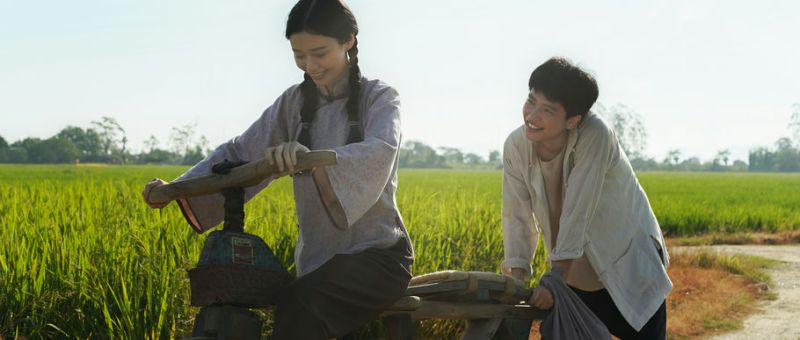
Flat broke and under pressure from a loan shark, Hiou-u (Zheng Runqi) decides there’s only one thing to do. Track down his no-good grandpa who apparently abandoned the family and became rich in Thailand to demand his share of the inheritance. Of course, by the end of the film, he’ll have realised the error of his ways and grown up a little, much like the protagonist of Thai megahit How To Make Millions Before Grandma Dies, by which Lan Hongchun’s tear-jerking melodrama Dear You (给阿嬷的情书, Gěi Āmà de qíngshū) is clearly inspired. It even features Usha Seamkhum in a small role as the older Lamgi at the film’s conclusion. 

Shot almost entirely in Teochew, the film is, in other ways, a tale of distance and diaspora which in some ways suggests that a Chinese citizen never really leaves “China” but continues to exist within it even while abroad. Though most of the film takes place in Thailand, it is largely unconcerned with the political and social situation of the nation in the mid-1950s or with the wider geopolitical realities of the era. Remaining largely within the Teochew community, it does not really explore the complicated position of the Chinese community in Thai society either, preferring to focus on their poverty and rootless as the source of their marginalisation. After eloping with a young woman from a wealthy family, Den Bhagseng (Wang Yantong) is forced to flee leaving his three children behind to avoid being drafted into the KMT during the Chinese Civil War. After arriving in Thailand he is unable to return home firstly because of the difficulty of doing so once the Communist regime gained power, though the film also skirts around this, and secondly because he sends almost of all the money back to his wife Sogriu (Wu Shaoqing) meaning he never manages to save enough for his return passage.

The film largely revolves around the qiaopi remittances, letters sent home to family declaring that the sender was safe and often including money. Aside from the sentimental dimension, these letters also reinforce the diaspora community’s ties to the Mainland and the inclusion of several real letters at the film’s conclusion seems intended to act as a mild suggestion that perhaps those living abroad could also send more of their money home, while the film’s themes of yearning and homesickness also seem primed to encourage those living away to return or at least put in a call to their loved ones before it’s too late.

But on the other hand, the fact that the letters were never written by Bhagseng, as he was largely illiterate, but firstly by a series of scribes and then by a heartbroken Lamgi who pens the heart wrenchingly romantic verses that bring so much comfort to Sogriu adds a note of poignancy while perhaps undercutting their sincerity. That these are, in effect, a series of love letters exchanged between two women, though mediated through the absent figure of a man, leads the film an unexpectedly queer undertone complimenting the accompanying messages of female solidarity. Though Sogriu originally harbours resentment towards Lamgi mistakenly believing her to have been Bhagseng’s mistress, she later gains respect for realising not only all that she did for them but they way in which she continued to honour Bhagseng’s memory.

Once of the reasons that the family had believed Bangseng had become rich was that there were several schools with his name on them, leading them to conclude he had sponsored them in some way. This turns out not to be case, but was rather a kind of tribute to his role within the local community having convinced Lamgi to allow a Chinese school to operate within her inn during a time in which the language was actively suppressed. Bangseng had shouted at her, pointing out that these children will be condemned to a life of poverty and exploitation if they, like him, cannot read and write. He also argues that without knowing how to read, write, and speak Chinese, they will lose their cultural roots and connection with the Mainland. This seems to already be true of Lamgi who did not herself know how to read Chinese and felt disconnected from Chinese culture having grown up in Thailand. After learning with the children at the inn, the necessity of writing the letters also encourages Lamgi to become fully literate. The ability to read and write not only allows her to earn an income as a single woman by running her own business and later becoming a teacher, but also reinforces her Chinese roots and sense of cultural identity. 

While it therefore presents a bittersweet tale of a love lost and then regained when the truth is revealed, the film also subtly issues a message to the diaspora community about the importance of their links to the greater Chinese community and responsibility towards the Mainland. Repeated references are made to the need to support each other in a foreign land with the Teochew community determined to protect each other against an often hostile environment in which they face exploitation and discrimination, while Lamgi’s sense of responsibility toward Sogriu could also be seen the same way as she willingly takes on the need to provide for Bangsen’s family despite her unrequited feelings for him. Nevertheless, what the film offers most is a sense of catharsis in its tear-jerking tale of young lovers separated by forces outside their control and symbolically reunited through the emotional truths contained within the letters.


Trailer (English / Simplified Chinese subtitles)

Burn (炎上, Makoto Nagahisa, 2026)

“You may not be okay, but neither is anyone else,” a well-meaning young woman advises neatly encapsulating the world of the Toyoko kids in Makoto Nagahisa’s second feature, Burn (炎上, Enjo). A little less anarchic than his debut We Are Little Zombies, the film is one of several exploring the fate of these displaced teens the media has often liked to demonise as means of deflecting the fact that society has largely failed them and the adults who should be helping often only make things worse.

This contrast is clear in the opening scenes in which Jurie’s (Nana Mori) Christian parents sing a hymn about the world being full of light, but Jurie’s father (Kanji Furutachi) is a crazed authoritarian who beats her and her sister with a belt while insisting that Jurie’s persistent stammer is a reflection of her “tainted soul”. Ironically, asking her sister if she believes in God, Jurie starts to pray for her father’s death. “If God exists, He took his fucking time,” she quips when her father finally drops dead a few years later. But the abuse doesn’t end. Her mother takes her father’s place and begins to beat them just as she was beaten. 

Shinjuku, is one sense, a place full of light given its brightness and shining signs, but in the real world you can’t have light without shadow. After running away, Jurie is taken in by a community of similarly displaced teens led by an adult Fagin-like character known as Kami (Wataru Ichinose), which is ironically the same as the word for “God”. He describes himself as a guardian angel who whose job it is to make everyone feel safe, yet there’s something disingenuous about his warm-hearted claims that this is a place that accepts everyone and that no matter what society may choose to reject, he is glad that they were born. His golden fangs seem to hint at something cruel and greedy echoed in his reluctance to left Jurie leave, insisting that she won’t make it in the real world despite having told her she needs to become independent.

Mitsuba (Aoi Yamada), who has a disability stemming from a traumatic childhood incident, similarly finds her attempt to find escape through a relationship with a host foundering. Ironically named “Hikari” which means light, he justifies himself to her in insisting that he’s a victim too having been abused by his mother as a child, though in the end Mitsuba’s need to be loved can only be satisfied transactionally as she deludes herself into thinking her relationship with Hikari is “real” even as he continues to exploit her. To earn the money pay him, she ironically takes to sex work and encourages Jurie to join her in an effort to earn a million yen and then go back to save her sister. One of their clients presents them with a strange-looking dildo that sort of resembles a wand used by magical girls in anime which they wave as though transforming, but later describe themselves as performing an exorcism after meeting clients.

The men that buy their services are just another symptom of an exploitative society. When Jurie almost overdoses and is taken to hospital, the police don’t send her back to her family but do place her in a childcare facility where she feels imprisoned. The implication is that society would rather hide these children away rather than attempt to help them. Jurie longs for the freedom of the city and escapes to return, but in the end discovers only darkness. The film shares its Japanese title with Kon Ichikawa’s adaptation of Mishima’s The Temple of the Golden Pavilion, Conflagration, which is also about a young man who decided to burn it all down in protest against a profane world, though Jurie seeks escape from the collective punishment of the contemporary society along with the traumatic legacy of her father’s abuse. Nagahisa mixes iPhone social media footage capturing the kids’ world from their perspective with dreamlike imagery and a video game aesthetic as Jurie looks for a way out of the labyrinth of her trauma while setting the world ablaze in her mind. What she discovers in the ashes, however, maybe a renewed hope for the future and the possibility of a different kind of salvation.


Burn screens as part of this year’s JAPAN CUTS.

Trailer (Engliish subtitles)

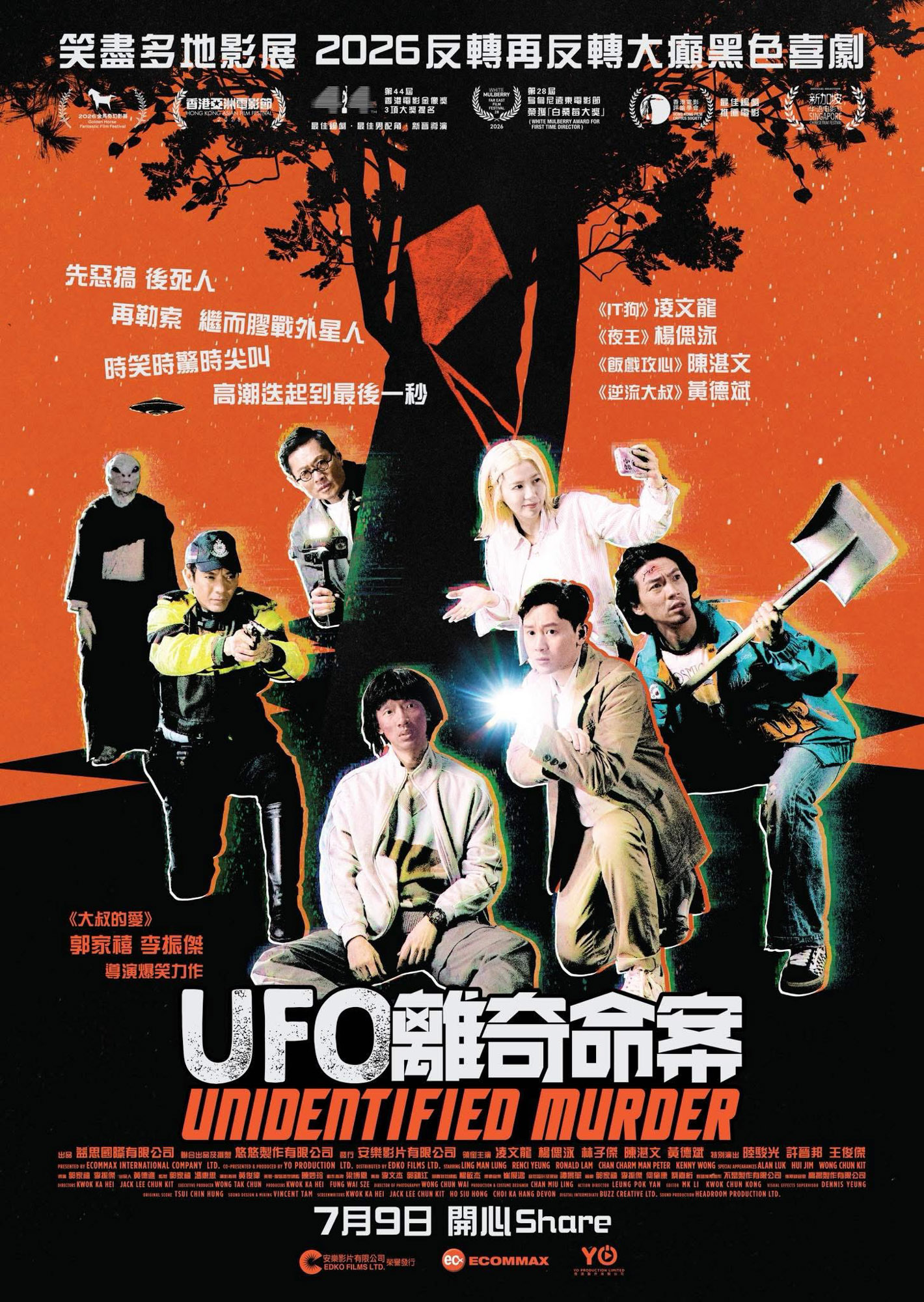
Unidentified Murder (UFO離奇命案, Kwok Ka-Hei & Jack Lee Chun-Kit, 2025)

The line between a prank and a scam maybe be necessarily thin in Kwok Ka-Hei and Jack Lee Chun-Kit farcical comedy Unidentified Murder (UFO離奇命案) in which nothing is quite as it first seems. Unfolding with an almost Rashomon-like structure, the film slowly peels back the layers of reality to reveal that pretty much everyone is playing a trick on someone, sometimes rooted in a childish sense of fun, but equally a desire for attention and the money that can be generated from it in today’s attention-obsessed society.

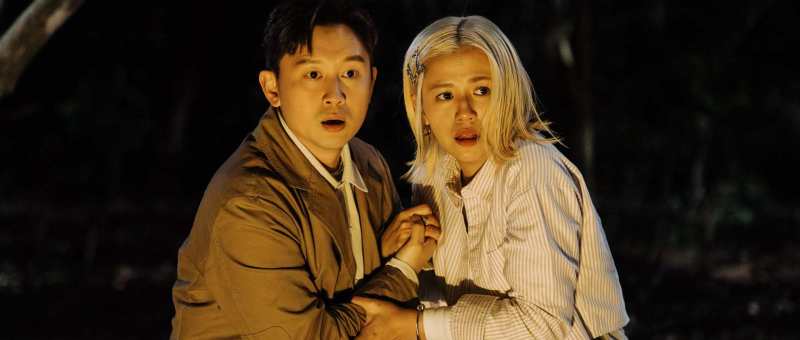
Twenty-five years ago, Kit (Ronald Lam Tsz-Kit) and Mark (Ling Man-lung) went up the mountain with their friend Ho but returned alone. Ho’s disappearance has apparently become a legendary local mystery with the boys claiming that Ho was abducted by aliens, though some seem to believe that their story is either a trauma-born fiction or a deliberate attempt to disguise their role in whatever may have happened to their friend. In any case, the film opens with an attempt by online content creator Man (Renci Yeung) of the “Prank My Boyfriend” video channel to play a trick on her boyfriend Mark by getting an actor, Kim (Peter Chan Charm-Man), to be the retuned Ho abruptly released by the aliens after 25 years. To begin with, this doesn’t seem like a very funny prank and could be crushingly insensitive. One might assume the now middle-aged men are carrying a degree of trauma about the failure to protect their friend, or else if they really were responsible for his disappearance in someway, it could turn out of be a dangerous situation for everyone. 

Nevertheless, Mark doesn’t seem to be particularly phased by Man’s prank and, on fact, sets out of prank her back by getting Kim onside to pretend that he and Kit kill him while planning to move Ho’s body due to the increased interest generated by the incident’s 25th birthday. This doesn’t seem like a very funny prank either, and it’s difficult to deny that this ultimately farcical situation began with a series of very bad decisions especially as this particular stunt is intended to work up to a marriage proposal. Unfortunately, however, nothing goes to plan and when it looks like Kim might be dead for real, the gang get a mysterious text trying to blackmail them threatening to release Man’s video of them murdering Kim online.

Or course, there’s a possibility that this is another prank too, or, to be frank, more of a scam. In this world, nothing really is certain and no one is really who they seem to be. A good friend might be playing a trick on you that could unwittingly be hurtful or insensitive though they may not mean it, while likewise they may be trying to con you out of a bit money to fight their own desperate circumstances. There’s a kind of childishness that underplays most of the trickery like a lie told by a child to get out of trouble that they then have to commit to for the rest of their lives. In this way a trick can become a shared secret, like an alternate reality that binds people together in ways few other things can. Others my be wilfully deceived by watching things like the Stardust Memories channel that purports to show evidence of aliens but may not be completely on the level. To that extent, at least Man’s channel is honest about its intentions even if it’s not clear to what extent Mark is already in on the joke.

Even if you regard it as harmless fun, these pranks too could wind up having devastating consequences and escalating to levels of death and violence all based on a series of misunderstandings. So confusing do things become while out in the mountain forest that Man even tries to grab the gun from a policeman and points it at her friends certain that they’re pranking her only to be shocked when the gun later goes off. But what could have unraveled a long-time mystery and exposed things best left buried or resulted in deadly consequences instead becomes another bonding exercise in which a group of people generate an unexpected friendship though all being in on the joke, each letting the incident end with good humour and no harm done. Filled with farcical comedy and an ironic cynicism the film seems to say that in this world where everything is grift being in on joke might be the only thing that makes life worth living.


Unidentified Murder screens as part of this year’s New York Asian Film Festival.

Trailer (English subtitles)

Magical Secret Tour (マジカル・シークレット・ツアー, Chihiro Amano, 2026)

When her husband falls into a coma and she discovers he’s left them in huge amounts of debt due to an undisclosed gambling problem, an ordinary housewife finds herself at the mercy of an already strained society in which it seems everyone is struggling to the extent that they have no capacity to listen to other people’s troubles. Inspired by a real-life case in which a group of women was arrested for smuggling gold into the country in 2017, Chihiro Amano’s lighthearted crime drama Magical Secret Tour (マジカル・シークレット・ツアー) is a condemnation both of a society ruled by money and the various ways that women are still expected to clear up the messes of irresponsible men.

Wakako (Kasumi Arimura) is quickly made to feel guilty for not having noticed anything wrong with her husband or their family finances while also expected to shoulder the burden of the repayment plan to his former employer to cover the money he embezzled on top of his hospital fees which must now be paid in full because he was unemployed and had no insurance. When she tries to turn for her own family for her help, her mother is not happy to see her and seems put out that she’s turned up unexpectedly. It seems their family garage business is in trouble while they are already under strain due to needing to pay for their bedridden grandfather’s medical treatment. Her mother leaves abruptly before Wakako has the chance to explain the situation denying her the possibility of both financial assistance and emotional support. 

Apparently ineligible for any kind of government assistance, Wakako’s attempts at job-hunting fail because she is a mother of two with one only an infant and has also been out of the workforce for too long for any career experience to count. Even when her husband does eventually make a partial recovery, he blasts her for neglecting her responsibilities and overburdening his mother by asking for help with childcare. Despite having let her down so badly, he insists he’ll get a job once he’s better and discourages her from continuing to work even though she tells him that she enjoys it and finds it fulfilling. To that extent, her experiences have shown her that she did not really need to be dependent on a man for money as society somewhat encouraged her to be and could also look for fulfilment outside the home as an independent woman. 

Nevertheless, the only work she can find means turning to criminality, first by agreeing to a loan shark’s dodgy gold-smuggling scheme by taking the kids to Singapore for a few days and then returning laden down by gold bars they smuggle through customs to avoid importation taxes. While there she meets two other women in similar situations. Kiyoe (Haru Kuroki) is a scientific researcher in her early 40s who faces persistent sexism at work where her boss steals credit for her discoveries and faces no consequences for fiddling his expenses. Unable to find a new position thanks to a poor publication history, she wants the money to provide for her future. Mayu (Sara Minami), meanwhile, is trying to escape her toxic mother while pregnant herself and working as a bar hostess. 

The women justify themselves that what they’re doing is basically a victimless crime and just really a bit sneaky rather than morally wrong even if aware it’s illegal. A disclaimer at the end of the film implies the law has been tightened since 2017, but the stakes are also fairly low as it seems they’d mostly likely just be asked to pay the tax if they got caught, so trying to smuggle it seems like a no-brainer to them. Even so, the film skirts around Wakako’s involvement with the criminal gang from whom one would expect some sort of payback after she runs off with some of their gold after her own attempt to run a similar business inevitably runs into trouble. Instead it focuses on her sense of isolation in which the mother can end up being pushed out of both families, disregarded and taken for granted while expected to pick up her husband’s slack even if he hasn’t kept his part of the bargain by providing financial stability while otherwise absent from the domestic space. The only way to make a man play his part in child-rearing might ironically be divorce, though it seems likely it might just be him overburdening his mother this time. In any case, Wakako’s magical secret tour does seem to have led her to a more fulfilling place even it may in other ways be bittersweet. 


Magical Secret Tour screens as part of this year’s New York Asian Film Festival.

Trailer (English subtitles)

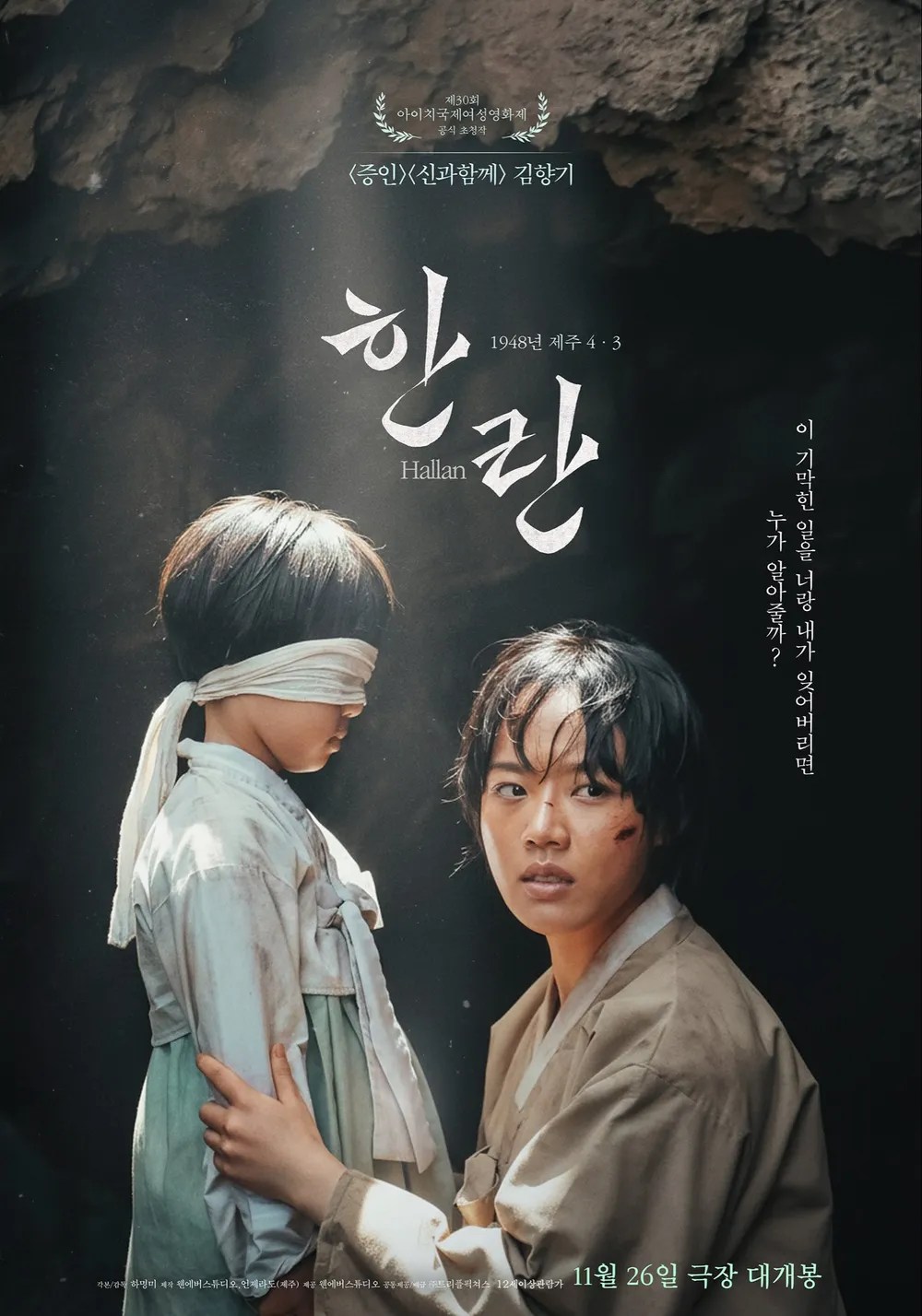
Hallan (한란, Ha Myung-mi, 2025)

Jeju Island had been at the forefront of the resistance to the Japanese during the colonial era and its transition into the new post-war reality had been more orderly than that of the mainland. Nevertheless, the Korea’s sovreingity had not been returned and the South remained under the governance of the occupying American military while the North was controlled by the Soviet Union. Many on the island objected to the proposed elections which were to take place in South only, fearing that it would lead to permanent division of the nation. Once police fired on protestors making the anniversary of the protest movement, an armed conflict arose between guerrilla fighters who took to the mountains and the police and military backed by the extreme right-wing Northwest Youth League that had been dispatched from the mainland to suppress the rebellion.

Ten percent of the island’s population are said to have died during the massacre, with many more fleeing to North Korea or Japan, though the events were suppressed during the long years of military dictatorships with their history little known. Ha Myung-mi’s Hallan (한란) aims to shed light on these historical events by following a collection of ordinary villagers whose peaceful lives are disrupted by a political conflict that some feel to be very distant and not particularly anything to do with them. To that extent, the film aims for a kind of political neutrality in which it depicts the South Korean soldiers and insurrectionists as little different from other. Sergeant Park is a crazed sadist who is drunk on his own power and obsessed with rooting out “commies”, while Jeongnam  is a paranoid authoritarian. Each of them kill members of their own side with little hesitation. Sergeant Park executes a local soldier who advised a collection of elderly people coming down from the mountain in response to a pamphlet promising their lives would be spared if they surrendered, that they shouldn’t trust the military and would be better to remain in hiding. Jeongnam kills a comrade who wants to look for his family fearing he will expose their plan to blow up an army base with dynamite left behind by the Japanese. The only innocents are the apolitical villagers who are caught between the two. 

But in characterising the rebels in this way, the film leans towards favouring the authorities if while denouncing their conduct and subtly implicating the American occupation forces for tacitly backing them. The only source of resistance comes from a conflicted Christian soldier who is racked with guilt over what he’s been asked to do, but still asks God to help him detect communists which suggests he does not necessarily think this actually wrong if the right people are being targeted. Rooting the resistance in faith further muddies the waters and perhaps just introduces a third source of potential authoritarism in the presence of organised religion, while simultaneously adding a subtly anti-communist sentiment.

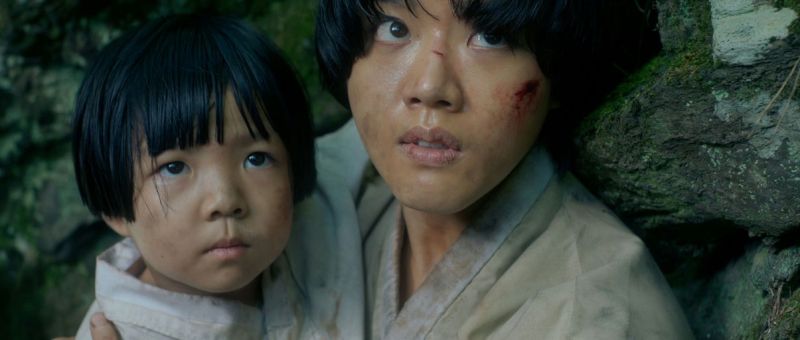
Conversely, the presence of the village’s shamaness adds a slightly less problematic voice of moral authority as she does her best to protect the villagers while staying behind to fulfil her role in service to the gods. Much of the film focuses on a little girl, Hae-sang, trying to find her mother in the mountains after surviving the massacre in her village conducted in retaliation for losses on the army’s side. That she becomes mute after witnessing so much trauma mimics the way in which these events have been suppressed and continue to haunt the island into the present day. Hae-sang’s mother Ajin had wanted a “better world” for her in which she could be educated and wouldn’t necessarily be left with no other option than to be a diver like she was, though the film’s melancholy conclusion largely renders this desire along with the idea of Hae-seng has a historical witness rather moot. Nevertheless, the film takes it’s title from a local wild plant sprouting all over the mountain that comes to stand in for the local people whom the authorities may have attempted to ruthlessly weed out but instead have endured and grown stronger in the face of hardship and adversity.


Hallan screens as part of this year’s New York Asian Film Festival.

Trailer (Korean subtitles only)

HIGUMA!! The Killer Bear (ヒグマ!!, Eisuke Naito, 2025)

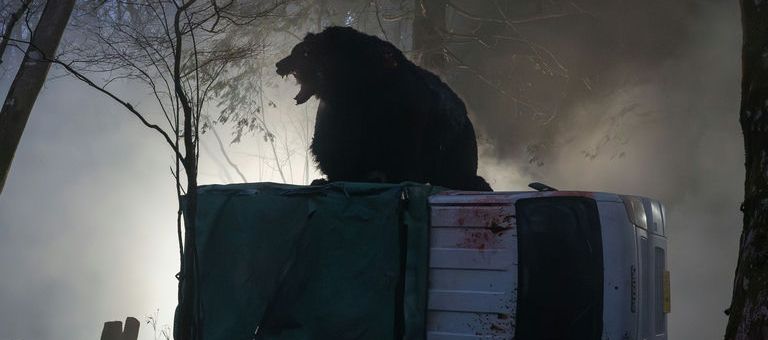
Last year Japanese society was sent into an existential panic due to a severe increase in the number of bear attacks as the creatures were forced to venture beyond their natural habitat due to climate change and the impacts of human behaviour on the rural environment. Eisuke Naito’s Higuma!! The Killer Bear (ヒグマ!!) then arrives at an apt time, though in this case, the bear seems to symbolise something else acting as a kind of karmic supernatural entity attacking those encroaching on its territory while drawn away from the safety of the city by greed and desperation.

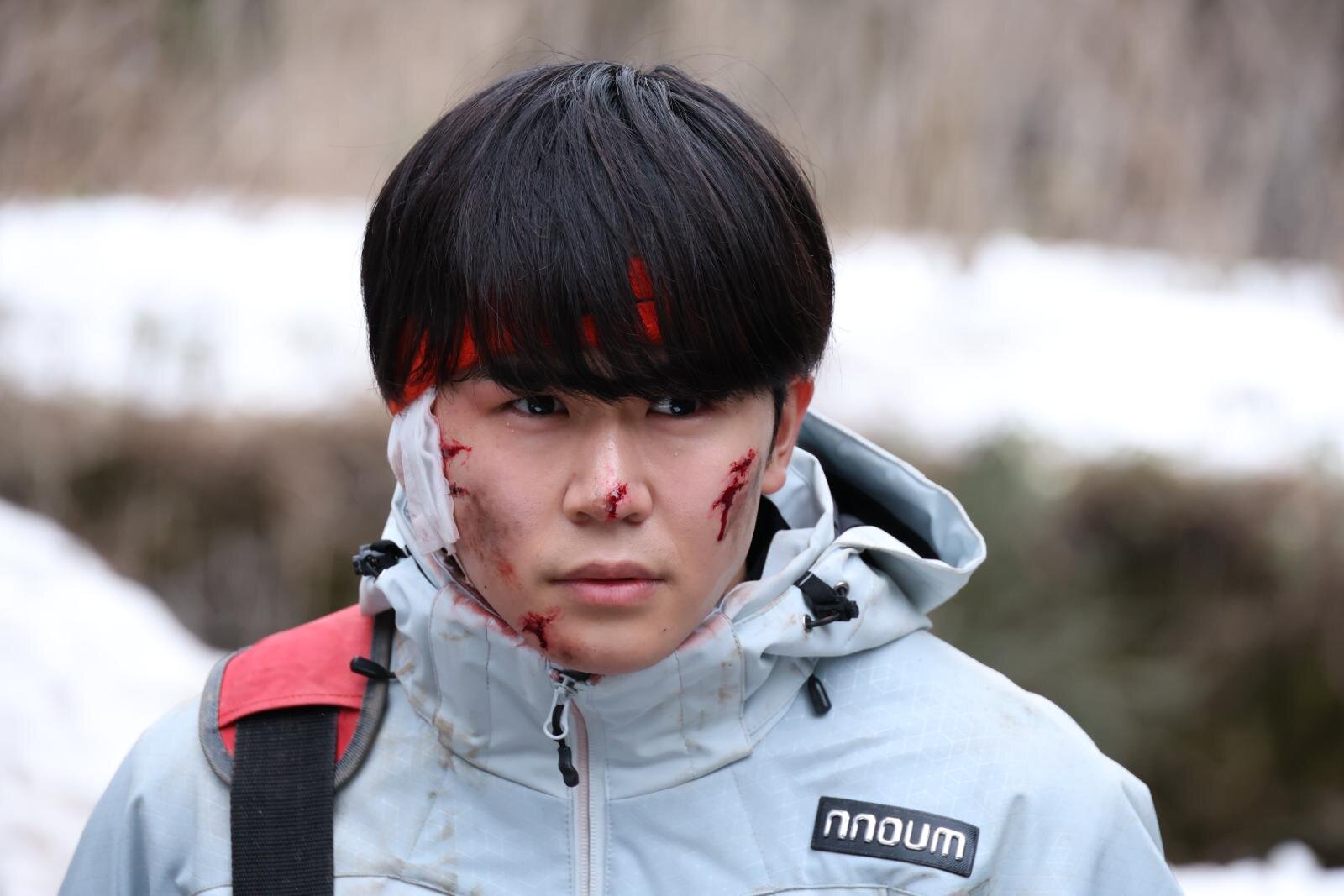
The cities are, it seems, in quite a bad way. Eighteen-year-old Sora (Fuku Suzuki) is an aspiring game developer, though the complaints that his retro 3D-platformer is too hard with janky character design might equally apply to the challenges of modern life. He’s just got into university, but his happiness is short-lived as his father takes his own life shortly afterward having been scammed out of all his savings and therefore unable to pay his son’s tuition fees. While his mother tries to make the best of the situation and insists she’ll figure something out so he can continue with his education, Sora is resentful and angry until unwisely agreeing to a shady job ad promising a large amount of money for delivering “an envelope” to an unspecified location. It’s after this that he’s plunged into a confusing world of backstreet crime, scams, and exploitation that he cannot otherwise escape.

Yet at the same time, this otherworld feels oddly like a video game and is often framed like an old-school arcade scroller, classic first-person shooter, or RPG as Sora is dragged further into this morally compromised sector of society. After being witness to his boss scamming an old lady out of her cash card and ink stamp, he’s charged with retrieving a precious gem from an agent turned rogue that looks a bit like a rupee from the world of Zelda and feels like a video game MacGuffin. The young woman, a former SDF member, decided to keep it for herself having been offered only 30,000 yen to steal it though it’s apparently worth ten million. It turns out that she’s a kind of victim too. Not only was she kicked out of the SDF for punching a superior officer who was sexually harassing her, but has become hooked on a live-streaming host and fallen into financial ruin. This has become such a common problem lately that legislation has been introduced specifically to stop hosts exploiting women and forcing them into sex work. Though Wakabayashi (Wan Marui) knows intellectually that this relationship is entirely one-sided and not actually real, she feels compelled to keep supporting him in part because he was the only person who listened to her worries and accepted her as she was even though she knows this is just part of his job.

That her desire for connection and acceptance can only be fulfilled through a transactional arrangement speaks of an increasing sense of disconnection and alienation just as Sora is dragged into this hellish world through an online ad, never having met his handler who goes by the ironic handle of “Angel”. It’s the need to get rid of Wakabayashi that forces the gang out of their natural habitat and into the bear’s territory of the forest where the human civility that marks urbanity is largely dissolved. Yet there’s a sense of human solidarity that emerges between Sora and Wakabayashi in which they call each other by their own names as they try to battle the bear even if they also give in to their greed by staying in the mountains longer than they need to in order to retrieve the gemstone which the bear has swallowed.

Another kind of human connection is brokered by Sora’s interaction with a young boy who is playing the game he designed. The boy has been told not to talk to strangers or his games will be taken away, but decides to trust Sora and ironically gives him some bear-shaped snacks. He ends up fulfilling the role of a wizard in an RPG, gifting Sora some much needed special items after he manages to beat his own game. This newfound senes of achievement allows Sora to regroup and decide to do the right thing, not only calling his mother to explain what’s going on honestly, but going back to confront the bear and save Wakabayashi. On his way back to the mountain, he passes a collection of elderly people who are running an anti-scammer drill which seems to be organised much like the bear catching drills being run various cities, only in that case, Sora would also be a kind of bear. Filled with darkly absurd humour, the film seems to say man is the most deadly predator and the cities are the place of real danger, but allows Sora to overcome his sense of despair in using his unique and specialist knowledge along with a sense of human solidarity to finally beat back the existential threats of an exploitative society. 


HIGUMA!! The Killer Bear screens as part of this year’s New York Asian Film Festival.

Trailer (English subtitles)

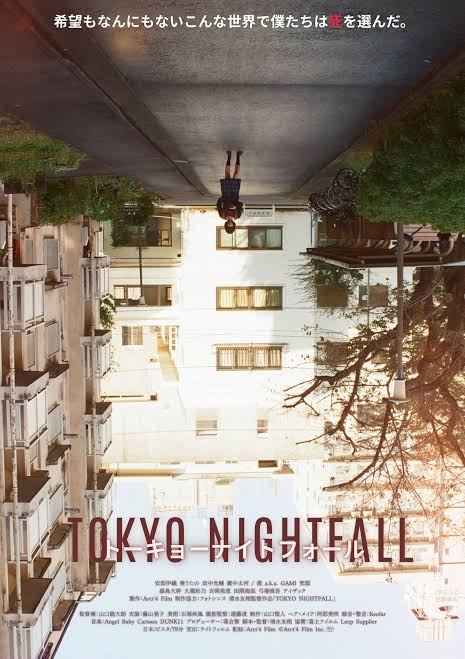
Tokyo Nightfall (トーキョーナイトフォール, Yuto Shimizu, 2026)

Struggling to deal with his feelings of grief and guilt following his younger sister’s suicide, a young man finds himself at an end of the world party for those who want to end their lives in Yuto Shimizu’s melancholy urban drama Tokyo Nightfall (トーキョーナイトフォール). The Tokyo these young people inhabit is one of loneliness and futility in which there is no real hope for future and the past holds only painful memories. 

The bleakness might best be demonstrated by Anna’s (Utano Aoi) reply that her happiest moment in life was her parents’ divorce. The pair hint at a childhood marked by domestic violence, but any hope they might have had for a better future was cut short when Anna witnessed the suicide of a friend of her brother Amenashi (Iori Abe) who jumped from their eighth floor flat. This even seems to have changed Anna who relates that it wasn’t so much the horror or the blood but the fact that she saw a person turn into an object in real time. It made her feel as if being alive wasn’t all that important. 

Working a soulless job as a delivery driver where his clients are often similarly withdrawn or hostile, Amenashi blames himself for Anna’s death and wonders if there was something more he could have done to prevent it while drawn into the same kind of darkness she was. Amenashi’s friend, Hattori (Taiga Hironaka), even states that he is worried about him because his erratic behaviour reminds him of that of Anna shortly before she died. It seems that the party he goes to a gathering for those planning to end their lives where they can have one last night of fun before they go.

Amenashi goes to the party, but is followed by his friends Hattori and Nozu (Kosuke Tanaka) who don’t quite know what the party is, but just want to find their friend. While Nozu, otherwise a comic relief character giving lewd and disgusting answers to the questions put to him, Nozu too sets out to enjoy the night even bonding with a young woman, but is also drawn into the darkness of the evening and reconsiders his own life. Others in the club react with irritation, telling Hattori he should respect his friend’s decision and has no business being here. Haunted by visions of Anna, Amenashi remains uncertain not quite knowing whether to live or die. Another guest at the club tells him that he should forget about this cold world and stay with them, dragging him over to the side of death, while Hattori does him best to encourage him to live.

The video camera sequences play out as a kind of will as Anna, Hattori, and Nozu look back over their lives. Shimizu sometimes replays the same video only to let the conversation run to add more information that changes our impressions of what’s gone before. Speaking about their happiest and saddest moments, the friends paint a bleak picture of familial disconnection and loneliness but are saved only by their bond with each other as Hattori names his happiest moment as spending time on the roof with them.

The irony is that may not be enough. The ghost of Anna tells Amenashi that neither choice is wrong and the film is non-judgemental about the idea of suicide, perhaps feeling that those who make the deacon to leave should be allowed to do so while Amenishi wrestles with himself about the right thing to do. Others may have the decision taken away from them, but he does at least have the power to decide his own future. Hattori had told him that there may be no point in thinking. People are full of contradictions and don’t even understand themselves. “We are here for each other,” Nozu adds, offering the only possible source of salvation in a world that otherwise seems hopeless and devoid of possibility. As Amenashi cycles around the city, he looks on at young couples and is struck by a sense of urban disconnection and loneliness, but does perhaps begin to rediscover something of the will to live in the power of friendship and the memories of those he’s lost, if perhaps only too late.


Tokyo Nightfall screened as part of this year’s Raindance Film Festival.

Trailer (English subtitles)

The Unluckiest Girl in the World (Ryosuke Hayazaka, 2026)

Sachiko Yamanoura feels herself to be the unluckiest person in the world. Her unluckiness may tens towards the superficial in that she has terrible luck with men and is the sort of person who always manages to step in gum and pick the tako-less takoyaki, but her perception of it seems to be impacting her quality of life This is partly because she has an odd conception of the world in which she believes that fate is decided by gacha capsule toys and therefore exercises very little agency over her life to the extent that she is continually unable to break up with her financially exploitative boyfriend who not only forgets her birthday, but chooses that particular day to bring another woman back to their flat.

It’s this romantic dimension that occupies most of Ryosuke Hayazaka 50-minute drama as Sachiko is abruptly hit by car and wakes up in an afterlife where a smartly suited version of herself invites her to choose a new lover for her next life from the Gacha Life machine. It apparently contains only men she is compatible with and therefore allows her to experience what it would actually be like to date them as a sort of advanced mental fantasy. What quickly becomes clear, however, is that none of these men are very good options for her and even the ones who looked good on the surface had hidden issues. She briefly considers dating her 45-year-old boss who did actually remember her birthday and otherwise appears to be kind and considerate, but it turns out that he is already married and fleeing domestic responsibility after his wife has given birth to their first child.

The real issue is that she’s still dealing with the fallout from the abrupt disappearance of her fiancé three years previously who left alone to travel the world the morning after proposing to her. When he suddenly reappears, she considers picking up where they left off but is continually insecure that he will suddenly disappear again. A popular influencer host, meanwhile, offers the opposite sort of comfort in making it his business to tell her what she wants to hear in soft and non-threatening tones while all the while planning to exploit her by recruiting her as a member of his cult-like pyramid scheme selling lucky water. A student she interviews at her company similarly claims that luck is his special skill, but when she considers dating him, she finds out that he’s overtly close with his mother and she’d need to pass an interview with her first if she wanted to be his girlfriend.

A series of speed dates provide a little more real life detail as Sachiko is subjected to the obviously married guy, the bully who insists no one else is going to want to date her, the guy who wants an open relationship, and the evangelistic polygamist who wants her join him in a new era. She certainly does seem to be unlucky in drawing all these men none of whom seem to be very viable prospects for a long-term relationship or even genuine romantic connection. But at the same time, it’s entrusting her life to luck that put Sachiko in this position. If she accepted that luck was something she could make for herself rather than continually accepting an unsatisfying status quo and basically allowing all these men to treat her badly, she might be able to find a degree of satisfaction in her life that may or may not include romance. 

Each of the rounds included the option to “pass”, but really Sachiko had that all along without really realising. Eventually she realises she doesn’t really need to pick any of these men and is free to stop drawing gacha rather than constantly waiting for the machine to spit out the winning ball. Shot in a 1:1 frame to mimic an Instagram reel, the film has a youthful, contemporary vibe informed by current dating mores and though it may present a rather bleak view of the prospect of romantic fulfilment in a chauvinistic society does at least allow the heroine to recover herself esteem and finally break up with her no-good boyfriend, refusing to let luck rule her life and finally taking control of her own destiny. 


The Unluckiest Girl in the World screened as part of this year’s Raindance Film Festival.

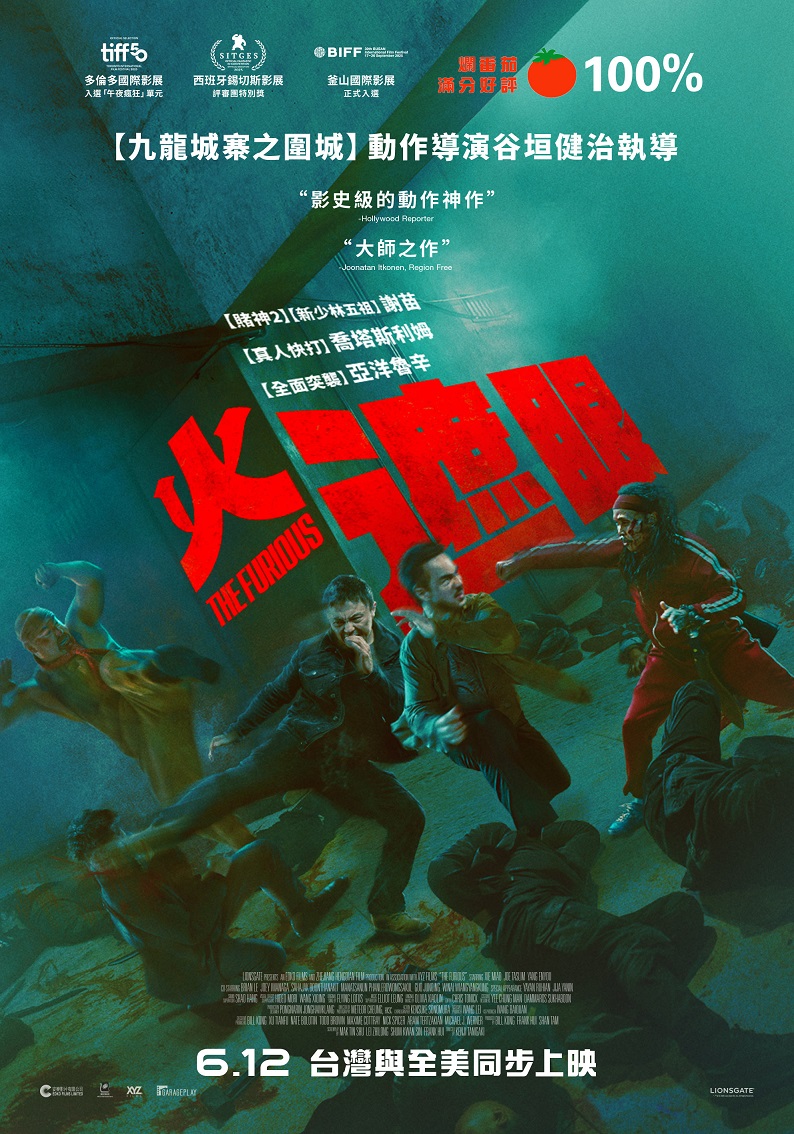
The Furious (火遮眼, Kenji Tanigaki, 2025)

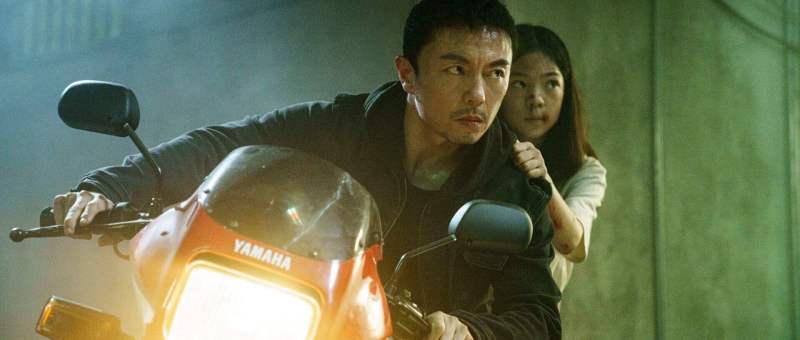
A gang of child traffickers kidnap the wrong man’s daughter in Kenji Tanigaki’s non-stop action thriller, The Furious (火遮眼). Once again set in a fictional South East Asian nation, the film sees two men team up against a world of corruption as the last line of defence rescuing kidnapped kids and returning them to their families but in return incurring the wrath of the powers that be who are all too happy go along with traffickers for the financial benefits it offers.

Wang Wei (Xie Miao) is living in South East Asia while seemingly unable to return to China for unclear reasons with the implication that he is some kind of fugitive. His young daughter Rainy (Yang Enyou), who lives with her grandmother on the Mainland, has been staying with him for the summer and constantly begs Wang either to return to China with her or let her stay here with him. Wang rejects both of these options while insisting that Rainy learn kung fu so that she is able to defend herself in his absence, though she claims that she actually hates it and sees her training only as a means of being able to spend time with her father. 

In some ways, and a little uncomfortably, Wang’s desire to train his daughter for independence is depicted as a rejection of his paternal responsibilities while Rainy rejects it in favour of a more traditional femininity, reusing to get her hair cut short out of fear her classmates will make fun of her. It’s after an argument about the haircut that Rainy is lured by the traffickers having stormed out of the hairdressers while the neighbourhood aunties stop Wang going after her, assuring him that she’s just at that age and needs some space to blow off steam. Rainy’s skills might not be enough to protect herself against the traffickers and may even in a way endanger her when she actively tries to fight adult men much bigger and stronger than herself, but do perhaps give her confidence to continue trying to escape.

Wang, meanwhile, tries to report Rainy’s kidnapping to the police but finds them entirely uninterested with the police chief actively telling him that his complaint is unimportant. Seeing a large wall full of missing child posters convinces him that if he wants his daughter back, he’ll have to get her himself. The film suffers from the decision to have a large part of the dialogue in English with several lines unconvincingly dubbed which is likely intended to play into the idea of this place being a melting pot of cultures and languages in addition to a hub for a crime network stretching across Asia with incidental dialogue from the trafficking gang offered in Tagalog. The implication is then that fail son-in-law Paklung was sent to the US for an international education but is unable to integrate into this gangster society, engaging in the taboo activity of child trafficking and causing his father-in-law to suggest making him the fall guy. Paklung, however, cannot accept this rejection and goes on a sociopathic rampage that ironically destroys the future he had dreaming of.

On the other hand, the resolution lies in a defiance of authority as an earnest police woman gains the courage to turn against the corrupt police chief partly thanks to rising public resentment generated by the disappearance of a reporter who was investigating the trafficking ring and live streams from her husband Navin who is trying to find her. Frustrated father son relationships become something of a theme with giant-baby like henchman Ho also seeking revenge for the death of his father, killed by Paklung’s arrow-wielding minion, Tak (Yayan Ruhian). 

The fact is that no had really cared much about these children because they were poor and were viewed as disposable, though it is surprising in a way that the gang wouldn’t just give up Rainy rather than go to the bother of dealing with Wang. Though he had refused to go back and help the old woman in the opening sequence, telling Rainy that it was none of their business, Wang’s sense of responsibly is reawakened by Rainy’s desire to go back and save the other kids while extending a hand of friendship towards the boy who tricked her in the knowledge that he didn’t really have much choice either and lacked the courage to resist because he was alone and was only trying to survive. The brutal and frenetic action sequences reflect the nihilism of the world of the world around them in which Wang and Navin face attacks from all sides and seemingly immortal opponents while mustering all of their strength and ingenuity to protect those closet to them.


Trailer

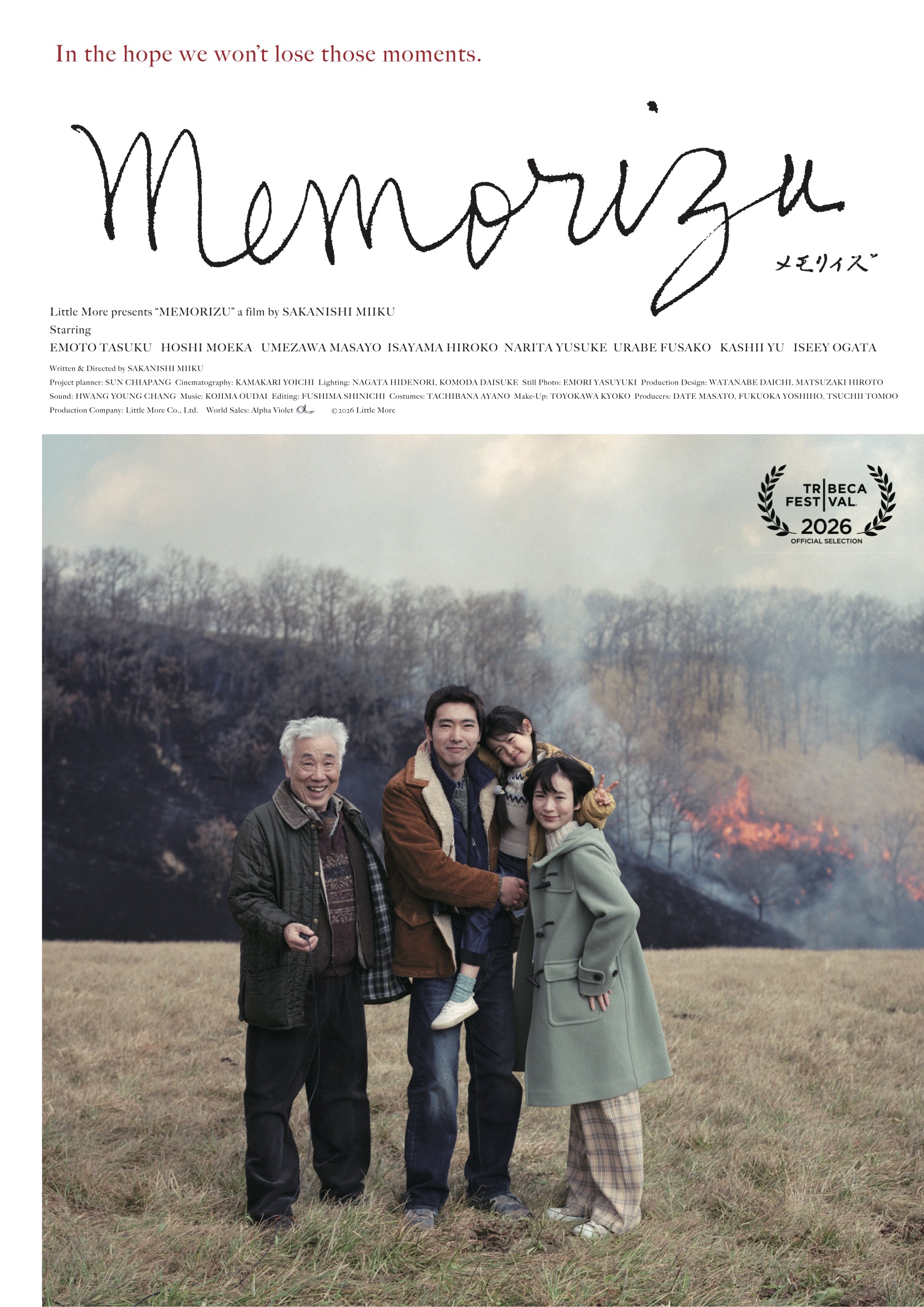
Memorizu (メモリィズ, Miiku Sakanishi, 2026)

Trying to calm a nervous groom, ageing photographer Makoto (Issei Ogata) tells him that he also took his grandfather’s wedding pictures in a moment that speaks of several kinds of continuity all at once. Yet why is that we take photos? Is it for ourselves, as a kind of proof of existence “to remember we were here,” or so that we can share these moments with others and create shared memories to paper over the rift of absence?

The weight of nostalgia hangs heavy over Makoto’s photography studio, but the irony is that it’s son-in-law, Yuta (Tasuku Emoto), who’s come to look after him while he recuperates after breaking a leg, and therefore has no particular attachment to this place or the landscape given that it is not the place where he grew up. Nevertheless, this sense of distance is perhaps why Yuta finds himself taking photos on his smartphone and documenting his daily live in the peaceful rural environment as a means of keeping in touch with his wife, Yuki (Moeka Hoshi), and daughter, Hana, who were supposed to be coming with him but had to cancel at the last moment.

These photos are often spontaneous and sparked by the desire to share a moment or re-experience it later, whereas the photographs taken at Makoto’s studio are more deliberate. Someone has made a decision to have their photo taken either for a prosaic reason such as an application form, or because they too want to mark an important event like a wedding or the birth of a child. These are not events that anyone is likely to forget, but the physical object of the photograph becomes a repository for the emotions the subjects and photographer were feeling at that moment which might otherwise me transitory but can now be re-accessed through film.

The same can be true of the photos and videos Yuta takes on his phone which enable a kind of time lapse communication between himself and his family in which one can be both present and absent at the same time. Yet there’s an implication that the ease with which we take photos in the present day has diluted has their potency. Yuki calls up the photo app on her phone is ad plunged into a sea of images, mainly of her young daughter, so many that she will likely never open most of them again while the vastness of the archive might discourage looking at any of them at all beyond the already visible thumbnail. 

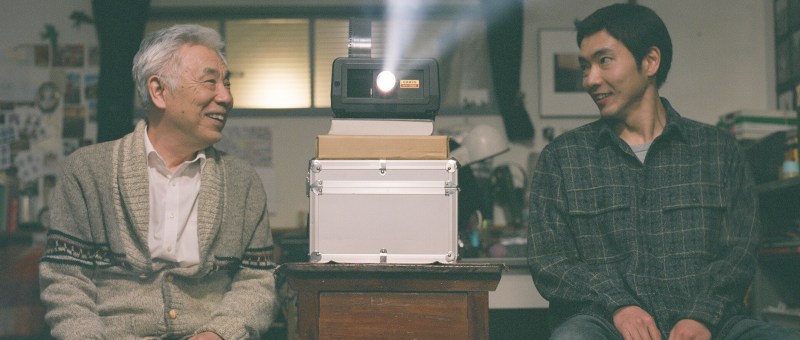
Even so, there’s a degree of poignancy in Makoto getting out the slide projector to show Yuta old pictures of his later wife and Yuki as a child as we see the same images recreated by the adult Yuki and Hana making exactly the same trip with the images appearing in Yuta’s mind like photographs. As Shiori and the young Yuki move further and further away from the camera, there’s a sense of continuing in these repeated images like a film negative running through a projector as one generation slowly replaces another. Though Shiori is already gone, her presence is felt through its absence in the empty seat next to Makoto as he remembers the time they saw a burning field, or her coat still hanging on the wall now on its own as Makoto has given his jacket to Yuta.

The gift of the jacket furthers Yuta’s identification with Makoto, though as one might expect the situation is a little awkward to begin with. Nevertheless, as he settles into the relaxed pace of rural life, the pair begin to bond and develop a familial relationship of their own. Sakanishi bookends the film with scenes of open windows, the first that of a ferry looking out onto the sea. Its rounded corners give it the aesthetic of film while the scene constantly changes to explore how various people react to it. Some look out on the sea as they eat, others more or less ignore it or get on with their work. The closing shot, meanwhile, is a timelapse photo through Makoto’s bedroom window capturing the changing seasons. The lesson is perhaps that the human eye is also a camera and that our lives our made up of these small, barely memorable moments that can nevertheless amount to something greater than ourselves. 


Trailer (English subtitles)