
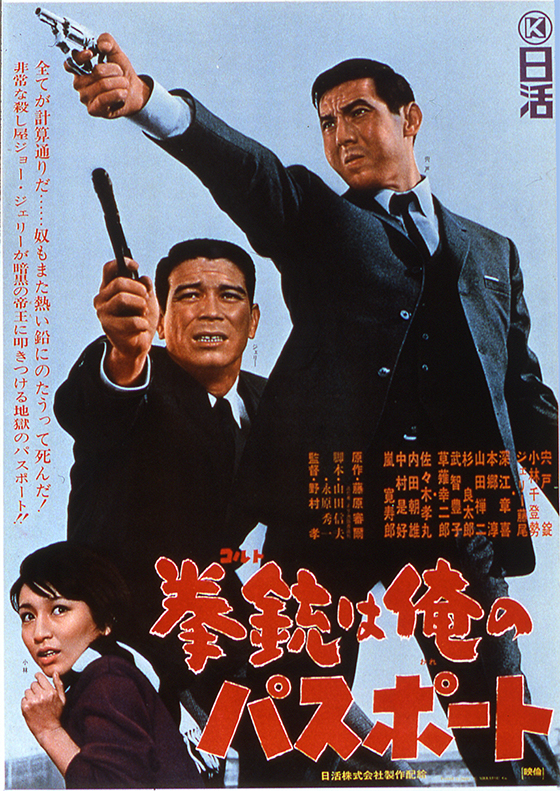
 Jo Shishido played his fare share of icy hitmen, but they rarely made it through such seemingly inexorable events as the hero of Takashi Nomura’s A Colt is My Passport (拳銃は俺のパスポート, Colt wa Ore no Passport). The actor, known for his boyishly chubby face puffed up with the aid of cheek implants, floated around the lower end of Nikkatsu’s A-list but by 1967 his star was on the wane even if he still had his pick of cooler than cool tough guys in Nikkatsu’s trademark action B-movies. Mixing western and film noir, A Colt is My Passport makes a virtue of Japan’s fast moving development, heartily embracing the convenience of a society built around the idea of disposability whilst accepting the need to keep one step ahead of the rubbish truck else it swallow you whole.
Kamimura (Joe Shishido) and his buddy Shiozaki (Jerry Fujio) are on course to knock off a gang boss’ rival and then get the hell out of Japan. Kamimura, however, is a sarcastic wiseguy and so his strange sense of humour dictates that he off the guy while the mob boss he’s working for is sitting right next to him. This doesn’t go down well, and the guys’ planned airport escape is soon off the cards leaving them to take refuge in a yakuza safe house until the whole thing blows over. Blowing over, however, is something that seems unlikely and Kamimura is soon left with the responsibility of saving both his brother-in-arms Shiozaki, and the melancholy inn girl (Chitose Kobayashi) with a heart of gold who yearns for an escape from her dead end existence but finds only inertia and disappointment.
The young protege seems surprised when Kamimura tosses the expensive looking rifle he’s just used on a job into a suitcase which he then tosses into a car which is about to be tossed into a crusher, but Kamimura advises him that if you want to make it in this business, you’d best not become too fond of your tools. Kamimura is, however, a tool himself and only too aware how disposable he might be to the hands that have made use of him. He conducts his missions with the utmost efficiency, and when something goes wrong, he deals with that too.
Efficient as he is, there is one thing that is not disposable to Kamimura and that is Shiozaki. The younger man appears not to have much to do but Kamimura keeps him around anyway with Shiozaki trailing around after him respectfully. More liability than anything else, Kamimura frequently knocks Shiozaki out to keep him out of trouble – especially as he can see Shiozaki might be tempted to leap into the fray on his behalf. Kamimura has no time for feeling, no taste for factoring attachment into his carefully constructed plans, but where Shiozaki is concerned, sentimentality wins the day.
Mina, a melancholy maid at a dockside inn, marvels at the degree of Kamimura’s devotion, wishing that she too could have the kind of friendship these men have with each other. A runaway from the sea, Mina has been trapped on the docks all her adult life. Like many a Nikkatsu heroine, love was her path to escape but an encounter with a shady gangster who continues to haunt her life put paid to that. The boats come and go but Mina stays on shore. Kamimura might be her ticket out but he wastes no time disillusioning her about his lack of interest in becoming her saviour (even if he’s not ungrateful for her assistance and also realises she’s quite an asset in his quest to ensure the survival of his ally).
Pure hardboiled, A Colt is My Passport is a crime story which rejects the femme fatal in favour of the intense relationship between its two protagonists whose friendship transcends brotherhood but never disrupts the methodical poise of the always prepared Kamimura. The minor distraction of a fly in the mud perhaps reminds him of his mortality, his smallness, the fact that he is essentially “disposable” and will one day become a mere vessel for this tiny, quite irritating creature but if he has a moment of introspection it is short lived. The world may be crunching at his heels, but Kamimura keeps moving. He has his plan, audacious as it is. He will save his buddy, and perhaps he doesn’t care too much if he survives or not, but he will not go down easy and if the world wants a bite out of him, it will have to be fast or lucky.
Original trailer (no subtitles)

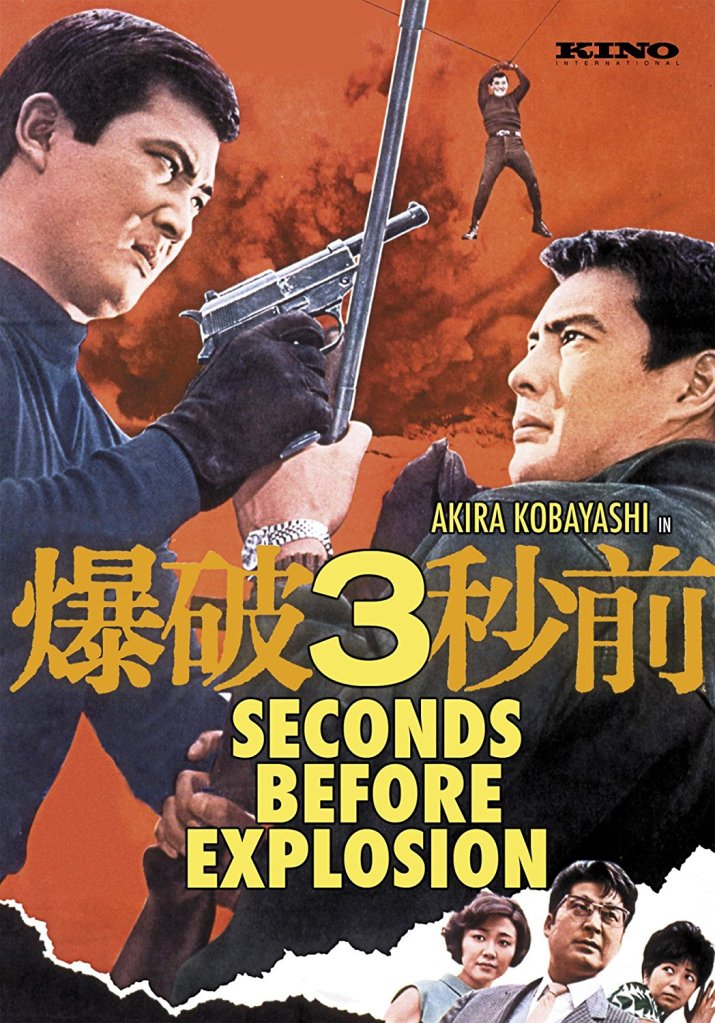 If Nikkatsu Action movies had a ringtone it would probably just be “BANG!” but nevertheless you’ll have to wait more than three rings for the Kaboom! in the admittedly cartoonish slice of typically frivolous B-movie thrills that is 3 Seconds Before Explosion (爆破3秒前, Bakuha 3-byo Mae). Once again based on a novel by Japan’s master of the hard boiled Haruhiko Oyabu, 3 Seconds Before Explosion is among his sillier works though lesser known director Motomu Ida never takes as much delight in making mischief as his studio mate Seijun Suzuki. What he does do is make use of Diamond Guy Akira Kobayashi’s boyish earnestness to keep things running along nicely even if he’s out of the picture for much of the action.
 Yukio Mishima’s Temple of the Golden Pavilion has become one of his most representative works and seems to be one of those texts endlessly reinterpreted by each new generation. Previously adapted for the screen by Kon Ichikawa under the title of
 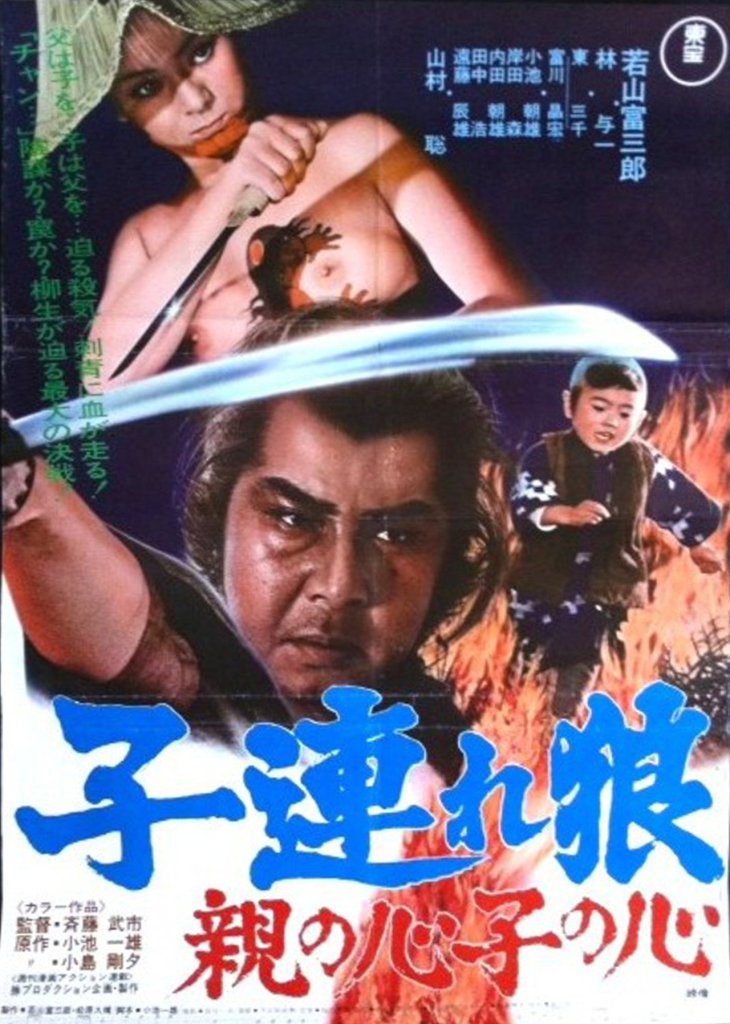 Now four instalments into the Lone Wolf and Cub series, Ogami (Tomisaburo Wakayama) and Daigoro (Akihiro Tomikawa) have been on the road for quite some time, seeking vengeance against the Yagyu clan who framed Ogami for treason, murdered his wife, and stole his prized position as the official Shogun executioner. Lone Wolf and Cub: Baby Cart in Peril (子連れ狼 親の心子の心, Kozure Okami: Oya no Kokoro Ko no Kokoro) is the first in the series not to be directed by Kenji Misumi (though he would return for the following chapter) and the change in approach is very much in evidence as veteran Nikkatsu director Buichi Saito picks up the reins and takes things in a much more active, full on ‘70s exploitation direction. Where
 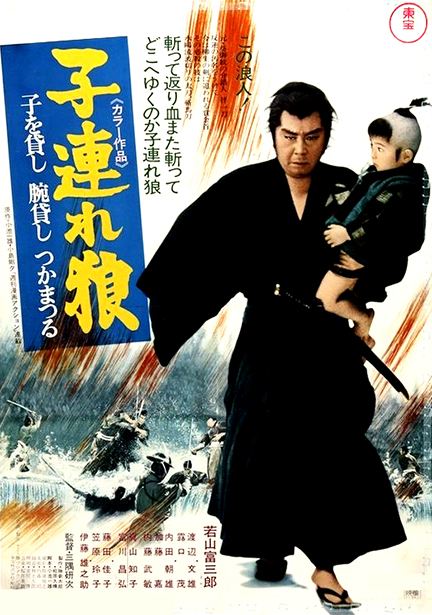 When it comes to period exploitation films of the 1970s, one name looms large – Kazuo Koike. A prolific mangaka, Koike also moved into writing screenplays for the various adaptations of his manga including the much loved Lady Snowblood and an original series in the form of Hanzo the Razor. Lone Wolf and Cub was one of his earliest successes, published between 1970 and 1976 the series spanned 28 volumes and was quickly turned into a movie franchise following the usual pattern of the time which saw six instalments released from 1972 to 1974. Martial arts specialist Tomisaburo Wakayama starred as the ill fated “Lone Wolf”, Ogami, in each of the theatrical movies as the former shogun executioner fights to clear his name and get revenge on the people who framed him for treason and murdered his wife, all with his adorable little son ensconced in a bamboo cart.
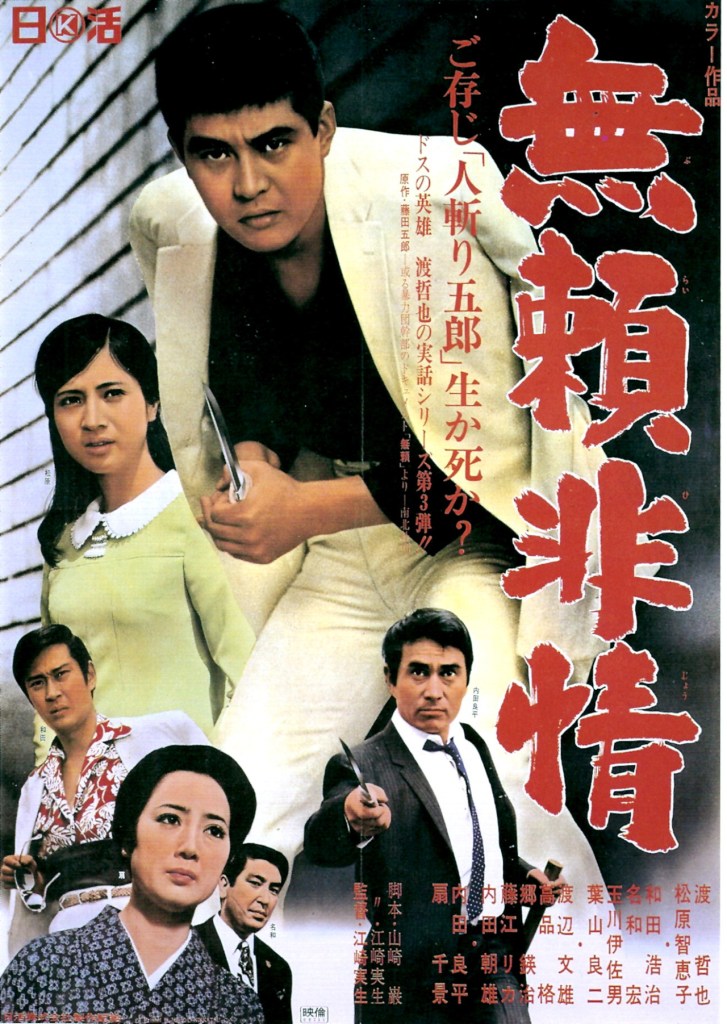 Things take a slight detour in the third of the Outlaw series this time titled “Heartless” (大幹部 無頼非情, Daikanbu Burai Hijo). Rather than picking up where we left Goro – collapsed on a high school volleyball court, it’s now 1956 and we’re with a guy called “Goro the Assassin” but it’s not exactly clear is this is a side story or perhaps an entirely different continuity for the story of the noble hearted gangster we’ve been following so far. The only constant is actor Tetsuya Watari who once again plays Goro Fujikawa but in an even more confusing touch the supporting characters are played by many of the actors who featured in the first two films but are actually playing entirely different people….
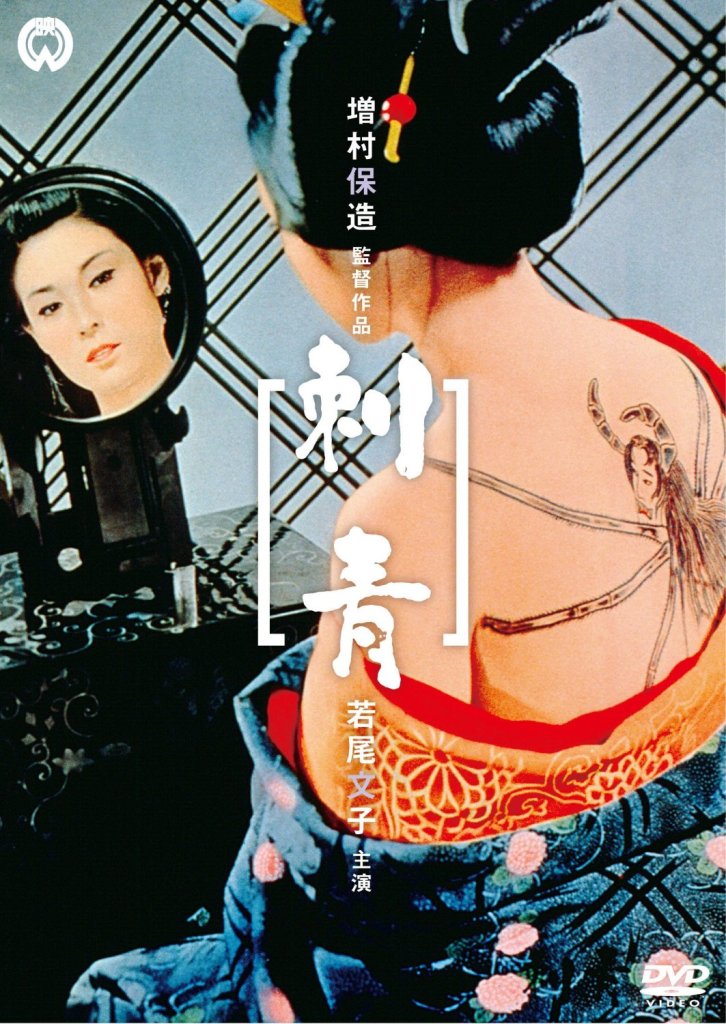 Irezumi (刺青) is one of three films completed by the always prolific Yasuzo Masumura in 1966 alone and, though it stars frequent collaborator Ayako Wakao, couldn’t be more different than the actresses’ other performance for the director that year, the wartime drama
 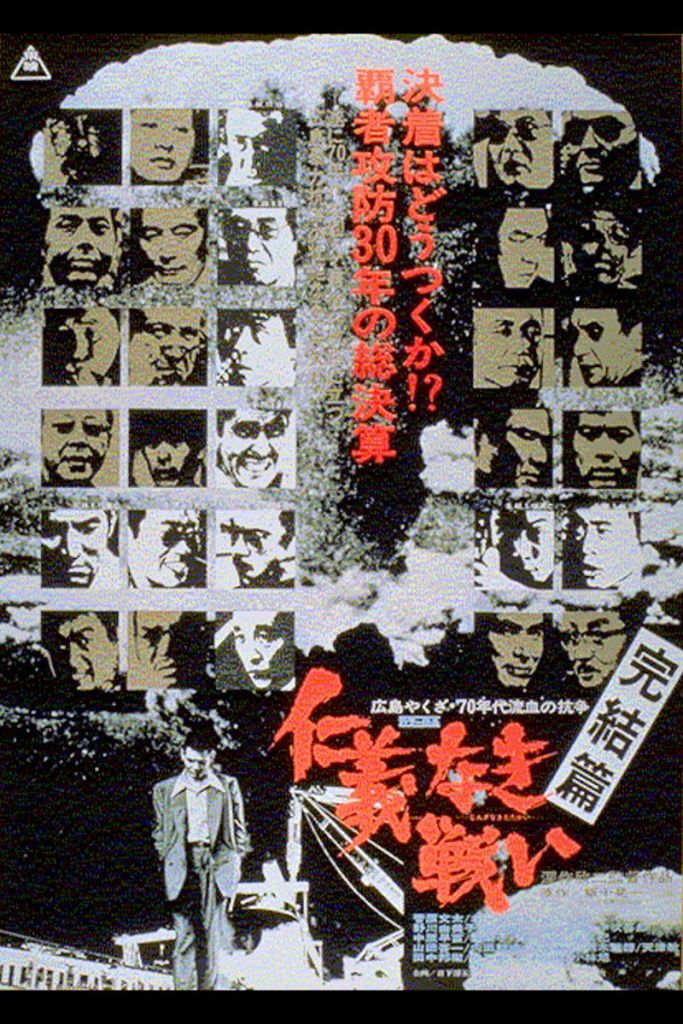 And so, the saga finally reaches its conclusion. Final Episode (仁義なき戦い: 完結篇, Jingi Naki Tatakai: Kanketsu-hen) brings us ever closer to the contemporary era and picks up in the mid ‘60s where Hirono is still in prison and Takeda, released on a technicality, has decided to move the yakuza into the legit arena. The surviving gangs have united and rebranded themselves as a political group known as the Tensei Coalition. However, not everyone has joined the new gangsters’ union and the enterprise is fragile at best.
 Windows on Worlds