Jungle Block (地図のない町, Ko Nakahira, 1960)

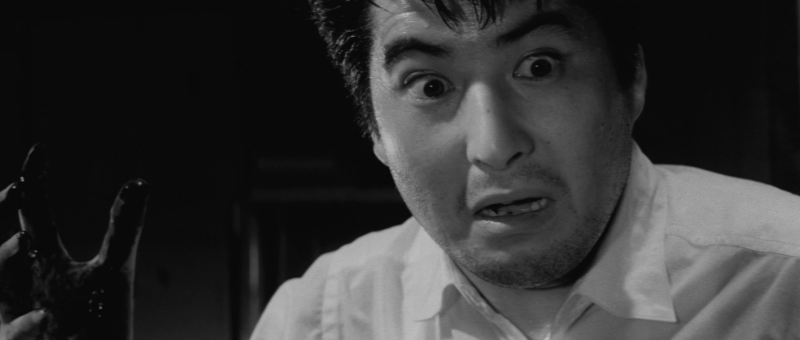
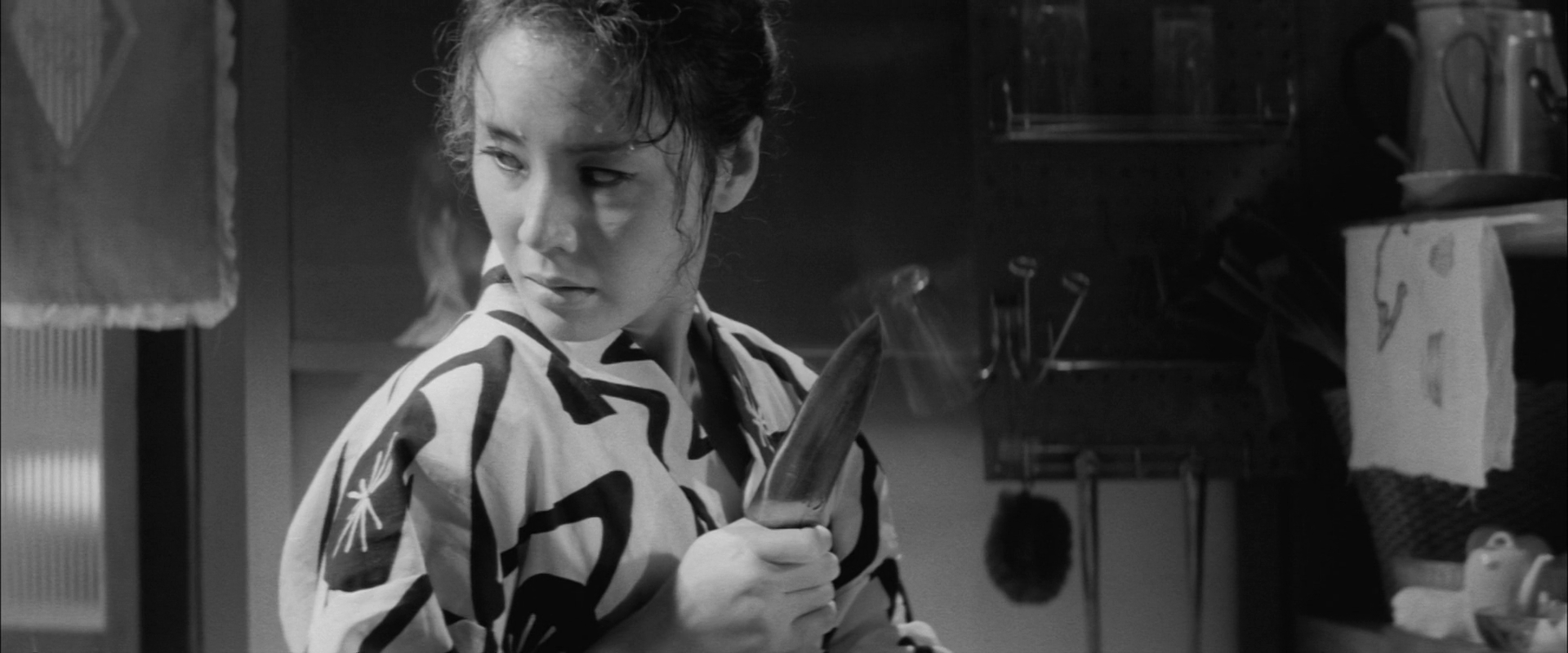
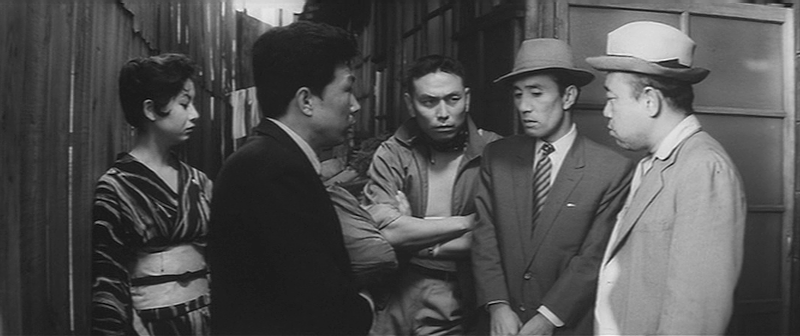
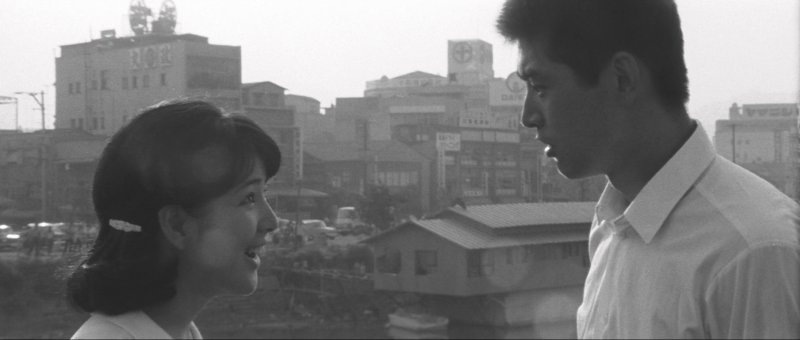
The contradictions of the post-war era are thrown into stark relief in the forced redevelopment of slum area on the edge of an increasingly prosperous city in Ko Nakahira’s intense noir, Jungle Block (地図のない町, Chizu no nai Machi). The slightly unfortunate English title may hark back to that chosen for a US screening of Nakahira’s landmark film Crazed Fruit, Juvenile Jungle, or just echo the titles of classic Hollywood noir movies such as Asphalt Jungle and Blackboard Jungle, but otherwise has little to do with the content of the film. The Japanese title, meanwhile, means something like “a town not marked on the map” and hints at the invisibility of those who live in this slum, a self-built post-war shantytown inhabited by those largely left behind by the nation’s rising prosperity. 

Then again, Shinsuke (Ryoji Hayama) seems to have fallen behind on his own account. We’re later told that he resigned from his position at the hospital because of some kind of medical mistake for which he blames himself and has since taken to drink and gambling while working at the poor clinic run by his former mentor Kasama. The most immediate effect of his, perhaps unnecessary, decision to resign was that it prevented the marriage of his younger sister, Sakiko (Kazuko Yoshiyuki), as he was then financially dependent on her. Having delayed the wedding for two years waiting for Shinsuke to pull himself together, Sakiko and her fiancé are set upon by local gangsters working for yakuza turned politician and legitimate businessman Azusa (Osamu Takizawa). Sakiko attempts to take her own life and the relationship does not survive this crisis thanks to her fiancé’s wounded masculinity in having been unable to save her or stand up to the goons afterwards. 

As repeated flashbacks reveal, Azusa is the root of the disease spreading across the city. It’s he that’s intent on clearing the slum, as he says just doing what the government has asked him to do, planning to build luxury apartments on its site along with supermarkets and entertainment facilities. Perhaps it’s not an entirely bad thing to clear a slum, the living conditions are in themselves a health hazard, but Azusa has drastically cut the amount of compensation on offer preventing the residents from securing new places to live and essentially rendering them homeless which defeats the humanitarian justification for forcing them out when most of them don’t want to go. 

Kayoko (Yoko Minamida), an old flame of Shinsuke’s who’s since become a sex worker to pay off her father’s debts to loan sharks and ends up as Azusa’s mistress, has a cat that she confesses to mistreating which makes her feel better only to feel terrible afterwards. The film seems to align the cat with the people of the slums who are bullied by men like Azusa who have untold influence buying off police and politicians while he himself later holds public office. The cat eventually fights back by scratching Kayoko who acknowledges it’s her own fault for her treatment of it, while it’s clear that the anger of the slum dwellers will eventually boil over and they too will strike back against the corruptions of this post-war era which otherwise sees fit to leave them behind. 

Meanwhile, Shinsuke plots a revenge he may not have the courage to take explaining to Kasama (Jukichi Uno), otherwise the voice of moral reason, that it’s the city that sick and the only way to save it is an operation to remove the Azusa-shaped tumour that’s currently killing it. It’s not for mere convenience that his weapon of choice is a scalpel. Kasama, however, tells him that he’s got the wrong idea and it’s their responsibility as doctors to take the long-term view and patiently run their clinic to produce results in the far off future. But Kasama’s eventual decision would seem to walk that back, suggesting that perhaps a radical solution really is necessary to save the patient from the ravages of amoral capitalism. 

Then again, like Kayoko’s father Yoshichi (Jun Hamamura) who is branded a “cripple” and “only half a man” by Azusa, Shinsuke begins to realise that perhaps you can’t create lasting change on your own and taking out Azusa won’t solve the problem as someone else will simply rise to take his place. There is a pervasive sense of hopelessness, Shinsuke caught and frantic amid the dim backstreets of this rundown town desperate for revenge when the police are in league with Azusa and no one really cares about the residents of the slum who are beginning to lose the will to resist. Nevertheless, eventually rediscovering himself Shinsuke opts to follow Kasama’s path insisting that will join the ranks of “good, honest, people” who, like the cat, will eventually scratch back until then resisting by “doing the right thing” even in the face of violence and intimidation while staunching the flow of corruption and cruelty from the seeping wounds of the post-war society.


DVD release trailer (no subtitles)

The Wolves (狼, Kaneto Shindo, 1955)

Post-war desperation drives a collection of otherwise honest men and women towards a criminal act that for all its politeness they are ill-equipped to live with in Kaneto Shindo’s biting social drama The Wolves (狼, Okami). “Wolves” is what the criminals are branded, but the title hints more at the wolfish society which threatens to swallow them whole. After all, it’s eat or be eaten in this dog eat dog world, at least according to a cynical insurance salesman hellbent on exploiting those without means. 

Each of the five “criminals” is an employee at Toyo Insurance where they’re immediately pitted against each other, reminded that in order to qualify for a full-time position they need to meet their quotas for six months. The orientation meeting is cultilke in its intensity, the boss insisting that only in insurance can you become a self-made man while recounting his own epiphany as to the worthiness of his profession. They are told that the only two things they need are “faith and honesty”, and then “faith and pursuasion”, while encouraged to think of their work as an act of “worship”, “for the salvation of everyone”. 

Yet they’re also told to exploit their friends and family by pressuring them into taking out life insurance policies in order to help them meet their quotas. As one man points out, friends and relatives of the poor are likely to be poor themselves, but these are exactly the kind of people they’re expected to target. They’re told there’s no point going after the weathly because they’re already insured, but there’s something doubly insidious in trying to coax desperate people who can’t quite afford to feed themselves into paying out money they don’t have on the promise of protecting their families from ruin. One man even asks if the policy covers suicide and is told it does if you pay in for a year, sighing that he doesn’t want to wait that long.

“Suicide or robbery, choose one,” one of the salespeople reflects after failing to make their quota once again. They each have reasons to be desperate, all of them already excluded from the mainstream society and uncertain how they will find work if the job falls through. Akiko (Nobuko Otowa) is a war widow with a young son who is being bullied at school because of his cleft palate for which he needs an expensive operation. She’s already tried working as a bar hostess but is quiet by nature and found little success with it. Fujibayashi (Sanae Takasugi) is widowed too with two children and five months behind rent for a dingy flat in a bomb damaged slum where the landlord is about to turn off her electric. Harajima (Jun Hamamura) used to work in a bank but was fired for joining a union and is trapped in a toxic marriage to woman looking for material comfort he can’t offer. Mikawa (Taiji Tonoyama) too is resented by his wife, a former dancer, having lost his factory job to a workplace injury while the ageing Yoshikawa (Ichiro Sugai) was once a famous screenwriter but as he explains people in the film industry turn cold when you’re not hot stuff any more. 

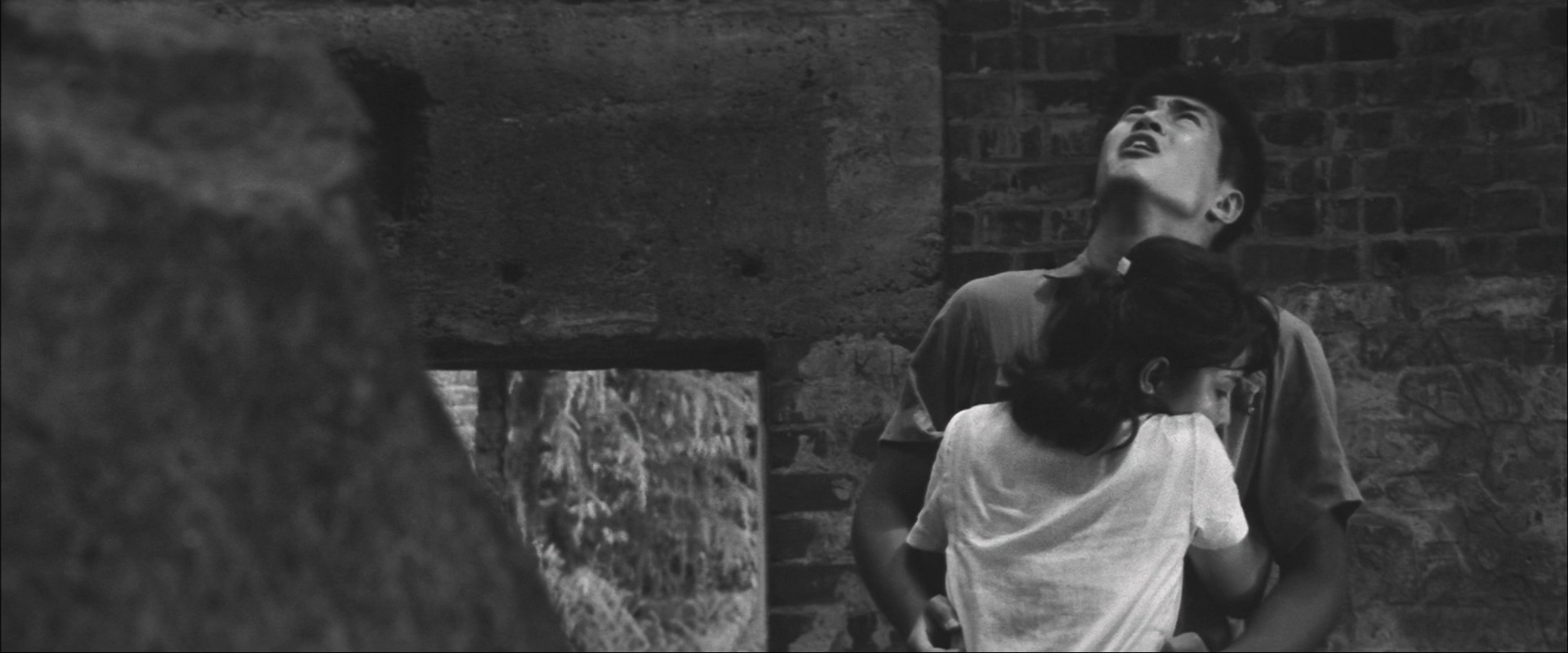
Their unlikely descent into crime has its own kind of inevitability in the crushing impossibility of their lives. They may rationalise that what they’re doing is no different from the insurance company that exploits the vulnerable for its own gain, thinking that if they can just get a little ahead they’d be alright while feeling as if robbery and suicide are the only choices left to them and at the end of the day they want to survive. Perhaps you could call them “wolves” for that, but they’re the kind of wolves that give the guards from the cash van they robbed their train fare home after bowing profusely in apology. The real wolves are those like Toyo who think nothing of devouring the weakness of others, promising the poor the future they can’t afford while draining what little they have left out of them. As the film opens, Akiko looks down at a bug writhing in the dirt attacked by ants from all sides and perhaps recognises herself in that image as the sun beats down oppressively on both of them. Breaking into expressionistic storms and unsubtly driving past a US airbase to make clear the source of the decline, Shindo paints a bleak picture of the post-war world as a land of venal wolves which makes criminals of us all. 


Endless Desire (果しなき欲望, Shohei Imamura, 1958)

In the noir films of the immediate post-war era, the protagonists are often haunted by an inescapable past that prevents them from moving on into the new democratic Japan. But in Shohei Imamura’s Endless Desire (果しなき欲望, Hateshinaki Yokubo) the situation is ironically reversed as a group of former soldiers who on the surface of things at least seem to have made moderately successful lives for themselves reunite to dig up buried treasure from the dying days of the war greedy for a little more glamour than the world has seen fit to show them.

Their venal amorality is directly contrasted with the bumbling earnestness of Satoru (Hiroyuki Nagato), a young man who fears his childhood sweetheart, butcher’s daughter Ryuko (Sanae Nakahara), is going to marry another man because he is unemployed and cannot find a job in the still difficult if steadily improving post-war economy. As such, he’s incredibly excited by the opportunity to get into the real estate business, wandering around town dressed in a suit and carrying a briefcase to scout properties or otherwise doing odd jobs for the gang, which is a shame because unbeknownst to him the business is a sham set up as a front by the crooks who’ve rented a vacant shop from Satoru’s land shark dad so they can tunnel their way to the treasure which they think is buried under Ryuko’s butcher’s shop. 

The changing nature of the times is rammed home by the fact that the shopping district, which stands atop the site of the former military hospital where the gang buried a barrel full of stolen morphine at the end of the war ten years previously, is itself about to be torn down. Effectively a post-war shantytown, the area is now ripe for redevelopment with the economy beginning to bounce back thanks to the stimulus of the Korea War. The post-war era is not quite “over”, but it’s definitely on its way out which makes the gang’s determination to recover the stolen morphine all the more ironic especially as the market for hard drugs may not be as a lucrative as it once was not to mention to the logistical difficulties of turning it into cash. 

Nevertheless, the desire for it immediately sets the gang against each other. The problem is that the lieutenant, Hashimoto, who set the whole thing up has apparently died and extra person has turned up to claim some of the loot despite the gang members having been told there should only be three of them. They were not particularly close in the war and cannot exactly remember each other while Hashimoto had them all work separately without knowing who else was on board so they don’t even know which one of them is the potentially uninvited guest. Meanwhile, the presence of a woman, Shima (Misako Watanabe), who claims to be Hashimoto’s sister sets them all on edge with masculine jealously as she sometimes gleefully plays the femme fatale later even trying to seduce the innocent Satoru, convincing him she’s a victim of domestic violence in need of rescue in an attempt to quiet his concerns over what might be going on at the shop. 

The fact is that none of the gang members can really claim to be desperate, all are simply greedy and selfish silently plotting to keep all the money for themselves rather than share it. One of them is eventually crushed under the barrel, an embodiment of their insatiable desire, but with their dying breath insists it’s theirs and no one else can have any. As old man later says, this kind of greed only leads to a bad end unlike the greed he’s patiently practiced over decades which seems to be taking a little here and there where you find it such as asking Shima for some extra money for “helping” her before asking the police about a reward and turning her in anyway.

Even Satoru’s dad is “greedy”, renting the crooks a shop he new would soon be knocked down and then complaining when his tenants try to take the tatami mats and shoji doors they’d paid for themselves out of his property. Greed maybe the way of the world, at least for those who unlike the diffident Satoru do not lack for self-confidence, but endless desire has only one reward. Darkly comic and often deeply ironic, Imamura plays with a noirish sense of fatalistic retribution but finally returns to a sense of childish innocence in the bumbling courtship of Satoru and Ryuko who may be her own kind of femme fatale playing two suitors against each other while refusing to be dominated by any man but nevertheless riding off into the sunset on her bicycle with a diffident Satoru chasing along behind her.


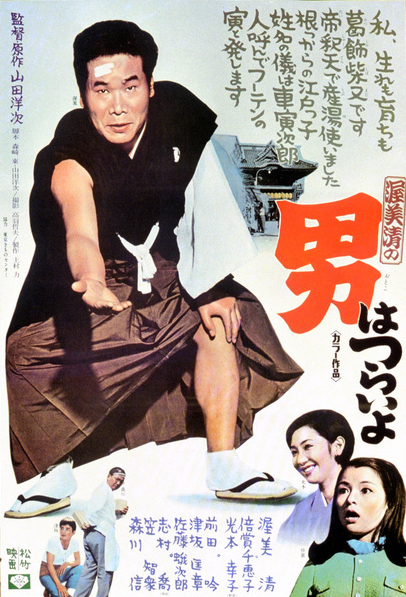
Tora-san, My Uncle (男はつらいよ ぼくの伯父さん, Yoji Yamada, 1989)

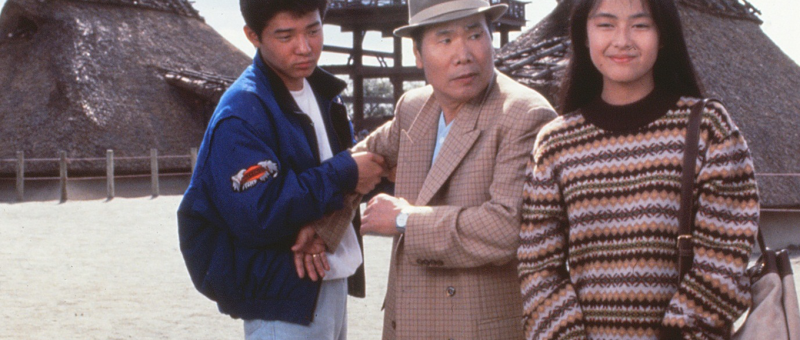
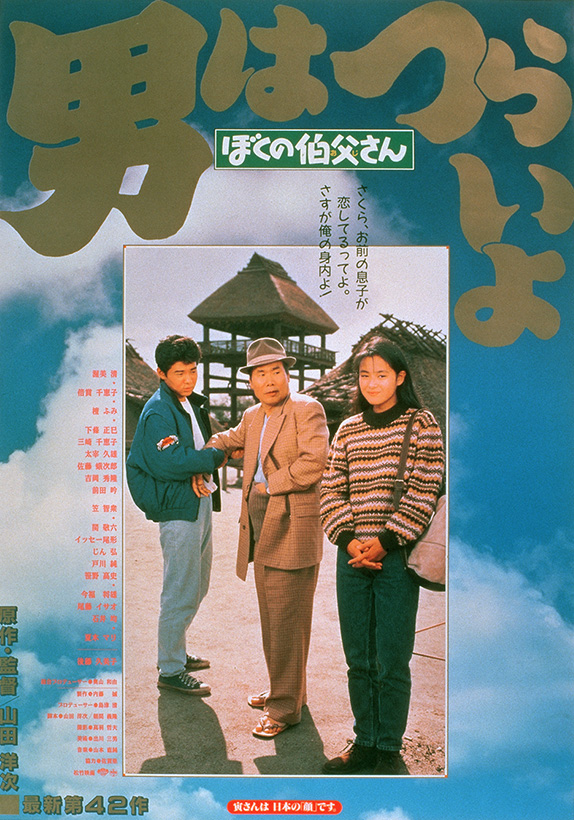
“My uncle was born a kind man, but his kindness is intrusive. He’s short tempered too, so often his kindness ends up causing a fight” according to the introduction given by Mitsuo (Hidetaka Yoshioka), nephew of the titular Tora-san (Kiyoshi Atsumi) in the 42nd instalment in the long running series, Tora-san, My Uncle (男はつらいよ ぼくの伯父さん, Otoko wa Tsurai yo: Boku no Ojisan). People may say he’s “an oddball”, but just recently, Mitsuo claims, he’s learned to appreciate his uncle’s peculiar charms. Up to this point, the series had followed a familiar pattern in which Tora-san has an encounter on the road and returns home to visit his family in Shibamata falling in love with an unattainable woman along the way. My Uncle, as the title perhaps implies, shifts the focus away from Tora directly towards his wayward nephew Mitsuo now a moody teenager studying to retake his university entrance exams. 

The problem is, Mitsuo is having trouble concentrating because he’s fallen in love. Izumi (Kumiko Goto) was a year below him in high school but after her parents got divorced she moved away and is currently living with her mother (Mari Natsuki) who runs a hostess bar in Nagoya. Mitsuo has been wanting to go and visit but his father, Hiroshi (Gin Maeda), has banned travel until after his exams and his authoritarian ruling has placed a strain on their relationship while Sakura (Chieko Baisho), Mitsuo’s mother and Tora’s younger sister, is getting fed up with his moodiness. That might be why she asks Tora to have a word with him on one of his rare visits, hoping Mitsuo will be able to talk frankly to his uncle about things he might not want to discuss with his parents. Only when Tora’s uncle (Masami Shimojo) and aunt (Chieko Misaki) point out the dangers does she realise her mistake. Perhaps you might not want your son to receive the kind of advice a man like Tora might give. Their misgivings are borne out when Tora brings him home a little the worse for wear after teaching him how to drink sake (and flirt with waitresses). 

Rather than Tora it’s Mitsuo we follow as he ignores his parents and goes off to find Izumi on his own. Mitsuo is not Tora, however, and he’s still fairly naive, unaware of the dangers inherent in a life on the road which is how he gets himself into a sticky situation with a man who helped him (Takashi Sasano) after he had a bike accident but turned out to have ulterior motives. After discovering that Izumi has gone to live with her aunt (Fumi Dan) in the country and finally arriving, Mitsuo begins to have his doubts. She wrote to him that she was lonely so he jumped on his bike and came, but now he wonders if that was really an OK thing to do or if she might find it a little excessive, even creepy. Her neighbours may gossip after seeing a (slightly) older boy from Tokyo suddenly turn up on a motorbike, maybe like Tora he’s acted on impulse out of kindness but has accidentally made trouble for her?

Meanwhile, Sakura and Hiroshi are at home worried sick, aware their son has grown up and evidently has some important rite of passage stuff to do, but it would have been nice if he’d called. Everyone’s used to Tora breezing in and out of their lives and it’s not as if they don’t worry, but it’s different with Mitsuo. Luckily and through staggering coincidence Mitsuo ends up running into Tora who, perhaps ironically, gets him to phone home and then starts helping him out with his youthful romantic dilemma. Though some of the advice he gives is a little problematic, there’s a fine line when it comes to being “persistent” in love, he is nevertheless supportive and proves popular with Izumi’s mild-mannered aunt and lonely grandfather-in-law (Masao Imafuku) who subjects him to a day-long lecture about traditional ceramics which he listens to patiently because as he says, old people are happy when someone listens to them. The problems are entirely with Izumi’s extremely conservative school teacher uncle (Isao Bito) who appears to terrorise his wife and objects strongly to Mitsuo’s impulsive gesture of love, bearing out Mitsuo’s concerns in implying that he’s endangering Izumi’s reputation, though apparently more worried about how it looks for him as a school teacher if she’s caught hanging out with a motorcycle-riding “delinquent”. The final straw is his telling Mitsuo off for neglecting his studies, insisting no one so “stupid” could ever hope to go to uni.

Left behind, Tora tries to defend Mitsuo to the snooty uncle, telling him that he’s proud of his nephew for doing something kind even if others don’t see it that way, but the uncle simply replies that they obviously disagree and abruptly walks off. Perhaps there’s no talking to some people, but Tora does what he can anyway. Mitsuo gains a new appreciation for his kindhearted family, not to mention his eccentric uncle. “Trips make everyone wise”, Tora tells Hiroshi, well except for some people, he later adds before once again getting literally cut off from everyone waiting for him back in Shibamata. The signs of bubble-era prosperity are everywhere from Mitsuo’s motorbike and comparatively spacious family home to the increased mobility and the upscale interior of Izumi’s mother’s “snack” bar, but Tora is still a post-war wanderer bound for the road, drifting whichever way the wind blows him.


Tora-san, My Uncle streamed as part of this year’s Japan Cuts.

Original trailer (no subtitles)

Tora-san Meets the Songstress Again (男はつらいよ 寅次郎相合い傘, Yoji Yamada, 1975)

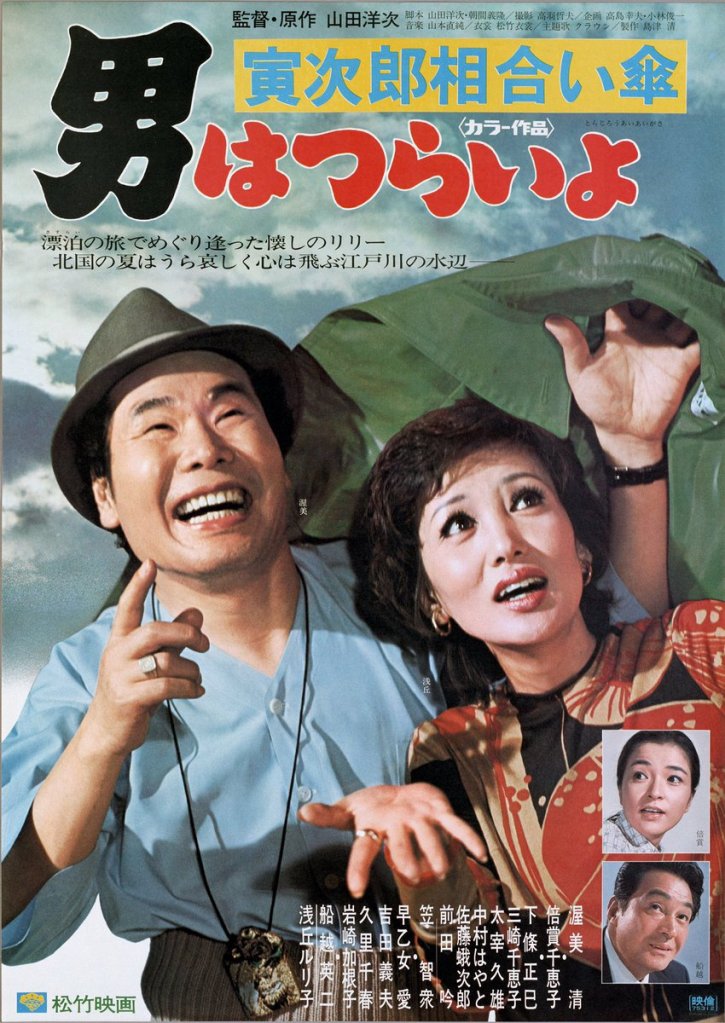
Spanning 48 films and almost 30 years from the middle of the economic miracle to the post-Bubble depression, the Tora-san series provided a certain kind of comforting stability with its well established formula that saw the titular travelling salesman alternately hit the road and return home to his wholesome family waiting and worrying in Shibamata, always glad to see him but also anxious as to what kind of trouble he’ll be causing this time around. Among the most melancholy of the series, Tora-san #15, Tora-san Meets the Songstress Again (男はつらいよ 寅次郎相合い傘, Otoko wa Tsurai yo: Torajiro Aiaigasa, AKA Tora-san’s Rise and Fall) sees him flirt with the idea of settling down while others wrestle with the costs of the salaryman dream and the contradictions of the post-war era. 

Yamada opens, however, with an exciting dream sequence in which Tora (Kiyoshi Atsumi) re-imagines himself as a heroic pirate saving his family members, and all the residents of Shibamata, from enslavement by some kind of evil capitalist villain. He wakes up and leaves the cinema, but Shibamata is perhaps on his thoughts once again acting as it does as a kind of “port” in his life of perpetual wandering. For the moment he’s travelling with a depressed salaryman, Hyodo (Eiji Funakoshi), whom he rescued at a train station fearing he may have been about to take his own life. Meanwhile, back in Shibamata, Tora’s old friend Lily (Ruriko Asaoka) has come looking for him at the dango shop apparently now divorced, tearfully explaining to Tora’s sister Sakura (Chieko Baisho) that she wasn’t well suited to being a housewife after all and is planning to head back out on the road as an itinerant singer. 

Perhaps ironically, Tora is angry with Hyodo for causing worry to his family by disappearing without notice, eventually ringing Sakura to tell her to ring Hyodo’s wife and let her know he’s alright (why he doesn’t just ring himself is a mystery, and in any case he only has the one coin for the payphone so runs out of time to explain). What we can infer is that Hyodo has in a sense achieved the “salaryman dream” but it’s left him feeling empty and unfulfilled. Mrs. Hyodo appears to be very prim and proper, their home spacious and tastefully decorated. When Sakura calls two men from her husband’s company are with her trying to figure out where Hyodo could have gone. She explains that her husband is a timid man and earnest, it’s unlikely he’s gone off with another woman and it’s out of character for him go AWOL from work so she’s at least very relieved to learn he’s alive even if Tora ran out of time to say where they were. Hyodo isn’t really sure anyone’s missing him, and as we later discover his flight is part mid-life crisis in that he’s heading to the hometown of his first love. He assumes she also will have married and has no illusions of a romantic reunion but simply wants to make sure she’s happy (as he, presumably, is not). Discovering she’s a widow gives him pause for thought, but on seeing her he realises the futility of his situation and resolves to return home to his dull and conventional salaryman life. 

It’s a huge source of irony to Tora that anyone might envy him. Indeed, Mrs. Hyodo quite snobbishly insists on asking Sakura about Tora’s company joking that “he can’t just be a pedlar” much to Sakura’s embarrassment. But that sense of freedom and the open road appears to be something Hyodo is looking for, childishly romanticising hardship, finding sleeping on park benches and helping Tora pull salesman’s scams in the street exciting rather than worrying (he could after all always just go home). Yet he also envies Tora for having such a loving and forgiving family, explaining that his now look down on him because he’s been demoted at work, as if they only value him for what he represents an embodiment of the salaryman dream. Lily too is as much in love with Tora’s family as anything else, though the complex relationship between the pair begins to scandalise the conservative local community. Sakura frames it as a joke but puts it to Lily that it would be nice if she and Tora could marry so she’d be a part of their family. Lily unexpectedly agrees, overcome with emotion, but Tora is his old insensitive, if perhaps perceptive self, declaring that they’re too alike. Like him she’s a bird meant to wander. She’d only stay until she felt ready to fly. 

Tora-san and Lily are wandering souls cast adrift in the post-war era, unable to find firm footing while Hyodo’s existential angst suggests the salaryman dream is not the answer either. Only Sakura and the Kurumas seem to be doing well enough, living their ordinary, wholesome lives in Shibamata. “She probably has problems we don’t know about” Tora’s aunt remarks watching Queen Elizabeth II waving gracefully on the television, lamenting that it must be tiring to have to stand around so long. Everyone has problems but they carry on. In Shibamata they try to be kind and especially to big-hearted men like Tora no matter what kind of trouble they may cause.


Tora-san Meets the Songstress Again streamed as part of this year’s Japan Cuts.

Original trailer (English subtitles)

Tora-san, Our Lovable Tramp (男はつらいよ, Yoji Yamada, 1969)

“It’s tough being a man” according to the Japanese title of the long running series affectionately known as “Tora-san” to its many fans. Tora-san began as a TV drama broadcast in 1968-9 in which the hero died of a snakebite in the very last episode much to viewers’ disappointment. Director Yoji Yamada then resurrected the loveable travelling salesman and made him the star of a reboot movie which proved so popular that it spawned a 48-film series which lasted until the death of star Kiyoshi Atsumi at the age of 68 in 1996. 

Yamada directed all but two instalments in the series each of which broadly follow a similar pattern to that introduced in the first film following the eponymous Tora as he gets himself mixed up in some kind of trouble, returns home to visit his family in Shibamata, and falls in love with a beautiful but unobtainable woman known as the “Madonna” in the series’ “mythology”, if you can call it that. At the beginning of Tora-san, Our Lovable Tramp (男はつらいよ, Otoko wa Tsurai yo), Torajiro Kuruma (Kiyoshi Atsumi) or “Tora-san”, explains that he’s been in a wistful mood thinking about his hometown while viewing the cherry blossoms and has decided to go back to Shibamata for the first time in 20 years having left swearing never to return after arguing with his father who has since passed away as has his brother. Tora-san’s only remaining family members are his younger sister Sakura (Chieko Baisho), a small child when he left but now a grown woman in her mid-20s, and an uncle (Shin Morikawa) and aunt (Chieko Misaki) who’ve been looking after her and run a small dango shop. 

Being away for 20 years necessarily means that Tora has been on the road since he was a young teenager back in 1949 when Japan was still very much in the throws of post-war chaos, in contrast to the increasingly prosperous nation it has since become. On his return to town he is relieved to discover that the local priest (Chishu Ryu), as well as his aunt, still remember and recognise him but shocks them all with an incongruous, and frankly over the top, show of politeness as he expresses gratitude and filial piety towards his uncle and aunt for having raised his sister but then immediately afterwards tries to sell them some of his tacky sales goods including some kind of electronic bracelet with supposed health benefits. Nevertheless, the family, including his sister Sakura who works as a typist at an electrical goods company, are very glad to seem him after all these years. 

Hardly in the house five minutes before peeing in the garden instead of using the bathroom like a regular person, Tora is already undercutting the image he first presented and causing trouble with the neighbours. The major drama occurs when he ends up accompanying Sakura to an omiai arranged marriage meeting set up by her boss in a fancy hotel. Sakura hadn’t been keen to go to the omiai, her uncle and aunt assume because arranged marriages are already outdated, but as we later discover she’s developed a fondness for factory worker Hiroshi (Gin Maeda) who lives in the house directly behind theirs. The uncle and aunt encourage the match because it’s an opportunity to marry up, viewing it as better than Sakura could otherwise hope for as an orphan with no dowry. Tora agrees with them, encouraging his sister not to write off tradition, but he has little understanding of the etiquette for these kinds of situations and quickly scandalises the refined, upper-class family by drinking far too much, making bawdy jokes about the composition of Chinese characters, and using vulgar language. As expected the suitors decide not to take things further, though luckily Sakura’s boss does not seem to mind or hold Tora’s behaviour against her.

On the road since he was little more than a child, perhaps it’s no wonder that Tora struggles when trying (or not) to adapt to the rules of civilised society though as he later tells us, he also had a traumatic childhood beaten by his father who resented him for being illegitimate, conceived during a drunken indiscretion with a geisha (Sakura is a half-sister born to his father’s legal wife). At one point he loses his temper completely and finds himself slapping Sakura, accidentally starting a mass brawl in their courtyard, though it’s obvious afterwards that he deeply regrets his behaviour and despite being forgiven by his ever patient sister feels as if it might be better to leave again before he makes even more trouble for his family. 

Tora is, however, perhaps good trouble in that his heart is (broadly) in the right place even if he makes a lot of mistakes. He meddles in Sakura’s love life and almost destroys her chance of romantic happiness, but it all works out in the end and he might have a point in implying that without his mistaken intervention she and Hiroshi would have just gone on in silent longing. Nevertheless, he remains a romantically naive figure, falling for the elegant daughter of the local priest (Sachiko Mitsumoto) who surprises him by expressing a fondness for low entertainment but in real terms is never going to marry a man like Tora. “Mine’s a hard world” he explains to a boatman, sadly making his way back towards the road filled with a deep sense of despair but pressing on all the same, trying his luck wherever he goes just another plucky, though no longer so young, guy, left behind by the rapid pace of the post-war economic miracle.  


Tora-san, Our Lovable Tramp streamed as part of this year’s Japan Cuts.

Original trailer (English subtitles)

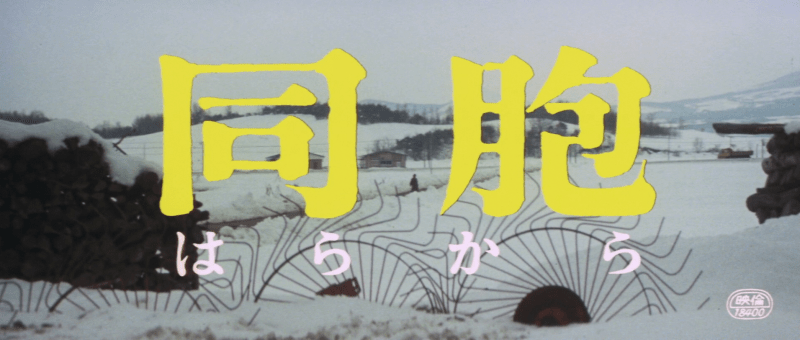
The Village (同胞, Yoji Yamada, 1975)

The Village posterBest known for the long running Tora-san series, Yoji Yamada has often been disregarded by international critics for a perceived over indulgence in sentimentality. Nevertheless, his films are often at pains to capture a Japan which is changing with a noted ambivalence towards the results of those changes. Home From the Sea had rooted itself in the difficult decision of a young couple in realising that their way of life was no longer sustainable in a rapidly modernising economy. The Village (同胞, Harakara) returns to a similar theme, once again harping on “furusato” while the conflicted younger residents of a farming village struggle with the decision to accept the life passed down to them by their parents or abandon it in favour of the bright lights of an urban future.

Narrated by Takashi (Akira Terao), a young farmer and president of the local youth club, The Village revolves around one heady spring in which the arrival of a sophisticated woman from Tokyo injects additional stimulation into the sometimes stagnant community. Takashi, in many ways a very typical resident of Matsuo and many other rapidly depopulating rural villages like it, has taken over his family dairy farm following the death of his father when he was relatively young. His brother, Hiroshi (Hisashi Igawa), took a factory job to help make ends meet and put Takashi through school but has now become embittered and resentful as the widowed father of two young girls. Trapped by circumstance he berates Takashi for his diffidence in remaining uncommitted to farm life while perhaps dreaming of something better that he is too afraid to pursue.

The arrival of Hideko Konno (Chieko Baisho) seems to give Takashi a new sense of purpose. Hideko works for an itinerant theatre company based out of Tokyo which makes a point of taking shows to remote areas which might not ordinarily get much access to the arts. The snag is that the locality will have to take the responsibility of producing the show and absorbing the shortfall should they fail to sell enough tickets to cover costs. Takashi is tempted but he’s also well aware of the risks – the investment is sizeable given the relative poverty of the rural area and the risks involved with failure extreme.

Yamada places the dilemma surrounding whether or not to produce the show at the forefront, but the questions are bigger than they might at first seem. It has to be said that farming, whatever its rewards, is an extremely hard life. As a character puts it in the emotively titled play “Furusato”, it’s disheartening when you get a bad harvest and all your work goes for nothing but it’s almost worse when the harvest is good and the value of your work drops exponentially. For Takashi and the others, the youth association is a much needed social outlet even if many of them regard it as something of a joke and rarely get around to doing very much with it. The idea of the play is attractive to them for several reasons, having something more interesting to do not the least among them, not to mention offering a valuable break in routine in what can often be an overly ordered and somewhat stagnant existence.

However, the very same reasons the play appeals to the youngsters are the ones their elders find suspicious. Having made their peace with rural life and learned to adapt to its rhythms, the older generation worry that the young ones are being swayed by outside influences and neglecting their work in favour of idle pursuits. Meanwhile, many of the youngsters have already left to try their luck in the cities, some of them returning and bringing new experiences back with them while others resolve to remain where the lights are brighter.

Setting the scene, Yamada reminds us the factories have long been encroaching on farmland and that this “ancient” way of life is becoming ever harder in a rapidly modernising economy, but through their involvement with the play and its extremely close to home themes, the members of the youth association are finally able to look at their village through new eyes, seeing not only its immense visual beauty for the first time but learning to reappreciate the value of community and friendship. Life in the city might be more glamorous but perhaps it’s no less hard and only lonely in a different way. At once a celebration of and lament for a changing rural landscape, The Village asks an accidentally profound series of questions about life and happiness but once again puts its faith in goodhearted people creating meaning from togetherness in a world that might otherwise set them apart.


Original trailer (no subtitles)

Flag in the Mist (霧の旗, Yoji Yamada, 1965)

flag in the mist poster 2In theory, we’re all equal under the law, but the business of justice is anything but egalitarian. Yoji Yamada is generally known for his tearjerking melodramas or genial comedies but Flag in the Mist (霧の旗, Kiri no Hata) is a rare step away from his most representative genres, drawing inspiration from America film noir and adding a touch of typically Japanese cynical humour. Based on a novel by Japanese mystery master Seicho Matsumoto, Flag in the Mist is a tale of hopeless, mutually destructive revenge which sees a murderer walk free while the honest but selfish pay dearly for daring to ignore the poor in need of help. A powerful message in the increasing economic prosperity of 1965, but one that leaves no clear path for the successful revenger.

Kiriko (Chieko Baisho), a twenty year old typist from Kyushu, has taken an arduous train journey into Tokyo to get a meeting with a top lawyer she hopes will defend her older brother and only living relative from a trumped up murder charge. The clerk attempts to dissuade her – Mr. Otsuka (Osamu Takizawa) charges a hefty sum for his services and, in any case, his docket is too full to be travelling back and forth to Kyushu never mind the additional travel and accommodation costs. Kiriko is disappointed but undeterred – she thinks she can manage the expenses, but asks for a discount on the fee. The clerk finds this amusing and does at least ask Otsuka who finally agrees to see Kiriko seeing as she’s come all this way. She makes an impression on him but ultimately he tells her he’s just too busy and she’s better off looking for a lawyer closer to home.

Kiriko leaves disappointed but refuses to give up, missing her original train to try again by telephone but Otsuka has already gone out “to see clients” and so she finally has to accept her mission to save her brother may have stalled. While Kiriko was using the public phone, she was overheard by a reporter, Abe (Yosuke Kondo), who wants to write something on the case but his Tokyo based bosses aren’t so keen on a local interest story from halfway across the country.

A year later, Kiriko’s brother Masao (Shigeru Tsuyuguchi) has been convicted and sentenced to death. After his second appeal fails, Masao dies of illness in prison before the sentence could be carried out. Kiriko writes a bitter letter to Otsuka blaming him for her brother’s death which forces Otsuka to reconsider his decision not to take the case. He comes to the conclusion that the case was unwinable and therefore his decision not to take it made no difference but then, he spots something that no one else seems to have noticed.

A tenacious and strong willed young woman – you’d have to be to jump on a long distance train from a tiny village all the way to the big city on your own in 1965, Kiriko is determined to save her brother but finds herself facing an uphill battle against a society deliberately structured to ignore her voice and those of everyone like her. Kiriko is an orphan and so her older bother is also a kind of father figure as well as the only living relative she has left. Masao had been a primary school teacher, which is to say a respected member of society, but found himself involved with a loanshark who was later murdered after he lost some cash collected from students to pay for a school trip and borrowed money he couldn’t pay back from a ruthless old woman. Masao has made a mistake he’s going to pay for dearly – disgraced and humiliated, it was easy work to frame him for a violent crime and force him into a confession through the usual police methods. Kiriko won’t stand for it, but she’s powerless to help him.

Otsuka is, in a sense, entitled to charge what he wants for his services. He’s clearly a talented lawyer, very much in demand, and so why “should” he trek all the way out to Kyushu for a case that doesn’t interest him when he has enough clients already. He does, at least, bother to listen to Kiriko’s pitch before letting her down gently, but just when it seems he might be about to change his mind he tells his clerk to cancel all his appointments and winds up on the golf course with his girlfriend. So much for being too busy to save an innocent man’s life.

Kiriko’s “whole life has been desecrated by one incident” as she cuttingly writes later in a letter which forms a crucial part of her plot of revenge against the man who refused to save her brother’s life (half talking about something else). Forced out of her hometown where she’s the murderer’s sister, she finds work as hostess going by the club name of Rie in a Tokyo bar which has a Kyushu theme. This brings her back into contact with the reporter, Abe, and that isn’t the last of the coincidences as Kiriko finds herself swept up by circumstances which allow her to turn an unfortunate series of events into a cunning plan to ruin Otsuka by neatly echoing the precise circumstances of her brother’s case. Now it’s Otsuka forced to plead with her night after night, begging on his knees that she agree to testify and turn over key evidence that proves his client is innocent all while Kiriko adamantly sticks to her story.

Yamada conjures a tense and gloomy film noir world, following Kiriko down foggy passageways as she tries to navigate the city from the shadows, chasing the spectre of the unjust but losing herself in the process. Masao dies because he was too poor to hire a good lawyer to save him from the police who were supposed to be protecting him, but decided it was easier to stitch up someone without influence than find the real killer. His sister destroys herself to get revenge not just on lawyers more interested in fame and success than in serving justice but on an entire society which believes her existence is insufficiently important to merit full consideration. Otsuka is not a bad man, he is not corrupt or incompetent, he is merely selfish in all the ways his society encourages him to be. Originally letting himself off the hook with the excuse that his decision made no difference, he’s genuinely horrified when he realises he’s noticed a crucial clue which could have exonerated Masao even if it’s an equally selfish guilt he feels more than a recognition that he’s failed his duty to justice by letting an innocent man die while a guilty one lives to kill again. No one wins in this case, everyone emerges ruined and broken by the increasing inequalities and selfish individualism of the post-war world. Justice is blind, so they say, but perhaps she needs to open her eyes.


Original trailer (no subtitles)