Killer’s Mission (賞金稼ぎ, Shigehiro Ozawa, 1969)

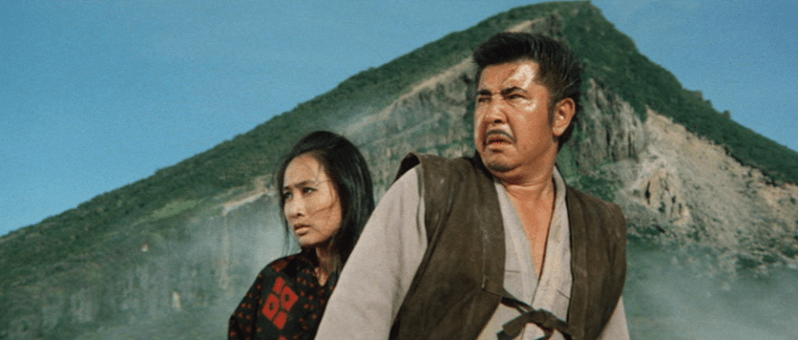
According to the title card at the beginning of Shigehiro Ozawa’s Killer’s Mission (賞金稼ぎ, Shokin Kasegi), none of the events it depicts have been recorded in history because the shogunate decided to erase them all in fear of the effect they may have on the nation’s geopolitical stability. Nevertheless, it gives some very concrete dates for its historical action, even if they may not make complete sense while foreshadowing the political turbulence of the following century. 

What it essentially attempts to do is tell a James Bond-style tale of political intrigue in a feudal Japan in which perpetual peace has begun to create its own problems. Here played in a cameo appearance from Koji Tsuruta, the Shogun Ieshige was weak in part because he was in poor health and had a speech impediment which led him to be rejected by his retainers. The problem here, however, is with Satsuma which has been on bad terms with the Tokugawa shogunate since the Battle of Sekigahara after which they took power. Satsuma will in fact be at the centre of the conspiracy to overthrow the government in the following century, but for the purposes of the film have fallen foul of a rumour that the plan to do an arms deal with some Dutch sailors who sailed South to Kyushu after being rebuffed in Edo. 

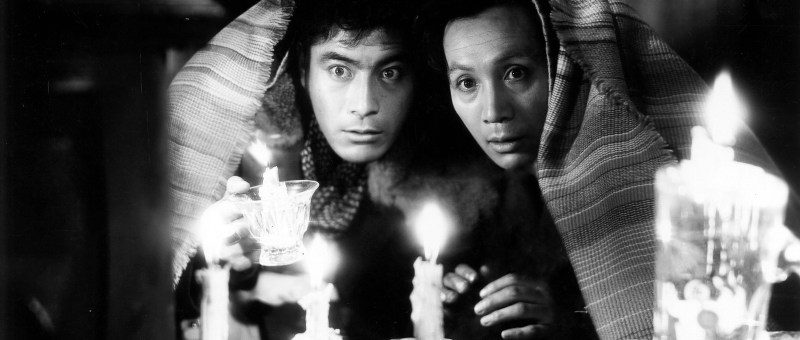
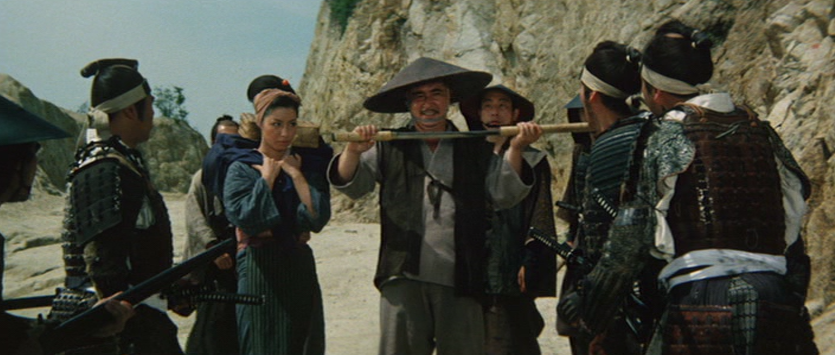
A civil war is feared and in the interests of maintaining peace, Ieshige sends his trusted spy Ichibei (Tomisaburo Wakayama) to protect Satsuma official Ijuin Ukiyo (Chiezo Kataoka) in the hope that he will be able to talk his young and naive lord out of doing the deal. Ostensibly a doctor by trade, Ichibei has a series of spy gadgets such as hidden blades and collapsible guns stored in a secret room at his surgery which he then carries in a black leather utility belt. He keeps the nature of his mission close to his chest, but often double bluffs by simply telling people he is a shogunate spy or otherwise adopting a disguise as he does in a moment of meta comedy impersonating the signature role of his brother Shintaro Katsu by posing as a Zatoichi-style blind masseur. 

As if to signal the cruelty of the feudal world, Ichibei comes across the corpses of suspected spies abandoned outside Satsuma territory while his enemies meditate on their ancient slight and consider taking the deal in the hope of avenging their defeat and overthrowing the Tokugawa. They are warned that creating unrest and sowing division may be exactly what foreign powers like the Dutch crave, but aren’t particularly bothered, preferring to take their chances with them rather than curry favour with the Shogun and possibly destabilising the entire society along with it. 

Of course, much of this is anachronistic with the Dutch sailors appearing in a distinctly 19th century fashion carrying weapons which are also too advanced for the era as are Ichibei’s folding pistols. Through his travels, he runs into a female Iga spy who too can do some nifty ninja tricks and has a gadget of her own in a comb which can shoot poison darts, though luckily it’s one of the poisons Ichibei has already developed an immunity to. Ichibei is fond of crying that you kill him he’ll simply come back to life, barrelling through the air with feats of improbable human agility and generally behaving like some kind of supernatural entity with a secondary talent for violent seduction. 

Though ironic and often darkly comic, there is an unavoidable poignancy in the inner conflict of Ijuin who knows his clan is about to do something very foolish but is torn between his duty to obey them and that to act in their best interests, eventually backed into a corner and left with no real way out of his predicament. As Ichibei points out, it’s difficult to keep the peace, especially when restless young samurai spot opportunities to cause chaos and the outside world knocks on the door of a closed community. Even so, Ozawa ends on a romantic image of a beach at sunset somehow undercutting the violence and tragedy with the restoration of an order that might itself be imperfect in its peacefulness.
Sound in the Mist (霧の音, Hiroshi Shimizu, 1956)

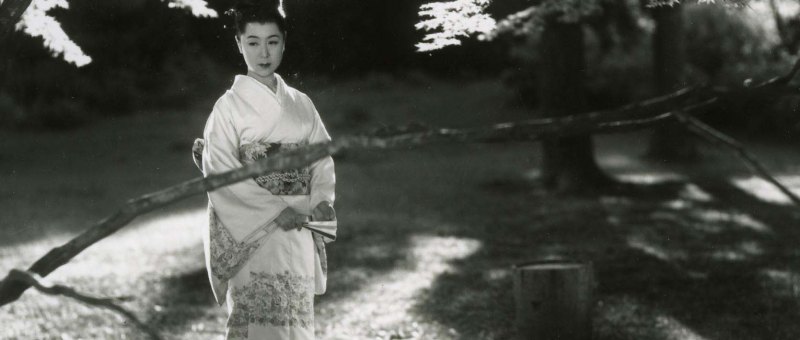
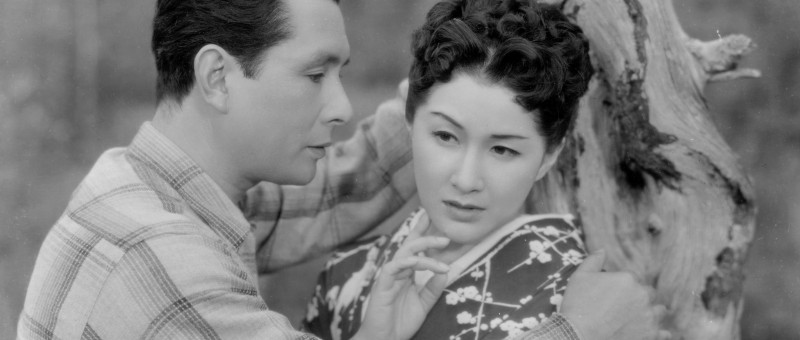
In the opening scenes of Hiroshi Shimizu’s Sound in the Mist (霧の音, Kiri no Oto), a young woman tells another that “as women, we need to create our own happiness,” though as it turns out it’s something that neither of them are really able to do. A classic melodrama, the film once again hints at Shimizu’s mistrust of romance and the frustrating inability of men and women to communicate or embrace their love for one another even when the seeming barriers preventing it have been removed.

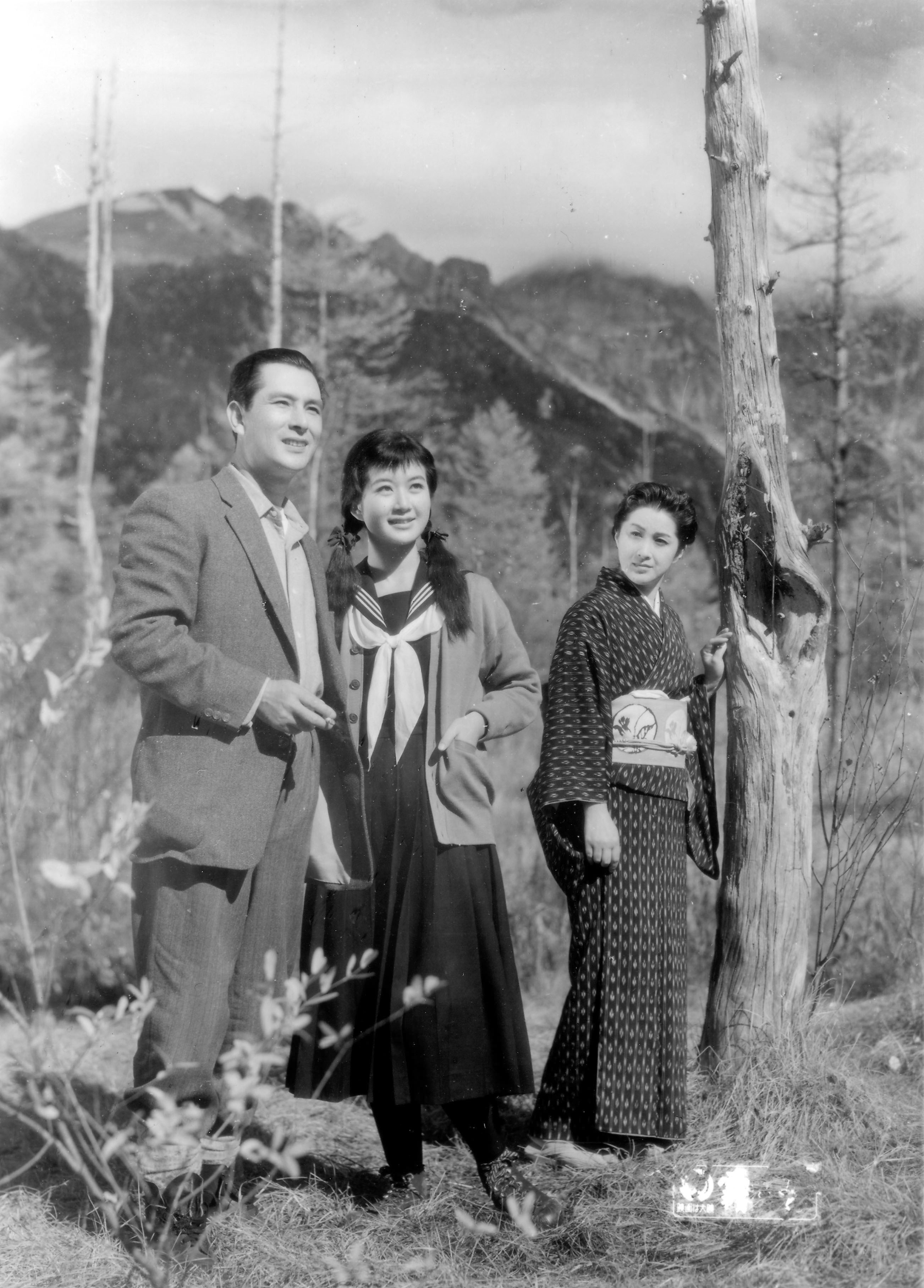
To that extent, it’s interesting that the chief disagreement between unhappily married botanist Kazuhiko (Ken Uehara) and his wife Katsuyo is over her feminist politics and desire to devote herself to women’s emancipation under the new post-war constitution. The main bone of contention is that she wants to sell a mountain owned by Kazuhiko’s family to fund her political career though as he later says this mountain is his life. In any case he lets her sell it, believing there’s no point putting up a fight. He puts up even less of one in his relationship with Tsuruko (Michiyo Kogure), his assistant who is hopelessly in love with him yet after his wife’s angry visit decides to absent herself feeling as if she’s in the way.

It was her friend Ayako, a Tokyo dancer, who told her that women need to make their own happiness but in the end she couldn’t do it either. She was similarly involved with a weak-willed married man who continued to vacillate over leaving his wife offering the justification that he didn’t want to mess things up for his children. Eventually the pair find escape through double suicide which only emphasises the futility of their romantic connection. Tsuruko similarly makes several comments about the idea of death and dying, stating that if she were to die she’d want to go to a particular spot in the mountain which seems like heaven to her.

Though Katsuyo describes it as a “filthy” place the cabin does indeed become a kind of haven, a bubble of apparently chaste love and longing inhabited only by Kazuhiko and Tsuruko as the voiceover says hiding out from post-war chaos. Tsuruko seems to be the kind of woman Kazuhiko regards as the ideal wife in that she cares for him and supports his work even if he tells Katsuyo he just needed someone to run errands and do the grocery shopping so Tsuruko is there as his maid. Both are at pains to emphasise that no physical relationship exists between them but are otherwise prevented from acting on the their love because of Kazuhiko’s marriage along the existence of his daughter, Yuko (Keiko Fujita), who may be adversely affected by her parents’ decision to divorce in an age when such things were less common.

Kazuhiko continues to return to the mountain cabin which has since become an inn at regular intervals to see the Harvest Moon, as does Tsuruko though she also carries a degree of shame that makes her fear re-encountering Kazuhiko having become a geisha apparently solely to ensure her proximity to the mountain. Once again filming with the gentle lateral motion familiar from his later films, Shimizu focuses on the landscape and suggests that these lovers are only free to love in the natural world unconstrained by the petty concerns of civilisation which prevent them from embracing their desires. The sound in the mist is perhaps that of Kazuhiko’s latent romanticism and the implication that to him it may be better to suffer for love than to accept it. The same may be true for Tsuruko who is equally powerless if filled with regret that in the end she gave up so easily rather than fight for the love of her life.

On the other hand, the cabin seems to have given rise to a love match between Kazuhiko’s daughter Yuko and her husband who vow to continue the tradition of coming to the inn on the occasion of the Harvest Moon which marks both their wedding anniversary and the time they met. Yuko’s melancholy expression on coming to an understanding of her father’s “special memories” suggests a gentle sympathy but also that this younger generation is freer to love though no less romantic.The poignant closing scenes in which Kazuhiko wanders into the mist are nevertheless filled with irresolution, regret, and a longing that express only a deep sadness for the misconnections and misunderstandings of a less open past.


Sound in the Mist screens at Japan Society New York on May 23/30 as part of Hiroshi Shimizu Part 2: The Postwar and Independent Years.

The Sands of Kurobe (黒部の太陽, Kei Kumai, 1968)

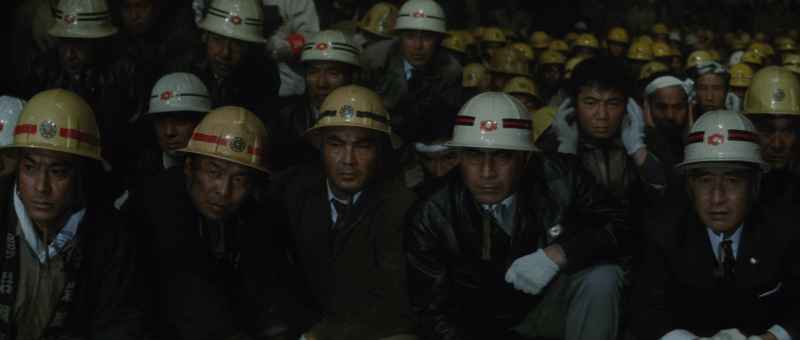
Kei Kumai’s three-hour epic of human engineering The Sands of Kurobe (黒部の太陽, Kurobe no Taiyo) opens with a titlecard to the effect that the film testifies to the courage of the Japanese people who brought the nation back to life after the war. Partly produced by Kansai Electric Power along with the production agencies of stars Toshiro Mifune and Yujiro Ishihara, the film is therefore somewhat conflicted, part bombastic celebration of Japanese engineering skill and ambivalent critique of the wilful decision to place success above all else including the welfare and safety of ordinary workers.

This critique is most evident to the flashbacks to the construction of Kuro 3 in 1938 which as many point out was conducted by the military under brutal and primitive conditions. The construction of the new Kurobe hydroelectric dam, by contrast, is a much more modern, enlightened affair in which workers have proper equipment and are not simply hacking at rocks with pickaxes wearing only a vest. But then as the conflicted Takeshi (Yujiro Ishihara) points out, it’s all effectively the same. Just because no one is pointing a gun at their heads, it doesn’t mean the men actually building the dam aren’t being exploited rather simply pressured by a vague notion of national good that they should be ready to lay down their lives. Could it be that “prosperity” is worse thing to die for than “patriotism”, especially when it appears as if your employer cares little for your physical wealth and economic wellbeing simply pledging that they will support the families of men killed during the dam’s construction. 

That there will be deaths seems inevitable. The man placed in charge of building a tunnel through the mountain, Kitagawa (Toshiro Mifune), is haunted by the vision of a man falling from a cliff that he witnessed when they first hiked to the dam site. He originally described the project as “crazy” and wanted to resign but was convinced to stay on. Kitagawa is himself fond of insisting on safety first where others are minded to cut corners, but also troubled by domestic issues in the film’s sometimes insensitive use of his daughter’s terminal leukaemia as a mirror for the dam project in considering what is and isn’t possible through human endeavour. The suggestion is that Kitagawa wants to believe the miracle of the dam is possible because needs to keep believing in a scientific miracle that can save his daughter, though obviously even if it is ultimately possible to build this dam that’s designed to fuel the post-war rocket to economic prosperity there are limits and unfortunately decades later we have still not found a cure for cancer though treatment may be more effective. 

Takeshi meanwhile has a similar battle with his hard-nosed father whose devotion to the dam project he describes almost like an addiction, suggesting that he values nothing outside of tunnelling and is willing to sacrifice everything in its name including the lives of himself and others. A flashback to to 1938 reveals that he asked his own teenage son to place dynamite and inadvertently caused his death though lax safety procedures which is the understandable reason why his wife eventually left him taking Takeshi with her. But the strange thing is for all his original opposition, Takeshi too is later captivated by the immensity of the challenge if also wary that the workers are falling victim to the same sickness as his father and are still being exploited by those like him who expect them to offer up their lives while paying them a pittance and complaining when the project does not proceed along their schedule. 

The almost nationalistic, bombastic quality of the film seems at odds with some of Kumai’s previous work save the discussion of the building of the 1938 tunnel though this largely serves as a contrast to imply that this time is different because they’re doing it for love of country rather the forced patriotism of the militarist past. Kitagawa justifies himself that if they don’t build the dam, economic prosperity will stall, companies will go bust, and people will lose their jobs but it seems somewhat hollow in the knowledge many men are certain to die while building this dam. Kumai undercuts the bombast with a series of scenes shot like a disaster movie in which supports collapse and the tunnel floods, or men are hit by falling rocks, eventually closing on an ironic Soviet-style statue dedicated to the labour of the workers that seems to question the immense loss of life along with the destruction of the natural beauty of Mount Kurobe but cannot in the end fully reconcile himself, torn between a celebration of human endeavour and its equally human costs. 


Original trailer (no subtitles)

Miss Oyu (お遊さま, Kenji Mizoguchi, 1951)

“I never realised how heavy this kimono was” a young woman exclaims towards the conclusion of Kenji Mizoguchi’s Miss Oyu (お遊さま, Oyu-sama), adapted from the Junichiro Tanizaki short story The Reed Cutter, finally collapsing under its weight having committed what amounts to an act of spiritual suicide in an internalised betrayal. Mizoguchi’s highly selective adaptation excises much of Tanizaki’s trademark perversity and targets instead the repressive social codes of the era which proceed to ruin three lives in frustrated affection, shame, and self-harming guilt. 

The trouble begins when Shinnosuke (Yuji Hori), a young man in search of a wife, mistakes his prospective bride for her sister and is forever smitten. Oyu (Kinuyo Tanaka), a widow with a young son, is only accompanying her younger sister, Oshizu (Nobuko Otowa), but is perhaps herself taken with the handsome suitor whom she repeatedly brands a “fine gentleman”. Having objected to all of Oshizu’s previous matches, she encourages her sister to marry this one not least because of his physical proximity that would allow the pair to visit each other regularly. The pain on Oshizu’s face is however readily apparent as Oyu relates the amusing incident to their brother, the younger sister clearly consumed with an inferiority complex in the shadow of the beautiful and elegant Oyu. 

It’s never quite clear to what extent Oyu is aware of her sister’s feelings, if she says these things thoughtlessly or with an intent to wound though she obviously cares deeply for Oshizu. Similarly the extent of her feelings for Shinnosuke remains oblique. As a woman well aware of her beauty and its power, perhaps she simply enjoys being desired or is so accustomed to male attention as to barely notice that Shinnosuke has fallen in love with her. Then again perhaps she knows all too well and for the sake of politeness pretends not to though in that case the decision to encourage her sister to marry him would seem perverse or suggest that she is attempting to deny her own feelings which she may not even understand by rendering Shinnosuke a “brother” in an attempt to remove him from the pool of potential romantic suitors. 

Even so there is an underlying quality of incestuous desire of Oshizu for her sister to whom she remains devotedly besotted, willing to sacrifice her own happiness in the hope of ensuring Oyu’s. After agreeing to marry Shinnosuke, she explains to him that she intends their marriage to be purely symbolic. She refuses to consummate their union on the grounds that it would be a betrayal of Oyu whom she knows to be in love with Shinnosuke while realising that he has married her only to be connected with her sister. When the trio take a trip together the strangeness of the ménage à trois is brought home by the confusion of the hotel maid who assumes that Oyu and Shinnosuke are the married couple, commiserating with Oshizu for being a third wheel. While Oyu childishly makes light of it, Oshizu is hurt and confused, jealous in two directions but pleading with Shinnosuke to be only his sister rather than a wife. 

Yet the wrongness of the arrangement is signalled on Oyu’s return home when she discovers not only that her son, Hajime, has fallen mortally ill in her absence but that rumours have begun to circulate about her unusual relationship with her brother-in-law. It is impossible to avoid the implication that Oyu is being punished firstly for betraying her maternity in having gone on holiday without her son to experience freedom as a woman, secondly for feeling sexual desire, and thirdly for feeling it for a married man who is now technically a brother in being her sister’s husband though as we know no one’s sexual desires are currently being fulfilled in this incredibly complicated and destructive arrangement. 

Though Tanizaki might have been more interested in exploring the darker aspects of human sexuality, Mizoguchi pulls back from the author’s trademark perversity to take aim at the repressive social codes of a patriarchal society which brought such a fraught situation into being. Oyu is unable to marry Shinnosuke because she is bound to her late husband’s family and by the responsibility to her son whom she would have to leave behind even if she were given permission to take another husband. Once her son dies, her ties to marital family are severed and they, disapproving of the rumours surrounding her unconventional relationship with her sister and brother-in-law, send her back to her brother who is also reluctant to accept her. On learning of the reality of her sister’s marriage, she decides to accept a proposal from a sake merchant in another town but the separation breeds only more destruction. Oshizu and and Shinnosuke move to Tokyo and three years later are living in poverty, Shinnosuke now dishevelled and dressing in Western suits with a modern haircut and a scraggly, half-hearted moustache. Oshizu’s eventual pregnancy which confirms that theirs is now a “full” union while Oyu’s is “symbolic” only the slows implosion of the trio’s repressed desires. 

Mizoguchi stops short of arguing for a transgressively new arrangement that would have allowed the trio to live together as a family but nevertheless attacks the repressive social codes that prevent them from speaking honestly about their feelings and force them into self-sacrificing acts of subterfuge which create only more suffering. He dramatises the claustrophobia of their lives through the obvious artificially of the stage sets which stand in such stark contrast to the expansive beauty of nature albeit sometimes unruly but always free, while lending their tragic tale a hint of the parabolic in its mists and rugged gardens as Shinnosuke finds himself alone under the cold light of the moon on a distant shore, a romantic exile from a repressive society. 


Road Warriors (あやめ笠 喧嘩街道, Tai Kato, 1960)

A penniless wanderer finds himself mixed up in chaos and conspiracy after deciding to help a lady travelling alone for the purposes of revenge in Tai Kato’s Toei chanbara, Road Warriors (あやめ笠 喧嘩街道, Ayame Kasa: Kenka Kaido). Truth be told, the hero isn’t much of a warrior at all and wisely prefers to avoid a fight if possible but is prepared to put his sword where his mouth is when the occasion calls. Still the conspiracy in this instance is small scale and incredibly petty as a trio of ambitious retainers attempt to frame their one time bodyguard for the murder of a lord.

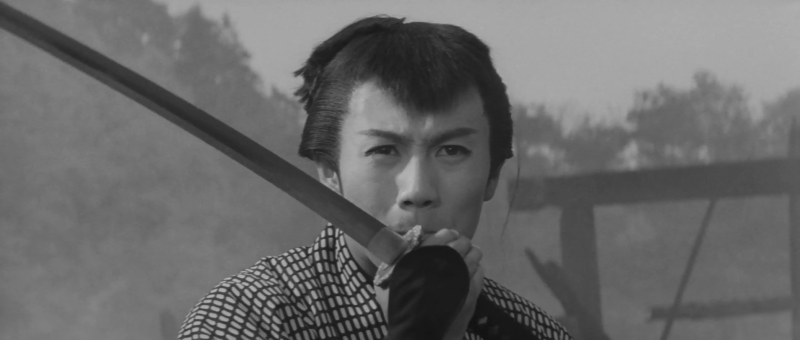
Before all that, however, Gantaro (Ryuji Shinagawa) is as he’s fond of introducing himself a penniless traveller who makes his ends meet through gambling. In debt to local boss Hidegoro (Ushio Akashi) he agrees to act as an intermediary in a dispute with the greedy Onizo (Eijiro Yanagi) who has usurped some of their territory. Gantaro suggests they settle the matter through gambling but is then challenged to combat by the gang’s bodyguard, Akiyama (Shin Tokudaiji). The young man looks noticeably afraid, sweating at the temples and gripping his sword at an unusual angle, but holds his own in the fight until Onizo tries to cheat by sending in one of his minions to finish him off. Noticing what’s happening, Akiyama proves his nobility by ending the fight and accepting defeat. Onizo appears cheerful and even asks Gantaro to join his gang, but seconds after the young man leaves he sends his guys out after him and evidently has no intention of enforcing a truce with Hidegoro.

Meanwhile, Gantaro runs into a melancholy samurai woman, Miyuki (Kyoko Aoyama), chasing after a thief who has stolen something from her far more precious than money. Discovering the thief has robbed him too, Gantaro springs into action and soon discovers that Miyuki is on a quest for revenge against the man who killed her father but that she’s been betrayed by her three retainers and has managed to ditch them to proceed alone. Unsprisingly, the prime suspect appears to be Akiyama but as stabbing a man in the back and running away don’t seem to fit with the noble character he displayed in the fight, Gantaro has an idea that something’s not quite right. 

Of course, he also begins to fall for Miyuki despite the obvious affection held for him by Hidegoro’s daughter Omitsu (Hiromi Hanazono) which he otherwise seems keen to escape. It’s reasonable to assume that loveable rogue Gantaro is the love them and leave them type, though his love for a samurai’s daughter is always going to be an impossibility no matter how much she may come to admire him. Even so, the conspiracy angle along with Onizo’s smug and overbearing duplicity do begin to awaken his sense of justice especially while travelling with an incredibly cynical thief who will sell anything or anyone in search of a quick buck. Even he however eventually comes around to the idea of helping Miyuki get away from her retainers and enact her revenge especially after overhearing the truth while cowering behind some barrels. 

It may be an overly familiar chanbara tale if one enlivened by Gantaro’s wisecracking antics, but Kato brings to it his characteristic sense of uncertainty in the potent mists that seem to surround Gantaro and Miyuki as they travel the mountain paths in search their enemy. Then again, there are shades of unexpected darkness not least in the implication that Gantaro was about to rape Miyuki before she fainted and brought him back to his senses. Nevertheless, her retainers may tell her that she has “no choice” but to obey them, but Gantaro seems to feel differently if abruptly giving up his intention of protecting her on learning that she has someone else in her heart. This is indeed a harsh world for women samurai and otherwise, a mother and daughter are saved by Akiyama after being harassed by Onizo when he annexes the local market while both Miyuki and Omitsu are left to finish their father’s unfinished business in the wake of their untimely deaths. Notably, it is indeed they who finally strike the final blow to eliminate the corruption which surrounds them. Penniless wanderer Gantaro doesn’t have it that easy either, gambling his life away and ending up with debts both financial and moral that may have dangerous consequences while often beset by cynicism even if latterly deciding to help those in need for no reward. In any case, like any good wanderer all he can do is smile and wave as he departs for the next adventure on the violent streets of the Edo-era society.


The Idiot (白痴, Akira Kurosawa, 1951)

“He was too good for this world” a matriarch finally concedes of the pure soul at the centre of Akira Kurosawa’s The Idiot (白痴, Hakuchi), though like most she had found his goodness unnerving. Adapted from the Dostoyevsky novel, Kurosawa’s poetic morality play is like much of his contemporary work a meditation on the post-war future but perhaps also an admission that this “faithless world” isn’t meant for pure souls and that goodness too can be destructive in its incompatibility with a world ruled by cruelty and selfishness. 

Relocated to a wintery Hokkaido, the film opens with former soldier Kameda (Masayuki Mori) travelling north to stay with a relative after a spell in a psychiatric hospital in Okinawa. Having been sentenced to death for war crimes in what he claims was a case of mistaken identity and then unexpectedly reprieved, Kameda suffered a nervous breakdown but also describes himself as having been reborn, as if everything that had happened to him up to that point had happened to someone else. Ever since then he’s been a pure soul, selfless and ethereal but also with, as someone later puts it, an eerie power to see into people’s hearts that leaves some feeling shamed or uncomfortable in the stinging light of his goodness. 

In the outdated language of the time, he is called an “idiot” because of his epilepsy which has he says caused him epileptic dementia. In the title cards that open the film, it is said that goodness is often conflated with idiocy as if to be good is only to be naive for sophistication necessarily favours calculation over feeling. He is an outcast firstly because of the stigma surrounding his condition and secondly because of the way his goodness reflects on others, leaving them feeling exposed or perhaps judged and found wanting. 

He finds his mirror in a young woman, Taeko (Setsuko Hara), who is loved by a man he met on the train, Akama (Toshiro Mifune), but is herself an outcast because she has been the mistress of a wealthy man, Tohata (Eijiro Yanagi), since she was only 14 years old. On seeing a photograph of her in a shop window near the station he remarks that she seems very unhappy, later explaining that in her eyes he saw only long years of lonely suffering that reminded him of the eyes of a young soldier executed by firing squad who looked back at him with eyes filled with reproach that he must be sacrificed for the folly of the war. But whereas Kameda’s awakening as a pure soul has opened him up to the world, Taeko’s internalised shame has made her cold and indifferent. Kameda’s recognition of her as another pure soul grants her the courage to escape one kind of suffering in abandoning the wealthy man who has ruined her life, but only provokes further destruction in her conviction that Kameda is the one man she can never love for she will only ruin him. 

Kameda, meanwhile, falls in love with the daughter of his relative, Ayako (Yoshiko Kuga), who is proud and largely unable to express her feelings honestly often saying the direct opposite of what she actually means. She too has her idea of goodness, breaking with her childhood sweetheart Kayama (Minoru Chiaki) when he is tempted by an offer from Tohata to enter into a sham marriage with Taeko for appearance’s sake in return for a large sum of money and guaranteed social advancement. Though Ayako originally rejects Kameda because of the shame and humiliation she would feel married to a man with a disability, she nevertheless fails in love with him but is unable to accept the equality of his love in his inability to abandon Taeko to whom he has come to represent a kind of salvation. 

Ayako later comes to believe that it was she who was truly the “idiot” in her petty jealousy lamenting that “if only we could all love without hatred” as Kameda had done though it was in the end his selfless love that sealed his fate, while for Akama it was perhaps the opposite in realising that he would never possess Taeko’s heart and that the only reason she returned to him was because she thought him to be a man of so little importance that ruining him was of no consequence and ruin him she did in the madness of his love. Guileless, Kameda is also a pauper cheated out of his inheritance by a relative and then again exploited by a duplicitous businessman, his poverty another proof of his goodness while others squabble over money. Having escaped an authoritarian father and come in to his inheritance, Akama wagers his fortune trying to buy Taeko from Tohata by gazumping Kayama who later redeems himself by letting the money burn but never really escapes the stain of his temptation. 

Kurosawa frames the tale as high gothic, filled with eerie winds and mist and fire in the midst of snow. The stove of Akama’s otherwise dark and gloomy mansion seems to flare with the intensity of confrontation as the passions of these four tortured souls rise and fall while each seeking a kind of salvation which necessarily cannot satisfy all. Originally intended to run in two parts over 265 minutes, the film was famously too big for producers at Shochiku for whom Kurosawa was working outside of his regular studio Toho. They cut 100 minutes to suit their exhibition needs, excising most of the prologue and inserting a number of clumsily placed intertitles absent from the rest of the film while undercutting the sense of mounting dread in the tragic backstories of each of these doomed romantics. But even in this compromised version, Kurosawa captures something of the gothic fatalism that surrounds Kameda, an innocent lamb in a world of wolves as Akama describes him, whose boundless, selfless love has no place in this faithless world. 


The Idiot screens at the BFI Southbank, London on 13th & 21st January 2023 as part of the Kurosawa season.

In a Ring of Mountains (中山七里, Kazuo Ikehiro, 1962)

A noble-hearted libertine stands up for love in an increasingly corrupt Edo in Kazuo Ikehiro’s adaptation of the well-known novel by Shin Hasegawa, In a Ring of Mountains (中山七里, Nakayama Shichiri, AKA 7 Miles to Nakayama). The son of a Daiei executive, Ikehiro joined the studio in 1950 working as an AD to Kenji Mizoguchi, Kazuo Mori, and Kon Ichikawa before being promoted to director in 1960 and then briefly demoted back to AD for annoying studio head Masaichi Nagata with the satirical content of his second film. Nevertheless, he later developed a close working relationship with top star Raizo Ichikawa and gained a reputation for unconventional jidaigeki displaying many of the techniques associated with the New Wave rather than the often more classically minded period films which were a Daiei mainstay. 

In this rather more modern tale set sometime in the Edo era, Ichikawa stars as big guy around town Masakichi who is nevertheless viewed with suspicion by local law enforcement officer Tohachi (Koh Sugita) who rebukes him for spending too much time with “yakuza” while out on the road conducting business for the lumber yard where he works. As we’ll come to discover this is a bit rich because Tohachi is as bent as they come, later raiding a gambling den in order to seize the proceeds for himself while in cahoots with equally corrupt magistrate who is also Masakichi’s boss but has designs on his girlfriend Oshima (Tamao Nakamura). After Masakichi proposes to her and goes so far as to set up a house and set a date to solemnise the union, his boss rapes Oshima which leads to her committing suicide and Masakichi killing him thereafter heading out on the run vowing to be Tohachi’s enemy for evermore. Sometime later, however, he gets himself mixed up in intrigue in another town where the corrupt magistrate is actually running the illegal gambling den and taking advantage of a naive young man, Tokunosuke (Koichi Ose), to press him into debt while trying to get his hands on his fiancée Onaka (also Tamao Nakamura) who happens to look exactly like Oshima. 

Something is very definitely rotten in Edo, the corruption so rampant as to be all but inescapable but Masakichi is so jaded that to begin with he doesn’t much care only to be reawakened on realising the same thing is happening again and to another woman who looks like his first love. Before he even sees her, he half-heartedly tries to warn Tokunosuke off gambling realising that he has no idea what he’s doing and seems to be having a run of very bad luck but Tokunosuke is a stubborn and insecure man who doesn’t know what’s good for him making one bad decision after another. When they are forced on the run together, Tokunosuke can’t help but feel his masculinity is being challenged by Masakichi’s infinite capability and is convinced that Onaka will eventually choose to leave with him. Consequently he repeatedly attempts to convince Onaka that Masakichi is a third wheel while quite obviously out of his depth and entirely incapable of protecting her from the mess that he has in part made through his series of poor decisions and general uselessness. 

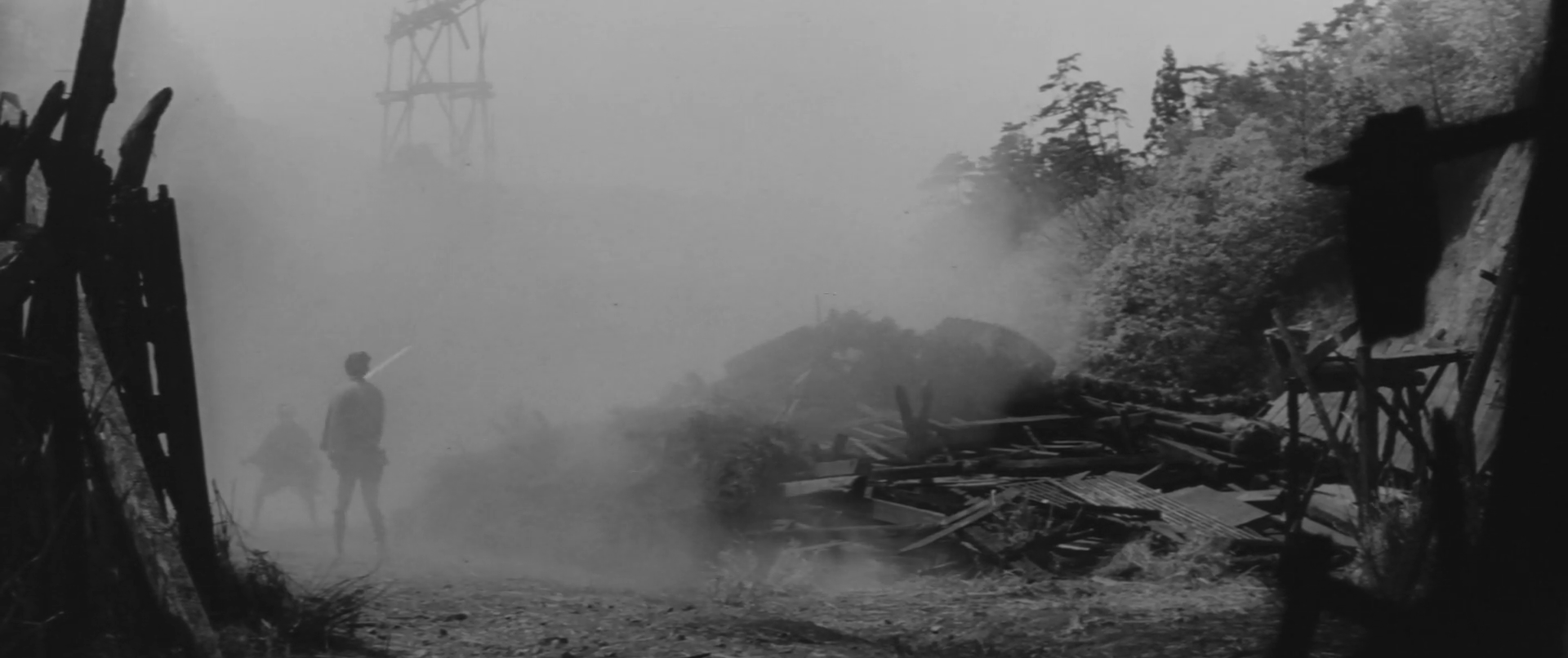
In this case, the hero isn’t so much standing up to injustice in the corrupt Edo-era society as standing up for love, exorcising his guilt over having been unable to protect Oshima by ensuring that Tokunosuke and Onaka’s romance is allowed to blossom. Even so, Onaka eventually concedes that his eyes frighten her while he remains trapped in the past reassuring her that he is aware she and Oshima are not the same and has no desire to intrude on her romantic destiny. The final showdown literally takes place in the ruins of the destroyed society as the trio take refuge in an abandoned village, an entire house later collapsing as Masakichi fights off Tohachi’s goons while beset by a heavy mist. Making frequent use of dissolves and canted angles to reflect Masakichi’s listlessness and sense of despair along with a couple of songs performed by Yukio Hashi, Ikehiro’s jidaigeki drama is an unusually romantic affair as the hero stands up to injustice only indirectly as means of rescuing love from the oppressive corruptions of Edo-era society. 


Trailer (no subtitles)

Destiny’s Son (斬る, Kenji Misumi, 1962)

“Sad is his destiny” laments a seemingly omniscient lord in Kenji Misumi’s elliptical tale of death and the samurai, Destiny’s Son (斬る, Kiru). A chanbara specialist, Misumi is most closely associated with his work on long running franchises such as his contributions to the Zatoichi series and Lone Wolf and Cub cycle, and though sometimes dismissed as a “craftsman” as opposed to “auteur” is also known as a visual stylist capable both of the most poetic imagery and breathtaking action. 

Scripted by Kaneto Shindo, Destiny’s Son follows cursed samurai Shingo (Raizo Ichikawa) who finds himself the victim of cruel fate and changing times during the turbulent years of the bakumatsu. His mother, Fujiko (Shiho Fujimura), a maid misused by a plotting courtier and talked into murdering the inconvenient mistress of a wayward lord, was executed for her crime by the man she loved, Shingo’s father who later renounced the world and became a monk. In a sense, it’s Shingo’s sense of displacement which later does for him, allowed the rare freedom of a three year pass from the apparently compassionate lord of the clan which took him in to go travelling during which he learns superior sword style something which came as a surprise to his old friends on his return who’d always thought him gentle and bookish. His talent makes him dangerous to an unexpected rival in his strangely mild-mannered neighbour who happens to have a crush on his sister Yoshio (Mayumi Nagisa) but is quite clearly under the thumb of his finagling father, Ikebe (Yoshio Inaba), who is convinced the family can “do better” as long as he triumphs in a contest of martial prowess with a passing master to whom the clan has given temporary shelter after he was cast out of his own. Of course, nothing goes to plan. The master easily defeats even the clan’s most talented warriors until Shingo is called up as a last resort only to best him with his signature move learned out on the road, a dangerous throat thrust. 

In a theme which will be repeated, Shingo finds himself in the middle of accidental intrigue through no fault of his own though the ill-conceived Ikebe revenge plot does at least allow him to discover the sad truth of his family history even as it deepens his sense of displacement. Slashing right into the mores of the chanbara, Misumi pares Shindo’s screenplay down to its poetic minimum as the hero sets off on his elliptical journey, achieving his revenge as the first stop before walking back into the past and then into an accidental future as a retainer to Lord Matsudaira (Eijiro Yanagi) himself at the centre of bakumatsu intrigue in trying to quell the divisions within the Mito clan some of whom have been involved in anti-shogunate terrorism setting fire to the British Legation shortly after the nation’s exit from centuries of isolation. An eternal wanderer, he resolves to have no wife and wanted no ties, haunted by the trio of women he couldn’t save from the mother who birthed him in part as a bid for mercy, to the sister who died a pointless and stupid death because of samurai pettiness, to another man’s sister whose name he never knew who stripped naked and threw her kimono at her assailants to save her brother’s life while they too were on the run after standing up to samurai corruption. He loses three women, and then three fathers, the first he never knew, the second taken from him in more ways than one, and the third betrayed by the complicated world in which they live. 

“I cannot be forgiven” Shingo exclaims, his end tied to that of his mother as a sword glints gently in the bright sunshine and blood drips, the only blood ever we see, on another woman’s breast. Elegantly composed and often set against the majestic Japanese landscape, Misumi’s ethereal camera with its dynamic tracking shots, controlled dolly movement, and frequent call backs to the setting sun lend Shingo’s journey an elegiac quality even in its evident nihilism as he finds himself consumed by the samurai legacy, discovering only futility in his rootlessness unable to protect himself or others from the vagaries of the times in which he lives. 


Original trailer (no subtitles)

The Young Boss (花笠若衆, Kiyoshi Saeki, 1958)

Hibari Misora takes on yet more Edo-era corruption in Kiyoshi Saeki’s musical adventure, The Young Boss (花笠若衆, Hanagasa Wakashu, AKA A Martial Crowd, Twin Princesses). A program picture director at Toei, Saeki mainly worked on jidaigeki and ninkyo eiga launching the Brutal Tales of Chivalry series, though he also became a frequent collaborator with Misora ironically enough mostly working on her contemporary films in which she often starred opposite Ken Takakura, representative actor in the noble gangster genre. Young Boss, however, is a jidaigeki musical adventure very much typical of those Misora was making at Toei at the time and once again finds her playing dual roles as a pair of twins separated at birth because of superstition and social stigma.

Opening and closing at a local Edo festival, the film introduces us to the second generation of Edoya Kichibei, Kichisaburo (Hibari Misora), as he steps in to protect a young woman who has accidentally annoyed a bunch of yakuza fulfilling his sidekick’s introduction that he “helps the weak and crushes the strong”. Kinpachi (Juro Hoshi) also describes him as a “man’s man”, though as we discover Kichisaburo is not a man at all but the niece/adopted daughter of a prominent merchant apparently raised as a boy. Kichisaburo, however, only learns this when a pair of samurai turn up to badger Kichibei about the whereabouts of his younger sister, Sano, who apparently served as a maid to the Ogiyama clan 18 years previously but was cast out with her younger daughter Yuki after giving birth to twin girls fathered by the lord. The other twin, Chiyo (also Hibari Misora), was raised in luxury in the palace and in the absence of a male heir and the lord’s failing health is in line to inherit the clan. As usual, however, courtly intrigue has led some to conclude that Yuki’s is the proper the claim. Kichibei attempts to convince them that Yuki passed away in infancy shortly after her mother and that he burnt her birth certificate, but the resemblance between the effete Kichisaburo and the lady Chiyo has not gone unnoticed both by the visiting samurai and the handsome Matanojo (Hashizo Okawa) who joins in with Kichisaburo’s battle against the yakuza and is in fact the betrothed husband of Chiyo. 

Lady Chiyo appears only briefly but is the soul of courtly kindness, hugely regretting what has befallen her absent sister and affirming that should she return she would instantly surrender her claim to the clan in guilt that she has been raised in such luxury when Yuki was cast out to live with strangers. The dual roles in a sense reflect a perfect whole, Lady Chiyo’s feminine elegance contrasted with the rough Kichisaburo who has not been raised as a samurai but a merchant’s son like his sister set to inherit the family business. He is very attached to his adopted father, but also possesses a strong sense of justice often ignoring his pleas to stop getting into fights. Other than perhaps to disguise her true identity, there is no real explanation for why Kichisaburo has been raised as a boy though it seems that there would have been a time the ruse came to an end, Kichibei sadly lamenting that perhaps he has been jealously attempting to keep the child he loved so much with him against her better interests but explaining that he would have found her a nice husband in time, perhaps like that gallant samurai Matanojo.

Teaming up with him for purposes of revenge and justice, Kichisaburo begins to develop feelings for Matanojo though Kichibei reminds him that a townsperson would be “unfit to be a samurai’s wife”. Most of Misora’s films in which she stars as a feisty young woman see her undergoing a softening, drawing closer to conventional femininity often with marriage or at least a romance with a manly man on the horizon. The Young Boss meanwhile flirts with just this conclusion as Kichisaburo becomes Yuki while out on the road with Matanojo, dressing as an elegant princess and experiencing a vivid dream sequence in which she becomes his wife, but ultimately highlights the class rather than gender barriers between them in allowing to Yuki to return to her previous life as Kichisaburo while Chiyo remains a samurai noblewoman in a seemingly perfect mirroring which also represents a return to order. 

Nevertheless, Misora finds numerous occasions for a cheerful song even in her manly guise finally even beating a taiko drum at the closing festival while joining in with several elaborately choreographed sword fights along the way with her customary gusto. A bittersweet ending, perhaps, but one in which Misora makes division of herself and unusually is allowed to remain feisty, defiant, and independent helping the weak and crushing the strong in an ever duplicitous Edo.


Musical number (no subtitles)

Big Shots Die at Dawn (顔役暁に死す, Kihachi Okamoto, 1961)

“Assassins make the world an unfit place to live in” according to a random gas station attendant clueing our errant hero in to the fact his small-town home is now a “den of yakuza” and unlikely tourist hotspot. An early, delightfully absurdist yakuza romp from Kichachi Okamoto, Big Shots Die at Dawn (顔役暁に死す, Kaoyaku Akatsukini Shisu) is part Nikkatsu parody, part ironic western, and all cartoonish fun as a prodigal son returns to find his father murdered and his uncle on the throne. Sound familiar? 

Jiro (Yuzo Kayama) has been working for the forestry commission in Alaska and has not returned to his small-town home of Kuraoka in some time which is why he didn’t even know his father, the mayor, was dead let alone that he was apparently assassinated in a manner which strongly anticipates the Kennedy assassination though the film was released in 1961. He also had no idea his father, a widower, had remarried and his family home is now occupied by his stepmother Hisako (Yukiko Shimazaki), a former secretary who scandalously lounges around in her underwear all day. His uncle Imamura (Eijiro Yanagi) is now the mayor, and as he explains to him, the town is a hotbed of gangster activity apparently a consequence of his attempt to turn it into a tourist hotspot. In trying to find out who killed his father, Jiro finds himself quite literally in the middle of a petty yakuza gang war aided and abetted by corrupt police. 

Quite clearly influenced by American cinema, Big Shots Die at Dawn situates itself in the new frontier of small-town Japan in which a war is being fought over the spoils of the post-war era. Uncle Imamura’s legacy is apparently a children’s theme park with the distinctly pregnant name Dreamland. Apparently a man who just loves the children but was unable to have any of his own, he’s also opened a pre-school for the local kids. Meanwhile, in the yakuza-backed casino, obsessive gamblers brush their teeth at the tables while local kingpin Goto (Akihiko Hirata) attempts to fend off the incursion of the rival Handa gang. Jiro’s return puts the cat among the pigeons as both sides attempt to use him as a way to take out the other.

The dark heart of small-town Japan is however present in the greed and double dealing which extends even to the police, a corrupt officer offering to sell Jiro a key piece of evidence he had concealed in the hope of profit. Just about everyone tries to sell the evidence to someone else at one time or another, leveraging an idea of justice alongside greed and self-interest. Meanwhile, Yoshiko (Kumi Mizuno), a quasi-love interest and former girlfriend of a fallen foot soldier, reports that she gave the police valuable evidence that her fiancé’s death wasn’t a suicide but they ignored her.

Jiro’s come to clean up the town, but the showdown takes place incongruously in the children’s theme park complete with its cutesy mascot characters and adverts for chocolate in the background making plain that these venal gangsters are really just boys playing war, taking pot shots at each other from tiny trains. What could be a dark comment on a loss of innocence is more cartoonish irony from Okamoto who shoots in extreme closeup with intentionally humorous composition and slapstick choreography. Nevertheless the message is unmistakable as we piece together the connections between small-town government and organised crime underpinned with a rather creepy all for the kids justification. 

Then again, the world has its share of misogyny, everything coming down to the incursion of transgressive femininity as one duplicitous woman manipulating her feminine wiles becomes the common link between each of the warring factions, as if this is all her fault and Jiro’s return is a way of clearing up the pollution her arrival provoked. Nevertheless as even he says, his father, and implicitly his father’s generation, must share some of the blame. Filled with stylish action sequences, car chases, self-consciously cool dialogue, and scored with a mix of moody jazz and dreamy childlike melodies, Okamoto’s cartoonish takedown of the zeitgeisty youth movie is very much in keeping with Toho’s spoofier side but chock full of charm even if its hero’s particular brand of smugness occasionally borders on the insufferable.