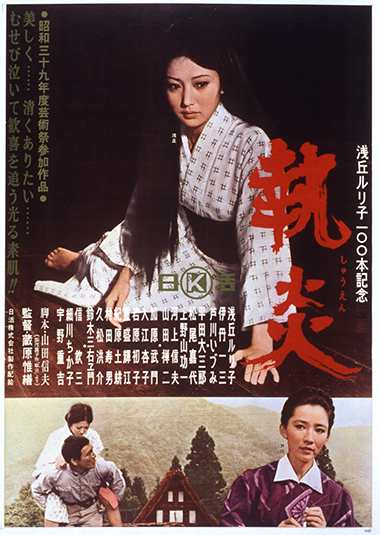
Flame of Devotion (執炎, Koreyoshi Kurahara, 1964)

Koreyoshi Kurahara, like Seijun Suzuki, began his career at Nikkatsu mostly working on its youth-orientated commercial cinema only to end up being fired for producing films deemed too “arty” for the studio’s target audience such as his 1967 Mishima adaptation, Thirst for Love. Released the same year as Black Sun, 1964’s Flame of Devotion (執炎, Shuen) is in someways a much more subdued affair, a fairly atypical melodrama critiquing not only the destructive legacy of war but also a cultural insistence on stoical endurance in the face of emotional difficulty which is itself the mark and enabler of militarism. 

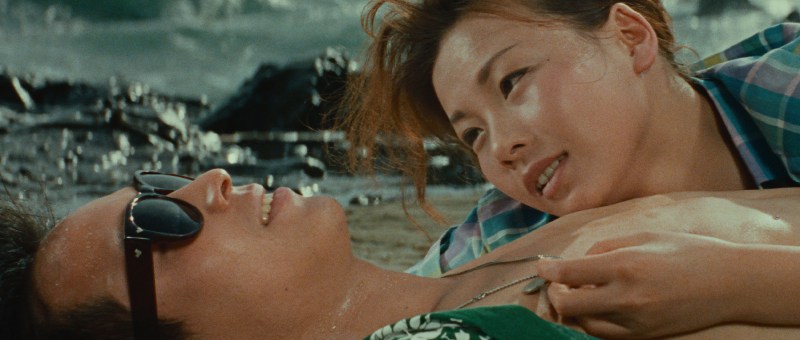
Beginning at the end, Kurahara opens with a small collection of men and women in mourning clothes walking towards a memorial service, later followed by an elegant young woman in western dress who has just arrived by train. Today marks the seventh anniversary of the death of a young woman, Kiyono (Ruriko Asaoka), who drowned herself after learning that her husband would not return from the war. The action then jumps back 20 years to a much more peaceful time in which the 10-year-old Kiyono first encountered the 12-year-old Takuji, before shifting to the more recent past in which the youngsters fell in love, overcame many hardships, and married only to be torn apart by war. 

The love story is complicated by the fact that Kiyono is a resident of a small and secretive village who claim to be descendants of the legendary Heike. Kiyono is a mountain woman, and Takuji (Juzo Itami) is a man of the sea, the son of a fishing village expected to take over the family business. When he first re-encounters Kiyono in his late teens, Takuji is in the process of finding wood to carve his own boat with dreams of sailing it all around the world. A mountain man advises him of a shortcut home, which brings him to Kiyono’s village where he serendipitously stops to ask for water and is invited inside. Kiyono insists on walking him back to the beach where she makes plain that she remembers him as the boy from all those years ago though he is now a man. She declares that she loves the sea, because it is big, manly, and also kind, abruptly stripping off and jumping in much to Takuji’s surprise. He waits for her on the beach every day after that, and the couple fall in love but the spectre of war is already upon them. Takuji has to leave for his mandatory military service and they are parted for the first time. 

Unable to see him off on the train because she would be ashamed to become emotional in front of so many people, Kiyono for the first time laments that she is not a strong woman. She sees this quality in herself as a failing and is constantly upbraided for it by the women around her who are quick to point out that the ability to bear all is a woman’s sorry duty. They see her as being too soft for the world, or perhaps merely too uninhibited, her mother lamenting that she always preferred the sea to the mountains which is perhaps why they finally agreed to allow her to leave the village and marry Takuji though no woman had ever married an outsider before. 

Yet Kiyono is a strong woman just in a different way. We were torn apart by a single order, Kiyoko laments, but when Takuji is injured she travels to the navy hospital to visit him and fiercely resists the doctor when he advises amputating Takuji’s leg. Though she is warned that the wound may become infected and Takuji may not survive, she is adamant that she will nurse him back to health herself and in fact does just that. To keep him safe from the war, Kiyono convinces Takuji move into an isolated cottage in the mountains where they can live together without being bothered by anyone else. She helps him learn to walk again, ignoring the advice of Takuji’s cousin Yasuko (Izumi Ashikawa) as a medical doctor that she is being reckless with Takuji’s health in boldly stating that she only wants the Takuji from before, not one damaged by war. But her devotion is a double edged sword, once he is healed, Takuji can be drafted again. She starts to regret her decision to oppose amputation.

The villagers, meanwhile, who had abandoned their initial scepticism to see Kiyono as a fine wife, now think her selfish and neurotic. They wonder why Takuji has not been to see his mother who is seriously ill, and for their own benefit want him to return so that he can communicate with the government who have requisitioned too many of their ships and left them unable to work. Kiyono has tried to create a space of her own into which the war may not enter, as if she were living in hiding. Nevertheless it is true that once Takuji makes the decision to leave the mountain the spell is broken, the war takes him, and there’s nothing Kiyono can do but “endure”. 

One of the ironic gifts brought to Kiyoko in the mountain is a Heike mask designed to contain all the pain and bitterness of a woman watching her husband march away to war. Yasuko, worried for her own husband, wonders if men and women are really so different. Kiyoko ironically replies that the men marching off to battle have an oddly beatific look, as if they too are in some way “enduring” in conforming to an idea of manliness though they too must be afraid, but if a woman looks that way it means she has gone mad. It’s the look that Kiyono herself eventually has, taking on the appearance of the mask, when her spirit is broken and she enters a kind of fugue state suspecting that Takuji will not return. 

Old women watching the few remaining men being recalled to the front remark on the cruelty, that they’re only going there to die because it’s quite obvious that the war is lost. It’s war which has divided the mountain and the sea, destroyed a fated a love, and created so much suffering. In an earlier time, Kiyono’s “devotion” might indeed have been seen as selfish, a desire to isolate herself and the man she loved and keep him from his duty because of her own pain. Now however, her tale is only tragedy. Not so much a woman driven mad by an excess of emotion, as a country by the lack of it.


Original trailer (no subtitles)

A Chaos of Flowers (華の乱, Kinji Fukasaku, 1988)

Kinji Fukasaku is best remembered for his work in the yakuza genre and most particularly the Battles Without Honour cycles which chronicled the darkness beneath Japan’s progress towards the economic miracle of the post-war era. He was, however, much more varied in output than it might at first seem. Set before the war, A Chaos of Flowers (華の乱, Hana no Ran) positions the great Kanto Earthquake of 1923 as the day innocence died, Taisho-era liberalism crushed in a fundamental collapse of the old world which led only to the intensification of militaristic ideology and the subsequent corruption of Japanese imperialism. 

Our guide is legendary poet Akiko Yosano (Sayuri Yoshinaga) who tells the story of pre-war 20th century Japan by recounting her own which begins in 1901 when she fell in love with fellow poet and later husband, Tekkan (Hiroshi) Yosano (Ken Ogata). The situation is complicated firstly because Hiroshi is already married with an infant daughter, and secondly because Akiko’s friend Tomiko (Yoshiko Nakada), another poet who had worked with her on a feminist journal, was also in love with Hiroshi and perhaps her rival. Akiko tricks Hiroshi into seeing him alone on the pretext that Tomiko is coming too, confessing her feelings and discovering that he plans to divorce his wife because she is unsupportive of his work. Full in the knowledge that he is choosing poetry over his daughter, Hiroshi decides to enter a relationship with Akiko because she, as a fellow poet, is more appreciative though it proves harder than expected to separate from his first wife. In any case, Akiko is left with a sense of guilt which continues throughout her married life that she cheated Tomiko to claim Hiroshi. 

During this time, Akiko Yosano becomes one of the most celebrated yet controversial young poets in Japan well known for her explicit, erotic love poetry much of which was inspired by her husband. She has eclipsed him as an artist and is supporting the family while he has fallen into a deep depression. A mother of 13 children, Akiko has begun to feel lonely in her marriage and wonders if someone who has only known one man has the authority to continue writing tracts about love and sex. Meanwhile, thanks to the admiration her poetry has received among the young radicals, she has become an accidental figurehead for the Taisho radicals and finds herself swept up by the movement through her associations with such avant-garde figures as Sakae Osugi (Morio Kazama) and his wife Noe Ito (Eri Ishida), the actress Sumako Matsui (Keiko Matsuzaka) held responsible for a revolution in Japanese theatre, and finally tragic author Takeo Arishima (Yusaku Matsuda) who was also the father of golden age actor Masayuki Mori. 

Arishima is first struck by Akiko when knocks her out of a rickshaw during an anarchist publicity stunt driving a motorcycle and sidecar around outside the theatre where Sumako Matsui is performing one of her most famous roles in a play inspired by Tolstoy’s Resurrection. It turns out that Akiko bears a striking resemblance to his late wife, which is one reason he sends her an extravagant gift of a beautiful Western-style outfit which she first tries to return partly because she only wears kimono and partly because it’s an inappropriately expensive gesture. Arishima is from a wealthy, landed family and like many of his generation uncomfortable with his privilege but struggling to convince himself to abandon it. Drawn to him in the same way she was drawn to Hiroshi, Akiko accepts the dress and later wears it on a picnic she organises where her children and Arisihma’s two sons can play together. The Western clothing becomes a kind of signifier of Akiko’s drive towards the future and away from her husband as she too despite her feminist perspective struggles to free herself of the image of the good wife while inwardly burning with a desire for love and passion which her husband can no longer satisfy. 

That same dilemma is one which plagues her rival, journalist Akiko Hatano (Kimiko Ikegami) who is already involved with Arishima but married to a patriarchal man who sees her as nothing more than a “doll”, something which is supposed to look pretty and live in its box until he chooses to take it out. Akiko Hatano warns Akiko Yosano that Arishima is a man drawn to death and is merely looking for someone to die with in a lovers’ suicide, something of a fad at the time. In meeting Akiko Yosano, however, his desire for life seems to have been reinvigorated. He makes peace with himself by dissolving his estate in Hokkaido and surrendering control of it to a peasants’ committee, but is thrown again into suicidal despair when the secret police turn up to harass the peasants for undermining the social order. 

As Akiko Hatano puts it, Arishima is a man vacillating between life and death, claiming to be in love with Akiko Yosano soon after meeting her and actively rejecting Akiko Hatano as symbolic of his newfound desire to live. Arishima committed a love suicide with Akiko Hatano on 9th June, 1923 which is only a few months before the Great Kanto Earthquake which devastated the city of Tokyo and enabled a roundup of subversive forces such as socialists and anarchists along with Koreans many of whom were massacred by state sanctioned forces after a false rumour circulated that they had been poisoning the wells and preparing an insurrection for Korean independence (Sakae Osugi and Noe Ito along with their 6-year-old nephew were also victims of this pogrom). 

In her voice over, Akiko describes the earthquake as the death of Taisho which in real terms lasted a few more years until 1926, but was perhaps over as far as its liberalising ideals are concerned, the crisis giving the militarists further excuses to increase their powers. Yet like Arishima the Taisho intellectuals had also been obsessed with death and futility of which the love suicides were a part. Arishima, shortly before witnessing Sumako’s very public breakdown over the death of her lover Hogetsu Shimamura (Keizo Kanie) from Spanish Flu, describes her nothing more than a ham actress but also believes that the theatrical revolution of the Taisho era would not have been possible without her. Sumako also committed suicide for love a few months after Hogetsu’s death, unable to go on without him. Tomiko, Akiko’s old friend, contracted TB and painfully faded away with Hiroshi unexpectedly by her side. Catching sight of a couple of Osugi’s comrades being dragged away after the earthquake Akiko chases after them with rice balls, telling them they must survive. She’s watched many of her friends and the finest minds of her generation die, mostly through choice, and is making an active choice to live. 

In essence this choice may not be as positive as it first sounds. One of Japan’s first avowed pacifists, Akiko Yosano turned increasingly towards the right in the years following the earthquake, eventually becoming an enthusiastic supporter of the war in China and actively subverting the words of her previous poems in insisting it was glorious to die for the emperor after all. Her friends died out of a sense of futility, that the social changes they envisaged were not possible or that they were unable to continue living with themselves in such a society. Society changed, and Akiko changed with it, such was the path she found to continue living. Nevertheless, something did die with the earthquake and it was perhaps those youthful dreams of overwhelming romance crushed like Akiko’s hat in the rubble of a world which was already collapsing. 


Original trailer (no subtitles)

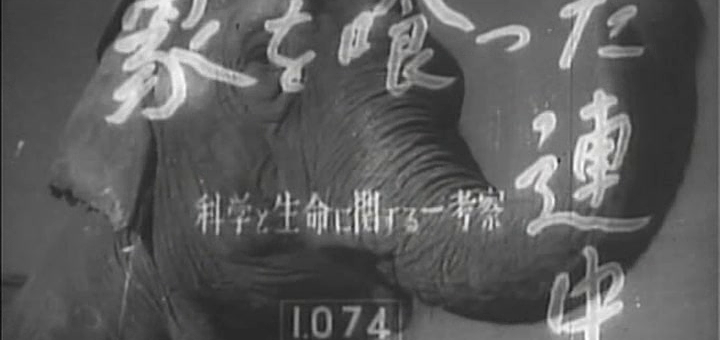
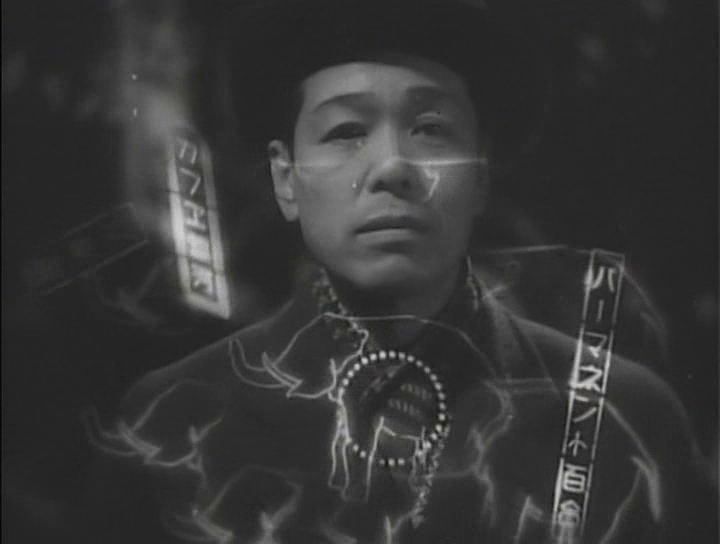
The Fellows Who Ate the Elephant (象を喰つた連中, Kozaburo Yoshimura, 1947)

The Japan of 1947 was one still very much caught up in post-war chaos. In the cities, most particularly, hunger was a major problem. The Fellows Who Ate the Elephant (象を喰つた連中, Zo wo Kutta Renchu) may have a title that strongly recalls the screwball comedies of the ’30s, but is less slapstick comedy than dark satire in its central premise that a bunch of idiot mad scientists might actually eat a deceased elephant in extreme dedication to “mottainai” waste not want not philosophy coupled with the justification that all is permissible in the name of science. 

The elephant is, apparently, the last in Japan and was the childhood friend of zookeeper Yamashita (Chishu Ryu) who brought him all the way over the mountains from Thailand after the war. “Shiro-chan” is very ill with some kind of elephant cold but for some reason the doctors the zoo uses aren’t vets specialising in large, exotic animals but virologists. While they stand around apparently mystified, Yamashita enquires after the professor he usually deals with but is told that, despite being over 60 years of age, he’s currently away on honeymoon after marrying a very young and extremely beautiful woman. Sadly, Shiro doesn’t make it. The professor is saddened to learn of the death from the paper and wonders if it might have been a virus similar to one which attacks hoofed animals like donkeys and horses but is not usually found in Japan (Shiro is Thai after all). 

This is relevant because the disease is fatal and contagious but does not usually pass to humans and is only a risk if you come into direct contact with it, like say if you eat meat from an infected animal. No one would eat an elephant though so there’s nothing to worry about. Enter extremely unpleasant mad scientist Wada (Shinichi Himori) who decides that science dictates they must find out if it’s sanitary to eat elephant meat. Though Wada ropes in fellow scientist Baba (Yasumi Hara) with his scientific justifications, he tricks the other two into eating some without telling them what it is. Unforgivably, he even gives some to Yamashita and seems to get a kick out of feeding him his own childhood friend when Yamashita had only come on instruction from his boss to apologise for being over emotional the day before. Yamashita leaves feeling sick after Wada tells him what he was eating for additional effect, but his wife (Chiyoko Fumiya) later remembers a story he told her about fellow elephant drivers in Thailand who ate some elephant meat from an infected animal and were dead within 30 hours. 

After hearing Yamashita’s concerns, the scientists begin investigating and indeed find cases of people dying after eating contaminated meat. The only cure is the serum they use to treat the horse infection the professor mentioned, but it seems nowhere has any in stock (the disease is rare in Japan after all). The idiot scientists come to the conclusion they will die in exactly 30 hours’ time and decide to put their affairs in order rather than consult an actual doctor who might be able to help them. This mostly involves trying to explain their foolishness to their wives. Watanabe (Takashi Kanda) is a father of three with another child on the way. He regrets that he hasn’t been present enough in his family life and has failed to adequately provide for his wife who he will shortly be leaving to raise four children alone. Nomura (Toru Abe) meanwhile is an uxorious newlywed constantly worried that his wife (Kyoko Asagiri), who already dislikes Wada for being a bad influence on her husband, will not be able to bear the anxiety of knowing he may soon die. Baba who has only his parents retreats back to his old country home to apologise for not being a better son. 

Wada, meanwhile, moans about everyone else’s understandable desires to comfort their wives and families. He criticises Yamashita for trying to excuse himself because he’d rather go home and have dinner with his wife, while mocking Nomura for being a henpecked husband. This might partly be because he has no wife or family of his own and is currently chasing after Tomie (Akemi Sora), a maid at his boarding house, who seems pretty indifferent or even hostile to his attentions, joking that she’d celebrate on hearing of his demise. She eventually agrees to go out with him, but only if he really dies. Other than the wives, no-one quite believes the guys’ bizarre story. Baba’s parents even try to stop him going back to Tokyo when a potential cure is located in case he goes “even more mad”. 

In these trying times, the idea that someone might try to eat a dead elephant is perhaps not quite as ridiculous as it might first seem. The act of trying it, however, also plays into the constant critiques of bad or irresponsible science which are a mainstay of films in the immediate post-war era. Wada knows that he can and so he doesn’t bother to think about if he should, spinning tales of Jenner and Koch as if they’re about to make some grand lifesaving discovery. His brush with death does at least begin to humble him as he finally accepts responsibility for the unexpected consequences of his cruel prank, realising that as a man with no wife or family it should perhaps be him if anyone is going to have to make a sacrifice. Finally someone manages to get through to the professor on the phone who tells them they’re all very stupid and haven’t thought of something perfectly obvious that makes all their panicking completely pointless, but at least the surreal 30-hour near death experience has brought out a warmer side of Wada and given a few irresponsible scientists a quick lesson in social responsibility. 


Gate of Hell (地獄門, Teinosuke Kinugasa, 1953)

Which is the greater challenge to the social order, love or ambition, or are they in the end facets of the same destabilising forces? Teinosuke Kinugasa’s Gate of Hell (地獄門, Jigokumon) is, from one angle, the story of a man driven mad by “love”, reduced to the depravity of a crazed stalker betraying his samurai honour in order to affirm his status, but it also paints his need as a response to the chaos of his age along with its many repressions while the heroine is, once again, convinced that the only freedom she possesses lies in death. Yet in the midst of all that, Kinugasa ends with a triumph of nobility as the compassionate samurai restores order by rejecting the heat of raw emotion for an internalised contemplation of the greater good. 

Set in the 12th century, the film opens in revolt as two ambitious lords combine forces to attack the Sanjo Palace in what would become known as the Heiji Rebellion. The lords have attacked knowing that Taira no Kiyomori (Koreya Senda) is not in residence, having departed on a pilgrimage. Fearful for the safety of his sister and father, retainers order decoys to be sent out to distract the rebels. Kesa (Machiko Kyo), a court lady in service to the emperor’s sister, agrees to be her decoy and Morito (Kazuo Hasegawa), a minor retainer, is ordered to protect her. He manages to escort her back to his family compound where he assumes she will be safe, transgressively giving her a kiss of life, pouring water into her mouth with his own, after she has fainted during the journey. Unfortunately, Morito has miscalculated. His brother has sided with the rebels and they are not safe here. During the chaos they go their separate ways, and as soon as Kiyomori returns he puts an end to the rebellion restoring the status quo.  

Shocked at his brother’s betrayal, Morito tells him that only a coward betrays a man to whom he has sworn an oath of loyalty but he explains that he is acting not out of cowardice but self interest. He has made an individualist choice to advance his status in direct opposition to the samurai code. Morito doesn’t yet know it but he is about to do something much the same. He has fallen in love with Kesa and after meeting her again at the Gate of Hell where they are each paying their respects to the fallen, his brother among them, is determined to marry her, so much so that he asks Kiyomori directly during a public ceremony rewarding loyal retainers for their service. The other men giggle at such an inappropriate, unmanly show of emotion but the joke soon fades once another retainer anxiously points out that Kesa is already married to one of the lord’s favoured retainers. Kiyomori apologises and tries to laugh it off, but Morito doubles down, requesting that Kiyomori give him another man’s wife. 

This series of challenges to the accepted order is compounded by a necessity for politeness. Morito is mocked and derided, told that his conduct is inappropriate and embarrassing, but never definitively ordered to stop. Making mischief or hoping to defuse the situation, Kiyomori engineers a meeting between Morito and Kesa, cautioning him that the matter rests with her and should she refuse him he should take it like a man and bow out gracefully. Kesa, for her part, has only ever been polite to Morito and is extremely confused, not to mention distressed, by this unexpected turn of events. She is quite happily married to Wataru (Isao Yamagata) who is the soul of samurai honour, kind, honest, and always acting with the utmost propriety. That might be why he too treats Morito with politeness, never directly telling him to back off but refusing to engage with his inappropriate conduct. That sense of being ignored, however, merely fuels Morito’s resentment. He accuses Kesa of not leaving her husband because Wataru is of a higher rank, as if she rejects him out of snobbishness, rather than accept the fact she does not like him. 

Morito continues in destructive fashion. We see him repeatedly, break, smash, and snap things out of a sense of violent frustration with the oppressions of his age until finally forced to realise that he has “destroyed a beautiful soul” in his attempt to conquer it. “One cannot change a person’s feelings by force” Wataru advises, but is that not the aim of every rebellion, convincing others they must follow one man and not another because he is in someway stronger? The priest whose head was cut off and displayed at the Gate of Hell was killed in part because he reaped what he had sown in beheading the defeated soldiers of a previous failed revolution. Morito kills a traitor and he falls seemingly into rolling waves which transition to an unrolling scroll reminding us that rebellions ebb and flow through time and all of this is of course transient. Only Wataru, perhaps ironically, as the unambiguously good samurai is able to end the cycle, refusing his revenge in the knowledge it would do no real good. Morito is forced to live on in the knowledge of the destruction his misplaced passion has wrought, standing at his own Gate of Hell as a man now exiled from his code and renouncing the world as one unfit to live in it. 


Gate of Hell is currently streaming on BFI Player as part of the BFI’s Japan season.

Late Autumn (秋日和, Yasujiro Ozu, 1960)

“It’s people who complicate life. Life itself is surprisingly simple” according to a puffed up old man having just hugely overcomplicated an admittedly delicate situation in Yasujiro Ozu’s Late Autumn (秋日和, Akibiyori). A reinterpretation of his classic Late Spring, Late Autumn once again stars Setsuko Hara but this time as a widowed mother far more enthusiastic about marrying off her only daughter while enduring the sometimes unwelcome assistance of a group of middle-aged men stepping into the decidedly female realm of matchmaking and of course concluding that they are doing a fantastic job. 

The action opens at the seventh memorial service for Akiko’s (Setsuko Hara) late husband, Miwa, attended by his three old high school friends, Taguchi (Nobuo Nakamura), Hirayama (Ryuji Kita), and Mamiya (Shin Saburi) who’s turned up fashionably late in the hope of skipping most of the sutras. At the refreshments afterwards, talk turns to the marriage of Miwa’s daughter Ayako (Yoko Tsukasa) who is now 24 which is actually edging towards the late side by the standards of the time. The three old men offer to help find prospective matches with Taguchi instantly proposing an acquaintance to which Ayako smiles demurely but is later relieved to discover is already taken. Mamiya too has a lead, a nice young man from his office, Goto (Keiji Sada) who graduated from a good university and is not bad looking either. Though Akiko is excited, she’s surprised to discover that her daughter wants to shut the offer down immediately before even exchanging photos. She feels she’s not ready for marriage and is happy the way things are. Of course, if she fell in love it might be a different matter, but to her mind there’s no rush to get married just for the sake of it. 

Generally speaking, it’s other women who mostly enforce these restrictive patriarchal social norms, after all a daughter’s marriage is ironically the one area of a woman’s life over which she usually has total control. In this case, however, Ayako’s marriage becomes a kind of hobby for three eccentric old men who each have problems of their own they don’t seem to be in a big hurry to deal with. They each have a latent crush on Akiko from their youth though it was obviously Miwa who later married her. Hirayama is widowed with a teenage son, but Mamiya and Taguchi have wives and daughters of their own, Taguchi’s already married but apparently experiencing frequent bouts of “frustration” with her husband, and Mamiya’s still in school, while their wives are fully aware of their lingering affections for Akiko but mostly content to laugh at their ridiculousness. They are all certain that Ayako “needs” to get married as soon as possible and that they are “helping” her towards “happiness” though what they’re mostly doing is a father knows best routine in which they resolutely ignore her repeated desire for things to go on as they are until she decides that they shouldn’t. 

Ayako isn’t interested in arranged marriage, but does become interested in Goto after accidentally meeting him at Mamiya’s company and then discovering they have a mutual friend, all of which makes their relationship both “arranged” and “not”, giving Mamiya cause to think he’s responsible when he’s really just incidental. Thinking things aren’t moving fast enough, the guys decide the problem is Akiko and if they can persuade her to remarry then Ayako will be less reluctant to leave home. Their behaviour is in fact quite manipulative, something they are later called out on by Ayako’s feisty friend Yuriko (Mariko Okada) who is also trying to help but determined to do it in a less problematic way. The gang’s suggestion to Ayako that her mother is considering remarriage when in fact she had no such intentions at all places a rift between the two women with Ayako left feeling hurt and betrayed, as if her mother has offended her father’s memory and done something improper behind her back. 

Ayako is not alone in her lingering prejudice against second marriage even if Yuriko tries to explain to her that she’s being unreasonable. Hirayama too originally objects to the gang’s plan to get him to marry Akiko on the grounds that it would be “immoral” to marry his old friend’s wife, but is brought round when he puts the idea to his son and finds him wildly enthusiastic if only in part because he’s already thought ahead to his own marriage and is worried his dad will want to live with them and that would inconvenient for everyone. When it comes to Akiko’s marriage, there seems to be more wiggle room. Everyone wants her to be “happy” and so there’s a greater freedom to explore various options while completely ignoring her preference to remain a widow. As we see from Akiko’s life, she is already financially independent and really has no “need” to remarry unless she happened to fall in love though she remains attached to her husband’s memory. As she later confesses to Ayako, she has no desire to “climb that mountain” again, and in fact will be happier living in freedom as an independent woman. 

As so often, however, while remarriage is optional marriage is not. Ayako has to marry, she never really has the option to remain single even that was what she wanted. She falls in love with Goto and indeed wants to marry him if perhaps worried about leaving her mother behind, making the three old men partially correct in their conviction that her reluctance was more anxiety than it was opposition. Unfortunately, their “success” emboldens them towards the next match and possibly more unhelpful meddling, complicating what should be simple with their increasingly outdated ideas fuelled by a desire to rebel against their sense of impending obsolescence. “In marriage you just give up” an exasperated wife admits, but wouldn’t it be something if you didn’t have to?


Late Autumn is currently streaming on BFI Player as part of the BFI’s Japan season.

Original trailer (no subtitles)

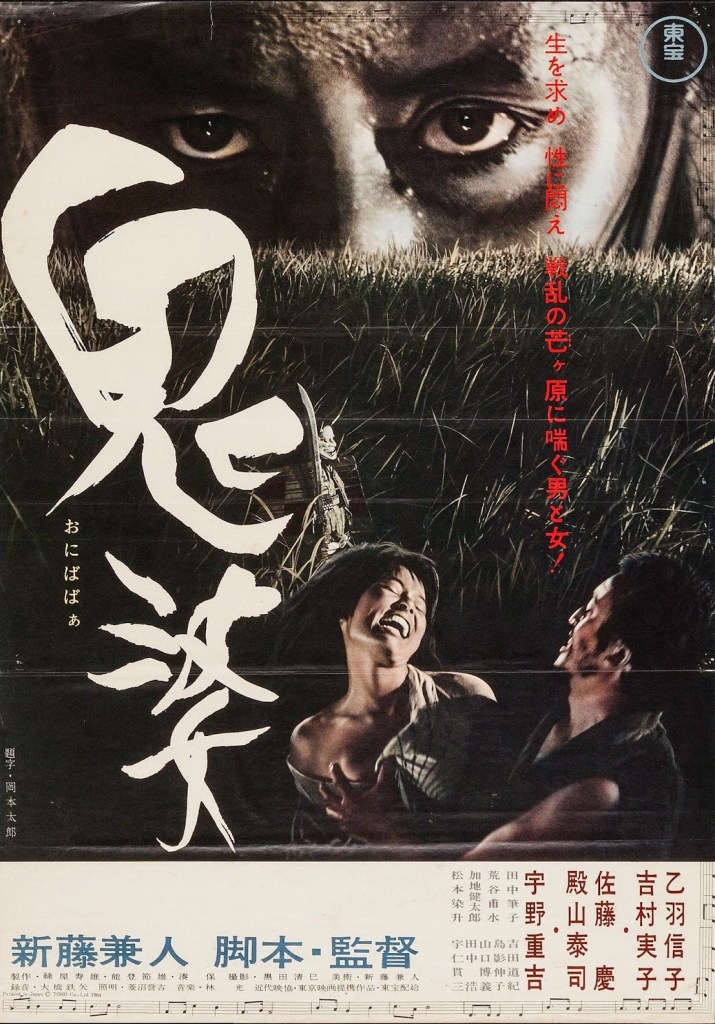
Onibaba (鬼婆, Kaneto Shindo, 1964)

How do you go on living in a world turned upside-down? It may be the central theme of post-war cinema, but few have tackled it in such a direct if allegorical way as Kaneto Shindo, repurposing a Buddhist parable about the perils of duplicity as a lesson in the dangers of the age, defined by a cruel hunger which could not be satisfied by bread alone even if there were bread to satisfy it. Onibaba (鬼婆), as the title implies, makes a villainess of an old woman driven to extremes by her chaotic times, but perhaps suggests that the times make villains of us all.

Deep in the war-torn country of 14th century Japan the imperial capital of Kyoto has been razed, a horse is said to have given birth to a cow, and the sun rose black in the sky leaving day as dark as night. With farmers dragged away from their fields to fight in a war they barely understand on behalf of distant lords, the grain basket of the nation is close to empty. An old woman (Nobuko Otowa) and her daughter-in-law (Jitsuko Yoshimura) have learned to make ends meet by hunting battle-weary samurai, stripping them of their armour, and throwing their bodies into a gigantic pit sitting right in the middle of the tall grass like a gravitational black hole of human compassion. The old woman has been patiently waiting for the return of her son, Kichi, who was taken away by the samurai, certain that everything is going back to normal when the war is over. Kichi, however, will not be returning. Hachi (Kei Sato), another young man from the village taken along with him, brings the sad news that the old woman’s son was beaten to death by a mob of farmers much like herself resentful of the war’s intrusion onto their land. 

Everything becomes food, Hachi explains, a sentiment extremely familiar to those who lived through the chaos of the immediate post-war era. Pointing at a baseline problem in the feudal economy, the war starves the poor and makes the wealthy hungry. The fields run wild with no men to tend them, as if symbolising the madness of the times. Lost in the tall grass, samurai and peasant alike search for an exit but are drawn only towards that black pit of human cruelty, more beasts than men driven by the need to survive alone. 

Without her son, the old woman is unable to farm, and without her daughter-in-law she is unable to survive through killing. She knows that these are times without feeling and that if Kichi will not return there is no reason for her daughter-in-law to stay. Ushi (Taiji Tonoyama), the broker for the looted samurai armour, makes an indecent proposal of extra millet for sexual favours but the old woman defiantly turns him down, perhaps not quite realising the offer was likely not intended for her. Which is to say that Hachi is not the only man in town, but is perhaps the only “desirable” one. Such desires that there are apparently cannot be satisfied by a crusty old man like Ushi, but are there all the same. Hachi presents a triple threat. The old woman knows her survival depends on the younger one, but also that she has no means to keep her now that her son is dead. She offers Hachi her body instead but he, as she did Ushi, baulks at the idea of slaking his lust on such an old woman. 

When a strange samurai wanders into her hut and orders her at the point of his sword to lead him out of the tall grass a solution presents itself. The old woman lures him to the black pit and prises away the ornate oni mask which he claimed he wore to protect his beautiful face from the ravages of war. Despite the fact that the samurai appears to have suffered from some kind of aggressive skin disease, the old woman unwisely decides to put the mask on her own face, convincing her daughter-in-law that her relationship with Hachi is sinful and appearing out of nowhere dressed as a demon to remind her that she’s going to hell. The mask’s crazed expression becomes fused with her own face, cementing her transformation into a “demoness” which it seems had already begun with stretch of white disrupting the uniformity of her hair and the kabuki-esque exaggeration of her eyebrows. Running desperately through the tall grass she cries out that she’s human, but this world has made demons of them all. The black pit of hunger knows no fill, and there can be no satisfaction in a world so devoid of human feeling.


Onibaba is currently streaming on BFI Player as part of the BFI’s Japan season.

Original trailer (dialogue free)

Blood End (天狗党, Satsuo Yamamoto, 1969)

When the black ships appeared off the coast of Japan in 1853, it provoked a moment of crisis which eventually led to the fall of the Tokugawa Shogunate and the Meiji Restoration. Between those two events however lay a period of intense confusion as several groups and movements attempted to lay claim to the future direction of the nation. Many, such as the legendary figure Sakamoto Ryoma, held that above all else Japan needed to Westernise as quickly as possible in order to defend itself against foreign powers now far more technologically advanced than the Japan which had attempted to hold back time for over 200 years. Others felt quite the opposite, that what was needed was an end to the corrupt rule of the Shogunate and the restoration of power to the emperor while expelling foreign influence and going back into isolation. 

Satsuo Yamamoto’s Blood End (天狗党, Teng-to) dramatises this debate through the melancholy tale of the Mito Rebellion as a brutalised peasant farmer is sucked in by the idea of revolution but eventually betrayed by it in discovering that the samurai, even revolutionary samurai, will never change. They may claim they want an end to the feudal caste system and to live in a world where all men are equal, but continue to feel themselves entitled to more equality than others and insist on deference from those they still believe to be inferior. 

The action begins with a scene familiar from many a jidaigeki in that a small farming community is being pressed to provide the usual amount of rice despite the failure of the harvest. Revolutionary yakuza Jingoza (Kanemon Nakamura) and egalitarian samurai Kada (Go Gato) stumble on the scene of a “stubborn” peasant being subjected to 100 blows as punishment for the village’s raising the unfairness of their situation with the local lord. Surviving his ordeal, Sentaro (Tatsuya Nakadai) asks only for water but is denied by his cruel samurai tormentor. Jingoza intervenes and offers him his flask along with some money by way of an apology on behalf of these savage nobles, a gesture for which Sentaro remains grateful. While many of his friends are exiled and lose their lands, Sentaro disappears from the village and becomes a yakuza himself, learning the art of the sword in preparation for his mission of revenge. 

Meeting Jingoza by chance, he takes the opportunity to thank him and agrees to transport some money back to his family in a nearby village while he engages in urgent business in the mountains. While there, Sentaro ends up defending Jingoza’s steely daughter Tae (Yukiyo Toake) who is running something like an orphanage for children rendered fatherless by the ongoing chaos. It’s at Tae’s that he ends up running into Kada, who is a member of revolutionary movement “Tengu-to”, named for the mythical ogres with long noses and bright red faces. Sentaro ends up joining the movement, but gradually discovers that Tengo-to is not all he thought it to be. In the modern parlance, many of their actions are terrorist, they care little for human life and have no issue with looting wealthy houses as they prove after helping Sentaro assassinate the man who beat him, killing the man’s wife and servants and making off with his money as “military funds”. Sentaro is shocked, but only manages to get some of the money for himself to take back to Tae as a way of making amends. He continues to associate with Tengu-to despite his growing disillusionment with their philosophy. 

The Mito clan were perhaps outliers in the great Bakumatsu culture war, running under the “Sonno Joi” banner but doing so alone and forcefully advocating that the emperor’s instruction to expel all foreigners with immediate effect be enforced. At least as far as Yamamoto’s revolutionaries go, they advocate for this not so much because they reject foreign influence but because they resent the country’s elites maintaining a stranglehold on the riches to be gained by foreign trade. Kada, however, claims to have a more revolutionary spirit in that he wants to improve conditions for farmers like Sentaro, protecting them from the “corrupt system” but he’s still a product of his society and finds the programming increasingly hard to break. Having recruited vast numbers of peasants to their cause and witnessing the failure of their campaign, the other leaders want to go to Kyoto to talk to the emperor but are embarrassed to go there in the company of so many men who are not samurai. The solution is that they simply kill them, because peasants aren’t really people anyway. 

Sentaro thought they were “doing something good for peasants and the poor”, but samurai will always be “samurai” and eventually they will betray him. He wavers when Kada and the others ask him to assassinate Jingoza because he’s gone over to the Westernising cause, and is half talked round by his insistence that he’s acting blindly without thinking far enough ahead but himself finds it hard to break with the idea that samurai are honest and know what they’re doing. 

Yamamoto is perhaps making a direct allusion to the imminent failure of the student movement in Japan which finds itself in much the same place as the Tengu-to, torn apart by infighting and increasingly corrupted by duplicitous dogma. Kada has a lot of fine ideas but he doesn’t act on them, doubling down on ruthlessness in complaining that Sentaro is too sentimental, insisting that emotion is the enemy. Sentaro, however, has figured out that the enemy is the sword and everything it represents. Jingoza’s “Restoration” is the one he should have been fighting for if he wanted to see a classless Japan, but the Tengu-to have misused his idealism for their own ends and turned him into a defender of his own oppression. Still, the Tengu-to are the ones who pay the price, their entreaties to the emperor falling on deaf ears with 353 retainers beheaded as punishment. Sentaro lives on, vowing he will never die, as he walks towards the “Restoration” of the future and away from the Blood End of an inherently corrupt insurrection. 


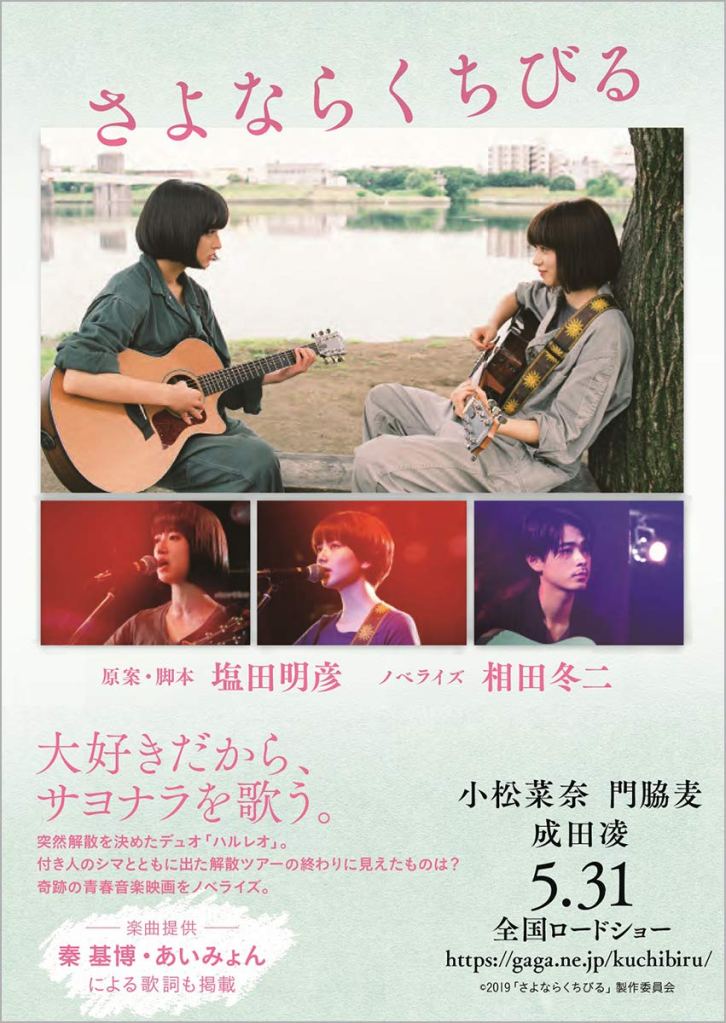
Farewell Song (さよならくちびる, Akihiko Shiota, 2019)

Repressed desire and toxic resentment conspire against a trio of melancholy musicians in Akihiko Shiota’s delicate indie drama, Farewell Song (さよならくちびる, Sayonara Kuchibiru). As the title implies, this is a tale of learning to let go, but then again perhaps not. As an over earnest interviewer suggests there are many ways to interpret the title song, but it also carries with it an unmistakable hint of defeatism as the singer songwriter heroine finds herself perpetually preparing to say goodbye, no longer believing in a positive future and unwittingly sabotaging its existence in an intense desire for protective distance. 

As the film opens in the summer of 2018, folk duo Haruleo is about to set off on a “farewell tour” though it’s not been advertised as such. The atmosphere is extremely awkward and emotionally volatile. Something has obviously gone very wrong in the previously close relationship between bandmates Haru (Mugi Kadowaki) and Leo (Nana Komatsu), while roadie Shima (Ryo Narita) seems to be doing his best to stay out of it and keep the peace if only until after they’ve played their final show in Hakodate way up in Hokkaido. 

That might be difficult however because Leo’s self-destructive streak is out in full force, wandering off with a rough-looking man from the petrol station where they stopped to use the facilities. “Aren’t you going to stop her?” Haru asks of Shima, entirely mistaken in the nature of their relationship, “What would be the point?” he replies, open mouthed in exasperation. Sure enough Leo turns up late to the gig and sporting a nasty bruise on her face after another encounter with a dark and violent man. “I don’t want to watch you fall apart”, Haru had told her on a previous occasion in an awkward attempt at comfort that finally backfired, Leo firing back that hearing that from her only made her feel even worse. Haru echoes those words herself when Shima tries something similar with her, only charged with a somewhat inappropriate fervour driven by misplaced desire. 

Desire is indeed circulating, but in an emotionally difficult and seemingly irresolvable love triangle between three people with extremely low self esteem. Struggling to accept love, they act on self-destructive impulse and only wound where they mean to console. Haru strikes up a conversation with Leo because she says that her “eyes wanted to sing”, seemingly captivated and taking the young woman in but still somehow maintaining a distance. Leo, who seems to have no family and is incapable of looking after herself, quickly bonds with Haru but is frustrated by her resistance to connection. When Haru interviews Shima for a position as their roadie, she’s quick to tell him that romance is prohibited, but later claims that she always expected he and Leo to run off together while silently pining for her in a mistaken belief that her love is hopeless. 

Filled with internalised shame, Haru takes Shima home as a beard to show off to her mother at her father’s memorial service, unable to disclose her sexuality and trying not to look hurt when her mother whips out a postcard from her first love who has since married abroad and had a child. Shima, strangely perhaps the most emotionally astute, is drawn to Haru even after learning that she is gay and realising that all of her songs are really about her unrealisable longing for Leo, who claims to be in love with him though it’s not exactly clear if that, like her tendency to disappear with dangerous men, isn’t a misdirected way of connecting with Haru.

Shima may have failed once and resolved to do better in avoiding making the same old mistakes, but is still an awkward third wheel in this increasingly difficult relationship despite his attempts to mitigate the effects of his presence while perhaps biased towards preserving Haru’s happiness in trying to “save” Leo. Learning that a close friend and former bandmate has passed away forces him, and perhaps the girls too, to reflect on what’s lost if you let important relationships fall by the wayside out of pettiness or pride. Shima’s friend apparently told his young son never to become a musician because it will rob you of the things that are most important. Still, Shima, echoing the words of Haruleo’s signature song, affirms that he regrets nothing. If it all ends in tears, Haru’s lyrics imply that she’s happy to live with the thorn in her side as a reminder of past love. The jury’s out on whether the Farewell Song leads to a new beginning or merely more of the same, perpetually trapped in an inescapable cycle of emotional frustration, but Haruleo seems resigned to weathering the storm whatever it is that might emerge on the other side. 


Original trailer (English subtitles)

Farewell Song music video

Cruel Story of Youth (青春残酷物語, Nagisa Oshima, 1960)

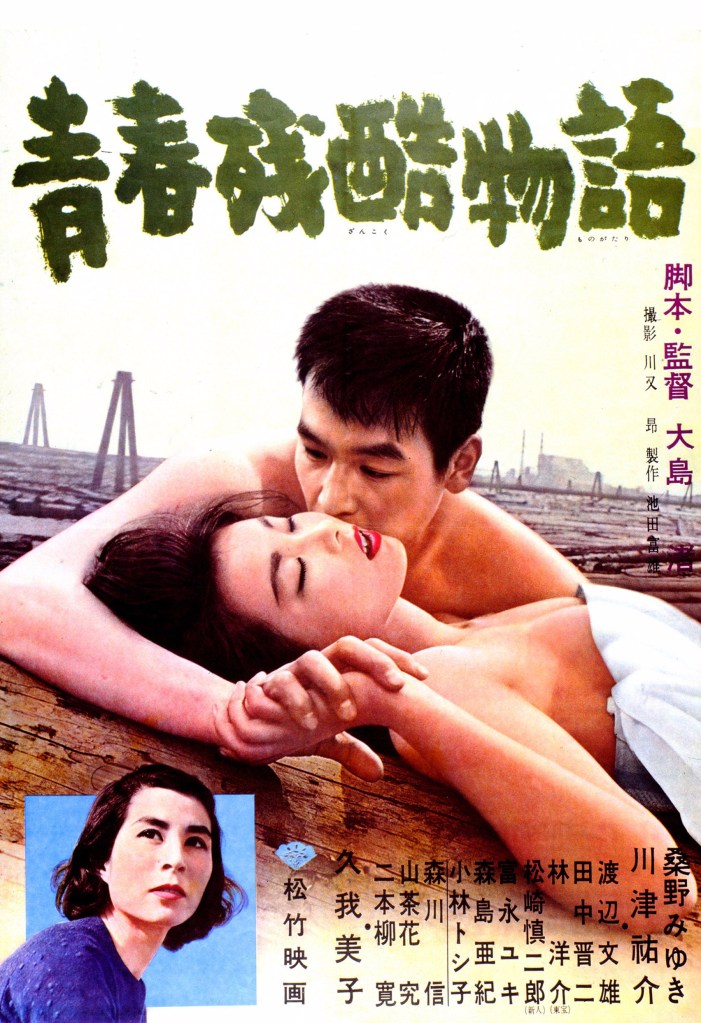
More interested in politics than cinema and never quite at home in the studio system, Nagisa Oshima began his career at Shochiku as one of a small group of directors promoted as part of the studio’s effort to reach a youth audience they feared their particular brand of inoffensive melodrama was failing to capture. Like The Sun’s Burial, Cruel Story of Youth (青春残酷物語, Seishun Zankoku Monogatari) is a nihilistic tale of a fracturing society, but it also looks forward to Night and Fog in Japan in its insistence that youth itself is a failed revolution and this generation is no more likely to escape existential disappointment than the last. 

The film opens with teenager Makoto (Miyuki Kuwano) and her friend Yoko (Aki Morishima) trying to get free rides from skeevy middle-aged men rather than having to pay for a cab. As you might expect, that’s a fairly dangerous game and while it might be alright while there’s two of you, as soon as Yoko has been dropped off, the driver changes course and suggests going for dinner only to park in front of a love hotel and try to drag Makoto inside. Luckily, or perhaps not as we will see, she is “rescued” by young tough Kiyoshi (Yusuke Kawazu), a student and angry if politically apathetic young man. Struck by his manly white knight act, Makoto takes a liking to Kiyoshi but he too later rapes her under the guise of satisfying her curiosity about sex to which he attributes her ride hailing activities. After this violent genesis, they fall in “love” but continue to struggle against an oppressive society.

We assume that the “cruel story of youth”, and it is indeed cruel, that we are witnessing is that of Makoto and Kiyoshi, but it’s also that of her slightly older sister Yuki (Yoshiko Kuga) and her former lover Akimoto (Fumio Watanabe) who has become a conflicted doctor to the poor betraying himself by financing the clinic through charging for backstreet abortions. Yuki complains to her apathetic father that they were strict with her in her youth, that she’d get a hiding just for coming home after dark, whereas Makoto can stay out all night and not get much more than a stern look. Her father explains that times were different then, “We thought we had new horizons. We started again as a democratic nation, and it was a responsibility that went hand in hand with freedom. What can I say to this girl today?” admitting both the failures of the past and the mistaken future of a society that actively resists change. 

Yuki and Akimoto were part of the post-war resistance, left-wing students like the older generation of Night and Fog in Japan, who’d actively fought for real social change but had seen that change elude them. Yuki, we hear, left Akimoto for an older man but perhaps now regrets it along with her half-finished revolution. She may not approve of her sister’s choices, but she also on some level admires her for them or at least for the strength of her rebellion even if it will ultimately be as fruitless as her own. “This is a cruel world and it destroyed our love” Akimoto laments, mildly censuring the youngsters in suggesting that his love was pure and chaste because they vented their youthful frustrations through political action whereas this generation is already lost to the mindless hedonism of unbridled sexuality. 

He forgives them, because he feels that their plight is a direct result of his failure to bring about the better world, but there is also a suggestion that it is a lack of political awareness which is somehow trapping the young. Oshima cuts from footage of the April Revolution in Korea which is described as a “student riot” in the news to a protest against the Anpo treaty at which Kiyoshi and Makoto look on passively from the sidelines. “I think taking part in the demonstrations is stupid”, Makoto’s friend Yoko tells a prospective boyfriend, “why don’t we think about getting married instead?”, drawing a direct line between social conservatism and political inaction. 

Makoto and Kiyoshi rebel by using, or to a point not using, their bodies as a direct attack on the society. Following their rather odd and troubling meeting, the pair earn their keep through repeating the experience. Makoto picks up men who will inevitably have an ulterior motive, and Kiyoshi rescues her, extorting money from their targets. Yet it is Kiyoshi who is forced to prostitute himself, gaining financial support as a gigalo kept by a wealthy middle-aged housewife who is just as sad and defeated as Yuki and Akimoto, dissatisfied with the path her life has taken and in her case attempting to escape it through passion and control exerted over the body of a young man. Though the consequences of a becoming a kept man may be different than those Makoto would face should the less “nice” delinquents get their hands on her, they do perhaps fuel his sense of violent emasculation which he channels into a pointless act of revenge against the society in the form of its most powerful, wealthy middle-aged men whose misogyny he claims to abhor while simultaneously mirroring and directly exploiting.

“Someone needs to be responsible” a strangely sympathetic policeman insists, chiding Kiyoshi that at heart he’s just a petty criminal who liked having money no matter how he might have tried to dress it up. “You’re just like them, you’re a victim of money too”, he adds correctly diagnosing the flaws of an increasingly consumerist society. Only, no one takes responsibility. Kiyoshi’s lady friend pulls stings. It turns out her husband does business with Horio, one of Makoto’s pick ups who despite being nice and kind still had his way with her and then reported Kiyoshi for extortion. Akimoto explained that their failures would drive them apart, but Kiyoshi swore they’d always be together only to wonder if in his love for her the only thing to do is save Makoto from his corrupting influence though she does not want to leave him. We won’t be like you, Kiyoshi countered, because we have no dreams with which to become disillusioned. But youth itself is a failed revolution, and the force which destroys them is perhaps love as they meet their shared destinies at the hands of an increasingly cruel society.


Cruel Story of Youth is currently streaming on BFI Player as part of the BFI’s Japan season.

Original trailer (no subtitles)
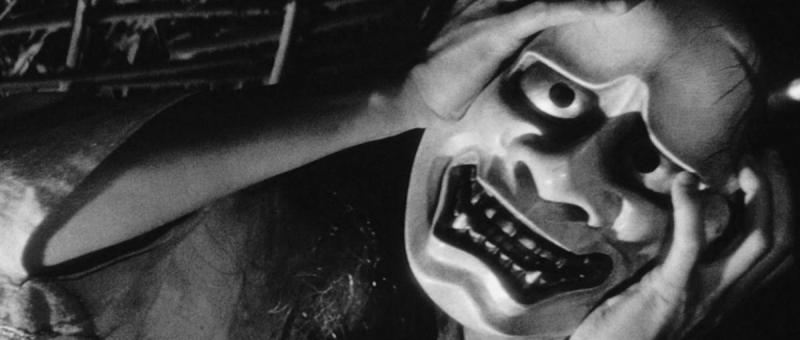
The Flavour of Green Tea Over Rice (お茶漬けの味, Yasujiro Ozu, 1952)

Famously, many of Yasujiro Ozu’s films end with a young woman getting married and the emotional desolation that it provokes in those left behind. Ozu, unlike some of his contemporaries, generally comes down on the side of marriage. His heroines always succumb, rarely finding independence or resignation and settling for a second choice even if their first proved unavailable. The Flavour of Green Tea Over Rice (お茶漬けの味, Ochazuke no Aji), however, takes him in a slightly different direction in asking what, if anything, is to blame when a marriage is unhappy, repurposing the arranged married debate to perhaps imply that wedded bliss is less about romance than it is about endurance and mutual understanding. 

Taeko (Michiyo Kogure), a middle-aged woman, consented to an arranged marriage to Mokichi (Shin Saburi) at the usual age but seems to feel little more than contempt for him. A friend from school, Aya (Chikage Awashima), invites her on an impromptu trip to an onsen and for reasons not entirely clear, Taeko feels she has to lie rather than simply telling Mokichi that she would like to go away with a friend for a couple of days. Aya encourages her to spin a tale that her niece, Setsuko (Keiko Tsushima), who often stays with them in the city, has been taken ill and is in need of urgent care, but the plan is foiled when she swans into their home right as rain before Aya could give her instructions. Caught on the hoof, Taeko is forced to improvise that a different friend is ill, the four women eventually heading off on a girls’ trip leaving Mokichi at home alone and apparently none the wiser. 

Perhaps surprisingly, Mokichi turns out to be a kind and considerate, if perhaps dull, kind of man. We later discover that he knew all along that Taeko was lying but thought it wasn’t worth making a fuss over. He makes a point of chatting with the maid, asking after her family and is apparently well acquainted with her circumstances. Unlike other men, he doesn’t spend his time out drinking or gambling or even overworking, coming home to read instead, but still Taeko is put out when she phones him at work to kickstart the onsen plan and discovers his desk to be empty. It turns out that he met up with the younger brother of an old friend killed in the war who had asked for his help with a recruitment exam. Non-chan (Koji Tsuruta), as everyone calls him, is a cheerful sort guy who openly admits he wears army surplus suits and likes to eat in restaurants which are “good and cheap”, all of which suits Mokichi much better than his wife’s rather more sophisticated tastes. The younger man is quick to introduce him to the pleasures of the age including bicycle racing and pachinko parlours which is where he runs into an old army buddy, Hirayama. 

While Taeko and her old friends break into a rendition of a song from their student days with Setsuko looking on in minor confusion, Mokichi sits around a small table with Hirayama and an equally out of place Non-chan recalling his glory days in Singapore and singing old army songs. They are each, in their own and infinitely parallel ways, mourning the promise of their youth. Taeko’s friends, Aya and Takako, have an equally cynical view of marriage. Takako’s husband has gone to Paris and she, it seems, couldn’t be happier with her newfound freedom, while Aya runs a small boutique and regards hers as little more than a necessary inconvenience. When the ladies take in a baseball game, Aya is surprised to spot her sports-hating husband on the bleachers apparently escorting a woman she recognises from a nearby bar, but she isn’t in any way jealous or angry merely amused and planning to use it as extra leverage to persuade him to buy her a new kimono despite the fact that we later see him asking her for money (which she snatches back as punishment). 

Despite all of that however Taeko’s tragedy maybe that somewhere deep down she wanted her marriage to work. Her open contempt for Mokichi, likening him to a big fat carp and referring to him as “Mr. Bonehead” in assuming he is stupid enough to believe all her lies, annoys the otherwise modern Setsuko who sees their unhappy union as definitive proof that arranged marriages do not work. Interrogated by her exasperated niece who was sure her aunt would support her in her resistance to her parents’ matchmaking, Taeko claims that she is happy and perhaps she is even if in her unhappiness, but Setsuko’s unexpected seizure of her agency though rudely walking out on the omiai brings her own marriage to a crisis point. Mokichi cannot quite say so but tacitly supports Setsuko’s desire to decide her own romantic future even if he disapproves of her irresponsible rudeness to her prospective suitor. “Forcing her to marry against her will would just create another couple like us” he eventually explains to Taeko in boldly saying that which should not be said. 

It would be easy to think that the problem is Taeko and Mokichi simply aren’t suited. There is an obvious class difference that seems to be a continuing problem for the snooty Taeko. It annoys her that he insists on pouring his miso soup into his rice bowl which she feels is common, like his cheap cigarettes and preference for third class rail travel. He explains that it’s not that he’s cheap, simply that these are the things he likes, that he’s familiar with, that make him feel relaxed. Their upbringings are different. Taeko feels relaxed in first class because that’s how she’s always travelled and she likes the finer things because they reassure her in her status. That might be one reason they occupy different areas of a shared home, he with a traditional futon in a tatami mat room, she in a well appointed Western-style boudoir even as she exclusively wears kimono. 

Yet the problem isn’t that they like different things so much as an essential misconnection. Without perhaps knowing, Taeko is so filled with resentment over her lack of control of her romantic destiny that she’s never warmed to her husband or felt secure in her marital home. It’s a cliche to say she doesn’t understand him, but perhaps she wanted something different to what she eventually got. A sudden crisis after the Setsuko episode sees Taeko make a temporary retreat only for Mokichi to be abruptly sent abroad. Sharing the homely comfort food of green tea poured over rice, she finally begins to understand that what she took for indifference was perhaps merely a different way of showing love. Mokichi really is a man who likes the simple things, affection without ceremony, like the flavour of green tea over rice. She knows that unlike Aya’s husband Mokichi will never betray or hurt her. He is infinitely “reliable” which might not sound romantic, but is perhaps the only solid basis for a successful marriage. 

That’s the advice she eventually offers to Setsuko, walking back on her commitment to arranged marriage, a “feudal” tradition she and all the other women had been determined to force onto her despite the fear and pain it caused them in their own youth and beyond, to remind her that marriage is for life. Find someone “reliable”. A flashy suit and a handsome face might look good now, but they might not in 20 years’ time. Setsuko has taken a liking to Non-chan who claims to be “reliable” but his taste for pachinko and bicycle races might suggest otherwise. In any case, after a heartwarming resolution that repairs the fractured marriage of Mokichi and Taeko, Ozu ends on a moment of cheeky ambivalence in which Non-chan says the wrong thing, upsetting Setsuko who retreats into a small hut. Non-chan repeatedly apologises and tries to enter, while she pushes him back out, neatly symbolising the arc of a marriage as an accidental battleground of intimacy though in this case one with a playful resolution. 


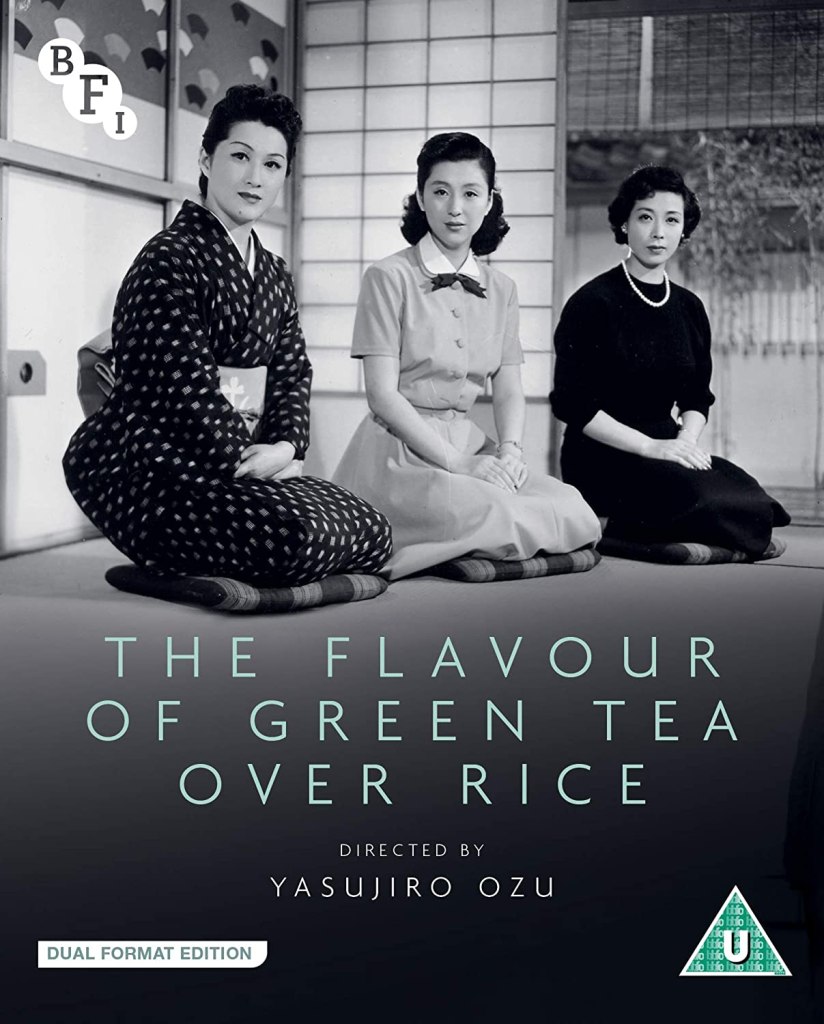
The Flavour of Green Tea Over Rice is released on blu-ray in the UK on 18th May courtesy of BFI in a set which also includes an audio commentary by Tony Rayns. The first press edition also comes with a booklet featuring an essay by Tom Milne.

Short clip (English subtitles)