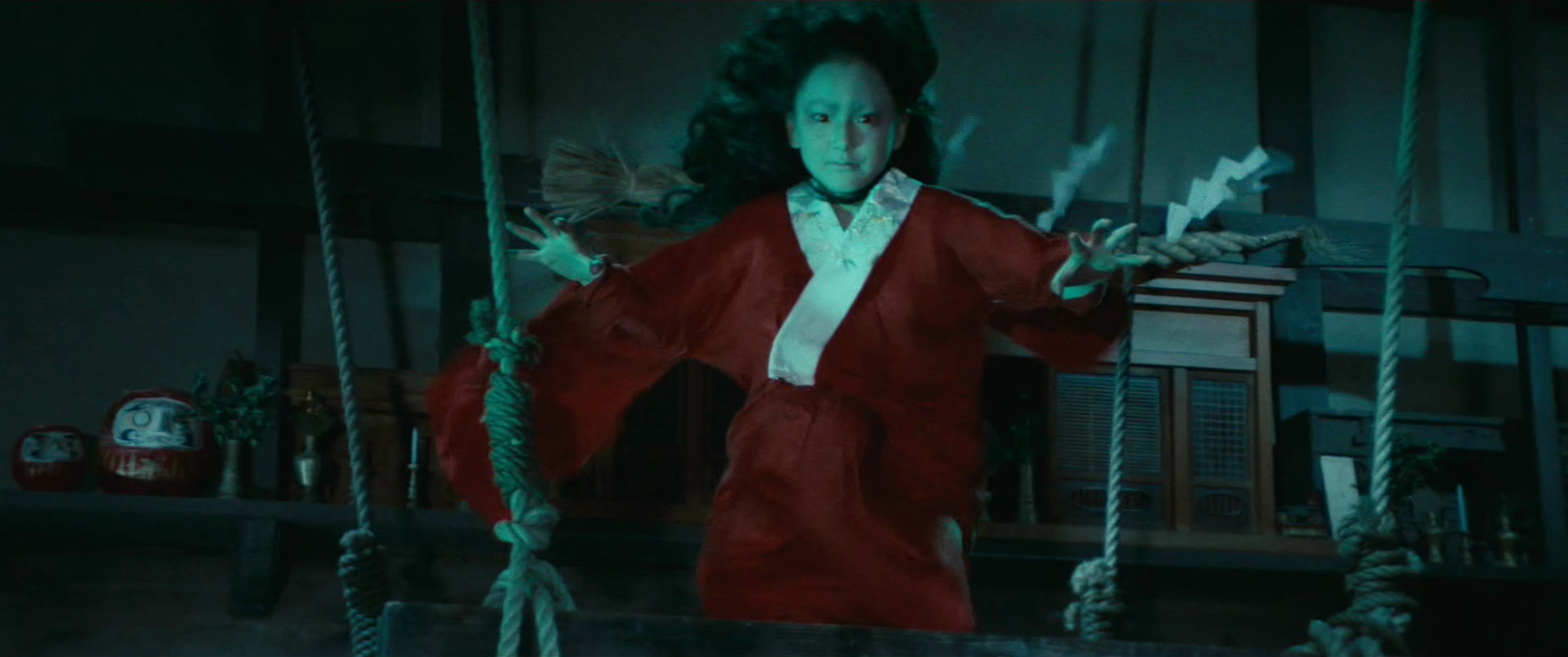

Luminous Moss (ひかりごけ, Kei Kumai, 1992)

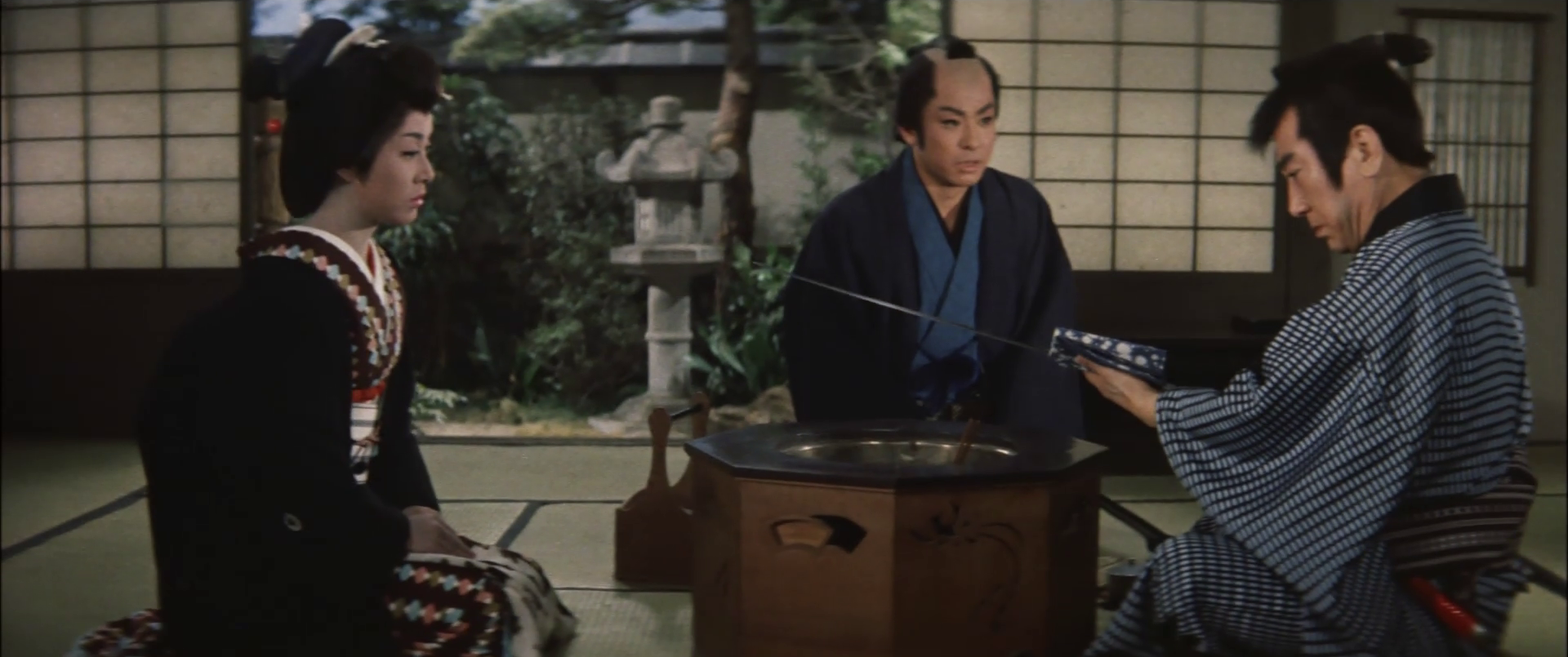
At the end of the increasing surreal trial which concludes the play within a play in Kei Kumai’s Luminous Moss (ひかりごけ, Hikarigoke), the protagonist turns to the people of the court and asks them to look at him. He wants to know if they see the ring of light around his head that looks like the luminescent plants inside the cave where he spent three months or so after being shipwrecked in the middle of the war. His plea is as much to ask what would you have done and if we can ever really judge him when we ourselves have never been faced with his dilemma.

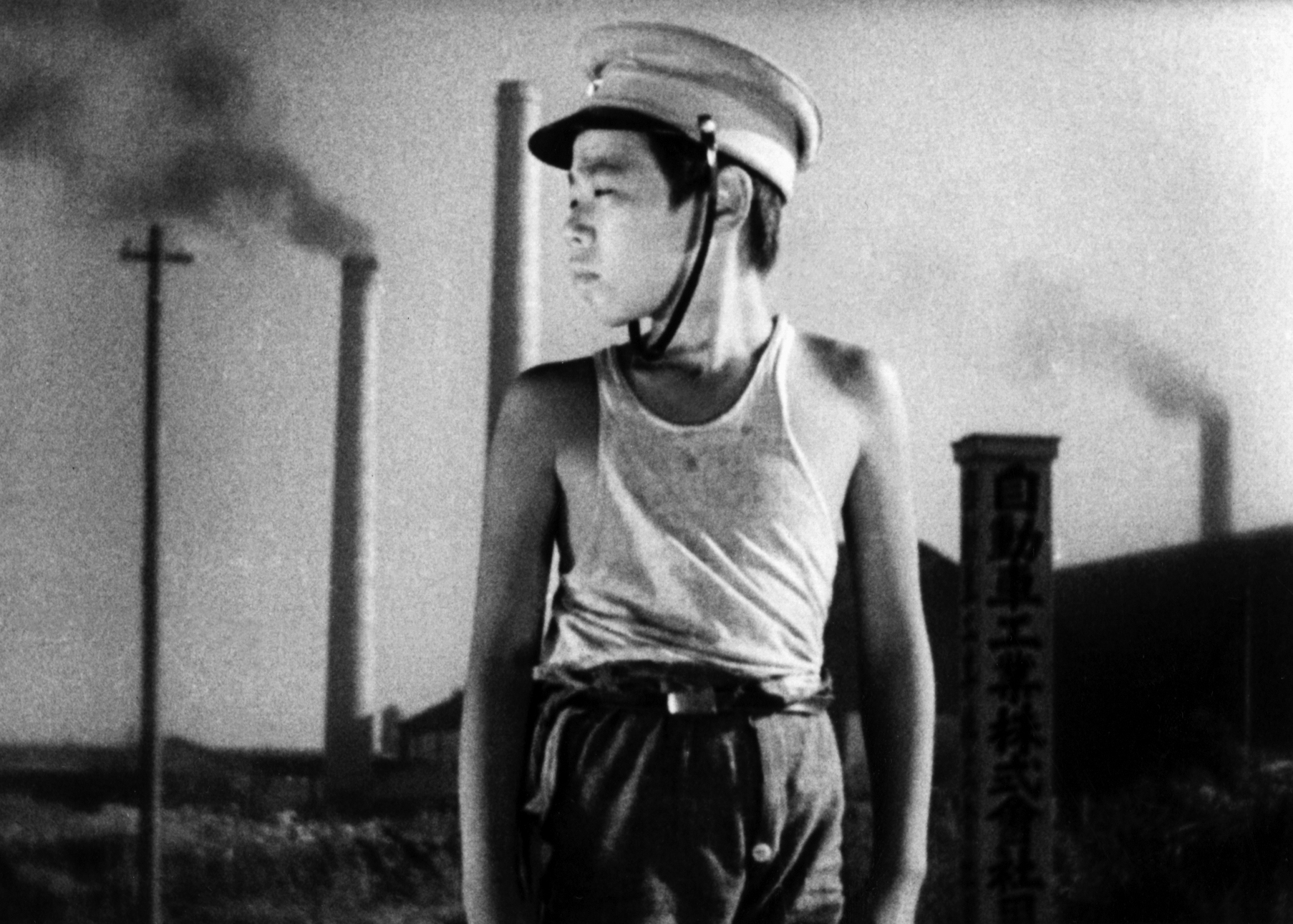
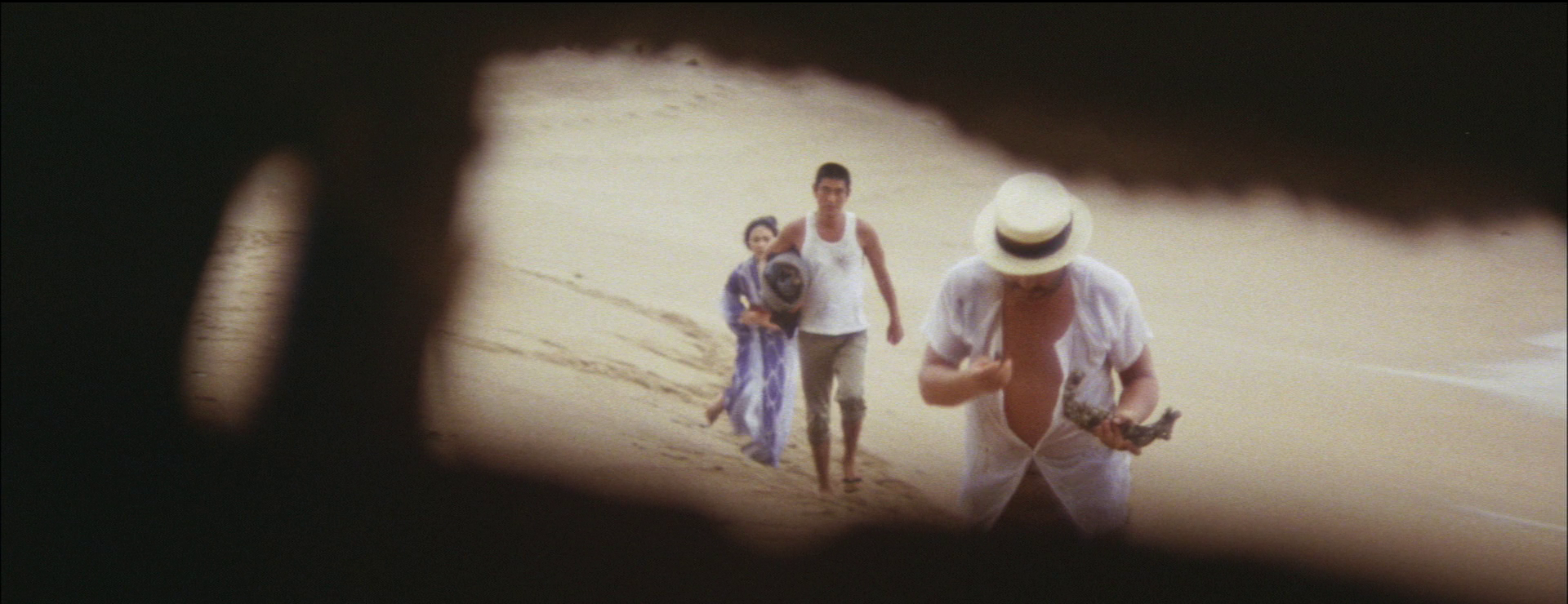
It is however a dilemma many were faced with, and one tacitly suggested in other earlier films such as Kon Ichikawa’s Fires on the Plain though at that point too taboo and painful to address openly. In the framing sequence which bookends the film, an author visits a town in Northern Hokkaido in search of inspiration and is guided to a cave, now reachable by a roadway built after the war, where luminous moss grows. The man who takes him, a headmaster (Rentaro Mikuni), also tells him of an incident which took place there in which four shipwrecked men swam to shore and took refuge within the cave. Only the captain (also played by Rentaro Mikuni) survived, making a perilous trek across the ice a few months later when his food source depleted and he was left with no other choice.

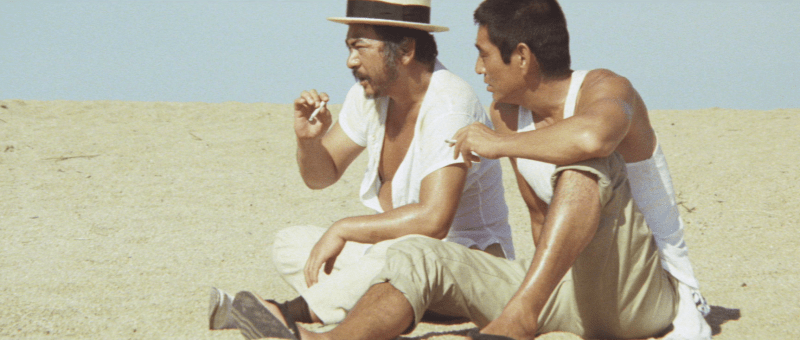
The middle of the film is presented as a flashback, but actually the play the author is writing based on the investigations of the headmaster who says that he increasingly came to sympathise with the captain because of his own experiences as a prisoner of war in Siberia. Hachizo (Kunie Tanaka), a middle-aged father to a large family who refuses to eat the corpse of the first man to die, Gosuke (Tetta Sugimoto), because he promised him he wouldn’t, describes the captain as a “resourceful man” in both positive and negative senses of the word. He assumes the captain is already calculating when the current supply will run out, and when his own body will have consumed, leaving him with a dilemma about what to do next. The captain is in no real doubt about the necessity of eating Gosuke’s flesh and feels no guilt about it, after all he died of natural causes after consuming seawater and is now, in the captain’s view, simply meat so not eating him is just a pointless waste. Perhaps the situation would be different if he had killed him deliberately in order to eat him, but on the other hand it would not really be advantageous to do so given that the captain’s end goal is surviving until the end of the winter when it will be possible to return to the mainland. Thus he waits for his men to die and leaves the rest up to fate. 

The situation only comes to light when a wooden box is washed to shore containing the bones of Private Nishikawa (Eiji Okuda), whom the captain did actually kill but accidentally while he was trying to commit suicide so that the captain would not be able to eat him. Nishikawa is originally a thorn in the side to the stranded men, a brainwashed militarist who insists they must survive out of loyalty to the emperor. He refuses to eat Gosuke’s corpse on moral grounds, but is eventually unable to resist unconsoled by Hachizo’s well-meaning advice that he should tell himself he did it for the emperor. Knowing that he did it solely for his own survival shatters his illusions of himself as a loyal subject and fractures his sense of identity. He cannot live with himself having eaten human flesh, while as the captain says those who were going to die were always going to while those who must survive must to everything to do so. 

Thus at his trial, in which he appears to have lost his mind, he stresses that though he does not object to the legal process or its consequences he will not feel himself to have been judged by the prosecutor (Hisashi Igawa) as he has never eaten human flesh nor had his own flesh eaten. While in the cave, Hachizo had claimed to see a glowing ring around Nishikawa’s face which he attributed to a folk belief that such a ring resembling the green glow of luminescent moss was a signifier of his guilt visible only from a certain angle and for a short time only to those who look for it. It’s this ring that captain asks others to look for at his trial, to show him the signifier of his own guilt so that he may himself accept it. But then he may actually have a point that those who have never experienced what he has experienced are incapable of judging him. At the critical moment, the trial is interrupted by an air raid, there after becoming increasingly surreal as the location is shifted back to the cave as if it were all taking place within the captain’s mind. 

The prosecutor tries to attack him for attempting to blame it all on nation and society, suggesting that his actions have disgraced all of Japan and brought shame on the emperor about whom the captain makes an inappropriate remark suggesting that the emperor too is human and merely “enduring” his circumstances. Pressed to explain himself, the captain only says that he is “enduring” many things and that during his time in the cave he simply “endured”, doing what seemed to him the only thing he could do. The prosector points out that Hachizo refused and chose death, while Nishikawa attempted suicide to atone for his actions, asking what right the captain had choose survival but the only ones who can really judge him the three men he cannibalised each of whom appear as (almost) silent ghosts whose judgement cannot be interpreted. 

Though the film is not as visually striking as others in Kumai’s earlier career, he succeeds in conjuring a sense of primeval eeriness in the swirling mists and oddly shaped icicles of the cave while avoiding any sense of gore in the act of cannibalism itself which might otherwise unbalance the ethical dimensions he wishes to address. In the closing sequence, both the writer and the headmaster are positioned behind the bars which now protect the moss as if this kind of primal impulse could really be restrained or tempered by our civility. After the death of Gosuke and given the objections of the other two men, the captain suggests waiting a day or two to see how long their “human feelings” could hold in the face of their survival, the answer perhaps being less than you’d hope and about as long as you’d expect.


In the Distance (距ててて, Saki Kato, 2022)

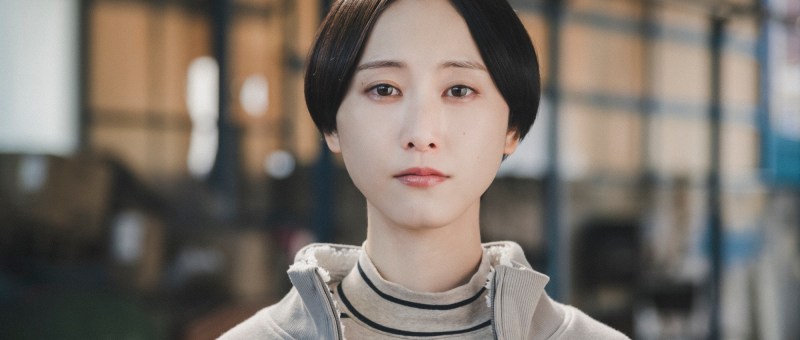
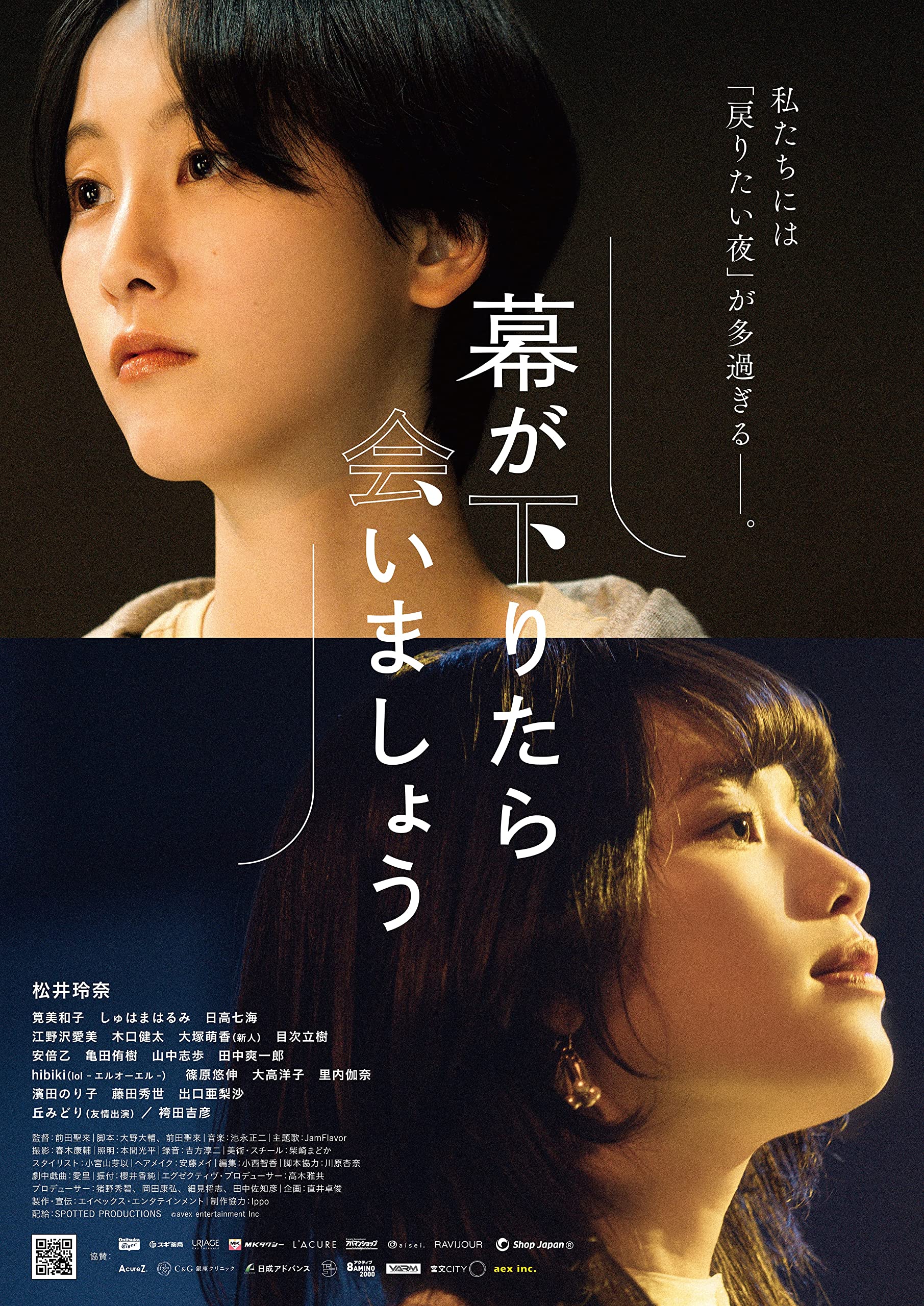
Can two people who have completely different outlooks and ways of living learn to get along and eventually become friends? A pandemic-era dramedy, Saki Kato’s In the Distance (距ててて, Hedatetete) asks just this question when two women are unexpectedly forced to co-exist on a greater level after their roommate is suddenly stuck abroad. A series of surreal adventures might leave them with no option other than to confront their differences, but also shows them that difference can be complementary rather than disharmonious. 

The main issues between Ako and San are those which are common to any house sharing arrangement particularly if the people involved did know each other well previously. Ako is an aspiring photographer who sees part-time work as a necessary evil but continues to struggle amid the vagaries of the covid-era economy. She is neat and tidy and likes the house to be in order. San, meanwhile, is picking up most of the rent and has a job which has not been too badly affected by the pandemic. But she’s also a total mess when it comes to her share of the housework and has an annoying habit of picking up everyone’s post and stuffing it somewhere in her room without letting her roommates know a letter has come for them. Obviously, this is also an invasion of privacy on top of simply being annoying so Ako’s irritation is understandable but she has a kind of animosity towards San simply for being what she sees as a boring wage slave while she’s just slumming it until she gets a break with her photography.

But then again, San is “artistic” if in a problematic way in that her accordion playing has caused complaints from neighbours but when their property manager comes to have a word with them he ends up bringing his ocarina to join in the fun. San vents her frustrations to a friend, Tomoe, who has a similar problem of her own in that she’s in the process of breaking up with her boyfriend because they keep disagreeing over trivial things like brands of rice or misaligned printing on greetings cards. They only talk to each other in terms of metaphor with Tomoe apparently sick of their mismatched pairing and hoping to find a new partner with more common interests while the boyfriend seems near distraught by the thought of the relationship ending. 

Ironically it’s San who points out their relationship may be fairly complementary and it’s more the case that they can get along together because they are different yet she still struggles with her relationship with Ako whom she finds uptight and pretentious. Ako, meanwhile, is having a strange encounter of her own with a teenage girl looking for a misdirected letter presumably spirited away by San. She claims not to have a phone or use a computer and implies that her mother is very strict, though when she actually arrives at the house she’s incredibly nice and even cooks a hearty meal though there is something a little sinister in her manner lending the pair a kind of supernatural quality like something out of a fairytale. 

In any case, a misplaced keepsake eventually prompts a confrontation between the two women that allows them to clear the air and find a way to work together. Turning somewhat surreal in its final section, the film hints at a transportational quality of their new alliance that drops them in a new and unfamiliar place with only each other to rely on. The lesson seems to be that sharing an environment necessarily gives rise to various interpersonal issues which can be dissolved while outside of it, and that even if two people seem completely incompatible they can still find common ground and learn to get along especially against the stressful backdrop of a global pandemic in which enforced isolation can exert additional pressure on an already strained relationship just when mutual cooperation becomes an absolute necessity. Filmed with everyday naturalism and a surrealist, deadpan humour Kato’s indie dramedy hints at the strangeness of the ordinary but also discovers the small moments of unexpected connection often brokered by casual misunderstanding.


Original trailer (no subtitles)

School of the Holy Beast (聖獣学園, Norifumi Suzuki, 1974)

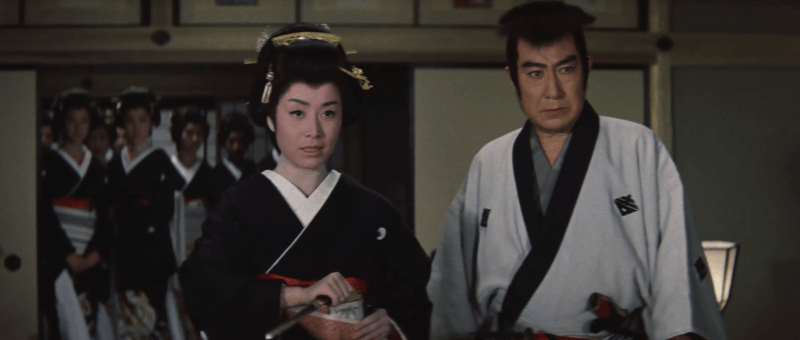
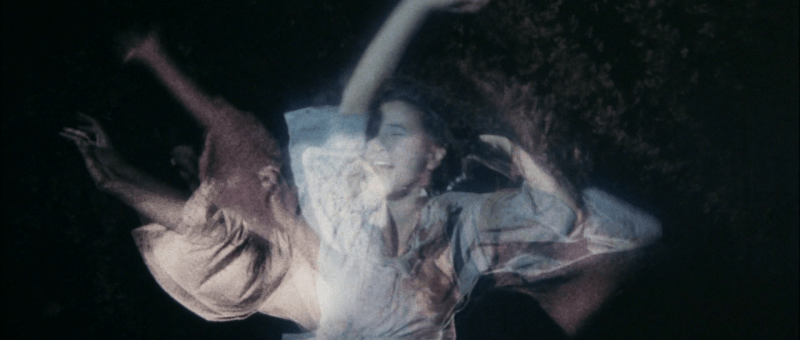
“Why is sex wrong?” a rebel nun enquires, hinting at the hypocritical atmosphere of the convent which comes to stand in for the patriarchal superstructure of the contemporary society. That it does so might in a way be surprising given that Christianity has relatively little cultural relevance in Japan save its stance as a persecuted religion during the feudal era. Director Norifumi Suzuki jumps on the nunsploitation bandwagon but does so with a baroque romanticism mixed with punkish youthfulness as two young women find themselves rebels in the house of God.

They are both there for reasons largely unconnected to religion. 18-year-old Maya (Yumi Takigawa) is searching for the truth behind her birth and her mother’s death, while Sister Ishida (Emiko Yamauchi) claims she’s been sent there by a wicked stepmother. Ishida also kicks up a stink during a class by questioning the truth of immaculate conception which is quite odd for someone who wanted to become a nun, while otherwise punished for drinking whisky in the middle of the night. Punishment does seem to be the main thrust of their religious practice with the transgressions of “adultery”, which includes all impure thoughts, murder (!), and theft taken the most seriously. On her first night at the convent Maya is woken by the sound of another nun furiously whipping herself though in fairness there just isn’t much else to do. 

Suzuki rams home the erotisicm of ritual in the baptism Maya undergoes during her initiation as a nun in which she is totally nude and instructed to stand with her arms out as if on the cross in front of the altar. She must then bend to kiss the crucifix before receiving her veil as a bride of Christ. The nuns talk of lives of eternal virginity while burying themselves in asceticism in an effort to deny their natural desires but have to a degree sublimated their lust in violence. The most common form of punishment is whipping, while Maya is later tortured with thorns and artfully battered by roses. When one nun steals money in guilt for having abandoned her impoverished family to begin her spiritual journey to Christ, she confesses herself to a priest who offers her the same amount so that she can help her family and ease her conscience by returning it. But in reality the priest has tricked her. He resents that she feels as if her sin has been forgiven and she may forget her guilt, cruelly telling her that she will never hear the voice of God before going on to violate her. 

The act of betrayal, of himself breaking the code to which he should subscribe, is only a echo of an societal corruption which allows men to abuse their power often with the complicity of the women around them such as the abess who has long been in love with him. Kakinuma (Fumio Watanabe) is a man whose faith has been shaken. He bears the scars from exposure to the atomic bomb in Nagasaki which is centre of Christianity in Japan. After telling Hisako (Yayoi Watanabe) that God will not see her, he asks if anyone has actually seen him and why he does nothing when his people suffer. 

Both he and the abbess are trapped in a hell of their own making, though as the girls both say the convent is akin to a prison. When Hisako’s sister visits her they talk to each other through glass as if she were a prisoner, though in many ways she is oppressed by her own repressed desires while those of the other nuns have begun to drive them quietly out of their minds and into sadomasochistic fury. This peculiar madness is only deepened by the arrival of a new Mother Superior who returns from Europe insistent on rooting out “witches” in league with the devil. Suzuki signals the absurdity by playing a chorus of elation when a tortured nun wets herself over a tablet featuring a crucifix in the inversion of a bizarre Edo-era ritual designed to identify secret Christians who were at that point illegal. 

To break free of the covent and return to her liberated life in contemporary Japan as seen in the cheerful opening sequences of her date with Kenta (Hayato Tani), Maya must also free her mother’s ghost and the souls of her sisters by forcing Kakinuma to reckon with his crimes if in the most ironic of ways. Suzuki shoots with febrile romanticism, the pastel colours of the church lending it a hellish glow even before the resurrection of a ghost enacts karmic revenge in a feverish atmosphere of romantic jealously and masochistic repression.


Original trailer (no subtitles)

*Norifumi Suzuki’s name is actually “Noribumi” but he has become known as “Norifumi” to English-speaking audiences.

Ajin: Demi-Human (亜人, Katsuyuki Motohiro, 2017)

Katsuyuki Motohiro’s 2001social drama Transparent: Tribute to a Sad Genius had attempted to show the government acting with compassion having discovered humans with a potentially dangerous power, in that case the unfortunate ability to broadcast their every thought. Rather than locking them up in labs, the government had allowed the Transparents to live in the community under the caveat that they must never be told of their ability while continuing to monitor them secretly and in fact micromanaging their lives with less than ethical attention. 2017’s Ajin (亜人), adapted from the manga by Gamon Sakurai, is in many ways Transparent’s flip side in which the government has discovered the existence of a series of people known as Demi-Humans with super fast healing ability meaning that they cannot die from injury and has been conducting what is essentially vivisection on them justifying themselves that “the Ajin are the precious key to the evolution of mankind”. 

Nevertheless, they are mindful that the public would not accept it if they knew the government’s claims of “protecting” Ajins was a smokescreen to disguise the fact they’ve been experimenting on them, let alone selling the results to commercial companies for the production of chemical weapons among other things. Previously a regular medical student, Kei Nagano (Takeru Satoh) is the third Ajin to be unmasked in Japan after being hit by a bus only to heal rapidly and stumble away. After a brief period of torture, Kei is “rescued” by crazed terrorist revolutionary leader Sato (Go Ayano) and his underling Tanaka (Yu Shirota), escaped Ajins 1 and 2, but becomes their enemy after he refuses to turn against the scientists who had been torturing him pointing out that killing them would only make him feel worse and is therefore counterproductive. 

The implication is that 20 years of brutal torture at the hands of mad scientists has turned Sato into a crazed fascist hellbent on the extinction of the human race, seeking an “autonomous” space for Ajin along with full civil rights for Demi-Humans. Though we are told that only three Ajin have been unmasked so far in Japan, the implication is that there are many more living quietly some of whom Sato recruits after putting out a call for all disenfranchised Demi-Humans to join his revolution not for equality but domination. It’s this movement Kei can’t support, the classically “good” Ajin who disapproves of Sato’s actions and wants to leave peacefully alongside humanity. As such, there’s something a little uncomfortable in his inevitable decision to team up with the people who were just vivisecting him in order to stop Sato achieving his goal of guaranteed civil rights for people like him asking for nothing more than that his family be protected and he be left alone and given a new ID to live quietly in somewhere in Japan when all of this over. 

The unpalatable implication seems to be that minorities are only worthy of respect if they serve those in power, both Kei and another closeted Ajin benefiting directly and individually by siding with humanity though humanity may not honour the various promises it makes while they are partially complicit in the torture and exploitation of other Ajins. Sato’s basic request is only to given his full rights in the freedom from torture, but even this cannot be granted because of the threat he presents to humanity in that the inability to die means that he cannot be controlled through violence. Ironically enough Sato does seem to believe himself to be the next step in human evolution, after 20 years of brutal torture believing that humanity is a lesser being which those like him are intended to replace. 

Kei meanwhile encounters kind humans such as Mrs. Yamanaka (Kazuko Yoshiyuki) who kindly offers him a place to hideout because when you see someone is in trouble you just help them even if a baying mob later turn up at your door to ask why. There may be a minor allegory in the way the Ajins are treated, feared by and excluded from regular society, forced to keep their true natures secret in order to live a “quiet” life but than again Sato and his cohort of equally crazed young Demi-Humans who presumably have never been tortured are depicted as quasi-fascist radicals selling their own organs on the medical black market and eventually prepared to unleash a chemical weapon on Tokyo to make it unliveable for regular humans in order to claim their own space. Nevertheless, Motohiro’s drama is at its best during its high impact, well choreographed action sequences displaying some top quality visual effects as the Ajins produce their ghostly avatars or reassemble themselves after catastrophic injury even if the discomfort of the underlying messages cannot be entirely escaped. 


Original trailer (no subtitles)

Target (薔薇の標的, Toru Murakawa, 1980)

By 1980 Toru Murakawa was an in-demand director thanks largely to his extremely successful collaborations with late ‘70s icon Yusaku Matsuda. Fresh off the back of the Game series, Toei Central Film hired him to do for their aspiring star Hiroshi Tachi what he’d done for Matsuda with grimy noir Target (薔薇の標的, Bara no Hyoteki). Interestingly enough Target shares its Japanese title with the 1972 drama The Target of Roses, a truly bizarre thriller in which a hitman stumbles on an international nazi conspiracy that was penned by the same screenwriters but is otherwise entirely unconnected with the earlier film and shares no common plot elements whatsoever. 

Set firmly within the contemporary era, the action takes place in Yokohama and is essentially a tale of proto-heroic bloodshed as the hero, Hiroshi (Hiroshi Tachi), seeks vengeance for the death of his best friend, Akira, during a drug deal which is ambushed by a third party who make off with both the drugs and the money killing Akira in the process. Hiroshi goes to prison for four years and then sets about getting some payback on his release by chasing down the Idogaki gang through gunman Yagi who he believes was directly responsible for Akira’s death. 

The plot is perhaps straight out of the Nikkatsu playbook, a little less honour than you’d find in the usual Toei picture though also cynical and nihilistic in keeping with the late ‘70s taste for generalised paranoia. Hiroshi is soon targeted by the Idogaki gang, but is saved by an old prison buddy, Kadota (Ryohei Uchida), who is a little older than he is and to an extent has a noble reason for his life of crime in that he has a son who became disabled after contracting polio and wants to get enough money together to make sure he’ll be alright when he can no longer look after him. Kadota then adds a third a man, Nakao, a former narcotics cop who jokes that he was kicked off the force for rape but according to Kadota was forced out for noble reasons after his attempt to help a friend backfired. The three men team up to turn the tables on Idogaki by ambushing his own drug deal with, in a throwback to ‘60s Sinophobia, gangsters from Shanghai. 

Meanwhile Hiroshi is caught between the life he had before and the contemporary reality in reuniting with his former girlfriend Kyoko (Yutaka Nakajima) who has evidently become the mistress of a wealthy man and is presumably the mysterious benefactor who paid all his legal fees. After a meet cute at a florist he also strikes up a tentative relationship with a wealthy young woman, the daughter of a CEO who plans to move to Mexico. Despite the rising prosperity of Japan in the early ‘80s, pretty much everyone has their sights set on going abroad, Kadota planning to head to Canada after making sure his son is well provided for. Yet Hiroshi is trapped in the Japan of the past, obsessed with vengeance for his friend while torn by his relationship with Kyoko who similarly wants to exit her comfortable yet compromised life to return to a more innocent time at Hiroshi’s side while unbeknownst to him the mistress of high ranking Idogaki boss Hamada. 

What becomes clear is that there is no prospect of escape from contemporary Japan, not even perhaps in death, Hiroshi left alive but dead inside at the film’s conclusion having committed a kind of spiritual suicide born of the dark side of what remained of his honour in seeking vengeance for the death of his friend who had seemingly only participated in the drug deal at Hiroshi’s command in an effort to improve the fortunes of their gang. Once again produced by Toei’s subsidiary Toei Central Film, Target has lower production values than the films Murakawa was making with Matsuda (who has a small yet memorable cameo as a rockstar whose life has been ruined by drugs) with non-synchronised dialogue and a grimy aesthetic which only adds to its sense of fatalistic nihilism otherwise enlivened by Murakawa’s artful composition and atmosphere of moral ruin in which there is no more humanity nor justice. 

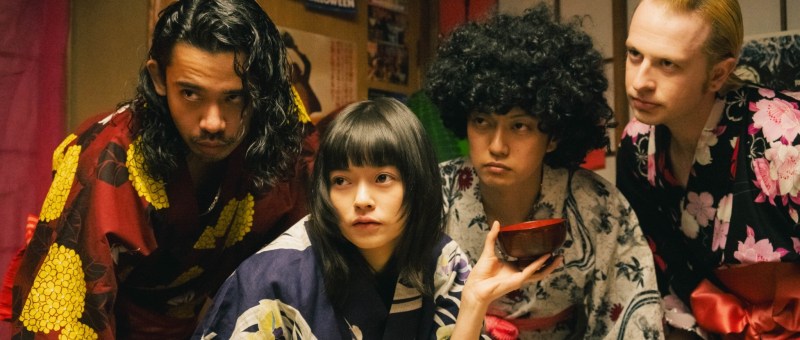
Baby Assassins: Nice Days (ベイビーわるきゅーれ ナイスデイズ, Yugo Sakamoto, 2024) [Fantasia 2024]

After beginning to conquer the demands of adulthood, Mahiro (Saori Izawa) and Chisato (Akari Takaishi) are taking a well-deserved break, or more like a working holiday to be precise, but soon find themselves with another unexpected mission to clean up a messy situation on behalf of the Guild. Baby Assassins: Nice Days (ベイビーわるきゅーれ ナイスデイズ, Baby Valkyrie​: Nice Days), the third in series of deadpan slacker action movies from Yugo Sakamoto, adjusts the balance of the previous two films shifting more towards action than the girls’ aimless lives while setting them against an opponent who is anything but aimless.

In fact with the girls find their way to the home of Kaede Fuyumura (Sosuke Ikematsu), is plastered in ironic motivational slogans that seem to be a kind of parody of salaryman’s kaizen obsession. Fuyumura likes to rank things and wants to make sure he’s at the top, but also wants out of the game because he’s bored with it and also fed up with difficult clients frustrated when one takes ages to decide whether or not he should kill the target resulting unnecessary stress for them and an unsatisfying kill for Fuyumura. That’s largely why he’s agreed to this one last job of killing 150 people who took part in cancelling a university student online. The problem is that Fuyumura is a freelancer which presents a problem for the Guild which has decided he must die for violating their rules and bringing the profession into disrepute. Thus Mahiro and Chisato find themselves in an awkward position when they turn up to kill their latest target and realise they’ve been double booked to take out Fuyumura ’s kill.

The admin mixup, though it isn’t one really, rams home the series’ persistent absurdity that this weird world of assassins isn’t so different from contemporary corporate culture while the girls are still subject to the same problems as any other 20-something. This time around, we’re introduced to another prominent agency which is run out of a farmer’s agricultural co-op and hides weapons inside boxes of vegetables, while Mahiro and Chisato get a pair of supervisors with the de facto team leader Iruka (Atsuko Maeda) going off on lengthy rants about why it’s impossible to work with Gen Z while the girls struggle with her uptight dismissiveness. Yet even when there’s tension or discord, the fact remains that the Chisato and Mahiro are also part of a team and have a vast network of support to rely on including their cleanup squad while Fuyumura is a lone wolf who’s driven himself half out of his mind with his quest to be the best, a message is brought home to him when he approaches the farmer’s union to ask for “a replacement” after getting one of their guys killed only to be told off and reminded the farmers work as one big family rather than a series of disposable minions. 

There is something a little poignant about Fuyumura’s wondering when his birthday is as if this small forgotten detail represented his missing humanity. The only time he feels like a human being is doing something mundane like cleaning his microwave and brushing his teeth. As she had the brothers in the previous film, Mahiro finds a kind connection with Fuyumura as they each discover a worthy match but knowing only one of them can survive. In an introspective movement, Mahiro asks Chisato if they can still hang out together on the other side if the worst happens, but she shuts the question down perhaps more in an attempt to shift Mahiro’s mindset but also berating herself for forgetting her birthday and making hurried plans to coverup her crime against friendship.

For all the absurdity about hitman union rules and rights of employment in an illegal profession, the films has a genuine affection for the relationship between the two girls as well as that between the wider team who are always around to have their back while they also take care to protect each other. Perhaps having to field a work crisis during their “holiday” is their final test of adulthood, and one they largely pass in enforcing their boundaries and defiantly having a good time anyway even if they did have to cancel their reservation at local barbecue restaurant to stakeout the home of a crazed killer. Once again featuring a series of well choreographed and innovative action sequences, the series’ third instalment seems to come into its own expanding the world of the Baby Assassins but setting them free inside it evidently a lot more at home with the concept of adulting.


Original trailer (no subtitles)

Round Trip Heart (ロマンス, Yuki Tanada, 2015)

“Somewhere in Japan, there’s someone waiting for me” sing the heroes of Yuki Tanada’s Round Trip Heart (ロマンス, Romance), each a little lost and unwilling to go home looking for something but also afraid to find it. In any case, they can only begin by stepping off the rails and taking a detour through their shared sense of loneliness bonding as they look for new directions and an accommodation with a disappointing reality. 

Ironically enough, Hachiko (Yuko Oshima) is a top operator of the refreshment cart aboard the Romance Car heading from Tokyo to the country by train. Hachiko claims to love trains because of their sense of certainty. After all they travel on rails, have a clear destination, and will definitely return after reaching the end of their journeys. She meanwhile feels a little lost and empty in her life of forced politeness with a feckless boyfriend who asks her for money before she heads off to work. An unexpected letter from her estranged mother, Yoriko (Megumi Nishimuta), and a strange encounter with a weird old man who tries to steal a packet of biscuits however force her change course, getting off the train and heading back into the past. 

Sakuraba (Koji Ookura), the biscuit pilferer, is a 45-year-old failed film producer on the run from the police and myriad loansharks. His sense of loneliness mirrors Hachiko’s own in that he is divorced with a 9-year-old daughter he hasn’t seen in two years and lifetime’s worth of regrets. Hachiko becomes for him a kind of surrogate daughter as he inappropriately reassembles the torn up letter and convinces Hachiko that it implies her mother may attempt to take her own life suggesting that they journey to the place it mentions, Hakone, where the family once spent a pleasant holiday. 

Familial breakdown is reason for their shared sense of displacement yet Hachiko has projected all of her resentment onto her mother who never got over her father’s decision to leave while Sakuraba fears that his daughter has grown to hate him and harbours a secret desire to restore his family but is too consumed with shame to approach them. By going to Hakone in search of her mother, Hachiko begins to reevaluate her childhood memories perhaps understanding a little more of her mother from the perspective of a grown woman rather than that of a small child who had sometimes felt left out by her parents’ closeness while they were together and rejected by her mother’s need for romantic validation once her father had left. In one particular scene we see Yoriko wearing dark glasses with what looks like a bruise over her eye while taking Hachiko to a restaurant where she orders steak only for her daughter presumably because she cannot afford two meals explaining that her boyfriend has broken up with her because of her lingering attachment to Hachiko’s father. 

The memory forces her back into a moment of resentment feeling as if her mother was only ever nice to her when men let her down, poignantly recalling her neediness in lamenting that everyone always leaves her while asking Hachiko to promise she never would. Sakuraba too complains that everybody leaves him though in his case in the wake of his repeated failures as a film producer and subsequent dealing with loansharks and other shady characters. Just as Yoriko had continued to dream of romantic fulfilment, Sakuraba continues to dream of success in film but crucially as a path back towards his family as perhaps finding a man might have been for Yoriko though she was never able to let go of the idealised image of her husband pining for the familial closeness of their Hakone trip. 

Even so the force that governs their lives is fatalistic passivity, Hachiko riding the rails to their certain destinations and back again, while Sakuraba makes every decision by tossing a coin, an action rendered meaningless by his inability to tell heads from tales. Only by rejecting their passivity in getting off the train and giving up the coin tricks can they begin to face themselves, deciding to set out and look for those who may be waiting for them rather than just sitting around waiting for something to happen. Then again perhaps if you sit in the same place long enough, what you’re looking for will eventually find you so long as you’re on the right track. 


Trailer (English subtitles)

Wolves of the Night (夜の狼, Yoichi Ushihara, 1958)

A cold-hearted yakuza starts to get second thoughts when confronted with the misery his actions create in Yoichi Ushihara’s slice of Nikkatsu Noir, Wolves of the Night (夜の狼, Yoru no Okami). Though the hero is ostensibly Tsukida (Ryoji Hayama), the conflicted gangster unable to reconcile himself with the fact that he has fallen in love with a women he himself destroyed, it’s equally about the women who get caught in the crossfire of a burgeoning gang war and are each victims of male greed and indifference.

In any case, gang boss Tachibana (Somesho Matsumoto) brings a lot of this on himself. The secondary narrative revolves around a woman, Takako (Mari Shiraki), who borrowed money from the Manji gang to build her bar, but now that it’s complete Tachibana swindles her by calling in the debt and foreclosing on the property, passing ownership to Tsukida with instructions to kick Takako out. She, however, doesn’t take well to this and is resentful of Tachibana for screwing her over so she vows revenge. Her original attempt to get it by seducing Tsukida doesn’t work out, so she recruits a yakuza from a rival gang to extort them claiming that they have mole and he’ll only reveal their identity when they hand over the cash. This plan has some pretty tragic consequences and not least for Tachibana himself, but none of this would have happened if he hadn’t behaved so badly in cheating Takako out of the bar she worked so hard to build. He’d also told Tsukida that the bar owner was a beauty and it was understandable if wanted to try seducing her. 

But by this point Tsukida has developed a fondness for Katsumi (Izumi Ashikawa), a young woman he first meets when she’s caught by some of his guys offering herself for sex work in their territory. The other ladies describe Katsumi as “odd” and “an outsider”. It’s clear from her behaviour and the way she’s dressed, not to mention a lack of awareness of the rules of the gang, that she’s never done this before and is terrified. Tsukida calls his men off and tells her to go home, but later realises that it’s his own fault she was put in this situation because he was responsible for collecting the debt her parents owed to Tachibana taken out because her father is bedridden. Tsukida seems shaken by the old lady’s intense resentment, but still takes their money if attempting to convince Tachibana not to pursue them any further because they have nothing left to give, correctly assuming that Katsumi resorted to sex work to get the money. 

It maybe the sense of guilt that proved the last straw as the old couple then take their own lives but rather than freeing her lead Katsumi on a lonely path of self-destruction driven only by her hated for Tachibana and Tsukida. The fact that she later becomes ill further emphasises her positioning as a symbol of a despoiled nation poisoned by the ruthless inhumanity of the post-war society, along with literal a embodiment of Tsukida’s guilty conscience. Tsukida rejects Takako as a person more like himself, an example of corrupted femininity using her body to manipulate men in a world in which a woman has little other power, and instead is drawn to Katsumi who was once innocent, demure, and cheerful but who he himself has destroyed through his own greed and heartlessness.

Spending some time in hospital following a failed suicide attempt seems to heal her in body body and soul, though the total about face in Katsumi’s feelings for Tsukida seems somewhat bewildering even if he did visit her every day and presumably win her over despite her resentment towards him for contributing to her parents’ deaths. Nevertheless, it’s his feelings for Katsumi that see Tsukida longing to quit the yakuza and retreat to the country to live a small, honest life with her free of the city’s corruption. But as so often in the movies, it’s not that simple and this time it’s a tragic consequence born of male failure and insecurity that eventually costs him his shot at a normal life even as his frenemy, a local policeman he often sees in the same bar and gives him unsolicited advice about how he should quit the yakuza, remains surprisingly supportive suggesting that his redemption may merely be on hold rather than cancelled. In any case, though shooting almost entirely on stage sets, Ushihara makes good use of stock footage of contemporary Ginza as a place of bright lights and equally dark shadows where gangsters lurk on every corner and mercy is in desperately short supply.

Tokyo Lullaby (東京夜曲, Jun Ichikawa, 1997)

A meditation on lost love and middle-aged regret, Jun Ichikawa’s Tokyo Lullaby (東京夜曲, Tokyo Yakyoku) weaves a melancholy path through a lonely city but finds in it a sense of comfort or perhaps serenity in the gentle rhythms of ordinary lives that somehow become something greater. A diffident translator in love with an unhappily married middle-aged woman slowly uncovers a deep well of unresolved longing largely thanks to those around him who will remember for those who do not wish to speak. 

Ichikawa signals his intentions early on, transitioning from a nighttime shot of the city to a small cafe where a woman is sitting in the foreground looking forlorn while customers behind her discuss the reappearance of Koichi (Kyozo Nagatsuka), the son of the man who owns the electronics store opposite, who had walked out on his family several years previously but has abruptly returned. From this short scene, we can perhaps infer that there is some connection between Koichi and the woman, Tami (Kaori Momoi), though we aren’t quite sure what it is. In any case, the cafe, which bears the name of her late husband Osawa, becomes a kind of nexus uniting the lives of the various community members who each come there to play go and discuss the past. 

Like Tami, Koichi is reticent and melancholy. He says nothing of where he’s been and his wife, Hisako (Mitsuko Baisho), asks him no questions. She later tells the writer, Tei, whose affections she does not return, that she doesn’t really care about how Koichi is living his life because she is busy living her own and likes to do as she pleases. His sister asks him if he plans to stay this time, but Koichi can’t answer her seemingly uncomfortable in himself and unable either to stay or to go. Walking on crutches his injured foot seems to symbolise his emotional unsteadiness literally unable to find sure footing or move forward with his life. 

Piecing the tale together, Tei figures out that Koichi and Tami were once together but she suddenly married someone else who had a terminal illness and passed away shortly afterwards around the time that Koichi first went walkabout. Hisako, meanwhile, had been in love with Osawa though he loved Tami who did not love him. Somehow it’s all very complicated and incredibly simple, the way they’ve sabotaged their own lives and happiness though it couldn’t have been any other way. Tei watches something similar play out in the neighbourhood. One of the young men who works at the electronics shop had been dating a girl who worked at the record store, but he abruptly begins pursuing Ng, a Chinese woman who works at the cafe, and eventually marries her leaving the record store girl heartbroken. 

Things change and they stay the same. Ng takes over the cafe, Koichi’s foot heals while he also manages to resurrect the family business by turning it into a shop that video games as if taking a symbolic step into modernity that suggests this time he’ll stay just as Tami decides it’s time for her to leave. Paths cross endlessly, Ichikawa frequently cutting away to tiny vignettes of other cafe goers as their stories weave through each other, each one note in the great symphony of the city without which life would be impossible. Yet what’s more important is what is not said, the silences that exist between people and perhaps within them too. Things that are understood, and those which are not. 

Tami explains that she looked for answers but all she found was junk until the relief of boredom became her only frame of happiness. Only by escaping the city does it seem that she’ll be happy while Koichi seems as if he’s getting itchy feet and Tei, joining the cycle, decides to move on rather than remain in painful proximity to Hisako who as she said has her own life and does not seem to want to share it with anyone much less him. The pain of the past cannot fully be healed, only borne amid the cheerful scenes of city life, children playing, people doing business, the sun shining and elderly couples meeting in cafes. Pain and loneliness seem to be the natural conditions of urbanity, but Ichikawa paints them with a kind of rosiness, merely the sadness that unpins the lullaby of a city which is always changing yet remains the same in its unwalled alleyways and those that exist only in the deepest recesses of memory. 


Original trailer (no subtitles)

Retake (リテイク, Kota Nakano, 2023)

What if life were like a movie and you could simply go for another take when things didn’t turn out like you planned? That’s the way it works out for the hero of Kota Nakano’s Retake (リテイク), a young man editing in realtime in an attempt to fix his mistakes and engineer a happier outcome while preparing to meet the end of his youth. Part summer holiday movie, part meta take on storytelling and the movies, the film is most of all about moving on whether things work out or not.

To that extent it’s telling that the film the teens are making is about a couple who attempt to go to a place where time does not flow. For the flighty Yu, the film’s architect, the desire seems to reflect her own anxiety about growing up and entering a new world of adulthood. “I wish this time would go on forever,” she sighs while discussing with her cameraman Kei how the film should end. Nakano plays with this scene, repeating it several times as if it itself were a land where time does not flow and Kei were playing out a memory in his head envisaging how something should have gone rather than how it did. Eventually the conclusion that they come to is that they should continue their journey instead of staying here, trapped in an eternal loop of dead time with no past or future. 

But moving forward is scary, after all it means leaving the past behind. Kei snaps images of the world around him as if he were trying to steal a moment, freeze it and take it with him. The hero of the film, played by his friend Jiro, is an artist who similarly tries to capture motion through the medium of sketching and constantly finds himself frustrated. He likes to sit still and concentrate, but he meets a girl who likes dance and move in the free flow of time. Kei is much the same, a natural observer yet sometimes blind to circumstance as in his decision to invite Allie, a girl they meet by chance while raiding the school broadcasting club for equipment, oblivious to the awkwardness that seems to exist between herself and Yu. 

The film teases the conflict, eventually settling on a disagreement if not exactly over a boy than surrounding him though for the rest of the runtime seems as if it may more have been more about the tension between the girls themselves. Nevertheless, Kei quickly fixes on the idea of repairing their friendship to prevent the film collapsing when his own attempt to confess his feelings is seemingly the straw that breaks the camel’s back prompting Yu into a petulant conviction that no one cares about her film and there are only ulterior motives among her crew. But paradoxically, what Kei learns is the importance of speaking up in the moment, shaking off his diffidence to support Allie when her suggestion is treated with callous indifference by Yu and thereby building bridges.

Though those same bridges may ironically leave him feeling left out and isolated as a peripheral figure on the team while the others all seem to pair off leaving him alone. He tries different approaches, and retakes his mistakes looking for the perfect ending while otherwise buoyed by the warmth of the summer and company of his new friends wishing like Yu and the protagonists of the film that this moment would never end, symbolically repeating and reliving it as if himself trapped in the land where time doesn’t flow. Nakano signals the unreality of his environment by allowing Kei to approach the unseen camera and turn it off, announcing a new take with a clapperboard and then editing in real time in search of perfect answers. In some senses, it’s the operation of nostalgia but also an adolescent desire to find the right path forward along with the courage to take it. But what the teens discover is that in the end you just have to go, frustrated by the boredom of being trapped in an external limbo of stagnant time and eager to see what the next scene will bring in a continual flow of isolated moments that somehow constitute a life.


Retake screened as part of this year’s JAPAN CUTS.