That Guy and I (あいつと私, Ko Nakahira, 1961)

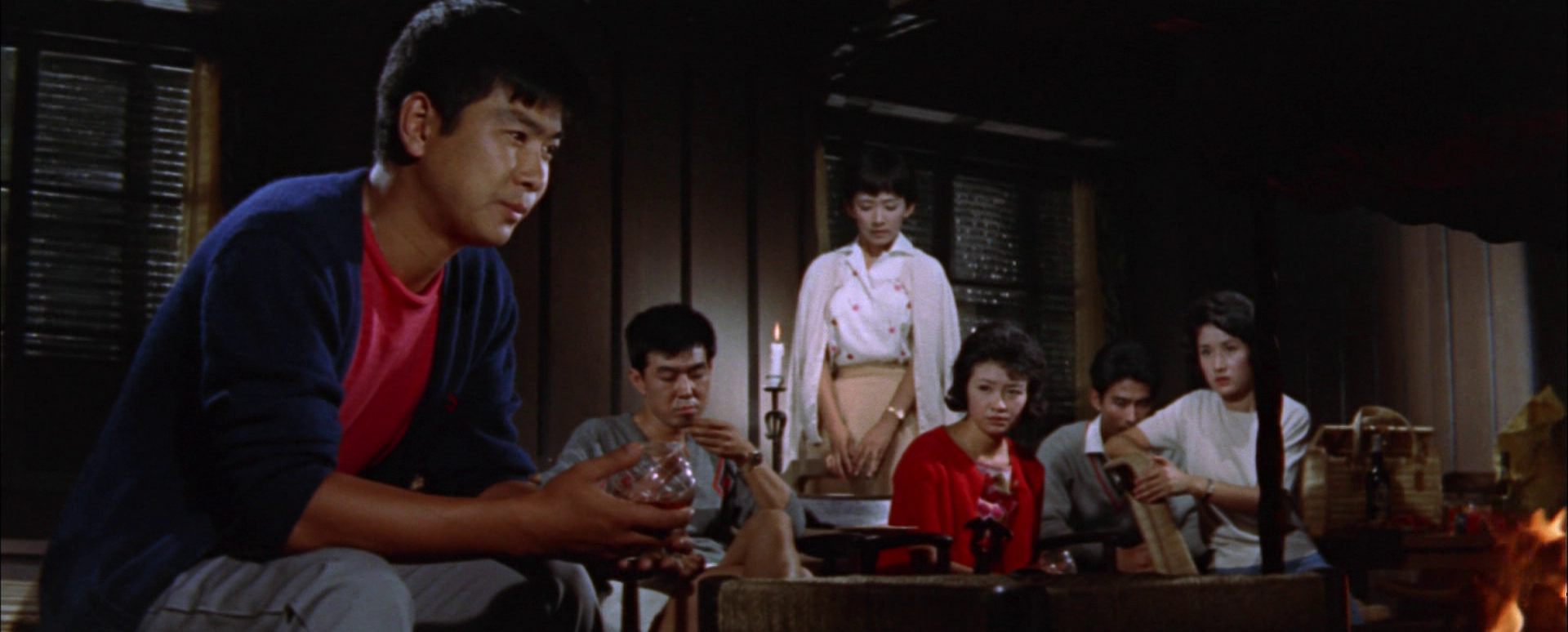
Likely intended as a slightly silly student rom-com, Ko Nakahira’s That Guy and I (あいつと私, Aitsu to Watashi) captures a sense of the changing gender roles and sexual mores of the early 1960s, if through a very male and at times even middle-aged lens. Adapted from a serialised novel by Yojiro Ishizaka and set amid the ANPO protests of 1960, the film is narrated by its heroine, a very ordinary young woman from a typical, moderately wealthy middle-class family, as she struggles with her attraction to a fabulously wealthy young man who pretends to be a boor but is actually a nice guy and unexpected feminist.

One of a new generation of women attending university with a prospect of independence, Keiko’s (Izumi Ashikawa) horizons seem to be broadening. She’s not exactly conservative and openly jokes about sex and dating with her friends, but is quite settled with her life, not particularly wanting anything more than she already has. Her psychology tutor highlights the problem of social inequality in their school that she had already raised in her opening voiceover in remarking that the rich kids all have cars and can drive themselves to school, while others are having to work to support themselves while they study. When he asks how much pocket money they all get, some are outraged and keen to stress they don’t get any help at all, but Keiko reveals that her parents actually give her a healthy allowance. It’s just that she has no real urge to spend it, so it’s been mounting up quietly in a desk drawer in her childhood bedroom while she still lives at home close to the university.

Saburo (Yujiro Ishihara), by contrast, boasts that he gets more than some people’s monthly wage as an allowance from his mother and blows it on drink, gambling, strip clubs and sex workers. It’s this last point that scandalises the female students who are all shocked and disapproving, even going so far as to ask the teacher to throw Saburo out because they don’t feel comfortable sharing a space with a man like that. The teacher also says he’s disappointed and wishes Saburo hadn’t added the last bit, only for Saburo to call him a hypocrite because sex work was legal in his day and he simply doesn’t believe that he’s never paid for sex. Most of the other boys join in on Saburo’s side, insisting that no man sees any problem with visiting sex workers which they regard as a natural right because the male sex drive is driven by “uncontrollable forces”.

But then there’s something unexpected that occurs among the female students in that some of them are obviously attracted by this very rough form of masculinity. “I’d rather have a wild beast than a meek sheep,” one intones, but nevertheless goes to join the group of girls confronting Saburo at the pool in the hope of gaining an apology for the offence he caused them. They’ve since found out that he probably made it up anyway, which is ironic because he claimed he’d only spoken the truth when they asked him to leave, but that’s somehow even worse because it means he said it deliberately to upset them. The upshot of it all is that Saburo ends up in the pool and is then forced to borrow some of the girls’ clothes while his dry off, signalling his awkward positioning between traditional masculinity and femininity in that he’s otherwise surprisingly sympathetic of women and makes sure to look out for them but in a way that encourages their independence and is never patronising. 

That might, in one way, be because of his unusual upbringing which is far more modern and bohemian than Keiko’s and in the beginning, at least, quite confusing for her. Saburo’s mother Motoko (Yukiko Todoroki) is a famous entrepreneur with a beauty shop empire. She writes her name in Western order and uses katakana for her first name which makes look foreign and therefore exciting and sophisticated even though it obviously isn’t. It was Saburo’s mild-mannered father who gave up his career in insurance to raise him, while his mother apparently blows off steam through numerous affairs. His father occasionally gets upset about this and the pair go through a charade of him leaving her while she professes her love for him, which seems to have a sexual dimension in itself. Perhaps this has given Saburo an alternative view of romantic relationships, though we also later discover that he was subject to what we’d now see as a form of sexual abuse as a teenager when his mother got a young but still adult woman, Michiko (Misako Watanabe), to essentially give him practical lessons in sex and satisfy his teenage urges, only he thought it was an organic romantic relationship and feels more than anything else emotionally betrayed. 

But then again, the film has a very of its time and defiantly male view of rape which is dealt with in a fairly flippant manner. Keiko rings her mother to tell her she’s realised that the reason she didn’t like the idea of her being at the ANPO protests was because she feared she’d be raped, which is at any rate an odd conversation to be having. Her mother asks her what her virginity has to do with ANPO, which is a fair question, but also implies that it’s not so much the physical and psychological harm of sexual assault that bothers her mother but the shame of premarital sex. One of the girls who goes to the protest, Ayako (Shigako Shimegi), is actually raped by the two boys she went with who deliberately plied her with alcohol and took her to a hotel knowing that she trusted them, but her roommate, who had a crush on one of the boys, immediately turns against her. Sadako (Kazuko Yoshiyuki), the most political of the students, calls her a slut who parades herself in front of men and says Ayako must have led them on. Only Keiko takes her side, walking her to the bath and waiting outside for her while admitting that she has conflicted thoughts about Saburo. She throws things at him to shoo him away, feeling that his presence as a man is inappropriate and not wanting him to see Ayako in this moment of vulnerability, but also she admits to herself because she’d be jealous and doesn’t want him to see a naked woman that isn’t her.

Something similar happens when she finds out about Saburo’s past and is jealous and resentful of Michiko, irrationally angry with Saburo, and on another level protective of him knowing that happened when he was a teenager was wrong. After she runs out into the rain and the pair argue about it, Saburo forces a kiss on her which, again, Keiko seems like in a show of robust manliness. Saburo is though also protective and sympathetic towards Ayako, insisting that that the way for her to move past her rape is to ensure she becomes financially independent and successful so that she can see it as just something unpleasant that happened to her rather than something that ruined her life or makes her unworthy of another man’s love. He even helps her to do that by getting her a job at his mother’s company. 

Saburo’s mother Motoko, meanwhile, gives Keiko some frank advice in disclosing the secrets of her life and Saburo’s birth. Even when Saburo suddenly announces their engagement without actually asking her, Keiko does not merely swoon but reflects that she’s got to have a proper think before actually agreeing which she is still free to do or not. Nevertheless, the film seems to have hit on a contradiction in redefining masculinity as both tough and soft. Keiko is despite herself attracted to Saburo’s forcefulness, but also his chivalrous nature and awkward kindness, his fair-mindedness and care, and recognition of women as actual human beings with interior lives and a right to independence. Nakahira may be a little less surreal than usual, but leans heavily into absurdity, on the one hand acknowledging the somewhat superficial quality of these privileged students’ lives in having them confront a band of angry rural workers and half-heartedly take part in the ANPO demonstrations without much thought to what they’re for or what they mean, but, in the end, characterises them as merely ordinary, slightly lost amid the rapid changes of the post-war society but otherwise cheerful and looking ahead to a bright future stretching out in front of them.


Trailer (no subtitles)
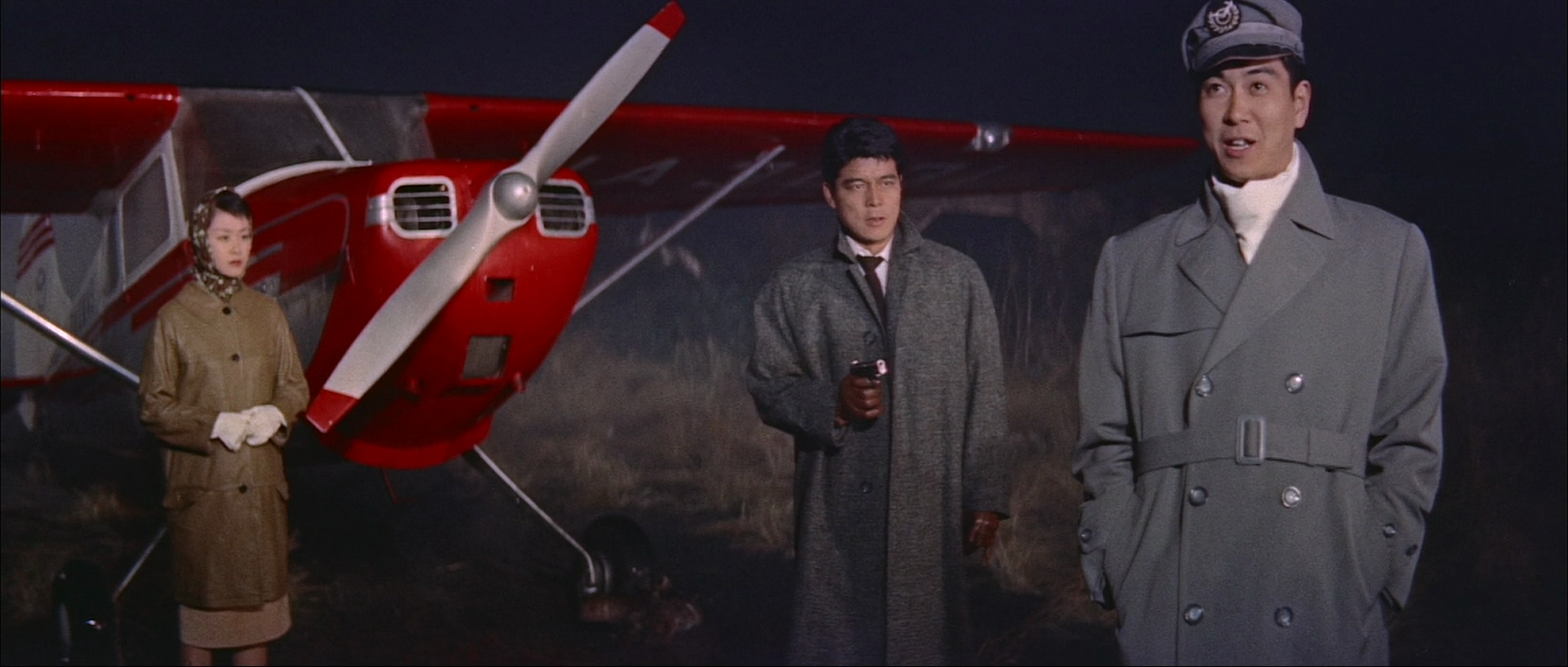
Crimson Wings (紅の翼, Ko Nakahira, 1958)

A heroic pilot on a mission to get life-saving medicine to a small boy on a remote island unexpectedly finds himself frustrated by a wanted man in Ko Nakahira’s aviation thriller, Crimson Wings (紅の翼, Kurenai no Tsubasa). This is of course a time in which air travel was still something new and exciting, but not only that, it also offered immense improvements to those living far flung areas making travel to the mainland far easier and much less time-consuming. 

Time is, however, of the essence as a little boy on Hachijojima has contracted tetanus and the only stocks of the antidote on the island are out of date. If they can’t get replacements in the next few hours, it will be too late. Hachijojima is a fairly remote island in the Philippine sea that was used as a base for suicide submarine missions during the war but was developed as a tourist destination in the years afterwards in which it was dubbed “The Hawaii of Japan”. It didn’t quite take off until the 1960s tourism boom, but this is perhaps the reason why there’s an air shuttle service to Tokyo three times a week that is described by the stewardess as their most popular route. It might also explain why part of her job is acting as a tour guide, pointing out important Tokyo landmarks passengers can see from their windows as they come in to land. In any case, it’s the most obvious way to get the serum to the island seeing as there’s a charter flight set to leave in a couple of hours’ time.

But that same day across town, a CEO, Iwami (Toru Abe), is assassinated by a yakuza hitman named Itagaki (Hideaki Nitani). Predictably, he’s the one who’s charted the flight as a speedy getaway and he’s not all that keen on hanging around waiting for the delivery of the tetanus serum. One of the pilots describes Iwami as “take over king” and the “richest tycoon in post-war Japan”, which is to say they don’t have tremendous sympathy for him as someone who’s almost certainly made his money through nefarious means. Itagaki even remarks that he was “one of us,” the only difference between them being that where yakuza use guns he used money though his killing him was a matter of purely business. He didn’t ask or care why Iwami had to die, but obviously thought he was fair game anyway. 

You can tell that Itagaki is not the sympathetic kind of gangster right away when he mows down a little girl while fleeing the scene, her little yellow balloon sadly flying off into the distance. His indifference to the girl’s death is ironic considering the rest of the film revolves around the struggle to save the life of a little boy, directly contrasting his callousness with the righteousness of the pilot, Ishida (Yujiro Ishihara), who is prepared to risk his own life to deliver the serum. Ishida hadn’t previously volunteered for the job because he was supposed to be going on a Christmas Eve date with stewardess Keiko (Shinako Mine), only she tells him she has to cancel because her father is on a surprise trip to town. Unbeknownst to him, however, she’s actually blown him off to go to a Christmas market with another man. In any case, with nothing else to do he accepted the job even though it involves going in a Cessna because of a malfunction on their regular plane that will take too long to repair. 

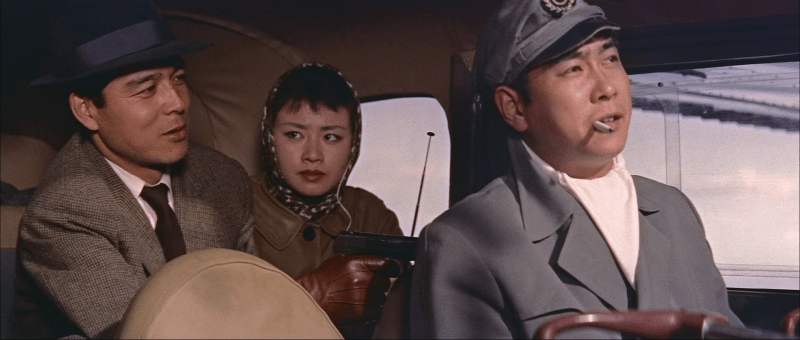
Aside from having to take Itagaki, who is pretending to be on an emergency trip to visit his mother’s grave, Ishida is also accompanied by pushy journalist Yumie (Sanae Nakahara) who was sent to the airport to interview Keiko as part of a series about “working girls” that she doesn’t seem particularly enthused by. In fact, she’s actually quite rude, elaborating that she’s already interviewed a TV producer and a continuity girl describing them all including stewardess as “glamour jobs” that don’t require very much in the way of brains as journalism obviously does. That might in a way reflect her own resentment in that it’s obvious she feels the paper’s not giving her a fair shake because she’s a woman which might be why she jumps so hard on the tetanus story sensing the potential for a heartwarming human interest article. She does however seem to genuinely care about the little boy on Hachijojima. Not only does she immediately arrange for a large amount of the serum to be delivered by police escort but insists on going to the island herself and after figuring out Itagaki is the fugitive thanks to her transistor radio sticks to the main mission rather than switching to the one about the CEO murder. 

Ishida meanwhile remains a cool-headed wisecracker brazening it out against Itagaki in the knowledge that he can’t actually kill him because he doesn’t know how to fly a plane so all his threats are meaningless. There’s also a rather awkward subplot about Ishida’s brother being a kamikaze pilot during in the war which is intended to further bear out Ishida’s righteousness while his sister (Izumi Ashikawa) also makes a long speech about how he said if he had to he’d like to die like him and is the sort of person who can’t stand by and watch someone suffer. A lengthy sequence switches between various branches of the Japanese government and self-defence forces, as well as the US military, who all swap messages between themsleves and immediately scramble to find this one Cessna when it inevitably gets into trouble and drops off radar. The message seems to be that the system works and the authorities are ready to handle events such as this. Using some impressive aeroplane footage along with a series of split screens and a memorable opening POV shot to disguise the assassin’s identity, Nakahira gives the otherwise lighthearted thriller a little more weight while still allowing its wholesome goodness to shrine through as a collection of determined people come together to save a little boy they don’t even know who lives on a remote island where the children work in soil-pits to make extra money which might as well be a million miles away from the modern capital with greedy fat cat CEO’s and nihilistic yakuza.


Trailer (no subtitles)

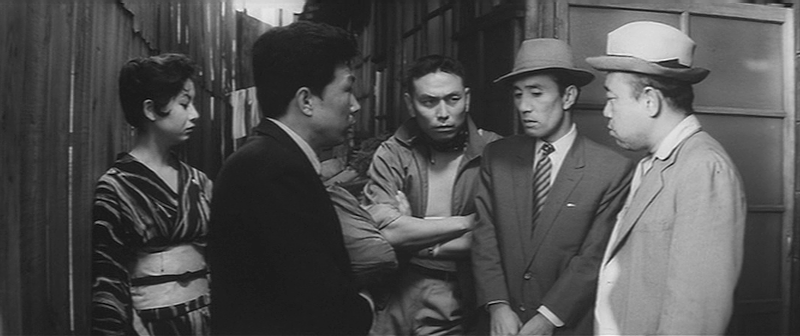
The Wolves (狼, Kaneto Shindo, 1955)

Post-war desperation drives a collection of otherwise honest men and women towards a criminal act that for all its politeness they are ill-equipped to live with in Kaneto Shindo’s biting social drama The Wolves (狼, Okami). “Wolves” is what the criminals are branded, but the title hints more at the wolfish society which threatens to swallow them whole. After all, it’s eat or be eaten in this dog eat dog world, at least according to a cynical insurance salesman hellbent on exploiting those without means. 

Each of the five “criminals” is an employee at Toyo Insurance where they’re immediately pitted against each other, reminded that in order to qualify for a full-time position they need to meet their quotas for six months. The orientation meeting is cultilke in its intensity, the boss insisting that only in insurance can you become a self-made man while recounting his own epiphany as to the worthiness of his profession. They are told that the only two things they need are “faith and honesty”, and then “faith and pursuasion”, while encouraged to think of their work as an act of “worship”, “for the salvation of everyone”. 

Yet they’re also told to exploit their friends and family by pressuring them into taking out life insurance policies in order to help them meet their quotas. As one man points out, friends and relatives of the poor are likely to be poor themselves, but these are exactly the kind of people they’re expected to target. They’re told there’s no point going after the weathly because they’re already insured, but there’s something doubly insidious in trying to coax desperate people who can’t quite afford to feed themselves into paying out money they don’t have on the promise of protecting their families from ruin. One man even asks if the policy covers suicide and is told it does if you pay in for a year, sighing that he doesn’t want to wait that long.

“Suicide or robbery, choose one,” one of the salespeople reflects after failing to make their quota once again. They each have reasons to be desperate, all of them already excluded from the mainstream society and uncertain how they will find work if the job falls through. Akiko (Nobuko Otowa) is a war widow with a young son who is being bullied at school because of his cleft palate for which he needs an expensive operation. She’s already tried working as a bar hostess but is quiet by nature and found little success with it. Fujibayashi (Sanae Takasugi) is widowed too with two children and five months behind rent for a dingy flat in a bomb damaged slum where the landlord is about to turn off her electric. Harajima (Jun Hamamura) used to work in a bank but was fired for joining a union and is trapped in a toxic marriage to woman looking for material comfort he can’t offer. Mikawa (Taiji Tonoyama) too is resented by his wife, a former dancer, having lost his factory job to a workplace injury while the ageing Yoshikawa (Ichiro Sugai) was once a famous screenwriter but as he explains people in the film industry turn cold when you’re not hot stuff any more. 

Their unlikely descent into crime has its own kind of inevitability in the crushing impossibility of their lives. They may rationalise that what they’re doing is no different from the insurance company that exploits the vulnerable for its own gain, thinking that if they can just get a little ahead they’d be alright while feeling as if robbery and suicide are the only choices left to them and at the end of the day they want to survive. Perhaps you could call them “wolves” for that, but they’re the kind of wolves that give the guards from the cash van they robbed their train fare home after bowing profusely in apology. The real wolves are those like Toyo who think nothing of devouring the weakness of others, promising the poor the future they can’t afford while draining what little they have left out of them. As the film opens, Akiko looks down at a bug writhing in the dirt attacked by ants from all sides and perhaps recognises herself in that image as the sun beats down oppressively on both of them. Breaking into expressionistic storms and unsubtly driving past a US airbase to make clear the source of the decline, Shindo paints a bleak picture of the post-war world as a land of venal wolves which makes criminals of us all. 


Endless Desire (果しなき欲望, Shohei Imamura, 1958)

In the noir films of the immediate post-war era, the protagonists are often haunted by an inescapable past that prevents them from moving on into the new democratic Japan. But in Shohei Imamura’s Endless Desire (果しなき欲望, Hateshinaki Yokubo) the situation is ironically reversed as a group of former soldiers who on the surface of things at least seem to have made moderately successful lives for themselves reunite to dig up buried treasure from the dying days of the war greedy for a little more glamour than the world has seen fit to show them.

Their venal amorality is directly contrasted with the bumbling earnestness of Satoru (Hiroyuki Nagato), a young man who fears his childhood sweetheart, butcher’s daughter Ryuko (Sanae Nakahara), is going to marry another man because he is unemployed and cannot find a job in the still difficult if steadily improving post-war economy. As such, he’s incredibly excited by the opportunity to get into the real estate business, wandering around town dressed in a suit and carrying a briefcase to scout properties or otherwise doing odd jobs for the gang, which is a shame because unbeknownst to him the business is a sham set up as a front by the crooks who’ve rented a vacant shop from Satoru’s land shark dad so they can tunnel their way to the treasure which they think is buried under Ryuko’s butcher’s shop. 

The changing nature of the times is rammed home by the fact that the shopping district, which stands atop the site of the former military hospital where the gang buried a barrel full of stolen morphine at the end of the war ten years previously, is itself about to be torn down. Effectively a post-war shantytown, the area is now ripe for redevelopment with the economy beginning to bounce back thanks to the stimulus of the Korea War. The post-war era is not quite “over”, but it’s definitely on its way out which makes the gang’s determination to recover the stolen morphine all the more ironic especially as the market for hard drugs may not be as a lucrative as it once was not to mention to the logistical difficulties of turning it into cash. 

Nevertheless, the desire for it immediately sets the gang against each other. The problem is that the lieutenant, Hashimoto, who set the whole thing up has apparently died and extra person has turned up to claim some of the loot despite the gang members having been told there should only be three of them. They were not particularly close in the war and cannot exactly remember each other while Hashimoto had them all work separately without knowing who else was on board so they don’t even know which one of them is the potentially uninvited guest. Meanwhile, the presence of a woman, Shima (Misako Watanabe), who claims to be Hashimoto’s sister sets them all on edge with masculine jealously as she sometimes gleefully plays the femme fatale later even trying to seduce the innocent Satoru, convincing him she’s a victim of domestic violence in need of rescue in an attempt to quiet his concerns over what might be going on at the shop. 

The fact is that none of the gang members can really claim to be desperate, all are simply greedy and selfish silently plotting to keep all the money for themselves rather than share it. One of them is eventually crushed under the barrel, an embodiment of their insatiable desire, but with their dying breath insists it’s theirs and no one else can have any. As old man later says, this kind of greed only leads to a bad end unlike the greed he’s patiently practiced over decades which seems to be taking a little here and there where you find it such as asking Shima for some extra money for “helping” her before asking the police about a reward and turning her in anyway.

Even Satoru’s dad is “greedy”, renting the crooks a shop he new would soon be knocked down and then complaining when his tenants try to take the tatami mats and shoji doors they’d paid for themselves out of his property. Greed maybe the way of the world, at least for those who unlike the diffident Satoru do not lack for self-confidence, but endless desire has only one reward. Darkly comic and often deeply ironic, Imamura plays with a noirish sense of fatalistic retribution but finally returns to a sense of childish innocence in the bumbling courtship of Satoru and Ryuko who may be her own kind of femme fatale playing two suitors against each other while refusing to be dominated by any man but nevertheless riding off into the sunset on her bicycle with a diffident Satoru chasing along behind her.


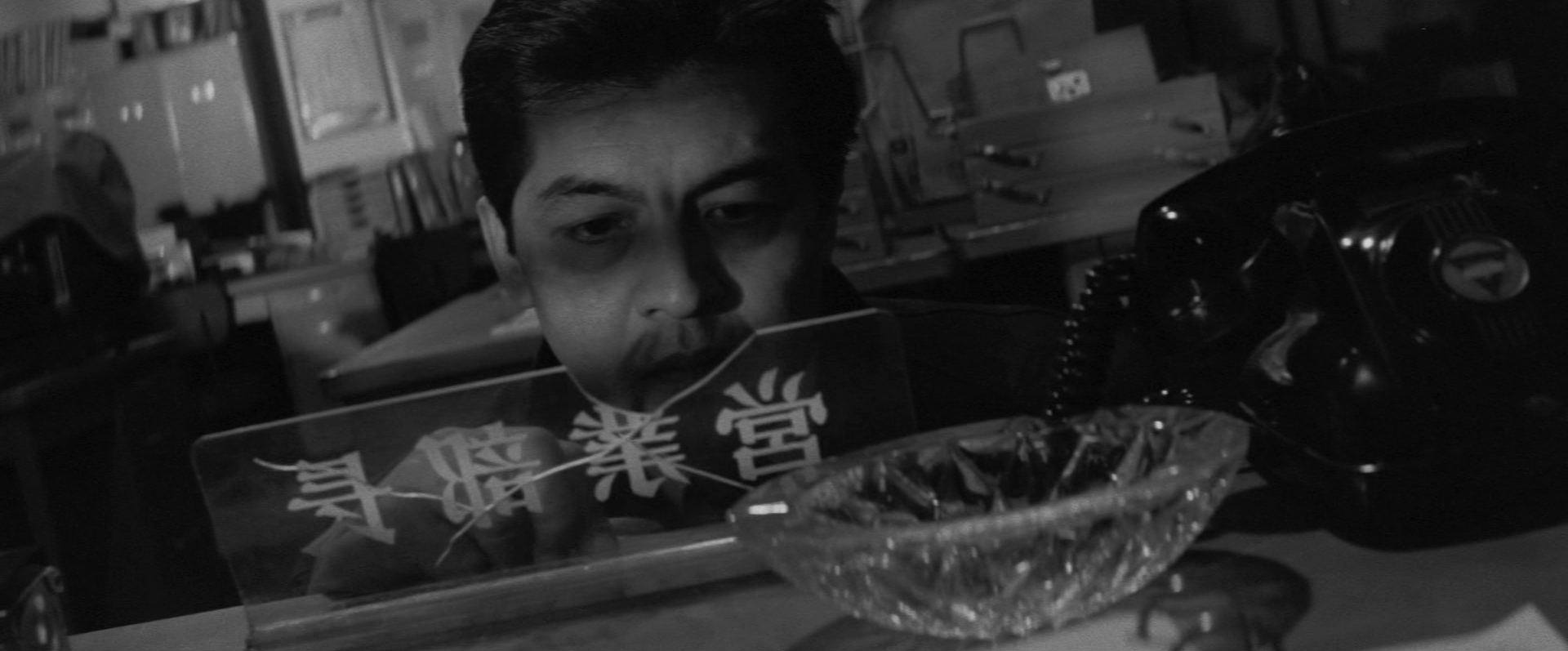
The Threat (脅迫, Kinji Fukasaku, 1966)

An ambitious executive is confronted with the emasculating nature of the salaryman dream when escaped convicts invade his home in an early thriller from Kinji Fukasaku, The Threat (脅迫, Odoshi). The threat in this case is to his family and implicitly his manhood in his ability or otherwise to protect them while accepting that his aspirational life has come at the expense of his integrity and left him, ironically, hostage to the whims of his superiors.

This much is obvious from the opening sequence which takes place at a wedding where Misawa (Rentaro Mikuni) is giving a speech congratulating two employees on their marriage. Misawa’s speech is long and boring, as such speeches tend to be, and according to some of the other guests disingenuous in giving glowing reports of two ordinary office workers while skirting around the elephant in the room which is that Misawa has played matchmaker to convince an ambitious junior to marry his boss’ mistress for appearance’s sake. As Misawa himself has done, the employee has sacrificed a vision of masculinity for professional gain in accepting that his wife’s body will “belong” to another man and it is the boss who will continue sleeping with her. 

The only person not aware what’s going on is Misawa’s naive wife, Hiroko (Masumi Harukawa), who enjoyed the wedding and remarked that the couple seemed very well suited giving rise to an ironic laugh from Misawa who of course knows that not to be the case. They return by car to a nice-looking home but one that stands alone at the end of a street preceded by a series of vacant lots presumably available to other similarly aspirant salarymen yet to make a purchase. Shortly after they arrive, two men force their way in and insist on staying explaining that they are the pair of escaped death row convicts that have been in the papers and are in fact in the middle of a kidnapping having taken the grandson of a prominent doctor with the intention of using the ransom money to illicitly board a ship and leave the country. 

Naked and covered in soap suds having been caught in the bath, Misawa is fairly powerless to resist and can only hope to appease the men hoping they will leave when their business is done. His acquiescence lowers his estimation in the eyes of his young son, Masao (Pepe Hozumi), who later calls him a coward and is forever doing things to annoy the kidnappers such as attempting to raise the alarm with visitors by smashing a glass or speaking out against them while Misawa vacillates between going along with the kidnapper’s demands or defying them to contact the police. After failing to retrieve the money when ordered to act as the bag man, Misawa stays out trying to find another way to get the cash and Masao wonders if he’ll come back or will in fact abandon them and seek safety on his own. Misawa really is tempted, darting onto a train out of the city his eyes flitting between the sorry scene of a small boy with a tearstained face tugging the sleeves of his father who seems to have fallen down drunk on the station steps, and a woman across from him breastfeeding an infant. He gets off the train only at the last minute as it begins to leave the station as if suddenly remembering his role as a father and a husband and deciding to make a stand to reclaim his patriarchal masculinity. 

The brainier of the kidnappers, Kawanishi (Ko Nishimura), had described Misawa as a like robot, idly playing with Masao’s scalextrics insisting that he could only follow the path they were laying down for him much as he’d already been railroaded by the salaryman dream. During a car ride Kawanishi had asked Misawa what he’d done in the war. Misawa replied that he was in the army, but had not killed anyone. Kawanishi jokes that he’d probably never raped a woman either, but to that Misawa gives no answer. Realising that the other kidnapper, Sabu (Hideo Murota), had tried to rape Hiroko he turns his anger towards her rather than the kidnappers striking her across the face and later raping her himself avenging his wounded masculinity on the body his of wife while unable to stand up to either of the other men. 

Kawanishi giggles and describes him as exactly the kind of man he assumed him to be but he’s both wrong and right. Misawa had been spineless, insecure in the masculinity he largely defined through corporate success though as Kawanishi points out most of what’s in the house is likely being paid for in instalments meaning that technically none of it’s actually his. He defined his position as a father as that of a provider, ensuring a comfortable life his wife and son rather than placing importance on his ability to protect them physically from the more rarefied threats of the contemporary society such as crime and violence. On leaving the train, another symbol of the path laid down for him both by the salaryman existence and by Kawanishi, he is able to reclaim a more primal side of his manhood in formulating a plan of resistance to lure the kidnappers away from his wife and son. 

But then in another sense, it’s Hiroko who is the most defiant often telling the kidnappers exactly what she thinks of them while taking care of the kidnapped baby and doing what she can to mitigate this awful and impossible situation in light of her husband’s ineffectuality and possible disregard. She is the one who finally tells Kawanishi that she no longer cares if he kills her but she refuses bow to his authority and he no longer has any control over her. Even so, the film’s conclusion is founded on Misawa’s reacceptance of his paternity in a literal embrace of his son, redefining his vision of masculinity as seen through the prism of that he wishes to convey to Masao as an image of proper manhood. Fukasaku sets Misawa adrift in a confusing city lit by corporatising neon in which the spectre of the Mitsubishi building seems to haunt him amid the urgent montage and tilting angles of the director’s signature style still in the process of refinement as Misawa contemplates how to negotiate the return of his own kidnapped family from the clutches of a consumerist society. 


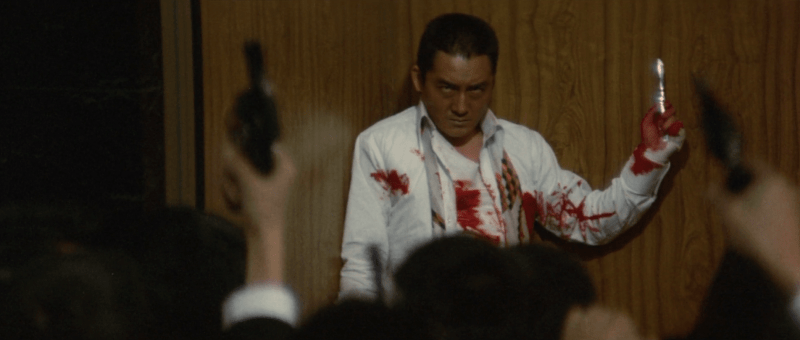
Operation Plazma in Osaka (実録外伝 大阪電撃作戦, Sadao Nakajima, 1976)

The precarious balance of the post-war yakuza society begins to crumble in Sadao Nakajima’s jitsuroku eiga, Operation Plazma in Osaka (実録外伝 大阪電撃作戦, Jitsuroku gaiden: Osaka dengeki sakusen). The Japanese title might more accurately be translated as “shock tactics in Osaka” which is a neat encapsulation of the turf war which arises when a larger gang from Kobe decides to muscle in and take over the city while a small upstart continues to agitate contemplating taking the whole prize for themselves. 

Inspired by a real life turf war which took place in Osaka in 1960, the film opens with classic jitsuroku voiceover revealing that a precarious balance had been held in the local underworld since the Meiji era in part because the city is simply too big to be ruled by any one gang. But times are changing, yakuza conglomerates are in style, and so it is that the Kawada gang mounts a largely political campaign to claim the city without bloodshed, as boss Yamaji (Akira Kobayashi) puts it, by convincing the smaller gangs to join up with them. According to the voiceover, however, it wasn’t Kawada that upset the balance but a small upstart group that came out of nowhere, Soryu. 

The screen then cuts to a map of Osaka, while the stills behind the credits feature the Tsuruhashi Market in Korea town. The thing about the Soryu group is that many of its leading members are ethnically Korean which sets them apart from most of the other mobsters in town. Even so, it’s hotheaded Yasuda (Hiroki Matsukata) that first gets them in trouble by getting into a fight with Takayama (Tsunehiko Watase) at a boxing match after climbing into the ring himself when the guy he bet on looks like he’s about to lose. This sets up a conflict between the Soryu and the Nanbara gang who run the boxing hall, but it never takes off because the recently released Daito suddenly announces that he’s bought the “Dance Hall” the ring is being run from and wants to turn it into a cabaret bar. It seems clear that someone’s backing Daito, but no one quite knows who. 

As Yamaji had said it would be, it starts of as a very modern silent war in which he slowly seduces various yakuza gangs convincing them that they’re stronger together with a slight note of join us or die. Yasuda and Takayama are two men who don’t like being told what to do and each end up exiled from their gangs thanks to their opposition to Kawada. Having failed to assassinate Yamaji, boss Nanbara pathetically rolls over and decides to join him instead while the Soryu gang is sent on the run leaving Yasuda and and Takayama to form an unlikely brotherhood brokered by Yasuda’s odd decision to gift his nightclub singer girlfriend to his sometime rival leaving Takayama permanently in his debt and touched by his selfless gesture.

Even by the standards of the jitsuroku, Operation Plazma in Osaka is rabidly misogynistic and often sleazy with an early scene seeing the Soryu gang cause trouble by stripping a hostess naked as one pours alcohol over her body and another drinks it from between her legs. Naked women are repeatedly fondled by fully clothed men, while nightclub singer Yoshiko (Yuko Katagiri) is treated largely as a pawn, a tool used to mediate the latent homoerotic desire between Yasuda and Takayama. Then again, everything in this world is extreme. The conflicted Miyatake (Tatsuo Umemiya) who had once tried to protect Takayama eventually tries to boil a man alive to get him to reveal Takayama’s location while Nakajima’s anarchic handheld camera desperately tries to keep up with the increasingly nihilistic violence. 

The resolution arrives not with death but total defeat, the traditional yakuza forced into submission by the corporatising giant with the survivors realising they will live the rest of their lives in subjugation making an “unconditional surrender” to changing times. Yasuda had claimed that the Soryu gang was a “free democracy” standing in opposition to the latent fascism of traditional gangsterdom which then finds its way into the corporate and the extreme hostile takeover Yamaji has just performed on the city of Osaka. Suddenly all that’s left of traditional yakuza is a pinkie in a jar, a grim a reminder of what happens when those in a position to resist back down in the face of an authoritarian power.


Japan Organized Crime Boss (日本暴力団 組長, Kinji Fukasaku, 1969)

A yakuza just out of jail emerges into a very different Japan in Kinji Fukasaku’s proto-jitsuroku gangster picture, Japan Organized Crime Boss (日本暴力団 組長, Nihon Boryoku-dan: Kumicho). A contemporary Oda Nobunaga is trying to unify the nation under his yakuza banner while fostering a nationalist agenda and colluding with corrupt politicians to prop up the 1970 renewal of the Anpo security treaty, but as it turns out some people aren’t very interested in revolutions of any kind save the opportunity to live a quiet life they once feared would elude them. 

As the film opens, a narratorial voice explains that the nation has now escaped from post-war chaos, but Japan’s increasing prosperity has led to a natural decline of the yakuza which has seen some try to ride the rising tides to find new ways to prosper. Exploiting its control of local harbours, the Danno group has quickly expanded though Osaka and on to the rest of the nation thanks largely to its strategist, Tsubaki (Ryohei Uchida), and his policy of convincing local outfits to ally with them and fight as proxies allowing Danno to escape all responsibility for public street violence. 

Perhaps strangely, the Danno group and others are acutely worried about optics and keen to present themselves as legitimate businessmen while using a prominent politician as a go-between to settle disputes between gangs. The yakuza already know they’re generally unpopular and fear that attracting too much attention will only bring them problems from the authorities. The politician needs Danno to look clean so that they can back them in opposing the protests against the Anpo treaty, while the yakuza organisation is later depicted as a militarised wing of the far right hoping to correct “misguided” post-war democracy while eradicating communism and instilling a sense of patriotic pride as they go. Of course, all of that will also likely be good for business while quite clearly marking these new conspiracy-minded yakuza as “bad”, hypocritical harbingers of a dangerous authoritarianism. 

Tsukamoto (Koji Tsuruta), the recently released lieutenant of the Hamanaka gang, is conversely the representative of the “good” yakuza who still care about the code and are genuinely standing up for the little guy against the oppressive forces now represented by bad yakuza. Hamanaka had allied with Danno while Tsukamoto was inside and was thereafter targeted by the local Sakurada group who have joined the Tokyo Alliance of yakuza clans opposed to Danno who continue to fight them by proxy. After his boss is killed and tells him that joining Danno was a mistake, Tsukamoto’s first thought is to rebuild the clan which he does by remaining neutral, refusing to engage in Danno’s proxy wars while protecting his men from their violence as mediated by the completely unhinged, drug-addled Miyahara (Tomisaburo Wakayama) and the anarchic Hokuryu gang. 

Miyahara comes round to Tsukamoto precisely because of his pacifist philosophy after he kidnaps one of his men and Tsukamoto stands up to him while making a point of not fighting back. As crazed as he is, Miyahara is a redeemable gangster who later also turns on Danno regretting having agreed to do their dirty work for relatively little reward. After a gentle romance with the sister of a fallen comrade, Tsukamoto, who lost his first wife to suicide while inside, begins to dream of leaving the life behind but as he and others discover there is no real out from the yakuza and the code must always be repaid. In failing to protect his clan he fails to save himself and becomes a kind of martyr for the ninkyo society taking on politicised yakuza and their lingering militarism. 

Fukasaku takes a typical ninkyo plot of a noble gangster standing up for what he believes is right against the forces of corruption and begins to undercut it with techniques such as voiceover narration and onscreen text that he’d later use in the jitsuroku films of the 1970s which firmly reject the idea of yakuza nobility seeing them instead as destructive forces born of post-war chaos and increasingly absurd in a Japan of rising economic prosperity. Men like Tsukamoto are it seems at odds with their times, unable to survive in the new society in which there is no longer any honour among thieves only hypocrisy and self-interest. 


Writhing Tongue (震える舌, Yoshitaro Nomura, 1980)

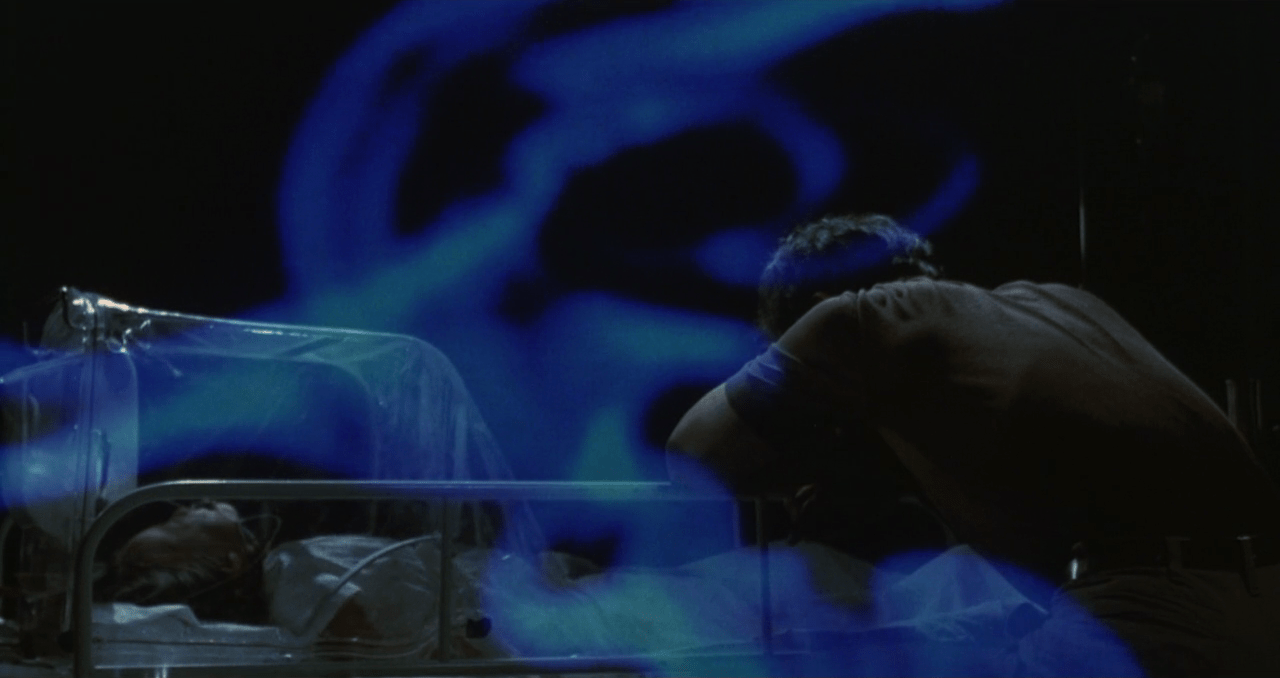
Yoshitaro Nomura is best known for his crime films often adapted from the novels of Seicho Matsumoto though his filmography was in fact much wider than many give him credit for. Even so, 1980’s Writhing Tongue (震える舌, Furueru Shita) may seem an odd entry adapted from the semi-autobiographical novel by Taku Miki exploring the psychological torment of the parents of a little girl who contracts tetanus while innocently playing near a pond. Like the following year’s Call From Darkness, Nomura’s intense drama eventually shifts into the realms of psychedelia in the father’s strange fever dreams while lending this harrowing tale of medical desperation the tones of supernatural horror. 

When five-year-old Masako (Mayuko Wakamori) seems to be under the weather, her mother Kunie (Yukiyo Toake) takes her to the hospital but is told by the disinterested doctor that she simply has a cold. This is a little surprising seeing as Masako’s main complaint is she that cannot open her jaw, probably the best-known indication of tetanus infection which is after all not so rare as to be easily missed by a medical professional. Still worried, Kunie keeps taking her daughter back especially once her leg becomes twisted leaving her struggling to walk, but the doctors that she sees don’t really listen to her, even implying that Masako is having some kind of early life breakdown because her father, Akira (Tsunehiko Watase), is overly strict with her. This may be in part because Masako, perhaps in fear, keeps saying that she could walk or open her mouth if she wanted but is choosing not to. In any case the true diagnosis is only discovered after the couple manage to get a referral from a friend to a larger hospital where the veteran professor (Jukichi Uno) quickly overrules his junior’s lack of concern to have Masako admitted right away later explaining that tetanus is a difficult disease to treat and unfortunately has a high mortality rate. 

The treatment dictates that Masako receive as little stimulation as possible, lying in an entirely dark room with minimal noise so as to avoid the violent convulsions that accompany overstimulation and cause her to bite her tongue. As Akira later puts it, all they can do is wait trapped alone in the dark and tiny room with Masako entirely powerless to help her and with little knowledge of what exactly is going on. Meanwhile, despite having been repeatedly reassured that the disease is not transmitted in that way, Akira is convinced he may have contracted tetanus after being bitten by Masako while trying to prise open her jaw. Kunie too later worries that she also has tetanus, the pair of them sucked into a claustrophobic world of isolation and medical paranoia in which they are unable to sleep or find relief while watching over their daughter. 

Some time later, Akira begins having bizarre psychedelic dreams recalling the time when he too was hospitalised as a child having contracted blood poisoning, remembering his own fear and confusion on being forced to endure “red injections” which he feared would “turn the whole world red” while the hieroglyphics he and his wife have been using to record Masako’s seizures dance before his eyes. He dreams of crows and blood rain while Kunie goes quietly out of her mind at one point threatening the sympathetic Doctor Nose (Ryoko Nakano) thinking it might be kinder to stop the treatment and let her daughter escape this excruciating pain. The utter powerless with which the couple are faced is filled with almost supernatural dread as if Masako had been possessed by some terrible evil, Akira attempting to speak directly to the bacteria asking them why it is they’re trying to colonise his daughter’s body and if they realise that in killing her they kill themselves too.

“It’s odd, our life. It’s so fragile” Akira sighs. All of this happened because of a tiny cut on a little girl’s finger the kind not even quite worth putting a plaster on and yet she might die from it. Convinced they all may die, Akira tells his wife to go home and put their affairs in order while she is so traumatised that she becomes unable to re-enter the room paralysed not out of physical disability but mental anguish. When Masako’s condition finally improves, Akira can hear his daughter crying that she’s frightened reminding him that he can never really understand the way she suffered through this terrible disease while all he could do was watch. A truly harrowing depiction of the hellish psychological torment of serious illness, Nomura’s occasionally psychedelic drama lays bare the fragility of life in a world of constant and unexpected dangers. 


Trailer (no subtitles)
Temptation (誘惑, Ko Nakahira, 1957)

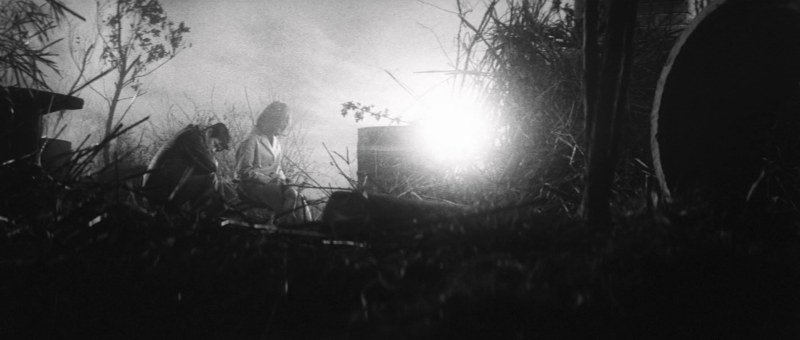
Ko Nakahira made his name with the seminal Sun Tribe movie Crazed Fruit, a nihilistic tale of bored, affluent post-war youth. Released a year later, Temptation (Yuwaku), adapted from a novel by Sei Ito, is in some ways its inverse pitting a melancholy widower harping on dreams of lost love against his relentlessly practical daughter for whom “Sex is life. Art is money” but finding in the end perhaps more commonality than difference save for the fact the youth of today may have no real dreams to betray. 

Now 55 years old, Sugimoto (Koreya Senda) is the proprietor of the Sugimoto Dried Goods store in upscale Ginza. Father to an only daughter, Hideko, now that his wife has passed away he finds himself carried back towards the past and is planning to turn the upstairs space in the store into a small gallery. For her part Hideko (Sachiko Hidari) and her coterie of artist friends are hoping to convince him to allow them to exhibit in the gallery for cheap, but he, slightly more conservative in his old age, views them all as low class Bohemians and fails to understand why Hideko hangs out with them in the first place. He has, it seems, an internal conflict symbolised by the beret he’s taken to wearing in which he is unable to let go of the broken dreams of his youth when he was a struggling artist forced to give up his first love, Eiko (Izumi Ashikawa), because he had no money or prospects while she eventually consented to an arranged marriage.  

The world of 1931 being very different, Sugimoto and Eiko never did anything beyond holding hands (later a key plot point), though in her parting letter she laments that she regrets not having let him kiss her and mildly berates him for not having been more forceful. A slightly uncomfortable sentiment, but diffidence seems to be the force defining Sugimoto’s life. At the store he finds himself dissatisfied with his senior salesgirl Junko (Misako Watanabe) whose brusque manner with customers and refusal to wear makeup he fears are harming sales, but is unable to say anything until his rather half-hearted attempt to talk to her provokes a mutual misunderstanding, he thinking she may be anxious about being fired and she wondering if he’s about to make a proposal. 

For unclear reasons, Junko seems to have a crush on Sugimoto, something which becomes a minor problem when he also becomes a target for Kotoko (Yukiko Todoroki), a middle-aged woman/insurance agent from Hideko’s floral arrangement class. Privy to their interior monologues, we can hear the two women squaring off against each other, Junko complaining that Kotoko is “meddling, talkative, and fat”, while Kotoko fires back that Junko wears “no makeup at all and is so stuck up” as they glare at each other through the shop window. Yet it’s not Sugimoto who eventually provokes a change in Junko, but another eccentric, struggling artist, Sohei (Shoji Yasui), who bluntly tells her that she is pretty and so should put some makeup on to bring it out. 

Junko later characterises this intervention as an act of salvation that sees her re-embrace her femininity, not only wearing makeup and having her hair styled but beginning to talk warmly with customers, improving the business but ironically giving Sugimoto the mistaken idea her friendly new demeanour may be partly for his benefit. For his part, Sohei, an unkempt artist suffering a seemingly permanent lice infestation, claims not to have cared very much about money or possessions which led him to accidentally abuse the generosity of his artist friends but has now been awakened, it seems, to a kind of consumerist mentality thanks to the interest of Junko and recognition of his art when some of Sugimoto’s old friends (well known artists Taro Okamoto, Seiji Togo, and critic Kimihide Tokudaiji) praise his paintings on seeing them in the gallery leading to them fetching a high price from prominent collectors. 

“The value of a work of art hinges on whether or not it sells” one of Hideko’s friends points out while she adds “We should be proud that art is profitable”, a sentiment that hugely offends Shohei (Ryoji Hayama), the beret-wearing leader of another artist circle the gang enlist to help them pay for the rental of the gallery. Though he concedes to Hideko’s argument that her father’s gallery is a business enterprise, not a charity, Shohei is somewhat horrified by the casual equation of art and commerce, shocked that the girls view their flower arranging as a practical more than an aesthetic skill. Still, in another irony it turns out that his talent is for business rather than art, shrewdly steering Sohei’s success rather than his own when it’s clear his work is the standout in the gallery. Just like Sugimoto had, he eventually resolves to give up his artistic dreams after falling in love with Hideko, planning to marry into her family and take over the Sugimoto store. She meanwhile, had described him as not good marriage material, “no poor painters for me, only rich men” but is apparently in favour of his selling out if only in that it ironically makes him more himself. 

As we discover there are more than a few reasons besides the beret that Sugimoto keeps feeling Shohei reminds him of someone else even as he finds himself wary of him, pointlessly trying to set Hideko up with someone more “suitable” just as she makes a point of inviting a series of alternative widowed, middle-aged ladies to the gallery opening not so much because she particularly objects to Kotoko but she’s worried her dad might get bamboozled into something without properly surveying his options. While Sugimoto remains maudlin and filled with regret though perhaps putting the past aside through a symbolic act of closure, the youngsters are cheerfully cynical, practical in the way the older generation are always telling them to be but are perhaps disappointed in them for not having dreams or aspirations beyond those of claiming or maintaining or their chosen status in life. “Art is money” Hideko is fond of saying, and it’s true enough in so much as money is an art and the one which seems at least to have captivated the post-war generation eagerly awaiting the advent of the consumerist revolution. 


I, the Executioner (みな殺しの霊歌, Tai Kato, 1968)

Nephew of Sadao Yamanaka, Tai Kato joined Toho as an apprentice in 1937, returning after the war training under Daisuke Ito and Akira Kurosawa, but later moved to Toei where he became closely associated with ninkyo eiga yakuza movies and jidaigeki. From the mid-1960s, however, he made several movies at Shochiku which had, it has to be said, a house style that was almost the polar opposite with a clear focus on polite, family-friendly melodrama. 1968’s I, the Executioner (みな殺しの霊歌, Minagoroshi no Reika) meanwhile is a surprisingly dark affair even among the grittier examples of Shochiku’s similarly themed B-movie thrillers, an avant-garde noir and proto-giallo in which the fugitive, serial killer antihero sees himself as an agent of divine justice in a hellish and immoral post-war landscape. 

Kato opens with a shocking scene of sexualised violence in which a woman is knocked unconscious, stripped, bound with telephone cord, and finally revived, forced to write down the names of four other women before being brutally raped and murdered by a killer whose voice we have not yet heard nor face seen. The police are mystified, attributing the woman’s death to the fact that she had worked as a bar hostess and maybe things like this are an occupational hazard for women who are surrounded by too many men. Her landlord, however, laments that hers is the second death to occur recently after a laundry boy threw himself off the roof. All things considered, he wishes the boy had picked somewhere else. 

The police have no reason to connect the two unfortunate events and so remain largely clueless, but we gradually become aware that the killer, Kawashima (Makoto Sato), is targeting the women because he holds them directly responsible for the boy’s death. He is the inspector that calls, avenging the death of this young man who, he has learned, like him hailed from Hokkaido and had come to the city at only 16 years old to earn money to support his family, saving almost all of his wages in the hope of opening a shop. Kato shows us scenes of a city under construction, a land of girders casting shadows on the ground like prison bars trapping men like these who are building the new Japan but will be discarded as soon the job is done and their labour no longer so much in demand. Kawashima has another reason for living like this, but he perhaps admires something pure and innocent in the desire of a young man leaving home to seek his fortune so that he might take care of those he loves and that this world betrayed that desire is something he finds impossible to forgive.

The five women have apparently done quite well for themselves, despite the fact that more than one of them has worked on the fringes of the sex trade. Their treatment of the boy is attributed to their boredom in the relative ease of their lives as monied women with little to occupy their time other than getting their kicks abusing the less powerful. It’s an uncomfortable role reversal that places women in a position of power and then sees them abuse it in the exact same way that men do, slinging back the same pithy justifications that men offer for sexual violence while the police meditate on the relative connotations of rape when the word is applied to a man at the hands of women rather than the other way around. If it were their sister, they could understand the desire to kill the men who had done it but a part of them struggles to see that a teenage boy may still find unwanted sexual contact a traumatic enough experience to push him towards suicide. 

Yet Kawshima appears to have no real connection to the boy, and his “revenge” is also a product of his misogyny in that as we later learn he also has reason to feel betrayed by womanhood and is already on the run from previous crime. Nevertheless, he is drawn to the innocent Haruko (Chieko Baisho), a girl-next-door type who works in his favourite ramen restaurant, only to discover that she too has a dark and violent past which may be why she seems to be drawn to him. He struggles with himself, but believes that he is taking revenge on a brutalising society defined by violence and abuse while sublimating his sense of emasculation in the face of women’s growing social and sexual freedoms in the post-war era. It is perhaps the post-war era which is cast as the major villain, one of the women later escaping her protective custody to dance furiously a hip nightclub only to return to the scene of her crime while refusing to see that she has done anything so “wrong” as to merit this kind of persecution. 

“The cycle of divine punishment must be fulfilled” Kawashima finally laments, acknowledging his grim place within this series of post-war tragedies. Surprisingly avant-garde, Kato experiments with blown out negatives, extreme close up, and deep focus mixed with his characteristic low angle composition to add to the sense of noirish dread which paints the modern city as an inescapable hellscape while even the romantic place of refuge shared by Kawashima and Haruko is a gothic moorland lit by moonlight and filled with eerie mist. Lurid and sweaty, the film has a grim sense of humour even in its oppressive atmosphere with a running gag devoted to the lead investigator’s painful case of piles, but its overriding fatalism nevertheless offers the hero a sense of redemption if only in acceptance of his narrative destiny.