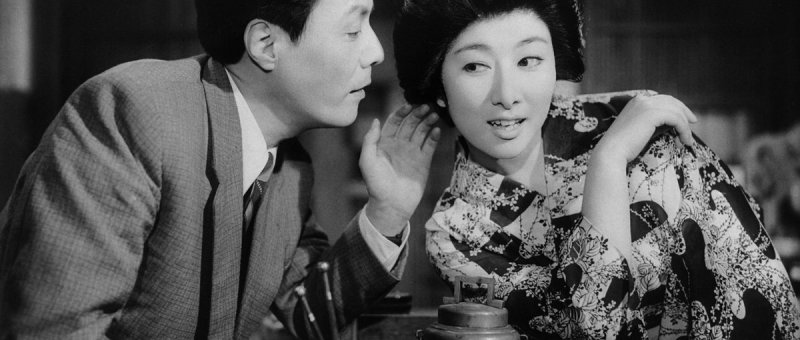
Twilight Story (濹東綺譚, Shiro Toyoda, 1960)

Director Shiro Toyoda, closely associated with high minded literary adaptations, nevertheless had a talent for melancholy comedy and for capturing the everyday reality of ordinary people. A fierce condemnation of the patriarchal society at a moment of intense masculinity, Twilight Story (濹東綺譚, Bokuto Kitan), an adaptation of the novel by Kafu Nagai, follows an ambivalent author as he covertly observes the life and love of a former geisha daring to dream of romantic salvation while fully aware of the world’s cruelty.

Set in 1936, the film opens with an author on a research trip who guides us into the world of the Tamanoi pleasure quarter which he seems to disdain but is drawn to all the same. Whilst there he runs into a nervous middle-aged man, Junpei (Hiroshi Akutagawa), who is later accosted by sex worker Oyuki (Fujiko Yamamoto) for use of his umbrella during a violent storm. A mild-mannered sort, Junpei is unused to the ways of the red light district and quickly makes his escape after being invited into Oyuki’s home. After a swift drink, however, he returns and the pair begin an awkward semi-romantic relationship.

Despite his affirmation that he is single, Junpei is in fact already married if (for the moment) unhappily. Though he knew his future wife Mitsuko (Michiyo Aratama) had given birth to an illegitimate child fathered by her employer, Junpei chose to marry her anyway because he was in love. The pair married, they say, for “genuine” reasons but the father of Mitsuko’s son continues to send maintenance money for the boy’s education and his constant presence has begun to play on Junpei’s mind especially as his teacher’s salary is dwindling in this age of militarism in which educational hours are decreasing in favour of compulsory military drills. Meanwhile, Mitsuko also seems to have got religion and spends most of her time reciting sutras with the implication that she has begun to neglect her husband, emotionally, spiritually, and most particularly physically. In order to escape his depressing home life, Junpei hangs out in the Tamanoi where men’s hearts are lighter and people talk frankly about love.

This is, of course, not quite the case, but the fantasy the pleasure quarters sell of themselves. Our jaded author is perfectly aware of that and broadly sympathetic towards the women caught in its web. Oyuki, a former geisha, has “debased” herself in order to earn extra money to send home to her family and pay the medical fees for her sickly mother. Her uncles constantly pressure her for more and she wonders if they are not merely exploiting her, using her money for their own benefit and refusing to chip in for her mother’s care. Nevertheless, she is trapped. On meeting Junpei with whom she seems to develop a genuine emotional connection, she dares to dream that one day they might marry, that she could leave this life behind and build a stable family home of her own.

Of course, it’s not to be. Like all men in the Tamanoi, Junpei is misrepresenting himself for his own ends. He is only using Oyuki as an idealised point of refuge from the unhappy marriage he shows no other signs of leaving. As the author points out, the men think they’re using women but the women are also using them though they do so without calculation. Denied power or agency of their own, the women of the Tamanoi have no other option than to manipulate that of men, though the author sympathises with them so strongly that to expose the hidden “vulgarity” seems to him an act of intense cruelty.

Junpei falls in love with the world of the Tamanoi because he thinks it’s more emotionally honest, but the truth is quite the reverse. Wandering through the narrow streets at night, the author pities the women in the windows, knowing that men come here to escape their isolation but there is no escape for these women who are forced to delude themselves that a better future is waiting in order to go on living. Meanwhile Junpei’s colleague, looking back over his shoulder towards the young men in uniform, declares that he too has lost all hope for a promising future. With militarism on the rise, hyper-masculinity has led to a further decline in the already woeful status of women with even the girls’ sympathetic pimp lamenting that the army, who have been rounding up sex workers for forced service in Manchuria, regard them as little more than products to be poked and prodded and giggled over as they are cruelly bought and sold.

Reuniting with his wife, Junpei is forced to face his emotional cowardice, that he was just playing with Oyuki’s feelings in indulging the fantasy of an idealised romantic union. Oyuki, meanwhile, faces the destruction of all her dreams when she realises her uncle has betrayed her, her mother is dead, and all her sacrifices have been for nothing. On some level she may have known Junpei had another woman, but needed to believe in the fantasy of his love for her in order to make her life bearable. Even so, she now sees no other future for herself than a return to work shorn of all her hope. Toyoda’s condemnation of the red light district is bleak and total, even as the jaded author himself becomes an ambivalent part of it, but the Tamanoi is only a symptom of longstanding social oppression exacerbated by militarist fervour as the lights go out all over town.
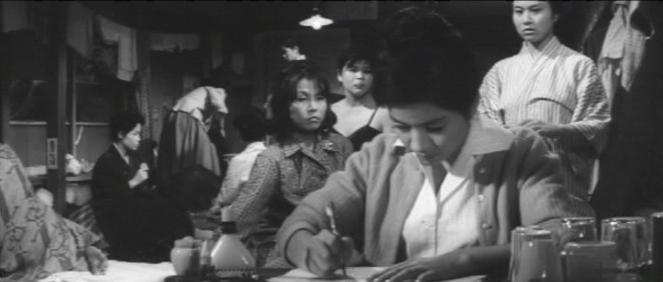
Girls of the Night (女ばかりの夜, Kinuyo Tanaka, 1961)

vlcsnap-2019-03-15-00h18m28s351

Working from a Keisuke Kinoshita script, Kinuyo Tanaka’s first film as a director, Love Letter, made a point of exploring the often hypocritical and contradictory attitudes towards women who had engaged in sex work or become the mistresses of American servicemen in the immediate aftermath of the defeat. For her fifth film, Tanaka returns to the same subject but this time adapting a novel by Masako Yana scripted by Sumie Tanaka (no relation) with whom she’d previously collaborated on The Eternal Breasts. Somewhat suggestively retitled Girls of the Night (女ばかりの夜, Onna Bakari no Yoru), Tanaka’s adaptation tones down the novel’s sensuality but dares to ask a series of subversive questions regarding female agency and sexuality in the rapidly changing post-war society.

Set in the contemporary era, the film opens with reportage-style voiceover and newspaper clippings highlighting the enforcement of the anti-prostitution laws of 1958. According to the voiceover, the red light districts of Japan may have all but disappeared but streetwalking and other forms of casual sex work are still very much a part of the post-war economy. In an attempt to bridge the gap between the old ways and new, those arrested by the police are divided into two camps – those deemed beyond “redemption” sent to prison, and the rest to reform centres such as the Shiragiku Protective Facility for Women which is where we find our heroines.

The reform centre itself is a fairly progressive place and much more forward looking that seen in the earlier Women of the Night though perhaps sometimes patronising even as it makes a strenuous attempt not look down on the women who enter its care. Our first entry into the facility is in the company of a similarly well meaning women’s association whose misplaced pity only reinforces their innately privileged position. They are as far from many of these women as it is possible to be and struggle to understand how it is possible that they found themselves engaging in a practice they find both shameful and degrading. Having got to know many of the women through trying to help them, the school’s headmistress Nogami (Chikage Awashima) and her assistant are better placed to understand even if they also apologise that many of the women in their care are of “low IQ” and fail to convey the kinds of pressures that many have been subject to from desperate poverty to bad family situations and abusive relationships.

Abuse and the trauma of abuse remains one of the barriers to the women moving on, as in the reason many of them found themselves in sex work was because of their relationship with an exploitative partner who either forced them to sell their bodies or left them with no other choice in order to support themselves through being unable or unwilling to work. Nogami, a compassionate and understanding woman, is at pains to insist that the reason many of these women see nothing wrong in sex work is that they have an insufficient level of self respect and value their bodily autonomy too cheaply in allowing others to buy and sell access to it without full consideration of everything that implies.

Then again, asked by one of her most promising cases, Kuniko (Hisako Hara), what is actually so “bad” about sex work, Nogami is forced to admit that she doesn’t know – only that it is now illegal and her job is to help these women live “honest” lives within law. It is difficult to evade the hypocrisy that Nogami is telling these women that they should exercise full agency over their bodies while simultaneously telling them what they shouldn’t be doing with them, but then for all the centre’s talk about “purity” Nogami herself is refreshingly frank and practical in her approach to helping these women towards reintegration into mainstream society in the assumption that that is something they would want rather than out of any quasi-religious ideas of moral goodness.

Shame and social stigma, however, become another barrier as Kuniko finds to her cost in her attempts to move on from the centre. At her first placement as a live-in assistant at a grocer’s, she is quickly outed by a nosy deliveryman already acquainted with the true nature of the Shiragiku centre. The exposure of Kuniko’s past provokes not only mild disgust and suspicion among “respectable” people but also unwanted male attention from those who assume her former life as a sex worker means that they are already entitled to her sexuality with or without her consent.

Thinking the direct approach might be better, Kuniko decides to share her past with the ladies in the dorm at her next job in a factory but they are not quite as supportive as she might have hoped. Despite the fact that many of these young women are sexually active and in fact involved in what might be thought of as acts of casual sex work, they collectively look down on Kuniko while also seeking to exploit her both for the practical knowledge they assume she must have and by attempting to pimp her out to other men they know. When the attempt fails (Kuniko humiliates the three men who try to pressure her into sex by frightening them off with nothing more than confidence and self-possession), the women turn on her and enact an extremely violent and sadistic revenge.

Despite what she observed at the centre, Kuniko learns to her cost that she cannot necessarily rely on female solidarity as a bulwark against male exploitation. Nevertheless, it is to female communities and friendships that she ultimately returns. The leader of the women’s group from the beginning turns out to be less of a dilettante than she first seems and eventually takes Kuniko in with a promising job in a rose a garden which seems to suit her perfectly. Roses, however, have thorns – this one’s being her tentative relationship with gardener Hayakawa (Yosuke Natsuki) who is aware of her past but falls in love with her anyway only for her romance to hit the barrier of entrenched social mores when she discovers that Hayakawa is in fact a member of a noble family. In another instance of women not helping women, Hayakawa’s mother puts the kibosh on her daughter-in-law being a former sex worker which both reinforces Kuniko’s sense of being irreparably damaged and makes her feel as if she has become a problem for a man with whom she has fallen in love. Vowing to live up to Hayakawa’s vision of her as a “pure” woman, Kuniko retreats once again to a supportive community of women – this time of pearl divers in what seems to be an act of spiritual cleansing.

In Kuniko’s final identification of the “disgracefulness” of her past and declaration that she does not hate the world but only herself, Girls of the Night shifts into a more conventional register than the broadly empathetic, subversively positive attitude it had hitherto adopted towards the idea of sex work and the women who engage in it, opting to blame the woman rather than engage with the various forces of social oppression which attempt to micromanage female sexuality. Nevertheless, Tanaka’s deft touch remains as sympathetic as it’s possible to be in affirming that there is a path forward for those who might feel trapped by past transgression even if it simultaneously insists that its heroine save herself only by rejecting her happy ending in atonement for her past “sins”.


The Inugami Family (犬神家の一族, Kon Ichikawa, 1976)

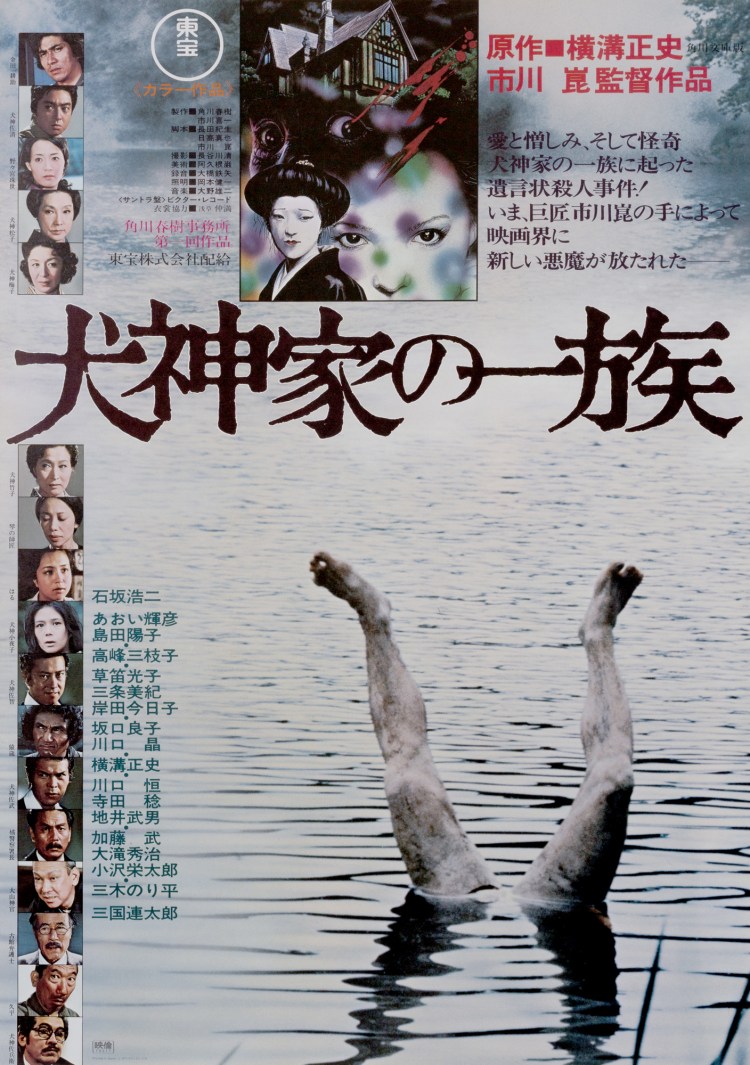
the inugami family 1976 posterUnlike many of his contemporaries, Kon Ichikawa was able to go on working through the turbulent ‘70s and ‘80s because he was willing to take on purely commercial projects. The phenomenal and hugely unexpected success of 1976’s The Inugami Family (犬神家の一族, Inugami-ke no Ichizoku) set him in good stead for the rest of the decade during which he followed up with another four movies starring Koji Ishizaka as the eccentric detective Kosuke Kindaichi as featured in the novels of Seishi Yokomizo each of which was a bonafide box office success partially thanks to the effect of Haruki Kadokawa’s intensive multimedia marketing strategy then still in its infancy. In fact, Ichikawa would return to the sordid world of the Inugamis for his final picture in which he dared to remake his “greatest hit” with a now much older Koji Ishizaka reprising his role exactly 30 years later. Ichikawa might have been making “commercial” movies, but he never lost his experimental spirit.

Old Sahei Inugami (Rentaro Mikuni) finally drops dead in 1947 after a lifetime of seemingly doing exactly as he pleased. As a 17-year-old orphan he was taken in by a kindly priest and thereafter founded one of the biggest pharmaceuticals companies in Japan which is to say he leaves behind him a vast estate and desirable name. Unfortunately, he also leaves a messy family situation. Sahei was never legally married, but fathered three daughters with three different women who each have a son. In his 50s, he also fathered a son with his maid who would be about the same age as the grandchildren if anyone knew where he was. Sahei’s will, which in dramatic fashion can only be read with everyone present, leaves everything to a young woman, Tamayo (Yoko Shimada), who isn’t even part of the family but was doted on all the same by the elderly patriarch. In order to inherit, Tamayo must consent to marry one of the three grandsons – Suketake (Takeo Chii), Suketomo (Hisashi Kawaguchi), or Sukekiyo (Teruhiko Aoi) with whom she seems to have shared a past attachment. The will stresses that she is free to choose though if she decides to marry someone else entirely, the fortune will be divided in five with one part each to the grandsons and the rest to the maid’s son. As one can imagine, the daughters are furious.

Kindaichi is called in by a clerk (Hajime Nishio) at the solicitor’s office who has seen the will and finds it all decidedly strange (plus he’s in love with Tamayo so it’s very bad news for him). The clerk gets murdered before he can spill the beans, but the solicitor himself, Furudate (Eitaro Ozawa), decides to enlist Kindaichi’s help in figuring all of this out before it claims any more lives. Unfortunately, claim more lives it will.

Greed, as ever, is at the root of all evil but like the other entries in the Kindaichi series the crimes are largely a result of the world which surrounds them. Old Sahei made his money in some dubious ways. Ingratiating himself with the rich and powerful, later becoming a militarist for what seems like opportunistic reasons, he got himself special dispensation to grow poppies for their medicinal properties. Which is to say, he got rich selling opium to the masses. Inugami pharmaceuticals profited hugely from suffering incurred in wars spanning the century – with Russia, with China, through the first world war and the second. There was Inugami, ready to fuel the fire by numbing the pain.

Yet it’s his own unresolved emotional suffering that seems to have sent him such a dark and amoral path. Later we discover that a strange and emotionally difficult set of circumstances involving a quasi-incestuous, bisexual love triangle seem to have left him craving something to numb his own pain but only succeeding in passing it on to those around him. Firstly through the women he kept around to satisfy his carnal desires and then sent away, keeping the children with him but in a loveless, austere home. The sisters – Matsuko (Mieko Takamine), Takeko (Miki Sanjo), and Umeko (Mitsuko Kusabue) share an uneasy sort of camaraderie but are quick to turn on each other when it becomes clear that only one of them will inherit the family fortune and that they are now each rivals for the hand of Tamayo.

Like their grandfather, the Inugami boys are not an especially good catch. Two of them eventually attempt to rape Tamayo in an attempt to force her into marriage through shame (despite the fact that one has already fathered a child with his cousin), while she also has her doubts that Sukekiyo, with whom she has always felt a connection, is really who he says he is. Having gone away to the war, Sukekiyo did not return home after being demobbed because of intense survivor’s guilt. He also sustained severe burns to his face which require him to wear a latex mask over his entire head making positive identification difficult seeing as his voice, which he rarely uses, is also changed.

Rather than submit himself to the necessarily pokerfaced approach common to prestige murder mysteries from across the globe, Ichikawa uses the saleability of the property as an excuse to go all out. His tone varies wildly, almost to the point of parody in his frequent cuts to Kindaichi causing another of his famous anxiety induced dandruff avalanches. The blood eventually flies as do severed heads while upended corpses do handstands in lakes. The story of the Inugami family is a strange one filled with moments of bizarre whimsy but somehow it all works. As in many a Japanese mystery, the past refuses to die and the guilty eventually realise how misguided their enterprise has been, but there is hope for those left behind if they can free themselves from the cycle of guilt and suffering on which the Inugami name was built.


Original trailer (no subtitles)

The Man Who Stole the Sun (太陽を盗んだ男, Kazuhiko Hasegawa, 1979)

(C) Toho 1979

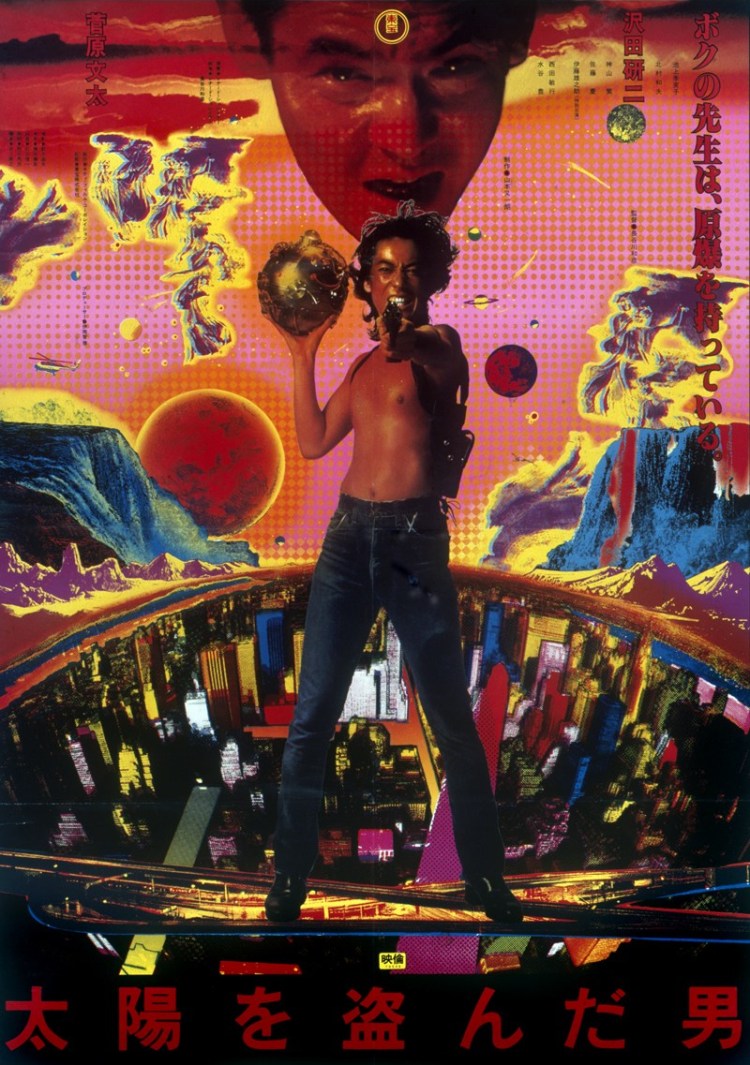
man who stole the sun posterIn the post-Asama-Sanso world, Japanese society had shifted into period of intense calm in which improving economic prosperity was in the process of delivering comfort rather than the creeping acquisitive anxiousness that began to overshadow the bubble era. Nevertheless, in cinematic terms at least anxiety was everywhere and not least among the young who, swept along by this irresistible economic current, were quietly doubtful about their place in a changing society. Co-scripted by an American screenwriter, Leonard Schrader (brother of Taxi Driver’s Paul), The Man Who Stole the Sun (太陽を盗んだ男, Taiyo wo Nusunda Otoko) provides a satirical snapshot of this confusing moment as an oppressed, belittled high school science teacher builds an atomic bomb in his apartment just to show he can but then realises he has absolutely no idea what to do with it.

Technically speaking, the science teacher’s name is Makoto Kido (Kenji Sawada) but no one really calls him that. The kids at school refer to him as “Bubble-gum” because he always seems to be chewing on the rather childish confectionary. Not the most conscientious of teachers, he tailors the curriculum to his own interests, teaching the kids all about atomic energy and the bomb, but the kids aren’t interested. They only want to know what’s going to be on the test. To them Kido’s information is irrelevant and so they ignore him, talking amongst themselves while he carries on, preaching to a seemingly empty room.

Meanwhile, Kido is building the bomb at home, for real. As he tells the kids, anyone can build an atomic bomb – you only need the plutonium which is, admittedly, tightly controlled for just this reason. He acquires his through a daring heist on a nuclear plant. Kido never elaborates on what prompted him to begin his bizarre masterplan, but there is certainly a degree of pent up rage inside him born of resentment with his reduced circumstances. “Just” a high school science teacher, who would really think he’d have the capability to build an atomic bomb, alone, using only household equipment (plus the plutonium and a custom furnace purchased after nearly exploding his oven)?

Kido’s problems are the same as many middle-aged men in ‘70s Japan in that he feels intensely oppressed from above and below. What he’s trying to tell the kids is that they have access to this power already – anyone can build a bomb, if you bother to learn how. The only thing that’s being kept from him is the plutonium (and for good reason), which he manages to acquire anyway. A chance encounter with the madness of the age seems to kickstart his plan into gear when he meets his opposing number in police inspector Yamashita (Bunta Sugawara).

Kido, having halfheartedly escorted a group of students on a school trip, finds himself rendered powerless once again when the bus is hijacked by a distressed older gentleman (Yunosuke Ito) armed with a rifle and grenade and wearing a World War II soldier’s uniform. He demands to be driven to see the emperor from whom he intends to demand the return of his son, presumably killed in the war 30 years earlier. Yamashita, clean cut and authoritative, is the gung-ho cop who masterfully brings the hostage crisis to a close by lying to the man that the emperor has consented to see him. During the evacuation the old man is killed by police snipers (despite Yamashita’s too late cries of “don’t shoot” after having dispatched the grenade and disarmed the suspect).

Like Kido, the old man likely didn’t really know what he intended to do, only that he was lonely and desperate. The emperor couldn’t give him back his son (whose uniform he seems to be wearing) and his gesture is one of futile defiance coupled with a suicide bid that has no real goal save making an elaborate protest against the world in which he lives. Kido makes the bomb, lets the authorities know he has it, but then realises he has no demands. He asks them to fix something minor that annoys him, to stop the TV networks pulling the plug on late running baseball games to make way for the news, and finds himself rewarded. He has taken back the power, they believe he has the bomb and they fear him, but he has no further goals or notion of how his society should change. There is no idealised future he is fighting for, all there is is futility and indifference.

Meanwhile, ironically enough, Kido’s desperation provokes a mini revolution in others. A talkshow radio host (Kimiko Ikegami) named “Zero” (in contrast to Kido’s adoption of the codename “No. 9” as the 9th owner of a nuclear device and the only individual), broadcasts his on-air request for ideas, believing it to be a kind of thought experiment. The ideas she gets from the public are of the usual kind – lonely men who want to bathe with naked women, nationalists who want to start a war with America, dreamers who think it might be better not to want anything and just embrace the dream, while she muses that she wants the Rolling Stones concert that was cancelled a few years ago after a band member’s narcotics conviction to be reinstated. That being as good as anything is what Kido goes for in an overture that passes as an odd kind of romance and a suitably ironic kick back against strait-laced authority.

Kido’s war is, in a sense, a war with the fathers of the world as symbolised by men like Yamashita with their suits and neatly trimmed haircuts. Their button-down existence has never offered anything to men like Kido who feel trapped and angry within it. Yet Yamashita is also reacting against his own generation of fathers as symbolised by the old man on the bus, the last remnant of wartime resistance offering a defeated cry against a world which got away from them. Yamashita let the old man die when he prioritised his own sense of heroism, and that annoyed Kido. He can’t help sympathising with his plight which is in a way also his own in being relentlessly silenced and ignored by austere authority figures.

Turning down Yamashita’s clumsy attempt at a pickup, Zero affirms that Kido has given her a dream, which no small thing and she feels bound to him because of it. It’s an ironic statement because Kido has no dreams and not only that, he has no future either – he is slowly dying of radiation poisoning despite his precautions during the building of the bomb. In their final confrontation, Yamashita, adopting a paternal authority, neatly summarises Kido’s dilemma. The only life he has the right to take is his own, and his own death is the only thing he really wants, but he’s embarked on this elaborate plan to make his presence felt all the while aware that he will remain totally anonymous. No one will ever see him. He will die, like thousands of others, faceless. A lowly high school science teacher, no terrorist mastermind or bomb building genius. His revenge is as absurd as it is futile. Male inferiority complexes threaten to drown us all in a sea of violent resentment, and as the Earth dies screaming all we will have to reflect on is that we ourselves brought this world into being through our own incurable apathy.


Original trailer (no subtitles)

Floating Clouds (浮雲, Mikio Naruse, 1955)

(C) 1955 Toho

floating clouds poster“The past is our only reality” the melancholy Yukiko (Hideko Takamine) intones, only to be told that her past was but a dream and now she is awake. Adapted from a novel by Fumiko Hayashi – a writer whose work proved a frequent inspiration for director Mikio Naruse, Floating Clouds (浮雲, Ukigumo) is a story of the post-war era as its central pair of lovers find themselves caught in a moment of cultural confusion, unsure of how to move forward and unable to leave the traumatic past behind.

We begin with defeat. Shifting from stock footage featuring returnees from Indochina, Naruse’s camera picks out the weary figure of a young woman, Yukiko, drawing her government issue jacket around her. She eventually arrives in the city and at the home of an older man, Kengo (Masayuki Mori), whom we later find out had been her lover when they were both stationed overseas working for the forestry commission but has now returned “home” to his family. Kengo had promised to divorce his wife, Kuniko (Chieko Nakakita), in order to marry Yukiko but now declares their romance one of many casualties of war. With only the brother-in-law who once raped her left of her family, Yukiko has nowhere left to turn, eventually becoming the mistress of an American soldier but despite his earlier declarations the increasingly desperate Kengo cannot bear to let her go and their on again off again affair continues much to Yukiko’s constant suffering.

Floating Clouds is as much about the post-war world as it is about a doomed love affair (if indeed love is really what it is). Kengo and Yukiko are the floating clouds of the title, unable to settle in the chaos of defeat where there is no clear foothold to forge a path into the future, no clear direction in which to head, and no clear sign that the future itself is even a possibility. Naruse begins with the painful present marked by crushing defeat and hopelessness, flashing back to the brighter, warmer forests of Indochina to show us the lovers as they had been in a more “innocent” world. At 22, Yukiko smiles brightly and walks tall with a lightness in her step. She went to Indochina in the middle of a war to escape violence at home and, working in the peaceful environment of the forestry commission, begins to find a kind of serenity even whilst dragged into an ill-advised affair with a moody older man more out of loneliness than lust.

Yet, Yukiko’s troubles started long before the war. Assaulted by her brother-in-law she escapes Japan but falls straight into the arms of Kengo who is thought a good, trustworthy man but proves to be anything but. Kengo, frustrated and broken, attempts to lose himself through intense yet temporary relationships with younger women. Every woman he becomes involved with throughout the course of the film comes to a bad end – his wife, Kuniko, dies of tuberculosis while Kengo was unable to pay for treatment which might perhaps have saved her, an inn keeper’s wife he has a brief fling with is eventually murdered by a jealous husband (a guilty Kengo later attempts to raise money for a better lawyer to defend him), Yukiko’s life is more or less destroyed, and goodness only knows what will happen to a very young errand runner for the local bar whom he apparently kissed in a drunken moment of passion.

The lovers remain trapped by the past, even if Kengo repeatedly insists that one cannot live on memory and that their love died in Dalat where perhaps they should have remained. Yukiko’s tragedy is that she had nothing else than her love for Kengo to cling to, while Kengo’s is that he consistently tries to negate the past rather than accept it, craving the purity of memory over an attainable reality, chasing that same sense of possibility in new and younger lovers but once again squandering each opportunity for happiness through intense self obsession. “Things can’t be the same after a war”, intones Kengo as an excuse for his continued callousness, but they find themselves retreating into the past anyway, taking off for tropical, rainy Yakushima which might not be so different from the Indochina of their memories but the past is not somewhere one can easily return and there can be only tragedy for those who cannot let go of an idealised history in order to move forward into a new and uncertain world.


After the Rain (恋は雨上がりのように, Akira Nagai, 2018)

KoiAme_teaser_B5_F_outAdolescence is a difficult time for all, a period of waiting, in a sense, for the rain to end and everything to make the kind of sense you’ve been led to believe life is supposed to make only to finally see that the thing about life is there is no sense to be made of it. After the Rain (恋は雨上がりのように, Koi wa Ameagari no yo ni), adapted from the popular manga by Jun Mayuzuki, is touted as an admittedly creepy age gap romance between a confused teen and a melancholy middle-aged man but thankfully arrives at something more thoughtful and less problematic in its philosophical look at self-imposed inertia seen through the lenses of age and youth.

High school girl Akira (Nana Komatsu) loves nothing more than running but her record-breaking track career was brought to an abrupt halt by a ruptured achilles tendon. Having given up on her athletic dreams, she now spends her “free” time on a part-time job in a diner-style “family restaurant”. Unbeknownst to all, the reason Akira took the job was that the restaurant’s manager, 45-year-old divorced father Kondo (Yo Oizumi), was once nice to her after her accident and now she’s developed an almighty crush on his mild-mannered charms.

While Akira is processing the loss of her future as a top runner, Kondo is trying to get over not only the failure of his marriage but of his own dreams of literary success. Jealous of a college friend with a bestseller, Kondo has barely written anything in years and has all but resigned himself to a lifetime of managing a low-level chain restaurant in suburbia.

Kondo, for all his faults, is essentially a good guy whose major problem in life is being too nice. Needless to say, he’s not enthused by Akira’s surprise declaration of love and understands that it could cause him a lot of trouble but even so he wants to help her get over whatever it is that makes her think an affair with an older guy might be a good idea. Realising that her misplaced crush is most likely a displacement activity born of her grief for her racing career, Kondo sets about trying to coax Akira back towards something more positive than unwise romance through genial paternal attention even if she finds his attempts to make clear that he is only prepared to offer friendly support somewhat frustrating.

Akira’s problems are perhaps greater than they first seem. A strange girl with underdeveloped social skills and a relatively low need for interpersonal interaction, Akira has few friends and a habit of accidentally glaring at everyone she meets (which is not an ideal quality for a diner waitress). She is however very beautiful which also earns her a heap of unwanted attention precisely because of her angry aloofness. Neither of the boys her own age who declare an interest are very promising – both of them are unwilling to take a flat no for an answer and continue to chase Akira even though she consistently ignores them, though sous-chef Kase (Hayato Isomura) is at least a little more perceptive than he originally seems and finally able to offer some impartial advice to the confused young woman once he’s realised that his attentions really are unwanted.

Unwilling to engage with anything that reminds her of what she’s lost, Akira has been avoiding all her old friends. Haruka (Nana Seino), who has been chasing along behind desperate to catch up ever since they were kids, is as broken-hearted about their ruptured friendship as Akira is about running and longs to repair what was broken if only to prove that there’s more between them than just sports. Originally worried about Akira’s interest in Kondo she relaxes when she realises that he, like her, just wants to help Akira escape her moment of wounded inertia.

As Kondo puts, it’s boring waiting for the rain to stop. Like the heroes of Rashomon which becomes a repeated motif, Akira and Kondo are essentially just marking time waiting to be released from a self-imposed sense of frustrated impossibility. Kondo needed a dose of self-confidence which the decision to help a depressed high school girl who seems to be the only person who doesn’t find him pathetic just might offer, while Akira needs to realise that her life isn’t over and that she may have been too hasty in abandoning her dreams over what could be nothing more than a minor setback. Through their awkward non-romance the pair each rediscover something about themselves that they’d forgotten along with the courage to face their painful failures head on rather than attempting hide and living on in melancholy resentment.

Thankfully not the creepy age gap romance the synopsis teases, Nagai’s adaptation perhaps fails to mine the unexpectedly rich philosophical seam of Mayuzuki’s manga to its fullest extent in its powerful confrontation of age and youth sheltering from the storm of disappointment, but nevertheless presents an oddly warm tale of serendipitous friendships and mutual support as two frustrated people at different points of life each find the courage to move forward through helping someone else do the same.


Original trailer (no subtitles)

The Lies She Loved (嘘を愛する女, Kazuhito Nakae, 2018)

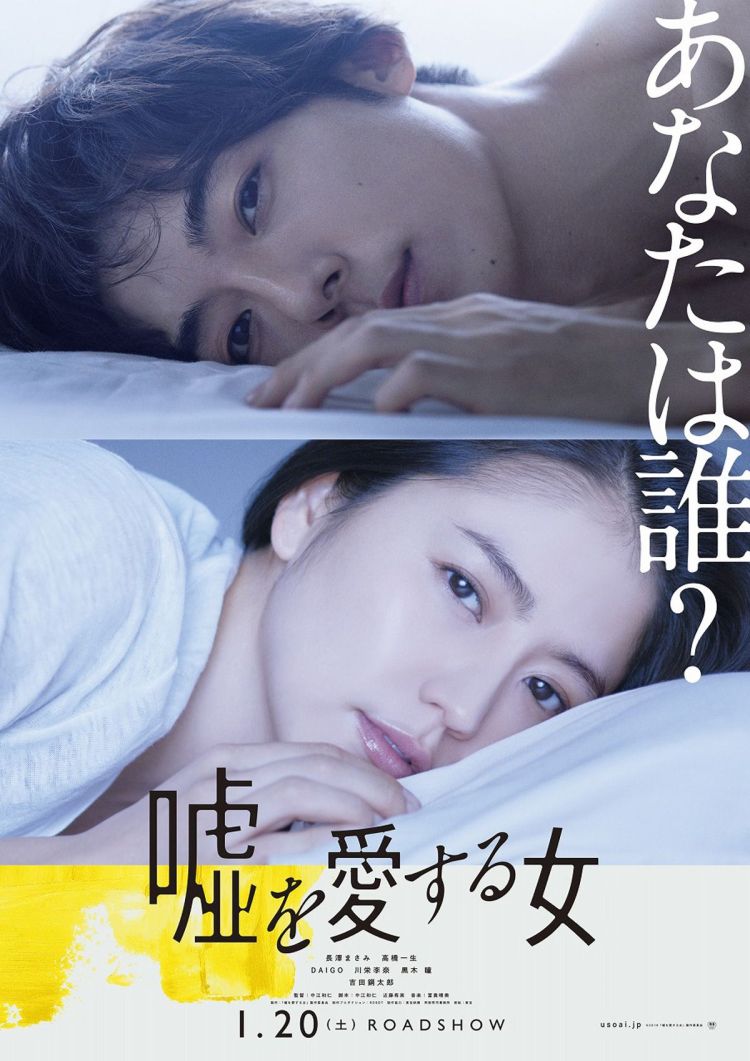
lies she loved posterHow well do you really know the people with whom you share your life? Or, perhaps, how honest have you really been with those closest you? Inspired by a notorious newspaper article, The Lies She Loved (嘘を愛する女, Uso wo Aisuru Onna) has a few hard questions to ask about the nature of modern relationships and the secrets which often lie at their hearts. Yet the message is perhaps that there are different kinds of truths and the literal may be among the least important of them. The salient message is that consideration for the feelings of others and a willingness to share the burden of being alive are the only real paths towards a fulfilling existence.
30-something Yukari (Masami Nagasawa) is a workaholic career woman currently at the top of her corporate game. Unmarried, she’s been living with impoverished medical researcher Kippei (Issey Takahashi) for the last five years and is happy enough with him (save the occasional one night stand) but also feels as if there’s something missing. She’s angry when he doesn’t show up to a pre-arranged dinner where he’s supposed to meet her mum, leaving her to deal with her mother’s disapproving scorn all alone, but chastened when it’s revealed he was found collapsed in a local park and is currently in the hospital after suffering a brain haemorrhage. If that weren’t enough chaos for the hyper organised Yukari, the police tell her Kippei’s ID is fake. He doesn’t work where he said he said worked and no one seems to have heard of him. Remembering a conversation about cheating spouses, Yukari turns to the detective uncle (Daigo) of one of her work friends for help but starts to wonder what sort of answers it is that she’s really looking for.

An intriguing mystery, The Lies She Loved begins in worrying fashion as if it wants to punish Yukari for her obsessive workaholic lifestyle and avoidance of the traditionally feminine roles of wife and mother. The couple aren’t married, but Kippei is for all intents and purposes a kept man and house husband. He doesn’t earn enough to contribute to the household economy, but makes up for it by handling the domestic tasks usually the domain of a “wife”, i.e. cooking and cleaning. Meanwhile, Yukari works insane hours and often stays out drinking with colleagues, claiming this valuable out of hours time as part of the job but sometimes spending it with other men. We see her “lie” to Kippei, telling him a large bouquet of snacks won from an amusement stand was a gift from a female friend when it came from a “date”, while he reproves her with coldness for her excessive drinking and the tendency it provokes in her for unsolicited cruelty.

Yet moving on we see that a woman’s career, or man’s lack of one, is not the issue at all. The issue is neglect, a taking for granted of other people’s feelings and their willingness to provide support and affection while getting nothing in return. Rather than going to work, Kippei had been spending time in a coffeeshop writing something that’s somewhere between novel and therapy about a happy family living on an idyllic island. We discover that he too once took something for granted, became wrapped up in his career, and overburdened someone else by allowing them to take on the entirety of their mutual responsibility with tragic consequences. Filled with remorse, he ran away from his crime and tried to forget.

The crime is not a woman working, but people in general working too much and knowing each other too little. Humiliated, Yukari wants answers about her immediate past, wanting to know if she was tricked by a conman in order to avoid facing the fact that she never really bothered to ask many questions about the man she invited into her home. Indeed, her decision to “invite” him in the first place is not altogether altruistic and cannot help giving off the scent of mild desperation as she tries to make the arrangement seem convenient while ensuring she retains the upper-hand in the power dynamics without giving too much away. What she really wants to know, without really wanting to admit it, is if her lover really loved her despite his “lies”, but to know that she’ll have to deal with her own longstanding intimacy issues and accept that a loving home is a balanced one in which both partners are equal and agree to share their burdens with openness and generosity. A progressive, nuanced look at modern romance The Lies She Loved is a surprisingly effective defence of love and a mild rebuke of the society which does its best to undermine it.


Original trailer (no subtitles)

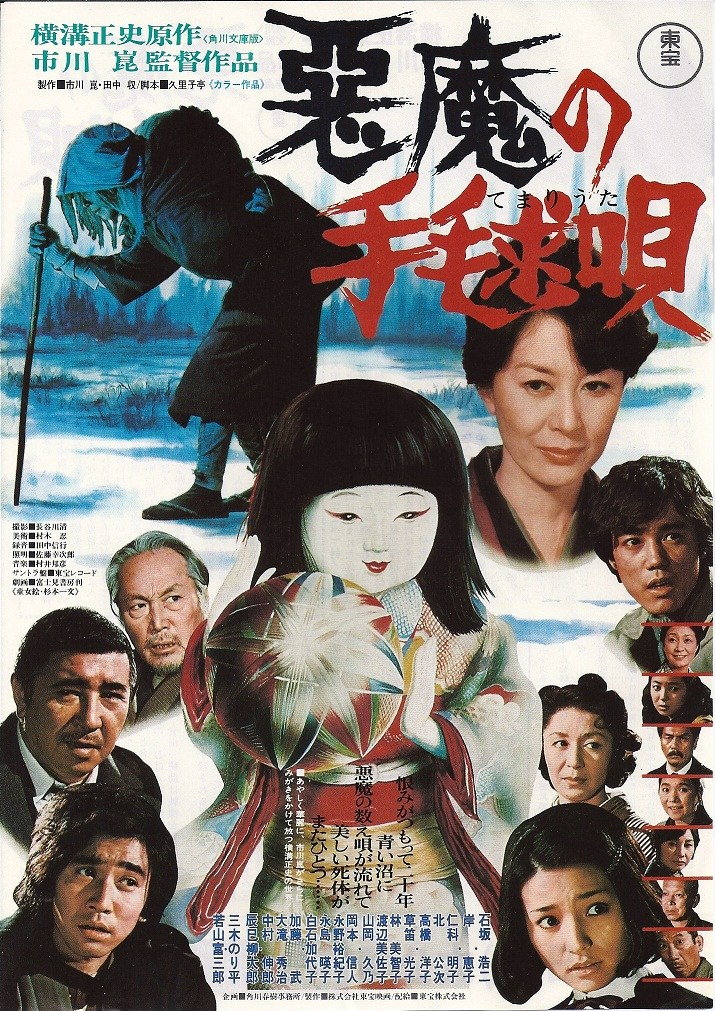
The Devil’s Ballad (悪魔の手毬唄, Kon Ichikawa, 1977)

Devil's Ballad posterA year after his box office smash The Inugami Family, Kon Ichikawa returns to the world of eccentric detective Kosuke Kindaichi with The Devil’s Ballad (悪魔の手毬唄, Akuma no Temari Uta). Like many a Kindaichi mystery, Devil’s Ballad finds him called upon to delve back into the past to satisfy an ageing detective’s anxiety about an old case, only to be faced with a series of new ones as a consequence. This time, however, the mystery leans less on buried secrets than deeply held grudges, betrayals, and lingering feudal feuds as the post-war society tries and fails to free itself from ancient oppressions.

The film opens with a tryst between two adolescent lovers in the ominously named “Devil’s Skull Village” in 1950. Yasu (Yoko Takahashi), the girl, is at pains to let her boyfriend, Kanao (Koji Kita), know that she is keen to take the relationship to the next level but he is old fashioned and wants to wait until their union is formalised. The pair are interrupted by some of their friends who are in the middle of planning a celebration for a visit from a girl who moved to the city, Chie (Akiko Nishina). Meanwhile, Kindaichi (Koji Ishizaka) has arrived at the inn owned by Kanao’s mother Rika (Keiko Kishi) on invitation from a retired policeman, Isokawa (Tomisaburo Wakayama), who wants Kindaichi to look into the murder of Rika’s husband twenty years ago. Isokawa, then a young rookie, is convinced that Rika’s husband was not the victim but the murderer and the corpse actually belonged to another man entirely – Onda, a drifter who defrauded half the village with a wreath making scam.

Rika and her children – 20-year-old Kanao and his younger sister Satoko (Eiko Nagashima) who has prominent facial birthmarks and rarely leaves the house, came to the village with her husband and are therefore slightly divorced from the longstanding social rivalries. The village has two noble families – the Yuras and the Nires. Feeling the need to modernise, the Nires bet everything on vineyards and it paid off. The Yuras, by contrast, were defrauded by Onda’s wreath scam and lost their fortune and social standing. Yasu, Kanao’s girlfriend, is a daughter of the Yuras, but the Nire’s have been petitioning Rika for quite some time to have her son marry their daughter, Fumiko (Yukiko Nagano), who also has a crush on him (though this is largely irrelevant to her father’s dynastic ambitions). When the younger generation start getting bumped off in ways eerily similar to a local folk song, Kindaichi and Isokawa are on the case, wondering if these new murders have anything to do with their old one.

Despite its 1950 setting, Devil’s Ballad is unusual in resolutely making an irrelevance of the war which only receives a brief mention as an explanation for why some of the case files have been destroyed and for why marriage is such a hot button issue given the lack of men and abundance of women. Nevertheless, the crimes span a turbulent 20 years of Japanese history with the original murder taking place in the early ‘30s during a period of economic instability following the Manchurian Incident. In the socially conservative pre-war era, it seems Onda also got around and may have fathered several illegitimate children with women in the village, some of them noble, some not. These buried secrets seem primed to bubble to the surface now that the children are coming of age and marriage again becomes an issue as worried parents try to think of acceptable ways to block potentially “inappropriate” matches without sending their children off into ruinous elopements or tipping off the wrong people that their kids may not be their kids.

The crimes themselves, old fashioned as they are, are partly reactions to a changing society. We discover that the reason Rika and her husband were forced to come back to the village was that their showbiz careers were stalling – she was a vaudeville performer specialising in shamisen, and he a “benshi” (narrator of silent films) who became convinced his job was obsolete after witnessing a subtitled print of Morocco. Likewise, the two rival families cannot let go of their petty provincial privileges, and as Kanao angrily snaps back at his mother, Japan is now a democratic country and he is free to choose his own wife at a time of his own choosing with or without parental blessing. This remote village is perhaps isolated from the privations of the post-war world but it’s also stuck in the past, hung up on past transgressions and unable to move forward into the new era. However, the primary motivations for murder are as old as time – guilt, humiliation, and self preservation.

Ichikawa keeps things simple but splices in a few strange, avant-garde sequences of kokeshi dolls menacingly bouncing balls coupled with shifts to black and white, fast-paced reaction shots, and stuttering still frame sequences all while Kindaichi showers innocent passersby with his famous dandruff, the idiot police officer continues to offer ridiculous theories while his sergeant dutifully follows him around, and the local bobby perfects a line in hilarious pratfalls. Overlong at two and a half hours and falling prey to the curse of the prestige crime drama in spoiling its mystery through casting, the Devil’s Ballad may not be the best of the Kindaichi mysteries but offers enough of a satisfying twist to prove worthy of the Kindaichi name.


Original trailer (no subtitles)

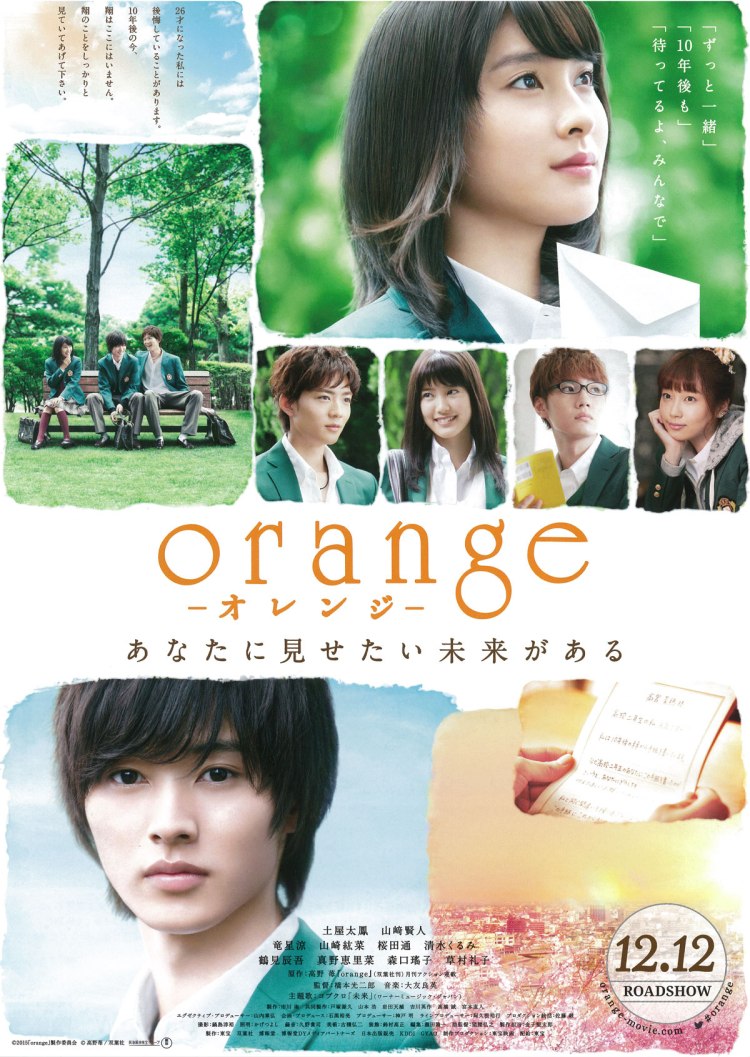
Orange (orange-オレンジ, Kojiro Hashimoto, 2015)

Orange posterPerhaps it isn’t possible (or even desirable) to live a life without regrets, but given the opportunity who wouldn’t want a second chance to tackle some of those thorny adolescent moments where you said something you shouldn’t have or didn’t say something that perhaps should have been said. The heroine of Kojiro Hashimoto’s Orange (orange-オレンジ) gets exactly this opportunity when she receives a letter from her future self asking for her help in “erasing” some of her teenage regrets by using the information in the letter to save a friend she hasn’t yet met. Though the letter contains little information about the life she is leading ten years from now, it is clear that something happened all those years ago which has profoundly affected the lives of a tight group of high school friends.

16-year-old Naho (Tao Tsuchiya) receives the letter at the beginning of her second year of high school, reading it under the vibrant pink cherry blossoms. A little creeped out, she doesn’t read it fully but is surprised when, just as the letter said, a new student, Kakeru (Kento Yamazaki), transfers into her class and occupies the previously empty desk next to hers. A shy and quiet girl Naho is nevertheless part of a group of five friends which includes sportsman Suwa (Ryo Ryusei), geek Hagita (Dori Sakurada), and two other girls Takako (Hirona Yamazaki) and Azusa (Kurumi Shimizu). For reasons unexplained, the group quickly takes Kakeru into their fold only for him to suddenly disappear for a couple of weeks. On closer inspection of the letter, Naho is disturbed by the news that Kakeru is “no longer around” at the time of her future self’s writing.

Orange fits neatly into the popular tragic high school romance genre in which an older version of the protagonist looks back on a traumatic event and tries to come to terms with their own action or inaction in order to move forward with their adult lives. 26-year-old Naho, as we quickly find out, has moved on – she is married to Suwa and has a young son she has named Kakeru but she and the others are still finding it difficult to come to terms with what happened to their friend and the possibility that they could have done something more to help him if they’d only known then what they know now.

So far so “junai”, but Orange tries to have things both ways by introducing a slightly clumsy time travel/parallel universe theory in which the protagonists realise that they won’t be able to change the past but are hoping that their friend is happy in an alternate timeline created by their efforts to influence their younger selves with more mature thinking coupled with the benefit of hindsight. Unlike other examples of the genre, Orange undercuts the usual need to deal with the past and find closure through a mild fantasy of denial in which the older protagonists can believe in an alternate future in which they were able to do things differently and save their friend from his unhappy destiny.

Saving their friend is, however, only a secondary goal – the first being to ease their own sense of guilt in not having seen that Kakeru was in trouble and needed their help. All this emphasis on personal “regret” cannot help but seem somewhat solipsistic – everyone is very sorry about what happened in the past and wishes that they could have acted differently but is also somewhat preoccupied with their own role in events rather than a true desire to have in someway eased their friend’s suffering. Though there is the true selflessness of real, grown up love such as that displayed by Suwa who has always loved Naho but supports her love of Kakeru despite his own feelings, the actions of the group remain childishly goal orientated as Kakeru’s survival becomes an end mission flag rather than an expression of love and care for a friend in trouble.

The teenagers are, despite advice from their older selves, still teenagers and so it is only to be expected that they respond to a very grown up problem with a degree of immaturity, but it is also true that Kakeru’s ongoing, mostly well hidden, depression plays second fiddle to the various romantic subplots currently in action. Though the friends rally round with fairly trite phrases about helping to carry Kakeru’s burden and always being there him, Orange almost tries to argue that kind words are enough to pull a strained mind back from the brink – not that kind words ever hurt, but some problems are bigger than superficial pledges of friendship can handle especially when you’ve half a mind on who loves who and who is trying to get in the way of someone else’s romantic destiny. In spending so much time worrying about their friend, they have, in a sense, left him to deal with all his problems on his own while revelling in their own “concern”.

Superficial and melodramatic, Orange’s insistence on the power of teenage friendship can’t help but ring a little false and the parallel universe solution an overly convenient narrative device which allows for two differing resolutions both of which essentially frustrate the attempts of the older protagonists to accept their own sense of guilt and responsibility for their friend’s death in order to move on with their lives. Kakeru, in a sense, gets forgotten in his friends’ need to absolve themselves of his fate – a particularly ironic development in a cautionary tale about the enduring legacy of regret and the necessity of communicating one’s true feelings fully in the knowledge that there may not always be another opportunity to do so.


Original trailer (no subtitles)

Ironfinger (100発100中, Jun Fukuda, 1965)

Ironfinger posterBy 1965, Japan was back on the international map as the host of the last Olympics. The world was opening up, but the gleefully surreal universe of Toho spy movies isn’t convinced that’s an entirely good thing. Jun Fukuda had begun his career at Toho working on more “serious“ fare but throughout the 1960s began to lean towards comedy of the absurd, slapstick variety. 1965’s Ironfinger (100発100中, Hyappatsu Hyakuchu) boasts a script by Kihachi Okamoto – Okamoto might be best remembered for his artier pieces but even these are underpinned by his noticeably surreal sense of humour and Ironfinger is certainly filled with the director’s cheerful sense of cartoonish fun with its colourful smoke bombs, cigarette lighters filled with cyanide gas, and zany mid-air rescues. The English title is, obviously, a James Bond reference (the Japanese title is the relatively more typical “100 shots, 100 Kills”) and the film would also get a 1968 sequel which added the spytastic “Golden Eye” (though it would be given a more salacious title, Booted Babe, Busted Boss, for export). Strangely the unlikely villains this time around are the French as Tokyo finds itself at the centre of an international arms smuggling conspiracy unwittingly uncovered by a “bumbling vacationer”.

We first meet our hero as he’s writing a postcard to his mum in which he details his excitement in thinking that he’s made a friend of the nice Japanese man in the next seat seeing as he’s finally stopped ignoring him. When they land in Hong Kong, our guy keeps shadowing his “friend” until he decides to ask him about “Le Bois” to which his “friend” seems surprised but is gunned down by bike riding assassins before he can answer though he manages to get out the word “Tokyo” before breathing his last. Picking up his friend’s passport and swanky hat, our guy becomes “Andrew Hoshino” (Akira Takarada) – a “third generation Japanese Frenchman” and “possibly” a member of Interpol.

The bumbling “Andy”, who can’t stop talking about his mother and is very particular about his hat (for reasons which will become clear), is obviously not all he seems. Despite his penchant for pratfalls and cheeky dialogue, he also seems to be a crack shot with a pistol and have an ability to talk himself out of almost any situation – at least with the aid of his various spy gadgets including his beloved cigarette lighter and a knife concealed in his wristwatch for cutting himself free should he get tied up. Andy “said” he was just here on holiday, but are all those postcards really for his dear old mum waiting for him in Paris or could they have another purpose? Why is he so keen on finding out about “Le Bois” and why does he always seem to end up at the centre of the action?

These are all questions which occur to one of his early antagonists – Yumi (Mie Hama), the ace explosives expert who often feels under-appreciated in the otherwise all male Akatsuki gang. Apprehending Andy, Yumi originally falls for his bumbling charm only to quickly see through his act and realise she might be better hedging her bets with him – hence she finally teams up with Andy and straight laced streetcop Tezuka (Ichiro Arishima) who’s been trying to keep a lid on the growing gang violence between the Aonuma who now run the town and the Akatsuki who want to regain control. Andy doesn’t much care about sides in a silly territorial dispute, but it might all prove helpful in his overall mission which is, it turns out, very much in keeping both with that of the gang-affiliated Yumi and law enforcement officer Tezuka.

There isn’t much substance in Ironfinger, but then there isn’t particularly intended to be. There is however a mild degree of international anxiety as our heroes become, in a sense, corrupted by French sophistication whilst “relying” on “Interpol” to solve all their problems (“Interpol” is frequent presence in Toho’s ‘60s spoofs providing a somewhat distant frontline defence against international spy conspiracies). Fukuda keeps things moving to mask the relative absence of plot as the guys get themselves into ever more extreme scrapes before facing certain death on a mysterious island only to save themselves through a series of silly boys own schemes to outwit their captors. Perhaps not as much fun or not quite as interesting as some of Toho’s other humorous ‘60s fare, Ironfinger is nevertheless a good old fashioned espionage comedy filled with zany humour and a cartoonish sense of the absurd.


Akira Takarada shows off his French