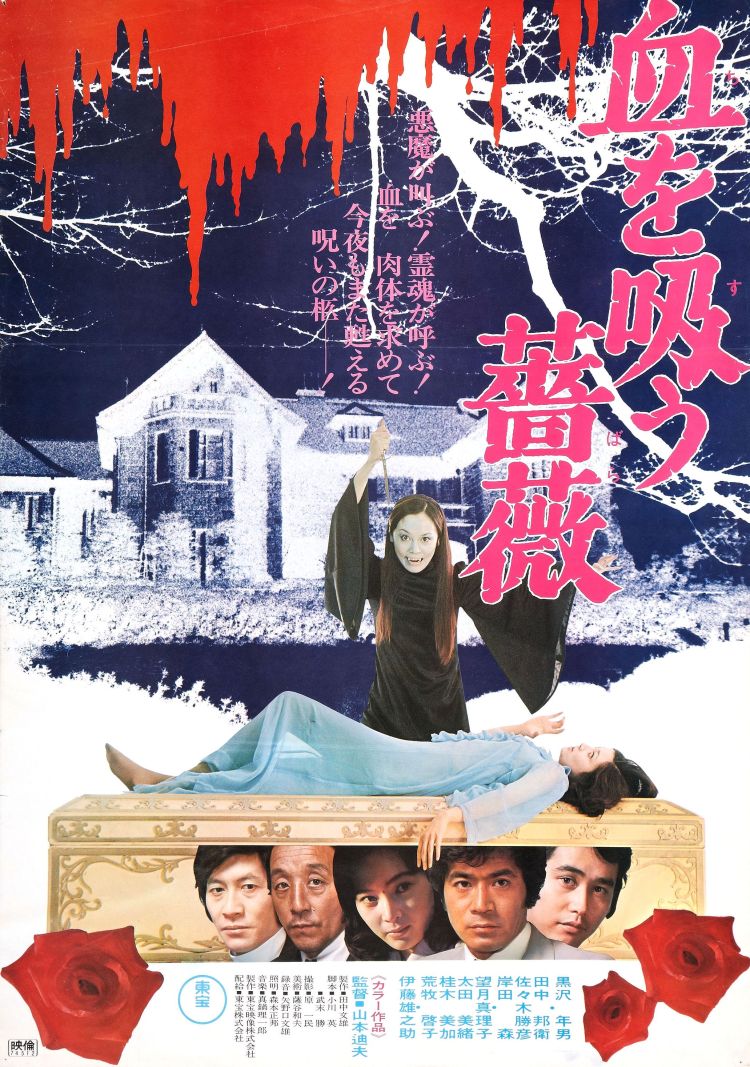
Evil of Dracula (血を吸う薔薇, Michio Yamamoto, 1974)

Evil of Dracula posterThe first two of Michio Yamamoto’s “vampire” movies for Toho made a valiant attempt to repurpose the idea of the bloodsucking ghoul to explore something other than their usual reason for being. In The Vampire Doll, the vampiress at the centre was a knife wilding, grudge bearing ghost of vengeance in keeping with the familiar image from Japanese folklore. In Lake of Dracula, Dracula was (uncomfortably) a bearer of bad blood and a symbol of the destructive capabilities of a repressed memory. Evil of Dracula (血を吸う薔薇, Chi wo Su Bara) takes us back to source as this time Dracula really is a sex crazed, bloodsucking maniac with a sideline in strange ambitions which include being the headmaster of an all girls’ high school in a no horse town somewhere in the frozen north.

Professor Shiraki (Toshio Kurosawa) gets off the train in a tiny provincial town but there’s no welcoming party there to great him. The station seems to work on an honour system and he drops his money in the box, but when Shiraki walks past the ticket office there is an employee, only he seems to be allergic to customers. The attendant gruffly explains that there are no busses running today and goes back to his paper, leaving Shiraki to wonder what to do next. Someone from the school he’ll shortly be working at eventually comes to fetch him but Mr. Yoshii (Katsuhiko Sasaki) is a bit strange too. It’s nothing, however, next to his new employer (Shin Kishida) whom, he learns, was widowed a few days ago when his wife died in a terrible car accident. In fact the headmaster’s wife is still at rest in the cellar – a “local custom” apparently demands holding off on burial for seven days while praying for the deceased’s “resurrection”. Shiraki is surprised to learn from the headmaster that he is being groomed as a potential successor which is why he asks him to stay over so they can get to know each other better. Whilst there, however, Shiraki has a “dream” in which he’s attacked by (he presumes) the headmaster’s wife and another much younger woman dressed in blue…

Evil of Dracula situates itself neatly in the middle of the girls’ school exposé, upping the camp factor with its overexcited adolescent girls apparently chomping at the bit for a little male attention. Shiraki is the new psychology teacher and one would expect him to be a paragon of ethics and an astute judge of character. He is, however, very much of his time and has a distinctly ‘70s approach to sexual politics. When the girls, flirting with him while he (refusing to deflect) appears flattered, complain to him about the “creepy” Mr. Yoshii who keeps leering at them from behind chainlink fences, he tells them Yoshii can’t be blamed because the girls are all so pretty to which they giggle and turn coy. Of course, they’ve all instantly fallen in love with Mr. Shiraki but unbeknownst to them there’s much more going on with creepy guys at the school than they could ever have guessed.

Shiraki finds out a girl recently went missing (apparently that’s something that happens often enough that no one thinks much of it), and can’t get it out of his mind that that’s the girl he saw in his “dream” even though he obviously didn’t know what she looked like. Meanwhile another of his charges, Kyoko (Keiko Aramaki), has turned pale and entered a semi-catatonic state. Her friends have agreed to stay behind and look after her while everyone else goes on vacation but Shiraki remains worried, especially as the school’s folklore obsessed doctor (Kunie Tanaka) has told him what happened to his predecessor.

Yamamoto goes back to source in partially blaming the girls for being led to destruction, allowing their nascent sexuality to pull them into the path of a supernatural evil rather than remaining chaste and innocent as schoolgirls should, punishing them for being flattered when Shiraki (with a slightly condescending air) tells them they can’t be annoyed by men looking them because that’s their fault too in being so very “pretty”. This time around the vampires like to bite their prey above the heart which takes us into the artier realms of exploitation as blood drips salacious from the girls’ bared breasts, though Yamamoto does his best to mitigate the sleaze factor by pushing a heavily romanticised gothic aesthetic complete with innocent white roses which ultimately turn a violent blood red once the vampires have had their way.

Once again, the “corruption” is foreign born though this time it has a Japanese catalyst, as folklore expert Dr. Shimomura explains. Long ago, a European washed up in Japan after a shipwreck, but he was a Christian when Christianity was illegal. He was persecuted, they made him betray his god and it turned him into a bloodsucking demon whose rage has lived on through a succession of Japanese hosts for more than a century. Why he particularly wants to be the headmaster of an elite girls boarding school in the middle of nowhere is never explained but it does at least seem to give him ready access not only to young and innocent victims, but also to weak willed minions.

The police, deciding vampires aren’t in their remit, declare themselves disinterested leaving Shiraki all that stands between the innocent young girls and the bloodsucking predator. The atmosphere is florid in the extreme, each frame filled with a macabre beauty as bodies fall artfully and vampires move with the elegance of dancers, but Yamamato also gives free reign to Hammer-inflected camp humour as hands almost wave from an open coffin behind the still unsuspecting Shiraki and the headmaster comes to a sticky end on the point of his own poker. Repeating the death motif from the second film which itself echoed Christopher Lee’s demise in the 1958 Hammer classic, romanticism is where Yamamoto chooses to end as his vampires decay, melting into skeletons but together, caught in one last gesture of an oddly eternal “love”.


Evil of Dracula is the third of three films included in Arrow’s Bloodthirsty Trilogy box set which also includes extensive liner notes by Jasper Sharp detailing the history of vampires and horror cinema in Japan.

Original trailer (no subtitles)
Lake of Dracula (呪いの館 血を吸う眼, Michio Yamamoto, 1971)

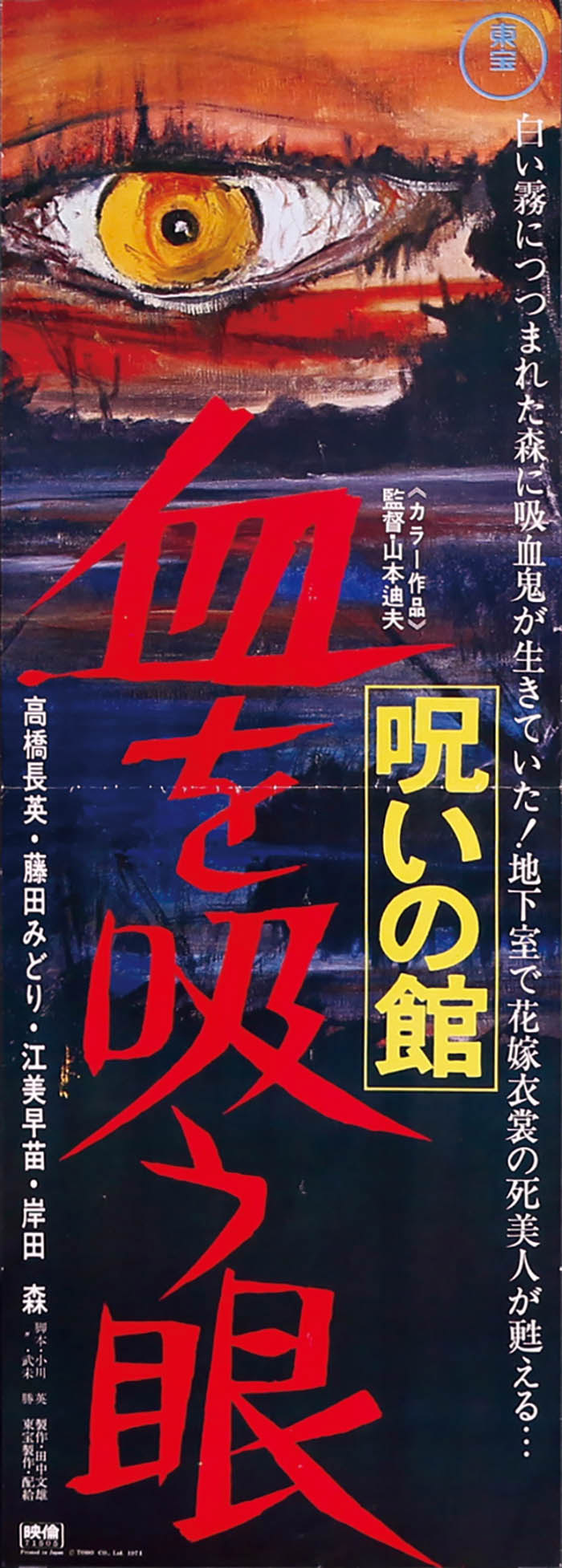
Lake of Dracula posterThe Vampire Doll, the first in a loose trilogy of films along vampiric themes released by Toho in the 1970s, had done its best to relocate Hammer-style horror to contemporary Japan. Adopting the best of the gothic from thundery skies to creepy mansions in the middle of nowhere, Vampire Doll successfully merged the Japanese longhaired grudge bearing ghost with the “romantic” bloodsucking tragedy of a young woman corrupted by illicit desires (though in this case for revenge). Returning to the theme a year later, Michio Yamamoto steps away from Japanese folklore altogether and positions his “foreign” Dracula as a “living” embodiment of repressed trauma, sucking the life out of his unwitting enemy until she finally learns to remember him, burning him away in the bright sunlight of his own eye.

Unlike Vampire Doll, Lake of Dracula (呪いの館 血を吸う眼, Noroi no Yakata: Chi wo Su Me) begins with a short prologue in which some children play on a rocky outcrop underneath a strangely ominous pink sky. When little Akiko’s pet dog Leo uncharacteristically runs off, she follows him and he leads her straight into the path of danger. Finding herself in a creepy mansion complete with stained glass windows and a dead body posed at a piano, the last thing that Akiko remembers is the pale face of a strange man with golden eyes and blood staining his chin.

Flashforward 20 years and Akiko (Midori Fujita) is a school teacher still living with her younger sister Natsuko (Sanae Emi) in their childhood home. She is convinced her traumatic childhood incident must have been a dream though it continues to haunt her enough to be a frequent subject in her artwork including a striking canvas she has just completed featuring a frightening golden eye looming over a tiny girl and her dog. Akiko has nice boyfriend, Takashi (Choei Takahashi), who is a doctor in the city, and all things considered a pretty nice life. Sadly it is not to last.

The trouble begins when someone randomly delivers a coffin to the local boathouse. First Akiko’s dog goes missing, then her trusted uncle figure tries to attack her before running off never to be seen again. Meanwhile, at Takashi’s hospital, a young “runaway” has been brought in in a catatonic state though no one can find much wrong with her until Takashi spots two suspicious bite marks on her neck. In case you’d forgotten about Natsuko, she has also begun behaving strangely – offering snide comments to her sister, going out alone in the middle of the night, and most alarmingly she has begun to grow pale.

Like Vampire Doll, Lake of Dracula is also an experimental vampire movie hybrid – a B-movie stalker picture in which Dracula is the creepy guy who can’t seem to take no for an answer. Yamamoto films the “naturalistic” action in standard Toho fashion but shifts into a higher register for his conception of heightened vampiric romanticism as Akiko’s “dream” erupts under a blood red sky and eventually leads her to an artfully appointed gothic cottage in which even the dead bodies are tastefully arranged.

Yet what Dracula comes to represent is the soul sucking power of the repressed past. Akiko has largely been able to move past her traumatic childhood adventure, convincing herself it was nothing more than a dream, and seems to be living a pleasant enough life even if her paintings betray her continuing anxiety. As we later find out, it is not quite so much the episode itself as the refusal to accept it which has caused Akiko so many problems – not least a buried rift with her treasured sister resulting from unfortunate sibling rivalry never fully dealt with both because of the incident and the early death of their parents. Akiko, resentful of having a new sister who had “displaced” her in her parents’ affections, sought to win back her rightful place by being the ideal child – good and obedient. Hence when no one believed her about the creepy house and strange man, she backed down, let them tell her it was only a dream to avoid being thought argumentative. Now she wonders if Natsuko harboured ill will towards her too for “stealing” back her parents’ love through her crazy story and perhaps relegating her to second place when she had become used to first.

Familial love becomes an odd kind of theme as we discover Dracula had a father of his own – a descendent of non-Japanese immigrants who had purposefully built a creepy mansion in the middle of nowhere in order to limit the possibility of his “bad blood” wreaking havoc in the world. The bad blood apparently skips a generation here and there and so Dracula, the third generation, is the first to be affected by it. His father tried to sacrifice himself to control his son, but now the demon is loose and is after Akiko who, creepily enough, seems to have caught his eye all those years ago (when she was five!) and he is determined to make her his “wife”. Vampirising someone’s sister is probably not a good way to win their heart, but Dracula, oddly, has never been very good at conventional romance.

Dracula’s “foreign” origins are perhaps an uncomfortable nod back to the xenophobic nature of the vampire myth. Despite being 3/4 Japanese and born and raised in Japan, Dracula’s late in the game exposure as not properly “Japanese” enough unfortunately reinforces the idea that “mixed” blood is somehow “impure”, even dangerous, and that even those who’ve spent their lives in Japan are not the same as those who are descended from long lines fully recorded 100% Japanese ancestors. Thus the danger becomes a “foreign object” which must be expelled to restore the integrity of the whole.

Restoring integrity is Akiko’s quest as she, along with her doctor boyfriend, attempts to solve the mystery through revisiting her traumatic childhood incident and finally learns to put it behind her. Yamamoto’s direction shifts between standard B-movie naturalism and florid avant-garde compositions but perhaps fails to capitalise on their inherent theatricality. Picking up the pace for the final set piece, Yamamoto also allows himself to go grim in taking a leaf directly out of the Hammer book by lifting the final death scene from the Christopher Lee starring Hammer Horror from 1958 in his crumbling, melting vampire, not to mention the other decomposing corpse resting in the house whose skin slides sickeningly from his body. A strange, hybrid adventure, Lake of Dracula makes an early attempt to pair the vampire chiller with serial killer thriller and does so moderately successfully even if its psychology remains firmly within the realms of the B-movie.


Lake of Dracula is the second of three films included in Arrow’s Bloodthirsty Trilogy box set which also includes extensive liner notes by Jasper Sharp detailing the history of vampires and horror cinema in Japan.

Original trailer (no subtitles)
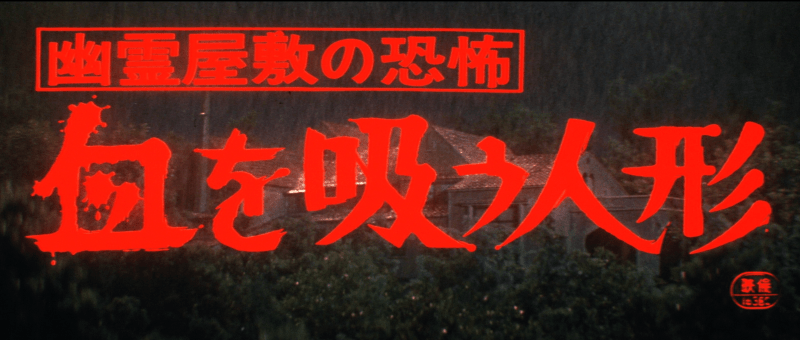
The Vampire Doll (幽霊屋敷の恐怖 血を吸う人形, Michio Yamamoto, 1970)

Vampire doll posterIn a roundabout way, Toho can almost be thought of as the most “international” of mainstream Japanese cinemas operating in the late ‘60s and ‘70s. Though their view of “the foreign” was not always positive, their forays into science fiction often made a point of the need for international co-operation to combat extraterrestrial threats and “Interpol” became a (slightly humorous) fixture in the studio’s small number of sci-fi inflected spy films. If the spy movies were an attempt to echo the increasing ‘70s cold-war paranoia coupled by post-Bond camp, Toho was also looking overseas for inspiration in its wider genre output which is presumably how they wound up adding Hammer-esque vampire horror to their tokusatsu world.

The Vampire Doll (幽霊屋敷の恐怖 血を吸う人形, Yurei Yashiki no Kyofu: Chi wo Su Ningyo) draws influence both from classic European gothic and, perhaps less predictably, Alfred Hitchcock’s Psycho to create a new hybrid horror model which effectively merges the Western “vampire” mythology with the “traditional” long haired, grudge bearing ghost. The tale begins with a young man who has recently been “abroad” for a number of months and has been looking forward to reuniting with his fiancée. When Sagawa (Atsuo Nakamura) reaches the gothic country mansion owned the family of Yuko (Yukiko Kobayashi), his longed for love, he learns that she has, unfortunately, passed away in a car crash just two weeks previously. Heartbroken he decides to stay over but is unable to sleep, not because of the grief or shock, but because of strange noises and the conviction that he has seen Yuko wandering around the house. Visiting her grave the next day, he finally meets her but she seems “different” and tearfully asks him to end her life.

Cut to the city, Sagawa’s sister Keiko (Kayo Matsuo) wakes up from a nightmare in which Yuko killed her brother and tries to cancel a date with her boyfriend to go look for him. Keiko’s boyfriend Hiroshi (Akira Nakao) eventually agrees to drive her to Yuko’s country pile to help investigate. On arrival, Yuko’s mother Shidu (Yoko Minakaze) tells them Sagawa left in heartbreak the day before, but Keiko doesn’t believe her and the couple fake car trouble to stay the night and investigate further.

Yamamoto’s film does indeed raid classic vampire movie tropes and mine them for all they’re worth. The curiously gothic architecture is explained away by Shidu’s husband having been a diplomat who developed a fondness for the European while overseas, but the presence of the hunched over, barely verbal servant Genzo (Kaku Takashina) seems a much more obvious Hammer homage. Shidu laments that the house is now “very old” and crumbling, a remnant of a pre-war world of lingering feudalism, all faded grandeur and declining influence – a fitting seat for a vampiric meditation of changing class and value systems with its kimono’d mistress and seemingly incongruous temporality.

Yet Yuko, not quite a “vampire” as we would usually think of them, is an extension of the traditional ghost story villainess rather than the sex crazed bloodsucker of European literature. Once again, the war is raised as a partial explanation of the tragedies which have befallen the family, if in a more logical fashion than the otherwise outlandish narrative would imply. Shidu carries a prominent scar across her neck – the mark of having tried to take her own life after a frustrated demobbed soldier massacred the family on learning that the woman he loved had married someone else while he was away fighting. This is apparently the origin of Yuko’s grudge (as the film clumsily explains), leaving her with a profound sense of rage against the world that killed her mother’s husband as well as intense resentment that she would die mere days before true happiness was finally in her grasp after enduring so much suffering.

Yuko may put on the billowing white nightgown of the repressed vampiress, her hair a flowing a chestnut-brown, but her blood lust is born of vengeance – she craves destruction rather than satisfaction. Toho flexes its tokusatsu muscles as lightning forks over the gothic mansion, perfectly achieving the air of oppressive supernatural unease provoked by the claustrophobic Western estate which seems to have even the local residents resolved to take the long way home to avoid it. Fusing European gothic with Japanese ghost story, Yamamoto’s first “vampire” movie is an unusual take on the material, refusing the foreign origins of the demonic for a homegrown tale of violence and tragedy consuming the life of a young woman attempting to find happiness in the rapidly changing post-war society.


The Vampire Doll is the first of three films included in Arrow’s Bloodthirsty Trilogy box set which also includes extensive liner notes by Jasper Sharp detailing the history of vampires and horror cinema in Japan.

Original trailer (no subtitles)
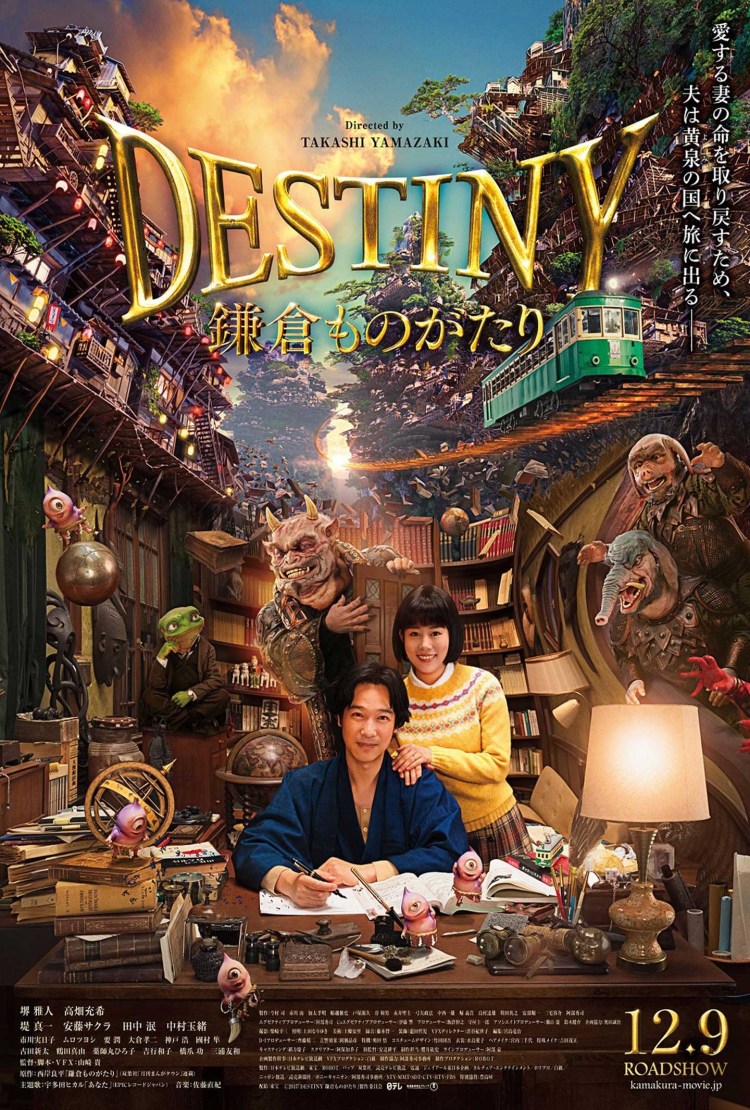
Destiny: The Tale of Kamakura (DESTINY 鎌倉ものがたり, Takashi Yamazaki, 2017)

Destiny tale of kamakura posterJapanese literature has its fair share of eccentric detectives and sometimes they even end up as romantic heroes, only to have seemingly forgotten the current love interest by the time the next case rolls around. This is very much not true of Destiny: The Tale of Kamakura (DESTINY 鎌倉ものがたり, Destiny: Kamakura Monogatari) which is an exciting adventure featuring true love, supernatural creatures, and a visit to the afterlife all spinning around a central crime mystery. Blockbuster master Takashi Yamazaki brings his visual expertise to the fore in adapting the popular ‘80s manga by Ryohei Saigan in which the human and supernatural worlds overlap in the quaint little town of Kamakura which itself seems to exist somewhere out of time.

Our hero, Masakazu Isshiki (Masato Sakai), is a best selling author, occasional consulting detective, and befuddled newlywed. He’s just returned from honeymoon with his lovely new wife and former editorial assistant, Akiko (Mitsuki Takahata), but there are a few things he’s neglected to explain to her about her new home. To wit, Kamakura is a place where humans, supernatural creatures, and wandering spirits all mingle freely though those not familiar with the place may assume the tales to be mere legends. To her credit, Akiko is a warm and welcoming person who can’t help being “surprised” by the strange creatures she begins to encounter but does her best to get used to their presence and learn about the ancient culture of the town in which she intends to spend her life. Unfortunately, she still has a lot to learn and an “incident” with a strange mushroom and a naughty monster eventually leads to her soul being accidentally sent off to the afterworld by a very sympathetic death god (Sakura Ando) who is equal parts apologetic about and confused by what seems to be a bizarre clerical error.

Destiny’s Kamakura is a strange place which seems to exist partly in the past. At least, though you can catch a glimpse of people in more modern clothing in the opening credits, the town itself has a distinctly retro feel with ‘60s decor, old fashioned cars, and rotary phones while Masakazu plays with vintage train sets, pens his manuscripts by hand, and delivers them in an envelope to his editor who knows him well enough to understand that deadlines are both Masakazu’s best friend and worst enemy.

The creatures themselves range from the familiar kappa to more outlandish human-sized creatures conjured with a mix of physical and digital effects and lean towards the intersection of cute and creepy. The usual fairytale rules apply – you must be careful of making “deals” with supernatural creatures and be sure to abide by their rules, only Akiko doesn’t know about their rules and Masakazu hasn’t got round to explaining them which leaves her open to various kinds of supernatural manipulation which he is too absent minded to pick up on.

Yet Masakazu will have to wake himself up a bit if he wants to save his wife from an eternity spent as the otherworld wife of a horrible goblin who, as it turns out, has been trying to split the couple up since the Heian era only they always manage to find each other in every single re-incarnation. True love is a universal law, but it might not be strong enough to fend off mishandled bureaucracy all on its own, which is where Akiko’s naivety and essential goodness re-enter the scene when her unexpected kindness to a bad luck god (Min Tanaka), and an officious death god who knew something was fishy with all these irreconcilable numbers, enable the couple to make a speedy escape and pursue their romantic destiny together.

Aimed squarely at family audiences, the film also delves a little into the awkward start of married life as Akiko tries to get used to her eccentric husband’s irregular lifestyle as well as his childlike propensity to try and avoid uncomfortable topics by running off to play trains. Masakazu, orphaned at a young age, is slightly arrested in post-adolescent emotional immaturity and never expected to get married after discovering something that made him question his parents’ relationship. Nevertheless, a visit to the afterlife will do wonders for making you reconsider your earthly goals and Masakazu is finally able to repair both his old family and his new through a bit of communing with the dead. Charming, heartfelt, and boasting some beautifully designed world building, Destiny: The Tale of Kamakura is the kind of family film you didn’t think they made anymore – genuinely romantic and filled with pure-hearted cheer.


Screened at Nippon Connection 2018.

Original trailer (English subtitles)

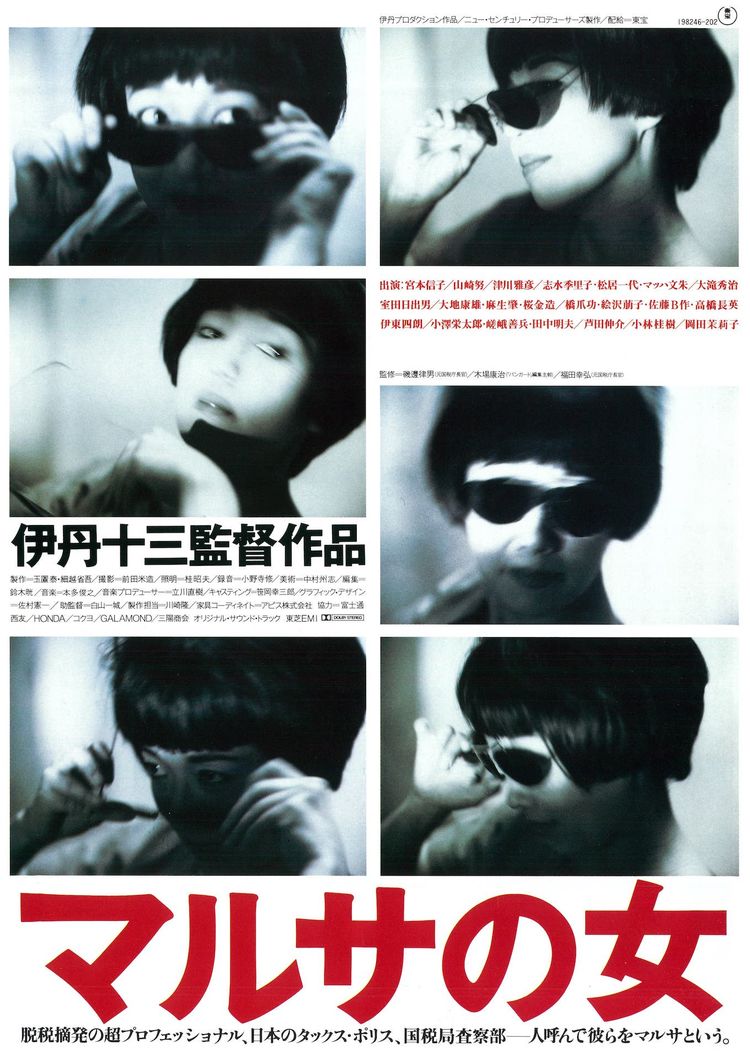
A Taxing Woman (マルサの女, Juzo Itami, 1987)

A Taxing Woman posterIn bubble era Japan where the champagne flows and the neon lights sparkle all night long, even the yakuza are incorporating. Having skewered complicated social mores in The Funeral and then poked fun at his nation’s obsession with food in Tampopo, Juzo Itami turns his attention to the twin concerns of money and collective responsibility in the taxation themed procedural A Taxing Woman (マルサの女, Marusa no Onna). Once again starring the director’s wife Nobuko Miyamoto, A Taxing Woman is an accidental chronicle of its age as Japanese society nears the end of a period of intense social change in which acquisition has divorced mergers, and individualism has replaced the post-war spirit of mutual cooperation.

Ryoko Itakura (Nobuko Miyamoto), a single mother and assistant in the tax office, has a keen eye for scammers. She demonstrates this on a stakeout with a younger female colleague in which she keeps a shrewd eye on the till at her local cafe and comes to the conclusion that they’ve been running a system where they don’t declare all of their cheques. Running her eyes over the accounts of a mom and pop grocery store, she notices some irregularities in the figures and figures out the elderly couple feed themselves from the supplies for the shop but don’t “pay” themselves for their own upkeep. That might seem “perfectly reasonable” to most people, but it’s technically a small form of “embezzlement” and Ryoko doesn’t like figures which don’t add up. Seeing as the couple probably didn’t realise what they were doing was “wrong” she lets them off, this time, as long as they go by the book in the future. A more complicated investigation of a pachinko parlour finds a more concrete form of misappropriation, but Ryoko is fooled by the owner’s sudden collapse into inconsolable grief after being caught out and leaves him in the capable hands of his confused accountant.

Nevertheless, Ryoko may have met her match in sleezy corporate yakuza Hideki Gondo (Tsutomu Yamazaki). Dressing in a series of sharp suits, Gondo walks with a pronounced limp that hints at a more violent past but as his rival from the Nakagawa gang points out, violence is a relic of a bygone era – these days gangsters go to jail for “tax evasion” as means of furthering their “business opportunities” and facilitating ongoing political corruption. Gondo’s business empire is wide ranging but mainly centres on hotels, which is how he arouses Ryoko’s interest. She looks at the numbers, does a few quick calculations, and realises either the business isn’t viable or the correct figures aren’t being reported. Ryoko doesn’t like it when the books don’t balance and so she sets her sights on the seedy Gondo, but quickly discovers she has quite a lot in common with her quarry.

Itami was apparently inspired to make A Taxing Woman after the success of Tampopo shoved him into a higher tax bracket. Given Japanese taxes (at the time) were extremely high, getting around them had become something of a national obsession even if, in contrast to the preceding 30 years or so, there was plenty of money around to begin with. More than the unexpected tendency towards civil disobedience the times seemed to cultivate, Itami homes in on the increasingly absurd desire for senseless acquisition the bubble era was engendering. Thus Gondo who owns a large family home well stocked with symbols of his rising social status, also occupies a bachelor pad where he keeps a mistress which reflects the gaudy excess of the age right down to its random stuffed hyena. Nevertheless when one of the tax clerks asks for some advice as to how to have it all, Gondo replies that that’s easy – to save money, you simply avoid spending it. Gondo lets his glass run over and delights in licking the edges. It’s all about delayed gratification, apparently, and having a secret room full of gold bars to gaze at in order to relieve some of that anxiety for the future.

Gondo, like many of his ilk, has “diversified” – yakuza are no longer thuggish gangsters but incorporated organisations operating “legitimate” businesses through “illegitimate” means. Thus we first find him using a nurse who allows herself to be molested by an elderly, terminally ill client whose identity they will steal to found a company they can quickly dissolve when he dies to shift their assets around and avoid the tax man. Later he pulls another real estate scam by pressing a desperate family but his real focus is the love hotels, whose slightly embarrassing existence ensures that not many come poking around. Ryoko, however, is unlikely to let such a large scam slide and delights as much in closing loopholes as Gondo does in finding them. Noticing a kindred spirit, Gondo quite openly asks his new tax inspector “friend” what she’d think if he married his mistress, gave her all his money, and divorced her – divorce proceeds are after all tax free. Sounds great, she tells him, as long as you trust your wife not to skip town with all the doe.

Ryoko, a modern woman of the bubble era, single and career driven, is a slightly odd figure with her officious approach to her job and unforgiving rigour. Unlike her colleague who dresses in the glamorous and gaudy fashions of the times, Ryoko wears dowdy suits and her mentor boss is always reminding her about her “bed hair”, meanwhile she stays late at the office and offers instructions to her five year old son over the phone as to how to microwave his dinner. Though there is another woman working with her at the tax office, when she’s finally promoted to full tax inspector status she finds herself in a room full of guys who apparently hardly ever go home. On her first job she’s only really brought along because she’s a woman and they want to threaten a mob boss’ mistress with a strip search to find a missing key for a safety deposit box. The mistress, however, tries to throw them off the sent by publicly stripping off and encouraging them to check her “cavity” if they’re so keen to find this key, only for Ryoko to find it under the sink while all the guys are busy being shocked. Ryoko’s methods are occasionally as underhanded as Gondo’s and, like his schemes, built on gaming the system but she’s certainly a force to be reckoned with for those considering defrauding the Japanese government.

Gondo’s schemes excel because they aren’t entirely illegal, only clever ways of manipulating the system, but they’re also a symptom of a large conspiracy which encompasses improprieties right up the chain as banks, corporations, and politicians are all part of the same dark economy managed by a corporatising yakuza. Gondo takes frequent calls from a local representative who often “helps him out”. Later the same representative tries to put pressure on the tax office to back off, but Ryoko’s boss points out that he doesn’t need to because the press are already on the story so he should probably get started on his damage control rather than bothering public servants. Gondo and Ryoko, perhaps as bad as each other, lock horns in a battle wills but discover a strange degree of respect arising between them in having discovered a worthy adversary. There’s something undeniably absurd in Ryoko’s firm determination to catch out struggling businesses and the confused elderly with the same tenacity as taking on a yakuza fronted conspiracy, and there’s something undeniably amusing in Gondo’s attempts to beat the man by playing him at his own game, but the overall winner is Itami who once again succeeds in skewering his nation’s often contradictory social codes with gentle humour and a dispassionate, forgiving eye.


Currently available to stream in the US/UK via FilmStruck.

Original trailer (no subtitles)
Inuyashiki (いぬやしき, Shinsuke Sato, 2018)

inuyashiki_poster_B1_0206D_fin_ol_3Japanese cinema has long been preoccupied by the conflict between age and youth though it usually comes down on the side of the youngsters, even when rebuking them for their selfish immorality. Inuyashiki (いぬやしき), adapted from the manga by Hiroya Oku, is similarly understanding but makes a hero of its sad dad protagonist whose adult life has been a socially acceptable disaster, while finding sympathy for his villainous teenage counterpart who resents his lack of possibilities in an already unfair world.

Unsuccessful salaryman Inuyashiki (Noritake Kinashi) has just moved into a new house of which he is very proud but his wife (Mari Hamada) and children find small and old fashioned. He’s bought sushi to celebrate the occasion, but the other family members ignore him and head out for dinner on their own. Held in contempt at home, Inuyashiki’s working life is also something of a disaster in which he is publicly berated by his boss who threatens to fire him, leaving Inuyashiki kneeling in supplication just to be allowed to work until retirement so he can keep up the mortgage payments on that new house (which he bought for his family who all hate him).

To make matters worse, Inuyashiki has also just received the news that he is suffering from terminal cancer and has only a few months to live. His only ray of sunshine appears when he finds an abandoned dog, Hanako, and decides to adopt her but his wife orders him to throw the dog out in case it messes up the house (that she already hates). Sadly walking Hanako to the park with the intention of sending her on her way, Inuyashiki is struck by a mysterious blast and later wakes up to discover he has become an all powerful cyborg with booster rockets on his back and guns in his arms.

Inuyashiki’s first instinct is that he can use his new found powers to save people. Contemplating his mortality, Inuyashiki was made to feel that his life had been a failure; he’d never done anything of consequence and had never been able to protect anyone. Reviving a wounded bird in the street, he realises he has the power to heal along with super sensitive hearing which allows him to hear the cries of those in peril.

Meanwhile, the teenager caught in the same blast, Shishigami (Takeru Satoh), is heading in the opposite direction. Shishigami is also filled with resentment though mostly as regards his poverty and comparative lack of possibilities. He hates that his single-mother (Yuki Saito) has to work herself to the bone because his father (Kiyohiko Shibukawa) left the family for another woman with whom he has built another home and become extremely wealthy. He hates that his video game otaku friend (Kanata Hongo) is mercilessly bullied and has stopped coming to school altogether rather than fight back. Filled with a young man’s rage and a mild kind of psychopathy, Shishigami doesn’t see why it’s wrong to become a bully rather than fighting them. Frustrated beyond reason he declares war on an uncaring society and sentences everyone in Japan to death for their indifference to their fellow citizens.

The conflict between the angel and the devil concludes in predictably bombastic fashion as our two cyborgs go head to head in a climactic battle for the soul of Japan. Strangely enough both men are motivated by love even if one’s actions are darker than the other’s. Inuyashiki wants to protect, to be someone his family can respect and depend on – he flees the scenes of his miracles because he isn’t interested in being a “hero”, just in being of use. Shishigami, by contrast, is motivated by love for his mother whose continuing suffering proves too much for him to bear though his attempts to take revenge only end in more tragedy. Mustering all the technology of the age from smartphones to live broadcasts, Shishigami makes himself a familiar face on TV sets and LCD screens across the country to preach his message of hate as a declaration of war.

Shishigami proclaims that Inuyashiki’s sense of justice is no match for his hate, but there is a definite irony in the squaring off of two men from different generations trying to figure out their differences by pounding the living hell out of each other and destroying half of Tokyo in the process. Still, that is in many ways the point as these two “gods” actively choose the sides of light and darkness, vying for the right to rule the future as forces of destruction or salvation.


Screened at the 20th Udine Far East Film Festival.

Original trailer (English subtitles)

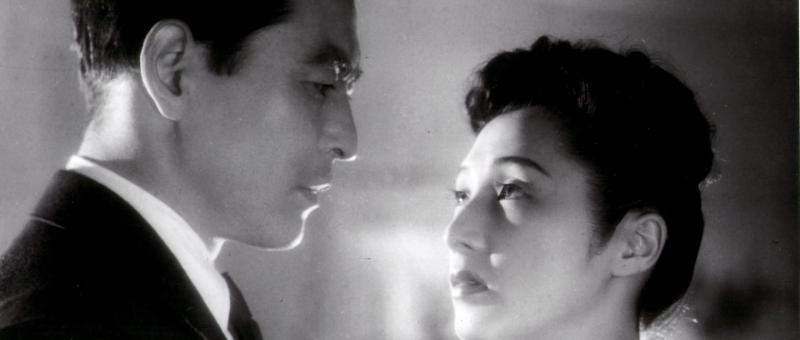
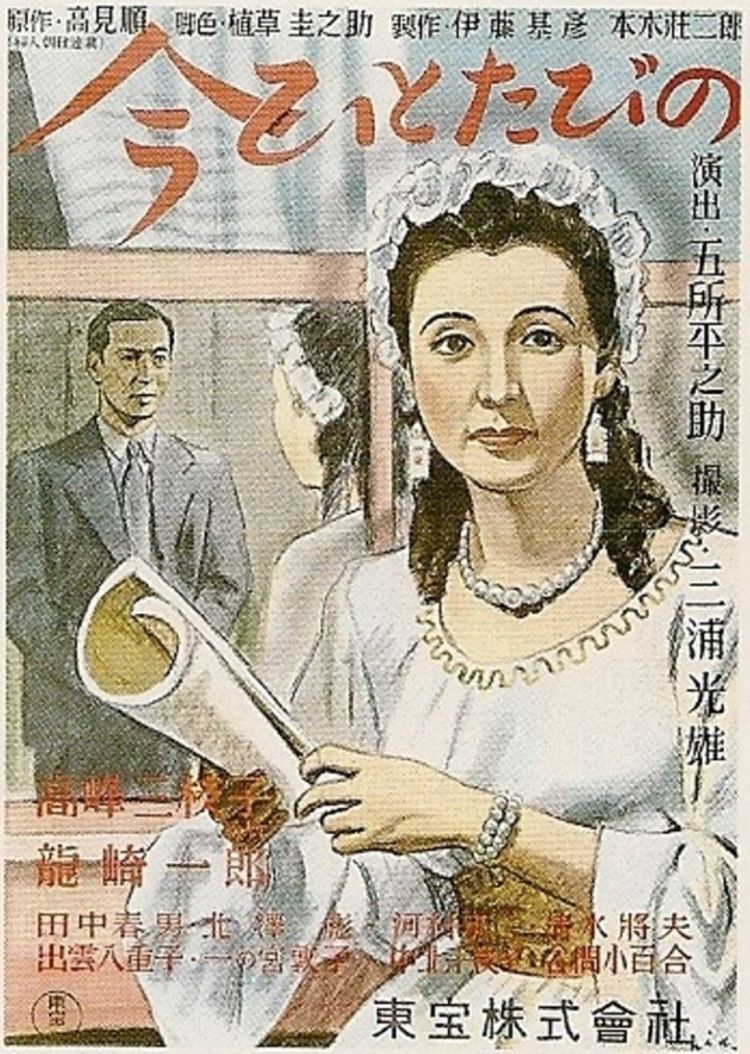
Once More (今ひとたびの, Heinosuke Gosho, 1947)

(c) 東宝

Gosho once more posterOf the Japanese golden age directors, there were few who’d “happily” gone along with the requirements of making films under a militarist regime. Heinosuke Gosho, however, must rank among the most recalcitrant in his unwavering refusal to compromise his convictions in order to preserve his career. Most of the scripts he submitted to the censor’s board were rejected in the preliminary stages though he was able to ruffle a few feathers with the few films he did manage to make if only for his skilful ability to skirt around the promised propagandistic overtones. It also “helped” that Gosho had become seriously ill with tuberculosis in 1937 which perhaps protected him from official interference and, in any case, removed him from the film industry for three years while he recovered. Nevertheless, he felt keenly that he and others had a duty and an opportunity to turn the tables in the post-war era, advancing the ideology of humanism to create a better, fairer world than the one which had descended into so much ugliness and chaos.

In fact one of the reasons Gosho decided to film Once More (今ひとたびの, Ima Hitotabi no) in 1947 under the American occupation was to counter the view held among some young people that there had been no active opposition to militarism. Gosho and his screenwriter Keinosuke Uekusa chose to adapt a heavily political novel by Jun Takami which painted itself as a romantic tragedy of resistance in which its leftist heroes find themselves carrying the legacy of defeat onward into the post-war world. Gosho depoliticises Takami’s tale and reconstructs it as a romantic melodrama with a more positive resolution, but is careful to preserve the fierce idealism of the conscientious students relentlessly protesting Japanese Imperialism whilst trying to advance the course of social justice in an increasingly oppressive environment.

The tale begins in 1936 as a group of students prepares to graduate. Nogami (Ichiro Ryuzaki), a doctor, has turned down a lucrative university post to minister to the poor. Unlike his friends Tanaka (Koji Kawamura) and Kambara (Hyo Kitazawa), Nogami is not an activist or left wing agitator but has a strong belief in humanistic socialism and a conviction that he has a duty to ensure his skills are available to those who need them most. Invited to a play directed by Kambara which is being performed to raise money for socialist causes, Nogami accidentally wanders into the dressing room of the leading lady – Akiko (Mieko Takamine), a wealthy socialite, and falls in love at first sight. Akiko too takes a liking to Nogami and invites him to her birthday party despite his rather odd behaviour after the play, but he finds it impossible to get on with her upperclass friends and eventually leaves. The pair advance and retreat, but their romance is frustrated by the times in which they live, politics, and their own senses of personal integrity which encourage them to willingly sacrifice their happiness in acknowledgement of living in an unhappy world.

Despite their original, electric attraction the obstacles surrounding the love of Akiko and Nogami may seem insurmountable, chief among them being the obvious class difference between the pair. Nogami, somewhat contrary to his humanistic ideals, has a mild prejudice against the bourgeoise, believing them to be selfish, unfeeling, and existing in their own bubble hermetically sealed away from the kind of suffering he sees everyday at the clinic. Yet he cannot forget Akiko who harbours no prejudice towards him because of his humble origins (though her friends and family make no secret of theirs) and feels similarly about her own social class, overcome with guilt that she lives in such comfort while others suffer. Eventually Akiko joins the cause, becoming a left-wing agitator and even getting herself arrested and branded a “Red Lady” in the papers (further annoying her very confused social circle). Unlike Nogami she is also subject to a kind of social and gender based oppression in which she is under constant pressure to marry her longstanding fiancé, Sakon (Haruo Tanaka), and conform to the requirements of her position. Nogami is “free” to choose to live a life of selfless altruism in a way that Akiko is not and will struggle to be throughout the rest of the picture.

Yet time and again it is the times which frustrate their romance. Akiko and Nogami repeatedly make plans to meet, but one of them is arrested and prevented from arriving leaving the other assuming the worst – that they have been abandoned, romantically and ideologically. Matters aren’t helped by Nogami’s natural diffidence and awkwardness coupled with his rigid code of honour which makes it impossible for him to pursue Akiko in any normal way, leaving her confused and later at the mercy of her controlling family. In the end it is their own senses of personal integrity which prevent their union, as a friend bound for the front points out when he, essentially, tells them to get over themselves and embrace happiness rather than overthinking an emotional response and ruining it in the process.

As much as Gosho’s central tenet could be boiled down to “don’t think, feel”, he does argue for compassionate rationality and considered fairness and understanding between people. Thus he removes the Marxist overtones from the original novel because his conflicts aren’t “political” but between justice and injustice; he simply sees unfairness and opposes it, placing his faith in the absolute truth of positive emotion and human connection to eradicate the false barriers of rational civility and irrational oppression. For Gosho, love wins, every time. 


The Bad Sleep Well (悪い奴ほどよく眠る, Akira Kurosawa, 1960)

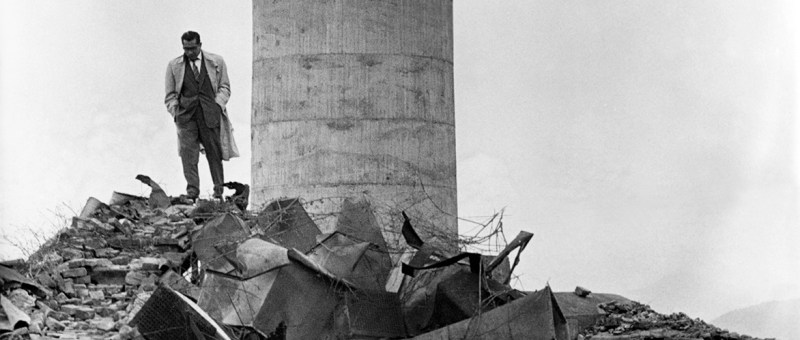
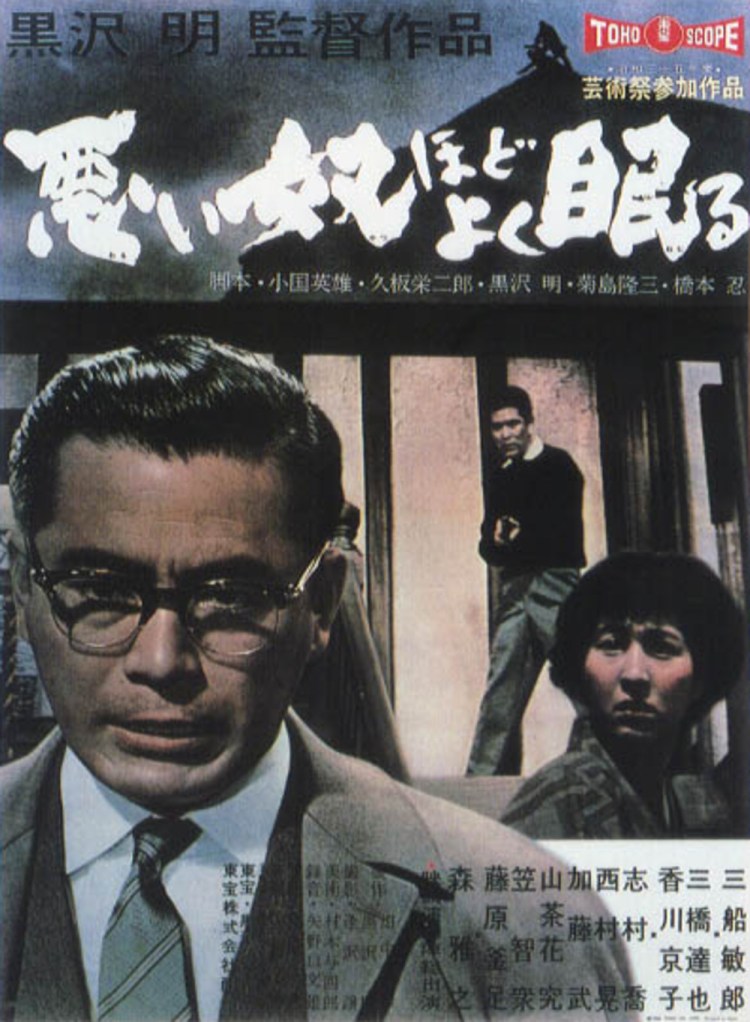
Bad Sleep Well posterThere’s something rotten in the state of Japan – The Bad Sleep Well (悪い奴ほどよく眠る, Warui Yatsu Hodo Yoku Nemuru), Akira Kurosawa’s take on Hamlet, unlike his previous two Shakespearean adaptations, is set firmly in the murky post-war society which, it becomes clear, is so mired in systems of corruption as to be entirely built on top of them. Our hero, like Hamlet himself, is a conflicted revenger. He intends to hold a mirror up to society, reflecting the ugly picture back to the yet unknowing world in the hope that something will really change. Change, however, comes slow – especially when it comes at the disadvantage of those who currently hold all the cards.

We open at a wedding. A small number of attendants lineup around a lift waiting for the arrival of the married couple only for a carriage full of reporters to pour out, apparently in hope of scandal though this is no gossip worthy society function but the wedding of a CEO’s daughter to his secretary. The press is in attendance because the police are – they believe there will be arrests today in connection with the ongoing corruption scandal engulfing the company in which a number of employees are suspected of engaging in kickbacks on government funded projects.

The rather strange wedding proceeds with the top brass sweating buckets while the bride’s brother (Tatsuya Mihashi), already drunk on champagne, takes to the mic with a bizarre speech “refuting” the claims that the groom, Nishi (Toshiro Mifune), has only married the bride, Yoshiko (Kyoko Kagawa), for financial gain before avowing that he will kill his new brother-in-law if he makes his little sister sad. Nishi, as we later discover, has indeed married with an ulterior motive which is anticipated by the arrival of a second wedding cake in the shape of a building at the centre of a previous corruption scandal with one black rose sticking out of the seventh floor window from which an employee, Furuya, committed suicide five years previously.

The police are keen to interview their suspects, the press are keen to report on scandal, but somehow or other the system of corruption perpetuates itself. The top guys cover for each other, and when they can’t they “commit suicide” rather than embarrass their “superiors” by submitting themselves to justice. The system of loyalty and reward, of misplaced “honour” mixed with personal greed, ensures its own survival through homosocial bonding with backroom deals done in hostess bars and the lingering threat of scandal and personal ruin for all should one rogue whistleblower dare to threaten the governing principle of an entire economy.

Nishi chooses to threaten it, partly as an act of revolution but mainly as an act of filial piety in avenging the wrongful death of his father who had, in a sense, cast him aside for financial gain and societal success. Wanting to get on, Nishi’s father refused to marry his mother and instead married the woman his “superiors” told him to. Later, his father threw himself out of a seventh floor window because his “superiors” made him understand this was what was expected of him. Furuya wasn’t the last, each time a man’s transgressions progress too far his “superiors” sacrifice him to ensure the survival of the system. Strangely no one seems to rebel, the men go to their deaths willingly, accepting their fate without question rather than submitting themselves to the law and taking their co-conspirators down with them though should someone refuse to do the “decent” thing, there are other ways to ensure their continuing silence.

Reinforcing the post-war message, Nishi chooses a disused munitions factory for his secret base. Both he and his co-conspirator, a war orphan, had been high school conscripts until the factory was destroyed by firebombing and thereafter were forced to live by their wits alone on the streets. Nishi swears that he wants to take revenge on those who manipulate the vulnerable, but finds himself becoming ever more like his prey and worse, hardly caring, wanting only to steel himself for the difficult task ahead.

In any revolution there will be casualties, but these casualties will often be those whom Nishi claims to represent. Chief among them his new wife, Yoshiko, who has been largely cushioned from the harshness of the outside world thanks to her father’s wealth and seeming care. She loves her husband and wants to believe in her father or more particularly that the moral arc of her society points towards goodness. Nishi, tragically falling for his mark, married his wife to destroy her family but ironically finds himself torn between genuine love for Yoshiko, a desire for revenge, and a mission of social justice. Can he, and should he, be prepared to “sacrifice” an innocent in the same way the “superiors” of the world sacrifice their underlings in order to end a system of oppression or should he abandon his plan and save his wife the pain of learning the truth about her husband, her father, and the world in which she lives?

In the end, Nishi will waver. Yoshiko’s father, Iwabuchi (Masayuki Mori), will not. Goodness becomes a weakness – Iwabuchi turns his daughter’s love and faith against her, subverting her innocence for his own evil. He makes a sacrifice of her in service of his own “superiors” who may be about to declare that they “have complete faith” in him at any given moment. The only thing that remains clear is that Iwabuchi will not be forgiven, the wronged children of the post-war era will not be so quick to bow to injustice. Let the great axe fall? One can only hope.


Original trailer (English subtitles)

Death on the Mountain (黒い画集 ある遭難, Toshio Sugie, 1961)

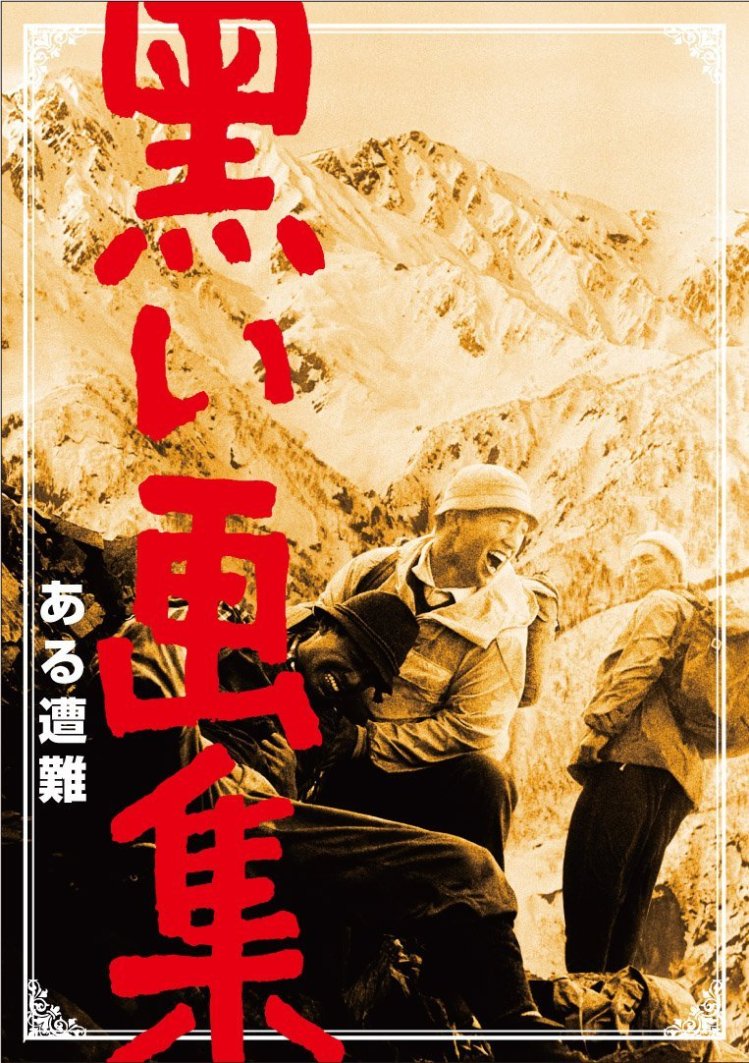
Death on the Mountain DVD coverThere can be few films with as accurate a title as Death on the Mountain (黒い画集 ある遭難, Kuroi Gashu: Aru Sonan) , but Toshio Sugie’s 1961 psychological melodrama certainly makes good on its promise. The Japanese title of the film is prefaced by “The Black Album” which is a title given to a series of novellas penned by one of Japan’s most prominent mystery writers, Seicho Matsumoto, whose work was frequently adapted for the screen including eight collaborations with director Yoshitaro Nomura of such well known mysteries as Zero Focus and Castle of Sand. Death on the Mountain was, like the others in the Black Album series, serialised in Shukan Asahi, in this case between 5th October and 14th December 1958 under the title “Sonan”. “Sonan” literally means “distress” or “disaster”, but it has another telling association – “Sonanshi”, meaning “accidental death” such as might occur while mountain climbing, sailing, or engaged in some other dangerous yet normalised activity. The death at the centre of Death on the Mountain is accidental in once sense, but very much not in another.

The film begins with a body being winched from a lower platform back up to a snowy ridge. Iwase (Kiyoshi Kodama), an experienced mountain climber, has perished in a freak accident. Packed inside his backpack, Iwase’s body is burned at the foot of his beloved mountains while his mother looks on sadly, his sister Masako (Kyoko Kagawa) angrily wondering how her brother, a true mountain man, could have died in such a bizarre way while a much less experienced climber, Urahashi (Takashi Wada), survived. The secret may lie with the leader of the expedition, Eda (Hisaya Ito), who has been looking sheepish ever since the incident but otherwise comports himself in a cool, detached manner.

Like many of Matsumoto’s mysteries, Death on the Mountain turns on a secret but Sugie’s adaptation never seriously considers that Eda is not in someway at fault or questions that Urahashi’s recollection of events, published in a popular mountaineering journal, is anything other than accurate. The facts, as laid out firstly by Urahashi’s article, state that Iwase had not been himself on the day of the climb. Eda had treated them all to first class sleeper cabins but Iwase spent the night drinking, chain-smoking and brooding, meaning he was tired before they even arrived at the mountain. He didn’t sleep at the inn either because of someone whispering all night long and needed to take frequent rests during the early part of the climb. Resting is, however, dangerous – as is excessive thirst, and Iwase spent a lot of time guzzling water and sitting down all of which made him even more exhausted. Coupled with a turn in the weather which left him cold and wet, Iwase’s exhaustion got the better of him and he finally lost his mind. At least, that’s the way Urahashi described it, and Eda seems not to dispute his version of events even if the failures – not bringing a map for both mountains they intended to climb but only one, pressing on despite the weather, and mistaking the trail back to the standard path, all rest squarely with him.

Japanese mysteries by and large are much more concerned with the how rather than the why, though in Death on the Mountain the how is a much greyer area than one might assume. As Masako’s cousin, an experienced mountaineer himself, points out, Iwase’s death was caused by a series of unfortunate circumstances but that doesn’t necessarily preclude that there was ill will or that someone didn’t help the “unfortunate circumstances” along in the hope that they would lead to the “accidental death” of the title. There was, therefore, not quite a murder but definitely a lot of ill will and gentle coaxing towards an act of guilty self destruction. As for the why, well that turns out to be far less interesting and suitably petty. Morally speaking, the act of “murder” becomes moot, though the “murderer” finally meets justice head on, only for the tale to end on a note of ambiguity as Masako, whose investigations have resulted only in further deaths, blames herself for daring to disturb the peace. If she’d only have let the “murder” of her brother lie, no one else would have died. Is Masako now an accidental “murderess” or a frustrated seeker of justice? Whatever the answer, all her efforts have been in vein.

Death on the Mountain was previously adapted as a TV drama shortly after the novel’s release, broadcast between 31st August and 7th September 1959, though presumably with lesser production values than Sugie’s admittedly minimal yet authentically detailed exploration of modern mountaineering. Shooting on location and making much of crunching snow, swirling fog, and pelting rain, Sugie runs high on atmosphere but fails to capitalise on the noirish sense of malevolence that lies at the centre of Matsumoto’s mystery, that evil can come dressed as kindness and the line between murder and accident is much thinner than might otherwise be presumed. Matsumoto seems to want to ask a few questions about causality and personal responsibility, the degree to which a man’s death is his own failing, how much the fault of “unfortunate circumstance”, and how much ill intentions from the world around him. Sugie, however, is content to let the suspense peter out with the solution offered in true detective style through a suppositional monologue delivered in front of the presumed murderer but for the audience’s benefit. Nevertheless, even if the mystery falls flat the mountain air rings true and Sugie has, at least, captured something of nature’s awesome power and terrifying beauty.


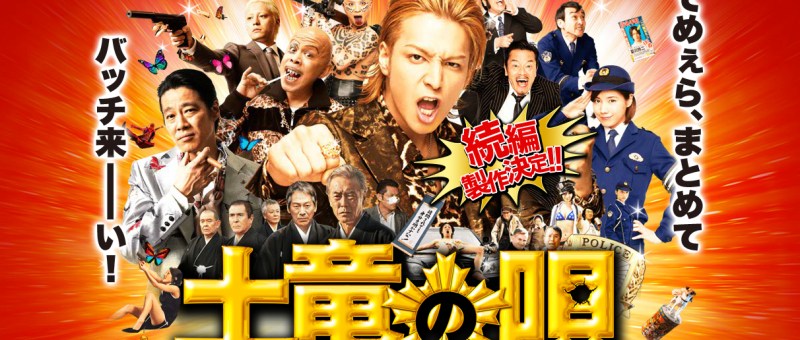
The Mole Song: Undercover Agent Reiji (土竜の唄 潜入捜査官 REIJI, Takashi Miike, 2013)

mole song under cover agent reiji poserYakuza aren’t supposed to be funny, are they? According to one particular lover of Lepidoptera, that’s all they ever need to be. Scripted by Kankuro Kudo and adapted from the manga by Noboru Takahashi, Takashi Miike’s The Mole Song: Undercover Agent Reiji (土竜の唄 潜入捜査官 REIJI, Mogura no Uta: Sennyu Sosakan Reiji) is the classic bad spy comedy in which a hapless beat cop is dragged out of his police box and into the field as a yakuza mole in the (rather ambitious) hope of ridding Japan of drugs. As might be assumed, Reiji’s quest does not quite go to plan but then in another sense it goes better than anyone might have hoped.

Reiji Kikukawa (Toma Ikuta) is, to put it bluntly, not the finest recruit the Japanese police force has ever received. He does, however, have a strong sense of justice even if it doesn’t quite tally with that laid down in law though his methods of application are sometimes questionable. A self-confessed “pervert” (but not a “twisted” one) Reiji is currently in trouble for pulling his gun on a store owner who was extracting sexual favours from high school girls he caught shop lifting (the accused is a city counsellor who has pulled a few strings to ask for Reiji’s badge). Seizing this opportunity, Reiji’s boss (Mitsuru Fukikoshi) has decided that he’s a perfect fit for a spell undercover in a local gang they suspect of colluding with Russian mafia to smuggle large amounts of MDMA into Japan.

Reiji hates drugs, but not as much as his new best buddy “Crazy Papillon” (Shinichi Tsutsumi) who is obsessed with butterflies and insists everything that happens around him be “funny”. Reiji, an idiot, is very funny indeed and so he instantly gets himself a leg up in the yakuza world whilst forming an unexpectedly genuine bond with his new buddy who also really hates drugs and only agreed to join this gang because they promised him they didn’t have anything to with them.

Sliding into his regular manga mode, Miike adopts his Crows Zero aesthetic but re-ups the camp as Reiji gets fired up on justice and takes down rooms full of punks powered only by righteousness and his giant yakuza hairdo. Like most yakuza movies, the emphasis is on the bonds between men and it is indeed the strange connection between Reiji and Papillon which takes centerstage as Miike milks the melodrama for all it’s worth.

Scripted by Kankuro Kudo (who previously worked with the director on the Zebra Man series), Reiji skews towards a slightly different breed of absurdity from Miike’s patented brand but retains the outrageous production design including the big hair, garish outfits, and carefully considered colour scheme. Mixing amusing semi-animated sequences with over the top action and the frequent reoccurrence of the “Mole Song”, Miike is in full-on sugar rush mode, barely pausing before moving on from one ridiculous set piece to the next.

Ridiculous set pieces are however the highlight of the film from Reiji’s early series of initiation tests to his attempts to win the affections of his lady love, Junna (Riisa Naka), and a lengthy sojourn at a mysterious yakuza ceremony which Reiji manages to completely derail through a series of misunderstandings. At 130 minutes however, it’s all wearing a bit thin even with the plot machinations suddenly kicking into gear two thirds of the way through. Nevertheless, there’s enough silly slapstick comedy and impressive design work at play to keep things interesting even if Reiji’s eventual triumph is all but guaranteed.


Screened as part of the Japan Foundation Touring Film Programme 2018.

Screening again:

  • Queen’s Film Theatre – 21 February 2018
  • Phoenix Leicester – 24 February 2018
  • Brewery Arts Centre – 16 March 2018
  • Broadway – 20 March 2018
  • Midlands Arts Centre – 27 March 2018
  • Showroom Cinema – 28 March 2018

Original trailer (English subtitles)