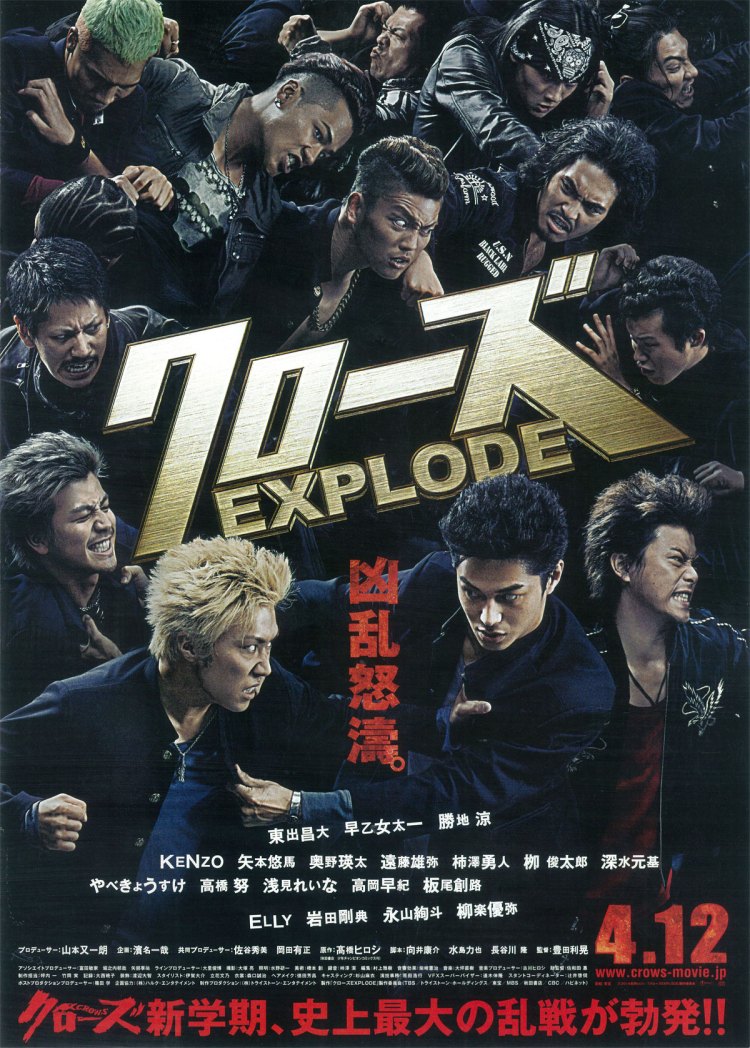
Crows Explode (クローズ EXPLODE, Toshiaki Toyoda, 2014)

crows explodeToshiaki Toyoda made an auteurst name for himself at the tail end of the ‘90s with a series of artfully composed youth dramas centring on male alienation and cultural displacement. Attempting to move beyond the world of adolescent rage by embracing Japan’s most representative genre, the family drama, in the literary adaptation Hanging Garden, Toyoda’s career hit a snag. Despite the film’s favourable reception with critics, a public drugs scandal cost Toyoda his career in Japan’s extremely strict entertainment industry. Since his return to filmmaking in 2009 Toyoda has continued to branch out but 2014’s Crows Explode (クローズ EXPLODE) throws him back into that early world of repressed male energy as internalised rage and frustration produce externalised violence. Picking up the Crows franchise where Takashi Miike left off, Toyoda brings his unique visual sensiblilty to the material, swapping Miike’s irony for something with more grit but losing the deadpan depth of its adolescent posturing in the process.

The old gods have fallen and new ones must rise. Tough guys graduate, but the battlefields of Suzuran High endure eternally. Suzuran is the ultimate in delinquent schools. None of the boys here are under any misapprehension that the adult world holds any promise for them. Many will drop out without completing high school, condemning themselves to a precarious life of continually uncertain, low paid employment, but even those who do manage to leave with a certificate will be heading into another competition to find a steady job in economically straightened times.

That is, those of them who don’t end up in a gang. The thing at Suzuran is that your fate is determined by your fists. Boys roam the halls looking for a fight, each vowing to become the top dog and de facto leader by proving themselves the best and the strongest of the strapping young men all vying for the title. A new challenger arrives in the form of transfer student, Kaburagi (Masahiro Higashide), whose intense energy upsets the dynamic between presumed number one Goura (Yuya Yagira) and his challenger Takagi (Kenzo) but Kagami (Taichi Saotome), the loner son of a fallen yakuza, seems further set to pose a threat in this knife edge environment.

Toyoda has some interesting points to make about the legacy of violence and the importance of father son relationships as each of these young men is reacting in some sense against a father or just his father’s world. Kaburagi, the film’s protagonist, is nursing a deep wound of double abandonment after witnessing his father’s death and then being deposited in a foster home by his sorrowful mother who promises to return for him soon but makes do with occasional visits and monetary gifts. Kaburagi is an angry young man and like many angry young men, he is eager not to become his father – a situation complicated by the fact that his father was a prize fighter who died in the ring.

His “mirror” Kagami, has a similar problem only his father died in a yakuza turf war. A surrogate presents himself in the form of former Suzuran scrapper “Jarhead Ken” (Kyosuke Yabe), now an ex-yakuza helping out at a friend’s second hand car dealership but unable to escape gangland troubles when it emerges Kagami’s clan are intent on acquiring it in order to turn the place into some kind of “entertainment complex”. Ken, a tough guy but soft hearted, has a talent for paternalism which he turns on the fatherless little boy of the car dealership’s owner to whom he teaches the importance of a hefty punch but also of friendship and loyalty.

Miike’s world was a surreal one, inflected with a wry middle aged eye which sees all of this teenage rambunctiousness for the ridiculous posturing it really is. Toyoda’s attempts to be more in the moment, experiencing the adolescent angst with all of its immediate force but unlike his early protagonists the boys of Suzuran are forced to “explode” rendering that central tenet of repressed anger redundant. Externalising the internal war somehow makes it much less interesting as boys trade blows, mindlessly trying to work out a mental struggle which their ill drawn backgrounds will not support.

The environment which the boys inhabit is a grey and hopeless one. Toyoda paints it with his characteristic visual flair, returning to his trademark sequences of slow motion coupled with indie music, but his energy is very different from Miike’s and its more contemplative rhythm never quite gels with the pugilistic fury of the source material even as it gives way to his more expressionistic imagery. The franchise is feeling a little punch drunk by this point, and Toyoda finds it in a particular puddle of teenage malaise. Still, the fists fly and the boys of Suzuran rise and fall as always providing enough self consciously cool action to sustain interest despite the otherwise insubstantial quality.


International trailer (English subtitles)

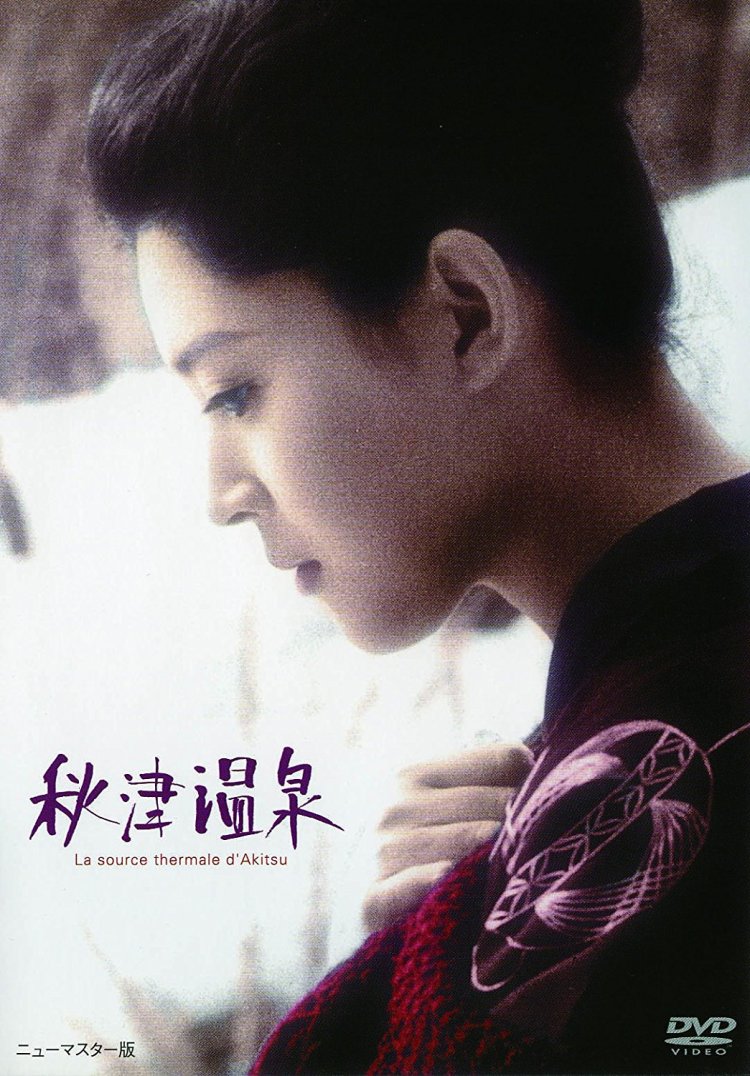
Akitsu Springs (秋津温泉, Kiju Yoshida, 1962)

akitsu springsKiju (Yoshishige) Yoshida is best remembered for his extraordinary run of avant-garde masterpieces in the late 1960s and early 1970s, but even he had to cut his teeth on Shochiku’s speciality genre – the romantic melodrama. Adapted from a best selling novel, Akitsu Springs (秋津温泉, Akitsu Onsen) is hardly an original tale in its doom laden reflection of the hopelessness and inertia of the post-war world as depicted in the frustrated love story of a self sacrificing woman and self destructive man, but Yoshida elevates the material through his characteristically beautiful compositions and full use of the particularly lush colour palate.
At the very end of the war, consumptive student Shusaku (Hiroyuki Nagato) finds his aunt’s house destroyed by aerial bombing. Attempting to find her but proving too ill to go on, Shusaku is taken to a nearby inn by a good samaritan where he first encounters the innkeeper’s daughter, Shinko (Mariko Okada). Despite her mother’s protestations, Shinko takes a shine to Shusaku and is determined to nurse him back to health. Shusaku, however, is a gloomy sort of boy and, ironically, longs only for death. Though the pair fall in love their youthful romance is forever tinged with darkness as Shusaku declares his love not with a ring but with a rope – he asks Shinko for that most classically theatrical of unions in proposing a double suicide.

Shinko agrees, but is not quite ready to die. In another dose of irony, Shinko’s tears of fear and despair on hearing the Emperor’s final wartime broadcast confirming his surrender inspire Shusaku to want to live but the pair are eventually separated. Reuniting and parting over and over again, their complicated love story repeats itself over a period of seventeen years but the painful spectre of the past refuses to allow either of them the freedom to move beyond Akitsu Springs.

Mariko Okada was only 29 in 1962, but she’d already worked with some of the best directors of the age including Ozu whose An Autumn Afternoon was released the same year, and Naruse in Floating Clouds which has something of a narrative similarity to Akitsu Springs. This prestige picture was her 100th screen appearance for which she also took a producer credit. Despite the obvious importance attached to both of these elements, the studio took a chance on a rookie director with only three films under his belt. Two years later Okada would become Yoshida’s wife and go on to star in some of his most important pictures including Eros + Massacre and Heroic Purgatory. At first glance her role here is a conventional one – a love lorn, melancholy woman unable to let the ghost of a failed romance die, but Okada’s work is extraordinary as Shinko travels from flighty teen to rueful middle aged woman, hollowed out and robbed of any sense of hope.

At Akitsu Springs time passes and it doesn’t all at once. Yoshida refuses to give us concrete demarcations, preferring to simply show a child being born and growing older or someone remarking on having been away. The inn becomes a kind of bubble with Shinko trapped inside, but Shusaku comes to regard the place as a temporary haven rather than a permanent home or place to make a life. For her everything real is at the spring, but for him everything at the spring is unreal – an unattainable paradise. She cannot leave, he cannot stay. Only for short periods are they able to indulge their romance, but the time always comes at which they must part again often swearing it will be for the last time, never knowing if it will.

Yoshida neatly bookends the relationship with announcements over loudspeakers as Shinko originally fails to understand the Emperor’s speech in which he remarks on enduring the unendurable, only to be prompted into later action by the banal drone of a train station tannoy. It’s almost as if their lives are being entirely dictated by outside forces, powerless drifters in the post-war world, condemned to a perpetual waiting sustained only by hopelessness.

Shinko may have convinced Shusaku to live but his growing successes only seem to deplete her. Wasting away at an inn she always claimed to hate, Shinko grows old while Shusaku grows bitter yet successful in the city. They move past and through each other, unable to connect or disconnect, yearning for the completion of something which consistently eludes them. Yoshida films the standard melodrama with appropriate theatricality but also with his beautifully composed framing as the lovers are divided by screen doors or captured in mirrors. Okada glows in the light of falling cherry blossoms, acknowledging the tragic and transitory character of love, but her final action is one which echoes the beginning of her suffering and finally declares an ending to an unendurable romance.


Original trailer (no subtitles)

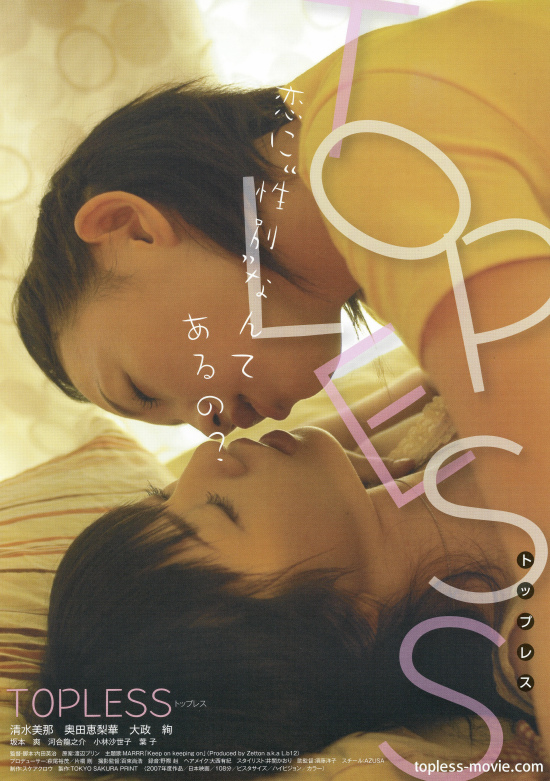
Topless (トップレス, Eiji Uchida, 2008)

toplessFollowing the surreal horror film The Greatful Dead and cynical industry exposé Lowlife Love, Eiji Uchida is not generally known for straightforward naturalism but his 2008 movie Topless (トップレス) maybe among the most refreshingly straightforward, naturalistic depictions of lesbian life in modern Japan. Inspired by the writings of Pudding Watanabe, Topless, despite the title and suggestive poster, immediately jettisons preconceptions and sets about exploring the lives of young men and women in the city, just trying to make it in an often hostile society.

Forthright Natsuko (Mina Shimizu) splits up with her high school sweetheart Tomomi (Erika Okuda) but continues to pine after her even once Tomomi reveals that she’s got herself a boyfriend and plans to try the conventional life for a while. This heavy emotional blow provokes a kind of crisis in the otherwise certain Natsuko who finds herself musing on the fate on older lesbians and expressing sympathy for those who decide it’s just easier to enter a marriage of convenience than try to live alone. For the moment, Natusko lives with her understanding flatmate, Koji (So Sakamoto), who’s been nursing a long time crush on her even if he knows she’s gay and it’s impossible. A chance meeting with a high school girl, Kana (Aya Omasa), who’s come to Tokyo to find the mother who abandoned her to run off with a lesbian lover ten years ago only deepens Natsuko’s contemplative mood as she starts to wonder about where her life will take her if she chooses not to follow the accepted path.

Topless is less about romance than it is about acceptance and identity. Natsuko maybe a member of her university’s lesbian society but she’s about as far from a flag waver as it’s possible to be and just wants to live her life without thinking too much about the big stuff. Bar one woman (a new addition and not a student) the other girls are also just hanging round to have fun, aren’t particularly interested in activism and don’t feel themselves to be part of a movement defined by their sexuality. Natsuko certainly refuses to be defined by hers though her recent falling out with Tomomi has shaken her to the core and forced her into a consideration of her own hopes and desires for the future.

Tomomi claims to still love Natsuko but also that it “can’t be helped” because they’re both women and it’s just not possible. Natsuko tries to come to terms with her friend’s decision whilst nursing a broken heart but struggles to overcome her feelings of jealously towards Tomomi’s new boyfriend. Koji, Natsuko’s roommate, can’t understand why a lesbian would marry a man but being a man himself he can’t appreciate the societal necessities which make trying to live a life outside the mainstream particularly hard for women. As Natsuko points out, women earn less and living is expensive, it’s difficult to live out and proud in a hostile society, and then there’s the fear of growing old without children or an extended family network to fallback on. Though she sympathises with all of these factors on an intellectual level and then eventually even contemplates trying out life with a man herself,  it’s not something Natsuko could ever do and a part of her can never forgive Tomomi for doing it even if she does understand why someone might.

Kana’s quest for her long lost mother gets lost between the meatier subplots but proves enlightening in the unexpected bond between the troubled schoolgirl and the shaken if confident Natsuko. Still nursing deep scars from her abandonment, Kana claims to hate lesbians but grows to like Natsuko, the only person willing to help her track down her mother in a totally unfamiliar world. Despite Koji’s protestations that Natsuko will be angry if she hears any of Kana’s anti-gay sentiments, she listens patiently to Kana’s complaints stopping only to tell her she understands why she feels that way but that she also thinks she’s wrong. Trying to help Kana understand why her mother made the decisions that she did and see that there’s nothing wrong with two women loving each other, Natsuko changes hearts and minds just by being patient and kind.

In the conventional sense Topless offers no happy endings but it does advocate first and foremost for a kind of self acceptance and finally allowing old wounds to scar over, closed but not forgotten. Normalising lesbian life with ease, Uchida proceeds with a straightforward approach which sidesteps the obvious in order to provide a more nuanced portrait of life and love among the young people of Tokyo each trying to navigate the difficult process of learning to live as an independent person constrained by social conventions. Admittedly low budget but tastefully done and anchored by a standout performance from Mina Shimizu, Topless is a refreshingly down to earth look at gay life in the big city which refuses to give in preconceptions and expectations.


Short clip from the film (English subtitles)

Burden of Life (人生のお荷物, Heinosuke Gosho, 1935)

Despite being at the forefront of early Japanese cinema, directing Japan’s very first talkie, Heinosuke Gosho remains largely unknown overseas. Like many films of the era, much of Gosho’s silent work is lost but the director was among the pioneers of the “shomin-geki” genre which dealt with ordinary, lower middle class society in contemporary Japan. Burden of Life (人生のお荷物, Jinsei no Onimotsu) is another in the long line of girls getting married movies, but Gosho allows his particular brand of irrevent, ironic humour to colour the scene as an ageing patriarch muses on retiring from the fathering business before resentfully remembering his only son, born to him when he was already 50 years old.
Rather than focussing on the main narrative right away, Gosho gives us a crash course in marital relations as we meet middle sister, Itsuko (Kinuyo Tanaka), who is currently posing for a raunchy portrait her starving artist husband is painting. Itsuko dresses in Western style, smokes openly and often, and her home is a bohemian one of the kind you’d imagine a (well to do) artist from the ‘30s would live in. The couple are interrupted by their brother-in-law who has come in search of his wife, Takako (Yoshiko Tsubouchi), with whom he’s had yet another argument causing her to storm off somewhere or other in a huff.

Takako has indeed stormed off, but has gone to her mother’s where her younger sister, Machiko (Mitsuyo Mizushima) is preparing for her own wedding and now feeling quite nervous hoping that it won’t be as tempestuous as Takako’s. The three sisters also have a little brother, Kanichi, who is doted on by the women of the family but has a strained relationship with his father, Shozo (Tatsuo Saito). The main conflict occurs once Shozo has successfully married off Machiko and begins happily contemplating a burden free life only to remember that little Kanichi is only eight and so there are twelve more years of fatherhood ahead of him and he’ll be 70 before he gets any peace. In order to speed up the process, he tells his wife Tamako (Mitsuko Yoshikawa) that maybe Kanichi doesn’t need to go school and should go out and get a job instead. Tamako, rightly outraged at her husband’s persistent coldness towards their son brings things to a head by leaving the family home.

The themes are common ones as a family faces the successful marriage of its youngest daughter but the pattern is complicated by the loose end that is Kanichi. Much younger than his sisters, it’s easy to believe Shozo’s assertions that his arrival was somewhat unexpected but far from a joyous surprise Shozo still seems to regard him with a degree of mild horror. Fearing becoming an elderly father Shozo’s concerns are fair given the additional burdens placed on him in having to find good husbands for three women and then pay for their weddings and dowries never mind a college education for a son he never wanted. Kanichi seems to be aware on some level of the way his father feels about him as a poignant scene implies when he begs some of the other neighbourhood children to keep playing with him even though it’s past tea time because he doesn’t want to go home if his dad is there.

Shozo fails to reform his opinion even after his wife leaves him. Almost delighting in a late life slice of batchelorhood, Shozo heads into the bar district for a night out where he ends up drinking with some younger guys, surrounded by students singing the Keio University song. His attention is momentarily taken by a small boy of around Kanichi’s age who is selling flowers to amorous patrons but it’s only once a hostess calls him “papa” that he seems to feel aged fatherhood reassert itself. Enquiring about her age he discovers she is only 19 – much younger than any of his daughters, and consequently Shozo begins to feel more like a ridiculous old man than a young buck on the prowl.

Gosho draws a number of contrasts within his “ordinary” family from the three sisters who seem to represent the changing times in their differing attitudes to the husband and wife and the division of their home. Itsuko, Westernised and brassy, is living well beyond her means and touching her parents for money in order to do it. Talking things over with the kimono’d Takako who offers to recommend a traditional hairstylist for Machiko’s wedding, Itsuko has some advice for dealing with men which she calls “reverse psychology”. Takako and her husband may not have children and fight all the time, but she is in other ways a model wife even if she thinks married life ought to be simpler than it is. Machiko is caught on the brink, though we never see her husband, wondering what her own married life will entail. Her father, Shozo, lamenting on his responsibilities remarks that women are like products for sale, requiring investments which will eventually pay off in terms of successful marriages but any investment in a son is, in a sense, a waste. Family, for him, is less a social unit and more a mini business enterprise from which he was looking forward to retiring.

In the end of course he changes his mind though more out of loneliness or a sense of mortality than any less selfish emotion. Slight at 66 minutes, Gosho packs in as much detail as possible whilst maintaining a broadly comic, almost screwball tone filled with selfish husbands and calculating wives all making the most of the relatively stable times. Life has many burdens but sometimes it’s better to rebrand those burdens joys and make the most of them before someone else decides to carry them for you and all you’re left with is an empty sort of lightness. You’re only old once, after all.


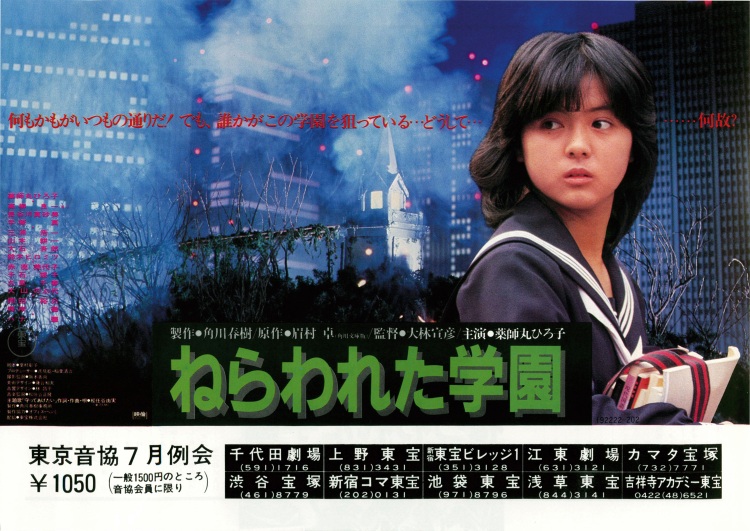
School in The Crosshairs (ねらわれた学園, Nobuhiko Obayashi, 1981)

Still most closely associated with his debut feature Hausu – a psychedelic haunted house musical, Nobuhiko Obayashi’s affinity for youthful subjects made him a great fit for the burgeoning Kadokawa idol phenomenon. Maintaining his idiosyncratic style, Obayashi worked extensively in the idol arena eventually producing such well known films as The Little Girl Who Conquered Time (starring Kadokawa idol Tomoyo Harada) and the comparatively less well known Miss Lonely and His Motorbike Her Island (starring a very young and extremely skinny Riki Takeuchi). 1981’s School in the Crosshairs (ねらわれた学園, Nerawareta Gakuen) marks his first foray into into the world of idol cinema but it also stars one of Kadokawa’s most prominent idols in Hiroko Yakushimaru appearing just a few months before her star making role in Shinji Somai’s Sailor Suit and Machine Gun.
Set once again in a high school, School in the Crosshairs is the ultimate teen movie for any student who’s ever suspected their place of education has been infiltrated by fascists but no one else has noticed. Top student Yuka (Hiroko Yakushimaru) is the archetypal Obayashi/idol movie heroine in that she’s not only bright and plucky but essentially good hearted and keen to help out both her friends and anyone else in trouble. Her life changes when walking home from school one day with her kendo obsessed friend Koji (Ryoichi Takayanagi) as the pair notice a little kid about to ride his tricycle into the path of a great big truck. Yuka, horrified but not quite knowing what to do, shouts for the little boy to go back only it’s time itself which rewinds and moves the boy out of harm’s way. Very confused and thinking she’s had some kind of episode, Yuka tests her new psychic powers out by using them to help Koji finally win a kendo match but when a strange looking man who claims to be “a friend”  (Toru Minegishi) arrives along with icy transfer student Takamizawa (Masami Hasegawa), Yuka finds herself at the centre of an intergalactic invasion plot.

Many things have changed since 1981, sadly “examination hell” is not one of them. Yuka and Koji still have a few years of high school left meaning that it’s not all that serious just yet but still, their parents and teachers have their eyes firmly on the final grades. Yuka is the top student in her class, much to the chagrin of her rival, Arikawa (Macoto Tezuka), who surpasses her in maths and English but has lost the top spot thanks to his lack of sporting ability. Koji is among the mass of students in the middle with poor academic grades but showing athletic promise even if his kendo career is not going as well as hoped.

Given everyone’s obsession with academic success, the aliens have hit on a sure thing by infiltrating a chain of cram schools promising impressive results. Grades aside, parents are largely laissez-faire or absent, content to let their kids do as they please as long as their academic life proceeds along the desired route. Koji’s parents eventually hire Yuka as a private teacher to help him improve only for her to help him skip out to kendo practice. Her parents, by contrast, are proud of their daughter and attentive enough to notice something’s not right but attribute her recent preoccupation to a very ordinary adolescent problem – they think she’s fallen in love and they should probably leave her alone to figure things out her own way. A strange present of an empty picture frame may suggest they intend to give her “blank canvas” and allow her to decide the course of her own life, but she has, in a sense, earned this privilege through proving her responsible nature and excelling in the all important academic arena.

School is a battlefield in more ways than one. Intent on brainwashing the teenagers of Japan, “mysterious transfer student” Takamizawa has her sights firmly set on taking over the student council only she needs to get past Yuka to do it. Takamizawa has her own set of abilities including an icy stare which seems to make it impossible to refuse her orders and so she’s quickly instigated a kind of “morality” patrol for the campus to enforce all those hated school rules like skirt lengths, smoking, and running in the halls. Before long her mini militia has its own uniforms and creepy face paint but her bid for world domination hits a serious snag when Yuka refuses to cross over to the dark side and join the coming revolution. Asking god to grant her strength Yuka stands up to the aliens all on her own, avowing that she likes the world as it and is willing to sacrifice her own life for that of her friends. Accused of “wasting” her powers, Yuka asks how saving people could ever be “wasteful” and berates the invaders for their lack of human feeling. Faced with the cold atmosphere of exam stress and about to be railroaded into adulthood, Yuka dreams of a better, kinder world founded on friendship and basic human goodness.

Beginning with a lengthy psychedelic sequence giving way to a classic science fiction on screen text introduction Obayashi signals his free floating intentions with Yuka’s desaturated bedroom floating over the snowcapped mountains. Pushing his distinctive analogue effects to the limit, Obayashi creates a world which is at once real and surreal as Yuka finds herself at a very ordinary crossroads whilst faced with extraordinary events. Courted by the universe, Yuka is unmoved. Unlike many a teenage heroine, she realises that she’s pretty happy with the way things are. She likes her life (exam stress and all), she loves her friends, she’ll be OK. Standing up for the rights of the individual, but also for collective responsibility, Yuka claims her right to self determination but is determined not to leave any of her friends behind.


Original trailer (no subtitles)

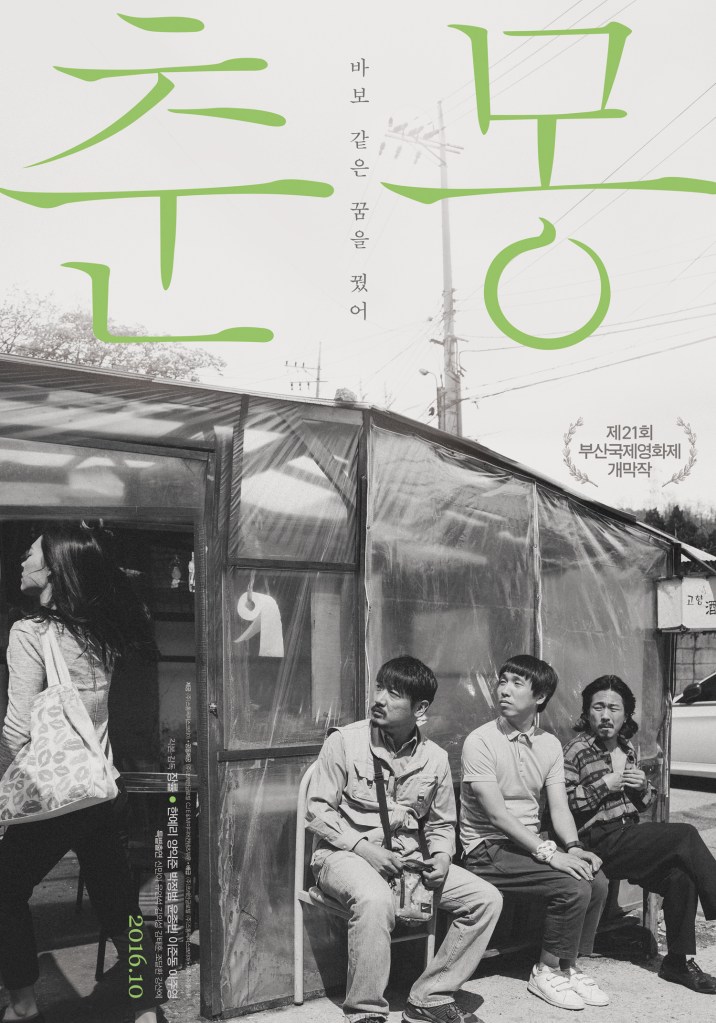
A Quiet Dream (춘몽, Zhang Lu, 2016)

Review of Zhang Lu’s A Quiet Dream (춘몽, Chun-mong) first published by UK Anime Network.
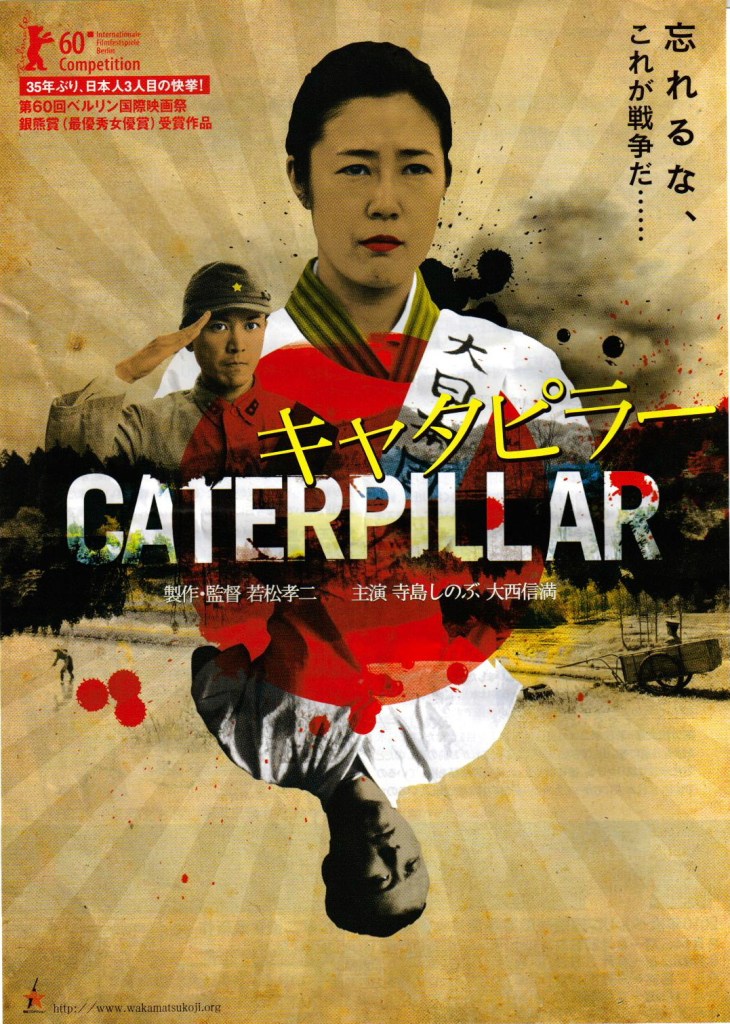

A North Korean defector, a lonely orphan, and a nerdy landlord walk into a bar but also, perhaps, into a dream or several dreams in Zhang Lu’s latest chronicle of lovelorn city dwellers and their eccentric days of tiresome banality. Dreams, reality, and wish fulfilment mingle freely in this run down land of cheerful hopelessness populated by the displaced and permanently fugitive. Zhang’s film is as elusive as it is melancholy but offers its painful meditations with good humour and kindness even if it sees little possibility of escape.

Everyone is in love with pretty barmaid, Yeri (Han Ye-ri). Yeri bears this with good grace as she divides her attentions equally between her three suitors, nervous landlord Jong-bin (Yoon Jong-bin), petty criminal Ik-june (Yang Ik-june), and sorrowful North Korean defector Jung-bum (Park Jung-bum). Having come to Korea as a teenager after her mother died, Yeri tracked down her estranged father only for him to suffer a serious illness requiring round the clock care soon after. When she’s not serving drinks or looking after dad, Yeri spends her time with the three guys, drinking, visiting the Korean Film Archive, or chatting with the romantic teenage poetess (Lee Joo-young) so obviously, painfully, in love with her that Yeri is able to do little other than ignore it in an attempt to let her down gently.

Dreamscape aside, the problems each of the protagonists is facing is real enough. Yeri’s life yields its own sorrows as her heartfelt rendition of Li Bai’s famous ode to homesickness makes plain as do her frequent references to her mother and the quest for a mysterious crater bound lake. Having lost a mother and found a father she loses again when he is taken ill and she is left to care for a man she barely knew in the most intimate of ways. Her burden is a heavy one and her dreams filled with the idea of abandoning it as her father’s wheelchair careers emptily down the hill on which they live. A visit to a fortune teller proves far from reassuring when he informs her that her father will live a long life, but abruptly changes the subject when it comes to a more personal projection.

The three guys could almost be aspects of her own personality turning up to haunt her but each of Yeri’s men (as she later describes them) is battling his own kind of despair. Jung-bum’s is the most pronounced as he battles bipolar disorder and possible PTSD from North Korean labour camps. A refugee with no one to protect him, Jung-bum falls victim to workplace exploitation only be fired because his eyes are “too sad” and it’s bringing his boss down. Ik-june, kinder than anyone gives him credit for, thinks he can help him through his gangland godfather “Mr. Jellyfish” but Ik-june can’t decide how far he really wants to be in the criminal underworld and is in disgrace after laughing at a funeral. Jong-bim lays claim to control over everything in sight as he’s “the landlord” only it’s his father who actually owns the land and Jong-bim is arrested in an almost adolescent sense of powerlessness.

Nevertheless, their days are ones of gentle dreaming as the guys push their luck but refuse to compete for the love of Yeri, preferring to share the unique light she seems to bring into their darkened world. Dreams and reality flow into one another without thought or warning leaving each indistinct as Yeri dances drunkenly on a rooftop only to turn around and find her trio of suitors disappeared, though the surreal characters which people the city including an old lady who collects cans, bottles and cardboard to place outside an old wardrobe on the side of the road which she uses “to pray” might make “reality” a difficult thing to believe in in any case.

Purgatorial as their existence is, the melancholy collective seem to find a comforting symbiosis in their personal miseries. Filming through mirrors and opaque curtains Zhang rejects any idea of certainty or concrete realities. The Chinese characters which accompany the film’s original title effectively mean “short lived illusion”, lending a poetic air to the otherwise surreal goings on, painting this greyed out land as a temporary container for eternal woes. At the film’s end we either wake up or fall asleep, or perhaps merely exchange one dream for another but despite all of the heartache and desperation this strange world is one defined by warmth and basic human goodness.


A Quiet Dream was screened as part of a teaser programme for the London Korean Film Festival. The next screening in the series will be E Oni’s Missing at Picturehouse Central on April 10, 2017. Tickets on sale now directly from Picturehouse.

Original trailer (English subtitles)

Caterpillar (キャタピラー, Koji Wakamatsu, 2010)

Koji Wakamatsu made his name in the pink genre where artistic flair and political messages mingled with softcore pornography and the rigorous formula of the genre. Wakamatsu rarely abandoned this aspect of his work but in adapting a well known story by Japan’s master of the grotesque Edogawa Rampo, Wakamatsu redefines his key concern as sex becomes currency, a kind of trade and power game between husband and wife. Caterpillar (キャタピラー), aside from its psychological questioning of marital relations, is a clear anti-war rallying call as a small Japanese village finds itself brainwashed into sacrificing its sons for the Emperor, never suspecting all their sacrifices will have been in vain when the war is lost and wounded men only a painful reminder of wartime folly.
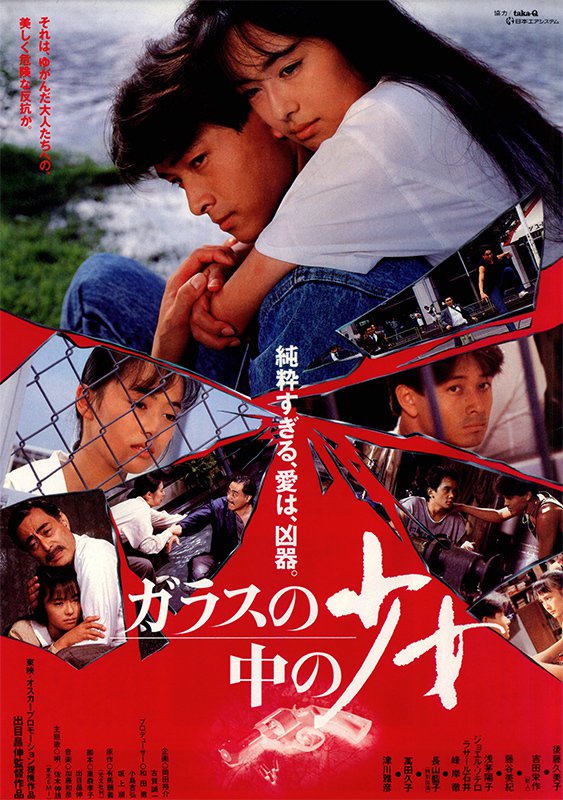
Kyuzo Kurokawa (Shima Onishi) has returned from the war. This makes him luckier than many of the other young men who disappeared from the village over the last few years. His return, however, provokes howls of fear and disbelief from his long suffering wife, Shigeko (Shinobu Terajima), who refuses to believe the creature they’ve brought back from the battlefield is really her husband. Kyuzo has lost all of his limbs, has facial disfigurement from burns, and has also lost his voice and hearing. Sitting across from the remnants of her brother, Shigeko’s sister-in-law remarks that she’s glad they didn’t “send Shigeko back to her family” because she is obviously the one who will have to look after this entirely helpless though apparently conscious battle scarred man.

This being early in the war, the village is in a fury of patriotic zealotry, determined to make Japan glorious again in the name of the Emperor. Far from letting the case of Kyuzo dissuade them from their warlike fervour, his sacrifice becomes a totem. He’s not a man destroyed by war but a “war god” and the pride of the village, a testament to their love and devotion that they would send a son of theirs to war who would return to them even in such a ruined form. Shigeko, quickly getting over her initial revulsion, comes to realise that her husband’s new-found status is also her own. As the wife of the war god, she becomes his voice and mistress in a way she had never been permitted before.

Truth be told, the war did not ruin Kyuzo’s character. The marriage of Kyuzo and Shigeko was never a happy one and perhaps her initial reeling, wailing flight on learning of her husband’s return was more out of fear than disbelief and compassion. Despite a lengthy marriage the couple had no children (perhaps an explanation for that early “sent back” comment), and Kyuzo regularly beat his wife for her failure to bear him a male heir. Now his carer, the roles are reversed as Shigeko babies her defeated husband, lamenting that all he is is urge – sleep, eat, sex. Kyuzo’s needs are animal and definite despite the signs of intelligent communication in his eyes. Shigeko, constrained to satisfy them, bends his need to her own advantage.

Emasculated in a deeper way by Shigeko’s increasing dominance, Kyuzo first attempts to assert himself in resentment at being trotted out to sell the virtues of war in his pristine uniform even as a man destroyed by nationalised violence. Spitting in Shigeko’s face as she dresses him, he attempts to refuse but is powerless to reject her authority. As time wears on and Kyuzo submits to female authority, memories of his atrocities haunt him as the fire which marked his face mingles with the faces of the Chinese women he raped and killed as a brave son of Japan on Manchurian soil.

For Wakamatsu war and sexualised violence are synonymous as the local women train for defending their village by repeatedly penetrating hey bales with long spears crying out patriotic slogans as they go. The flag waving and furore never waver despite the evidence of Kyuzo’s suffering and the numerous young men who will never come home or have done so in square boxes wrapped with white cloth. Only nearing the end is Shigeko left wondering what will become of her war god husband when no one needs a talisman. What will the nation do with these men who’ve sacrificed so much and received nothing in return?

Wakamatsu’s message is an unmistakably anti-war one though the curious inclusion of the executions of the lower class war criminals “hanged by the country they fought to protect” almost undercuts it even if his sympathy lies with those who succumbed to a national madness and have been made to pay a personal price. Kyuzo becomes the literal caterpillar of the title, taunted by Shigeko as he writhes and crawls around, condemned to eternal undulation, but it’s Shigeko who has been in a chrysalis all this time waiting to emerge from the fear and tyranny which has marred her married life into something with more freedom and autonomy – much like a nation waking up and realising that its Emperor is just a man and the long years of suffering nothing more than brainwashed madness.


Original trailer (English subtitles)

The Girl in the Glass (ガラスの中の少女, Masanobu Deme, 1988)

The popularity of idol movies had started to wane by the late ‘80s and if this 1988 effort from Masanobu Deme is anything to go by, some of their youthful innocence had also started to depart. Starring Kumiko Goto, only 14 at the time, The Girl in the Glass (ガラスの中の少女, Glass no Naka no Shojo) is an adaptation of a novel by Yorichika Arima which had previously been filmed all the way back in 1960 starring another idol starlet – Sayuri Yoshinaga. Given a new, modern twist for the very different mid-bubble era, the 1988 edition of the familiar rich girl falls for poor boy narrative is no less tragic than it ever was. Gone is the cheerful, carefree invincibility of youth – The Girl in the Glass is a painful lesson in loss of innocence in which the forces of authority will always betray you but in the end you will betray yourself.
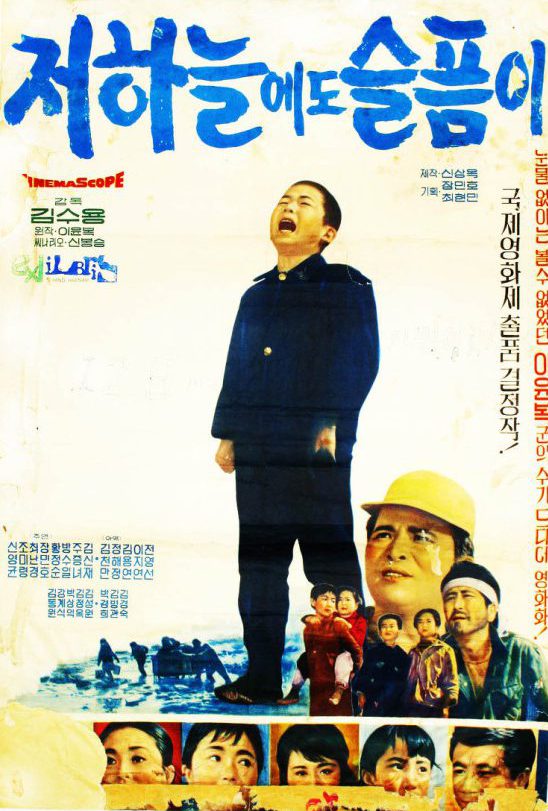
Middle schooler Yasuko (Kumiko Goto) has a very busy life. Accordingly, she maintains a coin locker at the station in which she keeps all the equipment she needs for her after school clubs which range from fencing to piano and cram school. Fiddling with the key one day she finds herself chatting with a rough young man who abruptly gives her something wrapped up in newspaper to stash in her locker with the instruction to meet him back there at nine to return it. Yasuko’s step-mother is a very strict woman who demands absolute punctuality and so Yasuko leaves a note to the effect that she’s taken the boy’s package home and will return it another time.

This is a big problem for the boy, Yoichi (Eisaku Yoshida), because the package contains a gun that some criminal types are quite keen to get back. After their factory closed, Yoichi and his Filipino friend have been forced into the fringes of the criminal underworld to make ends meet. Crafting pistols or adapting toy guns to fire real bullets, the boys are engaged in some shady stuff. Regretting his decision to get a random schoolgirl involved in all of this, Yoichi needs to get his gun back but also finds himself growing closer to Yasuko, particularly as he accompanies her on a personal journey to discover a few painful family truths.

Made the same year as Memories of You, The Girl in the Glass once again casts Goto as a spiky though eventually tragic heroine, unable to withstand the forces of time and society to fulfil her true love dream. The daughter of a prominent politician who is often absent for long stretches of time, Yasuko is devoted to her father though suspicious and hostile towards her noticeably cold step-mother. Her life is a tightly ordered one of swanky private school days followed by a series of clubs befitting an upper class girl, after which she is to return straight home lest she incur the wrath of her step-mother.

Yasuko, however, is getting to the age where doing what she’s told without question is no longer appealing. Yoichi’s appearance is then not an altogether unexpected development, but this very ordinary pull away from her overbearing family environment also coincides with its implosion as a chance telephone call tips Yasuko off to a long buried family secret. Yasuko’s father, so apparently doting on his pretty daughter, is forever the politician – cold, calculating and willing to sacrifice anything and everything for his political career.

Spouting nonsense about family values from the top of a bus with the resentful Yasuko made to stand beside him, Yasuko’s father is perhaps the symbol of a growing threat of a profligate and self centred authority whose selfishness and coldhearted austerity is already wreaking havoc on those who are excluded from Japan’s new found prosperity. Yoichi, fatherless, lives a typical working class life with his mother and younger sister. He’s left school but the factory where he worked has closed down and there are few other jobs for a high school graduate in these fast moving times. The family have taken in a Filipino friend, Jose, who also worked at the factory but is technically in the country illegally as his visa has expired. Yoichi has pulled Jose into the gun making business as a way to make ends meet, but even if the two are essentially nice kids making bad decisions, their accidental criminality will come back to haunt them.

About halfway through The Girl in the Glass, Yasuko and Yoichi end up on the run together. Holed up in Yasuko’s family summerhouse the pair enjoy a taste of domesticity as Yoichi cooks breakfast for an upperclass girl whose only culinary experiences have been in home-ec class, but their romantic dream is short lived. A stupid, pointless and tragic end, Deme dares to include the bizarrely silly outcome to a mad dash declaration of love which every viewer fears yet never believes will occur. The abrupt transition from romance to tragedy is not altogether successful as Yasuko’s coming of age takes on all of its painful, unforgivable wounds. Leaving on a note of total bitterness, there is no hope left for Yasuko, romantic love fails and familial love betrays. Strangely unforgiving, The Girl in the Glass lets no one off the hook from the corrupt politician, to the poor boy with empty pockets and a head full dreams, and the hardworking foreigner who finds himself caught up in someone else’s drama, but least of all Yasuko who is left with nothing more than the knowledge that she herself has been a prime motivator in all her suffering.


Sorrow Even Up in Heaven (저 하늘에도 슬픔이, Kim Soo-yong, 1965)

It’s a sorry enough tale to hear that many silent classics no longer exist, regarded only as disposable entertainment and only latterly collected into archives and preserved as valuable film history, but in the case of South Korea even mid and late 20th century films are unavailable thanks to the country’s turbulent political history. Though often listed among the greats of 1960s Korean cinema, Sorrow Even Up in Heaven (저 하늘에도 슬픔이, Jeo Haneuledo Seulpeumi) was presumed lost until a Mandarin subtitled print was discovered in an archive in Taiwan. Now given a full restoration by the Korean Film Archive, Kim’s tale of societal indifference to childhood poverty has finally been returned to its rightful place in cinema history but, as Kim’s own attempt to remake the film 20 years later bears out, how much has really changed?

11 year old Yun-bok has been forced out of his home and into a makeshift hovel near the river thanks to his gambling addicted invalid father’s inability to look after his four now destitute children. Yun-bok likes to narrate his life as a kind of letter to his absent mother who seems to have abandoned the family for unclear reasons possibly related to her husband’s drinking and gambling problem. Attending school as normal in an attempt to work hard and get an education so he can take care of the family in an adult world, Yun-bok, along with his younger sister Sun-na, spends his free time selling sticks of gum in the streets to try and earn enough money to feed everyone before his father drinks and gambles it all away.

Despite his obviously difficult circumstances, Yun-bok remains steadfast in his desire to stick by his family and take care of his siblings. Berated by the teacher for arriving late, Yun-bok finds an ally in a schoolmate who just wants to help even though many of the others shun him because of his raggedy clothes and lice infested hair. Eventually a teacher notices Yun-bok’s distress and urges him to write his struggles in a diary – which he does much as he’d been narrating his days in his imagined conversations with his mother. Moved by Yun-bok’s heartending descriptions of his life on the starvation line, the teacher manages to get the diaries to the newspapers who begin publishing them as a public interest column but just when it looks as if things maybe looking up for the family, Yun-bok loses heart and hops a freight train to look for Sun-na who has run away from home after an argument.

Korea in the 1960s was a difficult place, still bearing the scars of both WWII and the Korean War not to mention the resultant political turmoil. Nevertheless, by 1965 things had begun to pick up as seen in the flip side to Yun-bok’s sorry state of affairs – the various bars and drinking establishments he manages to work his way into in order to sell a few more sticks of gum. These places are filled with the sound of popular music where affluent young couples dance The Twist and salarymen in dark suits cement their business relationships over drinks. For some, everything is going fine but a concerted effort is being made to unsee the kind of unpleasantness which lurks below growing economic prosperity as manifested by 11 year old boys somehow responsible for the maintenance of a family of five.

As one teacher puts it, you can’t break the mirror because you don’t like what you see. Though there are some willing to help Yun-bok (at least to an extent) including his school friend who comes from a well to do family only too glad to set some food aside for Yun-bok and his siblings, out in the real world he finds only other desperate people willing to stoop to theft and violence against a child for nothing more than a few pennies. Many of these episodes are distressing as Yun-bok has his shoeshine kit stolen by an older boy or is violently beaten by a grown man at the harbour but the most serious occurs in the city when he is accused of pickpocketing by some louts who kidnap him and strip him naked for otherwise unclear reasons.

Though Sorrow Even Up in Heaven has a broadly positive ending as Yun-bok’s circumstances seem set to improve thanks to his accidental fame, Kim is quick to point out that there are many Yun-boks out there who can’t all become media sensations. Like many child heroes of classic Korean cinema, Yun-bok remains morally good – the idea of theft occurs to him but he remembers his teacher saying that everything will work out as long as his heart is pure, and his only transgression lies in spending a few pennies on himself to get something to eat and thereby work harder for his family (and for this he pays a heavy price). Even so his circumstances are portrayed in a naturalistic rather than melodramatic fashion neatly undercutting the inherent sentimentality of the material. Though Kim’s approach is closer to neorealism in the early scenes, he mixes in touches of magical realism with the ghostly appearances of Yun-bok’s mother which, alongside impressive montage and superimposition sequences, lend Yun-bok’s story an elevated cinematic quality. Remade several times over the last forty years, Sorrow Even up in Heaven remains sadly timeless in its depiction of an earnest young boy who knows only kindness and honesty even while those around him remain wilfully indifferent or actively cruel in the face of his continued suffering.


West North West (西北西, Takuro Nakamura, 2015)

This area has a weird magnetic field, claims one of the central characters in Takuro Nakamura’s West North West (西北西, Seihokusei), it’ll throw you off course. Barriers to love both cultural and psychological present themselves with almost gleeful melancholy in this indie exploration of directionless youth in modern day Tokyo. Three young women wrestle with themselves and each other in a complex cycle of interconnected anxieties as they attempt to carve out their own paths, each somehow aware of the shape their lives should take yet afraid to pursue it. The Tokyo of West North West is one defined by disconnection, loneliness and permanent anxiety but it is not the city which is the enemy of happiness but an internal unwillingness to find release from self imposed imprisonment.

After beginning with the twilight scene of a city in fog, Nakamura cuts to Iranian student Naima (Sahel Rosa) leaving the visa bureau with something on her mind. An attempt to call a friend strikes out when she discovers her with her fellow Chinese students busily chatting away in a language she does not understand. Taking refuge in a coffee shop, Naima spots another similarly depressed woman silently crying at a table in the very back corner.

Striking up a conversation, the two women unexpectedly begin a tentative friendship but Kei (Hanae Kan) has problems of her own. Trapped in a toxic relationship with fashion model Ai (Yuka Yamauchi) whose possessive, jealous, and entirely self-centred behaviour have turned her into a nervous wreck, Kei is acutely preoccupied with her lack of forward motion, feeling as if she’s just been somehow pushed out into the world with no clear idea of what it is she’s supposed to be doing.

Kei and Naima have much more in common than it might at first seem. Culturally displaced, Naima is at odds with her surroundings despite her native level language abilities but she finds a kind of ally in the taciturn Kei when an emotional outburst in the cafe causes commotion with an unpleasant fellow customer who objects either to the “inappropriate” loudness of her phone call or that it’s in another language. Naima is a retiring sort and mortified to have caused a fuss but Kei, coming to her rescue, is bored with accepting other people’s intolerance. Having felt so alone, pushed away from her only other real friend by an impenetrable barrier of culture and language, someone arriving and actively taking her side is an almost miraculous development.

Bonding instantly in their shared melancholy, the two women share a deepening sense of recognition as Naima begins spending more time with Kei, sleeping on her sofa and getting her to look after the pet bird which she refuses to name so that it will hurt less when they are eventually forced to part. Kei’s prejudices and preconceptions are pushed by Naima’s fierce attachment to her religion, but her eventual decision to casually state that she has a girlfriend meets with only mild surprise rather than rejection or moral questioning. Attempting to clarify Kei’s vague reply, Naima asks directly if Kei is a “lesbian” only for her to irritatedly deny the label – it’s just that she only falls in love with women, she says. Naima’s reasoned response that that’s pretty much the definition of “lesbian” leads to Kei quickly exiting the scene in confusion, not wanting to pursue this line of thought any further though it perhaps sends Naima in exactly the opposite direction.

Kei’s intense insecurity regarding her sexuality is one reason she seems to find it so hard to break things off with high maintenance girlfriend Ai despite her obvious unhappiness with the relationship. Ai, a low level fashion model, has a series of intense insecurities of her own though these have less to do with sexuality and more with power and control. Having realised that Kei is not as attached to her as she is to Kei, Ai’s jealous rages have Kei in a permanent state of fear from which she attempts to hide at a local pool only to have a full blown panic attack on receiving an unexpected phone call from her girlfriend.

An awkward hospital waiting room conversation with Ai’s mother explains much of her behaviour as she begins to lay out the various failings of her child and desire for her to give up modelling and live a “normal” life. Ai had not shared the fact that her lover was another woman, leaving her mother to feign politeness even whilst feeling he need to voice her “disgust” that her child had “these kinds of feelings”. Indifferent to Kei’s ongoing discomfort, Ai’s mother has a few home truths for the woman who’s corrupted her daughter, advising her to break up with Ai as soon as possible seeing as the relationship is doomed to failure.

In principle, Ai’s mother might have offended Kei but she has to concede that she has a point. Kei is not happy with Ai, but Ai will not let her go. Ai’s jealousy is both the catalyst and barrier for Kei’s growing feelings for Naima as she seeks a kindred spirit and gentle soul in refuge from Ai’s emotional violence. An awkward dinner party between the two makes plain the degree to which they are ill suited when Ai berates the sullen Kei for a lack of emotional readability ironically missing that Kei needs someone to understand her feelings instinctively – a level of connection on which self-centred Ai is ultimately unwilling to engage.

Ai’s attempt to warn off Naima in a worryingly threatening “stay away from my girl” speech eventually forces her to confront her own feelings and what exactly Kei is to her. Both women are repeatedly asked to provide a definition of their relationship, faltering each time, but Naima’s crisis runs deeper as she’s forced to confront herself on a more profound level. A group job interview provokes an unexpected moment of introspection as she’s cruelly asked what exactly she’s learned during her time in Japan and is thrown into silence before admitting that she does not know. Naima may indeed have learned or perhaps confirmed a few things about herself, but if she has she is still unable to accept them.

Beautifully played by Sahel Rosa, Naima’s isolation is palpable in her pain filled eyes and longing looks as she finds herself captivated by the more certain yet diffident Kei. Hanae Kan’s Kei is equally trapped within herself, essentially kind yet reserved, afraid to break things off with the controlling Ai yet confused by her growing feelings for the increasingly conflicted Naima. Returning to the fog filled cityscape, Nakamura leaves things as he finds them, refusing resolution as each of the central characters compromises themselves in one way or another, settling for something that seems “right” but feels essentially wrong. The melancholy greyness of a wintery sunset descends once again, leaving each of the three women rudderless but with an added burden of self knowledge tinged with regret and sorrow.


Reviewed at BFI Flare 2017.

Original trailer (English subtitles)

If you happen to understand either Japanese or German there’s an interesting video interview with director Takuro Nakamura produced for the Munich Film Festival: