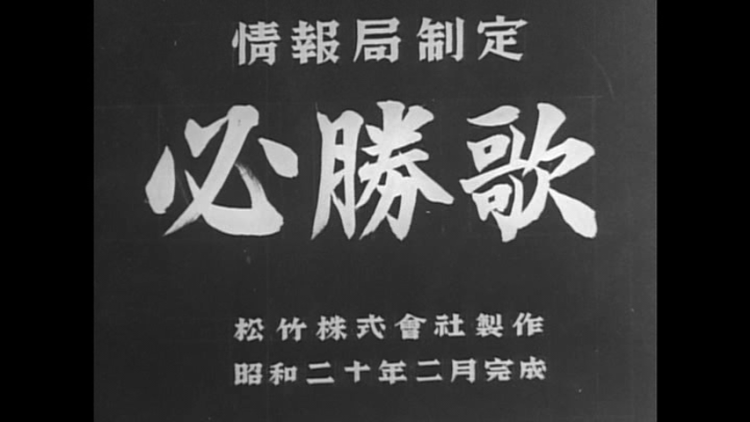
Victory Song (必勝歌, Masahiro Makino, Kenji Mizoguchi, Hiroshi Shimizu, Tomotaka Tasaka, Tatsuo Osone, Koichi Takagi, Tetsuo Ichikawa, 1945)

vlcsnap-2017-08-01-00h21m20s082Completed in 1945, Victory Song (必勝歌, Hisshoka) is a strangely optimistic title for this full on propaganda effort intended to show how ordinary people were still working hard for the Emperor and refusing to read the writing on the wall. Like all propaganda films it is supposed to reinforce the views of the ruling regime, encourage conformity, and raise morale yet there are also tiny background hints of ongoing suffering which must be endured. Composed of 13 parts, Victory Song pictures the lives of ordinary people from all walks of life though all, of course, in some way connected with the military or the war effort more generally. Seven directors worked on the film – Masahiro Makino, Kenji Mizoguchi, Hiroshi Shimizu, Tomotaka Tasaka, Tatsuo Osone, Koichi Takagi, and Tetsuo Ichikawa, and it appears to have been a speedy production, made for little money though starring some of the studio’s biggest stars in smallish roles.

The first scenes make plain the propagandistic intentions by starting in 660BC with a pledge of protection for the descendants of Amaterasu – ancestral mother goddess of Japan. Flash forward to 1941 and her sons are doing their best. Stock footage gives way to soldiers in the Asian jungle, taking a brief respite from the fighting to console each other with thoughts of home which is presumably where most of these small stories of resilience come from.

The soldiers appear to come from all backgrounds, the youngest of them seeming to be just a young boy whose strongest memory of home is his mother’s face. They chat cheerfully about their hometowns, never betraying any sense of fear, boredom or fatigue but the commander suddenly announces that they’re all “going home” until the next attack – taking a brief voyage of memory back to the motherland.

Within this framing sequence, the ordinary people of Japan go about their ordinary lives with cheerful forbearance. A young man cares for his parents after his older brother has given his life for the Emperor, serving on the home front by working himself so hard there’s a danger of going overboard and rendering himself out of action. His father argues that as long as everyone in Japan works as hard as they can, they can never be defeated. Community comes to the rescue again when a train gets stuck in the snow and the entire village gets out of bed to free it.

While the adults are giving it their all, the children are preparing to become fine subjects of the Emperor, training their minds and bodies to be of the most use whilst singing patriotic songs and performing military drills. Another segment finds the children praising their parents for their bravery, playing and roughhousing like any children would, but a hint of darkness emerges when a group of boys plays at war with their toy aeroplane. One little boy, Yuichi, has applied for the young pilots school without talking it over with his parents because he didn’t want them to be sad about him going away. His father, at least, is proud of him but upset at not being consulted. Practically measuring him up for the uniform, Yuichi’s father marvels at all the “young pilots” in the village – a chilling note seeing as none of these boys can be more than ten years old.

While the men go to war the women are at home waiting. Another persistent question relates to the fate of unmarried women – a positive motion for an arranged engagement is disrupted by the receipt of a draft card, prompting the male side to suggest they call the whole thing off. The woman, however, points out that every young man is in this position and she doesn’t see the point in expecting the worst. Life must go on, women must get married, and men must go to war. All of these things must be accepted without thinking too hard about it or there will be nothing for these gallant men to come home to.

The difficulties of wartime life extend to the fear and destruction of air raids, though a news report of the fire bombing of Tokyo reminds us that it could all have been much worse if it weren’t for the valiant efforts of the pilots and ground based defence forces keeping the threat from the skies at a minimum. Other reports detail dive bombing of hospital convoys while the wounded die happily knowing they’ve done their duty. Likewise the “special attack squad” prepare to meet their fates with stoicism and determination while their relatives are treated with especial esteem.

Interspersed with the vignettes and stock footage there are songs and dances bringing both entertainment and inspiration. The final message is one of resilience and unity, that Japan stands together to defend its ancient homeland in devotion to its Emperor, but then such a message would hardly be necessarily if the situation were brighter. Brief allusions are made to rationing, to the destruction and constant loss of life but these are all things which must be born for the glorious future. There is, however, much more stock put in remaining positive than there is in trying to deny the ongoing desperation. As propaganda films go, this one may backfire but does perhaps shine a light on the unspoken anxieties of ordinary people facing an extraordinary situation.


Final scenes including the “Victory Song” itself

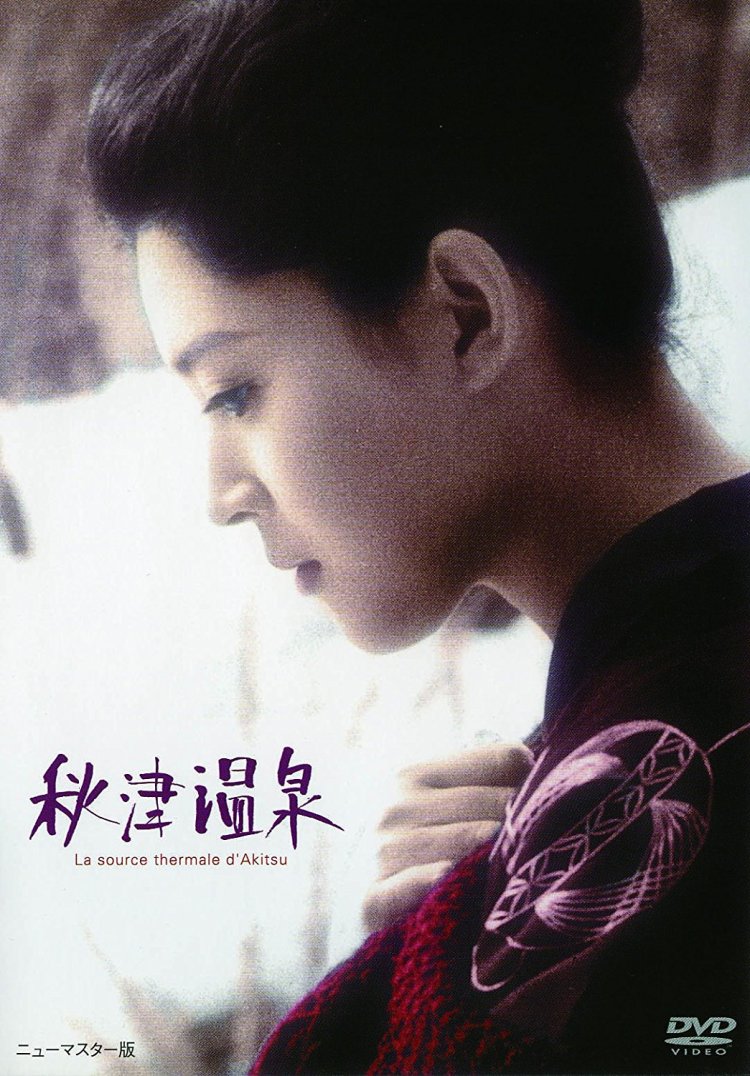
Akitsu Springs (秋津温泉, Kiju Yoshida, 1962)

akitsu springsKiju (Yoshishige) Yoshida is best remembered for his extraordinary run of avant-garde masterpieces in the late 1960s and early 1970s, but even he had to cut his teeth on Shochiku’s speciality genre – the romantic melodrama. Adapted from a best selling novel, Akitsu Springs (秋津温泉, Akitsu Onsen) is hardly an original tale in its doom laden reflection of the hopelessness and inertia of the post-war world as depicted in the frustrated love story of a self sacrificing woman and self destructive man, but Yoshida elevates the material through his characteristically beautiful compositions and full use of the particularly lush colour palate.
At the very end of the war, consumptive student Shusaku (Hiroyuki Nagato) finds his aunt’s house destroyed by aerial bombing. Attempting to find her but proving too ill to go on, Shusaku is taken to a nearby inn by a good samaritan where he first encounters the innkeeper’s daughter, Shinko (Mariko Okada). Despite her mother’s protestations, Shinko takes a shine to Shusaku and is determined to nurse him back to health. Shusaku, however, is a gloomy sort of boy and, ironically, longs only for death. Though the pair fall in love their youthful romance is forever tinged with darkness as Shusaku declares his love not with a ring but with a rope – he asks Shinko for that most classically theatrical of unions in proposing a double suicide.

Shinko agrees, but is not quite ready to die. In another dose of irony, Shinko’s tears of fear and despair on hearing the Emperor’s final wartime broadcast confirming his surrender inspire Shusaku to want to live but the pair are eventually separated. Reuniting and parting over and over again, their complicated love story repeats itself over a period of seventeen years but the painful spectre of the past refuses to allow either of them the freedom to move beyond Akitsu Springs.

Mariko Okada was only 29 in 1962, but she’d already worked with some of the best directors of the age including Ozu whose An Autumn Afternoon was released the same year, and Naruse in Floating Clouds which has something of a narrative similarity to Akitsu Springs. This prestige picture was her 100th screen appearance for which she also took a producer credit. Despite the obvious importance attached to both of these elements, the studio took a chance on a rookie director with only three films under his belt. Two years later Okada would become Yoshida’s wife and go on to star in some of his most important pictures including Eros + Massacre and Heroic Purgatory. At first glance her role here is a conventional one – a love lorn, melancholy woman unable to let the ghost of a failed romance die, but Okada’s work is extraordinary as Shinko travels from flighty teen to rueful middle aged woman, hollowed out and robbed of any sense of hope.

At Akitsu Springs time passes and it doesn’t all at once. Yoshida refuses to give us concrete demarcations, preferring to simply show a child being born and growing older or someone remarking on having been away. The inn becomes a kind of bubble with Shinko trapped inside, but Shusaku comes to regard the place as a temporary haven rather than a permanent home or place to make a life. For her everything real is at the spring, but for him everything at the spring is unreal – an unattainable paradise. She cannot leave, he cannot stay. Only for short periods are they able to indulge their romance, but the time always comes at which they must part again often swearing it will be for the last time, never knowing if it will.

Yoshida neatly bookends the relationship with announcements over loudspeakers as Shinko originally fails to understand the Emperor’s speech in which he remarks on enduring the unendurable, only to be prompted into later action by the banal drone of a train station tannoy. It’s almost as if their lives are being entirely dictated by outside forces, powerless drifters in the post-war world, condemned to a perpetual waiting sustained only by hopelessness.

Shinko may have convinced Shusaku to live but his growing successes only seem to deplete her. Wasting away at an inn she always claimed to hate, Shinko grows old while Shusaku grows bitter yet successful in the city. They move past and through each other, unable to connect or disconnect, yearning for the completion of something which consistently eludes them. Yoshida films the standard melodrama with appropriate theatricality but also with his beautifully composed framing as the lovers are divided by screen doors or captured in mirrors. Okada glows in the light of falling cherry blossoms, acknowledging the tragic and transitory character of love, but her final action is one which echoes the beginning of her suffering and finally declares an ending to an unendurable romance.


Original trailer (no subtitles)

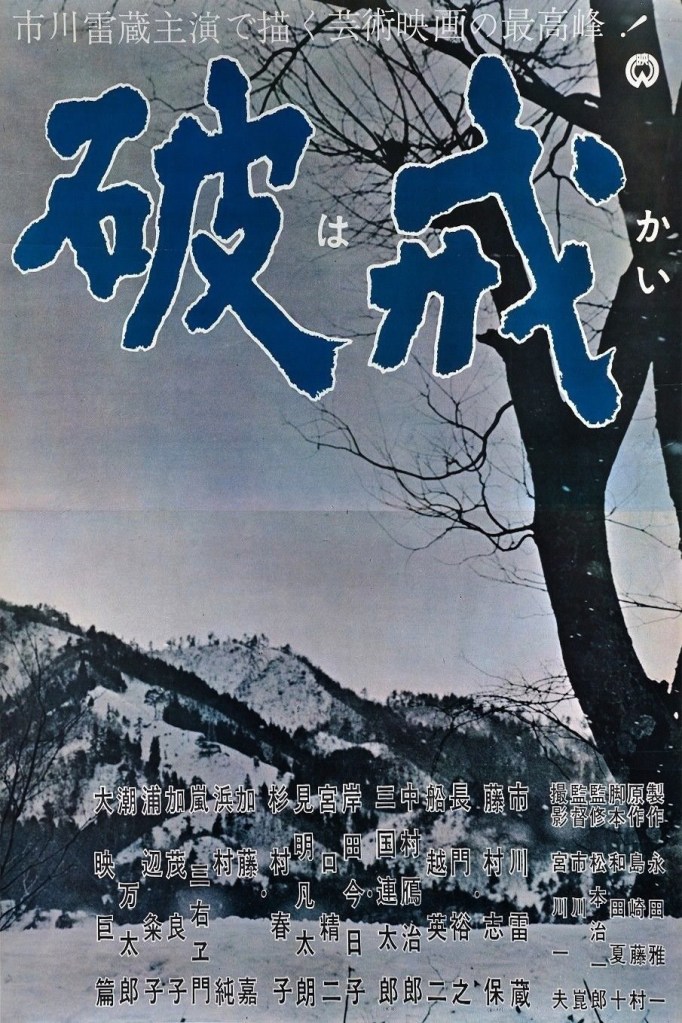
The Outcast (破戒, AKA The Broken Commandment, Kon Ichikawa, 1962)

Kon Ichikawa’s approach to critiquing his society was often laced with a delicious slice of biting irony but he puts sarcasm to one side for this all too rare attempt to address the uncomfortable subject of Japan’s hidden underclass – the burakumin. The term itself simply means “people who live in hamlets” but from feudal times onwards it came to denote the kinds of people with whom others did not want to associate – notably those whose occupations dealt in some way with death from executioners and undertakers, to butchers and leatherworkers. Though outright discrimination against such people was outlawed during the Meiji restoration, social stigma and informal harassment remained common with some lingering tendency remaining even today.
The Outcast (破戒, Hakai), adapted from the book by Toson Shimazaki (known as The Broken Commandment in English) is the story of a young man of burakumin lineage who has to hide his true identity in order to live a normal life in the Japan of 1904. Segawa’s father, formerly a village elder, sent his son away to live with his brother and his wife in a distant town where they could better hide their burakumin status to enjoy a better standard of life. Sadly, Segawa’s father dies after being trampled by a recalcitrant bull never seeing his son again and leaving him with the solemn commandment to live as a regular person, never revealing his connection with the burakumin world.

This debt to his father’s sacrifice creates a conflict in the heart of the young and idealistic Segawa (Raizo Ichikawa). Forced to listen to the casual racism all around him and unable to offer any kind of resistance, Segawa has become interested in the writings of a polemical political figure, Rentaro Inoko (Rentaro Mikuni), who has begun to write passionate political treatises advocating for burakumin rights. When Inoko turns up in Segawa’s town, he finds himself a new father figure and political mentor but continues to feel constrained by the debt of honour to his father’s sacrifice and is unable to confess his own burakumin heritage even to Inoko.

The world Segawa lives in is a conservative and stratified one in which old superstitions hold true even whilst hypocritical authorities use and abuse the trust placed in them. Inoko falls foul of local politics after he discovers a politician has married a wealthy burakumin woman solely for her money and is planning to expose him at a political rally. This same politician has already threatened to blackmail Segawa who continues to deny all knowledge of any burakumin related activities whilst failing to quell the eventual gossip surrounding Segawa’s lineage. The gossip causes problems at the school where Segawa had held a prestigious teaching position as the headmaster and school board fear the reaction of the parents. Though the people at the temple where Segawa takes refuge after growing tired of the racist inn owners in town are broadly supportive of the burakumin, the priest there has his own problems after having made a clumsy pass at his adopted daughter, Shio (Shiho Fujimura) – the daughter of a drunken teacher sacked by the school in order to avoid paying him a proper pension. At every turn the forces of authority are universally corrupt, selfish and venal, leaving no safe direction for a possible revolution of social justice to begin.

This is Segawa’s central conflict. After his experiences with Inoko, Segawa begins to want to follow in his footsteps, living out and proud as a burakumin and full time activist for burakumin rights. However, this would be undoing everything for which his father sacrificed so much. Talking things over with Inoko’s non-burakumin wife, Segawa is also presented with a third way – reveal his burakumin heritage and attempt to live honestly as an ordinary person, changing hearts and minds simply through leading a life among many other lives. This option seems attractive, especially as Segawa has fallen in love and would like to lead an ordinary life with a wife and family, but his youthful idealism is hungry for a greater, faster change than the one which will be born through simple integration. Despite the warnings of Inoko’s wife who believes change will occur not through activism but through the passage of time, Segawa decides his future lies in advancing the burakumin cause in the wider world.

When Segawa does choose to reveal himself, he finds that there is far more sympathy and support than he would ever have expected. A woman he has come to love wants to stay by his side, his previously hostile friend rethinks his entire approach to life and apologises, and even the children in his class convince their parents that their teacher is a good and a kind man regardless of whatever arbitrary social distinction may have been passed to him through an accident of birth. Segawa’s conflicted soul speaks not only for the burakumin but for all hidden and oppressed peoples who have been forced to keep a side of themselves entirely secret, faced with either living a lie in the mainstream world or being confined to life within their own community. His choice is one of either capitulation and collaboration, or resistance which amounts to a sacrifice of his own potential happiness in the hope that it will bring about liberation for other similarly oppressed people.

Scripted again by Natto Wada, The Outcast takes a slightly clumsy, didactic approach filled with long, theatrical speeches but does ultimately prove moving and inspiring in advocating for the fair treatment of these long maligned people as well as others facing similar discrimination in an unforgiving world. As a treatise on identity and rigid social attitudes, the film has lost none of its power or urgency even forty years later in a world in which progress has undoubtedly been made even if there are still distances to go.


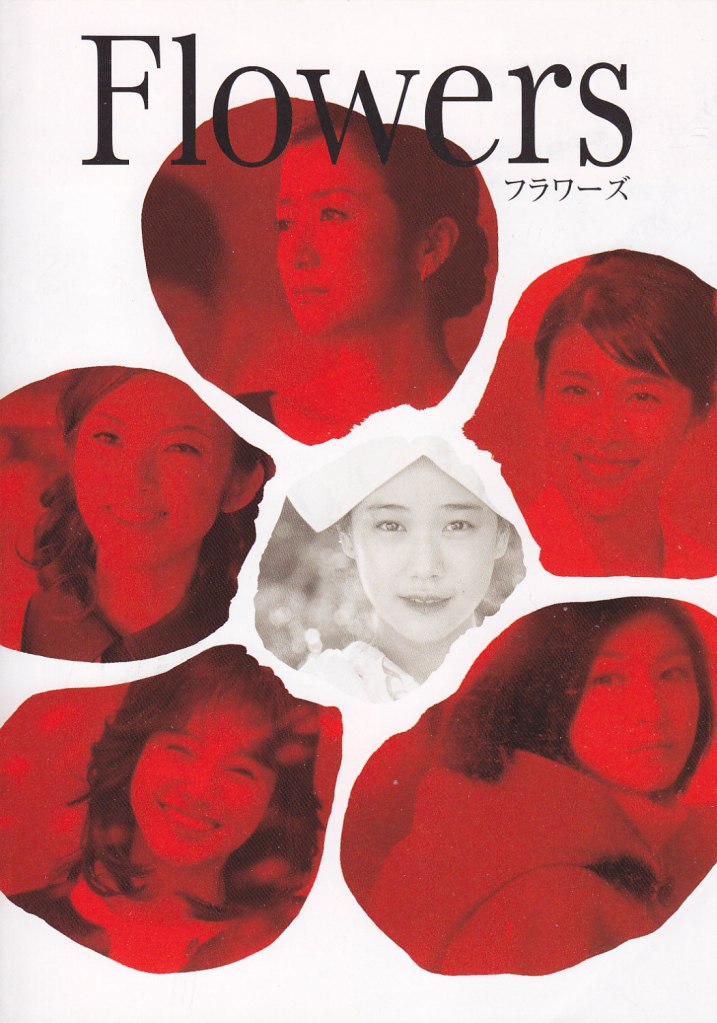
Flowers (フラワーズ, Norihiro Koizumi, 2010)

flowersThe rate of social change in the second half of the twentieth century was extreme throughout much of the world, but given that Japan had only emerged from centuries of isolation a hundred years before it’s almost as if they were riding their own bullet train into the future. Norihiro Koizumi’s Flowers (フラワーズ) attempts to chart these momentous times through examining the lives of three generations of women, from 1936 to 2009, or through Showa to Heisei, as the choices and responsibilities open to each of them grow and change with new freedoms offered in the post-war world. Or, at least, up to a point.
In 1936, oldest sister Rin (Yu Aoi) is to be married off against her will to a man picked by her father and whom she has never actually met. Bold and wilful, Rin finds herself more than usually torn between her intense resentment at being forced into a one time only life changing event simply on her father’s say so, and the guilt of rejecting centuries of tradition in rejecting her father’s authority. Minutes before the ceremony Rin makes a break for it fully done up in her wedding dress and makeup.

Flashing forward to her funeral in 2009, we learn that Rin did marry (someone, at least) and had three daughters. It’s her granddaughters we’re interested in now – happy mother Kei (Ryoko Hirosue), cheerful even at a wake, and the depressed Kanna (Kyoka Suzuki) – an unmarried former concert pianist who’s recently discovered she’s pregnant and is unsure what to do. In order to understand them we have to flashback a little again – to 1969, 1964, and 1977 to find out what happened to Rin’s three daughters – Kaoru (Yuko Takeuchi), Midori (Rena Tanaka), and Sato (Yukie Nakama).

Koizumi makes the most of his shifts in time periods to experiment with technical effects recreating the look of classic films of the era. Hence, 1936 is a desaturated monotone filled with classic silent movie compositions, seemingly owing a large debt to Ozu, Shimizu, and Mizoguchi. The difference between 1964 and 1969 might be thought slight but partly down to the different genre elements in the two vignettes, the contrast is marked with 1964 taking on the classic romantic melodramas of the period, and 1969 embracing bright and colourful salaryman comedy – only this time it’s a salary woman embarking on the era of having it all (though perhaps, tragically, ten too years to early to make the most of it). 1977 brings us back down with bump of realism as Sato lives an ordinary suburban life as a housewife and mother. Imbuing each of his eras with the warmth of nostalgia backed up with rich period detail, Koizumi has indeed framed his passage of womanhood narrative with an impressive degree of grounding.

This has been a period of intense social change, entirely for the better even if there is still a long way to go. Though marriages of 1936 were referred to as semi-arranged, families could and did place intense pressure on their children to consent or refuse to accept their refusal to do so (perhaps as true for sons as daughters, though sons were unlikely to find themselves in such a difficult position when things went wrong). Thus the course of Rin’s life is decided by her rigid, austere father leaving her with no possibility of choice in a world entirely controlled by men. Her daughters have more freedom and opportunities, marrying for love and choosing careers and/or motherhood as they see fit.

Midori, the most headstrong of the three sisters takes a job at a publishing house where she is the only female employee. Receiving a marriage proposal leads her to question her choices once again, wondering if accepting means jumping off the career ladder altogether. Wanting to get ahead, Midori has been behaving like her male colleagues – dressing in less feminine clothes and in subdued colours, heading off the inevitable sexist comments with aggression and violence but, eventually emboldened, she she finds herself blossoming when embracing her femininity within the workplace.

The world has moved on – women cannot be pushed in the same way Rin was pushed even if social mores can still be used to cajole them into conformity. The one big recent social change is in Kanna’s decision to proceed as a single mother. Though the question is still raised, there is broad approval for the idea which is met with no obvious stigma and only love and support from her immediate family. However, some things apparently don’t change as even if not all roads lead to marriage they all point towards motherhood which is still presented as the only marker of success as a woman. In this respect the closing montage accompanied by the odd choice of Olivia Newton John’s Have You Even Felt Mellow feels ill judged as the sister who’s experienced the ultimate heartbreak bounces around recreating the opening of Georgy Girl (only more successfully) with a new haircut and indulging in an ice-cream as a sort of antidote to eternal widowhood.

Nevertheless, Flowers does present a warm and broadly inspirational ode to the healing power of family and unbreakable female resilience even in the midst of such extreme social change. Painted with a keen eye for period detail and a deeply nostalgic longing for comforts long since passed, Koizumi’s exploration of womanhood through the ages is quick to acknowledge the pain and sacrifice experienced by women of all generations but is, in the end, too ready to accept it.


Original trailer (no subtitles)

My Second Brother (にあんちゃん, Shohei Imamura, 1959)

vlcsnap-2017-01-07-22h53m01s073Like most directors of his era, Shohei Imamura began his career in the studio system as a trainee with Shochiku where he also worked as an AD to Yasujiro Ozu on some of his most well known pictures. Ozu’s approach, however, could not be further from Imamura’s in its insistence on order and precision. Finding much more in common with another Shochiku director, Yuzo Kawashima, well known for working class satires, Imamura jumped ship to the newly reformed Nikkatsu where he continued his training until helming his first three pictures in 1958 (Stolen Desire, Nishiginza Station, and Endless Desire). My Second Brother (にあんちゃん, Nianchan), which he directed in 1959, was, like the previous three films, a studio assignment rather than a personal project but is nevertheless an interesting one as it united many of Imamura’s subsequent ongoing concerns.
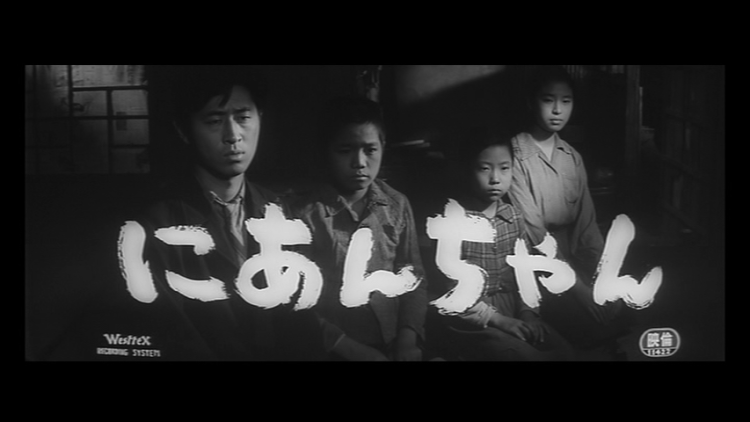
Set in the early 1950s, the film focuses on four children who find themselves adrift when their father dies leaving them with no means of support. The father had worked at the local mine but the mining industry is itself in crisis. Many of the local mines have already closed, and even this one finds itself in financial straits. Despite the foreman’s promise that he will find a job for the oldest son, Kiichi (Hiroyuki Nagato), there is no work to be had as workers are being paid in food vouchers rather than money and strike action frustrates what little production there is. After receiving the unwelcome suggestion of work in a “restaurant” in another town, Yoshiko (Kayo Matsuo) manages to find a less degrading job caring for another family’s children (though she receives only room and board, no pay for doing so). With younger brother Koichi (Takeshi Okimura) and little sister Sueko (Akiko Maeda) still in school, it seems as if the four siblings’ days of being able to live together as a family may be over for good.

Based on a bestselling autobiographical novel by a ten year old girl, My Second Brother is one of the first films to broach the Zainichi (ethnic Koreans living in Japan) issue, even if it does so in a fairly subtle way. The four children have been raised in Japan, speak only Japanese and do not seem particularly engaged with their Korean culture but we are constantly reminded of their non-native status by the comments of other locals, mostly older women and housewives, who are apt to exclaim things along the lines of “Koreans are so shiftless” or other derogatory aphorisms. Though there are other Koreans in the area, including one friend who reassures Kiichi that “We’re Korean – lose one job, we find another”, the biggest effect of the children’s ethnicity is in their status as second generation migrants which leaves them without the traditional safety net of the extended family. Though they do have contact with an uncle, the children are unable to bond with him – his Japanese is bad, and the children are unused to spicy Korean food. They have to rely first on each other and then on the kindness of strangers, of which there is some, but precious little in these admittedly difficult times.

In this, which is Imamura’s primary concern, the children’s poverty is no different from that of the general population during this second depression at the beginning of the post-war period. The film does not seek to engage with the reasons why the Zainichi population may find itself disproportionately affected by the downturn but prefers to focus on the generalised economic desperation and the resilience of working people. The environment is, indeed, dire with the ancient problem of a single water source being used by everyone for everything at the same time with all the resultant health risks that poses. A young middle class woman is trying to get something done in terms of sanitation, but her presence is not altogether welcome in the town as the residents have become weary of city based do-gooders who rarely stay long enough to carry through their promises. The more pressing problem is the lack of real wages as salaries are increasingly substituted for vouchers. The labour movement is ever present in the background with the Red Flag drifting from the mass protests in which the workers voice their dissatisfaction with the company though the spectre of mine closure and large scale layoffs has others running scared.

One of the most moving sequences occurs as Koichi and another young boy ride a mine cart up the mountain and talk about their hopes for the future. They both want to get out of this one horse town – Koichi as a doctor and his friend as an engineer, but their hopes seem so far off and untouchable that it’s almost heartbreaking. Sueko skipped school for four days claiming she had a headache because her brother didn’t have the money for her school books – how could a boy like Koichi, no matter how bright he is, possibly come from here and get to medical school? Nevertheless, he is determined. His father couldn’t save the family from poverty, and neither could his brother but Koichi vows he will and as he leads his sister by the hand climbing the high mountain together, it almost seems like he might.


Danger Pays (危いことなら銭になる, Ko Nakahira, 1962)

Danger PaysWhere there’s danger, there’s money! Or, maybe just danger, who knows but whatever it is, it certainly doesn’t lack for excitement. Ko Nakahira is best known for his first feature, Crazed Fruit, the youthful romantic drama ending in speed boat murder which ushered in the Sun Tribe era. Though he later tried to make a return to more artistic efforts, it’s Nakahira’s freewheeling Nikkatsu crime movies that have continued to capture the hearts of audience members. Danger Pays (AKA Danger Paws, 危いことなら銭になる, Yabai Koto Nara Zeni ni Naru) is among the best of them with its cartoon-like, absurd crime caper world filled with bumbling crooks and ridiculous setups.
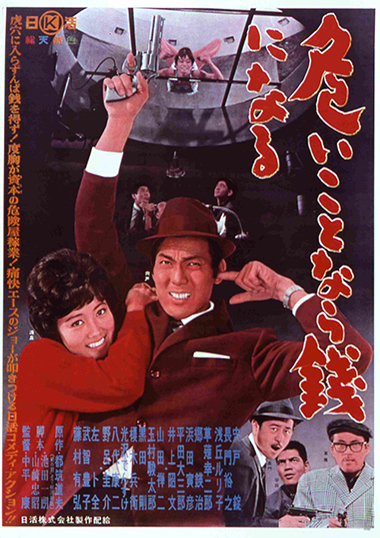
The central plot gets going when a truck carrying watermarked paper destined for the mint is hijacked with force by armed thugs. They need a master forger though so they set out to recruit one of the best counterfeiters currently working on his way back from a business trip to Hong Kong. However, three petty crooks have also gotten wind of the scam and are trying to head off their rivals by kidnapping the old grandpa first.

The three guys are “Glass Hearted Joe” – a purple suited dandy with an aversion to the sound of scraping glass, Slide Rule Tetsu who walks with a cane and is a whizz with the abacus, and Dump-Truck Ken who’s a geeky sort of guy who also owns a dumper truck. Sakamoto, the forger, eludes their grasp when the better equipped professionals turn up, but none of them is willing to give up on the prize. A little later, Joe teams up with a female ally – Tomoko, who is keen martial artist and smarter than the other three put together. Eventually the four end up becoming an accidental team though it remains to be seen if they can really turn this increasingly desperate situation to their advantage.

Danger Pays is in no way “serious” though this is far from a criticism. Armed with a killer script filled with amazing one liners which are performed with excellent comic timing by the A-list cast, Danger Pays is the kind of effortlessly cool, often hilarious crime caper which is near impossible to pull-off but absolutely sublime when it works – which Danger Pays most definitely does. Though there is a large amount of death and bloodiness in the final third, the atmosphere remains cartoonish as our intrepid team of four simply step over the bodies to go claim their prize with only one of them left feeling a little queasy.

Nakahira maintains the high octane, almost breathless pace right through to the end. The finale kicks in with our heroes trying to escape from a locked room which is about to be filled with gas only to be trapped like rats in an elevator shaft where they engage in an improbable shootout whilst bodies rain down on them from above bathed in the red emergency light of the escape vaults. This is a hardboiled world but one cycled through cigar munching wise guys and tommy guns, it’s all fun and games until you’re trapped in a lift knee deep in corpses while blood drips from a couple more dead guys on the ceiling.

Ridiculous slapstick humour and broad comedy are the cornerstones of Danger Pays though it also makes its central crime conceit work on its own only to overturn it with a final revelation even as the credits roll. Excellently played by its four leads, this comic tale of “victimless crime” in the improbably colourful underworld of ‘60s Tokyo is one which is filled with absurd humour, cartoon stunts, and ridiculous characters but proves absolutely irresistible! If only modern day crime capers were this much fun.


Danger Pays is the second of three films included in the second volume of Arrow’s Nikkatsu Diamond Guys box set.

At Noon (正午なり, Koichi Goto, 1978)

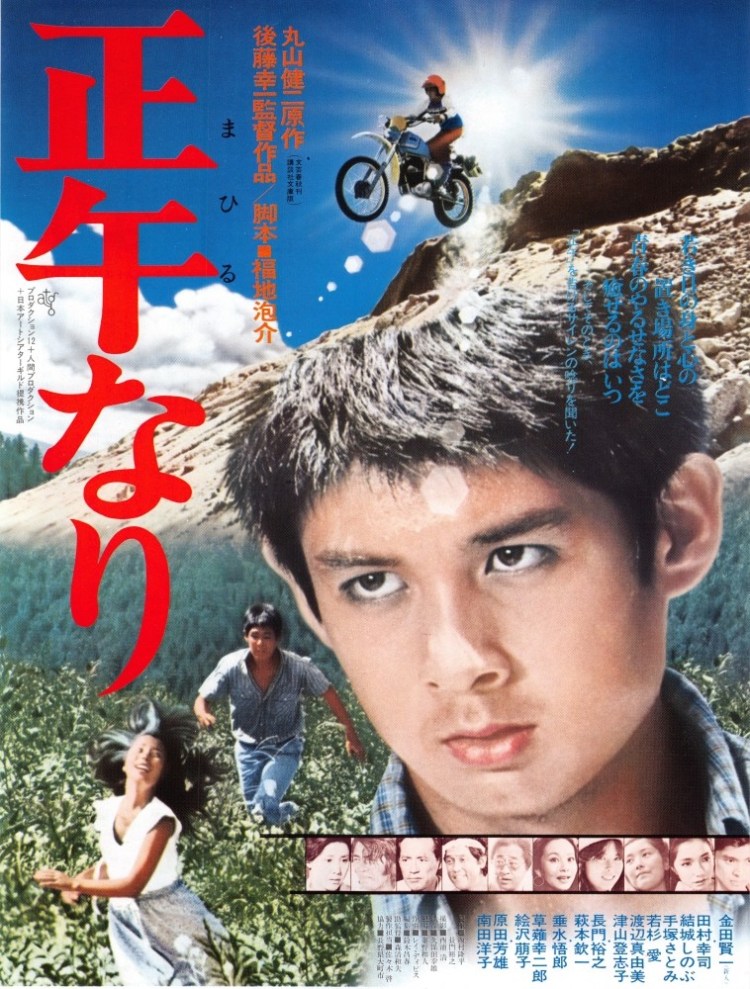
at noonKoichi Goto’s Art Theatre Guild adaptation of Kenji Maruyama’s 1968 novel At Noon (正午なり, Mahiru Nari) begins with a young man on a train. Forlornly looking out of the window, he remains aboard until reaching his rural hometown where he makes a late entry to his parents’ house and is greeted a little less than warmly by his mother. The boy, Tadao, refuses to say why he’s left the big city so abruptly to return to the beautiful, if dull, rural backwater where he grew up.

There’s little work here for a young man, which is why Tadao left in the first place. After using some family connections to try and find a job, he finally decides to make use of his abilities by fixing radios and TV sets for a local electronics store. To begin with he doesn’t want to see his old friend, Tetsuji, perhaps out of a sense of shame at having returned home but the pair later strike up their old friendship – that is, until Tetsuji suddenly announces his plans to run away with a local bar hostess.

It’s never quite revealed what happened to Tadao in Tokyo but it seems to have been something serious enough to change the course of his entire life and send him reeling back home depressed and angry. In many ways he’s a typical young man, if slightly sullen, but he’s developed a serious number of sexual hangups which have turned him into some kind of repressed, misogynistic, pervert. He appears to have made a deliberate decision to dislike the idea of women, or at least the idea of women with sexual appeal. He thinks women are trouble, that no good comes of love, but can’t stop himself from spying on the female tourists staying in an upper room. He’s always looking, staring invasively, but resolved not to touch.

Tadao has already been to the city and evidently found it not quite to his liking but his friend, Tetsuji, feels bored in the village and trapped by his parents who need his help in their orchards. When Tadao realises Tetsuji is taking the hostess with him when he skips town, he asks for the money he just agreed to lend him back and tells him to forget about running away and just to go home. Unfortunately for Tetsuji, Tadao’s advice proves sound as his city dreams don’t work out the way he planned either. To end his frequent attempts to escape, Tetsuji’s family float the idea of an arranged marriage which originally horrifies both boys but after meeting his prospective bride, Tetsuji changes his mind. Tadao doesn’t approve, but after meeting the girl in question and seeing that she is quite lovely changes his mind too and is happy for his friend – that is, until he realises Tetsuji has only introduced him to her as a pretext of getting her on her own to enact his marital rights a little ahead of schedule. This breach of morality proves the final straw for Tadao who does not like the idea of his wayward friend deceiving and then ruining this innocent young flower who’s far too good for him anyway.

Tadao’s fascination with another damaged bar girl, Akemi, continues as the two find themselves both looking at the sad figure of a tethered eagle imprisoned at the local zoo. Akemi says she likes to look at the bird as she feels perhaps somehow that helps him escape. She feels like a caged bird too – trapped in a bad relationship with a useless boyfriend who has a vague plan of turning manure into an energy source while she supports them both by working at a hostess bar and hating every second of it. Tadao feels trapped in a hundred different ways, by his town, by his parents, by whatever happened in Tokyo, and by his own pent-up frustrations. By this point, he’s a one man powder keg ready to explode and after blowing his final safety caps, tragedy is the only possible outcome.

At Noon begins with its epilogue, but uncomfortably frames its protagonist’s despicable final actions with an odd kind of heroism as his head eclipses the sun leaving him with a radiant halo. He may have satisfied himself in some way, put to rest some of that inner turmoil, but what he’s done is something truly dreadful and driven by an intensely animalistic instinct. At Noon may have something to say about the dangers of frustrated young men with no work to go to, no ambition to follow, and no luck with the ladies but displays an oddly ambivalent attitude to its deranged protagonist that makes for often uncomfortable viewing.


By the way, After Noon has music by Ray Davis of The Kinks!

Unsubbed Trailer: