Jungle Block (地図のない町, Ko Nakahira, 1960)

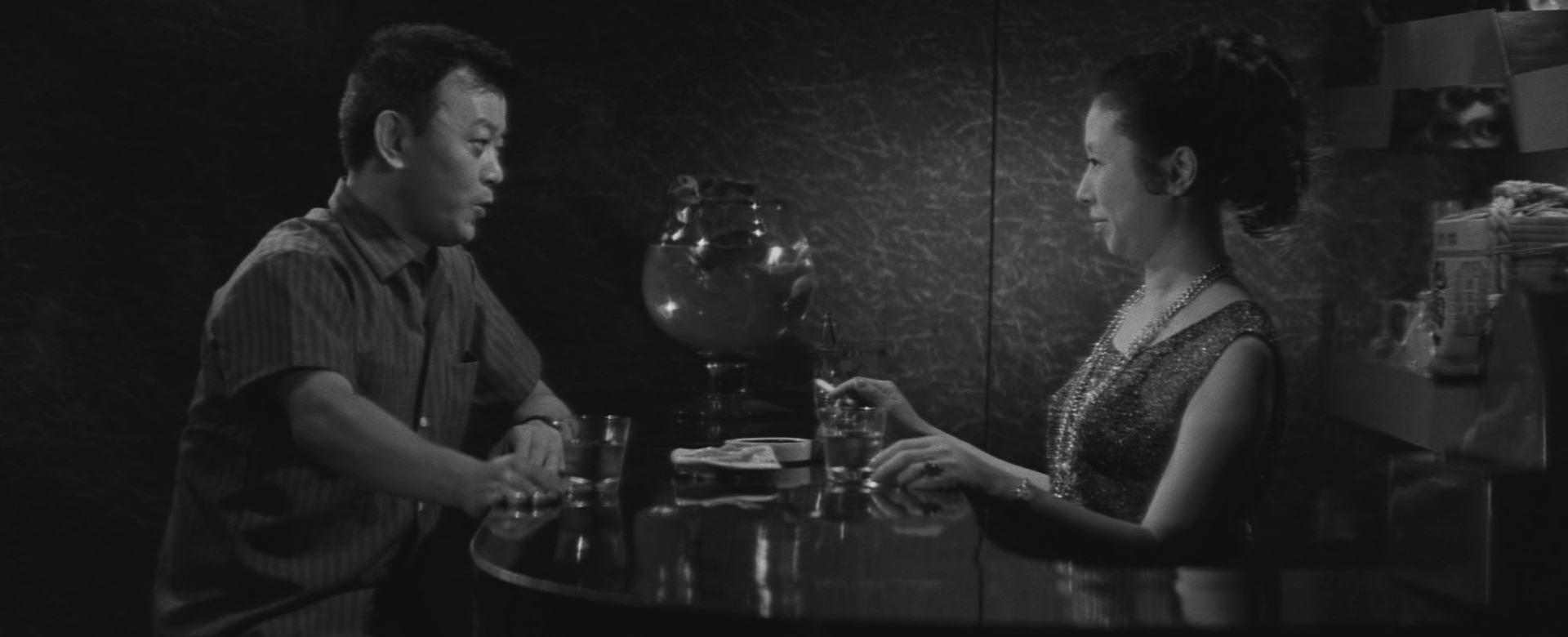
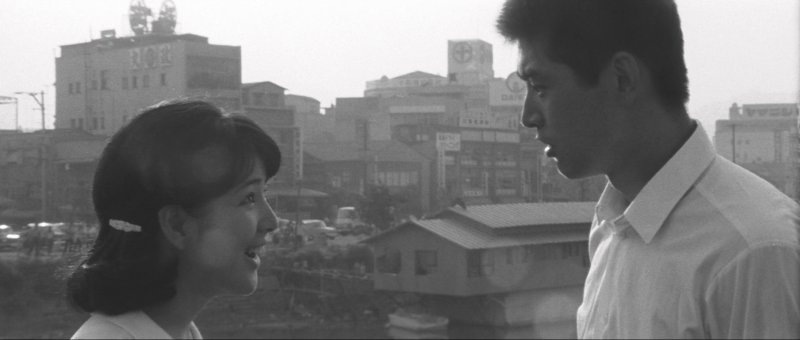
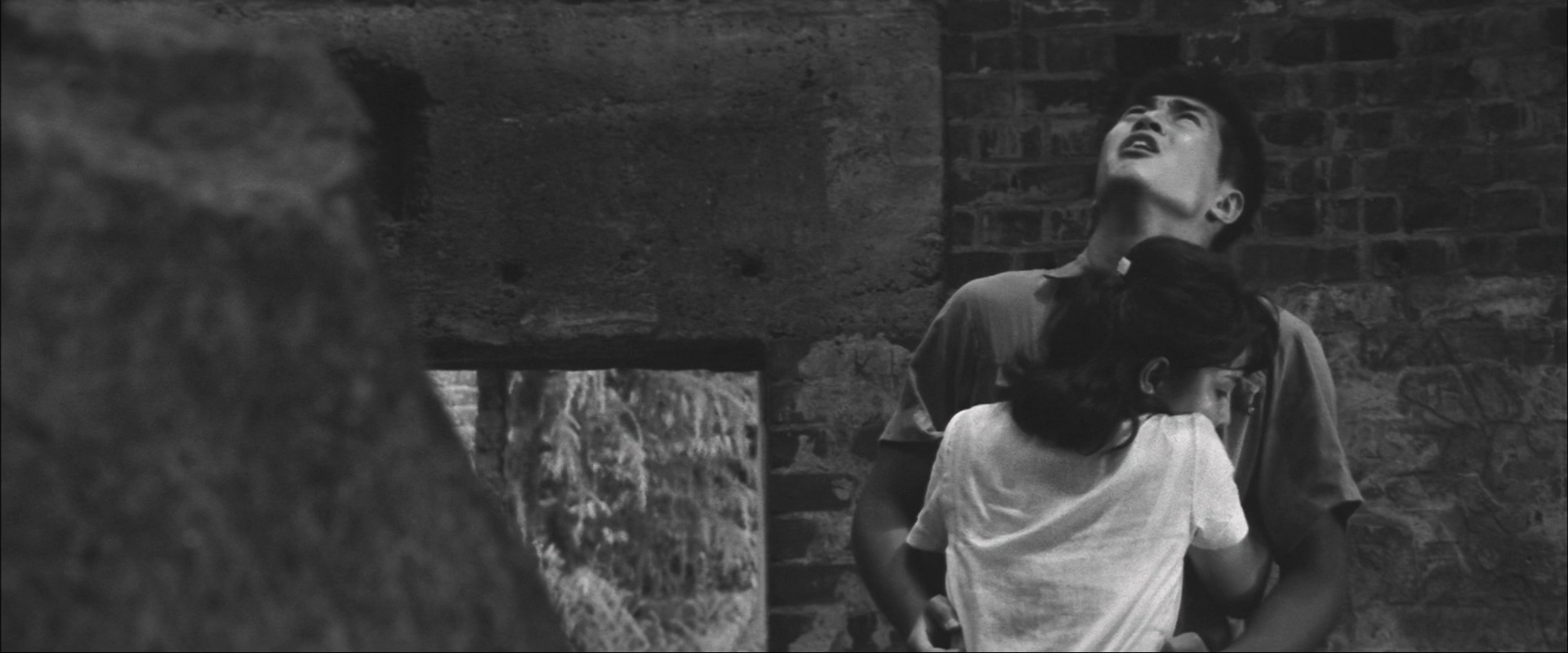
The contradictions of the post-war era are thrown into stark relief in the forced redevelopment of slum area on the edge of an increasingly prosperous city in Ko Nakahira’s intense noir, Jungle Block (地図のない町, Chizu no nai Machi). The slightly unfortunate English title may hark back to that chosen for a US screening of Nakahira’s landmark film Crazed Fruit, Juvenile Jungle, or just echo the titles of classic Hollywood noir movies such as Asphalt Jungle and Blackboard Jungle, but otherwise has little to do with the content of the film. The Japanese title, meanwhile, means something like “a town not marked on the map” and hints at the invisibility of those who live in this slum, a self-built post-war shantytown inhabited by those largely left behind by the nation’s rising prosperity. 

Then again, Shinsuke (Ryoji Hayama) seems to have fallen behind on his own account. We’re later told that he resigned from his position at the hospital because of some kind of medical mistake for which he blames himself and has since taken to drink and gambling while working at the poor clinic run by his former mentor Kasama. The most immediate effect of his, perhaps unnecessary, decision to resign was that it prevented the marriage of his younger sister, Sakiko (Kazuko Yoshiyuki), as he was then financially dependent on her. Having delayed the wedding for two years waiting for Shinsuke to pull himself together, Sakiko and her fiancé are set upon by local gangsters working for yakuza turned politician and legitimate businessman Azusa (Osamu Takizawa). Sakiko attempts to take her own life and the relationship does not survive this crisis thanks to her fiancé’s wounded masculinity in having been unable to save her or stand up to the goons afterwards. 

As repeated flashbacks reveal, Azusa is the root of the disease spreading across the city. It’s he that’s intent on clearing the slum, as he says just doing what the government has asked him to do, planning to build luxury apartments on its site along with supermarkets and entertainment facilities. Perhaps it’s not an entirely bad thing to clear a slum, the living conditions are in themselves a health hazard, but Azusa has drastically cut the amount of compensation on offer preventing the residents from securing new places to live and essentially rendering them homeless which defeats the humanitarian justification for forcing them out when most of them don’t want to go. 

Kayoko (Yoko Minamida), an old flame of Shinsuke’s who’s since become a sex worker to pay off her father’s debts to loan sharks and ends up as Azusa’s mistress, has a cat that she confesses to mistreating which makes her feel better only to feel terrible afterwards. The film seems to align the cat with the people of the slums who are bullied by men like Azusa who have untold influence buying off police and politicians while he himself later holds public office. The cat eventually fights back by scratching Kayoko who acknowledges it’s her own fault for her treatment of it, while it’s clear that the anger of the slum dwellers will eventually boil over and they too will strike back against the corruptions of this post-war era which otherwise sees fit to leave them behind. 

Meanwhile, Shinsuke plots a revenge he may not have the courage to take explaining to Kasama (Jukichi Uno), otherwise the voice of moral reason, that it’s the city that sick and the only way to save it is an operation to remove the Azusa-shaped tumour that’s currently killing it. It’s not for mere convenience that his weapon of choice is a scalpel. Kasama, however, tells him that he’s got the wrong idea and it’s their responsibility as doctors to take the long-term view and patiently run their clinic to produce results in the far off future. But Kasama’s eventual decision would seem to walk that back, suggesting that perhaps a radical solution really is necessary to save the patient from the ravages of amoral capitalism. 

Then again, like Kayoko’s father Yoshichi (Jun Hamamura) who is branded a “cripple” and “only half a man” by Azusa, Shinsuke begins to realise that perhaps you can’t create lasting change on your own and taking out Azusa won’t solve the problem as someone else will simply rise to take his place. There is a pervasive sense of hopelessness, Shinsuke caught and frantic amid the dim backstreets of this rundown town desperate for revenge when the police are in league with Azusa and no one really cares about the residents of the slum who are beginning to lose the will to resist. Nevertheless, eventually rediscovering himself Shinsuke opts to follow Kasama’s path insisting that will join the ranks of “good, honest, people” who, like the cat, will eventually scratch back until then resisting by “doing the right thing” even in the face of violence and intimidation while staunching the flow of corruption and cruelty from the seeping wounds of the post-war society.


DVD release trailer (no subtitles)

Wolves of the Night (夜の狼, Yoichi Ushihara, 1958)

A cold-hearted yakuza starts to get second thoughts when confronted with the misery his actions create in Yoichi Ushihara’s slice of Nikkatsu Noir, Wolves of the Night (夜の狼, Yoru no Okami). Though the hero is ostensibly Tsukida (Ryoji Hayama), the conflicted gangster unable to reconcile himself with the fact that he has fallen in love with a women he himself destroyed, it’s equally about the women who get caught in the crossfire of a burgeoning gang war and are each victims of male greed and indifference.

In any case, gang boss Tachibana (Somesho Matsumoto) brings a lot of this on himself. The secondary narrative revolves around a woman, Takako (Mari Shiraki), who borrowed money from the Manji gang to build her bar, but now that it’s complete Tachibana swindles her by calling in the debt and foreclosing on the property, passing ownership to Tsukida with instructions to kick Takako out. She, however, doesn’t take well to this and is resentful of Tachibana for screwing her over so she vows revenge. Her original attempt to get it by seducing Tsukida doesn’t work out, so she recruits a yakuza from a rival gang to extort them claiming that they have mole and he’ll only reveal their identity when they hand over the cash. This plan has some pretty tragic consequences and not least for Tachibana himself, but none of this would have happened if he hadn’t behaved so badly in cheating Takako out of the bar she worked so hard to build. He’d also told Tsukida that the bar owner was a beauty and it was understandable if wanted to try seducing her. 

But by this point Tsukida has developed a fondness for Katsumi (Izumi Ashikawa), a young woman he first meets when she’s caught by some of his guys offering herself for sex work in their territory. The other ladies describe Katsumi as “odd” and “an outsider”. It’s clear from her behaviour and the way she’s dressed, not to mention a lack of awareness of the rules of the gang, that she’s never done this before and is terrified. Tsukida calls his men off and tells her to go home, but later realises that it’s his own fault she was put in this situation because he was responsible for collecting the debt her parents owed to Tachibana taken out because her father is bedridden. Tsukida seems shaken by the old lady’s intense resentment, but still takes their money if attempting to convince Tachibana not to pursue them any further because they have nothing left to give, correctly assuming that Katsumi resorted to sex work to get the money. 

It maybe the sense of guilt that proved the last straw as the old couple then take their own lives but rather than freeing her lead Katsumi on a lonely path of self-destruction driven only by her hated for Tachibana and Tsukida. The fact that she later becomes ill further emphasises her positioning as a symbol of a despoiled nation poisoned by the ruthless inhumanity of the post-war society, along with literal a embodiment of Tsukida’s guilty conscience. Tsukida rejects Takako as a person more like himself, an example of corrupted femininity using her body to manipulate men in a world in which a woman has little other power, and instead is drawn to Katsumi who was once innocent, demure, and cheerful but who he himself has destroyed through his own greed and heartlessness.

Spending some time in hospital following a failed suicide attempt seems to heal her in body body and soul, though the total about face in Katsumi’s feelings for Tsukida seems somewhat bewildering even if he did visit her every day and presumably win her over despite her resentment towards him for contributing to her parents’ deaths. Nevertheless, it’s his feelings for Katsumi that see Tsukida longing to quit the yakuza and retreat to the country to live a small, honest life with her free of the city’s corruption. But as so often in the movies, it’s not that simple and this time it’s a tragic consequence born of male failure and insecurity that eventually costs him his shot at a normal life even as his frenemy, a local policeman he often sees in the same bar and gives him unsolicited advice about how he should quit the yakuza, remains surprisingly supportive suggesting that his redemption may merely be on hold rather than cancelled. In any case, though shooting almost entirely on stage sets, Ushihara makes good use of stock footage of contemporary Ginza as a place of bright lights and equally dark shadows where gangsters lurk on every corner and mercy is in desperately short supply.

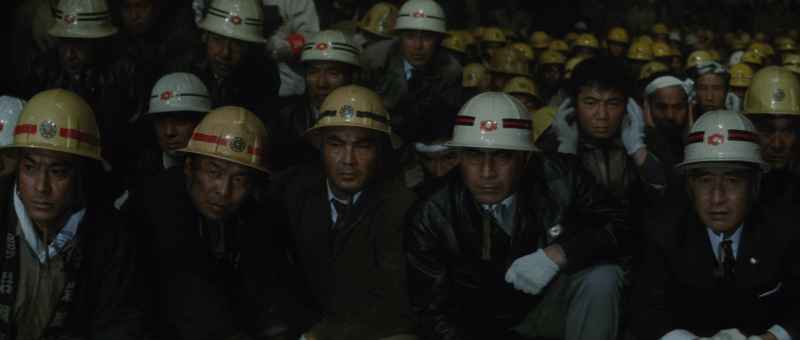
The Sands of Kurobe (黒部の太陽, Kei Kumai, 1968)

Kei Kumai’s three-hour epic of human engineering The Sands of Kurobe (黒部の太陽, Kurobe no Taiyo) opens with a titlecard to the effect that the film testifies to the courage of the Japanese people who brought the nation back to life after the war. Partly produced by Kansai Electric Power along with the production agencies of stars Toshiro Mifune and Yujiro Ishihara, the film is therefore somewhat conflicted, part bombastic celebration of Japanese engineering skill and ambivalent critique of the wilful decision to place success above all else including the welfare and safety of ordinary workers.

This critique is most evident to the flashbacks to the construction of Kuro 3 in 1938 which as many point out was conducted by the military under brutal and primitive conditions. The construction of the new Kurobe hydroelectric dam, by contrast, is a much more modern, enlightened affair in which workers have proper equipment and are not simply hacking at rocks with pickaxes wearing only a vest. But then as the conflicted Takeshi (Yujiro Ishihara) points out, it’s all effectively the same. Just because no one is pointing a gun at their heads, it doesn’t mean the men actually building the dam aren’t being exploited rather simply pressured by a vague notion of national good that they should be ready to lay down their lives. Could it be that “prosperity” is worse thing to die for than “patriotism”, especially when it appears as if your employer cares little for your physical wealth and economic wellbeing simply pledging that they will support the families of men killed during the dam’s construction. 

That there will be deaths seems inevitable. The man placed in charge of building a tunnel through the mountain, Kitagawa (Toshiro Mifune), is haunted by the vision of a man falling from a cliff that he witnessed when they first hiked to the dam site. He originally described the project as “crazy” and wanted to resign but was convinced to stay on. Kitagawa is himself fond of insisting on safety first where others are minded to cut corners, but also troubled by domestic issues in the film’s sometimes insensitive use of his daughter’s terminal leukaemia as a mirror for the dam project in considering what is and isn’t possible through human endeavour. The suggestion is that Kitagawa wants to believe the miracle of the dam is possible because needs to keep believing in a scientific miracle that can save his daughter, though obviously even if it is ultimately possible to build this dam that’s designed to fuel the post-war rocket to economic prosperity there are limits and unfortunately decades later we have still not found a cure for cancer though treatment may be more effective. 

Takeshi meanwhile has a similar battle with his hard-nosed father whose devotion to the dam project he describes almost like an addiction, suggesting that he values nothing outside of tunnelling and is willing to sacrifice everything in its name including the lives of himself and others. A flashback to to 1938 reveals that he asked his own teenage son to place dynamite and inadvertently caused his death though lax safety procedures which is the understandable reason why his wife eventually left him taking Takeshi with her. But the strange thing is for all his original opposition, Takeshi too is later captivated by the immensity of the challenge if also wary that the workers are falling victim to the same sickness as his father and are still being exploited by those like him who expect them to offer up their lives while paying them a pittance and complaining when the project does not proceed along their schedule. 

The almost nationalistic, bombastic quality of the film seems at odds with some of Kumai’s previous work save the discussion of the building of the 1938 tunnel though this largely serves as a contrast to imply that this time is different because they’re doing it for love of country rather the forced patriotism of the militarist past. Kitagawa justifies himself that if they don’t build the dam, economic prosperity will stall, companies will go bust, and people will lose their jobs but it seems somewhat hollow in the knowledge many men are certain to die while building this dam. Kumai undercuts the bombast with a series of scenes shot like a disaster movie in which supports collapse and the tunnel floods, or men are hit by falling rocks, eventually closing on an ironic Soviet-style statue dedicated to the labour of the workers that seems to question the immense loss of life along with the destruction of the natural beauty of Mount Kurobe but cannot in the end fully reconcile himself, torn between a celebration of human endeavour and its equally human costs. 


Original trailer (no subtitles)

The Wolves (狼, Kaneto Shindo, 1955)

Post-war desperation drives a collection of otherwise honest men and women towards a criminal act that for all its politeness they are ill-equipped to live with in Kaneto Shindo’s biting social drama The Wolves (狼, Okami). “Wolves” is what the criminals are branded, but the title hints more at the wolfish society which threatens to swallow them whole. After all, it’s eat or be eaten in this dog eat dog world, at least according to a cynical insurance salesman hellbent on exploiting those without means. 

Each of the five “criminals” is an employee at Toyo Insurance where they’re immediately pitted against each other, reminded that in order to qualify for a full-time position they need to meet their quotas for six months. The orientation meeting is cultilke in its intensity, the boss insisting that only in insurance can you become a self-made man while recounting his own epiphany as to the worthiness of his profession. They are told that the only two things they need are “faith and honesty”, and then “faith and pursuasion”, while encouraged to think of their work as an act of “worship”, “for the salvation of everyone”. 

Yet they’re also told to exploit their friends and family by pressuring them into taking out life insurance policies in order to help them meet their quotas. As one man points out, friends and relatives of the poor are likely to be poor themselves, but these are exactly the kind of people they’re expected to target. They’re told there’s no point going after the weathly because they’re already insured, but there’s something doubly insidious in trying to coax desperate people who can’t quite afford to feed themselves into paying out money they don’t have on the promise of protecting their families from ruin. One man even asks if the policy covers suicide and is told it does if you pay in for a year, sighing that he doesn’t want to wait that long.

“Suicide or robbery, choose one,” one of the salespeople reflects after failing to make their quota once again. They each have reasons to be desperate, all of them already excluded from the mainstream society and uncertain how they will find work if the job falls through. Akiko (Nobuko Otowa) is a war widow with a young son who is being bullied at school because of his cleft palate for which he needs an expensive operation. She’s already tried working as a bar hostess but is quiet by nature and found little success with it. Fujibayashi (Sanae Takasugi) is widowed too with two children and five months behind rent for a dingy flat in a bomb damaged slum where the landlord is about to turn off her electric. Harajima (Jun Hamamura) used to work in a bank but was fired for joining a union and is trapped in a toxic marriage to woman looking for material comfort he can’t offer. Mikawa (Taiji Tonoyama) too is resented by his wife, a former dancer, having lost his factory job to a workplace injury while the ageing Yoshikawa (Ichiro Sugai) was once a famous screenwriter but as he explains people in the film industry turn cold when you’re not hot stuff any more. 

Their unlikely descent into crime has its own kind of inevitability in the crushing impossibility of their lives. They may rationalise that what they’re doing is no different from the insurance company that exploits the vulnerable for its own gain, thinking that if they can just get a little ahead they’d be alright while feeling as if robbery and suicide are the only choices left to them and at the end of the day they want to survive. Perhaps you could call them “wolves” for that, but they’re the kind of wolves that give the guards from the cash van they robbed their train fare home after bowing profusely in apology. The real wolves are those like Toyo who think nothing of devouring the weakness of others, promising the poor the future they can’t afford while draining what little they have left out of them. As the film opens, Akiko looks down at a bug writhing in the dirt attacked by ants from all sides and perhaps recognises herself in that image as the sun beats down oppressively on both of them. Breaking into expressionistic storms and unsubtly driving past a US airbase to make clear the source of the decline, Shindo paints a bleak picture of the post-war world as a land of venal wolves which makes criminals of us all. 


The Angry Street (怒りの街, Mikio Naruse, 1950)

As its opening text explains, Mikio Naruse’s The Angry Street (怒りの街, Ikari no Machi) takes place in a world in which a love of justice and faith in others has been crushed under foot. That might equally apply to any other of Naruse’s films and well enough reflects his generalised philosophy that the world in which we live betrays us, but in this case it’s more than usually true as he adopts the trappings of film noir to consider the series of reversals that have taken place amid post-war chaos chief among them class and gender. 

Sociopathic student Shigetaka’s (Yasumi Hara) primary motivation is to earn money for his family, once upper middle-class but now fallen on hard times, but he’s also engaged in an act of class warfare taking revenge on the “nouveau riche” who he feels have usurped his class privilege. His chief weapon is his good looks along with his seductive charm which he puts to full use on the dance floor flirting with naive young women to whom he sells sob stories of his poverty to extort money out of them. He and his friend Mori (Jukichi Uno) have an “agreement” that what they’re doing’s alright as long as they only take advantage of the women financially rather than sexually though at this point Shigetaka seems to have little interest in that anyway insisting that women are just business to him so he little cares for their feelings. 

Their sense of class resentment is rammed home by their mocking of their classmates who have to do “humiliating” jobs to support themselves such as selling lottery tickets in the streets. Trying to get them to attend a meeting about student employment, their classmates describe them as “privileged” suggesting they may feel it’s not their problem because they don’t need to work little knowing that each of them is impoverished and dependent on exploiting women for their income.

There is however also a gender reversal in play as Shigetaka misogynistically takes on a feminised role, playing the gold digger in attempting to manipulate women, who are now in a position of power, into supporting him financially. He even tells some of them that he’s being forced into a financial marriage by his “old-fashioned” family, playing the damsel in distress and hoping that his target will swoop in to rescue him. When one of the women writes to his home after he abandons her, his grandmother is scandalised by the idea that he might have formed an attachment to a woman to whom he had not been formally introduced but equally that he might have been frequenting “effeminate” places such as dance halls. Unmanliness is something he’s accused of several times but also the tool which he uses to seduce women who are taken in by his feminine features and graceful dancing. Closely echoing Alfred Hitchcock’s Rope, it’s near impossible not to read both Shigetaka and Mori as queer coded and the relationship between them filled with homoerotic tension as Mori looks on in jealously while Shigetaka goes about his business seducing naive young women they’ll swindle together. 

A point of crisis arrives when the pair bite off more than they can chew in getting involved with a woman who is slightly older and sophisticated in her dealings with men. An independent woman, Tagami (Yuriko Hamada) claims to be a dentist but actually makes her money through smuggling and the black market if drawing her line at drugs. Shigetaka thinks he’s using her, but Mori warns him she’s really the one in charge and playing him at his own game planning to drop him once she’s got what she wanted which in this case is his youthful flesh (realistically the only thing he could possibly offer her). Tagami draws him into a wider and more dangerous world of crime than he’s equipped to deal with just as Mori receives twin blows that break the spell and encourage him to want out of Shigetaka’s schemes firstly in discovering that one of their targets, Kimiko (Mayuri Mokusho), is the sweetheart of an old war buddy, and then into running into Shigetaka’s earnest sister Masako (Setsuko Wakayama) who is the film’s de facto moral authority pulling him away from Shigetaka’s dark machinations back towards a more conventional morality. 

In a series of flashbacks, he remembers more innocent times before the war when he too sold tickets on the street and worked in a shop washing windows while going on innocent dates with Masako. The implication is that it’s his wartime service along with the world he came back to that have filled him with nihilistic cynicism while he later says that he indulges in Shigetaka’s schemes as a means of staying close to him and earning his favour. But Shigetaka is already far too corrupt, filled with class resentment over his lost privilege along with a deep-seated misogyny as a reflection of his sense of emasculation in this new world in which young women wield significant economic power. Kimiko in particular is brash and insensitive even aside from her naivety remarking on the piles of money that turn up at her home every day before virtually throwing cash at Shigetaka with seemingly no thought as to how that might make him feel even if he weren’t conning her in offending his pride and masculinity. 

Mori wonders how he can save himself if Shigetaka remains so irredeemable and is instructed by Masako that they must work together and live honestly though even she hangs on to her ideas of social class scandalised by the revelation that her mother too has begun selling things in the street, in her case knitted socks which is a fairly labour intensive activity for an incredibly small profit margin. Echoing film noir, Naruse opens and closes with scenes of the present day city teeming with life yet in a way that seems more ominous than exuberant even in the myriad dance halls where youngsters come to look for love but soon find themselves lost amid the contradictions and confusions of a rapidly changing city.


Apart from Life (地の群れ, Kei Kumai, 1970)

By 1970, Japan had more or less cemented its economic miracle and in terms of cinema at least memories of the war were beginning to recede with the young keen to address other concerns such as dissatisfaction with increasing consumerism or resistance towards American foreign policy in Asia. Unjustly neglected by international scholars, Kei Kumai by contrast refused to turn away from issues others might have found taboo or at least unpleasant enough to avoid mentioning. Like A Chain of Islands, Apart of From Life (地の群れ, Chi no Mure) has an overt anti-American sentiment but in essence criticises a society in which people are dying of guilt and shame though essentially blameless while those marginalised continue to oppress each other and fight amongst themselves rather than unite to resist their marginalisation. 

Based on a novel by Mitsuharu Inoue, the film opens with a brief prologue set in 1941 before jumping forward to the mid-1960s in the naval port town of Sasebo, the naval facilities now operated by American forces. An ensemble drama, the tale revolves around a drunken doctor, Unan (Mizuho Suzuki), though this one is far from an angel merely another wounded and compromised soul of the post-war era wracked by guilt over his various moral failures which began with the incident in the prologue in which he attempted to weasel out of his responsibility after getting an ethnically Korean girl pregnant as a young teenager working in a coal mine. He is the first of many to insist “I know nothing” that he’s “responsible for nothing” firstly denying the child is his then trying to smooth it over with money before coldly telling the woman’s sister to take her to a hospital in nearby Sasebo where no one will know them in order to get an abortion and avoid the social stigma of unwed pregnancy. The sister can only look at him with contempt. Later he discovers that the young woman lost her life while trying to provoke a miscarriage. 

Hako died, in a sense, out of shame. Many of Unan’s patients face the possibility of something similar. One woman comes to him about her teenage daughter, Yoshiko, who is bleeding continuously as if constantly menstruating. Unan asks the mother if she was in Nagasaki at the time of the atomic bombing as the symptoms are similar to the effects of the radiation poisoning he observed while working as a doctor in the city. She continues to deny it, but flashbacks to conversations with her now absent husband and daughter suggest she may not be telling the truth at least in its entirety even though her daughter’s life is at stake. She doesn’t want to be associated with “those Kaito Shinden people”, referring to the industrial slumland where many refugees from Nagasaki have settled which is treated as a kind of plague town by the rest of the local area. If her daughter survives but is unmasked as a second generation A-bomb victim her mother fears she will never be able to marry and that she will have “no future”. 

Yet they are not the only ones facing marginalisation. A young woman, Tokuko, comes to Unan’s office wanting a certificate that proves she has been raped, but Unan doesn’t help her firstly for the understandable reason that she is, understandably, unable to explain the exact circumstances to him, and secondly because he just isn’t very invested in her wellbeing bizarrely suggesting she come back with a relative or the person responsible. As she later explains, the rapist threatened to expose the fact that her family are burakumin in order to keep her quiet while she clearly remembers that he wore a glove on his left hand which she believes probably hides a distinctive keloid skin lesion marking him as an A-bomb victim and probable resident of Kaito Shinden. Tokuko’s father had also been a victim of workplace discrimination presumably because of his burakumin heritage, his wife told that he had stabbed himself while confronting the workers who were harassing him advised to keep quiet rather than attract the attention of the authorities. Tokuko is originally shamed into silence not by her violation but by her marginalisation, later deciding to track down her assailant by herself after someone else reports the crime to the police who arrest a local Kaito Shinden troublemaker and attempt to frame him for the crime. 

The confrontation however leads to a small war between the Kaito Shinden A-bomb survivors and the burakumin community which results in the death of a burakimin woman after they tactlessly insist that Kaito Shinden is a buraku below the buraku and that their blood is “rotten” and will be for generations. Discussing the case, some had even suggested that the rape was itself a result of prejudice towards the A-bomb survivors seeing as they are unable to find wives. Yet Tokuko’s mother had asked if being burakumin means it’s OK to rape her daughter, in much the same way Hako’s sister might have asked if being ethnically Korean made it OK for Unan to so casually discard her. Explaining that the locals regard Kaito Shinden as a “sick village” Yoshiko’s mother says she doesn’t think the people there are any different from anyone else despite her determination not to be associated with the A-bomb “disease”. “If Kaito Shinden is sick, the whole of Japan is sick!” Unan fires back revealing that he himself was also in Nagasaki shortly after the bomb dropped, apparently objecting to these baseless prejudices but seemingly unwilling to cure them even while his patients quite literally die of shame. 

In his own case, however, it’s not prejudice or wartime trauma that have led to Unan’s alcoholism but his many moral failures and their resulting guilt. His wife (Noriko Matsumoto) wants to divorce him, partly because of the drinking, but also because of his longstanding guilt over the death of a friend who retreated to the mountains with the communists during the Red Purge of the early 1950s of whom he is also jealous in that he was previously his wife’s lover and he can’t get over wondering if he’d lived his wife would have chosen him. Guilt over Hako, perhaps mixed with the fears of his radiation exposure, have also led him to emotionally blackmail his wife into several abortions as if he thinks it improper to father a child. 

Meanwhile, we seem to see pregnant women everywhere. Nobuo (Mugihito), orphaned by the A-bomb, sees a pair of them walking ahead of a gaggle of nuns which he later decides to freak out by creepily staring at them before lunging wildly like a dog among geese. The film’s conclusion finds him on the run from a gang of burakumin boys looking for revenge, running far out of the slums into the suburbs and through one of those nice new danchi housing complexes where a row of pregnant housewives sits silently knitting, something almost creepy in the vacant way they smile at him as he runs past before tripping over a child’s toy car. Boys like Nobuo are it seems cast out from the newly consumerist society of the economic miracle while just about everyone is in some way marginalised and in some cases several times over: rape victim, burakumin, A-bomb survivor, troublemaker, orphan, divorcee, communist, Christian. Nobuo wonders why God chose Nagasaki for an A-bomb when it’s where all the Christians live while the head of a Virgin Mary statue is repeatedly smashed as if to imply there’s no more mercy to be found here. 

Kumai regularly cuts back to a disturbing visual motif of a cage filled with rats who kill a live chicken and fight over the scraps of rotting meat until ignited by a gust of fire, the survivors scrabbling over each other blindly looking for an exit. Meanwhile, US jet planes fly constantly overhead and all Unan can think to do is throw a rock at a flag flying on the base. “She was killed by everybody” Tokuko exclaims of the burakumin woman, suddenly seeing the webs of prejudice, oppression, and selfishness which created the circumstances which led to her death by stoning. Shot in a crisp black and white and academy ratio, Kumai’s steely drama lets no one off the hook implying that all of Japan is indeed “sick” wilfully leaving these marginalised people to fight amongst themselves for the scraps of a newly prosperous society. 


DVD release trailer (no subtitles)

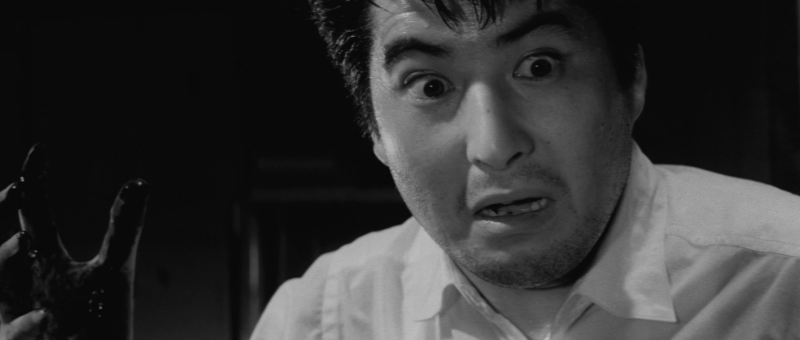
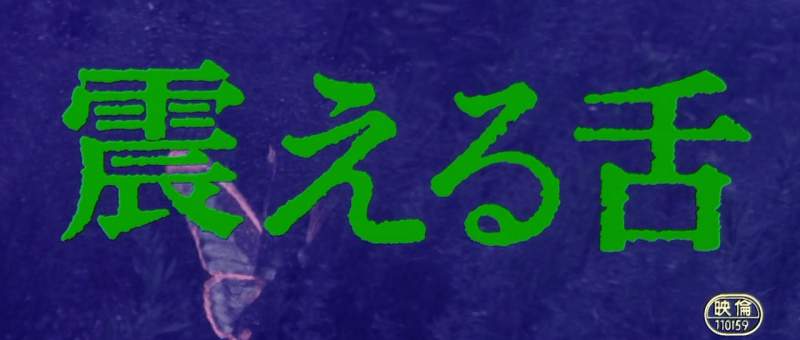
Writhing Tongue (震える舌, Yoshitaro Nomura, 1980)

Yoshitaro Nomura is best known for his crime films often adapted from the novels of Seicho Matsumoto though his filmography was in fact much wider than many give him credit for. Even so, 1980’s Writhing Tongue (震える舌, Furueru Shita) may seem an odd entry adapted from the semi-autobiographical novel by Taku Miki exploring the psychological torment of the parents of a little girl who contracts tetanus while innocently playing near a pond. Like the following year’s Call From Darkness, Nomura’s intense drama eventually shifts into the realms of psychedelia in the father’s strange fever dreams while lending this harrowing tale of medical desperation the tones of supernatural horror. 

When five-year-old Masako (Mayuko Wakamori) seems to be under the weather, her mother Kunie (Yukiyo Toake) takes her to the hospital but is told by the disinterested doctor that she simply has a cold. This is a little surprising seeing as Masako’s main complaint is she that cannot open her jaw, probably the best-known indication of tetanus infection which is after all not so rare as to be easily missed by a medical professional. Still worried, Kunie keeps taking her daughter back especially once her leg becomes twisted leaving her struggling to walk, but the doctors that she sees don’t really listen to her, even implying that Masako is having some kind of early life breakdown because her father, Akira (Tsunehiko Watase), is overly strict with her. This may be in part because Masako, perhaps in fear, keeps saying that she could walk or open her mouth if she wanted but is choosing not to. In any case the true diagnosis is only discovered after the couple manage to get a referral from a friend to a larger hospital where the veteran professor (Jukichi Uno) quickly overrules his junior’s lack of concern to have Masako admitted right away later explaining that tetanus is a difficult disease to treat and unfortunately has a high mortality rate. 

The treatment dictates that Masako receive as little stimulation as possible, lying in an entirely dark room with minimal noise so as to avoid the violent convulsions that accompany overstimulation and cause her to bite her tongue. As Akira later puts it, all they can do is wait trapped alone in the dark and tiny room with Masako entirely powerless to help her and with little knowledge of what exactly is going on. Meanwhile, despite having been repeatedly reassured that the disease is not transmitted in that way, Akira is convinced he may have contracted tetanus after being bitten by Masako while trying to prise open her jaw. Kunie too later worries that she also has tetanus, the pair of them sucked into a claustrophobic world of isolation and medical paranoia in which they are unable to sleep or find relief while watching over their daughter. 

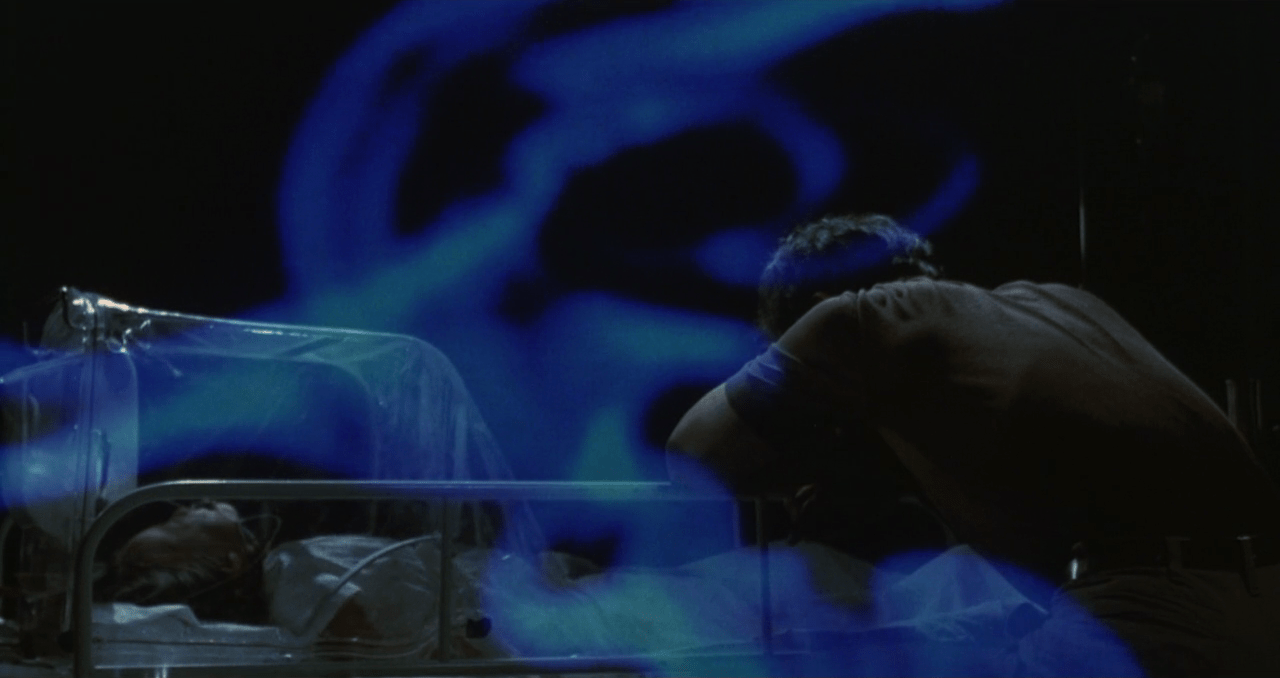
Some time later, Akira begins having bizarre psychedelic dreams recalling the time when he too was hospitalised as a child having contracted blood poisoning, remembering his own fear and confusion on being forced to endure “red injections” which he feared would “turn the whole world red” while the hieroglyphics he and his wife have been using to record Masako’s seizures dance before his eyes. He dreams of crows and blood rain while Kunie goes quietly out of her mind at one point threatening the sympathetic Doctor Nose (Ryoko Nakano) thinking it might be kinder to stop the treatment and let her daughter escape this excruciating pain. The utter powerless with which the couple are faced is filled with almost supernatural dread as if Masako had been possessed by some terrible evil, Akira attempting to speak directly to the bacteria asking them why it is they’re trying to colonise his daughter’s body and if they realise that in killing her they kill themselves too.

“It’s odd, our life. It’s so fragile” Akira sighs. All of this happened because of a tiny cut on a little girl’s finger the kind not even quite worth putting a plaster on and yet she might die from it. Convinced they all may die, Akira tells his wife to go home and put their affairs in order while she is so traumatised that she becomes unable to re-enter the room paralysed not out of physical disability but mental anguish. When Masako’s condition finally improves, Akira can hear his daughter crying that she’s frightened reminding him that he can never really understand the way she suffered through this terrible disease while all he could do was watch. A truly harrowing depiction of the hellish psychological torment of serious illness, Nomura’s occasionally psychedelic drama lays bare the fragility of life in a world of constant and unexpected dangers. 


Trailer (no subtitles)

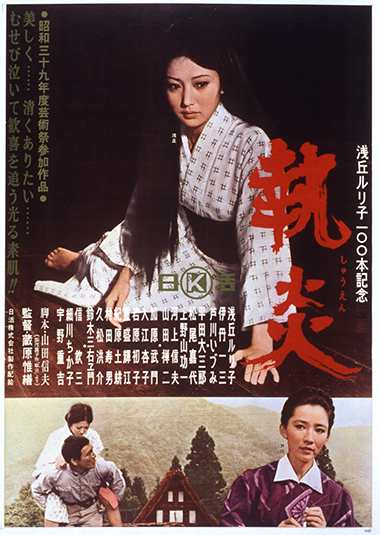
Flame of Devotion (執炎, Koreyoshi Kurahara, 1964)

Koreyoshi Kurahara, like Seijun Suzuki, began his career at Nikkatsu mostly working on its youth-orientated commercial cinema only to end up being fired for producing films deemed too “arty” for the studio’s target audience such as his 1967 Mishima adaptation, Thirst for Love. Released the same year as Black Sun, 1964’s Flame of Devotion (執炎, Shuen) is in someways a much more subdued affair, a fairly atypical melodrama critiquing not only the destructive legacy of war but also a cultural insistence on stoical endurance in the face of emotional difficulty which is itself the mark and enabler of militarism. 

Beginning at the end, Kurahara opens with a small collection of men and women in mourning clothes walking towards a memorial service, later followed by an elegant young woman in western dress who has just arrived by train. Today marks the seventh anniversary of the death of a young woman, Kiyono (Ruriko Asaoka), who drowned herself after learning that her husband would not return from the war. The action then jumps back 20 years to a much more peaceful time in which the 10-year-old Kiyono first encountered the 12-year-old Takuji, before shifting to the more recent past in which the youngsters fell in love, overcame many hardships, and married only to be torn apart by war. 

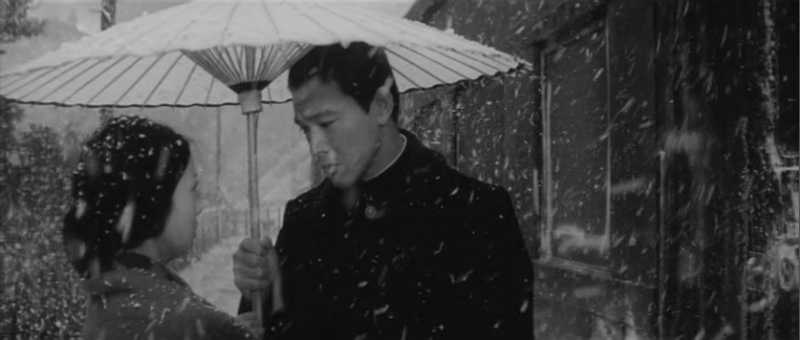
The love story is complicated by the fact that Kiyono is a resident of a small and secretive village who claim to be descendants of the legendary Heike. Kiyono is a mountain woman, and Takuji (Juzo Itami) is a man of the sea, the son of a fishing village expected to take over the family business. When he first re-encounters Kiyono in his late teens, Takuji is in the process of finding wood to carve his own boat with dreams of sailing it all around the world. A mountain man advises him of a shortcut home, which brings him to Kiyono’s village where he serendipitously stops to ask for water and is invited inside. Kiyono insists on walking him back to the beach where she makes plain that she remembers him as the boy from all those years ago though he is now a man. She declares that she loves the sea, because it is big, manly, and also kind, abruptly stripping off and jumping in much to Takuji’s surprise. He waits for her on the beach every day after that, and the couple fall in love but the spectre of war is already upon them. Takuji has to leave for his mandatory military service and they are parted for the first time. 

Unable to see him off on the train because she would be ashamed to become emotional in front of so many people, Kiyono for the first time laments that she is not a strong woman. She sees this quality in herself as a failing and is constantly upbraided for it by the women around her who are quick to point out that the ability to bear all is a woman’s sorry duty. They see her as being too soft for the world, or perhaps merely too uninhibited, her mother lamenting that she always preferred the sea to the mountains which is perhaps why they finally agreed to allow her to leave the village and marry Takuji though no woman had ever married an outsider before. 

Yet Kiyono is a strong woman just in a different way. We were torn apart by a single order, Kiyoko laments, but when Takuji is injured she travels to the navy hospital to visit him and fiercely resists the doctor when he advises amputating Takuji’s leg. Though she is warned that the wound may become infected and Takuji may not survive, she is adamant that she will nurse him back to health herself and in fact does just that. To keep him safe from the war, Kiyono convinces Takuji move into an isolated cottage in the mountains where they can live together without being bothered by anyone else. She helps him learn to walk again, ignoring the advice of Takuji’s cousin Yasuko (Izumi Ashikawa) as a medical doctor that she is being reckless with Takuji’s health in boldly stating that she only wants the Takuji from before, not one damaged by war. But her devotion is a double edged sword, once he is healed, Takuji can be drafted again. She starts to regret her decision to oppose amputation.

The villagers, meanwhile, who had abandoned their initial scepticism to see Kiyono as a fine wife, now think her selfish and neurotic. They wonder why Takuji has not been to see his mother who is seriously ill, and for their own benefit want him to return so that he can communicate with the government who have requisitioned too many of their ships and left them unable to work. Kiyono has tried to create a space of her own into which the war may not enter, as if she were living in hiding. Nevertheless it is true that once Takuji makes the decision to leave the mountain the spell is broken, the war takes him, and there’s nothing Kiyono can do but “endure”. 

One of the ironic gifts brought to Kiyoko in the mountain is a Heike mask designed to contain all the pain and bitterness of a woman watching her husband march away to war. Yasuko, worried for her own husband, wonders if men and women are really so different. Kiyoko ironically replies that the men marching off to battle have an oddly beatific look, as if they too are in some way “enduring” in conforming to an idea of manliness though they too must be afraid, but if a woman looks that way it means she has gone mad. It’s the look that Kiyono herself eventually has, taking on the appearance of the mask, when her spirit is broken and she enters a kind of fugue state suspecting that Takuji will not return. 

Old women watching the few remaining men being recalled to the front remark on the cruelty, that they’re only going there to die because it’s quite obvious that the war is lost. It’s war which has divided the mountain and the sea, destroyed a fated a love, and created so much suffering. In an earlier time, Kiyono’s “devotion” might indeed have been seen as selfish, a desire to isolate herself and the man she loved and keep him from his duty because of her own pain. Now however, her tale is only tragedy. Not so much a woman driven mad by an excess of emotion, as a country by the lack of it.


Original trailer (no subtitles)

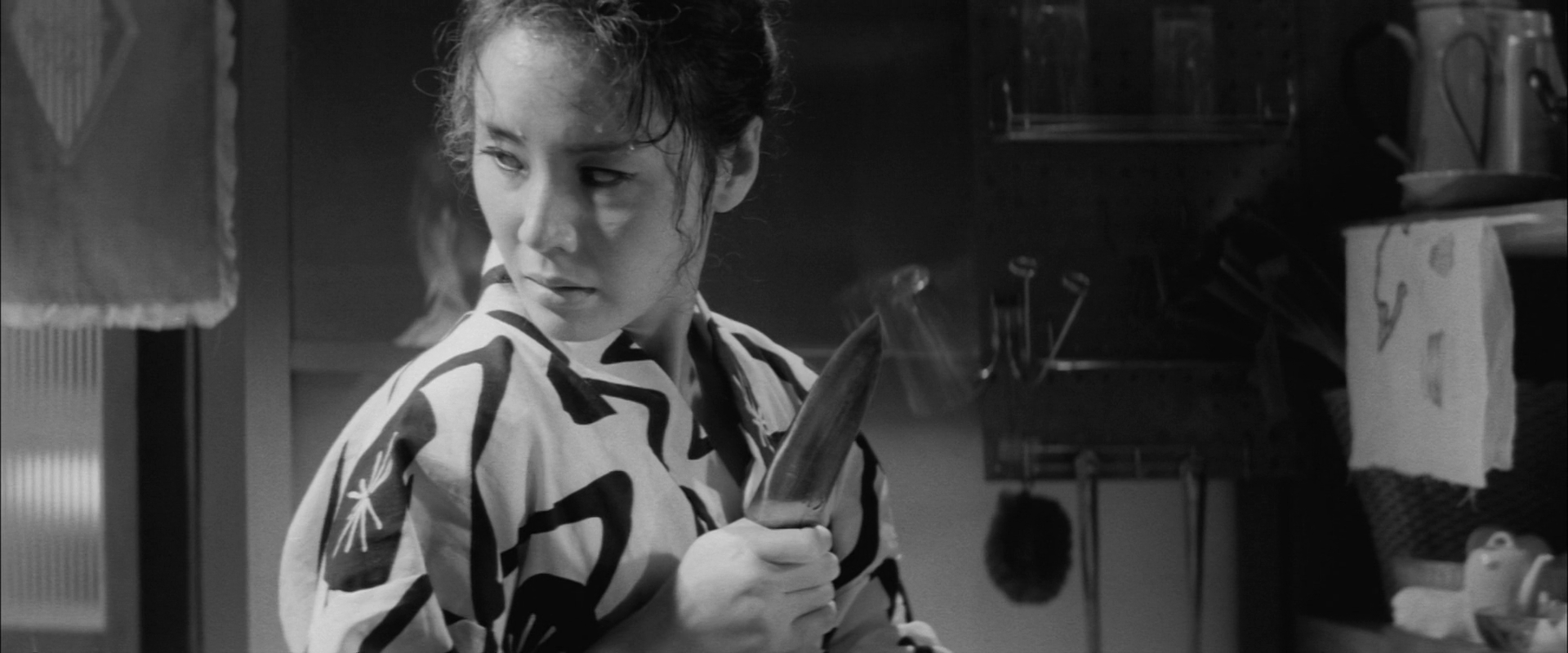
Onibaba (鬼婆, Kaneto Shindo, 1964)

How do you go on living in a world turned upside-down? It may be the central theme of post-war cinema, but few have tackled it in such a direct if allegorical way as Kaneto Shindo, repurposing a Buddhist parable about the perils of duplicity as a lesson in the dangers of the age, defined by a cruel hunger which could not be satisfied by bread alone even if there were bread to satisfy it. Onibaba (鬼婆), as the title implies, makes a villainess of an old woman driven to extremes by her chaotic times, but perhaps suggests that the times make villains of us all.

Deep in the war-torn country of 14th century Japan the imperial capital of Kyoto has been razed, a horse is said to have given birth to a cow, and the sun rose black in the sky leaving day as dark as night. With farmers dragged away from their fields to fight in a war they barely understand on behalf of distant lords, the grain basket of the nation is close to empty. An old woman (Nobuko Otowa) and her daughter-in-law (Jitsuko Yoshimura) have learned to make ends meet by hunting battle-weary samurai, stripping them of their armour, and throwing their bodies into a gigantic pit sitting right in the middle of the tall grass like a gravitational black hole of human compassion. The old woman has been patiently waiting for the return of her son, Kichi, who was taken away by the samurai, certain that everything is going back to normal when the war is over. Kichi, however, will not be returning. Hachi (Kei Sato), another young man from the village taken along with him, brings the sad news that the old woman’s son was beaten to death by a mob of farmers much like herself resentful of the war’s intrusion onto their land. 

Everything becomes food, Hachi explains, a sentiment extremely familiar to those who lived through the chaos of the immediate post-war era. Pointing at a baseline problem in the feudal economy, the war starves the poor and makes the wealthy hungry. The fields run wild with no men to tend them, as if symbolising the madness of the times. Lost in the tall grass, samurai and peasant alike search for an exit but are drawn only towards that black pit of human cruelty, more beasts than men driven by the need to survive alone. 

Without her son, the old woman is unable to farm, and without her daughter-in-law she is unable to survive through killing. She knows that these are times without feeling and that if Kichi will not return there is no reason for her daughter-in-law to stay. Ushi (Taiji Tonoyama), the broker for the looted samurai armour, makes an indecent proposal of extra millet for sexual favours but the old woman defiantly turns him down, perhaps not quite realising the offer was likely not intended for her. Which is to say that Hachi is not the only man in town, but is perhaps the only “desirable” one. Such desires that there are apparently cannot be satisfied by a crusty old man like Ushi, but are there all the same. Hachi presents a triple threat. The old woman knows her survival depends on the younger one, but also that she has no means to keep her now that her son is dead. She offers Hachi her body instead but he, as she did Ushi, baulks at the idea of slaking his lust on such an old woman. 

When a strange samurai wanders into her hut and orders her at the point of his sword to lead him out of the tall grass a solution presents itself. The old woman lures him to the black pit and prises away the ornate oni mask which he claimed he wore to protect his beautiful face from the ravages of war. Despite the fact that the samurai appears to have suffered from some kind of aggressive skin disease, the old woman unwisely decides to put the mask on her own face, convincing her daughter-in-law that her relationship with Hachi is sinful and appearing out of nowhere dressed as a demon to remind her that she’s going to hell. The mask’s crazed expression becomes fused with her own face, cementing her transformation into a “demoness” which it seems had already begun with stretch of white disrupting the uniformity of her hair and the kabuki-esque exaggeration of her eyebrows. Running desperately through the tall grass she cries out that she’s human, but this world has made demons of them all. The black pit of hunger knows no fill, and there can be no satisfaction in a world so devoid of human feeling.


Onibaba is currently streaming on BFI Player as part of the BFI’s Japan season.

Original trailer (dialogue free)

Broken Drum (破れ太鼓, Keisuke Kinoshita, 1949)

The evils of of authoritarianism are recast as family drama in Keisuke Kinoshita’s 1949 satirical comedy, Broken Drum (破れ太鼓, Yabure Daiko). Co-scripted by Masaki Kobayashi, a student of Kinoshita’s who went on to forge a long career dedicated to interrogating the place of the conscientious individual within an oppressive system, Broken Drum is also a testament to changing times and new possibilities as the youngsters slowly find the strength to resist and insist on their right to individual happiness. 

As the film begins, the family’s maid is leaving in a hurry, sick to the back teeth of the treatment she receives from the head of the household. Though she admits that the wife and children are all lovely, the husband is a tyrant and, according to her, a nouveau riche upstart, all money and no class. Tsuda (Tsumasaburo Bando), a self-made construction magnate, runs his family like a small cult and everyone is so afraid of upsetting him that they find themselves entirely unable to stand up for themselves. Times are, however, changing and Tsuda’s business is in trouble, which means his power may be waning. Denied loans all over town, he tries to railroad his eldest daughter, Akiko (Toshiko Kobayashi), into marrying a wealthy suitor, Hanada (Mitsuo Nagata), and is deaf to her cries of resistance.

Despite the rather ironical speech from the maid who describes herself as a “feminist” which is why she’s unable to put up with Tsuda’s poor conduct, stopping to tell a pregnant dog not to let anyone push her around just because she’s a girl, the world of 1949 is still an incredibly sexist one. Tsuda’s long suffering wife Kuniko (Sachiko Murase) complains that her younger daughter spends all her time rehearsing for her role as Hamlet rather than learning “useful” skills for women like cooking and housekeeping. Akiko’s suitor sides with the maid, affirming that “men should be nice to women” and making a point of telling her that all his maids love him without quite realising that what he’s just said isn’t quite as nice as he thought it was. Akiko doesn’t want to get married and she doesn’t even like Hanada, but she’s too conflicted to fully resist, unsure if she has the right to go against the “tradition” of arranged marriage. She asks her mother how she felt, and learns that she too cried every day, somehow normalising the idea that a woman’s marriage is supposed to make her miserable. 

Meanwhile, Tsuda is slowly destroying his oldest son, Taro (Masayuki Mori), who has been trying to quit the family construction firm to go into business with his aunt making music boxes. Tsuda isn’t having any of it, he tells Taro that music boxes aren’t a manly occupation and that he’ll never make it on his own, but Taro has an advantage in knowing that the construction company is in a bad place and his father’s authority is weakened. He becomes the first of the children to escape by rejecting Tsuda’s influence, decamping to his aunt’s which becomes a point of refuge for the other members of the Tsuda family seeking escape. 

Akiko begins to gain the courage to walk away after bonding with a painter she meets after her father was extremely rude to him on a bus, poking a hole in his canvas and then blaming it on the driver. Luckily he dropped his sketchbook which has his name, Shigeki Nonaka (Jukichi Uno), inside so she can pay him a visit to return it. Unlike the Tsuda’s, the Nonaka household is one of cheerful family warmth. They are not wealthy, but they do not particularly care. Mr & Mrs Nonaka fell in love in Paris decades ago where she was charmed by the sound of his violin while she sketched in the streets. Tsuda, angrily rejecting Akiko’s attempt to cancel the marriage, tells his wife that even if she doesn’t like him now, Hanada’s wealth will make her happy in the long run, but it’s at the Nonaka’s that she discovers “the true happiness of family”, vowing to do whatever it takes to be able to marry Shigeki with whom she has fallen in love. 

Even after losing two of his children and finally alienating his wife, Tsuda fails to learn, blaming his family for the failure of his business rather than accept his old school authoritarianism is out of step with the modern world. His middle son, Heizo (Chuji Kinoshita), actually the most sympathetic of the children, has written a satirical song that likens his father to a “broken drum”, something that makes a lot of noise but is confusing and very unpleasant to listen to. It doesn’t help that Tsuda also has the habit of going into speech mode, raising his arm in a fascist salute as he barks out his orders. “Life is most miserable when there’s no one to love”, Heizo tries to warn him, calmly explaining that a family is made up of “lonely creatures” with individual lives, and that that strong connection only survives through trust and independence.

Beginning to see the light, Tsuda accepts that he’ll be deposed if he doesn’t allow his family its democratic freedoms. Undergoing a conversion worthy of Scrooge at the end of a Christmas Carol, he he suddenly realises that “you need other people to succeed in life”, and is re-embraced by his family who decide to give him a chance to be better than he’s been in the knowledge that he has no more power over them than they choose to give him. 


Titles and opening (no subtitles)