Intimidation (ある脅迫, Koreyoshi Kurahara, 1960)

Intimidation still 1Social class as a means of social control is rarely dealt with overtly in Japanese cinema, but it’s been there all along from the feudal concerns of the jidaigeki to the inherent unfairness of the post-war world which made so many false promises to ambitious young go-getters, misselling dreams of social mobility in a newly meritocratic society. Koreyoshi Kurahara’s Intimidation (ある脅迫, Aru Kyohaku) is a noirish tale of blackmail and inexorable fall, but the title refers not just to the act literal act but to the oppression of a society in which the unscrupulous prosper and friendship, even love, is willingly sacrificed for the superficial comforts of wealth and status.

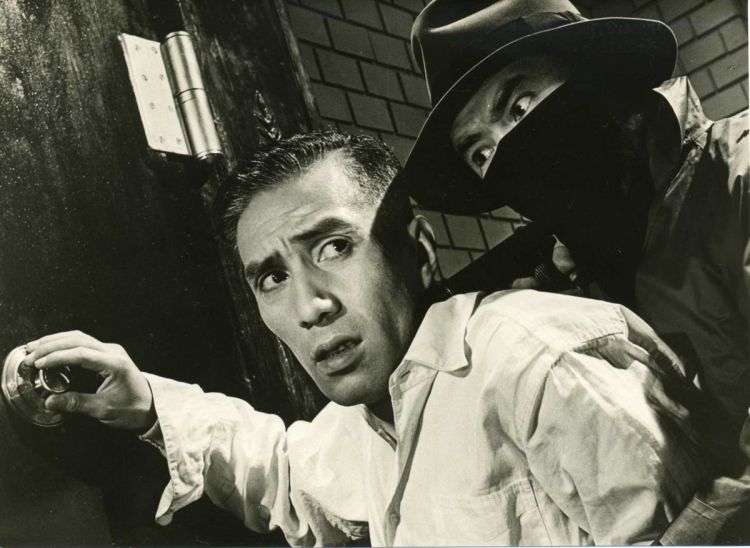
Bank manager Takita (Nobuo Kaneko) is riding high. He’s just been awarded an important new promotion but his success is less down to his innate talents, than to the fact he’s married the chairman’s daughter, Kumiko (Yoko Kosono). While Takita went to university and catapulted himself into the upper middle-classes, his childhood friend Nakaike (Ko Nishimura) only graduated middle school and has been working hard as a clerk in the same bank ever since. To make matters worse, Kumiko was once Nakaike’s sweetheart and Takita the lover of Nakaike’s sister, Yukie (Mari Shiraki). Where Nakaike is meek and earnest, Takita has abused every privilege he’s been given – illegal loans, backhanders, dodgy business deals and even an affair or two have left him wide open to blackmail. Takita’s party is about to end – Kumaki (Kojiro Kusanagi), a Tokyo hood, has proof of Takita’s improprieties and he threatens to expose all if he doesn’t get a sizeable amount of cash. It’s money that Takita doesn’t have, but Kumaki has a plan – Takita needs to rob his own bank. After all, who would expect the bank manager to raid his own vault?

Takita’s rise is as much down to societal corruption as it is his own lack of moral integrity. He’s got on by the traditionally “corrupt” ways that society condones – i.e. a dynastic marriage. He may have worked hard to get into university and get a good job that would enable him to be the kind of match a middle-class father would seek to arrange for his daughter, but everything after that is as straightforward and inevitable as a pair of train tracks. Takita has made it – his father-in-law will take care of everything else, all he has to do is sit back and avoid making any catastrophic mistakes. Perhaps because of the oppressive simplicity of his life, Takita has a lot going on the side – the “playing with fire” that he jokes about in his affairs and illicit backdoor deals are perhaps his ways of bucking the system, laughing at if not quite biting the hand that feeds. 

Meanwhile, mild-mannered Nakaike has been patiently muddling through waiting for a break that society just does not want to give him. Leaving school early (for circumstances which are never revealed but probably easy to guess) has defined his life prospects. Takita went to university, married Nakaike’s teenage sweetheart, and then became his boss – it isn’t fair, but it’s how things work. Not content with swiping Nakaike’s prospects, Takita continues to lord it over him, pretending to be “friends” like old times but belittling Nakaike behind his back and even continuing to carry on with his sister Yukie who has never given up on the childhood sweetheart who threw her over for career opportunity. Nakaike is bound by the superficial rules of society and men like Takita laugh at him for it, they think he’s a fool who doesn’t understand how the system works and only exists as a mechanism for them to exploit.

When Takita gets Nakaike roaring drunk as a part of his nefarious plan, Nakaike admits that he always found Kumiko intimidating – he has a natural deference to and mild fear of her upper-class elegance. Takita has no such qualms – he wants into that club, and he doesn’t care what he has to do or who he has to step on to get there. Yukie blames her brother for their present situation. She thinks his meekness makes him an obvious doormat, that if he had any kind of spine he wouldn’t have let Takita walk all over him and marry Kumiko which would mean she wouldn’t be trapped in the never-ending torment that is being Takita’s mistress rather than his wife. Playing lady Macbeth she needles and provokes her brother, though even if he should snap there’s not a lot that he could do.

Kurahara begins with the passage of a train and later ends on the same image. Our two protagonists are each railroaded towards their fates even if they think they can make a break for pursuing their own destinies. They both think they’ve won, got ahead of the other and the various things which chased them, beaten the intimidation of the society in which they live which attempts to “railroad” them onto a set of pre-ordained courses, but all each of them do is lose. The train rolls silently onward, there is no point of disembarkation save that which it allows, and its conductors are everywhere.


Robbery scene (dialogue free)

Born Under Crossed Stars (悪太郎伝 悪い星の下でも, Seijun Suzuki, 1965)

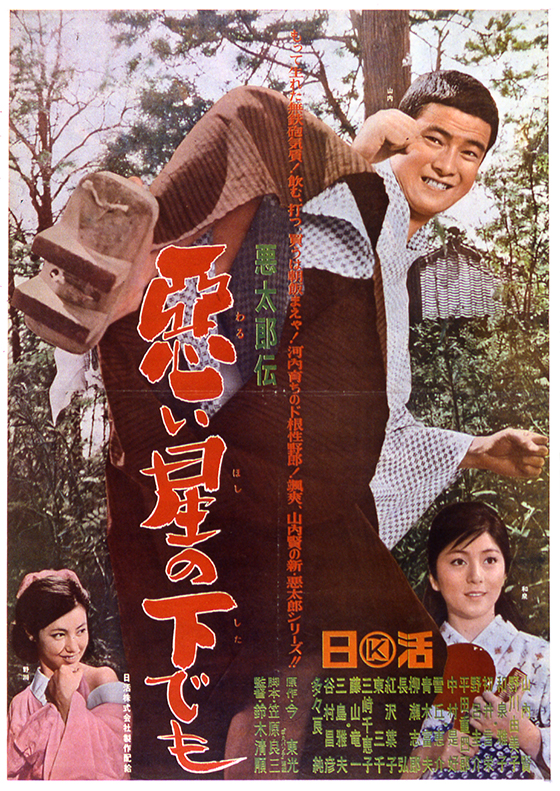
Born Under Crossed Stars posterFollowing his 1963 breakthrough, The Incorrigible, Seijun Suzuki returns to the work of Toko Kon for another tale of rural adolescent confusion in Born Under Crossed Stars (悪太郎伝 悪い星の下でも, Akutaro-den: Warui Hoshi no Shita demo). The Japanese title ties the film more closely to the earlier Kon adaptation by adding the preface “Stories of Bastards”, and once again stars Ken Yamauchi and Masako Izumi in leading roles though this time the setting is early Showa, swapping the promise and openness of Taisho for the rapidly closing doors of militarism. Much more obviously comedic than The Incorrigible, Born Under Crossed Stars is another anarchic coming of age tale in which an “incorrigible” youngster learns to find himself but is neatly undercut by the times in which he lives, his final triumph both a victory and a symbol of incoming tragedy.

Farmboy Jukichi (Ken Yamauchi) dreams of a way out of his lowly Osakan roots by getting into a prestigious local school, though his drunken father hardly sees the point of education and would prefer his son go out and earn some money. Jukichi is earning quite a bit working as a milkman for a local “cowboy” dairy farmer who’s recently returned from America but his sights are firmly set on university and a move into the city. Meanwhile, he experiences some personal turbulence thanks to his old friend, Yoshio (Jushiro Hirata). Yoshio gets himself into trouble with the Public Morals committee at school when he’s spotted out with a young lady – something which is against school regulations, but that’s not why he was stopped. Another boy, Oka (Keisuke Noro), wrote a letter to the girl Yoshio was with (who happens to be his cousin) but was rejected. Oka is abusing his position for personal point scoring. Jukichi can’t let it go and takes Oka to task, but his actions have serious repercussions when the humiliated Oka suddenly quits the school altogether.

Jukichi thinks Oka’s actions are very “manly”. Manliness is certainly something important to the boys at the school which has a noticeably militarist song along with various rituals involving fire and taiko drums, not to mention the shiny cap badges and weapons drills they seem to perform. As in Fighting Elegy released the following year, “manliness” precludes fraternising with women – sex has been placed off limits as the ultimate frivolity and a kind of theft of the zest of life which should be going towards more “productive” causes. Jukichi however, like The Incorrigible’s Konno has a taste for the ladies even if he reacts somewhat harshly to discovering Yoshio in flagrante with a girl in a park which turns out to be some kind of mass makeout spot behind a shrine. Uncovering the hypocrisy in his friend sets the two at odds and eventually turns them into enemies with disastrous consequences.     

Jukichi finds himself caught between two lovers – the elegant, shy sister of Yoshio, Suzuko (Masako Izumi), and the liberated, provocative Taneko (Yumiko Nogawa). Though resistant, Jukichi eventually succumbs to seduction and forever ruins his dreams in the process. Overcome with youthful frustrations, he channels his need for justice in a dangerous and destructive direction when he decides to start something with a bunch of local gangsters in a misguided attempt to avenge a wrong done to the father that has never supported him. Later seeing off an attack from the gangsters (tipped off by a remorseful Yoshio) Jukichi seals his fate, gives up on the “decent” life promised by a place at the prestigious middle school and commits himself to wandering, taking to the sea as one of many young men raised on nationalist myths finding their place in the military.

Another programme picture, Born Under Crossed Stars provides ample opportunity for Suzuki to embrace his taste for the strange – notably in his milk patter opening with its literal baby monkey, but also finding room for beetles on strings, “poisoned” manju buns, and illusionary visions. Sticking mainly to static camera, Suzuki nevertheless showcases his taste for unusual composition and editing, making use of rapid focus pulls, side wipes and dissolves to convey the passage of time. He closes with a voice over mimicking the one at the end of The Incorrigible only this time with a much more defiant (but in hindsight only tragic) declaration that Jukichi will continue living under his self made philosophy, vowing to do what ever it takes to survive and scale any wall which places itself in his path towards the achievement of his freedom.


Born Under Crossed Stars is the fifth of five films included in Arrow’s Seijun Suzuki: The Early Years. Vol. 1 Seijun Rising: The Youth Movies box set.

Original trailer (English Subtitles)

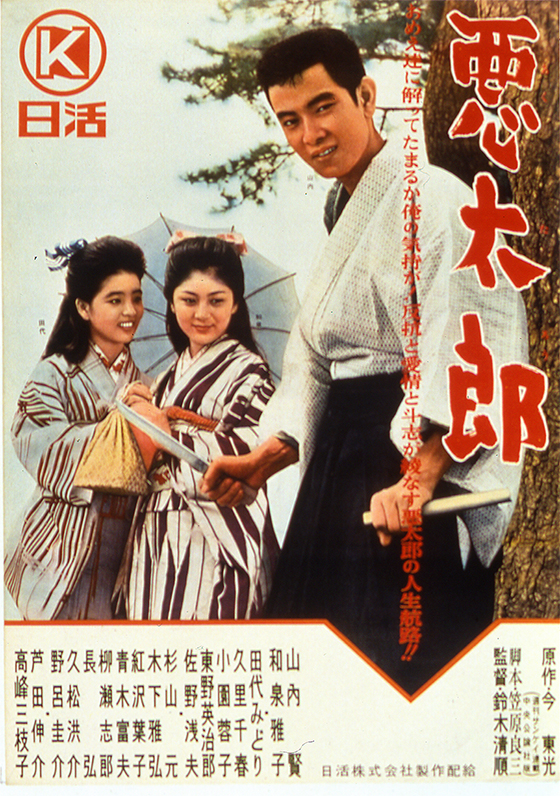
The Incorrigible (悪太郎, AKA The Bastard, Seijun Suzuki, 1963)

(C) Nikkatsu 1963

(C) Nikkatsu 1963

Seijun Suzuki often credits 1963’s Youth of the Beast as the real turning point in his directorial career, believing that it marked the first time he was ever really able to indulge his taste for the surreal to the extent that he truly wanted. The Incorrigible (悪太郎, Akutato, AKA Bastard), completed directly after Youth of the Beast, is another turning point of a kind in that it marks Suzuki’s first collaboration with set designer Takeo Kimura who would accompany him through his ‘60s masterpieces contributing to the uniquely theatrical aesthetic which came to be the director’s trademark.

Inspired by an autobiographical novel by Toko Kon, The Incorrigible of the title, Togo Konno (Ken Yamauchi), is a young man coming of age in the early Taisho era. He’s of noble birth and enjoys both wealth and privilege – something of which he is well aware, but is also of a rebellious, individualist character believing himself above the normal rules of civil society. Expelled from his posh Kyoto school after getting into a dalliance with a teacher’s daughter (she’s been sent off to a convent), Konno is then abruptly abandoned by his mother who has tricked him into travelling to a remote rural town where a friend of a family friend has promised to reform him at his military middle school. Konno thinks he’s too clever for this, he makes a point of deliberately failing his entrance exam in the mistaken belief that failing to get in would make him free to travel to Tokyo and start life on his own. He’s wrong, and failure to pass the exam would only entail being held back a year. Konno capitulates and agrees to start his new life as one among many in a backward little village in Southern Japan.

Though set in the Taisho era, Konno’s youth seems to suffer from the same problems that would plague the young men of 30 years later. His school is proto-militarist and hot on discipline. The boys are trained to be strong rather than smart and have inherited all the petty prejudices of their parents which they hone to the point of weaponry. The “Public Morals” department operates almost like a mini military police for students – making routine inspections of students’ home lives and keeping an eye out for “illicit” activities round and about town. Konno sees himself as grown man with a rebellious heart – he smokes openly, keeps a picture of the girl who got him into this mess in his room, and tells bawdy, probably made up stories about how he lost his virginity to a geisha (for free). He will not bow to the morality police, or any authority but his own.

Authority is something Konno seems to be good at. Picked on for his continuing preference for Japanese dress, Konno neatly deflects the attentions of the Public Morals division and comes out on top. When they raid his room and complain about his novel reading habit, he shouts them all down and gets them to sit on the floor while he “educates” them about foreign literature. Militarism has not yet arrived, but anti-intellectualism is already on the up and up. Konno’s love of literature is one of his many “deficient” qualities as teachers and students alike bemoan his “frivolous” hobbies, seeing his sensitivity and disregard for the commonly accepted ideals as signs of his unwelcome “unmanliness”.

Konno’s other big problem is, as might be expected, girls. Having been in town only moments Konno takes a fancy to doctor’s daughter Emiko (Masako Izumi) – his desire is only further inflamed after catching sight of her in the book shop and realising she too has bought a copy of Strindberg’s Red Room. She doesn’t care for Strindberg’s misanthropy, but a bond is quickly forged between the two sensitive souls trapped in this “traditional” small town where feelings are forbidden and youth constrained by social stricture.

It is, however, a love doomed to fail. The majority of Suzuki’s early work for Nikkatsu had been contemporary youth dramas, yet the artfully composed black and white photography of the Taisho setting is a melancholic affair which rejects both the rage of the modern action dramas and Suzuki’s trademark detached irony. Using frequent dissolves, The Incorrigible conjures a strong air of nostalgia and regret, a sad love story without end. Yet at its conclusion it makes sure to inject a note of uplifting inspiration as our hero wanders off into a fog of confusion, filled with a passion for pursuing truth and vowing to live without losing hope.


The Incorrigible is the fourth of five films included in Arrow’s Seijun Suzuki: The Early Years. Vol. 1 Seijun Rising: The Youth Movies box set.

Original trailer (English subtitles)

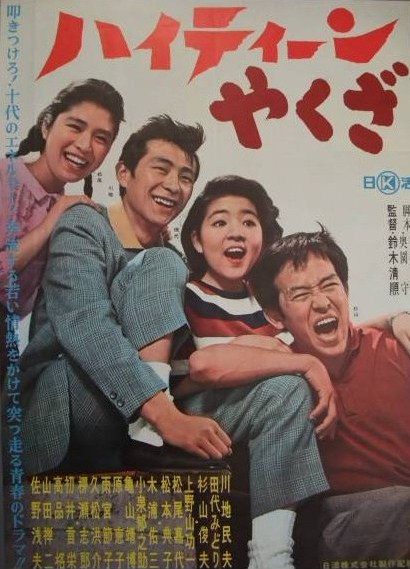
Teenage Yakuza (ハイティーンやくざ, Seijun Suzuki, 1962)

teen age yakuza poster jpgNikkatsu’s stock in youthful angst could have a nasty edge, even in their early days, but even so the Japanese teen movie is often a charming affair in which plucky youngsters defy the perils of their time from a position of relative safety. Rebellious punks die in Nikkatsu Action, but in the poppier coming of age world, innocence wins out as the angry young man finds a way to repurpose his rage for the good of society. Though Seijun Suzuki is generally associated with his “incomprehensible” work for the studio which eventually fired him in 1968, his trademark sense of absurd irony is a perfect fit for the essentially innocent world of the small town teen in ‘60s Japan.

High schooler Jiro (Tamio Kawaji) lives in a fatherless family with a grown-up older sister (Noriko Matsumoto) thinking about marriage and a mother (Kotoe Hatsui) about to open a trendy coffee shop/jazz parlour. He’s best friends with Yoshio (Hajime Sugiyama) – son of the carpenter working on the cafe, and is a typical scatterbrained teenage boy who enjoys fighting and has a “part-time job” taking illicit bets at the bicycle races. His problems start when he wins big on a bet but is hassled by a couple of punks dressed up like cowboys who deprive him of his winnings. Getting revenge, Jiro and Yoshio end up in a fight with the local gangsters in which Yoshio is stabbed in the leg and crippled for life and to make matters worse, his dad is killed in a traffic accident rushing to the scene of the crime. Filled with remorse, Yoshio turns to the dark side and falls out with Jiro while the petty punks start upping the ante and terrorising the town. The daughter of a local restaurant owner, Kazuko (Midori Tashiro), pulls Jiro in to frighten the punks off and convinces her dad to pay him for his time. Soon enough the other store owners are doing the same and Jiro is earning a pretty penny but what he thinks of as public service the store owners are beginning to think of as extortion – Jiro has become the yakuza he feared.

Like many a Nikkatsu hero, Jiro is a good kid misunderstood. He thought he was the lone voice standing up to the yakuza, the only sheriff in town and a shining beacon of justice. He didn’t see danger in taking the money because he genuinely thought it was a gift given freely out of gratitude, and perhaps to begin with it was. Danger rears its head when his sister’s fiancé suggests that Jiro’s illicit bodyguard business might cause problems for him at work and thereby endanger their marriage. When his mum talks sense into him, Jiro decides to try stopping the payments but it’s already too late. Thinking Jiro is after more money the store owners are scared, assuming Jiro will either remove his protection or turn on them as the yakuza they now believe him to be.

This sudden reversal of his self perception deeply wounds Jiro. He believed he was acting in the best interests of everyone and now has to accept he was corrupted by greed and status. He was acting like a yakuza, if accidentally, and has to accept his complicity in his present predicament. Rather than lashing out in rage and becoming the thing he’s been branded, Jiro (eventually) swings the opposite way, commits to ridding the town of yakuza but accepts that delinquency is not his best weapon.

Teenage Yakuza (ハイティーンやくざ, High Teen Yakuza) is no lone wolf story – lone wolves die at the end of Nikkatsu pictures, but Jiro and his ilk need to live to restore the peacefully innocent atmosphere that was broken by the random cowboys at the beginning. Jiro realises that saving the town is not his responsibility – at least not his alone, and he cannot do it all by himself. If the town is to be saved, it has to be because everyone chose to save it – Jiro’s job is not to fight the “yakuza”, but to make everyone else understand that the “yakuza”’s power is illusionary. Leading by example, he gradually wins them over (even the petty delinquents his original exploits helped to corrupt), ousting the growing influence of the shady gangsters through simple resistance.

A shorter, more disposable effort, Teenage Yakuza perhaps allows Suzuki wider scope for experimentation or at least allows him to express his trademark irony in a more direct way than your average programmer would. Filled with the youthful energy of the frequently echoed pop song, the twisters in the jazz bars, and the soba noodle delinquent with her cheerful ukulele, this is less youth on fire than youth breezing through. Teenage Yakuza neatly subverts the ideology of Nikkatsu’s action line, refusing the bad end for the angry lone wolf and gleefully restoring order with a hippyish plea for the solidarity of goodness. 


Teenage Yakuza is the third of five films included in Arrow’s Seijun Suzuki: The Early Years. Vol. 1 Seijun Rising: The Youth Movies box set.

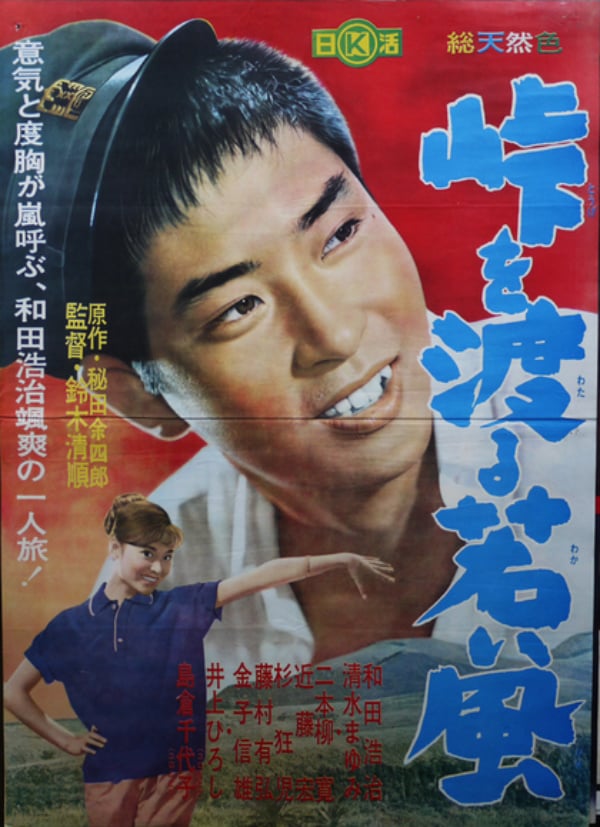
The Wind-of-Youth Group Crosses the Mountain Pass (峠を渡る若い風, Seijun Suzuki, 1961)

The Wind-of-Youth Group Crosses the Mountain Pass posterSeijun Suzuki made his first colour film in 1960 – Fighting Delinquents starred young matinee idol Koji Wada as a noble hearted construction worker with a temper who suddenly learns that he is the heir to an aristocratic fortune. Suzuki would make another two youth dramas starring Wada before getting to 1961’s The Wind-of-Youth Group Crosses the Mountain Pass (峠を渡る若い風, Toge wo Wataru Wakai Kaze, AKA Breeze on the Ridge) – this slice of colourful anarchy is a world away from Nikkatsu’s usual action fare though it does make space for the odd pop song or two.

Naive and cheerful university student Shintaro (Koji Wada) loves to travel and has taken off to wander around alone during the summer break. Getting thrown off a regular city bus for not having the cash for a ticket (his request to defer payment is not looked on kindly), Shintaro catches a lift with a group of travelling performers heading into the summer festival in the next town. Once there Shintaro showcases his lack of forethought once again when he happily sets down to start selling some of the “merchandise” he was given as a salary when the last place he worked at went bust. Not having realised that one generally needs a permit to sell goods in a market, Shintaro gets into an argument about the evils of monopolies and freedom verses regulation with the guy on the next stand all of which brings him to the attention of the yakuza. Luckily for Shintaro, he’s run into the nice kind of yakuza who just think he’s funny and invite him to travel on with them for a bit. Being so essentially good hearted and innocent, Shintaro agrees without thinking about all the reasons travelling around with a bunch of shady yakuza might not be a good idea.

Connecting with both the yakuza and the travelling players, Shintaro becomes involved in a number of interconnected crises – the biggest being the fate of the performers when a local gangster type swipes their headline act. The head of the troupe, Kinyo Imai (Shin Morikawa), is a traditional magician who performs in exaggerated Chinese dress complete with Fu Manchu moustache, but it doesn’t really matter how good he is, the rural audience is only here for the strip show. No stripper means no bookings which Kinyo knew already but it’s still a huge blow to his self esteem to realise that his magic doesn’t do the business anymore, especially as he’d always been conflicted about the strippers anyway.

Shintaro is one of Nikkatsu’s wandering heroes but unlike most he’s a cheerful soul who wanders out of a sense of curiosity and adventure rather than a need to escape something or someone at home. He likes meeting new people, even if the relationships are transitory and necessarily shallow, and treats everyone he meets with kindness and an open mind. In return he meets only kind and open people – even the yakuza are a generally decent sort who treat him like a new friend and can be relied upon to come to his aid if called. The only note of sourness arrives in the form of shady gangster Akita (Hiroshi Kondo) who pinches the troupe’s stripper, and their sometime patron who makes an indecent proposal to Kinyo as a kind of bet to decide whether he continues to fund their moribund performing career.

This being a regular program picture there’s not a lot of scope for experimentation but as it’s also a slightly odd entry to the Nikkatsu catalogue Suzuki does have the freedom to spice things up in his own particular way. Making the best use of colour film, Suzuki has a ball capturing Japan’s unique summer festival culture with its giant floats and cheerful market atmosphere. Wandering around the festival in a lengthy POV shot manages to exoticise something which would be quite ordinary to many viewers (at least those not born in large cities) but Suzuki’s other innovations are mostly relegated to one extremely interesting sequence in which Shintaro has a paint fight with yakuza he’s fallen out with (don’t worry, they both end up laughing like school boys). Every time Shintaro gets hit with paint, the entire screen tints to match neatly intensifying the effect and marking an early example of Suzuki’s love of colour play. Warm and goodnatured, The Wind-of-Youth Group Crosses the Mountain Pass is a gentle tale of youth finding its path but also one in which Suzuki takes advantage of the travelling motif to break from the regular programming and present an anarchic carnivale of music and song.


The Wind-of-Youth Group Crosses the Mountain Pass is the second of five films included in Arrow’s Seijun Suzuki: The Early Years. Vol. 1 Seijun Rising: The Youth Movies box set.

Original trailer (English subtitles)

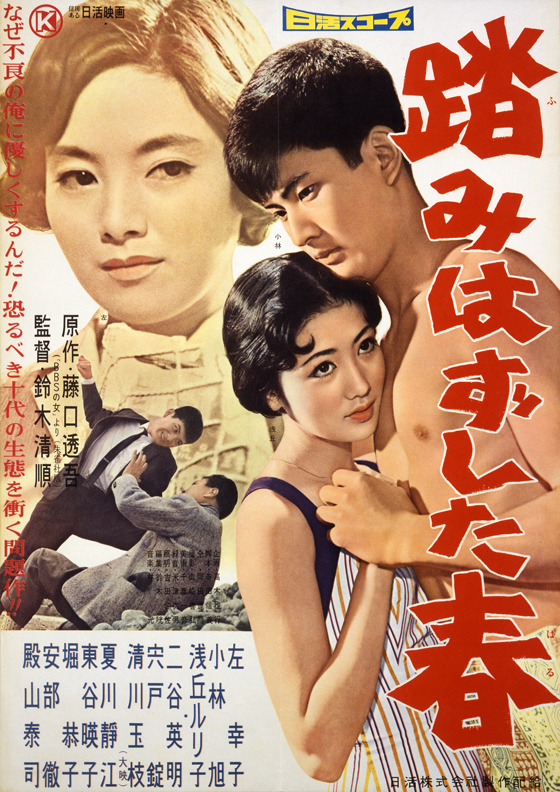
The Boy Who Came Back (踏みはずした春, Seijun Suzuki, 1958)

the boy who came back posterSeijun Suzuki may have been fired for making films that made no sense and no money, but he had to start somewhere before getting the opportunity to push the boat out. Suzuki’s early career was much like that of any low ranking director at Nikkatsu in that he was handed a number of program pictures often intended to push a pop song or starring one of the up and coming stars in the studio’s expanding youth output. The Boy Who Came Back (踏みはずした春, Fumihazushita Haru, AKA The Spring that Never Came) is among these early efforts and marks an early leading role for later pinup star Akira Kobayashi paired with his soon to be frequent leading lady, Ruriko Asaoka. A reform school tale, the film is a restrained affair for Suzuki who keeps the rage quelled for the most part while his hero struggles ever onward in a world which just won’t let him be.

Keiko (Sachiko Hidari) is a conductress on a tour bus, but she has aspirations towards doing good in the world and is also a member of the volunteer organisation, Big Brothers and Sisters. While the other girls are busy gossiping about one of their number who has just got engaged (but doesn’t look too happy about it), Keiko gets a message to call in to “BBS” and is excited to learn she’s earned her first assignment. Keiko will be mentoring Nobuo (Akira Kobayashi) – a young man getting out of reform school after his second offence (assault & battery + trying to throttle his father with a necktie, time added for plotting a mass escape). Nobuo, however, is an angry young man who’s done all this before, he’s not much interested in being reformed and just wants to be left alone to get back to being the cool as ice lone wolf that he’s convinced himself he really is.

Made to appeal to young men, The Boy Who Came Back has a strong social justice theme with Keiko’s well meaning desire to help held up as a public service even if her friends and family worry for her safety and think she’s wasting her time on a load of ne’er do wells. Apparently an extra-governmental organisation, BBS has no religious agenda but is committed to working with troubled young people to help them overcome their problems and reintegrate into society.

Reintegration is Nobuo’s biggest problem. He’s committed to going straight but he’s proud and unwilling to accept the help of others. He turns down Keiko’s offer to help him find work because he assumes it will be easy enough to find a job, but there are no jobs to be had in the economically straightened world of 1958 – one of the reasons Keiko’s mother thinks the BBS is pointless is because no matter how many you save there will always be more tempted by crime because of the “difficult times”. When he calms down and comes back, agreeing to an interview for work at his mother’s factory Nobuo leaves in a rage after an employee gives him a funny look. There are few jobs for young men, but there are none for “punks” who’ve been in juvie. Every time things are looking up for Nobuo, his delinquent past comes back to haunt him.

This is more literally true when an old enemy re-enters Nobuo’s life with the express intention of derailing it. His punk buddies don’t like it that he’s gone straight, and his arch rival is still after Nobuo’s girl, Kazue (Ruriko Asaoka). If Nobuo is going to get “reformed” he’ll have to solve the problem with Kajita (Jo Shishido) and his guys, but if he does it in the usual way, he’ll land up right in the slammer. Keiko’s dilemma is one of getting too involved or not involved enough – she needs to teach Nobuo to fix his self image issues (which are largely social issues too seeing as they relate to familial dysfunction – a violent father and emotionally distant mother creating an angry, fragile young man who thinks he’s worthless and no one will ever really love him) for himself, rather than try to fix them for him.

A typical program picture of the time, The Boy Who Came Back does not provide much scope for Suzuki’s rampant imagination, but it does feature his gift for unusual framing and editing techniques as well as his comparatively more liberal use of song and dance sequences in the (not quite so sleazy) bars and cabarets that Nobuo and his ilk frequent. Unlike many a Nikkatsu youth movie, The Boy Who Came Back has a happy ending as everyone, including the earnest Keiko, learns to sort out their various difficulties and walks cheerfully out into the suddenly brighter future with a much more certain footing.


The Boy Who Came Back is the first of five films included in Arrow’s Seijun Suzuki: The Early Years. Vol. 1 Seijun Rising: The Youth Movies box set.

Original trailer (English subtitles)

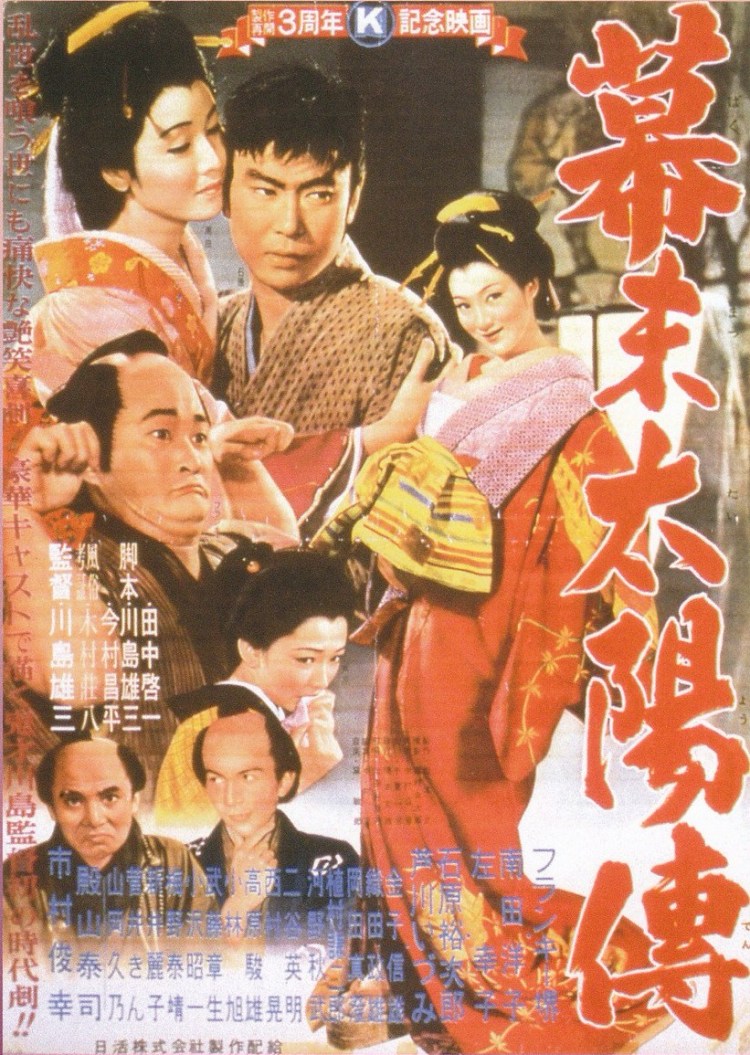
Bakumatsu Taiyoden (幕末太陽傳, Yuzo Kawashima, 1957)

bakumatsu taiyoden posterMany things were changing in the Japan of 1957. In terms of cinema, a short lived series of films known as the “Sun Tribe” movement had provoked widespread social panic about rowdy Westernised youth. Inspired by the novels of Shintaro Ishihara (later a right-leaning mayor of Tokyo), the movement proved so provocative that it had to be halted after three films such was the public outcry at the outrageous depictions of privileged young people indulging in promiscuous sex, drugs, alcohol, and above all total apathy – frivolous lives frittered away on self destructive pleasures. The Sun Tribe movies had perhaps gone too far becoming an easy source of parody, though the studio that engineered them, Nikkatsu, largely continued in a similar vein making stories of youth gone wild their stock in trade.

Yuzo Kawashima, a generation older than the Sun Tribe boys and girls, attempts to subvert the moral outrage by reframing the hysteria as a ribald rakugo story set in the last period of intense cultural crisis – the “Bakumatsu” era, which is to say the period between the great black ships which forcibly re-opened Japan to the outside world, and the fall of the Shogunate. The title, Bakumatsu Taiyoden (幕末太陽傳), literally means “legend of the sun (tribe) in the Bakumatsu era”, and, Kawashima seems to suggest, perhaps things now aren’t really so different from 100 years earlier. Kawashima deliberately casts Nikkatsu’s A-list matinee idols – in particular Yujiro Ishihara (the brother of Shintaro and the face of the movement), but also Akira Kobayashi and familiar supporting face Hideaki Nitani, all actors generally featured in contemporary dramas and rarely in kimono. Rather than the rather stately acting style of the period drama, Kawashima allows his youthful cast to act the way they usually would – post-war youth in the closing days of the shogunate.

They are, however, not quite the main draw. Well known comedian and rakugo performer Frankie Sakai anchors the tale as a genial chancer, a dishonest but kindly man whose roguish charm makes him an endearing (if sometimes infuriating) character. After a post-modern opening depicting contemporary Shinagawa – a faded red light district now on its way out following the introduction of anti-prostitution legislation enacted under the American occupation, Kawashima takes us back to the Shinagawa of 1862 when business was, if not exactly booming, at least ticking along.

Nicknamed “The Grifter”, Saiheiji (Frankie Sakai) has picked up a rare watch dropped by a samurai on his way to plot revolution and retired to a geisha house for a night of debauchery he has no intention of actually paying for. Though he keeps assuring the owners that he will pay “later” when other friends turn up with the money, he is eventually revealed to be a con-man and a charlatan but offers to work off his debt by doing odd jobs around the inn. Strangely enough Saiheiji is actually a cheerful little worker and busily gets on with the job, gradually endearing himself to all at the brothel with his ability for scheming which often gets them out of sticky situations ranging from fake ghosts to customers who won’t leave.

Saiheiji eventually gets himself involved with a shady group of samurai led by Shinshaku Takasugi (Yujiro Ishihara) – a real life figure of the Bakumatsu rebellion. Like their Sun Tribe equivalents these young men are angry about “the humiliating American treaty”, but their anger seems to be imbued with purpose albeit a destructive one as they commit to burning down the recently completed “Foreign Quarter” as an act of protest-cum-terrorism. The Bakumatsu rebels are torn over the best path for future – they’ve seen what happened in China, and they fear a weak Japan will soon be torn up and devoured by European empire builders. Some think rapid Westernisation is the answer – fight fire with fire, others think showing the foreigners who’s boss is a better option (or even just expelling them all so everything goes back to “normal”). America, just as in the contemporary world, is the existential threat to the Japanese notion of Japaneseness – these young samurai are opposed to cultural colonisation, but their great grandchildren have perhaps swung the other way, drunk on new freedoms and bopping away to rock n roll wearing denim and drinking Coca Cola. They too resent American imperialism (increasingly as history would prove), but their rebellions lack focus or intent, their anger without purpose or aim.

Kawashima’s opening crawl directly references the anti-prostitution law enacted by the American occupying forces – an imposition of Western notions of “morality” onto “traditional” Japanese culture. In a round about way, the film suggests that all of this youthful rebellion is perhaps provoked by the sexual frustration of young men now that the safe and legal sex trade is no longer available to them – echoing the often used defence of the sex trade that it keeps “decent” women, and society at large, safe. Then again, the sex trade of the Bakumatsu era is as unpleasant as it’s always been even if the familiar enough problems are played for laughs – the warring geisha, the prostitute driven in desperation to double suicide, the young woman about to be sold into prostitution against her will in payment of an irresponsible father’s debt, etc. One geisha has signed engagement promises with almost all her clients – it keeps the punters happy and most of them are meaningless anyway. As she says, deception is her business – whatever the men might say about it, it’s a game they are willingly playing, buying affection and then seeming hurt to realise that affection is necessarily false and conditional on payment of the bill.   

Playing it for laughs is, however, Kawashima’s main aim – asking small questions with a wry smile as Saiheiji goes about his shady schemes with a cleverness that’s more cheeky than malicious. He warns people they shouldn’t trust him, but in the end they always can because despite his shady surface his heart is in the right place. Warned he’ll go to hell if he keeps on lying his way though life, Saiheiji laughs, exclaims to hell with that – he’s his own life to live, and so he gleefully runs away from the Bakumatsu chaos into the unseen future.


Masters of Cinema release trailer (English subtitles)

Five Scouts (五人の斥候兵, Tomotaka Tasaka, 1938)

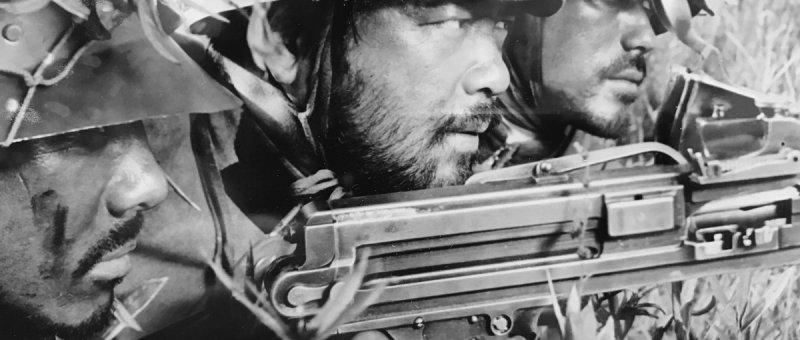
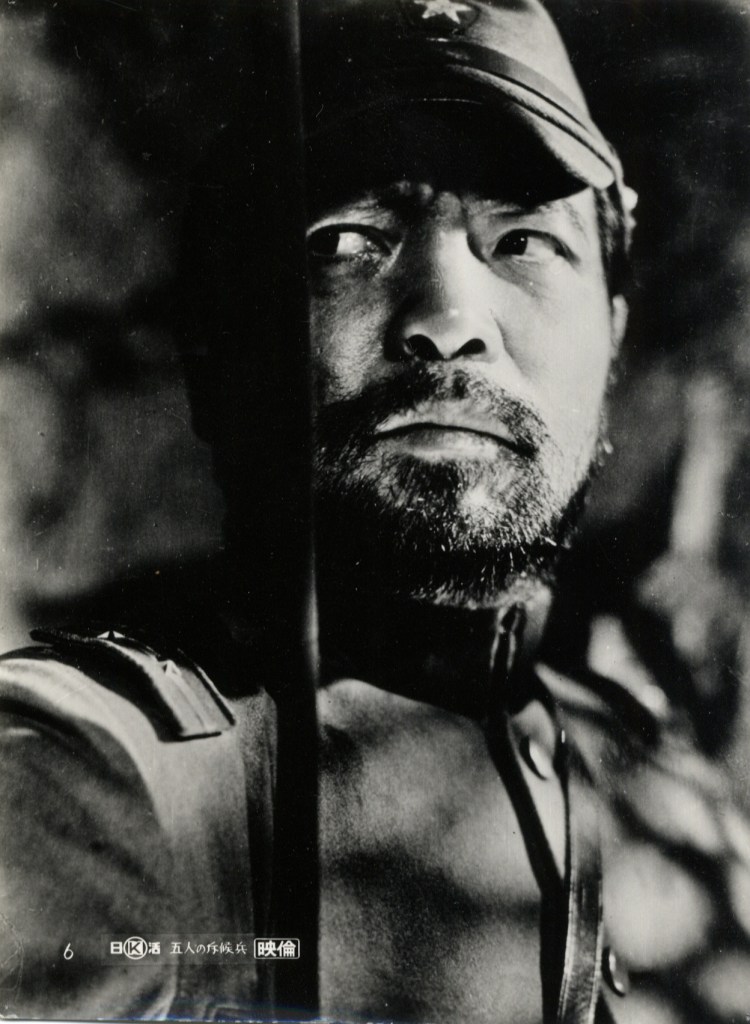
five scouts still 3War, in Japanese cinema, had been largely relegated to the samurai era until militarism took hold and the nation embarked on wide scale warfare mixed with European-style empire building in the mid-1930s. Tomotaka Tasaka’s Five Scouts (五人の斥候兵, Gonin no Sekkohei) is often thought to be the first true Japanese war film, shot on location in Manchuria and trying to put a patriotic spin on its not entirely inspiring central narrative. Like many directors of the era, Tasaka is effectively directing a propaganda film but he neatly sidesteps bold declarations of the glory of war for a less controversial praise of the nobility of the Japanese soldier who longs to die bravely for the Emperor and lives only to defend his friends.

The film opens with an exciting action sequence playing behind the titles featuring impressive scenes of battle with mortar shells exploding while soldiers run over trenches before entrenching themselves with a light machine gun. Eventually the day is won – after a fashion. Having lost 120 men, the 80 surviving of the 200 strong company settle-in to a fortified position awaiting further orders.

The excitement of the battlefield soon gives way to behind the lines boredom. Danger lurks around every corner, but there is work to be done. The men dig trenches, clean their weapons, draw water, cook and eat but they also try to live, chatting or enjoying the “spoils of war” which in this case amount to stolen watermelons and captured ducks. In quiet moments they dream of sukiyaki and of home, but are content in each other’s company and as cheerful as it’s possible to be given the seriousness of their circumstances.

When two enemy soldiers are detected on the perimeter, a squad of five scouts is sent out to investigate but find themselves lost in the confusing Chinese terrain and eventually come under heavy fire. Worryingly enough, only one of the soldiers makes it back in good time with the others remaining unaccounted for until they eventually arrive save one who no one can remember seeing since the beginning of the attack and whose helmet has been found in an abandoned trench.

Tasaka refuses to glorify the business of war. What the men experience is rain and mud and sorrow, not an exultation in male virility and the politics of strength. He does however fulfil his propaganda requirements in demonstrating the army’s dedication to the Emperor. The commanding officer’s final rousing speech reminds his troops that now is the time they are expected to “repay the benevolence of the Emperor” whilst also emphasising that the hopes and dreams of the Japanese people are invested in them and, even if their families at home are worried for their safety, they are also proud of their sons fighting proudly for their homeland so far away from home.

The men too display the appropriate level of patriotic fervour, breaking off to wave at a Japanese plane before dragging out a giant banner to show their support and each remaining committed to serving even when physically compromised. One soldier with a bullet lodged in his arm, violently rejects the idea of going to a field hospital even though there is a strong chance that his arm will need to be amputated if they do not remove the bullet in due time. The soldier pleads to be allowed to stay on the front line, claiming that he does not mind losing an arm if it means he gets to stay and help his comrades. His comrades, touched by his dedication, nevertheless urge him to get his arm seen to by subtly suggesting that his desire to remain on the frontline is a kind of vanity when his effectiveness is compromised. His arm, technically speaking, does belong to the army and the Emperor after all. Another soldier, not so lucky, exclaims he can see Japan as he lays dying, singing the first verse of the national anthem before finally giving up the ghost.

As the men march off towards the final battle following the rousing speech from their commander who warns that many will die, they do so melancholically rather than with eagerness to sacrifice themselves on an imperial altar. Tasaka stages the battle scenes with impressive realism, drawing inspiration from news reel footage to capture the immediacy and energy of the live battlefield, filming on location behind the lines in Manchuria for added effect. The behind the lines sequences are intentionally less dynamic and conventionally captured, allowing the tedium and the anxiety of a soldier’s life of waiting to take centre-stage. Tasaka’s film may seem naive and perhaps lacks the initial impact of the shock of seeing such visceral action scenes portrayed on screen for the first time, but it is also mildly subversive in its subtle rejection of the militarist lust for glory even whilst heaping praise on the ideal soldier’s love of Emperor, comradeship, and strong sense of duty and honour.


A Colt is My Passport (拳銃は俺のパスポート, Takashi Nomura, 1967)

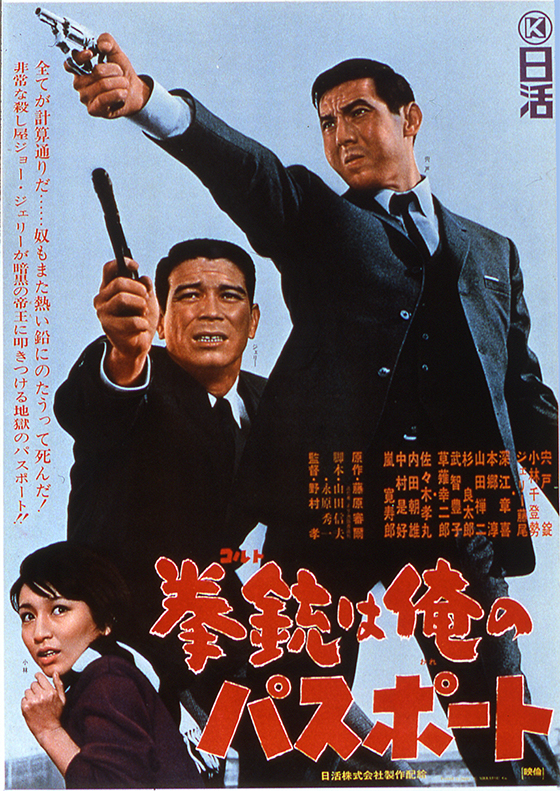
colt is my passport posterJo Shishido played his fare share of icy hitmen, but they rarely made it through such seemingly inexorable events as the hero of Takashi Nomura’s A Colt is My Passport (拳銃は俺のパスポート, Colt wa Ore no Passport). The actor, known for his boyishly chubby face puffed up with the aid of cheek implants, floated around the lower end of Nikkatsu’s A-list but by 1967 his star was on the wane even if he still had his pick of cooler than cool tough guys in Nikkatsu’s trademark action B-movies. Mixing western and film noir, A Colt is My Passport makes a virtue of Japan’s fast moving development, heartily embracing the convenience of a society built around the idea of disposability whilst accepting the need to keep one step ahead of the rubbish truck else it swallow you whole.

Kamimura (Joe Shishido) and his buddy Shiozaki (Jerry Fujio) are on course to knock off a gang boss’ rival and then get the hell out of Japan. Kamimura, however, is a sarcastic wiseguy and so his strange sense of humour dictates that he off the guy while the mob boss he’s working for is sitting right next to him. This doesn’t go down well, and the guys’ planned airport escape is soon off the cards leaving them to take refuge in a yakuza safe house until the whole thing blows over. Blowing over, however, is something that seems unlikely and Kamimura is soon left with the responsibility of saving both his brother-in-arms Shiozaki, and the melancholy inn girl (Chitose Kobayashi) with a heart of gold who yearns for an escape from her dead end existence but finds only inertia and disappointment.

The young protege seems surprised when Kamimura tosses the expensive looking rifle he’s just used on a job into a suitcase which he then tosses into a car which is about to be tossed into a crusher, but Kamimura advises him that if you want to make it in this business, you’d best not become too fond of your tools. Kamimura is, however, a tool himself and only too aware how disposable he might be to the hands that have made use of him. He conducts his missions with the utmost efficiency, and when something goes wrong, he deals with that too.

Efficient as he is, there is one thing that is not disposable to Kamimura and that is Shiozaki. The younger man appears not to have much to do but Kamimura keeps him around anyway with Shiozaki trailing around after him respectfully. More liability than anything else, Kamimura frequently knocks Shiozaki out to keep him out of trouble – especially as he can see Shiozaki might be tempted to leap into the fray on his behalf. Kamimura has no time for feeling, no taste for factoring attachment into his carefully constructed plans, but where Shiozaki is concerned, sentimentality wins the day.

Mina, a melancholy maid at a dockside inn, marvels at the degree of Kamimura’s devotion, wishing that she too could have the kind of friendship these men have with each other. A runaway from the sea, Mina has been trapped on the docks all her adult life. Like many a Nikkatsu heroine, love was her path to escape but an encounter with a shady gangster who continues to haunt her life put paid to that. The boats come and go but Mina stays on shore. Kamimura might be her ticket out but he wastes no time disillusioning her about his lack of interest in becoming her saviour (even if he’s not ungrateful for her assistance and also realises she’s quite an asset in his quest to ensure the survival of his ally).

Pure hardboiled, A Colt is My Passport is a crime story which rejects the femme fatal in favour of the intense relationship between its two protagonists whose friendship transcends brotherhood but never disrupts the methodical poise of the always prepared Kamimura. The minor distraction of a fly in the mud perhaps reminds him of his mortality, his smallness, the fact that he is essentially “disposable” and will one day become a mere vessel for this tiny, quite irritating creature but if he has a moment of introspection it is short lived. The world may be crunching at his heels, but Kamimura keeps moving. He has his plan, audacious as it is. He will save his buddy, and perhaps he doesn’t care too much if he survives or not, but he will not go down easy and if the world wants a bite out of him, it will have to be fast or lucky.


Original trailer (no subtitles)

Cruel Gun Story (拳銃残酷物語, Takumi Furukawa, 1964)

cruel-gun-story-poster.jpgIn the history of Japanese noir, the name Haruhiko Oyabu looms large. Oyabu’s gritty, pulp infused tales of tough guy heroes found their clearest expression in the hardline ‘70s with Toru Murakawa’s unique brand of macho action as seen in Resurrection of the Golden Wolf or The Beast Must Die, but a decade earlier they were also finding fertile ground in Nikkatsu’s harder B-movie noir. Based on a novel by Oyabu, Cruel Gun Story (拳銃残酷物語, Kenju Zankoku Monogatari) seems to owe more than a little to Kubrick’s The Killing in its crime never pays tale of honest crooks undercut by their unscrupulous comrades but the central message is that the gun is a cruel master and those living under its control will pay a heavy price.

Togawa (Jo Shishido) has just been (unexpectedly) given early release from a prison sentence incurred when he took revenge on the truck driver who knocked down his little sister (Chieko Matsubara) and confined her to a wheelchair for the rest of her life. Middle rank gangster Ito – formerly a crooked lawyer with a pencil mustache a supercilious air, has a job for him the gang thinks only he can do. The payout is 120 million yen – not to be sniffed at, but Togawa has reasons to be suspicious. He takes some convincing but finally relents when he finds out an old and trusted friend, Shirai (Yuji Kodaka), has already agreed. The gang have another three guys lined up but Togawa rules the third one out when he tests him and confirms he’s an untrustworthy blabbermouth. The other two are a former boxer with mild brain damage whose girlfriend has just left him, and an unscrupulous but clever chancer named Teramoto (Kojiro Kusanagi).

Following the general pattern, Furukawa walks us through the heist as it’s supposed to go if everything goes to plan complete with a 3D diagram and plastic toy cars but, of course, not everything goes to plan. The job is to steal the ticket money from the Japan Derby (much like the race course robbery in The Killing). The gang will set up fake road signs and station a “policeman” to divert the armoured car onto a small country lane where they will kill the police motorcycle escort, get rid of the guards, and load the truck onto a bigger lorry that they will then take to a disused US airbase they’ll use as their lair.

Disused American airbase could easily apply to the entirety of the surrounding area. Jets fly ominously overhead while the world Togawa and his guys inhabit is one of noirish jazz bars filled with foreigners, grimy boxing clubs, signs in English and the relics of destruction everywhere. This is a place for those who’ve already fallen through the cracks, even the gangsters are only really small fry – not yakuza but hoodlums ripped straight from the Edward G. Robinson playbook. This giant heist is the most audacious in living memory, pulling it off would be the finest achievement any of them would ever make, taking them out of their dead end environments and catapulting them into the criminal high life.

Togawa knows there’s something not right about this – he almost turns it down because he wants to be around to take care of his sister, but he also wants the money to pay for an operation he hopes will restore her mobility to assuage his guilt over having sent her out on the fateful day she was injured. Rie now lives in the care of kindly nuns and is a goodhearted, religious woman hoping for her big brother’s reformation. Togawa and his sister are also victims of war having lost their parents during the evacuation from Manchuria and have been essentially on their own ever since. Rie has become a living symbol of Togawa’s failures – his inability to protect her, to keep them both safe and together, and to free them of the ruined post-war landscape within which they both remain trapped. Rie pins her hopes on God, but Togawa says to hell with that – where has He been so far?

Having pinned his hopes on the gun, Togawa intends this to be the heist to end all heists. After this, he’ll be free to give his sister the life she deserves away from crime and the rundown town strewn with mementos of a distant, dethroned occupying power. The gun, however, is a divisive weapon and engenders nothing but mistrust among men. Resentful of Togawa’s solid friendships, the other guys turn on him as do his shady employers sending Togawa even further along the dark path to moral ruination than he already was. All that’s waiting for Togawa is a hollow victory and the intense disappointment of those whose faith in him was ultimately misplaced.