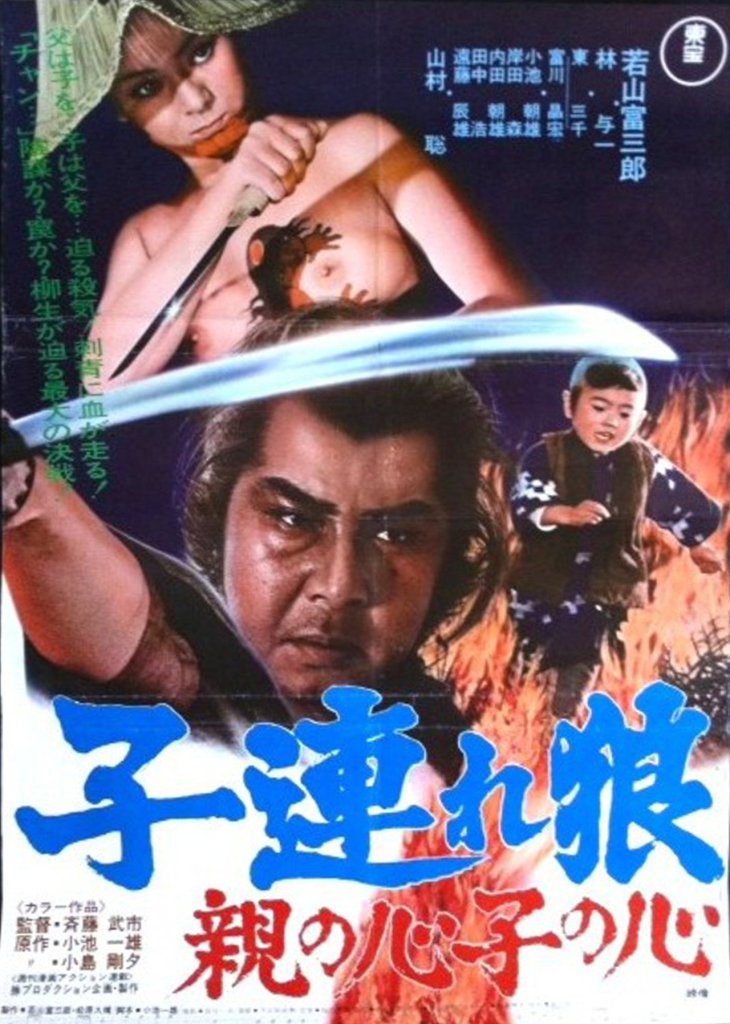
 Now four instalments into the Lone Wolf and Cub series, Ogami (Tomisaburo Wakayama) and Daigoro (Akihiro Tomikawa) have been on the road for quite some time, seeking vengeance against the Yagyu clan who framed Ogami for treason, murdered his wife, and stole his prized position as the official Shogun executioner. Lone Wolf and Cub: Baby Cart in Peril (子連れ狼 親の心子の心, Kozure Okami: Oya no Kokoro Ko no Kokoro) is the first in the series not to be directed by Kenji Misumi (though he would return for the following chapter) and the change in approach is very much in evidence as veteran Nikkatsu director Buichi Saito picks up the reins and takes things in a much more active, full on ‘70s exploitation direction. Where Baby Cart to Hades was content to take a break for contemplation of Ogami’s quest, Baby Cart in Peril is a post-thought spring into action. It is, however, among the most melancholic episodes in the series as it continues to explore the often precarious position of women and the disenfranchised poor in Ogami’s often cruel world.
Opening with a thrilling action sequence in which a topless and heavily tattooed female warrior elegantly despatches a series of enemies, Saito makes the most of the genre’s tendency for economy to jump straight to a scene of Ogami receiving the request to assassinate her. As they travel onward, father and son become accidentally separated after Daigoro wanders off to follow a pair of street performers. Looking for his dad in all the familiar places he can think of, Daigoro unwittingly comes into contact with an old foe, Gunbei (Yoichi Hayashi) – son of Ogami’s arch enemy, Lord Retsudo, who is immediately alarmed by the steely look in Daigoro’s eyes which he claims is only born of mass killing. Daigoro gets himself into trouble when he’s accidentally caught in a field of long grass which the local peasants are set to clear by burning, but gets himself out of it by cleverly digging himself into the mud. Gunbei, impressed, is poised to execute Daigoro on the spot but luckily Ogami turns up to save the day.
Once Ogami has accepted a contract he will see it through but this one brings him no pleasure as his target, Oyuki (Michi Azuma), has a sad story to rival his own. A skilled swordswoman, she finds employment with a local clan but is deceived and then raped by one of their retainers leading her to escape and seek her vengeance. Oyuki’s origins lie in an underclass of street performers, loosely grouped into a clan of their own but with communities spanning the entire country. On meeting Oyuki’s father, Ogami’s sorrow in his task deepens as he finds him to be an honest, decent and kind man who accepts his forthcoming suffering with a weary resignation. Further torn between his contract and his personal judgement, Ogami steps back to allow his target to avenge her honour but then must obey his own.
Baby Cart in Peril, even more so than the other chapters, dives into the parent and bond between Ogami and Daigoro as Ogami is once again forced to consider if he made the right choice for his son in bringing him into the “Demon’s Way” of death dealing vengeance. Oyuki, thoroughly and heartbreakingly alone, is distressed to learn that her own father also consents to her death but in Ogami’s view, it’s sometimes lucky to have a parent who wishes for the death of their child. This uncomfortable idea leads him back into that first fateful decision when he allowed Daigoro to choose the sword or the ball and then consented to his choice of the sword. Oyuki also chose the sword as a child and has paid heavily for it, yet more so than Daigoro will ever be she is a victim of her class and gender, subject to a second set of rules of which Daigoro and his father live on the opposing side.
Betrayed, scarred and in the view of the world she lives in defiled, Oyuki has every right as much to seek her vengeance as Ogami has, yet Ogami has already agreed to carry out her sentence for breaking the rules of that same world. He does, however sympathise and feel sorry her plight which is not so different from his own though hers is a heavier burden. Treating Oyuki with far more respect than his previous targets which have all been in some way guilty of crimes against samurai honour, Ogami also tries to help her father whose adherence to that same code (with a sincerity absent from the countless “true samurai” he’s encountered so far despite being a member of an underclass) has sparked his admiration but Ogami is unable to salvage anything at all from the rapacious hands of the uncaring lords.
Baby Cart in Peril marks the return of evil antagonist Lord Retsudo (Tatsuo Endo), not seen since the first instalment, which hints at Ogami finally getting closer to his goal even as Retsudo and his (disgraced) son Gunbei amp up their plotting. This climaxes during one of the large scale brawl scenes the films are famous for as Ogami faces off against hordes of grey clad ninja and basket heads in white. Though badly injured, Ogami makes his way onward even whilst Gunbei celebrates his survival in order that he might face him on equal footing and end his own cycle of vengeance in person.
From the exciting action packed opening, the fight scenes are once again innovative in design including a surprising sequence in which Ogami is attacked by ninjas masquerading as statues in a temple. Saito’s approach is much more contemporary than Misumi’s artful aesthetic, prioritising speed over beauty though that’s not to say the film lacks for impressive visuals. Baby Cart in Peril breaks from the series pattern in adding in other narrative devices from film cycles of the time as in the narrative voice over and greater use of non-diegetic music most obviously when Daigoro’s forlorn wandering turns into a kind of sad music video. Nevertheless, even if Baby Cart in Peril sinks a little from the artistic highs of the first three instalments, it does at least embrace some of its more outlandish elements with a degree of self aware witticism that plays to its exploitation roots. The baby cart and its master have escaped the peril for now, but Ogami and his son are still bound on the Demon Way leaving the sad story of Oyuki behind them. Lord Retsudo may be coming into vision but the road stretches on promising nothing other than death and suffering for all who travel it.
Original trailer (subtitles in German for captions only, NSFW)
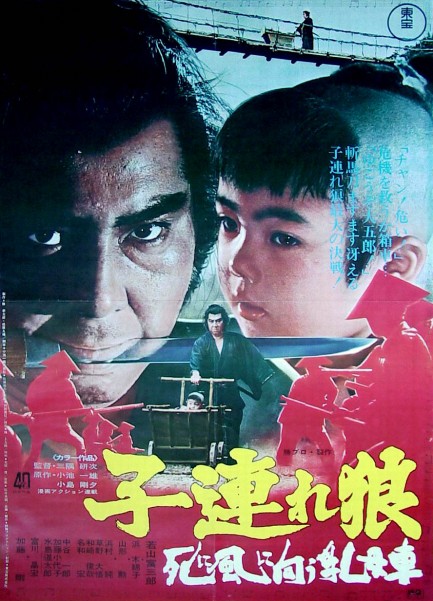 Ogami Itto (Tomisaburo Wakayama) and his (slightly less) young son Daigoro (Akihiro Tomikawa) are going to hell in a baby cart in this third instalment of the six film series, Lone Wolf and Cub: Baby Cart to Hades (子連れ狼 死に風に向う乳母車, Kozure Okami: Shinikazeni Mukau Ubaguruma). The former shogun executioner, framed for treason by the villainous Yagyu clan intent on assuming his position, is still on the “Demon’s Way”, seeking vengeance and the restoration of his clan’s honour with his toddler son safely ensconced within a bamboo cart which also holds its fair share of secrets. In the previous chapter,
 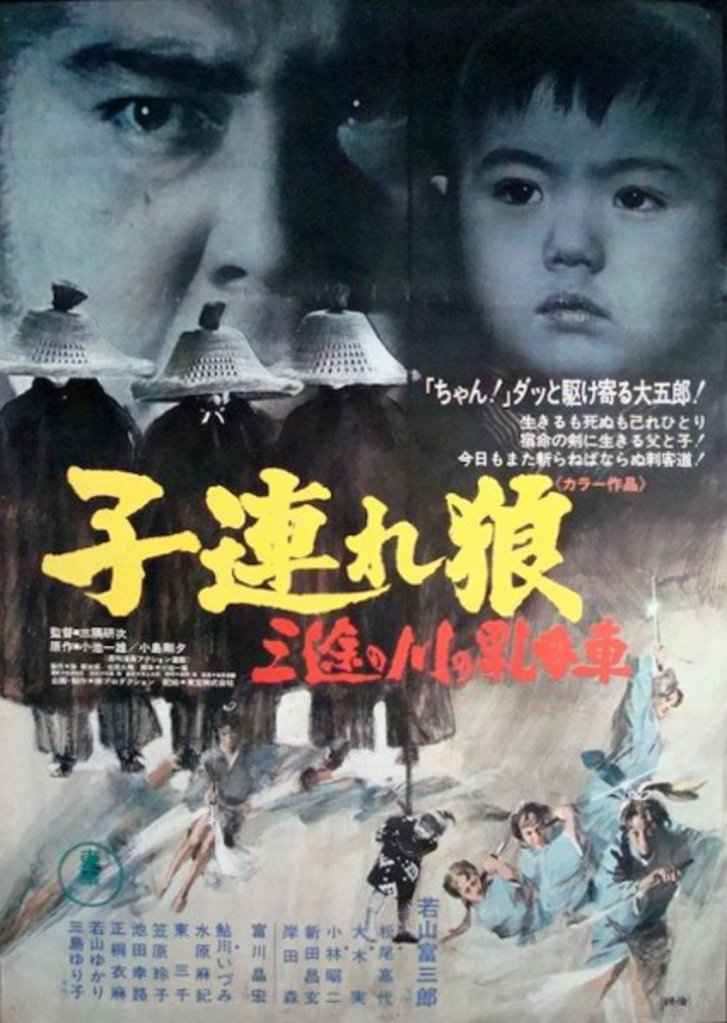 The first instalment of the
 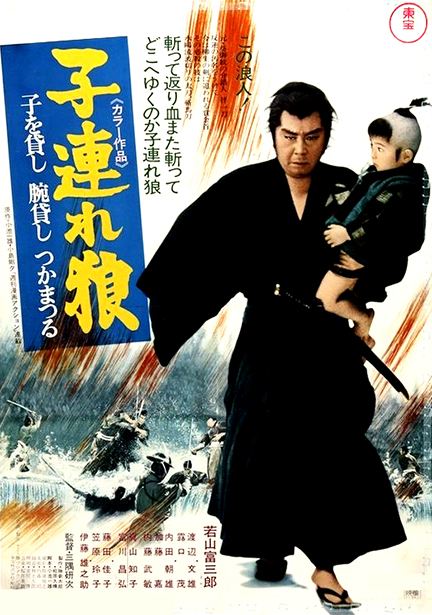 When it comes to period exploitation films of the 1970s, one name looms large – Kazuo Koike. A prolific mangaka, Koike also moved into writing screenplays for the various adaptations of his manga including the much loved Lady Snowblood and an original series in the form of Hanzo the Razor. Lone Wolf and Cub was one of his earliest successes, published between 1970 and 1976 the series spanned 28 volumes and was quickly turned into a movie franchise following the usual pattern of the time which saw six instalments released from 1972 to 1974. Martial arts specialist Tomisaburo Wakayama starred as the ill fated “Lone Wolf”, Ogami, in each of the theatrical movies as the former shogun executioner fights to clear his name and get revenge on the people who framed him for treason and murdered his wife, all with his adorable little son ensconced in a bamboo cart.
 Shimizu, strenuously avoiding comment on the current situation, retreats entirely from urban society for this 1941 effort, Introspection Tower (みかへりの塔, Mikaheri no Tou). Set entirely within the confines of a progressive reformatory for troubled children, the film does, however, praise the virtues popular at the time from self discipline to community mindedness and the ability to put the individual to one side in order for the group to prosper. These qualities are, of course, common to both the extreme left and extreme right and Shimizu is walking a tightrope here, strung up over a great chasm of political thought, but as usual he does so with a broad smile whilst sticking to his humanist values all the way.
 The well known Natsume Soseki novel, Botchan, tells the story of an arrogant, middle class Tokyoite who reluctantly accepts a teaching job at a rural school where he relentlessly mocks the locals’ funny accent and looks down on his oikish pupils all the while dreaming of his loyal family nanny. Hiroshi Shimizu’s Nobuko (信子) is almost an inverted picture of Soseki’s work as its titular heroine travels from the country to a posh girls’ boarding school bringing her country bumpkin accent and no nonsense attitude with her. Like Botchan, though for very different reasons, Nobuko also finds herself at odds with the school system but remains idealistic enough to recommend a positive change in the educational environment.
 Isn’t it sad that it’s always the kids that end up hurt when parents fight? Throughout Shimizu’s long career of child centric cinema, the one recurring motif is in the sheer pain of a child who suddenly finds the other kids won’t play with him anymore even though he doesn’t think he’s done anything wrong. Four Seasons of Children (子どもの四季, Kodomo no Shiki) is actually a kind of companion piece to
  It would be a mistake to say that Hiroshi Shimizu made “children’s films” in that his work is not particularly intended for younger audiences though it often takes their point of view. This is certainly true of one of his most well known pieces, Children in the Wind (風の中の子供, Kaze no Naka no Kodomo), which is told entirely from the perspective of the two young boys who suddenly find themselves thrown into an entirely different world when their father is framed for embezzlement and arrested. Encompassing Shimizu’s constant themes of injustice, compassion and resilience, Children in the Wind is one of his kindest films, if perhaps one of his lightest.
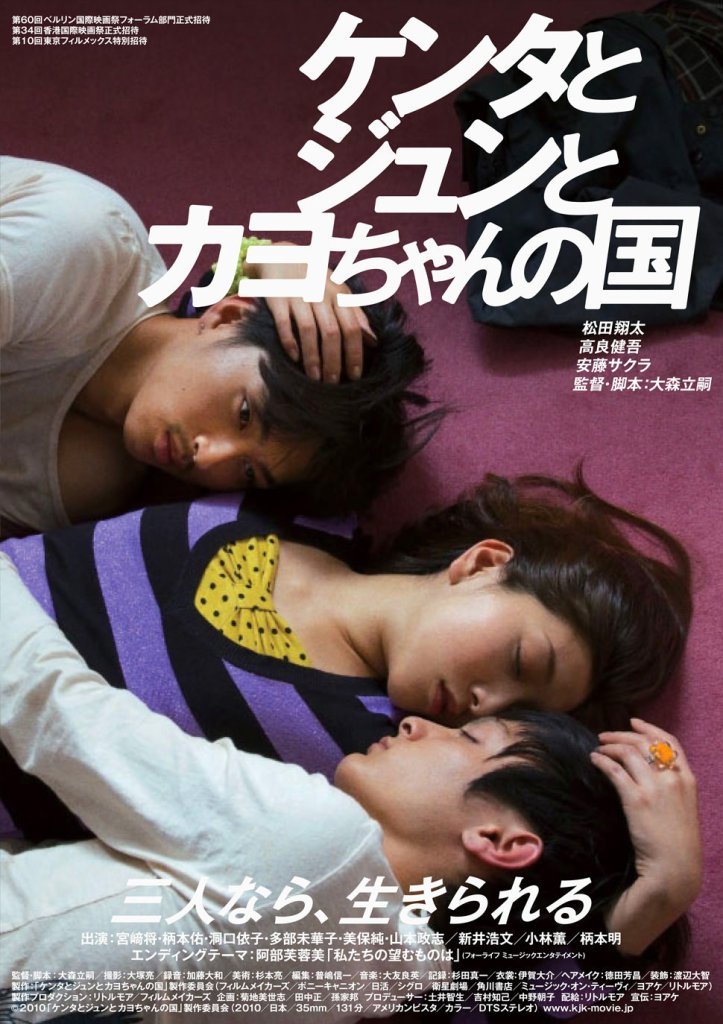 Tatsushi Omori’s debut feature
