Wife (妻, Mikio Naruse, 1953)

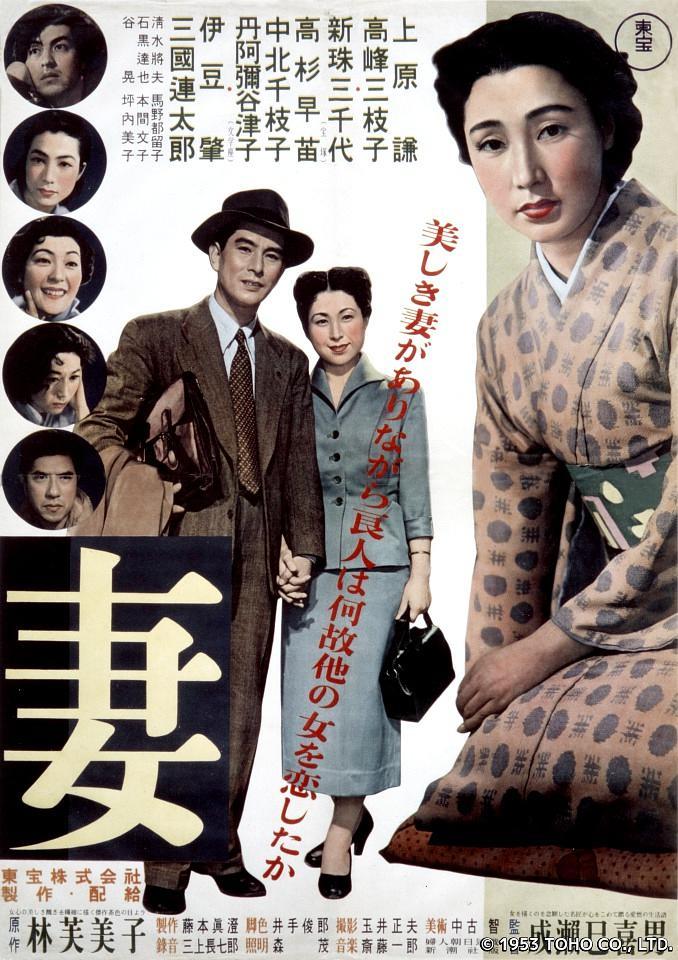
The post-war world, to a certain way of thinking at least, promised a greater degree of freedom in which it might no longer be necessary to go on stoically bearing unhappiness in service to a social ideal. Then again, old habits are hard to break and not everyone is quite so equipped to acknowledge that misery can in a sense be a choice. Mikio Naruse’s Wife (妻, Tsuma) finds itself at a moment of transition in which the meaning of everything the word meant was perhaps beginning to change while the idea that a woman might choose to reject the role was no longer a taboo but an increasingly viable possibility. 

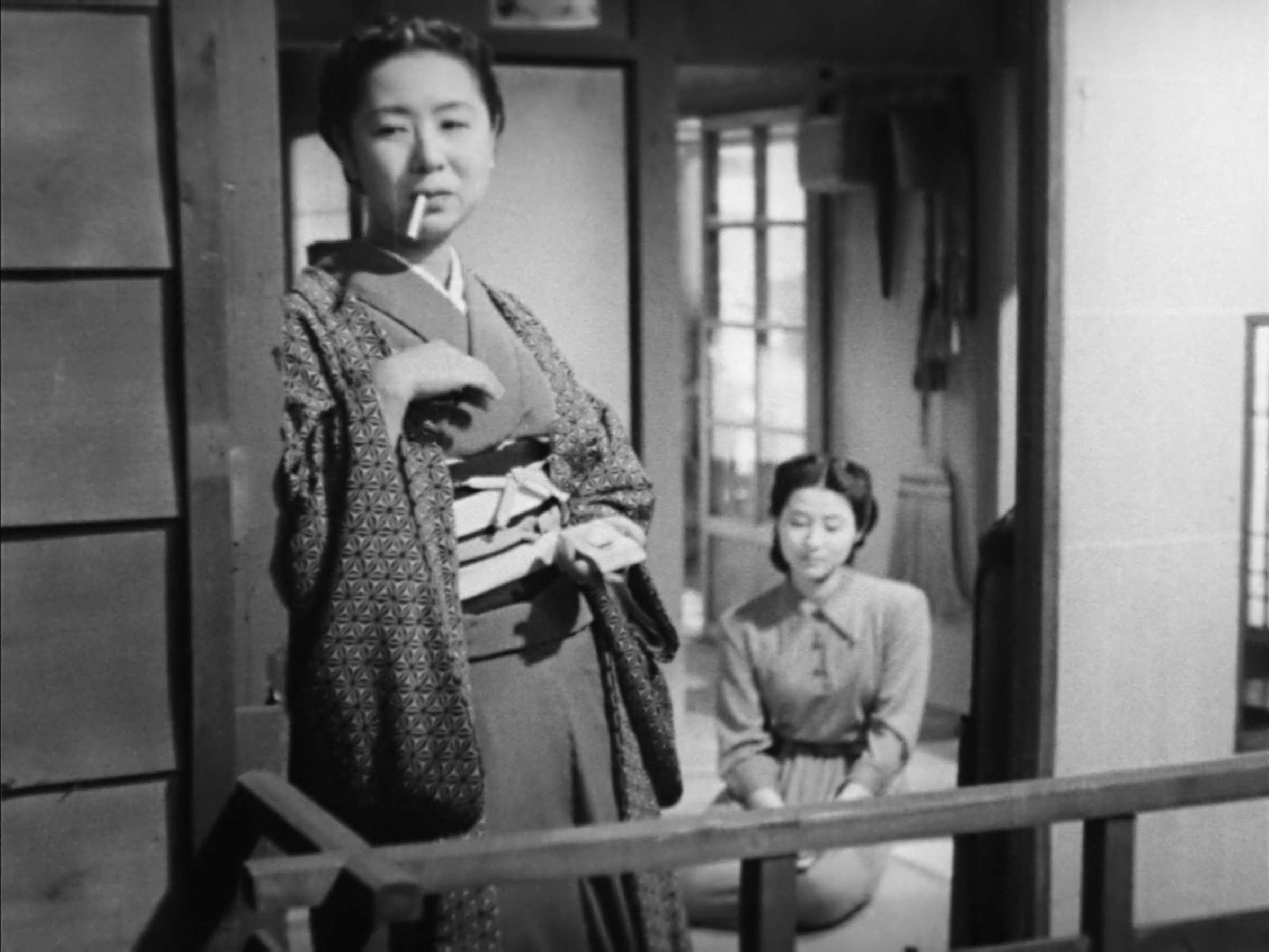
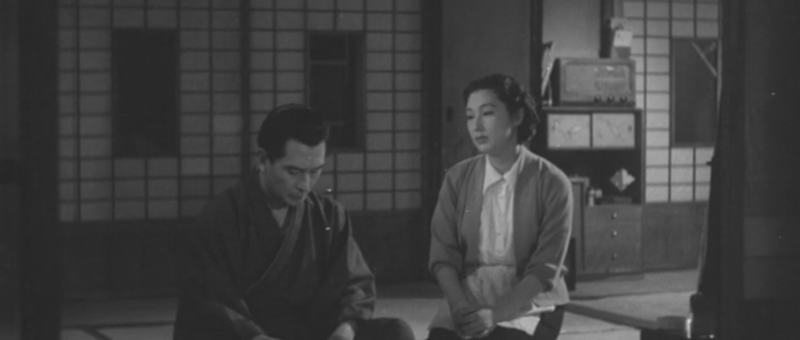
To the unhappily married Mineko (Mieko Takamine), however, the idea of independence remains somewhat distasteful. Each morning her husband, Nakagawa (Ken Uehara), leaves the house without a word. In fact, he doesn’t even look at her before silently walking away. She complains that she has no idea what he’s thinking, all he ever tells her is that he’s “tired” but she also resents him for failing to provide for her in the way that she perhaps expected. The couple live in a sizeable home, but Mineko has to rent out the upstairs to a series of lodgers as well as taking in sewing as a side job to make ends meet. What seems perfectly apparent is that the couple are ill suited, both in terms of temperament and of personal desires. Nakagawa is a soft hearted, romantic sort of man who isn’t particularly bothered if their lodgers pay their rent or not, while his wife is emotionally distant and infinitely practical as perhaps life has taught her to be. 

The peculiarities of life in Japan in 1953 place considerable strain on not only on the Nakagawas but on each of the other couples that we see. Those who married in haste during the war may be regretting their choices, while others, like Eiko (Chieko Nakakita) who rents the upstairs room with her husband Matsuyama (Hajime Izu), complain that the men they waited so long for came back changed. That Matsuyama cannot find a job in the difficult economic circumstances of the post-war society may not be his fault, but the necessity of relying on his wife for economic support has nevertheless eroded his sense of masculinity and left him a resentful drunk, destroying his wife’s love for him. Mineko is slightly scandalised when another tenant, art student Tanimura (Rentaro Mikuni), reveals that Eiko works not in a store but in a bar in Ginza, that being in truth the only kind of job that pays enough to support a married couple and a mother-in-law that a woman can get in 1953. Eventually Eiko leaves her husband, something else that scandalises Mineko, and resolves to live an independent life rather than remarry.

The idea of independence is repeatedly mentioned to her, but Mineko continues to reject it. Her sister jokingly suggests going into business together, while another customer, a widow with a young son, floats the idea of leaving the home of her late husband and opening a shop to support herself independently. She believes remarriage is not a viable option because she has a child, a thought echoed by another widow, Fusako (Yatsuko Tanami), who eventually decides to do something similar by returning to her hometown and going into business with a friend. Opening a shop is a popular option, but it of course requires investment and relies on having strong support, in Fusako’s case from female solidarity in teaming up with another woman in a similar situation. 

It might be easy enough to say that becoming financially independent is a choice on offer only to widows with children who have, in some way, already fulfilled their social obligations, while women like Eiko who chose childless self-sufficiency would still struggle to find acceptance even if their career were not dependent on an industry still itself taboo. That Nakagawa and Mineko have no children perhaps places an additional strain on the marriage. Nakagawa tells a colleague complaining about his family that he wonders if children might have made his life easier, while his only moment of contentment seems to be in playing with Fusako’s young son on the morning after spending an illicit night with her in an inn at Osaka. She sadly tries to ask what might be next for them, but he only wants to live in that moment knowing that their future is an impossibility. 

Despite his unhappiness, Nakagawa doesn’t seem motivated towards ending his marriage, perhaps out of guilt or because as friend later suggests it’s not so much Fusako that he loves as the possibility of a different future. On his return from his Osaka trip, he encounters a new tenant, Mineuchi, who has found her own way to be independent in becoming a mistress. Nakagawa seems to find the arrangement mildly distasteful, though it’s perhaps not so far off what he’s planning to do with Fusako. Mineuchi paid premium for the room and has even brought her own refrigerator and an electric gramophone so she is in a sense living the dream, especially as her “patron”, a furniture store owner, only visits twice a month. 

After learning that Nakagawa has fallen in love with Fusako, Mineko wonders if she should pay her a visit, but then receives one herself from the furniture store owner’s tearful wife who reveals that he is not a wealthy man and has ruined himself, and therefore her, after being bewitched by a Ginza bar hostess. Later, Mineko discovers that the furniture store owner’s wife took her own life in humiliation, lamenting that she didn’t have to go so far just because of her husband’s indiscretion, but also threatens to do the same herself to try and guilt Fusako into giving up her husband. 

Yet, pretty much everyone seems to tell Mineko that this is all her own fault and the reason her perfectly good husband has looked elsewhere is because she has failed as a wife. Sharp and emotionally distant, she alienates those around her but is devastated to realise that she’s lost her husband’s love and will most likely never be able to regain it. Her decision to talk not to him but to Fusako hints at the way in which women see each other as rivals and not as friends, actively holding each other back, as her sister Yoshimi (Michiyo Aratama) also does in insisting on the social order over personal feeling, rather than attempting to find understanding or mutual support. It doesn’t seem to occur to her that ending her husband’s dream of romantic escape through emotional manipulation is unlikely to improve the quality of her married life. 

Mineko, however, never contemplates independence. She tells Fusako that she won’t consent to a divorce just to claim alimony, but privately wonders what would become of her if she left her husband. She might be able to put a stop to it this time, but who’s to say he won’t find someone else. What she seems primed to choose is socially mandated misery, rejecting the “freedoms” of the post-war age to end an unhappy marriage because she can’t conceive of herself as anything other than a “wife” and being miserable is apparently better than being nothing at all. 


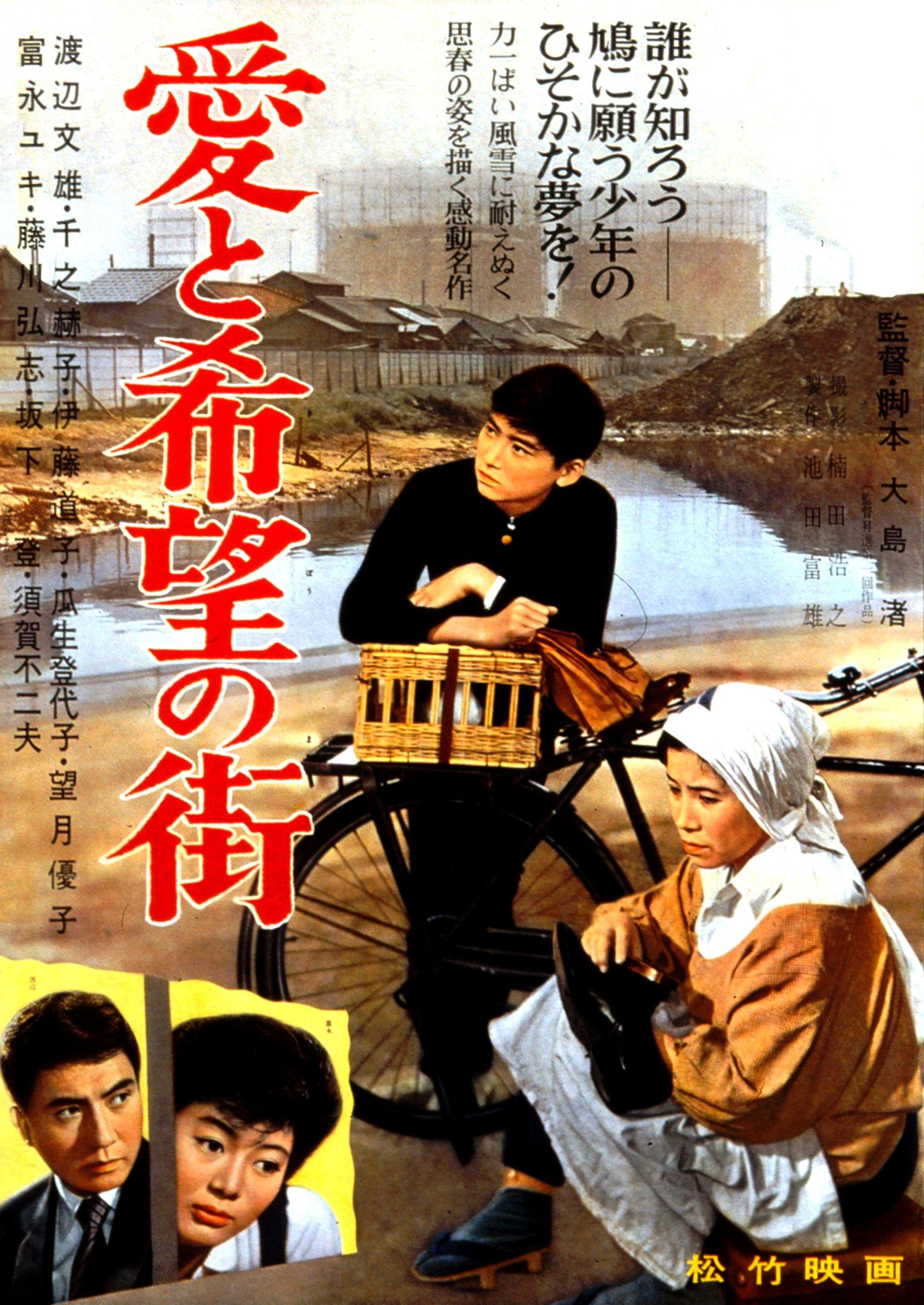
Street of Love and Hope (愛と希望の街, Nagisa Oshima, 1959)

“You must sell your pigeons or you can’t survive in this world” a less progressive figure than he first seemed eventually admits in Nagisa Oshima’s ironically titled debut feature Street of Love and Hope (愛と希望の街, Ai to Kibo no Machi). As might be expected given the director’s later trajectory, there is precious little love or hope on offer and it seems his particular brand of grumpy pessimism ruffled studio feathers from the very beginning earning him a sixth month directing ban with a top executive complaining “this film is saying the rich and poor can never join hands”. The executive may have had a point in the increasing inequalities of the post-war society in which humanist hypocrisy offers only entrenched division and inevitable class conflict. 

As the film opens, the hero, Masao (Hiroshi Fujikawa), is selling his sister’s beloved pet pigeons because, as his social worker later explains, welfare payments are not enough to live on and his mother Kuniko (Yuko Mochizuki), who usually shines shoes for a living, has TB which leaves her unable to work. Kuniko is keen for Masao to stay in education and attend high school, but he acutely feels the burden on his mother and intends to work while attending evening classes. The trouble begins when Masao sells his pigeons to a wealthy young lady, Kyoko (Yuki Tominaga), who is the teenage daughter of an electronics factory boss. 

Well-meaning as she is, Kyoko tries to give Masao the change from her purchase after he explains he’s selling the birds because he needs money. Ironically she gives one of them to her sickly younger brother, but the problem is that Masao is effectively running a scam. The birds are homing pigeons. Assuming the new owners don’t cage them in properly, the birds will fly right back home and he can sell them again. He’s already done this a couple of times and is at least conflicted about it, especially as it upsets his sister Yasue (Michio Ito) so much, though what else really is he supposed to do?

This central question is the one that eventually comes between Masao’s progressive schoolteacher Miss Akiyama (Kakuko Chino) and Kyoko’s sympathetic older brother Yuji (Fumio Watanabe) who works in HR at his father’s factory. Another of Oshima’s mismatched, ideologically opposed frustrated couples, Miss Akiyama and Yuji find themselves on either side of a divide. It seems that the factory does not ordinarily employ city boys, preferring to recruit from the countryside and house employees in dorms because the boss is convinced rural youth is less corrupted by amoral urbanity. Hoping to help Masao, Kyoko and Miss Akiyama team up to convince him to change his mind and give Masao a chance, but they eventually fail him during the exam because it accidentally uncovers his pigeon scam and therefore proves the boss’ point. 

That isn’t all it exposes, however, as even the seemingly progressive Yuji expresses some extremely outdated, quite offensive prejudices even as he insists they didn’t fail Masao because he comes from a single-parent family. According to the boss, children of “broken families” become “twisted human beings” which is unfortunate because “corporations value stability”. Even while not disagreeing with his father’s logic, Yuji explains that he can’t employ Masao not because of his fatherless status but because he’s fundamentally dishonest as proved by his pigeon scam. Miss Akiyama who’d previously described him as the kind of boy who never lies, is shocked but later reflects on his circumstances and her own. In its own ways, her life is also hard and she can see how it might happen that she too may have to “sell her pigeons” (a handy piece of wordplay hingeing on the fact the Japanese for pigeon, “hato”, sounds similar to the English word “heart”) in order to survive. She can forgive Masao for doing the same in the knowledge he had no other choice, but believes Yuji wouldn’t nor would he forgive her if he discovered that she too had sold herself. She cannot be in a relationship with a man who is so “heartless” and unforgiving and it is this which creates the unbreachable gulf between them itself informed by their differing socioeconomic circumstances. 

These differences in standing are also brought out in the youthful idealism of Kyoko who wholeheartedly believes she can help Masao by giving him money and then trying to improve his circumstances by getting him a job in her father’s factory. Both her father and her brother dismiss her altruistic desire to help as childish, Yuji pointing out that there are millions of poor people not just one and you can’t help them all, while their cynicism is eventually validated in the exposure of Masao’s “fraud” which accidentally brands those living in difficult economic circumstances as duplicitous criminals even as it directly implies that it is an unfair society which turns honest boys like Masao who never lie and just want to take care of their mothers into “heartless” bird traffickers. You can see why Shochiku didn’t like it, the hope of the post-war era shot down by the gun of a conflicted industrialist. 


Warm Current (暖流, Yasuzo Masumura, 1957)

Never one to tread the beaten path, Yasuzo Masumura studied film abroad in Italy before, perhaps counter intuitively, entering the Japanese studio system apprenticing at Daiei where he’d remain until its bankruptcy in the early ‘70s forced him into freelancing. His 1957 debut Kisses was a response to the taiyozoku or sun tribe craze of nihilistic youth movies though it was in its own way quietly hopeful and even sweet, at least in contrast to some the more cynical views of romance which colour some of the director’s later work, but again despite being positioned as precursor to the New Wave is also very much in the classical tradition if owing something to contemporary European art house. Masumura’s second film Blue Sky Maiden continued in the same vein, an ostensibly cheerful take on Sirkian melodrama in which the plucky heroine finds self-actualisation while dealing with her difficult family history. Warm Current (暖流, Danryu), meanwhile, builds on the same Sirkian foundations, remaking a popular weepy which had proved a big hit for Kozaburo Yoshimura 20 years earlier, but further undercutting it with a sense of ironic inconsequentiality as the heroes engage in a background battle for the post-war future. 

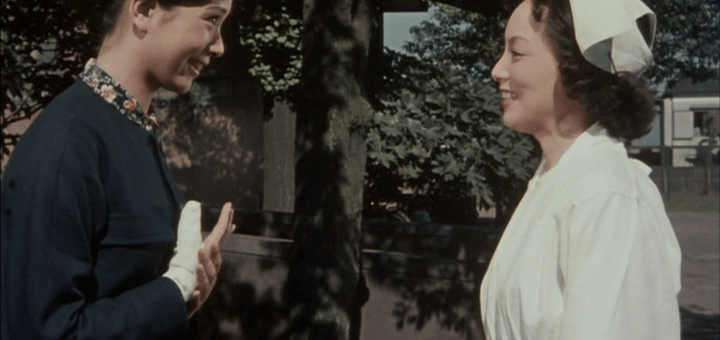
The film opens with a suicide, a nurse discovered dead on a bench after apparently having poisoned herself. She is, however, not the focus of the story and all too quickly forgotten in favour of the return of Keiko (Hitomi Nozoe), the daughter of the hospital’s director who has until recently been studying abroad. She’s come to the hospital because she has a piece of a sewing needle somehow embedded in her finger which needs rather more treatment than one might expect. Anyway, while there she attracts the attentions of handsome doctor Sasajima (Ryuji Shinagawa) and meets up with old schoolfriend Gin (Sachiko Hidari) who has since become a nurse. The problem is that the hospital is in big financial trouble and Keiko’s father Shima (Toranosuke Ogawa) is secretly terminally ill with cancer. He brings in Hibiki (Jun Negami), a pharmaceuticals executive he’s been supporting as a favour to his late father, as a consultant to streamline the business, while sidelining his rather feckless son Yasuhiko (Eiji Funakoshi), an orthopaedics doctor who might be assumed to take over were he not so entirely useless. 

Introduced rather late, Hibiki is positioned almost as a villain, a destabilising force within this very bourgeois world of the hospital determined to strip it of the corrupt entitlement of the surgical class. To that extent, he comes in like a new broom to apply modern business thinking to the ancient art of medicine but does so with rather old-fashioned ideas of gratitude and loyalty to Shima, always acting in the best interests of the family while positioning himself as a servant retainer. This the minor conflict that defines his complicated relationship with the equally confused Keiko who too has returned from abroad with taste for Western individualism but is uncertain how to live her life as a woman in still conservative Japan. All her friends ask her about blue-eyed boyfriends, and though it seems that she is immediately smitten with Hibiki she quite rudely dismisses him for his slightly condescending manner later remarking that she was turned off by a sense of his overconfidence. 

Keiko tells her father she’s no plans to marry and has come back to Japan intending to continue her studies. For his part, Shima is all for a woman working but not as he puts it if it causes her to become a “brainy spinster”. Eventually courted by Sasajima she finds herself torn, even as he tells her that, unexpectedly, he has no issue with her desire to work or study were she to become his wife, uncertain in her attraction to Hibiki while drawn back towards conservatism in knowing that her father favours marriage and that Sasajima is her class-appropriate match. Despite his own attraction to her, Hibiki says nothing even on hearing of her engagement precisely because of this increasingly outdated sense of social inferiority. Meanwhile, he remains seemingly oblivious to the fact that Gin, who like him is a war orphan, has fallen in love with him which is why she continues to help him as a “spy” within the hospital. 

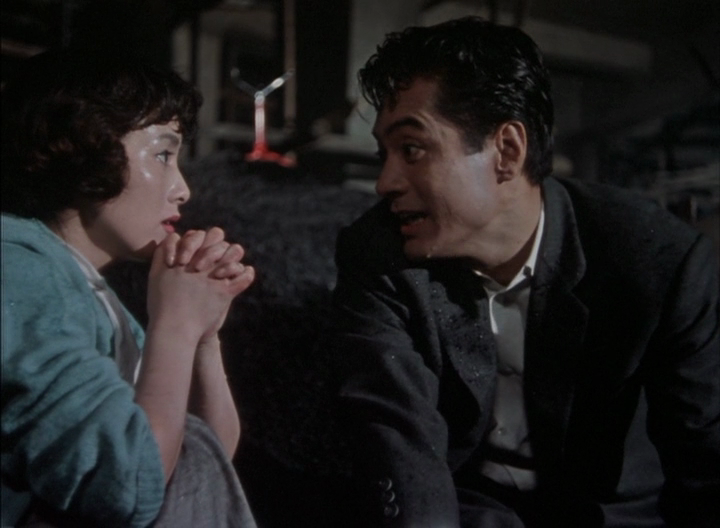
In response to her war trauma, Gin has developed the habit of laughing loudly, an especially unusual trait in a generally reserved culture, and often remarks on her own “stupidity”, the childlike excitability which so clearly positions her as a mirror to the elegant Keiko. Yet the push and pull between the two women has little rancour in it, save that Gin is already aware that Sasajima was responsible for the suicide of the nurse on the rooftop but has chosen not to say anything hoping they’ll marry and Hibiki will be hers. As Keiko later discovers, Sasajima is fairly brazen in his “modernity”, having lived with an aspiring model who declines to marry him because it would adversely affect her career but has no problem with him marrying someone else confident that their physical relationship will continue. Sasajima turns up while Keiko is visiting her, but calmly sits down on the bed and explains that he essentially plans to have two wives, the model for the bedroom and Keiko to be his companion of the mind. He brands her vulgar and small-minded in her conservatism when she proves unconvinced, laying bare an essential misogyny when he echoes that brainy women are “boring”, which is why he “needs” the model to satisfy himself sexually. Nevertheless, Keiko is not that kind of “modern” and in any case not so in love with Sasajima nor deluded enough to think she needs him to agree to his arrangement. 

Gin meanwhile echoes something of the model’s passive resignation when she too declares that she doesn’t care if Keiko marries Hibiki because she’s certain he’s supposed to be with her in the end because they are “alike”. There is no class conflict between them, and as they are both war orphans they share a sense of displacement in the post-war society. Unlike Keiko Gin is open in her feelings, declaring her love for Hibiki even chasing after him at the station and calling out across the ticket barriers that she’ll wait forever even if she only becomes his mistress. Earlier on, Keiko had been reading a foreign romance about a woman courted by two men she was unable to choose between only making up her mind when one of the men’s accent slipped, but in essence it’s Hibiki who finds himself torn if earnestly, thinking himself in love with Keiko but prevented from pursuing her because of his class anxiety rather than attracted to her precisely because of her class standing and everything it represents which is in a sense the target of his “revolutionary” reforms at the hospital. Tempted, he is eventually pulled back towards the side of “passion”, won over by Gin’s slightly scary if unwavering love for him. 

Yet this is no grand weepy, just the romantic confusion of three young(ish) friends who eventually find direction in their lives as mediated through “love”. Keiko reassumes her stance as a thoroughly modern woman, explaining to her rather naive mother that Yasuhiko, who has wrested control of the estate away from Hibiki, is not capable of looking after them even if he had the desire and so she intends to work, apologising to her father for her intention to become a “brainy spinster” after all. Hibiki loses out in the hospital too which is quickly retaken by the same corrupt forces Shima brought him in to combat. “I understand a woman’s feelings” Hibiki somewhat patronisingly claims as a result of his experiences, immediately proving that he doesn’t in misreading Keiko’s intentions while she, ironically, claims that she is no longer afraid of being overwhelmed by male authority. Unable to change their respective futures, the only option that remains is to abandon them for new ones of their own making but this is far from a tragedy, merely the ironic fate of the post-war generation remaking itself in real time, letting the door close behind them as they walk away from the irredeemably corrupt. 


Original trailer (no subtitles)

Temptation (誘惑, Ko Nakahira, 1957)

Ko Nakahira made his name with the seminal Sun Tribe movie Crazed Fruit, a nihilistic tale of bored, affluent post-war youth. Released a year later, Temptation (Yuwaku), adapted from a novel by Sei Ito, is in some ways its inverse pitting a melancholy widower harping on dreams of lost love against his relentlessly practical daughter for whom “Sex is life. Art is money” but finding in the end perhaps more commonality than difference save for the fact the youth of today may have no real dreams to betray. 

Now 55 years old, Sugimoto (Koreya Senda) is the proprietor of the Sugimoto Dried Goods store in upscale Ginza. Father to an only daughter, Hideko, now that his wife has passed away he finds himself carried back towards the past and is planning to turn the upstairs space in the store into a small gallery. For her part Hideko (Sachiko Hidari) and her coterie of artist friends are hoping to convince him to allow them to exhibit in the gallery for cheap, but he, slightly more conservative in his old age, views them all as low class Bohemians and fails to understand why Hideko hangs out with them in the first place. He has, it seems, an internal conflict symbolised by the beret he’s taken to wearing in which he is unable to let go of the broken dreams of his youth when he was a struggling artist forced to give up his first love, Eiko (Izumi Ashikawa), because he had no money or prospects while she eventually consented to an arranged marriage.  

The world of 1931 being very different, Sugimoto and Eiko never did anything beyond holding hands (later a key plot point), though in her parting letter she laments that she regrets not having let him kiss her and mildly berates him for not having been more forceful. A slightly uncomfortable sentiment, but diffidence seems to be the force defining Sugimoto’s life. At the store he finds himself dissatisfied with his senior salesgirl Junko (Misako Watanabe) whose brusque manner with customers and refusal to wear makeup he fears are harming sales, but is unable to say anything until his rather half-hearted attempt to talk to her provokes a mutual misunderstanding, he thinking she may be anxious about being fired and she wondering if he’s about to make a proposal. 

For unclear reasons, Junko seems to have a crush on Sugimoto, something which becomes a minor problem when he also becomes a target for Kotoko (Yukiko Todoroki), a middle-aged woman/insurance agent from Hideko’s floral arrangement class. Privy to their interior monologues, we can hear the two women squaring off against each other, Junko complaining that Kotoko is “meddling, talkative, and fat”, while Kotoko fires back that Junko wears “no makeup at all and is so stuck up” as they glare at each other through the shop window. Yet it’s not Sugimoto who eventually provokes a change in Junko, but another eccentric, struggling artist, Sohei (Shoji Yasui), who bluntly tells her that she is pretty and so should put some makeup on to bring it out. 

Junko later characterises this intervention as an act of salvation that sees her re-embrace her femininity, not only wearing makeup and having her hair styled but beginning to talk warmly with customers, improving the business but ironically giving Sugimoto the mistaken idea her friendly new demeanour may be partly for his benefit. For his part, Sohei, an unkempt artist suffering a seemingly permanent lice infestation, claims not to have cared very much about money or possessions which led him to accidentally abuse the generosity of his artist friends but has now been awakened, it seems, to a kind of consumerist mentality thanks to the interest of Junko and recognition of his art when some of Sugimoto’s old friends (well known artists Taro Okamoto, Seiji Togo, and critic Kimihide Tokudaiji) praise his paintings on seeing them in the gallery leading to them fetching a high price from prominent collectors. 

“The value of a work of art hinges on whether or not it sells” one of Hideko’s friends points out while she adds “We should be proud that art is profitable”, a sentiment that hugely offends Shohei (Ryoji Hayama), the beret-wearing leader of another artist circle the gang enlist to help them pay for the rental of the gallery. Though he concedes to Hideko’s argument that her father’s gallery is a business enterprise, not a charity, Shohei is somewhat horrified by the casual equation of art and commerce, shocked that the girls view their flower arranging as a practical more than an aesthetic skill. Still, in another irony it turns out that his talent is for business rather than art, shrewdly steering Sohei’s success rather than his own when it’s clear his work is the standout in the gallery. Just like Sugimoto had, he eventually resolves to give up his artistic dreams after falling in love with Hideko, planning to marry into her family and take over the Sugimoto store. She meanwhile, had described him as not good marriage material, “no poor painters for me, only rich men” but is apparently in favour of his selling out if only in that it ironically makes him more himself. 

As we discover there are more than a few reasons besides the beret that Sugimoto keeps feeling Shohei reminds him of someone else even as he finds himself wary of him, pointlessly trying to set Hideko up with someone more “suitable” just as she makes a point of inviting a series of alternative widowed, middle-aged ladies to the gallery opening not so much because she particularly objects to Kotoko but she’s worried her dad might get bamboozled into something without properly surveying his options. While Sugimoto remains maudlin and filled with regret though perhaps putting the past aside through a symbolic act of closure, the youngsters are cheerfully cynical, practical in the way the older generation are always telling them to be but are perhaps disappointed in them for not having dreams or aspirations beyond those of claiming or maintaining or their chosen status in life. “Art is money” Hideko is fond of saying, and it’s true enough in so much as money is an art and the one which seems at least to have captivated the post-war generation eagerly awaiting the advent of the consumerist revolution. 


The Munekata Sisters (宗方姉妹, Yasujiro Ozu, 1950)

Though they may eventually turn melancholy, the films of Yasujiro Ozu are often cheerful affairs in which kindhearted people bear life’s troubles with stoic dignity. There are few villains, only those trying to live even while living is hard. The Munekata Sisters (宗方姉妹, Munekata Shimai) adapted from a story by Jiro Osaragi and produced for Shintoho rather than home studio Shochiku, however, strikes a much less happy tone, ambivalently condemning its heroine to unhappiness through her own adherence to the codes it otherwise insists are noble. 

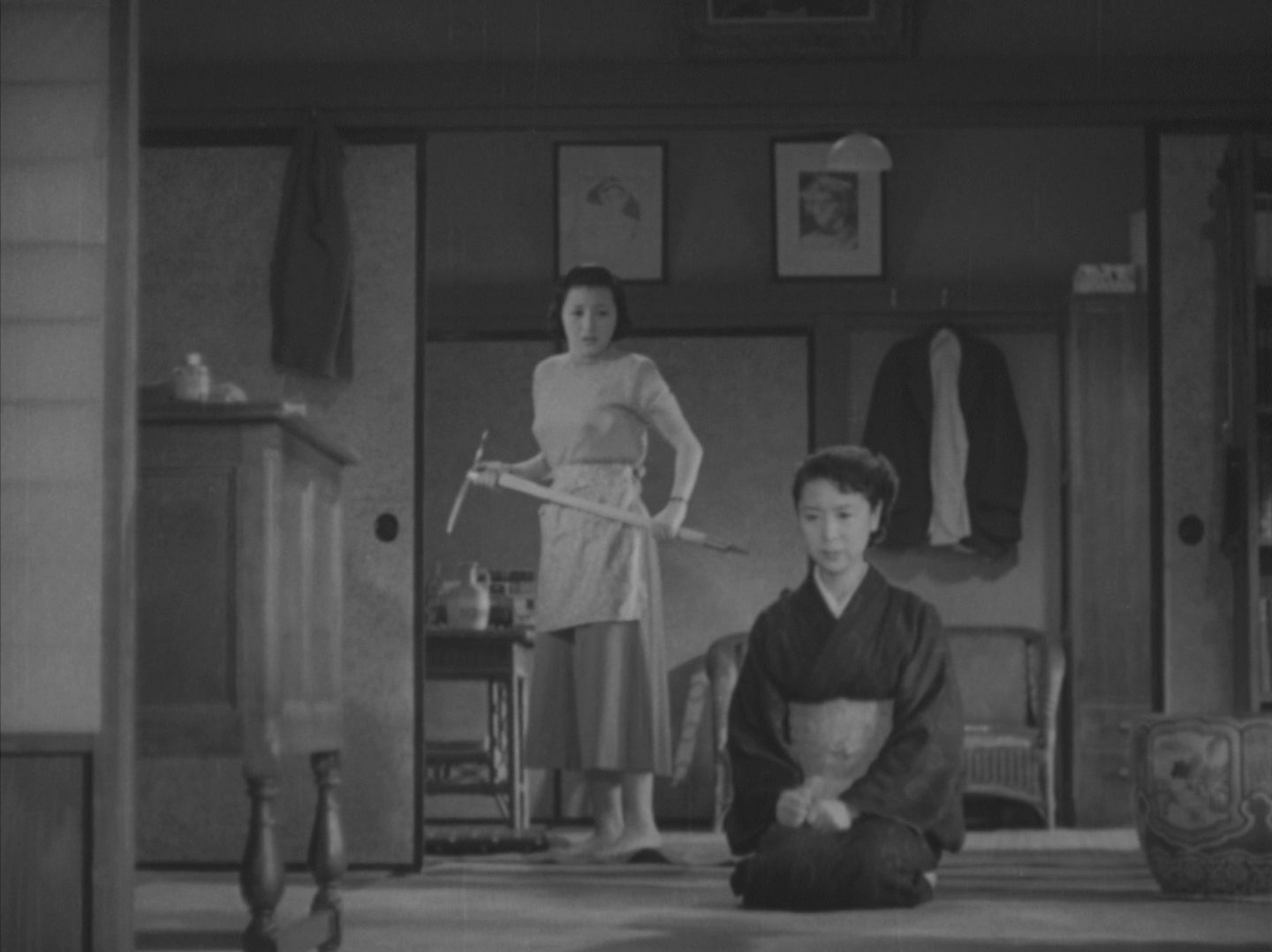
The two titular sisters, Setsuko (Kinuyo Tanaka) and Mariko (Hideko Takamine), live in Tokyo where Setsuko runs a small bar which supports the family while her moody husband Mimura (So Yamamura) has long been out of work. Their father, Mr. Munekata (Chishu Ryu), has returned to Kyoto where, a doctor informs Setsuko in the opening scenes, he is suffering from terminal cancer but surprisingly healthy all things considered. Like his oldest daughter, Kyoto suits Mr. Munekata because as he puts it it is full of the beauty of old Japan, though Mariko has soon had enough of temples and palaces and longs to return to the modernity of the contemporary capital. Whilst in the city, however, they run into an old friend from Manchuria, Hiroshi (Ken Uehara), with whom Mariko soon realises her sister had been in love but he left for France before they could declare their feelings while she was already engaged to her present husband. 

Mariko, a youthful woman dressing exclusively in modern Western fashions, is quite taken with the idea of her sister’s failed romance and determines to get the pair back together. She has only resentment for her moody brother-in-law and has long been aware that Setsuko’s marriage is a failure. Within her seeming modernity, Mariko is surprisingly conservative when it comes to traditional gender roles, resenting Mimura for failing to provide for the family as a man is expected to do. Overcome with despair, he spends his days in a drunken stupor playing with stray cats rather than seriously looking for a job, defined by wounded male pride in his obvious discomfort with the fact that his wife is supporting him through the business that she operates herself. Mariko tells him to man up, tired of the way he leaves each of the women anxious in their own home, but Setsuko, more conservative still, reminds her younger sister that marriage isn’t all sunshine and rainbows and that sometimes all you can do endure. 

Mariko regards her sister’s way of thinking as “old-fashioned”, while Setsuko disapproves of her vacuous “modernity” which she sees as little more than social brainwashing that leads her to blindly follow only what is “fashionable” without thinking for herself. Mr. Munekata had said those who refused to see the beauty in old things were simply “ignorant”, but when asked to arbitrate between the sisters adopts a more equivocal position. You are you and your sister is your sister, he insists, you have your own ways of thinking and neither of you is wrong, you have simply to choose the path which suits you best. He does however caution against Mariko’s “fashionable” mindset, reminding her that it isn’t good to be mindlessly swayed by the prevailing trends, what’s important is to think deeply and value your own life. Those who only do what’s fashionable are boring, he tells her.

Later Mariko describes “modernity” as “not growing old despite the years” perhaps to counter Setsuko’s earlier dismissal that new things never become old because they don’t last. In any case, she is still in many ways a child with an underdeveloped appreciation for complex emotions which might explain why she suddenly proposes to Hiroshi herself as if she means to marry him on her sister’s behalf. She also unfairly takes against a wily widow, apparently a “friend” of Hiroshi’s from Paris who may or may not be in love with him but has obviously not replaced Setsuko in his heart. Setsuko however is conflicted, accepting financial help from Hiroshi to keep the bar open but resentful of her husband’s suggestion there is anything improper between them. She is an “old-fashioned” woman after all. Like What Did the Lady Forget?, Munekata Sisters also posits domestic violence as a reset button on a marriage as Mimura angrily slaps his wife across the face several times, but thankfully here it signals the death knell rather than rebirth of their relationship. Mimura has reasserted his manhood, but it has only shown him just how desperate and empty he has become. His wife no longer has respect for him, let alone love. 

Yet Mimura continues to control her feelings, implying that the failure of the relationship is her fault alone because she never loved him. He has slowly destroyed himself out of resentment and romantic disappointment. It seems that, though he was too cowardly to confess his feelings, Hiroshi has never forgotten his love for Setsuko and the possibility remains that she may be able to claim a happier future through abandoning her “traditional” way of thinking (“fashionable” in its own way), separating from her husband to marry for love. But in the end her code will not allow it. Guilt casts a shadow over her heart, leaving her feeling that she is no longer allowed happiness and must sacrifice her true desires to atone for the failure of her marriage. A glimmer of hope remains in Hiroshi’s determination to wait, trapping himself within the repression of patriarchal social codes, but in the end even Mariko is forced to recognise her sister’s nobility as she too tours the beauty of old Japan without complaint in new contemplation of its ambivalent charms.


The Men Who Tread on the Tiger’s Tail (虎の尾を踏む男達, Akira Kurosawa, 1952)

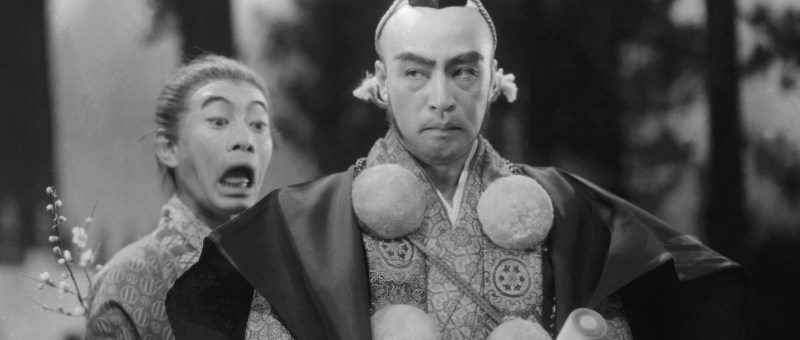
Like many directors of his age, Akira Kurosawa began his career during the war sometimes working on what were effectively propaganda films yet perhaps attempting to skirt around the least palatable implications of the task at hand. The Men Who Tread on the Tiger’s Tail (虎の尾を踏む男達, Tora no O wo Fumu Otokotachi) is an example of just that, repurposing a well known historical incident from its noh and kabuki roots and subtly undercutting it with a dose of irreverent humour unwelcome to those who liked historical tales because of their nationalistic connotations. This was not, however, the reason the film found itself out of favour so much as an ironically personal issue in which Kurosawa had apparently irritated one of the censors by pointing out his ignorance of cultural tradition leading him to conveniently leave Tiger’s Tail off the list of titles in production resulting in the American Censors rejecting it for being an unknown, illegal film which is why it languished on the shelf for seven years after filming was completed in 1945. The Americans may not have liked it much either given their aversion to period drama which they feared encouraged the kind of thinking incompatible with the democratic era, but like many of Kurosawa’s samurai dramas it has a rather ambivalent attitude to feudal loyalty both admiring of nobility and despairing of its austerity. 

Set in the late 12th century, the action takes place during a period of warfare in which warrior Yoshitsune (Iwai Hanshiro X) has returned a victory for his brother, the ruler. His brother Yoritomo, however, feels as if his victory has perhaps been too good and he is therefore a threat to him. Yoritomo accuses his brother of sedition and puts a purge in motion, leaving Yoshitsune with no option other than to flee. With six of his best retainers, he escapes dressed as an itinerant Buddhist monk and tries to make his way to neutral territory in the North. To get there, however, they need to pass through a series of checkpoints which is why they’re currently accompanied by a cheerful fool in the form of a lowly porter (Kenichi Enomoto) supposedly guiding them along a secret path through mountain forests. 

The porter is a new addition to the story added by Kurosawa for reasons of expediency and comic relief, yet his intrusion is also one which deeply angered the more nationalistic of the censors who resented the director’s irreverence towards a key historical event. Like many other of Kurosawa’s bumbling peasants, he’s both contemptuous and in awe of the world of the samurai, offering down to earth common sense takes on the politics of the day. He has already heard all about the Yoritomo/Yoshitsune drama and recounts it in the manner of a soap opera, quite reasonably asking if a quarrel between brothers could not have been sorted out with a good old-fashioned private fist fight rather than a state mandated manhunt which is also quite inconvenient for ordinary people in addition to being somewhat heartless. 

The samurai, not wanting to break cover, can only look sad and lament the cruelty of their codes, yet it’s precisely in the subversion of their ideology that they are able to escape. They have already transgressed, some with shaved heads and all already in the clothes of a monk. The porter looks at Yoshitsune, apparently a successful warrior, and remarks on his delicate physique and seeming femininity. Eventually he says too much, realises that the men are the fugitives everyone’s looking for and is suddenly afraid, forgetting for the moment that they need him to get out of the woods and knowing that samurai think nothing of killing “insignificant nobodies” like him. Nevertheless they do not kill him, but on hearing that there are lookouts on the horizon aware of Yoshitsune’s presence, they ask their lord to change places with a peasant, wearing his worn out clothes and carrying his heavy pack though the weight of it perhaps betrays him. As the porter points out, he does not have the look of a man used to trekking through the mountains and his delicate legs are already shaking under the unfamiliar strain. 

When the band is intercepted by loyal retainer Togashi (Susumu Fujita) who has been instructed to stop all priests in case Yoshitsune comes his way, Benkei (Denjiro Okochi), a real monk if also a warrior with a talent for bluff, manages to talk his way out of Togashi’s questioning, improvising an entire prospectus on the spot to convince him that they really are collecting money to repair a temple, quickly explaining that his robes are ornate because even ascetics have fashion sense. It’s not entirely clear if Togashi simply believes him, or if he too is wilfully subverting the code having recognised Yoshitsune and decided to help him escape. Might that not, in a certain sense, be the better way of serving a lord, preventing him from making a huge and painful mistake in killing his own brother out of a misplaced sense of paranoia? 

In any case, Benkei talks his way out of trouble only for a minor retainer to intervene, insisting that the porter is too pretty and bears a striking resemblance to Yoshitsune. Reacting quickly again, Benkei does the unthinkable. He strikes his lord and loudly berates him as if he really were a lazy porter failing in the duties for which he has been paid. The real porter becomes upset, placing himself in between Benkei’s staff and Yoshitsune’s body, either out of empathetic identification or horror in the betrayal of feudal loyalty. Benkei knows he must now be believed, no one would ever do what he has done because it is a complete and total negation of the samurai code. Yet in breaking it he saves his lord, which is all that really matters. Yoshitsune later forgives him, because he is a good lord after all and how could he not. But as Benkei was keen to keep pointing out, this isn’t the only checkpoint they must pass and their journey is without end, all they can do is “continue without rest”, taking this brief moment of unexpected levity provided by apology wine from Togashi and the hilarious antics from the porter before setting off once again. As for the porter, he is soon abandoned, left on one side of the samurai divide as the curtain closes on this brief strange tale. 


Currently streaming in the UK via BFI Player as part of Japan 2020. Also available to stream in the US via Criterion Channel.

Tokyo Twilight (東京暮色, Yasujiro Ozu, 1957)

Closely associated with the family drama, Yasujiro Ozu is perhaps the most socially conservative of golden age directors. Unlike Naruse or Mizoguchi, he cheerfully reinforces patriarchal social norms and foregrounds the paternal experience while upholding the primacy of the traditional family in a rapidly modernising society. In his later career he’d come to sympathise more strongly with the young, but 1957’s Tokyo Twilight (東京暮色, Tokyo Boshoku), perhaps his bleakest take on familial failure, is essentially a treatise on the legacy of corrupted motherhood and rebuke to growing post-war freedom in which a young woman is made to feel that her future is impossible because of maternal betrayal while her sister is forced back into an unhappy marriage to an abusive husband in order to avoid the same fate befalling her own daughter. 

Unlike most Ozu families, the Sugiyamas do not seem to be particularly happy in each other’s company, living in superficial politeness rather than true intimacy. This may partly be because the sisters had a brother who passed away young in a mountain climbing accident, but it also seems that Mr. Sugiyama (Chishu Ryu), though kind and polite, is a typically authoritarian, distant father. Oldest daughter Takako (Setsuko Hara) has returned home declaring herself unable to go on living with her professor husband Numata (Kinzo Shin) who, she says, has become increasingly erratic, taking out his petty professional disappointment on their small daughter Michiko whom he seems to resent. Younger sister Akiko (Ineko Arima) meanwhile is sullen and introverted. Unmarried, she lives at home and is studying to become a stenographer. 

As we later discover, the girls’ mother Kikuko (Isuzu Yamada) left the family during the war after falling in love with the junior officer Mr. Sugiyama enlisted to look in on the family while he was away in Seoul. Akiko was only three when their mother left and barely remembers her. Takako attributes her wayward behaviour to “loneliness”, that she has been forever corrupted through never knowing a mother’s love. Mr. Sugiyama admits he tried his best, but both agree that children need two parents and no matter how much he wants to a father cannot make up a mother’s share. 

This atmosphere of alienation is perhaps why Akiko feels as if she has no one to turn to in her own moment of maternal crisis. She has become pregnant by her college student boyfriend who has been avoiding her and even has the audacity to ask if the baby’s his when Akiko finally manages to pin him down. Trying to borrow money for an abortion, Akiko visits her aunt who declines to give it to her without knowing why, eventually turning to a family friend who apparently provides no questions asked. The woman at the clinic assumes she is a bar girl, as does a policeman who eventually “arrests” her for loitering in a sleazy cafe where her boyfriend has obviously stood her up which is quite openly being used as a place for men to pick up call girls. All of this contributes to Akiko’s increasing sense of shame and worthlessness. She sees herself as a fallen woman, convinced that she is all her mother’s child contaminated by her “bad blood” which makes a conventionally successful life as an ordinary wife and mother an impossibility. 

Akiko’s aunt wants to set her up with arranged marriage matches, but Akiko declares she has no intention of marrying or having children. Without knowing anything of Akiko’s circumstances, Takako assumes this is because of her obviously unhappy marriage, trying to convince her sister that there are plenty of happy couples she is merely unlucky. Mr. Sugiyama attempts to talk to his son-in-law but finds him strange and indifferent, offering treatises on familial love while implying that he has little of it. He regrets pressuring Takako to marry him when he knew that she preferred someone else while Takako is once again haunted by the spectre of corrupted maternity in her mother’s decision to leave the family for emotional fulfilment and is fearful of making the same mistake creating another troubled daughter just like Akiko in denying her a father’s love (which seems a moot point given that Numata does not care for the child). 

Neither woman is able to escape paying for their mother’s transgression. Akiko is punished firstly for embracing her sexuality and secondly for the rejection of motherhood in choosing to have an abortion. Alone and humiliated by her unreliable boyfriend, she is denied the opportunity to start over, while Takako meditates on female failure and believes that her only option is to live in misery with a cruel and narcissistic husband because that is the “proper” thing to do and the only way to bring her daughter up “right”. The absent mother, meanwhile, is denied reconciliation and left only with the painful separation from her daughter who finally rejects her in order to reclaim the image of the good wife and mother by returning to her unhappy home. Bleak as it is, all of this is presented as a kind of happy ending in that it restores the idea of the traditional family, increasingly threatened by post-war modernity, to its original primacy. We leave with Mr. Sugiyama rehiring his maid and heading cheerfully back to the male world of work, making the fresh start that his daughters have been so cruelly denied.  


Currently streaming in the UK via BFI Player as part of Japan 2020. Also available to stream in the US via Criterion Channel.

Ginza Cosmetics (銀座化粧, Mikio Naruse, 1951)

1951’s Ginza Cosmetics (銀座化粧, Ginza Kesho) is often said to mark a kind of rebirth in the career of director Mikio Naruse whose output in the 1940s was perhaps unfairly denigrated not least by Naruse himself. As in much of his golden age work and in anticipation of When a Woman Ascends the Stairs, Ginza’s heroine is a resilient bar hostess whose brief hopes of escape through romance are doomed to failure, but it’s also, like the slightly later Tokyo Profile (Hiroshi Shimizu, 1953) and Tales of Ginza (Yuzo Kawashima, 1955) an ode to the upscale district and all the defeated hopes of its illusionary glitz and glamour. 

Yukiko (Kinuyo Tanaka), the heroine, is a single-mother approaching middle age and working as a hostess in a Ginza bar. Her landlady who runs a nagauta school on the ground floor and constantly complains about her feckless though goodnatured unemployed husband seems to think she could do better, pointing out that she is an educated woman who seems slightly out of place in the rundown backstreets of this otherwise aspirational area. Even for educated women, however, there may not be many other opportunities in the straitened and socially conservative post-war economy especially for those without connections, and Yukiko also needs to provide for her young son Haruo (Yoshihiro Nishikubo), born out of wedlock after an affair with a customer with whom she had fallen in love but abandoned her when she became pregnant. 

As a slightly older woman who has been working at the Bel Ami bar for many years, seemingly from war to occupation, Yukiko is both looked up to by the younger women and resented as a stern older sister who does not approve of the way some of them ply their trade. She’s taken one, Kyoko (Kyoko Kagawa), who often babysits for her, under her wing, cautioning her against making the same mistakes that she once made in taking the kinds of men that come into the bar at their word. “Men are all animals” she warns her, supporting her desire not to give in to her parents’ attempts to arrange for her not a marriage but a “position” as a mistress. Unlike Yukiko, Kyoko still has hope of leaving the Ginza bar world behind to become a respectable wife even if those hopes are fading with the relative unlikelihood of finding a “good” man with a salary good enough to support a wife who is not already married and can be understanding of her bar girl past. 

The bar world may be on the fringes of the sex trade, but the bar girls are not necessarily sex workers even if some of the younger women are clearly engaging in the kinds of casual sex work of which Yukiko clearly disapproves even while not against consensual romantic liaisons. For her own part, she finds herself in the awkward situation of a continuing non-relationship with a failed businessman, Fujimura (Masao Mishima), who was fairly wealthy during the war but apparently no longer. Yukiko attributes this to him being in someway too good to prosper, though having money in the war which disappeared afterwards perhaps implies the opposite. She does not love him and seems to find his presence a little irritating, but feels indebted because he stood by her when she was pregnant and alone. In any case, he has a wife (whom he apparently resents) and children (whom he claims to adore) and so she feels at best conflicted, especially as the tables have turned and it’s him now constantly asking her for money. Money is not something Yukiko has a lot of, but she isn’t mean and often consents to losing it with a resigned shrug as she does by taking on Kyoko’s bar debt after a customer runs out on the bill and then tricks Yukiko into buying more drinks while waiting for a “friend” to arrive. 

Men, it seems, will always be predatory and unreliable. On hearing from her boss and longtime friend that the bar is in trouble and may have to close, Yukiko ends up acting on an introduction from an acquaintance, Shizue (Ranko Hanai), to meet a “stingy” industrialist who had expressed an interest in her. Shizue has escaped the bar world by becoming a wealthy man’s mistress and with it has claimed a kind of independence. He splits his time between Tokyo and Osaka, leaving her free to do whatever she likes (including meeting other men) for most of her time with none of the strings that go with being a wife. Yukiko is perhaps too “pure” for that kind of arrangement, hinting at the Ginza paradox that only those who learn to accept a certain level of complicity can ever truly be happy there. She agrees to meet Kanno (Eijiro Tono), the businessman, in order to ask him to “invest” in the bar, suggesting they talk things over in a coffeeshop while he tries to pull her into various shady establishments before pushing her into a warehouse and attempting to rape her to get his money’s worth. Yukiko escapes and resolves not to see him again. After all, the point of getting the money to keep the bar open was precisely to avoid having to make arrangements with men like Kanno. 

It’s Shizue, however, who later gives her a last shot at escape when she introduces her to her “true love”, Ishikawa (Yuji Hori), making a brief trip into the city. Shizue can’t entertain him herself because her patron is in town and so entrusts him to Yukiko with the strict instruction not to try it on. Despite herself, however, Yukiko becomes fond of him, reassuming something of a past persona in engaging in intellectual conversation, once again an educated, middle-class woman rather than a bar hostess used to telling men what they want to hear. She has been warned, however, that Ishikawa hates anything “low culture” which is why Shizue has told him they are both war widows and discovers that he has a strong dislike for Ginza which sees him longing for the wholesome charms of home. 

The crisis occurs when Yukiko has to break a promise to Haruo to take him to the zoo in order to look after Ishikawa, causing him to go temporarily missing when he wanders off on his own roaming all over the endless construction site of the contemporary city standing in for the makeshift, in-progress reconstruction of the post-war society. She perhaps feels she’s being punished for choosing to disappoint her son in order to pursue a dream of romantic escape she might also feel is somehow undeserved, but pays in quite a different way after accidentally setting Ishikawa up with Kyoko whom she introduced as her “sister”. Originally angry and resentful, proclaiming herself disappointed with Kyoko in assuming she is the same as the other young women at the bar, Yukiko’s good nature eventually wins out as she realises that Kyoko and Ishikawa seem to have fallen in love in a single night. She has told him everything, and he apparently wants to marry her anyway. Kyoko, at least, is getting out, and Yukiko can be happy about that while privately internalising defeat. Acknowledging that Haruo is the only one on whom she can depend, she resolves to live on as a mother only, trapped in the deceptive diminishing returns of a Ginza bar life even while knowing it has increasingly little place for her.  


The Ghost of Kasane (怪談かさねが渕, Nobuo Nakagawa, 1957)

“Fear the hatred of the dead!” a blameless slain wife exclaims after being cruelly cut down by her deluded husband in Nobuo Nakagawa’s tale of karmic vengeance, The Ghost of Kasane (怪談かさねが渕, Kaidan Kasane-ga-fuchi). Then again, though cleaving close to the standard formulas of the ghost movie not to mention the famous tale, these fatalistic, generationally twinned tales of ghostly revenge have an oddly imprecise quality in which it is the innocent who are eventually made to suffer, caught between concentric circles of guilt and retribution. 

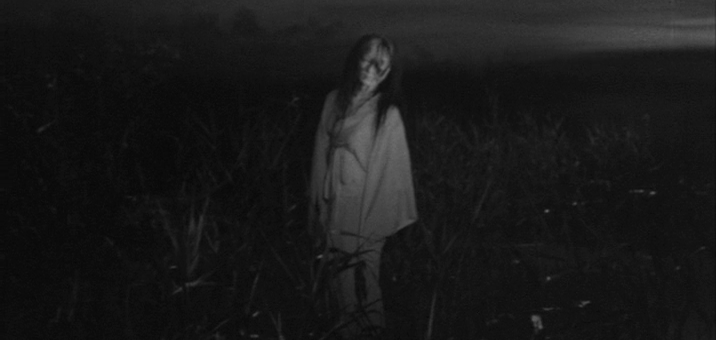
The tale opens in 1773 with a blind masseur/money lender, Soetsu (Yoji Misaki), leaving his home on a snowy day hoping to catch venal samurai Shinzaemon (Akira Nakamura) at home. Shinzaemon and his wife are hospitable, but a conflict soon breaks out during which Shinzaemon accuses the old man of disrespecting him as a samurai and generally getting above himself as a mere member of the peasant class. All Soetsu has done is politely ask for the money he’s owed while making it clear that Shinzaemon’s attempts to give him the run around are wearing thin, but he ends up with a nasty gash on his face after the enraged samurai throws a pot at him. Driven into a frenzy by this unwelcome class-based anxiety, Shinzaemon slashes Soetsu with his sword and kills him, instructing a servant to stuff his body in a case and dump it in Kasane swamp. Soetsu, however, does not rest easy, returning to taunt him, eventually causing him to murder his wife by mistake and thereafter drawing him to his death by drowning in the very swamp where he dumped the body. 

20 years later in Edo, Soetsu’s daughter Rui (Katsuko Wakasugi) has become a successful shamisen teacher, while Shinkichi (Takashi Wada), the orphaned son of Shinzaemon, was taken in by a merchant family who continue to treat him as a poor relation. While having internalised a servant mentality that ironically inverts his father’s anxiety in his samurai status, Shinkichi has fallen in love with the daughter of the house, Hisa (Noriko Kitazawa), who is about to be betrothed against her will to the horrible son of local merchants, Seitaro (Shuji Kawabe). Rui, meanwhile, an older unmarried woman, is desperate to fend off the violent attentions of rough ronin Omura (Tetsuro Tanba), eventually convincing herself she is in love with the mild-mannered Shinkichi who might well think a rebound relationship is a good idea if it clears the way for Hisa’s inevitable marriage. 

Oddly enough and somewhat incomprehensibly, it’s Rui who becomes the target of her father’s curse, perhaps for her unwitting affection for the son of the man who killed him though it seems insufferably cruel that a father would involve his own child, not to mention the blameless infant of his murderer, in his bid for vengeance from beyond the grave. For his part, Shinkichi pays a heavy price for his unmanly diffidence, brave enough neither to say no to Rui or to run away with Hisa, simply passive if kind in the face of mounting impossibilities. Yet as much as it’s her father’s resentment that causes her downfall, struck by the pluck from the shamisen which scars her face to mirror his, she adds her own share in the wrath of a woman scorned dragging Shinkichi towards the lake for his inability to let go of his love for Hisa.

Old Soetsu might have a right to be vengeful, but his curse has collateral damage, enacted on women in order to target men as in Shinzaemon’s unwitting murder of his wife and Shinkichi’s accidental violence against Hisa at the instigation of Rui. Only the two old servants are left behind to make peace and tell the story, united by their respective positions rather than divided by their conflicting affiliations. Studio-bound yet filled with a series of supernatural tricks, Nakagawa’s atmospheric adaptation of the classic tale once again features the bug-eyed deformity of the scorned female ghost as Rui’s initial injury eventually balloons as her “sickness” intensifies, later finding time to turn her rage on Omura who was not, it has to be said, on the original list of victims being simply an embodiment of the cruelty of the age. Nakagawa ends, however, not with darkness but with light, freeing the souls of the troubled lovers from the gloom of earthly torment in urging them to leave their hatred behind and return to Buddha in eternal peace. 


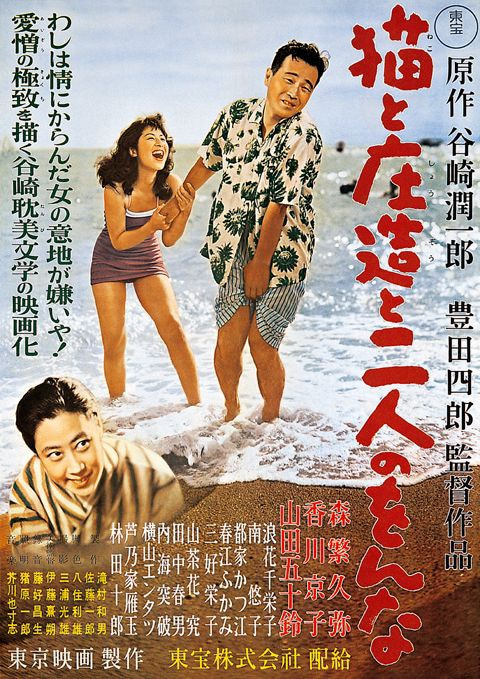
Shozo, a Cat and Two Women (猫と庄造と二人のをんな, Shiro Toyoda, 1956)

Post-war melodrama is largely concerned with the place of women, in particular, in a rapidly changing society, but given the centrality of domestic life, were men yearning for “independence” too? Shiro Toyoda was closely associated with comedic tales of strong women and weak men, and Shozo, a Cat and Two Women (猫と庄造と二人のをんな, Neko to Shozo to Futari no Onna) is as its title implies no exception. Adapting the novel by Tanizaki, Toyoda offers a subtle critique of the traditional family as its hapless hero finds himself caught between the conflicting demands of his feudalistic mother, stoic first wife, hedonistic second, and his much loved but perhaps mercenary feline, Lily. 

Shozo (Hisaya Morishige) is perhaps a typical spoiled only son, lazy, feckless, and essentially passive. Shinako (Isuzu Yamada) who agreed to an arranged marriage with him four years previously is walking out, thoroughly fed up with her mother-in-law Orin’s (Chieko Naniwa) constant complaints not least among them that the couple have no children. Unbeknownst to Shinako, however,  Shozo has been carrying on with his slightly younger cousin, Fukuko (Kyoko Kagawa), who is a free spirited modern woman. In fact, Fukuko has already run away from home three times in the company of various men so her wealthy father would be only too pleased to see her settle down and is so desperate to offload her that he’s even offering a huge dowry. All of this is complicated by the fact that Fukuko’s father already owns the mortgage on Shozo’s family store, which presents a serious challenge to typical family dynamics. 

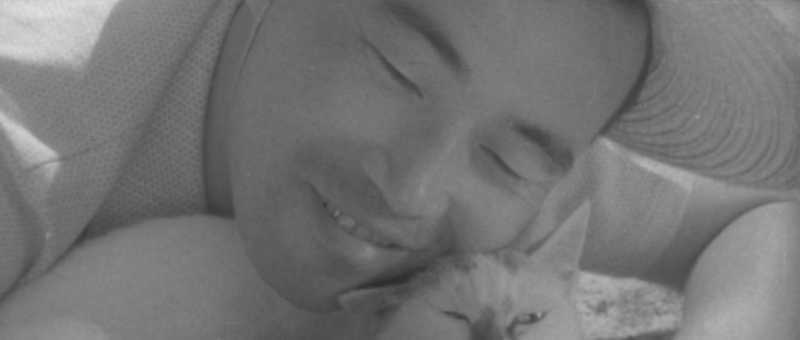
Shozo, meanwhile, is only really interested in his pet cat, Lily, something which was a bone of contention in his failed marriage to Shinako (and perhaps a reason they have not been blessed with children). On learning that Orin has already moved Fukuko into the family home mere seconds after she vacated it, Shinako is suddenly struck by remorse and feels the need to vindicate her pride through revenge. Plotting how best to drive a wedge between Fukuko and her new husband, she settles on petitioning Shozo to give her custody of Lily, and then suggests the same thing to her rival knowing that whatever happens it will cause a series of problems in the Oyama household. 

The irony is, in a sense, that it’s Shozo who has been displaced from his own home. Perhaps surprisingly, he often tries to help out with household tasks but his mother always stops him, insisting that housework isn’t something a man should pay attention to. Orin is of course perpetuating outdated ideas of traditional gender roles, but there is also an obvious anxiety in her need to protect her territory from possible incursion. She doesn’t necessarily trust the idea that she and Shozo are connected by anything deeper than practicality and filial obligation and her only currency is her ability to provide the services that Shozo “cannot” provide for himself. His learning to take care of himself is an existential threat to her position as his caregiver even though he is a grown man in his 30s perfectly capable of doing his own laundry and preparing his own meals (as he already does for Lily who particularly enjoys grilled chicken). 

When they brought Shinako into the house, they did so apparently because she was known to be a “good worker” at her job as a maid for a wealthy family. Since then she has indeed worked hard, but is viewed as little more than a glorified servant by Orin who has delegated much of the feminine labour to the younger woman, while Shozo emotionally neglects her in favour of the cat and apparently satisfies his carnal urges outside the home. They accept Fukuko for her money, but take the opposite approach, treating her as the lady of the manor. Fukuko does no housework (a cupboard is later discovered where she’d thrown all the washing she couldn’t be bothered to do), but Orin simply picks up her share and more, becoming maid to her daughter-in-law who frequently reminds them that it’s her money paying for everything so she is the one who is really in charge. 

Shozo does not seem to react too closely to these assaults on his masculinity, but only wants to escape to be alone with Lily whom he believes is the only one who really loves him. In this he is perhaps the truly modern man who wanted his family relations to be “real” rather than defined by social obligation, but he’s also self-centred and childish, still seeing the women (even Lily) as providers of service rather than fellow human beings. His mother satisfied his hunger, Shinako kept him financially by managing the business, and Fukuko sated his passion, but he feels oppressed by all of them in different ways and in the end does not want the responsibility of dealing with human emotions. Lily may be capricious, but her needs are easily satisfied and to that extent she is dependent on him. His desire to be “independent” and find emotional fulfilment only with his cat is just as much of a challenge to the social order as a woman who rejects marriage or seeks to fulfil herself outside of the home. 

Shozo’s dilemma is however presented as comedic until its unexpectedly melancholy conclusion which reduces him to the status of a stray cat as the women come to literal blows, fighting not quite over him (he isn’t worth fighting over) but for their own self-esteem and particular brand of womanhood. Shinako sits at home and calculates all the back pay she’d be entitled to for the labour she performed at the Oyama household in recognition that being a wife is also a job and they treated her as a maid anyway (which is to say as an outsider with no intention of love or loyalty), while Fukuko begins to see the “emptiness” in her party girl lifestyle but prefers to be pampered and resents being “beaten” by a mere housemaid. This system traps everyone, forcing them to manipulate the desires of others while suppressing their own. Shozo and his cat are left out in the cold, trapped between tradition and modernity but no more free than they were before even in their mutual dependency.