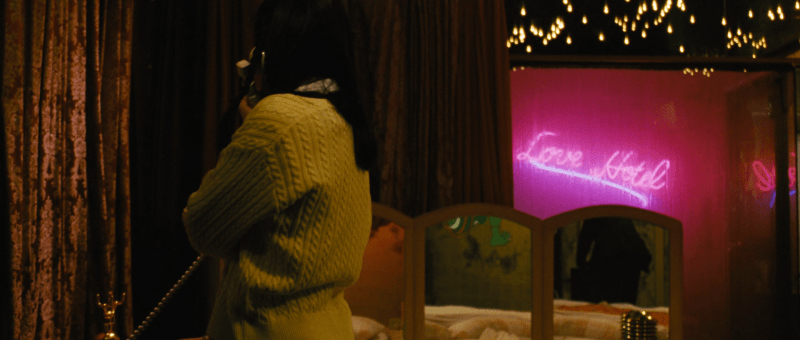

Shinji Somai is not particularly well known outside of Japan but where his work is celebrated it’s mostly for his youth films of teen alienation and pop culture cool. Released in the same year as his iconic Typhoon Club, Love Hotel (ラブホテル) seems like something of an aberration in Somai’s career which leans towards the melancholic rather than the passionate. Somai had begun his working life apprenticing with Nikkatsu during their Roman Porno years and Love Hotel is, in someways, a return to this genre but is only accidentally a “pink film”, produced with Director’s Company and later acquired by the pink film giant. As such it contains a number of explicit sex scenes but maintains Somai’s characteristic long takes and contemplative approach rather than adhering to the often formulaic nature of the Roman Porno.
Failed businessman Muraki (Minori Terada) returns one day to find his office full of gangsters in the middle of raping his wife. Distraught, his first thought is suicide but then he decides on a little roundabout revenge before he goes. Dressed in a dark suit and sunglasses like some ‘60s Nikkatsu bad guy, Muraki holes up in a love hotel and calls down for a girl. “Yumi” (Noriko Hayami) arrives not long after. Handing the girl a vast sum of money, Muraki then instructs her to close her eyes because he’s also brought “a present”. He handcuffs her and reveals his true purpose by tearing off her clothes, tying her up and fitting her with a vibrator. He’s going to kill himself tonight, but he doesn’t want to go alone. In the end, he can’t go through with it, something in Yumi’s face changes his mind and he leaves her there, tied up and handcuffed.
Two years later, Muraki has divorced his wife (apparently to keep her safe from the yakuza who are still after him for his debts) and is now living an intentionally dull life as a taxi driver. One fateful day he runs into Yumi again, only she’s no longer “Yumi” but “Nami”, an office lady at a top company. Eventually recognising each other, the pair are each forced to face the circumstances surrounding the traumatic night of two years previously but doing so means risking everything they have now.
Love Hotel is a film of seeing and not seeing, of looking and refusal to look. The film opens with a semi-explicit sexual scene in which Muraki’s wife is raped by a loanshark in which we watch both Muraki’s horrified expression and the act itself by means of a well positioned mirror. Somai repeats the mirroring motif throughout the film both by showing us Nami repeatedly caught in mirrors and by the obvious tripartite glass arrangement of the love hotel’s headboard. Both Muraki and Nami have elements of themselves at which they’d rather not look but the ever present mirrors constantly prompt them into areas of self-reflection, ironically possible only by looking at the other.
Where Muraki has chosen a life of austerity, separating from his wife who nevertheless continues stopping by to look after him in all of the wifely ways, Nami has tried and failed to put her traumatic past behind her by hopping into the consumerist revolution. Having supported herself through prostitution as a student, she’s managed to swing a pretty good job at top company only to find herself “prostituted” again through an ill-advised affair with her married boss. After his wife finds out and Nami loses her job and the entire life she’d begun to build for herself, she tries to call her former lover for consolation only to have him cruelly hang up on her. Nami continues her lamentations to the alarming trill of the dial tone in a heartbreaking moment of true loneliness.
Left with nothing else, the pair decide to revisit their unfinished love hotel business but their much more normal encounter changes each of them in different ways. It’s clear something has passed between the two, but Muraki’s final glance into the mirror perhaps shows him something he’d rather not have seen. Nami’s face, like Yumi’s face, may well have been “angelic” but cannot “save” Muraki in the same way twice – or at least, not in the way the restored Nami would have liked to save him. Dark, melancholy and fatalistic, Somai’s stab at Roman Porno is a sad tale of frustrated love, destroyed by the use and misuse of bodies speaking against each other and becoming a barrier to true connection. The Love Hotel is a place romance goes to die, and what the pair of damaged lovers at the centre of his noir-tinged tale of despair find there is only emptiness and pain devoid of any sign of hope.
Opening scene (no subtitles)
Masterfully constructed one take final scene (dialogue free)
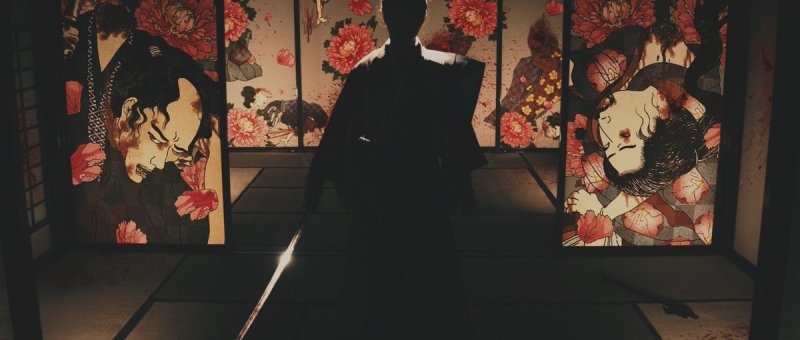
 All life is suffering, and all suffering is caused by desire. Ninko, the titular monk at the centre of this entertaining oddity from Norihiro Niwatsukino, seems to have taken this to heart and is suffering more than most in his attempts to reach Nirvana. Suffering of Ninko (仁光の受難, Ninko no Junan) takes its cues from the Hyaku-monogatari classical Japanese tales of ghosts and the supernatural as its seemingly comic story of a pretty monk and his ironic talent for attracting the wrong kind of attention gradually darkens until its unexpectedly strange finale. Visually striking if a little rough around the edges, Suffering of Ninko has a pleasantly organic quality as if its narrator were really making it up as she goes along only to tire of it a little by the end and give us a suitably spooky conclusion to send us on our way.
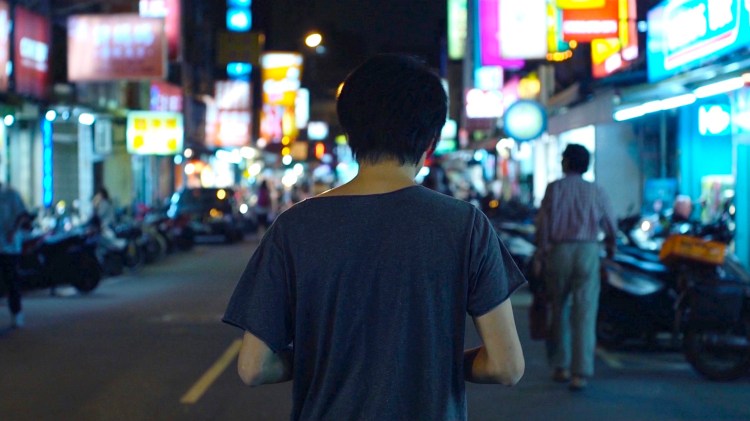 We don’t move forward in this dance, comments the lady currently being waltzed by a charming lost soul. Don’t worry, he says, that’s not a bad thing. Indeed, Out There, the first independent feature film from director Takehiro Ito exists in a fixed yet liminal space, here and not there as its protagonist finds himself without the proper place to be. Conceived as a way of salvaging some of the material collated for a documentary on the late Taiwanese director Edward Yang, Out There takes more of its cues from Tsai Ming-liang or even Lav Diaz in its preoccupation with the intersection between time, existence, and place. If that all sounds to weighty, there’s a little whimsy in here too, but the intent is a serious one as nationhood (or the lack of it), drifting cultures, love and history all conspire to confuse and distract the course of a young man in search of an identity which is entirely his own.
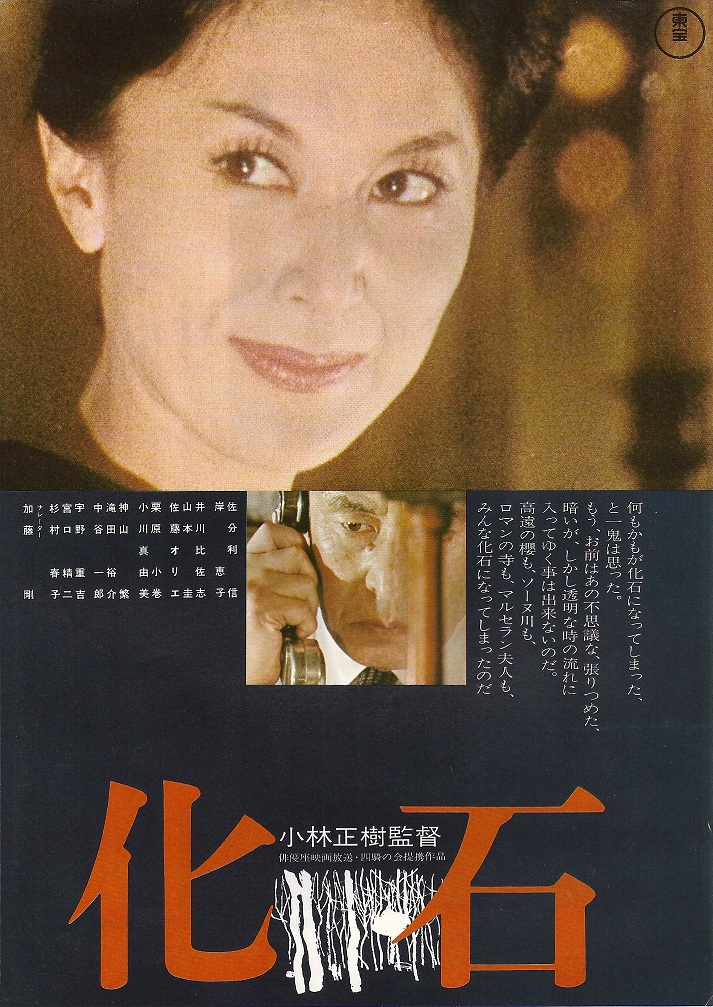 Throughout Masaki Kobayashi’s relatively short career, his overriding concern was the place of the conscientious individual within a corrupt society. Perhaps most clearly seen in his magnum opus,
 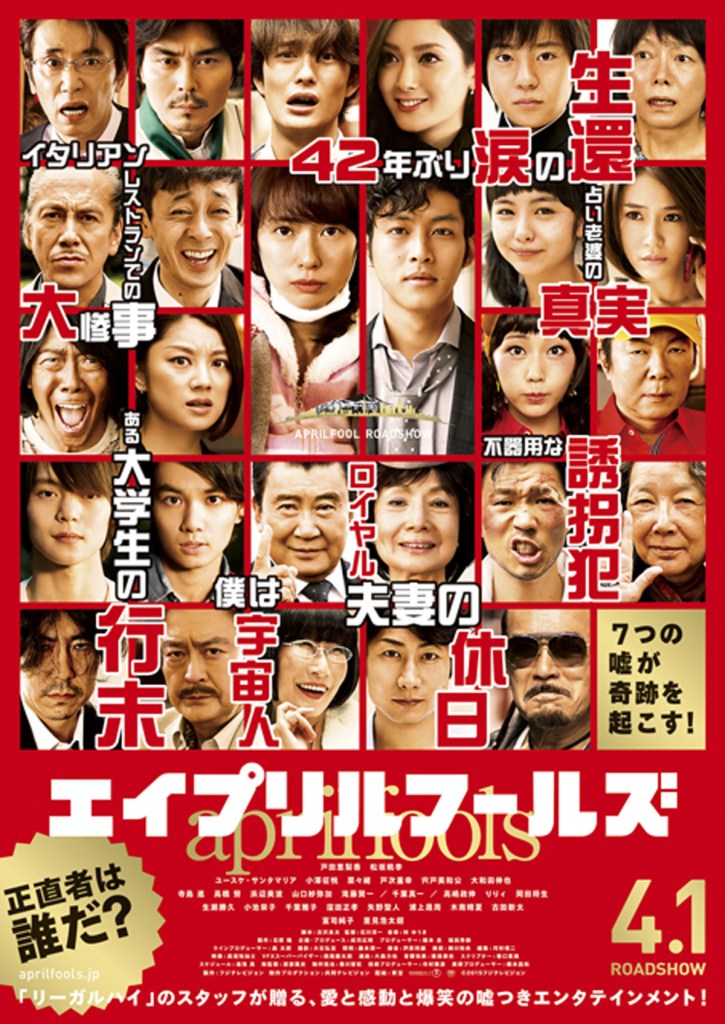 In this brand new, post truth world where spin rules all, it’s important to look on the bright side and recognise the enormous positive power of the lie. 2015’s April Fools (エイプリルフールズ) is suddenly seeming just as prophetic as the machinations of the weird old woman buried at its centre seeing as its central message is “who cares about the truth so long as everyone (pretends) to be happy in the end?”. A dangerous message to be sure though perhaps there is something to be said about forgiving those who’ve misled you after understanding their reasoning. Or, then again, maybe not.
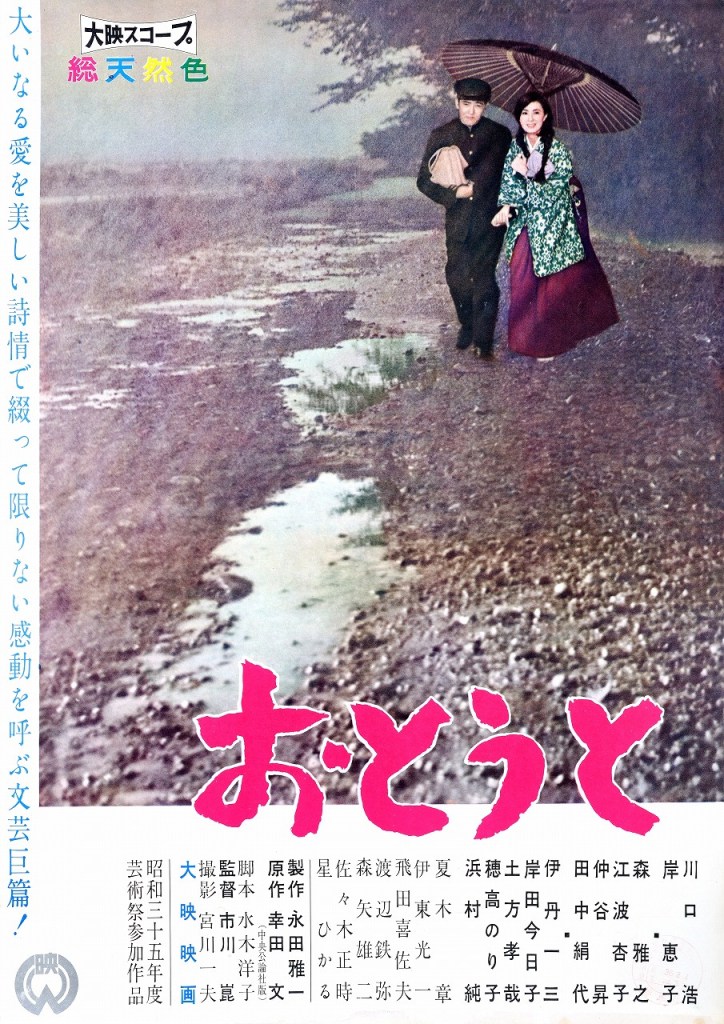 Perhaps oddly for a director of his generation, Kon Ichikawa is not particularly known for family drama yet his 1960 effort, Her Brother (おとうと, Ototo), draws strongly on this genre albeit with Ichikawa’s trademark irony. A Taisho era tale based on an autobiographically inspired novel by Aya Koda, Her Brother is the story of a sister’s unconditional love but also of a woman who is, in some ways, forced to sacrifice herself for her family precisely because of their ongoing emotional neglect.
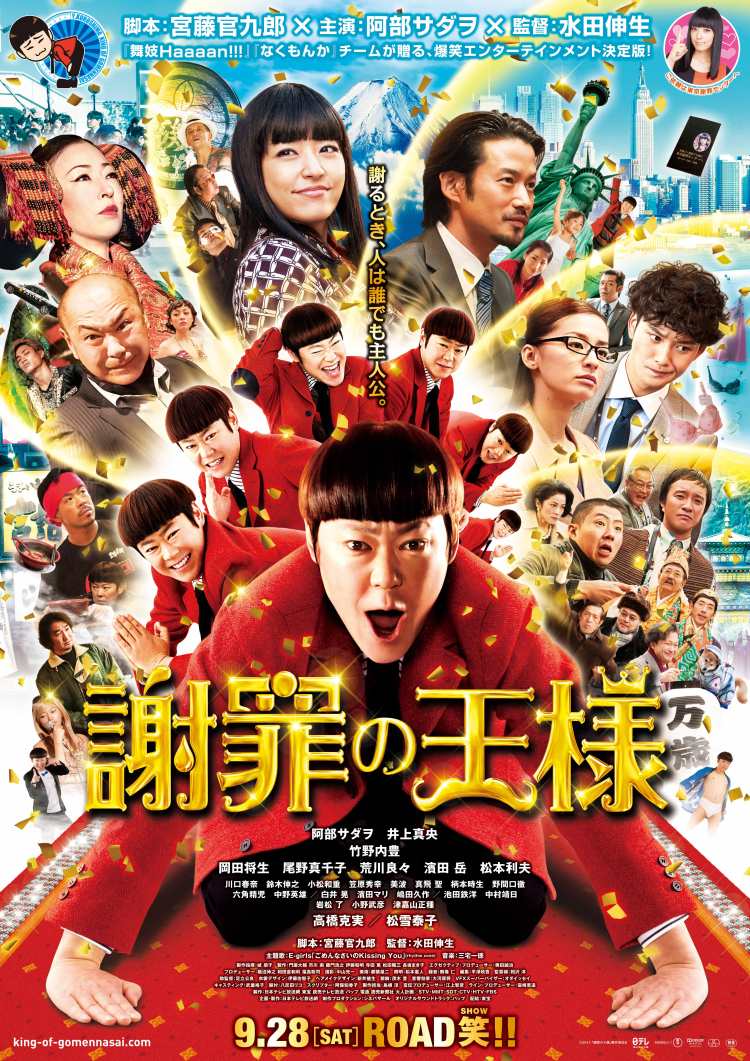 There are few things in life which cannot at least be improved by a full and frank apology. Sometimes that apology will need to go beyond a simple, if heart felt, “I’m Sorry” to truly make amends but as long as there’s a genuine desire to make things right, it can be done. Some people do, however, need help in navigating this complex series of culturally defined rituals which is where the enterprising hero of Nobuo Mizuta’s The Apology King (謝罪の王様, Shazai no Ousama), Ryoro Kurojima (Sadao Abe), comes in. As head of the Tokyo Apology Centre, Kurojima is on hand to save the needy who find themselves requiring extrication from all kinds of sticky situations such as accidentally getting sold into prostitution by the yakuza or causing small diplomatic incidents with a tiny yet very angry foreign country.
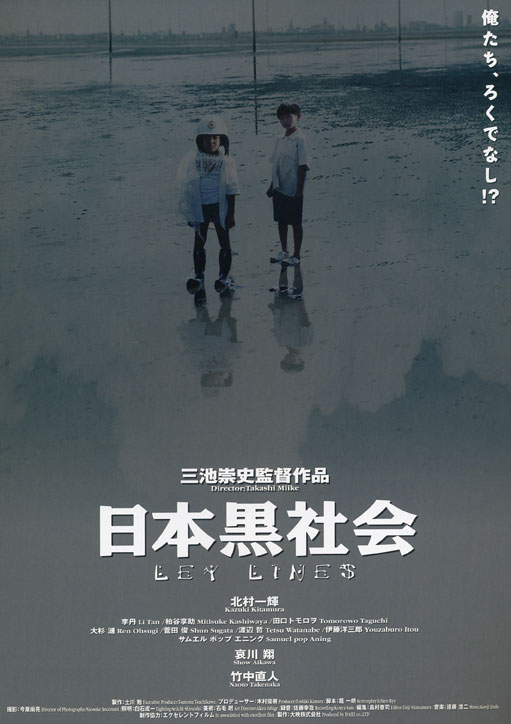 The three films loosely banded together under the retrospectively applied title of the Black Society Trilogy are not connected in terms of narrative, characters, tone, or location but they do all reflect on attitudes to foreignness, both of a national and of a spiritual kind. Like Tatsuhito in the first film,
 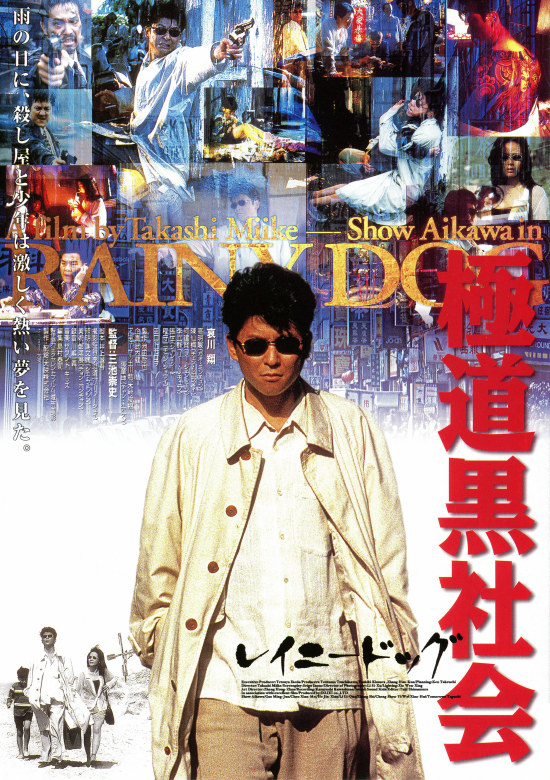 They say dogs get disorientated by the rain, all those useful smells they use to navigate the world get washed away as if someone had suddenly crumpled up their internal maps and thrown them in the waste paper bin. Yuji (Show Aikawa), the hero of Rainy Dog (極道黒社会, Gokudo Kuroshakai) – the second instalment in what is loosely thought of as Takashi Miike’s Black Society Trilogy, appears to be in a similar position as he hides out in Taipei only to find himself with no home to return to. Miike is not generally known for contemplative mood pieces, but Rainy Dog finds him feeling introspective. A noir inflected, western inspired tale of existential reckoning, this is Miike at his most melancholy but perhaps also at his most forgiving as his weary hitman lays down his burdens to open his heart only to embrace the cold steel of his destiny rather than the warmth of his redemption.
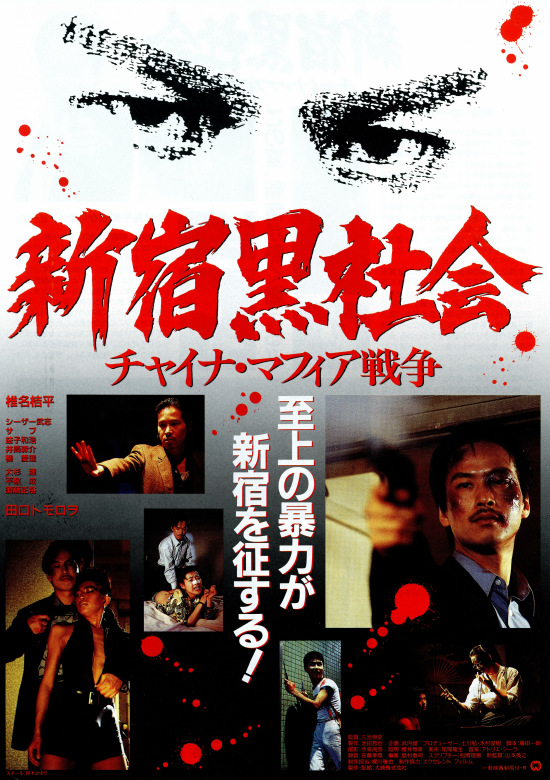 These days Takashi Miike is known as something of an enfant terrible whose rate of production is almost impossible to keep up with and regularly defies classification. Pressed to offer some kind of explanation to the uninitiated, most will point to the unsettling horror of
