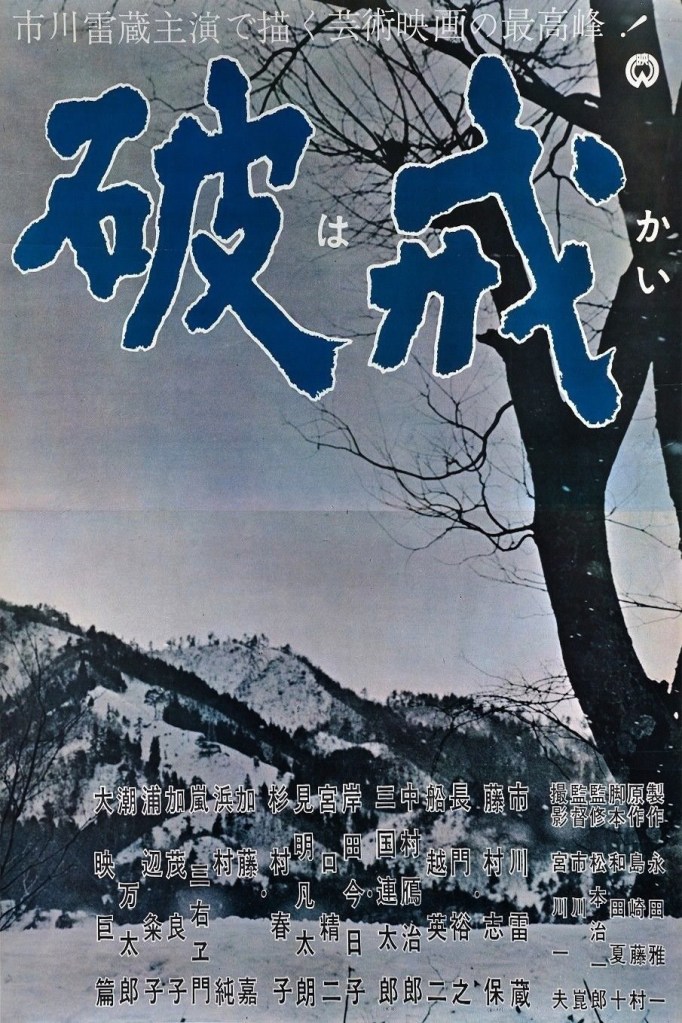
 Kon Ichikawa’s approach to critiquing his society was often laced with a delicious slice of biting irony but he puts sarcasm to one side for this all too rare attempt to address the uncomfortable subject of Japan’s hidden underclass – the burakumin. The term itself simply means “people who live in hamlets” but from feudal times onwards it came to denote the kinds of people with whom others did not want to associate – notably those whose occupations dealt in some way with death from executioners and undertakers, to butchers and leatherworkers. Though outright discrimination against such people was outlawed during the Meiji restoration, social stigma and informal harassment remained common with some lingering tendency remaining even today.
The Outcast (破戒, Hakai), adapted from the book by Toson Shimazaki (known as The Broken Commandment in English) is the story of a young man of burakumin lineage who has to hide his true identity in order to live a normal life in the Japan of 1904. Segawa’s father, formerly a village elder, sent his son away to live with his brother and his wife in a distant town where they could better hide their burakumin status to enjoy a better standard of life. Sadly, Segawa’s father dies after being trampled by a recalcitrant bull never seeing his son again and leaving him with the solemn commandment to live as a regular person, never revealing his connection with the burakumin world.
This debt to his father’s sacrifice creates a conflict in the heart of the young and idealistic Segawa (Raizo Ichikawa). Forced to listen to the casual racism all around him and unable to offer any kind of resistance, Segawa has become interested in the writings of a polemical political figure, Rentaro Inoko (Rentaro Mikuni), who has begun to write passionate political treatises advocating for burakumin rights. When Inoko turns up in Segawa’s town, he finds himself a new father figure and political mentor but continues to feel constrained by the debt of honour to his father’s sacrifice and is unable to confess his own burakumin heritage even to Inoko.
The world Segawa lives in is a conservative and stratified one in which old superstitions hold true even whilst hypocritical authorities use and abuse the trust placed in them. Inoko falls foul of local politics after he discovers a politician has married a wealthy burakumin woman solely for her money and is planning to expose him at a political rally. This same politician has already threatened to blackmail Segawa who continues to deny all knowledge of any burakumin related activities whilst failing to quell the eventual gossip surrounding Segawa’s lineage. The gossip causes problems at the school where Segawa had held a prestigious teaching position as the headmaster and school board fear the reaction of the parents. Though the people at the temple where Segawa takes refuge after growing tired of the racist inn owners in town are broadly supportive of the burakumin, the priest there has his own problems after having made a clumsy pass at his adopted daughter, Shio (Shiho Fujimura) – the daughter of a drunken teacher sacked by the school in order to avoid paying him a proper pension. At every turn the forces of authority are universally corrupt, selfish and venal, leaving no safe direction for a possible revolution of social justice to begin.
This is Segawa’s central conflict. After his experiences with Inoko, Segawa begins to want to follow in his footsteps, living out and proud as a burakumin and full time activist for burakumin rights. However, this would be undoing everything for which his father sacrificed so much. Talking things over with Inoko’s non-burakumin wife, Segawa is also presented with a third way – reveal his burakumin heritage and attempt to live honestly as an ordinary person, changing hearts and minds simply through leading a life among many other lives. This option seems attractive, especially as Segawa has fallen in love and would like to lead an ordinary life with a wife and family, but his youthful idealism is hungry for a greater, faster change than the one which will be born through simple integration. Despite the warnings of Inoko’s wife who believes change will occur not through activism but through the passage of time, Segawa decides his future lies in advancing the burakumin cause in the wider world.
When Segawa does choose to reveal himself, he finds that there is far more sympathy and support than he would ever have expected. A woman he has come to love wants to stay by his side, his previously hostile friend rethinks his entire approach to life and apologises, and even the children in his class convince their parents that their teacher is a good and a kind man regardless of whatever arbitrary social distinction may have been passed to him through an accident of birth. Segawa’s conflicted soul speaks not only for the burakumin but for all hidden and oppressed peoples who have been forced to keep a side of themselves entirely secret, faced with either living a lie in the mainstream world or being confined to life within their own community. His choice is one of either capitulation and collaboration, or resistance which amounts to a sacrifice of his own potential happiness in the hope that it will bring about liberation for other similarly oppressed people.
Scripted again by Natto Wada, The Outcast takes a slightly clumsy, didactic approach filled with long, theatrical speeches but does ultimately prove moving and inspiring in advocating for the fair treatment of these long maligned people as well as others facing similar discrimination in an unforgiving world. As a treatise on identity and rigid social attitudes, the film has lost none of its power or urgency even forty years later in a world in which progress has undoubtedly been made even if there are still distances to go.
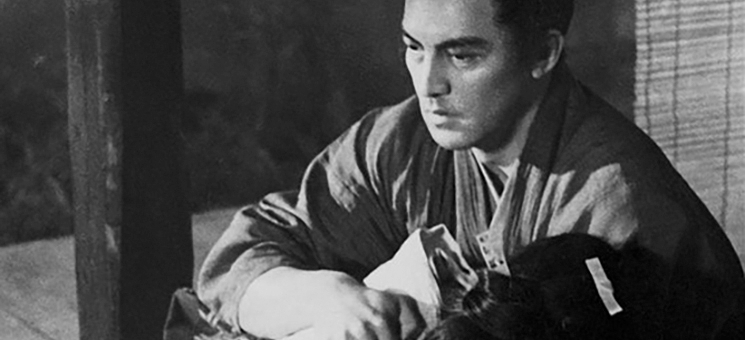
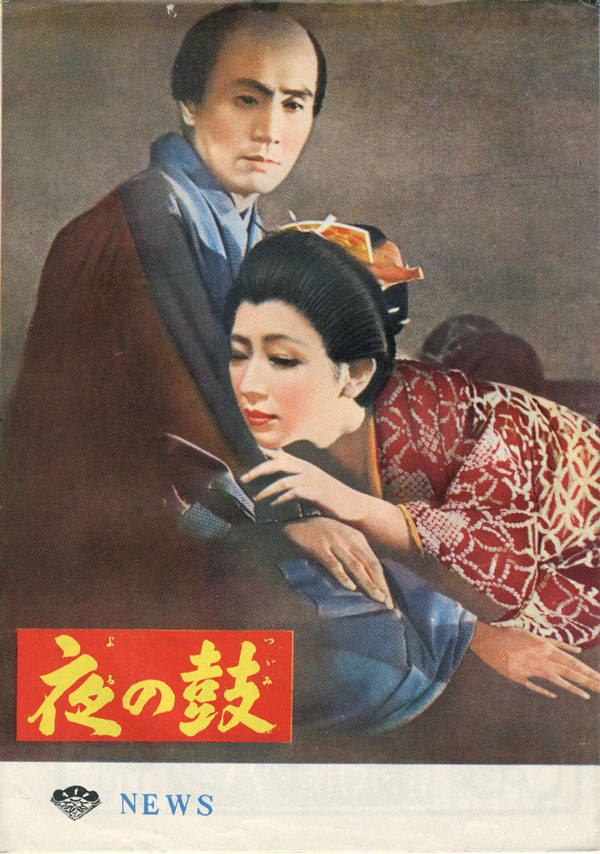
 Junichiro Tanizaki is widely regarded as one of the major Japanese literary figures of the twentieth century with his work frequently adapted for the cinema screen. Those most familiar with Kon Ichikawa’s art house leaning pictures such as war films The Burmese Harp or Fires on the Plain might find it quite an odd proposition but in many ways, there could be no finer match for Tanizaki’s subversive, darkly comic critiques of the baser elements of human nature than the otherwise wry director. Odd Obsession (鍵, Kagi) may be a strange title for this adaptation of Tanizaki’s well known later work The Key, but then again “odd obsessions” is good way of describing the majority of Tanizaki’s career. A tale of destructive sexuality, the odd obsession here is not so much pleasure or even dominance but a misplaced hope of sexuality as salvation, that the sheer force of stimulation arising from desire can in some way be harnessed to stave off the inevitable even if it entails a kind of personal abstinence.
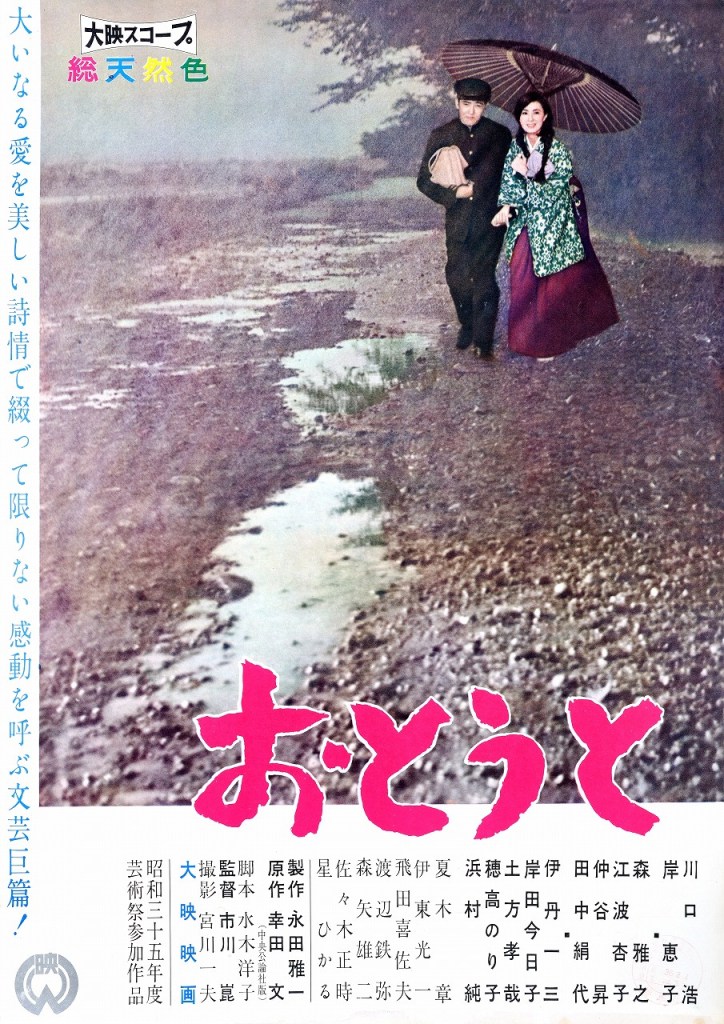 Perhaps oddly for a director of his generation, Kon Ichikawa is not particularly known for family drama yet his 1960 effort, Her Brother (おとうと, Ototo), draws strongly on this genre albeit with Ichikawa’s trademark irony. A Taisho era tale based on an autobiographically inspired novel by Aya Koda, Her Brother is the story of a sister’s unconditional love but also of a woman who is, in some ways, forced to sacrifice herself for her family precisely because of their ongoing emotional neglect.
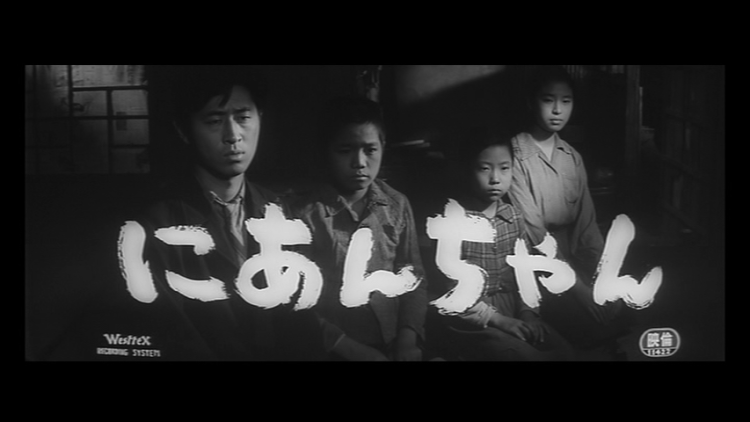 Like most directors of his era, Shohei Imamura began his career in the studio system as a trainee with Shochiku where he also worked as an AD to Yasujiro Ozu on some of his most well known pictures. Ozu’s approach, however, could not be further from Imamura’s in its insistence on order and precision. Finding much more in common with another Shochiku director, Yuzo Kawashima, well known for working class satires, Imamura jumped ship to the newly reformed Nikkatsu where he continued his training until helming his first three pictures in 1958 (Stolen Desire, Nishiginza Station, and Endless Desire). My Second Brother (にあんちゃん, Nianchan), which he directed in 1959, was, like the previous three films, a studio assignment rather than a personal project but is nevertheless an interesting one as it united many of Imamura’s subsequent ongoing concerns.
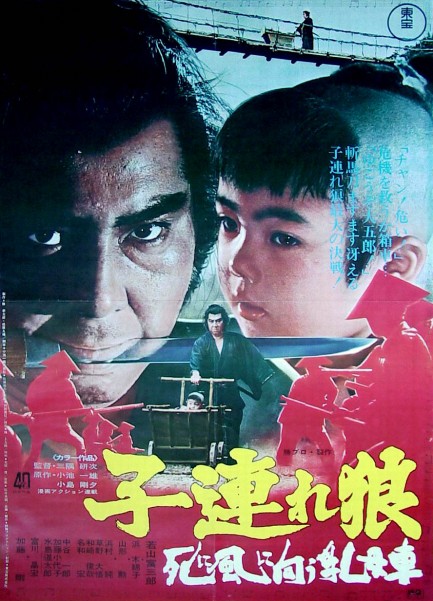 Ogami Itto (Tomisaburo Wakayama) and his (slightly less) young son Daigoro (Akihiro Tomikawa) are going to hell in a baby cart in this third instalment of the six film series, Lone Wolf and Cub: Baby Cart to Hades (子連れ狼 死に風に向う乳母車, Kozure Okami: Shinikazeni Mukau Ubaguruma). The former shogun executioner, framed for treason by the villainous Yagyu clan intent on assuming his position, is still on the “Demon’s Way”, seeking vengeance and the restoration of his clan’s honour with his toddler son safely ensconced within a bamboo cart which also holds its fair share of secrets. In the previous chapter,
 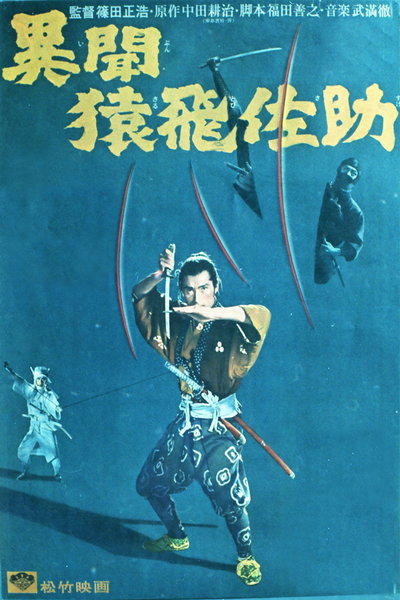 Nothing is certain these days, so say the protagonists at the centre of Masahiro Shinoda’s whirlwind of intrigue, Samurai Spy (異聞猿飛佐助, Ibun Sarutobi Sasuke). Set 14 years after the battle of Sekigahara which ushered in a long period of peace under the banner of the Tokugawa Shogunate, Samurai Spy effectively imports its contemporary cold war atmosphere to feudal Japan in which warring states continue to vie for power through the use of covert spy networks run from Edo and Osaka respectively. Sides are switched, friends are betrayed, innocents are murdered. The peace is fragile, but is it worth preserving even at such mounting cost?
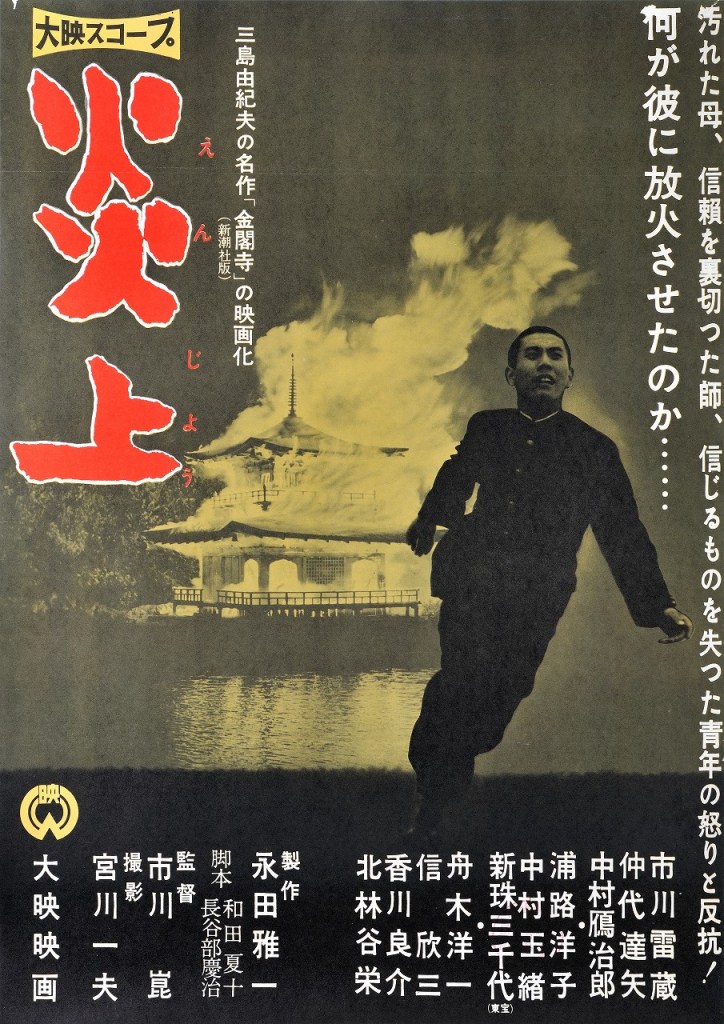 Kon Ichikawa turns his unflinching eyes to the hypocrisy of the post-war world and its tormented youth in adapting one of Yukio Mishima’s most acclaimed works, The Temple of the Golden Pavilion. Inspired by the real life burning of the Kinkaku-ji temple in 1950 by a “disturbed” monk, Enjo (炎上, AKA Conflagration / Flame of Torment) examines the spiritual and moral disintegration of a young man obsessed with beauty but shunned by society because of a disability.
 Despite being one of the most prolific directors of the ‘80s and ‘90s, the work of Yoshimitsu Morita has not often travelled extensively overseas. Though frequently appearing at high profile international film festivals, few of Morita’s films have been released outside of Japan and largely he’s still best remembered for his hugely influential (and oft re-visited) 1983 black comedy, The Family Game. In part, this has to be down to Morita’s own zigzagging career which saw him mixing arthouse aesthetics with more populist projects. Main Theme is definitely in the latter category and is one of the many commercial teen idol vehicles he tackled in the 1980s.
