Empire of Kids (ガキ帝国, Kazuyuki Izutsu, 1981)

Empire of Kids posterJapan in 1981 was a vastly different place than the Japan of 1967. Rising economic prosperity had produced an amiable social calm in which desire for conventional success and increasingly aspirational consumerism had replaced the firebrand need for social change which had defined the previous decade. Filmmaker, film critic, and sometimes outspoken TV personality Kazuyuki Izutsu was presumedly not a huge fan of consumerism and for this, his first “mainstream” film made for ATG, retreats back to the Osaka of 1967 in which petty street punks lamented their lack of opportunities by banding together and battling for control of their respective neighbourhoods like boys in the schoolyard only armed with knives and filled with nihilistic desperation.

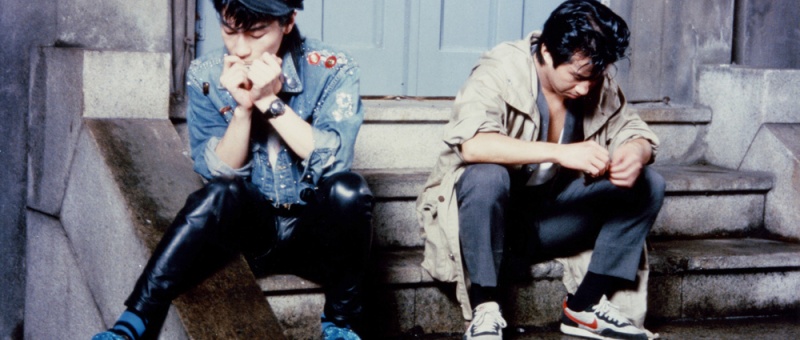
The film opens with our “hero”, Ryu (Shinsuke Shimada), being released from juvie after presumably getting into trouble for his petty punk antics. Waiting for him are his two best friends – soulful zainichi Korean Ken (Cho Bang-ho), and rockabilly Chabo (Ryusuke Matsumoto). Ryu is released alongside another boy, Ko (Takeshi Masu), whom he tries to recruit into their mini gang but quickly becomes an enemy, teaming up with the boys’ rivals – the Hokushin Alliance, while also becoming a potential rival for Ryu’s old girlfriend with dancing dreams, Kyoko (Megumi Sanuki). The boys, still in their last year of high school, become obsessed with trouncing their competition, proving their manhood on the streets while asserting their rightful place as the dominant forces in their native area, but as it increases in intensity the game becomes frighteningly serious and its dangers all too apparent.

Izutsu’s film fits comfortably into the “delinquent” genre but perhaps takes its cues from the Hollywood cinema of alienation more than the tough guy antics of the youth movie past. From Chabo’s bright red jacket and neatly greased quiff, the starting point is Rebel Without a Cause as these otherwise not too bad kids struggle with their place in the world, unable to see a clear path and direction for themselves in the society of 1967 which seemed both frustratingly open and closed to unremarkable lower middle-class boys. Ryu’s brother is going to give up football to go to cram school so he doesn’t end up like Ryu, while Ryu has taken to reading brain training books to try and get back on the academic path to success which he fears may have already passed him by. Ken, idly talking of the future, can’t see much beyond winding up in the yakuza, opening a bowling alley, or maybe becoming a comedian (this is Osaka after all). None of these guys is going to university or getting a salaryman job, they know not much awaits them outside of low-paid manual work, marriage, children, family and death, so they take their frustrations out on each other playing at gangsterism out on the streets.

For Ryu, Ken, and Chabo the reasons for their violence are “honourable” – they want to keep their local space local and are committed to defending it from the “external” threat of the shadier street punks from uptown. Apparently from stable economic backgrounds, the boys’ acts of street justice have no particular economic component, in contrast to those of the Hokushin Alliance which positions itself as a yakuza training school with a brutal hazing regime for new recruits and a business plan which involves hunting young women and trapping them through rape and blackmail to force them into prostitution. 

Aside from lack of direction, Ken – the most introspective of the boys, also has to deal with the constant threat of discrimination due to his roots as an ethnic Korean living in Japan. One of the reasons he hates the Hokushin Alliance and distrusts some of the other gangs is that they deliberately target Koreans in racially motivated attacks. One of his old friends, Zeni (Masaaki Namura), is a member of an all Korean street gang which attempts to defend itself against the strong anti-Korean sentiment out on the streets but finds itself outgunned by the sheer weight of numbers. Ken speaks Korean openly with his friends (even when there are non-Koreans close-by) and has no interest in hiding his ethnic identity even if he uses his Japanese name in his every day life, while Ko (whom we later realise is also ethnically Korean) hides his ethnicity completely and subsumes himself into the Hokushin with a view to finally joining the yakuza even whilst knowing that the gangs he has joined are extremely prejudiced against “foreigners” and Koreans in particular. Ken would never out someone deliberately, but finds Ko’s attitude difficult to stomach, not only in his willingness to hide his roots to fit in with gangster thugs, but in his willingness to persecute his own in order to do it.

The atmosphere that surrounds the boys is one of intense futility. They fight each other pointlessly, like children in the playground, and it’s all fun and games until someone reaches for a knife. Petty disputes quickly escalate when the yakuza gets itself involved in children’s games – an assault rifle, after all, has little place in a kids’ disco where teenagers come to drink Coca Cola and slow dance to a terrible covers band singing the “uncool” music of the day. Despite the melancholy air of frustration and inevitability, Empire of Kids (ガキ帝国, Gaki Teikoku) adopts the otherwise warm and nostalgic tone of the Japanese teen movie, embracing the typically Osakan need for spiky comedy even as our guys fall ever deeper into the hole their society has cut out for them. There are few rays of sunshine to be found here, friendships are broken, trusts betrayed, and futures ruined but then again, that was only life, in Osaka, in 1967.


A Taxing Woman’s Return (マルサの女2, Juzo Itami, 1988)

Taxing Woman 2 posterA Taxing Woman introduced us to Ryoko Itakura (Nobuko Miyamoto) – an oddball detective working as an insurance inspector who met her Irene Adler in a tax dodging corporate gangster with a limp. A year later she’s back, still the only woman working with the tax inspectorate and apparently still a dogged pursuer of those who would seek to defraud the Japanese government of its rightful earnings. Ryoko may have been a stickler for the rules who applied the same dog with a bone approach to a mom and pop store chowing down on its own supplies as to a dodgy yakuza led conspiracy, but she also believed in justice – something which stands her in good stead when she rubs up against a dodgy cult which, again, is a yakuza front but adds insult to injury by deliberately manipulating the vulnerable.

The action opens with some kids poking at the dead body of a “landshark” floating in a pond before flashing to a meeting of officials sucking crab meat from the shell and wondering what they’re going to do about this land they need cleared now their heavy is out of the picture. The corrupt politician from the first film, Urushibara (Takeya Nakamura), is apparently still involved in semi-legal land deals but palms the assignment off on a colleague. The big wigs need to empty a dated housing complex on some valuable land so they can build a vanity skyscraper – office space apparently being scarce in mid bubble Tokyo.

To do this they enlist the services of dodgy cult leader Onizawa (Rentaro Mikuni) and his troop of yakuza goons. Most of the tenants have already signed but they have three key holdouts – a diner owner clinging on to the family legacy, a stubborn paparazzo, and an intellectual professor who heads up the housing association. Unlike the yakuza of Taxing Woman, these guys have not reformed – they are the new/old style of lawless thugs who are perfectly prepared to threaten women and children to get their own way. Making it impossible for the tenants to stay through intimidation and noise torture, they stoop to blackmail to seal the deal.

Despite arriving only a year after A Taxing Woman, Taxing Woman’s Return (マルサの女2, Marusa no Onna 2) takes place in a much darker, though more obviously comedic, world. Whereas the earlier film adopted a noticeably ambivalent attitude to the tax inspectors and the enterprising gangsters, the villains of A Taxing Woman’s Return are so heinous and morally bankrupt as to be entirely indefensible even if the inspectorate takes a turn for the bumbling to compensate. The “cult” is, of course, merely a convenient money laundering front and tax dodge for the yakuza – religious organisations are exempt from taxation in the vast majority of cases which may be why the local tax office records hundreds of registered “religious bodies” in its jurisdiction alone. That doesn’t mean it doesn’t have its loyal followers, often vulnerable people looking for spiritual fulfilment but being bled dry by the money hungry cultists while the leader’s wife swans around in sables costing more than the average annual salary. A desperate devotee in need of a loan puts his own teenage daughter up as collateral only to see her raped by Onizawa, eventually becoming pregnant by him at only 16 years of age and thereafter becoming his devoted concubine in a bizarre instance of Stockholm Syndrome.

Yet for all the background darkness of weird cultists and nasty yakuza backed up by corrupt and venial politicians, Itami ups the cartoonish sense of the absurd with our hero Ryoko clambering over rooftops to listen in to the bad guys while her boss throws himself down flights of stairs and has to battle piercing sirens to get into the villains’ secret vault. It is however a dark humour as the opening makes plain with its troupe of little children staring at the strange shape floating in the water – a motif later repeated when a yakuza is gunned down in the street only for another group of children to pour over him as he expires, a single tear rolling down his cheek. The original spongy white body gives way to the businessmen sucking spongy white crab out its shell while insensitively discussing the late land shark, and the yakuza are unafraid to deploy a maggot infested severed hand (thankfully a fake picked up from a friend who makes horror movies) to convince the tenants they mean business.

At the end of A Taxing Woman, the gangster and the inspector reached something of a truce but one which came down, broadly, on the side of right. This time things aren’t quite so simple. The conspiracy is bigger and deeper, stretching all the way into the Diet and about more than just office space in still developing Tokyo. Onizawa, regarding himself as public servant, tries to say he did it all for his country, that if someone didn’t get their hands dirty Tokyo would be eclipsed by Hong Kong or Seoul. A post-war justification for a bubble era problem, but one that takes us straight back to the first film in Onizawa’s second proposition that only through money does he truly feel “immortal”. He may be a liar and a cheat, but he’s only a symptom of rapidly spreading infection, one which Ryoko and her team are powerless to cure, trapped on the wrong side of the fence while the bad guys build monuments to economic hubris, indulging in vanity in an era of bad faith which is about to be brought to a rather abrupt close.


Currently available to stream in the US/UK via FilmStruck.

Original trailer (no subtitles)

A Taxing Woman (マルサの女, Juzo Itami, 1987)

A Taxing Woman posterIn bubble era Japan where the champagne flows and the neon lights sparkle all night long, even the yakuza are incorporating. Having skewered complicated social mores in The Funeral and then poked fun at his nation’s obsession with food in Tampopo, Juzo Itami turns his attention to the twin concerns of money and collective responsibility in the taxation themed procedural A Taxing Woman (マルサの女, Marusa no Onna). Once again starring the director’s wife Nobuko Miyamoto, A Taxing Woman is an accidental chronicle of its age as Japanese society nears the end of a period of intense social change in which acquisition has divorced mergers, and individualism has replaced the post-war spirit of mutual cooperation.

Ryoko Itakura (Nobuko Miyamoto), a single mother and assistant in the tax office, has a keen eye for scammers. She demonstrates this on a stakeout with a younger female colleague in which she keeps a shrewd eye on the till at her local cafe and comes to the conclusion that they’ve been running a system where they don’t declare all of their cheques. Running her eyes over the accounts of a mom and pop grocery store, she notices some irregularities in the figures and figures out the elderly couple feed themselves from the supplies for the shop but don’t “pay” themselves for their own upkeep. That might seem “perfectly reasonable” to most people, but it’s technically a small form of “embezzlement” and Ryoko doesn’t like figures which don’t add up. Seeing as the couple probably didn’t realise what they were doing was “wrong” she lets them off, this time, as long as they go by the book in the future. A more complicated investigation of a pachinko parlour finds a more concrete form of misappropriation, but Ryoko is fooled by the owner’s sudden collapse into inconsolable grief after being caught out and leaves him in the capable hands of his confused accountant.

Nevertheless, Ryoko may have met her match in sleezy corporate yakuza Hideki Gondo (Tsutomu Yamazaki). Dressing in a series of sharp suits, Gondo walks with a pronounced limp that hints at a more violent past but as his rival from the Nakagawa gang points out, violence is a relic of a bygone era – these days gangsters go to jail for “tax evasion” as means of furthering their “business opportunities” and facilitating ongoing political corruption. Gondo’s business empire is wide ranging but mainly centres on hotels, which is how he arouses Ryoko’s interest. She looks at the numbers, does a few quick calculations, and realises either the business isn’t viable or the correct figures aren’t being reported. Ryoko doesn’t like it when the books don’t balance and so she sets her sights on the seedy Gondo, but quickly discovers she has quite a lot in common with her quarry.

Itami was apparently inspired to make A Taxing Woman after the success of Tampopo shoved him into a higher tax bracket. Given Japanese taxes (at the time) were extremely high, getting around them had become something of a national obsession even if, in contrast to the preceding 30 years or so, there was plenty of money around to begin with. More than the unexpected tendency towards civil disobedience the times seemed to cultivate, Itami homes in on the increasingly absurd desire for senseless acquisition the bubble era was engendering. Thus Gondo who owns a large family home well stocked with symbols of his rising social status, also occupies a bachelor pad where he keeps a mistress which reflects the gaudy excess of the age right down to its random stuffed hyena. Nevertheless when one of the tax clerks asks for some advice as to how to have it all, Gondo replies that that’s easy – to save money, you simply avoid spending it. Gondo lets his glass run over and delights in licking the edges. It’s all about delayed gratification, apparently, and having a secret room full of gold bars to gaze at in order to relieve some of that anxiety for the future.

Gondo, like many of his ilk, has “diversified” – yakuza are no longer thuggish gangsters but incorporated organisations operating “legitimate” businesses through “illegitimate” means. Thus we first find him using a nurse who allows herself to be molested by an elderly, terminally ill client whose identity they will steal to found a company they can quickly dissolve when he dies to shift their assets around and avoid the tax man. Later he pulls another real estate scam by pressing a desperate family but his real focus is the love hotels, whose slightly embarrassing existence ensures that not many come poking around. Ryoko, however, is unlikely to let such a large scam slide and delights as much in closing loopholes as Gondo does in finding them. Noticing a kindred spirit, Gondo quite openly asks his new tax inspector “friend” what she’d think if he married his mistress, gave her all his money, and divorced her – divorce proceeds are after all tax free. Sounds great, she tells him, as long as you trust your wife not to skip town with all the doe.

Ryoko, a modern woman of the bubble era, single and career driven, is a slightly odd figure with her officious approach to her job and unforgiving rigour. Unlike her colleague who dresses in the glamorous and gaudy fashions of the times, Ryoko wears dowdy suits and her mentor boss is always reminding her about her “bed hair”, meanwhile she stays late at the office and offers instructions to her five year old son over the phone as to how to microwave his dinner. Though there is another woman working with her at the tax office, when she’s finally promoted to full tax inspector status she finds herself in a room full of guys who apparently hardly ever go home. On her first job she’s only really brought along because she’s a woman and they want to threaten a mob boss’ mistress with a strip search to find a missing key for a safety deposit box. The mistress, however, tries to throw them off the sent by publicly stripping off and encouraging them to check her “cavity” if they’re so keen to find this key, only for Ryoko to find it under the sink while all the guys are busy being shocked. Ryoko’s methods are occasionally as underhanded as Gondo’s and, like his schemes, built on gaming the system but she’s certainly a force to be reckoned with for those considering defrauding the Japanese government.

Gondo’s schemes excel because they aren’t entirely illegal, only clever ways of manipulating the system, but they’re also a symptom of a large conspiracy which encompasses improprieties right up the chain as banks, corporations, and politicians are all part of the same dark economy managed by a corporatising yakuza. Gondo takes frequent calls from a local representative who often “helps him out”. Later the same representative tries to put pressure on the tax office to back off, but Ryoko’s boss points out that he doesn’t need to because the press are already on the story so he should probably get started on his damage control rather than bothering public servants. Gondo and Ryoko, perhaps as bad as each other, lock horns in a battle wills but discover a strange degree of respect arising between them in having discovered a worthy adversary. There’s something undeniably absurd in Ryoko’s firm determination to catch out struggling businesses and the confused elderly with the same tenacity as taking on a yakuza fronted conspiracy, and there’s something undeniably amusing in Gondo’s attempts to beat the man by playing him at his own game, but the overall winner is Itami who once again succeeds in skewering his nation’s often contradictory social codes with gentle humour and a dispassionate, forgiving eye.


Currently available to stream in the US/UK via FilmStruck.

Original trailer (no subtitles)

Kaisha Monogatari: Memories of You (会社物語 MEMORIES OF YOU, Jun Ichikawa, 1988)

Kaisha monogatari dvd coverJapanese corporate life is a strange thing – sometimes more cult than job, the company demands absolute dedication from its devotees though it promises them little more than a guaranteed life of toil. Being cast out from one’s company is akin to being robbed of one’s identity. Retirement is therefore not quite so much of a reward as an excommunication – especially to those who have given so much of themselves to an employer that they don’t quite know who they are when the suit comes off. This is especially true of the hero of Jun Ichikawa’s 1988 existential drama, Kaisha Monogatari: Memories of You (会社物語 MEMORIES OF YOU). The title is deceptively romantic – in fact there was an identically titled idol starring melodrama released the same year, but it is in a way a love story of an old man who finally gets a chance to reunite with the dreams he abandoned in youth while coming to terms with his old age and the various ways the world has moved past him.

Very early one morning, veteran salary man Hanaoka (Hajime Hana) stares into the empty screen of his television set from the comfort of his kotatsu, examining his own tearful face before his wife gets up to prepare breakfast. Hanaoka is set to retire soon, after 34 years of corporate life. His career has been unremarkable and he has few friends at the office – he feels he most likely will not be missed when he goes. Home life is not too successful either. Hanaoka’s grown-up daughter has come home with a daughter of her own after a divorce, and Hanaoka’s son is currently a NEET would-be-student supposedly studying to retake entrance exams though his mother is convinced he’s just messing around and avoiding getting a job.

Though Hanaoka is a section head, it’s clear he’s not rated by his colleagues who gossip about him behind his back while his mild and timid nature sees him sitting quietly forgotten in the back of meetings. He does however have admirers including one of the older ladies in the admin staff who has always been comforted by Hanaoka’s gleeful laughter, suddenly feeling the world expand as she watched him beavering away earnestly. Despite this, nobody is very excited about his leaving party. Discussing things among themselves, the office ladies lament that planning farewell parties is either too depressing to just too much hassle, while gossiping guys in the men’s room complain that Hanaoka was never very good at his job anyway and his leaving do will be a “pitiful” affair. All of this proves too much for the kind hearted, shy, Hanaoka who eventually decides to have a goodbye note distributed around the office in which he tells everyone that there’s no need to bother with yet another office party in the overly festive December to the relief (and consternation) of all.

Hanaoka does, however, have to write his official goodbye for the company newsletter (1000 characters due by Dec. 15). Struggling to find the words, he writes a first draft in which he declares the deep sorrow he feels on having to leave his corporate family behind – after all these are people he’s dined and gone drinking with for 34 years, through good times and bad, company picnics, and away days. He’s spent longer with the office ladies than his wife, had more conversations with his subordinates than with his son. The company has been his life, and leaving it is a kind of death. Embarrassed he screws up the draft and throws it away, only to encounter another salaryman returning late (and more than a little the worse for wear) who lets him have a go on the very high tech laser guns he’s just won at bingo.

Yet Hanaoka does manage to find a solution in reconnecting with his younger self and makes a few new friends in the process. In his youth, Hanaoka was a jazz drummer – sophisticated as it is, jazz was the music of his glory days and so he finds many of the other men in his position share his love of music and were also forced to abandon their musical dreams for corporate careers. Now freed of the burdens of the salaryman, they decide to form a band of their own and even to give a special concert in place of Hanaoka’s leaving do.

Meanwhile, Yumi (Yumi Nishiyama), the office lady who reminds Hanaoka of his younger self, is undergoing something of a crisis when she realises that her boyfriend is not as serious about the relationship as she is and has been seeing someone else behind her back – the CEO’s daughter whom he intends to marry to further his career. Kaisha Monogatari is, in many ways, the passing of a baton from the post-war generation to the bubble era though getting ahead through advantageous arranged marriage is apparently still a viable option. Those of Hanaoka’s age had to work hard, rebuilding the nation after crushing wartime defeat from bombed out ruins to the economic miracle of the East. Their children, by contrast had things easy – they hardly have to worry at all. Hanaoka’s son, apparently a delinquent lost and confused by the comparative freedom of economic stability, has no need to submit himself to the insane demands of life as a company man but millions like him will, because that’s just what you do.

Hanaoka finds a way to break out of the corporate straightjacket through re-embracing his love of jazz, proving there is something left inside him when you strip the company man away but there is nevertheless something sad in having wasted so much time slaving away for a organisation that is ultimately so ungrateful for the sacrifice. A gloomy picture of bubble era Japan in which families are fragmenting, young men choose career over love, and old men are made to feel worthless once their economic function is spent, Kaisha Monogatari: Memories of You does offer the faintest glimmer of hope in the goodness of men like Hanaoka, no matter how they may have failed those around them, whose lives may be brighter when finally allowed to be themselves again.


The Ballad of Narayama (楢山節考, Shohei Imamura, 1983)

ballad of narayama imamura 1983 posterWhen Keisuke Kinoshita decided to dramatise The Ballad of Narayama (楢山節考, Narayama Bushiko), adapted from a recent novel inspired by the ancient legend of “ubasute”, he recast it is as myth – a parabolic morality play adopting the trappings of kabuki to tell a timeless tale of transience and sacrifice. As much as Kinoshita praised the heroine’s kindness and altruistic sense of duty, he also questioned her failure to question the cruel and arbitrary social codes which defined her life, sacrificing her deep familial love for the cold austerity of religious reward. Shohei Imamura, slightly younger than Kinoshita, had also read the novel when it came out though he was not sufficiently progressed in his career to have considered adapting it for the screen. Unlike Kinoshita’s highly stylised approach, Imamura opts for his trademark sense of realism, exposing nature red in tooth and claw as he attempts to restore rural earthiness to the rarefied cinema screen.

Deep in the mountains, a small village does what it can to survive in harsh terrain. 69-year-old Orin (Sumiko Sakamoto) is as strong as they come but she is preparing to meet her end. In the villages of these parts, men and women of 70 are carried by their children to summit of Mount Narayama where they are left as a sacrifice to the god, praying for snow to hasten an otherwise long and drawn out death. Orin’s husband disappeared 30 years ago, the laughing stock of the village for his sentimental aversion to carrying his own mother up the mountain, and her son, Tatsuhei (Ken Ogata) seems equally reluctant to accept that Orin will making her own journey as soon as the next snows arrive.

Existence is indeed cruel. The custom of “obasute” or “throwing away” one’s old people, originated because of a lack of food. There not being enough sustenance to support a large population, the old sacrifice themselves in the name of the young. Life is cheap and of little consequence. Tatsuhei’s simple-minded younger brother, Risuke (Tonpei Hidari), notices the body of a newborn baby emerging from the melting snow to the edge of his rice paddy but the sight does not disturb or sadden him – he is annoyed that someone has “dumped” their “rubbish” on his land. Baby boys, oddly, are worthless – just another mouth to feed until it becomes strong enough to work, but baby girls are a boon because they can be sold. Orin herself sold her baby daughter in desperation following a bad harvest, and when the salt seller calls in unexpectedly Orin is at pains to tell him they’ve still not made a decision as to whether to sell her granddaughter who has been left without a mother following the death of Orin’s daughter-in-law in a freak accident.

She needn’t have worried however because the salt seller is bringing good news – a new wife for Tatsuhei, meaning Orin can make her final journey with an unburdened heart knowing that the household will be taken care of. Tamayan (Aki Takejo), a kind and cheerful woman much like Orin herself, fits right in despite the objections of Tatsuhei’s teenage son, Kesakichi (Seiji Kurasaki), who has got his girlfriend pregnant and wants to “marry” her – bringing not one but two extra mouths into his household. Orin loves him dearly, but all Kesakichi can do is make fun of his granny for still having all her teeth and resentfully enquire if she isn’t needed somewhere up a mountain sometime about now.

Kesakichi’s coldness and selfishness is contrasted with the goodness and warmth of Orin and her son. Hardship, far from bringing people together in their shared struggle, has made beasts of all. Imamura splices in frequent shots of animals copulating or feasting on each other – rats gnawing on the body of a snake giving way to a snake swallowing the body of a twitching grey mouse. Yet it is nature that will win in the end. Early on the village men chase a hare in the snow, Tatsuhei shooting it dead, only for an eagle to swoop down and make off with the prize. On the mountain, strewn with bones, a host of flapping crows emerges from a battered rib cage. 

Catching a thief is no different to catching a hare. Convinced that the thief’s family is a curse on the village, the villagers determine that they must all be eliminated – the roots of a poisoned tree must be burned away. Breaking into the home, friends and former neighbours tie up and kidnap an entire family, burying them alive and then redistributing all their worldly goods in “recompense” for what they’d “lost”. The cycles of loss and redistribution continue, as Tatsuhei observes finding Orin’s belongings draped around other shoulders. Kesakichi, having lost one lover, quickly takes another forgetting the first while Tatsuhei struggles to come to terms with the loss of his mother and the knowledge that someday he too, and Kesakichi, and the sons of Kesakichi, will make this same journey to this same spot.

Kinoshita’s secondary concern had been with the cruelty of the custom and the mechanisms of social conformity which enforced it, but Imamura almost seems to be in agreement with the villagers, finding horror but also beauty in the sacrifice of Orin who accepts her fate with transcendent beatification and willingly sacrifices herself to the mountain gods. The world is cruel, and tender. A son’s acceptance of his mother’s sacrifice becomes the greatest expression of a love he must destroy by honouring.


Original trailer (no subtitles)

Distant Thunder (遠雷, Kichitaro Negishi, 1981)

distant thunder dvd coverBy 1981 Japan’s economic recovery was more or less complete and the consumerist future had all but arrived. Based on the novel by Wahei Tatematsu, Distant Thunder (遠雷, Enrai) is the story of impending doom staved off by those clinging fast to the their ancestral traditions even whilst the modern world threatens to engulf them. Kichitaro Negishi already had a long career directing Nikkatsu’s Roman Porno, but made his mainstream debut with this quietly affecting social drama for Art Theatre Guild which relies on the strong performances of its cast to convey the subtitles of youth caught between past and future.

In the contemporary world of 1981, 23-year-old Mitsuo (Toshiyuki Nagashima) is a tomato farmer stubbornly hanging on to his family’s ancestral land which happens to be inconveniently placed in the middle of a modern housing complex. Women from the estate sometimes pop round to ogle Mitsuo under the pretext of buying super fresh tomatoes. Mitsuo is happy for them to enjoy the fruits of his labour, but refuses to accept them as “neighbours” lamenting the death of the village in which he grew up.

It transpires that Mitsuo’s father (Casey Takamine) sold off most of the farmland without consulting the rest of the family and used the proceeds to open a bar with the hostess he ran off with. Mitsuo hasn’t forgiven him for this and continues to work the tomatoes alone while his older brother is married and living a modern salaryman life in the city. At 23 it’s high time Mituso got himself a wife, but a flirtation with a barmaid, Kaede (Rie Yokoyama), who claims to be a divorced single parent proves diverting enough for the time being. Mitsuo knows being a farmer’s wife is no prize, so when his mother comes up with a possible match Mitsuo thinks it’s worth a try even if she’s probably none too pretty.

An old soul in many ways, Mitsuo wants to hang on to his family’s farm despite the constant offers he gets from salesmen at the door who want him to sell. Where once there was a village, now there are high rise apartment blocks. Mitsuo misses the world he grew up in where farmers helped each other out in difficult times and wandered in and out of each other’s houses like one big happy family. Not content with ruining his own, it’s also this wider concept of community as family that Mitsuo’s father has ruined for him in rejecting his traditional responsibilities for the irresponsible pleasures of taking up with a fancy woman and starting again as a bar owner.

Sadly, the bar hostess really does seem to love Mitsuo’s feckless father, perhaps seeing him as her last chance for happiness. Kaede, by contrast, is looking for something far less permanent. She claims to be divorced but is married to a mild-mannered man (Keizo Kanie) with a tattoo poking out of his collar who accepts her need for new conquests but would rather they not become regular arrangements. Kaede whips up more potential destruction when she comes between Mitsuo and his childhood best friend, Koji (Johnny Okura), who also likes her and has been led to believe Kaede’s relationship with Mitsuo was not altogether consensual. Meanwhile, Mitsuo’s blind date went far better than expected and it looks like he’s on course to find a wife in petrol station assistant Ayako (Eri Ishida).

Ayako, like Mitsuo, is a more old fashioned sort though she’s no prude and is of an earthier yet somehow “purer” nature than the comparatively urban Kaede. Mitsuo finds himself pulled in different directions – Ayako and the tomato farm, or the freely given pleasures of Kaede who threatens to burn everything to the ground with her mysterious, self destructive lifestyle. Mitsuo doesn’t want to be like his dad – a philanderer who runs out on his responsibilities and makes a fool of himself in the process, cosying up to local politicians and playing fast and loose with the law, but he’s late to see the danger a woman like Kaede might cause him. His friend, Koji, is not quite so perceptive and naively falls for her charms. Mitsuo knows deep down that his friend has in a sense saved him from making a ruinous life decision and helped him rediscover the happiness of his traditional, simple way of life.

Filming in 4:3, Negishi’s camera is soft and unobtrusive yet pointed, capturing the minor details of the everyday with a poetic beauty. Filled with realistic detail and anchored by strong performances, Distant Thunder is both a picture of innocents battling the inevitable death of their way of life with determination and purity, and a document of changing times in which the confusions of the modern world threaten to destroy those who cannot reconcile themselves to their fated paths.


Short clip from the ending (English subtitles)

P. P. Rider (ションベンライダー, Shinji Somai, 1983)

PP rider poster

Despite a brief resurgence following a retrospective at Tokyo Filmex followed by another at Edinburgh International Film Festival, Shinji Somai remains frustratingly underrepresented in the West. Though his career is more varied than most give him credit for, encompassing the melancholy pink film Love Hotel and masculinity drama The Catch among others, Somai is justifiably most closely associated with his youth films. Running from the artier Typhoon Club and The Friends to the rabidly populist in the Kadokawa idol movies Sailor Suit and Machine Gun and Tokyo Heaven, Somai’s work is unique in managing to catch hold of a zeitgeist, capturing the essence of the contemporary teenager more or less in the way they saw themselves rather than the way they were generally seen by adults. Like many Japanese teen movies of the ‘80s, the world of P.P. Rider (ションベンライダー, Shonben Rider) is essentially a safe one. Our three protagonists get themselves mixed up in some dark and shady business but they are never afraid, do not lose heart, and face danger with only contempt and determination.

Somai opens with one of his trademark long takes which whirls around from two suspicious looking yakuza types to a bunch of kids playing around in the school swimming pool. One of the kids, a rotund boy who goes by the nickname Debunaga (his full name being Nobunaga (like the historical tyrant) Deguchi, ‘Debu” essentially meaning “fat”) is being a bit of a twit and having a go at one of our heroes, JoJo (Masatoshi Nagase). Debunaga (Yoshikazu Suzuki) then tries to “drown” JoJo’s friend Jisho (lit. “Dictionary”) (Shinobu Sakagami), before the third member of the trio arrives, an androgynous girl who goes by the name of Bruce (Michiko Kawai). Bruce neatly dispatches the petty high school punks while a teacher, Arane (Hideko Hara), attempts to shift some bosozoku bikers who’ve invaded school property.

Meanwhile, the petty yakuza get on with their plan. They’ve come to kidnap Debunaga, his pharmacist dad apparently has a sideline in drug dealing, but before they can grab him, Debunaga is kidnapped by entirely different kidnappers! Our three heroes, JoJo, Jisho, and Bruce are very annoyed about this because they didn’t get a proper chance to get even with him. Accordingly, they decide the best way to make use of their summer holiday is to rescue Debunaga themselves and make sure they get their revenge before the kidnappers do him in.

P.P. Rider means exactly you think it means, except it doesn’t quite mean anything at all aside from perfectly capturing the strange mix of childish jokes and serious crime that defines the movie’s tone. The atmosphere is absurd and ironic, the kids distrust adult authority and attempt to define their own nascent personalities by effectively rejecting them by using nicknames, dressing in highly codified ways, and either conforming to or subverting social codes as they see fit. Amusingly enough, the trio take a brief pause in the middle of their quest to get haircuts and change outfits, after which they emerge dressed in each other’s clothes as if implying they are almost interchangeable. 

In keeping with most Japanese youth dramas, parents are an entirely off screen presence. Adult input comes from two very different directions (plus the occasional interventions of bumbling beat cop Tanaka), a down-at-heels yakuza called Gombei (Tatsuya Fuji), and the kids’ teacher, Arane. Gombei, a drug-addled gangster, is hardly an ideal role model (especially when he tries to drown Bruce and attacks Jisho with a samurai sword), but he does eventually take the kids under his wing with JoJo picking up the classic deputy role in learning the yakuza ropes. Arane, by contrast begins by letting them down. Harried by the bosozoku she tells the kids to buzz off when they try to talk to her, telling them that she’s off to hot springs town Atami and they’d best come back next term. Nevertheless she eventually becomes an integral part of their group, assisting in the quest and helping to rescue Debunaga while the strange finale plays out before her impassive eyes.

The kids didn’t really want to save Debunaga, and are conflicted when they eventually locate him, but in the end it’s friendship which wins out as they each celebrate their various roles in the successful rescue whilst lamenting the relative lack of care they’ve received from adults and authority figures aside from Arane and Gombei. Absurdist and ironic, P.P. Rider is a strange children’s odyssey in which the adolescent teens head out on a dark and dangerous adventure but live in the relative safety of the world and so nothing very bad is going to happen to them despite the terrible things they eventually witness. Classical long takes jostle alongside Somai’s mobile camera, random intertitles, and frequent breaks for pop music (this is an idol movie after all) in a frenzy of post-modern gags but somehow it all just works, and does so with wit and charm.


Opening scene (no subtitles)

Interview with actor Masatoshi Nagase from the Tokyo Filmex screening in 2011 (Japanese only, no subtitles)

Michiko Kawai’s main titles song – Watashi, Takanna Koro

The Sea and Poison (海と毒薬, Kei Kumai, 1986)

the sea and poison posterWhen thinking of wartime atrocity, it’s easy enough to ascribe the actions of the perpetrators to a kind of madness, to think that they have in some way moved away from us to become some kind of “other”. In thinking of those who transgress our notions of humanity as inhuman or “evil” we can absolve ourselves of their crimes, believing that they are not like us and we are not like them. The truth is never so simple and as long as we continue to other these dark parts of ourselves, we will not be able to overcome them. The Sea and Poison (海と毒薬, Umi to Dokuyaku), adapted from the novel by Shusaku Endo, shows this delusion of inhumanity for what it is in taking as its central concern the real life case of the doctors at a Kyushu university who committed heinous acts of experimentation on eight American prisoners of war in late 1945. Rather than focus of on those who took the decision that the experiments should take place, Endo and Kumai examine the motives of those on the fringes who merely went along with them finding that they did so for petty, essentially human motives.

Shot in a crisp black and white, the film opens in a caged cell where an American officer is interrogating a young man still in a student’s uniform. Suguro (Eiji Okuda) is the first of several witnesses to the deaths of eight American servicemen during alleged vivisection at the hospital at which Suguro had worked. Young and naive, Suguro is the most sympathetic of three witnesses we will encounter but his essentially compassionate nature puts him at odds with his colleagues who abhor “sentimentality” and regard his emotionality as a childish weakness. It is through Suguro that we discover that the hardness that has apparently led to these horrific betrayals of the physicians’ code are not born of the war, or of militarism, or of adherence to some ideal like god or country but are a natural extension of the hyper-rational attitude of the medical profession.

Suguro’s colleague, Toda (Ken Watanabe), is his polar opposite, viewing Suguro’s sense of compassion as a ridiculous but somewhat endearing character trait. A textbook nihilist, Toda takes the view that as death comes to us all, the when and why are essentially unimportant. When so many are dying in air raids or on the battlefields, what does it matter that some also die in hospitals. Yet Toda is, in someways, the most ruminative among the hospital staff. In the diary he keeps, Toda attempts to dissect himself and his ongoing lack of feeling. Telling the interrogators that he began the diary because he had begun to find himself “creepy”, Toda asks why it is he feels nothing in relation to his fellow men. Surely it must be right that one should feel some degree of empathy? Toda volunteers for the experiments in part to test his own hypothesis but discovering that he still feels no pity for these men, he wonders if these ideas of morality are a kind of affectation seeing as others too can commit such acts of extreme cruelty and think nothing of it.

In this, Toda earns our sympathy, seeming at least to want to feel something even if he does not. Nurse Ueda (Toshie Negishi), by contrast, is the most human and also the most repugnant of our three witnesses. Her concerns are petty and ordinary, born of jealousy and resentment. Returning again to the scene of a botched surgery, Kumai shows us Ueda calling the operating theatre and being told to give a patient a dose of morphine by a harried doctor still panicked by the ongoing OR drama. Following her instructions, Ueda fills a syringe but the vial is knocked out of her hand by the German wife of the head doctor, Hilda, who was once a nurse herself and likes to help out on the wards. Hilda is a severe woman but not a cold one, she cares for the patients but perhaps with a more rigorous adherence to the nurses’ code than the less experienced team at the hospital. Hilda tries to get Ueda fired for her “mistake”, scolding her by asking (in German) if she is not afraid of God, and expressing concern that she thought so little of giving a fatal dose of morphine to a suffering patient.

Ueda’s decision to attend the experiments is a form of backhanded revenge – Hilda, whom everyone regards as some kind of annoyingly saintly figure, has no idea her husband would be involved in something so against her deeply held ideals, but Ueda also offers another reason when she says that the doctors exist in another, more rarefied world to the rank and file ward staff. This idea is echoed again by the head nurse, Ohba (Kyoko Kishida), who states that nurses must do as the doctors tell them without asking questions. Ohba rounds out the just following orders contingent but the first half of the film has already shown us that the medical profession is corrupt and cannot be trusted.

The old Dean has had a stroke and there is a mini war of succession in play between the heads of surgery divisions one and two. Dr. Hashimoto (Takahiro Tamura) had been the favourite but his star is fading. In an effort to improve his chances, he decides to move up an operation on a friend of the Dean – a young woman with advanced TB. Meanwhile, Suguro’s patient, an old woman who also has TB has been earmarked for “experimental surgery”. The old woman has not been properly briefed on the risks of the operation in which she has only a five percent chance of survival and has only agreed to it because the doctor, whom she trusts implicitly, has told her it’s her only chance. The Dean’s friend is “Mrs. Tabe”, and she is “important”. The old woman is only “the welfare patient” and therefore not important at all.

Suguro, anxious to save the old woman to whom he has developed an attachment, wants the operation to be postponed, at least until she’s potentially strong enough to survive but Dr. Shibata (Mikio Narita) is only interested in using her as a potential candidate for experimentation which he claims will help future treatment of TB but also, of course, improve his career prospects. Mrs. Tabe’s mother asks the doctor if her operation carries any risk but the assistant laughs in her face, claiming the operation is so simple even a monkey could do it and pretending to be insulted that she has so little faith in her physicians. The operation goes wrong and Mrs. Tabe dies which is bad news for Dr. Hashimoto but rather than offer his apologies to the relatives, he tries to cover it up. So that it won’t look like she died on the table, they take the body back to her room and hook it up to a drip, insisting to Mrs. Tabe’s mother and sister that all is well while planning to announce that Mrs. Tabe died of complications from the operation early the following morning.

This level of callousness and self interest is echoed in Dr. Shibata’s justification that the old woman is going to die anyway and therefore the operation is worth a shot even though he believes it will kill her and is not in any way attempting to save her life (though it would be a nice bonus). Unlike Toda’s nihilism, Shibata’s practicality has no human dimension, he thinks in numbers and statistics, deciding who is a “real patient” and who is not. This same justification is used when recruiting doctors for the experiments. The US servicemen are downed aircrew from the bombers which have been making raids overhead for months. A court in Tokyo has ruled the random bombing contravenes international law and has sentenced the airmen to death. Seeing as the airmen will die anyway, might it not be “better” for their deaths to “benefit” medical science? The operations will be conducted under anaesthetic and so the men will not be in pain or know their fates which might, perhaps, be better than a firing squad.

The reality is not so convenient. Asked if his agreement was partly revenge, Suguro replies that, no, he felt no hate, he was just too mentally and physically exhausted to resist. Threatened by soldiers with guns he capitulates but refuses to assist in the room on the day, remaining a passive witness cowering at the edges. Before the operation, Dr. Gondo (Shigeru Koyama) makes small talk with the subject in English, asking about his hometown to which the airman, poignantly, says he’d like to return. The surgery is not like that conducted on Mrs. Tabe. The airman gets only ether and he struggles as the cloth is placed over his mouth, requiring four people – two doctors and two nurses, to hold him down until he stops kicking. This is no gentle death, this is murder.

A possible “justification” lies in the fact that the operating room is also filled with soldiers who laugh and jeer, snapping away on their brand new German-made camera. Tanaka, the officer in charge, asks for the airman’s liver after the operation, joking that he’d like to feed it to his men. The liver is indeed delivered to the horrified faces of the soldiers waiting for the party they’ve organised to begin, though it is not clear whether Tanaka really intends to feast on it or keep it as some sort of grim souvenir. Gondo, looking at the liver, remarks that they’ve all grown used to corpses but that “sentimentality” is never far away. Nevertheless, he appears to feel no real remorse for the heinous act of killing in which he has just been involved.

Adopting Endo’s Christianising viewpoint, the interrogations take place in a ruined church, a statue of the Virgin Mary directly above Ueda as she gives vent to her impure thoughts. The trio are being judged, not only by God but by us – or “society” as Suguro later puts it. The central proposition is that prolonged exposure to death on a mass scale – firstly as members of the medical profession, and later as victims of war, has led to an inhuman, nihilistic viewpoint in which we are all already dead and that, therefore, nothing really matters anymore. It isn’t clear who suggested this be done or why, but it is clear that Hashimoto collaborated in an effort to save his career by allying himself with the military – something he misses out on anyway when Shibata steals his thunder. Suguro is powerless to resist, Toda a melancholy sociopath, Ueda a vengeful woman, and Ohba a willing disciple of a beloved doctor, but none is a zealot to a regime or true believer in militarism. This is the dark heart of humanity – selfishness and cowardice, petty jealousies and ambitions. Kumai paints this scene of desolation with intense beauty, which only makes it all the more painful.


Original trailer (no subtitles)

The Last Witness (최후의 증인, Lee Doo-yong, 1980)

Last Witness Restoration posterThe Last Witness (최후의 증인, Choehuui jeungin), a pregnant title if there ever was one, begins with a melancholy voice over by way of a warning. It tells us that the path we are about to embark on will be a dark one but strikes a more optimistic note in affirming that 1980 was the year old evils were cleared away and, the narrator hopes, such darkness will have been left behind in the approaching new decade. Sadly this will not come to pass. The Last Witness is adapted from a novel by Kim Seong-jong which was published in 1974 but Lee Doo-yong filmed his adaptation in 1979 during the brief surge of hope for a brighter future following the assassination of dictator Park Chung-hee which ended with the military coup staged by general Chun Doo-hwan placing the country under martial law. A detective is assigned a case, but his investigation takes him on a long, soul searching journey into the recent past in which he finds countless crimes, betrayals, and proofs of human cruelty which ultimately destroy his ability to believe in the better, brighter future which has been promised yet denied.

Oh (Hah Myung-joong), a recently widowed, strung out police detective is handed a case by his sympathetic boss which seems to have been buried. A brewery owner, Young Dalsoo (Lee Dae-keun), has been murdered whilst fishing at a river and there appear to be few clues save that the woman he was living with was apparently not his legal wife. Oh’s preliminary enquiries all point back to an incident 20 years previously when Young was the youth leader in the village and supposedly helped to capture/kill a squad of rebel communist guerrilla fighters who had been hiding on Mt. Jirisan. 

Lee structures the tale to mimic Oh’s investigation; we follow him as he follows leads, jumping back to the 1950s and then forward again the world of 1980. The war becomes a corrupting and dividing line but Lee is bold in his tenet that the wounds did not heal after the truce. The villainy and greed continued, women were used and abused, men were cheated and betrayed. Justice no longer existed and the system continued to be bent to the will of the powerful rather than used for the defence of the weak.

It’s no surprise that Lee had such trouble with the censors. The version of the film restored by the Korean Film Archive runs 154 minutes (the first cut apparently ran 158) but for its original release the mandated cuts took it down to 120, leaving an already complex narrative near incomprehensible. Aside from the scenes of rape and violence, the censors took issue with the depiction of judicial corruption and particularly with its manipulation to facilitate sexual coercion of a defenceless young woman.

The woman at the centre of the storm is Son Jihye (Jeong Yun-hui) – the daughter of a wealthy man who nevertheless became a commander of a communist guerrilla unit during the war. When General Son went into the mountains he took his daughter with him, but realising he was on the losing side, and resenting orders he believed would result in nothing more than martyrdom, Son lost faith in “communism” and was murdered by his own men in an act of mutiny. Before he died he entrusted a treasure map marking the spot he buried his ancestral wealth to a fellow officer with the instruction to look after his daughter and make sure she gets her inheritance. The soldier failed to keep his promise. Jihye is raped and then gang raped, rescued by a sweet and simple man, Bau (Choi Bool-am), whom she later marries, and then forced to become the mistress of an official who also raped her. Jihye and Bau are the innocents chewed up by the system, good people pushed into a corner by the politics of others and then let down by a society so riddled with corruption that it can no longer command any degree of faith from its continually oppressed people.

The Korea of 1980 is being attacked through the legacy of 1950 but whether in concession to the censors or no, the communists do not come off well either. Son, described as an eccentric, is clearly a misguided madman who has betrayed his class on a superficial level, saving his own wealth for a rainy day, but he is allowed a semi-noble death in finally renouncing communism as a cruel, ambitious underlying has him brutally executed by bloody, violent bayonets while his daughter watches from behind a nearby bush. Once Son is dead the madness sets in as the guerrillas hide out beneath a primary school, listening to small children sing happy songs while they tie up and rape a terrified teenage girl having abandoned all concessions to morality and their supposedly noble cause.

If the communists were bad what came later was worse. Interviewing a witness, Oh is keenly aware that the man is telling him only a part of the truth, leaving out a painful detail but leaving in just enough for a skilled investigator to understand. It is this act of selective silence that Oh has come to challenge, exposing the whole sordid story of his nation across two decades of war, trauma, economic recovery and political oppression. Oh cannot resist meting out a little justice of his own in reciting the man’s hidden truth back to him, forcing him to confront the ugliness of his of youth and the guilt that he has long been repressing. Unable to prosecute him for his crimes, Oh hopes that the man will be punished “emotionally” by his words but his actions have far more severe consequences than he ever could have anticipated.

What Oh finds when he solves the crime is a long history of rape, secrecy, betrayal, selfishness, and the misappropriation of law by the powerful to oppress the powerless. It all goes back to the mountain and the war, a young woman robbed and violated, her protector imprisoned, and a legacy of pain which will come back to haunt those responsible but bring only ruin and anguish to its original victims. The question of the “last witness” remains unsolved – will these be the last witnesses to an era of fear and impotence now that the bright future is on its way, or is Oh the last witness, deciding to take his terrible knowledge with him to a better place? Then again the film itself stands as a testament to its times, butchered by censors but carrying forth its own hidden truths only to deliver them 30 years later than expected. Lee’s powerful murder mystery is an investigation into the death of a nation about to be reborn which makes its grim yet inevitable conclusion all the more painful in its brutal negation of a long buried hope.


Screening as part of the London Korean Film Festival 2017 at Regent Street Cinema on November 4th, 2pm.

The Last Witness is also available on all regions dual format DVD & blu-ray courtesy of the Korean Film Archive. In addition to English subtitles on the main feature, the blu-ray disc also includes subtitles for the commentary track by Park Chan-wook and film critic Kim Young-jin, while The DVD includes subtitles for the commentary track by Kim and Lee Doo-yong as well as an additional commentary by director of Kilimanjaro/The Shameless Oh Seung-uk and journalist Ju Sung-chul.

The accompanying booklet is fully bilingual and includes essays by Kim Young-jin, Ju Sungchul (Editor of Korean film magazine Cine 21), and Inuhiko Yomota (film critic – the booklet also includes the original, untranslated essay in Japanese), as well as a note on the restoration from the KOFA conservation centre.

(Not currently available on the Korean Film Archive’s YouTube Channel)

Original trailer (Restored, English subtitles)

People in the Slum (꼬방동네 사람들, Bae Chang-ho, 1982)

People in the slum still 2The Korea of the early ‘80s was not an altogether happy place. One dictator fell in 1979, but hopes of returning to democracy were dashed when general Chun Doo-hwan staged a coup and instigated martial law, brutally suppressing a large scale democracy protest in Gwangju in 1980 (though the news of the incident was also suppressed at the time it took place). People in the Slums (꼬방동네 사람들, Kkobangdongne Salamdeul), adapted from the best selling novel by Lee Dong-cheol, is not an overtly political film but takes as its heroes those who have lost out in the nation’s bold forward march into the capitalist future. Opening with a voice over from the author himself, the film dedicates itself to “the memory of neighbours of bygone days”, remembering both the hardships but also the fierce sense of community and warmth to be found among those living at the bottom of the heap.

Myeong-suk (Kim Bo-yeon), a still young-ish woman with a young son, lives in a slum outside of the city with her second husband, Tae-sub (kim Hee-ra). Nicknamed “Black Glove” because of the glove she always wears on her right hand, Myeong-suk is about to open her own business – a small grocery store serving the local residents, but her happiness is tempered with anxiety. Tae-sub, despite his promises, steals money from Myeong-suk to go drinking and gambling, is occasionally violent, and does not get on with her son, Jun-il, who refers to him as Mr. Piggy. Jun-il is also a constant worry because he’s picked up a habit of stealing things and generally causing trouble around the neighbourhood. When Myeong-suk’s former husband and the father of Jun-il, Ju-seok (Ahn Sung-ki), catches sight of her by chance one day, the past threatens to eclipse the small hope of her future.

Life in the slums is not easy. There are few resources, few people are working and there are lots of children with no money to feed and clothe them. Fights are frequent but often unserious. The community pull together to support each other, turning out in force for the grand opening of Myeong-suk’s shop or the 60th birthday celebration of a fellow resident. Besides Myeong-suk, her second husband, and son, the slum is home to a collection of unusual characters from a widow who dresses in white and does strange dances to entertain the locals, to the pastor who does his best to help where he can. A poor drunken woman makes a fool of herself all over town, nursing a crush on the pastor but seemingly unable to move past her dependency on alcohol and whatever it is that caused it and landed her in the slum.

Myeong-suk’s early life would not have suggested her current trajectory, as Bae reveals in Ju-seok’s flashbacks of his courtship to the woman who would become his wife. Ju-seok, a pickpocket, spotted Myeong-suk on a bus and it was love at first sight. Eventually he married her but never revealed his illicit occupation until he was finally arrested. For the sake of his wife and child, Ju-seok attempts to go straight but his efforts are frustrated by bad luck, temptation, and unforgiving policemen. No matter how hard Ju-seok tries to be a decent, hardworking, family man, the economic instability of late ‘70s Korea will not allow him to do it.

Myeong-suk waits for him, but there comes a point she cannot wait anymore. Her second husband is no better than her first and, just like Ju-seok, is hiding something from her. Tae-sub is a bully and a bruiser who is only using Myeong-suk as a convenient place to hide. She cannot rely on him for affection, protection, or financial stability. Ju-seok, at least, did love Myeong-suk even if that love was the very thing which kept leading him back into a life of crime which then took him away from her. Once again love is a luxury the poor cannot afford .

Where the general atmosphere may seem destined for a tragedy for the resilient, suffering Myeong-suk, her damaged son, and reformed taxi-driver former husband, Bae gives them hope for a warmer, if not a better, future. As Myeong-suk prepares to leave the slum, the pastor, encircled by the residents, reads out a passage reminding the locals that a neighbour’s suffering is one’s own suffering while the drunken woman who previously hated children appears to have sobered up and happily hugs a child. Myeong-suk makes a selfless gesture of atonement and solidarity in giving the money from selling her shop to another single mother whose youngest three all have different fathers, perhaps indicating the difficulty of her life since the father of her eldest passed away. Tae-sub too reforms, decides to face the past he’s been running from and make amends for his former life, facilitating a possible reunion for the star-crossed lovers Myeong-suk and Ju-seok. The future suddenly looks brighter, but it remains uncertain and who knows if love and a taxi-driver’s salary will be enough to keep Ju-seok on the straight and narrow as a responsible husband and father in turbulent ‘80s Korea.


People in the Slum screens as part of the London Korean Film Festival 2017 which is hosting a mini Bae Chang-ho retrospective of three films at each of which the director will be present for a Q&A.

The film was also recently released on all regions blu-ray courtesy of the Korean Film Archive. In addition to English subtitles on the main feature, the blu-ray also includes English subtitles for the commentary track by Bae Chang-ho and film critic Kim Sungwook, and comes with a bilingual booklet featuring essays by Jang Byung-won (programmer for Jeonju International Film Festival), Lee Yong-cheol (film critic), and Chris Berry (King’s College London).

You can also watch the entirety of the film legally and for free courtesy of the Korean Film Archive’s YouTube Channel.