Karaoke Terror (昭和歌謡大全集, Tetsuo Shinohara, 2003)

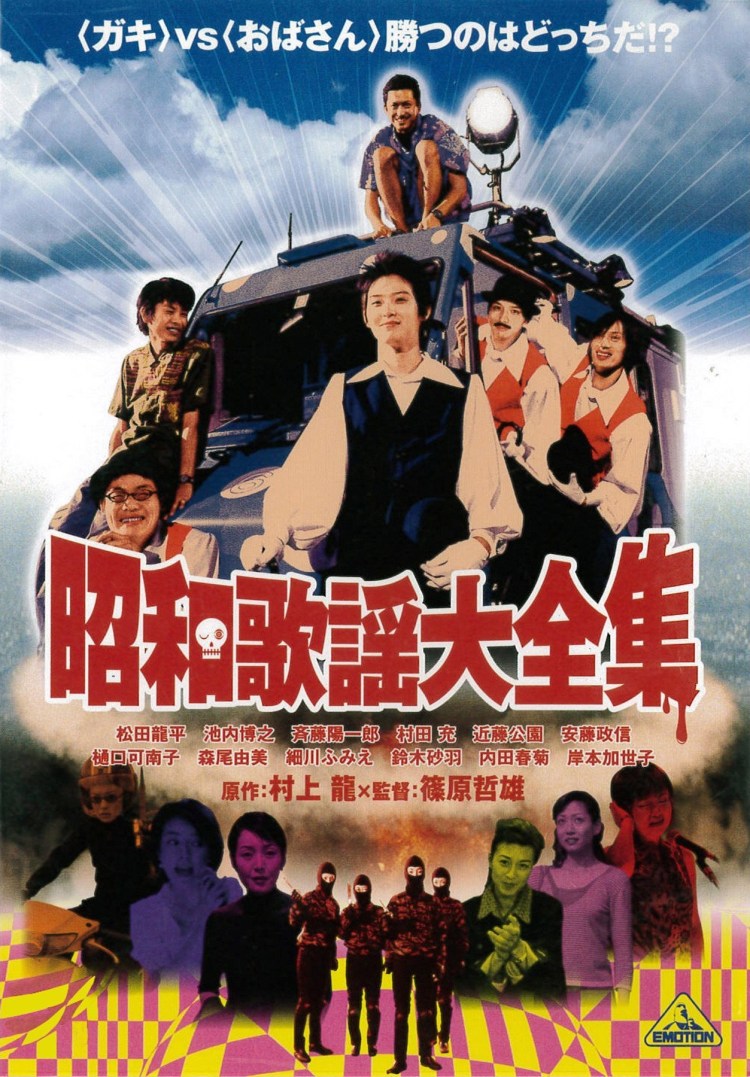
karaoke terror poster.jpgEver since its invention karaoke has provided the means for many a weary soul to ease their burdens, but there may be a case for wondering if escapism is a valid goal in a society which seems to be content in stagnation. The awkwardly titled Karaoke Terror (昭和歌謡大全集, Showa Kayo Daizenshu), adapted from the book Popular Hits of the Showa Era by Audition’s Ryu Murakami, pits two very different groups of karaoke enthusiasts against each other – aimless adolescent males, and jaded middle-aged women. Despite the differences in their ages and experiences, both enjoy singing the wistful bubblegum pop of an earlier generation as if drunk on national nostalgia and longing for the lost innocence of Japan’s hopeful post-war endeavour to rebuild itself better than it had been before.

We open with the slackers and a voice over from the presumed “hero” of the film, Ishihara (Ryuhei Matsuda), who informs us that he can’t really remember how he met most of the guys he hangs out with but that he always knew the one of them, Sugioka (Masanobu Ando), was a bit cracked in the head. In a motif that will be repeated, Sugioka catches sight of a middle-aged woman just on the way back from a shopping trip and decides he must have her but his attempts to pick her up fail spectacularly at which point he whips out his knife and slashes her throat.

Meanwhile, across town, a middle-aged woman, Hemmi (Kayoko Kishimoto), offers to let a co-worker share her umbrella but the co-worker misinterprets this small gesture of courtesy as romantic interest and crudely asks her “how about a fuck?” to which Hemmi is quite rightly outraged. Rather than apologise, the co-worker shrugs and says his “direct” approach works six times out of eight and some women even appreciate it. Once she manages to get away from her odious aggressor, Hemmi ends up stumbling over the body of the woman murdered by Sugioka and realises she knows her. The murdered woman was one of six all named Midori who were brought together for a newspaper article about the lives of middle-aged divorced women and have stayed “friends”. Outraged about this assault not just on their friend and their sex but directly against “women of a certain age” who continue to be the butt of a societal joke, the Midoris decide they want revenge and hatch a plan off Sugioka, but once they have, the slackers hit back by offing a Midori and so it continues with ever-increasing levels of violence.

Which ever way you slice it, you can’t deny the Midoris have a point and Hemmi’s continuing outrage is fully justified. When the boys rock up at a mysterious general goods store out in the country looking for a gun, the proprietor (Yoshio Harada) is only too happy to give it to them when they explain they need it for revenge and that their targets are middle-aged women. The proprietor has a lot to say about ladies of a certain age. In fact he hates them and thinks that bossy, embittered, unproductive women “too old” to fulfil their only reason for existence will be the only ones to survive a nuclear apocalypse that even the cockroaches cannot overcome. The boys appear timid and inexperienced but ironically enough can’t take their eyes off the middle-aged woman from across the way and her sexy dance routines. They feel entitled to female deference and cannot accept a woman’s right to decline. The Midoris are sick of being “humiliated”. They’ve fallen from Japan’s conformist path for female success in getting divorced or attempting to pursue careers. They’ve lost their children and endured constant ridicule as “sad” or “desperate”, made to feel as if their presence in the workplace past a certain age was “inappropriate” and the prices they have paid for their meagre successes were not worth the reward. They strike back not just at these psychotic boys but at a society which has persistently enacted other kinds of violence upon them.

Meanwhile, the boys remain boys, refusing adulthood and responsibility by wasting their time on idle pursuits. Truth be told, karaoke performances involving dance routines and elaborate costumes is not a particularly “cool” hobby by the standards of the time but it appears that none of these men have much else in their lives to invest themselves in. With the economy stagnating and the salaryman dream all but dead, you can’t blame them for their apathy or for the rejection of the values of their parents’ generation, but you can blame them for their persistent refusal to grow up and tendency to allow their insecurities to bubble over into violence.

As it turns out, adolescent males and middle-aged women have more in common than might be thought in their peripheral existences, exiled from the mainstream success which belongs exclusively to middle-aged and older men who’ve been careful to (superficially at least) adhere to all the rules of a conformist society. Neither group of friends is especially friendly, only latterly realising that “real” connections are forged through direct communication. Their mutual apathy is pierced only by violence which, ironically, allows their souls to sing and finally shows them just what all those cheerful songs were really about. Darkly comic and often surreal, Karaoke Terror is a sideways look at two diametrically opposed groups finding unexpected common ground in the catharsis of vengeance only for their internecine warfare to graduate into world ending pettiness.


Original trailer (English subtitles)

The greatest hits of the Showa era:

Koi no Kisetsu – Pinky & Killers

Hoshi no Nagare ni – Akiko Kikuchi

Chanchiki Okesa – Haruo Minami

Shiroi Cho no Samba – Kayoko Moriyama

Linda Linda – The Blue Hearts

Sweet Memories – Seiko Matsuda

Kaze Tachinu – Seiko Matsuda

Minato ga Mieru Oka – Aiko Hirano

Sabita Knife – Yujiro Ishihara

Hone Made Aishite – Jo Takuya

Kimi to Itsumademo – Yuzo Kayama

Mata Au Hi Made – Kiyohiko Ozaki
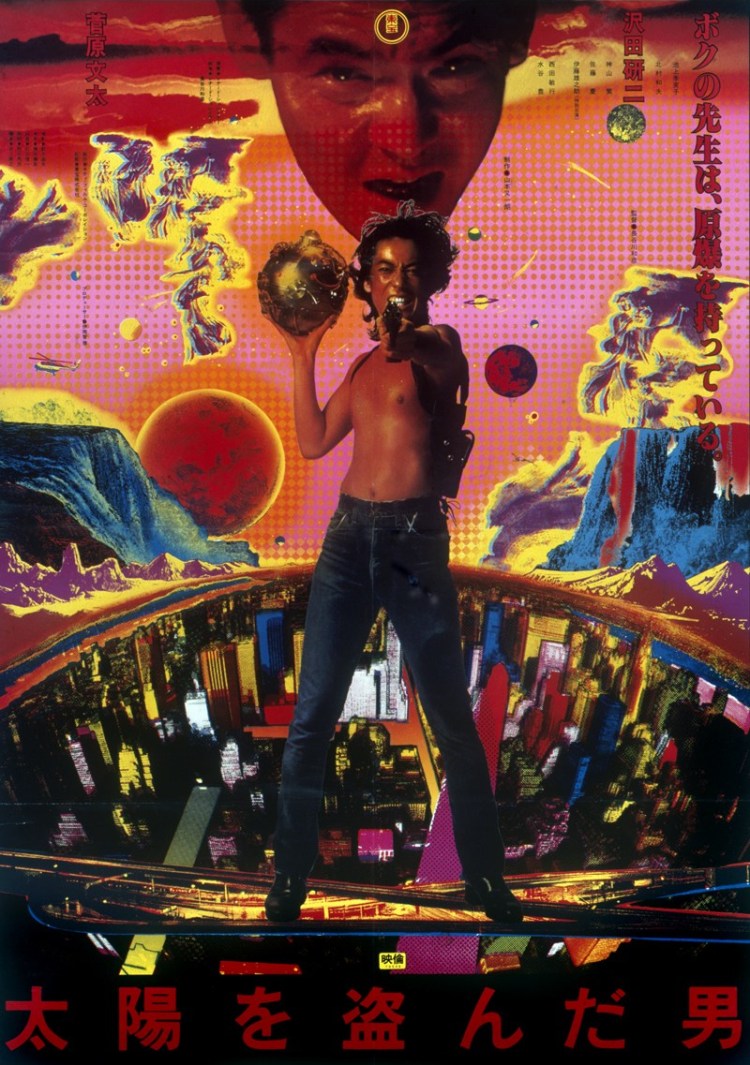
The Man Who Stole the Sun (太陽を盗んだ男, Kazuhiko Hasegawa, 1979)

(C) Toho 1979

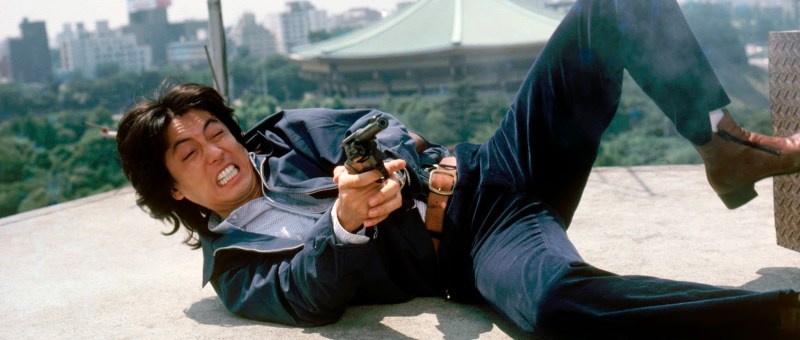
man who stole the sun posterIn the post-Asama-Sanso world, Japanese society had shifted into period of intense calm in which improving economic prosperity was in the process of delivering comfort rather than the creeping acquisitive anxiousness that began to overshadow the bubble era. Nevertheless, in cinematic terms at least anxiety was everywhere and not least among the young who, swept along by this irresistible economic current, were quietly doubtful about their place in a changing society. Co-scripted by an American screenwriter, Leonard Schrader (brother of Taxi Driver’s Paul), The Man Who Stole the Sun (太陽を盗んだ男, Taiyo wo Nusunda Otoko) provides a satirical snapshot of this confusing moment as an oppressed, belittled high school science teacher builds an atomic bomb in his apartment just to show he can but then realises he has absolutely no idea what to do with it.

Technically speaking, the science teacher’s name is Makoto Kido (Kenji Sawada) but no one really calls him that. The kids at school refer to him as “Bubble-gum” because he always seems to be chewing on the rather childish confectionary. Not the most conscientious of teachers, he tailors the curriculum to his own interests, teaching the kids all about atomic energy and the bomb, but the kids aren’t interested. They only want to know what’s going to be on the test. To them Kido’s information is irrelevant and so they ignore him, talking amongst themselves while he carries on, preaching to a seemingly empty room.

Meanwhile, Kido is building the bomb at home, for real. As he tells the kids, anyone can build an atomic bomb – you only need the plutonium which is, admittedly, tightly controlled for just this reason. He acquires his through a daring heist on a nuclear plant. Kido never elaborates on what prompted him to begin his bizarre masterplan, but there is certainly a degree of pent up rage inside him born of resentment with his reduced circumstances. “Just” a high school science teacher, who would really think he’d have the capability to build an atomic bomb, alone, using only household equipment (plus the plutonium and a custom furnace purchased after nearly exploding his oven)?

Kido’s problems are the same as many middle-aged men in ‘70s Japan in that he feels intensely oppressed from above and below. What he’s trying to tell the kids is that they have access to this power already – anyone can build a bomb, if you bother to learn how. The only thing that’s being kept from him is the plutonium (and for good reason), which he manages to acquire anyway. A chance encounter with the madness of the age seems to kickstart his plan into gear when he meets his opposing number in police inspector Yamashita (Bunta Sugawara).

Kido, having halfheartedly escorted a group of students on a school trip, finds himself rendered powerless once again when the bus is hijacked by a distressed older gentleman (Yunosuke Ito) armed with a rifle and grenade and wearing a World War II soldier’s uniform. He demands to be driven to see the emperor from whom he intends to demand the return of his son, presumably killed in the war 30 years earlier. Yamashita, clean cut and authoritative, is the gung-ho cop who masterfully brings the hostage crisis to a close by lying to the man that the emperor has consented to see him. During the evacuation the old man is killed by police snipers (despite Yamashita’s too late cries of “don’t shoot” after having dispatched the grenade and disarmed the suspect).

Like Kido, the old man likely didn’t really know what he intended to do, only that he was lonely and desperate. The emperor couldn’t give him back his son (whose uniform he seems to be wearing) and his gesture is one of futile defiance coupled with a suicide bid that has no real goal save making an elaborate protest against the world in which he lives. Kido makes the bomb, lets the authorities know he has it, but then realises he has no demands. He asks them to fix something minor that annoys him, to stop the TV networks pulling the plug on late running baseball games to make way for the news, and finds himself rewarded. He has taken back the power, they believe he has the bomb and they fear him, but he has no further goals or notion of how his society should change. There is no idealised future he is fighting for, all there is is futility and indifference.

Meanwhile, ironically enough, Kido’s desperation provokes a mini revolution in others. A talkshow radio host (Kimiko Ikegami) named “Zero” (in contrast to Kido’s adoption of the codename “No. 9” as the 9th owner of a nuclear device and the only individual), broadcasts his on-air request for ideas, believing it to be a kind of thought experiment. The ideas she gets from the public are of the usual kind – lonely men who want to bathe with naked women, nationalists who want to start a war with America, dreamers who think it might be better not to want anything and just embrace the dream, while she muses that she wants the Rolling Stones concert that was cancelled a few years ago after a band member’s narcotics conviction to be reinstated. That being as good as anything is what Kido goes for in an overture that passes as an odd kind of romance and a suitably ironic kick back against strait-laced authority.

Kido’s war is, in a sense, a war with the fathers of the world as symbolised by men like Yamashita with their suits and neatly trimmed haircuts. Their button-down existence has never offered anything to men like Kido who feel trapped and angry within it. Yet Yamashita is also reacting against his own generation of fathers as symbolised by the old man on the bus, the last remnant of wartime resistance offering a defeated cry against a world which got away from them. Yamashita let the old man die when he prioritised his own sense of heroism, and that annoyed Kido. He can’t help sympathising with his plight which is in a way also his own in being relentlessly silenced and ignored by austere authority figures.

Turning down Yamashita’s clumsy attempt at a pickup, Zero affirms that Kido has given her a dream, which no small thing and she feels bound to him because of it. It’s an ironic statement because Kido has no dreams and not only that, he has no future either – he is slowly dying of radiation poisoning despite his precautions during the building of the bomb. In their final confrontation, Yamashita, adopting a paternal authority, neatly summarises Kido’s dilemma. The only life he has the right to take is his own, and his own death is the only thing he really wants, but he’s embarked on this elaborate plan to make his presence felt all the while aware that he will remain totally anonymous. No one will ever see him. He will die, like thousands of others, faceless. A lowly high school science teacher, no terrorist mastermind or bomb building genius. His revenge is as absurd as it is futile. Male inferiority complexes threaten to drown us all in a sea of violent resentment, and as the Earth dies screaming all we will have to reflect on is that we ourselves brought this world into being through our own incurable apathy.


Original trailer (no subtitles)

Floating Clouds (浮雲, Mikio Naruse, 1955)

(C) 1955 Toho

floating clouds poster“The past is our only reality” the melancholy Yukiko (Hideko Takamine) intones, only to be told that her past was but a dream and now she is awake. Adapted from a novel by Fumiko Hayashi – a writer whose work proved a frequent inspiration for director Mikio Naruse, Floating Clouds (浮雲, Ukigumo) is a story of the post-war era as its central pair of lovers find themselves caught in a moment of cultural confusion, unsure of how to move forward and unable to leave the traumatic past behind.

We begin with defeat. Shifting from stock footage featuring returnees from Indochina, Naruse’s camera picks out the weary figure of a young woman, Yukiko, drawing her government issue jacket around her. She eventually arrives in the city and at the home of an older man, Kengo (Masayuki Mori), whom we later find out had been her lover when they were both stationed overseas working for the forestry commission but has now returned “home” to his family. Kengo had promised to divorce his wife, Kuniko (Chieko Nakakita), in order to marry Yukiko but now declares their romance one of many casualties of war. With only the brother-in-law who once raped her left of her family, Yukiko has nowhere left to turn, eventually becoming the mistress of an American soldier but despite his earlier declarations the increasingly desperate Kengo cannot bear to let her go and their on again off again affair continues much to Yukiko’s constant suffering.

Floating Clouds is as much about the post-war world as it is about a doomed love affair (if indeed love is really what it is). Kengo and Yukiko are the floating clouds of the title, unable to settle in the chaos of defeat where there is no clear foothold to forge a path into the future, no clear direction in which to head, and no clear sign that the future itself is even a possibility. Naruse begins with the painful present marked by crushing defeat and hopelessness, flashing back to the brighter, warmer forests of Indochina to show us the lovers as they had been in a more “innocent” world. At 22, Yukiko smiles brightly and walks tall with a lightness in her step. She went to Indochina in the middle of a war to escape violence at home and, working in the peaceful environment of the forestry commission, begins to find a kind of serenity even whilst dragged into an ill-advised affair with a moody older man more out of loneliness than lust.

Yet, Yukiko’s troubles started long before the war. Assaulted by her brother-in-law she escapes Japan but falls straight into the arms of Kengo who is thought a good, trustworthy man but proves to be anything but. Kengo, frustrated and broken, attempts to lose himself through intense yet temporary relationships with younger women. Every woman he becomes involved with throughout the course of the film comes to a bad end – his wife, Kuniko, dies of tuberculosis while Kengo was unable to pay for treatment which might perhaps have saved her, an inn keeper’s wife he has a brief fling with is eventually murdered by a jealous husband (a guilty Kengo later attempts to raise money for a better lawyer to defend him), Yukiko’s life is more or less destroyed, and goodness only knows what will happen to a very young errand runner for the local bar whom he apparently kissed in a drunken moment of passion.

The lovers remain trapped by the past, even if Kengo repeatedly insists that one cannot live on memory and that their love died in Dalat where perhaps they should have remained. Yukiko’s tragedy is that she had nothing else than her love for Kengo to cling to, while Kengo’s is that he consistently tries to negate the past rather than accept it, craving the purity of memory over an attainable reality, chasing that same sense of possibility in new and younger lovers but once again squandering each opportunity for happiness through intense self obsession. “Things can’t be the same after a war”, intones Kengo as an excuse for his continued callousness, but they find themselves retreating into the past anyway, taking off for tropical, rainy Yakushima which might not be so different from the Indochina of their memories but the past is not somewhere one can easily return and there can be only tragedy for those who cannot let go of an idealised history in order to move forward into a new and uncertain world.


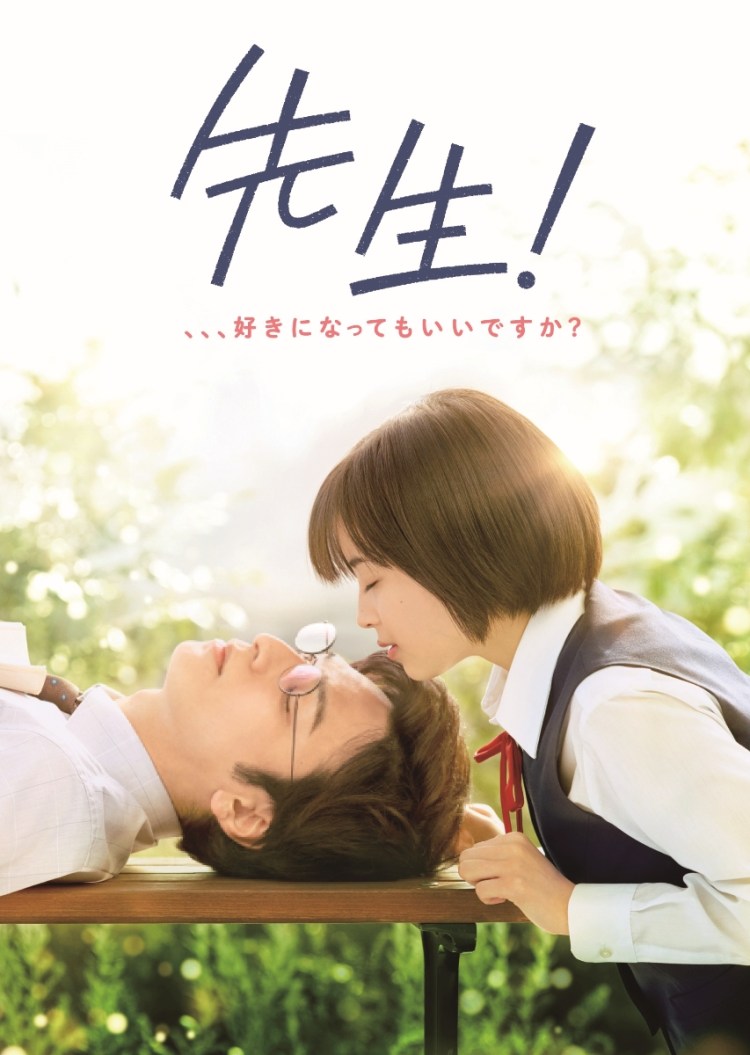
My Teacher (先生!、、、好きになってもいいですか?, Takahiro Miki, 2017)

My Teacher posterJapanese cinema is having a mini moment of shojo crisis in its awkward obsession with student/teacher romance. While similarly themed age-gap “romances” such as After the Rain might have been better able to navigate the difficult seas of misplaced adolescent affection, Narratage and latterly My Teacher (先生!、、、好きになってもいいですか?, Sensei! …Suki ni Natte mo ii Desuka?), seem to have gone in a less palatable direction in accidentally implying that our squeamishness with these obviously inappropriate attachments might not be justified. The latest from romantic melodrama veteran Takahiro Miki, My Teacher is a perfect exemplification of the inherent problems with shojo romance and, in this case somewhat ironically, its inability to process the implications of a necessarily romantically naive perspective.

Our heroine, Hibiki Shimada (Suzu Hirose), is a shy, awkward teenager with a hopeless crush on her handsome, if somewhat aloof, history teacher, Mr. Ito (Toma Ikuta). Unlike her classmates, Hibiki has been slow to a romantic awakening and confused by her friends’ various and rapidly changing crushes. Nevertheless, like her best friend Chigusa (Aoi Morikawa), Hibiki has begun to develop feelings for a teacher – Ito whose gruff exterior hides a considerate heart. Mistaking his general kindness for an extension of personal affection, Hibiki has fallen in love and even whilst knowing that there is something not quite acceptable about her feelings decides to pursue her inappropriate crush in the manner only a naive schoolgirl can.

Ito, as expected, turns down Hibiki’s confession with weary resignation. A kind man who seems to limit his interactions with other humans in order to avoid becoming over involved, he is aware of the delicacy of the situation but also of its dangers as regards his own standing as an educator and responsible adult. He wants to protect his student, emotionally and physically, but is at a loss as to how to handle his dilemma without causing her further distress. Consequently, he fails to definitively shut down a tricky set of circumstances in good time, allowing to Hibiki to bamboozle him into an awkward bargain in which she asks him if her crush will be “OK” if she manages to score over 90% on the upcoming test. Surprised, Ito laughs and reminds her of her woeful results in the previous midterms. Understanding that she’s been turned down, Hibiki nevertheless regards Ito’s awkward laughter as a flicker of possibility and continues on in hope.

Had My Teacher continued in the same vein, with Mr. Ito valiantly attempting to guide Hibiki towards a healthier romantic consciousness while remaining mindful of the tenderness of her feelings and the delicacy of the situation as a whole, it might have entered more interesting and less problematic thematic territory. Unfortunately, it remains firmly rooted in shojo romance in which the heroine’s innocent desires must be recognised and so Mr. Ito’s nobility eventually crumbles as he begins to fall for the “earnest”, “awkward” schoolgirl and forgets his “position as a teacher”, finally giving in to “temptation” even if he then agrees that the responsibility for his transgression must rest entirely with him. Ito attempts to remove himself from the situation in recognition of the harm he may be causing, but the film won’t let him because it needs a resolution that is “romantic” rather than “realistic”.

“Realism” rears its head when the inappropriate relationship between the pair is eventually uncovered and Ito hauled before a staff committee to explain himself but the school’s understandable decision that he must be summarily fired for gross misconduct is undercut by its presentation as an act of unavoidable tragedy that fails to make a distinction between “genuine feeling” and “abuse of position”, conveniently forgetting that in these kinds of cases that is not a distinction that it is useful to make. Chigusa, trying to encourage her friend in her great romance, affirms that there is no one in the world it is not OK to love, which might have some truth in it seeing as love itself is rarely wrong, but there are instances where acting on that love would be and a teacher/student relationship is definitely one of them especially where the student is still a minor.

Indeed, the kids resent the fact that everyone treats them as children but they are, as a similarly exasperated teacher tries to explain to them, not yet adults as exemplified by their consistently self-centred perspectives which prevent them from realising the difficult position in which their decision to air their inappropriate feelings places those whom they claim to love. This dawning realisation is heralded as the pathway to adulthood in finally coming to an acceptance of the individual’s place within a community bound by ethical rules and the responsibility one has towards the feelings of others most particularly when they conflict with one’s own. It is however undercut by the irresponsible decision to push the innocent romance to its “natural” conclusion even if it has the decency to wait until after graduation until it does so. Ethically questionable as it is, Miki’s obvious talents are not in question and his beautifully composed emotionally moving aesthetics are out in force but only serve to emphasise the uncomfortably naive sensibilities of the source material.


International trailer (English subtitles)

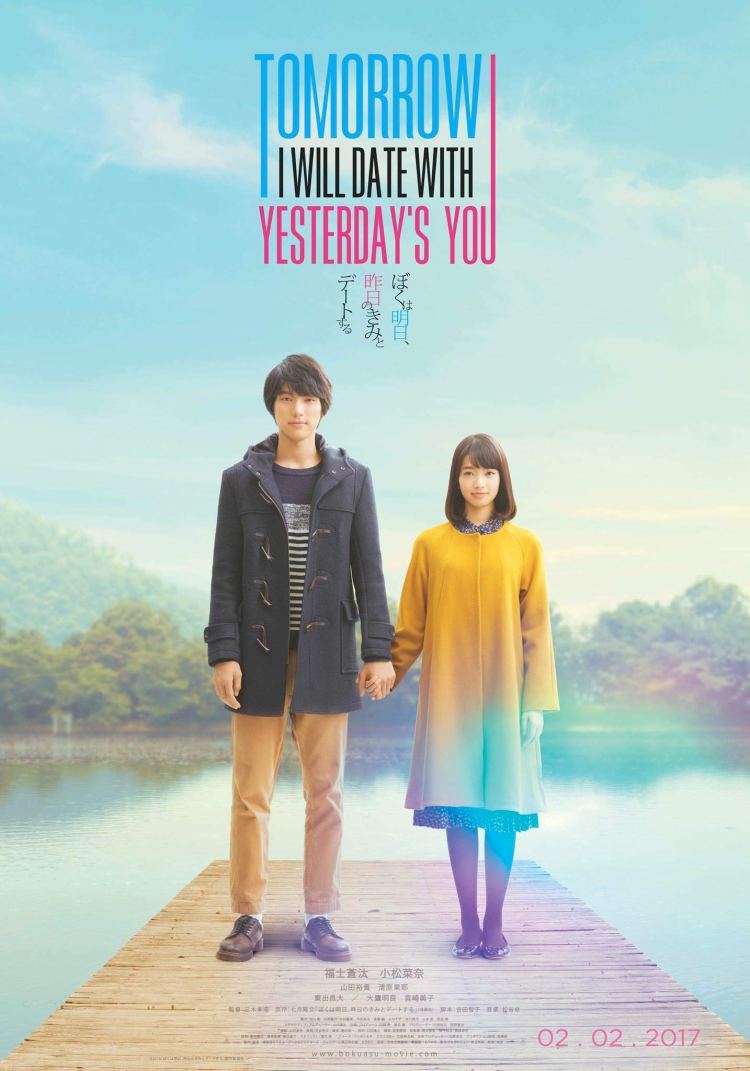
My Tomorrow, Your Yesterday (ぼくは明日、昨日のきみとデートする, Takahiro Miki, 2016)

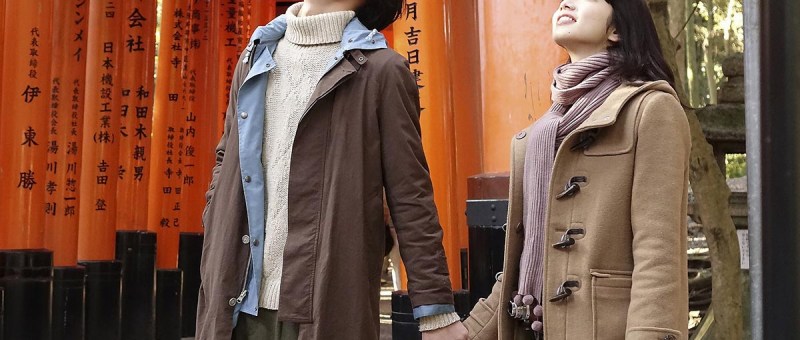
Tomorrow I will date with yeaterday's you posterLike the Earth and the Moon, are lovers destined to move past and away from each other, sharing the same space only for a cosmic instant yet forever connected by the arc of their existences? It’s a heavier question than you’d expect from your average romantic melodrama. My Tomorrow, Your Yesterday (ぼくは明日、昨日のきみとデートする, Boku wa Asu, Kino no Kimi to Date Suru), another finely crafted tragic romance from genre master Takahiro Miki, is a kind of sci-fi “junai” in which the barriers to romantic fulfilment aren’t cultural or societal or medical, but cosmic in that our star-crossed lovers occupy opposing temporal realms which conspire against their union while also carving it into the arc of the spacetime continuum like a cruel existential joke.

At 20, art student Takatoshi (Sota Fukushi) spots the beautiful Emi (Nana Komatsu) on his morning commute. Hit by a thunderbolt, he falls for her instantly but is shy and diffident. Despite himself, Takatoshi decides that if she alights at the same station as him then it’s really meant to be and he can’t not at least try talking to her. Alight she does and he chases after her as best he can only for his cheerful attempt to ask for a phone number to be rebuffed by the ultimate excuse that she doesn’t have one. Surprisingly, Emi’s claim turns out to be the truth rather than an attempt to politely decline his attentions, though Takatoshi is surprised that his attempts at romance eventually provoke a few tears from the visibly moved Emi. The pair eventually start dating and are well into the world of young love when Emi reveals her secret – she is from a parallel universe where time runs in the opposite direction. Takatoshi’s future is her past, and her past his future. Their universes only overlap every five years for a maximum of 30 days and so this is their one and only shot at true love.

Miki begins in true romantic fashion as Takatoshi giddily pursues his first, idealised romance only latterly beginning to see signs of trouble on the horizon in Emi’s sometimes quirky behaviour and strange ability to predict the future. They walk through the usual steps towards becoming a committed couple, finally dropping the honourifics in  mutual recognition of their deepening bond, but every decisive step reduces Emi to tears in a fashion that runs beyond the merely cute or girlish. Takatoshi, young, naive, and in love, finds his mild suspicion vindicated when he discovers Emi’s diary which seems to run in reverse order and mainly contains entries for dates which have not yet happened.

Gradually, Takatoshi begins to realise that he and Emi exist on opposing planes, destined forever to orbit each other with only this brief moment of connection to sustain them. He muses on whether moving past each other is the natural path of a romance before learning to accept the transitory nature of love so that he might appreciate this brief gift he’s been given even in the knowledge that it will soon be over. Briefly petulant, he resents Emi’s dependence on the diary, filled as it is with “facts” from his 25-year-old self gleaned during a “previous” meeting, wondering if she is merely going through the motions of their predetermined romance and spoiling his vision of easy, serendipitous love in the process.

Privileging his own perspective, Takatoshi comes late to the realisation that Emi has been making a series of sacrifices on his behalf and that their strange romance is likely to prove much more painful for her than it will for him. Their relationship is built not on “shared” memories, but only in their brief moments of togetherness as they actively forge a present for themselves which is distinct from their two worlds of past and future. Like the diverging points which heralded their meeting, they are travelling in different directions – every first for him is a last for her as their moments of joy and pain become strange mirrors of their eventual heartbreak. Nevertheless, each eventually comes to the realisation that their love is worth enduring despite its inevitably sad end and that something of it is destined to remain even in the entropic melancholy of their love story. An old fashioned romance in every sense, My Tomorrow, Your Yesterday offers a surprisingly deep appreciation of true love anchored by mutual understanding and emotional equality even if it acknowledges that the world is cruel and that love is unlikely to survive as anything more than a bittersweet memory.


Original trailer (no subtitles)

Here’s to the Young Lady (お嬢さん乾杯!, Keisuke Kinoshita, 1949)

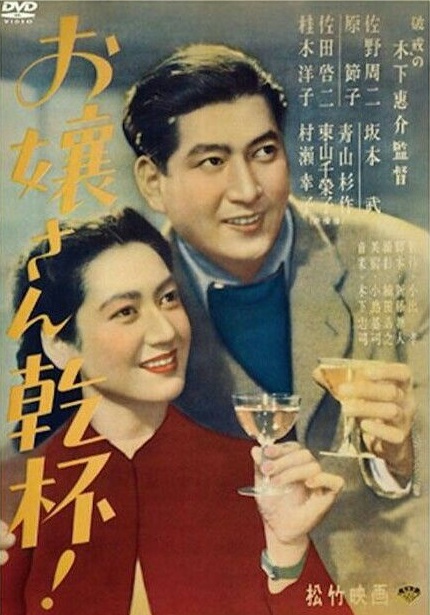
Here's to the young lady DVD coverLove across the class divide is a perpetual inspiration for melodrama, but what if the problem is less restrictive social codes and more emotional inertia and frustrated desire? Many things were changing in the Japan of 1949, racked by post-war privation and burdened with a scrappy desire to remake itself better and kinder than before. Keisuke Kinoshita, the foremost purveyor of post-war humanism, looks back to the 1930s for his 1949 cheerfully superficial romantic comedy Here’s to the Young Lady (お嬢さん乾杯!, Ojosan Kampai!). A tale of changing social codes and youth trying to find the courage to break free, Kinoshita’s easy romance is as breezy as they come but also hard won and a definitive step towards the freer, fairer world he so often envisages.

Keizo Ishizu (Shuji Sano), a 34-year-old self-made man and successful garage owner, is still single and seemingly pestered by his well meaning friends who keep finding matches for him that he doesn’t really want. Reluctantly, he acquiesces to the demands of his good friend Mr. Sato (Takeshi Sakamoto) who is desperate to introduce him to a pretty young woman from a wealthy family and agrees to meet Yasuko (Setsuko Hara) – a demure 26-year-old apparently keen to get married. Ishizu is instantly smitten, dumbstruck by her beauty and elegance. He begins to think all this marriage talk isn’t so silly after all, but then he is only a country bumpkin made good in the scrappy post-war economy. Yasuko is old money. How could he ever be permitted to enter her world and would she ever truly fit in his? Ishizu falls hard but his dreams of romance are eventually crushed when he discovers that the Ikedas, once a noble family, have hit upon hard times following half the family’s repatriation from Manchuria and the unwise business relations of Yasuko’s father which have landed him in jail as a co-conspirator in large scale fraud.

Despite his misgivings, Ishizu is talked into “dating” Yasuko for a few months during which he plans to find out if she could fall in love with him for real or if the marriage is likely to be an eternally one-sided affair which will make them both miserable. Ishizu resents being thought of as the cash cow, the classless nouveau riche upstart roped in to breathe new life into the fading aristocracy, but can’t let go of the hope that Yasuko might fall for his down to death charms even if not all of her family are very happy with this particular means of survival.

Yasuko’s grandparents are at great pains to emphasise (repeatedly) the immense gap in social class between Ishizu and their cultured, refined ingenue of a granddaughter who enjoys such elegant hobbies skiiing, tennis, and the ballet. Ishizu is into boxing and drinking at his favourite bar. He has no idea what the tune is that Yasuko plays on the piano that he bought for her and somewhat gauchely had delivered direct in front of the mildly scandalised family who can’t help feeling belittled by his generosity, but he finds it charming all the same even if his lack of refinement also stings with embarrassment. Nevertheless, the youngsters end up finding their own way – she takes him to the ballet where he is bored and then somehow moved, and he her to the boxing where she is frightened and then thrilled. They grow closer, but also not as Ishizu becomes increasingly frustrated (if in his characteristically good natured way) by Yasuko’s continuing aloofness.   

Perhaps unusually, it is Yasuko who struggles to move on from the idealised pre-war past in which she lived the romanticised life of a wealthy noblewoman who had not a care in the world and no need to worry about anything. The war has destroyed the nobility but this no Cherry Orchard-style lament for a declining world of elegance and rise of the unrefined in its place but a plea for rational thinking and a desire to move forward into a more egalitarian future. Yasuko’s grandparents cannot accompany her on this journey even if her parents and siblings are minded to be pragmatic, but it’s she herself who will need to make the decision to abandon her rigid ideas of what it is to be a fine lady and learn to embrace her own desires if she is to find happiness (as her father urges her to do) in the rapidly changing post-war world.

Then again, Ishizu is not entirely free of petty prejudice and the mild conservatism of the upwardly mobile as he shows in his intense hostility towards his best friend’s (Keiji Sada) tempestuous relationship with a club dancer (Naruko Sato). Nevertheless, after a good old fashioned case of fisticuffs and a proper consideration of all the obstacles he faces in winning the heart of Yasuko, Ishizu eventually reconsiders and urges his friend to chase happiness wherever it may lie. He vacillates and doubts himself, finds it impossible to approach the icy lady of the manor because of a feeling of social inferiority and finally decides to give up on an unrealistic idea of romance to spare them both pain, but then the obstacles were not all his to overcome and if there is a choice to be made it is Yasuko’s to make. A joyous throwback to the screwball ‘30s, Here’s to the Young Lady, banishes the darkness of the postwar world to the margins while its melancholy youngsters use romantic heartbreaks as a springboard to free themselves from the restrictive social codes of the past in order to choose happiness over misery and despair.


Titles and opening scene (no subtitles)

Neko Atsume House (ねこあつめの家, Masatoshi Kurakata, 2017)

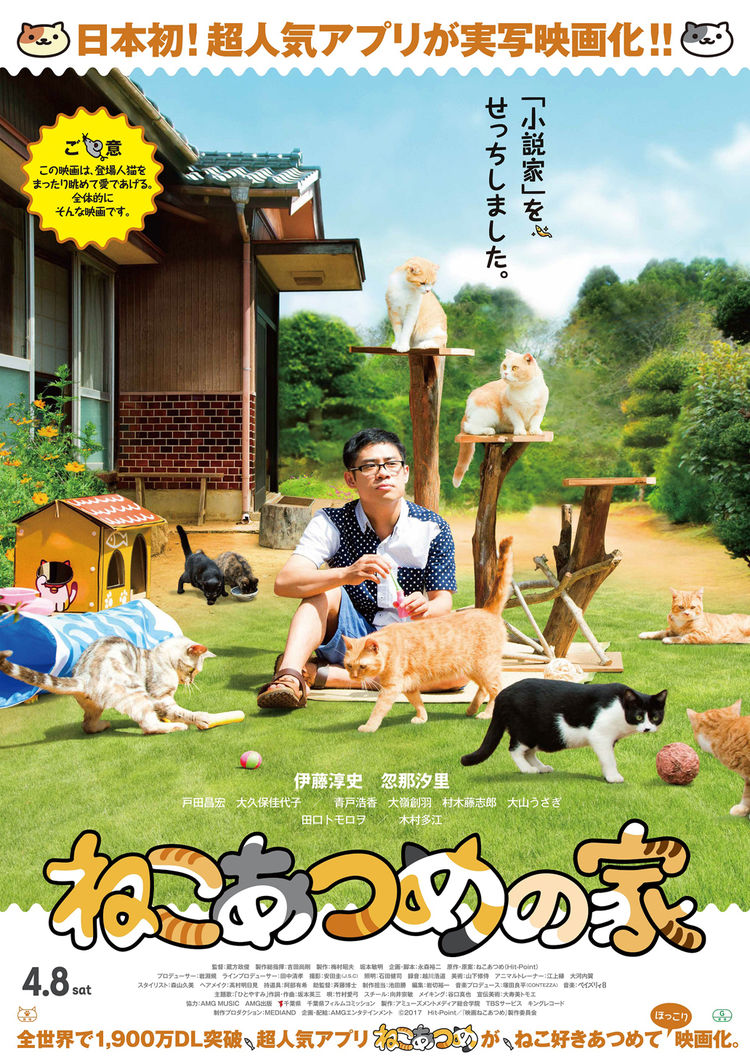
mihon_neko_chirashi_BzenIt’s important to note that cats are living beings and not playthings for humans though they do seem know just what it takes to manipulate our affections. Neko Atsume started life as a popular smartphone game in which the aim is to “seduce” various types of cats to come into your garden so you can catalogue them. The game is just about collecting things and otherwise has no real narrative so it’s not the first one you’d think of for a movie adaptation, but then it does have the all powerful allure of cats being cats.

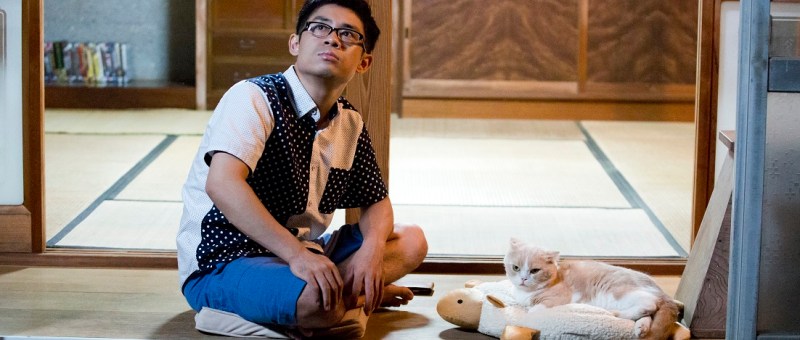
The movie revolves around blocked writer Masaru (Atsushi Ito) who scored a big hit with his debut work but is floundering in the high pressure world of serialised novels and has already skipped the last two editions. His editors are getting antsy – the truth is the series is boring, a simple college love story the like of which has been seen a million times before. What the suits think is…Masaru should turn his protagonist into a zombie! Understandably, he is not very keen on the idea, and neither is his junior editor Michiru (Shioli Kutsuna), but they need ideas and they need them fast. Unfortunately, Masaru doesn’t have any and so, after a strange meeting with a “fortune teller”, he decides to move to the country to get away from it all. The only problem is, his new home seems to be full of stray cats…

Neko Atsume House (ねこあつめの家, Neko Atsume no Ie) isn’t particularly trying to do very much beyond its rather restrictive title, though it does its best to set up Masaru’s internal dilemmas before he finds himself becoming a crazy cat man out in the middle of nowhere. Like many a youngster he’s been beaten down by early success and the subsequent pressure to repeat it. Where he’s going round in circles with a cliched story of young love, his contemporary who put out a less successful debut at the same time as Masaru’s, has gone on to score billboard worthy hits and become a rising star of the literary scene. At a particularly low point, Masaru even tries to add a few positive comments underneath his own work in the hope of digging up fans but only kicks the hornets nest of abuse as the mean spirited readers seem to know right away the only person who would say anything nice about his work is Masaru himself.

In touch of the meta, it’s Masaru who is the zombie, chowing down on the remains of his artistic integrity in order to save some semblance of a career. Of course, it doesn’t work. Unable to get any real writing done, Masaru becomes increasingly obsessed with the stray cats outside, eventually building them an entire mini paradise so they’ll come and keep him company while he’s busy not writing. In true fatalistic fashion, it turns out that Masaru has loved cats all along. He just forgot about it, and that’s one of the reasons he can’t write. Then again, perhaps it was just as Michiru, who never lost her faith in him, had said – he had to learn to be free like the cats in the garden in order to get his creative juices flowing again. At any rate, an up close observation of the lazy lives of pampered kitties begins to bring him closer to the human world, especially when he ends up working for the crazy (in a nice way) lady (Tae Kimura) who runs the local feline grooming centre and has to up his people skills as well as his cat man ones.

The latest in a long line of low budget dramas in which a conflicted creative exiles themselves from “real” life to get their mojo back, Neko Atsume House is at least the nicest in which Masaru’s petulance only really stretches to one unkind conversation with Michiru before he begins figuring out how to fix his many and various personal problems. Otherwise, the draw is the cats who are generally content to let it all hang out. Superficial, if charming, Neko Atsume House knows its target audience and proves a delectable enough treat to attract its very own cohort of cat collectors ready for cataloguing.


Original trailer (no subtitles)

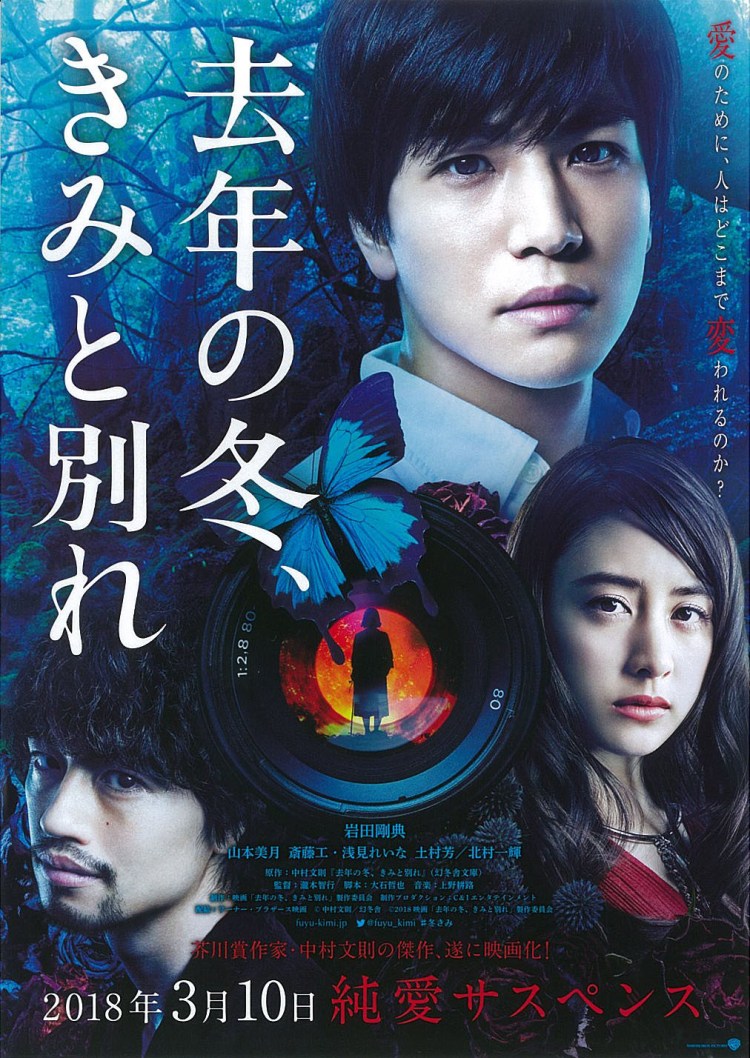
Last Winter, We Parted (去年の冬、きみと別れ, Tomoyuki Takimoto, 2018)

Last Winter we Parted posterAmong the most promising young writers of Japan, the work of Fuminori Nakamura is, it has to be said, extremely dark. Adapted by Grasshopper’s Tomoyuki Takimoto, Last Winter We, We Parted (去年の冬、きみと別れ, Kyonen no Fuyu, Kimi to Wakare) is as poetic an exploration of the dark side of desire as its title implies. Parting is, it turns out, not so much sweet sorrow as a wrenching act of existential dissonance that requires an absenting of the self and the creation of a new dark entity rising from the ashes of a once pure soul.

The tale begins in flames as a blind model, Akiko (Kaho Tsuchimura), burns to death in the studio of a respected photographer, Kiharazaka (Takumi Saito). Kiharazaka claims the fire was an accident and that he tried to save the victim but was not able to. Others claim that Kiharazaka had kidnapped Akiko and held her prisoner before deliberately setting fire to her in order to photograph a body burning alive. Released on a suspended sentence, Kiharazaka remains the focus of media attention which is where freelance writer Yakumo (Takanori Iwata) enters the picture. He is convinced Akiko’s death was not an accident and fascinated by an eerily oppressive photograph taken by Kiharazaka has approached a mainstream news organisation with a pitch for a book profiling the famously enigmatic figure with the ulterior motive of exposing the darkness of his soul.

The exposure of the authentic is the concern that binds Yakumo and Kiharazaka in a mutually destructive act of artistic inquiry. Kiharazaka’s most famous and only real success of a photograph features a whirl of butterflies that feels oddly like drowning as if pulled towards something dark and oppressive. Like the butterflies he observed, Kiharazaka instils fear while beguiling, a good looking man who seems to make a habit of luring vulnerable women into his web of destruction with a promise of intimate recognition, that he alone is able to truly see them and bring their true selves to the surface in act of artistic connection. Inspired by Akutagawa’s Hell Screen, he photographs only what he sees but craves darkness and violence, eventually, as Yakumo fears, allowing his need for fiery visions of hellish brutality to push him into heinous acts of human cruelty.

Meanwhile, Yakumo searches for an explanation behind Kiharazaka’s unsettling nature, trying to expose his own true face through (ostensibly) less violent means. He discovers that Kiharazaka and his sister Akari (Reina Asami) were orphaned after a violent attack in their home during which they were also injured. He hears that they may have endured years of abuse and cruelty at the hands of their father and that both are in some way warped, locked into an incestuous world of pain and suffering. A high school friend warns him that Kiharazaka has a magpie-like tendency to steal the things of others and that Akiko probably had a boyfriend which is what made her sparkle to Kiharazaka’s monstrous eyes. Still, Yakumo dangles his own fiancée, Yuriko (Mizuki Yamamoto), in front of the dangerous man as if daring him to take her while Kiharazaka declares himself captivated by her failure to know her “true self” which only he can expose.

Of course, not all is as it seems and there are several layers of “truth” in play as Yakumo continues his investigation and becomes further entangled in the spiderweb of Kiharazaka’s warped existence. Later, hearing from Akiko, she reminds us that there are other ways of “seeing” and that in the end she was not the one who was “blind” to the reality. Akiko’s boyfriend lost her precisely because he feared doing so, became over protective and patronising, and ruined their true connection through an over anxious preoccupation with unseen threat. Love can constrain as well as liberate, it makes people do dark things in its name and provokes chaos and confusion in place of happiness and harmony. Like the butterflies it can beguile while instilling fear.

Yet that same darkness also fuels art as in Kiharazaka’s distressing photographs and Yakumo’s all encompassing need to fulfil his “dream” of becoming an author. Vengeance takes many forms but all of them are destructive and in order to achieve it, one must enact a murder of the self leaving nothing behind other than a burnt out husk once the bloody business is done. A wretched tale of inescapable torments, the legacy of violence, frustrated loves, and the dark side of desire, Last Winter, We Parted is a suitably poetic exploration of the nihilistic despair in the hearts of its corrupted heroes living for love but only through a spiritual death.


Original trailer (no subtitles)

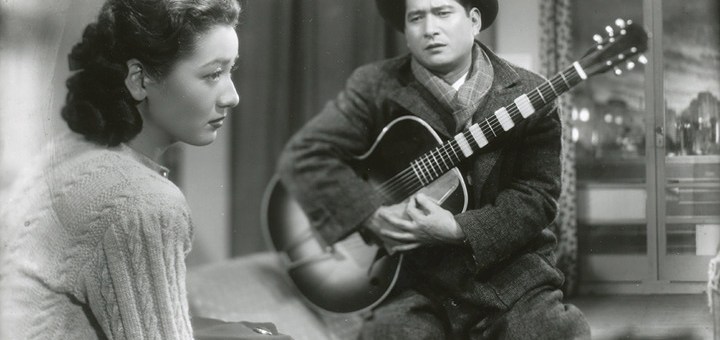
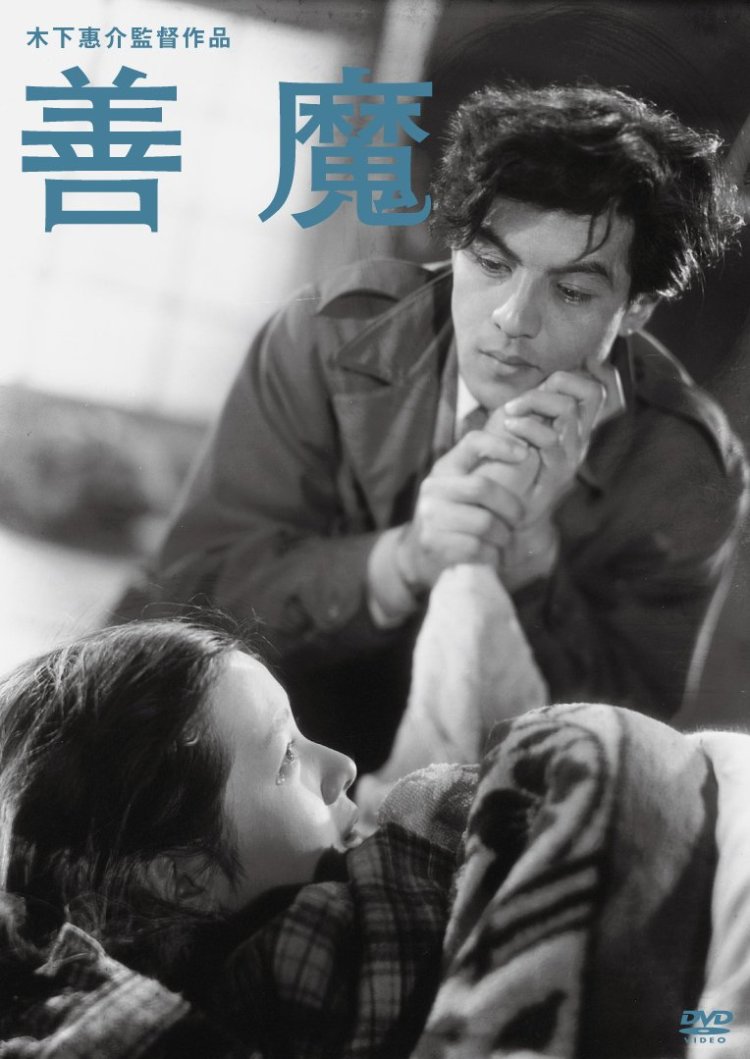
The Good Fairy (善魔, Keisuke Kinoshita, 1951)

Good fairy DVDAlthough one of the more prominent names in post-war cinema, the work of Keisuke Kinoshita has often been out of fashion, derided for its sentimental naivety. It is true to say that Kinoshita values heroes whose essential goodness improves the world around them though that is not to say that he is entirely without sympathy for the conflicted or imperfect even if his equanimity begins to waver with age. 1951’s The Good Fairy (善魔, Zemma), however, working from a script penned not by himself but Kogo Noda and adapted from the novel by Kunio Kishida, seems to turn his life philosophy on its head, wondering whether the tyranny of puritanical goodness is an evil in itself or merely the best weapon against it.

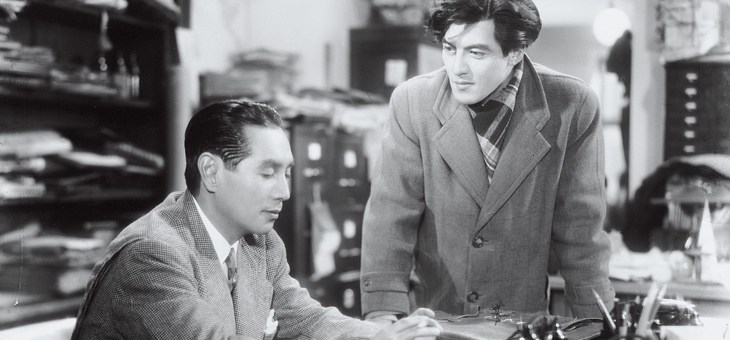
After beginning with a hellish, ominous title sequence set against the flames, the film opens with newspaper editor Nakanuma (Masayuki Mori) getting a hot tip regarding a politician’s wife who seems to have mysteriously disappeared. He hands the assignment to rookie reporter Rentaro Mikuni (played by the actor Rentaro Mikuni who subsequently took his stage name from this his debut role) who specialises in political corruption. Mikuni doesn’t like the assignment. He thinks it’s unethical and whatever happens between a man and his wife is no one’s business, but ends up going to see the politician, Kitaura (Koreya Senda), anyway and instantly dislikes him. Mildly worried by Kitaura’s lack of concern over his wife’s sudden absence, Mikuni stays on the case and visits the wife’s father (Chishu Ryu) up in the mountains where he also meets her sister, Mikako (Yoko Katsuragi), who eventually leads him to the woman herself, Itsuko (Chikage Awashima), who has taken refuge with a friend after becoming disillusioned with her husband’s “vulgar” pursuit of success at the continuing cost of human decency.

To pull back for a second, in any other Kinoshita film, Itsuko would be among the heroes in standing up against her husband’s corrupting influences, but for reasons which will later be explained she lingers on the borders of righteousness owing to having made a mistaken choice in her youth which was, in many ways, defined by the times in which she lived. Nukanuma had not been entirely honest with Mikuni in that he had known and secretly been in love with Itsuko when they were both students but he was poor and diffident and so he never declared himself, his only attempt to hint as his feelings either tragically or wilfully misunderstood. Where Itsuko, who married for money and status as a young woman was expected to do in the pre-war society, has mellowed with age and gained compassionate morality, Nakanuma who became a reporter to fight for justice against the background of fascist oppression has become cynical and selfish. Never having quite forgotten Itsuko, he has been in a casual relationship with a young actress, Suzue (Toshiko Kobayashi), for the last two years never realising that she has really fallen in love with him.

Thinking back on his college relationship with Itsuko, Nakanuma remembers talking with her about unsuccessful romances, that if a man tries his best to make a woman happy but isn’t able to then it must be because she doesn’t love him. Itsuko agrees, adding that men never seem to know what makes a woman happy in love but that friendship is a different matter. She says something similar when she tells him she’s getting married but doesn’t want to lose his friendship, and when he begins floating the idea of marriage hinting that he wants to marry her but perhaps giving the mistaken impression that there’s someone else in stating that it’s sad when a friend marries because the relationship with never be the same again and knowing that he intends to marry she now treasures their friendship even more. In a sense, Nakanuma thinks of Suzue as a “friend” with whom he occasionally sleeps, believing that their relationship is only ever liminal and temporary but mutually beneficial and capable of continuing even if the sexual component had to end.

Having failed once in love, Nakanuma is resolved not to do so again and determined to fight to win Itsuko rather than lose her through cowardice, but to do so he will cruelly wound Suzue who has treated him with nothing other than tenderness. By this time, Mikuni has fallen in chaste, innocent love with Mikako who reminds him of the parts of himself he feels are being erased by his compromising job as part of the mass media machine. Mikuni’s terrifying “goodness” is largely a positive quality which leads him to fight for justice against oppression even within his own organisation but his love for the saintly Mikako only intensifies his moral purity and threatens not only to turn him into an insufferable prig but to create in him a new oppressor, spreading guilt and unhappiness like the self-righteous hero of an Ibsen play.

Early on, following their mild disagreement about journalistic ethics, Mikuni and Nakanuma have dinner together over which they debate the power of the press to bring about social change and hold power to account. Nakanuma says he’s become cynical because hating injustice isn’t enough and there’s nothing that the individual can do against an oppressive system. What he’s telling Mikuni is that he used to be like him, but time has taught him righteousness is not an effective weapon against entrenched social privilege. He recounts a dark story from a Buddhist monk who told him that good can never win over evil because it isn’t strong enough, only evil is strong enough to fight evil and so in order to counter it you will need to affect its weapons. Later, crazed by grief and exhaustion, Mikuni’s “goodness” seems to pulse out of him with ominous supernatural force as he takes Nakanuma to task for his callous treatment of Suzue only for he and Itsuko to come to the conclusion that they’ve heard the voice of “evil” and are now condemned by their past choices to lives of morally pure unhappiness.

This central conundrum seems to contradict Kinoshita’s otherwise open philosophies in its unwelcome rigidity which says that there are no second chances and no possibility of ever moving on from the past with positivity. Itsuko made the “wrong” choice when she was young in choosing to marry for material gain, but she was only making the choice her society expected her to make in the absence of other options – it wasn’t as if she had any reason to wait around for Nakanuma whose regret over his romantic cowardice has made him cold and bitter. She realised her mistake too late and resolved to correct it, but the “Good Fairy” won’t let her, it says she has to pay (for the crimes of an oppressive society) by sacrificing again her chance of happiness in the full knowledge of all she’s giving up. Kinoshita’s films advocate the right to love by will, free of oppressive social codes or obligations but Itsuko is denied a romantic resolution despite having “reformed” herself and made consistently “correct” choices since discovering her husband’s “fraud”. She is denied this largely because of Nakunuma’s failing in being unkind to one who loved him, which is, in a round about way, still her fault for not having realised he loved her and deciding to marry him instead. In fact, the only one who seems to get off scot-free is Kitaura whose fraudulent activities will be covered up on the condition he consent to Itsuko’s divorce petition and sets her fully “free” so she can be fully burdened by the weight of her romantic sacrifice.

In the end, it’s difficult to see a positive outcome which could emerge from all this unhappiness which seems primed only to spread and reproduce itself with potentially disastrous consequences. Mikuni’s purity has become puritanical, unforgiving and rigid, condemning all to a hellish misery from which there can be no escape. The cure is worse than the disease. No one could live like this, and no one should. Goodness, tempered by compassion and understanding, might not be enough to fight the darkness all alone but it might be better to live in the half-light than in the hellish flickering of the fires of righteousness.


Title sequence and opening scene (no subtitles)

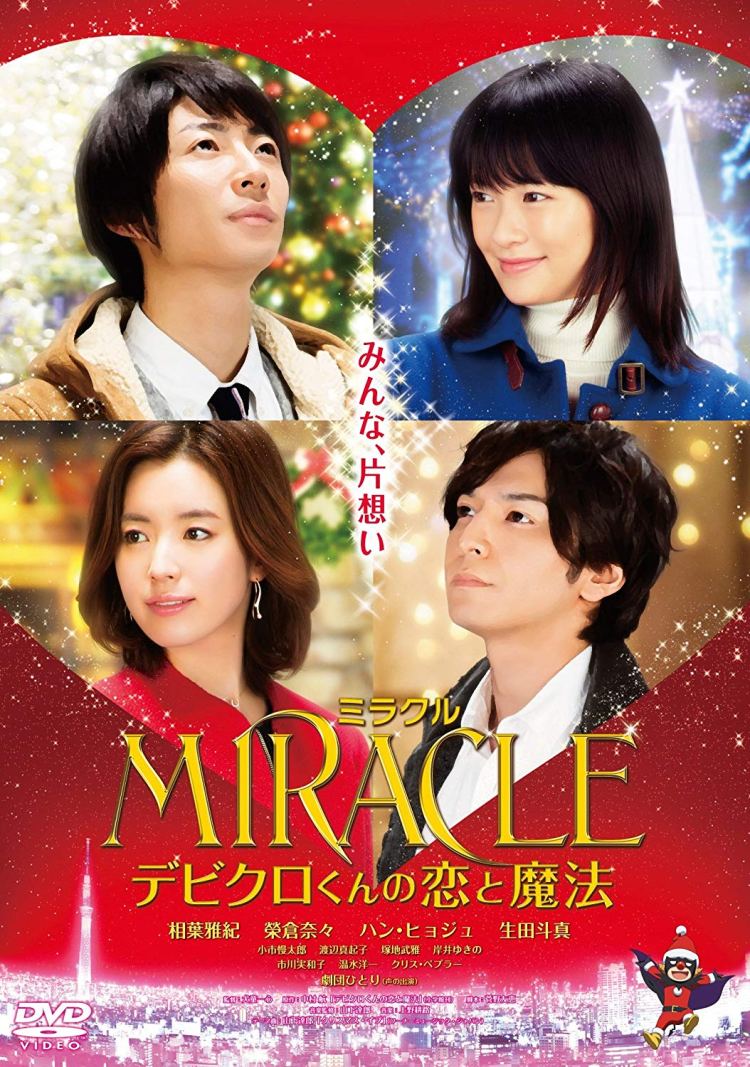
Miracle: Devil Claus’ Love and Magic (MIRACLE デビクロくんの恋と魔法, Isshin Inudo, 2014)

Miarcle devil claus posterChristmas is a time for romance, at least in Japan, but thanks to the magic of the season it can also be confusing. For one nerdy aspiring mangaka at the centre of Isshin Inudo’s Miracle: Devil Claus’ Love and Magic (MIRACLE デビクロくんの恋と魔法, Miracle Devil Claus-kun no Koi to Maho) it’s about to become very confusing indeed as he becomes convinced a prophecy he himself made up when he was a child is actually coming true. Cross-cultural love, lifelong longing, frustrated dreams, and misconstrued realities threaten to derail fated romance but never fear – it is Christmas after all, and even evil Santa has his heart in the right in place as long as anyone is prepared to really listen to him.

Hikaru (Masaki Aiba) and Anna (Nana Eikura) have lived across the street from one another all their lives and been friends as long as either of them can remember. These days, Hikaru is chasing dreams of manga success while working in a bookstore, and Anna is an aspiring artist specialising in large scale metal work. 20 years ago, Hikaru made up the figure of Devil Claus who is the embodiment of Santa’s emotional pain on being forgotten and abandoned for 364 days of the year. Seeing as no darkness can be permitted in the heart of Santa, Devil Claus evolved into his own pixie-like creature and now mostly stars in the cute, inspirational posters Hikaru illegally pastes all over town.

Devil Claus is also a big part of a prophecy Hikaru revealed to himself in which he believed Devil Claus would eventually lead him to the “Goddess of Destiny” who will appear dressed in red with the moon at her back, carrying knowledge of the future and accompanied by a leopard! It is quite a list and so when Hikaru bumps into an extraordinarily beautiful woman wearing a red coat, carrying a wooden leopard in one hand, and a collection of books about “the future” in the other, he comes to the obvious conclusion. In a coincidence worthy of the movies, it just so happens that the woman is Seo-yon (Han Hyo-Joo), a Korean artist in charge of organising a large scale Christmas display which is also the project Anna has been working on.

Predictably enough, Anna has long been in love with the completely clueless yet pure hearted Hikaru. Ironically, Hikaru thinks of Anna as a big sister who has always protected him when he is so obviously unable to stand up for himself, but though she berates him for his lack of backbone she is the one too embarrassed to confess her real feelings and has been patiently waiting for him to finally notice her all her life.

Nevertheless, this particular plot strand takes a strange turn when Anna figures out that Hikaru’s “Goddess of Destiny” is almost certainly Seo-yon. Despite her own feelings she does her best to fulfil Hikaru’s dreams but Inudo frames her behaviour strangely – Anna acts coldly towards Hikaru, while gazing somewhat longingly at Seo-yon who seems to literally sparkle as the sun shines ever behind her. It would be easy to come to the seemingly obvious conclusion that Anna has a different reason for being irritated with Hikaru and his current romantic pre-occupation (why exactly does she already have the book Seo-yon has been wanting before she decides to give it Hikaru to give her?), but the dilemma is later reframed as an inner conflict about her lack of traditional femininity. Yes, Anna’s “manly” dungarees and love of welding might easily play into a stereotype supporting the first conclusion but are actually offered as reasons for feeling underconfident in romance. Just as Hikaru thinks he isn’t good enough for someone so glamorous and accomplished, Anna thinks she isn’t good enough for Hikaru because she can’t measure up to a woman like Seo-yon.

All of that aside, the refreshing message behind Devil Claus is less one of conforming to a social ideal than of learning to regain your self confidence in order to open yourself up to the vulnerability of exposing your true feelings. Hikaru’s romantic and professional rival (not that Hikaru would ever really think of anyone else as an enemy), Kitayama (Toma Ikuta), was one a top rated city trader and now apparently successful mangaka but in a depressive slump over a conflict of artistic integrity. Only by remembering the importance of sincerity and emotional connection can he unlock his creative block by remembering what it is that’s really important. Frothy fun and proud of it, Devil Claus mixes infinitely cute if slightly subversive animation with innocent and pure hearted romance in which the main messages are embracing your authentic self and accepting other people’s. In other words, a perfect Christmas story.


Original trailer (no subtitles)