Bakumatsu Taiyoden (幕末太陽傳, Yuzo Kawashima, 1957)

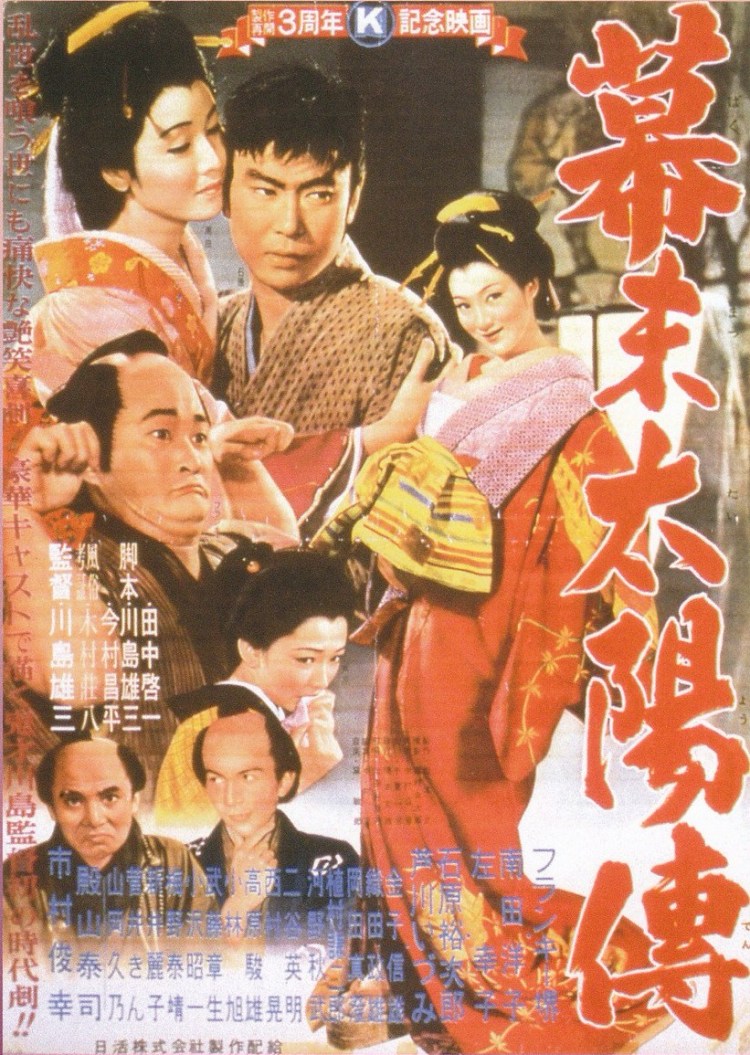
bakumatsu taiyoden posterMany things were changing in the Japan of 1957. In terms of cinema, a short lived series of films known as the “Sun Tribe” movement had provoked widespread social panic about rowdy Westernised youth. Inspired by the novels of Shintaro Ishihara (later a right-leaning mayor of Tokyo), the movement proved so provocative that it had to be halted after three films such was the public outcry at the outrageous depictions of privileged young people indulging in promiscuous sex, drugs, alcohol, and above all total apathy – frivolous lives frittered away on self destructive pleasures. The Sun Tribe movies had perhaps gone too far becoming an easy source of parody, though the studio that engineered them, Nikkatsu, largely continued in a similar vein making stories of youth gone wild their stock in trade.

Yuzo Kawashima, a generation older than the Sun Tribe boys and girls, attempts to subvert the moral outrage by reframing the hysteria as a ribald rakugo story set in the last period of intense cultural crisis – the “Bakumatsu” era, which is to say the period between the great black ships which forcibly re-opened Japan to the outside world, and the fall of the Shogunate. The title, Bakumatsu Taiyoden (幕末太陽傳), literally means “legend of the sun (tribe) in the Bakumatsu era”, and, Kawashima seems to suggest, perhaps things now aren’t really so different from 100 years earlier. Kawashima deliberately casts Nikkatsu’s A-list matinee idols – in particular Yujiro Ishihara (the brother of Shintaro and the face of the movement), but also Akira Kobayashi and familiar supporting face Hideaki Nitani, all actors generally featured in contemporary dramas and rarely in kimono. Rather than the rather stately acting style of the period drama, Kawashima allows his youthful cast to act the way they usually would – post-war youth in the closing days of the shogunate.

They are, however, not quite the main draw. Well known comedian and rakugo performer Frankie Sakai anchors the tale as a genial chancer, a dishonest but kindly man whose roguish charm makes him an endearing (if sometimes infuriating) character. After a post-modern opening depicting contemporary Shinagawa – a faded red light district now on its way out following the introduction of anti-prostitution legislation enacted under the American occupation, Kawashima takes us back to the Shinagawa of 1862 when business was, if not exactly booming, at least ticking along.

Nicknamed “The Grifter”, Saiheiji (Frankie Sakai) has picked up a rare watch dropped by a samurai on his way to plot revolution and retired to a geisha house for a night of debauchery he has no intention of actually paying for. Though he keeps assuring the owners that he will pay “later” when other friends turn up with the money, he is eventually revealed to be a con-man and a charlatan but offers to work off his debt by doing odd jobs around the inn. Strangely enough Saiheiji is actually a cheerful little worker and busily gets on with the job, gradually endearing himself to all at the brothel with his ability for scheming which often gets them out of sticky situations ranging from fake ghosts to customers who won’t leave.

Saiheiji eventually gets himself involved with a shady group of samurai led by Shinshaku Takasugi (Yujiro Ishihara) – a real life figure of the Bakumatsu rebellion. Like their Sun Tribe equivalents these young men are angry about “the humiliating American treaty”, but their anger seems to be imbued with purpose albeit a destructive one as they commit to burning down the recently completed “Foreign Quarter” as an act of protest-cum-terrorism. The Bakumatsu rebels are torn over the best path for future – they’ve seen what happened in China, and they fear a weak Japan will soon be torn up and devoured by European empire builders. Some think rapid Westernisation is the answer – fight fire with fire, others think showing the foreigners who’s boss is a better option (or even just expelling them all so everything goes back to “normal”). America, just as in the contemporary world, is the existential threat to the Japanese notion of Japaneseness – these young samurai are opposed to cultural colonisation, but their great grandchildren have perhaps swung the other way, drunk on new freedoms and bopping away to rock n roll wearing denim and drinking Coca Cola. They too resent American imperialism (increasingly as history would prove), but their rebellions lack focus or intent, their anger without purpose or aim.

Kawashima’s opening crawl directly references the anti-prostitution law enacted by the American occupying forces – an imposition of Western notions of “morality” onto “traditional” Japanese culture. In a round about way, the film suggests that all of this youthful rebellion is perhaps provoked by the sexual frustration of young men now that the safe and legal sex trade is no longer available to them – echoing the often used defence of the sex trade that it keeps “decent” women, and society at large, safe. Then again, the sex trade of the Bakumatsu era is as unpleasant as it’s always been even if the familiar enough problems are played for laughs – the warring geisha, the prostitute driven in desperation to double suicide, the young woman about to be sold into prostitution against her will in payment of an irresponsible father’s debt, etc. One geisha has signed engagement promises with almost all her clients – it keeps the punters happy and most of them are meaningless anyway. As she says, deception is her business – whatever the men might say about it, it’s a game they are willingly playing, buying affection and then seeming hurt to realise that affection is necessarily false and conditional on payment of the bill.   

Playing it for laughs is, however, Kawashima’s main aim – asking small questions with a wry smile as Saiheiji goes about his shady schemes with a cleverness that’s more cheeky than malicious. He warns people they shouldn’t trust him, but in the end they always can because despite his shady surface his heart is in the right place. Warned he’ll go to hell if he keeps on lying his way though life, Saiheiji laughs, exclaims to hell with that – he’s his own life to live, and so he gleefully runs away from the Bakumatsu chaos into the unseen future.


Masters of Cinema release trailer (English subtitles)

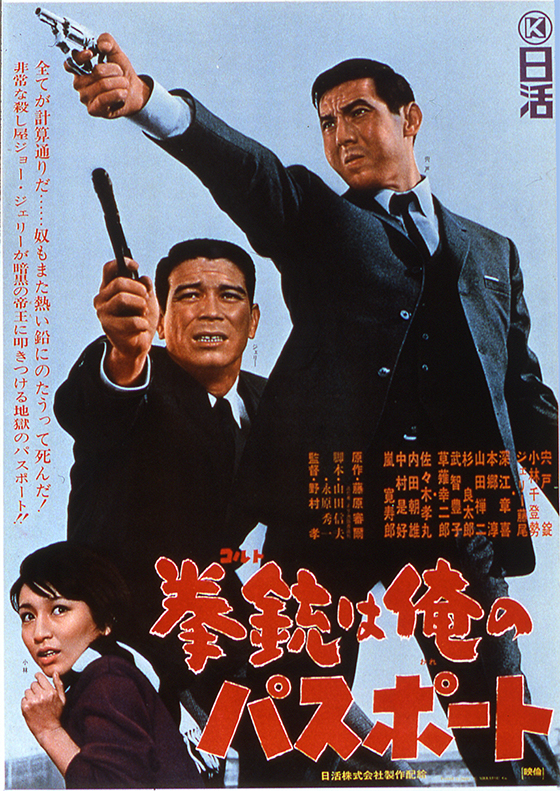
A Colt is My Passport (拳銃は俺のパスポート, Takashi Nomura, 1967)

colt is my passport posterJo Shishido played his fare share of icy hitmen, but they rarely made it through such seemingly inexorable events as the hero of Takashi Nomura’s A Colt is My Passport (拳銃は俺のパスポート, Colt wa Ore no Passport). The actor, known for his boyishly chubby face puffed up with the aid of cheek implants, floated around the lower end of Nikkatsu’s A-list but by 1967 his star was on the wane even if he still had his pick of cooler than cool tough guys in Nikkatsu’s trademark action B-movies. Mixing western and film noir, A Colt is My Passport makes a virtue of Japan’s fast moving development, heartily embracing the convenience of a society built around the idea of disposability whilst accepting the need to keep one step ahead of the rubbish truck else it swallow you whole.

Kamimura (Joe Shishido) and his buddy Shiozaki (Jerry Fujio) are on course to knock off a gang boss’ rival and then get the hell out of Japan. Kamimura, however, is a sarcastic wiseguy and so his strange sense of humour dictates that he off the guy while the mob boss he’s working for is sitting right next to him. This doesn’t go down well, and the guys’ planned airport escape is soon off the cards leaving them to take refuge in a yakuza safe house until the whole thing blows over. Blowing over, however, is something that seems unlikely and Kamimura is soon left with the responsibility of saving both his brother-in-arms Shiozaki, and the melancholy inn girl (Chitose Kobayashi) with a heart of gold who yearns for an escape from her dead end existence but finds only inertia and disappointment.

The young protege seems surprised when Kamimura tosses the expensive looking rifle he’s just used on a job into a suitcase which he then tosses into a car which is about to be tossed into a crusher, but Kamimura advises him that if you want to make it in this business, you’d best not become too fond of your tools. Kamimura is, however, a tool himself and only too aware how disposable he might be to the hands that have made use of him. He conducts his missions with the utmost efficiency, and when something goes wrong, he deals with that too.

Efficient as he is, there is one thing that is not disposable to Kamimura and that is Shiozaki. The younger man appears not to have much to do but Kamimura keeps him around anyway with Shiozaki trailing around after him respectfully. More liability than anything else, Kamimura frequently knocks Shiozaki out to keep him out of trouble – especially as he can see Shiozaki might be tempted to leap into the fray on his behalf. Kamimura has no time for feeling, no taste for factoring attachment into his carefully constructed plans, but where Shiozaki is concerned, sentimentality wins the day.

Mina, a melancholy maid at a dockside inn, marvels at the degree of Kamimura’s devotion, wishing that she too could have the kind of friendship these men have with each other. A runaway from the sea, Mina has been trapped on the docks all her adult life. Like many a Nikkatsu heroine, love was her path to escape but an encounter with a shady gangster who continues to haunt her life put paid to that. The boats come and go but Mina stays on shore. Kamimura might be her ticket out but he wastes no time disillusioning her about his lack of interest in becoming her saviour (even if he’s not ungrateful for her assistance and also realises she’s quite an asset in his quest to ensure the survival of his ally).

Pure hardboiled, A Colt is My Passport is a crime story which rejects the femme fatal in favour of the intense relationship between its two protagonists whose friendship transcends brotherhood but never disrupts the methodical poise of the always prepared Kamimura. The minor distraction of a fly in the mud perhaps reminds him of his mortality, his smallness, the fact that he is essentially “disposable” and will one day become a mere vessel for this tiny, quite irritating creature but if he has a moment of introspection it is short lived. The world may be crunching at his heels, but Kamimura keeps moving. He has his plan, audacious as it is. He will save his buddy, and perhaps he doesn’t care too much if he survives or not, but he will not go down easy and if the world wants a bite out of him, it will have to be fast or lucky.


Original trailer (no subtitles)

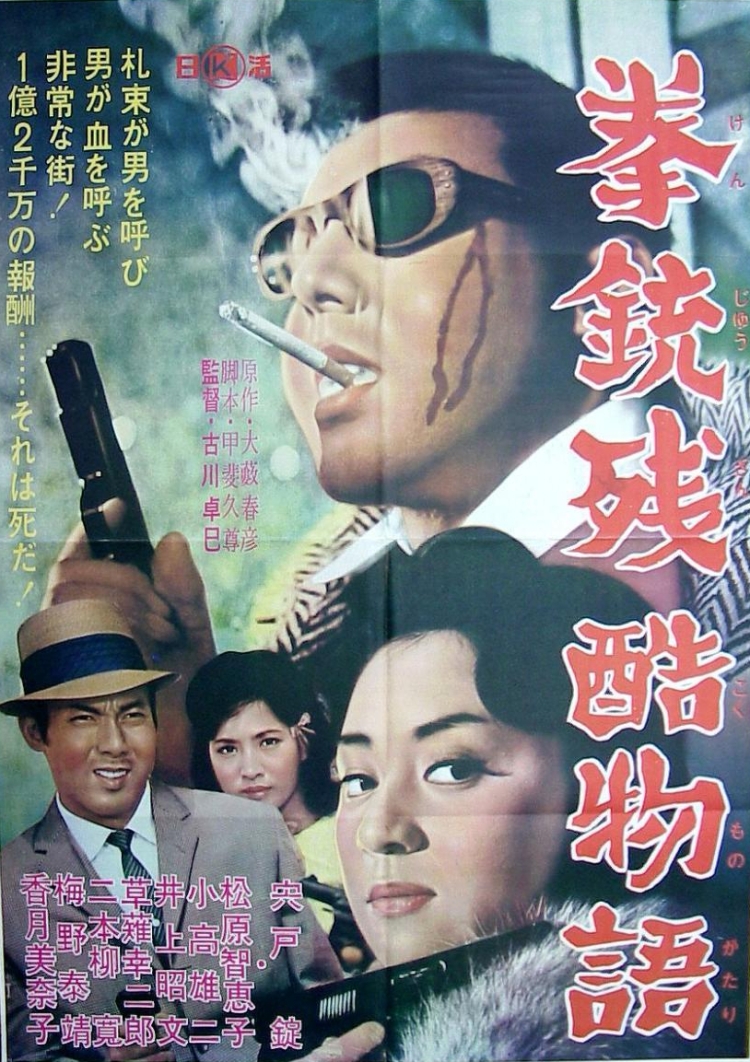
Cruel Gun Story (拳銃残酷物語, Takumi Furukawa, 1964)

cruel-gun-story-poster.jpgIn the history of Japanese noir, the name Haruhiko Oyabu looms large. Oyabu’s gritty, pulp infused tales of tough guy heroes found their clearest expression in the hardline ‘70s with Toru Murakawa’s unique brand of macho action as seen in Resurrection of the Golden Wolf or The Beast Must Die, but a decade earlier they were also finding fertile ground in Nikkatsu’s harder B-movie noir. Based on a novel by Oyabu, Cruel Gun Story (拳銃残酷物語, Kenju Zankoku Monogatari) seems to owe more than a little to Kubrick’s The Killing in its crime never pays tale of honest crooks undercut by their unscrupulous comrades but the central message is that the gun is a cruel master and those living under its control will pay a heavy price.

Togawa (Jo Shishido) has just been (unexpectedly) given early release from a prison sentence incurred when he took revenge on the truck driver who knocked down his little sister (Chieko Matsubara) and confined her to a wheelchair for the rest of her life. Middle rank gangster Ito – formerly a crooked lawyer with a pencil mustache a supercilious air, has a job for him the gang thinks only he can do. The payout is 120 million yen – not to be sniffed at, but Togawa has reasons to be suspicious. He takes some convincing but finally relents when he finds out an old and trusted friend, Shirai (Yuji Kodaka), has already agreed. The gang have another three guys lined up but Togawa rules the third one out when he tests him and confirms he’s an untrustworthy blabbermouth. The other two are a former boxer with mild brain damage whose girlfriend has just left him, and an unscrupulous but clever chancer named Teramoto (Kojiro Kusanagi).

Following the general pattern, Furukawa walks us through the heist as it’s supposed to go if everything goes to plan complete with a 3D diagram and plastic toy cars but, of course, not everything goes to plan. The job is to steal the ticket money from the Japan Derby (much like the race course robbery in The Killing). The gang will set up fake road signs and station a “policeman” to divert the armoured car onto a small country lane where they will kill the police motorcycle escort, get rid of the guards, and load the truck onto a bigger lorry that they will then take to a disused US airbase they’ll use as their lair.

Disused American airbase could easily apply to the entirety of the surrounding area. Jets fly ominously overhead while the world Togawa and his guys inhabit is one of noirish jazz bars filled with foreigners, grimy boxing clubs, signs in English and the relics of destruction everywhere. This is a place for those who’ve already fallen through the cracks, even the gangsters are only really small fry – not yakuza but hoodlums ripped straight from the Edward G. Robinson playbook. This giant heist is the most audacious in living memory, pulling it off would be the finest achievement any of them would ever make, taking them out of their dead end environments and catapulting them into the criminal high life.

Togawa knows there’s something not right about this – he almost turns it down because he wants to be around to take care of his sister, but he also wants the money to pay for an operation he hopes will restore her mobility to assuage his guilt over having sent her out on the fateful day she was injured. Rie now lives in the care of kindly nuns and is a goodhearted, religious woman hoping for her big brother’s reformation. Togawa and his sister are also victims of war having lost their parents during the evacuation from Manchuria and have been essentially on their own ever since. Rie has become a living symbol of Togawa’s failures – his inability to protect her, to keep them both safe and together, and to free them of the ruined post-war landscape within which they both remain trapped. Rie pins her hopes on God, but Togawa says to hell with that – where has He been so far?

Having pinned his hopes on the gun, Togawa intends this to be the heist to end all heists. After this, he’ll be free to give his sister the life she deserves away from crime and the rundown town strewn with mementos of a distant, dethroned occupying power. The gun, however, is a divisive weapon and engenders nothing but mistrust among men. Resentful of Togawa’s solid friendships, the other guys turn on him as do his shady employers sending Togawa even further along the dark path to moral ruination than he already was. All that’s waiting for Togawa is a hollow victory and the intense disappointment of those whose faith in him was ultimately misplaced.


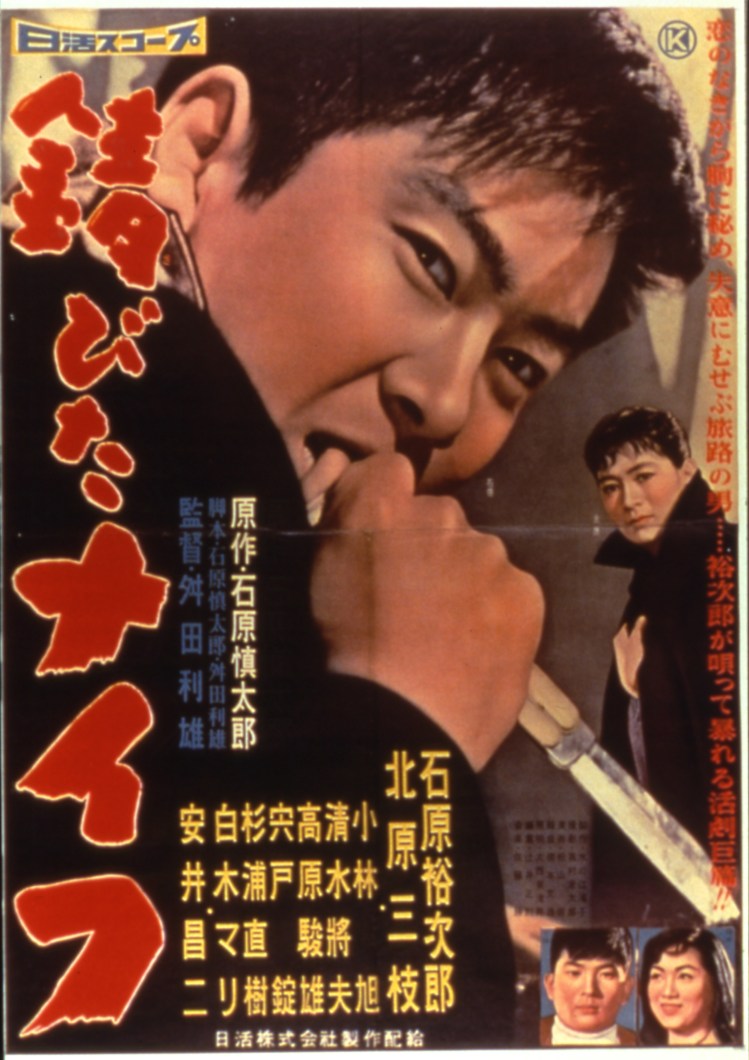
Rusty Knife (錆びたナイフ, Toshio Masuda, 1958)

rusty knife posterPost-war Japan was in a precarious place but by the mid-1950s, things were beginning to pick up. Unfortunately, this involved picking up a few bad habits too – namely, crime. The yakuza, as far as the movies went, were largely a pre-war affair – noble gangsters who had inherited the codes of samurai honour and were (nominally) committed to protecting the little guy. The first of many collaborations between up and coming director Toshio Masuda and the poster boy for alienated youth, Yujiro Ishihara, Rusty Knife (錆びたナイフ, Sabita Knife) shows us the other kind of movie mobster – the one that would stick for years to come. These petty thugs have no honour and are symptomatic parasites of Japan’s rapidly recovering economy, subverting the desperation of the immediate post-war era and turning it into a nihilistic struggle for total freedom from both laws and morals.

Public support is, largely, behind this new force of order as seen in the local uproar when top gangster Katsumata (Naoki Sugiura) is arrested in connection with an assault. Things being what they are, Katsumata is soon released to laugh at law enforcement from a safe distance but the past is coming for him. Some years ago Katsumata killed a local councillor, Nishida (Ikunosuke Koizumi), and made it look like suicide but three guys from a local gang saw him do it. He paid them to keep quiet, but now one of them feels like talking and thinks Katsumata might like to pay a little more to reseal the deal.

Chatty Tokyo thug Shima (Jo Shishido) gets pushed off a train for his pains but Katsumata is worried enough about the other two to send his guys out to make some enquires. He’s particularly worried about Tachibana (Yujiro Ishihara) – a “sleeping lion”, Tachibana is a hot head who’s now gone straight after coming out of jail for murdering a guy he thought was a direct cause of his girlfriend’s death. Luckily enough, Tachibana now runs a bar where he employs the other witness, Terada (Akira Kobayashi), to whom he acts as a stern big brother hoping to keep them both on the straight and narrow. Tachibana is unlikely to talk, he wants out of the gangster world for good, but Terada is young and ambitious with a girlfriend to impress. He takes more hush money from Katsumata, not realising what he’s getting himself into, and then lets it go to his head.

Tachibana is the rusty knife of the title. After letting his rage consume him in murdering a petty mobster in revenge for the rape of his girlfriend who later committed suicide, Tachibana has vowed to quell his anger and live a decent, peaceful life. Angry outbursts are, however, never far from the surface and following recent revelations, a rusty knife may find its cutting edge once again.

Keiko (Mie Kitahara), a customer at Tachibana’s bar, is making a documentary about violence in the city which coincidentally turns up a few clues as to Tachibana’s past, not to mention her own. The daughter of the murdered councilman, Nishida, and the niece of another powerful politician, Keiko is a figure of righteousness, charting her own course through the difficult post-war world and attempting to do so with dignity and elegance while refusing to abandon her sense of decency and compassion. Later a real life married couple, Kitahara and Ishihara were a frequent on screen romantic pairing though this time around the connection is more subtle as Keiko begins to sympathise with Tachibana’s plight and commits herself to saving him from destroying himself in becoming consumed by his barely suppressed rage.

Tachibana is indeed raging, though his rage is understandable. As someone later puts it “nothing in this city makes sense”. The systems are corrupt, the wartime generation continue to run the show and run it badly, or at least for their own ends, robbing youth of its rightful place at the forefront of economic recovery. Yet even if Ishihara is a symbol of youthful alienation, his rage is one which must be quelled. Even in this city where nothing makes sense, self control is one’s greatest weapon. If youth is to walk forward into the exciting post-war future, it will have to drop its rusty knives.


Original trailer (English subtitles)

Youth of the Beast (野獣の青春, Seijun Suzuki, 1963)

youth of the beast posterSeijun Suzuki had been directing for seven years and had made almost 20 films by the time he got to 1963’s Youth of the Beast (野獣の青春, Yaju no Seishun). Despite his fairly well established career as a director, Youth of the Beast is often though to be Suzuki’s breakthrough – the first of many films displaying a recognisable style that would continue at least until the end of his days at Nikkatsu when that same style got him fired. Building on the frenetic, cartoonish noir of Detective Bureau 2-3: Go to Hell Bastards!, Suzuki once again casts Jo Shishido in the the lead only this time as an even more ambiguous figure playing double agent to engineer a gang war between two rival hoodlums.

Suzuki opens in black and white as the bodies of a man and a woman are discovered by a small team of policemen. Finding a note from the deceased female which states that she settled on taking her own life because she loved her man and thought death was the only way to keep him, the police assume it’s an ordinary double suicide or perhaps murder/suicide but either way not worthy of much more attention, though discovering a policeman’s warrant card on the nightstand does give them pause for thought.

Meanwhile, across town, cool as ice petty thug Jo Mizuno (Jo Shishido) is making trouble at a hostess bar but when he’s taken to see the boss, it transpires he was really just making an audition. The Nomoto gang take him in, but Mizuno uses his new found gang member status to make another deal with a rival organisation, the Sanko gang, to inform on all the goings on at Nomoto. So, what is Mizuno really up to?

As might be expected, that all goes back to the first scene of crime and some suicides that weren’t really suicides. Mizuno had a connection with the deceased cop, Takeshita (Ichiro Kijima), and feels he owes him something. For that reason he’s poking around in the local gang scene which is, ordinarily, not the sort of world straight laced policeman Takeshita operated in which makes his death next to a supposed office worker also thought to be a high class call girl all the stranger.

Like Detective Bureau 2-3: Go to Hell Bastards!, Youth of the Beast takes place in a thoroughly noirish world as Mizuno sinks ever deeper into the underbelly trying to find out what exactly happened to Takeshita. Also like Detective Bureau 2-3: Go to Hell Bastards!, Youth of the Beast is based on a novel by Haruhiko Oyabu – a pioneer of Japanese hardboiled whose work provided fertile ground for many ‘70s action classics such as The Beast Must Die and Resurrection of the Golden Wolf, but Suzuki’s ideas of noir owe a considerable debt to the gangster movies of the ‘30s rather than the moody crime dramas of twenty years later.

Jo Shishido’s Mizuno is a fairly typical ‘40s conflicted investigator, well aware of his own flaws and those of the world he lives in but determined to find the truth and set things right. The bad guys are a collection of eccentrics who have more in common with tommy gun toting prohibition defiers than real life yakuza and behave like cartoon villains, throwing sticks of dynamite into moving cars and driving off in hilarious laughter. Top guy Nomoto (Akiji Kobayashi) wears nerdy horn-rimmed glasses that make him look like an irritated accountant and carries round a fluffy cat he likes to wipe his knives on while his brother Hideo (Tamio Kawaji), the fixer, is a gay guy with a razor fetish who likes to carve up anyone who says mean stuff about his mum. The Sanko gang, by contrast, operate out of a Nikkatsu cinema with a series of Japanese and American films playing on the large screen behind their office.

The narrative in play may be generic (at least in retrospect) but Suzuki does his best to disrupt it as Mizuno plays the two sides against each other and is often left hiding in corners to see which side he’s going to have to pretend to be on get out of this one alive. Experimenting with colour as well as with form, Suzuki progresses from the madcap world of Detective Bureau 2-3: Go to Hell Bastards! to something weightier but maintains his essentially ironic world view for an absurd journey into the mild gloom of the nicer end of the Tokyo gangland scene.


Original trailer (no subtitles)

https://www.youtube.com/watch?v=RoruaIPA41U

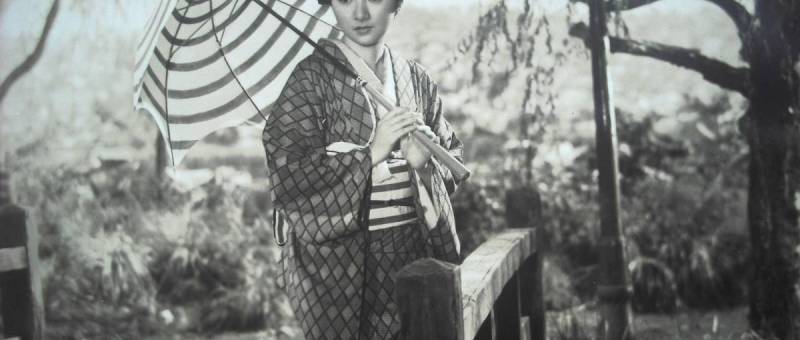
Wild Geese (雁, AKA The Mistress, Shiro Toyoda, 1953)

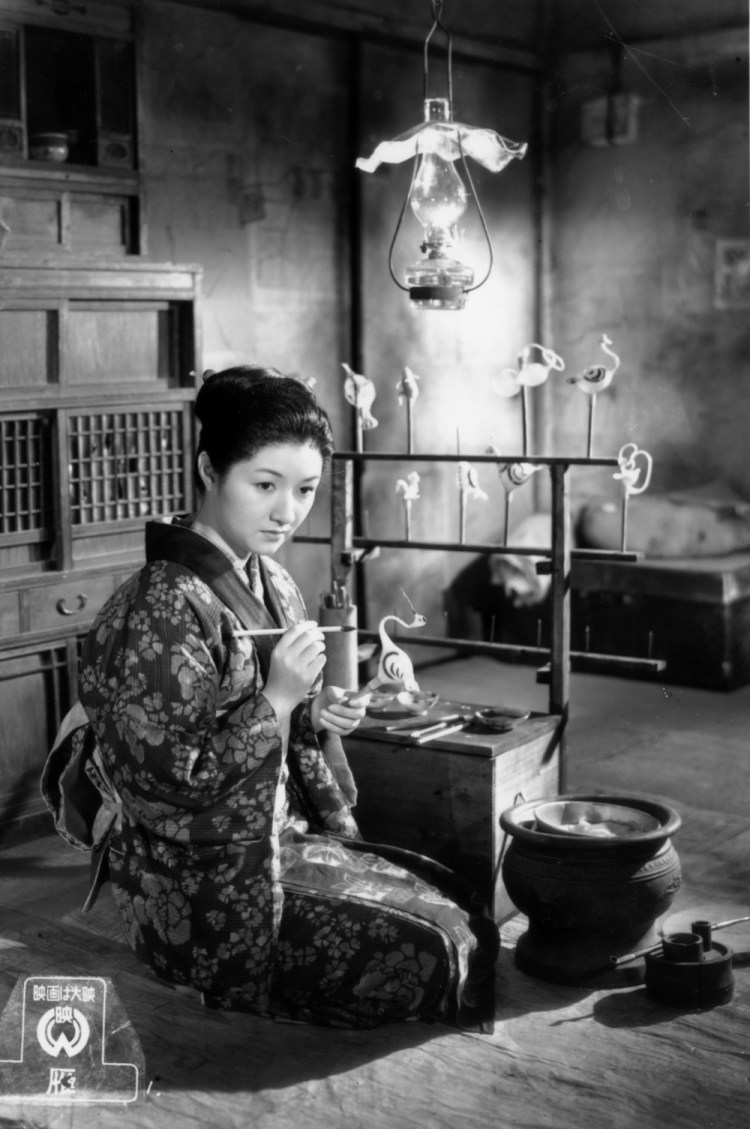
(C) Daiei, 1953In the extreme turbulence of the immediate post-war period, it’s not surprising that Japan looked back to the last time it was confronted with such confusion and upheaval for clues as to how to move forward from its current state of shocked inertia. The heroine of Shiro Toyoda’s adaptation of the Ogai Mori novel, Wild Geese (雁, Gan, AKA The Mistress), finds herself at a similar crossroads to the women of the 1950s, caught between tradition and modernity as they embrace the new freedoms but remain constrained by a conservative society. Toyoda, well known for his adaptations of great literature, makes a few key changes to Mori’s novel in effect placing a Showa era heroine in a recognisably “Meiji” world.

The Japan of the 1880s is one of extreme contrast and rapidly unfolding modernity. Having finally opened its doors to the outside world, the nation is in a big hurry to “catch up” to those it sees as its equals on the world stage. Consequently, Western thoughts and values are flooding into the country, bringing both good and ill. Arranged marriages are still common and Otama (Hideko Takamine) has been married once but the marriage has failed – she was deceived, the man she married already had a wife and child. Still, having lived with a man as his wife, Otama is considered “damaged” goods and will find it difficult to make a good match in the future (especially given the whiff of scandal from being involved in an illegitimate marriage with a bigamist).

When a matchmaker (Choko Iida) arrives with a potential husband it proves hard to turn down but the matchmaker is not quite on the level. Suezo (Eijiro Tono), she says, is a recently widowed man with a young child who is in need of a new wife but cannot marry again immediately for propriety’s sake. Otama will be his mistress and then in due course his wife. However, the matchmaker is an unscrupulous woman who has spun Otama a yarn in the hope of getting her debt written off by getting the shady loanshark she owes money to a pretty young woman to have some fun with.

The position Otama finds herself in is one of impossibility. A woman cannot survive alone in the Meiji era and its lingering concessions to feudalism. For a woman as poor and lowly as Otama whose marriage prospects are slim there are few options available. Otama’s neighbour (Kuniko Miyake) has managed to carve out a life for herself as a single woman through teaching sewing classes but such opportunities are few and far between, as Otama is warned when she considers following her example. The “arrangement” with Suezo may not seem too bad on the surface – he looks after her and her father, has set her up in a house, and treats her well even if his behaviour leans toward the possessive. Despite confessing to her father that she feels trapped and miserable, humiliated on learning she has been ostracised as the mistress of a married loanshark, Otama finds little sympathy as her father declares himself “very happy” and councils her against leaving because he has no desire to return to a life of poverty, remaining selfishly indifferent to his daughter’s suffering.

Resigned to her fate, Otama does her best to adapt to her new life but remains as trapped within Suezo’s house as the caged bird he presents her with “for company”. Jealous and fearing that his wife will find out about the affair, Suezo’s preference is for Otama to stay indoors waiting for him to call. His visits are routine and perfunctory. Handing the maid a few coins to go to the public bath, Suezo signals his intentions in the least romantic of ways, pausing only to lock the garden gate.

Catching sight of an earnest student who passes by everyday at 4, Otama begins to dream of something better. The student, Okada (Hiroshi Akutagawa), is a source of fascination for all the young women in the neighbourhood but he too is instantly captivated when he glimpses the beautiful Otama trapped behind the bar-like slats of Suzeo’s love nest. Adding a touch of biblical intrigue, it is a snake which eventually leads to their meeting but no matter how deep the connection this is a love destined to fail – Otama is the kept woman of a loanshark, and Okada is a medical student with international ambitions. They inhabit different worlds and, as his friend (Jukichi Uno) puts it, this is still the Meiji era, the times will not allow it.

Nevertheless, even if her brief infatuation seems doomed, the mere act of wanting something else provokes a shift in Otama’s way of thinking. This act of fierce individualism which prompts her to defy the dominant male forces in her life whose selfish choices have caused her nothing but misery would normally be severely punished in the name of preserving social harmony but Otama’s epiphany is different. The opening title card reminded us that this was a time wild geese still flew in the skies above Tokyo. It seems to imply that birds no longer fly here, that there is no true freedom or possibility for flight in the modern age of Showa, but Otama is a woman trapped in the cage of Meiji suddenly realising that the doors have been open all along. Her choices amount to a humiliating yet materially comfortable life of subjugation, or the path of individualistic freedom in embracing her true desires. Her dream of true love rescue may have been shattered, but Otama’s heart, at least, is finally free from the twin cages of social and patriarchal oppression.


Screened at BFI as part of the Women in Japanese Melodrama season.

Kokoro (こころ, Kon Ichikawa, 1955)

kokoro coverAmong the most well-regarded of his works, Natsume Soseki’s Kokoro (こころ) is a deeply felt mediation on guilt, repression, atonement, and despair as well as an examination of life on a temporal threshold. Kon Ichikawa’s long career would be marked by literary adaptations both of classics and genre fiction but even among these Kokoro is something of an exception, marshalling all of his skills bar his trademark irony in a melancholy tale of loneliness, self loathing, and the destructive effects self-destruction on those caught in the cross fire.

Ichikawa opens in media res as Nobuchi (Masayuki Mori) and his wife, Shizu (Michiyo Aratama), appear to have had an argument. She darns angrily while he paces and eventually seems to relent on his decision not to let her accompany him to the grave of a mutual friend, Kaji (Tatsuya Mihashi), who died when Nobuchi was still a student. Eventually Nobuchi goes alone but is disturbed in the graveyard by the approach of an enthusiastic young university student, Hioki (Shoji Yasui), who has been redirected by Shizu after turning up to ask to borrow some books. Nobuchi is not really in the mood to talk but the two men chat, eventually sharing a drink together in the local bar before Nobuchi abruptly returns home, pausing only to invite Hioki to visit another time for the books he wanted to borrow.

Though the marriage of Nobuchi and Shizu may seem to be a model one, their lives together are mostly performance. Nobuchi is a melancholy, gloomy man who does not work and lives the life of a scholar, living off family money. The household is not wealthy but they are able to afford one maid and live in reasonable comfort. They have no children and, it seems, the marriage may be one of companionship rather than passion.

On their first meeting Nobuchi refuses to tell Hioki the reason why he is the way he is, but decides he must explain and that Hioki is the only person he can unburden himself to. Badly let down by those who should have had his best interests at heart at a young age, Nobuchi has learned not to trust, believes that love is a “sin”, and that he is unworthy of any kind of personal happiness or fulfilment. As a young man, Nobuchi did something completely unforgivable for the most selfish (and fiendishly complicated) of reasons and his best friend, Kaji, later died as a direct result.

Where Nobuchi is cynical, Kaji is ascetic and closed off but sincere in his Buddhist practice. Nobuchi’s actions are not only hurtful in their deliberate betrayal, but amount to a slow implosion of Kaji’s entire spiritual universe. Having been tempted away from his religious beliefs by irrepressible desire, Kaji’s path to spiritual fulfilment has been severed and his path to other kinds of happiness blocked by Nobuchi’s own panicked act of personal betrayal. Unable to reconcile his cowardly, cruel actions which have, in a sense, broken Kaji’s “heart”, Nobuchi resolves to deny himself the life he stole from his friend, committing himself to a living death defined by the absence of physical love, desire, or success.

Hioki first meets Nobuchi when he sees him attempt to walk into the sea and saves him from drowning. Immediately drawn to him, Hioki believes he and the man he calls “sensei” share the same kind of existential loneliness. His eagerness to forge a friendship with the older, aloof scholar may seem strange but Ichikawa is keen to build on a much disputed subtext of the original novel in Nobuchi’s possible repressed homosexuality. Hioki steps into the space vacated by Kaji which has been empty the last 15 years as the sort of man who might understand Nobuchi’s “heart”.

Shizu attempts to ask the question directly, both about Nobuchi’s relationship with Kaji whose name she is forbidden to mention and to new friend Hioki whom she fears maybe taking Kaji’s place in her husband’s affections. Pleading that she just wants to understand his “heart”, Shizu tries to get some clarification on the empty hell that is her married life, but Nobuchi’s heart is firmly closed to her and she’s shut out once again.

On hearing of the death of the Emperor Meiji, Nobuchi’s gloom descends still further as he feels himself to be a man who’s outlived his age. At one point, long before, he pushes Kaji on his spiritual weaknesses prompting him to admit he doesn’t know whether to go forward or back. Nobuchi, cynical and perceptive, points out that there likely is no back even if you wanted to go there. Taking the teacher/student relationship to its natural conclusion, Nobuchi’s final testament in which he confesses the circumstances which have led to his spiritual death is intended only for Hioki in the hope that the younger man can learn from his mistakes and prepare himself to step forward into the bright new age where Nobuchi fears to tread. Once again his actions are selfish in the extreme, but there is something universally understood in Nobuchi’s particular pain and the steps he takes to ease it.


Previously available on DVD from Eureka, now sadly OOP.

Scene from midway through the film

https://www.youtube.com/watch?v=9piqtmNzFZY

Danger Pays (危いことなら銭になる, Ko Nakahira, 1962)

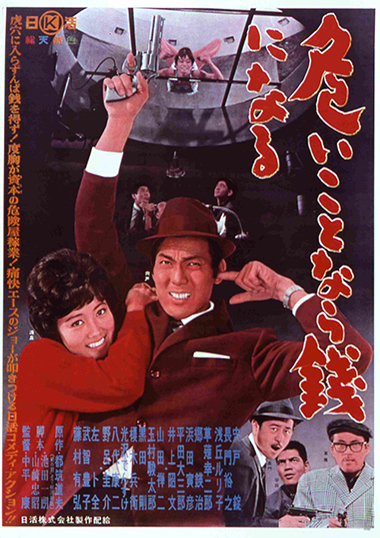
Danger PaysWhere there’s danger, there’s money! Or, maybe just danger, who knows but whatever it is, it certainly doesn’t lack for excitement. Ko Nakahira is best known for his first feature, Crazed Fruit, the youthful romantic drama ending in speed boat murder which ushered in the Sun Tribe era. Though he later tried to make a return to more artistic efforts, it’s Nakahira’s freewheeling Nikkatsu crime movies that have continued to capture the hearts of audience members. Danger Pays (AKA Danger Paws, 危いことなら銭になる, Yabai Koto Nara Zeni ni Naru) is among the best of them with its cartoon-like, absurd crime caper world filled with bumbling crooks and ridiculous setups.
The central plot gets going when a truck carrying watermarked paper destined for the mint is hijacked with force by armed thugs. They need a master forger though so they set out to recruit one of the best counterfeiters currently working on his way back from a business trip to Hong Kong. However, three petty crooks have also gotten wind of the scam and are trying to head off their rivals by kidnapping the old grandpa first.

The three guys are “Glass Hearted Joe” – a purple suited dandy with an aversion to the sound of scraping glass, Slide Rule Tetsu who walks with a cane and is a whizz with the abacus, and Dump-Truck Ken who’s a geeky sort of guy who also owns a dumper truck. Sakamoto, the forger, eludes their grasp when the better equipped professionals turn up, but none of them is willing to give up on the prize. A little later, Joe teams up with a female ally – Tomoko, who is keen martial artist and smarter than the other three put together. Eventually the four end up becoming an accidental team though it remains to be seen if they can really turn this increasingly desperate situation to their advantage.

Danger Pays is in no way “serious” though this is far from a criticism. Armed with a killer script filled with amazing one liners which are performed with excellent comic timing by the A-list cast, Danger Pays is the kind of effortlessly cool, often hilarious crime caper which is near impossible to pull-off but absolutely sublime when it works – which Danger Pays most definitely does. Though there is a large amount of death and bloodiness in the final third, the atmosphere remains cartoonish as our intrepid team of four simply step over the bodies to go claim their prize with only one of them left feeling a little queasy.

Nakahira maintains the high octane, almost breathless pace right through to the end. The finale kicks in with our heroes trying to escape from a locked room which is about to be filled with gas only to be trapped like rats in an elevator shaft where they engage in an improbable shootout whilst bodies rain down on them from above bathed in the red emergency light of the escape vaults. This is a hardboiled world but one cycled through cigar munching wise guys and tommy guns, it’s all fun and games until you’re trapped in a lift knee deep in corpses while blood drips from a couple more dead guys on the ceiling.

Ridiculous slapstick humour and broad comedy are the cornerstones of Danger Pays though it also makes its central crime conceit work on its own only to overturn it with a final revelation even as the credits roll. Excellently played by its four leads, this comic tale of “victimless crime” in the improbably colourful underworld of ‘60s Tokyo is one which is filled with absurd humour, cartoon stunts, and ridiculous characters but proves absolutely irresistible! If only modern day crime capers were this much fun.


Danger Pays is the second of three films included in the second volume of Arrow’s Nikkatsu Diamond Guys box set.

Outlaw: Gangster VIP 2 (大幹部 無頼, Keiichi Ozawa, 1968)

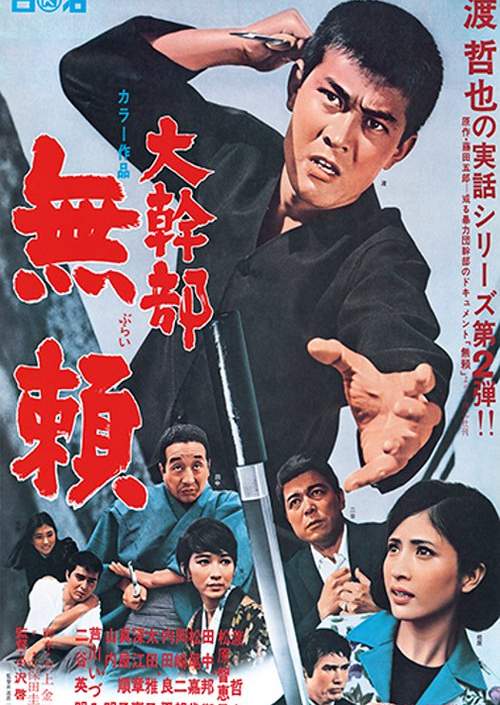
Outlaw Gangster VIP 2So, as it turns out the end of Outlaw: Gangster VIP was not quite as final as it might have seemed. Outlaw Gangster VIP 2 (大幹部 無頼, Daikanbu Burai) picks up not long after the end of the first film when Goro (Tetsuya Watari), having recovered from his injuries, takes a train to go and find Yukiko (Chieko Matsubara) with the intention of starting an honest life with her away from the temptations of the big city. However, as often happens, his past follows him.

Like the first film, Outlaw: Gangster VIP 2 also begins with a black and white flashback sequence reminding us of Goro’s childhood only this time with a voice over from Goro himself who goes on to include the first film’s events in his recap. Goro might have come to the country to get away from the gangster life but as soon as he steps off the train he gets himself into trouble with a local gang by interfering with a few tough guys who are trying to entrap a group of actresses and force them into their employ. One of the leading actresses is just as taken with Goro as Yukiko was in the first film and gives him her red scarf as a thank you. Goro is still very much with Yukiko though and trudges off through the snow to find her.

She and Yumeko, Sugimoto’s former girlfriend, are living in a small hut but Yumeko has fallen ill and is refusing to see a doctor out of fear of the expense. Goro gets a legitimate logging job but before long the company hits trouble and he’s let go. All the while Yumeko’s condition is weakening and the three are in desperate need of money. One of the local gangsters Goro runs into trouble with turns out to be an old friend who offers him a job. Goro was hoping to leave the Yakuza world behind forever but it seems it isn’t finished with him yet…

In many ways this second instalment in the Outlaw: Gangster VIP series is very much more of the same as noble outlaw Goro battles the ever more cruel and corrupt forces of the Yakuza underworld in defence of women folk and underdogs everywhere. Directed this time by Keiichi Ozawa the film is disappointing only where it begins to feel like a rehash by following the familiar story beats of the first film with its betrayed underlings and treacherous bosses yet still manages to feel fresh and exciting for most of the running time.

The action this time around takes place in the vast snowy expanses of Northern Japan and has a much more open feeling overall with greater use of location shooting rather than the studio bound atmosphere of the first film. Ozawa follows Masuda’s lead but angles for a few expressive sequences of his own such as attempting to cut a flamenco dance sequence (starring a young Meiko Kaji acting under her original name) with a potential stand off and less successfully by playing a high school girl volleyball game against the final fight to the death which is going on in the waterway below.

The concept of home and having a home town is once again emphasised as a recurring motif where the desire for a normal life and family can get a man killed – the recurrent message being that a yakuza is a man without ties to the normal world. Such relationships are now denied him by his bond to his gangster brothers and will not only place in danger those you most love, but will ultimately lead to your own downfall too. Once again Goro wrestles with his desire to build a more normal life with Yukiko and the self knowledge that his yakuza past will never let him rest and perhaps the best thing for her is to make her go.

Outlaw: Gangster VIP 2 can’t quite match the power of the first film’s finale and often feels as if it’s retreading the same ground yet it is quite interesting ground to retread. Even if there weren’t another four films in the series, one gets the feeling that fate hasn’t finished toying with Goro yet and even if the yakuza world continues turning in the same ancient cycles of violence and revenge, Goro at least will be standing on the side of right, perpetually and ironically fighting in an attempt to put an end to it all for good.


Outlaw: Gangster VIP 2 is the second of six films included in Arrow films’ Outlaw: Gangster VIP The Complete Collection box set (which is region free on DVD and blu-ray and available from both US and UK).

English subtitled original theatrical trailer:

https://www.youtube.com/watch?v=nmXRcvzyXCQ