The Long Darkness (忍ぶ川, Kei Kumai, 1972)

Golden age Japanese cinema is generally resistant to the idea of romance as salvation. There may be a romantic happy ending, lovers uniting despite the mounting odds, but their happiness is often overshadowed by the anxieties of the world in which they live. Adapted from the novel by Tetsuo Miura, Kei Kumai’s post-war romance The Long Darkness (忍ぶ川, Shinobugawa) meanwhile insists that it’s love that will save you in the end as its dejected, insecure heroes find the courage to go on living precisely because of the strength and validation they discover in loving and being loved.

The hero, Tetsuro (Go Kato), feels himself to be cursed, overcome with a sense of shame and anxiety because of the dark shadow that hangs over his once prosperous family. His oldest sister committed suicide for love on his sixth birthday, while another sister then took her own life some time later out of guilt for having contributed to her death. His oldest brother whom he describes as sensitive and eccentric disappeared in grief, while the next oldest took a job at a Tokyo lumber yard and supported him as a student but later disgraced the family by running off with money he’d fraudulently accumulated in the name of opening his own company. Tetsuro is convinced that there is something genetically wrong with the family line and is intensely anxious that it will one day consume him too. 

That might be why he’s unexpectedly bashful for a man of 27 in courting the pretty waitress of a local bar, Shino (Komaki Kurihara), whom he first met while celebrating the graduation of some other students after making a belated return to university. Shino too is carrying her own burdens which lead her to feel unworthy of happiness in that she was raised in the red light district and her family, evacuated to rural Tochigi during the war, is now impoverished and living in a shrine. The proprietress at her restaurant has pressured her into an engagement with a prosperous car salesman whom she doesn’t like but feels unable to refuse on the grounds that he will take care of her sick father. The car salesman tries to rape her so she’ll have to marry him which, as her father points out, does not speak well for his character or the prospect of a happy marriage. Her father is clear, he wants his daughter to be happy and in this age a woman’s happiness does largely depend on the man she marries. He tells her to find a man she loves more than life itself and marry him without a moment’s thought. 

The forces which divide them aren’t so much to do with class, politics, money, or custom but with internalised shame and the deeply held belief that they are “bad” people who do not deserve to be happy. “Can I go on living?” Tetsuro’s only remaining sister tearfully asks him, burdened both by her traumatic family history and by a visual impairment that further convinces her she cannot expect to be a part of regular society and has no prospect of a happy future. He almost turns away after noticing her crying but realises that’s what his absent siblings might have done and resolves to behave differently, reforging his his familial bonds with love and compassion in place of the gloominess and futility that had long overshadowed his family home. Just as Shino’s father had anointed Tetsuro a “good person” he could entrust his daughter to, Tetsuro’s sister and mother affirm that Shino too is “good” and her presence brings light and laughter back into their lives after years of lonely suffering. 

“We’ve spent our whole lives worrying about appearances” Tetsuro declares, “it’s time we stop”. Affirming that her new in-laws are also “all good people”, Shino too admits that she realises the “uselessness” of her old life “never saying what I want or don’t want, going along with everything”, liberated by the transcendent power of love that allows her to overcome her fear and insecurity to claim her own agency, the jingling bells of a farmer’s horse cart echoing from below as if in celebration. Shooting in a classic 4:3 monochrome with occasional intertitles and voiceover, Kumai emphasises the literary quality of the tale spanning the rundown lumberyards of post-war Tokyo to the frozen north of Tetsuro’s frosty home but finally argues for the freedom and possibility to be found in the contemporary era by making an active choice for happiness rather than submitting oneself to a fated misery out of misguided obedience to austere and oppressive social codes. “Everyone’s jealous of you” an old woman cackles catching sight of the newly-wed couple on the train to their new life, and you can well understand why. 


Original trailer (no subtitles)

Snake Princess (新蛇姫様 お島千太郎, Tadashi Sawashima, 1965)

Hibari Misora fights Edo-era corruption once again in another jidaigeki musical adventure from Tadashi Sawashima. Snake Princess (新蛇姫様 お島千太郎, Shin Hebihimesama Oshima Sentaro) sees her doing double duty as a sake-loving stage performer in love with a reluctant revenger, and an austere princess mourning the murder of her confidant and only friend but, as in some of her other films, the resemblance is never remarked upon nor is it any kind of plot point. There isn’t even really a “snake princess”, though snakes and the supernatural do play their part and there is perhaps less space for the derring-do and swashbuckling musical numbers which typically characterise a Hibari picture. 

The film opens with stage performer Oshima (Hibari Misora) waking up from a drunken snooze on a riverbank and realising she’s been left behind by her acting troupe. Running into the mysterious Ittosai (Minoru Oki) on her way, she hurries on to the next town to catch them up while he heads in the opposite direction towards Karasuyama and the Princess Koto (also played by Hibari Misora). Meanwhile, in the town, a rowdy samurai starts a drunken fight in an inn, demanding to drink with the innkeeper’s pretty daughter Suga (Tomoko Ogawa). The innkeeper refuses, offering the excuse that his daughter is at the palace with the princess, but the samurai doesn’t take no for an answer and starts thrashing about with his sword eventually killing the innkeeper for the offence he feels has been caused to him. The innkeeper’s son Sentaro (Yoichi Hayashi), a former pupil of Ittosai, then kills the samurai in revenge and is forced on the run, taken in by the leader of Oshima’s acting troupe, Juzo (Takashi Shimura), who apparently knew his father well. 

What ensues is of course a tale of intrigue and revenge mixed with mild romantic melodrama. Oshima begins to fall for Sentaro, but is warned that he is from a prominent non-samurai family and as such is unlikely to marry a travelling actress, itinerant players then belonging to a kind of underclass which is in part one reason why it is so easy for Sentaro to hide among them. Even so he is also subjugated by the samurai who frequently object to being ordered around by “commoners”, insistent on their privilege the refusal of which is the reason Sentaro’s father had to die. 

Meanwhile,  the Princess Koto is herself oppressed within the feudal system as a female ruling a clan in the absence of her father who has placed her in charge while he remains in the city. While Oshima falls for Sentaro, the relationship between Koto and Suga is perhaps transgressively equally close, Koto describing Suga as the only one she can trust within her own court and plaintively asking her to stay by her side forever. Unfortunately however Suga is murdered by the male court conspirators attempting to wrest power from the princess on her way back with evidence of their smuggling plot after meeting Ittosai on Koto’s behalf. Misled into thinking that Koto had his sister killed, Sentaro plots revenge but on learning the truth asks her why she hasn’t dealt with the wrongdoing among her own retainers, only later realising that even as the leader of the clan she lacks the power to do so and remains in a precarious position. 

Arguably, Oshima has more freedom, fearlessly walking the roads alone, drinking and gambling with the men refusing to abide by traditional social codes though perhaps in some ways permitted to do so precisely because of her position within the entertainer underclass. A further gender reversal sees the fallen Sentaro temporarily resorting to sex work as a host at an inn drinking with a melancholy noblewoman who fully expects to bed him for her five Ryo only for Sentaro to become indignant and throw the money back in her face, much to Oshima’s approval though she later becomes jealous and irritated questioning him if he’s ever done this sort of work before as if it would actually change her feelings for him. While Sentaro is forced into but then rejects the subjugated female role, Oshima chooses the male solution of trying her luck at the gaming tables, occasionally charging into a fight wielding a nearby object such as a handy water bucket. 

The snake theme of the title links back to the supernatural appearances of Suga’s silent ghost, protecting the princess with a wall of serpents when Sentaro plans to attack under the false assumption that she was responsible for his sister’s death. Musical numbers are largely restricted to a lengthy stage performance featuring Oshima and Sentaro’s evolving act utilising several sets and elaborate design while Sawashima ups the game a little from the lower tier Toei norm with varying locations shifting from a set-bound snowscape as Oshima is carted off by local goons, to a shot-on-location set piece as the conspirators take down a spy in the rocky desert. Revenge is eventually taken not only for the murders of Sentaro’s father and sister, but for the samurai transgressions of the Edo era, restoring order by wiping out the bad apples but also allowing Sentaro to free himself from his class-bound destiny and pursue a life, and love, of his choosing regardless of contemporary social codes.


Musical sequences (no subtitles)

Call from Darkness (真夜中の招待状, Yoshitaro Nomura, 1981)

“In today’s society, everyone is warped in some way” according to the investigative psychologist at the centre of Yoshitaro Nomura’s Call From Darkness (真夜中の招待状, Mayonaka no Shotaijo, AKA Midnight Invitation). Adapted from the novel by Shusaku Endo, Nomura’s late career psychological mystery places the dark past at the centre of familial implosion as increasingly estranged brothers find themselves falling victim to the same “curse”, called to destruction by the extreme resentment of one who feels himself wronged both personally and on a familial level. 

The film opens, however, with the heroine, Keiko (Asami Kobayashi), visiting a psychiatrist and visibly perturbed by the strange, twitching figures which surround her in the waiting room. The patient immediately before her is irritated by the psychiatrist’s “childish games”, eventually leaving the room in exasperation with the medical staff who refuse to take his symptoms seriously, convincing him that his pain is all in his mind and his lame leg is merely a manifestation of repressed trauma. Nevertheless, Keiko has not come for herself but for her fiancé, Tamura (Kaoru Kobayashi), who has suffered a nervous breakdown after all three of his brothers mysteriously disappeared leaving him feeling as if he must be next. As Dr. Aizawa (Etsushi Takahashi) points out, disappearances are a matter for the police but he does agree to help treat Tamura’s paranoia in the belief that his family circumstances are a series of unfortunate and improbable coincidences rather than a concerted effort to wipe out his bloodline. 

As it turns out, that is not quite true and Tamura perhaps has reason to worry but then there is no one targeting him, in fact no one very interested in him at all, but still he will be sucked into a vortex of guilt and pain despite having, as it turns out, a different name and minimal connection to those who are his brothers by blood. The youngest of the four boys, Tamura was adopted into another family who had no children of their own at eight years old. His mother had already passed away and after his father too died not long after his adoption he never returned to his ancestral home in Kumamoto and had little contact with either of his brothers besides Kazuo (Tsunehiko Watase) with whom he had remained close and who would often visit him when he came to Tokyo on business. The fact of his brothers’ disappearances does not perhaps concern him emotionally, at least until Kazuo too goes missing, as much as its strangeness threatens his ordinary, conventional life not to mention his engagement to Keiko whose parents do, as expected, urge her to reconsider in light of the dark shadows around Tamura’s family history. 

That’s perhaps one reason Keiko is so keen to delve to the bottom of the mystery, not only to cure Tamura’s depression but to defend her choice of husband and therefore the future direction of her life. Aizawa, meanwhile, proves a strange and slightly dubious guide despite his presentation as a figure of infinite authority. He persuades the pair that the answer lies in dreams, intrigued by a recurring nightmare Kazuo had apparently been having about travelling through tunnels and valleys towards a mysterious castle, a dream that Tamura eventually begins dreaming too. Aizawa and Keiko find themselves making a bizarre visit to a spirit medium, while Aizawa later recommends experimental hypnotherapy treatments, diagnoses based on glanced body language, and describes the oldest brother, Junkichi (Makoto Fujita), as a probable misanthropic sadist based on a series of drawings he made of a man with serious deformities. He later walks back some of these statements as strategy in his quest to help Tamura, but you have to admit that his practice is esoteric to say the least. 

Central to events, the deformed man turns out not to be an invention of Junkichi but a very real “victim” and perhaps symbol of the “warped” society Aizawa alludes to at the film’s conclusion. We learn that the young man suffered from rheumatism and was recommended experimental treatment which led to his deformity and apparently left him brain damaged, unable to look after himself. The mysterious calls the brothers receive late in the night are reminders of the harm they have caused, beckoning them towards a spiritual retribution though there is of course no real way to atone, the young man can never be restored. It’s this sense of dread that leads Aizawa and others to describe what’s happened to the brothers as a “curse” though it’s one largely self-imposed if perhaps precipitated by the intense resentment of the wounded parties which sends itself through the air, and the telephone lines, to convince the brothers they must pay though, in real terms, the young man’s fate is not really their fault only that of the doctors who developed the drug and administered it if, as Aizawa implies, they were aware of what could happen if they went too far. 

Nevertheless, it seems that responsibility must be taken though the extents of that responsibility, rather than the secrecy or the events themselves, eventually corrupt the previously pure and strong relationship between Keiko and Tamura. He wants to end it with money, she is disappointed in his cynical conservatism and lack of compassion. Aizawa meanwhile, believes that the brothers were drawn to death, tired of the business of living and perhaps looking for an exit and an excuse to give in to despair. Nomura slips into painful negative for his explanatory flashbacks, while undercutting a sense of reality through the dissolves and superimpositions of his ethereal dream sequences, but finally returns us to the “warped” society of the present day as the survivors look for new ways of living with a newfound darkness. 


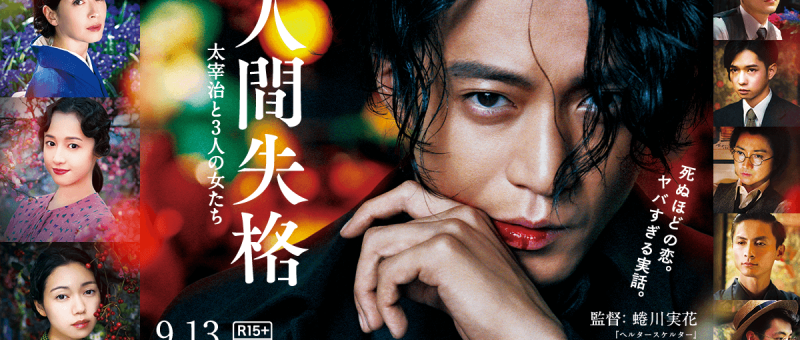
No Longer Human (人間失格 太宰治と3人の女たち, Mika Ninagawa, 2019)

Like a character from one of his novels, Osamu Dazai is remembered as a figure of intense romanticism, an image fuelled by his love suicide with a woman who was neither his wife nor the mistress with whom he had conceived a child. A proponent of the “I novel”, Dazai lived as he wrote, but crucially gives the hero of his final book, No Longer Human, a less destructive ending than he eventually gave himself in that he finally accepts his toxicity and chooses self-exile in the belief that he has fallen so far as to lose the right to regard himself as “human”. Mika Ninagawa’s biographical treatment of Dazai borrows the title from his most famous novel (人間失格 太宰治と3人の女たち, Ningen Shikkaku: Dazai Osamu to 3-nin no Onnatachi), but gives it a subtitle which pulls focus from the author himself towards the three women who each in their own way made him what he was. 

Yet what he was, in Ninagawa’s characterisation at least, was hollow. Late into the film, she includes a famous literary anecdote in which a young Yukio Mishima (Kengo Kora) turns up to a party where Dazai (Shun Oguri) is holding court following the publication of The Setting Sun and accuses him of being a poseur, a coward who writes endlessly about death but has no real intention of following through. That’s something of which he was often accused, having already failed to die as we see in the film’s opening in a love suicide in which the woman died calling out another man’s name. Intensely insecure, he carps on about being disrespected by the literary establishment, in fact using his final days and one of his last chances to pen an embittered screed against the famous authors who read but apparently did not care for his work. His editor despairs of him, resenting him not only for the debauched lifestyle which interferes with his writing but his essential caddishness that sees him both mistreat his loyal wife and use countless women as fuel for his art never quite caring about what happens to them afterwards. 

Dazai claims that Michiko (Rie Miyazawa), his legal wife and mother of his children, is OK with his affairs because it is “love in the service of art”. There is some truth in that, though as Michiko points out, Dazai himself would have no interest in a woman so passively self-sacrificing as that of Villon’s Wife. When the children catch sight of their father embracing another woman at a festival, she calmly tells them that he is “working” before pulling them on in embarrassment, putting up with it perhaps more because she has no other option than in respect for Dazai the great artist. 

Yet as his new lover Shizuko (Erika Sawajiri) claims, beautiful art comes from broken people, an idea which perhaps enables Dazai’s grandiose vision of himself as an unjustly dismissed literary genius. Just as Villon’s Wife was “inspired” by his relationship with Michiko, The Setting Sun is about Shizuko, only this time Shizuko is more collaborator than muse. He plunders her diaries and the most famous line from his novel, “Men are made for love and revolution” was in fact not written by him but stolen from her (she eventually asks for a co-writing credit but evidently did not get one, penning her own book instead). What she asks him for in return is a child, a strangely common request also made of him by Tomie (Fumi Nikaido), the woman with whom he eventually dies largely, the film suggests, because despite the longing for life that birth represents she pulled him towards death and he was too indifferent to resist. Dazai’s resistance, if you can call it that, is listlessness in which he has no desire to live but equally perhaps no real desire to die. 

Despite the foregrounding of the title, the three women are perhaps three paths he could take – the conventional as a husband and father, the radical as man standing equal with a woman who is not a wife with whom he births “a new art”, and finally the nihilistic “death” which is the route he eventually takes. With or perhaps for Tomie he writes the work he knows will destroy him in which he excoriates himself rather than her but, unlike in life, receives the gift of self-awareness and then lets himself (partially) off the hook. In Ninagawa’s visual complexity he is perhaps to an extent already dead, collapsing in the snow after haemorrhaging blood in the later stages of TB next to a red circle looking oddly like the flag of Japan only for white petals to begin raining down on him as if he were already in his coffin. We see repeated shots of shimmering water reminding us of his death by drowning, and for all of Ninagawa’s characteristically colourful compositions it’s the women who are surrounded by the vibrancy of flowers in full bloom never Dazai himself. On her husband’s death, Michiko can exclaim only (and ironically) that the sun has finally come out as she gets on with her life putting out the washing. Shizuko affirms that Dazai was the love of her life while asserting her own artistic identity in pushing her book which is an inversion of his. Meanwhile, Dazai has consumed himself, a cad to the last, overdosing on romanticism as an artist who fears he has nothing else to say.


Hong Kong trailer (English/Traditional Chinese subtitles)

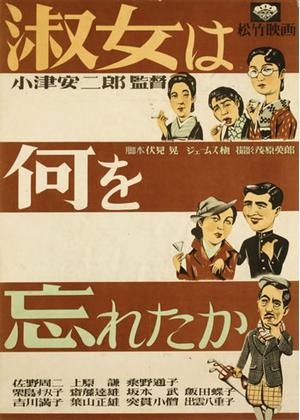
What Did the Lady Forget? (淑女は何を忘れたか, Yasujiro Ozu, 1937)

Japan was in a precarious position in 1937. Ozu’s What Did the Lady Forget? (淑女は何を忘れたか, Shukujo wa Nani wo Wasureta ka) was released in March of that year but by July the Second Sino-Japanese War would be in full swing and on the home front increasing censorship would render this kind of inconsequential comedy a much less easy sell. True enough, the film includes no “patriotic” content though it does eventually reinforce a set of patriarchal values in the remasculinisation of a henpecked husband while quietly sniggering at a new bourgeois social class.

The drama unfolds in the home of a medical professor, Komiya (Tatsuo Saito), and his austere wife Tokiko (Sumiko Kurishima). The couple have no children and mostly lead separate lives. Tokiko spends her days with two close friends, widowed single-mother Mitsuko (Mitsuko Yoshikawa), and wealthy older woman Chiyoko (Choko Iida) who is married to her husband’s friend, Sugiyama (Takeshi Sakamoto). The three women gossip about the usual things from fancy department store kimonos to new ways to laugh so you don’t get wrinkles along with the bizarrely difficult maths problems Mitsuko’s son has been studying in preparation for middle-school that none of them can answer. To help with the embarrassingly taxing homework, Tokiko offers to find a tutor, press-ganging her husband’s best student, Okada (Shuji Sano), into spending time with Mitsuko’s son Fujio (Masao Hayama) though it turns out that he too, a college graduate, is unable to solve these middle-school level problems. 

The real drama occurs when the couple’s neice, Setsuko (Michiko Kuwano), whom Tokiko had described as “proper” and “wholesome” rocks up from Osaka having become the epitome of a modern girl. Setsuko’s arrival further strains the Komiyas’ already fraying relationship as her surprising habits which include driving, smoking, drinking, and hanging out with geisha, continue to exasperate her aunt whose main objection to all of those things is that they aren’t appropriate because Setsuko is not yet married. To get away from his nagging wife who forces him to go golfing as usual when he doesn’t really want to, Komiya stashes his clubs with Okada and goes to a bar in Ginza where he meets Sugiyama who has also been forced outside by his wife. Sugiyama really does go golfing, promising to mail a previously written postcard to Tokiko on Komiya’s behalf, while he is eventually joined by Setsuko who has tracked him down to the bar despite being told to stay home and mind the house (the Komiyas have two live-in maids so the instruction seems unnecessary at best).  

As a “modern gal” Setsuko has some strangely old fashioned ideas even as she behaves like a 1930s ladette, striding around like man while drinking, smoking, and generally being almost as intimidating as Tokiko just in a more likeable fashion. Setsuko finds Komiya’s deferral to his wife embarrassing, encouraging him to be more masculine and stand up for himself even advising that he use violence to reassert his position as the man of the house. He seems uncomfortable with the idea but eventually does just that after a climactic argument once his lying about the golf and Setsuko’s nighttime adventures have been exposed. Caught in a moment of frustration, he slaps Tokiko across the face, leaving her to retreat in shock apparently “beaten”. The thing is, however, Tokiko likes it. She sees his slapping her as a sign of his love, as if she’s been needling him all this time in hope of a reaction while frustrated that perhaps he doesn’t care for her. Once he hits her, the marriage is rebalanced and repaired with traditional gender dynamics restored. She becomes more cheerful and deferent to his male authority, he acknowledges that he enabled her “arrogance” with his weakness as a man.  

Setsuko however, continues to shout at her uncle, disappointed that he apologised for his reaction and accusing him of giving away the victory he’d just won. He tells her that he’s simply using reverse psychology because wives like to believe they’re in charge and in the main it’s best to let them. Setsuko seems satisfied, but jokes with her new love interest Okada that he better not use reverse psychology on her. Or, he can, but she’ll just use reverse reverse psychology to get the upper hand, which perhaps undercuts the central message in praise of traditional gender roles. Nevertheless, What Did the Lady Forget? is full of Lubitschy late-30s charms from an unexpected sighting of real life star Ken Uehara at the Kabuki to Setsuko’s movie magazines featuring Marlene Dietrich and repeated references to Frederich March and William Powell proving that Ginza is open even in 1937, while the Komiya household descends into an oddly peaceful harmony of delayed marital bliss. 


Currently streaming in the UK via BFI Player as part of Japan 2020. Also available to stream in the US via Criterion Channel.

Rex: Dinosaur Story (REX 恐竜物語, Haruki Kadokawa, 1993)

Like him or loathe him, Haruki Kadokawa was the dominant force in commercial Japanese cinema from the mid-70s to the end of the Bubble era. Thanks to his circular marketing approach which involved producing movie adaptations of books his company published starring idols he had under contract at his movie studio and releasing the theme songs they often sang to accompany them on his record label, Kadokawa had a virtual stranglehold on ‘80s pop culture. All that came to an end, however, in 1993 when he was arrested for cocaine use/smuggling and accused of embezzling money to pay for his habit, eventually winding up with a four-year jail sentence. Despite all of that, Rex: Dinosaur Story (REX 恐竜物語, Rex: Kyoryu Monogatari) was until the release of Lord of the Rings in 2002 the highest grossing movie distributed by veteran studio Shochiku and was due to extend its 10-week run but was ultimately pulled early because of the “moral embarrassment” surrounding its director’s arrest. 

That moral panic might be all the more acute because as the title and poster might imply, Rex: Dinosaur Story is a tentpole family film released, despite its Christmas setting, at the height of the summer season and in the wake of Jurassic Park with an obvious eye on merchandising (much of which actually appears in the movie). The slightly ridiculous story revolves around 10-year-old Chie (Yumi Adachi) whose parents have recently split up with her mother Naomi (Shinobu Otake), a professor of veterinary medicine, heading to New York for an exciting work opportunity while she’s stayed behind with her nerdy father Akira (Tsunehiko Watase), a researcher of Japan’s Jomon period, and moved in with her maternal grandmother (Mitsuko Kusabue) at a Hokkaido ranch. Little Chie is it seems finding it hard to adjust and has become very withdrawn, refusing to answer when expected to introduce herself at her new school. Mostly she spends her time alone on the farm hanging out with the family dog and riding a horse while drawing pictures of her longed-for mother in a stylish Edwardian outfit with the farmhouse in the background. 

Meanwhile, Akira has made a discovery. A Jomon statue appearing to feature a boy riding on the back of a dinosaur along with a collection of shards he thinks are from a dinosaur egg have convinced him that dinosaurs may have survived in Japan until the Jomon period and perhaps may survive still. Intrigued by a message on a stele that advises one should not advance any further because a giant god is living further up the mountain, Akira takes his daughter and a handful of researchers to meet an Ainu priest (Fujio Tokita) who eventually leads them to a grotto where they find a giant dinosaur egg, narrowly escaping with it after having angered the gods. Akira and the researchers eventually hatch the egg, giving birth to Rex and allowing Chie to become his “mother”.

The egg’s discovery eventually hastens Naomi’s return, but she virtually ignores her daughter greeting her with nothing more than a curt hello while making it plain she’s only here to work on the historically significant discovery not patch up her family. Chie’s relationship with Rex is, in many ways, a way of bonding with her aloof mother who, it has to be said, comes in for a lot of slightly misogynistic criticism as a woman who “abandoned” her daughter to chase career success. Nevertheless, through parenting Rex Chie comes to understand something of motherhood while recognising that she and Rex are essentially the same and that he is most likely lonely missing his dinosaur birth mother. 

Meanwhile, she’s also acutely aware that not everyone has Rex’s best interests at heart. The birth of a cute baby dinosaur is obviously front page news with the consequence that Rex becomes the moment’s biggest celebrity trotted out for a host of TV commercials (featuring a cameo by Kirin Kiki) one of which has Chie and Rex perhaps insensitively sitting down to enjoy a wholesome family meal of Japanese curry. Aside from the irony, Chie’s attempt to suggest that they take break because Rex is after all a baby and he’s tired results in one of the other scientists, Morioka (Mitsuru Hirata), physically abusing him. Sidelined from the project, he enacts a dastardly plan to steal Rex for himself, turning up with four minions dressing like he’s just joined the Gestapo. 

In typical kids movie fashion, Chie and Rex end up on the run through a weird Christmas wonderland in which religious ceremonies and Santa mingle freely, a choir full of children led by her schoolfriend Kenta (Yuta Yamazaki) eventually aiding their escape by throwing snowballs at the bad guys. Chie’s attempts at “disguise” may be laughably bad, but it seems so many people are indulging in Rex cosplay that it becomes possible to blend in even while travelling with a dinosaur companion wearing a Santa hat and sunglasses. Nevertheless, the lesson that Chie begins to learn is that sometimes mothers have to separate from their children but it doesn’t mean they love them any less or that it doesn’t make them sad. Incongruously relegating the “happy ending” to a post-credits sequence, Rex’s distinctly Mid-Western aesthetic with its Dorothy-esque Hokkaido ranch coupled with the fantastical Jomon-era/Ainu mythology lend it a rather strange flavour but it remains an oddly nostalgic experience even as it lifts gleefully from its Hollywood contemporaries. 


Original trailer (no subtitles)

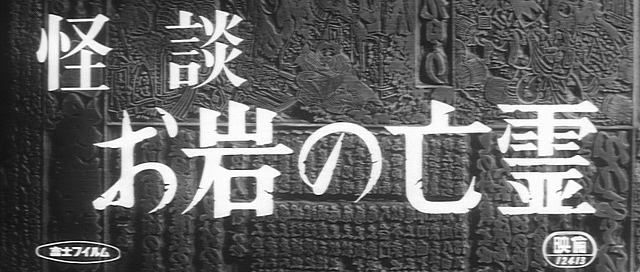
The Tale of Oiwa’s Ghost (怪談 お岩の亡霊, Tai Kato, 1961)

Yotsuya Kaidan is among the most well-known and enduringly popular of Japanese ghost stories. Originating as a kabuki play first staged in 1825, it has inspired countless film adaptations though Tai Kato’s The Tale of Oiwa’s Ghost (怪談 お岩の亡霊, Kaidan Oiwa no Borei) from 1961 is accounted among the most faithful despite the variation in its title. Usually regarded as a cautionary tale about a man whose ruthless ambition destroys his humanity earning him supernatural retribution, Yotsuya Kaidan is also a tale of female vengeance as Kato’s slight refocussing makes plain. In this version of the tale, all of Tamiya Iemon’s problems are, aside from the offscreen murder for which he has already been exiled from his family before the film begins, caused by female subjugation.

Having married into Oiwa’s (Yoshiko Fujishiro) family, Tamiya (Tomisaburo Wakayama) is in a rueful mood even as the film begins. After randomly killing a man in a fight some time previously, Oiwa has left him because, quite reasonably, she does not want to be in a relationship with a murderer nor do her family wish to be associated with someone stained with such a serious crime. Noticeably ragged, Tamiya swears he’s going to get Oiwa back because he’ll “never find another woman with such a beautiful body”. He wants her firstly because she has rejected him and his pride is wounded, secondly to regain his status, and thirdly because for the moment she is a glittering prize though he’ll later come to tire of her. 

Tamiya is hanging around because he wants to talk to his father-in-law about reinstatement but he is currently meeting with a “masseuse”, unbeknownst to Tamiya planning to sell his second daughter Osode (Hiroko Sakuramachi) to a brothel in order to pay a debt. He has been assured that his daughter will not be expected to participate in sex work but will be running a toothpick stall near the temple. Needless to say, both he and Osode are very much mistaken and once the money has changed hands Takuetsu (Atsushi Watanabe), doctor and owner of the brothel, can do whatever he likes. Tamiya doesn’t much care about Osode, encouraging his lusty friend elixir pedlar Naosuke (Jushiro Konoe) who declared her the more beautiful of the sisters to buy her body that very night. You wouldn’t think Naosuke could afford it but he decides to do just that, only to be gazumped by Osode’s conflicted fiancé Yomoshichi (Sawamura Sojuro) who is about to depart for Edo with the lord for a year the very next day. Rather than save her, Yomoshichi merely takes her virginity and asks her to wait for his return in a year’s time, leaving her in the brothel. 

Both Oiwa and Osode are essentially made to pay for their attempt to refuse male subjugation. Naosuke has “bought” Osode’s body and feels entitled to have it, attempting to rape her while she violently refuses him. His resentment leads him to plot Yomoshichi’s murder, but he mistakenly ends up killing his friend instead while Tamiya takes the opportunity to kill his father-in-law and reunite with his wife under the pretext of revenge for a crime he himself committed, essentially gifting Osode to Naosuke as a kind of reward. But Tamiya isn’t satisfied because he remains poor and lowly. His wife may be from a previously well respected samurai family, but he’s having to resort to making umbrellas to get by and now that Oiwa has given birth to their child he no longer finds her so “beautiful”. Bearing out the misogyny in their society, the men joke that Tamiya had been hoping his wife would die in childbirth so he’d be free of her at last. 

It’s at this point that he is offered an opportunity. Oume (Yumiko Mihara), the daughter of the wealthy Ito family of merchants fell in love with Tamiya when he returned her comb to her after a tussle in the square. Moving in nearby, the Itos are keen to persuade Tamiya to marry Oume but he has a wife and child already. The source of Tamiya’s heartlessness is it seems a kind of toxic masculinity, his intense sense of insecurity and a need to prove himself through promotion that fuels his obsession with advancing up the ranks to serve the shogun. As much as this is about inhumanity, it’s also about a society in flux. Unlike Naosuke, Tamiya is a samurai. The Itos are members of a new middle class whose increasing wealth is beginning to threaten the social order of the tightly regimented feudal society. Mr. Ito wants to make his daughter happy, or so he says, but marrying her to a samurai and therefore into the ruling class even if that ruling class is impoverished and possessed of only illusionary power is certainly advantageous. It is however somewhat irrational to encourage a man to murder his first wife so he can marry your lovestruck daughter, it does not bode well for her future safety. In any case, Tamiya is aware that “one’s reputation affects one’s promotion prospects” and so is unwilling to simply kill Oiwa without “a good reason”, later deciding to try and frame her for adultery which would make her death not only permissible but in fact socially mandated.  

In this age a woman’s life has no value, as Oiwa eventually sees. Tamiya gets the adultery idea after catching sight of the bodies of a samurai woman murdered for having an affair with a servant, marking her double transgression against the social order in both advancing her own agency over her body and her love for a man who was not of her own social class (assuming of course that there was any kind of relationship at all and they haven’t simply been killed on pretext by a man like Tamiya). Oiwa’s ruined face, caused by poison disguised as medicine, is symbolic of her social disfigurement, turning her into a “monstrous” woman who vows revenge on the man who has so maliciously wounded her. She asserts her own agency only in her death, choosing to pursue her vengeance from beyond the grave.

Yet it’s not only Tamiya who must pay, but the Itos too for their attempt to cheat the class system. Unlike other retellings, there is little suggestion that Tamiya’s torment is psychological, he is quite literally haunted, taunted into ruining his bright future by exorcising the demon of crime. Unusual for a Toei programmer of the time, Kato’s camera has New Wave verve, replete with handheld photography and swooping zooms while making use of his characteristic low angle composition but the final confrontation precipitated by a literal storm and earthquake which implodes the transgressive world Tamiya and the Itos are forging, is realised with expressionist ferocity. Tamiya tries to atone by taking refuge in a temple, but is undone not perhaps by guilt but by regret in realising he has destroyed his much hoped for chance of advancement and thereby rendered his existence meaningless. 

Returning the play to its roots, he dreams his relationship with Oiwa as kabuki dance until woken by the sight of her ruined face, demanding to be freed from his torment. Yet vengeance comes in realer terms and it is Osode who strikes the blow, striking back on behalf of her sister and herself as a representative of all wronged women, while Naosuke can only lament that “this life had nothing good in it” as he too pays for his transgressions. Osode reclaims her mother’s comb and with it restores the social order while simultaneously rejecting her subjugation at the hands of duplicitous men, laying Oiwa’s unquiet ghost to rest as she leaves the venal past behind for a (presumably) less inhuman world. 


Original trailer (no subtitles)
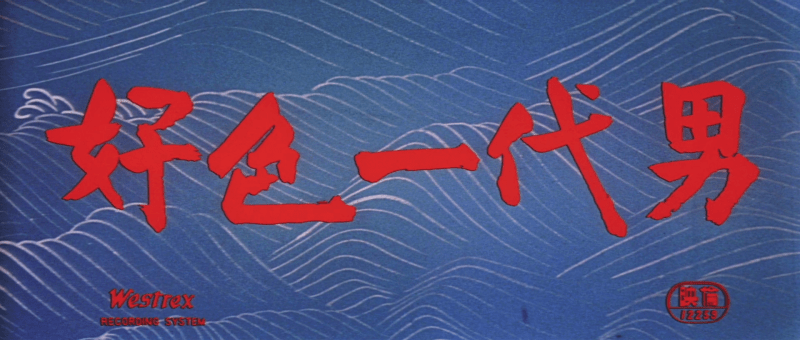
A Lustful Man (好色一代男, Yasuzo Masumura, 1961)

“Why are women in Japan so unhappy?” the carefree Casanova at the centre of Yasuzo Masumura’s 1961 sex romp A Lustful Man (好色一代男, Koshoku Ichidai Otoko) laments, never quite grasping the essential inequalities of the world in which he lives. Masumura is best known for extremity, a wilful iconoclast who flew in the face of golden age cinema’s genial classism, but shock was not his only weapon and he could also be surprisingly playful. Adapted from a well known novel by creator of the “floating world” Ihara Saikaku, A Lustful Man finds him indulging in ironic satire as his hero sets out to “make all the women in Japan happy” chiefly by satisfying their unfulfilled sexual desire while resolutely ignoring all of the entrenched patriarchal social codes which ensure that their lives will be miserable. 

Set in the Edo era, the film opens not with the hero Yonosuke (Raizo Ichikawa) but with his miserly father who berates a servant after discovering a single grain of rice on the hall floor. According to him, the central virtues necessary to become rich are endurance, diligence, and vitality. You must treasure each and every grain of rice in order to accumulate. A cruel and austere man who only thinks of money, Yonosuke’s father keeps his wife in earnest poverty despite their wealth, angrily grabbing an obviously worn kimono out of her hands and insisting that it’s still good for another year, apparently caring nothing for appearances in the otherwise class conscious Kyoto society. It’s this meanness that Yonosuke can’t seem to stand. He hates the way his father disrespects his mother, and her misery is a primary motivator in his lifelong quest to cheer up Japan’s melancholy women though the weapon he has chosen is sex, a convenient excuse to live as a genial libertine to whom money means essentially nothing. 

Yonosuke’s father has set him up with an arranged marriage into a much wealthier family, which is not something he’s very interested in despite the fact she seems to be quite pretty but on learning that she has transgressively found love with the family butler he determines to help her instead, ending the marriage meeting by chasing her round the garden like a dog in heat. Several similar stunts eventually get him sent away from his native Kyoto to Edo but he takes the opportunity to escape, travelling all over Japan making women “happy” as he goes. 

As the first example proves, Yonosuke genuinely hates to see women suffer. His own pleasure, though perhaps not far from his mind, is secondary and he never seeks to take advantage of a woman’s vulnerability only to ease her loneliness. Despite that, however, he remains essentially superficial opting for the transience of postcoital bliss while ignoring the very real societal factors which make an escape from misery all but impossible. During an early adventure, he spends all of the money he conned out of his new employer on redeeming a geisha (at more than three times the asking price) so that she can be with the man she loves, but he continues to visit sex workers without interrogating their existence as indentured servants, “merchandise” which is bought and sold, traded between men and entirely deprived of freedom. In fact, he proudly collects hair cuttings from the various geishas he has known as a kind of trophy only to later discover the grim truth, that the hair likely doesn’t belong to the geisha herself but is sold to them by middlemen who get it by digging up dead bodies. 

Yonosuke remains seemingly oblivious to the duplicitous hypocrisy of the yoshiwara, but is repeatedly confronted by the evils of Edo-era feudalism with its proto-capitalist cruelty where everything is status and transaction. He is often told that as he is not a samurai he would not understand, but seems to understand pretty well that “samurai are idiots” and that their heartless elitism is the leading cause of all the world’s misery. To some a feckless fool, Yonosuke refuses to give in to the false allure of worldly riches. As soon as he gets money he spends it, and does so in ways he believes enrich the lives of women (even if that only extends to paying them for sex), eventually getting himself into trouble once again reneging on his taxes after trying to prove a geisha is worth her weight in gold. 

Yogiri (Ayako Wakao) complains that women are but “merchandise”, valued only as toys for men. “Japan is not a good country for women” Yonosuke agrees, suggesting they run away together to find a place where women are respected, indifferent to Yogiri’s rebuttal “no, wherever you go, no one can change women’s sad fate”. Yonosuke’s naive attempts to rescue women from their misery often end in disaster, a runaway mistress is dragged back and hanged, the woman he was set to marry goes mad after her father and lover are beheaded for having the temerity to speak out about corrupt lords, Yogiri is killed by a samurai intent on arresting him for tax evasion, and his own mother dies seconds after his father only to be immediately praised as “the epitome of a Japanese wife”. Yet he remains undaunted, wandering around like an Edo-era Candide, setting off into exile to look for a supposed female paradise without ever really engaging with the systems which propagate misery or with his own accidental complicity with them. Nevertheless, he does perhaps enact his own resistance in refusing to conform to the rules of a society he knows to be cruel and unfair even if his resistance is essentially superficial, self-involved, and usually counterproductive which is, in its own way, perfectly in keeping with Masumura’s central philosophies on the impossibilities of individual freedom within an inherently oppressive social order.


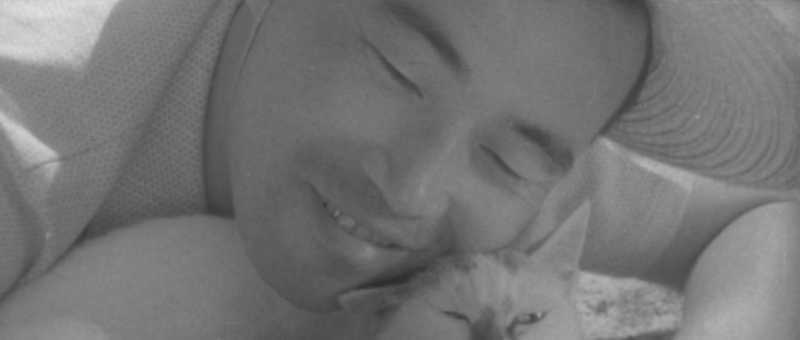
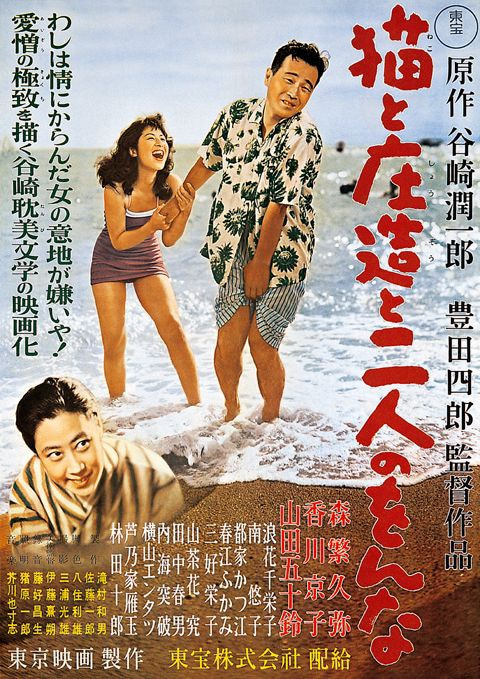
Shozo, a Cat and Two Women (猫と庄造と二人のをんな, Shiro Toyoda, 1956)

Post-war melodrama is largely concerned with the place of women, in particular, in a rapidly changing society, but given the centrality of domestic life, were men yearning for “independence” too? Shiro Toyoda was closely associated with comedic tales of strong women and weak men, and Shozo, a Cat and Two Women (猫と庄造と二人のをんな, Neko to Shozo to Futari no Onna) is as its title implies no exception. Adapting the novel by Tanizaki, Toyoda offers a subtle critique of the traditional family as its hapless hero finds himself caught between the conflicting demands of his feudalistic mother, stoic first wife, hedonistic second, and his much loved but perhaps mercenary feline, Lily. 

Shozo (Hisaya Morishige) is perhaps a typical spoiled only son, lazy, feckless, and essentially passive. Shinako (Isuzu Yamada) who agreed to an arranged marriage with him four years previously is walking out, thoroughly fed up with her mother-in-law Orin’s (Chieko Naniwa) constant complaints not least among them that the couple have no children. Unbeknownst to Shinako, however,  Shozo has been carrying on with his slightly younger cousin, Fukuko (Kyoko Kagawa), who is a free spirited modern woman. In fact, Fukuko has already run away from home three times in the company of various men so her wealthy father would be only too pleased to see her settle down and is so desperate to offload her that he’s even offering a huge dowry. All of this is complicated by the fact that Fukuko’s father already owns the mortgage on Shozo’s family store, which presents a serious challenge to typical family dynamics. 

Shozo, meanwhile, is only really interested in his pet cat, Lily, something which was a bone of contention in his failed marriage to Shinako (and perhaps a reason they have not been blessed with children). On learning that Orin has already moved Fukuko into the family home mere seconds after she vacated it, Shinako is suddenly struck by remorse and feels the need to vindicate her pride through revenge. Plotting how best to drive a wedge between Fukuko and her new husband, she settles on petitioning Shozo to give her custody of Lily, and then suggests the same thing to her rival knowing that whatever happens it will cause a series of problems in the Oyama household. 

The irony is, in a sense, that it’s Shozo who has been displaced from his own home. Perhaps surprisingly, he often tries to help out with household tasks but his mother always stops him, insisting that housework isn’t something a man should pay attention to. Orin is of course perpetuating outdated ideas of traditional gender roles, but there is also an obvious anxiety in her need to protect her territory from possible incursion. She doesn’t necessarily trust the idea that she and Shozo are connected by anything deeper than practicality and filial obligation and her only currency is her ability to provide the services that Shozo “cannot” provide for himself. His learning to take care of himself is an existential threat to her position as his caregiver even though he is a grown man in his 30s perfectly capable of doing his own laundry and preparing his own meals (as he already does for Lily who particularly enjoys grilled chicken). 

When they brought Shinako into the house, they did so apparently because she was known to be a “good worker” at her job as a maid for a wealthy family. Since then she has indeed worked hard, but is viewed as little more than a glorified servant by Orin who has delegated much of the feminine labour to the younger woman, while Shozo emotionally neglects her in favour of the cat and apparently satisfies his carnal urges outside the home. They accept Fukuko for her money, but take the opposite approach, treating her as the lady of the manor. Fukuko does no housework (a cupboard is later discovered where she’d thrown all the washing she couldn’t be bothered to do), but Orin simply picks up her share and more, becoming maid to her daughter-in-law who frequently reminds them that it’s her money paying for everything so she is the one who is really in charge. 

Shozo does not seem to react too closely to these assaults on his masculinity, but only wants to escape to be alone with Lily whom he believes is the only one who really loves him. In this he is perhaps the truly modern man who wanted his family relations to be “real” rather than defined by social obligation, but he’s also self-centred and childish, still seeing the women (even Lily) as providers of service rather than fellow human beings. His mother satisfied his hunger, Shinako kept him financially by managing the business, and Fukuko sated his passion, but he feels oppressed by all of them in different ways and in the end does not want the responsibility of dealing with human emotions. Lily may be capricious, but her needs are easily satisfied and to that extent she is dependent on him. His desire to be “independent” and find emotional fulfilment only with his cat is just as much of a challenge to the social order as a woman who rejects marriage or seeks to fulfil herself outside of the home. 

Shozo’s dilemma is however presented as comedic until its unexpectedly melancholy conclusion which reduces him to the status of a stray cat as the women come to literal blows, fighting not quite over him (he isn’t worth fighting over) but for their own self-esteem and particular brand of womanhood. Shinako sits at home and calculates all the back pay she’d be entitled to for the labour she performed at the Oyama household in recognition that being a wife is also a job and they treated her as a maid anyway (which is to say as an outsider with no intention of love or loyalty), while Fukuko begins to see the “emptiness” in her party girl lifestyle but prefers to be pampered and resents being “beaten” by a mere housemaid. This system traps everyone, forcing them to manipulate the desires of others while suppressing their own. Shozo and his cat are left out in the cold, trapped between tradition and modernity but no more free than they were before even in their mutual dependency.


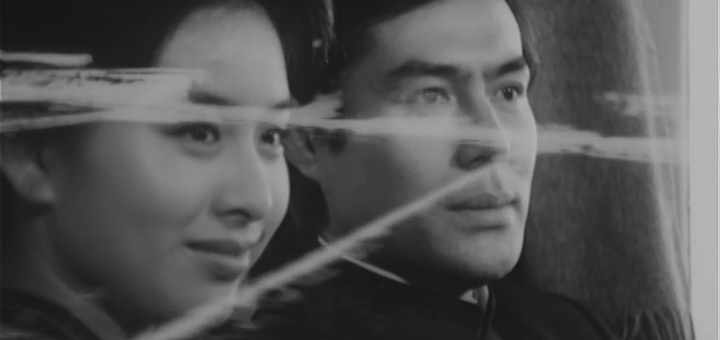
A Killer’s Key (ある殺し屋の鍵, Kazuo Mori, 1967)

Raizo Ichikawa returns as the jaded ace assassin only this time a little less serious. Set some time after the events of A Certain Killer, A Killer’s Key (ある殺し屋の鍵, Aru Koroshiya no Kagi) finds Shiozawa (Raizo Ichikawa) having left the restaurant business to teach traditional dance under the name Fujigawa while known as killer for hire Nitta in the underworld. Like the previous film, however, he thinks of himself as a justifiable good, standing up against contemporary corruption while still burdened by his traumatic past as a former tokkotai pilot. 

Nitta’s troubles begin when a corruption scandal kicks off with a prominent businessman, or less generously loan shark, arrested for tax evasion. Asakura (Asao Uchida) knows too much and political kingpin Hojo (Isao Yamagata) is worried because he knows Asakura has hard evidence about a land scandal and might be persuaded to spill the beans, exposing a circle of corrupt elitists for their shady goings on. He wants Asakura knocked off on the quiet, as he heavily implies but does not explicitly state to his underling Endo (Ko Nishimura) who gets in touch with their yakuza support who in turn decide that Nitta is the only man for the job.

Petty yakuza Araki (Yoshio Kanauchi) sells the job to Nitta as a public service, pointing out how unfair it is that Asakura has been cheating on his taxes when other people have taken their own lives in shame because they weren’t able to pay. Conveniently, he doesn’t mention anything about petty vendettas or that he’s essentially being hired to silence a potential witness before he can talk so Nitta is minded to agree, for a fee of course (which, we can assume, he won’t be entering on his tax form). Unfortunately things get more complicated for everyone when the gangsters try to tie up loose ends by engineering an “accident” for Nitta which sends him on a path of revenge not only taking out the gangsters but the ones who hired them too. 

Nitta’s revenge is personal in focus, but also a reflection of his antipathy to modern society as a man himself corrupted by wartime folly who should have died but has survived only to become a nihilistic contract killer. He perhaps thinks that the world is better off without men like Asakura, the dim yakuza, spineless underling Endo, and corrupt elitist Hojo but only halfheartedly. His potential love interest, Hideko (Tomomi Sato), a geisha learning traditional dance, has fallen for him, she says because she can see he’s not a cold man though continually preoccupied and there is indeed something in his aloofness which suggests that he believes in a kind of justice or at least the idea of moral good in respect of the men that died fighting for a mistaken ideal. 

As Hideko puts it, Asakura made his money off the suffering of others, so perhaps it’s not surprising that he met a nasty end. She herself is a fairly cynical figure, aware as a geisha that she is in need of a sponsor and that it’s better to get the one with the most money though she too has her code and will be loyal to whoever’s paying the bills. Or so she claims, eventually willing to sell out Endo to protect Nitta but disappointed in his continued lack of reciprocation for her feelings. Echoing his parting words at the close of the first film but perhaps signalling a new conservatism he coldly tells Hideko that he doesn’t need a woman who stays with anyone who pays refusing to include her in the remainder of his mission.

Nitta is perhaps a man out of his times as a strange scene of him looking completely lost in a hip nightclub makes clear. He tries to play a circular game, stockpiling his winnings in different suitcases stored in a coin locker, but eventually finds that all his efforts have been pointless save perhaps taking out one particular strain of corruption in putting an end to Hojo’s nefarious schemes. More straightforwardly linear in execution than A Certain Killer, Killer’s Key is a less serious affair, resting squarely on an anticorruption message and easing back on the hero’s wartime trauma while allowing his needle-based hits to veer towards the ridiculous rather than the expertly planned assassination of the earlier film, but does perhaps spin an unusual crime doesn’t pay message in Nitta’s unexpected and ironic failure to secure the loot proving that sometimes not even top hit men can dodge cosmic bad luck. 


Update, 13th February 2025: now available to stream via Arrow Player.

Original trailer (no subtitles)