 Junichiro Tanizaki is widely regarded as one of the major Japanese literary figures of the twentieth century with his work frequently adapted for the cinema screen. Those most familiar with Kon Ichikawa’s art house leaning pictures such as war films The Burmese Harp or Fires on the Plain might find it quite an odd proposition but in many ways, there could be no finer match for Tanizaki’s subversive, darkly comic critiques of the baser elements of human nature than the otherwise wry director. Odd Obsession (鍵, Kagi) may be a strange title for this adaptation of Tanizaki’s well known later work The Key, but then again “odd obsessions” is good way of describing the majority of Tanizaki’s career. A tale of destructive sexuality, the odd obsession here is not so much pleasure or even dominance but a misplaced hope of sexuality as salvation, that the sheer force of stimulation arising from desire can in some way be harnessed to stave off the inevitable even if it entails a kind of personal abstinence.
Our narrator for this sardonic tale is an ambitious young doctor, Kimura (Tatsuya Nakadai), who opens the film in an unusually meta fashion with a direct to camera address taking the form of a brief lecture on the decline of the human body (which begins at age ten and then gets progressively worse). Kimura reminds us that we too will grow old, but his warning is intended less to engender sympathy for the elderly patriarch who will become our secondary protagonist than it is to raise a grim spectre of the inescapability of death.
The story Kimura wants to tell us of a man who fought against senility centres on antiques expert and respected cultural critic Kenmochi (Ganjiro Nakamura). Advanced in years, Kenmochi is beginning to feel the darkness encroaching along with the desire to resist it through restored virility. For this reason, he’s been making regular appointments at Kimura’s clinic which he keeps secret from his wife who would be unhappy to know he’s been getting mysterious injections to help with his sex drive but which also come with a number of side effects including dangerously raising his blood pressure.
Eventually Ikuko (Machiko Kyo), Kenmochi’s slightly younger wife and mother of his grown up daughter Toshiko (Junko Kano), does indeed find out though what she does not appear to know is that Kenmochi has also been drugging her so that he can take photos of her naked body and enjoy his rights as her husband without her needing to be 100% present at the time. Kenmochi’s plan is to lure Kimura into having an affair with his wife so that the resultant jealousy will stimulate his system, staving off senility and other unwelcome effects of ageing. This would be strange enough on its own were it not that Kenmochi has also been trying to set up a marriage between Toshiko and Kimura who are already engaged in a discreet affair.
In contrast with the source material which takes the form of a number of diary entries providing differing perspectives on events, the film takes the point of view of the cynical and morally bankrupt doctor Kimura who feels himself above this “pathetic” old man with his sexual preoccupations and diminished prospects. As the narrator, Kimura evidently believes himself in control but Ichikawa is keen to play with our sense of the rules of storytelling to show him just how wrong he could be. Intrigue is everywhere. Kenmochi may think he’s using all around him in a clever game to prolong his own life but he’s entirely blind to a series of counter games which may be taking place behind his back.
Sex is quite literally a weapon – aimed at the heart of death. Kimura recounts a dream he sometimes has in which he is shot through the heart in an arid desert, only for this same scene to invade the mind of a paralysed Kenmochi on gazing at the naked body of his wife. The marriage of Kenmochi and Ikuko has apparently been a cold (and perhaps unhappy) one with Kenmochi berating his wife for remaining “priest’s daughter” all these years later, prudish and conventional. Nevertheless, Ikuko – the kimonoed figure of the traditional Japanese wife, subservient yet mysterious and melancholy, becomes the central pivot around which all the men turn, eclipsing her own daughter – a Westernised, sexually liberated young woman rendered undesirable in her very availability. Kimura is not quite the destructive interloper of Pasolini’s Theorem so much as he is a “key” used by Kenmochi to “unlock” a hidden capacity within himself but one which, as it turns out, opens many doors not all of them leading to intended, or expected, destinations.
Ichikawa continues with a more experimental approach than was his norm following the bold opening scene in which Kimura directly addresses the audience with a straight to camera monologue. A pointed symbolic sequence of a train coupling, freeze frames, dissolves and montages add to his alienated perspective as he adopts Kimura’s arch commentary on the ongoing disaster which is the extremely dysfunctional Kenmochi family home. Middle class and well to do, the Kenmochis’ lives are nevertheless empty – the house is mortgaged and the beautiful statues which taunt Kenmochi with their physical perfection have all already been sold though Kenmochi refuses to let the buyer take them home. Old age should burn and rave at close of day, but as the beautifully ironic ending makes plain it will be of little use, death is in the house wearing an all too familiar face which you will always fail to recognise.
Screened as part of the Japan Foundation Touring Film Programme 2017.
Opening scene (no subtitles)
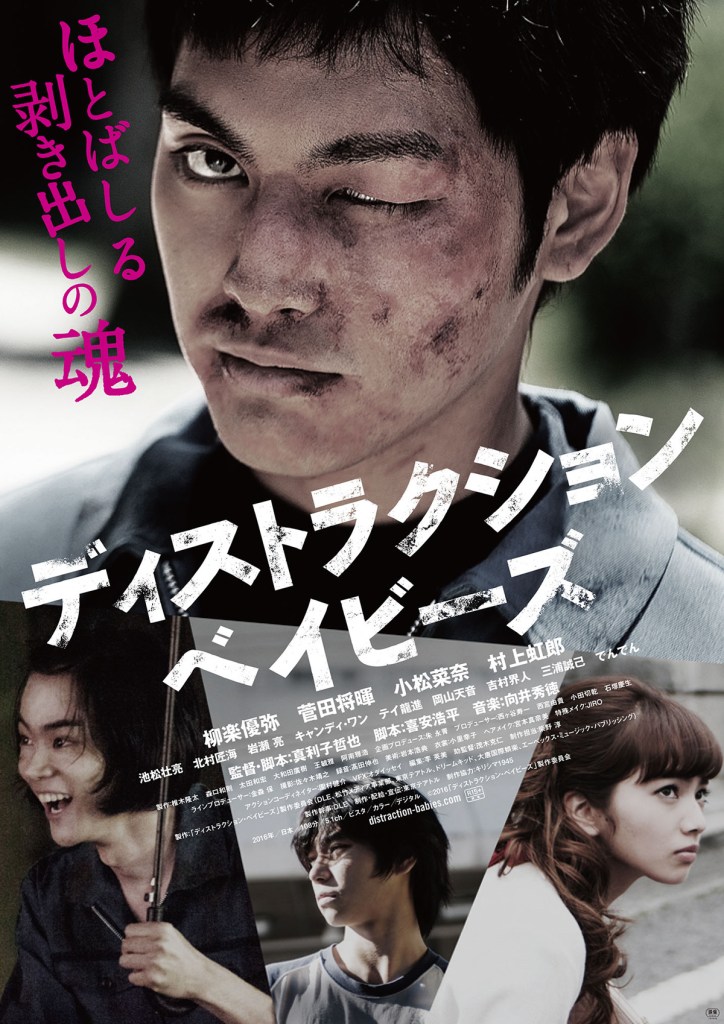 Post-golden age, Japanese cinema has arguably had a preoccupation with the angry young man. From the ever present tension of the seishun eiga to the frustrations of ‘70s art films and the punk nihilism of the 1980s which only seemed to deepen after the bubble burst, the young men of Japanese cinema have most often gone to war with themselves in violent intensity, prepared to burn the world which they feel holds no place for them. Tetsuya Mariko’s Destruction Babies (ディストラクション・ベイビーズ) is a fine addition to this tradition but also an urgent one. Stepping somehow beyond nihilism, Mariko’s vision of his country’s future is a bleak one in which young, fatherless men inherit the traditions of their ancestors all the while desperately trying to destroy them. Devoid of hope, of purpose, and of human connection the youth of the day get their kicks vicariously, so busy sharing their experiences online that reality has become an obsolete concept and the physical sensation of violence the only remaining truth.
 They say the way to a man’s heart is through his stomach, but for some guys you’ll have to do a whole lot of baking. Based on the popular manga which was also recently adapted into a hit anime (as is the current trend) My Love Story!! (俺物語!!, Ore Monogatari!!) is the classic tale of innocent young love between a pretty young girl and her strapping suitor only both of them are too reticent and have too many issues to be able to come round to the idea that their feelings may actually be requited after all. This is going to be a long courtship but faint heart never won fair maiden.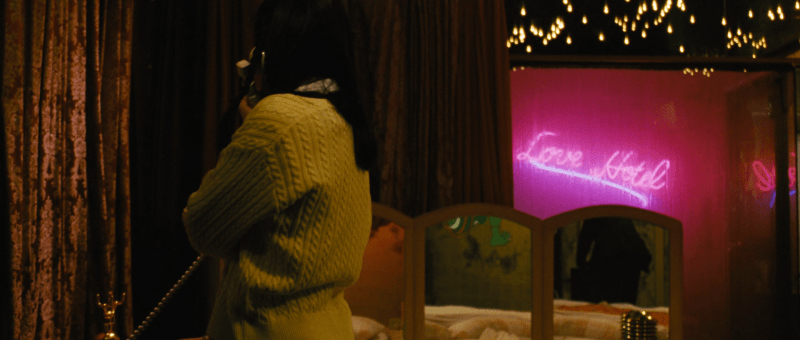

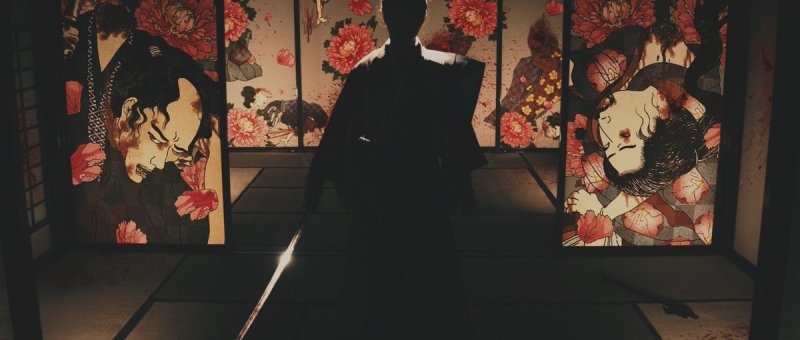
 All life is suffering, and all suffering is caused by desire. Ninko, the titular monk at the centre of this entertaining oddity from Norihiro Niwatsukino, seems to have taken this to heart and is suffering more than most in his attempts to reach Nirvana. Suffering of Ninko (仁光の受難, Ninko no Junan) takes its cues from the Hyaku-monogatari classical Japanese tales of ghosts and the supernatural as its seemingly comic story of a pretty monk and his ironic talent for attracting the wrong kind of attention gradually darkens until its unexpectedly strange finale. Visually striking if a little rough around the edges, Suffering of Ninko has a pleasantly organic quality as if its narrator were really making it up as she goes along only to tire of it a little by the end and give us a suitably spooky conclusion to send us on our way.
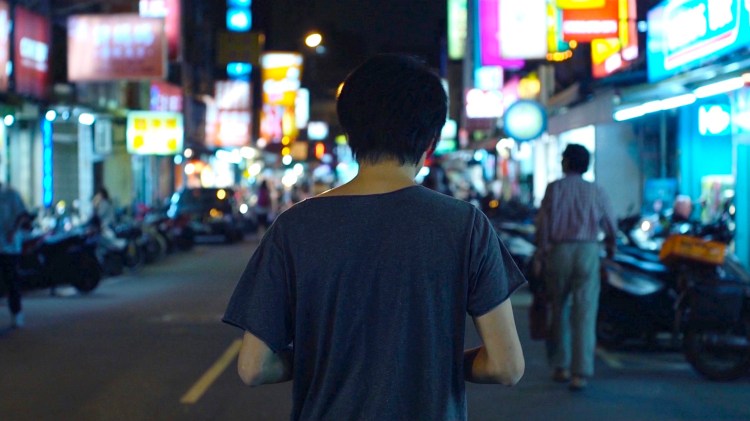 We don’t move forward in this dance, comments the lady currently being waltzed by a charming lost soul. Don’t worry, he says, that’s not a bad thing. Indeed, Out There, the first independent feature film from director Takehiro Ito exists in a fixed yet liminal space, here and not there as its protagonist finds himself without the proper place to be. Conceived as a way of salvaging some of the material collated for a documentary on the late Taiwanese director Edward Yang, Out There takes more of its cues from Tsai Ming-liang or even Lav Diaz in its preoccupation with the intersection between time, existence, and place. If that all sounds to weighty, there’s a little whimsy in here too, but the intent is a serious one as nationhood (or the lack of it), drifting cultures, love and history all conspire to confuse and distract the course of a young man in search of an identity which is entirely his own.
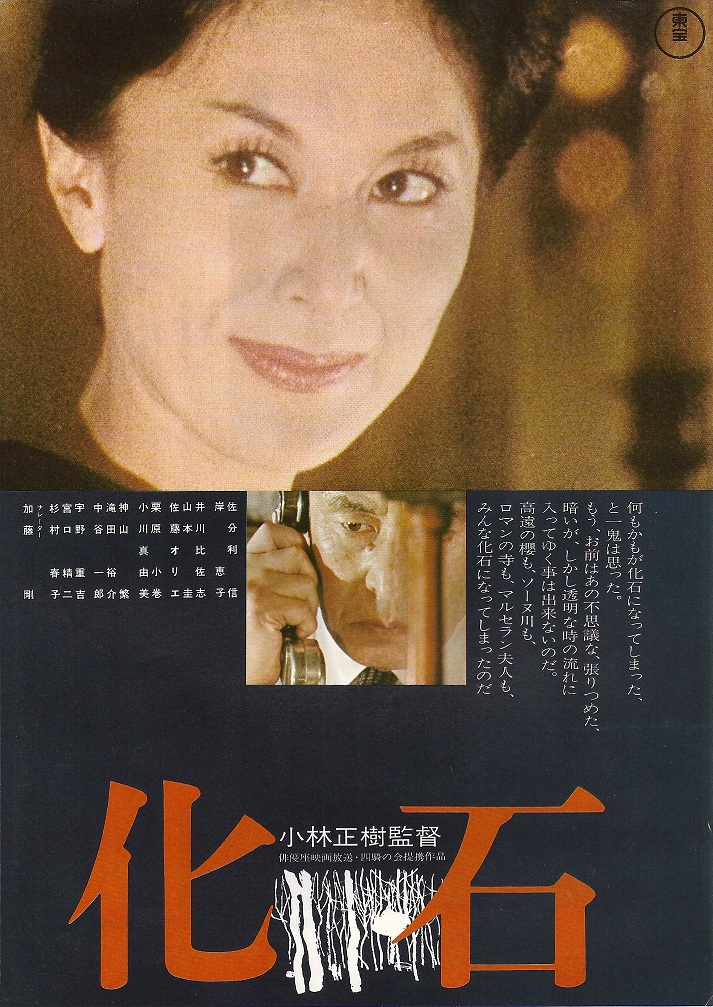 Throughout Masaki Kobayashi’s relatively short career, his overriding concern was the place of the conscientious individual within a corrupt society. Perhaps most clearly seen in his magnum opus,
 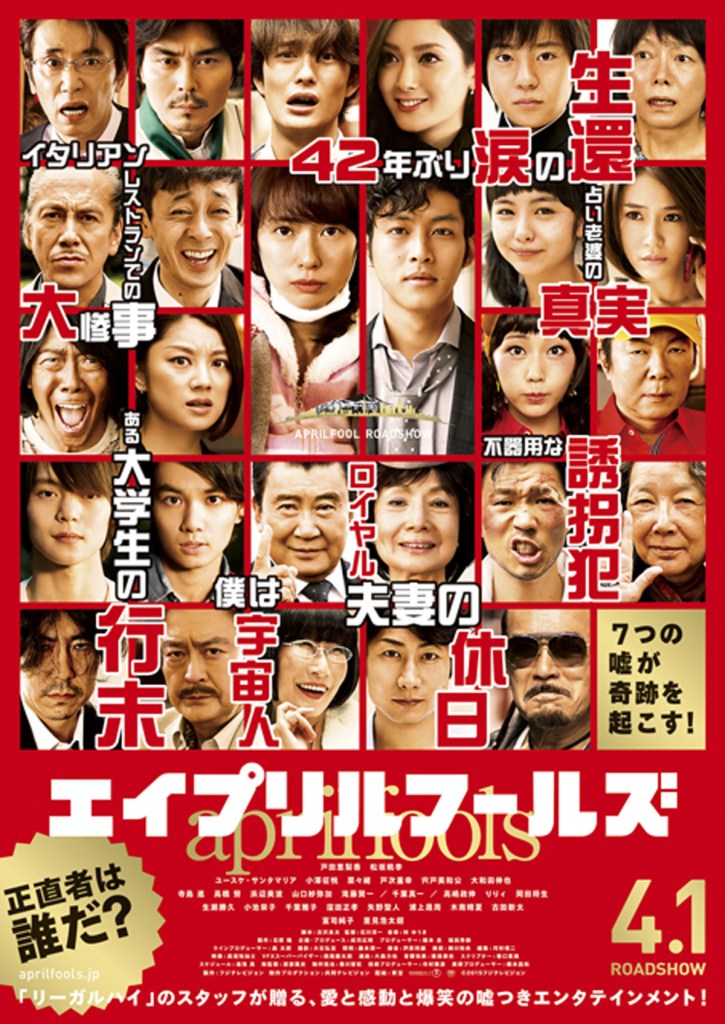 In this brand new, post truth world where spin rules all, it’s important to look on the bright side and recognise the enormous positive power of the lie. 2015’s April Fools (エイプリルフールズ) is suddenly seeming just as prophetic as the machinations of the weird old woman buried at its centre seeing as its central message is “who cares about the truth so long as everyone (pretends) to be happy in the end?”. A dangerous message to be sure though perhaps there is something to be said about forgiving those who’ve misled you after understanding their reasoning. Or, then again, maybe not.
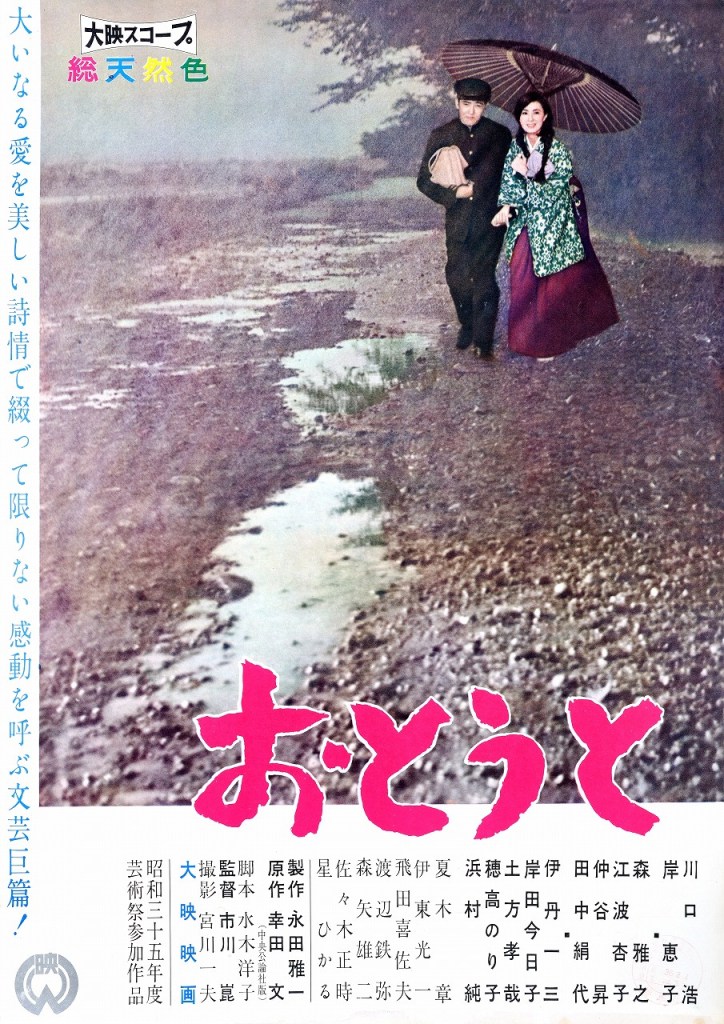 Perhaps oddly for a director of his generation, Kon Ichikawa is not particularly known for family drama yet his 1960 effort, Her Brother (おとうと, Ototo), draws strongly on this genre albeit with Ichikawa’s trademark irony. A Taisho era tale based on an autobiographically inspired novel by Aya Koda, Her Brother is the story of a sister’s unconditional love but also of a woman who is, in some ways, forced to sacrifice herself for her family precisely because of their ongoing emotional neglect.
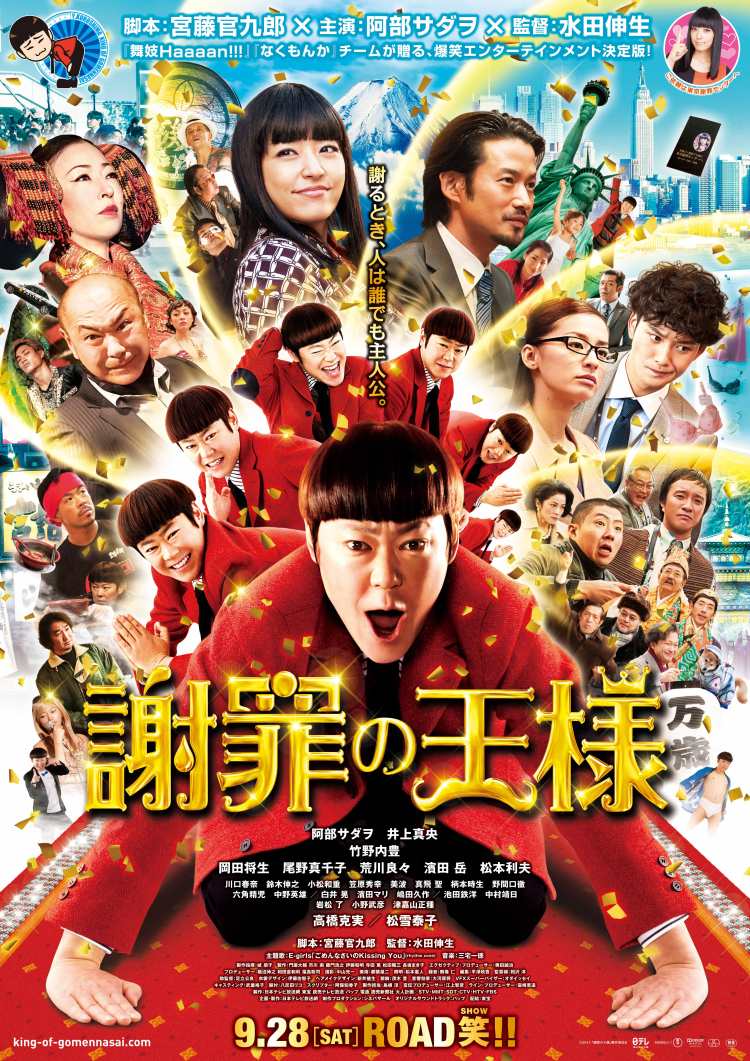 There are few things in life which cannot at least be improved by a full and frank apology. Sometimes that apology will need to go beyond a simple, if heart felt, “I’m Sorry” to truly make amends but as long as there’s a genuine desire to make things right, it can be done. Some people do, however, need help in navigating this complex series of culturally defined rituals which is where the enterprising hero of Nobuo Mizuta’s The Apology King (謝罪の王様, Shazai no Ousama), Ryoro Kurojima (Sadao Abe), comes in. As head of the Tokyo Apology Centre, Kurojima is on hand to save the needy who find themselves requiring extrication from all kinds of sticky situations such as accidentally getting sold into prostitution by the yakuza or causing small diplomatic incidents with a tiny yet very angry foreign country.
