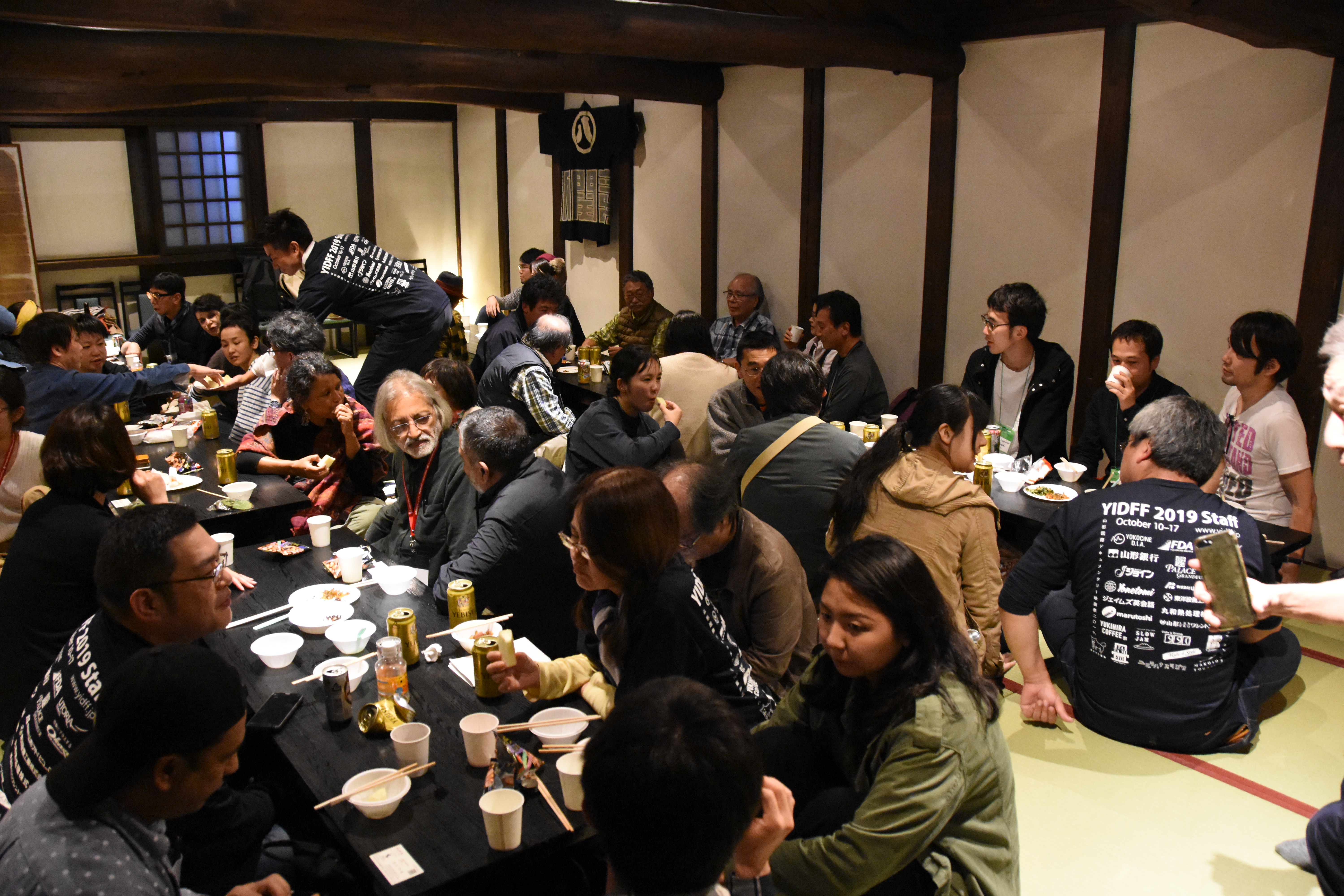
Launched in 1989, the Yamagata International Documentary Film Festival is one of the key events in Asia dedicated to documentary filmmaking. In celebration of their long history, YIDFF has put together a special series showcasing some of the key works from Japan which have featured over the last 30 years. The program will stream worldwide (excl. Japan) via DAFilms from Jan. 17 to Feb. 6 with all titles streaming for free during the first week.
A Movie Capital
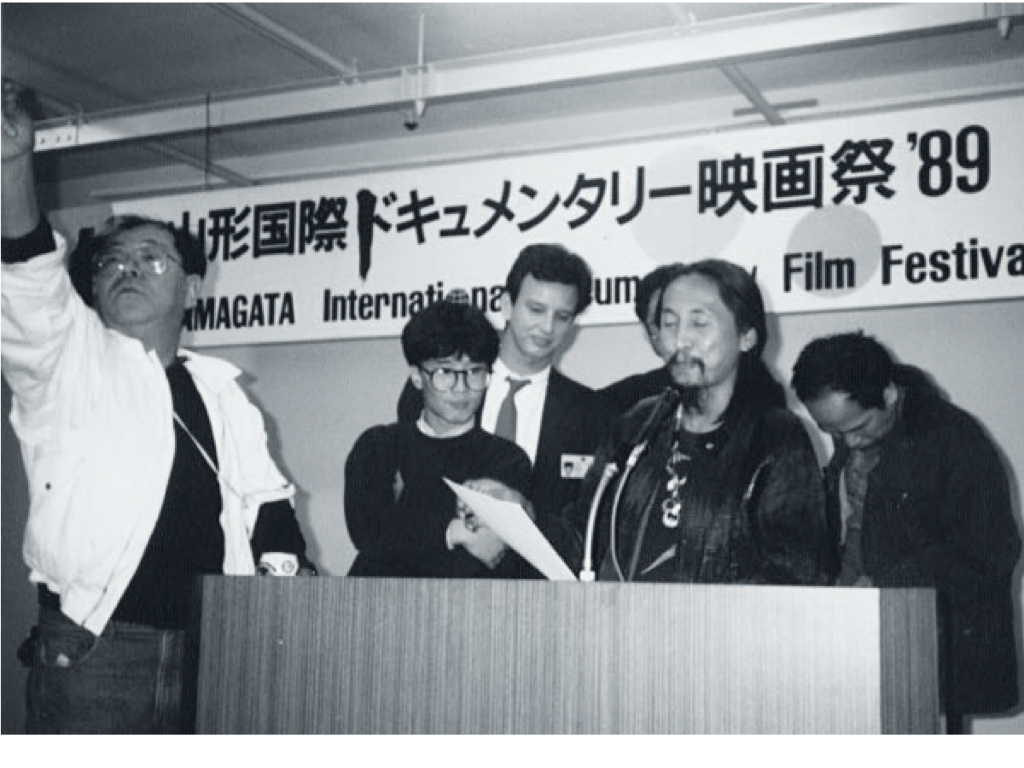
Directed by Toshio Iizuka, A Movie Capital is a record of the Yamagata Documentary Film Festival’s first edition held in 1989 and against the turbulent geopolitical backdrop of the Tiananmen Square protests and the fall of the Berlin Wall.
Living on the River Agano
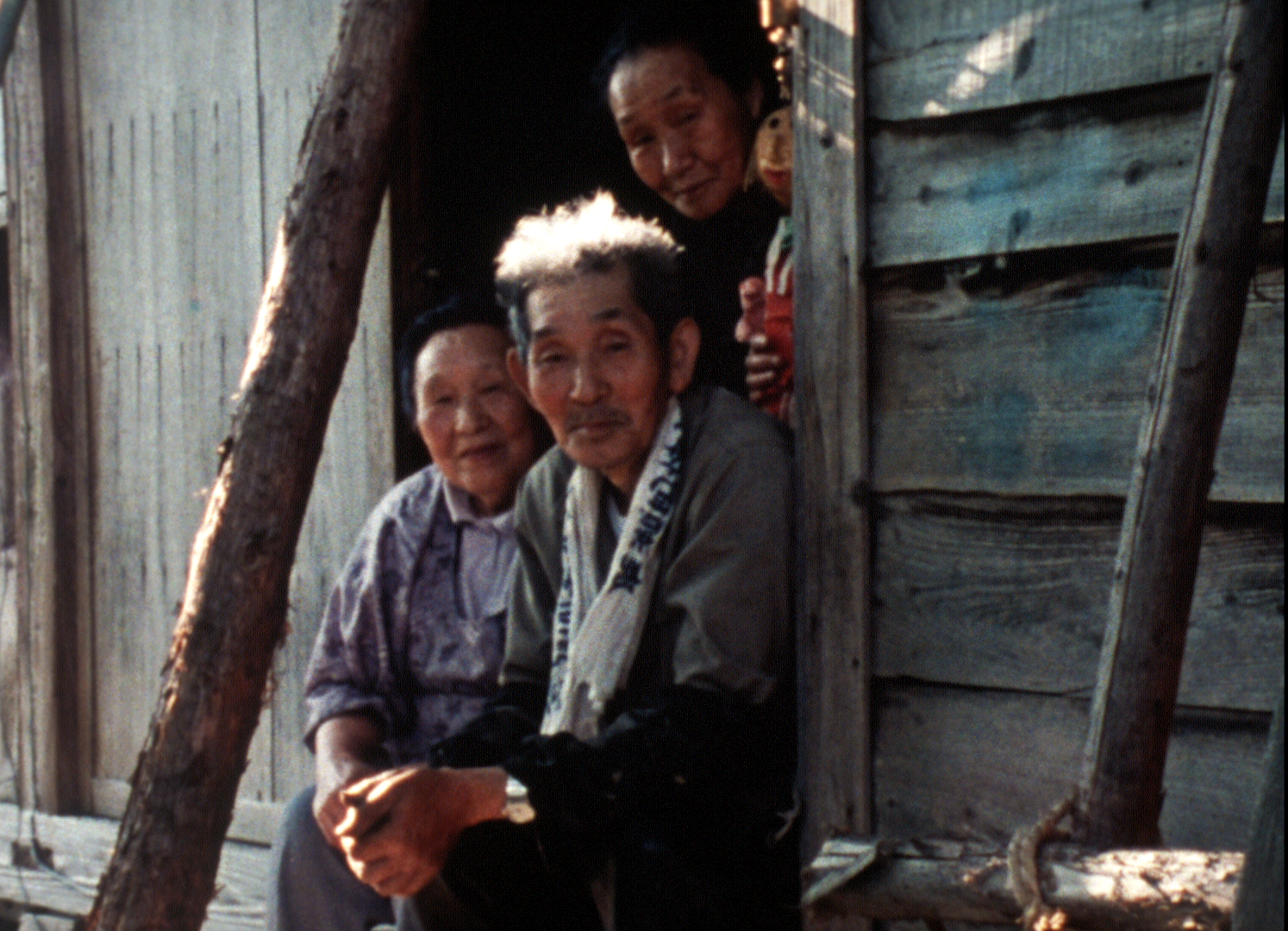
Makoto Sato’s documentary weaves its way along the Agano River talking to the mostly elderly residents of small-town Japan many of whom remained unrecognised victims of the Minamata disease caused by industrial pollution.
The Weald
1997 documentary from Naomi Kawase focussing on six groups of elderly people living in the Yoshino Mountains.
The New God
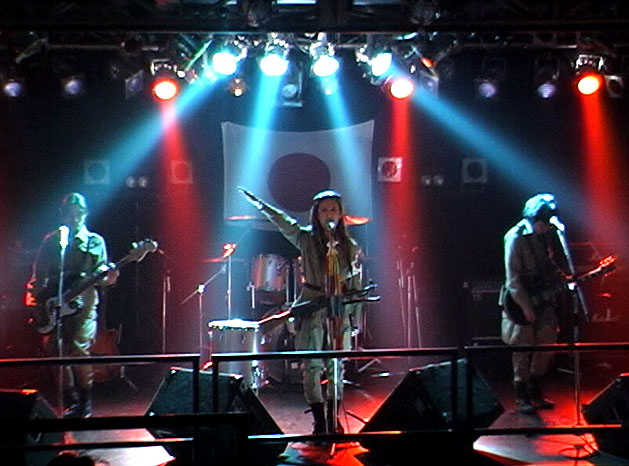
Personal documentary from Yutaka Tsuchiya in which he documents his relationship with a right-wing punk band which eventually led to his marrying its vocalist Karin Amamiya despite not sharing their nationalist views.
A2
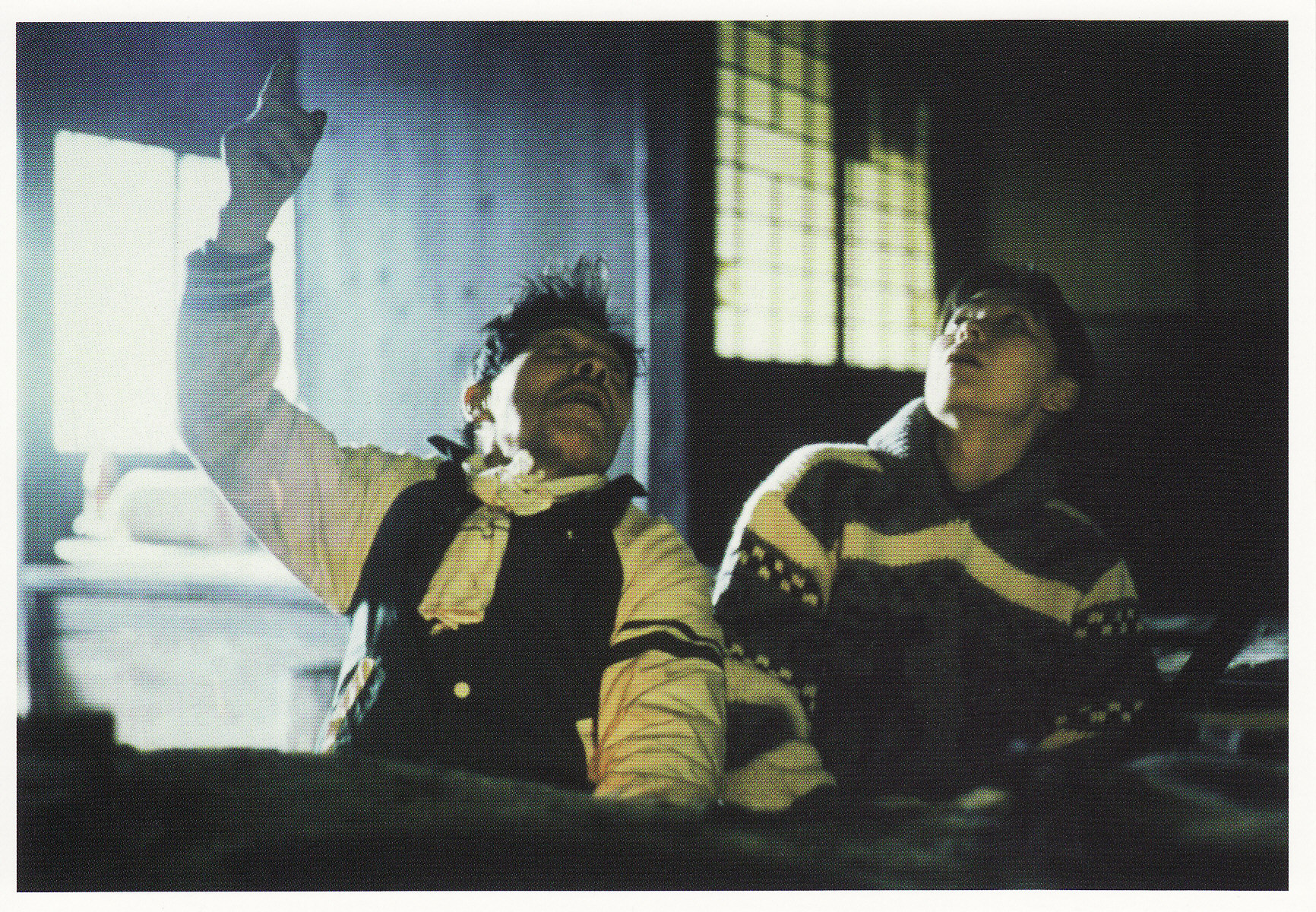
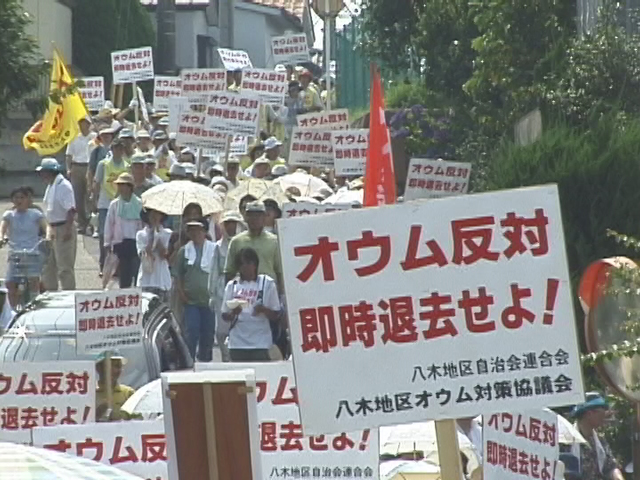
Tatsuya Mori’s 2001 sequel to his 1997 film A in which he returns to follow the everyday lives of members of the new religion sect Aum Shinrikyo who were responsible for the 1995 sarin gas attack on the Tokyo underground.
The Cheese and the Worms
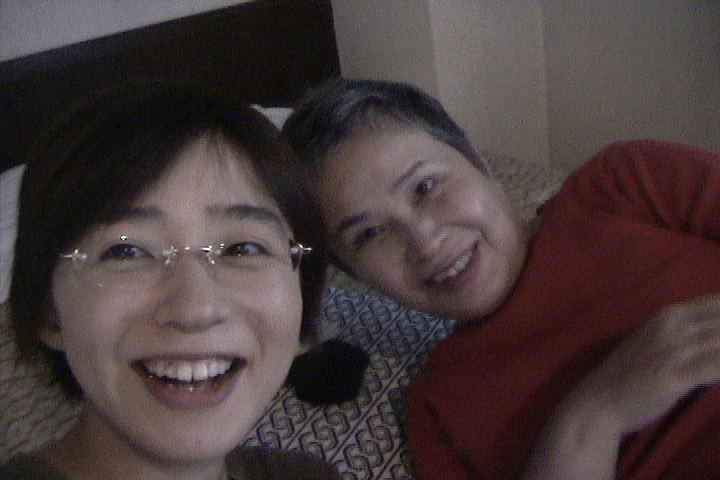
1995 personal documentary from Haruyo Kato documenting her life in the mountains living with her grandmother while caring for her mother who is suffering with a terminal illness.
Dear Pyongyang
Documentary by ethnic Korean Yang Yong-hi who stayed in Japan after her father who was a committed communist and leader of the pro-North Korean movement sent her three brothers back to North Korea as part of a repatriation program only to see them become increasingly dependent on care packages from home as the situation in Pyongyang continues to decline.
Storytellers
2013 documentary by Ryusuke Hamaguchi & Ko Sakai focussing on the stories of those affected by the 2011 earthquake and tsunami.
Cenote
Experimental doc from Kaori Oda shot on Super-8 focussing on the “cenote” sink holes of Mexico which were once the sole water source for Mayans living far from rivers and lakes.
Pickles and Komian Club
Poignant 2021 documentary from Koichi Sato following Maruhachi Yatarazuke, the owner of a 135-year-old family-run pickle store forced to close during the pandemic.
All films will be available to stream worldwide (excl. Japan) via DAFilms Jan. 17 – Feb. 6 and will be free to view until Jan. 24. Full details for all the films can be found on the official Yamagata International Documentary Film Festival website, while you can also keep up with the latest news by following the festival on Twitter, Facebook, and Instagram.
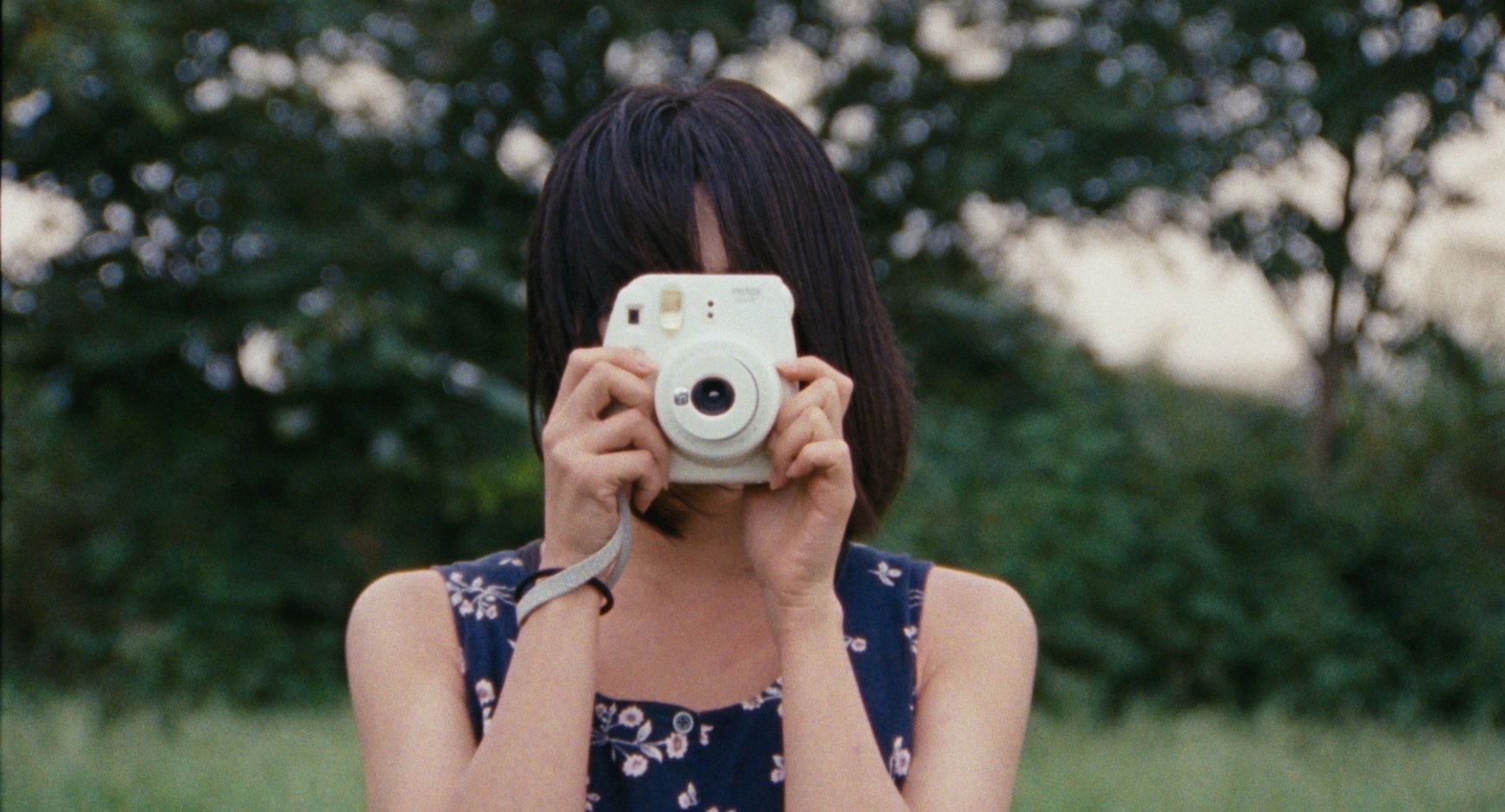
A lonely teenage girl begins to reevaluate her ideas of freedom and family after bonding with a sophisticated older woman from her neighbourhood in Ohno Candice Mana’s cheerfully quirky coming-of-age tale Lovely Little Ai (愛ちゃん物語♡, Ai-chan Monogatari). Aptly named for this is indeed a story of love, Ohno’s gentle drama cycles through the destructive effects of toxic, unsupportive parenting while finally finding solace in the strength of human connections to create new and enduring bonds not tied by blood.
16-year-old Ai (Akane Sakanoue) explains that she lives alone with her father, her mother having passed away shortly after she was born, though alone is perhaps the most accurate word seeing as workaholic salaryman Tetsuo (Kan Hotoda) is rarely at home. Nevertheless, his authoritarian parenting style borders on the abusive as he bans Ai from hanging out with friends, makes her ask permission before anything she does, and insists she send him a photo of the clock to prove she’s home by the 6pm curfew (why she doesn’t just send the same picture every day is anyone’s guess). Ai seems not to think too much of it, but is also beginning to yearn for more freedom while additionally anxious that she has no friends and no idea how to make them because of her father’s controlling personality.
Everything changes when she accidentally bumps into another woman on the street, knocking her over and spilling her bespoke cosmetics all over the road. Sensing a connection and hoping to get some feminine advice, Ai asks the woman to stay for a while and eventually ends up becoming friends with her, often eating in her apartment and taking various shopping trips together. In a sense, Ai comes to think of Seiko (Hisao Kurozumi) as a maternal figure but their relationship is later strained when she incorrectly comes to believe that she really is her mother despite having known all along that Seiko is trans and therefore could not have given birth to her.
Well, Ai mostly refers to Seiko as someone who wears women’s clothing but evidently has no problem accepting her, offended on her behalf when a boy from school, Ryo (Ryo Matsumura), who has a crush on her rudely runs away screaming on seeing them together in town though he later makes a point of apologising explaining that he was merely shocked and had an unusual reaction born of nervousness. Nevertheless, a melancholy flashback reveals Seiko’s difficult childhood with an authoritarian father not unlike Ai’s who disturbingly decapitated her Barbie and broke her colouring in pencils in two in an attempt to discourage her femininity. Watching over Ai she encourages her to embrace her freedom, explaining that life is dull if you can’t do the things you want to do and allowing her the space and confidence to make friends with the popular girls at school while figuring out who she is in defiance of her father’s control.
Even so on finding evidence that suggests Seiko has been keeping something from her she begins to doubt her new maternal relationship, unfairly feeling betrayed while refusing to give Seiko the opportunity to explain. What she eventually learns is that she’s come to see Seiko as a mother even if they are not related by blood and that the connection she has with her is what is most important. Her decision validates her right to choose and redefine the meaning of family including the boundaries around her own, but also affirms Seiko’s right to play a maternal role despite the rather unkind words Tetsuo had used to describe her before himself getting a wake up call in what it means to be a responsible father.
Cute and quirky with its pastel colour scheme, whimsical production design, and frequent flights into fancy, Lovely Little Ai is a heartfelt tale of family as active choice in which a young woman comes of age while repairing her fracturing relationships by embracing the love of a new maternal figure and pushing her wounded father into accepting his emotional responsibilities and relinquishing his need for control. A lovely little tale indeed, Ai’s sweet summer story is a breath of fresh air and a welcome advocation for the new family founded on love and mutual respect rather than blood or obligation.
Lovely Little Ai streamed as part of Yubari International Fantastic Film Festival 2021.
Working mainly with Toei, singer Hibari Misora was able to carve out for herself a distinctive career as a tentpole movie star in the early post-war period. In contrast to other female stars of the day, Misora’s leading women are generally feisty and rebellious standing up against injustice in period films and contemporary dramas alike while she also made a point of subverting societal gender norms often crossdressing or playing with gender ambiguity. 1955’s The Swordsman and the Actress (大江戸千両囃子, Oedo Senryo Bayashi) meanwhile sees her taking a backseat to the main action but sowing the seeds for her later career as she stops a cruel samurai plot in its tracks and even gets to participate in the final showdown.
The drama starts when young actress Koharu (Hibari Misora) misplaces her fan and is lent one by another performer which attracts the attention of bad samurai Shuzen Ogaki (Kyu Sazanaka) who recognises it as having once belonged to the Shogun. As it turns out, Koharu’s friend Hanji (Rentaro Kita) was gifted the fan by a childhood friend, a noble woman, Okyo (Keiko Yashioji), for whom he may have had feelings which would could never be returned seeing as he was the son of a maid. Having seen him in a play but feeling it would be inappropriate to meet, Okyo sent the fan in fondness but had not realised it to be valuable and is now in a difficult position as the Shogun will soon be visiting and if he does not see the fan will be offended. Shuzen wants the fan for himself to embarrass Okyo and her husband and advance his own position. Just as Okyo dispatches trusted retainer Gennojo (Chiyonosuke Azuma) to ask Hanji to return the fan, Shuzen sends in his goons killing Hanji but only after he manages to substitute a fake fan for the real one.
What follows is a complicated game of find the lady as the fake fan and the real are swapped between Gennojo and Shuzen often via a pair of pickpockets, Oryu (Ayuko Saijo) and sidekick, who alternately help and hinder largely because Oryu develops a crush on the extremely disinterested Gennojo. As usual, Koharu is on the side of right trying to fulfil Hanji’s dying wish by returning the fan to Okyo before the Shogun’s New Year visit but is also on a side quest of her own in looking for her long lost sister. It would be tempting in a sense to view the fan as cursed as it indeed provokes nothing but trouble, not only getting Hanji killed and endangering the lives of Okyo and her son, but also provoking discord wherever it’s mentioned sending a pair of married shopkeepers into a blazing row when they realise their young son may have walked off with the priceless object (and later sold it so his mum can buy sake).
In the quest for the fan, Koharu takes a backseat while Gennojo does most of the leg work played as he is by jidaigeki star Chiyonosuke Azuma with whom Misora would frequently co-star. Though there are hints of a romance it is not the main thrust of the drama considering Misora’s relative youth, though she does get to wistfully sing the title song several times over. Meanwhile the pair are finally joined by a late in the game appearance from veteran Ryutaro Otomo as a typically raucous ronin, Jubei, who steals the screen to such an extent it almost seems as if the film is part of a series revolving around his character who turns out to be another victim of Shuzen’s plot having been exiled from his clan supposedly for having turned down the advances of his now mistress Oren. “I, Fujisaki Jubei, may be unemployed but mine is still the sword of righteousness and it doesn’t like evil doers!” he snarls apparently quite fed up with samurai corruption.
Sasaki certainly has a lot of fun with his fan swapping shenanigans, even going slightly experimental in an excuse to give Chiyonosuke Azuma a fan dance while throwing in additional comic relief from the bumbling pickpockets and some strangely comic death scenes but does not disappoint as the major heroes and villains reunite in the final showdown taking place as it does on stage and allowing Koharu’s troupe mistress to show off her sword skills while Oryu redeems herself and the evil samurai plot is finally defeated by the forces of righteousness. An anarchic affair, Swordsman and the Actress never takes itself too seriously but nevertheless sows the seeds for many of Misora’s subsequent adventures as she sets the world to rights again with the aid of her two complementary samurai sidekicks.
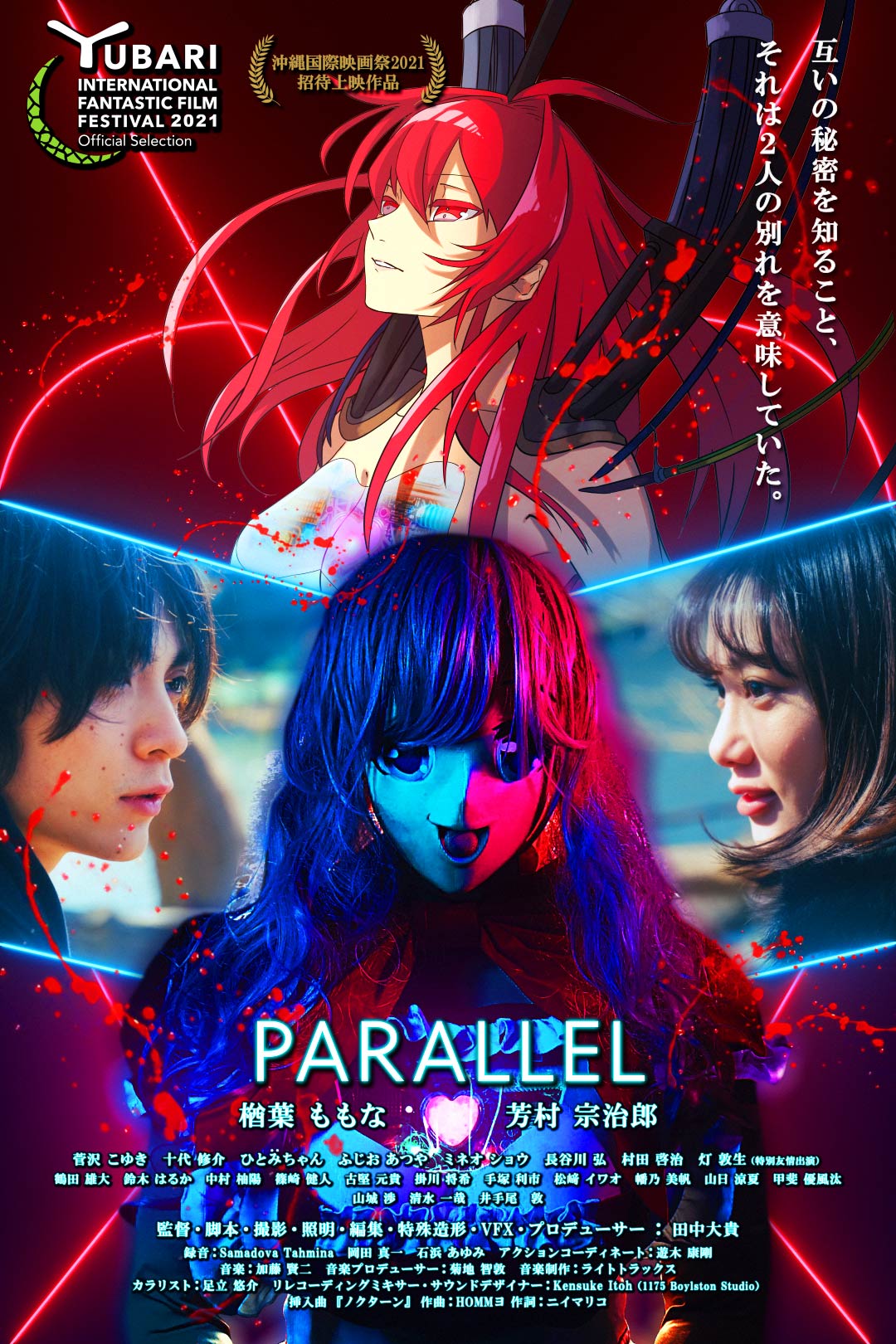
A wounded young woman in search of a protector and a nihilistic serial killer fight for the meaning of existence in Daiki Tanaka’s dark romantic drama, Parallel. Taking different paths out of a sense of “unworthiness” each look for ways out of this “rotten world” but find themselves mirroring the magical girl anime that inspires the killer’s desire for escape in discovering an uncomfortable sense of mutual salvation in the histories of their shared trauma.
Panning over a scene of scattered cosmetics and tangled wigs, the camera first lights on the sight of a bearded man gently stroking coloured hair before putting on lipstick in the mirror. We then transition to a scene of violence as a young girl is brutally beaten by her parents who later lock her inside a cupboard only for the cross-dressing man to turn up and kill them with a knife. The man spots the lock on the door and rescues the girl, giving his name as Shinji and asking in a soft voice if the girl, Mai, thinks he is beautiful. Mai nods tearfully, evidently viewing the killer as her saviour. Flashing forward a decade or so, Mai is a 20-year-old woman still haunted by her childhood trauma and captivated by reports of the “Cosplay Killer” who dismembers his victims and places lights inside to make them glow. The Cosplay Killer uploads photos of Shinji along with videos of his kills though it seems that Shinji was killed by police at the scene of Mai’s parents’ murder so the current killer is thought to be a copycat.
That turns out to be true and not. A very emo, nihilistic young man, Mikio is a manga artist working on a magical girl series in which humanoid robots developed as anthropomorphic weapons develop a sense of humanity after becoming “broken” through fighting an earlier iteration of themselves inspired by Shinji. Something similar happens to Mikio on encountering Mai. A sociopath with no sense of morality, he is confused by his innate connection with the wounded young woman apparently the only person he would not like to kill, which makes him think perhaps he should kill her.
Meanwhile, he secretly plots with a collection of similarly disaffected young men fed up with being made to feel inferior by this “rotten” world full of “trash humans” who can’t recognise people from machines. The present source of their ire is TV pundit Okudera who is a frequent commenter on the Cosplay Killer later going on a long rant about how anime should be banned for corrupting the minds of the youth seeing as they never had this kind of thing in their day. Backstage meanwhile he makes a point of humiliating his assistant, forcing him to get down on his knees and apologise for being “worthless” insistent that he should be grateful Okudera is training him so thoroughly when the rest of the world is so cold.
Mai too just wants to feel “worthy”, laughing about a rubbish date with her friend Kana in which a dating app hook up earnestly declared his love. Kana not unfairly thinks that might have been a little creepy but even though she doesn’t plan to see the man again Mai enjoyed the attention in the sense that in the moment she needed to feel desirable. That might be why she seems to be making a living through compensated dating, making the middle-aged man she hangs out with wear a wig to better resemble Shinji while he somewhat uncomfortably echoes the words of her abuser in making her say “I love you, Daddy” over a hug to end the session. He offers her more money for a pair of her used panties, but at present Mai thinks that’s a step too far.
Equally drawn to Mikio, Mai finds herself bonding with the “creepy” young man the pair of them baring their literal scars and then symbolically giving each other new ones with the aid of a box cutter. Mikio is obsessed with the idea of transformation but originally rejects his attraction to Mai because would it tie him to this rotten world rather than the better anime one his killing sprees allow him to escape into, his mangaka mentor later asking him why he can’t use love to transform himself and find new meaning, a kind of Earthly magic, in human connection but all of this is perhaps forgetting that Mikio is a man who stalks, kills, and dismembers his prey later explaining that unlike Mai no one came to save him from the abuse he too suffered and this was the way he freed himself. His concept of revolution has an extremely dark edge reminiscent of that pursued by angry, embittered young men radicalised by their sense of inferiority and so the otherwise touching affirmation from Mai that he has shown her the magical moment everything can change because they can create their own meaning in life has an unavoidable air of discomfort. A mix of slasher horror and emo teen romance, Tanaka’s giallo-esque neon-lit journey through a world of trauma and abuse allows its “broken robot” to find both peace and purpose but equally to avoid responsibility for his heinous violence.
PARALLEL streamed as part of Yubari International Fantastic Film Festival 2021.
Yoshitaro Nomura is best known for his crime films often adapted from the novels of Seicho Matsumoto though his filmography was in fact much wider than many give him credit for. Even so, 1980’s Writhing Tongue (震える舌, Furueru Shita) may seem an odd entry adapted from the semi-autobiographical novel by Taku Miki exploring the psychological torment of the parents of a little girl who contracts tetanus while innocently playing near a pond. Like the following year’s Call From Darkness, Nomura’s intense drama eventually shifts into the realms of psychedelia in the father’s strange fever dreams while lending this harrowing tale of medical desperation the tones of supernatural horror.
When five-year-old Masako (Mayuko Wakamori) seems to be under the weather, her mother Kunie (Yukiyo Toake) takes her to the hospital but is told by the disinterested doctor that she simply has a cold. This is a little surprising seeing as Masako’s main complaint is she that cannot open her jaw, probably the best-known indication of tetanus infection which is after all not so rare as to be easily missed by a medical professional. Still worried, Kunie keeps taking her daughter back especially once her leg becomes twisted leaving her struggling to walk, but the doctors that she sees don’t really listen to her, even implying that Masako is having some kind of early life breakdown because her father, Akira (Tsunehiko Watase), is overly strict with her. This may be in part because Masako, perhaps in fear, keeps saying that she could walk or open her mouth if she wanted but is choosing not to. In any case the true diagnosis is only discovered after the couple manage to get a referral from a friend to a larger hospital where the veteran professor (Jukichi Uno) quickly overrules his junior’s lack of concern to have Masako admitted right away later explaining that tetanus is a difficult disease to treat and unfortunately has a high mortality rate.
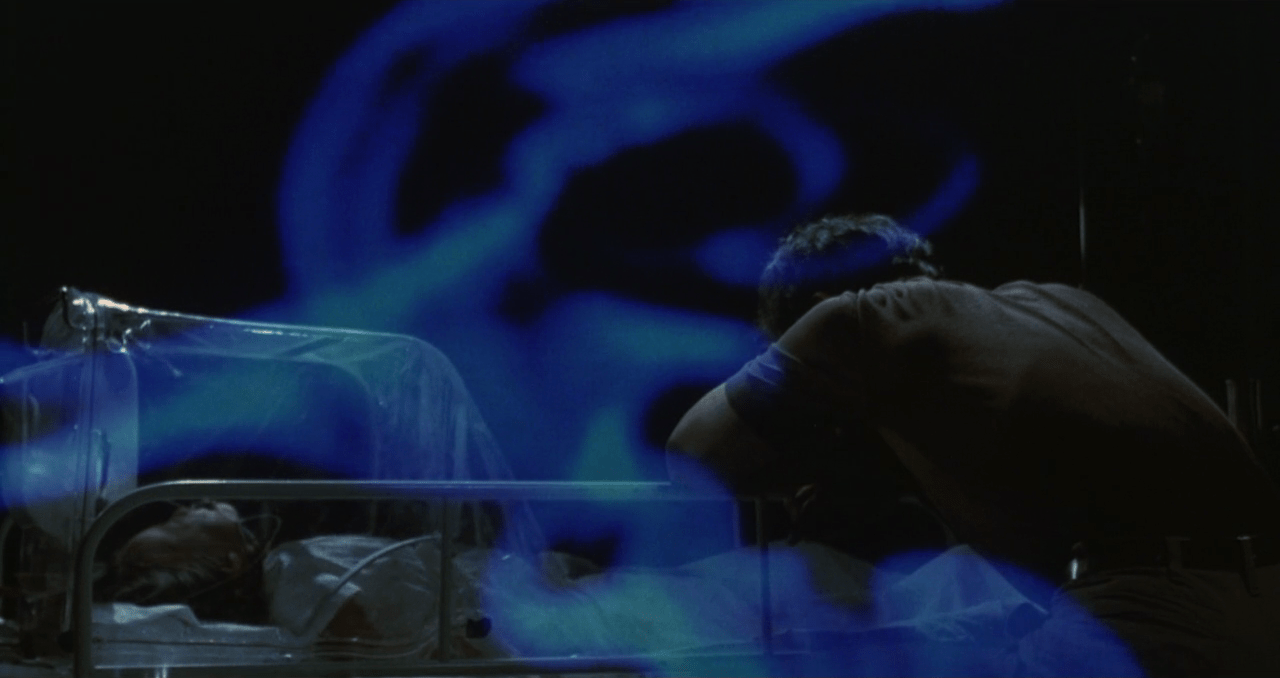
The treatment dictates that Masako receive as little stimulation as possible, lying in an entirely dark room with minimal noise so as to avoid the violent convulsions that accompany overstimulation and cause her to bite her tongue. As Akira later puts it, all they can do is wait trapped alone in the dark and tiny room with Masako entirely powerless to help her and with little knowledge of what exactly is going on. Meanwhile, despite having been repeatedly reassured that the disease is not transmitted in that way, Akira is convinced he may have contracted tetanus after being bitten by Masako while trying to prise open her jaw. Kunie too later worries that she also has tetanus, the pair of them sucked into a claustrophobic world of isolation and medical paranoia in which they are unable to sleep or find relief while watching over their daughter.
Some time later, Akira begins having bizarre psychedelic dreams recalling the time when he too was hospitalised as a child having contracted blood poisoning, remembering his own fear and confusion on being forced to endure “red injections” which he feared would “turn the whole world red” while the hieroglyphics he and his wife have been using to record Masako’s seizures dance before his eyes. He dreams of crows and blood rain while Kunie goes quietly out of her mind at one point threatening the sympathetic Doctor Nose (Ryoko Nakano) thinking it might be kinder to stop the treatment and let her daughter escape this excruciating pain. The utter powerless with which the couple are faced is filled with almost supernatural dread as if Masako had been possessed by some terrible evil, Akira attempting to speak directly to the bacteria asking them why it is they’re trying to colonise his daughter’s body and if they realise that in killing her they kill themselves too.
“It’s odd, our life. It’s so fragile” Akira sighs. All of this happened because of a tiny cut on a little girl’s finger the kind not even quite worth putting a plaster on and yet she might die from it. Convinced they all may die, Akira tells his wife to go home and put their affairs in order while she is so traumatised that she becomes unable to re-enter the room paralysed not out of physical disability but mental anguish. When Masako’s condition finally improves, Akira can hear his daughter crying that she’s frightened reminding him that he can never really understand the way she suffered through this terrible disease while all he could do was watch. A truly harrowing depiction of the hellish psychological torment of serious illness, Nomura’s occasionally psychedelic drama lays bare the fragility of life in a world of constant and unexpected dangers.
When is a ghost cat not a ghost cat? Drawing inspiration from classic folklore and kabuki theatre, the ghost cat movie had been a popular genre of pre-war cinema yet thereafter fell out of favour before a brief resurgence in the 50s and 60s. Inspired by the classic vampire cat legend, 1949’s Ghost Cat of Nabeshima (鍋島怪猫伝, Nabeshima Kaibyo-den) was part of a wave of post-war kaibyo yet in a slightly meta touch features no actual “ghost cat” leveraging instead the superstitious fear of their existence along with a mild prejudice towards otherwise supernaturally cute kitties.
Set in the feudal era, the central drama revolves around a weakened lord, a supposedly cursed Go board, and local hysteria about a dangerous ghost cat lurking round the palace that has the townspeople nervous enough to have organised a patrol on the look out for suspicious-looking felines. A store owner has recently taken in an ornate Go board which has sent his wife into a minor frenzy because it looks just like the one from the local temple which she knows to be haunted by the vengeful spirit of a man who was killed during a dispute over a particularly heated game. As such, she pushes him to sell it as quickly as possible which he does to a lower level samurai whose gaming companion is so weirded out by the bad vibes emanating from the board that he gives it away to villainous retainer Tanuma (Ureo Egawa). Tanuma then gifts it to the rather effete lord ignoring the advice of his noble rival Komori (Denjiro Okochi) that Go is bad for the lord’s health both mental and physical.
Komori may in a sense be proved right when, lacking a companion, the lord decides to summon Matashichiro (Haruo Tanaka) who is reputed to be a good player. Matashichiro is something of a Go obsessive and had been planning to leave for Edo in order to train with a true master partly it seems because he is carrying a chip on his shoulder as his family has been reduced in circumstances leaving him with few opportunities. On seeing the board, however, he appears to have something of an episode repeating the earlier tragedy in insisting the lord is playing “unfairly” before starting a fight during which the lord accidentally kills him, Matashichiro’s adorable black kitten Kuro leaving tiny bloody footprints as he scuttles away to relative safety glaring at the lord as he goes.
The lord thereafter develops an intense fear of cats, half-believing Kuro has become a bakeneko out to get him. All of this plays directly into the hands of Tanuma who is secretly plotting against the lord and hopes to capitalise on the ghost cat rumours while simultaneously making the lord seem mad in order to usurp and manipulate him. Tanuma had rejected concern over the cursed nature of the board insisting that “supernatural things don’t exist” while suggesting “weak government” is the reason such rumours were allowed to arise in the first place though it later becomes clear he too is manipulating them later sending out one of his minions in a ghost cat outfit with the instruction to cause trouble to keep the townspeople afraid. Komori, meanwhile, the good samurai later reminds the lord that he brought some of this on himself in his selfishness, failing to properly care for his subjects such as the rebellious Sanpei (Yataro Kurokawa) who openly disparages him while encouraging a peasant revolt in the face of samurai indifference.
In this, there is perhaps a message for the immediate post-war world in the peasants’ frequent mistaken assertion that greed is good and a necessary tool for survival, Sanpei and the others half-heartedly taking part in a cat cull ordered by the increasingly paranoid lord which creates further animosity towards the samurai authorities from local people who love their cats and won’t stand for their beloved pets being sold off and killed because of a bizarre rumour about a vengeful feline spirit. One of the reasons cited for the decline in popularity of the ghost cat film is that post-war audiences simply no longer took such things seriously and some of that flippancy is indeed seen in the attitudes of some of the townspeople who are quick to dismiss such ridiculous superstition. Yet there are ghostly apparitions only they’re very much human if perhaps mildly linked to feline activity, a dishevelled Matashichiro appearing in front of the lord to remind him of his crime while Tanuma does his best to cover it up. Here more than most, there’s a heavy implication that the spirits of the deceased are mere hallucinations of a guilty mind, but could the Go board really be responsible, it did provoke a violent rage in the otherwise dejected Matashichiro after all?
Then again, when the townspeople regain it, they realise the Go board is just a Go board experiencing very few supernatural incidents despite having it in their possession for over two months and as any cat owner knows, footprints on the tatami are hardly an unusual occurrence. “Did anyone actually see the ghost that everyone was fussing about?” a woman asks to confused silence before someone jokingly points at Matashichiro’s former girlfriend Otoyo (Michiyo Kogure) now guardian to the adorable Kuro looking like butter wound’t melt. Order has in any case been restored, the disruptive Tanuma’s schemes unmasked, the lord reminded of his proper responsibilities whether by supernatural intervention or not, and the townspeople laying aside their “greed” while rediscovering a sense of mutual solidarity not to mention affection for their feline companions. Playful to the last, Watanabe closes with a handheld zoom into the cute kitten sitting innocently atop the cursed board while the drunken townsmen snooze all around him in ominous tranquility.
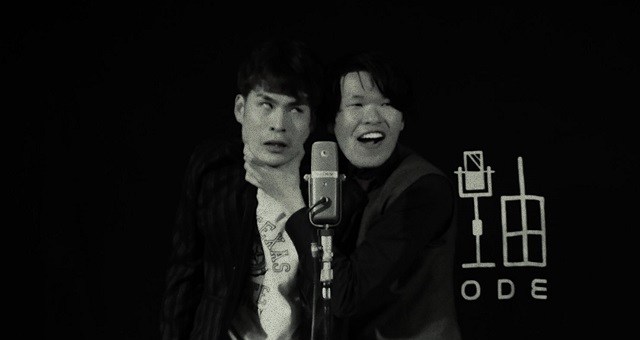
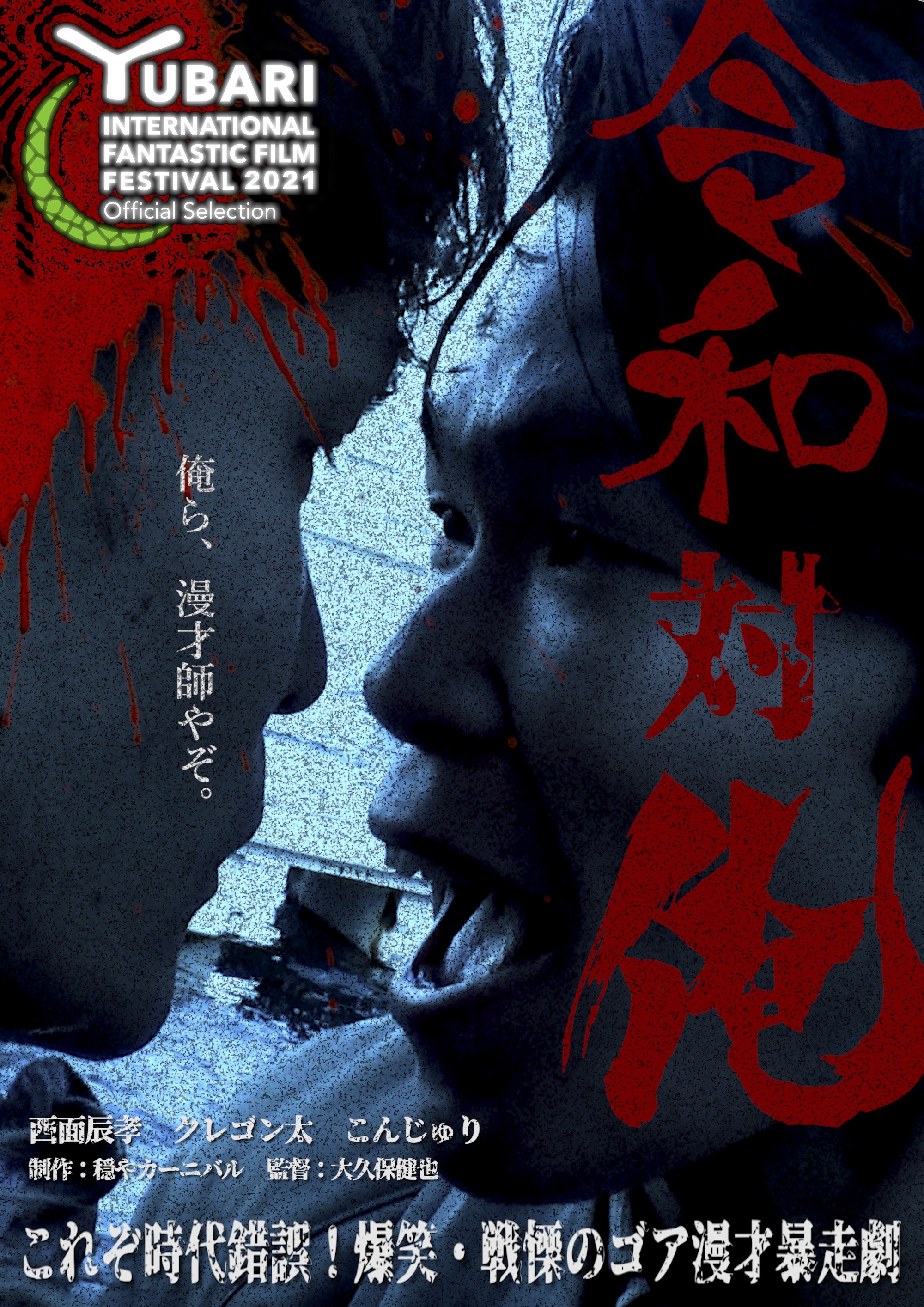
“There’s definitely nothing good about him at all” is the verdict on the Tsukaguchi, the irredeemable hero of Kenya Okubo’s eventually intense psychological drama MANZAI Conflict (令和対俺, Reiwa tai Ore). Not even his stage partner Kunimatsu is prepared to defend him as a person, but still refuses to end their partnership insisting that Tsukaguchi is funnier than he is though to everyone else evidence of Tsukaguchi’s funniness is thin on the ground. “Manzai” is a form of double act comedy particular to Japan often involving high speed, surreal narrative skits thrown back and for between the funny guy (boke) and straight man (tsukkomi). For these purposes, Tsukaguchi is the funny the guy in that he leads the narrative while Kunimatsu occasionally chimes in with a note of realism, but the problem is that Tsukagichi’s comedy, like the man himself, is stuck in the 1970s and his series of poor taste jokes simply aren’t very funny.
Okubo signals his intentions early on. The film opens with a riff on the classic Toei logo, a studio closely identified with the yakuza genre and most particularly of the 1970s. Even the opening credits are presented in classic blood red calligraphy just like those of a retro gangster picture though this is not a gangster film even if Tsukaguchi broodily walks about in a trench coat and three-piece suit, smoking away and generally behaving like a street thug angry at a world he doesn’t understand. When he and Kunimatsu, at this point calling themselves the Ashtray Brothers, are banned from the rundown, tiny comedy club where they usually perform because of one of Tsukaguchi’s off-colour routines, Tsukaguchi tracks down another performer who criticised his act and brutally assaults him in the street eventually getting arrested.
Tsukaguchi keeps harping on that he’s only one who truly understands manzai and everyone else is just a hack while the audience are simply too unsophisiticated to appreciate his art. We occasionally see brief flashbacks to the two men rehearsing which appear to show them laughing together happily suggesting that Tsukaguchi may have been conventionally funny at some point in the past when he wasn’t doing lewd routines about his grandmother’s sex life, but as a TV exec points out no one want a loose cannon like Tsukaguchi around which is why he’d like to hire Kunimatsu independently as a fill-in artist for his variety show. Loyal to the end, Kunimatsu resists and tries to bring Tsukaguchi with him, but the offer along with the failure of Tsukaguchi’s relationship with his live-in girlfriend whom he beats and attempts to rape, provokes a kind of crisis in the mind of the already troubled “comedian” born being forced to switch sides from funny guy to straight man now standing stage left rather than right.
After the TV show, which might not even be “real”, Tsukaguchi’s mental state becomes ever more fluid drifting between fantasy and reality in confronting differing versions of himself playing straight man to his girlfriend’s funny guy before snapping back to take out his masculine frustrations on the calmer Kunimatsu who has renamed their duo the “New Cigarettes” and written a much more conventional routine better suited to a variety show audience which ironically also includes an onstage wedding. “If you stray from the path of manzai I’ll fucking kill you” he dramatically declares, an abusive partner onstage and off seemingly fragile in his masculinity and intent on dominance unable to accept either of his partners creative or romantic has the right to break with him even as his internalised self-loathing fuels his continually destructive behaviour.
Yet Okubo in a sense refuses to condemn him. The film’s Japanese title translates as “Me vs Reiwa”, painting Tsukaguchi as a man who was simply born in the wrong time as if he’s a refugee from one of Toei’s grittier yakuza flicks where his intense misogyny and destructive male pride might have seemed even “normal” given the values of the time. Tsukaguchi literally defaces the modern society, beating it to a bloody pulp attempting to assert his own dominance while unable to escape his sense of impotence and futility. Shot in 4:3 and in a variegated muted colour scheme travelling from stark digital monochrome to a softened ‘70s grain, Okubo’s psychedelic psychodrama travels in a decidedly unexpected direction as its defiant anti-hero discovers that you can’t beat an era into submission.
MANZAI Conflict streamed as part of Yubari International Fantastic Film Festival 2021.
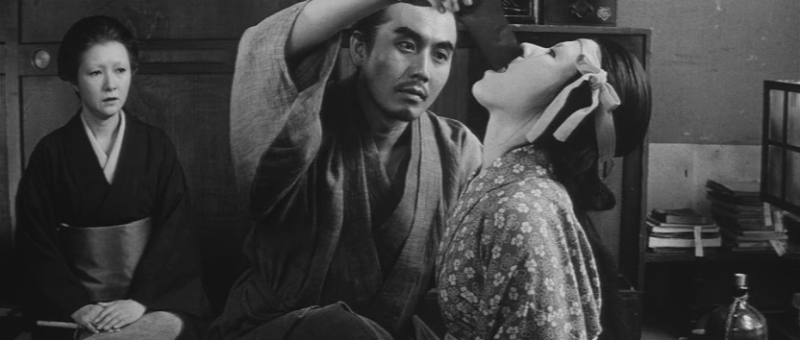
The close relationship between two women is disrupted by the reintroduction of a man in Yasuzo Masumura’s fictionalised account of the rivalry between the wife and mother of pioneering Japanese doctor Seishu Hanaoka. Scripted by Kaneto Shindo and adapted from the novel by Sawako Ariyoshi, the refocusing of the narrative is apparent in its title, not the life of but The Wife of Seishu Hanaoka (華岡青洲の妻, Hanaoka Seishu no Tsuma) less a tale of scientific endeavour than of domestic rivalry born of the inherently patriarchal social codes of the feudal society which cannot but help pit one woman against another while forcing each of them to play a role they may not wish to fulfil in order to secure their status and therefore their survival.
Samurai’s daughter Kae (Ayako Wakao) first catches sight of the beautiful Otsugi (Hideko Takamine) at only eight years old and is instantly captivated by her, a fascination which persists well into adulthood when she is approached to marry into the Hanaoka household as wife to oldest son Seishu (Raizo Ichikawa) away studying to become a doctor like his father. Kae’s father originally objects to the match because of the class difference between the two families, Seishu’s father Naomichi (Yunosuke Ito) being only a humble country doctor of peasant stock whereas they had envisaged a grander station for their only daughter. Yet Kae is already old not to be married and continues to decline prospective suitors and so her mother and nanny (Chieko Naniwa) are minded to put it directly to her discovering that she is in fact more than willing to become a Hanaoka though mostly it seems in order to get close to Otsugi whom she has continued to idolise.
The strange thing is that the wedding is conducted in Seishu’s absence, a medical text standing in for him while Kae in effect marries her mother-in-law Otsugi. These early days are spent in blissful tranquility as Kae does her best to be the ideal daughter-in-law, Otsugi even remarking that she’s come to love her more than a daughter. The two women share a room, Kae often staring longingly at the back of Otsugi’s head, their relationship one of mutual respect and affection that allows them to forget their respective stations but when three years later Seishu finally returns, it forces them apart in reverting to the roles of wife and mother their statuses conferred only by proximity to a man.
Pregnant with her first child and about to become a mother herself, Kae’s resentment towards Otsugi begins to boil over. In an ironic premonition of the way the relationship between Masumura and his muse would eventually break down, she claims to have seen through Otsugi’s beauty and concluded that she is cold and calculating believing that she only brought her into the household as an unpaid servant forcing her to work a loom to raise money for Seishu’s medical training. Alternately jealous and condescending, Otsugi’s resentment is mediated through attempts to undermine her daughter-in-law’s authority finally leading to an ironic and absurdist battle between the two as they attempt to outdo each other volunteering to become test subjects for Seishu’s ongoing experiments to discover a safe anaesthetic in order save patients who require surgery but cannot endure the trauma.
The marriage itself perhaps represents a moment of change in the feudal society, it becoming clear that the samurai are on their way down while skill and knowledge will define success in this new age of enlightenment. While Seishu works on his anaesthetic, the superstitious local community begins to view the Hanaokas with suspicion, believing that the misfortune that befalls them is the result of a curse owing to the large number of cats and dogs which have become casualties of Seishu’s failed experiments while a pedlar brings news of a mysterious disease attributed to the rain which is in fact due to mass malnutrition following a famine caused by the bad weather. When news of Seishu’s prowess as a doctor spreads they are soon overwhelmed with patients, many of whom cannot pay but are seemingly treated anyway.
Seishu’s eventual victory is one of science over superstition, but it also requires faith which is the battleground contested between wife and mother. Having found a successful solution in cats, Seishu needs human test subjects with both instantly volunteering only to become locked into an absurd, internecine contest to prove who is the most self-sacrificing. The competition goes so far that it effectively becomes a game of dare with each determined to be the one to die for Seishu’s discovery but later realising that the stakes are even higher than first assumed because the winner will be dead but the loser saddled with guilt and possible ostracisation as someone who allowed their mother/daughter-in-law to die to in their place.
Even so, the pair of them are described as “wonderful examples of womanhood” in their willingness to risk their lives for their “master’s success”. Kae is reminded that a woman’s job is to give birth to a healthy baby, later weaponising her ability to do so as currency in realising that Otsugi has all the control but the one thing she can’t do is bear Seishu’s child. Ironically enough, the cases Seishu is trying to treat are of aggressive breast cancer, the oft repeated maxim being that a woman’s breasts are her life and to remove them is as good as killing her contributing to the sense that maternity is the only thing that gives a woman’s life meaning. It’s not without irony that the first successful surgery under anaesthesia directly juxtaposes a massive tumour removed from a woman’s breast with a baby being removed from a pregnant Kae who, at this point having lost her sight as a consequence of Seishu’s experiments, must bear the pain with no relief.
Brought together by tragedy, Kae comes to a better understanding of her relationship with her mother-in-law only after she dies learning to see her once again as the kind and beautiful woman she met at eight years old while her unmarried sister-in-law having witnessed their painful war of attrition prays that she won’t be reborn as a woman glad that she was never forced to become a bride nor a mother-in-law. “The struggles of the women in this house were in the end just to bring up one man” she laments, suggesting that Seishu most likely noticed the conflict between the two and used it to his advantage in getting them to participate in his experiments as they desperately tried to prove themselves the better through dying for his love.
Going one step further, it seems that being a woman is an exercise in futility the only source of success lying paradoxically in birth or death alone, the natural affection between Otsugi and Kae neutered by the presence of Seishu who inserts himself as the pole around which they must dance for their survival. Kae becomes a local legend, a woman who sacrificed her sight in service of her husband but now rejects this mischaracterisation of her life along with the implication that it’s somehow a wife’s duty to deplete herself for her husband’s gain retreating entirely from the society of others while Seishu’s practice continues to prosper. Even so Masumura ends on a note of irony in the literal transformation of Kae into the figure of Otsugi recreating the opening scene as she walks among the bright flowers she can no longer see.
It may be one thing to live profoundly in the moment, but if you have no memory of yesterday and know you’ll have no memory of today tomorrow can you really say that you “exist”? The hero of Takayoshi Shiokawa & Kanta Tomatsu’s Scherzo (スケルツォ) believes that he’s born every day and dies every day, his mind wiped clean each time he sleeps but how can you learn to find meaning in a life so defiantly brief in which you have no past or future?
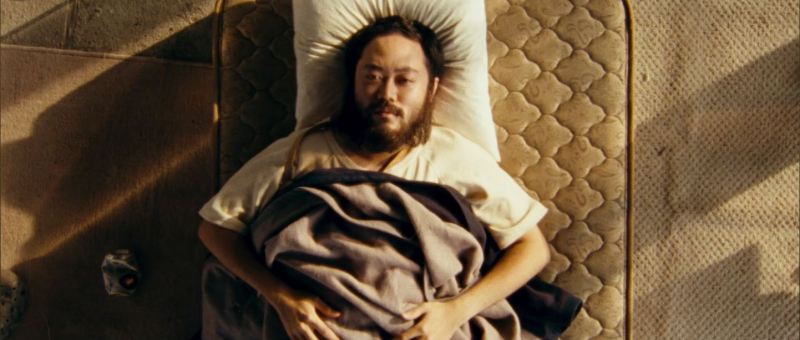
Then again, according to a random man in a laundrette people only start thinking about the value of life in order to avoid thinking about how bad their lives are currently when the real answer is to concentrate less on whether your current life has value and more on how to lead a better one. For “Koji” however, a name he chose for himself, the question may be moot. He wakes up every day on a stained mattress in a partially exposed rooftop flat with a sign above telling him to look at the wall where he’s explained to himself that his memory resets every day. A selection of polaroid photos feature the same young woman who also appears in a video tape playing on a nearby TV though Koji doesn’t know who she is. Taking the video camera with him he walks out into the town recording his every movement in lieu of his ability to remember and lives as if there’s no tomorrow because in a sense there isn’t. His first few days he hangs out in a hostess bar where he can’t pay the bill, robs a pizza man, and visits a sex worker for some existential chit chat abandoning the rules of morality in the knowledge that there can be no consequences because he dies by night and his existence is futile.
All that begins to change, however, when he encounters a woman, Hinako, who looks like the one in his photos and appears to be suffering from the same condition as himself. Bonding with her slowly though neither of them can recall the other, Koji suddenly wants to find a way to remember certain that logically they are here today because of something that happened yesterday because of all the yesterdays that came before.
Scherzo literally means “joke” in Italian, and you could indeed read Koji’s predicament as a bizarre cosmic prank otherwise unexplained in its absurdity. Yet it’s perhaps also a metaphor for the mutability of memory and elusiveness of love as much as in its usage in classical music a playful allusion to the self-contained brevity of his daily lives. He feels an innate connection to Hinako, as if he must have known her before but simply can’t remember. Even the most essential of emotions, love, can it seems be forgotten or gently fade away even if, as in the bar hostess’ melancholy ballad, something of it remains when everything else is gone. This is in one sense at least, a story of a couple who’d fallen out of love, or perhaps taken it for granted to extent that they’d almost forgotten it was there, rediscovering their feelings for each other and discovering in them a meaning for life.
Meanwhile, Koji obsessively records all of his actions, filling 40 DV tapes of a sleepless road trip with Hinako, as if a physical recording could be more accurate than an organic memory. Memory is of course subjective and you can never know what it is you’ve forgotten whereas a tape maybe tampered with or faulty but supposedly contains objective truth though even that has a subjective quality simply by virtue of who recorded it and how. Nevertheless, if you can forget love, does memory really count for anything at all? Koji thinks he dies every day, but like Alice in Wonderland no one except for Koji is the same person they were yesterday or will be tomorrow. He can’t change or grow and has only the same version of himself to offer imperfect guidance. Nevertheless it’s love that in a sense restores his identity, gives him the will to remember, and makes it possible for him to live in the shadow of tomorrow rather than in an eternal present. Shot with a deadpan absurdism, Takayoshi Shiokawa & Kanta Tomatsu’s dryly humorous drama eventually concludes that it’s the memory of love, even if old or faded or failed, that gives life meaning allowing its anxious hero to move forward in finally regaining a sense of self if reflected in the eyes of another.
Scherzo streamed as part of Yubari International Fantastic Film Festival 2021.
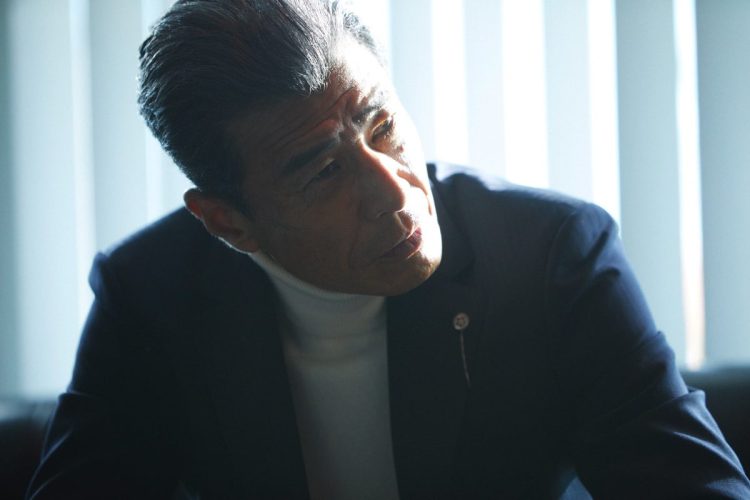
Presented by the Association of Tokyo Film Journalists, the Blue Ribbon Awards has announced its nominations for the 64th edition honouring films released in 2021. Ryusuke Hamaguchi’s international festival hit Drive My Car picks up five nominations as does Michihito Fujii’s A Family with both Hayato Isomura and Hiroshi Tachi nominated in the supporting actor category, while Yuya Ishii’s A Madder Red and Kazuya Shirashi’s Last of the Wolves also make a strong showing. Like last year, the physical awards ceremony has been canceled due to the ongoing coronavirus pandemic though the winners are expected to be announced in mid-February.
Best Film
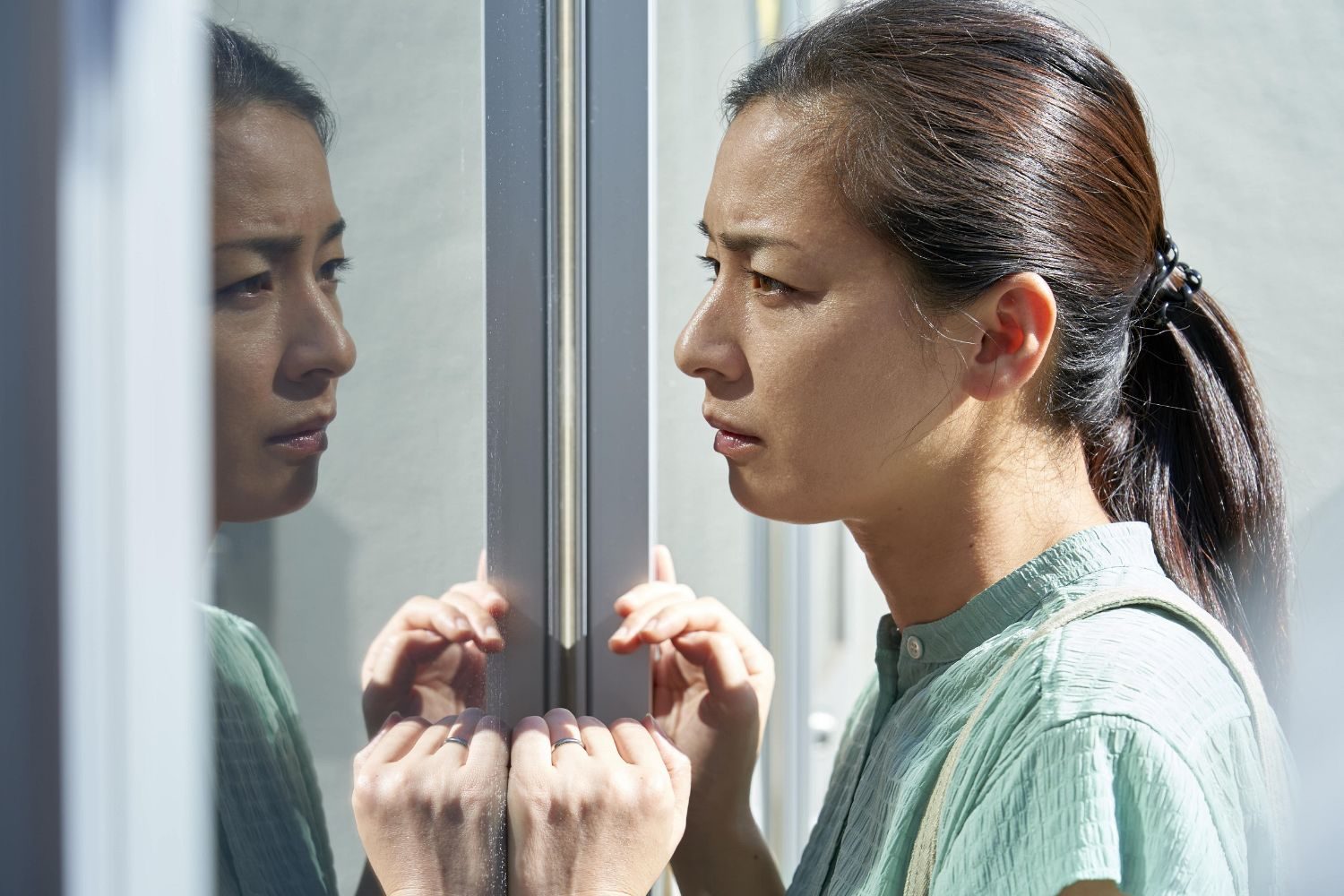
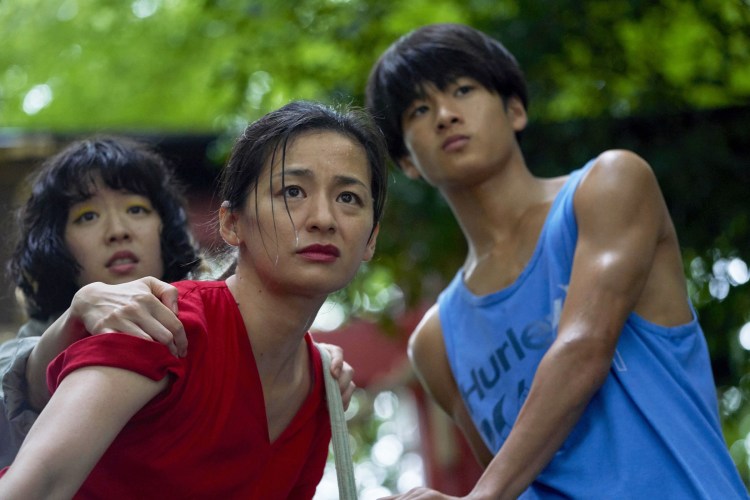
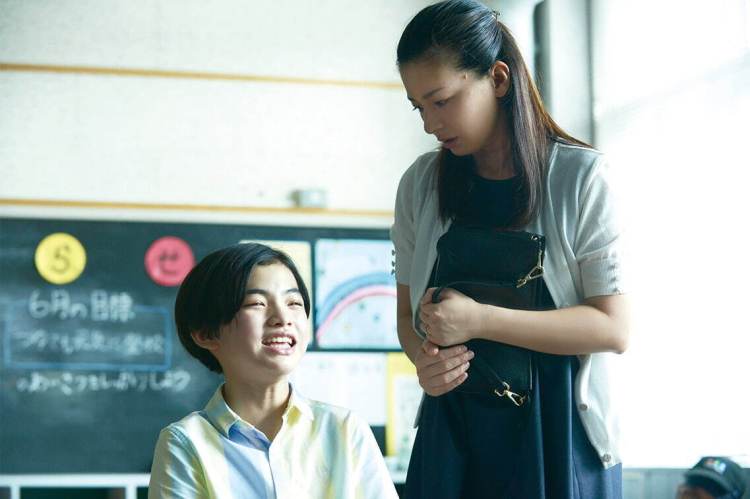
A Madder Red – latest from Yuya Ishii starring Machiko Ono as a widowed single mother struggling under a highly stratified society in the midst of the coronavirus pandemic.
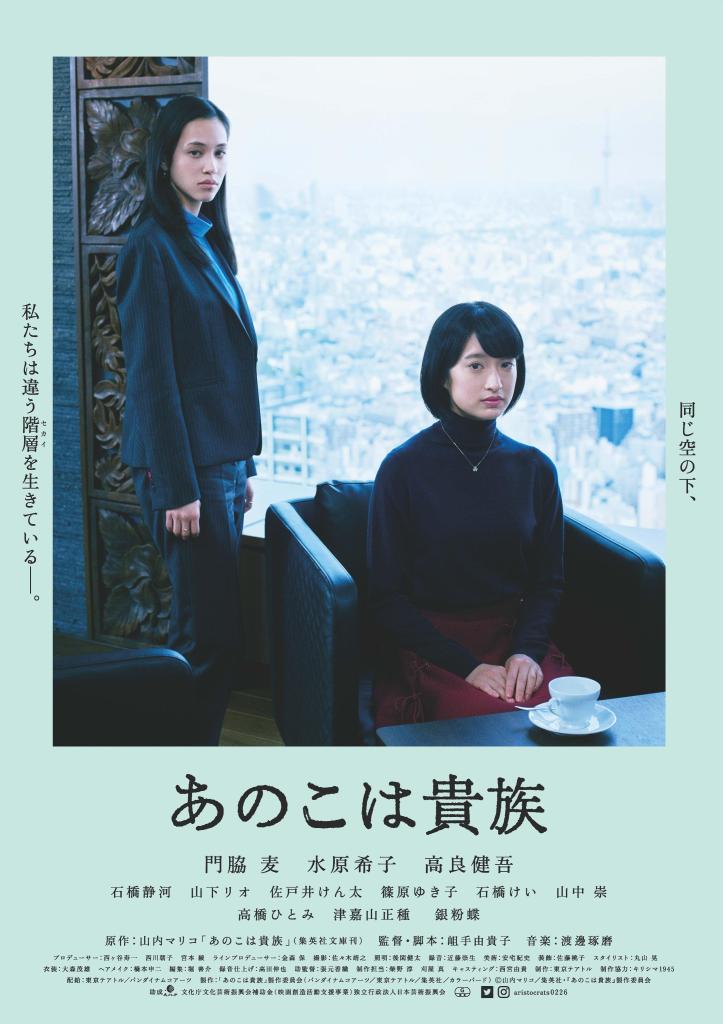
Aristocrats – two women involved with the same man eventually find interclass solidarity in Yukiko Sode’s empathetic critique of a highly stratified and fiercely patriarchal society.
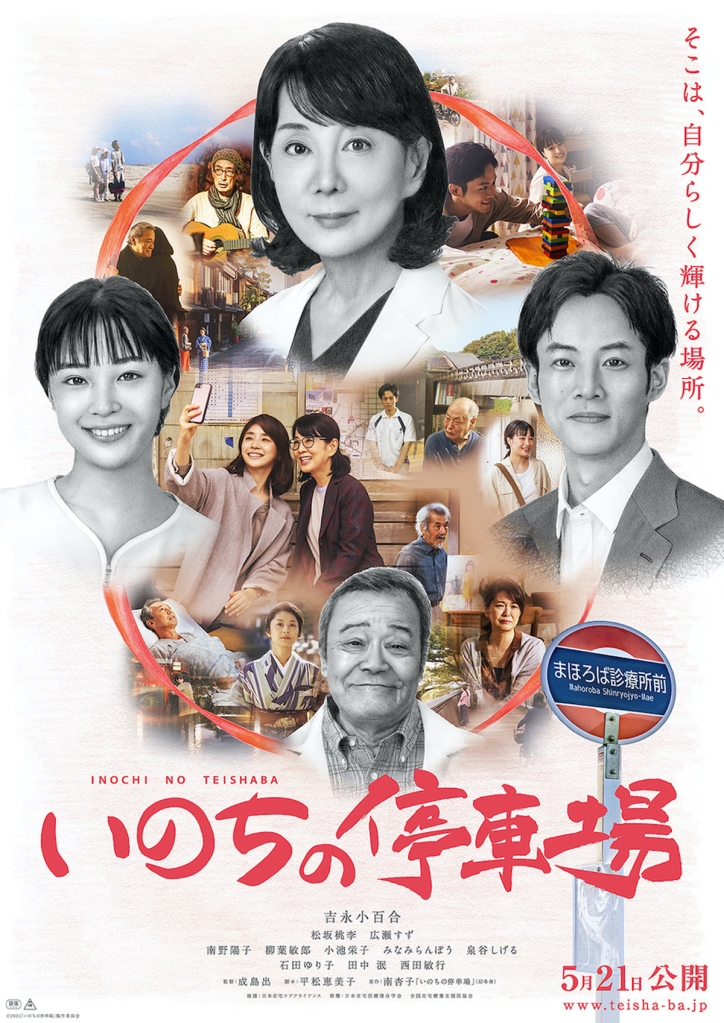
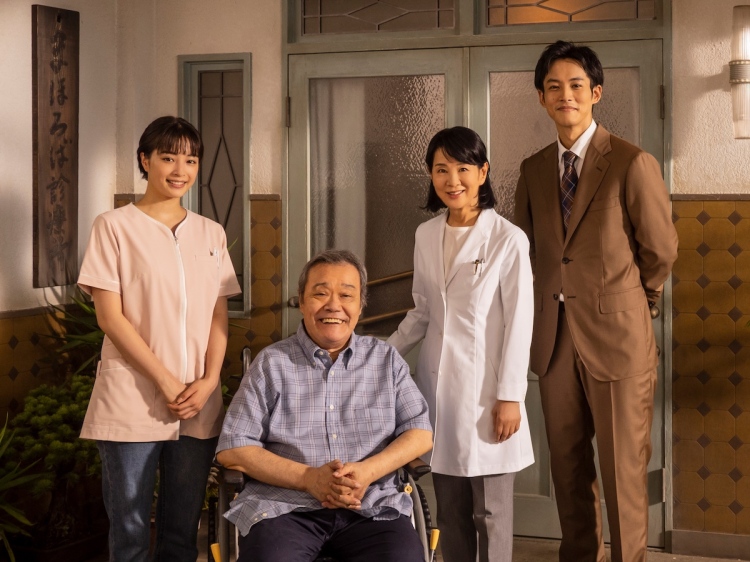
A Morning of Farewell – melodrama from Izuru Narushima starring Sayuri Yoshinaga as a doctor who returns to her hometown and begins working in a local clinic.
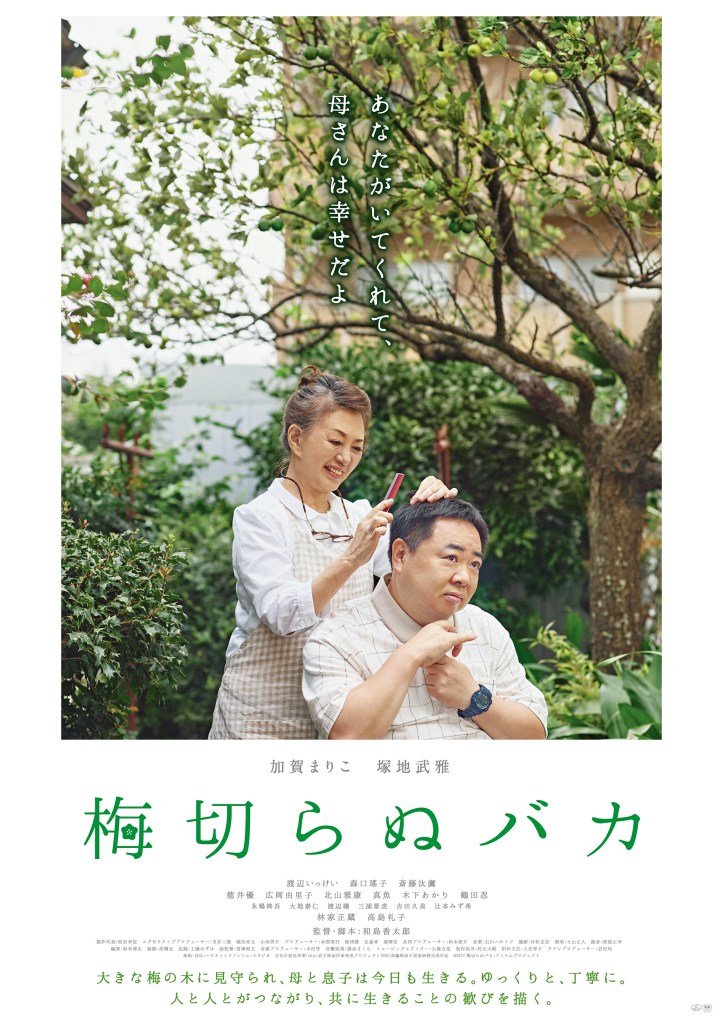
The Lone Ume Tree – ’60s New Wave icon Mariko Kaga stars as an ageing woman caring for her autistic son but worrying what will happen when she is no longer able to look after him.
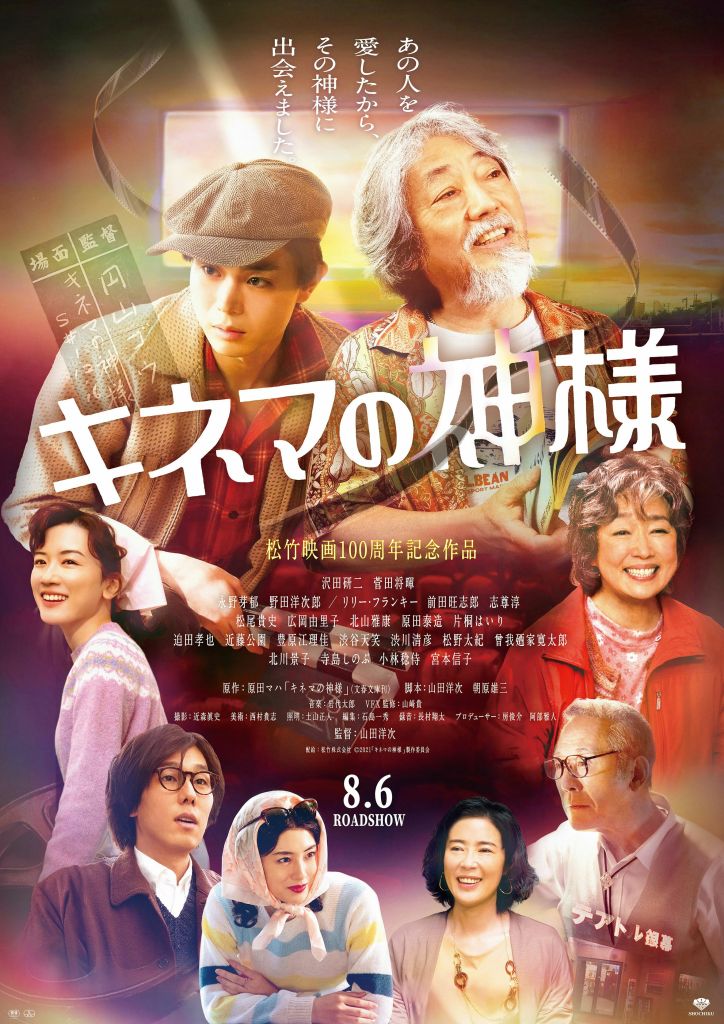
It’s a Flickering Life (God of Cinema) – Yoji Yamada’s adaptation of the novel by Maha Harada starring Kenji Sawada as an ageing movie obsessive with a gambling problem looking back on his younger self (Masaki Suda) and broken cinematic dreams
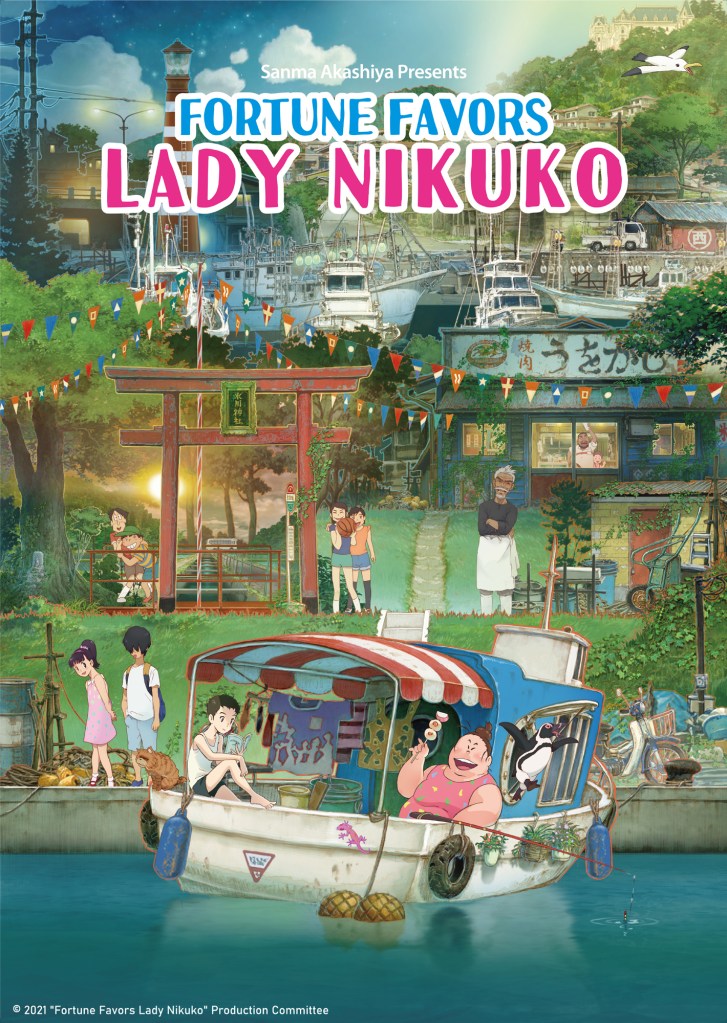
Fortune Favors Lady Nikuko – a resentful teenage girl comes to realise that she really does love her larger than life mum after all in Ayumu Watanabe’s anime adaptation of the Kanako Nishi novel.
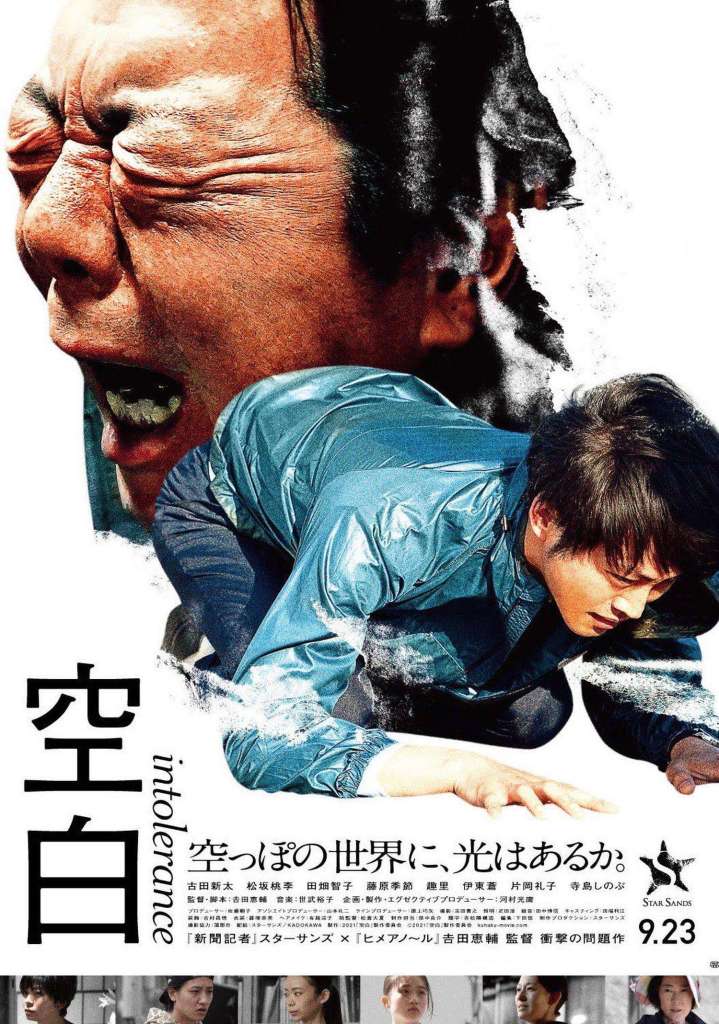
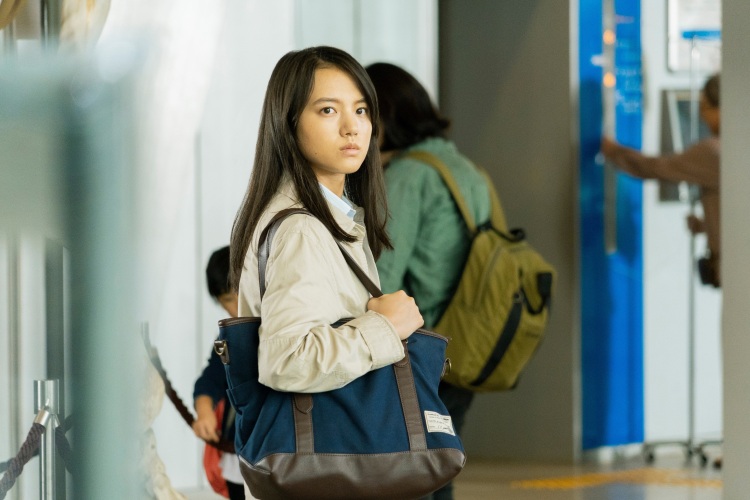
Intolerance – drama from Keisuke Yoshida starring Tori Matsuzaka as a supermarket manager whose attempt to catch a teenage shoplifter ends in tragedy while her father (Arata Furuta) relentlessly pursues vengeance.
Last of the Wolves – no longer an earnest rookie, a corrupted Hioka attempts to keep the peace in Heisei Hiroshima in Kazuya Shirashi’s Blood of Wolves followup.
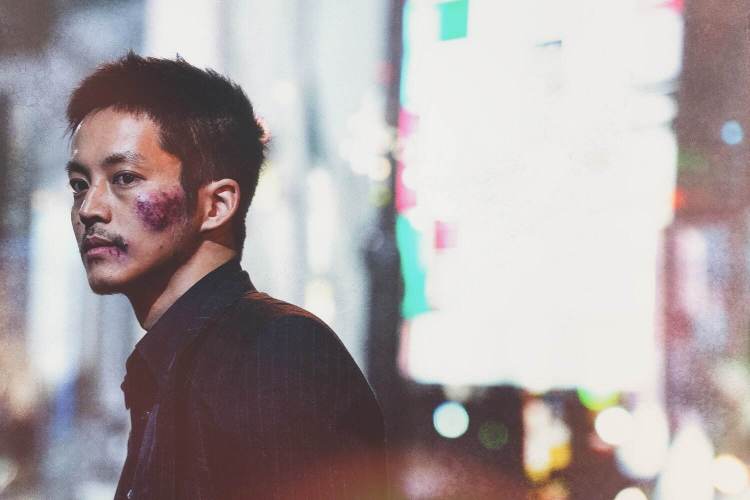
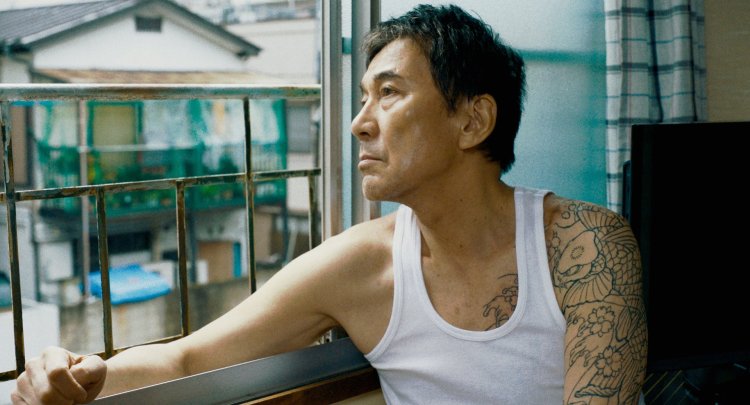
Under the Open Sky– a pure-hearted man of violence struggles to find his place in society after spending most of his life behind bars in Miwa Nishikawa’s impassioned character study.
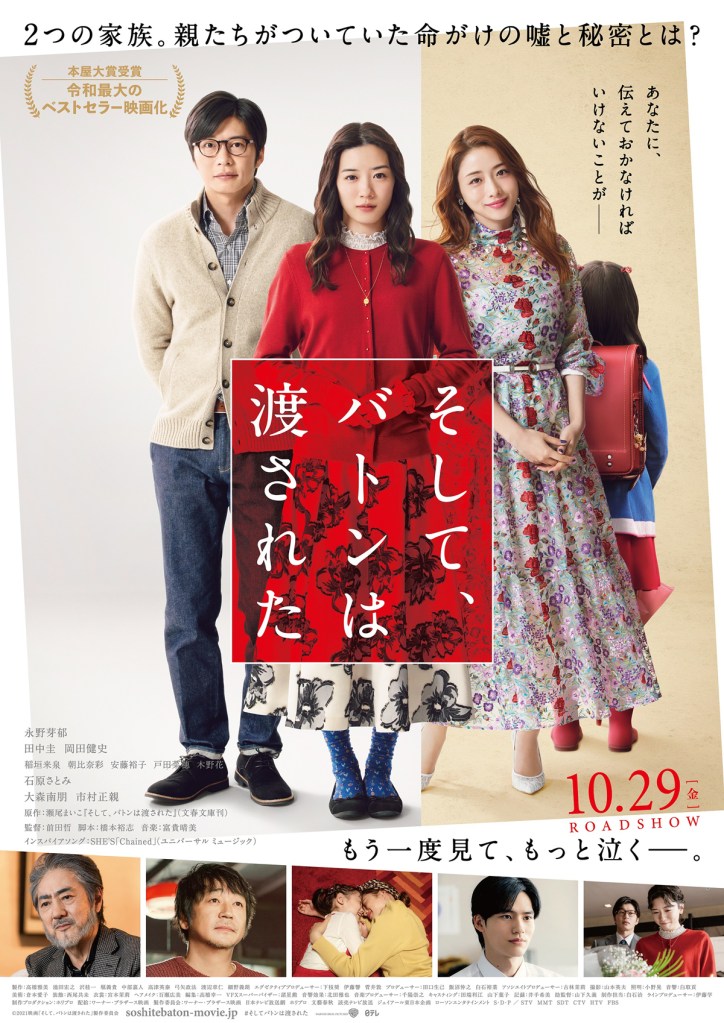
And, the Baton Was Passed – comedy from Tetsu Maeda (A Banana? At This Time of Night?) revolving around the close relationship between a high school girl and her step dad.
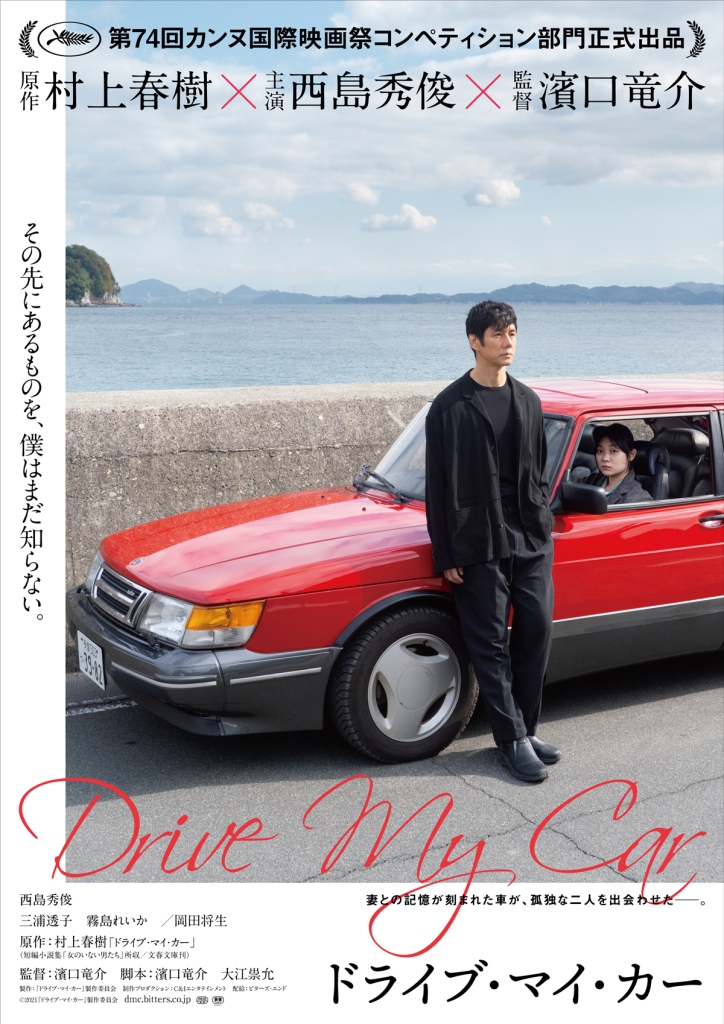
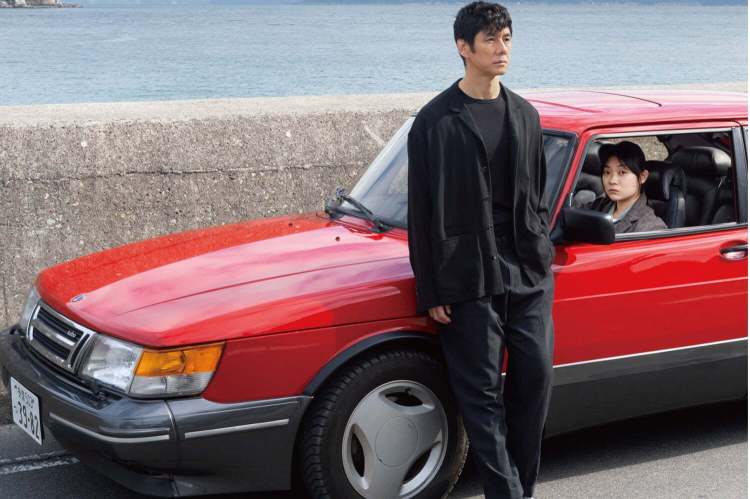
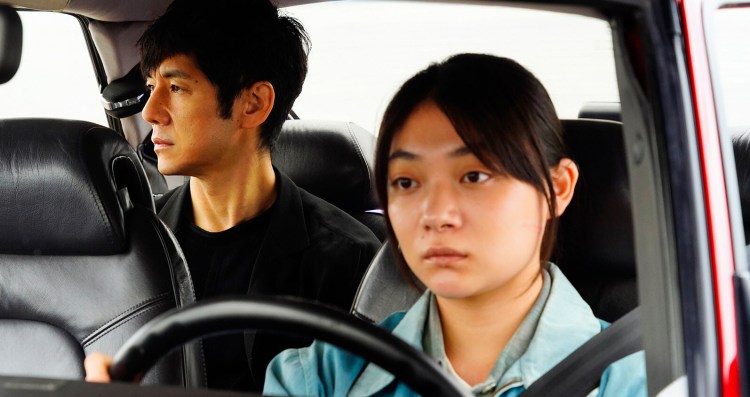
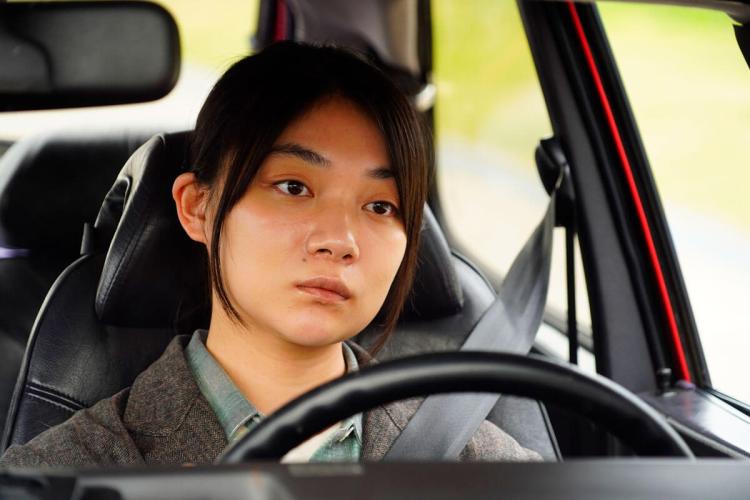
Drive My Car – a theatre director begins to overcome his sense of inertia after bonding with a young woman hired to drive his car in Ryusuke Hamaguchi’s deeply moving drama.
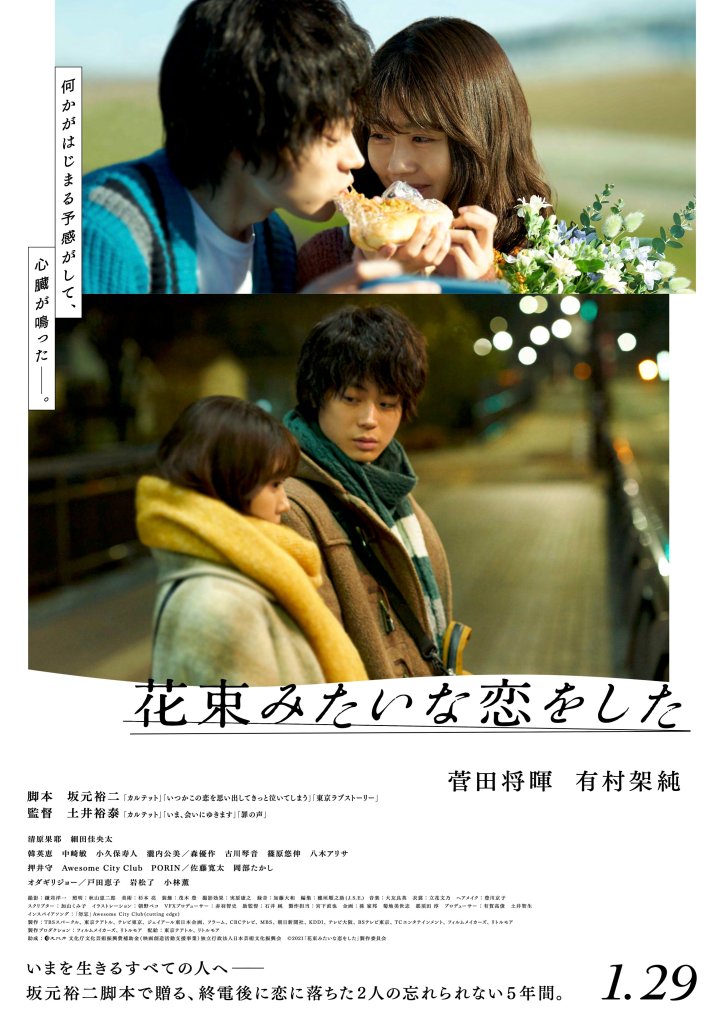
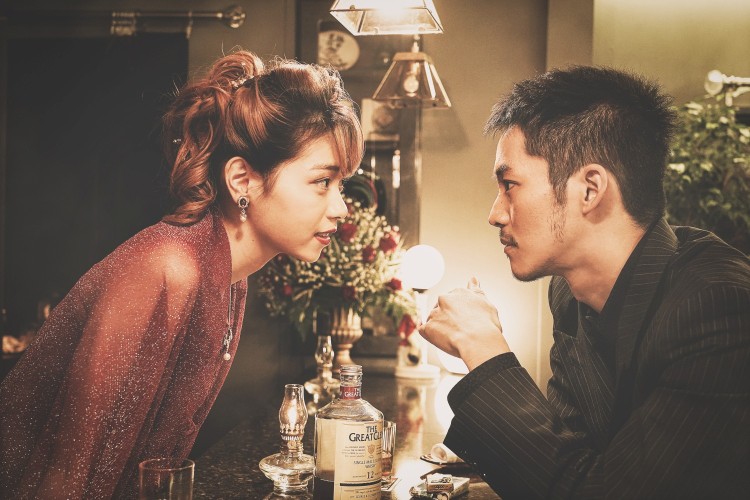
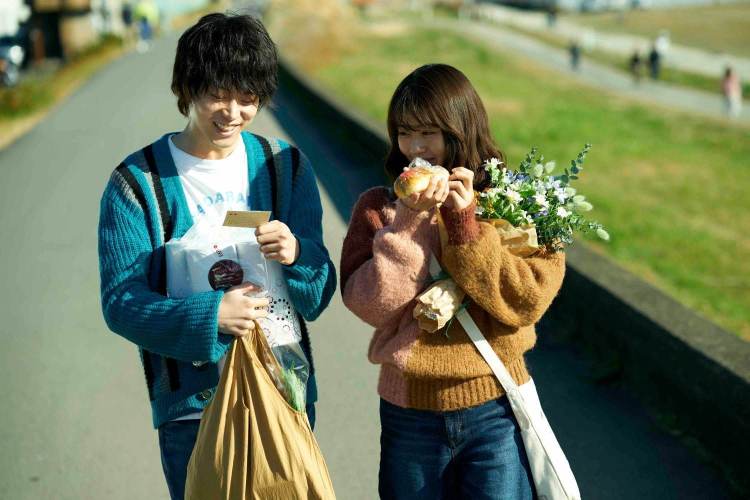
We Made a Beautiful Bouquet – romantic drama from Nobuhiro Doi (Flying Colors) starring Masaki Suda and Kasumi Arimura as a young couple who meet after missing the last train home.
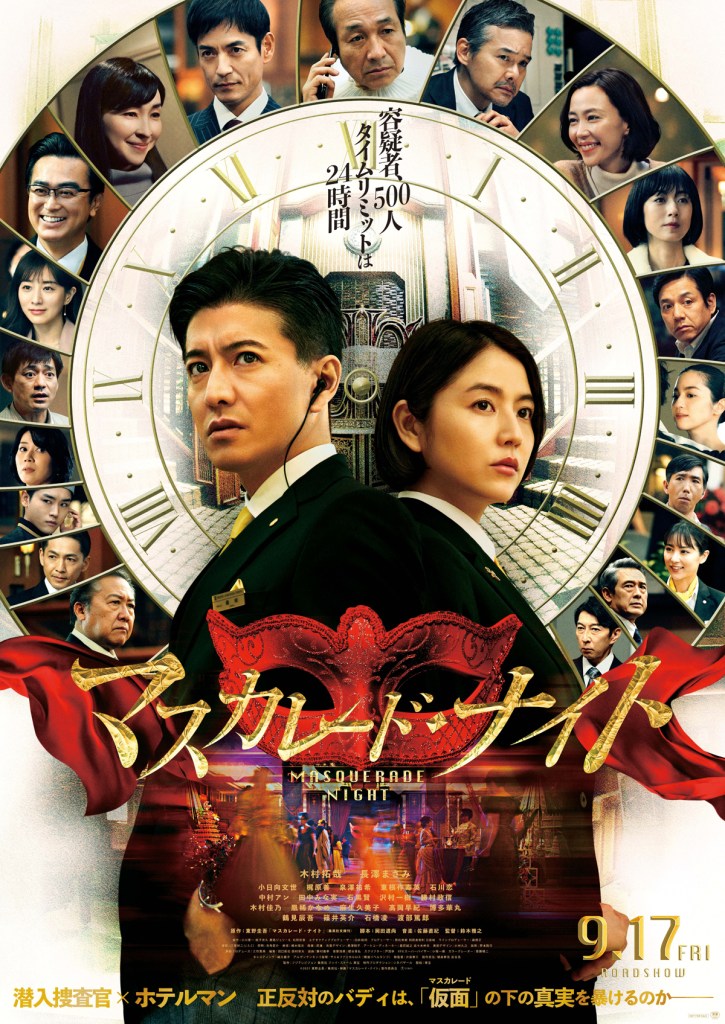
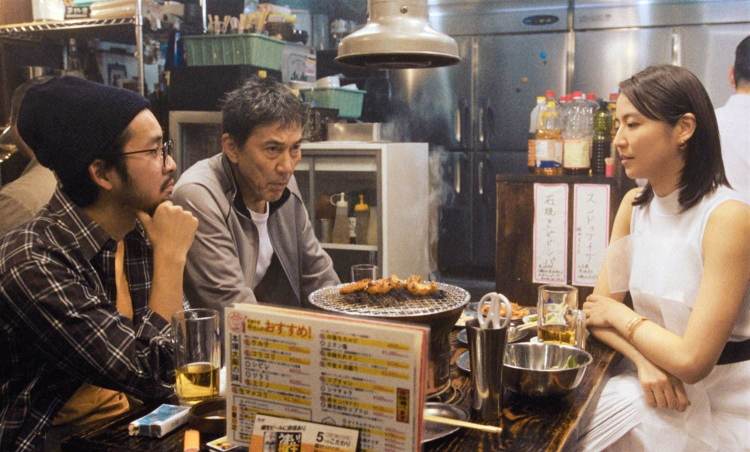
Masquerade Night – sequel to the hugely popular Masquerade Hotel starring Masami Nagasawa and Takuya Kimura.
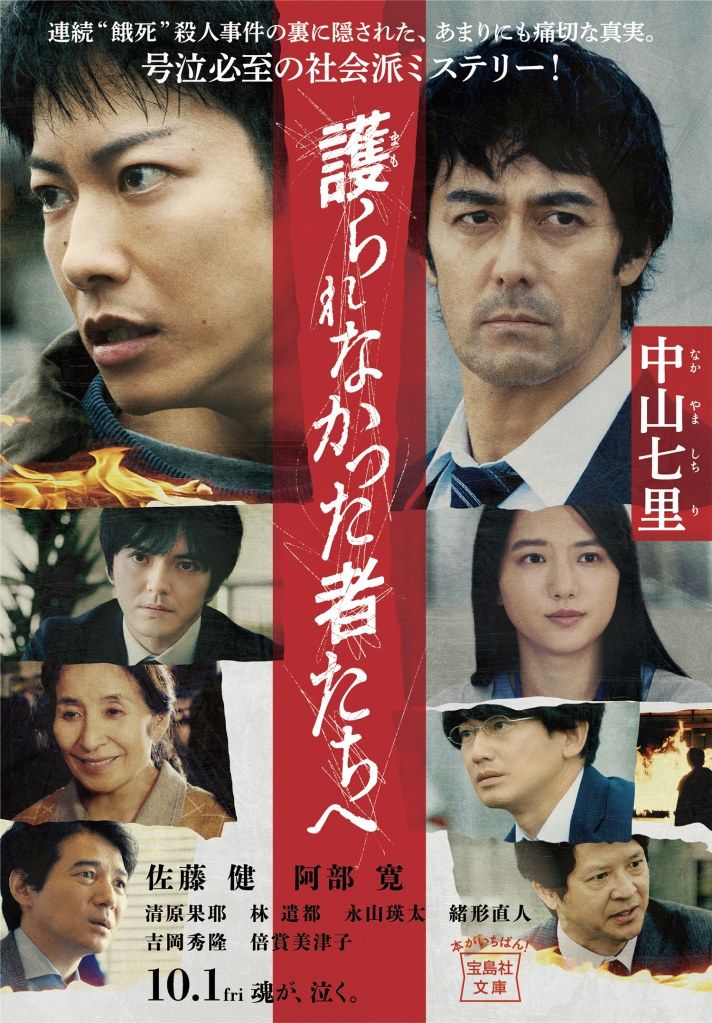
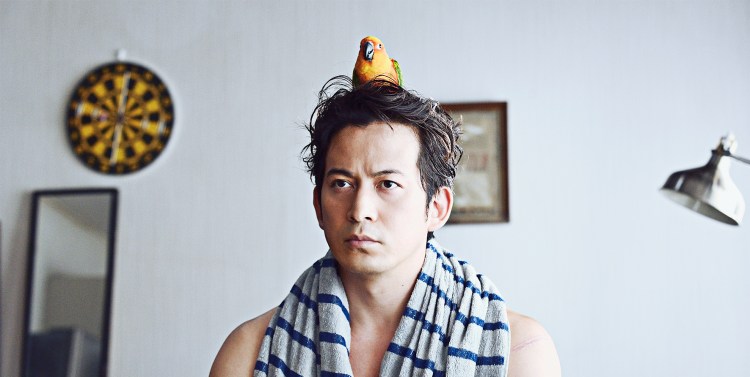
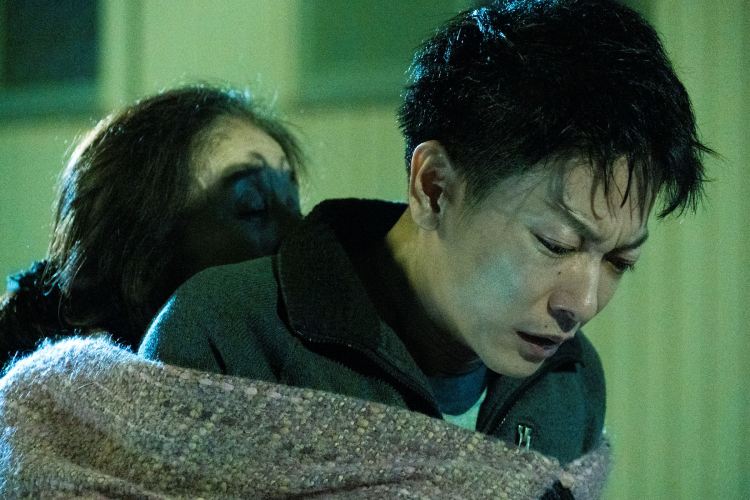
In the Wake – mystery drama from Takahisa Zeze starring Hiroshi Abe as a detective hot on the trail of suspect Takeru Satoh
Baragaki: Unbroken Samurai – historical drama from Masato Harada starring Junichi Okada as Shinsengumi Vice-Commander Hijikata Toshizo
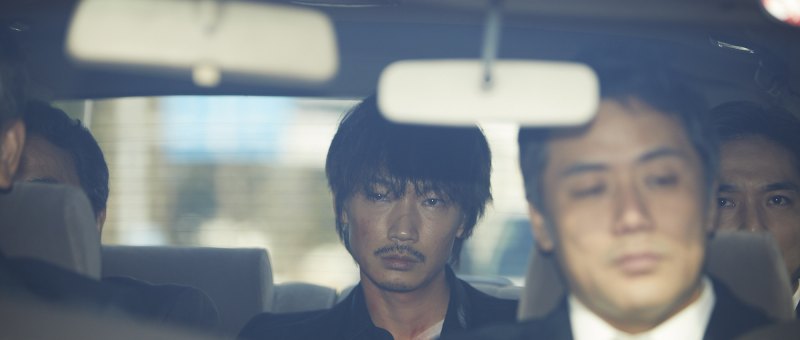
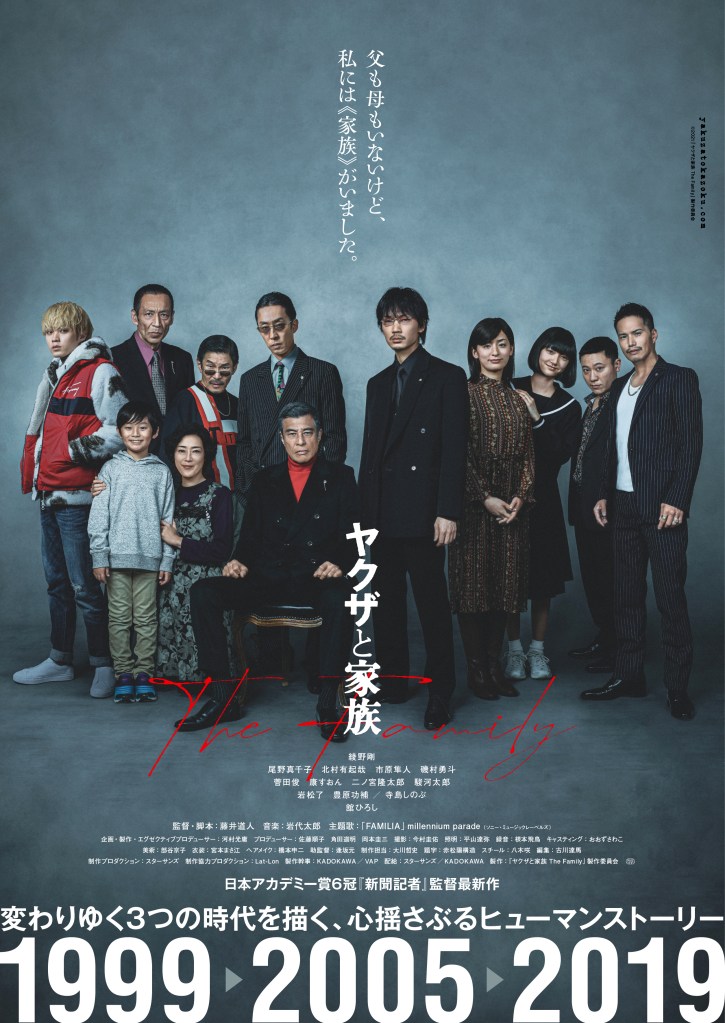
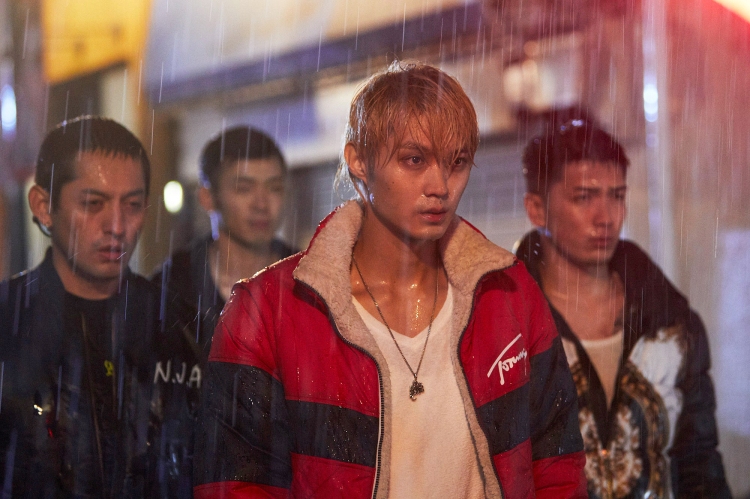
A Family – Michihito Fujii’s contemporary yakuza epic starring Go Ayano
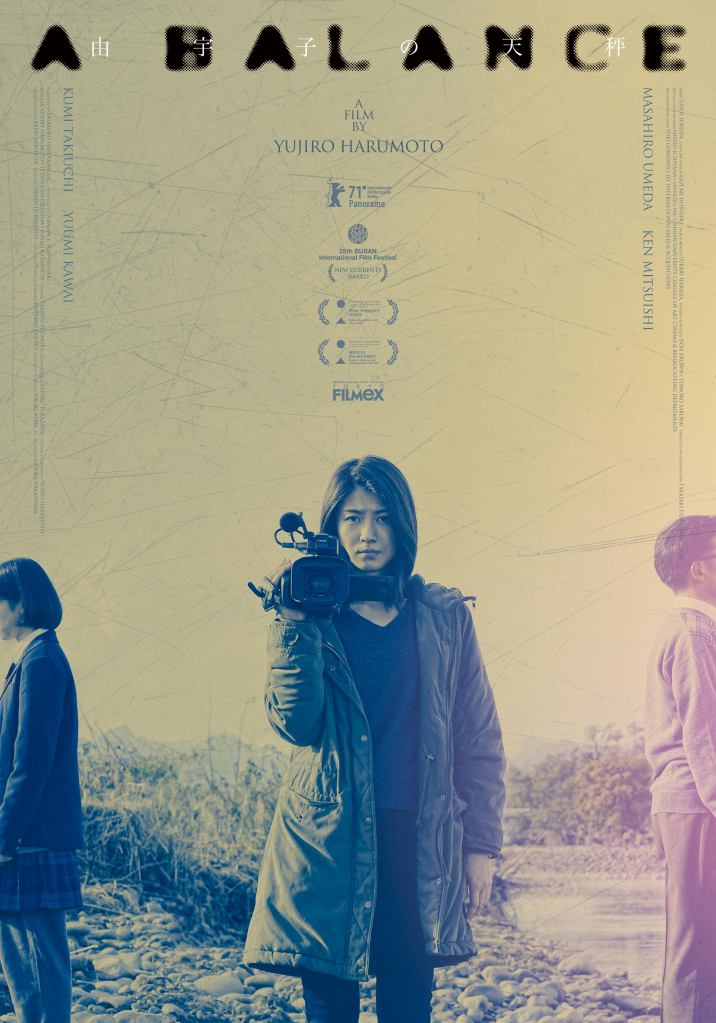
A Balance – an idealistic documentarian’s journalistic ethics are strained when she uncovers scandal close to home in Yujiro Harumoto’s probing social drama.
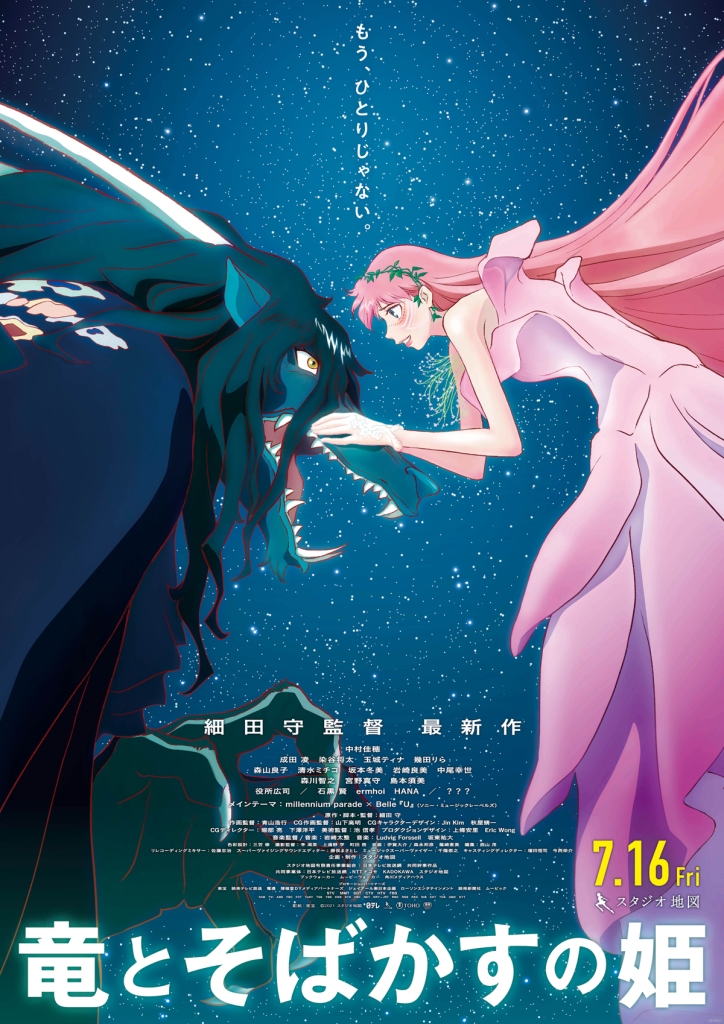
Belle – Mamoru Hosoda reinterprets Beauty and the Beast as a grieving young woman becomes an in-app idol star but is also threatened by the presence of a mysterious dragon.
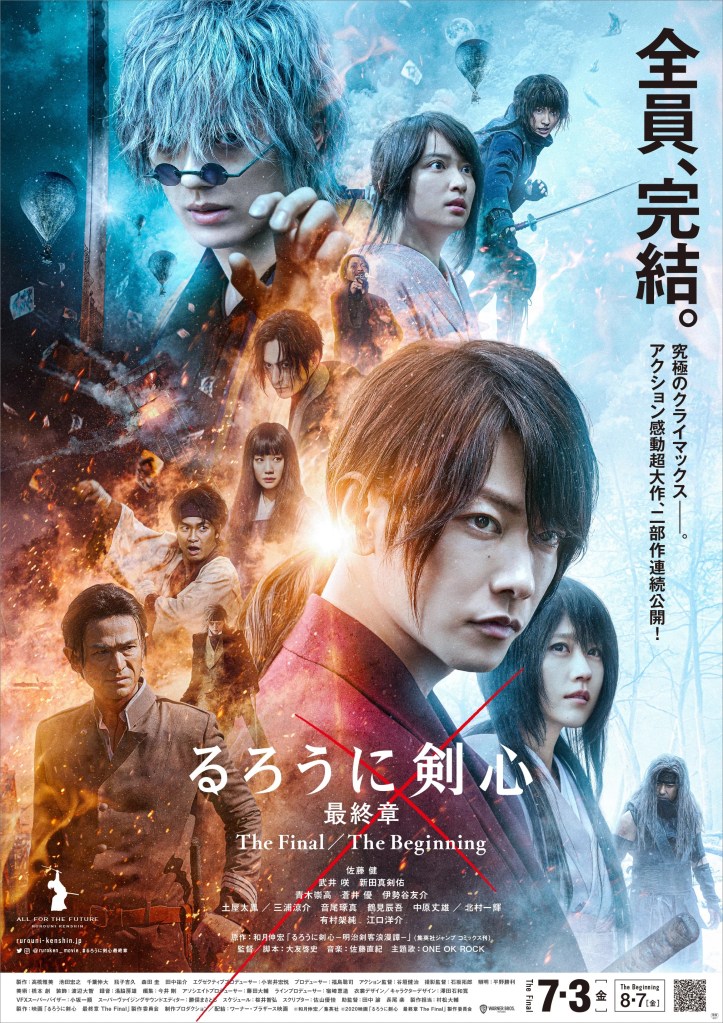
Rurouni Kenshin: The Final – concluding chapter of Keishi Ohtomo’s manga adaptation starring Takeru Satoh as the former assassin turned wandering protector.