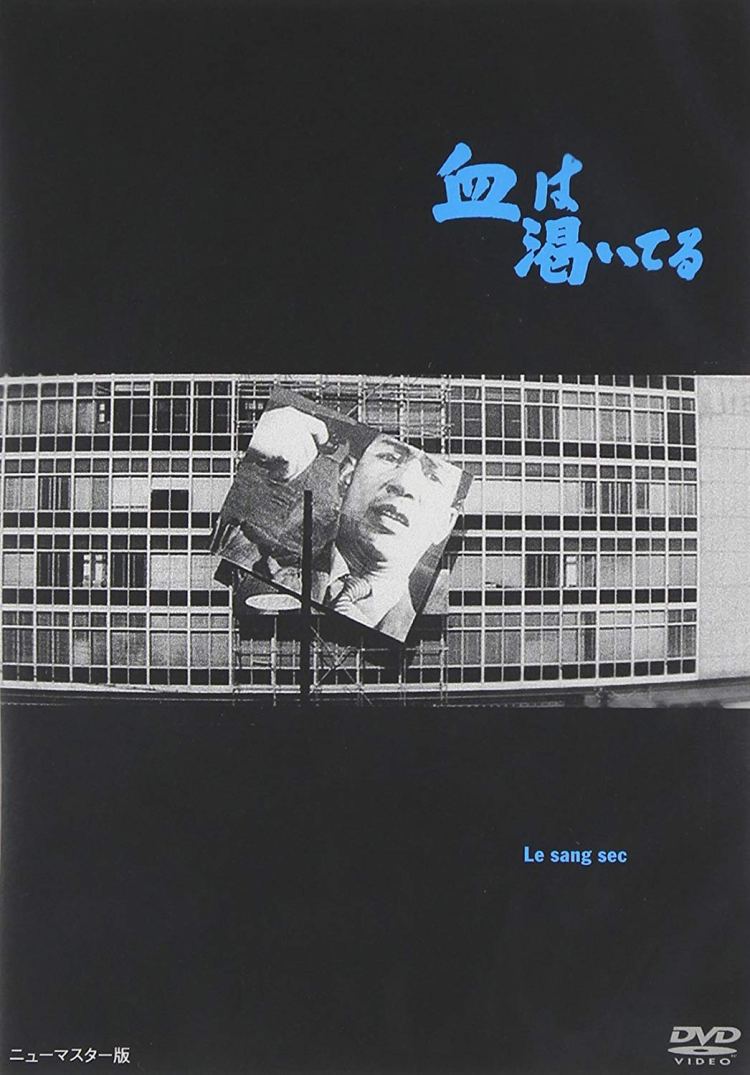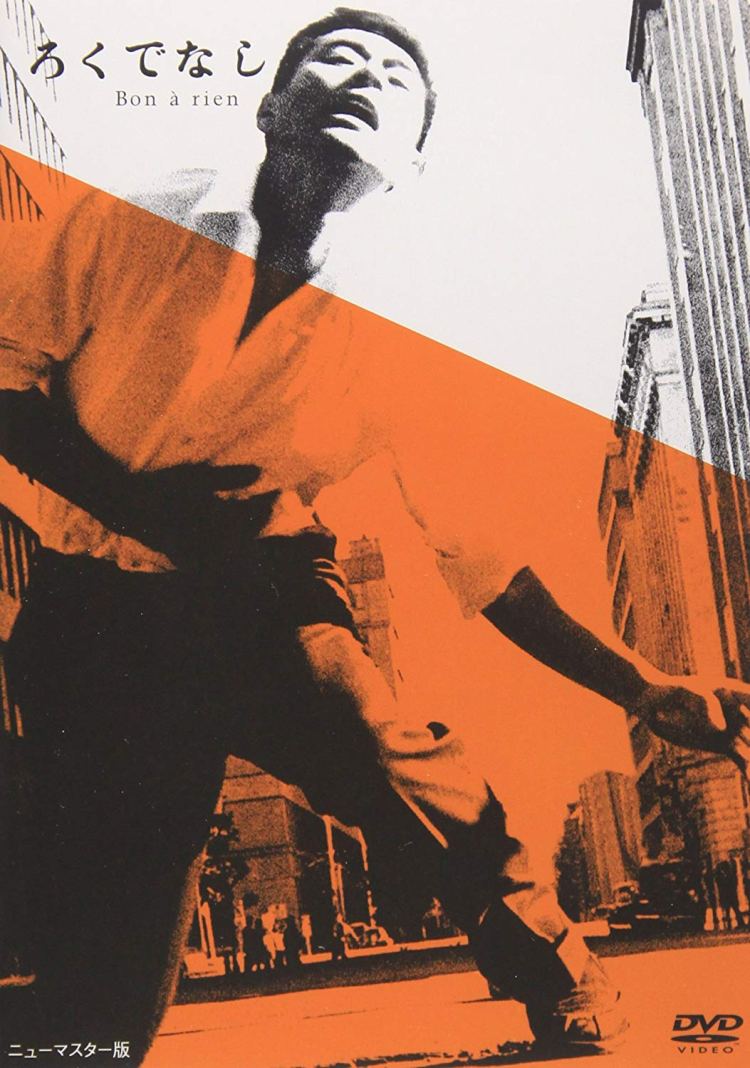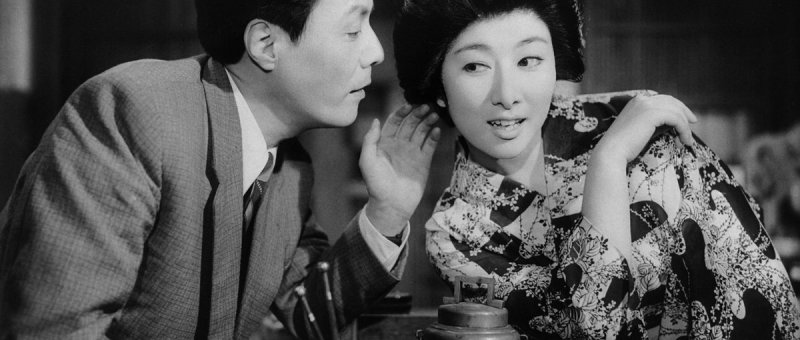
Good-for-Nothing (ろくでなし, Kiju Yoshida, 1960)

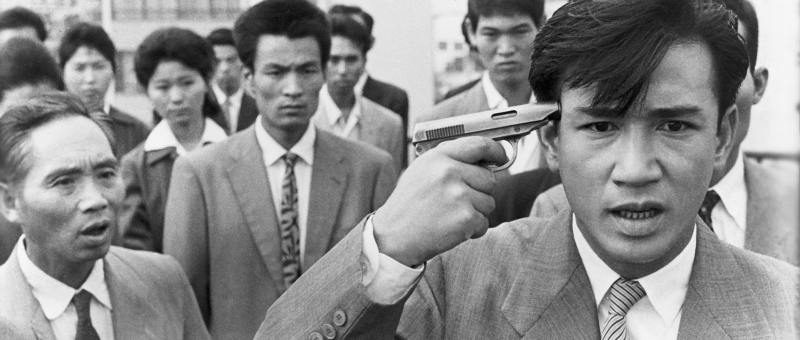
Good for nothing dvd coverIn the mid-1950s, Nikkatsu had accidentally provoked social outrage with a series of films later known as “taiyozoku” or Sun Tribe movies which revolved around aimless post-war youth who largely rejected the strident ambition of their parents for lives of dissipated abandonment. While the original author of the book that kickstarted it all fully intended to create moral panic, Nikkatsu perhaps hoped to capitalise on the inherent cool of adolescent rebellion and did it seems find an audience they hoped to continue courting with their youth movies even after the forced end of the taiyozoku movement. Shochiku, the home of polite melodrama, was a world away from Nikkatsu’s brand of angry young man but declining receipts encouraged them to get in on the action and so they began giving some of their younger ADs a chance to direct features in the hope of finding bold new voices who could speak to youth (a demographic their usual fare was not perhaps reaching).

Among these directors, Kiju (Yoshishige) Yoshida would go on to greater heights of avant-garde cinema but his Shochiku debut is perhaps more or less the kind of thing the studio was looking for. Released in the same year as Koreyoshi Kurahara’s The Warped Ones, Good-for-Nothing (ろくでなし, Rokudenashi) is another tale of youth gone wild only one with a much deeper sense of self pitying futility which casts its ill-fated hero as a noble soul left without purpose in the rapidly stratifying society of post-war Japan.

Against a heady yet whimsical jazz score (composed by Shochiku stalwart Chuji Kinoshita, brother of Keisuke), the action opens with a gang of petty delinquents kidnapping the secretary of one of their fathers, Hisako (Kakuko Chino), as she leaves the local bank. Toshio (Yusuke Kawazu) is in many ways the typical taiyozoku hero in that he is extremely rich and therefore filled with ennui because his life has no real purpose. He is not, however, the hero of Yoshida’s film. Gradually, our focus shifts to the intense figure of university student Jun (Masahiko Tsugawa) who, unlike the other members of the gang, remains internally conflicted as to the forward direction of his life and his complicated relationship with Toshio.

Whereas the taiyozoku films most often focussed on the bright young things of the new era – the children of those who had become rich in the post-war economy but had few values and were content to bury themselves in imported hedonistic pleasures, the “heroes” of Good-For-Nothing are the collaborators. If the taiyozoku were despised by the older generation as parasites living off inherited wealth and contributing nothing to society, then the guys like Jun are the parasites on the parasites. This is perhaps a view Jun holds of himself, wilfully embracing the “rokudenashi” label as expression of his intense self-loathing and acting in accordance with its values as an act almost of self-harm.

Toshio rebels against his sense of powerlessness in the darkest of ways – by setting his sights on taking his father’s “haughty” secretary down a peg or two. He may not like her confidence, self possession, and earnest determination towards honest industry but it is exactly these qualities which begin to attract Jun as representative of the society he has rejected but secretly longs to belong to. A poor student, he’s tried doing things the “right” way – part-time jobs, hard work etc, but has little interest in the student movement and views himself as “weak” for allowing himself to be swayed by the easy life of those like Toshio even in the full knowledge that he cannot live that way forever and his time at the beach will be as short as a summer vacation.

Hisako sees the conflict in Jun and tries to pull him towards a more positive path but is also attracted to him because of his darkness and nihilistic ennui. She too is unhappy with the status quo, living with her brother and his wife who quarrel about money and the disappointments of the salaryman dream while the office playboy hassles her at work and is only spurred on by her constant rejections. Hisako knows getting involved with Jun is playing with fire, especially if it keeps her in the orbit of the continually declining Toshio whose worrying behaviour is perhaps enabled by his well meaning liberal (though arch capitalist) father who is hoping his son will find his own way through hitting rock bottom, but salvation is a temptation it’s difficult to resist.

The heroes of the taiyozoku movies are aimless because they have no economic imperatives towards individual progress, but those like Jun or indeed like those of The Warped Ones are aimless because they see no sense of purpose in an intensely class bound society in which, paradoxically, all the cards are held by men like Toshio. Some, like Jun’s gang mate, decide the best way forward is to become a willing underling living off Toshio’s largesse who is, in his own way, intensely lonely and filling the friendship void with minions. Others, like Hisako, decide to plug on anyway despite the disappointments of socially conservative success. For men like Jun, however, the prognosis is as grim as in much of Yoshida’s later work, suggesting his nihilism is justified because there is no hope for men without means lost in the widening gulf of post-war inequality where any attempt at moral righteousness is likely to be rewarded only with further suffering.


Original trailer (Japanese with French/Traditional Chinese subtitles)

The Body Confession (肉体의 告白 / 육체의 고백, Jo Keung-ha, 1964)

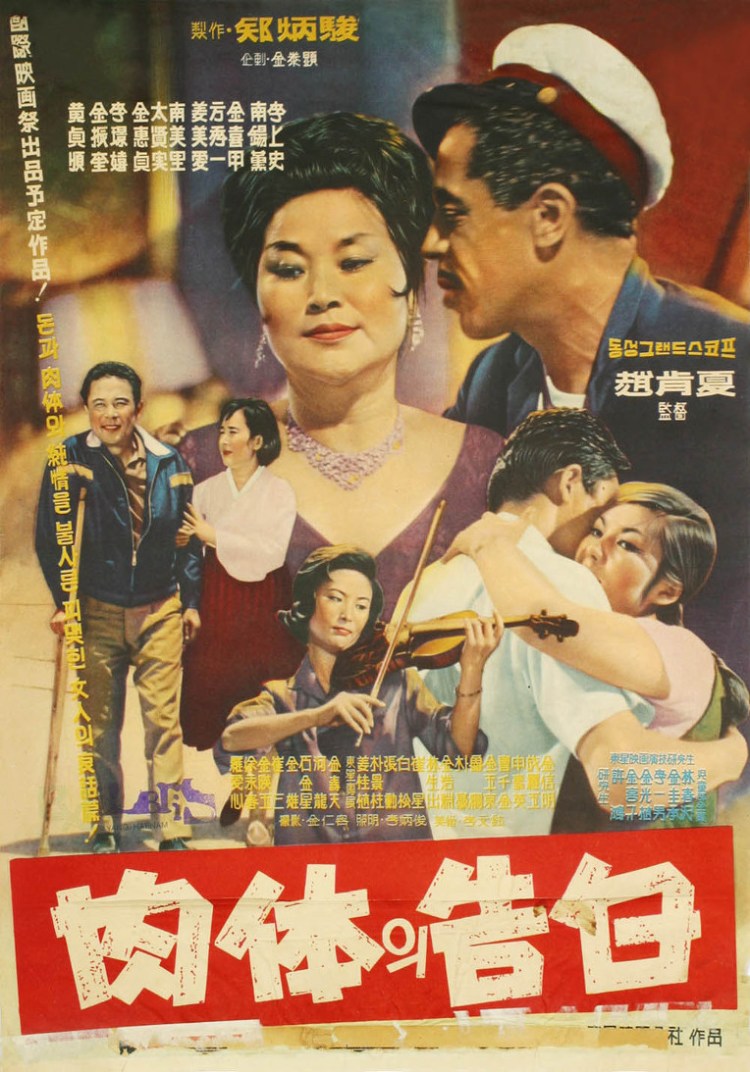
Body Confession posterThe Korea of 1964 was one beginning to look forwards towards a new global future rather than back towards the turbulent colonial past, but the rapid leap forward into a new society had perhaps left an entire generation behind as they prepared to watch their children reject everything they’d strived for in search of “modernity”. 1964’s The Body Confession (肉体의 告白 / 육체의 고백, Yukche-ui Gobak) is the story of one such woman. Widowed young, she turned to sex work in order to support her three daughters in the hope that sending them to university would win them wealthy husbands only for her daughters to encounter the very problems she worked so hard for them to avoid.

The heroine, a veteran sex worker known as The President (Hwang Jung-seun), has become a kind of community leader in the red light district largely catering to American servicemen in the post-war era. While she labours away in the brothels of Busan, her three daughters are living happily in Seoul believing that she runs a successful fashion store which is how she manages to send them their tuition money every month. The President goes to great lengths to protect them from the truth, even enlisting a fashion store owning friend when the girls visit unexpectedly. Nevertheless, she is becoming aware that her position is becoming ever more precarious – as an older woman with a prominent limp she can no longer command the same kind of custom as in her youth and is increasingly dependent on the support of her fellow sex workers who have immense respect for her and, ironically, view her as a maternal figure in the often dangerous underworld environment.

This central idea of female solidarity is the one which has underpinned The President’s life and allowed her to continue living despite the constant hardship she has faced. Yet she is terrified that her daughters may one day find out about her “shameful” occupation and blame her for it, or worse that it could frustrate her hopes for them that they marry well and avoid suffering a similar fate. Despite having, in a sense, achieved a successful career in the red light district, The President wants her daughters to become respectable wives and mothers rather than achieve success in their own rights or be independent. Thus her goal of sending them to university was not for their education but only to make them more attractive to professional grade husbands.

The daughters, however, are modern women and beginning to develop differing ideas to their mother’s vision of success. Oldest daughter Song-hui (Lee Kyoung-hee) has fallen in love with a lowly intellectual truck driver (Kim Jin-kyu) who has placed all his hopes on winning a literary competition. He is a war orphan and has no money or family connections. Meanwhile, second daughter Dong-hui (Kim Hye-jeong) has failed her exams twice and developed a reputation as a wild girl. Toying with a poor boy, she eventually drifts into a relationship with the wealthy son of a magnate (Lee Sang-sa) but fails to realise that he too is only toying with her and intends to honour his family’s wishes by going through with an arranged marriage. Only youngest daughter Yang-hui (Tae Hyun-sil) is living the dream by becoming a successful concert musician and planning to marry a diplomat’s son.

The three daughters have, in a sense, suffered because of their mother’s ideology which encourages them to place practical concerns above the emotional. Song-hui is conflicted in knowing that she will break her mother’s heart by marrying a man with no money or family but also knows that she will choose him all the same. Dong-hui, by contrast, enthusiastically chases Man-gyu for his money but naively fails to realise that he is selfish and duplicitous. In another evocation of the female solidarity that informs the film, Man-gyu’s fiancée Mi-ri eventually dumps him on witnessing the way he treats Dong-hui, roundly rejecting the idea of being shackled to a chauvinistic man who assumes it is his right to have his way with whomever he chooses and face no consequences. Like Song-hui, Mi-ri breaks with tradition in breaking off her engagement against her parents’ wishes and reserving her own right to determine her future.

Yang-hui, whose future eventually works out precisely because of the sacrifices made on her behalf by her mother, turns out to be her harshest critic, rejecting The President on learning the truth and attempting to sever their connection by repaying all the “ill-gotten” investment. Her wealthy husband, however, turns out to be unexpectedly sympathetic in pointing out that her mother has suffered all these long years only to buy her future happiness and that now is the time they both should be thanking her. Meanwhile, The President has become despondent in realising she is out of road. There is no longer much of a place for her in the red light district, and she has nowhere left to turn. Only the kindly Maggie, another sex worker who has been a daughter to her all this time, is prepared to stand by her and take care of her in her old age.

The gulf between the two generations is neatly symbolised by the surprising inclusion of stock footage from the April 19 rising against the corrupt regime of Rhee Syngman which led to a brief period of political freedom before the dictatorship of Park Chung-hee took power in 1961. The poor intellectual author whom The President dismissed, eventually becomes an internationally renowned literary figure after being published abroad while the wealthy magnate’s son turns out to be a louse. The President staked her life on the old feudal ways of ingratiating oneself with privilege by playing by its rules, but the world has moved on and it’s up to the young to forge their own destinies rather than blindly allowing those in power to do as they please. Sadly for The President, her sacrifices will be appreciated only when it’s too late and her desire for her daughters to escape the hardship she had faced misunderstood as greed and snobbishness. There is no longer any place for her old fashioned ideas in the modern era and her daughters will need to learn to get by on their own while accepting that their future was built on maternal sacrifice.


The Body Confession was screened as part of the 2019 Udine Far East Film Festival. It is also available to stream online via the Korean Film Archive’s YouTube Channel.

An Actor’s Revenge (雪之丞変化, Kon Ichikawa, 1963)

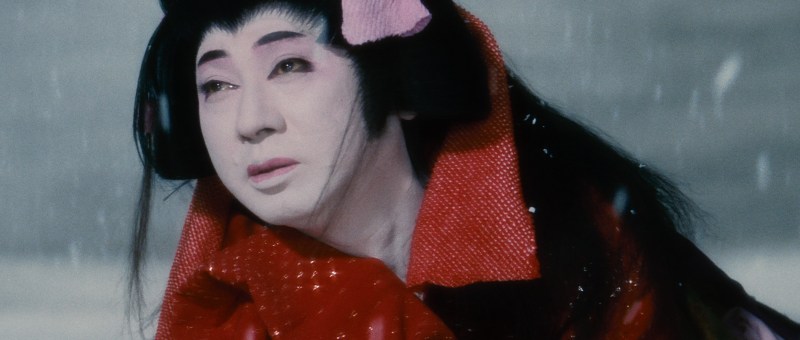
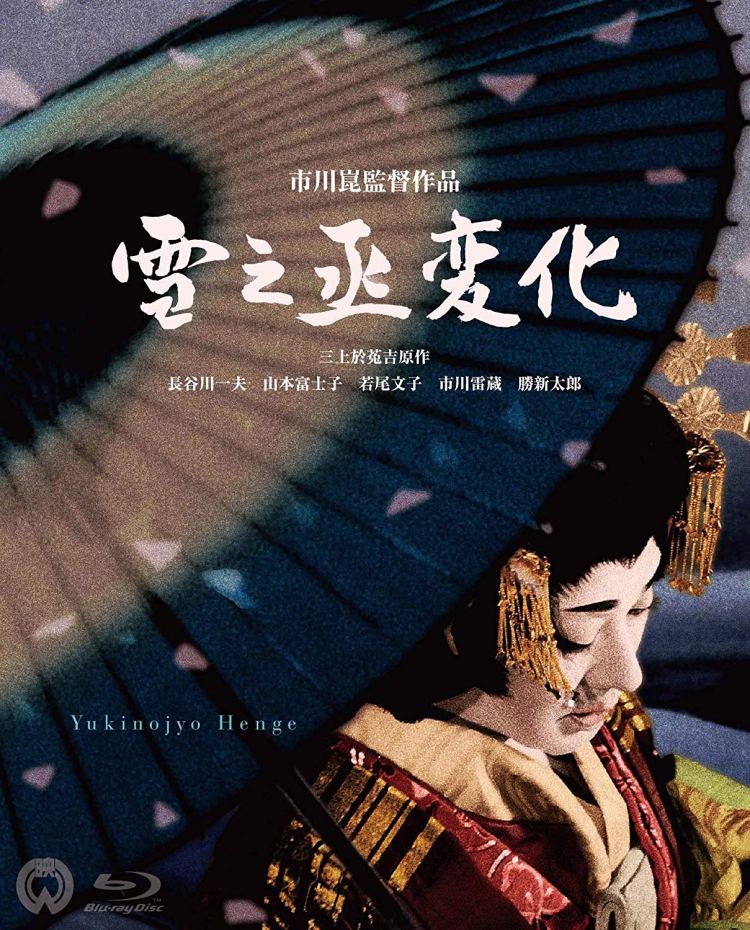
An Actor's Revenge blu-ray cover“Revenge is difficult even for an actor” our secret observer tells us, watching quietly from the rooftops like a spectator at a play. In celebration of his 300th screen appearance, Kazuo Hasegawa stars once again as vengeful onnagata Yukinojo in another version of An Actor’s Revenge (雪之丞変化, Yukinojo Henge), this time directed by Kon Ichikawa with a script written by his wife, Natto Wada, which was itself based on the earlier film with minor adaptations. Recasting the scope frame for the Kabuki stage, Ichikawa shows us a maddening world of theatricality, defined by artifice and governed by the rules of narrative determinism.

Orphaned after his parents were driven to suicide, Yukinojo (Kazuo Hasegawa) was taken in by an actor at a young age and trained as an “onnagata” – an actor specialising in female roles on the kabuki stage where women were forbidden to tread. Years later Yukinojo is one of the most popular actors of the age and lives more or less as a woman on stage and off. Having brought his Osakan theatre company to the Edo capital he finally sees his chance for revenge against the trio of corrupt and ambitious merchants who conspired to ruin his father for personal gain. He is, however, conflicted – not in his desire for vengeance but in the strain it continues to place on his mental state as well as the moral corruption need for it provokes.

Despite his feminine appearance, Yukinojo is regarded as male and most assume that his (volitional) romantic attachments will be with women. His gender ambiguity is, however, a problem for some such as the spiky pickpocket Ohatsu (Fujiko Yamamoto) who describes him as “creepy” in being neither male nor female. Then again, Ohatsu’s gender presentation is also atypical in that though she dresses and acts as a woman, most regard her as inappropriately masculine in the independence and authority which make it possible for her to act as the leader of a gang of street thieves. Lamenting her tomboyishness, some of her minions make the suggestion common in these kinds of films that Ohatsu will rediscover her femininity on falling in love (with a man). Despite her supposed hatred of men, Ohatsu finds herself falling for Yukinojo possibly precisely because of his gender ambiguity in that she is in some sense permitted to fall in love with him as a woman because he is a man.

Meanwhile, Yumitaro (also played by Kazuo Hasegawa) – another street thief only a much more egalitarian one, has no desire for women and has also developed some kind of fascination with Yukinojo as man who presents as female. Yukinojo is remarkably uninterested in Ohatsu, but seems drawn both to the mysterious Yumitaro and to the pawn in his revenge plot, lady Namiji (Ayako Wakao). The daughter of Dobe (Ganjiro Nakamura), the ambitious lord who orchestrated the plot against Yukinojo’s father, who has sold her to the Shogun as a concubine in order to buy influence, Namiji develops a deep fascination with the feminine actor which is then manipulated both by Yukinojo who plans to break her heart solely to get at Dobe, and by Dobe who intends to indulge her fascination in order to persuade her to return to the Shogun. Namiji is entirely innocent and effectively powerless. Involving her in the plot weighs on Yukinojo’s conscience but he refuses to look back, preparing to sacrifice her solely in order to a strike blow towards her father.

Meanwhile, chaos reigns in Edo as the corruption of the ruling elite provokes a rebellion by the ordinary people fed up with their persistent profiteering. This too Yukinojo harnesses as a part of his plot, setting his greedy merchants one against the other as they weigh up the benefits of making themselves look good to the people and the Shogun through engineering a crash in the price of rice by dumping the stocks they’ve been hoarding. The theatrical world and the “real” begin to overlap as Yukinojo performs the ghosts of his parents to bring the merchants’ crimes home to them, but his revenge plot has devastating and unforeseen consequences which perhaps begin to eat away at his carefully crafted chameleonism. Possessing no true identity of his own, Yukinojo passes into legend, retreating back to his natural home of the stage the shadow of an avenger disappearing over the horizon.


Original trailer (no subtitles)

Elegant Beast (しとやかな獣, Yuzo Kawashima, 1962)

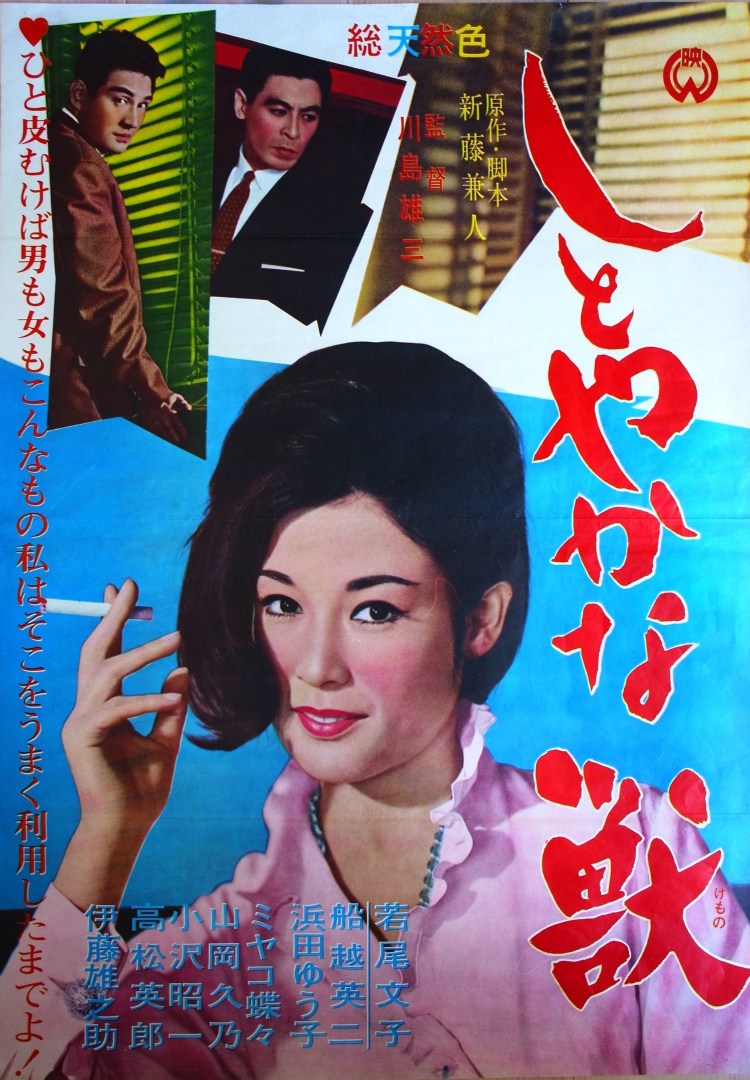
elegant-beast-poster-2.jpgBy 1962 the Japanese economy had begun to improve and with the Olympics on the horizon the nation was beginning to look forward towards hoped for prosperity rather than back towards the intense suffering that had defined the post-war era. There would be, however, a kind of reckoning to be had if not quite yet. Yuzo Kawashima’s Elegant Beast (しとやかな獣, Shitoyakana Kemono) is perhaps among the first to start asking questions about what the legacy of the immediate aftermath of the war might be. It may have been impossible to survive with one’s integrity entirely intact, but how should one proceed now that there is less need to be so self serving, calculating, and cruel when there is more food on the table?
The Maedas may not be the best people to ask. Carrying the scars of their poverty, they have made a “comfortable” life for themselves in a cramped flat on the fifth floor of an ordinary walk-up apartment building. When we first meet them, dad Tokizo (Yunosuke Ito) and mum Yoshino (Hisano Yamaoka) are having a furious tidying up because they’ll shortly be receiving visitors, only unlike most they’re quickly trying to scuzz up the apartment so that they look sufficiently humble. When their guests arrive, it turns out to be the boss of their only son Minoru (Manamitsu Kawabata) who has come along with one of the artists he represents and his accountant, to have a word about possible embezzlement. Tokizo and Yoshino outdo themselves with humility, pointing out the simplicity of their surroundings, and appear offended that their son is being accused of thievery but of course in reality they know all about it and are willing accomplices in his scheming. Tokizo hasn’t had a steady job since coming back from the war and the entire family is supported by the kids with the remainder of their income coming from daughter Tomoko (Yuko Hamada) who has become the mistress of a famous author (Kyu Sazanka).

Universally unrepentant, cracks start to appear in the Maedas’ morally dubious existence when they begin to realise that Minoru is not quite on the level. He’s only been giving them a portion of the money he’s been stealing – something they can understand and perhaps even admire, if it were not that he’s given most of it to a lover to fund her hotel business. The surprise twist is that the lover is none other than the accountant at the company Minoru had been working for, Yukie (Ayako Wakao), who is a widow with a 5-year-old son (which is to say, not Minoru’s usual type). Now that the hotel is fully funded and the scam has been exposed, Yukie feels there’s no more need to associate herself with lowly punks like Minoru and draws the affair to a businesslike conclusion.

Yukie is, perhaps, the “elegant beast” of the title. Refined, seemingly sweet and innocent, she inspires trust and affection. The slightest suspicions are unlikely to fall on her – something she well knows and is prepared to use to her advantage, along with her sex appeal and, ironically, reduced desirability in the marriage stakes as a widow with a child. Yukie has her dreams and they are ordinary enough. She wants a peaceful, stable life in economic comfort alone with her son. She does not want to remarry and means to be independent which necessarily means industrious. Thus she needs to get her hotel business off the ground as quickly as possible. She needed money, a lot of money, much more than she could get “honestly” but she didn’t want to dirty herself with crime and so she used the tools at her disposal, making her “weakness” a strength as she later puts it. Using her womanliness as a weapon against venal men, she convinced them to ruin themselves on her behalf and thereafter resolved to put the past behind her.

The past is, however, difficult to forget. “Your mind still wears an old fashioned coat”, the quip happy Minoru tells his father as he laments the new society’s tolerance for youthful ebullience and reluctance to forgive the wartime generation for even its most recent transgressions. As much as they resent her, there is perhaps a grudging admiration for a woman like Yukie who has managed to outsmart them all while, technically at least, remaining on the right side of the law. Tomoko, on the other hand, seems to be losing out in playing much the same game by the old rules. Essentially pimped out by her dad, she’s damned herself by becoming the mistress of one man who is becoming rather bored of her family’s obvious attempts to bleed him dry, rather than fleecing several at the same time and bending them to her will as Yukie has managed to do. Old fashioned thinking won’t get you far in this world. The Maedas, however, seem to be out of ideas.

In the closing moments, they may ponder abandoning their hard-won apartment, believing that there’s always trouble brewing in the big city and the clean country air may be what they really need to thrive but, it’s clear that this insular claustrophobic environment filled with peep holes and tiny imprisoning windows will be near impossible to escape. Tokizo hasn’t left the apartment for the entire picture. A woman ascends the stairs, walking purposefully towards a future of her own making, while the Maedas remain locked inside unable to escape the painful legacy of post-war poverty for the bright, if no more ethical, lights of a consumerist future dancing quietly on the horizon.


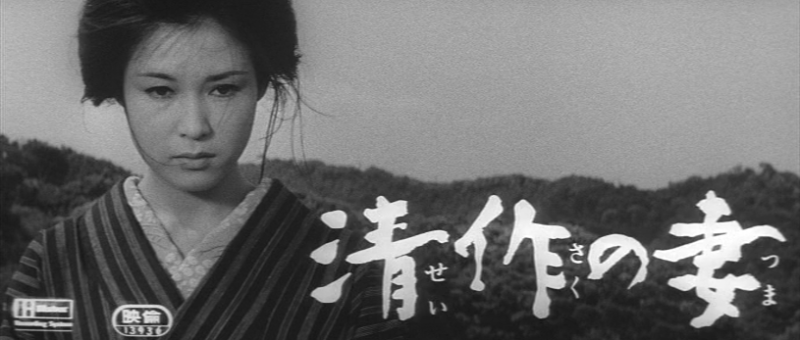
Seisaku’s Wife (清作の妻, Yasuzo Masumura, 1965)

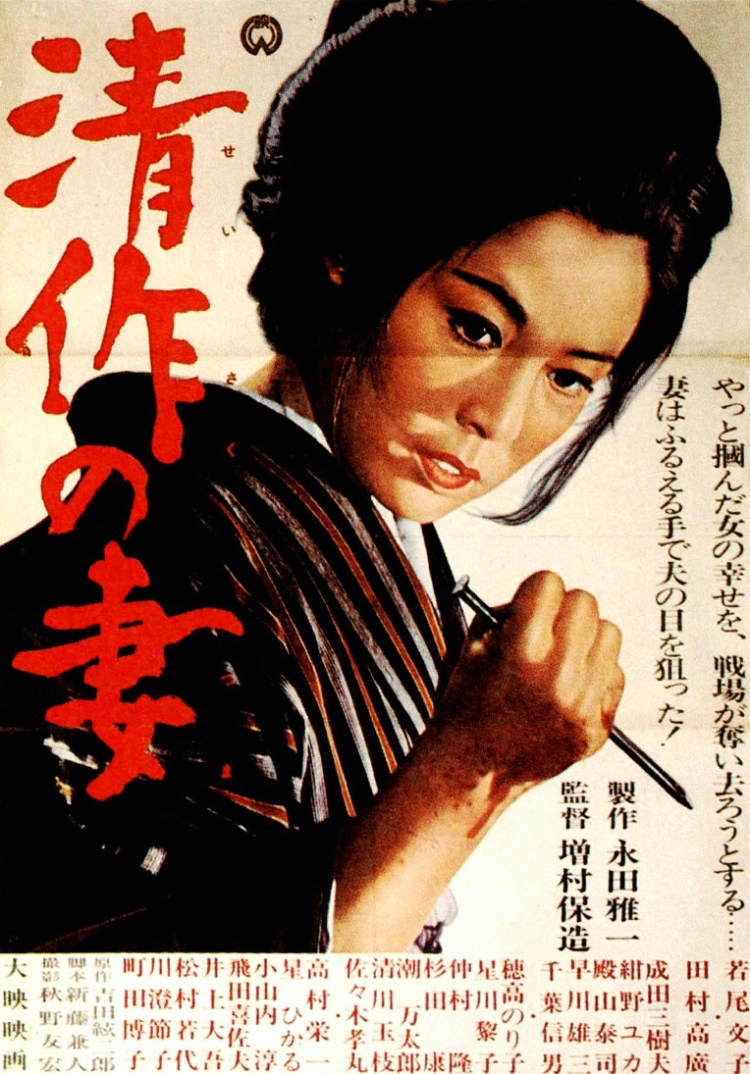
Seisaku's wife posterFor Yasuzo Masumura, sexuality is both freedom and constraint but also the ultimate act of social rebellion. Seisaku’s Wife (清作の妻, Seisaku no Tsuma), set in late Meiji as Japan prepares for the possibility of war with Russia, finds its melancholy heroine a defiant outcast as she first abandons her cruel, conformist society for empty independence and then reclaims her sense of self only through a love deemed inappropriate by those around her. The seeds of militarism are already being sown and breaking the programming is hard but transgressive acts of love can, it seems, overcome persistent societal oppression.

Okane (Ayako Wakao), our heroine, was sold as a bride to a much older man (Taiji Tonoyama) at 17 to provide for her parents. Three years later she views her husband, a wealthy kimono merchant, with contempt – as does much of the local area where he is derided as a sex crazed pervert. Luckily for her, Okane’s husband eventually dies leaving her a small sum of money while his extended family would rather she absent herself as quickly as possible to minimise embarrassment. Her father now too passed away, she and her mother (Tamae Kiyokawa) return to their home village which they were chased out of some years previously for their massive debts, but are now resented by their former neighbours for their seeming wealth and aloofness. Okane, traumatised by her experiences and having lost the will to live, barely interacts with the villagers who regard her as arrogant and haughty, and has been ostracised as a result.

The situation begins to change with the return of Seisaku (Takahiro Tamura) – the village’s bright hope. Seisaku had been away doing his military service and has come back with order and discipline on his mind. Now believing that the villagers are lazy and frivolous he has brought back with him a bell he had forged himself which he hooks to a nearby tree and bangs early in the morning to “awaken” them lest they sleep in rather than hasten to their fields. As might be anticipated, the villagers find this quite irritating but respect Seisaku too much to stop him and so find themselves going along with his new brand of militarist austerity. Meanwhile Okane is the only one to refuse the call, wasting no time in telling Seisaku that she has no intention of following his “orders” and his assumption that she should is in itself offensive.

Seisaku is intrigued rather than offended and finds himself attracted to Okane despite the villagers’ obvious animosity towards her. Convincing her that his feelings are real, the pair drift into an intense sexual relationship which eventually sees the model soldier Seisaku make a transgressive choice of his own in rejecting his longstanding betrothal to a village girl in favour of marrying Okane without the approval of his conservative mother and sister. Holed up together in Okane’s remote farmland shack, they remove themselves as much as possible from village life in an insular, obsessive world of their own.

Okane, rejected because of her past as the kept woman of a wealthy man (something over which she herself was powerless and means never to be powerless again), in turn rejects the village after having lost all faith in human relationships except perhaps that with her mother whose cruel treatment at the hands of her father she both identified with and resented. Intensely lonely, she subsumes herself entirely into her love for Seisaku, eventually trying to rebuild bridges in the village in order to strengthen their relationship but finding herself rejected once again by Seisaku’s austere mother even if his sister begins to come around. Meanwhile, the spectre of the war hovers on the horizon. Seisaku, as hopelessly in love with Okane as he is, is still the model soldier in his heart and unwilling to abandon his proto-militarist ideology which tells him that dying in service of the nation is man’s highest calling.

Having abandoned such obvious brainwashing to claim her independence, Okane struggles to convince Seisaku he should do the same. She clings to him and pleads, begging him not to leave her behind alone while he resolves to go off to battle and a glorious death. The village men too regard failure to die on the battlefield as a disgrace but send their sons away with cheers and celebration. Facing the possibility her dream of love may die, Okane takes drastic action to ensure its survival but does so at an ironic cost which sees her separated from her love possibly forever. Seisaku, meanwhile, angry and resentful, begins to understand something of Okane’s life when branded a coward and traitor by his former friends, no longer the model soldier but an outcast himself. Having suffered her fate, he begins to let go of his rage in favour compassionate understanding, allowing his love to triumph over his hate as he strives to forgive the woman who has both trapped and helped him to free himself from the oppressive ideology which turned him into an unthinking “model soldier” who wilfully abandoned his freedom in favour of internalised conventionality.

Freed from didactic social brainwashing, the pair are then in a sense imprisoned by their individualistic freedom, forced to isolate themselves within a bubble of love and mutual dependence but with a new hope for the future for which they now plan even while acknowledging that they cannot know what will come of it save that they will face it together. They can no longer live within the conservative society, but must form their own new world within it in which they can be fully free and express their freedom through their love. Melancholy but tranquil, Masumura ends on an uncharacteristically hopeful note which implies that love, though violent and transgressive, can be an effective weapon against destructive militarist ideology and the folly of war through a warmer path towards compassionate freedom.


Original trailer (no subtitles)

Law in Ghost Island (幽霊島の掟, Yasushi Sasaki, 1961)

The post-war world was one of increasing globalisation which brought with it anxiety as well as hope as Japan readied itself to step back onto the world stage. The populist cinema of the early ‘60s is marked by ambivalent attitudes to international influences, not just towards creeping Americanisation and its perceived costs but perhaps somewhat uncomfortably towards the wider world and Asia in particular with the same old prejudices which had marked the previous 20 years rearing their heads once again. Voice of the post-war era, the films of Hibari Misora are, by contrast, about as forward looking and progressive as it was possible to be but Law in Ghost Island (幽霊島の掟, Yurei-jima no Okite) in which she plays a noticeably smaller part, is a bizarre exception in which a “lawless” melting pot outpost must be “civilised” by Japanese influences else the creeping rule of thuggish Asian gangs finally reach Japan “proper”.

We’re deep in the Bakumatsu. The Black Ships have already arrived and there is considerable political trouble brewing back in Japan. That’s not our immediate concern however because we’re on a creepy boat with slovenly ronin Yagi Hanzo (Hashizo Okawa) and a mysterious woman wearing a cheongsam (Hibari Misora). Fellow petty gangster and slave trafficker Bunji (Chiyonosuke Azuma) is suspicious of Hanzo, but decides he’s probably just an unlucky retainer on the run from something or other and might prove useful. Therefore, on arrival at Dragon Island, Bunji starts on trying to recruit Hanzo for his boss Chou Yang Po (Isao Yamagata), but Hanzo’s his own man and he hasn’t come here looking for a job. Fearing Hanzo is a government official here to bring the law down on all their heads, Chou tries to force him to harm a man they have in custody and believe to be working for the state. Hanzo gets round this by breaking a chair over the man’s back but leaving him otherwise unharmed, keeping his cover (if that’s what it is) firmly intact.

During his stay on Dragon Island, Hanzo will meet several other shady characters, many of them dressed in outfits more usually associated with the Chinese, Indians, nondescript “islanders”, and strange movie pirates, but what must be assumed is that though Japan “owns” this distant island it is unable to police it and as such it has become a den of scum and villainy in which various tribal gangs vie for hegemony and control over the lucrative smuggling hub which has unwittingly formed in direct response to Japan’s unwise policy of internal isolation which is itself at breaking point thanks to Perry’s Black Ships which we later hear are also on their way to Dragon Island.

Our key into this conflict is the crazed child of the leading gangster, Isakichi (Hiroki Matsukata), who dresses like a cowboy and likes to showoff his hard-won saloon credentials as sharpshooting libertine and all round party animal. Hanzo is not as impressed by this as Isakichi was hoping though an awkward sort of camaraderie eventually arises between them. Meanwhile, Isakichi has fallen in innocent love with the sister of his childhood best friend who is deep into a putative resistance movement hoping to end the stranglehold the smugglers have placed over the previously peaceful island.

Misora’s Madame Song, for some reason posing as a Chinese sex worker, hints at the various ways nothing is quite as it seems in her astute observations of the world around her, sensing that Hanzo is hiding something but also assuming that he is on the “right” side. There is conspiracy everywhere – the putative revolution at home is sending its shockwaves all the way out here as our unscrupulous gangsters try to procure guns to send to various sides on the mainland, while Madame Song ironically laments that what Dragon Island needs is to be more like Japan which is to say ruled less by law itself than an internalised acceptance of the proper order of things. Uncomfortably, it also probably means sending the people who aren’t wearing kimono somewhere else and trying to stop them tricking nice women from Kyushu into coming to tropical islands where they discover they’ve been trafficked into sex work and are unable to leave.

Among Toei’s lower budgeted efforts, Law in Ghost Island bills itself as a supernatural tale and does indeed open with a creepy scene of a misty boat but Hanzo doesn’t end up anywhere like the isle of the dead only a fantasy tropical “paradise” filled with zany movie pirates. Somewhere between pirate fantasy and western, Law in Ghost Island is closer to the kind of spy spoofs Toho would start producing in a few years’ time and even ends with a strangely comic scene in which just about everyone reveals themselves as spy for the same side during the climactic final shootout having been too busy playing spy games to figure any of it out before.

The final messages too are uncomfortable and ambivalent as Hanzo affirms that if there were more “good samurai” Japan would not become lawless like it is here while also claiming Dragon Island for the mainland in fear external forces may use it as a base to attack Japan. The smugglers pay heavily for their “treachery” in contributing to internal mainland chaos while the revolutionary islanders declare their intentions to make the island a better place, which mainly seems to mean making it more “Japanese” which is a fairly ambivalent message whichever way you look at it. Misora only sings two songs and is relegated to a minor mystery in the strange goings on of Ghost Island which features absolutely no ghosts or supernatural intrigue. It does however perhaps shine a light on a strange moment of cultural flux however how unflattering that mirror may turn out to be.


Brief clip of some of Hibari’s songs (no subtitles)

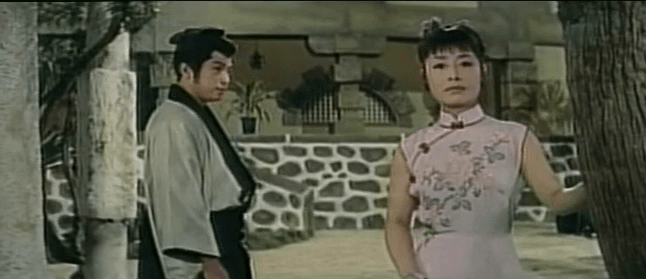
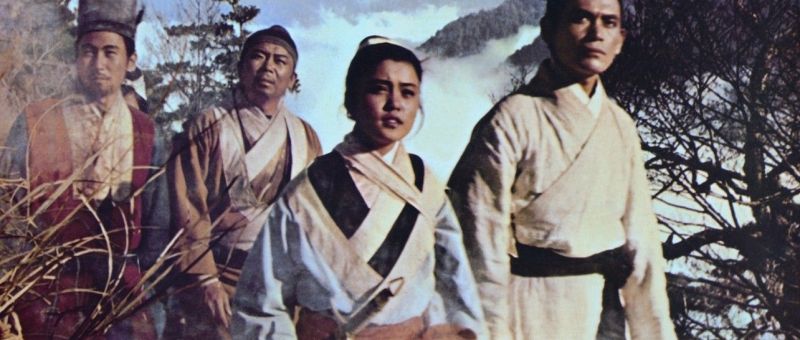
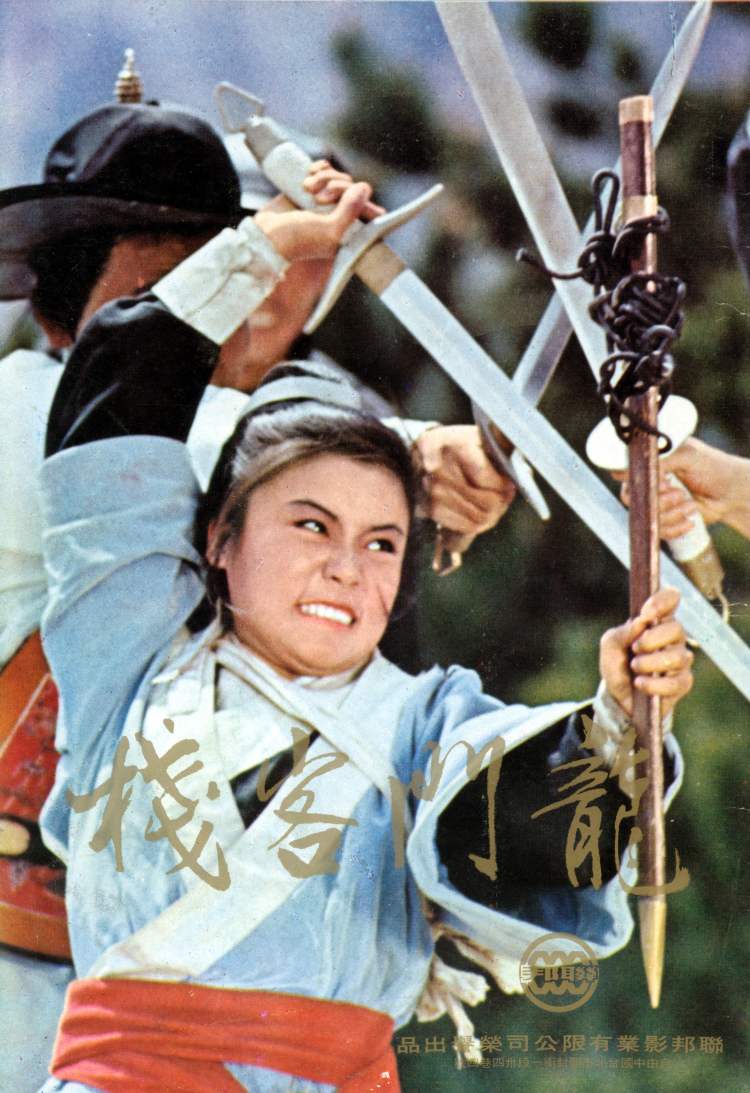
Dragon Inn (龍門客棧, King Hu, 1967)

Goodbye Dragon inn posterCorruption invades the court, the innocent flee the city but are pursued. Able to run no more, they take refuge at a point of hospitality where they encounter the jaded forces of justice who eventually offer themselves as a human shield, protecting the precious seed of a new world while beating back the evil of the old. It is the archetypical wuxia plot, but never better told than in King Hu’s (Hu Jinquan) seminal Dragon Inn (龍門客棧, Lóng Mén Kè Zhàn).

The first Taiwanese production from Mainlander Hu who began his career at Shaw Brothers in Hong Kong, Dragon Inn is set in feudal China. A weak emperor has enabled the rise of an ambitious underclass of eunuchs – once trusted servants whose forced celibacy supposedly ensured loyalty because, having no children, they would have no interest in dynasty. A loyalist scholar is about to pay the price for the eunuchs’ rise when they have him executed for treason as a means of silencing his rebellion. Fearing reprisals from his still young children, they exile them to the far frontiers as a ruse to disguise their murders on the road. Fortunately, however, the Yu children are saved by the heroic intervention of wandering swordsmen. Hoping to head them off at the next pass, the villainous Cao (Bai Ying) sends his best men to Dragon Inn where they will lie in wait.

Obviously, Cao’s plan is not to work out quite as he intended. Firstly because of the arrival of ultra cool swordsman for hire Xiao (Shi Jun), who happens to be a friend of the temporarily absent innkeeper Wu, and then because of the wandering bandit Zhu Ji and his sister (currently dressed as a man) Hui (Shang Kuan Ling‐Feng), who are determined to cause trouble with the East Espionage Chamber who are currently occupying the inn by means of force. In order to minimise the possibility of resistance, EEC have also wiped out a local company of Tartar soldiers, seemingly indifferent to any diplomatic incident which might ensue. Xiao, Wu, Ji, and Hui, are eventually joined by a pair of Tartar defectors who were pressed into the EEC after pledging their loyalty to Yu, and thereafter commit themselves to ensuring the safety of Yu’s offspring as a means of protecting his legacy while facing off against the corrupt forces of Cao.

Like all wandering heroes, Xiao and the others are mainly concerned with the problem at hand, saving the Yus, rather than acknowledging that their present predicament is a product of the society in which they live. They do not challenge “authority”, but only minor corruption as embodied in the upstart Cao who has attempted to step beyond his station. Cao is, however, himself a victim of his society as Xiao almost seems to admit in his cruel taunting of him over his complicated liminal status as a castrated man. Xiao repeatedly mocks his lack of appendage and his (presumed) lack of sexual experience coupled with his inability to father children which places him well outside the demands of regular society in being unable to carry on his family line. Cao’s usurping ambition is then a kind of revenge born of frustration and resentment against a society which has placed a deliberate limit on his progress.

Still, his villainy knows no bounds – not only did he have a “good”, innocent man sent to his death, but he also dared to call for the murder of his still small children solely to secure his own position. Of course, this inevitably means that the fault lies with the “weak” emperor whose softness has enabled the wicked ambition of men like Cao who have simply stepped into a vacuum created by insufficiently robust government (an idea perhaps born of the same kind of social values which have corrupted Cao). Nevertheless, our heroes are nominally loyalists rising in support of the fallen Yu in an attempt to rescue his legacy in the form of his children. Outlaws all, they have their wanderers code and even if their first meeting may be strained, they are quick to recognise each other as fighters for justice even if by virtue of being among those who’ve chosen to live outside of the systems of corruption which define their world. The tale ends as they always do, but it does so with an ambivalent sense of triumph in acknowledgement of the hollowness of moral victory in a world still defined by corruption and injustice.


Dragon Inn screened as part of the Taiwan Film Festival UK 2019.

Restoration trailer (English subtitles)

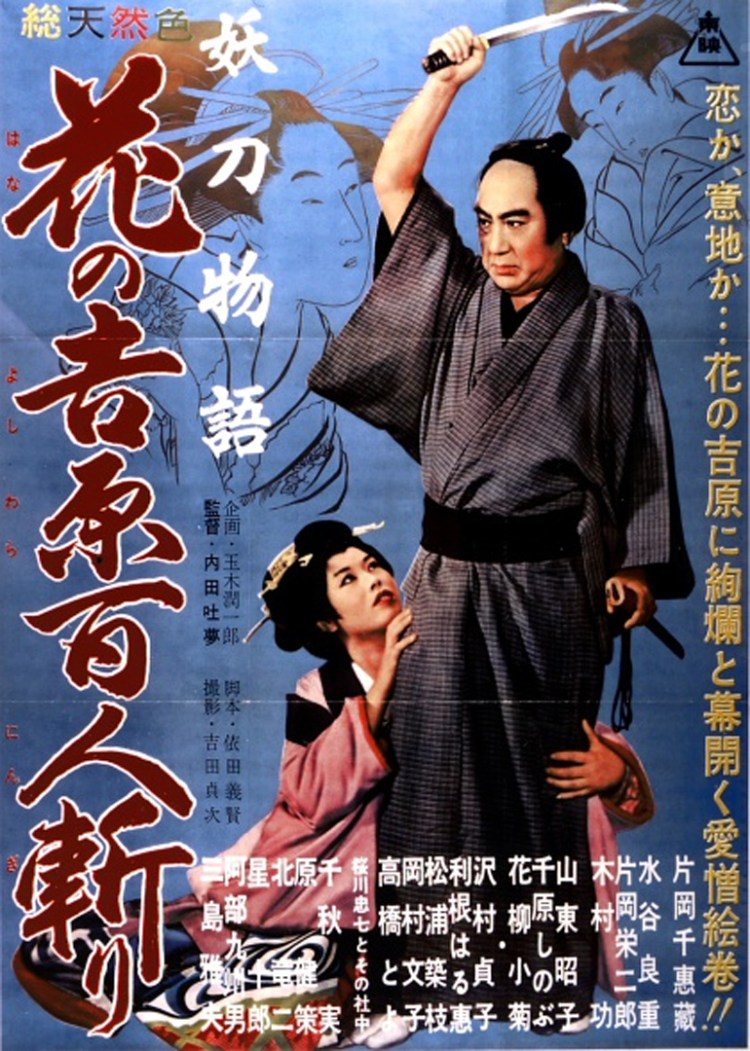
Killing in Yoshiwara (妖刀物語花の吉原百人斬り, Tomu Uchida, 1960)

Killing Yoshiwara posterHaving led a somewhat floating life, Tomu Uchida returned to Japan in only in 1953 after a sustained period with the Manchurian Film Cooperative followed by a brief flirtation with Maoism. Before the war Uchida had been closely identified with the Keiko Eiga movement of broadly left-wing filmmaking but later fell hard for the inherent romanticism of militarist ideology during his time in Manchuria. Nevertheless it was apparently the Maoist doctrines of progress through contradiction that influenced his later dramatic philosophy in which he came to think of narrative as a series of conflicts which culminate in an explosive act designed to resolve them (or not, as we will see). 1960’s Killing in Yoshiwara (妖刀物語花の吉原百人斬り, Yoto Monogatari: Hana no Yoshiwara Hyakunin-giri, AKA Hero of the Red Light District) is perhaps a prime example as it takes a seemingly generic story inspired by a kabuki play and uses it to tell a melancholy tale of parallel yet mutually thwarted desires for vengeance against a cruel and oppressive society.

Ostensibly, our “hero” is Jiro (Chiezo Kataoka) – a successful silk merchant. A good and kind man, Jiro is beloved of all his staff for his careful consideration of them as people as well as employees. This concern is, however, perhaps not as wholly “good” as it seems. Jiro’s major problem in life is that he is an adopted child, taken in by his parents who auspiciously discovered him abandoned on the anniversary of their own child’s death. Jiro, apparently of noble birth, was abandoned because he has a prominent grey birthmark “staining” his face. This is the reason he has so far been unable to find a wife despite his good character and relative wealth. Desperately grateful to the couple who took him in “despite” his “imperfection”, Jiro feels this failure heavily in his current inability to provide them with a male heir to take over the family business.

Being good and earnest, Jiro has never dared to fritter money away in the red light district but is tempted when invited by a valued client whom he would not want to offend by refusing. Nevertheless, his first visit to the Yoshiwara is not an altogether pleasant experience as even the seasoned courtesans find it difficult to bear the sight of his “monstrous” face. Embarrassed, the innkeepers finally decide to employ a lowly servant, Otsuru (Yoshie Mizutani), who is not a trained courtesan but a woman convicted for illegal prostitution, to minister solely to Jiro. Otsuru does her work and is relatively unbothered by Jiro’s facial abnormality – something which endears her to Jiro’s heart and has the desired effect of hooking him through his weakness.

Otsuru, later “Tamarazu” the courtesan, is in many ways our villainess but she is also Jiro’s mirror and merely another outsider trying to escape oppression through any means possible. Uchida is careful to frame Otsuru not as a cruel and amoral adventurer, but someone who has decided to survive and can at least be honest about her intentions. We see her caged, imprisoned inside the Yoshiwara to do inside it what was declared “illegal” outside and acknowledging that she may well die here to met by a lonely funeral and rest unnamed in a communal grave. Otsuru decides that if she has to stay in the Yoshiwara then she will be its queen and then use that success to catapult herself into a more comfortable life even if she knows that it will be little more than a nicer kind of cage.

Jiro and Otsuru are each victims of the oppressive society in which they live as symbolised by the cruelly hypocritical worldview of the brothel owners who set out to exploit them both. Otsuru, worldly wise, is fully aware of the ways in which she is and will continue to be exploited but has chosen to be complicit within them as a means of effecting her escape. Jiro, meanwhile, is obviously aware that the “stain” across his face is the reason for his unhappy destiny but has only ever sought to minimise the distress his appearance causes to others. Thus he overcompensates by being relentlessly nice and infinitely humble, grateful for each and every concession which is extended to him as a fully human being rather than the “monster” which he is later branded by the innkeepers in a rare moment of candour which exposes their venial desires. 

This extreme desire for acceptance is in itself a symptom of his self loathing and internalised shame regarding his appearance which is after all merely an accident of birth over which he had no control. Abandoned by his birthparents who left him with a “cursed” destiny in the form of an unlucky sword, Jiro has been working overtime to overcome social prejudice but finding his path continually blocked. He latches on to Otsuru simply because she was nice to him without understanding the peculiar rules of interactions within the Yoshiwara, or as she later puts it “no money, no love”. Jiro ruins himself out of frustrated loneliness and a forlorn hope of repaying the debt he owes the couple who took him in by being able to provide them with a male heir to inherit the family business.

It is these mutual conflicts which eventually lead to the explosive finale hinted at by the violence of the title. Otsuru’s star rises while Jiro’s falls – not only is he fleeced by the innkeepers and an unrepentant Otsuru, his business also fails thanks to an act of God while his reputation lies in tatters once his associates get to know of his “frivolous” behaviour in the Yoshiwara. This in itself is doubly hypocritical as it was this same major client who introduced Jiro to the “pleasure” quarters in the first place only to remind him that business is a matter of trust and that they no longer trust him because he has broken his promise of keeping away from the Yoshiwara.

Pushed to the brink by successive humiliations, Jiro’s rage erupts in a singular act of violence which takes the sword not only to the Yoshiwara but the entrenched systems of oppression and exploitation which it represents. Otsuru, now an oiran, is literally trapped by her ostentatious outfit (in reality the very purpose it is designed to serve) as she struggles to escape male violence, her hand on the gate of the Yoshiwara which refuses to release her. Their parallel quests for revenge eventually converge only to defeat each other in a staggering act of futility which remains unresolved as the curtain falls on a moment of unanswerable rage.


Love Under the Crucifix (お吟さま, Kinuyo Tanaka, 1962)

Love Under the Crucifix cap 1A legendary screen actress, Kinuyo Tanaka completed only six films in her career as a director. The last film that she would ever make, Love Under the Crucifix (お吟さま, Ogin-sama), is the only one to be set in the historical past taking place against the backdrop of turbulent late 16th century politics just forty years or so before the nation would embark on 200 years of self imposed isolation undertaken in the name of preserving the national character while solidifying a political regime. As in her other films, however, Tanaka employs a standard melodrama narrative in order to subvert it. Her heroine defies all “for love”, but not so much in itself as for the right to it and to the legitimisation of her feelings as a human woman with all the rights and freedoms that ought to entail.

The film begins in the 15th year of Tensho (or 1587). Toyotomi Hideyoshi (Osamu Takizawa) is attempting to solidify his command over a Japan which is in a state of constant warfare. Meanwhile, foreign trade and influences, including Christianity, are flooding into the nation. There is growing suspicion among Hideyoshi’s advisors that Christian converts are nothing more than foreign spies working to undermine the social order and cannot be trusted. Therefore, Christianity is a spanner thrown in the works of Hideyoshi’s plans for peace and unification, only no one is quite sure as yet what to do about it except disapprove.

Meanwhile, our heroine, Ogin (Ineko Arima), is the step-daughter of prominent tea master Rikyu (Ganjiro Nakamura). She has long been in love with Ukon (Tatsuya Nakadai) – a young lord who has converted to Christianity and is in fact already married. Despite the impossibility of her love, Ogin holds fast to its purity and has refused all entreaties to marry. However, she is placed in a difficult position when it is made clear that a prominent suitor affiliated with the local lord desires her. Rikyu affirms that he will follow Ogin’s will, but Mozuya (Hisaya Ito) is too important a man to be refused out of hand and the consequences of turning him down may be severe. Ogin searches for a sign from Ukon, but he coldly tells her to marry, refusing any confirmation of the feelings which she believes to exist between them.

The film’s English title, Love Under the Crucifix, reminds us that this is not so much a story of religious freedom as social oppression. Divorced form its Christianising context, the crucifix was in this era the primary punishment for sexual transgression, most often for both men and women committing adultery or daring to love in places where society would not approve. Thus Ogin lives her life under it in being reminded of the potential costs of her inappropriate emotions. Even so, observing a young woman tied to the cross (Keiko Kishi) and apparently electing to go to her death rather than become the concubine of the local lord against her will, Ogin sees in it not censure but defiance and path towards personal empowerment if only in ultimate negation.

The literal crucifix becomes a noose around Ogin’s neck in the form of the necklace given to her by Ukon. Ogin remains unconvinced by Ukon’s religiosity even if she respects it but later resents the austerity it provokes in him while wondering if his friendship with her was only ever a pathway to conversion. Ukon’s troubles are multiple, not only is he oppressed by the social strictures of his time but also by an additional burden of Christianising morality which instructs him that his feelings are sinful and must be rejected.

Later, Ogin berates Ukon insisting that all of this suffering and the predicament they now find themselves in might have been avoided if only he had not kept his feelings hidden. Ukon’s religiosity obliges him to behave in ways which are cruel and selfish, and which ultimately bring him little other than additional suffering and unhappiness. This emotional tension has also played into the hands of the ruling regime who are content to use their feelings, and the prevailing tendency towards properness, against them as a plot against Rikyu and to prevent Ukon’s return as a military rival.

Despite Rikyu’s best efforts, Ogin has indeed become a pawn in the hands of men. Rikyu, as we’re reminded at the film’s conclusion, fell from favour and committed ritual suicide at the age of 70. Like Ogin, he remained true to himself even when politically unwise, advancing his philosophies of simplicity and respect for the natural world in the face of what he saw as Hideyoshi’s increasingly gaudy superficiality. Thus he councils Ogin that there is nothing wrong in her feelings and her only duty to him or to anyone else is to try to live happily even if that means she must live in hiding with the less courageous Ukon who refuses to abandon his faith but struggles to find the courage to fight for love, or more specifically for the right to love, as Ogin has done all her life.

Ogin is, in a sense, already on the cross as she continues to suffer not for faith but for faith in love and in her own right to her individual feelings and agency. Faced with being forced to surrender her body to a man she does not love because of a cruel game played by men for men, Ogin prefers death and finds in it the ultimate expression of her personal freedom and emotional authenticity.


Girls of the Night (女ばかりの夜, Kinuyo Tanaka, 1961)

vlcsnap-2019-03-15-00h18m28s351

Working from a Keisuke Kinoshita script, Kinuyo Tanaka’s first film as a director, Love Letter, made a point of exploring the often hypocritical and contradictory attitudes towards women who had engaged in sex work or become the mistresses of American servicemen in the immediate aftermath of the defeat. For her fifth film, Tanaka returns to the same subject but this time adapting a novel by Masako Yana scripted by Sumie Tanaka (no relation) with whom she’d previously collaborated on The Eternal Breasts. Somewhat suggestively retitled Girls of the Night (女ばかりの夜, Onna Bakari no Yoru), Tanaka’s adaptation tones down the novel’s sensuality but dares to ask a series of subversive questions regarding female agency and sexuality in the rapidly changing post-war society.

Set in the contemporary era, the film opens with reportage-style voiceover and newspaper clippings highlighting the enforcement of the anti-prostitution laws of 1958. According to the voiceover, the red light districts of Japan may have all but disappeared but streetwalking and other forms of casual sex work are still very much a part of the post-war economy. In an attempt to bridge the gap between the old ways and new, those arrested by the police are divided into two camps – those deemed beyond “redemption” sent to prison, and the rest to reform centres such as the Shiragiku Protective Facility for Women which is where we find our heroines.

The reform centre itself is a fairly progressive place and much more forward looking that seen in the earlier Women of the Night though perhaps sometimes patronising even as it makes a strenuous attempt not look down on the women who enter its care. Our first entry into the facility is in the company of a similarly well meaning women’s association whose misplaced pity only reinforces their innately privileged position. They are as far from many of these women as it is possible to be and struggle to understand how it is possible that they found themselves engaging in a practice they find both shameful and degrading. Having got to know many of the women through trying to help them, the school’s headmistress Nogami (Chikage Awashima) and her assistant are better placed to understand even if they also apologise that many of the women in their care are of “low IQ” and fail to convey the kinds of pressures that many have been subject to from desperate poverty to bad family situations and abusive relationships.

Abuse and the trauma of abuse remains one of the barriers to the women moving on, as in the reason many of them found themselves in sex work was because of their relationship with an exploitative partner who either forced them to sell their bodies or left them with no other choice in order to support themselves through being unable or unwilling to work. Nogami, a compassionate and understanding woman, is at pains to insist that the reason many of these women see nothing wrong in sex work is that they have an insufficient level of self respect and value their bodily autonomy too cheaply in allowing others to buy and sell access to it without full consideration of everything that implies.

Then again, asked by one of her most promising cases, Kuniko (Hisako Hara), what is actually so “bad” about sex work, Nogami is forced to admit that she doesn’t know – only that it is now illegal and her job is to help these women live “honest” lives within law. It is difficult to evade the hypocrisy that Nogami is telling these women that they should exercise full agency over their bodies while simultaneously telling them what they shouldn’t be doing with them, but then for all the centre’s talk about “purity” Nogami herself is refreshingly frank and practical in her approach to helping these women towards reintegration into mainstream society in the assumption that that is something they would want rather than out of any quasi-religious ideas of moral goodness.

Shame and social stigma, however, become another barrier as Kuniko finds to her cost in her attempts to move on from the centre. At her first placement as a live-in assistant at a grocer’s, she is quickly outed by a nosy deliveryman already acquainted with the true nature of the Shiragiku centre. The exposure of Kuniko’s past provokes not only mild disgust and suspicion among “respectable” people but also unwanted male attention from those who assume her former life as a sex worker means that they are already entitled to her sexuality with or without her consent.

Thinking the direct approach might be better, Kuniko decides to share her past with the ladies in the dorm at her next job in a factory but they are not quite as supportive as she might have hoped. Despite the fact that many of these young women are sexually active and in fact involved in what might be thought of as acts of casual sex work, they collectively look down on Kuniko while also seeking to exploit her both for the practical knowledge they assume she must have and by attempting to pimp her out to other men they know. When the attempt fails (Kuniko humiliates the three men who try to pressure her into sex by frightening them off with nothing more than confidence and self-possession), the women turn on her and enact an extremely violent and sadistic revenge.

Despite what she observed at the centre, Kuniko learns to her cost that she cannot necessarily rely on female solidarity as a bulwark against male exploitation. Nevertheless, it is to female communities and friendships that she ultimately returns. The leader of the women’s group from the beginning turns out to be less of a dilettante than she first seems and eventually takes Kuniko in with a promising job in a rose a garden which seems to suit her perfectly. Roses, however, have thorns – this one’s being her tentative relationship with gardener Hayakawa (Yosuke Natsuki) who is aware of her past but falls in love with her anyway only for her romance to hit the barrier of entrenched social mores when she discovers that Hayakawa is in fact a member of a noble family. In another instance of women not helping women, Hayakawa’s mother puts the kibosh on her daughter-in-law being a former sex worker which both reinforces Kuniko’s sense of being irreparably damaged and makes her feel as if she has become a problem for a man with whom she has fallen in love. Vowing to live up to Hayakawa’s vision of her as a “pure” woman, Kuniko retreats once again to a supportive community of women – this time of pearl divers in what seems to be an act of spiritual cleansing.

In Kuniko’s final identification of the “disgracefulness” of her past and declaration that she does not hate the world but only herself, Girls of the Night shifts into a more conventional register than the broadly empathetic, subversively positive attitude it had hitherto adopted towards the idea of sex work and the women who engage in it, opting to blame the woman rather than engage with the various forces of social oppression which attempt to micromanage female sexuality. Nevertheless, Tanaka’s deft touch remains as sympathetic as it’s possible to be in affirming that there is a path forward for those who might feel trapped by past transgression even if it simultaneously insists that its heroine save herself only by rejecting her happy ending in atonement for her past “sins”.