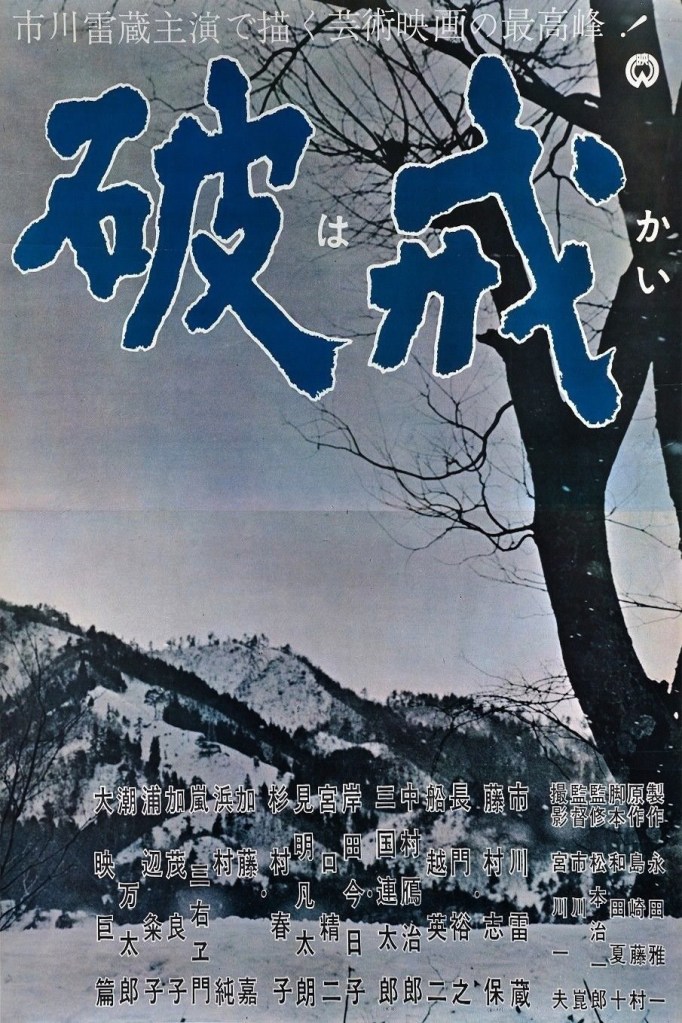
The Outcast (破戒, AKA The Broken Commandment, Kon Ichikawa, 1962)

Kon Ichikawa’s approach to critiquing his society was often laced with a delicious slice of biting irony but he puts sarcasm to one side for this all too rare attempt to address the uncomfortable subject of Japan’s hidden underclass – the burakumin. The term itself simply means “people who live in hamlets” but from feudal times onwards it came to denote the kinds of people with whom others did not want to associate – notably those whose occupations dealt in some way with death from executioners and undertakers, to butchers and leatherworkers. Though outright discrimination against such people was outlawed during the Meiji restoration, social stigma and informal harassment remained common with some lingering tendency remaining even today.

The Outcast (破戒, Hakai), adapted from the book by Toson Shimazaki (known as The Broken Commandment in English) is the story of a young man of burakumin lineage who has to hide his true identity in order to live a normal life in the Japan of 1904. Segawa’s father, formerly a village elder, sent his son away to live with his brother and his wife in a distant town where they could better hide their burakumin status to enjoy a better standard of life. Sadly, Segawa’s father dies after being trampled by a recalcitrant bull never seeing his son again and leaving him with the solemn commandment to live as a regular person, never revealing his connection with the burakumin world.

This debt to his father’s sacrifice creates a conflict in the heart of the young and idealistic Segawa (Raizo Ichikawa). Forced to listen to the casual racism all around him and unable to offer any kind of resistance, Segawa has become interested in the writings of a polemical political figure, Rentaro Inoko (Rentaro Mikuni), who has begun to write passionate political treatises advocating for burakumin rights. When Inoko turns up in Segawa’s town, he finds himself a new father figure and political mentor but continues to feel constrained by the debt of honour to his father’s sacrifice and is unable to confess his own burakumin heritage even to Inoko.

The world Segawa lives in is a conservative and stratified one in which old superstitions hold true even whilst hypocritical authorities use and abuse the trust placed in them. Inoko falls foul of local politics after he discovers a politician has married a wealthy burakumin woman solely for her money and is planning to expose him at a political rally. This same politician has already threatened to blackmail Segawa who continues to deny all knowledge of any burakumin related activities whilst failing to quell the eventual gossip surrounding Segawa’s lineage. The gossip causes problems at the school where Segawa had held a prestigious teaching position as the headmaster and school board fear the reaction of the parents. Though the people at the temple where Segawa takes refuge after growing tired of the racist inn owners in town are broadly supportive of the burakumin, the priest there has his own problems after having made a clumsy pass at his adopted daughter, Shio (Shiho Fujimura) – the daughter of a drunken teacher sacked by the school in order to avoid paying him a proper pension. At every turn the forces of authority are universally corrupt, selfish and venal, leaving no safe direction for a possible revolution of social justice to begin.

This is Segawa’s central conflict. After his experiences with Inoko, Segawa begins to want to follow in his footsteps, living out and proud as a burakumin and full time activist for burakumin rights. However, this would be undoing everything for which his father sacrificed so much. Talking things over with Inoko’s non-burakumin wife, Segawa is also presented with a third way – reveal his burakumin heritage and attempt to live honestly as an ordinary person, changing hearts and minds simply through leading a life among many other lives. This option seems attractive, especially as Segawa has fallen in love and would like to lead an ordinary life with a wife and family, but his youthful idealism is hungry for a greater, faster change than the one which will be born through simple integration. Despite the warnings of Inoko’s wife who believes change will occur not through activism but through the passage of time, Segawa decides his future lies in advancing the burakumin cause in the wider world.

When Segawa does choose to reveal himself, he finds that there is far more sympathy and support than he would ever have expected. A woman he has come to love wants to stay by his side, his previously hostile friend rethinks his entire approach to life and apologises, and even the children in his class convince their parents that their teacher is a good and a kind man regardless of whatever arbitrary social distinction may have been passed to him through an accident of birth. Segawa’s conflicted soul speaks not only for the burakumin but for all hidden and oppressed peoples who have been forced to keep a side of themselves entirely secret, faced with either living a lie in the mainstream world or being confined to life within their own community. His choice is one of either capitulation and collaboration, or resistance which amounts to a sacrifice of his own potential happiness in the hope that it will bring about liberation for other similarly oppressed people.

Scripted again by Natto Wada, The Outcast takes a slightly clumsy, didactic approach filled with long, theatrical speeches but does ultimately prove moving and inspiring in advocating for the fair treatment of these long maligned people as well as others facing similar discrimination in an unforgiving world. As a treatise on identity and rigid social attitudes, the film has lost none of its power or urgency even forty years later in a world in which progress has undoubtedly been made even if there are still distances to go.
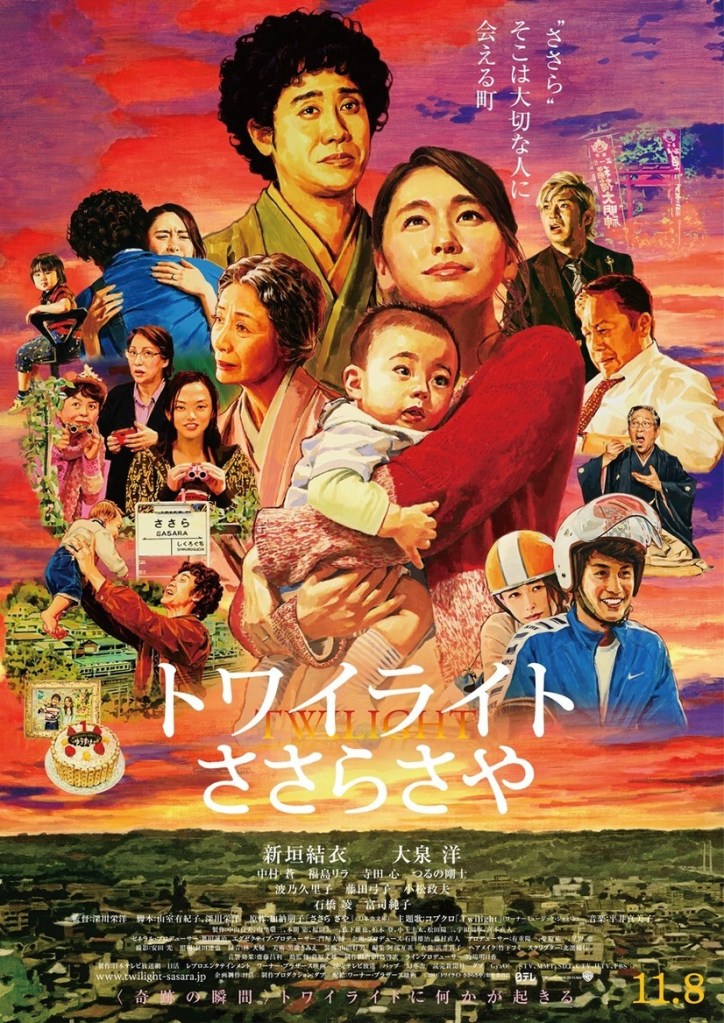


Twilight: Saya in Sasara (トワイライト ささらさや, Yoshihiro Fukagawa, 2014)

Japanese cinema has its fare share of ghosts. From Ugetsu to Ringu, scorned women have emerged from wells and creepy, fog hidden mansions bearing grudges since time immemorial but departed spirits have generally had very little positive to offer in their post-mortal lives. Twilight: Saga in Sasara (トワイライト ささらさや,  Twilight Sasara Saya) is an oddity in more ways than one – firstly in its recently deceased narrator’s comic approach to his sad life story, and secondly in its partial rejection of the tearjerking melodrama usually common to its genre.

Unsuccessful Rakugo performer Yutaro (Yo Oizumi) met the love of his life during one of his sparsely attended recitations. Saya (Yui Aragaki) was the only one laughing but even she didn’t think he was very funny, she just liked him because he was trying so hard. Eventually, he married her and they had a lovely baby boy but before little Yusuke was even a year old, Yutaro got himself killed in a random traffic accident. Such is life. Still, knowing that Saya had no family of her own and having grown up without a father himself Yutaro feels even worse about leaving his wife and son all alone in such a stupid way. Therefore he decides to delay going to heaven so that he can stick around to help Saya in whatever way he can.

A crisis occurs when Yutaro’s estranged father (Ryo Ishibashi) suddenly turns up at the funeral laying claim to little Yusuke with no thought to the additional emotional ramifications of trying to snatch a baby from a grieving mother right over the coffin of her husband. Possessing the body of another guest, Yutaro manages to convince Saya to run leading her to retreat to her late aunt’s house in the peaceful rural village of Sasara.

Though the premise is a familiar one, Fukagawa neatly sidesteps the more maudlin aspects for a broadly comic approach in which Yutaro recounts the story of his death as if it were a rakugo tale. Possessing various people along the way, Yutaro does indeed help Saya adjust to her new life but eventually discovers that perhaps the reason he hasn’t passed over was one of the past rather than one of the future.

Saya’s arrival in Sasara gets off to a bad start – essentially forced out of the city to escape Yutaro’s father Saya causes unexpected trouble when it emerges that the corrupt local estate agent has been letting out her aunt’s house without telling her. If that weren’t enough, some of her valuables are almost stolen by a local delivery boy but, this being an ageing village, children are a rarity and so little Yusuke quickly captures the hearts of the neighbourhood grannies who eventually become Saya’s friends and staunch supporters. Familial problems are the name of the day from childlessness to children (hopefully) writing down possible signs of dementia or just leaving town and not coming back. Yutaro also helps Saya improve the life of another young woman with a son who doesn’t speak by allowing him to finally voice what he really feels, adding to the circle of female help and support which becomes the family Saya had always longed for.

Orphaned at a young age, raised by her grandmother until she died and having lost her only living relative in her aunt a few years previously, Saya had always wondered what it felt like to have a real family of her own. Yutaro had also lost his mother at a young age through illness and was estranged from his father who refused to visit her even on her deathbed. Yutaro’s untimely death adds to Saya’s ongoing sorrows but also ends the beginnings of the happy family they’d begun to build with each other. As it turns out, Yotaro’s limbo is less about his son and more about his father as he gets a last opportunity to bond with his outwardly harsh and cruel dad and come to a kind of understanding about fatherhood in hearing his side of the story. Life is too short for grudges, and even spirits sometimes need to give up the ghost so that the air can rest a little lighter.

Though there are the expected moments of sadness as Yotaro realises the number of people he can possess is dwindling and his time with Saya will be limited, Fukagawa keeps things light and whimsical with a kind of small town quirkiness aided by Oizumi’s spirited delivery. Adding in frequent rakugo references complete with painted backdrops and sound effects as well as a repeated motif which sees the little town remade as a diorama model, Twilight: Saya in Sarasa has a pleasantly old fashioned feeling which only adds to its wholesome emphasis on an extended family of community coupled with the continuing presence of Yutaro watching from somewhere on high. Warm and funny if a little lacking in impact, Twilight: Saya in Sasara is a rare instance of a ghost bringing people together in love and harmony through helping them get closer to their true emotions but one that is also keen to emphasise that we’re all only here for an unspecified time – better not to waste it with silly things like grudges.


Original trailer (no subtitles)

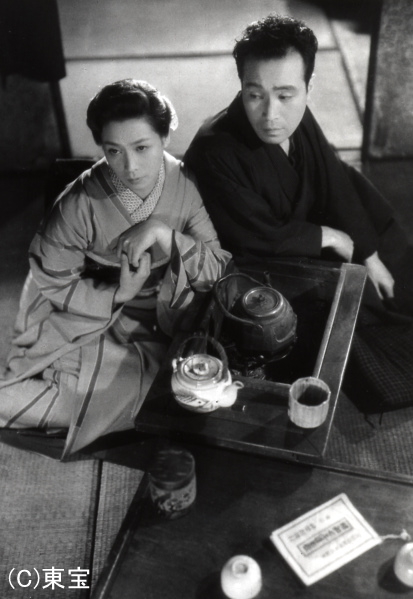
Marital Relations (夫婦善哉, AKA Meoto Zenzai, Shiro Toyoda, 1955)

Marriage is not always simple, but when you aren’t actually married (and one of you is technically still married to someone else) the difficulties can be all the more pronounced. Often neglected in comparison with some of his contemporaries, Shiro Toyoda is best remembered for his often humorous literary adaptations. Marital Relations (夫婦善哉 Meoto Zenzai), based on a 1940 novel by Sakunosuke Oda and runner up to Naruse’s Floating Clouds in Kinema Junpo’s top ten for 1955, is a prime example of his style as it examines the unconventional relationship between a spoilt younger son of a wealthy family and a feisty geisha who nevertheless remains devoted to him despite his often insensitive treatment.

In the early 1930s, the oldest son of a wealthy family has scandalised his conservative father by continuing to consort with a local geisha. Irritated, Ryukichi (Hisaya Morishige) elopes with Choko (Chikage Awashima) assuming that he will eventually get his own way only to find his father is just as stubborn as he is. Ryukichi is already married though living apart from his wife who has a serious illness and has returned to her family with their only child, Mitsuko. Nevertheless, Choko and Ryukichi manage to live together as man and wife even without the official paperwork, installing themselves at her parents’ tempura shop. Though the couple are happy enough, Ryukichi is unused to living without his family money and Choko soon has to go back to work.

Even in early Showa things were changing. Ryukichi, spoilt and made useless by access to his family fortune and previously secure path to succession, pouts and whines about his arranged marriage and the wife he’s abandoned, emphatically demanding a free choice of mate even if she happens to have been a geisha. Choko, a working class daughter of shopkeepers, seems to have been sold to the geisha house to fund her parents’ store – in fact, Choko’s abrupt decision to leave the geisha house will also have financial consequences which Ryukichi claims he will take up with his father. Even if Choko were not a geisha, she would likely not have been accepted by the traditional upper middle class family and her constant battle is always for recognition as Ryukichi’s significant other (or perhaps primary carer). Geisha she was though, and will be again thanks to Ryukichi’s recklessness and mistaken assumption that he will regain his former status simply by being his father’s son.

Not having had the luxury of a wealthy upbringing, Choko is (financially, at least) a realist and prepared to work hard for what she wants. Heading back into the geisha world as a hostess and entertainer, Choko is the sole breadwinner of their technically illegitimate union though Ryukichi cannot entirely break with his former habits, casually burning Choko’s carefully balanced housekeeping accounts book, and eventually spending all her savings on a night of debauchery. Nevertheless, it’s Choko who eventually takes the initiative and goes into business with a friend opening a successful night spot which cleverly caters to her internationalist clientele with a “traditionally Japanese” theme. Like many of Toyoda’s women, Choko is a hardworking, practical lady determined to make a success of everything she does even if she’s had the misfortune to find herself shackled to the inconvenient man child that is Ryukichi.

Eventually it all gets too much and Choko takes a drastic decision after receiving a cruel and thoughtless slight from Ryukichi’s brother-in-law who has been adopted as the heir to the family. This shocking incident aside, the tone is largely one of comic knowingness as Ryukichi continues with his various schemes to wheedle his way back into his elite social circle while Choko spends her time working hard to create something new. Ryukichi is the worst of the old world – lazy, entitled, often selfish and thoughtless (if well meaning and resolutely devoted to Choko), whereas Choko is the best of the new – resilient, hardworking, honest and kind. Towards the end, having settled some of their differences, Choko and Ryukichi appear to have cemented their coupledom for good but are suddenly confronted with another ugly aspect of class legacy when a former servant (and sort of friend) of Ryukichi’s passes them in the street now obviously raised in status, and blanks them even as they call out to him.

Ryukichi’s sister comments at one point that her brother’s personality has been warped by his strict upbringing and the pressure to conform to social conventions has meant that he doesn’t quite know himself, though at heart he is good and kind. She may indeed have a point, honest in his love, at least, both for his daughter and for Choko, Ryukichi finds he lacks the moral compass which comes with needing to live in an interconnected society rather than the deference associated with being “the young master”. Subtle political commentary aside, Marital Relations is a wry, humorous look at an unconventional family life as its put upon heroine does her best to rescue her consistently disappointing (if often amusing) unofficial spouse.


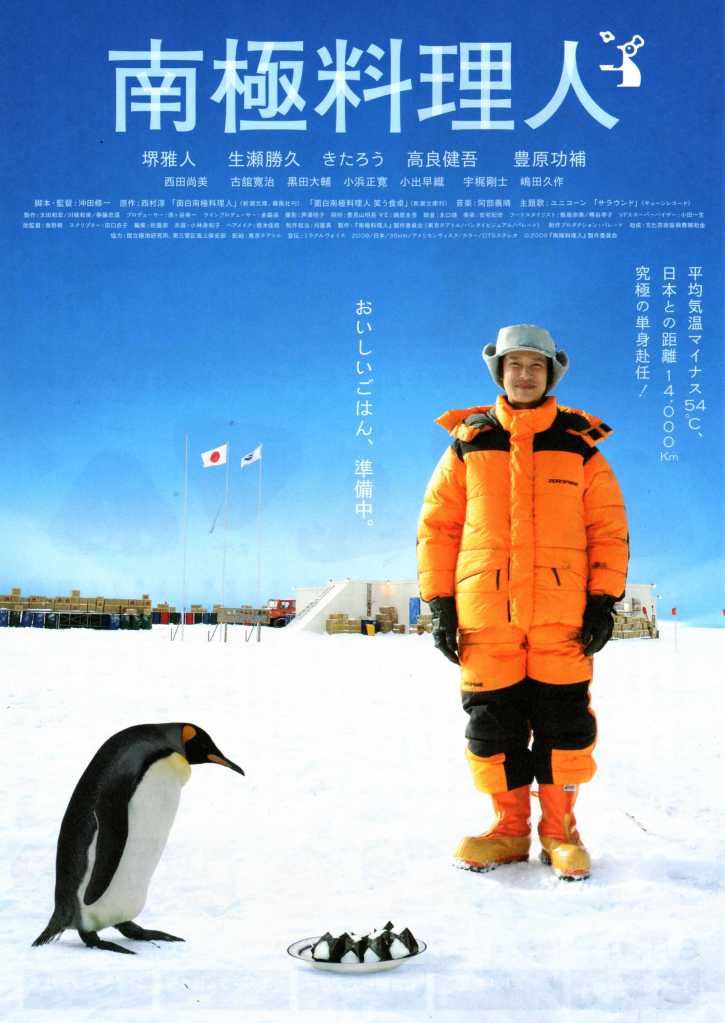
The Chef of South Polar (南極料理人, Shuichi Okita, 2009)

If there’s one thing which unites the universes present in the films of Shuichi Okita, aside from their warm and humorous atmosphere, it’s their tendency to take a generally genial, calm and laid-back protagonist and throw them into an inhospitable environment which they don’t quite understand. When it comes to “inhospitable”, the hero of The Chef of South Polar (南極料理人, Nankyoku Ryourinin) couldn’t have it much worse, unfairly transferred to a polar research station where the air temperature is so cold nothing, not even bacteria, can survive outside. Still, like all of Okita’s laid-back guys, he handles his difficult circumstances with a kind of stoical resignation until, of course, the situation can be handled no more.

Separated from his wife and children, Jun Nishimura (Masato Sakai) previously worked for the Japanese coastguard but has now been transferred (not altogether of his own volition) to a polar research station where he is responsible for all the culinary needs of the seven men who will be working together during the expedition which is intended to last one year. Each of the other men has his own part to play in the scientific endeavours but cooped up as they are, the greater issue is downtime as the guys revert to a kind of high school camp mentality, divided into various groups and activities from the “Chinese Research Club” to a bar being run by the doctor who is also training for a triathlon. 365 days in the freezing cold does eventually begin to take its toll but all of the crazy only serves to remind people how important it is that they all get on and make it through this together.

Based on the autobiographical writings of the real Jun Nishimura, Okita’s isolation experiment has a pleasantly authentic feeling as the titular chef laments the difficulties of the conditions but continues to churn out beautifully presented culinary treats despite the hostile environment. Resources are also strictly limited as the original provisions are intended to last the entire expedition, hence why most of the foodstuffs are canned, vacuum packed or frozen but there are a few luxuries on offer including some prize shrimp apparently left behind, uneaten, by a previous team which proves an additional occasion for celebration just as despair is beginning to set it in. Seeing as the men are all here for more than a year, celebratory occasions do present themselves with regularity from birthdays to “mid winter holiday” and even a good go at the Japanese festival of Setsubun with peanuts instead of beans.

Despite these brief moments of respite, being completely cut off from the outside world for such a long time with little natural light and hardly anything to do outside of research places its own kind of pressure on the minds of these top scientists. As their hair gets shaggier and their beards progressively less kempt, sanity also begins to slip. Each of the guys has their own particular marker, something they’re missing that’s playing on their minds until they eventually break completely. For some this could be realising they’ve eaten all of the ramen which exists in their tiny world and now have nothing left to live for, missing their kids, or realising that their girlfriend might have met someone else while they’ve been busy devoting themselves to science, but this being an Okita film even if an axe is raised it rarely falls where intended and the only cure for mass hysteria is guilt ridden kindness and a willingness to work together to put everything right again.

Of course, the other thing the guys have to put up with is the attitude of the outside world as everyone is very keen to ask them about the cute penguins and seals which they are sure must be everywhere at the South Pole, only to have to explain that it’s just too cold for cuteness though it does lead them to the epiphany that they are the only living creatures in this desolate place and so share a special kind of kinship. Filled with Okita’s usual brand of off the wall humour and gentle humanity, The Chef of South Polar is another warm and friendly tale of nice people triumphing over adversity through cooperation, mutual understanding and sustained belief in the healing power of ramen.


Original trailer (no subtitles)

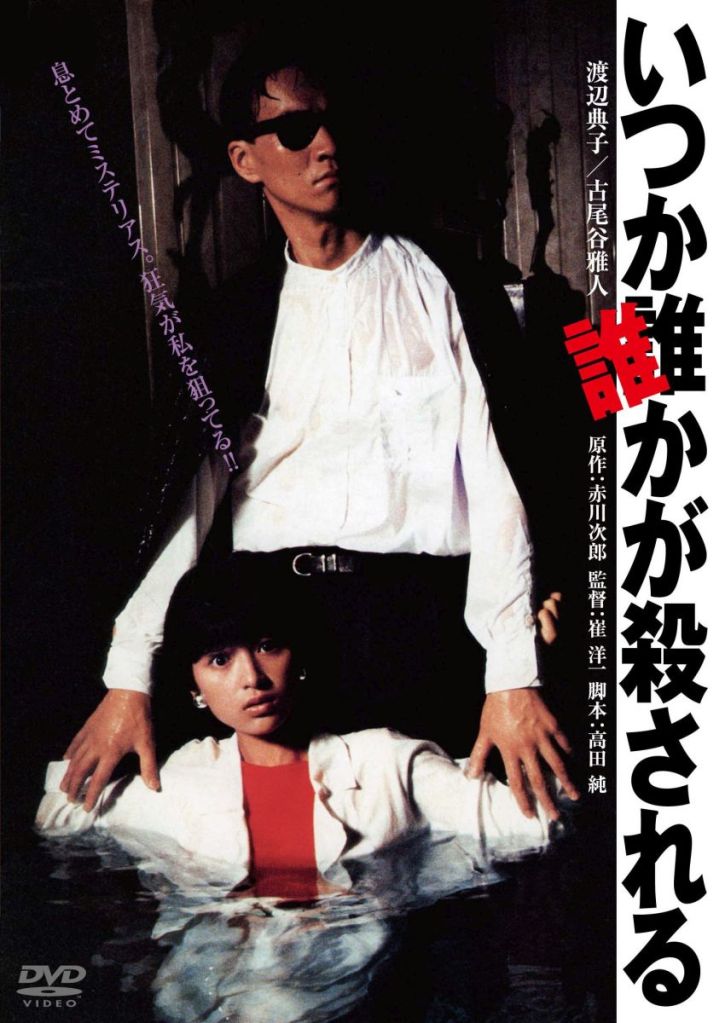
Someday, Someone Will Be Killed (いつか誰かが殺される, Yoichi Sai, 1984)

Haruki Kadokawa dominated much of mainstream 1980s cinema with his all encompassing media empire perpetuated by a constant cycle of movies, books, and songs all used to sell the other. 1984’s Someday, Someone Will be Killed (いつか誰かが殺される, Itsuka Dareka ga Korosareru) is another in this familiar pattern adapting the Kadokawa teen novel by Jiro Akagawa and starring lesser idol Noriko Watanabe in one of her rare leading performances in which she also sings the similarly titled theme song. The third film from Korean/Japanese director Yoichi Sai, Someday, Someone Will be Killed is an impressive mix of everything which makes the world Kadokawa idol movies so enticing as the heroine finds herself unexpectedly at the centre of an ongoing international conspiracy protected only by a selection of underground drop outs but faces her adversity with typical perkiness and determination safe in the knowledge that nothing really all that bad is going to happen.
The film opens with a strange, often forgotten subplot as an eccentric elderly lady, apparently loathed by her children who are taking bets on when she will die, celebrates her birthday by announcing a new game – taking the first syllables of her children’s names she comes up with that of our heroine – Atsuko Moriya (Noriko Watanabe), whom she intends to invite to her party. Approaching the end of high school, Atsuko is an ordinary girl of the time which is to say her interests are studying, shopping, and boys. Her father is a reporter for a newspaper who is often away but has returned to take her on a rare shopping trip. Revealing that he was actually born abroad, her father slips a floppy disc into her handbag and disappears after going to make a phonecall while Atsuko is occupied in the fitting room. Striking up a friendship with the store assistant, Cola (Masato Furuoya), Atsuko is taken in by a collection of fake fashion peddling drop outs from society while she tries to work out what’s going on with her dad and what she’s supposed to do with the much sought after floppy disk.

Like many a Kadokawa heroine, Atsuko is quickly plunged into a dark and complicated world she is ill equipped to understand but in keeping with the nature of the genre the atmosphere is largely dictated by her typically teenage outlook. Despite the increasingly high stakes, the film remains bright and cheerful as Atsuko continues in her quest without fear or danger. Her main allies are a computer nerd (Toshinori Omi) who has such a crush on her he’s created his own 8-bit Atsuko operating system complete with palm reader door lock for his base of operations, and the guys from the fashion store who, it transpires, are a gang of counterfeiting squatters. A thoroughly middle class girl, Atsuko reacts negatively to her new found friends and their unusual domestic arrangements but quickly warms to them as they show her nothing but kindness and acceptance, even risking their own existence in an attempt to help her uncover the circumstances surrounding her father’s disappearance.

Fathers become something of a running theme as Atsuko’s solid relationship with hers is contrasted both with Cola’s disconnection from his family and his new found role as a kind of surrogate father for a little girl at the commune. Later the same theme resurfaces as Atsuko uncovers the truth behind her father’s birth which explains the dreams she often has of a bright red sun setting over a wide river. These circumstances are echoed in the strange atmosphere of the mansion at which the film begins as its eccentric, regency dressing older lady engages with her seemingly resentful children in a cold and severe manner. An insert song playing as Atsuko and Cola take a drive wonders what the point of family is, but Atsuko’s concern is less than with the nature of familial bonds than with her own identity as filtered through that of her father and her discoveries of his apparently mysterious birth and career. Thus her final decision becomes one which sets her on a course of growing up in a quest for self knowledge and the creation of an identity which is both of her own making and takes into account her new found family history.

Making room for a musical sequence in which Atsuko picks up a guitar and embarks on a rendition of Summertime as well a few insert songs alongside the title track, Someday, Someone Will be Killed is pure Kadokawa idol movie but Sai makes sure to up the stakes with some genuinely exciting action sequences and mounting tension as Atsuko finds herself in way over her head. Of course there are a few comic moments too including the unfortunate detective charged with locating Atsuko to give her the invitation to the old lady’s ball who often finds himself beaten up by mistake by one side or the other. Very much of its time with its cold war paranoia coupled with up to the minute technology, Someday, Someone Will be Killed is among the darker of the idol dramas Kadokawa had to offer but nevertheless remains rosy and innocent in terms of outlook right up until Atsuko takes off on her motorbike in search of the woman she’ll eventually become.


Title track sung by Noriko Watanabe Itsuka Dareka ga…

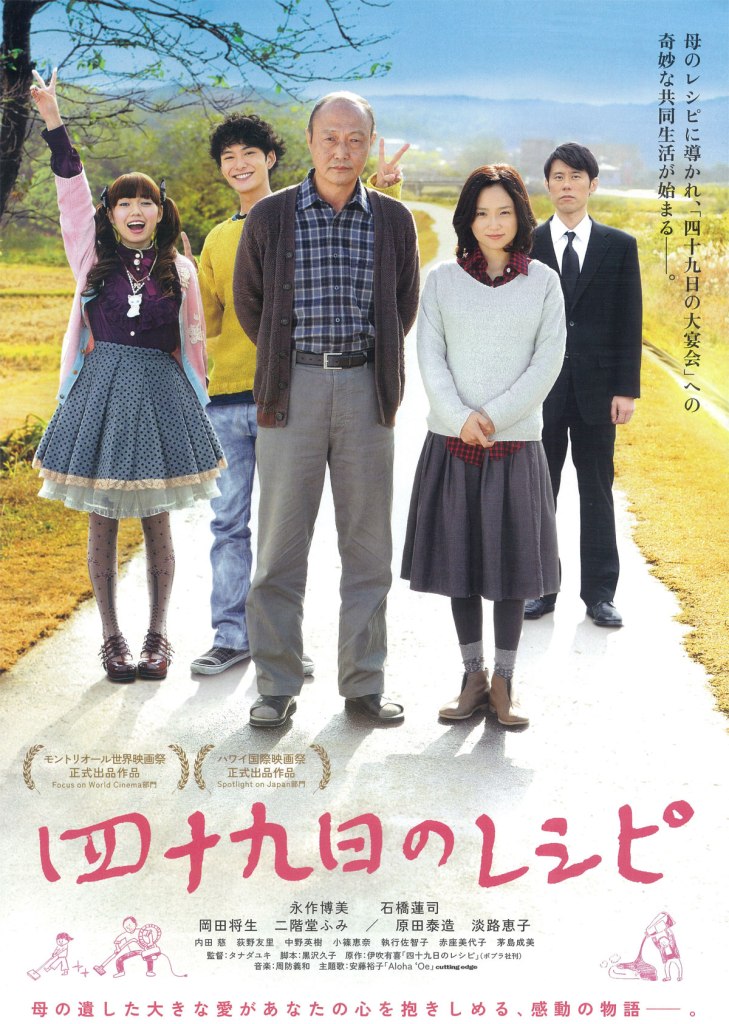
Mourning Recipe (四十九日のレシピ, Yuki Tanada, 2013)

mourning-recipeWhen everything goes wrong you go home, but Yuriko, the protagonist of Yuki Tanada’s adaptation of Yuki Ibuki’s novel might feel justified in wondering if she’s made a series of huge mistakes considering the strange situation she now finds herself in. Far from the schmaltzy cooking movie the title might suggest, Mourning Recipe (四十九日のレシピ, Shijuukunichi no Recipe) is a trail of breadcrumbs left by the recently deceased family matriarch, still thinking of others before herself as she tries to help everyone move on after she is no longer there to guide them. Approaching the often difficult circumstances with her characteristic warmth and compassion, Tanada takes what could have become a trite treatise on the healing power of grief into a nuanced character study as each of the left behind now has to seek their own path in deciding how to live the rest of their lives.
Beginning in pitch darkness, housewife Yuriko (Hiromi Nagasaku) answers the phone to the voice of another woman requesting that she separate from her husband who is apparently the father of her unborn child. This double sting hits Yuriko hardest as the couple had been trying for a baby for quite sometime with little success. Thinking a divorce is for the best, Yuriko packs her bags, leaves the papers and her ring on the table, and heads for her father’s house. When she gets there she finds an oddly bubbly young girl, Imoto (Fumi Nikaido), washing her father’s back. Apparently, Imoto has been charged with looking after the house during the 49 day mourning period for Yuriko’s step-mother, Otomi – the upcoming memorial service something Yuriko had forgotten all about in the midst of her personal crisis. When Imoto presents the pair with a book that Otomi illustrated before she died listing everything they should do to prepare for the big party she wants everyone to enjoy rather than solemnly chanting sutras for her 49th day memorial, it prompts Yuriko and her father into a reconsideration of themselves, their pasts and futures, and who exactly should be making those decisions for them.

Yuriko’s position may seem like a straightforward one, betrayed by her husband her decision to leave seems inevitable but it’s complicated by the intricate web of duties and obligations Yuriko feels herself to be a part of. Reconsidering various turning points of her life, Yuriko makes plain that her marriage to the mild mannered salaryman Hiroyuki (Taizo Harada) had been under considerable strain due to the couple’s difficulty conceiving a child. Owing to the intense pressure placed on women to bear children, Yuriko internalises a sense of shame at having failed in this most basic of wifely tasks, leading her husband (she believes) to replace her with a model more fit for purpose. This point of view is rammed home by Yuriko’s insensitive aunt who continues to interrogate her about her lack of children and encourage her to return home to her husband and fix the problem rather than “giving up” and settling for the “shameful” option of divorce as young people are want to do. Aunt Tamako (Keiko Awaji) also points out that neither of her daughters bothered with university or work or any of that nonsense and now have fulfilled their duties by bearing bright and bonny grandchildren with no trouble at all. Heartbroken and blaming herself, Yuriko has to listen to the ongoing lecture whilst keeping her composure right until its gloomy conclusion.

Motherhood becomes the film’s biggest theme as mothers, non-mothers, and bad mothers swirl around the childless Yuriko, still trying to find her place in the world if the path society seems determined to set her on has been well and truly blocked off. Yuriko’s biological mother died when she was only little but happily her father fell in love with and married Otomi – a truly good woman who, like Yuriko, had no children of her own, but lived her life trying to make a difference and help other people to be happy. Little Yuriko didn’t always see it that way and found it difficult to bond with her new mother, settling for the nickname “Okka” – a combination of Otomi’s name and the word for mother, rather than straightforward “mum”.

Reinvestigating Otomi’s life in order to plan for her 49th day memorial, Yuriko truly gets to know her step-mother for the first time, discovering just how big of a difference she made in the lives of those around her. Imoto is just one of the young people Otomi went out on a limb for volunteering at a local rehabilitation centre for young people experiencing problems with addition. She then introduces them to a young Brazilian/Japanese migrant (Masaki Okada) who found himself feeling all alone in a foreign land until Otomi handed him the keys to her car and insisted he get out and about and meet new people. Otomi might not have had children of her own, but she became a mother to the world, reaching out and helping those who most needed it, becoming the springboard so that they could fly far away from her happier and healthier than before.

In learning from Otomi’s book, Yuriko regains her sense of self and a desire to find her purpose, knowing that the ability to bear children is not the be all and end all of a woman’s existence. Indeed even if a woman can give birth to a child, that’s not to say she’ll be a good mother as Imoto points out in reference to the toxic relationship she has with hers which feeds back into the insensitive way Hiroyuki’s mistress talks about her plans in front of her young son.

Given all of these epiphanies and mini realisations, Yuriko’s final decision may seem like an odd one, sending her back into a conservative world bound by all of the same duties and obligations the film spent so long undermining. Nevertheless, Yuriko emerges from her 49 days of mourning with a better understanding of herself and the way she should be living her life. Filled with wit and warm humour, Mourning Recipe neatly skirts its melodramatic nature to present a genuinely moving examination of the true nature of family, motherhood, and the necessity of individual freedom. Otomi’s final springboard action was for the ones she left behind, even if, once again, she won’t be able to see them fly.


Original trailer (English subtitles)

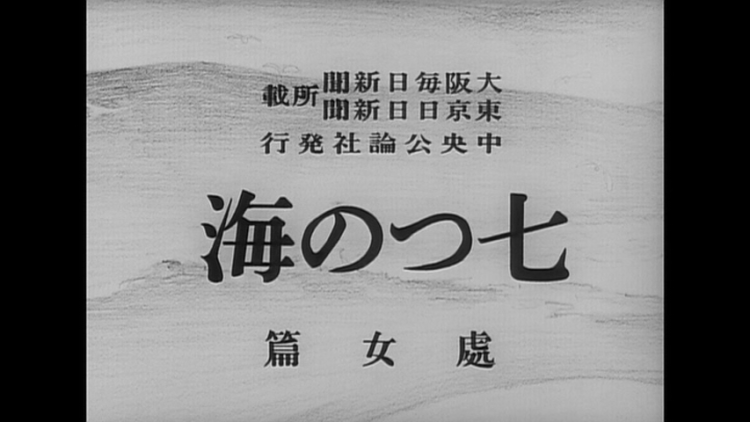
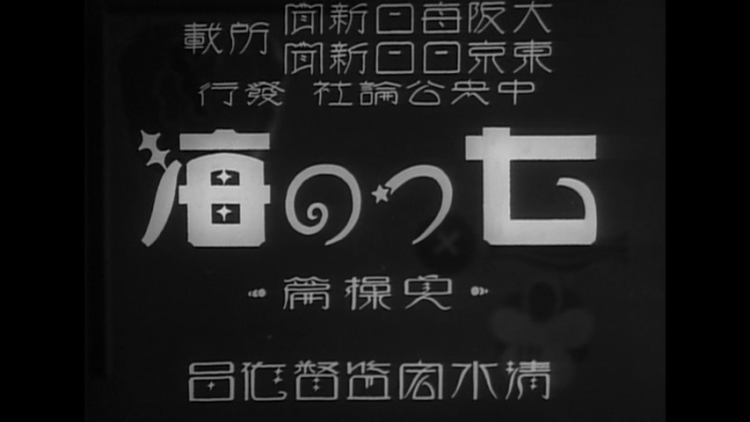
Seven Seas (七つの海, Hiroshi Shimizu, 1931-1932)

vlcsnap-2017-02-19-01h57m24s364Hiroshi Shimizu is best remembered for his socially conscious, nuanced character pieces often featuring sympathetic portraits of childhood or the suffering of those who find themselves at the mercy of society’s various prejudices. Nevertheless, as a young director at Shochiku, he too had to cut his teeth on a number of program pictures and this two part novel adaptation is among his earliest. Set in a broadly upper middle class milieu, Seven Seas (七つの海, Nanatsu no Umi) is, perhaps, closer to his real life than many of his subsequent efforts but notably makes class itself a matter for discussion as its wealthy elites wield their privilege like a weapon.
Split into two parts each around an hour long, Seven Seas begins with the chapter entitled Virginity in which we meet the closely interconnected circle of friends around whom the narrative turns. Yumie (Hiroko Kawasaki) is a young woman from a middle class background but fallen on hard times as her father, a former government official, is now bedridden and supporting the family only on his pension. She is about to announce her engagement to the upperclass boy Yuzuru (Ureo Egawa) but when his playboy brother Takehiko (Joji Oka) returns from abroad he takes a fancy to her himself, eventually raping her whilst she is a guest in their house. Devastated, Yumie’s father marches over to sort things out but even more tragic events occur, breaking the family forever as Yumie’s sister Miwako (Kinuko Wakamizu) has a breakdown and is committed to an asylum. In desperate need of money, Yumie eventually agrees to become the wife of the man who has so brutalised her, though she also contrives to turn the situation to her advantage in an act of revenge.

vlcsnap-2017-02-19-02h01m28s875
Part two is entitled “Chastity” as this is to be Yumie’s primary method of resistance. Refusing her new husband his conjugal rights, Yumie spends his money with gay abandon making huge donations to her sister’s hospital and eventually also providing a kind of “salary” for her husband’s long term mistress whom he has been seeing for some years and had neglected to inform about his marriage. Meanwhile, Yumie’s friend Ayako (Sachiko Murase) has also fallen in love with Yuzuru who is still nursing a broken heart having separated from his family and taken refuge with the couple’s friends working in a sports equipment shop in the city.

Unusually for a Shimizu hero, Yuzuru is an uncomplicated, innately good person who instantly rejects his family following their heinous treatment of the woman he loves, remaining committed to her even after she has been assaulted by his own brother. This decision is, however, difficult as he no longer has access to the familial fortune and has few options for earning his own. He eventually finds work as a French translator but it doesn’t pay enough to make up for all the extra expenses incurred as a result of his brother’s actions from the loss of Yumie’s father’s pension to the ongoing medical costs for her sister’s treatment. Times being what they are, moralising forces creep into the frame suggesting all of this “made right” by Takehiko doing the “honourable” thing and marrying the woman he’s “bought” by force.

The Yagibashi family think they can sweep all of this under the carpet by throwing money at Yumie and otherwise ignoring the problem but this is not good enough for the morality police. Forced to marry her rapist, Yumie maintains an air of cool distain, detailing her plans for vengeance in her daily diary and arming herself with a pistol in case Takehiko tries his old tricks once again. Takehiko, a vain and selfish man, seems to be filled with a kind of resentment born of his class in which he remains a perpetual child controlled by his father who holds all of the purse strings. He does at least attempt to be a proper husband to Yumie, defending her from his snobbish parents and providing her with everything she asks for but he retains his tendency to believe that he can behave however he likes because he’s the eldest son of the wealthy Yagibashi family. Yumie may be reduced in circumstances but thanks to her father’s position would be considered from a “good family”, yet to Takehiko and the Yagibashis she is just another faceless person from the lower orders, unworthy of consideration or compassion and simply one of the exploitable masses.

Takehiko is also the bearer of the frequently ambivalent attitude to the Western world found in many of Shimizu’s other films of the period. Returning from a trip abroad, he belittles another woman in the carriage for her supposed snobbery. Having been abroad, they say, she feels herself superior to ordinary Japanese – unlike the two of them, obviously. Ironically when they arrive Takehiko discovers that the woman in question is the daughter of his former professor, recently returned from studying music in Italy. The other major foreigner we meet is Ayako’s boss at the newspaper where she has a good job as a female reporter. The diffident Englishman attempts to confess his love for her, leaping straight into a proposal. Shocked, Ayako eventually informs him that unfortunately she’s in love with someone else – Yuzuru. Reacting badly, he tries to stop Ayako from leaving but once she does he abruptly shoots himself! Unusual passion for an Englishman, this side of foreignness is a definite cultural difference though one perhaps imbued with a degree of entitlement that also speaks of a kind of oppressive arrogance.

This is however, contrasted with Yuzuru’s gentle career as a translator of French. These creative, cultural influences seem to be broadly positive ones adding to Japan’s already impressive artistic history which brings both pleasure and new ways of thinking which will help the fledgling nation interact with the new global order. The Yagibashis’ dependence on their inherited wealth and social status proves their downfall when they are the subject of an ongoing scandal but the family name is, in part, saved by Yuzuru’s artistic endeavours in turning his traumatic life story into a bestselling, critically acclaimed novel. The creative instinct triumphs over the passivity of the established order.

Remaining mostly straightforward in terms of approach, Shimizu experiments with his trademark tracking shots coupled with dissolves which are unusually impressive and innovative in terms of their setting. The narrative may be melodramatic but the setting is naturalistic, giving an ordinary picture of these upper class and lower middle class lives as people lived them in the early 1930s. From crowded city streets and rooms above shops to spacious country mansions these class divisions are neatly drawn though it’s perhaps interesting that friendship groups have begun to ignore these lines in spite of the differing possibilities offered to each of the differently troubled friends. As in much of Shimizu’s output, the good end happily and the bad unhappily, fulfilling the need for narrative justice as Yumie finds an unusual path for restitution after having been so cruelly misused by those who held her existence so cheaply as to rob her of her future, family and dignity solely because of their own sense of social superiority.


3 Seconds Before Explosion (爆破3秒前, Motomu Ida, 1967)

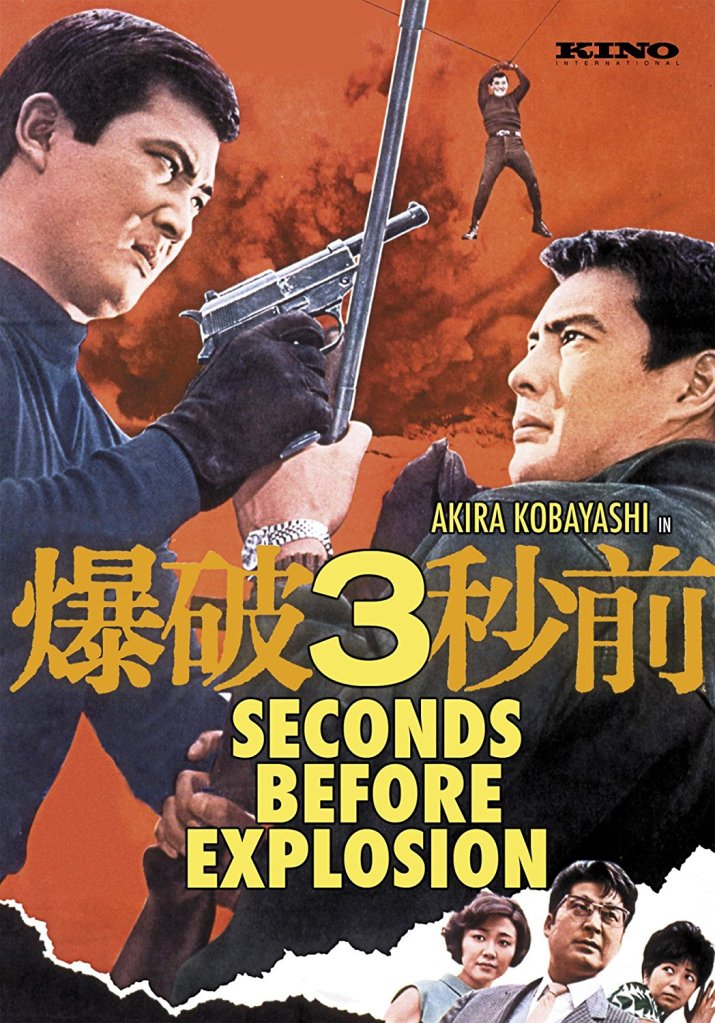
three-minutes-before-explosionIf Nikkatsu Action movies had a ringtone it would probably just be “BANG!” but nevertheless you’ll have to wait more than three rings for the Kaboom! in the admittedly cartoonish slice of typically frivolous B-movie thrills that is 3 Seconds Before Explosion (爆破3秒前, Bakuha 3-byo Mae). Once again based on a novel by Japan’s master of the hard boiled Haruhiko Oyabu, 3 Seconds Before Explosion is among his sillier works though lesser known director Motomu Ida never takes as much delight in making mischief as his studio mate Seijun Suzuki. What he does do is make use of Diamond Guy Akira Kobayashi’s boyish earnestness to keep things running along nicely even if he’s out of the picture for much of the action.
Like most of the more outlandish Nikkatsu action fests, 3 Seconds Before Explosion has a complicated relationship with narrative but we begin with former boxer Yabuki (Akira Kobayashi) in the middle of being brainwashed with flashing lights and high pitched noises until he agrees to become a shady government (?) assassin. Perhaps in an effort to save our sanities too, he relents and his first job is ensuring some jewels which were stolen during in the war don’t get into the hands of an evil nazi who will presumably be wanting them for evil nazi business. Anyway, Yabuki does his ninja stuff and thinks he’s tracked the jewels down but runs into a former colleague, Yamawaki (Hideki Takahashi), who is working for a businessman who already has the jewels and wants to keep them. Yamawaki quit being a super spy because he fell in love, which Yabuki thinks is a bit lame but still knows his friend has right stuff and would rather not have to kill him or anything.

Somewhere between the less serious yakuza/gang movies Nikkatsu were making in the late ’60s and a spy spoof, 3 Seconds Before Explosion has its fair share of oddness from strangled dogs to the mini Chinese theme in which one of the henchmen, Yang, wanders around in traditional Chinese garb while another girl at the club enjoys flirting in Mandarin for no apparent reason. It also goes without saying that the evil Nazi is played by an American spouting unconvincing German whilst chewing the scenery to a pulp. Realism is not where we are, but there’s something a little old fashioned about the way Ida chooses to stage his weirdness even if the film is filled with crazy contemporary youth touches such as in the achingly hip Club Casba.

The interpersonal drama comes as Yabuki and Yamawaki face off about their life choices much more than the case at hand. Yamawaki grew tired of the spy life and decided to leave it behind for his lady love, only to get mixed up in all of these petty gangster shenanigans. Still, if he can keep Yabuki away from the jewels until the time limit he’ll be free forever. Nothing is really said about Yabuki’s brainwashing at the beginning of the film, but Yamawaki’s choice does seem to prompt him into a consideration of his own lifestyle. That said, life as a government assassin doesn’t seem so bad – Yabuki doesn’t even really kill people much, just spends his life sneaking into places and leaping heroically between rooftops whilst making use of clever gadgets to evade his foes. The gangsters, however, are pretty evil and keep killing people after claiming to let them go which offends Yabuki’s sense of honour.

Yabuki may not kill, but the film does seem to make a point of killing off all the female characters in case they get in the way of the manly stuff like fighting and making bombs. An innocent kidnapped secretary who had nothing to do with anything is machine gunned down, another girl is murdered by the evil Nazi, and a final one gets marched into a mine field by her boyfriend before returning for revenge and getting unceremoniously taken down anyway. To lose one woman is careless but to kill off (all) three in a short time seems a step too far or perhaps too “realistic” for this otherwise cartoonish approach to violence.

Lacking the visual flair of other Nikkatsu efforts, 3 Seconds to Explosion is never as exciting as its title promises. Despite the athletic displays of the slightly bulkier Kobayashi, there’s a kind of clumsiness to the action and a straightforwardness in approach which does not gel with the ridiculousness of the premise. On lower end of Nikkatsu’s B-movie output, 3 Seconds to Explosion does not stint on the silliness but could do with enjoying itself a little more rather than trying to corral its non-sensical plot into something with serious intent.


Someone’s Xylophone (だれかの木琴, Yoichi Higashi, 2016)

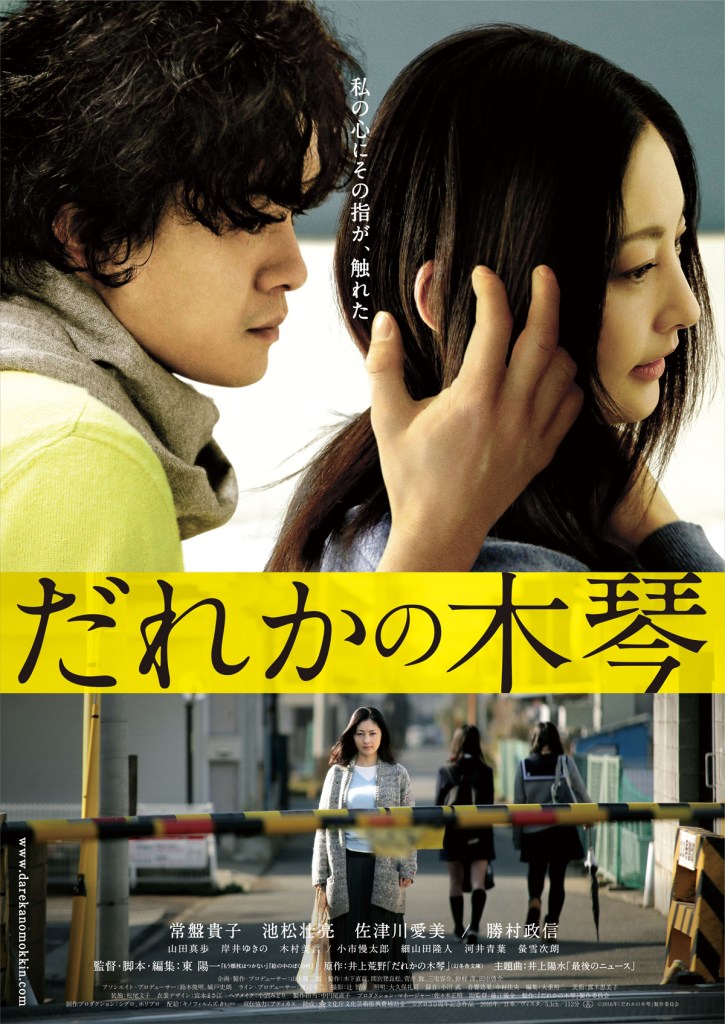
someones-xylophoneYoichi Higashi has had a long and varied career, deliberately rejecting a particular style or home genre which is one reason he’s never become quite as well known internationally as some of his contemporaries. This slightly anonymous quality serves the veteran director well in his adaptation of Arane Inoue’s novel which takes a long hard look at those living lives of quiet desperation in modern Japan. Though sometimes filled with a strange sense of dread, the world of Someone’s Xylophone (だれかの木琴, Dareka no Mokkin) is a gentle and forgiving one in which people are basically good though driven to the brink by loneliness and disconnection.
Middle aged housewife Sayoko (Takako Tokiwa) has just moved into a new area with her security alarm salesman husband, Kotaro (Masanobu Katsumura), and teenage daughter, Kanna (Mikoto Kimura). By all appearances the home seems to be a happy one, and the atmosphere is pleasant, if ordinary. Even so, stopping into an upscale salon one day Sayoko gets a haircut from the very good looking and warm hearted hairdresser Kaito (Sosuke Ikematsu). Hoping for repeat business Kaito gives her a business card and she reciprocates with one of her own so that she can be added to the mailing list. After some awkward chitchat, she leaves but when she gets a typical “thank you for visiting, please come again” text message, Sayoko makes the unusual decision to reply. Not wanting to seem rude, Kaito continues the strange text correspondence but Sayoko’s growing interest in the good looking young man, and later even in his girlfriend, soon crosses the line from harmless fixation to inappropriate obsession, threatening to derail her otherwise “normal” happy family life.

Higashi begins the film with a naturalistic sequence travelling from early morning light to bright sunshine as Kaito takes his bike out for a ride before returning to make breakfast for his still sleeping girlfriend, Yui (Aimi Satsukawa) – a model/store assistant at the upscale Lolita brand Baby the Stars Shine Bright. Accompanied by a thrumming, modern jazz funk soundtrack, these scenes reflect the film’s baseline reality. Kaito and Yui may live in the real world, to a point at least, whereas Sayoko has her head in the clouds and almost lives there too. A middle aged housewife, her life has begun to lose its purpose now that her daughter is almost grown and needs her much less than she ever has before. Though Sayoko and her husband appear to have a good relationship, she seems to want something more – bored with his caresses and long since past the point where there is nothing left to talk about.

The delivery of a new bed prompts a very particular fantasy of being fondled by both men at the same time though what exactly she wants from Kaito remains unclear. If her original decision to reply to a standard confirmation email could be dismissed as friendly innocence, sending a picture of your new bed to someone you just met is decidedly strange. Nevertheless, Kaito feels the need to keep replying even once it becomes clear that Sayoko has also tracked down his apartment and seems intent on further infiltrating his life. When she takes the decision to visit Yui at her work (the brand is not one which ordinarily caters to women of Sayoko’s age), the younger woman starts to get worried and eventually takes some direct action of her own.

Sayoko remains something of a cypher, a woman who can’t seem to figure herself out. The xylophone of the title refers to a dream or vision she has of a girl in far off window banging away at the instrument but never quite getting the tune – eventually she realises the girl is her, still trying to find her inner rhythm all these years later. Kotaro, by contrast, seems to have more worldly anxieties despite his outwardly calm and kindly manner. When his daughter asks him if they really need the security system they have at home he tells her about a long unsolved family murder before explaining that it just makes him feel safer when he can’t be there in person to protect his wife and daughter. Kanna, a bright child, points out that more threat is posed by accidents in the home than by intruders – to which Kotaro is forced to agree, lamenting that there is no alarm system to prevent a domestic accident. Thus when Kanna calls him to say that there has been an “incident” at home, the metaphor is an apt one – nobody was looking, and now everything’s falling apart.

Despite the expectation for grand scenes or bloody violence, Someone’s Xylophone consistently refuses to follow the signposted direction preferring a more adult resolution born of self reflection and mutual understanding. A subplot involving a very particular young man who comes to the salon solely for female contact hints at a darker path for unresolved loneliness and repressed emotion, but even if Sayoko and Kotaro make ill advised decisions in search of closeness their sojourns in alternate realities ultimately allow them to rediscover their mutual universe (for a time, at least). The xylophone finally plays out a recognisable tune as a more settled Sayoko fantasises about a phantom blanket rather than an illicit ménage à trois but whether this craving for warmth will provoke a similar crisis as the need for passion remains to be seen.


Screened as part of the Japan Foundation Touring Film Programme 2017.

Original trailer (no subtitles)

Flora on the Sand (砂の上の植物群, Ko Nakahira, 1964)

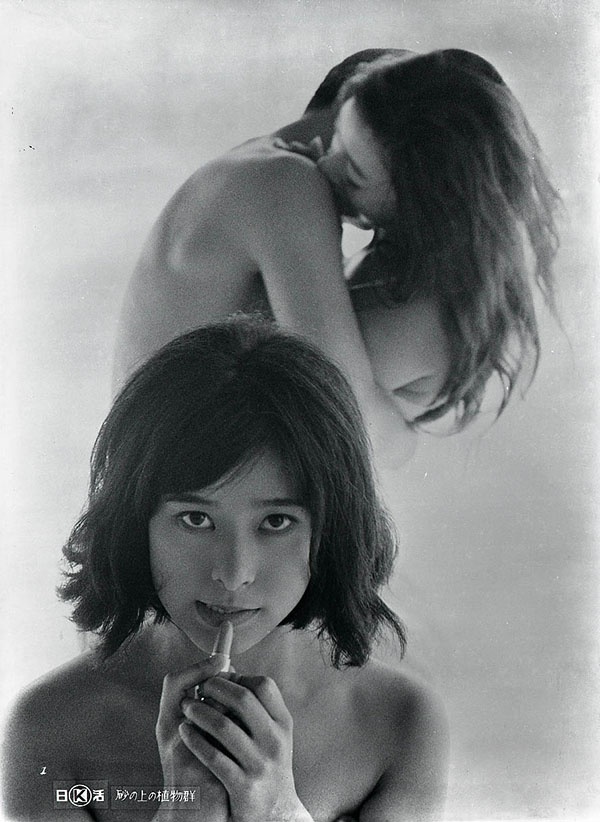
© 1964 Nikkatsu CorporationDespite being among the directors who helped to usher in what would later be called the Japanese New Wave, Ko Nakahira remains in relative obscurity with only his landmark movie of the Sun Tribe era, Crazed Fruit, widely seen abroad. Like the other directors of his generation Nakahira served his time in the studio system working on impersonal commercial projects but by 1964 which saw the release of another of his most well regarded films Only on Mondays, Nakahira had begun to give free reign to experimentation much to the studio boss’ chagrin. Flora on the Sand (砂の上の植物群, Suna no Ue no Shokubutsu-gun), adapted from the novel by Junnosuke Yoshiyuki, puts an absurd, surreal twist on the oft revisited salaryman midlife crisis as its conflicted hero muses on the legacy of his womanising father while indulging in a strange ménage à trois with two sisters, one of whom to he comes to believe he may also be related to.

After a brief prologue in which our hero, cosmetics salesman Ichiro Igi (Noboru Nakaya), imagines a scenario for a novel in which a dying husband becomes so jealous of the man that may succeed him in his wife’s life that he sets about plotting to make her the weapon of that very man’s destruction, Igi heads to his regular barber and longtime family friend where he takes the time to probe him about his late father’s womanising habits. Igi’s father died young at only 34 for years of age, three years younger than the age Igi is now. His father’s spitting image, Igi cannot help seeing him everywhere he goes and feels unable to evade his ongoing influence, almost as if he were possessed by his father’s (un)departed spirit.

The major preoccupation Igi has is that his wife (Yukiko Shimazaki) may have slept with his father before they were married while she was just a teenager. The barber tells him he’s pretty sure not, but Igi cannot let the idea go and repeatedly brings it up with his wife, creating discord in the family home. Meeting a precocious schoolgirl at the Marine Tower one evening, Igi finds himself taking her to a hotel and deflowering her even though she begins to resist him at the last minute. The girl, Akiko (Mieko Nishio), then makes a strange request of him – she wants Igi to seduce and “hurt” her older sister Kyoko (Kazuko Inano) whose sanctimonious attitude she can no longer stand. Igi does indeed visit the bar where Kyoko works as a hostess and embarks on an intense affair with her but Akiko’s pleas to “hurt” her sister are complicated by Kyoko’s masochistic tendencies and Igi’s descent into a kind of madness.

Beginning with the painting by Paul Klee which gives the film its name, Nakahira asks us to imagine what would happen if a large dash of red were suddenly to appear, disrupting the comforting harmony of Klee’s perfectly matched colours. The discomforting redness does dutifully appear as strangely shaped squares on the canvas but the symbolic value of the colour is felt throughout the black and white narrative from the dark stain of Akiko’s broken maidenhead to the affectation of her lipstick and constant references to red seas and suns.

Though Igi’s world may have seemed just as perfectly ordered as Klee’s painting from the outside, his constant preoccupations with his father become the disruptive influence which leads to all of the redness later leaking in. Haunted by his father as he is, seeing his face everywhere from train windows to the barber shop mirror, Igi’s attempt at a plot for a murder mystery takes on a strangely Oedipal quality as we begin to wonder if it’s his father rather than Igi himself who has assumed the role of the “protagonist”, leaving a time bomb for his wayward son, the inheritor of his woman, just as Igi laid out in his prologue. Bizarre reality or another symptom of Igi’s increasingly fractured mind, the plot seems likely to succeed at least in a sense as Igi declines into a dishevelled mess, prone to hallucinations and uncertain visions.

Nakahira gives us several of these as Igi panics and struggles with a key only to open a door into bright white light and nothingness or another in which he and Kyoko dine in an empty restaurant which is suddenly filled with the noisy chatter of other diners. Strange touches such as the German beerhall with a Spanish guitarist, or the odd peepshow in which Igi and his two friends take on the appearance of demons or impassive Buddhist statues thanks to the light reflected into their eyes, add to the unbalanced atmosphere as do the frequent closeups of lips and hands, and the symbolic value of seeds never meant to be planted which nevertheless flower at an unintended moment. Shooting in black and white, Nakahira begins with a colour sequence featuring the abstract artwork with occasional flashes of colour as well as voice over and occasional intertitle-style captions adding to the absurdist atmosphere.

A surreal and complex psychological exploration of sex, power, obsession, identity, and legacy Flora on the Sand finds Nakahira flexing his experimental mussels for a drama rife with ambiguity and strangeness. Sadly this brand of innovation was not entirely welcome at Nikkatsu head offices and so he found himself left out in the cold eventually ending up in Hong Kong making action movies for Shaw Brothers. Despite some later success at international festivals, Nakahira’s work remains sadly neglected but the unusual degree of sophistication and almost playful atmosphere seen in Flora on the Sand make him worthy of attention as more than just an almost was of the rising New Wave.


Screened as part of the Japan Foundation Touring Film Programme 2017.