
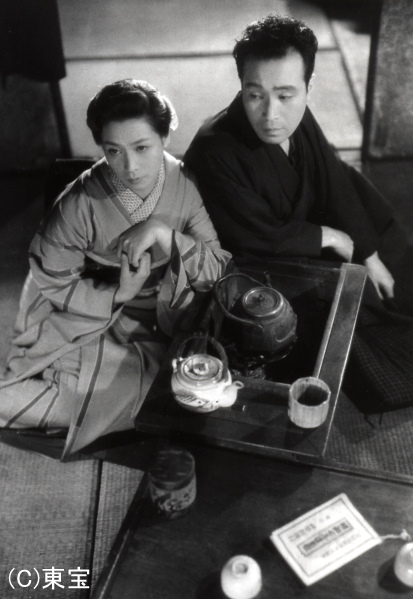
Marriage is not always simple, but when you aren’t actually married (and one of you is technically still married to someone else) the difficulties can be all the more pronounced. Often neglected in comparison with some of his contemporaries, Shiro Toyoda is best remembered for his often humorous literary adaptations. Marital Relations (夫婦善哉 Meoto Zenzai), based on a 1940 novel by Sakunosuke Oda and runner up to Naruse’s Floating Clouds in Kinema Junpo’s top ten for 1955, is a prime example of his style as it examines the unconventional relationship between a spoilt younger son of a wealthy family and a feisty geisha who nevertheless remains devoted to him despite his often insensitive treatment.
In the early 1930s, the oldest son of a wealthy family has scandalised his conservative father by continuing to consort with a local geisha. Irritated, Ryukichi (Hisaya Morishige) elopes with Choko (Chikage Awashima) assuming that he will eventually get his own way only to find his father is just as stubborn as he is. Ryukichi is already married though living apart from his wife who has a serious illness and has returned to her family with their only child, Mitsuko. Nevertheless, Choko and Ryukichi manage to live together as man and wife even without the official paperwork, installing themselves at her parents’ tempura shop. Though the couple are happy enough, Ryukichi is unused to living without his family money and Choko soon has to go back to work.
Even in early Showa things were changing. Ryukichi, spoilt and made useless by access to his family fortune and previously secure path to succession, pouts and whines about his arranged marriage and the wife he’s abandoned, emphatically demanding a free choice of mate even if she happens to have been a geisha. Choko, a working class daughter of shopkeepers, seems to have been sold to the geisha house to fund her parents’ store – in fact, Choko’s abrupt decision to leave the geisha house will also have financial consequences which Ryukichi claims he will take up with his father. Even if Choko were not a geisha, she would likely not have been accepted by the traditional upper middle class family and her constant battle is always for recognition as Ryukichi’s significant other (or perhaps primary carer). Geisha she was though, and will be again thanks to Ryukichi’s recklessness and mistaken assumption that he will regain his former status simply by being his father’s son.
Not having had the luxury of a wealthy upbringing, Choko is (financially, at least) a realist and prepared to work hard for what she wants. Heading back into the geisha world as a hostess and entertainer, Choko is the sole breadwinner of their technically illegitimate union though Ryukichi cannot entirely break with his former habits, casually burning Choko’s carefully balanced housekeeping accounts book, and eventually spending all her savings on a night of debauchery. Nevertheless, it’s Choko who eventually takes the initiative and goes into business with a friend opening a successful night spot which cleverly caters to her internationalist clientele with a “traditionally Japanese” theme. Like many of Toyoda’s women, Choko is a hardworking, practical lady determined to make a success of everything she does even if she’s had the misfortune to find herself shackled to the inconvenient man child that is Ryukichi.
Eventually it all gets too much and Choko takes a drastic decision after receiving a cruel and thoughtless slight from Ryukichi’s brother-in-law who has been adopted as the heir to the family. This shocking incident aside, the tone is largely one of comic knowingness as Ryukichi continues with his various schemes to wheedle his way back into his elite social circle while Choko spends her time working hard to create something new. Ryukichi is the worst of the old world – lazy, entitled, often selfish and thoughtless (if well meaning and resolutely devoted to Choko), whereas Choko is the best of the new – resilient, hardworking, honest and kind. Towards the end, having settled some of their differences, Choko and Ryukichi appear to have cemented their coupledom for good but are suddenly confronted with another ugly aspect of class legacy when a former servant (and sort of friend) of Ryukichi’s passes them in the street now obviously raised in status, and blanks them even as they call out to him.
Ryukichi’s sister comments at one point that her brother’s personality has been warped by his strict upbringing and the pressure to conform to social conventions has meant that he doesn’t quite know himself, though at heart he is good and kind. She may indeed have a point, honest in his love, at least, both for his daughter and for Choko, Ryukichi finds he lacks the moral compass which comes with needing to live in an interconnected society rather than the deference associated with being “the young master”. Subtle political commentary aside, Marital Relations is a wry, humorous look at an unconventional family life as its put upon heroine does her best to rescue her consistently disappointing (if often amusing) unofficial spouse.
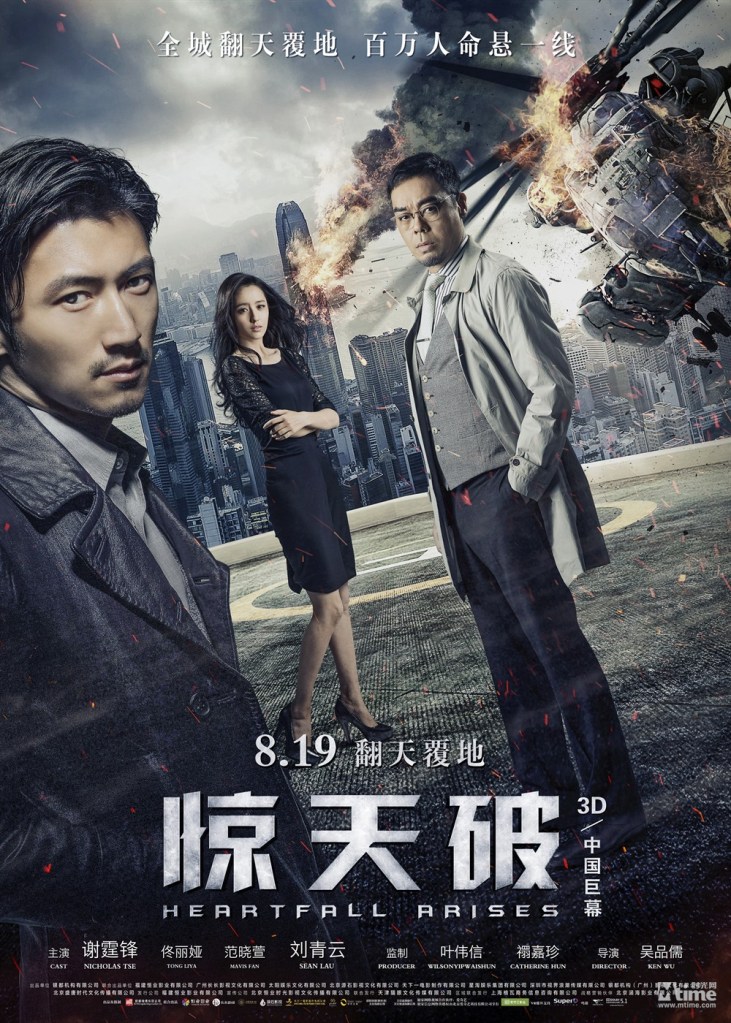 Sean Lau Ching-wan and Nicholas Tse are together again after being denied the opportunity to reteam for a sequel to the acclaimed

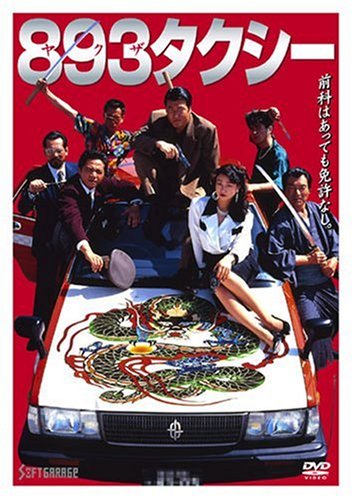 Like many fillmakers of his generation, Kiyoshi Kurosawa began directing commercially in the 1980s working in the pink genre but it was the early ‘90s straight to video boom which provided a career breakthrough. This relatively short lived movement was built on speed where the reliability of the familiar could be harnessed to produce and market low budget genre films with a necessarily high turnover. Kurosawa made his first foray into the V-cinema world in 1994 with the unlikely comedy vehicle Yakuza Taxi (893 タクシー, 893 Taxi). Although Kurosawa had originally accepted the project in the hope of being able to direct a large scale action film, his distaste for the company’s insistence on “jingi” (the yakuza code of honour and humanity) proved something of a barrier but it did, at least, lend free rein to the director’s rather ironic sense of humour.
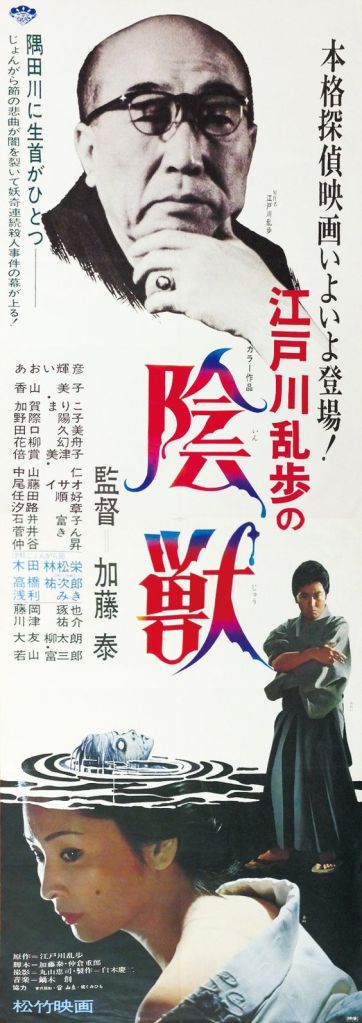 Edogawa Rampo (a clever allusion to master of the gothic and detective story pioneer Edgar Allan Poe) has provided ample inspiration for many Japanese films from
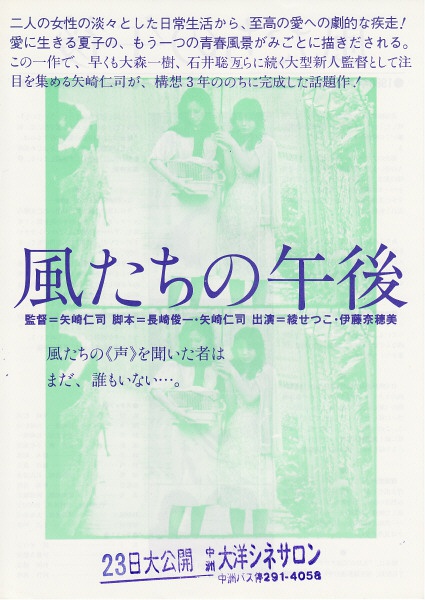
 Post-war cinema took many forms. In Korea there was initial cause for celebration but, shortly after the end of the Japanese colonial era, Korea went back to war, with itself. While neighbouring countries and much of the world were engaged in rebuilding or reforming their societies, Korea found itself under the corrupt and authoritarian rule of Syngman Rhee who oversaw the traumatic conflict which is technically still ongoing if on an eternal hiatus. Yu Hyun-mok’s masterwork Aimless Bullet (오발탄, Obaltan) takes place eight years after the truce was signed, shortly after mass student demonstrations led to Rhee’s unseating which was followed by a short period of parliamentary democracy under Yun Posun ending with the military coup led by Park Chung-hee and a quarter century of military dictatorship. Of course, Yu could not know what would come but his vision is anything but hopeful. Aimless Bullets all, this is an entire nation left reeling with no signposts to guide the way and no possible destination to hope for. All there is here is tragedy, misery, and inevitable suffering with no possibility of respite.
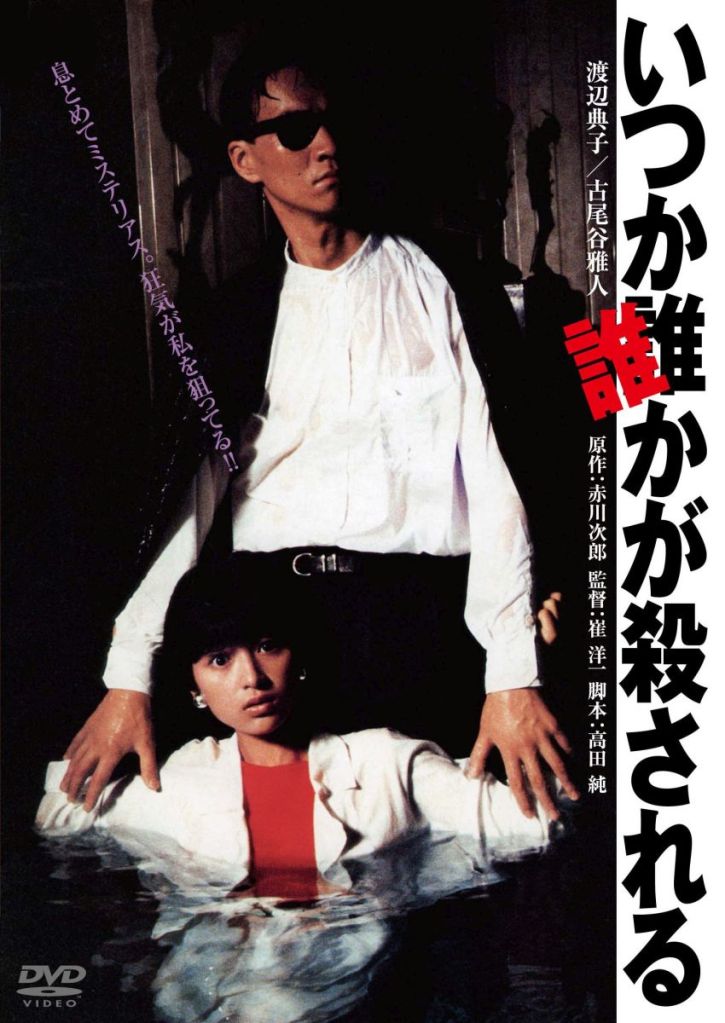 Haruki Kadokawa dominated much of mainstream 1980s cinema with his all encompassing media empire perpetuated by a constant cycle of movies, books, and songs all used to sell the other. 1984’s Someday, Someone Will be Killed (いつか誰かが殺される, Itsuka Dareka ga Korosareru) is another in this familiar pattern adapting the Kadokawa teen novel by Jiro Akagawa and starring lesser idol Noriko Watanabe in one of her rare leading performances in which she also sings the similarly titled theme song. The third film from Korean/Japanese director Yoichi Sai, Someday, Someone Will be Killed is an impressive mix of everything which makes the world Kadokawa idol movies so enticing as the heroine finds herself unexpectedly at the centre of an ongoing international conspiracy protected only by a selection of underground drop outs but faces her adversity with typical perkiness and determination safe in the knowledge that nothing really all that bad is going to happen.
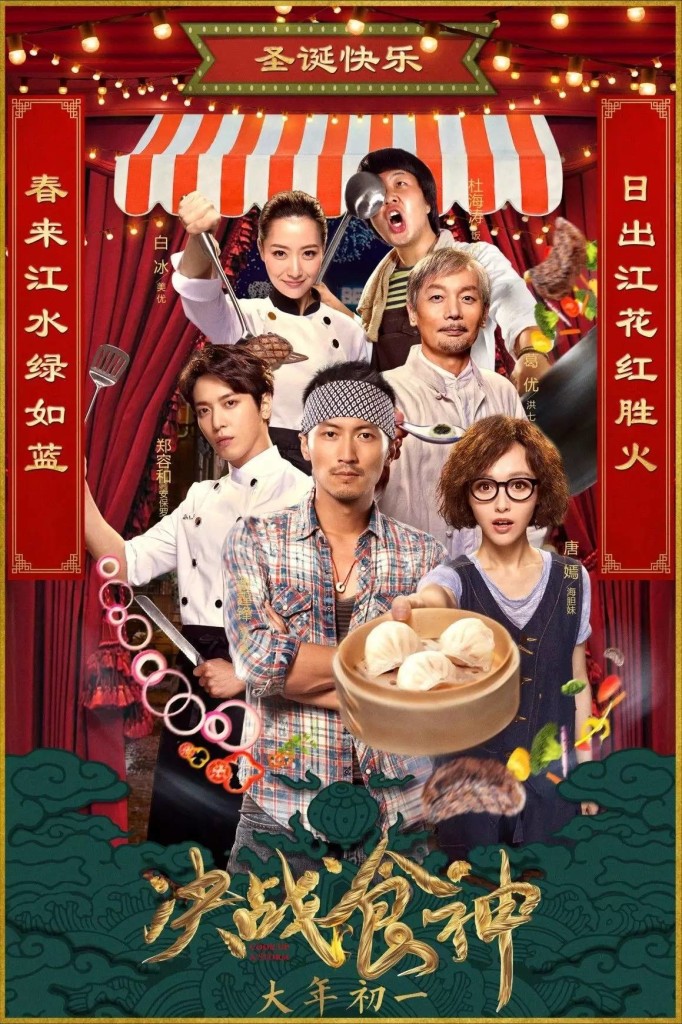 Raymond Yip Wai-man’s Cook up a Storm (决战食神, Juézhàn Shíshén) was scheduled to open at Chinese New Year but eventually found itself delayed and awkwardly repositioned as a Valentine’s Day date movie. Something of a rarity, there is no real romance in Cook up a Storm though it may inspire a post-movie visit to the nearest Chinese restaurant with its deeply felt tribute to classic Chinese cuisine and the raucous social gathering that often goes with it. Yip does his best to throw in as many themes as possible from the familiar tradition vs modernity to fathers and sons and the undue influence to China’s new ruling class who possess extreme wealth but (apparently) no taste. Most of these get somewhat lost in the meandering script which eventually falls into a conventional tournament narrative as two very different chefs face off in the kitchen before realising they have more in common than not.
 There are two kinds of people in the world, those who swing and those who…don’t – a metaphor which works just as well for baseball and, by implication, facing life’s challenges as it does for music. Shinobu Yaguchi returns after 2001’s

